



Abstract
Futures research is gaining increased prominence in educational research and development (Tesar, 2021), and particularly now as we emerge from the global COVID-19 pandemic, which has provided a lever for change and an opportunity for innovation in learning, teaching and assessment (Hall et al., 2020; Jandrić et al., 2022; Tesar, 2020). Designing Futures (DF) is an initiative that aims to transform the student learning experience at university, including through promoting student entrepreneurship and enhanced interaction with enterprise, industry and the innovation sector, supported by a national employability policy agenda, and concomitant, significant government funding. Ireland’s Higher Education Authority has invested €7.57 m in the DF programme at University of Galway for a period of 5 years, 2020–2025. However, introducing such a programme as DF within higher education raises problematic tensions around the purpose of higher education today, as set amidst the current policy futures perspective. Specifically, how do we balance policy imperatives to work more closely with enterprise and industry, while at the same time protecting the essential role of higher education, which must be to provide a formative context for all students to reach their fullest potential as active citizens? This paper helps to position the concept of student engagement, taking DF as an exemplar initiative, and examining the concept as it is construed and deployed in an innovative, futures-oriented educational programme. This review is critical for DF, to ensure we remain fundamentally focused on education, and not just for the world of work, which is of course important, but beyond enterprise and industry: to ensure students’ readiness for the complex and challenging world of today and tomorrow. Furthermore, this constitutes an important contribution to the literature, at a time when the identity of the university and purpose of higher education are the focus of an educationally problematic neoliberal agenda (Mintz, 2021).
Introduction
Futures research has become a key topic in education, particularly in how learning, teaching and assessment can be designed for the world of today, but critically also, the world of tomorrow, where we will be increasingly faced by the significant challenges created by globalisation (Tesar, 2021). The growth of educational futures institutes and programmes internationally reflects the contemporary currency of the idea of ‘futures’ as a central, orienting construct in how we conceptualise and design educational experiences that will prepare young people and the next generations to be able to deal with the complexities and uncertainties of life, both for today and into the future. Moreover, future’s research studies, and specifically ‘sustainable futures’, are construed as urgent, critical concepts, in order to support the development of educational systems that can tackle pressing global issues, such as climate change; wellbeing; global citizenship; and the protection of democratic, inclusive values and societies. This paper examines a specific large-scale, institution-wide educational futures programme, DF, which is funded (€7.57 m) by the Irish Government (2020–2025). The aim of the Designing Futures (DF) programme is two-fold: to support next-generation graduates to develop the competencies for the modern and future workplace, but beyond this is to provide students with the skills to discern the life and career that will afford them the greatest meaning and fulfilment.
The programme is funded within a government scheme where there is a marked emphasis on employability and futures skills development, specifically for the workplace of tomorrow. Notwithstanding, set amidst this neoliberal discourse, it is crucial that we explicate the concepts and values that will ensure a programme such as DF can achieve its aims beyond mere graduate employability. By undertaking a considered, critical discussion of a specific futures programme in education, we contribute to thinking generally and the critical literature with respect to the design of university-based educational futures programmes, especially those funded within jurisdictions challenged by the prevailing influence of the neoliberal turn in education (Mintz, 2021). The new managerialism agenda necessitates a counterpoint that includes explication of what educational futures should be in higher education today, especially as we contend with market and industry-driven discourses which predominantly focus on graduate attributes and skills agendas. This is imperative to ensure that such initiatives and programmes remain principally focused on values that uphold the idea of the university as a place of higher education, focused on the fully realised, holistic and rounded development of the individual learner. This paper will describe the DF programme and its constituent components as the case study at hand. It will locate DF within the policy imperatives in the HE sector to which it belongs. It then explores the student engagement landscape as providing a robust theoretical underpinning for the programme. It specifically considers the question of ideologically locating student engagement initiatives and their application to DF. It then proceeds to consider the role of the HEI in relation to the skills debate. The notion of graduate capital is deployed to set out a potentially transformative agenda for the higher education institutions of today and tomorrow. Finally, our paper is a point in time analysis of the policy imperatives underpinning our project. It is an analysis we will return to and deepen as we implement our formative evaluation of the DF programme, gaining insights from the students, enterprise partners and university staff who participate.
Designing futures
‘DF’ is an educational programme that aims to prepare students to deal with today’s complexity and uncertainty, and the future world of work. This programme has been funded for 5 years, (2020–2025), through the Irish Government’s Human Capital Initiative. Although the proposal for DF was written pre-COVID-19, the funding was awarded in the Autumn of 2020, and as with all our endeavours in life at the time, both personal and professional, the pandemic had a significant influence on the implementation of the programme, but also on our capacity to deal with disruption and complexity with limited agency. It is also noteworthy that this paper is now being written at a time when the (World Health Organization, 2023) has just declared that the COVID-19 global emergency is over. DF was funded at the outset, and has developed through a momentous period in recent history, in which education internationally has been irrevocably impacted. The OECD has estimated that almost 1.6bn learners have had their education significantly disrupted/discontinued as a consequence of the pandemic.
Jandrić et al.’s three articles (2020; 2021; 2022) in Postdigital Science and Education provide a ‘moving, collective piece’ of how teaching in higher education responded to, and was undertaken across a range of different jurisdictions during the pandemic. DF takes its place alongside these documented principled efforts, as an educational initiative that endeavours to embody the new normal of how we can best try to integrate and synergise both in-person and online learning and teaching. The aim of the DF programme has been to respond systematically – as other initiatives worldwide – to the constraints imposed by the global pandemic (Hall et al., 2020; Tesar, 2020). Where we have had to, and where it works well, learning and teaching are facilitated online. As COVID-19 has receded as a global pandemic, DF had also taken advantage of the opportunity to restore, and where appropriate maximise, on-campus and face-to-face teaching. This is predicated on the fact that this social interaction is fundamentally intrinsic to the educational experience of young people (Jandrić et al., 2020).
DF is a proactive response to a growing international and national policy agenda in relation to skills and the HE. It has been developed to enhance the employability of graduates by offering additional practical and creative teaching, learning and skills development alongside traditional degree studies. The programme aims to: • Promote greater student engagement with civic society, community and enterprise, while expanding their education and preparedness for life and a career. • Empower students to design personalised skills development pathways and to ensure graduates’ transversal skills achievements are recognised alongside their degree. • Enhance the university and Ireland’s position as a leader in innovative, student-centred and enterprise-engaged education in Europe and internationally (Millar et al., 2022).
Figure 1 illustrates the main components of the DF programme as it is implemented over its 5-year time frame. Each programme component is defined below. Model of designing futures.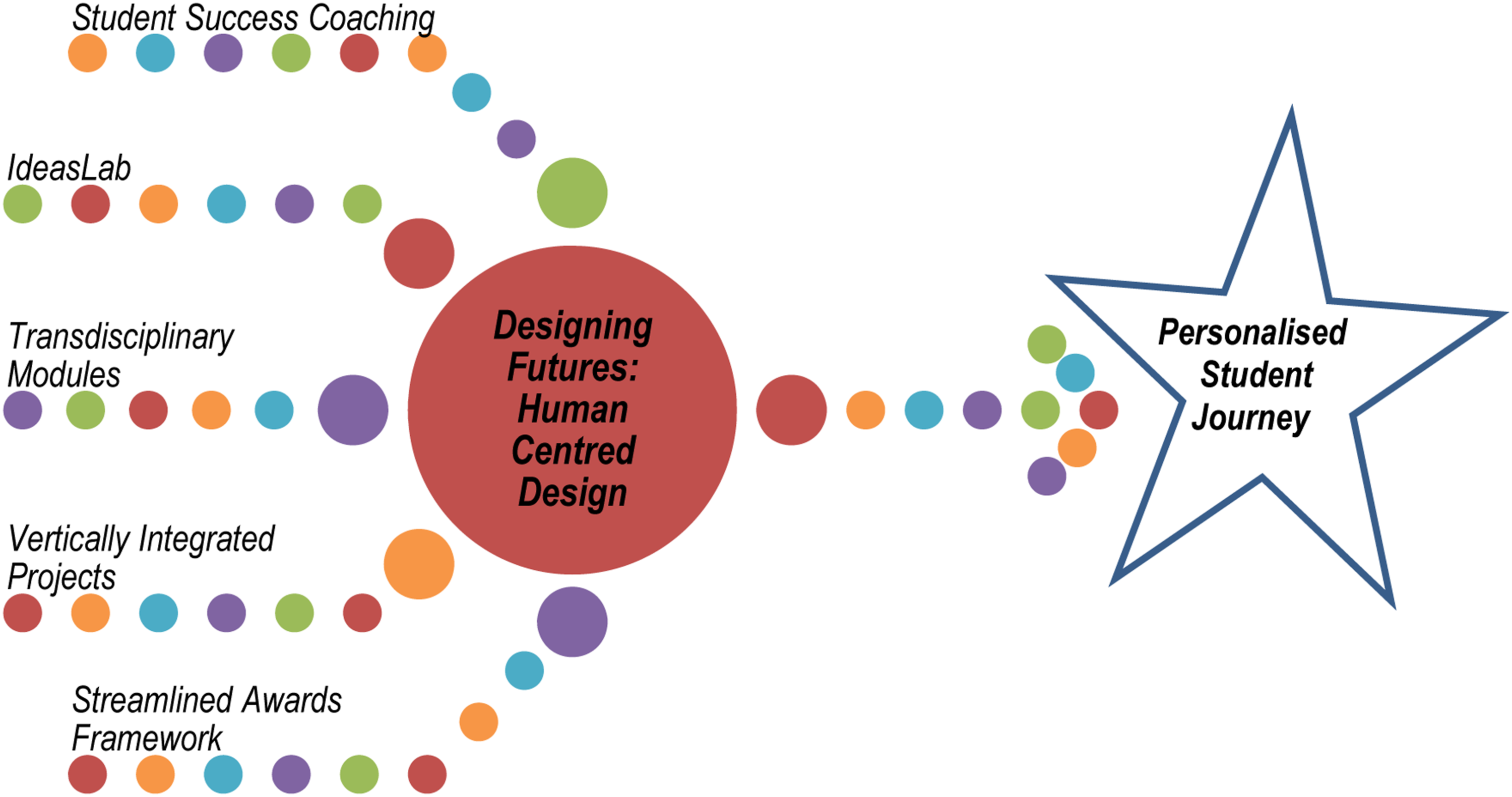
Student Success Coaches support students to take an active role in ‘designing their lives’ in order to achieve their unique academic, personal and life goals during their time at university. Support sessions can be delivered either on a one-to-one basis or in group/workshop format. Students can work with a coach to: • Navigate their successful transition into university life and community, • Increase their self-awareness with the aim to maximise their interests, talents and values, • Make decisions about their educational and professional goals including module choices, • Explore co-curricular and extracurricular opportunities – for example, societies, clubs, peer learning – that can complement and support their degree, or just to connect students more closely with fellow students and their university community.
IdeasLab activates and cultivates a community of curious and innovative minds across the campus. IdeasLab nurtures and supports students to develop skills to explore new possibilities with real world impact. It offers educational programming and events, enterprise specific activities and funding supports to inspire and develop creative and innovative confidence within our student and enterprise communities. The approach taken within the unit is based on applying Human Centred Design (Brown, 2008).
Transdisciplinary Modules (TDMs) enhance students’ professional skills, designed by experts from across the university and with input from our enterprise partners. Modules include Design Your Life (DYL), Design Thinking, Digital Citizenship, Global Engagement, Scalable Technology-based Innovation, Communicating through Storytelling, Introduction to Sustainability and Megatrends. These modules are available for credit and delivered to students in transdisciplinary settings where they engage with students and faculty outside their main academic assignment.
Vertically Integrated Projects (VIP): Through VIPs, students work in teams with faculty on multidisciplinary, longitudinal research projects to address grand challenges. Students earn credits and can participate in multiple semesters, with returning students taking on additional leadership/project responsibilities. ‘Vertically Integrated’ refers to VIP team compositions, which can include undergraduate, postgraduate (taught) and research students in addition to university staff. This approach originated in Georgia Institute of Technology (Georgia Tech), USA (Strachan et al., 2019). During DF, the University of Galway will join the international VIP consortium. 1
Streamlined Awards Framework: A multi-dimensional university Student Award Framework (Dean of Students Award) is being developed and implemented in order to recognise student personalised skills development and achievements (curricular, co-curricular and extracurricular). This framework will integrate and interlink pathways across existing awards frameworks within the university to allow students to develop a cumulative record of their skills development during their time in university alongside their academic transcript.
The DF programme is currently at the mid-way point and included in the original proposal was an evaluation work stream. The evaluation function within the project seeks to identify underlying project theory; track project workflows; and collate stakeholder feedback to refine and amend the approach iteratively as the project is implemented (see O’Regan et al., 2023).
Policy imperatives
DF addresses key objectives of Irish Higher Education policy, namely the National Skills Strategy (Department of Education, 2017), the Technology Skills 2022- Ireland’s Third ICT Skills Action Plan (Department of Education, 2018) and Project Ireland 2040 (Department of Housing and Local Government, 2018). The university is committed to sharing these education innovations with colleagues in the HEI sector. It also responds to a number of the employers’ representative, IBEC’s 2 (2018, 5) key priorities for Irish higher education today by providing a curriculum that ‘offers a catalyst for innovation and the best opportunity to embed employability skills development into the teaching, learning and assessment experience for students’. DF is a bridge between the imperatives and recommendations of policy and research, and the transformative changes that are needed in Irish higher education in transversal skills development. It aims to enable students – at all ages and stages in their third-level education, and across all subjects and faculties – to develop the bespoke range of transversal skills that are identified and prioritised in the research and policy literature as being crucial for the world of work and societal participation in the 21st Century.
While enterprise and industry engagement are seen as important developments in tertiary education today, heavily advocated in the policy literature, it is crucial also that any initiative in this space, including DF, does not contribute to a creeping ‘new managerialism’ in higher education, as an organisational form of the neoliberal agenda (Lynch, 2017). The future of education can be portrayed as inevitably characterised by metrics and performativity; however any such problematic framing of education needs to be challenged, both conceptually and in educational design practice (Bayne and Gallagher, 2021). Therefore, this engagement with the critical literature on student engagement is necessary in order to provide a robust, theoretically sound pedagogical foundation for DF, one that is principally focused on educational goals. This will significantly help to ensure that students’ developmental needs and wellbeing remain as the central foci of the DF programme.
Education policy is the cornerstone of the welfare state and the handmaiden to a state’s economic policy. In recent years, advanced economies are changing to knowledge intensive production which in turn has changed the role of education as a social policy within the welfare state (Carstensen and Emmenegger, 2023). Plavgo asserts “The contemporary welfare state approach to dealing with economic and social challenges is geared towards human capital formation, preservation and activation. This brings education to the core of the welfare state together with Active Labour Market Policies” (2023326).
This calls for education policy on one hand to address the workforce demands of advanced economies whilst playing a pivotal role in social inclusion. Carstensen and Emmenegger (2023) argue that as such all knowledge economies are faced with the challenges related to two functions of education: efficiency and inclusion. The efficiency function strives to prepare students for the workforce by offering skills demanded by employers whilst simultaneously the social inclusion function whereby education policy strengthens equality of opportunity. They acknowledge that tensions can occur when education systems attempt to satisfy the demands for both efficiency and inclusion. However, they suggest these tensions can be politically mediated and that ‘investment in skills, at all levels and at all ages, is increasingly considered the most promising strategy to reconcile efficiency and inclusion’ (Carstensen and Emmenegger, 2023, 118).
Whilst the needs of the Irish economy have been reflected in education policy developments since the publication of the OECD ‘Investment in Education Report’ (Department of Education, 1965). According to Walsh (2014, 29), ‘the emergence of economic imperatives in educational policy, closely linked to “human capital” ideas mediated through the OECD and adopted by Irish domestic elites, exerted a decisive influence on the transformation of Irish higher education from an “elite” to a “mass” system within a single generation’. From a former laggard in the education league tables, Ireland now is at the forefront, as the percentage of the Irish population who have attended third level has risen from 13.6% in 1991 to 42% in 2016 (Central Statistics Office, 2017). Recent concern with human capital development in Irish higher education policy due to economic need explicitly emerged with the publication of ‘The Hunt Report’ (Higher Education Authority, 2011). The report presents a vision for HE which is premised on the view that ‘a high proportion of the skills that we need now in the workforce are high-order knowledge-based skills, many of which can be acquired only in higher education institutions’ (Higher Education Authority, 2011, 4). However, the report also notes that ‘it is essential to create and enhance human capital by expanding participation in higher education’ (Higher Education Authority, 2011, 10). In essence, this report attempted to reconcile the efficiency and inclusion tension as described by Carstensen and Emmenegger (2023).
Given increased levels of participation and some success in broadening access to higher education, it is equally important to ensure that while students are on campus that they benefit fully from their participation. Specifically, within an Irish context, O’Farrell (2019) found that in a sample of over 1000 Irish third level students, where students were asked their top three priorities for success, the mostly commonly reported priorities were ‘developing skills to maximise employability (37%)’, ‘achieving high academic attainment (37%)’ and ‘completing award, graduating (31%)’. Therefore, we believe programmes such as DF funded through this space need to deploy supports in a transformative way so that connectivity between college education and employment is strongly enabled for students who need that support.
Student engagement
Our exploration of Student Engagement as a theoretical framework for DF is based on Trowlers’ definition that ‘student engagement is concerned with the interaction between the time, effort and other relevant resources invested by both students and their institutions intended to optimise the student experience and enhance the learning outcomes and development of students and the performance, and reputation of the institution’ (2010, 3). This definition was developed based on a comprehensive review of the student engagement literature and crucially recognises that engagement can be both a positive or negative experience for the individual student as they journey through university. The DF evaluation team also conducted a systematic review of the literature on student engagement (O’Regan et al. 2023, In Press). Arising from this review, the team selected the Kahu and Nelson (2018) model of student engagement, as updated by Trowler et al. (2022) as appropriate for the project by focusing on how the student can actively engage in Higher Education. In their revised model, Trowler et al. emphasise that the student experience through Higher Education is dynamic rather than the linear. They focus on the range educational experiences students will have outside of the formal education site. Finally, they recommend an expansion from the accepted ‘triggers’ of student’s engagement beyond academic self-efficacy, emotions, belonging and wellbeing to include motivation, resilience and reflexivity as ‘pathways to engagement’ (2022, 768). This more dynamic and student led framing of engagement in this context fits particularly well with the focus within DF on supporting students on a personalised journey through their time in Higher Education.
Ideology of student engagement
Typology of student engagement (Murphy, 2014, 168).
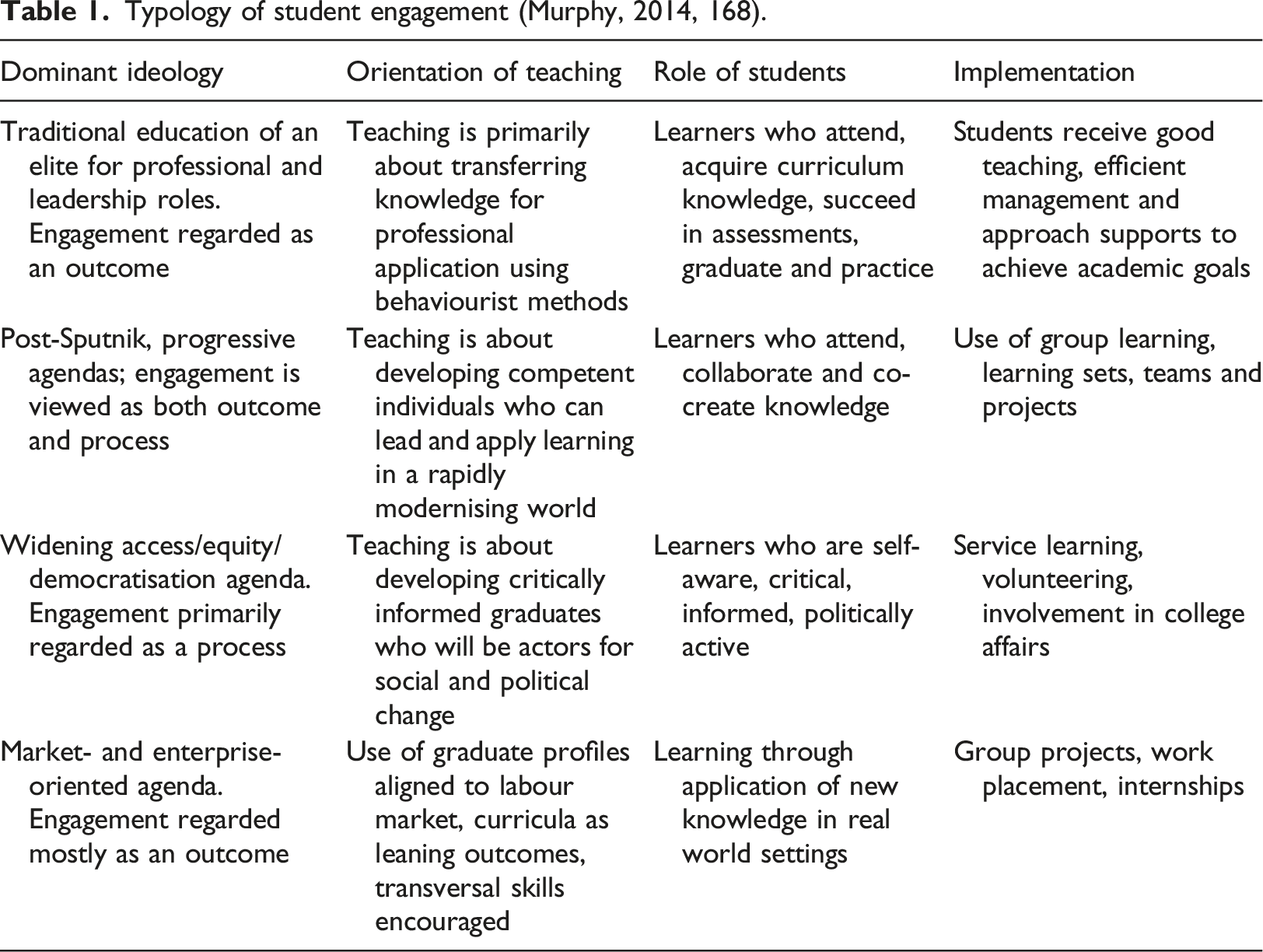
Student engagement is a complex concept and one which should not be seen as primarily a function of one type of ideological viewpoint but rather a lens that can be applied across a number of ideologies and used to consider student agency and lived experience during their journey through university. It is this broad conceptualisation of student engagement which offers a strong theoretical underpinning for the DF programme.
Student engagement and DF
The DF programme has been designed with a number of constituent parts to foster student agency and student voice. With such a progressive focus and sited within the transformative aim of HE, how does its view of student engagement fit within the neoliberal agenda? Zepke (2017) sets out an alternative viewpoint of the relationship between student engagement and neoliberal agenda. For Zepke, both are separate concepts as the student engagement agenda considerably predates the neoliberal turn of social policy. In addition, the student engagement literature has examples of researchers critiquing instrumental measurement of student performance and spotlighting the need for student voice to be considered. Zepke believes the relationship is more accurately termed an ‘elective affinity’, a term used by Max Weber, where both concepts share similar ideas but exist separately. He states “three key understandings of neoliberalism in particular share this elective affinity with engagement: that what is to be learnt is practical and economically useful in the market place; that learning is about performing in certain ways in order to achieve specified outcomes; and that quality is assured by measurable accountability processes. While these ideas support the argument for an elective affinity between engagement and neoliberalism, they deliberately do not suggest that the spirit or form of student engagement is connected causally to neoliberalism” (2017, 85).
Zepke’s critical values in a big E critical Curriculum (2017, 165).
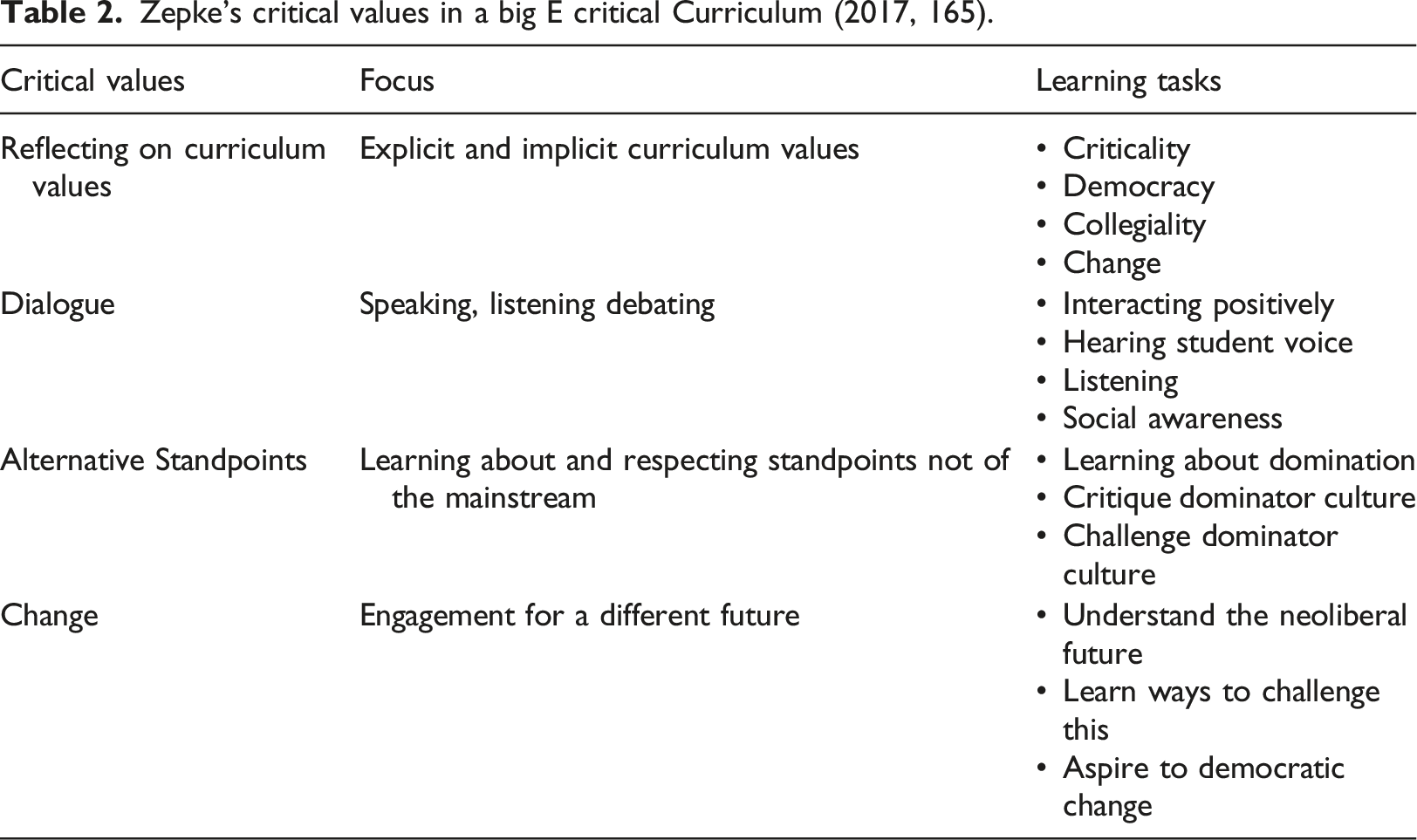
In DF, by student engagement, we mean a form of deeper connection between the student and their HE. This extends beyond a surface, transactional arrangement, where the student attends university to accumulate credit and gain a qualification. While success in one’s studies remains a central focus of DF, the goal in the programme is to cultivate and nurture a more profound form of student partnership, beyond mere employability. This entails students’ feeling a sense of belonging to their educational institution, and supportive community at their university. Furthermore, when we refer to student engagement, we intend it in the most inclusive manner possible – it is engagement for all students of the institution (and not only those already feeling connected and motivated). Through this deeper form of engagement, students are encouraged and supported to engage in civic activity and service learning, bringing their talents to bear in directly impacting their community, while at the same time enhancing their academic studies. Central to this mission, as we see it, is helping students to try to figure out and discern their passions, curiosities and talents, for life and the future of work. Consequently, DF has been purposefully designed to include a range of innovations aimed at supporting students, beyond employability. For example, this is why DYL methodology features as a core aspect of the project, whereby students work with a team of Student Success Coaches using systematic DYL tools to develop and enhance their sense of identity, their wellbeing and their plans for college and life. Critically, DF focuses on students’ holistic, rounded education, as whole people facing a complex and uncertain world. Therefore, when we refer to student engagement in DF, and thus throughout this paper, it is this deeper level of relationship which we mean, and which we are focused on realising, across the DF programme. We hope that through DF students will be prepared for the precarious world in which we live, with the confidence and competence to collaboratively tackle the big challenges facing our society today, through a fully realised and engaged university education. In addition, sustainable futures constitute a key focus of the DF programme. Curriculum innovation is a key feature of DF, mobilised through the VIPs (Vertically Integrated Projects) and TDMs. Furthermore, in these research-based courses, which challenge, unbundle and reframe the boundaries of academic disciplines, students are also encouraged to pursue collaborative and entrepreneurial projects that have strong social justice and inclusion goals.
The skills agenda
Taking this transformative agenda of HE, how can we locate efforts to promote certain employability skills within this lens. Daniels and Brooker (2014) argue that the focus should not be on the specific skills which are part of the future identity of the student, but on their current identity. They go on to reference the seminal works of Dewey, Kolb and Piaget, specifically, their focus on the active engagement of the experiential learner. Daniels and Brooker conclude that it is better to “consider these attributes as one part of a more extensive process of identity development that acknowledges students’ engagement with, and learning about, their emerging and changing student identities” (2014, 72).
While Tight (2021) is even more critical of the graduate attribute movement, noting a cyclical process of concern with a focus on student achievement stemming back to the 1940s, Wong et al. (2022) found the practice of identifying graduate attributes widespread across UK HEIs. In analysing the types of attributes focused on, Wong et al. (2022) concluded that whilst there were some differences in how universities define these skills, they could be grouped as either self-awareness/lifelong learning, employability/professional development, global citizenship/engagement and academic/research literacy. However, Wong et al. (2022) recognise that frequently graduate attributes can be seen as a top-down university initiative. There is considerable merit they argue for colleges to focus instead on a bottom-up approach which would be based on student and staff priorities. Mason O’Connor et al. (2011) reviewed the literature on how the relationship between the university and community; the graduate attributes agenda and the pedagogies underpinning student and community engagement. They found evidence that community engagement across higher education institutions supports the development of positive outcomes for student learning and development. Whilst they recognise that the neoliberal graduate agenda can be critiqued for having a narrow focus on employability, they posit that universities must both hold to their transitional role while preparing graduates for the complexities they will face. “the role of higher education in twenty-first century society demands universities to look Janus-like in different directions. Universities need to look both to the past and to the future – to retrieve the traditional civic role of universities and to look forward to creating new approaches to the modern contribution of universities” (Mason O’Connor et al., 2011, 111).
Similarly, Star and Hammer argue that far from being a new departure for the academy, supporting graduates in the development of 21st century skills is in keeping with the universities role as facilitator of knowledge. “Because embedded skills-based pedagogy can help undergraduates successfully navigate their transition to higher education, engage critically with their discipline and make informed judgments about their own performance, we argue that it is also a timely means for universities to clarify and re-articulate their traditional role in the formation of reflective practitioners, good citizens and social critics” (2008, 248)
Star and Hammer (2008) recommend that the debate should be instead on how best to develop the pedagogy and resources within university in order to deliver on this imperative. This position is also supported by Chan et al. (2017) who argue that the lack of progress in this area within universities over the past two decades is impeded by a lack of agreement of who and how best to impart this knowledge and how learning might be assessed. Sala et al. (2020) offer an approach to lifelong skill development approach that illustrates how supporting students might be prepared for the challenges they face. Developed by the Joint Research Centre (JRC) of the European Commission, the LifeComp offers a comprehensive framework across 27 indicators in either the personal, social and growth areas. The JRC group worked in a consultative manner with a range of experts and compared existing skills frameworks to develop these indicators. Sala et al. (2020) describe their framework within a socio-cultural approach to learning, where the individual learner’s agency and autonomy is central to embedding a lifelong approach to learning. Having set out how this broader focus on student agency can be incorporated into a skills framework, the review now considers the utility of a graduate capital framework to conceptualise the student-centric contribution of DF.
Graduate capital
For Tomlinson (2017a, 2017b), graduate capital and its inter-linked psychological, identity, human, social and cultural capital is a more progressive way to frame the employability agenda. It promotes emancipation and the role of the HEI as a facilitator of the graduate enhancing their capital through participation. His alternative framework for the employability agenda, one that that is located within the transformational potential of participation describes the higher education environments as one that can enhance and extend opportunity. This notion of graduate capital is equally applicable to the DF agenda whereby ‘a range of human, social, cultural, identity and psycho-social dimensions and are acquired through graduates’ formal and informal experiences’ (2017, 338). Tomlinson’s model describes each type of capital in terms of its key resources and how it supports the transition of the graduate into the workplace. Within DF, this notion of capital is directly relevant as it flows from the belief of the transformative potential of higher education and the notion that through positive student engagement, individual’s graduate capital can be enhanced and developed. There is a high degree of overlap and correlation between the aims of the various DF initiatives and the opportunities to enhance graduate capital across its sub domains. While these initiatives enhance graduate capital across multiple domains, the main intended impact is set out below. • TDMs enhance students’ professional skills, designed by experts from across the university and with input from enterprise partners. In so doing, students have the opportunity to develop their hard skills (Human Capital) and professional networking skills (Social Capital). • VIPs facilitate students to work in teams with faculty on multidisciplinary, longitudinal research projects to address grand challenges. Through participation, students will develop both their research skills (Human Capital) and increase engagement across the university community (Cultural Capital). • IdeasLab nurtures students to develop skills, explore new possibilities with real world impact, develop creative and innovative confidence though educational programming, enterprise specific activities and funding. Given the design centric focus of participation, students have opportunities to develop empathic understanding (Psychological Capital) and their connections to participating industries (Social Capital). • Streamlined Awards Framework is a multi-dimensional university student award Framework to recognise student personalised skills development and achievements (curricular, co-curricular and extracurricular). Through participation students develop their competencies for life beyond the university (Identity and Cultural Capital) • Student Success Coaching support students to take an active role in ‘designing their lives’ in order to achieve their unique academic, personal and life goals during their time at university, and after they graduate. With their focus on strengths based approaches and use of DYL methodologies (Burnett and Evans, 2021), this support aims to enhance both Psychological and Identity Capital.
Conclusion
DF is a funded opportunity which seeks to enhance participation for students in their HE journey with an open invitation for them to engage in a range of initiatives focused on developing their psychological, social, cultural and human capital within a privileging of student agency, identity and autonomy. It sits firmly within a world view that believes in the transformative potential of a third level education and the imperative to enable as many students as possible to avail of that opportunity during their time in university. The DF initiative creates space within the student engagement agenda to deliver on these priorities by re-asserting the transformative potential of university education. By positioning DF as an exemplar, this paper has explored the policy imperatives within the HE sector to which it belongs. It argued that the student engagement landscape provides a robust theoretical underpinning for the programme. It has unpacked the ideological underpinnings of this type of student engagement initiative and considered more broadly the role of the HE in relation to the skills debate. Finally, the notion of graduate capital is deployed to set out a potentially transformative agenda for individuals attending the higher education institutions of today and tomorrow.
A key focus and advantage of DF has been the inclusion of all stakeholders, but particularly students, and their perspectives in terms of the kind of education they want. This has entailed a focus in DF on supporting the development of students’ graduate capital, including their employability and entrepreneurial capability, but beyond this, their rounded development as agentic learners, who have skills that are needed to navigate the challenging world we live in today and who are well-prepared to face the complexities of the future (Mason O’Connor et al., 2011; Tesar, 2021; Tomlinson, 2017a, 2017b).
On a practical level, DF mitigates the tension of the role of the HEI in the wider neoliberal context by providing a programme of learning that includes students’ personal and life development alongside their employment skills and attributes development. In particular, by implementing a coordinated set of complementary pedagogical innovations that unbundle and reframe the traditional university curriculum (e.g. TDMs; IdeasLab; Vertically Integrated Projects; Student Success Coaching), DF has been able to offer a bespoke form of the ‘Big E Critical Curriculum’ (Zepke, 2017).
Tesar (2021, 4) notes how impact in futures methodologies necessarily involves ‘being inclusive of not only internal and external stakeholders, but also of everybody who has a stake in education and is a beneficiary of the positive future educational outcomes’. This nexus of consultation, participation, co-design and co-creation is at the heart of DF. Critical to this is and will be the formative evaluation of the DF programme as it now matures, so that we continue to learn from all our core stakeholders, both within and outside the university. This will help to ensure the positive future educational outcomes of DF benefit enterprise and industry but also – as crucially our students and the present and future society they will help to create as active citizens.
Footnotes
Declaration of conflicting interests
The author(s) declared no potential conflicts of interest with respect to the research, authorship, and/or publication of this article.
