



Abstract
While a small number of school districts across the United States are well into the process of implementing system-wide computer science education (CSed), most districts are only just getting started. But what does it look like to “get started” on CSed for a whole district? This manuscript presents a single case study of a district’s process of initiating their CS instructional initiative, highlighting a distinct set of instructional leadership practices and the institutional conditions they were responding to. Early implementation research around CSed shows that in some districts, leadership practices are less often the focus of early activities. This study sheds light on what such leadership practices can look like in the early stages of a district’s CSed initiative. Our analysis, based on qualitative data collected longitudinally over 18 months of the district’s work, identified eight intertwined leadership practices that aimed to support instructional coherence, and in our findings, we share a narrative of the district’s initiation of its CS initiative around them. The case begins with the (1) initial
Keywords
Introduction
While a small number of school districts across the United States are well into the process of implementing system-wide computer science (CS) education (CSed) (see Dettori et al., 2016; Fanscali et al., 2018; Margolis et al., 2012), the large majority of districts undertaking this work are only just getting started on the process of defining and designing their initiatives. But what does it look like to “get started” on CSed for a whole district? This manuscript presents a single case study of a district’s process of initiating their CS instructional initiative, highlighting a distinct set of instructional leadership practices (Lochmiller and Acker-Hocevar, 2016) that served to “infrastructure” (Penuel, 2019) change processes, the institutional conditions they were responding to, and tensions associated with their enactment.
Aiming to augment classroom-level theories of change that focus solely on developing curriculum and teacher training, advocates of whole district change around CSed see system-wide approaches as necessary to create conditions for more equitable and sustainable instructional initiatives (DeLyser and Wright, 2019). This systems change perspective prioritizes the development of coherence across various elements of district instructional systems (Cobb et al., 2020; Newmann et al., 2001)—from standards to professional development to curriculum—a process that necessitates careful and intentional leadership practices. And while scholarship on policy implementation generally has shown the critical role such practices play in establishing instructional coherence (Forman et al., 2017), early implementation research around CSed shows that for many districts initiating CS programs, leadership practices are less often the focus of early activities (DeLyser et al., 2020).
This study sheds light on what such leadership practices can look like in the early stages of a district’s CSed initiative. We present an analysis based on data collected longitudinally over 18 months of a single district’s work, including 36 district created documents, 9 interviews with district leaders and faculty, and field notes documenting approximately 40°h of district strategic planning.
Our analysis identified eight intertwined leadership practices that aimed to support instructional coherence, and in our findings we share a narrative of the district’s initiation of its CS initiative around them. The case begins with the (1) initial
The case is intended to support researchers interested in school change with an analytic lens to investigate early stage leadership practices around CSed, and provide district leaders with an example of what activity could look like as they attempt to initiate their own local initiatives.
Background
Processes aimed at initiating organizational change within school districts are inherently complex, dependent on careful consideration of both the affordances and constraints related to existing priorities, initiatives, capacities, and resources. As such, many scholars focusing on the intersection of learning design and organizational change have focused on the frame of infrastructuring (Penuel, 2019; Smirnov et al., 2018), defined as “activities that aim to redesign components, relations, and routines of schools and districts that influence what takes place in classrooms.” As we consider the formation of new district-wide initiatives focused on comprehensive CSed, infrastructuring offers a useful frame for change, centering the relational and social processes around exploring instructional concepts and practices, implicating issues of sustainability and navigation of complex institutional dynamics. Within the context of this study then, we center various leadership practices that we understand as attempts to infrastructure the formation of CSed initiatives.
We draw on a range of more specific theoretical constructs from within literature on organizational change in order to highlight meso-level activities observed in the context of this study. These include the following: • Efforts to engage in • Activities of institutional • Capacity building to support • • • • • Engaging in
Taken together, these practices, well established in existing literature on educational change, form the basis of infrastructuring a new computing education focused initiative.
Within the context of computing education research, an examination of the intertwined nature of these leadership practices in situ within a district serves to expand a growing base of scholarship related to whole-systems change processes within school settings. Such literature is still nascent, but is increasingly being embraced as necessary to establish as the field looks to broaden its inquiries beyond questions of defining student learning goals, pedagogies, and professional development supports—all of which see the classroom as the central site of change—to perspectives that understand the critical role that institutional change processes play in supporting comprehensive, sustainable, and equitable computer science education.
This body of literature is serving to establish important considerations at the level of institutional change in schools and districts around computer science. As it grows, it has begun to explore a range of issues, including how dynamics of prior knowledge and perceived capacity within district change processes implicate issues of equitable decision-making (Proctor et al., 2019), the challenges of aligning values around equity with on the ground district implementation (Santo et al., 2019, 2020), tensions around limited instructional time for integrating computing education (Israel et al., 2015), the role of students as leaders within systems change initiatives (Phelps and Santo, 2021), the nature of data use to reduce inequities within district-wide efforts (McGill et al., 2023; Phelps and Santo, 2022), and faculty perspectives on district-level policy requirements (Judson and Glassmeyer, 2019). Within this context, this study serves to address a key question that has both practical and theoretical implications—how do district actors get started on computer science if they want to create a district-wide effort?
Methodology
This study centers on data collected within a research–practice partnership (RPP) that focused on supporting a cohort of districts to develop comprehensive strategic plans around district-wide CSed. Through a variety of supports including strategic planning workshops, one-on-one consultations with district teams, and cross-district sharing opportunities, the RPP team aimed to simultaneously support planning and implementation while also researching the institutional change processes that participating districts engaged in outside the context of these support structures. Within the context of RPP activities, districts worked to develop foundational instructional visions for their local initiatives (Santo et al., 2019; Vogel et al., 2017), set strategic planning goals related to leadership practices, curriculum, and professional development (DeLyser et al., 2020), and worked collaboratively with the research team to create continuous improvement metrics that could guide implementation (Bryk et al., 2015).
We purposively sampled a single district for this analysis—Springfield Central School District 1 —from the broader group of four districts that the RPP worked with closely between late 2017 and early 2019. Springfield was chosen due to the particularly intentional set of instructional leadership practices it engaged in during the period of activity. While many of the practices we explore in this article were also present in the other districts, both the range and depth of activities in Springfield provided a rich context to understand early stage development of district work around CSed.
It is important to note that as a district, Springfield represents a highly particular context. Small and well-resourced, the district serves just over 1000 students across one elementary school and combined middle/high school. It serves a relatively affluent community, with just 11% of its students qualifying for free and reduced price lunch, and a fairly homogeneous student body that is 84% White and the rest a mix of Black, Latinx, Asian, and multiracial students. Given this context, it is likely that the district had greater resources on hand to draw on as it pursued its work around CSed.
We collected a range of qualitative data related to Springfield’s initiative over the course of the study period. These included gathering 43 internal district documents, provided by district administrators, that were relevant to the formation of their CSed initiative. These included internal planning and goal setting documents, meeting agendas and notes, presentations made to faculty and the school board, landscape analysis documents such as surveys and curricular mapping spreadsheets, and outreach documents related to professional development activities. In December 2017, we conducted an initial group interview with the CS leadership team that was formed in response to the RPP’s requirements in order to gather context on existing district priorities and initiatives, along with existing work related to computer science education. In Winter 2019, 1 year into Springfield’s implementation work, we conducted a total of eight interviews, each lasting approximately 1 hour, with district CS leadership team members. Within these interviews, we asked members of the CS leadership team to both recount specific activities they had engaged in relation to the formation of the CS initiative, their particular roles within those activities, and perceptions around the implementation activities to date. Finally, we captured field notes during two-day RPP-led strategic planning workshops that occurred at three time points throughout the project’s implementation period: at its initiation in January 2018, at a midpoint in July 2018, and at its conclusion in January 2019. At these workshops, we documented 40°h of district strategic planning activities that the Springfield CS leadership team engaged in.
Our analysis addresses the research question: What instructional leadership practices are involved in the formation of a district-wide, comprehensive computer science education initiative? While the methodological approach of a single case analysis does not offer an exhaustive answer to this question—it is likely that other leadership practices may be involved contingent on a given district context, institutional dynamics, and history—our analysis offers a starting point for researchers and practitioners considering this phenomenon.
In order to address this question, the research team coded aforementioned qualitative data using a coding scheme rooted in an existing district change framework that focuses on the construct of instructional coherence (Cobb et al., 2020; Forman et al., 2017), which explores the nature of implementation and change around district and school-based instructional systems. Our codebook included two sections, each orthogonal to the other. The first aimed to account for various elements of the instructional system (e.g., curriculum, leadership activities, and professional development activities), and the second aimed to account for various actions made in relation to those instructional system elements (e.g., a goal set, a possibility considered, an action taken, a goal abandoned, and a tension encountered). Through these dual code sets, the research team was able to center on how various elements of planning and implementation across the instructional system were playing out within the data. After the data was coded, the research team constructed an 18-month timeline of key activities undertaken by district actors that focused on multiple levels of the instructional system including leadership and administration, professional development, curricular materials, and enactment of student learning opportunities. Following this, we surfaced data from within the broader coded data corpus that spoke directly to our focal question of leadership practices that supported the launching of the CSed initiative. Looking across these data, the research team identified specific leadership practices and linked them with extant literature, outlined in the background section, identifying eight distinct but intertwined practices. We then constructed a set of analytic memos that centered on these specific and intertwined leadership practices. These memos were then synthesized into the theorized narrative presented in our findings.
Instructional leadership practices initiating district CSed programs
Springfield’s CS leadership team formation
Administrators within Springfield formed a
While the team was ostensibly formed in response to the requirements of the larger RPP structure developed by the research team which required cross-district representation in order to participate, the two district administrators involved—Juan, the assistant superintendent of curriculum and instruction, and Tony, a principal for grades 6–12—actively developed routines for the team to engage in continued learning, sensemaking, planning, and coordinated implementation around the district’s computer science initiative over the course of the 18 months of the study.
Leadership capacity building and sensemaking around CS through team routines
Notable among these leadership team routines was a series of three half day meetings that took place on Saturdays during the Spring 2018 semester. Juan, the assistant superintendent, described his motivation to organize these sessions in this way: It is almost too difficult to try to do this work within the school day unless you give teachers half the day off, and even still you're in the building, there are a million things that are going on. Having a Saturday there are no interruptions. That’s all you can focus on, all you can think of. That then gave us a lot of preparation time […] We all had an opportunity to dig into it. - Juan, Springfield Assistant Superintendent, 2/4/19
While these meetings included various activities, interviews with team members pointed to two critical functions they played during the initial phase of the district’s work around CS. First, they were designed to support
In order to support the meetings, Juan allocated dedicated funds to pay for teacher time, and hired an external consultant knowledgeable about district-level planning and implementation of CSed to support meeting activities and planning. The meetings involved pre-work, with leadership team participants reading a variety of external guidance documents around CSed including the K-12 Computer Science Framework, the Massachusetts Digital Literacy and Computer Science Standards, and CS-related vision and scope and sequence documents from San Francisco Unified School District, among others. Discussing, asking questions, and clarifying and contextualizing ideas in these documents during the Saturday meetings was a central mechanism by which the leadership team increased their capacity around CSed, and began to figure out what it might look like in their district. Tony, the middle school/high school principal said this about the meetings: I would use the term fact finding for us. It was peeling back the layers of the onion. […] We knew there were some great documents there. We said, "Okay, well we have to get more informed to figure out where we are as a building," and then where do we want to go? So we dove right into those things and that [K12 CS] framework I think really led the conversation with us. - Tony, Springfield MS/HS Principal, 2/12/19
Sally, the elementary school librarian on the team, noted the value of the process of going through the K-12 CS Framework during these meetings, not just from the perspective of learning about CS more deeply but also in correcting her own misconceptions about what ‘counted' as CS and where and how she might already be engaging in CS learning within the context of her existing work, a key aspect of institutional sensemaking: The full day Saturdays where we were unpacking the framework were really helpful for me, to just learn about all the components of Computer Science, because I had also come in with a little bit of a misconception that it was more about like teaching coding and robotics. So I was happy to hear of the breadth of it because it meant that I was covering that already in the library media curriculum. - Sally, Springfield Elementary Librarian, 2/13/19
In both what was shared by Tony and Sally, as well as others on the team, we saw evidence of the team’s routines providing a space to both deepen their knowledge and correct misconceptions around what constituted CSed, while also linking that emerging knowledge to the instructional context of the district. Tony noted that it helped him move to a decision to dedicate resources towards figuring out where in the 6–12 grades CS learning activities and goals were present (see “Mapping perceptions and instructional practices related CT”, below), and Sally around seeing her existing library media curriculum through a CS ‘lens,' and where she could further build it out. In this way, the practices of content-specific instructional capacity building were tightly coupled with those of sensemaking, an intertwined process that supported concrete steps within initiation of the CSed effort in the district.
Centering on computational thinking: Formation of a CS instructional vision and implementation strategy
By the end of the Spring 2018 semester, the team began
The computational thinking instructional vision for the district was formed in the context of the leadership team’s sensemaking and capacity building routines, as well as through additional external professional development attended by Juan and the district’s CS education consultant. Juan shared about his own sensemaking process around ideas of computational thinking, how he saw them related to the existing mission of the district, and his motivations for centering this particular approach to CS teaching and learning in the district’s instructional vision for the initiative: Looking at [computational thinking], it was like, wait a minute, in some ways there's so much that we're doing already with our mission with critical and creative thinking. There's some differences with critical thinking and computational thinking, but it was an easy way for us to latch onto that work, and not scare our broader faculty and staff to say we're going to do something totally new, or something totally different—this is already close to the work that I'm doing. It's a jumping off point. -Juan, Springfield Assistant Superintendent, 2/4/19
Notably, Juan pointed to two contextual factors motivating the decision to move towards a computational thinking approach. First, alignment with the existing district mission of promoting “critical and creative thinking,” which he saw as similar enough to computational thinking to “latch onto that work,” even if he did perceive “some differences.” And second, he saw the approach as one that would address issues related to teacher buy-in—he did not want to “scare faculty,” something which he saw as possible if they perceived that they were going to “do something totally new.” As we’ll explore later, while his concern around teacher buy-in was warranted, the computational thinking approach didn’t necessarily mitigate it, and might have even presented distinct challenges around teacher buy-in.
Irene, another teacher on the leadership team who taught eighth grade math, similarly noted the ways that focusing on computational thinking ‘fit' with the district’s mission, especially an aspect of the mission that focused on promoting problem-solving skills, and considered the frame of computational thinking as one that would help faculty understand that “it’s not just ‘we think you should be programming in your classroom’,” as she put it. In reflecting on the process the team had gone through of reviewing various external frameworks, she felt that among all of them, “computational thinking worked,” representing “good first steps” that would “get people going.”
Tony, the MS/HS Principal, also shared similar sentiments, linking his own learning process around CS and CT with the importance of finding alignment with their existing district mission. He spoke of when he considered an “a-ha moment” when he made a connection between the process of developing algorithms, as a general practice of creating clear steps to break down and address complex processes, and the district mission’s focus on “critical and creative thinking,” stating that it was in that moment when he saw computational thinking as an instructional vision that “fits to our mission.” He also noted that that as a new principal, still in his first year, he’d engaged in a round of interviews with teachers in the district and heard a clear message about the importance of the mission: “I’ve heard for a year [that] the mission is the blanket in which we sleep in this district, and you don’t dare do anything to go against that mentality. So [computational thinking] made a lot of sense.”
An additional motivation for the decision to center on computational thinking, beyond those of mission alignment, was the goal the leadership team had around reaching all students through the initiative. To the group, the approach of integrating computational thinking into existing subject areas—ones that all students took courses in—was key to the goal they had of creating universal access to and participation in CS education. As Sally, the elementary library and media specialist, noted, the group began to think differently once they considered the question of universal access and how they would achieve it from an implementation standpoint: I think maybe some of our initial goals were around getting more people in AP [Advanced Placement CS], but then I think the group moved away to, "Okay like this is Computer Science for All." Right, so we need other avenues that all students are getting, it's not just this small group of students that are going to go onto AP classes. -Sally, Springfield Elementary Librarian, 2/13/19
She noted that the place they landed, focusing on integrating computational thinking into existing subjects, meant that these learning experiences would be “something that everybody is going to get.” Part of the reason the leadership team decided to focus on integrated computational thinking was through sensemaking between the goal of reaching all students and considering what kind of implementation strategy would allow for that. In computational thinking, they felt that they had found a solution in terms of instructional vision that matched their broader goals around equitable access, which then implied an aligned implementation strategy.
Development and enactment of early implementation strategy: Sensegiving, piloting, and mapping around computational thinking
With a core instructional vision around their CS initiative in place, there were a number of questions related to ‘roll out' and the associated implementation strategy that the Springfield team then pursued. The integrated CT approach had an important implication for implementation—it meant that it would not only be a subset of teachers in the district but rather all teachers, whose instruction would be implicated. This posed a number of new challenges to be addressed, and questions moved from ‘what should we teach and why?' to ‘how do the answers to those questions shape roll out in the district?'.
Towards the end of the Spring in 2018, the leadership team decided that they were not going to try to have any goals around instructional shifts in classrooms in the following school year (2018–2019), but instead focus on work that they believed needed to happen that would be foundational, setting the stage for more robust classroom implementation further down the line.
While there were other activities, the most central ones that the leadership team oriented toward were building awareness in a way that involved communicating underlying alignment and rationales—“
“Year of awareness”: Strategic sensegiving around the CT initiative
During the first 8 months of Springfield’s work, the leadership team decided that the forthcoming school year of 2018–2019 would focus centrally on awareness-building around the CT initiative. They referred to this as the “year of awareness.” Juan, the assistant superintendent, described it in this way: We had set a goal for ourselves that we were going to launch to staff what our goal was with this work, which was our year of awareness. We presented to the staff that we're going to start this, we're gonna focus with computational thinking, and you're really not responsible for doing anything else other than just being aware of what computational thinking is, and, you know, just very baby stuff in terms of learning vocabulary behind it, but not necessarily integrating it into their lessons. -Juan, Springfield Assistant Superintendent, 2/4/19
In interviews, both Juan and Tony emphasized that there were no expectations or mandates for faculty around bringing CT into their instruction—they were solely aiming for the faculty know what the initiative’s goals were, who was involved in terms of the leadership team, and, as Tony put it, “a little bit of knowledge” (his emphasis) around what constitutes computational thinking pedagogy.
A central element of what the “year of awareness” looked like in practice was the group’s development of presentations that they shared at a number of all-faculty meetings, one in June 2018 and another in September 2019. Tony discussed how the CS leadership team prepared for these presentations: Basically what we did was we consolidated the hundreds of documents that we had gone through and narrowed down. It was an elevator pitch. That's really what started the whole thing. Our elevator pitch was 20 slides […] and we weeded that down, so I think our elevator pitch turned into like six slides when we were done. We’re saying, ‘here's what we're gonna do and here's what we expect, and here's what we're gonna look for, and here's the team that's gonna be an expert and then they're gonna push out. So if you have questions, come to the team and ask’. And that's basically what we did with the year of awareness. -Tony, Springfield MS/HS Principal, 2/12/19
Within the context of these communication efforts with the broader teaching faculty, leadership team members shared in interviews that the synergistic relationship between computational thinking and the district’s mission was always emphasized. Caroline, a middle school/high school librarian, put it this way: We knew if we phrased the computational thinking as a way of looking at critical and creative thinking and problem solving, people would understand that this as a way of aligning with the mission. So that I think was really important for us. -Caroline, Springfield MS/HS Librarian, 2/13/19
Beyond these all-faculty presentations, leadership also engaged in somewhat less formal approaches to raising awareness about the initiative and sent signals that the ideas it centered on were on their mind. Tony, as the MS/HS Principal, saw part of his leadership role as “constantly seeding and fertilizing and watering ideas,” whether through sending emails with articles about CT to individual teachers or mentioning ideas in staff meetings: At staff meetings I give them a little sip from the fire hydrant. I'll give them an article that says ‘Here's what simulation looks like in three content areas' or ‘Here's what data representation and data analysis can be, and here's a couple lessons your fellow staff members have done.' -Tony, Springfield MS/HS Principal, 2/12/19
Tony, in framing the sharing of new instructional practices as akin to “sip[ping] from a fire hydrant,” acknowledges what he saw as potential for teachers to feel overwhelmed. His approach to encouraging exploration, while not mandating anything new, was an acknowledgement of how he was approaching the process of building awareness deliberately, saying “I’m very careful about how I speak about [the initiative] and what my expectations are for it.”
Leadership encouraging instructional piloting within awareness-raising
Another element of the “year of awareness,” in line with the kind of informal encouragement of
Mapping perceptions and instructional practices related to CT
A second line of implementation activity that the CS leadership team undertook following the formation of the initiative’s instructional vision around CT related to what can be broadly referred to as
While it was not an extensive line of activity, the team made efforts to gather how teachers within the district understood computer science education. The most notable of these efforts was made during one of the initial all-faculty meetings in June 2018 where the new initiative was announced, as noted in the prior section. During that meeting, the team gave out sticky notes where faculty were asked to write down what they thought computer science was. Following the meeting, members of the team took the sticky notes and created a ‘word cloud' (below). Sally, the elementary library and media specialist, shared that this word cloud helped the team understand misinterpretations and “how narrowly they see computer science,” with other members of the team referencing these perceptions in our interviews as evidence that the faculty largely understood computer science as centrally focused on “coding” and “programming” (Figure 1). Word cloud of district-wide teacher perceptions of ‘what counts' as computer science.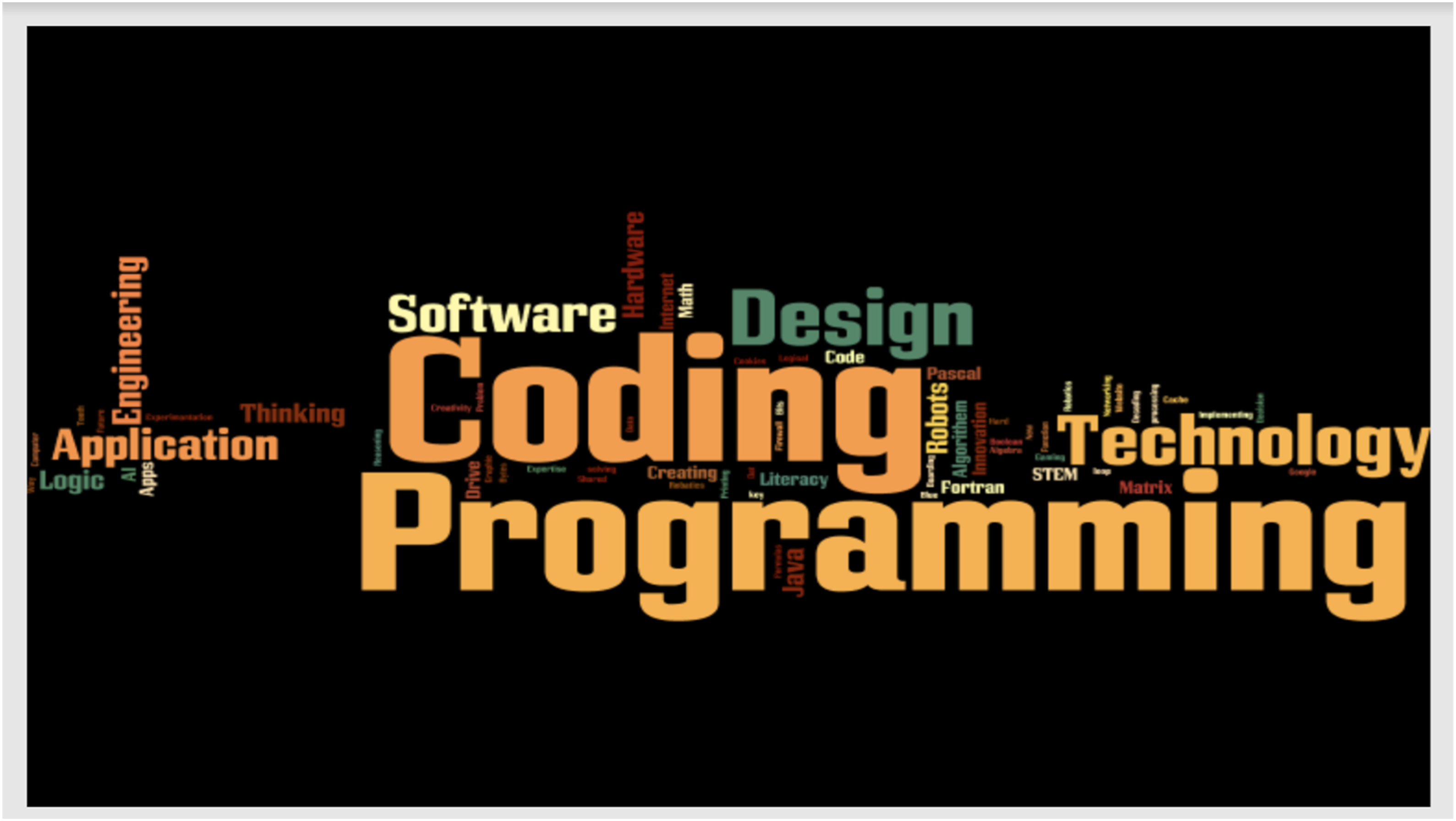
A second line of system-mapping activity was concerned with conducting a curricular ‘gap analysis,' which aimed to understand current instructional activities in the district in terms of where and how they might represent opportunities to build on and extend curricula to meet CS-related learning goals, and what the most significant gaps were in current instruction vis-a-vis CS.
A central theme that emerged around this gap analysis concerned the expertise required to effectively conduct the assessment given that the CS leadership team was itself only just developing its understanding of CS-related learning goals and instruction, pointing back to the foundational role of content-specific instructional capacity building for leaders. Essentially, if the team didn’t know enough about CS learning and instruction, how would they know what to look for in the gap analysis? This resulted in questions about how best to go about the process.
Specifically, Juan and Tony, the two most senior members of the team, deliberated about whether it would make more sense to bring in external experts in CT from an organization that had provided professional development to the team to conduct the gap analysis. They had concerns that if the teachers on the leadership team conducted the analysis, or, worse in their minds, teachers not yet involved in the initiative did so, that they might not do so accurately. As Juan put it, “we don’t want them to have them put something down and then later come back and say this is too vague or we don’t know what this means.”
At the same time, on bringing the idea of having the external organization conduct the gap analysis, Juan received push-back from the teachers on the CS leadership team. They in some ways took a little bit of an offense to “We're going to map this with you. We were going to tell you how to map it.” And some of them voiced the fact that we've got this. Give us the documentation and we can do it ourselves. -Juan, Springfield Assistant Superintendent, 2/4/19
The team eventually came to a compromise—the teachers on the CS leadership team would conduct the initial gap analysis, documenting places in the curriculum where the teaching of practices related to CT was already present to some degree, and then the external consultant would review and validate the work done by the team.
The particulars of this example highlight the tensions around ownership of process, on one hand, and leadership capacity and expertise required to effectively conduct various implementation activities, especially early stage ones, on the other.
Emergent tensions within and in response to leadership activities
Across the enactment of these leadership practices, a range of tensions emerged, pointing to both general sensitivities around launching a new initiative, and, more specifically, related to the choice to center the new effort around the integration of computational thinking into existing courses and curriculum. In a chapter focused on this choice (Santo et al., 2021), we explore more deeply five tensions, which we review in brief here.
Discussion
As Springfield’s CS leadership team attempted to ‘boot the system' in their district around computer science education, they wove together a set of instructional leadership practices in an attempt to create coherence (Cobb et al., 2020; Forman et al., 2017) both within the new initiative as well as with their pre-existing instructional system. These practices simultaneously aimed to create collaborative routines to help them understand possible goals and directions (team formation, content-specific instructional capacity building), understand how those might align with existing priorities (sensemaking), articulate a guiding approach (instructional vision and implementation strategy development), and then engage in early stage activities to their goals make sense to broader actors (sensegiving), create possibilities for experimentation (instructional piloting), and understanding existing instructional realities to build from (landscape analysis).
The configuration and combination of these practices, naturally, was linked to the particular conditions within the district. Existing initiatives both related and unrelated to CSed, the nature of CS expertise within the team, the external intermediary with its attendant resources, and the external accountability represented by our RPP were all consequential. And the tensions that arose as they enacted these practices were similarly contextually dependent—others have begun to document challenges distinct from those noted in this case (see Israel et al., 2015; Proctor et al., 2019; Santo et al., 2020). At the same time, the case highlights how each of these practices, as also indicated by the broader literature bases around them, represent forms of organizational activity that can consequentially advance the work of initiating new computer science education initiatives.
More broadly, the case contributes additional insights related to broader scholarly debates about the relationship between content knowledge and instructional leadership. Some scholarship in this area points to the viability of more limited content knowledge on the part of administrators and principals, showing evidence that leaders can utilize a combination of managerial approaches and leveraging external experts to support change processes within content areas (Lochmiller and Acker-Hocevar, 2016). Such a perspective is posed as somewhat of a counter to the dominant view that effective instructional leadership is deeply intertwined with content-knowledge expertise on the part of administrators (Stein and D’Amico, 2000; Stein and Nelson, 2003; Theoharis and Brooks, 2012). In this case, we see warrants to both of these perspectives. On one hand, the administrators were effectively able to utilize more managerial approaches; they successfully created collaborative spaces for faculty learning about a new content area and encouraged experimentation in low stakes ways.
At the same time, both the presence as well as limits of the administrators’ content knowledge around computational thinking and computer science were clearly consequential in the leadership efforts outlined in the case. On one hand, the leadership was able to learn enough about CS/CT pedagogical approaches to find synergies with the district’s strategic plan as well as envision an implementation strategy—one focused on integration of computational thinking within existing disciplinary teaching—that could reach many of the equity goals they envisioned for the initiative. At the same time, as they moved deeper into the pedagogical details associated with implementing the initiative, they encountered various challenges that may have been avoided if they’d possessed deeper content knowledge of computational thinking pedagogies. This was highlighted in their missed opportunities in involving faculty members that would be relevant to the initiative and in the realization that some of their equity goals related to CS career access would likely not be reached solely through an integrated CT approach. And, most centrally, the limits of their understanding of CT hindered their ability to effectively frame the value proposition of CT within the context of existing disciplinary learning for teachers, as evident in the case of the “coup.”
The case, then, warrants the perspectives of both sides of this debate—managerial approaches can advance the development of a new pedagogical initiative, but this case suggests that they should be paired with content-specific knowledge on the part of administrators. It is reasonable to surmise that this is especially true of pedagogical initiatives that are cross-curricular in nature, as was the case here around integrating computational thinking into existing disciplines.
Conclusion and recommendations
Although the Springfield School District’s population, resources, and community do not necessarily generalize to a broader national context, the activities they engaged in are likely to be echoed in some way in many of the schools and districts across the US working to develop computer science initiatives. To form coherent pathways aligned with emerging standards, curricula, and definitions of computer science education, the nation’s teachers and administrators must engage in collaborative work to create cross grade and cross building initiatives. For practitioners, advocates, policy makers, and administrators, the case study of Springfield School District can provide a preliminary starting point for booting their own system of CS education. Instructional staff in partnership with administration should consider the same questions as Springfield, even if they come to other decisions based on their community and school contexts. Instructional leaders looking to begin development of such initiatives, rather than seeing this case as a blueprint, might instead consider the steps taken and the practices these steps entailed as potential starting points that can be carefully and intentionally configured based on the particulars of their context.
The case offered suggests that there is substantial value for districts that are interested in developing computer science initiatives to invest intentionally in leadership related activities that are ‘upstream' from activities of teacher professional development, curriculum development and selection, and implementation of student-facing learning opportunities across grade levels. Such leadership activities as those noted in this case—building cross-level leadership teams, deepening the content knowledge of key administrators and faculty, establishing linkages to district priorities and initiatives, developing a long-term strategy for implementation, communicating the value of the work, and creating space and support for experimentation—all represent key leadership activities for district leaders to draw on and engage in. Most critically, the case shows the importance for administrators to both attend to these kinds of leadership practices while simultaneously investing time to develop their own leadership content knowledge related to computing education, as such knowledge critically informs strategic decision making in a domain where little prior knowledge often exists within districts.
Universal, equitable, and sustainable computer science education will not have a one-size-fits-all solution in the United States, and local education professionals are the ones who can best navigate how to put in place these systems for students together—this study aims to highlight what this might look like in practice.
Footnotes
Acknowledgements
The authors would like to thank their district partners who generously and openly shared about their work to bring computer science education to their students. Support for this project was provided by the National Science Foundation award #1738675.
Declaration of conflicting interests
The author(s) declared no potential conflicts of interest with respect to the research, authorship, and/or publication of this article.
Funding
The author(s) disclosed receipt of the following financial support for the research, authorship, and/or publication of this article: This work was supported by National Science Foundation (1738675).
Note
 ), she oversees programs and strategic planning and supervises research to build support for high-quality CS education at all levels. A former high school and university CS educator, Leigh Ann understands challenges faced by teachers, administrators, and students developing their competency in the field and accessing high-quality learning opportunities and resources. Her influential “Running on Empty” report guides policies and research that support high-quality program implementation. Previously, Leigh Ann was Director of Research and Education at CSNYC, which built a foundation for CS in New York City public schools. She received a PhD in Computer Science and Cognitive Psychology, with a focus on CS education, from Carnegie Mellon University.