




Abstract
While there has been an increased interest in making computer science a core K-12 academic subject in the United States, there is a shortage of K-12 teachers who can teach computer science. Experts in computer science education have expressed the importance of establishing clear expectations for who should be able to teach CS. To enhance the quality of computer science teachers, clear and consistent preparation and certification pathways are needed for teachers to implement computer science education. This study extends on prior work by creating a consistent framework of definitions for talking about and comparing CS teacher qualification pathways policies across states. We summarized the current landscape of the CS teacher pathways for all 50 states as of 2020. Nineteen states had an initial certification program, 42 states had an add-on license, and 24 states had an authorization pathway. There were five states that did not have any computer science teacher qualification pathways policy: Delaware, Maine, New Jersey, New Mexico, and Oregon. We discuss the policy implications and recommendations for future research around CS teacher qualification pathways.
Introduction
Despite the growing demand for computer science (CS) education for all K-12 students (Wang, 2017), one of the most significant barriers to schools offering CS courses is the lack of certified teachers (Code.org, CSTA, & ECEP Alliance, 2021; Warner et al., 2019a, 2019b). Some stakeholders have stated the importance of recruiting CS-certified teachers, suggesting that those who launch their careers at a higher level of effectiveness can consistently produce stronger student achievement gains than uncertified teachers (Darling-Hammond et al., 2005). Studies support the positive effects that teacher certification has on positive student achievement (Betts et al., 2000; Fetler, 1999; Goe, 2002). words, certified teachers tend to show higher student achievement test scores. Scholars suggest that this may be due, in part, to the process of preparation like testing efforts, which may add value to teachers’ subject matter competence and may add important information to judgments about teachers’ qualifications beyond what might be learned from degree status alone (Darling-Hammond, 2000; Ferguson & Womack, 1993; Monk, 1994). Therefore, teacher preparedness and credentials have been suggested as key to guaranteeing high-quality K-12 education (Darling-Hammond et al., 2002). In fact, Schleicher (2011) pointed out that “the quality of an education system cannot exceed the quality of its teachers” (p. 202).
According to the most recent State of CS Education Report (Code.org, CSTA, & ECEP, 2021), there are currently 41 states that have state CS teacher certification pathways. Many states are trying to find ways to “amend existing requirements in order to reduce barriers for teachers and increase the number of certified teachers” (Code.org et al., 2020, p. 27). In terms of initial teacher certification (or preservice teacher education), the 2021 report found that 21 states now have a state-approved preservice teacher CS certification program. However, according to Title II Data, there were only 62 preservice teachers who completed programs prepared to teach CS in 2018, only 85 who received an initial teaching certification in CS, and only 15 with a major in Teacher Education - CS.
The need for and lack of certified CS teachers is not new. The 2013 Bugs in the System report on CS teacher certification across the states found that not only did CS teacher certification vary markedly from state to state, but the reporting or requirements was inconsistent within individual states (Lang et al., 2013). The lack of clear and consistent preparation and certification was, and still is, confusing for teachers, school districts, and state education advocacy programs. Ultimately, the inconsistency makes it challenging to discuss and debate which approaches may be most successful. Without the ability to discuss and compare certification pathways, this may undermine the field’s growth and sustainability of CS education.
There has been progress and growth around CS teacher certification. In 2013, Bugs in the System reported that 21 states plus DC had a CS certification (Lang et al., 2013). In 2017, the number of states had grown to 27; by 2018, 33 states had a CS certification, 38 in 2019, 40 in 2020, and 41 in 2021 (Code.org, 2018, Code.org, CSTA, & ECEP Alliance, 2021). However, this annual counting of states reports on the existence of a certification, licensure, endorsement, or other credential with “computer science” (or related term like computer programming) in the name and enables a teacher to teach CS courses. It does not describe how teachers obtain the qualification, if it is required, or if it is accessible to the teachers who desire to gain it. The report Bugs in the System described some of these challenges in several states; and although some states have increased their pathways to certification or changed requirements, others are still confusing or inaccessible. As an example, as we explored many of the states’ department of education websites, we struggled to find this information and often needed to reach out to a staff member for clarification. Further, it is unclear which states require which credentials to teach CS, or which states allow any teacher with any credential to teach CS (with no demonstration of CS knowledge).
One of the challenges of creating a clear understanding of CS teacher certification in the United States is that this term can have many meanings and the meanings differ from state to state (Lang et al., 2013). This study gathers nationwide data of all the pathways to teach CS to create definitions for the multitude of CS credential pathways, demonstrate the spectrum of credential pathways, and highlights the need for more preservice initial certification programs. This study extends on prior work by creating a consistent framework of definitions for talking about and comparing CS credentials across states.
Method and results
Data on each state’s CS teacher certification pathways were collected from all 50 states’ board of education websites, emailing CS certification professionals, and meeting with CS or certification professionals. The first round of data collection focused on identifying the requirements for obtaining CS credential information from the state’s board of education website as well as other CS advocacy websites. Specifically, we investigated who was allowed to teach CS in each state and what was the process to be qualified in each state. Data were also collected through email correspondence with certification or CS education professionals for the states where information was not easily accessible or clear. Furthermore, all states were contacted to verify eventual codes and descriptions as a form of member checking. All but four states replied and confirmed that the codes and descriptions were valid. Those four states (MN, NM, OK, and SC) could not be contacted to confirm the descriptions.
The number of different terms used by states to describe teacher certification was vast and inconsistent. Some states used the term certification to describe the licensing process, while others used license to describe the same process. We found that eighteen states described the CS teacher pathway process as certification, eighteen states described it as an endorsement, six states described it as authorization, and eight states had no description for the process. The research team analyzed the data using a constant comparative approach (Glaser & Strauss, 1967). We reviewed several states’ processes, and then talked about these as a whole group, came to an agreement, and established codes and definitions. Then, we reviewed the next several states, and discussed these as a whole group with our current codes and definitions.
The research team, consisting of multiple graduate students, education policy experts, and professors, identified each state's qualification pathway on their state’s website or through email correspondence. Some of the data was also collected through virtual meetings with licensure or CS education professionals. The research team would first analyze how the state categorized their qualification pathway. Then, all of the categorizations were coded to identify similarities and differences in their definitions of the qualification. Using this information, the team came to a consensus and created definitions for the different pathways. These new definitions were used to re-categorize the pathways for each state. After the final round of coding, we member checked the categorizations with each state but four states did not reply. Based on the descriptions of each term, we identified where there was overlap between descriptions.
For example, we found that eleven states (AR, GA, IN, MA, MI, NY, PA, TX, VA, WA, and WY) had CS education preservice programs to earn initial certification at the university and college level. Maryland had three pathways for preservice teachers including CS education prep programs, whereas Ohio had an education track for CS majors, which required three semester hours focused on CS standards, 12 weeks of student teaching, and a test about CS contents and pedagogy. We combined these pathways into one that related to college/university preservice teachers who lacked teaching experience. This was included in the initial licensure portion as they had never had a teaching license.
Definitions of CS qualified teacher pathways terms.
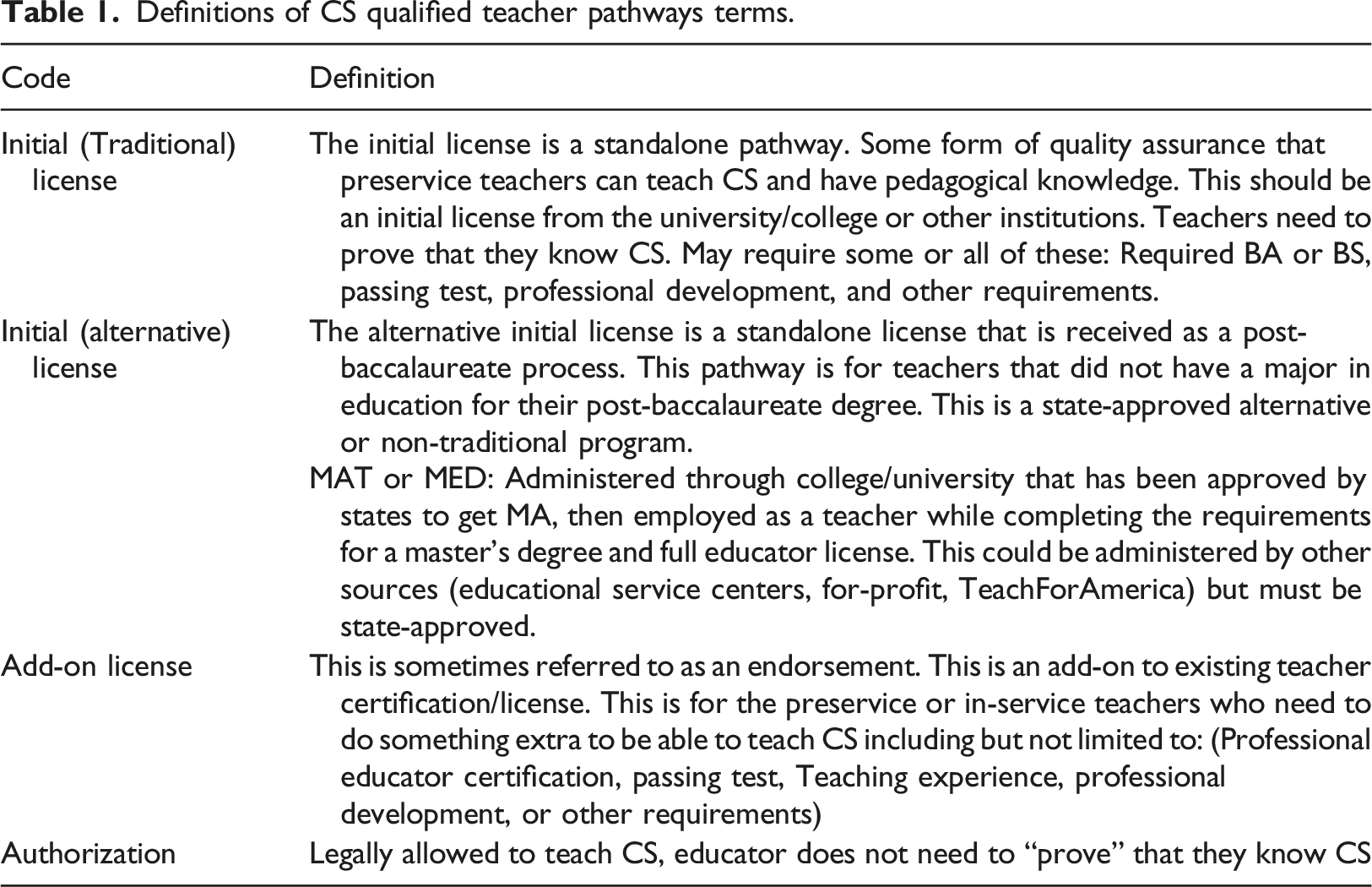
The research team categorized all potential pathways into the three
Results
Listing of the state CS qualified teaching pathways.
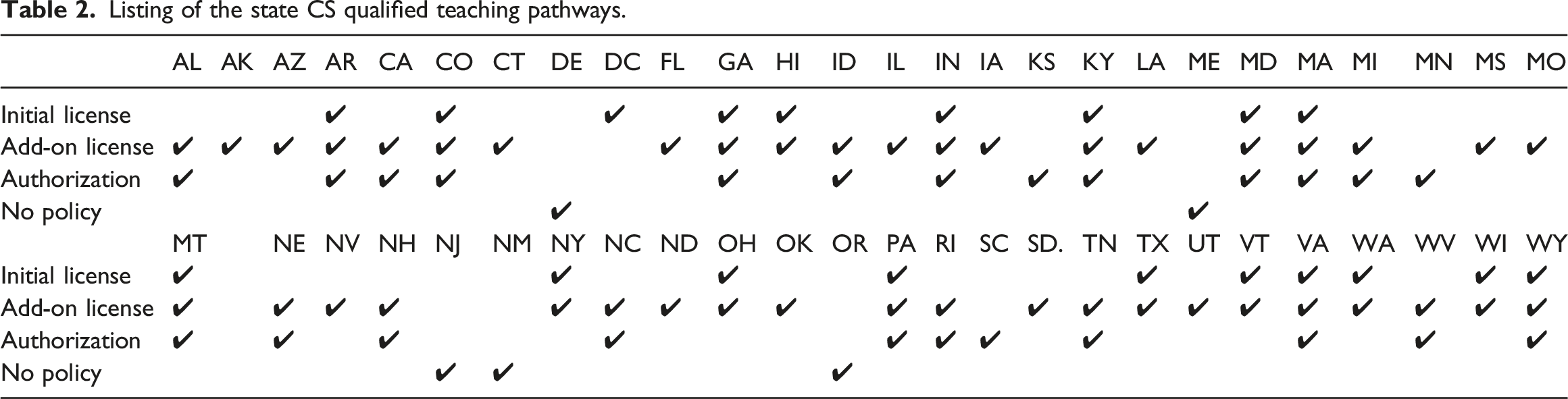
Authorization
Authorization to teach CS in states requires the least amount of administration. If a state had an authorization policy, it described what the teacher candidates needed to be legally allowed to teach CS. Teacher candidates did not need to “prove” that they had CS knowledge nor CS pedagogical knowledge. Twenty-two states had an authorization policy, typically allowing other subject area teachers (e.g., math, science, business, career, and technical education (CTE)) to be able to teach CS without providing evidence that they had CS knowledge.
Some states only have authorization. At the time of this analysis, Minnesota authorized anyone with a technology or business license to teach CS. In Rhode Island, any educator with a valid license could teach an introductory level CS course. Michigan allowed any educator with a valid license to teach CS at their license grade level if they provide evidence that they know CS. This evidence is often provided in the form of PD participation, such as the Michigan Math and Science center’s AP CS Principles professional development program.
In Indiana, teachers were authorized to teach CS at the 6–12 levels if they had secondary CTE and Business licenses. Indiana math, science, technology education, or information technology teachers could also be authorized to teach CS if they completed additional professional development. This could include professional development from several organizations such as Nextech or taking a college course. At the K-6 levels, teachers were authorized to teach CS with an elementary license. In another example, Georgia authorized teachers to teach CS if they held an engineering license. However, teachers could also be authorized to teach middle school CS if they had a math, science, or business license. Alabama allowed the superintendent of a school district to request authorization for someone to teach CS. If someone met an appropriate occupational proficiency (e.g., currently employed as a computer scientist), they could receive an adjunct instructor permit and be authorized to teach CS on a less than half-time basis. In terms of authorization, most states authorized teachers from other subject areas to teach CS. These subject areas were most typically math teachers (n = 8), science (n = 1), CTE (n = 6), technology education (n = 5), or business teachers (n = 11).
Initiation license
The initial license means that the individual does not have a prior teaching license. An initial license to teach CS also required that the individual has participated in some form of quality assurance showcasing that the preservice teacher was capable of teaching CS. The initial license requires teachers to prove that they know CS, which may include college degrees, passing specific tests, participating in professional development activities or other requirements. Traditional initial licensure programs are provided by state-approved universities and colleges. Individuals receive their initial CS licenses through a traditional preservice teacher education program that would enable them to teach CS.
An initial license would also include any alternative initial licensure programs, which would include those pursuing a CS teaching license that have a non-education degree (e.g., computer science, engineering). Similarly, to the traditional initial license, these teachers had not received a teaching license and would be earning their initial license. The alternative initial licenses were typically run through a state-approved alternative or non-traditional program. Sometimes this resulted in a Master of Arts in Teaching or a Master’s in Education degree that was administered through college/university that was approved by the state. In the alternative initial licensure programs, candidates could often be employed as a CS teacher while completing the requirements for a master's degree and license. Some states had the alternative initial licensure programs administered by other organizations such as educational service centers, for-profit organizations, or TeachForAmerica. However, these programs required the state’s approval to provide an alternative initial license pathway.
In Massachusetts, to earn an initial license in CS, teachers must complete a state-approved digital learning computer science (DLCS) educator preparation program at a college/university. In Maryland, there are four potential pathways to earn an initial license in CS. The first and second options require a (a) bachelor’s degree in CS
Add-on license
The add-on license was sometimes referred to as an endorsement or add-on certification. The add-on was a supplement license to an existing teacher certification/license. The add-on license could be completed by preservice or in-service teachers. Teachers would already have an existing license in another area (or be in the process of earning a license in another area), but would add-on a CS license to be able to also teach CS. Some states allowed teachers to add-on CS if they passed tests, had additional teaching experiences, completed professional development, or completed additional coursework.
Thirty-four states had the option for teachers to add-on a CS license. In fact, 13 states only allow CS as an add-on license: Alaska, Connecticut, Florida, Illinois, Iowa, Kansas, Louisiana, Mississippi, Missouri, North Dakota, Oklahoma, South Dakota, and Utah. To receive an add-on license to teach CS in Louisiana, teachers must hold a valid math teacher license, have 21 college credit hours in CS, and receive a passing score on the Principles of Teaching and Learning test. In Mississippi, to earn their add-on CS license, teachers must hold a value teacher license, complete a college board-approved program, and earn at least a “C” in all of the prescribed coursework. Alternatively, Mississippi teachers could also complete an approved Mississippi professional development program to earn their add-on CS license. In Alaska, teachers needed to have a valid teacher license and 2 years of teaching experience before passing the Praxis 5652 Computer Science test to earn their add-on CS license.
Evidence of CS knowledge to qualify teachers
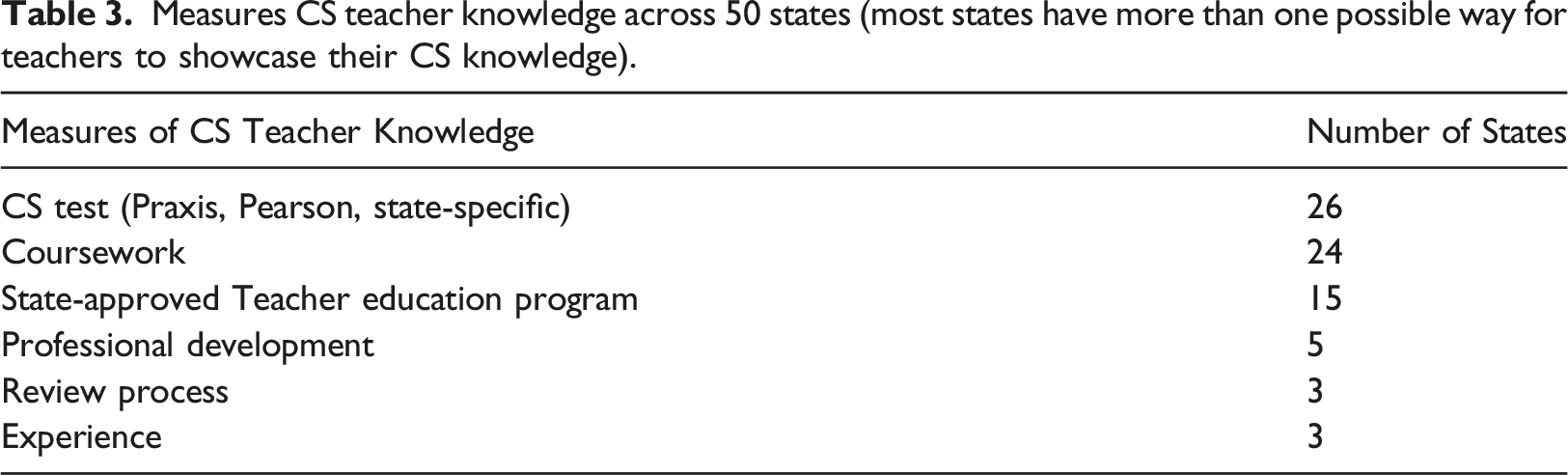
To ensure CS teachers were qualified to teach CS, states measured their teachers’ CS knowledge in a variety of ways. Many used a national CS teacher test (n = 26), typically the CS Praxis test (#5652). The Praxis test was based on the CSTA and ISTE CS teacher standards and was “designed to assess the computer science knowledge and competencies necessary for a beginning teacher of secondary school computer science” (Educational Testing Services, 2021; p. 5). Twenty-one states required their teachers to take and pass the CS Praxis exam. The minimum passing score varied by state, with most states required a score of 149, while a few (Arkansas, South Dakota, Montana, and Virginia) required a score of 142, and Massachusetts required a score of 160. There were also a few states that required teachers to pass a CS Pearson test (e.g., Colorado) requiring a score of 220 or a state specific exam meant to assess teachers’ CS knowledge (e.g., Georgia, Missouri).
Measures CS teacher knowledge across 50 states (most states have more than one possible way for teachers to showcase their CS knowledge).
Discussion
This study gathered nationwide data of all the pathways to teach CS in K-12 schools. The study highlighted the discrepancies in CS terminology, which makes cohesion and gathering information difficult for teachers desiring to teach CS. We also found many states that attempted to make the process more attainable for teachers to identify and pursue a pathway to teach CS. For example, Alabama provided six different pathways for teachers and districts when it comes to teaching CS. Alabama also includes a provision which allows external volunteers with CS experience to teach one class per day. These myriad of pathways may be helpful to provide more opportunities and entry points for individuals to become CS teachers.
Our study proposes that the CS education field use common language to advance an advantageous CS teacher certification agenda. Overall, we found state CS qualified teaching pathways could be categorized under three categories: initial license, add-on license, or authorization. We also summarized the current landscape of the CS teacher qualification pathways. Nineteen states had an initial license program pathway, 44 states had an add-on license program pathway, and 22 states had an authorization pathway (see Table 2). There were three states that did not have any CS qualification pathway policy, namely, Oregon, Maine, and New Mexico.
Research literature on K-12 CS teacher certification has grown considerably since the release of the report: Bugs in the System. There have been several initiatives to increase the number of CS teachers, with many of these efforts focused on current in-service teachers from other subject areas such as math, and business (Lang et al., 2013). In fact, NSF initiated the CS10K program, which aimed to have 10,000 well trained CS teachers in 10,000 schools by 2015 (NSF Program Solicitation 15-537). While coming up short in its goal, CS10K was able to train approximately 3500 high school teachers to offer either the Exploring Computer Science (ECS) course or the Computer Science Principles (CSP) course (Zarch et al., 2018). Code.org has provided ongoing professional development for over 100,000 middle school and high school teachers (Code.org, 2021), and Google provides targeted professional development for over 50,000 teachers through CS4HS (Davis et al., 2018).
However, we still do not know how many teachers are qualified to teach a CS course through these multiple pathways. The data from Title 2 illustrates how many teachers are getting initially licensed through alternative or initial licenses in CS. However, we still do not know how many have gone through other pathways; we still lack a robust mechanism for tracking this data holistically. Out of 25,000 schools, approximately 12,000 schools offer CS (Code.org et al., 2021). We can estimate one CS teacher per high school (knowing that many schools have more than one, while others share one teacher across schools). We can estimate that there are approximately 12,000 teachers teaching CS (a small amount may be dual credit at university, or shared teachers, or virtual programs). If we know that fewer than 100 preservice candidates are graduating with an initial licensure, what proportion of those 12,000 teachers (minus 100) are certified, endorsed, qualified, or merely authorized? Some states have data on teachers being certified, others have landscape reports that report on some data. Praxis also has some state-level data documenting how many teachers passed the exam. We also lack information on the demographics of teachers teaching CS, which pathways they pursued, and where they end up teaching.
If we need a multi-pronged way to achieve the number of needed CS teachers, all of these data points are important and need to be reviewed systematically. However, our next step is to examine the different pathways for teachers to be able to teach CS and how this impacts equity. Specifically, we need to be able to identify a balance between the number of teachers that progress through each pathway and the quality of teachers that progress through each pathway.
Implications
What does this mean for policy and practice?
As CS education continues to be an important factor in K-12 schooling, we outline several implications for policy and practice that should be considered. Once a state decides to add additional CS teacher qualification pathways, there are a myriad of factors that should be considered. For example, a state may decide to implement a policy that allows existing in-service teachers an add-on CS license through additional professional development activities. Rationales for this approach could be that college programs or CS praxis tests are cost-prohibitive, or professional development activities often provide support networks for teachers beyond the PD. Regardless of the rationale, states have to make decisions on their professional development activities that would benefit their teacher workforce and consider the unintended consequences of those decisions. Who will manage professional development activities within states? How will they be rolled-out in districts and directly reach teachers? Should states centralize professional development activities, or export them to external providers? This includes considering processes that will lead to the selection of quality external organizations. How will states ensure the quality of professional development activities? These questions are just a few of many that states will need to carefully consider in order to support their CS teacher certification pathways and promote qualified CS teachers into schools and districts.
As states consider various CS teacher qualification pathways, there are many questions to consider before implementing pathways. Perhaps the most critical consideration of pathways needs to be how pathways might impact equity around CS education. Many have raised concerns around the lack of underrepresented students in K-12 CS education (e.g., female students, Black students, Hispanic students, Native American students, low-income students, English-language learners, students with disabilities, etc.) (Code.org et al., 2021). Furthermore, numerous studies have shown the importance of having female and teachers of color as examples in K-12 CS courses (Scott et al., 2017; Seneviratne, 2017). When K-12 students have been able to see people who looked like them be successful in CS, they have been more likely to perceive CS as a relevant field.
If states decide that qualified CS teacher pathways can only be accomplished through cost-prohibitive college programs or CS Praxis tests, this may limit the diversity of CS teachers. For example, Nettles et al. (2011) conducted an analysis of pass rates on Praxis I and Praxis II tests used in 28 states. These tests focused on general skills tests in reading, writing, and mathematics (Praxis I) and areas of content and pedagogy (Praxis II). Teachers were required to pass those tests to teach in those 28 states. They found “very large score gaps between African American and White teacher candidates on selected Praxis I and selected Praxis II tests…[which] appeared to be as large as the gaps that are commonly observed on the SAT and GRE (p. 47). In another example, certification exams may deter teachers from low-income backgrounds (Barnum, 2017). Currently, the Praxis 5672 (Computer Science) is $130 and it becomes more expensive if teachers fail multiple times. Although some states and/or districts subsidize this cost, and in fact, the Texas WeTeach program even provides a bonus incentive of $1000 once teachers pass the exam.
If states decide that qualified CS teacher pathways can be accomplished with professional development, the location of the professional development offerings can also impact the diversity of CS teachers. Teachers in rural schools may not have access to professional development offerings which would impact how many rural schools could offer CS. Therefore, as policymakers gather to establish pathways, we implore these individuals to consider the unintended consequences for all student and teacher populations. How do these pathways impact student and teacher populations in each state? Are there certain pathways that enable more teachers to reach students of color or from low-income areas? Are there certain pathways that serve as barriers for states to create the number of necessary CS teachers? These are all critical questions that need to be considered to provide equitable CS education experiences for all K-12 students.
What does this mean for research?
As we begin to implement these different pathways, it is critical for us to examine the outcomes of these pathways, policies, and practices. One of our most critical research needs at this time is an examination of these different pathways. We need to investigate the demographics of teachers going through each pathway, and where these teachers end up teaching CS. This can have implications on equity and quality, especially as it relates to broadening participation in computing. Previous studies have shown that there was a negative relationship between that schools with larger proportions of students of color enrolled in CS courses and CS-certified teachers (e.g., Warner et al., 2019b). In other words, students of color are less likely to have a teacher who is CS-certified in Texas.
In another example, Texas allows teachers to teach certain introductory CS courses with a Technology Applications license (Warner et al., 2019). The Technology Applications license is more heavily focused on using computer applications, web design, digital citizenship, and technology integration. The CS content knowledge required for this license is much more basic than a CS license. This means that the teachers teaching introductory CS courses with a Technology Applications license are less likely to have advanced understandings of CS, and thus may provide less informed CS educational experiences for students. If schools are only able to offer the introductory CS courses (because their teachers are only licensed to teach these courses), students in these schools are left with only an introduction to CS and cannot take more advanced CS courses without a teacher with a more advanced license.
Therefore, we need to continue to investigate how different pathways are impacting CS education equity for our K-12 students. Studies in other K-12 contexts have investigated the impact of qualified teacher pathways. According to a 1998 study of nearly 3000 beginning teachers in New York City, teachers from teacher education programs (traditional initial license) “felt significantly better prepared across most dimensions of teaching than those who entered teaching through alternative programs or without preparation” (Darling-Hammond et al., 2002, p. 286). However, some studies have shown little difference in terms of quality between traditional and alternative licensure programs (e.g., Shuls & Trivitt, 2015). While other studies have found that lower income schools and those with higher ratios of students of color tend to have a lower percentage of highly qualified teachers (Darling-Hammond, 2004). Through further examination, rural schools in Texas have far fewer CS-certified teachers, with less than 30% in non-Title 1 rural schools and less than 20% of Title 1 rural schools having a CS-certified teacher (Warner et al., 2019b). Students in rural areas were less likely to have access to CS classes because the remote schools lacked the resources to staff teaching positions.
In addition to the effectiveness of teacher pathways, we also need to investigate how different teacher pathways impact the quantity of CS teachers. Although we have increased the number of CS teachers in the US, we are still struggling to meet the demand (Code.org et al., 2021). Therefore, we also need to investigate which options are yielding more CS teachers. Out of the 50 states, eleven offered all three qualified CS teacher pathways (initial license, add-on license, and authorization). By providing clear categorizations of these pathways, we could start to examine which pathways produce the greatest number of CS teachers, particularly comparing across these three pathways within individual states.
There is also the question of balance between quality and quantity of qualified CS teacher pathways. If a state’s pathway requires a master’s degree (i.e., Kentucky), this may increase the quality of CS teaching, but it will also likely yield fewer CS teachers. If there are fewer CS teachers, we may find that districts with low-income students are less likely to be able to offer CS. In fact García and Weiss (2019) pointed out that with the overall teacher shortage, “high-poverty schools are suffering the most from the shortage of credentialed teachers…[and] the shortage is distributed so unevenly among students of different socioeconomic backgrounds challenges the U.S. education system’s goal of providing a sound education equitably to all children” (p. 2). Highly qualified teachers, such as those with CS licenses, are in high demand. Therefore, these teachers can select where they want to teach. Many of these teachers often will opt for schools with more resources, which typically means higher-income schools (García and Weiss, 2019).
By establishing the common language described in this paper, researchers can start looking across states and comparing pathways and CS teaching. Research also needs to investigate where the “sweet spot” lies between teacher effectiveness/quality and quantity of CS teachers, especially as we try to broaden participation in computing to include more marginalized or underrepresented students. Do we see certain states that are able to increase access and participation in CS at a higher rate based on the options for teacher pathways? Do the types or number of pathways seem to impact states’ CS offerings or diversity of students enrolled in CS courses or performance of students enrolled in CS courses?
Conclusion
Overall, we found state CS qualified teaching pathways could be categorized under three categories, namely, initial license, add-on license, or authorization. We hope that as we move forward as a field, these terms can help states have more robust conversations around teacher pathways. We will need to work together to investigate the most effective pathways to prepare enough teachers to move CS education forward. Equity has to be the yardstick by which we measure the impact of these pathways, otherwise, we are not achieving the idea that CS can and should be for ALL students. In order for this to happen, we need to thoroughly investigate the capacity of our districts to offer CS, and this starts with having enough teachers who can teach CS for every school.
Footnotes
Declaration of conflicting interests
The author(s) declared no potential conflicts of interest with respect to the research, authorship, and/or publication of this article.
Funding
The author(s) disclosed receipt of the following financial support for the research, authorship, and/or publication of this article: This work was supported by Google (CS-ER 2019) and NSF (1822011).
Author Biographies
 , and ECEP to investigate ways to teach computer science and expand these offerings at the preservice and in-service levels. She is Indiana’s co-lead for the ECEP alliance and working with CSforIN to increase CS access opportunities for all K-12 Indiana students. Her research focuses on teachers’ value beliefs related to technology and computer science, as well as how those beliefs influence teachers’ adoption and implementation.
,
. She holds a doctorate in Curriculum and Instruction and a master’s degree in cultural studies in education from Ohio University. With Code.org, Katie works with states across the nation advocating for policies that advance computer science education. Prior to joining Code.org, she was a 2014–15 Albert Einstein Distinguished Educator Fellow, placed at the National Science Foundation in the Computer and Information Sciences and Engineering Directorate. She is a former secondary mathematics teacher.