




Abstract
There has been a heightened awareness and intensified discussion of the ethical issue in global higher education among scholars of international education. There are also strong calls for actions from the governmental, organizational, and institutional perspectives. However, there seems to be little discussion on what frontline international educators can do in this regard. Motivated by Freire’s (1970) critical pedagogy, this paper aims to develop an actionable framework for frontline professionals’ value-based practice. It hopes to engage the large number of fellow practitioners in higher education internationalization to increase their awareness of the dire world situation of unbalanced development, to reaffirm the values they should uphold in their profession, and to implement actions within their scope of agency to make a change.
Introduction
The globalization process has pushed 21st century higher education toward greater international involvement, and universities have quickly expanded their international activities in volume, scope, and complexity (Altbach & Knight, 2007). As a result of this development, international education has become a quickly expanding profession. Value-based practice in education can help practitioners reorient their work around the values they espouse and resist unwarranted expectations and interventions that do not align with their value system (Biesta, 2010). In this sense, it is beneficial for educators to consider their own personal theories of practice in order to show that they hold themselves accountable for their educational influence in learning (McNiff, 2013). With this in mind, this critical review paper aims to engage fellow practitioners in higher education internationalization in the Western world to examine and critique the current practices of international education and the underlying values in the global North. Without aiming to aggregate and synthesize all available literature in an explicitly structured way, a critical review focuses on the conceptual values of relevant literature to provide new insights on the chosen topic (Grant & Bootht, 2009). The goal of this critical review is to develop a framework for individual international educators’ action-based reflective inquiries into their everyday practices in order to help reverse the neoliberal trend in higher education internationalization.
Based on his own experiences teaching literacy skills to Brazilian adults, the critical education scholar Freire (1970) proposed a new pedagogy embedded in a deep Marxist class analysis of the oppressors and the oppressed in education. In his understanding, students have a fear of freedom and change due to the social conditions of injustice, exploitation, and oppression. The goal of his Pedagogy of the Oppressed is to empower students, not to become new oppressors, but to change the unjust system that dehumanizes learners. In this process, it is important to identify the oppressors and criticize their materialistic goals. According to Freire, the traditional banking model of education, with knowledge flowing from the teachers to students, is tied to the oppressive system, as it serves to perpetuate the unjust system, instead of allowing students to question it. In critical pedagogy, the educators’ job is to reshape how students see the world and the history, to engage with students in critical dialogues to investigate issues and problems, and ultimately to allow students to become full humans and seek change so that oppression does not have space to exist.
Motivated by Freire’s (1970) critical pedagogy, this paper aims to develop an actionable framework for international educators’ value-based practice. It hopes to discuss and design what Freire calls “dialogical actions” for practitioners in international education which would allow them to critically reflect on the unjust conditions in global higher education among themselves and with students. Originally developed for the purpose of evaluating student outcomes of international learning, some major concepts in Deardorff’s (2006) framework for intercultural competence, such as “attitude,” “knowledge,” and “skills,” are borrowed and modified in this paper to build a framework for international educators’ value-based professional inquiry for ethical practice. These concepts can be easily transferred to the context of international educators. In “attitude,” international educators need to respect international students’ home cultures, withhold any judgment, and tolerate ambiguity in their interaction with international students; in “knowledge,” international educators need to demonstrate cultural self-awareness, deep intercultural knowledge and global sociolinguistic awareness; in “skills,” international educators need to listen, observe, and evaluate students’ circumstances, and to analyze, interpret, and relate with students’ intercultural experiences.
In Deardorff’s (2006) original framework, positive “attitudes” are considered as the prerequisite for the acquisition of “knowledge” and “skills.” In the revised framework in this paper from a critical perspective, the awareness (Deardorff’s “knowledge”) of the oppressive postcolonial world conditions in higher education internationalization is considered the foundation and precondition for the application of equitable values (Deardorff’s “attitude”) and empathetic actions (Deardorff’s “skills”) (see Figure 1). International educators need to conduct deep critical reflections on these conditions, among themselves and with students, to acutely raise their awareness of the unsustainability of the current practices, and based on such reflections, they need to dedicate themselves to such professional values as equity, justice, empowerment, and transformative change. International educators should then hold themselves accountable in their actions and practices in line with these espoused values. In the following, we will apply this framework to examine the current practices and underlying values in international higher education with an eye for practitioner-led change. Framework for international educators’ ethical inquiry in practice.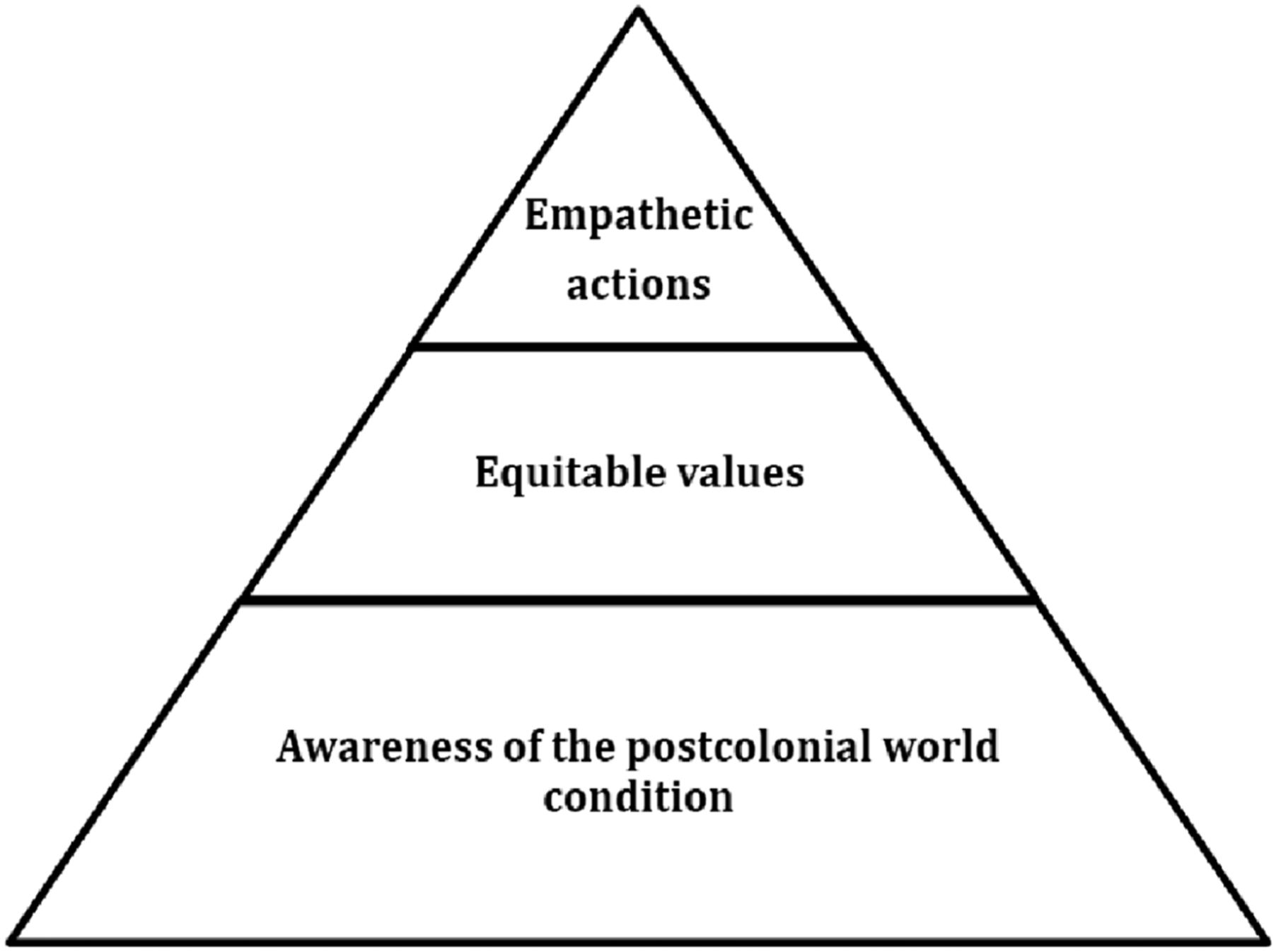
The inherent dilemma of international education: Awareness
There have been a few recent postmodern studies on the issue of international student mobility. Drawing on the experiences of three international students from Syria, the Philippines, and Congo who study in the United Kingdom, Ploner’s (2017) work challenges the conventional paradigm of power and capital in understanding students’ global mobility, and highlights individual students’ resilience that underlies and enables their international education experiences. The perseverance, creativity, and coping strategies of socially and economically disadvantaged students from the developing world in seeking better educational opportunities in Western countries are seen as an alternative way in understanding students’ global mobility. In a similar vein, Fakunle’s (2021) study draws on Amartya Sen’s Capability Approach to argue that international students’ pursuit of personal well-being and freedom should be considered an important aspect of their rationale for overseas study, instead of only focusing on the economic motivations.
In still another recent study that was based on interviews with 14 international graduate students, all from developed countries, who study in mainland China, Yu, Cheng and Xu (2021) challenge the traditional push–pull analysis of student mobility which focuses on the trend of economically privileged youths from the developing world seeking Western education as a way of reproducing their social capital. Studying in China has empowered these students from disadvantaged backgrounds in the global North to access further education beyond their national borders. All the above studies are valuable observations and welcome trends, and as international educators, we should encourage, promote, and enable such healthy alternative-narratives and counter-narratives in student mobility. However, it would be a mistake if we take these observations of unique cases as the norm of international education and declare our profession as free of any ethical challenges. According to Freire (1970), neutral, uncommitted, apolitical educational practice does not exist. Educators are thus obligated to conduct critical reflections on the political, social, and cultural context of their work in order to uncover the unequal power dynamics and work to transform them.
As practitioners in international education, we must recognize that deep inequalities exist in higher education globalization and internationalization (Altbach, 2015), and higher education in the Western centers has been benefiting from the global marketplace for students and scholars. This is the big picture and the larger context of our work. International students are typically “pushed” by unfavorable conditions at home, and “pulled” by more favorable conditions host countries offer (Altbach, 1998). For this reason, international students have been mostly flowing from the developing South to the developed North. Asian students represent 53% of all international students enrolled worldwide, mostly from China and India, of whom 83% are studying in G20 countries and 77% in OECD countries (OECD, 2021). Two most important pull factors in the Western center have been the technological advantage and the English language, as “(a) few countries dominate global scientific systems, the new technologies are owned primarily by multinational corporations or academic institutions in the major Western industrialized nations, and the domination of English creates advantages for the countries that use English as the medium of instruction and research.” (Altbach, 2015, p. 7)
International students pay higher tuition fees for better quality education in the medium of a desirable language that is not available in their home countries. Isn’t it simply fair trade? However, we have to admit that international education in the developed Western centers, by catering mostly to rich kids from rich families of the developing world, serves to reinforce the economic inequality and social stratification in students’ home societies. In addition, international education has been utilized by major Anglo countries as an export industry to obtain economic resources, and in this sense, international education has increased the gap between students’ host and home societies as well. The Bourdieu theory of social capital reproduction is still a sound paradigm to understand the global educational mobility pursued by privileged individuals to convert social capitals across borders (Waters et al., 2011; Yang, 2018). Recognizing this condition is an important starting point for our ethical practice in international education.
As an export industry, international education generated $42.4 billion in revenue annually in the United States, rivaling export revenue in pharmaceuticals and automobiles, and sustaining 455,000 jobs (Larmer, 2019). Revenue from education-related exports and transnational education brings £20 billion to the United Kingdom economy annually (O’Malley, 2019), making international education the 5th largest export industry only after mechanical machinery, cars, electrical machinery, and pharmaceutical products (IES, 2021). International education earned Australia A$40.4 billion in 2019, making it the country’s fourth biggest export after iron ore, coal, and gas, supporting over 250,000 jobs (Ross, 2020). International students in Canada spend an estimated CAN $21.6 billion annually, sustaining close to 170,000 jobs, with a greater impact on Canada’s economy than exports of auto parts, lumber, or aircraft (Government of Canada, 2019). International education is New Zealand’s fourth largest export earner valued at NZD $5.1 billion, sustaining close to 50,000 jobs (New Zealand Government, 2021).
International students’ tuition has also become a very important source of institutional income for host universities. In the United States, international students constituted 12% of the total student population in 2015, and their tuition fee accounted for 28% of total annual tuition revenue (Loudenback, 2016). International students account for 20% of students at UK universities, and their tuition fee incomes constitute 17% of the total income of the universities, 37% of total fee income (Brittonn, et al., 2021). In Australia, international students take 32% of the total undergraduate student body, and their tuition fees contribute to 24% of the total revenue for institutions (Study international, 2021). In Canada, international student fees represent 35% of all fees collected and 9.3% of total institutional revenue (Usher, 2018). In New Zealand, international tuition fees contributed to 10% of universities’ total revenue (Universities NZ, 2021).
The host countries’ gain is the sending countries’ loss. China is the number one source country of international students. In 2016, there were 544,500 Chinese students studying overseas, which was less than 1.4% of the total postsecondary enrollment within China in the same year (36,990,000) (MoE, 2017). The total spending of Chinese students overseas in 2016 was estimated at 380 billion RMB (Ge, 2017), which is about 38% of the total investment of the Chinese government in higher education in China in the same year (Statista, 2021). What this means is that slightly over 1% of the Chinese students studying overseas takes up 27% of the total Chinese expenditure (both public and private) on postsecondary education. India is the second largest source country of international students. In 2015, there were 125,000 Indian students studying overseas (Gu, 2017), which was less than 0.36% of the total enrollment of postsecondary education within India (34,600, 000) (Department of Higher Education, 2016). The total spending of Indian students overseas in 2015 was ₹ 45,000 Crore (NDTV.com, 2015), which was 1.67 times of the total amount the Indian government invested in higher education in the same year (Nanda, 2015). What this means is that about 0.36% of the Indian students studying overseas takes up over 62% of the total Indian expenditure (both public and private) on postsecondary education. These numbers speak to the inherent moral dilemma in international education due to the neoliberal approach to higher education internationalization, and the neoliberal approach to higher education internationalization is part and parcel of economic globalization. A strong awareness of this inherent moral dilemma of global higher education is the foundation of ethical practices for international educators.
The world as a community with common destiny: Values
Globalization has become the universal condition for higher education in the twenty-first century, but it is not a neutral force that delivers benefits evenly to all parts of the world (Liu, 2020). Globalization tends to concentrate more wealth, knowledge, and power in the wealthy, knowledgeable, and powerful (Altbach & Knight, 2007). The global imbalance of development, both within a country and between countries, is a result of the capital’s unrestricted cross-border pursuit of most profit in the globalized economy (Yang, 2002). The world has become one big market, and the capital has been allowed to chase profit across national borders. Universities’ internationalization strategies adopted in the Western centers have typically not aimed to reverse the unequivocal global trends, but to capitalize on them (Liu, 2020). According to Altbach and Knight (2007), “Current thinking sees international higher education as a commodity to be freely traded and sees higher education as a private good, not a public responsibility. Commercial forces therefore have a legitimate or even a dominant place in higher education, which comes under the domain of the market.” (p. 291)
International education has become an industry, a source of revenue and a means for enhanced reputation in the past 30 years (De Wit, 2020). However, the adverse effect of economic globalization seems to have reached a critical tipping point, indicated by Global Warming, the global pandemic, and the rising populism in politics. Higher education internationalization is at least partially responsible for such consequences. International mobility has been a key element of higher education internationalization, but it has been brought to increasing environmental scrutiny. One study shows that international student mobility around the world was responsible for CO2 emission between 14.01 and 38.54 megatons in 2014, comparable to the national annual emissions of Jamaica (15.47 megatons) on the lower end and Tunisia (39.72 megatons) on the upper end (Shields, 2019). Despite the benefits of international mobility that can be argued for individual students, countries, and even the world at large, leaders in higher education internationalization are challenged to integrate environmentally conscious practices in students’ education abroad programing.
International education has been clearly a victim of the global pandemic due to the restrictions on international travel. But no one seems to see international education as an element that contributes to global public health challenges we face today. The viruses have always historically spread from the developed old world to the undeveloped new world through colonization (Diamond, 1997). They have been responsible for killing millions of indigenous people in the new world during European expansion. In today’s world, it is easy for transmittable viruses to develop in overpopulated developing countries with poor public health care. And the poor economic and public health conditions in these regions can be attributed to colonization in history and the unjust world structure today. Of course, increased global mobility of people, including the global movement of international students and scholars, serves as a carrier of new diseases worldwide, in addition to its contribution to CO2 emission and global warming.
Political Populism, and the associated Nationalism and Protectionism, has obstructed to some extent the flow of international students to top destination countries such as the United States. This is a result of the politically motivated visa restrictions. The same Nationalism and Protectionism also resulted in the hostile attitude toward other immigrants and the wall-building rhetoric, both physical walls along the border of neighboring countries and ideological walls that separate and alienate nations. The rise of Populist political movements, such as Trumpism and Brexit, is also attributable to globalization (Rodrik, 2020), of which international education is part and parcel again. As the gap between the rich and the poor widens, the anger of the poor is channeled toward new immigrants and the developing countries who they believe have taken their jobs. They elect Populist governments who promise to defend their interests by pursuing nationalist and protectionist policies. The key to combating Populism and returning to rationality is thus not to fight trade wars, but to seek measures to overcome the adverse effects of globalization as root causes and narrow the gap between the rich and the poor.
Higher education internationalization has served multiple goals (Stier, 2004). We have to acknowledge the positive impacts of internationalization. Higher education internationalization has served to prepare our postsecondary students with the much needed international competences and skills to participate fully in the globalized world and to succeed in the global job market. But we have to also be aware of the fact that internationalization has been increasingly motivated by profits rather than by either government policy or goodwill (Yang, 2002). It has been used more as an instrument to obtain resources around the world and to ensure a country’s economic competitiveness. Traditional values such as exchange and cooperation, peace and mutual understanding, human capital development, and solidarity have been pushed to the side for the purpose of competition, revenue, and reputation/branding (De Wit, 2020). Higher education internationalization has so far given too little attention to the ethics of international engagement, particularly across unequal relations of power (Buckner & Stein, 2019). But the discourse on higher education internationalization has hit a turning point, transitioning from an overwhelming focus on its benefits to a reflection on its negative implications (Yemini, 2015). The same urgency in the wake of Global Warming and the global pandemic is needed to deal with the ethical challenges of global higher education.
Though often ignored as a piece of Chinese Communist propaganda, the Chinese President Xi’s “Community of Common Destiny” (Smith, 2018) is a fairly good description of the globalized world we live in. A community of common destiny is based on the simple truth that when one place screws up in the world, no matter where it is, the whole world screws with it. Some countries might have emitted more CO2s in history, and thus contributed more to global warming, but global warming affects us all and all should work to solve the problem. Some individuals and even governments in the West may accuse China for starting the COVID-19 pandemic and bringing down the whole world with it, but no matter where the first outbreak took place, a world pandemic has world consequences, and it should be a wake-up call to address public health issues of any country as a global public health priority of the world. Economic crisis, political instability, and armed conflicts may be issues of some small developing nations, but desperate people from these countries may show up on the shores of developed Western countries as refugees and thus make it a problem for the whole world. The world has become a shared community with shared responsibility.
The concept of a village seems to have been used quite often as a metaphor to refer to the globalized world we live in today. The world has become a small village, as people say. Suppose we are the wealthiest family in a village, and all the other families are very poor. We have two choices. We can build high walls around our house and raise a few big dogs to guard the door so that we can enjoy my wealth inside and keep the poor people out. But we would always be on high alert, as we know there are always people trying to climb in and they may well succeed. We know that even the Great Wall of China failed to keep out people they wanted to keep out. Walls simply don’t work. The other choice we have is to share our wealth and try to help all the villagers become better off. It takes work to help others and we will not have as much wealth left to ourselves. But we will not have to spend money building high walls and keeping fierce dogs, as no one would want to rob us. We would feel more relaxed and enjoy what we have. Globalization has made the world a community of common destiny. In a community of common destiny, equality in development should be upheld as the most important value to secure common prosperity.
To reverse the adverse effect of global higher education, there have been strong calls for governments, organizations, and institutions to take action. Governments have been widely called to take higher education as a public good, not a private good, and to increase public funding to universities, instead of leaving universities to survive in the global marketplace (see e.g., Giroux, 2010). Associations of international education are called to give more attention to the ethics of international engagement by recognizing global inequality, ethical responsibilities, and alternative possibilities (Buckner & Stein, 2019). Internationalization policies and initiatives at universities can be good, bad, or neutral in their impacts (Hoey, 2016), and thus universities have a conscious decision to make as well. Many scholars have pointed to the potential of the United Nations (UN) sustainable development goals (SDGs) as an ethical basis to guide universities’ international activities. For example, Ramaswamy, et al. (2021) argue that universities should reorient their activities in global citizenship education, special institutional initiatives, international research partnerships, international mobility programming, and cross-cultural bridge building toward the achievement of SDGs and for the betterment of society. A comprehensive approach should be adopted to integrate SDGs in all functions of the university, such as teaching, research, and partnership development. The service mission of the university is also called to focus on the internationalization agenda and contribute to the global common good (Jones, et al., 2021). Instead of continuing on with a singular focus on international recruitment, international education has been re-imagined recently with a new focus on internationalization at home. The concept of internationalization at home was around over two decades ago (see e.g., Nilsson, 2003), however, it really came to the forefront of international educators’ attention during the pandemic. Curriculum internationalization and global education programming on campus are called to be strengthened in order to raise the awareness of world injustice for domestic students at the Western center.
Students as global citizens: actions
In addition to being an export industry, international education has also served as a very important platform for developed host countries to recruit good-quality skilled immigrants, harvesting brain gain after economic gain. Evidence on “stay rates” and “return rates” suggests that a very large proportion of international students from developing countries immigrate to their host countries upon graduation (Bhandari, 2019). For example, between 2004 and 2016, nearly 1.5 million foreign graduates of U.S. colleges and universities stayed on to work in the U.S. (Pew Research Center, 2018). In 2017, almost 90 percent of Indian doctoral students and 83 percent of Chinese doctoral students studying in the U.S. indicated their interest in remaining in the U.S. after their studies (Bhandari, 2019). The same is true for other major host countries. Brain Drain is a serious ethical challenge with international education, and only countries with a good economic foundation and good employment opportunities may achieve some level of “Brain Circulation” (Saxenian, 2005) and thus benefit somewhat from international education. Most source countries of international students do not benefit from their students’ outbound mobility as much as the Western destination countries.
As a recommendation for ethical practice, Healey (2017) suggests that international work should start to put international students’ learning experiences at heart, instead of equating internationalization with international recruitment. Liu (2021) also stresses that, in a competitive recruitment environment, more serious effort should be made within host institutions in Anglo countries to improve the quality of education and services to international students so as to make sure that they stay as a more desirable choice for future international students. But what are the current practices in international student education and services? As international educators working in the field, the vocabulary we hear most often in our work with international students are “acculturation,” “adjustment,” “adaptation,” and “integration.” So the most dominant paradigm guiding our work with international students is still an ethnocentric one, viewing international students as in need of acculturation in a one-way path to the elitist host country language and culture (Liu & Lin, 2016). The goal is to change students’ previous habits in learning or living to fit into the new academic environment. Similar to the direction of mobility, education and service are also characterized by a one-way street.
A more ethical paradigm is needed to guide our work with international students who have come to study in the West. Challenging the acculturational approach, Liu & Rathbone (2021) argue that a truly global perspective should be embraced which stops treating international students coming to study in technologically and economically advanced regions as novice members of the elite society, but as global citizens who are on their way to effect change to the current world order, and our goal in international education is to equip students with bilingual and bicultural competences so that they can become effective global leaders for the future. From this perspective, international education is not a process of the diffusion of Western values, but a process of the diffusion of the universal values of care, justice, and peace. International educators need to engage in truly intercultural advising (Lin & Liu, 2019) which requires deeper understanding and appreciation of students’ home cultures. A fundamental shift of the profession is needed to change from its current singular focus on host country culture orientation toward a broader function of intercultural brokering (Lin & Liu, 2019). To better serve as students’ intercultural brokers, international educators need to become interculturalists in order to support students in their additive and bicultural identity development (Liu & Rathbone, 2021).
In addition to international student recruitment and education, another important dimension of higher education internationalization is to send domestic students overseas for education abroad opportunities. However, there seems to be a drastic difference between the narrative for outbound domestic students and the narrative for inbound international students. We often deem inbound international students as in need of acculturation in order to fit into the academic, social, and cultural norms of the host country, but we afford outbound domestic students from the Western center the status of being global citizens in training for global awareness, global competence, and global leadership. The postcolonial ideology looms large in such different narratives with the perception of a Western center and non-Western periphery. While students in the non-Western periphery need to shed their home country cultures before they are adopted as new members of the elite Western world, students in the Western center are to become global citizens and lead the future world with Western values.
A new perspective needs to be adopted by international educators in our work with education abroad students from the West. More students from the West should be encouraged to study in poor developing countries to strengthen their willingness and commitment to building a more equitable and just world. The ultimate goal is to develop a generation of mindful, idealistic, and transformative global citizens in the West who are conscious of the world problems we face and are committed to working toward a change. Education abroad programs are to be designed in a mindful way to reduce stereotypical understandings of the non-Western cultures and systems. Efforts should also be made to reduce environmental footprints of education abroad programs, such as providing students with green guidelines, choosing closer destinations, supporting blended mobility, encouraging the use of environmentally friendly travel schemes, offsetting greenhouse gas emissions resulting from mobility, promoting more sustainable consumption patterns, or even providing students with free bike passes (Ramaswamy et al., 2021). These are not only tangible actions to curb global warming, but also educational tools to strengthen students’ awareness of their responsibility as global citizens in tackling world problems.
Conclusion
The past practices in internationalization have focused too much on output, a quantitative economic approach on numbers, with too little attention to values or ethics of internationalization practices (De Wit, 2013). Higher education should not be a mindless follower of economic globalization; instead, it should serve to be a mindful and ethical force to reverse the adverse effect of economic globalization. Higher education should be pursued as the bottom-line of social morality. In the past decade, particularly during the COVID-19 pandemic, there has been a stronger call for comprehensive internationalization, which aims to address all aspects of international education in an integrated way, such as quality assurance and learning outcome, and the goal of international education is reconsidered and redefined as a force to enhance the quality of education and research for all students and staff, and to make a meaningful contribution to society (De Wit, 2020). What would ethical value-based internationalization practices look like for individual practitioners in international education? How do we do internationalization so that higher education can help reverse the adverse effect of globalization and contribute to the betterment of the world?
Using Freire’s (1970) revolutionary pedagogy of the oppressed as a guiding principle, this paper hopes to develop a functional framework for international education professionals’ reflective inquiry into their own value-based practices. Freire’s critical paradigm views “education as the practice of freedom—as opposed to education as the practice of domination” (p. 81). To do so, educators must have a deepened “critical awareness of reality” (106). As the foundation of the framework, international education professionals need to recognize the inherent ethical challenge of global higher education as a part of neoliberal economic globalization. Only after this first stage of critical awareness raising, according to Freire, can we start a dialogue about ways for change. The second building block of the framework is a dialogue among international educators about the professional values we need to embrace to guide our practice. Globalization has brought the world into an interconnected community of common destiny, and in the tight community of common destiny, balanced and equitable development for all should be the value upheld by all professionals in international higher education to reverse the current neoliberal materialistic trend. Freire believes in the people’s revolutionary praxis of “reflection and action directed at the structures to be transformed” (p. 126). Correspondingly, the last building block of the framework is to provide some actionable items in our daily work with international students to gradually transform the system. Both incoming students from the developing world and outgoing students from the developed world need to be seen as equal global citizens and future global leaders with an instilled commitment to build an equitable world.
The COVID-19 pandemic has presented unprecedented challenges to international education. It has also provided a unique opportunity for international educators around the world to re-examine and re-imagine the future of international education practices. There are different approaches to global ethics operation according to different orientating assumptions, horizons of hope, and theories of change (Stein, et al., 2019), but the willingness to work toward ethical internationalization should be an urgent and universal imperative. Much discussion has been had about the roles of governments, organizations and institutions in this regard. This paper draws on a critical review of previous discussions and extends to the role of individual international educators. Individual practitioners are able to contribute to the field of ethical international education by conducting and disseminating their action-based reflective inquiries into their practice against espoused professional values (Lin & Liu, 2019). The framework developed in this paper aims to aid international educators in exercising their agency and effecting desired change. The framework can be fruitfully used in international educators’ professional development to enable internal and external change as ethical professionals in the field.
Ethical international education can be a very difficult conversation to engage in for fellow practitioners in international education. Revealing the “dirty laundry” of one’s own profession can be a very uncomfortable and even demoralizing exercise. For this reason, ethical internationalization has stayed as a part of the academic discourse only. It is time to include ethical internationalization as a topic in international education practitioners’ professional learning, as was argued above, but much consideration is needed to make sure that such conversations do not put blame on international educators as sinful “devil’s advocates,” and thus become awkward or even defensive. Instead, such conversations should focus on the ethical issue as a global structural issue and what individual international educators can do to make the profession more ethical within our scope of work on a daily basis. Action-based reflective inquiry as professional development is crucial to the realization of the ethical turn of the international education industry, as educational change ultimately happens as a result of the changes in everyday practices of individual practitioners. The outcome of such reflections should not be self-doubt, self-denial, or even self-destruction. Instead, deep reflective inquiries, followed by some small but tangible actions, will help international education become a healthier, stronger, and more sustainable profession in the long run.
Footnotes
Declaration of conflicting interests
The author(s) declared no potential conflicts of interest with respect to the research, authorship, and/or publication of this article.
Funding
The author(s) received no financial support for the research, authorship, and/or publication of this article.
