




Abstract
This article is concerned with presenting a qualitative study of teachers dealing with undemocratic attitudes in secondary school. The research question was: how do teachers teach when the aim is to remove undemocratic attitudes and prevent the formation of undemocratic attitudes? The research group which was part of the study established collaboration with two teacher groups at a Norwegian secondary school. This collaboration included two start-up meetings, filming and observation of teaching sessions, as well as group interviews with two different teacher groups about the teaching which had been filmed and observed. The findings were analysed by way of the theory of indirect pedagogy and its different models for teaching, including both direct and indirect approaches of teaching. First, there is the model of direct instruction; second, there is the model of indirect summoning which is specified; and third, there is the model of indirect summoning which is unspecified. A major finding was that the teachers who participated in the study combined direct and indirect approaches in their teaching. While direct approaches and the model of indirect summoning which is specific were mostly used for learning purposes, such as acquiring knowledge of certain concepts (epistemology), the model of indirect summoning which is unspecified was particularly prominent in situations where the purpose was to make students responsible for society and democracy (existence and morality).
Introduction
Studies conducted by the Norwegian Center for Holocaust and Minority Studies show that racism, anti-Semitism, xenophobia, discrimination and the like appear among parts of Norway’s population in the form of prejudice and negative emotions, attitudes which exclude others (HL-Center, 2012; Hoffmann and Moe, 2017). While a democracy is characterized by inclusion, we have here an example of exclusion. Therefore, we will make use of the term ‘undemocratic attitudes’. Why is this exclusion of others happening? Is it something society just have to expect, that certain people embrace undemocratic attitudes? Or can schools prevent and avert the formation of such attitudes? Can such attitudes also be removed, a kind of process of unlearning (Baldacchino, 2019)? It is difficult to answer these questions unequivocally as it is almost impossible to know what it is that removes undemocratic attitudes and prevents the formation of undemocratic attitudes. It may be that the schools contribute in doing so, but it may be other contributing factors as well. Nonetheless, the schools’ social mandate requires them to do what it takes to remove undemocratic attitudes and prevent undemocratic attitudes from becoming part of pupils’ existence and way of life. So, what can schools do to remove undemocratic attitudes and prevent the formation of undemocratic attitudes?
We have chosen to locate the general question within a concrete teaching situation. As such we propose the following descriptive problem or research question: How do teachers teach to remove undemocratic attitudes and prevent the formation of undemocratic attitudes? To address this question we needed to enter classrooms and observe teachings in which these issues were prominent. In order to sharpen our research perspective according to how teachers teach to remove undemocratic attitudes and prevent the formation of undemocratic attitudes (Middeke and Reinfandt, 2016), we made use of the theory of indirect pedagogy (TIP) and its different models for teaching (Saeverot, 2013, 2017). Basically, TIP includes two models for teaching. 1 First, there is the model of indirect summoning which is specified and, second, there is the model of indirect summoning which is unspecified (Saeverot, 2017). In the first model the teaching is indirect-direct so to speak, as the teacher is pointing out directly what the students should do or how to respond in an indirect way. The second model is characterized by teachers being indirect without specifying what the students should do or how they should respond. Additionally, there is the model of direct instruction, which is part of TIP even though it stands in opposition to indirect teaching. The models of both indirect pedagogy and direct instruction will be presented below, as they have been used as categories of analysis.
In the following sections we move through the necessary steps from methods to analysis and findings, and finally to discussion and conclusion.
Method
Research design
To address the research question the research team 2 established collaboration with two teacher groups at a Norwegian secondary school. This collaboration included two start-up meetings, filming and observation of teaching sessions, as well as group interviews with two different teacher groups about the teaching which had been filmed and observed. This group interview and the conversations were specifically concerned with the research question, as well as the planning, implementation and evaluation of the teachings. The group interview was used as a corrective source for the observations of the teachings (Kvale and Brinkmann, 2009). In the first meeting, we discussed direct and indirect pedagogy, as well as possible educational actions related to the dual purpose of education and undemocratic attitudes. The goal was to have a mutual understanding of the main concepts of the study (Kvale and Brinkmann, 2009).
Second, the teacher groups planned a teaching session separately on a topic they wished to explore through their teaching. The research team and the teacher groups had already agreed that the chosen topic should be connected to undemocratic attitudes. Thus, within a predetermined framework, the teachers could choose a topic that was relevant and useful to themselves, the students and the goals of the school (Creswell, 2014). While the first teacher group, related to the subject of social science, chose power as their topic for teaching, the second teacher group, related to the subject ‘Knowledge of Christianity, religion, philosophies of life and ethics’ (KRLE), chose learning to reflect and discuss as their main topic for teaching. 3 Next, the teachers sent us their planning forms as preparation for the observation and the sound and film recording of their teaching. In addition to the recordings, we used fieldnotes as documentation (Creswell, 2013; King and Hornberger, 2010). The empirical material in the study was thus collected by way of observations, fieldnotes, sound and film recordings of teaching lessons at a Norwegian secondary school, i.e. a double lesson in social studies (8th grade) and one school hour lesson in the subject KRLE (10th grade). The teachings, both in social sciences and KRLE, were conducted by one teacher while the other teachers in the respective groups observed the actions. While the research team filmed and observed the social science lesson, the KRLE lesson was observed and recorded by way of a dictaphone.
Explanations and justifications of the research methods
Observation
The study was based on participatory observation where the research team was present while the main research objects, the teachers, performed actions that were studied closely (Kawulich, 2005). It was not just a matter of observing based on pure coincidence (Croll, 1986). The observation had to be constructed as several elements. Prior to the observation, we had, as already stated, meetings and conversations with the teachers on the theme of undemocratic attitudes. Both the research team and the teacher groups then agreed that this particular theme should be taught and observed.
Film and sound recordings
Recordings of the teaching can serve several purposes. For example, film recordings can help capture events and social interactions in greater detail and more precisely than other data collection methods (Vetter and Schieble, 2016). A film recording provides a precise representation of the events in specific contexts. Facial expressions, body language and dialogue can be studied in a more accurate way compared to observation notes and the like (Hatch, 2002: 126). Film and audio recordings also make it possible to rewind and pause the recording so as to study the events repeatedly (Vetter and Schieble, 2016). In this way, the recordings gave us opportunities to study more closely both what we ourselves noticed during the observation and what we might have missed during our observation. Other sources, such as our fieldnotes, provided additional and contrasting information which enriched the analyses of the recordings (Creswell, 2013).
Group interviews
The purpose of the group interview was to create a conversation that made it possible for the participants to explore a topic in common, where the statements of others might have the function of inspiration, support, contrast, challenge or supplement for the individuals who participated (cf. Hatch, 2002; Kvale and Brinkmann, 2009). Corbin and Strauss (2008) emphasize the value of supplementing observations with interviews, as researchers may misinterpret observations or impose false intentions on those being observed. The same applies to artifacts such as planning forms which are investigated by the research team. In this way, group interviews can have both a corrective and an exploratory function. One particular strength of making use of a group interview was that during the interview situation we could use observations from the teaching sessions as a starting point for reflections on the teachers’ educational actions. We could read quotes and give examples to support the teachers’ memories, while generating sources that stimulated the conversation during the group interview. All dialogues in the film and audio recordings were transcribed, so that episodes and statements from the teaching sessions could be discussed with the teachers during the group interview.
The validity of the study
The question of validity constantly emerged, i.e. whether we were able to measure what we intended to measure (Onwuegbuzie and Leech, 2007). At the same time, we could question whether the research methods were able to capture the ‘essence’ of what we intended to investigate, and whether relations, tensions due to power between colleagues and other contextual conditions possibly contributed to inhibiting the exploration of the research object. Due to such possible scenarios, the research team focused on voluntary participation, regular meetings with the teachers and good information and communication all through the process. These steps were taken to make the teachers feel as secure as possible ahead of the observations and interviews, which were also an attempt to strengthen the validity of the study. The validity of the study was further enhanced by way of dialogic intersubjectivity (Kvale and Brinkmann, 2009), i.e. the research team conducted the analyses individually and then discussed and interpreted findings jointly with the teacher group. There were also several levels of interpretation. One aspect concerned the participants’ understanding of the concept of undemocratic attitudes; another was the research group’s interpretations of actions and statements that may represent different forms of understanding. The purpose was not to find a form of causality or ideal practice, but rather to distinguish and characterize actions that, in a teaching context, took place in complex interactions.
Even though these precautions may enhance the validity of the study, it was still likely that some of the teachers and students may have been hampered due to feelings of being exposed and assessed.
Analysis
Both the film and sound recordings were transcribed, after which the data material from both teaching lessons (social studies and KRLE) was repeatedly studied and systematized based on the three theoretical models for direct and indirect pedagogy.
Direct instruction
An obvious trend in modern education is the so-called visible learning paradigm (Nielsen and Klitmøller, 2017: 3). Since the publication of his book Visible learning: A synthesis of over 800 meta-analyses relating to achievement, John Hattie (2009) has had a major impact on Western education. Hattie’s book on visible learning consists of a synthesis of over 800 meta-analyses, of which more than 52,637 individual studies are integrated. Although Hattie’s book consists of a vast empirical material, he also finds support from certain theoretical assumptions on what learning and teaching signify. One of Hattie’s projects was therefore to develop a theory of what good teaching is. At the heart of Hattie’s learning and teaching model, we find the term ‘direct instruction’ (DI) (Hattie, 2009). A typical feature of DI is to clarify goals in advance of the teaching, so that the students know exactly what is expected of them in terms of learning (Hattie and Zierer, 2018). Not least, the teachers are direct, explicit and as concrete as possible in their communication to the students. Clear explanations, descriptions and illustrations are given of what is being taught. One of the goals of DI is to avoid misunderstandings while ensuring that the reception and interpretation of the content of the teaching becomes as easy as possible for the students (Hattie and Larsen, 2020). Therefore, the information and knowledge being taught are well structured so that students learn what the teacher communicates and disseminates (Figure 1).
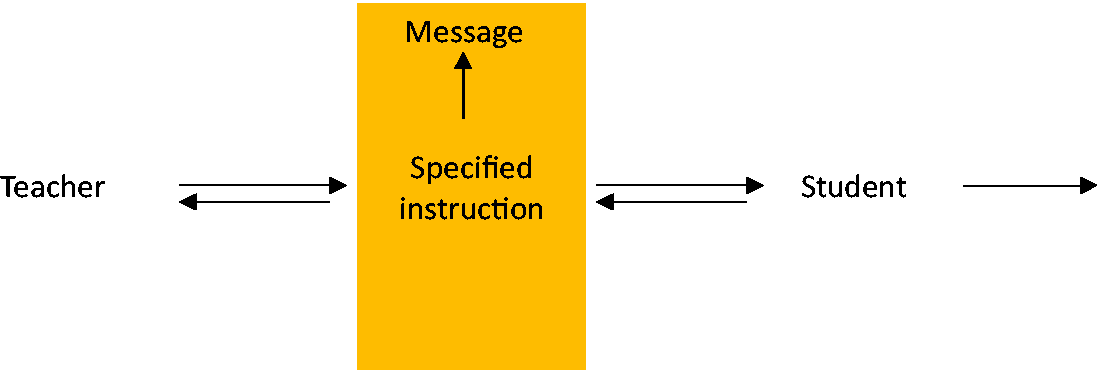
Model for direct instruction. The model shows a communication relationship between teacher and student. First, the teacher conveys a message to the student. This message takes the form of a specific instruction, i.e. the teacher is explicit as to how the student shall relate to the message. This means that the teacher issues a clear direction for the student. The arrow at the far right of the model illustrates that there is only one way to go for the student. The two arrows that proceed from student to teacher are the student’s response to the teacher.
As the model illustrates, DI is strongly teacher driven. DI is therefore a third-person perspective, as the teacher points out the direction to the students, who in turn must trust the teacher’s directives and guiding instructions. Learning is at the centre of the model.
Indirectness
Beyond this direct form of teaching, the dual purpose of pedagogy implies teaching that is indirect, which may be both third-person oriented and first-person oriented. A first-person perspective of the individual and social side of the dual purpose of education does require an indirect approach (Saeverot, 2013). That is to say, if you wish someone to respond independently of a third person (e.g. a teacher) you cannot point out the answer beforehand; instead, you need to be indirect in ways that you find valuable in the particular situation (Saeverot, 2013). But how may we understand the notion of indirect? In soccer, there is something called an indirect free kick, which can be helpful in understanding the notion. An indirect free kick means that the player is not allowed to shoot the ball into the goal on the first touch. When a player kicks the ball as the first person after the referee has blown the whistle, that same player cannot touch the ball until an opponent or co-player has touched the ball. This means that the ball must go through a co-player before it can be shot into the goal. In pedagogy, there are several forms of indirect teachings, which can be divided into two main groups (Saeverot, 2017). We will now examine these two groups.
Indirect summoning which is specified (ISS)
The first group or form of teaching is referred to as indirect summoning which is specified (ISS) (Saeverot, 2017). A concrete example of ISS is the teacher who praises one of the students publicly in the class for having acted morally according to certain criteria and standards. Such a form of praise communicates indirectly to the other students, who are thereby indirectly encouraged to act morally in the same or a similar way as the student being praised. Actually, the teacher has acted indirectly in two ways. First, the teacher has made a detour through an intermediary, which in this case is one of the students (who is praised), rather than communicating directly to the whole class. Second, the teacher has ‘wrapped the message’ by highlighting the ‘good’ behaviour of one of the students rather than saying directly that the other students may not have acted satisfactorily according to certain moral standards (Figure 2).
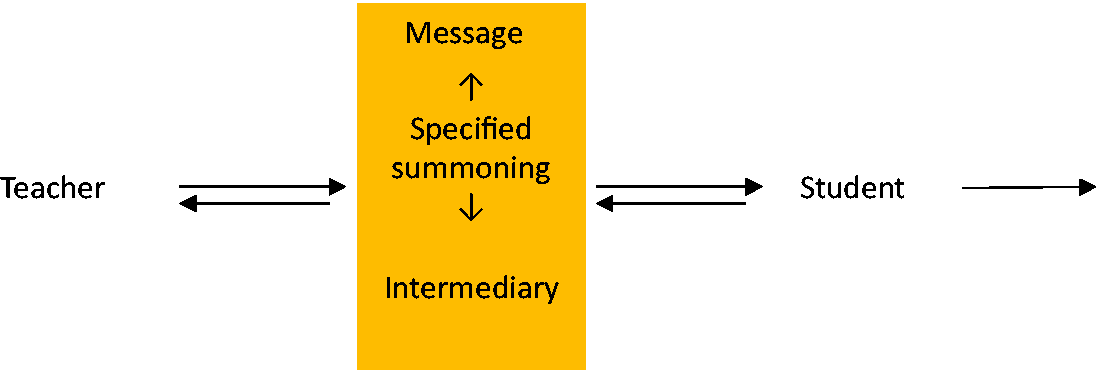
Model for indirect summoning which is specified (Saeverot, 2017). The model shows a communication relationship between teacher and student. First, the teacher conveys a message. This message goes through an intermediary, e.g. a fellow student. Even though the message goes through an intermediary, the message summons specifically how it should be received by the student (or group of students). That is to say that the teacher is explicit as to how the student should respond to the message. Despite the fact that the message goes through an intermediary, the teacher issues a clear direction for the student. The arrow at the far right of the model illustrates that there is only one way to go for the student. The two arrows that proceed from student to teacher are the student’s response to the teacher.
Although the teacher in this example is indirect, the teaching must be considered as a third-person perspective, as the student’s choices are neither free nor independent of the teacher as a third person. Furthermore, the teacher’s summoning is specific even though it is not specified in words, i.e. the teacher makes use of an example, specific words and perhaps also body language, as a way of guiding and directing the students. This ISS is therefore strongly teacher driven and based on a relatively strong desire for control.
Indirect summoning which is unspecified (ISU)
The other group or form of teaching which is indirect is referred to as indirect summoning which is unspecified (ISU) (Saeverot, 2017). A concrete example of ISU is teacher students who train to become teachers. Teacher students train to work in educational practice contexts where moral issues, such as value judgements, justice, principles of right and wrong, are prominent. Educational practice is therefore highly unpredictable, compared to a crafts person’s practice, e.g. a plumber (Saeverot and Kvam, 2019). One cannot teach a teacher student to become a good teacher in the same way as one can teach a plumber student to become a good plumber. Faced with teacher students, one must be much more indirect, precisely because educational practice is unpredictable by nature (Saeverot, 2017). For this reason, it is not beneficial to say specifically and directly what the teacher students should do when they enter educational practice. That would mean pre-empting what they might do. Therefore, teacher educators should, to a great extent, be indirect in their teaching of teacher students. For example, this can be done by using moral examples from educational practice, examples that make room for reflection, which may enhance the students’ understanding and awareness of moral issues in educational practice (Figure 3).
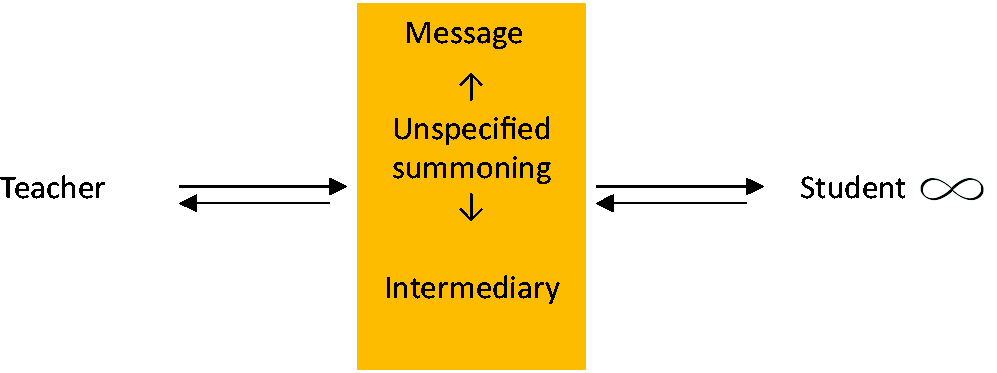
Model for indirect summoning which is unspecified (Saeverot, 2017). The model shows a communication relationship between teacher and student. First, the teacher conveys a message. This message goes through an intermediary, such as praise by way of criticism. The message, which goes through an intermediary, does include a summon, but the summon is unspecified. That is to say that the teacher is open as to how the student should respond to the message. This is how the teacher makes room for choice. How to respond is up to the student, who may also choose not to respond. The infinity symbol at the far right of the model illustrates that there is more than one way to go for the student. The two arrows that proceed from student to teacher are the student’s response to the teacher.
Since the teacher educator in this example does not summon anything predetermined and specific through the indirect teaching form, the teacher students are free to respond to the example regardless of what the teacher educator might think of the matter. In this way, ISU is categorized as a first-person perspective, as the students must trust themselves, involving self-trust rather than relying entirely on the teacher as a third person.
Praise given indirectly, e.g. by way of criticism, is another example of ISU (Saeverot, 2011). This kind of indirect praise also creates space for the recipients’ freedom, as the one who hands out criticism, through which praise appears indirectly, does not summon or call upon anything specific. Instead of praising someone directly, criticism may be used, i.e. a form of criticism which communicates indirectly that the recipient’s behaviour, or whatever it might be, is being credited as valuable, in addition to the criticism. Thus, the recipient has greater freedom and a more open choice when it comes to receiving such a form of indirect praise compared to direct praise which more clearly indicates and specifies the direction of the recipient’s response.
Findings
Direct instruction
The analyses of the social science lesson show that the teacher gave direct instructions both to the students individually and in groups. For example, the teacher said the following at the start of the lesson: The teaching henceforth will be about ‘power’. The first thing to do then is to open your books and write for two minutes, completely on your own. You should not talk to each other; rather, you should write individually for two minutes what you associate with the word power. You may start.
Similar direct instructions in connection with students at both an individual and a group level, alongside requirements for academic results, were revealed in the KRLE lesson. After the teacher gave instructions regarding group work, he gave the following message to the students: ‘Initially, you will receive pictures that you should try to place in the correct place. To which religion and beliefs do the pictures belong to?’ Shortly thereafter he added: ‘Your discussions are the most important part of this task. You must simply reflect’. Even though the teacher encouraged the students to discuss and reflect, he gave a clear indication of what this discussion and reflection should result in. He expected the students to acquire a specific academic form of knowledge. The teaching therefore equals a direct instruction as to what the students should achieve (by locating the pictures in the right place). During the group interview, the teachers pointed out that the purpose was to encourage the students to reflect, argue and discuss, and therefore figure out what was right.
Indirect summoning which is specified
After the individual work, the social science teacher asked the students to share their opinions on what they associated with the concept of power. At one point the teacher responded: ‘Some of them [the opinions] are quite obvious – they are associated with power. I hope you think: That was smart, I had not thought of that, but now I have’. The teacher highlighted the good examples from some of the students, while indirectly encouraging the other students to learn from these examples. This assertion is substantiated by the following situation. After a response from one of the students the teacher replied by addressing the whole class: ‘Now you must listen as these remarks are important. Please, repeat what you just said’. The student repeated his words: ‘Children of rich parents are spoiled and look down on others’. The teacher responded, yet again, to the whole class: ‘Is this true? Is this the way we show others that we are rich, i.e. by stating that this is not good enough for me?’ The teacher made use of a student’s claim and lifted it up both in a positive and questioning sense. Moreover, the teacher made use of the student’s claim as an indirect summoning to the whole class, giving them the opportunity to reflect and take a stand on whether the claim was true or not.
During the group interview one teacher told us that his job was ‘to sow the seed’. He did so by using good examples so as to highlight valuable statements from the students. Our findings also showed that the social science teacher, on several occasions, urged the other students indirectly to reflect upon assertions and statements made by the other students. He also used, on several occasions, the work efforts of individual students as intermediaries in the form of indirect criticism of the other students’ work efforts. For example, he said the following to the whole class: ‘Then I saw that some of you were writing eagerly’. He praised some of the students’ work efforts without criticizing directly those who did not. Rather, the critique shines indirectly through the praise. At the same time, something else is ‘working’ indirectly through this form of criticism, as the teacher tried to spur some of the students on to put more effort into their work. It all seems to be an attempt to improve the students’ work ethic.
In the KRLE lesson, too, the findings showed that the teacher made use of different intermediaries, including questions and hints, to indirectly encourage students to think and reflect. As stated, the task of the students was to place certain symbols under the correct religion or belief. After working with the task for a while, one of the students approached the teacher and said: ‘We think it resembled a scripture reminiscent of Hinduism or Buddhism’. The student and the group she was a part of were obviously not right, after which the teacher said: ‘Mm … yes, from that part of the world. Where have you seen Arabic script?’ The teacher would not give the student the correct answer directly. Instead, he pointed out where the particular religion (which was the right answer) is widespread, and then asked a question with a fairly clear hint (in other words that the religion is associated with Arabic script), through which the student and the rest of her group were then given the opportunity to find the answer on their own. This is how the students reached the correct answer, which in this case turned out to be Islam. During the group interview with the KRLE teachers it was obvious that the teachers tried to help students to understand that reflection can help them find the correct answers. For example, one of the teachers stated that they wished to ‘spur on the students to reflect’.
Indirect summoning which is unspecified
A concrete example of ISU was found through the following statement by the social science teacher: ‘Are there any of you who have power?’ Yet again the teacher addressed the whole class, with an apparently direct question which could be answered either yes or no. On closer inspection, however, the question is both complex and indirect. For the first time during the lesson, the teacher directed the question of power directly to each and every student. At the same time, indirectness was at work as the question created space for each of the students to reflect on their own relationship to power; whether they have power and how they possibly use power, and so on. Metaphorically, the teacher directed a ‘mirror’ to the students, and through this ‘mirror’ the students could assess themselves.
The observations showed that none of the students responded directly to the teacher’s question, but there were new opportunities to do so, as the teacher followed up on his question with: ‘I believe some of you have more power than others. And I believe there are quite a few young people who experience power repeatedly’. Notice that the teacher uses the word ‘believe’ in both sentences. To believe indicates some kind of uncertainty and doubt, a form of assumption, but also an indirect ‘test’ in which students were given the opportunity to test out the teacher’s assumption and belief. The indirect approach being used by the teacher is related to unspecificity as no specific directions were given other than a summons to think and reflect, i.e. the students could, if they chose to do so, think and reflect upon their own relationship to power. Yet again, the students did not respond to the teacher’s reaching out, but that does not mean it was wasted. On the contrary, he had made it possible for the students to reflect on issues which concern their inner life and, ultimately, the way in which they exist morally in the world, in this case with regard to the concept of power.
During the group interview, the teachers pointed out the importance of challenging the students to reflect on their own, and whether they exercise power and, not least, how they influence others through their own use of power. The teachers were concerned about raising self-awareness concerning power. At the same time, they emphasized that they did not look for ready-made answers. The important thing was that the students had to think for themselves. As one of the teachers said: ‘We were keen not to dismiss anything’. Another teacher pointed out that the students’ responses to experiences of power were never seen as wrong (‘even though it was far from what I expected’). It was about challenging the students to respond, either publicly (aloud) or privately (in silence), and it was about the students’ unique responses and opinions.
In contrast to the social science lesson, the KRLE lesson had more focus on correct answers, which is confirmed by the teacher’s introduction to the lesson: There are six religions/beliefs on this wheel. First, you’ll receive pictures which you should try to place in the correct location. Then, there are texts … it is a matter of problem-solving to find out where the pictures belong. You simply have to discuss and reflect.
Outlines for a fourth model of teaching: Direct-indirect teaching
In the analysis of the data material from the social science lesson, we also found indicators for a fourth model of teaching, i.e. an interactive combination of DI and ISU, which I refer to as direct-indirect teaching (DIT). Even though the findings were too weak to form a new model of TIP, they formed an outline or sketch of the possibility of developing such a model.
It was very difficult to pinpoint DIT in the analyses, because at first glance it seemed that the teacher had only instructed the students directly and explicitly on what to do and what they should achieve: Now you should spend a few minutes talking together in the group, and you must make notes on the sheet I gave you. Who, among youths – you may think in general, or you can use yourselves as examples – but in any case, you should say something about who among the youth has power. And you should consider or say something about how that power works, and you should write something about certain characteristics of those who possess power.
Actually, in this case, indirectness worked through the directness. In what way? At the beginning the teacher approached the students’ own world but not on an individual level. The teacher let there be space between the concept of power and the individual student as he urged the student group to assess the use of power by other youths. Even so, the teacher’s approach can be understood in the sense that he indirectly encouraged the students to assess themselves, based on the concept of power. The teacher, although this was not stated in so many words, minimized the distance between the relatively abstract concept of power and the individual student. First, he created space for talking about and reflecting upon power on a general basis. Second, he gave room to reflect on the power of youth, and this is where the teacher indirectly created an opening for the students to reflect on their own relationship to power. It was entirely up to the individual student to do this or not. The choice was completely free. Therefore, in my view, this is an example of ISU. This is supported by the fact that the teacher directly encouraged the students to perform the task in groups. While he created a certain distance between the individual student and power, he indirectly closed the distance between the individual student and power. On the one hand, the teacher let the students choose to keep this distance, thus ignoring themselves with regard to power and, on the other, he made room for reflection whereas students might draw the theme of power closer to their own world.
In the group interview, the teachers stated that they would connect power ‘on the personal level of the students’ and find out whether the students were aware that they were subjected to power and whether they themselves were using power and thereby influencing others negatively. One of the teachers asked the following question: ‘How much do they know about their own power?’ ‘We wanted to investigate power among peers’, another teacher stated. Furthermore, ‘As the goal is to make the students socially competent we have to play ball with them’. The teachers also realized that it might be easier for the students to talk about power on behalf of a group. Responding on behalf of a group does not signify whether the student belonged to this group or whether the student referred to a group that exercised power. Yet, there were openings for relating power to their own individual lives.
Discussion
There are no findings in the study as to whether the teachers succeeded in removing undemocratic attitudes or preventing the formation of undemocratic attitudes. Such a task is way too complex and was therefore not the purpose of the study. One purpose of the study was to address this research question: How do teachers teach to remove undemocratic attitudes and prevent the formation of undemocratic attitudes? So, what do the findings show in this sense? Can the findings in any way help us to see how teachers teach to remove and prevent the formation of undemocratic attitudes? In order to address these questions, we will now discuss the following question: When, or in what situations, did teachers make use of direct and indirect approaches (DI, ISS, ISU, DIT) in their teaching where undemocratic attitudes were the main theme?
The analyses of the data material show, both with regard to the social science lesson and the KRLE lesson, that DI were given to the students individually and in groups, as well as in connection with what they should do or perform and for results and outcomes throughout the course of the teaching. In other words, DI was used when students were about to learn something in the sense of acquiring knowledge and insight. DI was also used when the teacher explained something to the students, especially related to the understanding of concepts. All in all, DI was primarily used for purposes of learning in an epistemological sense.
We also found that the KRLE teacher acted indirectly on certain occasions. Instead of giving the students the right answer directly, he used questions and hints to help them find the right answer. This way of teaching was therefore classified as ISS. The specificity of this indirect summoning is also related to learning in an epistemological sense, as the purpose was to acquire certain knowledge and insight (on particular symbols used in the major world religions). As for the social science teacher, he used the indirect method in a somewhat different manner. For example, he communicated indirectly by way of praise, as well as criticizing and motivating the students. On several occasions the social science teacher made use of ISS, but it did not always lead up a correct answer, contrary to the KRLE teacher’s use of this model. As we have already seen, the social science teacher summoned the students to take a stand concerning other students’ claims and statements, which is a detour or an indirect path along which the students must travel before they can reach the goal. Even though the teacher did not look for fixed answers in these situations, his indirectness was specific (ISS), as he clearly encouraged the students to decide whether the claims and statements of other students were true or not.
As already stated we found no signs of ISU being used during the KRLE lesson. In the social science lesson, however, we did find signs of teaching in which ISU was used. Through indirect summoning, the social science teacher created spaces in which students could, if they chose to do so, reflect on their own relationship to power. Questions were raised in silence, such as: Do I use power? How do I use power with my fellow human beings? The students were thus challenged on a subjective-existential and moral level (Saeverot, 2013; Biesta, 2014). The challenge became even more prominent as the teacher threw out the assumption that some of the students in the class both have power and exert power over others. It is important to emphasize that the teacher did not go beyond assuming and believing without any attempts at reaching a conclusion or final answer. Rather, he was both doubtful and interrogative in his approach, and because of that he gave the students the opportunity to reflect on this and how they relate to power in their daily life. I called the teacher’s approach an indirect ‘test’ which was unspecified as it was not a matter of finding a specific answer. No specific directions were given as to what the students should achieve, and there was certainly no use of coercion; instead, the students were given the freedom to respond in their own unique manner or, indeed, the freedom to not respond at all.
The social science teacher then spent quite a lot of time on clarification and understanding of the notion of power. Through DI he attempted to contextualize power by relating it to the students’ world and sphere of existence. Through indirect questions and personal assumptions, he summoned the students to turn their eyes on themselves and thereby reflect on their own relationship to power. There is also support in the data to claim that the teacher, by using ISU, worked to remove undemocratic attitudes and prevent the formation of undemocratic attitudes in light of the students’ perception of power.
But, as noted previously, this was not specified by the teacher, and the choice was entirely up to the students themselves. The teacher then avoided pointing a moral finger, instead giving explicit instructions as to how the students should relate to power. Such a strategy contains both advantages and disadvantages. While the disadvantage may be that the teacher cannot know whether the students will choose to reflect on their own relationship to power or not, the advantage is that the students can freely choose to do so, or not. If we imagine that the students choose to relate power to their own lives, then what? In such a case one might imagine that the students can have an inner conversation with themselves, even judging themselves and, so to speak, point the moral finger at themselves. Directing the introspection at oneself in this way is synonymous with a first-person perspective. It is not a third person who does this for them, even though this third person – the teacher – has indirectly summoned them to do so.
Conclusion
Figure 4 summarizes and categorizes the main findings of the study, while explaining why teachers alternate between the different models of teaching.
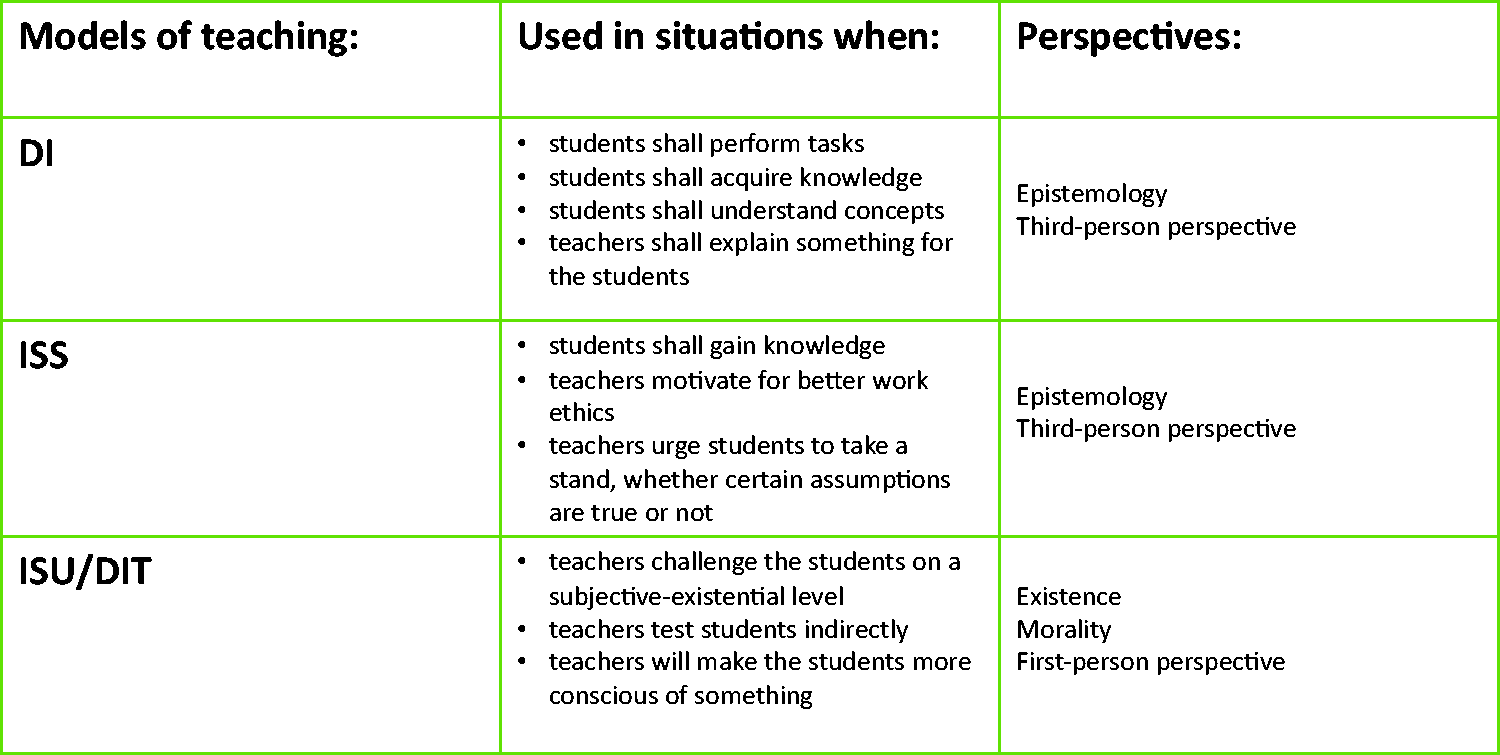
Model showing when DI, ISS and ISU/DIT were used during the observed teaching lessons.
While the teachers used DI and ISS in situations when it was important to achieve knowledge of terms and concepts, ISU and DIT were used when the teacher challenged and tested the students on a subjective-existential and moral level, and, inter alia, to remove undemocratic attitudes and prevent the formation of undemocratic attitudes. Both DI and ISS are connected to epistemology and are relatively teacher driven, i.e. the teacher appears as a third person, one that the students must trust, at the cost of self-trust. ISU and DIT, on the other hand, are connected to existence and morality. The students’ choices, responses and opinions, which may be completely unknown to the teacher in advance, are strongly emphasized. Thus, ISU and DIT are first-person perspectives, where both trust in the teacher and trust in oneself (self-trust) are prominent features. The findings indicate that the teachers were quite aware that DI and ISS would not work in situations where they wanted the students to reflect on their way of being in the world. We therefore assume, based on what the teachers stated in the group interviews, that DI and ISS would simply be too direct and intrusive when it came to issues of existence and morality. 4 Conversely, the findings imply that DI and ISS are more suitable when it comes to epistemological matters.
If we look at the findings in a holistic perspective, they suggest a combination and alternation between DI, ISS and ISU, and there are two main reasons for doing so. First, students need knowledge and insight of concepts which are related to undemocratic attitudes, e.g. the concept of power. In such cases, DI and ISS may be appropriate ways of teaching. Second, the findings imply that removing undemocratic attitudes or preventing the formation of undemocratic attitudes are not just a matter of achieving knowledge. Epistemology should therefore be combined with both existence and morality. An important factor, the findings imply, is that neither existential nor moral issues can be forced upon the students. For that reason, teachers should teach in such a manner that the students can, by way of free choice, have inner conversations with themselves on, e.g. their relationship to power and how their exertion of power may affect their own and other’s lives, both in action and attitude. In such cases, ISU and DIT may be appropriate ways to teach.
As already stated, our study provides no answers as to whether the teachers were able to remove undemocratic attitudes or prevent the formation of undemocratic attitudes. But despite this and other limitations of the study, we believe it can have value and actuality by contributing to knowledge and awareness of DI, ISS, ISU and DIT. Perhaps more importantly, the study creates space for new research topics in education, e.g. DI, ISS, ISU and DIT, which are relatively unexplored in education.
Footnotes
Declaration of conflicting interests
The author(s) declared no potential conflicts of interest with respect to the research, authorship, and/or publication of this article.
Funding
The author(s) received no financial support for the research, authorship and/or publication of this article.
