



Abstract
The profound evolution that Spanish language education has experienced since the passing of the first modern educational law in 1970 has led to improved students’ proficiency. In this sense, traditional foreign language teaching has been gradually substituted by Bilingual Education in the country to promote language learning, intercultural competence, and mobility; however, reviews in the field have not examined language education in all the Spanish regions but rather they have only considered isolated regions or compared some of them. This paper provides a historical analysis of Spanish language education, reviewing its evolution since 1970, and comparing the country’s bilingual and monolingual regions. Findings show that differences among territories mainly concern the areas and number of hours devoted to foreign language teaching and teacher linguistic requirements. Content and Language Integrated Learning is the main approach to Bilingual Education followed, whereas English is the main language of instruction in all regions.
Introduction
The efforts of European institutions such as the Council of Europe (2019) and the European Commission (2003) to promote language learning among citizens have materialized into different forms of Bilingual and/or Multilingual Education (BE), where two or more languages—native or foreign (FL)—are used to teach non-linguistic contents, seeking simultaneous proficiency in the languages and the content areas. Unlike traditional FL teaching where languages are taught solely as linguistic subjects, BE offers students more language input while also allowing them to learn languages in a functional way; however, linguistic diversity and natural differences among nations make countries’ attempts to implement this type of language education significantly dissimilar (Izquierdo, 2017).
Spanish regions and official languages.
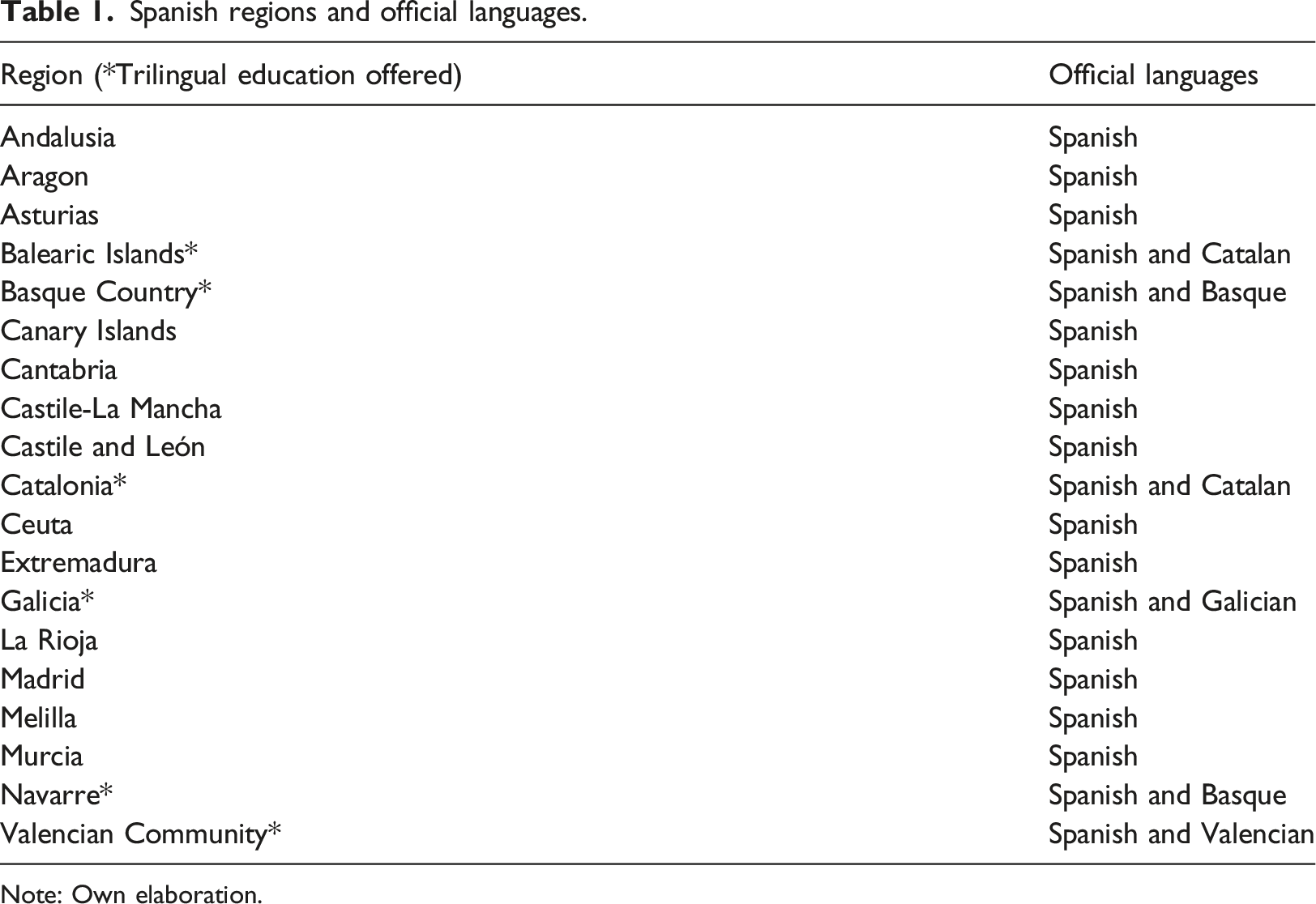
Note: Own elaboration.
Considering Spain’s linguistic diversity, previous historical analyses on BE evolution in the Spanish regions in the last decades have not been comprehensive, as they only focus on either isolated regions (Couto-Cantero and Bobadilla, 2017) or a comparison among some of them (Vila et al., 2017). Furthermore, few revisions consider the historical development of language teaching before BE implementation in the country, yet hardly any mention the situation in Ceuta and Melilla. Addressing this gap by analyzing language provision could help understand not only how language education has evolved in Spain since the passing of the first modern educational law in 1970 (Spain, 1970) but also how Spain’s attitude toward learning and teaching languages has shifted over the years and adapted to the new demands that society is posing on individuals. Furthermore, it could help comprehend how this evolution has led to similarities and differences among regions in terms of how language education developed. Therefore, this paper analyzes BE in each region to determine similarities and disparities between BE developed in the different Spanish regions.
Key aspects
Language policies and bilingual education
Language policies encompass the set of decisions that a government adopts to regulate “the scope and use of the languages and/or language varieties within its territory” (Chacón-Beltrán, 2015: 141). These allow explaining how languages are conceived as part of the cultural identity of a context (Tsui and Tollefson, 2015). These policies, which may affect different areas of society, have a clear impact on educational systems since governments’ decisions must be reflected in the way language education takes place in schools.
Language policies have been extensively analyzed trying to explain their importance for understanding BE in different contexts (Johnson, 2010; Tsui and Tollefson, 2015) and to depict how several actors play a role in developing standards for language education (Ricento and Hornberger, 1996). As pointed by Tsui and Tollefson (2015), language policies reflect not only a country’s national cultural identities but also the effects of globalization and its responses to it; therefore, the study of language policies with a historical perspective can help to understand the evolution of a country’s conceptions of the languages, national and foreign, spoken by its citizens, while identifying the main educational approaches and methodologies developed to promote language learning and linguistic diversity and their possible weaknesses to encourage the improvement of language education.
As for the concept of BE, it aims at “teach[ing] content through an additional language other than the children’s home language” (García, 2009: 17). BE in European countries is intrinsically influenced by the Council of Europe’s (2019) aim to make EU citizens master, at least, two languages in addition to their mother tongue. European educational institutions have gone beyond teaching languages as isolated subjects and now implement BE. Among the different approaches, Content and Language Integrated Learning (CLIL) has spread across Europe aiming at learning FLs and non-linguistic contents simultaneously (Coyle et al., 2010).
BE has been claimed to force assimilation into nationalist ideologies (e.g., Kaur and Shapii, 2018). In Spain, for instance, co-official languages were prohibited for 36 years during Franco’s regime (1939–1975; Núñez-Méndez, 2019) until in 1992 regions were allowed to operate in the areas of language policy. The situation today has somehow reversed 1 : nationalism is growing in bilingual regions and so is the importance given by regional institutions to co-official languages over Spanish (especially in Catalonia, where some people complain against the imposition of Catalan at schools; Núñez-Méndez, 2019). Nevertheless, it is still noteworthy that, despite how teaching these languages in all the regions could favor Spaniards’ mobility within the country, these are exclusively taught where they are co-official.
Bilingual and language education in Spain and regional affairs
In the Spanish context, the LGE (Ley 14/1970) can be considered the first modern educational law since it entailed a series of significant changes in compulsory education. Although passed during the last years of Franco’s dictatorial regime (1939–1975), the educational system experienced a relevant shift: after years of dominance of Spanish over other languages, which were claimed to be inferior (Núñez-Méndez, 2019), FL teaching was introduced in compulsory education. Decades later, the linguistic intolerance toward co-official languages finished with Ley Orgánica 9/1992 (Spain, 1992).
Since the passing of the LGE, Spanish regions have the freedom to adapt the general standards established by the state education law; thus, BE implementation may vary from region to region. However, research has not developed a comprehensive analysis on BE evolution in the different regions as it either focuses on isolated ones or compare some of them. For instance, Couto-Cantero and Bobadilla (2017) analyze Spanish language teaching standards but only focus on Galicia. Vila et al. (2017) describe the sociolinguistic historical backgrounds of bilingual regions (see Table 1) and BE without reference to monolingual territories; even comprehensive studies do not mention Ceuta and Melilla (Izquierdo, 2017). Moreover, hardly any revisions consider the historical development of FL teaching preceding BE implementation.
In this line, the fact that Spanish education has been traditionally characterized by constant legislative changes by which different political ideologies have instilled their beliefs into education (cf. Merchán-Iglesias, 2020; Valls-Montés, 2007), together with regional competences to operate in language education as well as the linguistic diversity of the country (see Table 1), have undoubtedly affected BE implementation. Therefore, a comprehensive historical analysis of the laws passed since then could allow a better understanding of the current Spanish BE.
Method
Objectives
This paper develops a historical analysis of language education in Spain. To do so, a qualitative approach is followed, based on a systematic analysis of Spanish state and regional educational language policies that have been in force since 1970, when the first modern Spanish educational law was passed.
The objectives of the study are: (i) to examine how language education has evolved in Spain since 1970; (ii) to analyze and describe language education in each region; and (iii) to determine similarities and disparities between language education developed in the different regions.
Procedure
Three stages were followed: (i) literature search and selection, (ii) document gathering, and (iii) data analysis (Kitchenham et al., 2009). In the first stage, a general search in legal and non-legal databases (i.e., Aranzadi, Biblioteca Jurídica Digital, Dialnet, and Google Scholar) was developed. The search query was “((Spain OR España) AND (“foreign language*” OR “lengua* extranjera*” OR “bilingual education” OR “educación bilingüe” OR “language polic*)).” This phase aimed at studying previous research analyzing Spanish language policies and creating a documentary corpus with the state language policies passed since 1970 and the regional language policies currently in force in each Spanish territory. Furthermore, the websites of the regional educational institutions were also used in this stage to identify regional language policies that have not been previously identified in the databases aforementioned. In the second stage, the full texts of the final 31 selected documents were obtained from the databases and the webpages of regional educational institutions’ webpages, using Mendeley Desktop for Windows to organize them. In the third stage, which will be fully explained in the following section, the documents were analyzed using content analysis (Arbeláez-Gómez and Onrubia-Goñi, 2014).
Data analysis
Historical and content analysis techniques were followed in the study. Historical analysis entails the study of “documents as the material for the re-creation of the past, the perceived historical patterns and an explanation of them [bearing in mind that the] understanding should be informed, but not overwhelmed, by the preoccupations of the present” (Bricknell, 2008: 108). Rather than focusing on chronological time, an effective historical analysis focuses on the use of language to understand historical events and the social contexts where they take place (Foucault and Rabinow, 1994). Considering the potential of historical analysis to understand educational policies (e.g., Peters, 2007), in the present study Spanish state and regional educational language policies are analyzed historically to understand how language education has evolved in Spain since 1970.
On the other hand, content analysis aims to verify the presence of certain themes, words, or concepts and their meaning within a text in a particular context (Arbeláez-Gómez and Onrubia-Goñi, 2014). This type of analysis will determine whether specific ideas (such as the first implementation of BE in the different regions or the linguistic requirements for teachers) are present in the Spanish state and regional educational language policies considered in the study.
To perform content analysis, three stages were followed (Arbeláez-Gómez and Onrubia-Goñi (2014): (i) initial document organization according to their legal scope (i.e., state or regional policy); (ii) description of the explicit references to the coding categories and sub-categories established by the researchers; and (iii) interpretation of the data following reading, analysis, synthesis, deduction, and induction procedures. To minimize bias, the researchers developed an individual inductive analysis of the documents and determined their own categories; after, consensus was reached by sharing the categories found individually and selecting the two most repeated by the three researchers as the final ones for the study. The analysis was developed between January and May 2021.
Two main coding categories were established: (i) legal scope and (ii) standards for language education. The sub-categories found are described in Figure 1: Coding categories. Note: Own elaboration.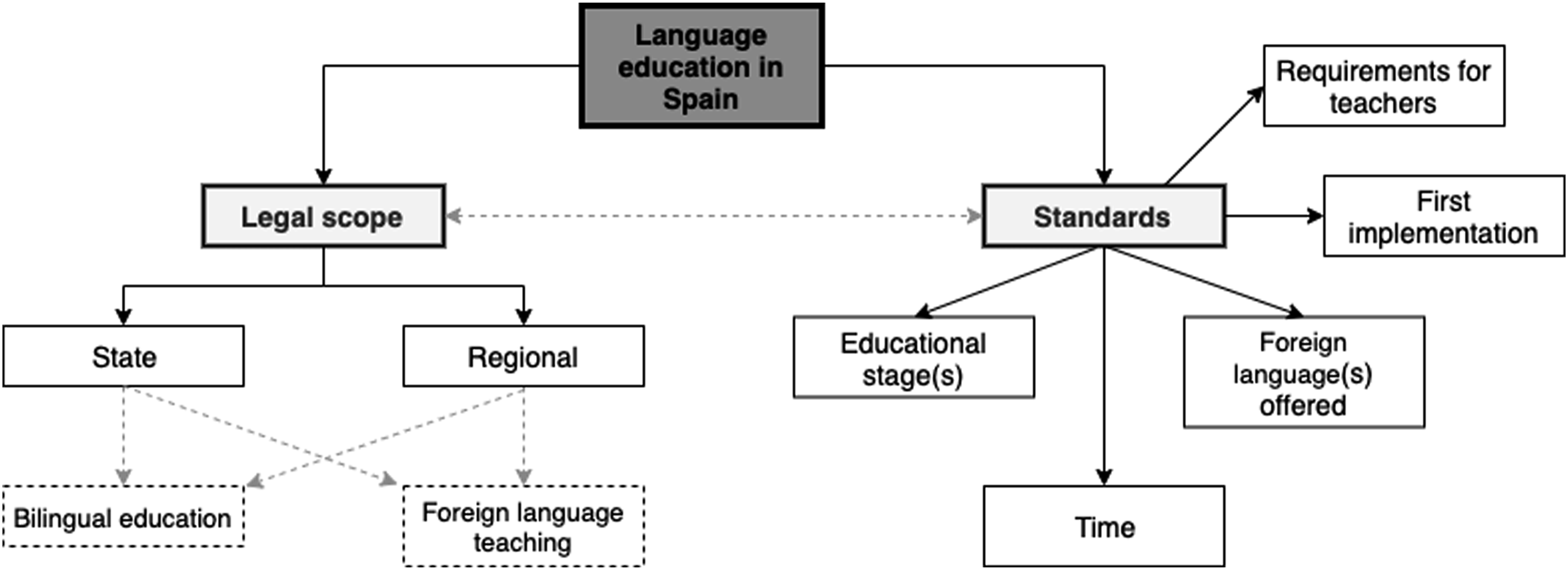
Findings and discussion
Foreign language teaching
Spanish educational legislation from 1970 to 2020.
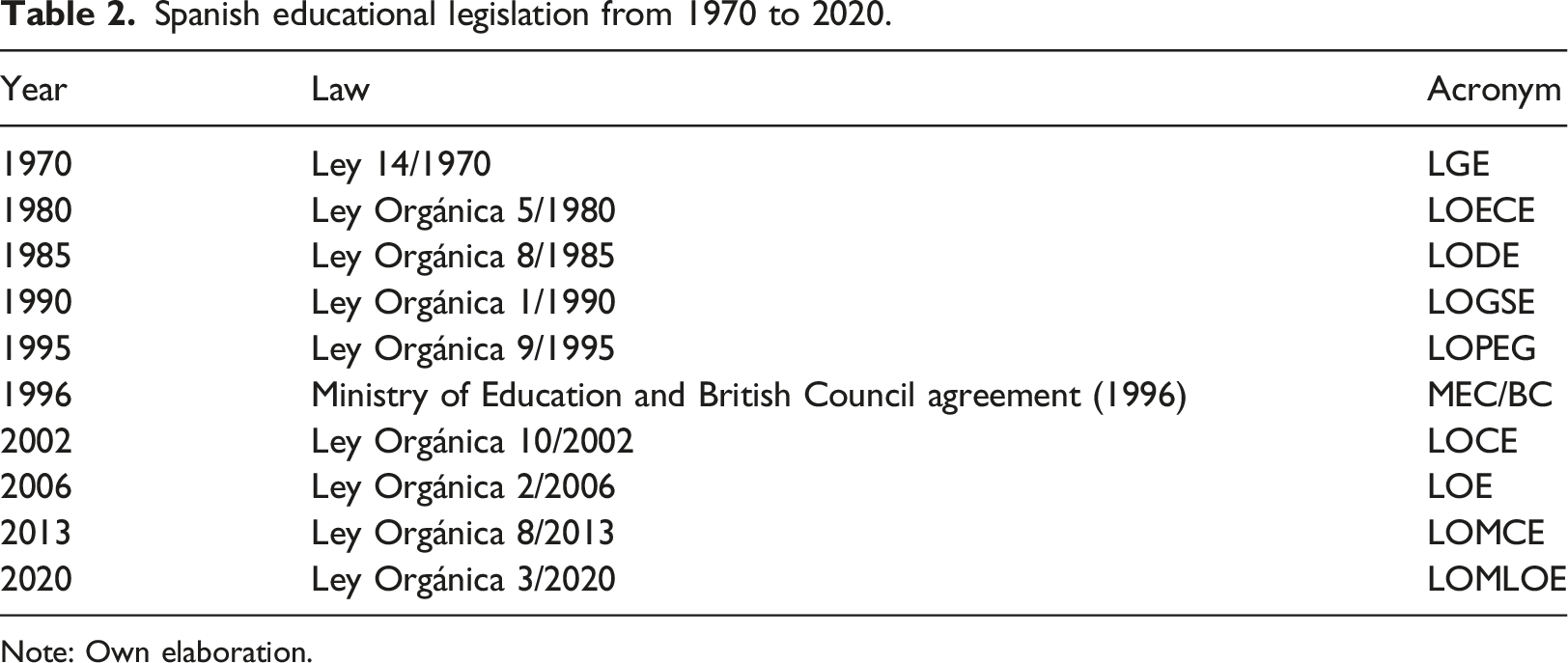
Note: Own elaboration.
FL learning/teaching in Spain has shifted over the last decades. The traditional FL teaching methodology has given way to different CLIL programs being administered by regional authorities throughout the country (Roldán-Tapia, 2012). This shift in the understanding of FL education has its roots in the 1996 MEC/BC agreement, developed to respond to Europe’s guidelines to promote linguistic diversity and FL learning (MEC/British Council, 1996). The agreement established BE in 43 state schools with 1200 pupils aged 3–4, and since then, BE started to be introduced in compulsory education at all levels (Dobson et al., 2010). Two decades later, this pioneering program is still in force in 89 Pre-primary and Primary and 56 Secondary public schools in 10 regions and in Ceuta and Melilla. Both the MEC/BC project and CLIL promote active and meaningful learning, and content and language proficiency; nevertheless, CLIL goes beyond by including more FLs apart from English (e.g., French and German) and a greater variety of non-linguistic subjects (e.g., music and mathematics).
However, the Spanish linguistic reality began to change in the late 20th century when claims for a new language teaching methodology arose. In this light, eight educational laws have been elaborated since 1970, each introducing new nuances in FL and BE. Up to then, FL learning/teaching was reduced to upper Secondary Education; FLs were studied (French, primarily) from the age of 12 until 16. With LGE (Spain, 1970), education was made compulsory up to the age of 14, and FL teaching was introduced in the sixth year of Elementary Education. English started to gain relevance as an FL at schools, and the use of the mother tongue was reduced. Unfortunately, FL resources were scarce since schools did not have enough means to meet the recommendations from official institutions (Barbero, 2012). In the 1980s, students aged 10 could start studying FLs, although in the practice the idea did not materialize. FL learning was also provided for students aged 14–18, being French and English the common options. A second FL was also introduced at the age of 16 (Spain, 1985).
LOGSE (Spain, 1990) emphasized the importance of English for multicultural knowledge. It introduced FL learning from the age of 8 and increased the hours devoted to the FL subject up to 170 per year. However, the Ley Orgánica 9/1992 (Spain, 1992) gave regions the freedom to organize educational aspects, which led them to gradually configure their own linguistic policies.
Changes continued with the beginning of the 21st century. In 2002, LOCE (Spain, 2002)introduced FL learning in the last year of Pre-primary Education (from two to four weekly hours depending on the region) and reassured the need to speak an FL to guarantee integration. Likewise, LOE (Spain, 2006) restated the introduction of the FL at an early age and the necessity of promoting FL learning to foster integration within Europe.
More recently, LOMLOE (Spain, 2020) highlights the need to establish flexibility measures and methodological alternatives for students with specific educational needs, especially for those with comprehension and expression difficulties. Furthermore, it also emphasizes the promotion of teacher training in FLs regardless of the subject they teach.
Despite the evolution of FL education throughout the years, there has been a prevailing tendency to consider English as the prime FL in educational laws since 1970, as English has been established as the modern lingua franca (i.e., an international/intercultural communication tool; Barbero, 2012). Multiple reasons explain the power of English, including historical facts such as colonialism and the expansion of the British Empire, or its importance in technology. However, apart from English, French and German have been and are also present in Spanish education, although the number of students that decide to study them is considerably lower (Izquierdo, 2017).
Bilingual education
Language policies in the Spanish regions.
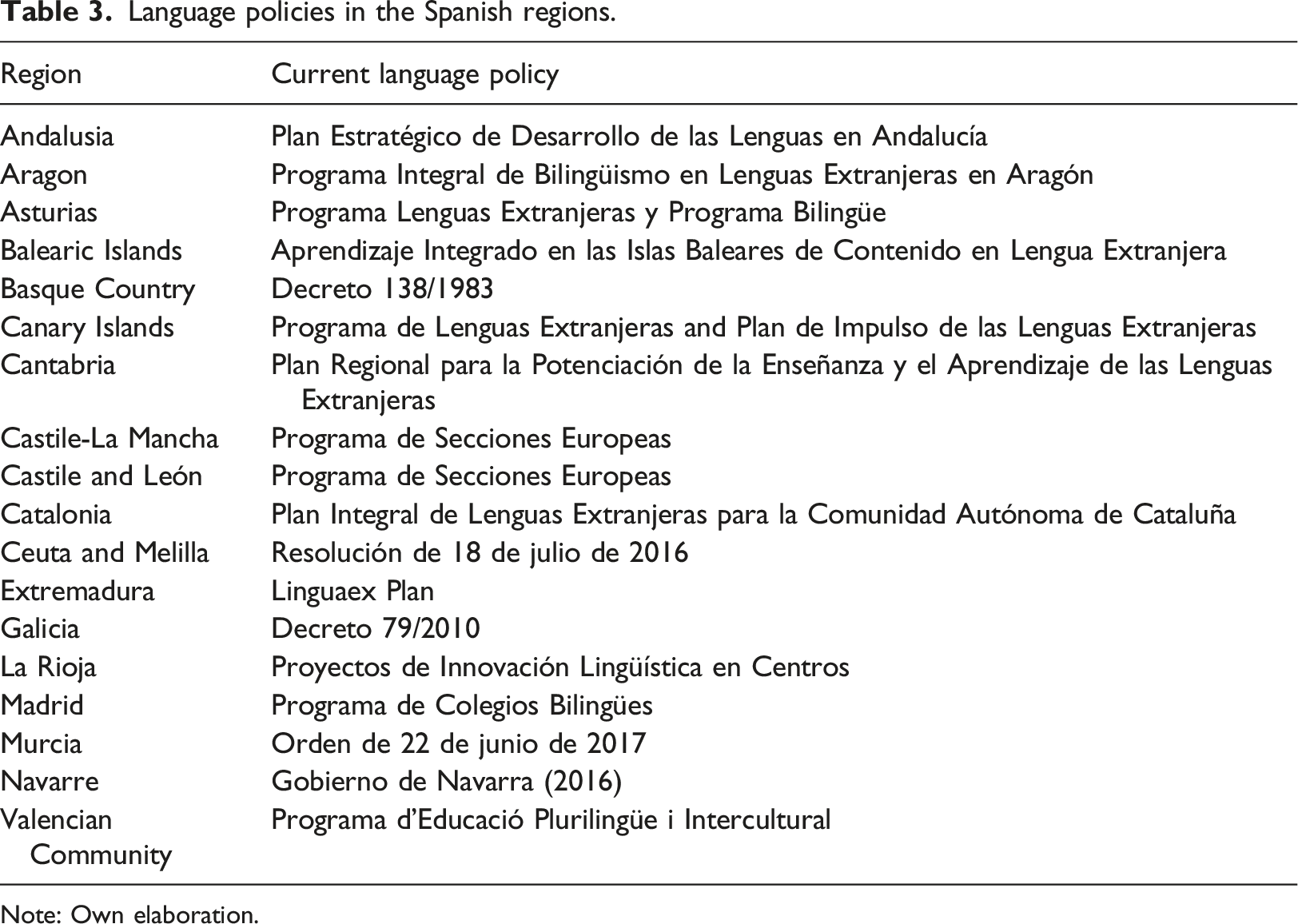
Note: Own elaboration.
Precursors of bilingual education: Community of Madrid and Andalusia
Madrid and Andalusia can be considered forerunners in BE implementation, where two decades of work and efforts have resulted in CLIL students having better results than their non-CLIL counterparts (British Council, 2017; Madrid and Corral, 2018). In Madrid, the Programa de Colegios Bilingües started in 2004 in 26 public schools, initially aimed at Primary and Secondary Education, although it has been recently extended to the second cycle of Pre-primary. Nowadays, it is present in 553 Pre-primary and Primary schools (of which 360 are public, 193 are state-funded, and 10 offer BE through the MEC/BC agreement), and 134 public high schools. Within Secondary schools, 15 of them provide BE programs where French is the language of instruction since 2006. There are also four high schools where German is the language of instruction: two of them started with BE in 2006, the third one in 2007, and the fourth in 2013. All subjects, except for mathematics and Spanish, can be instructed in the FL (Comunidad de Madrid, 2019).
BE in Pre-primary and Primary Education is used in science and any other subject up to 30% of the teaching hours. BE in Secondary Education is offered in two modalities: (i) bilingual sections, where students receive 5 hours per week of advanced FL (including literature from FL-speaking countries) as well as the areas of natural and social sciences and any other (except for mathematics, Spanish, and second FL) through the first FL; and (ii) bilingual programs, where students also receive five weekly hours of FL and at least one other subject. As for teachers, they need a C1 (advanced) level in the FL and are provided with specific CLIL training (Comunidad de Madrid, 2019).
The situation is similar in Andalusia. BE at schools started in 2005 aiming at implementing CLIL, reinforcing language learning, and developing communicative competences in FLs. In 2015, the Plan Estratégico para el Desarrollo de las Lenguas (Junta de Andalucía, 2016) was developed to improve students’ and teachers’ communicative competences in the FL as well as the methodologies applied, and also to promote intercultural competence. Teachers need a B2 (upper-intermediate) level and, as in Madrid, the subjects taught in the FL can be many: science, arts, technology, and PE, among others.
There are two CLIL modalities in Andalusia: (i) BE centers, where content subjects are taught through English, and (ii) plurilingual centers, where the first FL can be English, French or German, and which incorporate the learning of certain areas in a second FL. From the initial 139 BE centers, the number has now increased to a total of 1128 public schools (1082 offering BE in English, 45 offer a combination of English and French, and one combining English and German) and 345 state-funded schools teaching an average of 300,000 students (Junta de Andalucía, 2018). In Pre-primary, FL is introduced with 1 hour and a half per week; in Primary, science and any other subject different from mathematics, Spanish, and the second FL can be taught through the first FL, while mathematics can also be taught in the FL in Secondary.
Bilingual regions
The situation is slightly different in bilingual regions, where education becomes trilingual to protect and revitalize their co-official languages (see Table 1). Therefore, maintenance programs are developed in these territories. In all of them, the co-official becomes one, if not the principal, language of instruction, and in this line, there are raising debates on whether these should be compulsory at schools or offered as optative (Núñez-Méndez, 2019). Nevertheless, this study only describes how co-official languages are present in language policies without attempting to include subjective judgments on the issue.
In Catalonia, Catalan and Spanish are the two official languages. However, with the gradual introduction of English in the educational scene, schools are promoting multilingual programs. Since 2009, the region implements two BE types: (i) Tratamiento Integrado de Lengua y Contenidos in Primary and Secondary Education, a CLIL-like method based on collaboration between language and content teachers where Catalan is the language of instruction (parents cannot choose Spanish); and (ii) a CLIL approach which allows introducing an FL (English, French, German or Italian) when teaching non-linguistic contents. The distribution of hours devoted to each language depends on schools, with up to 30% of the teaching hours for each one, and teachers are required a B2 level to participate in BE. Both modalities provide students with multilingual and intercultural competences that guarantee a good command of Catalan and two FLs (Gobierno de Cataluña, 2018).
The Basque Country has undoubtedly promoted the revitalization of the Basque language the most (Etxebarria, 2015). For this purpose, three types of models were introduced in the Basque educational context in 2010: (i) model A, where Spanish is the language of instruction, and Basque one single subject; (ii) model D, where Basque is the language of instruction, and Spanish one single subject; and (iii) model B, where both are used as vehicular languages (Basque Country, 1983). Furthermore, a Basque-Spanish-FL trilingual model is implemented since 2010, and students must have five weekly hours in Primary and six in Secondary of the three languages.
The situation in Navarre is similar to that of the Basque Country. However, Basque is becoming highly controversial in Navarre and, although there have been attempts to promote English (Gobierno de Navarra, 2016), experts urge revitalizing Basque rather than other FLs to boost minority languages in a Global-English-speaking world (Etxebarria, 2015). Regarding the teaching of English, two options are possible: (i) Programa Aprendizaje en Inglés following CLIL in Primary; and (ii) bilingual sections in Secondary, where French and German are also used as vehicular languages; in both, at least two content subjects must be taught through the FL (18–35% of the teaching) and teachers need a C1 level (Izquierdo, 2017).
In Galicia, bilingual sections were officially regulated in 2006 and implemented from Primary to Secondary Education. Schools are free to choose the language of instruction, either Spanish, Galician, or an FL, which are combined giving each 30% of school time approximately. As in other regions, teachers must have at least a B2 level in the FL to teach BE lessons (Galicia 2010). Furthermore, special attention is given to teacher training (Couto-Cantero and Bobadilla, 2017).
Since 2012, The Valencian Community has three different types of multilingual education in all stages: (i) multilingual programs teaching in Valencian, Spanish, English, or another FL (in which teachers need at least a B2 level); (ii) a program where Valencian is the language of instruction; and (iii) a model where Spanish is the language of instruction. In all of them, content areas must be taught in Spanish or Valencian, and curricular measures (support materials and reinforcement of specific non-linguistic contents) must be adopted to reinforce the learning of English. In this sense, in Pre-primary, students must be exposed to simple English input, while content subjects (at least one different from Valencian and Spanish) have to be taught through it in Primary and Secondary (Comunidad Valenciana, 2018).
Finally, in the Balearic Islands, both Spanish and Catalan are official languages. However, Catalan has been used as the language of instruction for nearly three decades, while English is also acquiring great importance (Juan-Garau and Salazar-Noguera, 2015). Two CLIL models are developed since 2009: (i) one with at least five weekly hours of Spanish, Catalan, and English in Primary and at least six in Secondary; and (ii) another, also implemented in Higher Education, where at least 1 hour must be devoted to the teaching of any subject in an FL, except for those that must be taught in Catalan. Teachers in this region are also required a B2 level to teach BE lessons () (Illes Balears, 2013).
Monolingual regions
Spanish is the only official language in monolingual territories. However, they also implement BE aiming to foster plurilingualism among citizens. Aragon, for instance, follows two CLIL-like models since 2013: (i) with only one subject taught in the FL (at least 20% of the schedule must be taught in English, French or German); and (ii) with at least two subjects taught in the FL using 30% of the schedule (Aragon, 2014). Similarly, Murcia started BE implementation in Primary schools in 2009. Nowadays, an English-Spanish approach is developed in Primary and Secondary schools in the region, with at least 25% of one subject (except Spanish) taught in the FL (Región de Murcia, 2017). In both regions, teachers are required a B2 level to participate in BE.
CLIL is developed in the Canary Islands since 2004, with at least 1 hour of the chosen non-linguistic area (usually science and arts) taught in the FL (English mainly), except for Spanish, religion, or Latin. As in other communities, teachers need a B2 language level (Gobierno de Canarias, 2018).
Since 2008, Cantabria implements BE in public schools at all stages, with four main CLIL types implemented by teachers with a certified B2 level in an FL: (i) English-Spanish BE in Pre-primary (with one hour of instrumental English and four weekly hours of one or two content subjects in the FL) and Primary (with 6 h combining the English language subject and the content subjects, which can be all except for Spanish, mathematics, and the second FL); (ii) BE in Secondary, with two non-linguistic subjects taught in English, French, or German; (iii) FL teaching in baccalaureate, where the hours for English, French, or German increase; and (iv) English-Spanish BE in Vocational Studies (Cantabria, 2013). In Castile-La Mancha, BE was first implemented in 2005 to promote students’ FL proficiency (English, French, German or Italian). It is now developed from Pre-primary up to Higher Secondary and Vocational Studies in all subjects except for Spanish and the other FL (Castile-La Mancha, 2017). Similarly, Castile and León implements BE since 2006, also teaching two or three content subjects in English, French, German, Italian, and Portuguese although not in baccalaureate (Castile and León, 2012). In Extremadura, BE is implemented since 2008 and is present in Primary (English or French are used in subjects except for Spanish, mathematics, religion, and the second FL) and Secondary (Portuguese is introduced and one or two FLs are used to teach one or two content areas) (Extremadura 2017). In these three communities, teachers also need at least a B2 level.
La Rioja develops bilingual sections similar to the aforementioned in Secondary Education and Vocational Studies. BE is present in all stages since 2005, following a CLIL approach where English or French are the languages of instruction. Three modalities are available: (i) where teachers with at least an intermediate level develop small parts of the syllabus in the FL; (ii) where teachers with at least an upper-intermediate level teach just one didactic unit of the syllabus in the FL; and (iii) where teachers with at least an upper-intermediate level teach contents of a non-linguistic area in the FL (La Rioja, 2018). Since 2008, Asturian BE responds to two modalities: (i) BE in Primary Education, with one or two non-linguistic subjects (i.e., science, arts, or physical education) taught in English in two weekly sessions; and (ii) BE in high schools (including Secondary, Baccalaureate, and Vocational Studies), with French or English used to teach up to four content subjects. Teachers in Asturias are also required a B2 level of the chosen FL (Principado de Asturias, 2015). Finally, BE in Ceuta and Melilla is regulated since 2016 by the Ministry of Education (Spain, 2016) up to Primary Education. Schools must teach at least five weekly hours of English in Pre-primary; in Primary, non-linguistic areas can also be taught in English following a CLIL approach except for mathematics and Spanish. Three modalities are possible with B2-level certified teachers: (i) 7–8 weekly sessions of English including a content subject; (ii) 9–11 lessons of English including two content areas; and (iii) at least 12 weekly sessions of English including three content subjects. Besides, Dariya in Ceuta and Tamazight in Melilla are also spoken (although not recognized as co-official languages) and inhabitants are starting to claim the need to include them in curricula (Fernández, 2016).
Conclusions
This paper has reviewed Spanish language education, which has experienced several changes throughout the years. The lack of FL provision during Franco’s dictatorship until the late 1970s, together with the dominance of Spanish over foreign and co-official languages, evolved into new forms of addressing language learning in Spain. It has been shown how the regions and Ceuta and Melilla adopted BE during the 2000s improving exposure and promoting intercultural competence and mobility. Years later, LOE (Spain, 2006), LOMCE (Spain, 2013), and LOMLOE (Spain, 2020) would foster FL learning/teaching and BE and encourage plurilingualism.
Today, although BE is implemented differently across regions, CLIL is the common approach and English the main language of instruction, although French and German are starting to receive importance. The efforts of regional governments to foster bilingualism/multilingualism within educational policies are clear; however, each one establishes the hours for BE and, regarding them, there is neither agreement on which ones should be taught in FLs nor a common language level requirement for teachers.
Beyond what is written in language policies, many studies have analyzed the benefits of BE in the country regarding how it favors language and content learning (Bellés-Calvera, 2018) and students’ motivation (Navarro-Pablo and García-Jiménez, 2018). However, there are also claims about lack of funding and quality materials and a need for more compulsory CLIL didactics subjects in teacher training (Couto-Cantero and Bobadilla, 2017). These facts point to the need to revisit not only how BE teachers are being prepared but also how language education is being implemented at schools.
This study has two main educational implications. First, the historical account developed can help better understand the current situation of the educational system and, ultimately, improve the results of Spanish BE. Second, results can also help reflect on the need for policy homogenization in terms of areas taught in the FL and teacher linguistic requirements to get the most out of BE. Similarly, it has one main limitation: only language policies were considered, so the results may not correspond to the school reality. Future studies should compare legislation with classroom implementation to uncover possible differences between theory and practice. Ultimately, further research is still needed: a reflection on how minoritized and minority languages are addressed in Spanish language policies, an analysis of teacher training, and a study of how state and regional efforts have impacted Spaniards’ FL proficiency.
Footnotes
Acknowledgments
This paper was supported by Project “Facing Bilinguals: Study of Bilingual Education Programmes’ Results through Social Data Analysis” (Ref. no. EDU2017-84800-R), granted by a competitive call of the Spanish Ministry of Science and Innovation. Moreover, it was also supported by the Spanish Ministry of Education (Resolución de 5 de diciembre de 2017, de la Secretaría de Estado de Educación, Formación Profesional y Universidades, por la que se convocan ayudas para la formación de profesorado universitario, de los Subprogramas de Formación y de Movilidad incluidos en el Programa Estatal de Promoción del Talento y su Empleabilidad, en el marco del Plan Estatal de Investigación Científica y Técnica y de Innovación 2013–2016).
Declaration of conflicting interests
The author(s) declared no potential conflicts of interest with respect to the research, authorship, and/or publication of this article.
Funding
The author(s) received no financial support for the research, authorship, and/or publication of this article.
