



Abstract
Policy researchers have difficulty understanding stratification in enrollment in US higher education when race and ethnicity data are plagued by missing values. Students who decline to ethnoracially self-identify become part of a “race unknown” reporting category. In undergraduate enrollment, “race unknown” students are not randomly distributed and are highest among the most selective universities. In this “Policy Research Note,” we investigate these patterns at US law schools to understand if they are driven by selectivity. We find that the most competitive law schools, on average, report 8% of their students are race unknown, double the rate of other law schools. We argue that race unknown enrollment cannot be ignored when studying ethnoracial enrollments in higher education because it varies systematically by institutional type and may mask actual rates of ethnoracial diversity. We posit that the race unknown category is likely produced by a combination of individual and institutional processes. Individual applicants may resist disclosing their ethnoracial identities, perhaps because of a perceived threat to their chances of admission. Additionally, institutional actors may willfully ignore race unknown students (not following up upon enrollment) because this category may enhance the appearance of campus diversity by diminishing the percentages of students in over-represented ethnoracial groups. In this way, high rates of race unknown students may be a product of prestigious and highly competitive educational processes.
Introduction
A clear understanding of racial stratification in higher education in the United States (US) has been obscured by the sizable enrollments of students who decline to ethnoracially self-identify, a group classified as “race unknown” in data reporting. Recent research shows that “race unknown” enrollment is not randomly distributed across undergraduate institutions, but rather can be attributed to systematic variation in institutional characteristics. In particular, “race unknown” enrollments were highest among the most selective 1 universities (Ford et al., 2020). Some journalistic and non–peer-reviewed sources suggest that high rates of race unknown enrollments at US selective universities may be driven by students concealing their ethnoracial identities because they believe that will increase their likelihood of being admitted (Associated Press, 2011; Belkin, 2019; English, 2015; Smith et al., 2005).
This Policy Brief extends this work by investigating the distribution of race unknown enrollment across the domain of US law schools. The organizational field of US law schools provides an ideal arena to look at patterns of race unknown enrollment because it is more competitive on the whole than undergraduate postsecondary education. If students are choosing not to identify their ethnoracial backgrounds because they fear doing so would adversely impact their chances of admission, we would expect to see the same or higher rates of race unknown students in law school enrollments.
Data
The primary data source for this study is the institutional-level statistics collected and publicly disseminated by the American Bar Association (ABA). Every year, the ABA requires accredited law schools to report institutional-level information, including the characteristics of enrolled students, expenses and financial aid, and test scores for entering students. Law schools, like all postsecondary institutions, collect race/ethnicity data using a two-part question (see below for an example). Part A: Are you Hispanic/Latino? (Choose only one) __No, not Hispanic/Latino __Yes, Hispanic/Latino Part B: What is your race? (Choose one or more) __American Indian or Alaska Native __Asian __Black or African American __Native Hawaiian or Other Pacific Islander __White
Note that this question does not provide students an option to decline to answer. The responses collected from this question are reported to the ABA using the six categories shown, along with two additional reporting categories: “two or more races” (when students select more than one identification) and “race unknown,” for students who declined to provide an identification.
For the present study, we focus on full-time JD program enrollment, during eight academic years, from 2009-10 to 2016-17.
2
The final sample includes a total of 209 institutions which were accredited for at least 1 year within the time frame of the data
3
. We provide a descriptive investigation of race unknown enrollment at public and private laws schools (Figure 1(a)), at the highest ranked law schools versus all others (Figure 1(b)), and by region (Figure 1(c)). We use the group of law schools informally known as the Top 14 (T14) as our grouping of highest ranked and most competitive law schools. This group of 14 law schools are the only law schools ever to be ranked in the top 10 of the US News and World Report law school rankings. Though there is some shuffling among these law schools year to year, they are consistently ranked highest. While T14 is not an official category created by US News and World Report, it is widely used and understood by those in the legal community and potential law applicants (see this article in the College Gazette as an example: https://collegegazette.com/10-prominent-law-schools-on-the-rise/). The T14 is a solid conceptual grouping to test our hypothesis about race unknown enrollments being higher at places where competition for enrollment is fierce because it is widely known and understood to the public as being the most competitive grouping in the law school field. Average percentage of race unknown among full-time law school and most competitive undergraduate enrollment. Data for law school enrollment come from information provided by the ABA. Data for undergraduate enrollment come from the Integrated Postsecondary Education Data System and is reported for institutions classified as “most competitive” by Barron’s Profile of American Colleges in 2017, a group of highly selective undergraduate institutions.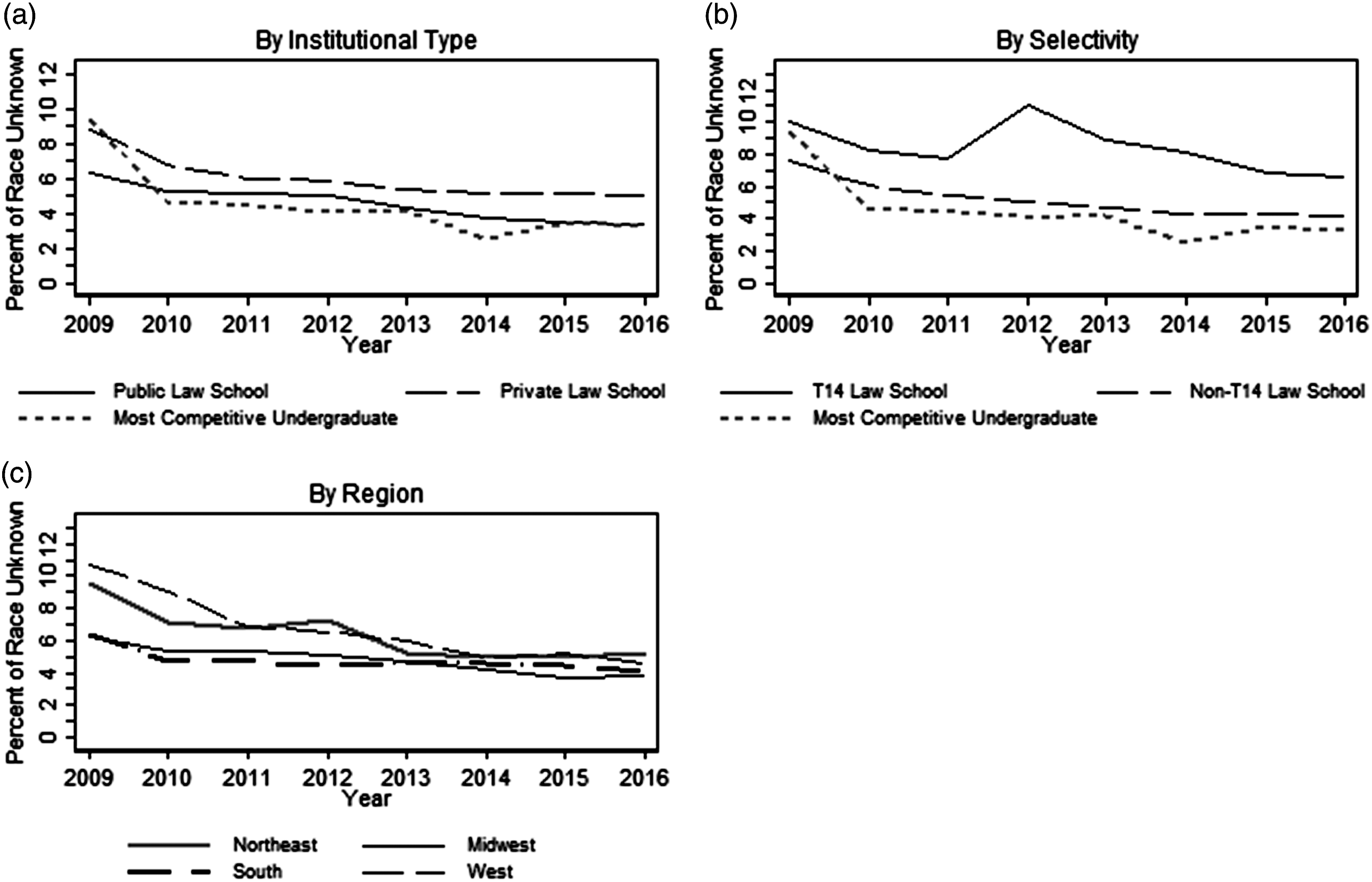
In our findings, we include the rates of race unknown enrollment for the most selective undergraduate institutions drawn from the Integrated Postsecondary Education Data System. We include these undergraduate statistics as a baseline. Our hypothesis is that if competitive admissions are motivating some undergraduate students to withhold their ethnoracial identifications, we would expect to see this pattern amplified in law school enrollments generally, and highly selective law school enrollments in particular.
Findings
US law schools reported between 0% and 42% race unknown students over the 8-year period we examined. 4 This range in race unknown by itself indicates that race data and reporting is problematic. At law schools with high rates of race unknown students (up to 42.15%), a substantial share of students’ racial identities are missing, making it difficult to draw meaningful conclusions about diversity trends in legal education at these institutions.
Both public and private law schools reported higher proportions of race unknown students than highly selective undergraduate institutions, as anticipated (Figure 1(a)). Private institutions reported higher percentages of race unknown students than public law schools on average. Most illuminating was that the most competitive law schools in the United States, the colloquially named, but conceptually significant grouping of competitive T-14 law schools, reported about 8% of their students as race unknown (Figure 1(b)). This was almost double the rate of race unknown students at the non-T-14 schools, 4%. Regional differences tended to reflect placement of the private and selective law schools in the Northeast rather than specific geographic patterns (Figure 1(c)).
Discussion
In the United States, law schools are sites of intense competition for admission among highly qualified applicants. Previous research indicates that highly selective undergraduate institutions report high levels of “race unknown” enrollments (Ford et al., 2020), and competition for entry to legal education can be seen as an extension of this undergraduate environment. We find that race unknown makes up a sizable portion of enrollments and represents an even larger share at the most selective T-14 schools.
These findings add to the growing literature that warns researchers not to ignore or drop race unknown students when examining the racial makeup of elite higher education opportunities. Rather, researchers should examine systematic variation in race unknown and think of it as a product of two potentially concurrent processes. First, it may reflect the rational choices of self-interested individuals who choose not to report race because they perceive it will harm their admissions chances. Second, variation in race unknown reporting may be a reflection of institutional processes, such as strategic decisions about data representation and reporting. That is, having high rates of race unknown students effectively excludes a portion of students from race reporting, which could enhance the appearance of diversity in overall enrollments. Research has shown universities make strategic choices in reporting their ethnoracial enrollments in brochures (Pippert et al., 2013; Stevens, 2009), and tables reporting race/ethnicity on their websites. However, more research is needed to investigate if these practices carry over to reporting enrollments. In addition, further research is needed to probe students’ motivations and reasoning around whether or not to declare their race. These data are foundational for researchers and policymakers’ ability to understand processes of stratification in higher education.
We mention these individual and institutional processes (and the need to study them more) to underscore the idea that all ethnoracial data are a product of individual and organizational processes working in conjunction.
Regardless of the process that motivates race data collection and reporting patterns at law schools, as we demonstrate here, race unknown is not random noise that can be dropped without further investigation as it varies by the institutional characteristics of law schools. We also emphasize the need for better guidance for institutions to collect and report race data. The range of race unknown we observe, from 0 to 42% of law school students, indicates that at some law schools almost half of students are not included in an ethnoracial category. More systematic data collection efforts will better inform our understanding of racial inequities in undergraduate, graduate, and professional educational enrollment more broadly.
Footnotes
Declaration of conflicting interests
The author(s) declared no potential conflicts of interest with respect to the research, authorship, and/or publication of this article.
Funding
The author(s) received no financial support for the research, authorship, and/or publication of this article.
