



Abstract
To increase global recognition and quality education, universities in Indonesia establish English-mediated International University Programs (IUPs). Within different capacities and resources, however, internationalisation sometimes preserves inequalities among Indonesian higher education institutions (IHEIs). This study investigates how the practice of English-mediated internationalisation may not only support global recognition and quality education but also perpetuate linguistic hegemony. Framed by Canagarajah’s (1999b) Linguistic Imperialism (LI) and Pennycook’s (2017) critical perspective of English as an international language, government document analysis and semi-structured interviews with lecturers and students reveal different international programs, ranging from deliberation to initial emergence. Most IUPs are deliberately designed to cater for international students by providing high-standard infrastructure, international curriculum and quality human resources in order to increase international admissions and partnerships which are essential for international recognition. Despite these attempts, several have not been successful in attracting international enrolments and recognition. In contrast, other programs are not deliberate but are initially emerging to become international and attract overseas students. The study also discusses some emerging linguistic hegemony between English and maintenance of national language in the internationalisation of the Indonesian tertiary sector.
Keywords
Introduction
Internationalisation in HEIs cannot ignore the reality of English as a Medium of Instruction (EMI). Supporting academic reputation and international networking, EMI has become a teaching norm in HEIs (Macaro and Han, 2019), an inevitably growing global phenomenon (Dearden, 2016; Macaro et al., 2017) and a common practice in universities worldwide, including in ASEAN countries like Indonesia, Malaysia and Thailand (Barnard and Hasim, 2018). Given its importance in attracting international admissions and partnerships, EMI has experienced a ‘rapid expansion with strong government backing, in its both English as Foreign Language (EFL) and English as Lingua Franca (ELF) contexts’ (Dearden, 2016: p. 2). Within EFL setting, Indonesian HEIs have also introduced English-mediated IUPs to attract more international students and faculty members in order to gain international recognition and quality education.
Considering the EFL status of English in Indonesia, the practice of EMI poses both benefits and challenges for university internationalisation. On the one hand, lecturers’ sound English language competence may improve the practice of IUPs, increase both the number of international students and of academic publications as well as improve the quality of teaching and learning (Enskar et al., 2011). These are essential indicators of global university ranking which the majority of Indonesian HEIs are developing as mandated by the national government. On the other hand, not only does low English competence hamper teaching and learning practice in the classroom but also opportunities for publication thus leading to unsatisfactory university global ranking. Moreover, this language requirement in internationalisation sometimes creates linguistic tensions and educational inequalities which are worthy of concern.
In Indonesia, most studies on internationalisation focus on schooling, from early childhood (Adriany, 2018) to high school (Tamu, 2014, 2016; Khasbani, 2019), including the perspectives of students and parents on international schooling (Arfani and Nakaya, 2019). In contrast, there has been limited research into the practice of EMI and internationalisation programs at IHEIs. A small number of studies focus on its practice, benefits and challenges (Ibrahim, 2001; Hamied and Lengkanawati, 2018); the complex perceptions of EMI between linguistic benefits and feelings of national identity (Dewi, 2017); its teaching characteristics in different subjects (Simbolon, 2017) and its feasibility as language policy (Suwarno et al., 2018). These studies, however, do not specifically address how EMI may contribute to the development of IHEI’s internationalisation, which is necessary to increase international recognition. Therefore, this study explores the practice of English-mediated IUPs in Indonesia and how this may not only contribute to the improvement of English competence, global recognition and quality education but also create linguistics hegemony and inequalities among Indonesian HEIs.
Internationalisation of HEIs and inequalities
A globalised world makes internationalisation more essential for HEIs in global South countries. International education serves as a means to support global citizenship and develop national competitiveness (Engel and Siczek, 2018). Unlike HEIs in some global North countries in which internationalisation is emerging from quality tradition, however, internationalisation of HEIs in global South countries like Indonesia is more a ‘top-down strategy’ determined by the Ministry of Education and Culture, ‘influenced by, and contributing to, the knowledge economy’ (Kostrykina et al., 2021: p. 9) and highly driven by external and internal pressures (Sukoco et al., 2021). To build global recognition and quality education, IHEIs need to reach out their counterparts overseas and build strategic partnerships to develop academic and non-academic capacities through various strategies, including the establishment of overseas campuses. However, given the expense of this approach to internationalisation, English-mediated IUPs may serve as the most affordable initiative to increase international admission, student exchange and joint research (Altbach and Knight, 2007) as practiced by many IHEIs.
Internationalisation of HEIs requires competent global-networking. Faculty members need to build both local credentials and international partnerships so that they are internationally acknowledged in their areas of discipline. For faculty members, one way for international recognition is publication of their research in a language accepted by the international audience. Consequently, in addition to academic and professional knowledge, internationalisation requires ‘multilingualism, attitude and social and intercultural skills’ (Qiang, 2003: p. 248). This means that HEI individuals must have good English language skills, given that English is the language needed for internationalisation. They also have to show a positive attitude towards international engagement and demonstrate sound understanding of intercultural communicative competence.
HEIs have used different strategies in implementing internationalisation. Some institutions have been deliberate in internationalising their campus activities, whereas others have let their internationalisation naturally emerge as real practice (Soliman et al., 2019). To achieve a measurable degree of internationalisation, HEIs need to integrate ‘international, intercultural or global dimensions into their strategies’ (Knight, 2013: p. 86). These aspects need to become the core competencies of the people involved in internationalisation, particularly lecturers and students who are at the front line of these programs. These strategies of internationalisation may be identifiable from HEIs in the global South like Indonesia.
Despite its significant contribution to global recognition and cooperation between HEIs in global South and North for quality education, international of education has led to inequalities. While supporting global citizenship and national competitiveness, educational internationalisation as indicated by international ranking has become a commodity in the global marketplace (Engel and Siczek, 2018: p. 763) and capitalism (Pennycook, 2017), making leading HEIs in the global North more competitive than those in the other side of the globe. Educational institutions in global South have to spend a significant amount of financial supports to meet the standard and achieve international recognition and branding (Knight, 2011) determined by these ranking agencies. In fact, internationalisation requires HEIs in global South and North to learn from each other in building the capacity of human resources and appreciating multiculturalism like the maintenance of linguistic diversity. In this line, higher education institution has shifted from its symbolic into instrumentalised disciplinary knowledge, favouring its economic function (Sakhiyya and Rata, 2019). Such educational inequality, economic orientation and tension between ‘economic development and commitment to the public good as a fundamental principle of education (Kostrykina et al., 2021) due to a competition for international recognition may be identifiable from the participating HEIs in this study.
English Medium Instruction at HEIs and linguistic hegemony
As an international language, English has become increasingly used as a medium of instruction in non–English-speaking countries. This EMI phenomenon has become an essential part of educational promotion and marketing (Hu et al., 2014), making study programs at HEIs more competitive and attractive to international students (Tatzl, 2011; Barriosa et al., 2016). This is also in line with the increasing internationalisation of HEIs and the establishment of regional and international associations for accreditation, certification and ranking such as the ASEAN University Network (AUN), QS Ranking and Times Higher Education. Today, English has become a means of development, modernisation, capitalism, science, technology and democracy (Pennycook, 2017: p. 187).
Given its significance in international education, English has become a teaching norm in higher education institutions (Macaro and Han, 2019). Many studies show the use of EMI at HEIs in Eastern Europe, Africa, Asia and the Middle East. For instance, students at some universities in Vienna use English as a medium of classroom instruction but speak their first language when socially interacting with their peers out of the classrooms (Komori-Glatza, 2015). This tendency is underlined by a belief that English language skills improve their job opportunities (Tamtam et al., 2012). For this reason, many university students in Thailand, particularly female, are motivated to learn and use English in their classrooms (Hengsadeekul et al., 2014). Similarly, a study found that Turkish students also prefer English-mediated courses, two-thirds in English and one-third in the Turkish language (Basibeka et al., 2014). In this case, not only can international students become an important source of revenue for HEIs but at the same time help to improve the language skills of local students.
In addition to language competence, due to its applicability in such various subjects as science, engineering, social studies and humanities, EMI also increases learning motivation. For instance, EMI was found to increase the academic competence of Spanish students majoring in accounting (Dafouz and Camacho-Minano, 2016). Students with high English skills were found to have increased motivation to learn as they can show their academic achievement (Huang, 2015; Hengsadeekul et al., 2014). Meanwhile, combining a communicative approach and content-based teaching methodology, Thai students were reported to find English-mediated learning both interesting and motivating (Panyawong-Ngama et al., 2015). This students’ increased interest in EMI requires provision of quality programing and instruction, particularly by faculty members. To ensure their language competence, some HEIs use oral English proficiency tests to select lecturers in the EMI program (Dimova, 2017). A similar approach is taken by various HEIs worldwide to ensure quality programing for international students, given their importance as stakeholders.
However, the application of EMI at IUPs still poses challenges, including less-integrated language learning, lecturers with low English competence and varying English competence of students (Barriosa et al., 2016). Students with low English competence tend to show high anxiety participating in EMI classes and may want to avoid this (Huang, 2015). This leads to the limitation of subjects offered in English as is the case in Austria (Tatzl, 2011). Likewise, Thai students also experience anxiety leading to reduced support from parents and peers (Hengsadeekul et al., 2014). To support students’ academic, social and emotional achievement, faculty members need to show sympathy, motivate students and maintain a good relationship with them so that they show enthusiasm in learning (Popescu-Mitroi et al., 2015).
This emotional and academic anxiety related to low English proficiency is caused by linguistic hegemony. English serves as a conscious dominant language in internationalisation of education as advocated by agents and institutions like international accreditation and ranking bodies (Phillipson, 1992) and a commodity in the global marketplace (Engel and Siczek, 2018: p. 763). Pennycook (2017) has also critically shown that the practice of EMI relates to ‘social and economic power both within and between nations, and the inequitable structures of international relations’ (p.35). This scholar also argues that the worldliness of English serves as a discursive construct to explore its cultural and political implications.
Moreover, along with multilingualism, the practice of EMI should appropriate the value of local languages (Canagarajah, 1999b). Again, Pennycook (2017) argues that ‘the complex worldliness of English is tied up with questions of colonialism, neocolonialism, religion, education, knowledge and resistance’ (p. 120). Accommodation of local language is necessary to navigate the hegemony of English and reduce its tension with local language maintenance. Not only will the practice of English combined with local language build learners’ motivation for English but also their sense of nationalism (Agai-Lochi, 2015). In this study, the combination of English and Bahasa Indonesia in the classroom may improve the practice of English-mediated internationalisation and maintain students’ sense of nationalism as experienced by Hong Kong students with English and Chinese (Sung, 2016), a practice to support World English in higher education (Brutt-Grifles, 2002). The practice of EMI and its combination with national and local ethnic languages may become an interesting aspect of data collected among the participating Indonesian HEIs in this study.
Method
Data in this qualitative study were derived from government document of higher education internationalisation issued by the Indonesian Higher Education Directorate General and semi-structured interviews with faculty members and international students on the use of EMI to support internationalisation. The government document provides information of philosophical purposes of higher education internationalisation in Indonesia and demographical information of international students in the country.
Meanwhile, semi-structured interviews with 12 lecturers and 24 students of some public and private universities located in major cities in Java, Jakarta, Bandung, Bogor, Semarang, Yogyakarta, Surabaya and Malang. These IHEIs were purposefully selected because they are leading universities which have established IUPs, admitting a large number of international students. The interviews identified the English proficiency levels of lecturers and students, perceptions on the practice of internationalisation, the benefits of EMI, possible challenges in its implementation and suggestions to improve international programs. Each IUP was represented by two students and one lecturer and one interview lasted for 35–45 min. Although the interview was only conducted once, a few participants were re-contacted by phone for clarification. While the interviews were conducted in English to identify participants’ English fluency, they were also allowed to respond in Bahasa Indonesia for convenience. Results of document analysis and interviews were merged and analysed to identify some emerging themes such as participants’ English proficiency, English use in the classroom, perceptions on EMI and its challenges as well as their suggestions for the improvement of internationalisation at Indonesian HEIs.
Finally, instruments were piloted with students and lecturers at a public university in Bandung before they were administered to participants from other IHEIs. As participation in this study was voluntary, prior to data collection, participants were asked for their informed consents with the right to withdraw from participation. Pseudonyms were used for all participating IHEIs, lecturers and students.
Findings and Discussion
Current practice of English-mediated internationalisation at Indonesian HEIs
Document analysis and interviews identified two major types of international programs with some variation. The first type is a deliberate internationalisation to increase global recognition and quality education. To improve international recognition as mandated by the government, many IHEIs, including the 12 participating universities, deliberately designed special programs to attract international students. Some IHEIs call this an International University Program (IUP), the others an International Program (IP) only. As a deliberate internationalisation, such programs are designed to meet standards determined by international accreditation and ranking agencies so that curriculum, lesson plans, and learning materials are all written in English and compatible with the curriculum of overseas universities. The programs are not only attended by international students but also by local Indonesian students who want to develop international experience.
Deliberate IUPs are offered to undergraduate and graduate students and organised by different faculties. They include science and engineering, agriculture, food technology, education, architecture, language, social sciences, business, law, communication and international relations. Several IUP classrooms have a balanced number of international and domestic students, but most are still dominated by domestic students. Some international participants are registered as degree students while others have exchange status. In terms of funding, many international students, particularly those coming from developing and underdeveloped countries, are sponsored by government or the private sector and host universities, whereas others from more developed countries are financially self-sponsoring.
International admission at Indonesian Universities (Per July 2019).
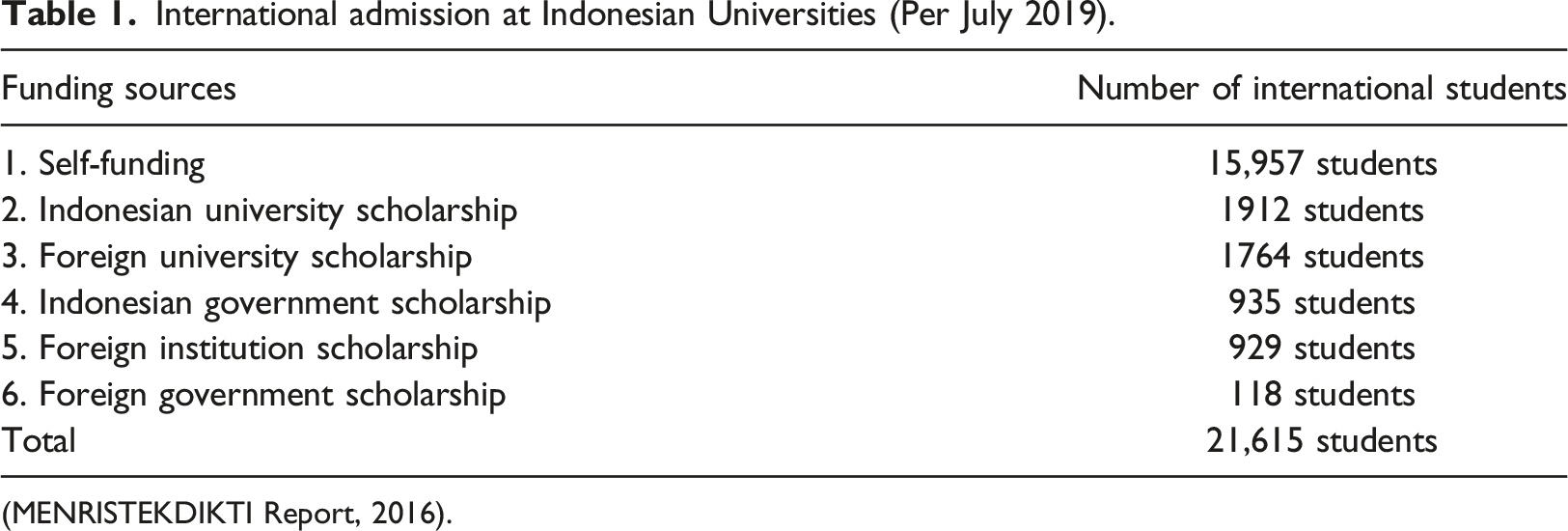
The international students study a range of programs, degree and non-degree. The majority of students (8415) pursue undergraduate degrees, followed by short course (4637 students), student exchange (4459 students), Master degree (1658 students), Diploma 3 (938 students), Diploma 4 (115 students), internship (611 students), doctoral degree (262 students) and specialist (12 students). Degree studies (undergraduate, master and doctoral) attract the greatest number of international students, followed by student exchange and short courses. These students are distributed in 532 IHEIs following 647 majors across the country (MENRISTEKDIKTI, 2016).
Participants in IUPs have different purposes. Local students are interested in the program to improve international understanding. They want to improve their English language skills and have opportunities to intern and work overseas upon completing their studies. Many students from developed countries such as Australia, the United States, China, Japan, South Korea and other European countries have come to learn the language and cultural aspects of Indonesia. The majority of international students from developing countries in Asia and Africa, mostly sponsored by the Indonesian government and other supporting institutions, want professional development. Currently, the majors of international students at IHEIs vary, ranging from social sciences, humanities, engineering and science (MENRISTEKDIKTI, 2016). This shift in study focuses from Indonesian language and culture to other areas such as management, medicine, civil engineering, nursing, dentistry and informatics which show the growing significance of Indonesia as a centre for education in the Asia Pacific region. This change also indicates a growing international recognition for Indonesian HEIs. With the increasing number of deliberate internationalisation programs, international admissions are expected to grow each year, thus increasing international recognition and quality education of IHEIs.
The second category of IUPs is that of deliberate program with limited international admission. Similar to the first type, this program type is deliberately geared to increase international admission. Despite this international deliberation, due to insufficient marketing, international recognition and a range of other reasons, this customised IUP only attracts a few international students. Although the curriculum and other teaching-related activities are designed in English, almost all registering students are domestic. Despite the absence of international students, local students in this program are still taught in English. This type of international program has not successfully increased international recognition of Indonesian HEIs and, as a result, some of which have been temporarily ceased.
The third category is that of regular classes with international admission. Indonesian HEIs within this category do not claim to have established IUP and therefore programs are not customised for international admission. However, due to international partnerships, they receive international admission of exchange students. Some universities of this type are involved in regional mobility programs like AIMS (ASEAN International Mobility Students), organised by SEAMEO RIHED (Southeast Asian Ministers of Education Organization, Regional Institute of Higher Education) based in Bangkok, Thailand. In Indonesia, this program is fully funded by MENRISTEKDIKTI. The program is mostly attended by local students with a small number of international students from ASEAN countries such as Thailand, Vietnam, Malaysia, the Philippines, Japan and South Korea.
It seems that deliberate IUP has financial consequence. To meet some standards determined by international accreditation and ranking agencies, universities need to upgrade supporting infrastructure, human resources and other related services. HEIs need to provide ‘smart’ classrooms supported by advanced technology and select appropriately qualified faculty members who can provide excellent teaching to students as key stakeholders. In addition to discipline expertise, the selected faculty members need to have good English competence. As a consequence of this excellence-driven service, the universities require higher tuition fees of students enrolled in IUPs. While this may not create problems for international students, the increased cost of tuition may become burdensome for local students participating in the international program. Bearing in mind the importance of the international horizon and competence for the future job market, however, participating local students have not objected to the rise in tuition costs.
Echoing Knight (2011) on the importance of internationalisation for quality improvement, this deliberate and emergent internationalisation of IUPs is expected to increase the number of foreign students as internationalisation agents, followed by international institutional agreements, international accreditation and branding. Given the increasing number of international admissions at IHEIs, as hinted by Altbach and Knight (2007), these important aspects of internationalisation, international admission and student exchange seem to be the most affordable initiatives to achieve global reputation and quality education.
The use of English as medium of instruction and educational inequalities
Interviews with faculty members explore the use of English as a medium of instruction in international programs. Firstly, most deliberate IUPs use English as a medium of instruction for all subjects offered. To meet this demand, heads of department designate teaching staff with sufficient English competence to teach in international classrooms. Regardless of their majors, most faculty members with overseas educational degrees have good English competence and are considered qualified to teach IUP classes. Because of their personal experience as international students when pursuing degrees overseas, they have confidence in teaching international programs. Lecturers are required to design syllabus, curriculum and learning materials such as text books and other recommended materials in English. They also need to enrich the learning materials with online resources, all written in English. However, since not all faculty members have sufficient English proficiency, as indicated by previously obtained English proficiency scores, department heads hire lecturers from the English Department to compensate for lecturers’ limited English. This is to welcome and provide excellent service for both international and local students participating in the program.
Secondly, English is also offered to classes of deliberate international programs with minimum international admissions. As part of the design, English language serves as the instructional medium, regardless of international attendance. Complying with the internationalisation principle, although both lecturers and students are Indonesian, instructors have to maintain English as the medium of instruction. This practice of EMI may sound ironic but is consistently run in line with deliberate IUP design. In spite of limited international admission, English serves as the medium of instruction so that local students can improve their English skills. This international language competence is necessary for local students to build international confidence, which will later help with internships and job opportunities overseas. One lecturer at a public university in Bandung said: Although my students are all Indonesian, I still have to teach in English because um, the program is international. Sometimes, I think this is an irony. Why should I teach in English when um, all students and myself are Indonesian? But, ya, this international program, so, you know, I have just to follow the rules.
Other emerging international programs only offer English as a medium of instruction for certain subjects offered to overseas students. In this type of international program, the use of English as a medium of instruction is limited. As the program is not deliberately designed to become international, English instruction is only selectively offered in courses attended by overseas students. For instance, universities involved in AIMS program only offer English medium instruction in courses attended by international students from Thailand, Malaysia, Vietnam, Japan and South Korea. As for other subjects only attended by local students, the instructional medium is Bahasa Indonesia as the case with regular courses at other Indonesian HEIs.
In order to welcome international students in the classrooms, heads of department select lecturers who have met the necessary requirements to teach in these emerging international classes, such as good English proficiency for classroom interactions combined with the ability to design a syllabus and learning materials in English. One head of department at a public university in Bandung, West Java, confirmed:
We offer some courses for international students as part of AIMS program. Our department has some students from Thailand and Malaysia for this program. Therefore, we have to offer courses in English. So, I have to select lecturers who can teach subjects in English. It is challenging, you know, as not all lecturers are ready to prepare syllabus and teach in English.
The practice of English as a medium of instruction poses challenges for both lecturers and students. Faculty members admit that the use of EMI does not always run effectively. Not all lecturers have the English proficiency necessary to facilitate the learning process successfully. For instance, some lecturers have basic speaking skills so that they can only facilitate the learning process on a basic level. They have difficulty in providing a more complex explanation of the topics discussed in the classroom. In terms of oral proficiency, their English fluency level may be below that of Malaysian and Pilipino students. This low oral proficiency, however, does not inhibit lecturers’ efforts to best support students’ learning. Lecturers’ subject expertise and students’ good understanding of the subject may compensate for the limited English proficiency of the faculty members.
Given this, the practice of English-mediated internationalisation at Indonesian HEIs shows the significance of English as medium of learning. Supporting a previous study (Macaro and Han, 2019), English has become a well-accepted teaching norm in university internationalisation. In this context, despite some challenges lecturers and students face in relation to content learning, EMI is arguably a growing phenomenon worldwide (Dearden, 2016; Macaro et al., 2017) and has been common practice among universities in ASEAN countries (Barnard and Hasim, 2018) like IHEIs. Increased English language competence of faculty members and students may improve the practice of IUPs, increase the number of international students and academic publications as well as improve the quality of teaching and learning.
Furthermore, compared to other settings, the classification of deliberate and emergent internationalisation at IHEIs has context specific implications. As Soliman et al. (2019) have identified among European universities, emergent internationalisation tends to have better results than deliberate internationalisation. In this context, universities with low ranking deliberately establish internationalisation programs to attract international admissions and gain recognition. Meanwhile, at some leading universities like the Russell Group in the United Kingdom or the Ivy League institutions in the United States, international recognition has become a tradition that emerges naturally in their teaching and research. On the other hand, deliberate internationalisation by more prestigious IHEIs is done to increase international recognition and quality education. In the long term, this deliberate internationalisation is expected to allow the international recognition of IHEIs to emerge naturally. This internationalisation serves as an initial emergence for quality tradition and international recognition.
Finally, internationalisation may have created educational inequalities. While supporting global citizenship and national competitiveness, educational internationalisation as indicated by international ranking has become a commodity in the global marketplace (Engel and Siczek, 2018: p. 763), making leading HEIs in the global North more competitive than those in the other side of the globe. To achieve global recognition as their counterparts in some developed countries have experienced, Indonesian HEIs have been trapped in ‘inequitable structures of international relations’ (Pennycook, 2017: p.35) by spending a significant amount of financial sources to participate in international ranking. Internationalisation at IHEIs has created a shift from knowledge generation to economy orientation as Sakhiyya and Rata (2019) and Kostrykina et al. (2021) have identified. This change has also increased the gap in which leading universities have more opportunities and funding for internationalisation than the small-sized ones. This occurs because of limited funding provision so that the Indonesian government needs to bear with priority policy in internationalisation of high education sector.
However, supporting the legacy of neoliberalism in internationalisation, adequately facilitated public and private IHEIs are more ready to develop international recognition and quality education. Extra funding provision from the Indonesian Directorate of Higher Education (DHE) enables leading universities to arrange attractive programs that can build the capacity of human resources in research, partnership and publication so that these HEIs can improve international recognition and quality education. With this extra support, they own sufficient human, financial and management sources to organise internationalisation programs so that they achieve and maintain international branding and performance (Knight, 2011). Meanwhile, the majority of small universities do not receive priority in internationalisation and are still struggling to meet the national requirements.
Perceptions on EMI and negotiated linguistic hegemony
The final aspect of findings relates to the perceptions of the participating students, lecturers and management on internationalisation and the use of EMI in higher educational institutions. As interviews reveal, most lecturers show positive attitudes towards IUPs. They believe that, as previous studies have identified (Tatzl, 2011; Barriosa et al., 2016), internationalisation can make the study programs more competitive and attractive for international admission. Not only can international admissions increase global recognition of the institution but it also improves the quality of local students. Since IUPs also increase students’ international competences and global competitiveness, this program complies with university internationalisation and marketisation (Hu et al., 2014). As mandated by the Indonesian government, deliberate internationalisation has increased international admissions by about 21,615 (MENRISTEKDIKTI, 2016), thus supporting global recognition as required by international ranking institutions such as QS and THE.
Similarly, most students also have positive perceptions of deliberate internationalisation. Supporting Dewi’s (2017) study on the use of English among Indonesian universities, and other studies on the relation between English proficiency and job opportunities (Tamtam et al., 2012) among ASEAN students (Hassan et al., 2011; Hengsadeekul et al., 2014) and worldwide (Basibeka et al., 2014), the participating students believe that such programs may improve global partnerships and competitiveness as well as widen job opportunities. While international admissions may expand the friendship and networking of local students, the use of English will enhance their fluency, skills and confidence so that they become more competitive globally. This increased human index will expand their job market and opportunities. Graduates of the international programs are not only expected to contribute in the local job market but also compete regionally and internationally. One student said: Now, I have more friends, not only from Indonesia but also from overseas. This friendship is important in the future. When my friend um, come back to their countries, we can still keep our friendship. I think my English also gets better. You know, I am more confident to speak with my friends from abroad.
English-mediated internationalisation also improves learning motivation. Having practised English skills in classroom activities and interacted with both local and overseas classmates, students feel more eager to learn their own subjects. Across disciplines, students of science, engineering, architecture, tourism and humanities find English-mediated learning activities more fun and engaging. Despite their limited English, as previous studies have indicated (Dafouz and Camacho-Minano, 2016; Panyawong-Ngama et al., 2015; Hengsadeekul et al., 2014), the participating students feel more motivated to learn, thus leading to improved academic competence, as experienced by Chinese students participating in international programs (Huang, 2015).
Despite these positive perspectives, internationalisation at Indonesian HEIs is still a work in progress. The deliberate internationalisation has not escaped from some misconceptions (Knight, 2011) which regard foreign students as internationalisation agents and international reputation as a proxi for quality, international institutional agreement, international accreditation and branding. Nonetheless, this may not always be true in the context of Indonesian HEIs. Since most of these educational institutions are on the early stages of developing quality internationalisation, these ‘misconceptions’ may be regarded as part of the journey to increased global reputation and acknowledgement. To achieve this goal while responding to the misconceptions, Indonesian HEIs need to integrate international, intercultural and global dimensions into their deliberate strategies of internationalisation (Knight, 2013).
Moreover, perceptions of English-mediated internationalisation are not always positive. As previous studies have shown, the practice of English-mediated instruction in Indonesian HEIs still faces challenges (Ibrahim, 2001; Hamied and Lengkanawati, 2018). Several lecturers object to this deliberate internationalisation, believing that it gives them additional responsibilities. They have to design curriculum, syllabus, learning materials and classroom presentations in English, in addition to those in Bahasa Indonesia for regular classes. They are also required to anticipate students’ responses and questions in English during classroom sessions. This added responsibility is considered burdensome for lecturers with limited English as they need extra time to prepare adequately for a successful teaching and learning process.
Several students are also sceptical about internationalisation. The practice of English-mediated IUPs may have discouraged them psychologically. Due to the language barrier, local students do not feel confident to take part in classroom discussions and other social engagements with their international counterparts. Interviews reveal that international students were mainly engaged with their peers, rarely with local students, when assigned group work. At AIMS classrooms, for instance, Malaysian and Thai students were more dominant in classroom discussion than their Indonesian peers. It seems that, as participants of exchange programs, these overseas students have better English competence than local students so that they were more confident in classroom interaction. Similarly, as participation in AIMS requires English competence, Indonesian students who were sent to universities in Malaysia, Thailand and South Korea may have better English proficiency than their Indonesian, Malaysian, Thai and Korean peers who do not join this exchange program.
In emergent programs, this attitude is also reflected in course selection. When a subject is offered in two parallel classes of English for an international program and Bahasa Indonesia for the regular class, most local students sign up for the Bahasa Indonesia version and avoid the English class. Confirming this practice, one lecturer at a public university in Bandung said: I teach a parallel class in both English and Bahasa Indonesia. Most local students sign up for Bahasa Indonesia class and only a few of them, including international students from Malaysia and Thailand, take the English class.
Those local students are reluctant to sign up for an international program because of their low English proficiency needs extra attention from the course instructor. Since the status of English in Indonesia is only a foreign language, students have limited access to English use. To maintain a student’s academic, social and emotional achievements, which may decrease due to low self-esteem in English, faculty members should provide additional psychological support. As Popescu-Mitroi et al. (2015) have suggested, lecturers need to show sympathy, motivation and maintain a good relationship to increase students’ enthusiasm for English-mediated content learning.
In addition to lecturers and students, the challenges in implementing IUPs are also experienced by management. Since not all lecturers have good English competence, heads of department have to select qualified lecturers for the program. They have to find instructors who have not only good English skills to support their academic and professional knowledge for teaching in the IUPs but also the appropriate attitude, social and intercultural skills (Qiang, 2003; Knight, 2013). For the program to succeed, they may need to upgrade the English competence of both students and lecturers so that they feel more confident and are ready to contribute to internationalisation. To provide academic and psychological supports, the practice of English-mediated IUPs needs to accommodate the use of local or national language like Bahasa Indonesia. A head of international program confirmed:
We provide extra Bahasa Indonesia classes for our international students. Therefore, they can participate in the classroom when the medium of instruction is English mixed with Bahasa Indonesia. Our international students from Malaysia and south Thailand do not have problem with classes mostly offered in Bahasa Indonesia.
Nevertheless, such combination should not negate the importance of English in building students’ competence. The use of national language in internationalisation should not exceed that of English. Otherwise, the English proficiency of students will not increase, thus reducing their global competitiveness. As Suwarno et al. (2018) have indicated, this should be carefully considered when designing the feasibility of language policy at IUPs.
Finally, the practice of English-mediated internationalisation at Indonesian HEIs may have perpetuated linguistic hegemony. English seems to become a conscious dominant language (Phillipson, 1992) and a commodity in the global marketplace (Engel and Siczek, 2018: p. 763) as well as a discursive construct which has cultural and political implications (Pennycook, 2017) advocated by international accreditation and ranking bodies. Due to limited English proficiency, however, while most Indonesian HEIs are compliant to this linguistic hegemony as a compromise for internationalisation, a few others show resistance by appropriating Bahasa Indonesia as the value of local language (Canagarajah, 1999b) into the discourse of internationalisation. Facilitated by the Ministry of Education and Culture (MoEC), for instance, international students who receive the Indonesian government scholarship are required to take this national language class prior to degree commencement so that they are eligible to participate in courses offered in combined English and Bahasa Indonesia. It appears that, as indicated by previous studies on linguistic tension in different contexts (Agai-Lochi, 2015; Sung, 2016), not only can this negotiated linguistic practice provide psychological support and motivation for internationalisation but also nurture a sense of nationalism among Indonesian tertiary students who are welcoming educational internationalisation.
Conclusions and recommendations
This study has several conclusions. Firstly, based on different management capacities, the English-mediated IUPs come into a range of deliberate and emergent strategies. Deliberately designed to increase global recognition and quality education, the first category receives both domestic and international admission. With good supporting infrastructure, deliberate IUPs have successfully attracted a substantial number of international students under different funding schemes, scholarship and self-funding. Due to limited marketing and reputation, however, a few deliberate programs have not received international admissions and are only attended by local students who have strong motivation for global competitiveness. Meanwhile, other study programs are not deliberately customised for internationalisation but, despite this, receive international admission. To sustain, this second category needs more deliberate support so that programs can emerge naturally as quality international programs for global recognition and quality education. Secondly, English plays a significant role as a medium of internationalisation. The practice of English-mediated IUPs enables IHEIs to attract international admissions and partnerships, thus improving the quality of teaching and learning, leading to increased international recognition.
Despite these benefits, the development of IUPs sometimes creates inequalities. Firstly, there is a large disparity among IHEIs in establishing and managing international programs. A small number of leading universities, both public and private, have better infrastructures and human resources so that they have greater capacity in managing internationalisation. Other medium and small-sized universities have limited supporting infrastructures, making their international programs less successful. In addition, not only has the English-mediated internationalisation perpetuated imbalances of human, financial and management resources in the sector of Indonesian HEIs but also created linguistic tension due to limited English proficiency and the maintenance of Bahasa Indonesia as national identity. Nevertheless, perceived as a neoliberal instrument, internalisation has also served as a means to increase education provision in the country.
In addition, the study also makes several recommendations. Firstly, the government needs to provide more support for smaller IHEIs so that they can have more equal opportunities for internationalisation. For this, large universities need to collaborate with small-sized IHEIs so that they can work together for better global recognition. Secondly, deliberate IUPs need continuous support so that they can develop IHEI’s quality tradition for increased international recognition and quality education. Finally, for internationalisation to become more successful, lecturers and students need to improve their English competence so that they can develop functional communication with international students and potential collaboration partners. While maintaining Bahasa Indonesia as a national identity, IHEIs need to provide the necessary support for students, lecturers and administrators to improve their English proficiency so that they can develop quality teaching and learning, research and community services for global recognition. Further study of this issue needs to address internationalisation practices at IHEIs outside Java island of Indonesia for more equality and quality education.
Footnotes
Acknowledgements
The authors thank Dr Jill Brown of Monash University who has carefully read the draft and also two anonymous reviewers who have provided constructive feedbacks for the improvement of this manuscript.
Declaration of conflicting interests
The author(s) declared no potential conflicts of interest with respect to the research, authorship, and/or publication of this article.
Funding
The author(s) disclosed receipt of the following financial support for the research, authorship, and/or publication of this article: Funding for this study was provided by RISTEKDIKTI INDONESIA.

Author Biographies
Ahmad Bukhori Muslim is a senior lecturer at the Department of English Education and Director of International Affairs, Universitas Pendidikan Indonesia (Indonesia University of Education). His main interests include international education, children’s language development and English education.
Didi Suherdi is a professor at Department of English Education, Universitas Pendidikan Indonesia. His main interests include English education and classroom discourse analysis.
Ernie D. A. Imperiani is a lecturer at Department of English Education, Universitas Pendidikan Indonesia. Her research interests include sociolinguistics and applied linguistics.