



Abstract
The study of video games can be fun, and it is interesting to see what players can explore inside video games. This paper explores public policy practice and its political content or aspects in video games. The very idea itself may sound vague and unclear; can such a thing be found inside a mere video game? To strengthen the argument of what kind of political aspects can be found in video games, the authors use a comparative case study, comparing two games: Animal Crossing: New Horizon and Genshin Impact. By comparing the two games, this paper forms an understanding of how political aspects are found inside each game and their influence on affairs and issues in certain countries. The result of this research shows that video games have become an election-winning strategic political marketing and communication policy. Video games have also used procedural rhetoric, which reveals how game producers promote certain ideologies through legislation and rules in their games.
Introduction
Research into video games mainly focuses on the benefits and effects of playing video games, violence, addiction, psychological behavior, and gender issues (Granic et al., 2014 ). Video game scholars rarely engage in the political aspect that can be found inside certain games (Lima, 2017). This article identifies political aspects based on consumption as one of the categories showing that video games are political (Lima, 2017). Media such as movies, newspapers, books, TV, and radio are categorized as old media, while video games are categorized as new media content (Kücklich and Fellow, 2004). Research has shown that children, teenagers, and young adults tend to enjoy and are more accustomed to video games than older adults. Over the years, video games have grown to become mainstream media, making adult audiences adapt as they try to be involved in the video game itself. Kücklich and Fellow also state that the gaming industry’s revenues are now larger than the box-office returns of the film industry (Kücklich and Fellow, 2004). “Why use video games as a new media practice?” This question has been frequently asked in new media studies. Video games enhance aesthetic pleasure with interactive components that cannot be found in old media and games (Ardèvol et al., 2009). People who watch TV can only view what they see on TV itself. However, people who play video games not only watch, they also engage intensely through immersion and participation in the video games they play.
Bogost (2007) gives an example of how video games have been used in the past and present as a work of art, as a source of titillation and relaxation, as exercise and habituation, and as a venue for promotion and politicking, among others. Video games, as a part of modern media, are more than just mere entertainment. Video games provide ways for us to experience ourselves as both human and machine through technological, esthetic, and historical features (Anable, 2018). Video games have a unique feature, particularly in terms of user interaction, compared to other media. The interactive element, the relationship between the users and their devices, their physical movement, and the effects of video games and their content are crucial features (Kautzky, 2020). A further question is: “What motivates gamers to engage with content from video games?” There are three overarching video game motivations, each of which includes the completion of various rewards, according to Dalisay et al. (2014). These are socialization, relationship, and teamwork motivations. By examining interactive fiction and non-interactive fiction, we can gain insight into how apparently different media types interact and influence the world views of the public. Reality and fiction are in constant collision, but they are never closely intertwined. Instead, they collide in fascinating and unforeseen ways, with impacts on one another (Kautzky, 2020).
Previous studies conducted by Jesper Juul (2019) have investigated whether virtual reality inside video games is real or not. According to the studies, even the most painstakingly accurate virtual object will still contain fictional characteristics. Instead of arguing that virtual objects are real or non-real, it is better to understand their overlapping and continuous characteristics (Juul, 2019). From that viewpoint, this study focuses on how political aspects and policy issues are found in video games, examining whether and how video games are political to define the connectivity between games and the real world by focusing on the political aspects. It is useful to first determine what policy refers to in this article before further details are discussed, since the word can represent a wide range of different ideas and meanings. According to the Oxford English Dictionary (https://www.oxfordlearnersdictionaries.com/definition/american_english/politics), politics means every activity that is associated with and relates to authority and government. It can be hard to define in video games because of the uncharacteristic and unorthodox connection between video games and politics itself. In this article, the author describes politics as an activity and event reflected in how the real world works and what it brings to or the effects it has inside the video game (political campaigns, issues, or affairs between certain countries).
This paper explores public policy and its political content or aspects inside video games, using Bogost (2007) and Chalmers’ (2018) procedural rhetoric and political marketing framework. Using those two concepts, the authors believe that any political aspect or content can be identified inside certain games. Bogost’s procedural rhetoric concept can be used as a framework to describe certain players’ intentions for what they are trying to accomplish and what purposes they want to pursue inside certain video games. If the player is coming from a political background, one can assume they will use procedural rhetoric as an art of persuasion to dictate certain behaviors. However, the very idea itself may sound vague and unclear as to whether such a thing can be found inside a mere video game. It is therefore difficult to determine how political leaders learn from and how they can benefit from gaming. Hence, the authors use the procedural rhetoric concept to focus on how political aspects are found inside certain games, what kind of policy issues occur, and how the government of a certain country reacts to or addresses the issues.
The first part of this article will focus on two main concepts: political marketing and procedural rhetoric. These concepts will strengthen the argument for describing any political aspect that can be found inside certain games. To begin, this study will first explore the academic literature from video game study scholars on the political aspects of video games in general. The second part of this study will focus on two games using the comparative case study methodology to better understand how political aspects are found in those two games and how the government of a certain country reacts to and responds to particular issues or events inside the game. Last, a summary of findings and results will be discussed to strengthen the argument and to broaden the knowledge about video game studies in general. The article concludes with an explanation answering the research questions in this study.
Literature review
Political marketing
Political marketing is now becoming an inevitable political communication strategy in many countries. Political marketing has played an important part in many countries in recent years in the digital gaming industry. Political campaigners recognize that video games are a key part of our culture and routines, affecting various aspects of our everyday lives, including consumer trends, communities, and identity development (Baltezarevic et al., 2019 ). Political marketing is not only related to advertising, but is also a series of strategies and tools used to study public opinion prior to and during elections (Kavanagh, 1995). Political marketers should focus on research and developing new technologies, such as artificial intelligence (AI), virtual reality, cognitive computing, and digital gaming, to improve their understanding of digital practices for advertising reasons, as well as their impact on policy processes. Modern politics has quickly discovered that digital games may be one of its main tools and today digital players are strongly involved in politics (Baltezarevic et al., 2020; Kahne et al., 2009).
Digital games can be political products and the political dynamics with which we deal daily reflects, interprets, and even redefines. The focus of this study is on numerical games, which have become strong tools of persuasion that can be used to promote politics. According to Lerner (2014), both analog and digital games are used for many political purposes. He proposes three main categories: games about politics; play as political action; and games as political action. Games about politics are not very creative and do not contribute politically. These games are simple and have a short lifespan. They deal with general political issues, with the only objective being to inspire and inform players (Sicart, 2014).
However, by introducing games into a range of public programs in North and South America, Josh Lerner offered a new solution for partcipatory budgeting and planning in the Child Councils in Argentina and Toronto. In the Department of Children in Argentina and Toronto, in social services, in participatory budgeting and planning, he offers rich stories about game techniques. With these examples in mind, Lerner describes five types of games and 26 game mechanics that are particularly important for democracy. He found that public participation becomes more attractive, more effective, and transparent when governments and organizations use games to design their programs (Lerner, 2014). Political action that incorporates game design principles also applies the principles of game design. Sicart (2014) says that play is an ideal tool for illustrating political concepts, especially in oppressive or tyrannical environments. When games are seen as political action, they are not a way of doing politics, but a political tactic. Games of this type are made using rules specific to a certain setting, and are thought of as decision-making tools in politics (Lerner, 2014). Modern political marketing has soon realized that digital games can become one of politics’ main instruments.
Procedural rhetoric
Video games can create highly compressed versions of other citizens’ and policymakers’ experiences via procedural rhetoric. The potential role of procedural rhetoric in political communication in Illinois offers a comprehensive example. An integrated experience of public policy matters is very difficult to build, and the methods are too weak or too detailed. The Animal Crossing: New Horizon and Genshin Impact games are different and inform decision-making, such as the Congressional Budget Office (CBO) public policy simulations, which guide economic policy. They also differ from the computer systems of the Pentagon to shape political answers to current or potential conflicts (Bogost, 2006). In The Rhetoric of Video Games, Ian Bogost explains how video games’ rhetorical and persuasive mechanics can emphasize and amplify certain behaviors. Moreover, video games also aim to inform, educate, persuade, or motivate specific audiences in specific situations (Bogost, 2007). For example, gamers who play war games must abide by the rules as soldiers to avoid harsh punishment. Bogost (2007; pp. 119) also states, “Video games are not just distracting or entertaining with meaningless content; instead, video games can make claims about the world using any argument and interaction within certain games between all the characters.” As a political medium, everyday political conversations can be found inside video games.
Gerry Stahl, a video game scientist, claims that western consumers through the seductive shows of the military industrial entertainment complex have been transformed into virtual soldiers (Stahl, 2006). With lucrative simulation and training commissions, Stahl supports his claim by showing the connections between the military and the gaming industry. The United States army has been providing consultants with work on the Medal of Honor series with EA Games. Players who play certain video games are more likely to be attracted to games based on real-life world events and settings than just fantasy games (Hitchens, 2014 ). War games, such as Call of Duty and the Medal of Honor series, are tools for recruiting soldiers. There is a thin line between reality in real life and non-reality in video games. Although debate still rages over whether it is a mere coincidence or not that video games reflect real-world events, research has found that mixed reality creates a cross-over between the real world and an imaginary or fictional world in video games (Kücklich and Fellow, 2004).
In Video Games as a Political Medium, Borges Lima argues that video games are politically based on three categories: production, content, and consumption (Lima, 2017). The political aspect in production is about the game developer who made certain games. For example, war games made by American game developers such as Wolfenstein portray how cruel the Nazis were. Players control an American agent as the main character who fights and kills the Nazis. It shows their biases by clearly showing Nazis as bad guys. Next, the second political aspect is content. Content is based on how the theme and settings inside the video game are based on real-world, historical, or current events. The newly launched Plague Inc: The Cure game raises awareness about the tools and challenges to respond swiftly and effectively to emerging pathogens. The third one is consumption. Political aspects based on consumption are tied to how the audience and consumers of a certain game act. It depends on player behavior and what they are trying to get from certain games. Each individual experiences different feelings, even though the game is played the same. Politicians might use video games as a tool for campaigns; the military government might use a game to recruit soldiers; a certain company might use a game as a tool to advertise their products, etc. Although political opinions are black and white, most problems are gray areas strongly influenced by other matters of public policy. Policy problems are complex systems that interconnect and combine. Video games provide a new political perspective since they represent complex systems in a particular way. Through understanding how games are able to use rhetoric, we are able to gain critical perspectives of artifacts from video games and consider designing games with the main aim of editing, teaching, and making political statements (Bogost, 2006).
Methodology
In this article, the authors utilize the comparative case studies (CCS) approach to answer research the questions and get a better understanding of video game studies in general. The CCS approach promotes a multi-location fieldwork model that studies sites and scales and is widely used in several disciplines and fields (Bartlett, 2017). The CCS approach uses case-based research to compare two cases that seek different perspectives from both respected parties. Using CCS and comparing two case studies will broaden our knowledge and allow us to better understand how to handle the issues. Research only examines aspects of the cases, not the cases as a whole, using the embedded case study and mainly focusing on political aspects inside video games. Using the embedded case study means the authors only analyze the political aspects inside the video game, without exploring and explaining the case as whole, explaining the detail of the disputes between China and Hong Kong, and instead only focusing on the effects leading to certain policies. The two cases refer to Joe Biden’s 2020 political campaign inside video games and the Chinese government’s ban on the words Hong Kong inside Chinese games, given the disputes between Hong Kong and China last year. The case study collects data from studies of events that happened the previous year about video games and politics. Secondary data are used as an approach by collecting data from the literature on the internet.
Articles from many scholars who engage in video game studies also need to broaden the available information and knowledge about video games and politics in general. To search articles that strengthen the argument, multiple databases were used, using Google Scholar as a primary source and citing many available journal articles. Keywords such as “video games” and “politics in video games” were mainly used to search journal articles related to this. From Google Scholar, many scholars are engaged in research related to video games from the video games studies category. This has led to a dedicated website made by video game scholars. Besides the database search, many articles were found by using the snowball method, where one scholar leads to another. When examining the data in the articles, an assessment was made to ensure the research had been properly conducted. Expert statements also become a source to collect data and affiliate with the studies, theory, and research mentioned before. These experts are game developers, video game analysts, video game reviewers, game companies, and video game enthusiasts in general.
The challenge of citing resources from the internet is that the researchers have to check for the credibility and relevance of the information found. This is very important because anyone can publish any information on the internet, and sometimes that information can be false or misleading. It might only be a mere opinion that cannot be proven. To check for credibility of certain information on the internet, the authors’ background (title and education) can be found inside the article or at the top of the website. On top of that, we also check the relevance of certain information by checking the year the article was released; the most recent one is usually more relevant because it accumulates from the previous research before. All the sources and information cited become the researchers’ responsibility, and are credible, valid, and relevant to support the argument of this study.
Case study
(a) Animal Crossing: New Horizon – Joe Biden’s political campaign inside the game
Animal Crossing: New Horizon is a life simulation game developed and published by Nintendo and only released exclusively on Nintendo Switch. Animal Crossing: New Horizon is one of the most successful games on Nintendo Switch. According to financial data on Nintendo’s official website, Animal Crossing: New Horizon sold 31.18 million copies, making it Nintendo’s second-best-selling Switch game of all time. It also became the third-best-selling game worldwide in 2020. The game achieved the Grand Award at the Japan Game Awards 2020, and The Best Family Game award at The Game Awards 2020. Animal Crossing: New Horizon was chosen because the very purpose of this game is to have fun and connect with friends, relatives, family, and other people worldwide. The game does not have a complicated storyline. Instead, choices drive the player into particular predicaments. The sole purpose of Animal Crossing: New Horizon is just to have fun (Nintendo, 2020). Why Animal Crossing: New Horizon then? This question can be answered from one of the biggest political activities last year: the 2020 United States presidential election. One candidate used Animal Crossing: New Horizon as a tool for his political campaign to attract more voters; this notably targeted young adults who play the game. In light of that controversy, Nintendo updated their usage guidelines in the game by threatening to ban any individual who brought politics into the game (Nintendo, 2020).
(b) Genshin Impact – disputes between Hong Kong and China affect certain games, and how the Chinese government reacted
Genshin Impact is a free-to-play open-world action role-playing game developed and published by Chinese game developer miHoYo. Genshin Impact was released on almost every platform, including iOS, Android, Microsoft Windows, and PlayStation, with a cross-platform co-op between mobile and PC; it is only missing on Xbox and Nintendo Switch. Genshin Impact also won the Best Game Award and Game of the Year for 2020 from both Google Play and Apple’s App Store. There are four servers in the game: Asia, China, Europe, and America (miHoYo, 2020). While Animal Crossing: New Horizon identifies political activity inside the game, Genshin Impact’s purpose is to define the correlation between real current events and in-game situations. Besides the US presidential election, another controversial political activity found is the dispute between China and Hong Kong. Disputes between these two countries affect Genshin Impact in that the words Taiwan and Hong Kong are censored in the in-game chat. Is it just a mere coincidence? Or is there a connection between reality and non-reality? How do they affect each other? Moreover, why did the government drag these issues into the game?
Results
After comparing two cases of two different games using CCS as a methodology, political aspects were found inside video games depending on the behavior of certain players. On a theoretical level, this article’s findings support Borges Lima’s idea that video games can be a political medium based on the consumption of how the audience and the consumers of particular games act. To answer the first research question presented earlier in this article on how political aspects are found inside video games, such an answer can be found in how Joe Biden, a candidate in the US presidential election, used Animal Crossing as a new political campaign platform. In the game, Joe Biden’s logo can be found in his official “gardens.” Biden claims that by doing so, he believes many voters, especially young adults, will engage in the US presidential election. Thus, Biden used video games as political marketing by doing his political campaigns inside the game. Another finding also supports David Chalmers’ idea about connectivity between reality and virtual reality inside video games as real-world current events, such as the dispute between Hong Kong and China, affect certain video games, specifically games developed by Chinese video game developers. For example, Genshin Impact banned the words Hong Kong and Taiwan in the in-game chat. As a correlation to the second research question, the Chinese government also banned Animal Crossing: New Horizon in light of the “free Hong Kong movement” protest inside the game itself.
(a) Joe Biden’s political campaign inside Animal Crossing: New Horizon
How are political aspects found inside video games? To answer this question, we must identify and explain the political aspects that can be found inside video games. For example, Joe Biden, a candidate in the 2020 US presidential election, used Animal Crossing as a political campaign platform. Christian Tom, the director of the Biden campaign’s digital partnerships, said in a statement that Animal Crossing: New Horizon is a powerful platform bringing together communities around the world. Therefore, Biden believed that many voters, especially young adults, would engage in the US presidential election by using the platform. Players at Biden HQ can visit a candidate’s field office, where they are encouraged to help the campaign’s telephone, text bank, and polling station. The Animal Crossing partnerships provided Biden with the opportunity to market himself to young voters, who during the primary Democratic period fought hard for a demographic but were overwhelmingly supportive of President Trump (Ranalli, 2020). Figures 1 to 3 show the actual evidence on how Joe Biden used Animal Crossing: New Horizon in his political campaign for the 2020 US presidential election.

Joe Biden dedicated a room inside his island in Animal Crossing: New Horizon.
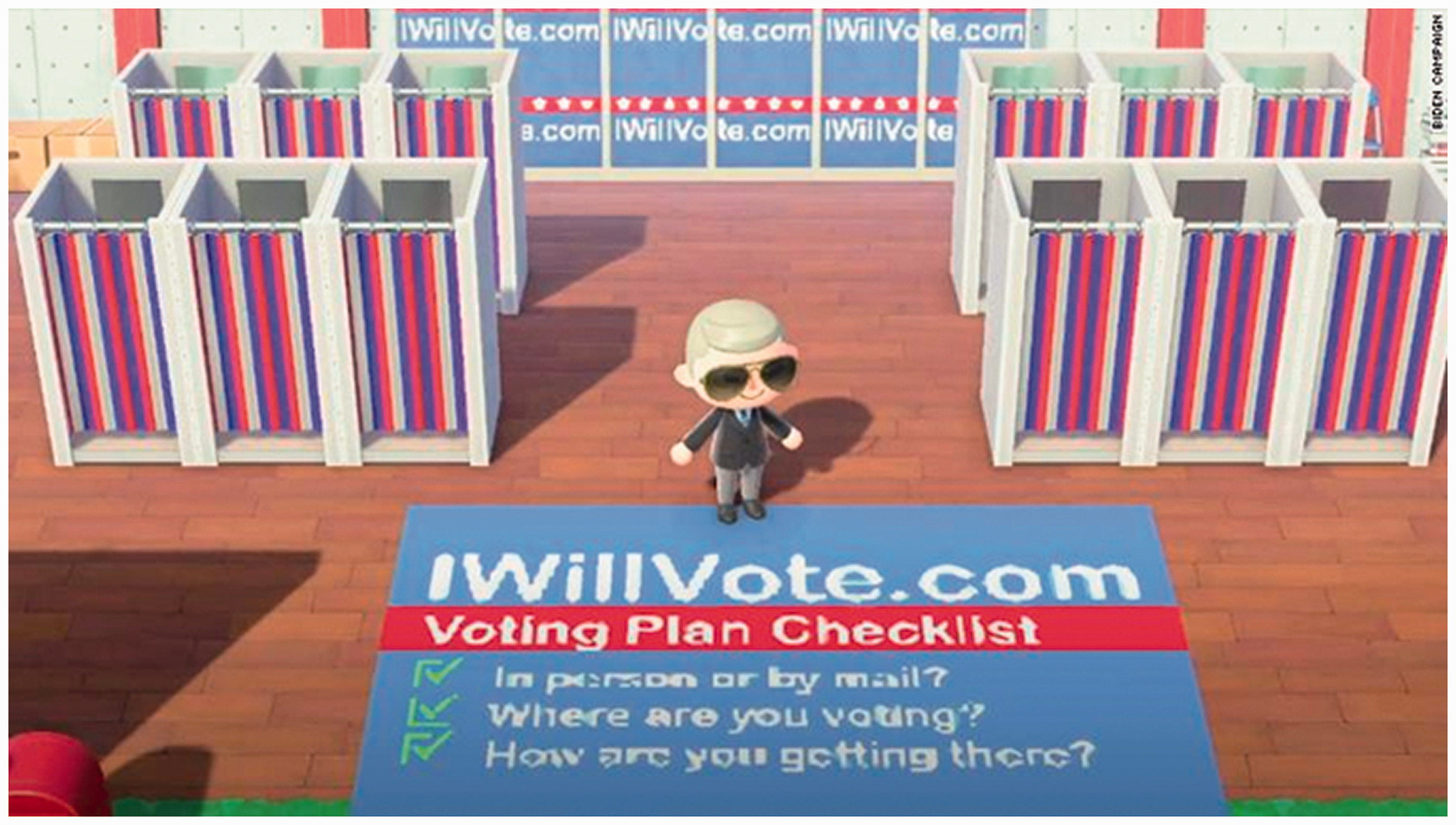
IWILLVOTE.com banner in Joe Biden dedicated island that directs players to visit a website sponsored by the Democratic National Committee and sign up for Biden campaign text messages.

Joe Biden’s island in Animal Crossing: New Horizon.
(b) Digital social movement – “Free Hong Kong” movement
What are the policy issues that arise from issues or events inside the game? Moreover, how does the government respond to those issues? As previously stated, issues or events inside the game affect the real world in many ways. For example, the Chinese government reacted to issues and events inside video games by banning Animal Crossing: New Horizon because players caused controversy. One of the biggest political issues that occurred last year was the dispute between China and Hong Kong. With restricted movement caused by the ongoing pandemic, people could no longer voice their opinion by protesting on the streets, so some people started to use video games as a medium to voice their opinion.
The secretary-general of Hong Kong’s pro-democracy party Demosisto, Joshua Wong, by creating satirical images, used this game to promote Hong Kong’s ongoing pro-democracy movement. Some mock Hong Kong CEO Carrie Lam, while others depict scenes like CCP leader Xi Jinping’s funeral. As similar images spread across social media, Nintendo suddenly announced the supposed downfall of the Chinese server of the game, following pressure from the Chinese Foreign Ministry. Several Chinese e-tailers have also been removed from their platforms, such as Jingdong and Taobao. The ban was introduced after players were found to be creating and sharing material that is generally sensitive on the Chinese web with a sample creation feature from Animal Crossing. Overseas, players have also been found to be freely participating in politically motivated activities (Du, 2020).
People from Hong Kong voiced their opinion in the games, saying, “Free Hong Kong, revolution starts now” (see Figure 4). Such words can be found in players’ respective yards. Animal Crossing was banned in China, given Hong Kong’s protest movement in the game. Not only that, China also censored the words Taiwan and Hong Kong from every game made by Chinese game developers. The Chinese regulatory authority for gambling has stated that games cannot “threaten Chinese national unity” (Niko Partners, 2020). Nintendo’s game developers who made Animal Crossing also stated that players should not bring political aspects into the game. The main purpose of the game is to have fun and to help bring people together from around the world who cannot meet face to face because of the pandemic. Any political activities, discrimination, and offensive words are prohibited (Nintendo, 2020).
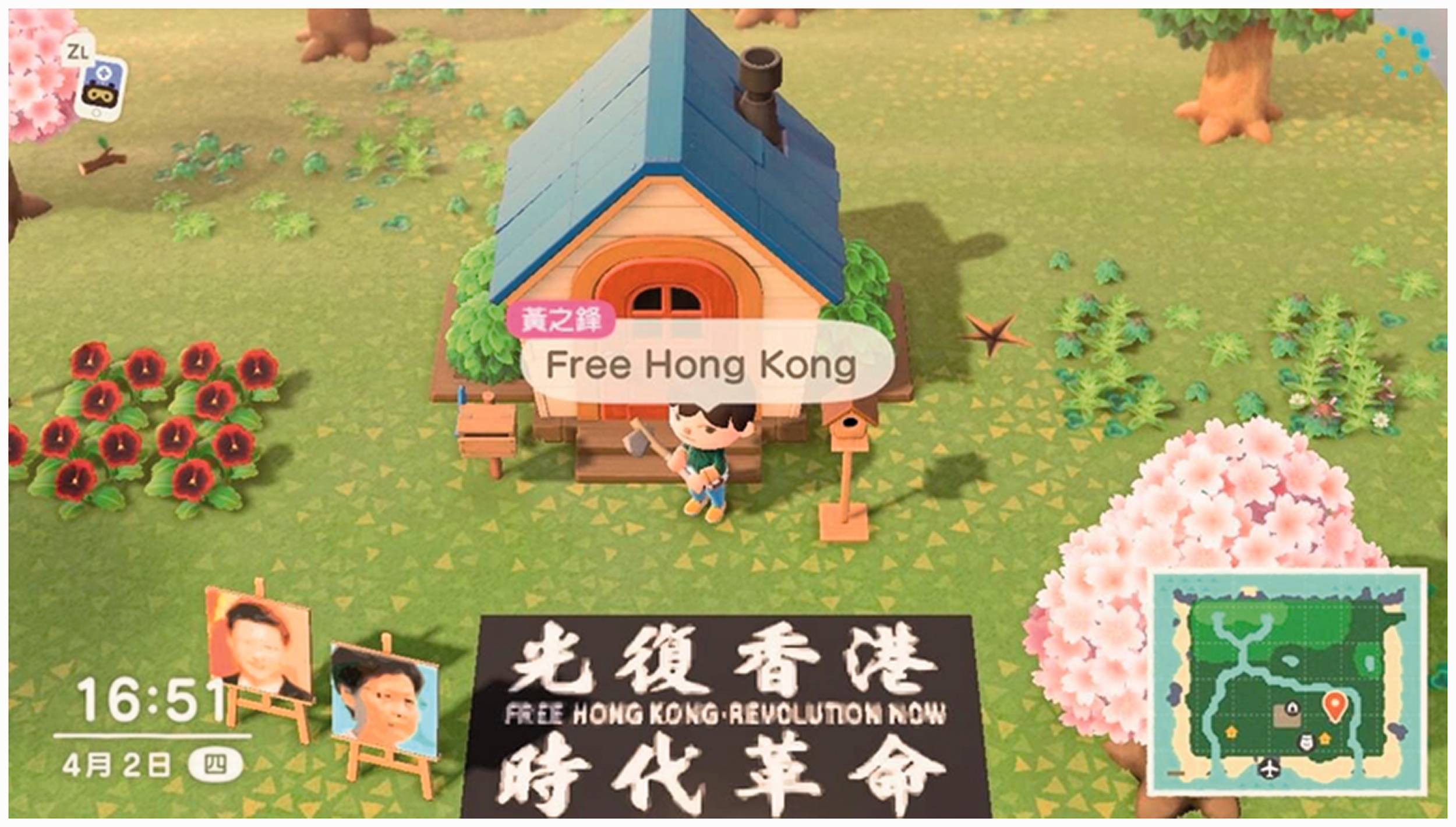
Animal Crossing: New Horizon players voice their opinion by supporting the “Free Hong Kong” movement.
Discussion
The last part of this study summarizes the findings and discusses the important topics related to video games in general. It is necessary to elaborate on how video games are intertwined with real-world current events or issues before describing how political aspects are found inside certain games. It demonstrates how issues and events inside certain games affect the real world in many ways. The authors believe the topics in the discussion below are important to support the argument that leads to the summary of the results and shows the thought process of explaining how political aspects are seen in games and how governments of certain countries react to policy issues or events inside video games.
Mixed reality – interaction between real life and video games
Inside video games, there are always places the gamer usually calls “worlds” that can be explored. Every game may have different worlds, but most people agree that this world is defined as virtual reality (Pallavicini et al., 2019). Virtual reality brings players into their own reality using vision as a primary tool to show that, while a player cannot feel things using their physical senses, the player’s immersion strengthens how real the virtual reality can be perceived. How real is virtual reality? The best view is that virtual reality is a kind of fictional or illusory reality, and it is not really real. David Chalmers argues in “The Virtual and the Real” that perception in virtual reality is not an illusion and life in virtual worlds can have the same kind of value as life in non-virtual worlds (Chalmers, 2018 ). Jesper Juul also said that virtual reality, to support Chalmers’ statement, is and does not become indistinguishable from regular reality, and this is the point (Juul, 2019). Non-virtual reality, such as Pokemon Go or Harry Potter: Wizards Unite, that uses augmented reality, and virtual reality are just two implementations related to structure. While virtual reality might be less valuable and irrelevant than reality itself, connectivity still can be found between them and they can be intertwined with each other in many ways. Virtual reality can be equal to reality itself in the long term, value and relevancy wise (Chalmers, 2017).
Politics in video games
As agreed, there are interactions between video games and real life. For starters, some people may disbelieve or disagree whether there are many political aspects we can find in video games. Video games are supposed to be fictional with literally zero connection with what happens in the real world outside. The two cannot go well with each other, which is also a completely different aspect. Just as any other media, such as movies and books, video games tend to be fictional with a lot of fantasy added to amuse the gamer so they will enjoy playing it without being reminded of real life. Anything with politically related themes in video games is usually only a mere coincidence and does not have any hidden meaning. Intended or as a coincidence, this politically related theme in video games strongly connects with current or past affairs in the real world.
The general knowledge that most of us play themleads video games into a billion-dollar business, and that people extrapolate themselves from their human experience when they create stories, stories of any kind. Policy as a term is multidimensional and applies to any structure that supports or controls how people live. Video games deal with people’s fundamental rights and duties to politics. Cultural products like gameplays examine why it is difficult, although they often suggest it is a viable solution to shoot someone in the face. By choice and because we have also changed, games may be made more obviously political. We are now more globally informed than ever about politics, and we can form an opinion on political discussion and see when certain matches try to reflect current events. However, we cannot eradicate politics completely, not even single aspects of our lives, and we have realized that in developing games and in the discussion of them. Games seem politically interwoven now, but they have always been. When we think of policy we often think of politicians—of game dependence debates, especially loot boxes and the never-ending question whether the shooters are causing real global violence. Politicians are interested in games when it is obvious that games are the main force in the lives of people (Hetfeld, 2019).
Gaming regulations in China
On August 30, 2018, the Ministry of Education issued a new notice to prevent children and adolescents from becoming myopic or short-sighted. The communication also included recommendations for implementing regulatory bodies. The report was produced as the increased use of gaming and the internet among minors can result in higher rates of myopia. The recommendations were to reduce childhood and teenage myopia nationwide by more than 0.5 percentage points annually until 2023. Families, schools, and public health institutions need to be guided so as to create a healthy atmosphere both at home as well as at school. Schools are encouraged to provide myopia training to all students and to regulate electronic device time during school hours. Medical centers are recommended for diagnostic therapy standardization in order to diagnose myopia early in children. The Ministry of Education also advised eight regulatory bodies. Regulations are further strengthened in order to restrict online minors’ time. Besides national actions taken in recent years, Tencent introduced restrictions for its hit game Honor of Kings in 2017. Players under 12 had a one-hour per day limit and players aged 13–17 had a two-hour limit per day. In addition, the regulators investigated an age rating system with colors (green, red, etc.); however, this was not implemented. IChina has no ratings entity such as the Entertainment Software Rating Board (ESRB) in North America or the PEGI (Pan European Game Information) in Europe. According to the Ministry of Education in China, these suggestions would guarantee that children do not spend too much time playing games that could lead to abuse and ultimately myopia. The third is new and can have the highest impact. It demands that the number of games distributed throughout China be reduced by SAPP (China's State Administration of Press and Publication). The published text is not as detailed as expected but, depending on SAPP completing its institutional restructuring, the detailed policy is likely to be unpublished until the end of September 2017 or later. After publication of the detailed policy, game licenses will to some extent resume and it is not clear whether the policy is eventually limited or not (Niko Partners, 2018).
Political marketing and procedural rhetoric inside the games
Many political campaign studies have shown that traditional methods used by politicians to boost their popularity are not effective, and lead to fewer votes (Kalla and Broockman, 2018). We can no longer depend on speeches delivered in front of television audiences, political rallies organized in city squares, or the use of posters and newspaper articles to gather voters. Therefore, it is necessary to use more sophisticated approaches in the modern age. Joe Biden’s political campaign inside the game Animal Crossing: New Horizon has become a political marketing and policy communication strategy to win the election. The political campaign creators of this game have successfully inserted the campaign program into part of our culture and daily routine. Gamers, regardless of age, are politicized and deal with a never-ending, wide array of political situations daily. Political marketing is aimed at helping voters and political parties make better decisions through the use of analyses of marketing, planning, execution, and control. An approach that focuses on building long-term relationships between voters and political institutions is being advocated by Bannon (2005), Johansen (2005), and Henneberg and O'Shaughnessy (2009). Many modern digital games are politically designed. Digital game players are more politically involved than most Americans. It is estimated that the presidential election included 100 million of them (Baltezarevic e. al., 2019). Therefore, gamers from Animal Crossing: New Horizon were involved, informed, and strongly advocated on critical issues in the election.
Ian Bogost (2010) introduces “procedural rhetoric” as a way of rhetorically studying games based on their ability to persuade users to think, feel, and act. Studying video games is part of digital rhetoric. Looking at the games Animal Crossing: New Horizon and Genshin Impact, these games show how challenging procedural rhetoric can be to identify and analyze. The growing use and active public interaction in games to argue for policy purposes underlines the importance of encouraging gamers to think how the unique benefits of specific media can contribute to or reinforce ideas and arguments. Based on procedural rhetoric, these two video games are ideological to such an extent that they reward conduct coded in conformity with game standards while penalizing conduct that violates conventional principles. Since video games are rule-based systems, they have an effective mechanism for feedback: therefore, games are structures that must be optional (choices of an individual voluntary nature), and never coercive (dependent on force or external pressures). Procedural rhetoric focuses on how producers of video games develop legislation and rules to promote a specific ideology in a game. Each game expresses an ideology or a message, regarding literature, art, and cinema, rather than utility or instrumentation (Bogost, 2007).
Conclusion
Video games are a form of new media content that offers many functions, such as entertainment or media marketing, depending on how people use it. Nearly all young people in the developed world now play video games. As time goes by, not only will younger audiences grow accustomed to video games, but even adults will start to engage more with video games in general. Video games are becoming more influential and affecting our lives in many ways. Like individuals, policy and professional organizations have expressed varied positions regarding video game effects. Interpreting what gaming is and how it is to be used for analysis of policy and planning depends largely on the view of the general public. Video games have proven to be excellent instruments for experimenting and learning. Games are especially useful in public policy making and public planning (Mayer, 2009).
Some people may perceive video games as fiction and unrelated to the real world. However, this study found that a connection can still be found between reality in the real world and fiction in video game virtual reality. The two of them collide and intertwine with each other in many ways. Furthermore, real-life issues and events can affect video games, and events and issues in video games can affect real life. This can be seen in two of the biggest recent political activities: Joe Biden’s decision to use Animal Crossing: New Horizon in his political campaign to attract and target voters, mainly younger adults, and China’s decision to ban Animal Crossing: New Horizon in light of the Hong Kong and China dispute. China censored the words “Hong Kong” and “Taiwan” in the Genshin Impact in-game chat, claiming those two words threatened China’s national unity. The results provide confirmatory evidence that political aspects can be found inside video games.
New media and rapidly changing technology require scholars to keep up to date with public administration fields. This research shows that digital games have been effective persuasion tools in public policy because people who play digital games are heavily engaged in politics and policy. This is an opportunity for government administration to become a new platform for public policy formulation. Political analysis and policymakers may interact and customize the policy message with citizens in the virtual world. Implementing the policy has begun using a range of micro-targeting technologies using individualized and other data sets, and marketing applications, with recent technological innovations and industry breakthroughs. Public administration can gain advantages from digital gaming, and explore and provide potential future guidance for the role and impact of these techniques. However, public policy implementation may depend not only on digital gambling, but also on AI. AI could someday demonstrate it can provide data-driven policies much faster and more efficiently. Using AI, the right to collect large quantities of data from different sources can be easily targeted by a policy. In the years to come, automated content generation policies for specific users tailored to their needs and interests will likely be developed. This could lead to personalized, updated, and prepared messages for each policy regularly.
Footnotes
Declaration of conflicting interests
The author(s) declared no potential conflicts of interest with respect to the research, authorship, and/or publication of this article.
Funding
The author(s) received no financial support for the research, authorship, and/or publication of this article.