



Abstract
This article problematizes the status of the visually impaired students in Bangladesh under the COVID-19 global pandemic. We inquire into two inter-related questions: (a) what level and quality of technological access does a visually impaired student have in their higher education institution (e.g. a university or government-affiliated college operating under a university)? And, (b) how are these students coping academically under the pandemic? Our preliminary study employed mixed methods for data collection, encompassing a quantitative survey questionnaire followed by qualitative phone interviews. We reached out to approximately 15 male and female students enrolled in public and private higher educational institutions in the country. The findings will be instrumental to initiate a collaborative discussion among academics and practitioners in the government, non-government and private sectors in the country and around the Global South.
Introduction
The blessings of information technology continue to transform and upgrade the quality of life throughout Bangladesh. The ruling government initiated the “Digital Bangladesh,” which is a timely and futuristic philosophy to introduce the country to the quickly changing global information and communication technology (ICT) scenario. For this, the government has taken numerous projects, for example, the use of ICT in government services, introduction to the 4G network, access to the submarine cable and e-tender. Interestingly, the COVID-19 global pandemic directly points towards the future when even day-to-day activities could be conducted online using information technology devices and services. At this juncture, one of the cracks is the marginalized social groups in the country that remain unable to reap the potentials and benefits of growing technological advancement. In particular, many, if not most of the visually impaired students in Bangladesh do not have access to basic technology to cope with the needs of the time. This article focuses on this issue because in the world that’s constantly changing, inclusive access and mobility along with state-of-the-art technologies and relevant resources for all social groups are a must to secure progress and development.
This article also illustrates the challenges faced by the visually impaired students before and during the COVID-19 global pandemic in terms of ICT usage and other facilities available in the higher education institution. Similar to the rest of the world, the COVID-19 global pandemic has created turmoil in Bangladesh; in particular the country’s higher education sector has been hit heavily. For example, the University of Dhaka led the way by deciding to move its summer vacation in mid-March 2020 and it remains closed ever since. The other public universities soon followed the same directive and have been refraining from offering regular on-campus academic activities until the time of our data collection. However, private universities opted for online classes and online exams. There are legal frameworks in Bangladesh that ask these institutions to provide equal opportunities for visually impaired students. However, the resources are limited and the lack of collective awareness is hindering the initiatives taken with these limited capabilities. With preliminary findings derived from visually impaired students studying in public and private universities in Bangladesh, this article shares a number of recommendations for the institutions and related authorities. It is important to note that one of the authors in this study is a visually impaired person and, as a fresh graduate, has first-hand experience of the academic life in a public higher education institution of Bangladesh. Thus, this paper is a representative voice for visually impaired students and, thus, undertakes a compassionate angle.
Literature review
The review of academic literature on the conditions of visually impaired students in Bangladesh and issues faced by them reveals some considerable limitations. Interestingly, researchers find a lack of research on the topic to be a common pattern across countries. According to Heather Hill (2013), “…there appears to be a lot of discussion about people with disabilities, but little direct involvement of these people in research.” The author adds that in many instances, authorities attempt to assess accessibility without inviting people with disabilities to discussions. That leads to significant deficiencies in research and policy implementation (Hill, 2013). An empirical research on the university students of Tanzania reveals that inadequate access to ICT facilities among the visually impaired students affects their learning process. These students shared that the learning process and activities can become time consuming without the aid of ICT resources. In addition, students experienced an increased dependency on assisting readers. These students also felt that poor access to ICT and relevant learning support materials impeded their access to a range of learning materials as well as forced them to endure an inflexible education routine. Essentially, the shortage or absence of ICT facilities makes the learning process challenging and limits the capacity and output of the visually impaired students (Eligi and Mwantimwa, 2017).
A survey conducted by Bhardwaj and Kumar (2017) on visually impaired students at the University of Delhi shed light on many little-known or less appreciated aspects of their learning environment. The researchers observed that approximately two-thirds of the visually impaired students were not able to take any notes during lectures and they mainly relied on listening to teachers. In total, 60% of the students revealed that inaccessibility of the existing facilities was one of the major difficulties faced by them. Thus, Bhardwaj and Kumar (2017) argue that even if a facility is made available to visually impaired students, it does not mean that it will also be accessible. Rather, special efforts are needed so that a facility is actually used by visually impaired students. The researchers suggested that typing classes should be arranged for these students so that they can use the available laptops to their full potential. Efficiency gained from practice can assist such students to take notes in classes, and write their own assignments and exams. At the same time, audio notice boards should be installed so that visually impaired students can access information about activities on campus. The researchers also found an acute shortage of study material in digital format. Even when such material is available, it is not immediately accessible (Bhardwaj and Kumar, 2017).
Other researchers, such as Southwell and Slater (2012) discover that developed countries with state-of-the-art technology and classroom facilities can still do more to accommodate visually impaired students. These researchers observed that only 42% of academic digital collections in the academic libraries of the United States are accessible using screen reading software while 58% are not. The major reason for inaccessibility has been found to be the lack of readable text and transcripts in the digital collections. Furthermore, the study suggested the formulation of institutional policies and mandates to obtain consistent accessibility for digital contents.
As a result, we modified and expanded our research queries targeting visually impaired students of any educational level. Few pieces of research address the situation in school students and children’s education. It is interesting yet saddening to discover that fresh initiatives regarding improving learning conditions have yet to be taken at the higher education level in Bangladesh. A recent study that was conducted on the students of a school for visually impaired students in the capital Dhaka has shown some important insights. As the author puts it, According to the guardian of blind students in comparison to the autistic, blind students are getting no government facilities. But it is a matter of immense pleasure that in 2015 for the first time they got Braille book from government. But these books are not sufficient. Only the students in hostel get the Braille books for group study. Those who comes from outside [out of the capital city, Dhaka] do not get the benefit. By interviewing the students who reside in hostel we came to know that they did not get the Braille book in full set. These books are expensive and the price of a full set book is about 12,000 TK [US$142] (Nasrain, 2017).
Another author reported that several initiatives were taken over recent years to develop Bengali text-to-speech converter and optical character recognition (OCR) software. However, resource constraints and lack of continuation have impeded the progress of most of these initiatives. In the NGO sector, some level of success was achieved by an organization called “Team Engine” that developed a converter and OCR applications that were purchased by the ICT division of the Ministry of Post, Telecommunication and Information Technology (Chandan, 2018). The author summarizes that the visually impaired students in Bangladesh are some of the worst victims of negligence and marginalization. Unfortunately, very few from this marginalized group are able to overcome intense social and practical barriers to continue their education. Even if they rise above those challenges, “[societal] negligence in ensuring their universal right to access knowledge in their mother tongue has further curbed their immense potential” (Chandan, 2018).
These findings illustrate a gap between law, policy and reality on the ground. It is because the key terms from the Rights and Protection of the Persons with Disabilities Act 2013 undertaken by the Government of Bangladesh acknowledges that education at all levels of institution is one of the fundamental rights for every Bangladeshis with disabilities. Therefore, the government recommends developing favorable, conducive co-education facilities for participation in educational institutions. The act defines three different kinds of visual disabilities: (a) fully visual impairment or no visual function in both eyes;
1
(b) partially visual, in which one eye is completely sightless or blind; and (c) indistinct visual, in which vision within 6/18 or 20/60 and 6/60 or 20/200 (between 20 degrees and 40 degrees out of 60) is considered as insufficient blindness. Building upon that, the Rights and Protection of the Persons with Disabilities Act 2013 states, Government will take necessary steps towards facilitating accessibility for persons with disabilities in reading books listed in the National Curriculum and Text Board (NCTB) and other libraries through the installation of an acceptable and proper technology that supports an e-learning platform (Women with Disabilities Development Foundation (WDDF) et al., n.d.).
Design and method of the pilot research
Research design
We employed a mixed research design to collect, process and analyze data. Our choice of research methodology is shaped by Freire’s (1982) notion of participatory research, the aim of which is to generate a sense of mutual learning and bonds of solidarity by placing individual experiences in a broader context and looking for patterns (Small, 1995). We collected qualitative data from semi-structured interviews and quantitative data using an online survey. The rationale for using semi-structured interviews is that they allow flexibility to delve into subjects that the participant considers of great importance. The quantitative survey provided direct information on informants’ demography. Applying both methods ensured that in-depth insights are generated to meet the answers to the research queries. Employing a mixed-method approach also helped to generalize the findings in a broader sense and enhance the reliability and credibility of the data collected from the respondents.
Study area and population
The settings of this preliminary study did not center on any particular university campus or within a region in Bangladesh. Until today, no particular unit/institute or other national/university-based entity provides courses solely to visually impaired students. In addition, as of 2021, according to the University Grants Commission of Bangladesh (2021a, 2021b), there are 49 government universities and 107 registered private universities in Bangladesh. However, not a single private university offers any course or program for visually impaired students. The pandemic deepened this central issue. At the heart of the pandemic, the universities closed down and asked their students to leave the residential halls. Out-of-town students thus had to move out or find a new place to live. Visually impaired students that lived in residential halls were part of this group. Therefore, rather than confining the geographic boundary for this study, we decided to keep the study an open one for participants because our focus was to learn and understand the issues they faced. Therefore, from the outset, the study posed challenges to understanding the visually impaired students’ hardships and developing more profound insights into their accessibility and usage of the assistive ICT facilities during the COVID-19 global pandemic. All the participants spoke for themselves, and their experiences are the basis of this research.
Sample
We conducted purposive sampling to select a sample of 15 key informants based on their knowledge of living academic life as visually impaired students and surviving the COVID-19 global pandemic. We also employed a snowball sampling method to locate other university-attending visually impaired participants because it was difficult to contact them in the exact location or use a specific medium or contact channel. Overall, out of the many participants we reached out to, only 13 (86.67%) respondents participated and completed both the study’s quantitative and qualitative components. Unfortunately, two (13.33%) respondents were unable to complete either of the components due to a number of technological, social or personal challenges.
Data collection method and instruments
We collected the primary data using different methods and instruments such as questionnaires and interviews. Although it was initially included in the plan, we could not conduct participant observations due to the movement restrictions brought in by the pandemic. The contributing researchers designed the 14 questionnaires with closed and open-ended questions. We pre-tested the sample questionnaires with three visually impaired students to increase validity. The feedback we received from them helped to improve the quality of the questionnaire. Considering our data collection materialized during the pandemic, as per the instruction of the authorities, we tried our best to limit in-person interaction. As the student informants did not have regular internet access, some of the interviews were taken over the phone.
Data processing and analysis
We used Google Forms to organize and analyze the collected data. We did not collect any data of a personal nature from the respondents. Google Forms’ auto-generated function conducted the calculations required for the quantitative data. We used the content analysis method to analyze qualitative data to construct classifications, descriptions and narrations.
Results and discussion
Demographic information
Before we share the study findings, we acknowledge that the findings represent the views and perspectives of the informants. In addition, these findings do not necessarily generalize the conduct of the governing bodies and the employed personnel. This findings section begins by providing demographic characteristics of the respondents. The respondents provided information regarding their age, sex, degree program and year of study and the degree they are working on. All the respondents are in their 20s, with an age range of 20–26 years of age. One participant was not willing to share this particular set of demographic information. The majority (69.2%) of the respondents were male. This can be attributed to the broader challenges attributed to female visually impaired students in the country in regard to attaining higher education. Unfortunately, different human-made factors, such as traditional beliefs, norms and marginalization of females with visual impairments may prompt many families to emphasize educating sons rather than daughters. Our participants were from the universities listed in Table 1.
Number of participants from different universities.

Based on the list in Table 1, only Independent University is a private university. All the other universities are operated through government funds. Ten of the participants were working towards getting their bachelor’s degree. Three of the participants were at the master’s level. An interesting fact is, none of them was enrolled in the business or science faculty. All of them studied either social sciences or subjects related to arts and humanities. This is a significant drawback in the Bangladeshi higher education system that has failed to create a conscious awareness of the diversity of optical challenges faced by visually impaired students, let alone a level playing field for them (Figure 1).
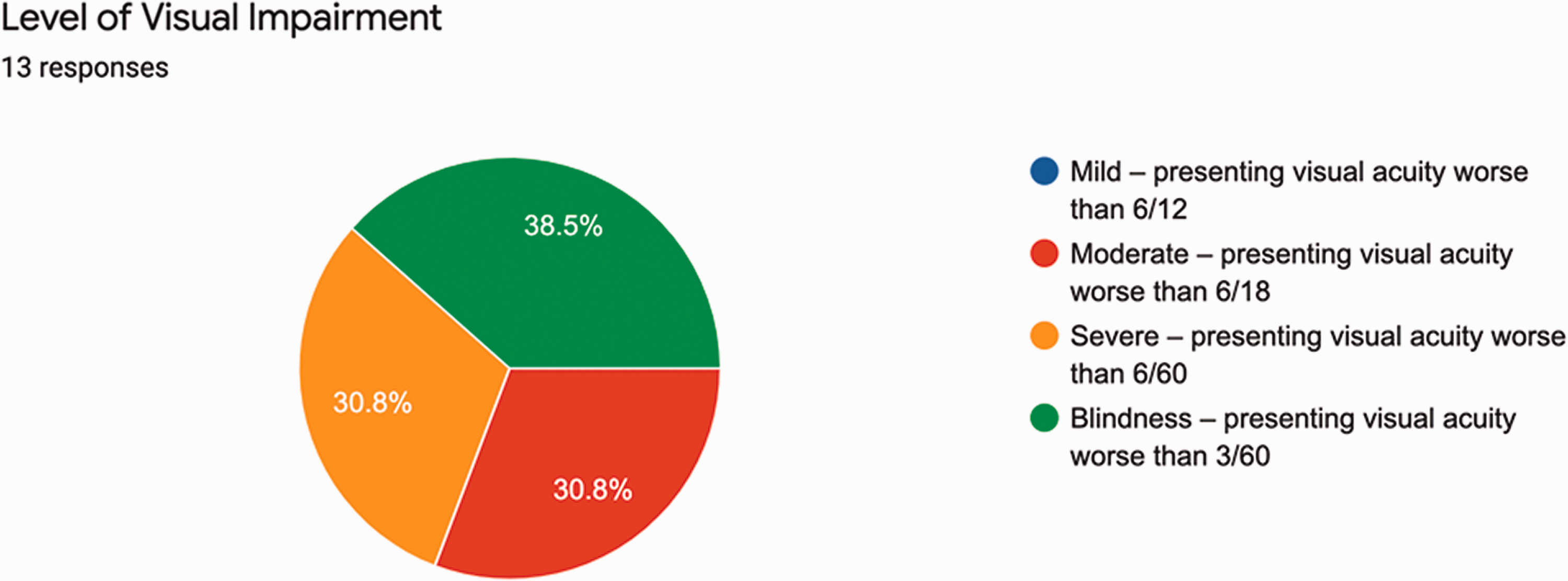
Level of visual impairment of the respondents.
Figure 1 depicts the level of visual impairment of the research participants. These four levels are taken from the International Classification of Diseases 11, published in 2018 (World Health Organization, 2021). From the figure it is easy to decipher that all the respondents who took part in this research are considered as having moderate, severe or complete blindness.
In addition, Figure 2 reemphasizes what we briefly stated earlier that as a result of the imposed country-wide lockdown caused by the pandemic, students were asked to leave the hostels in the city and return to their homes. As the figure illustrates, 53.8% of the respondents lived in villages. This data reflects the national population trend; 63% of the population of Bangladesh live in villages (World Bank, 2019).
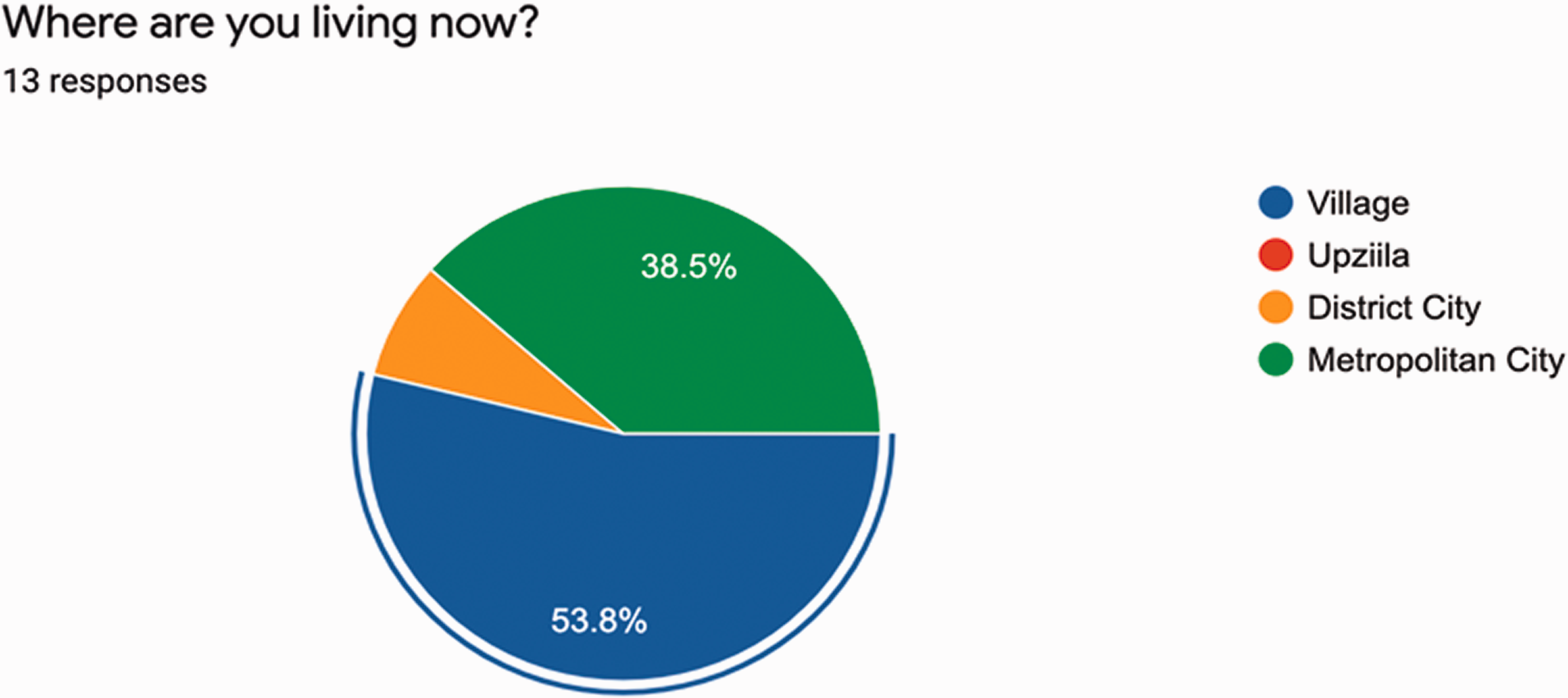
Areas where the respondents are living during the pandemic.
Access to ICT services and other study materials
Pre-COVID 19 situation
Each of the study respondents has basic ICT literacy. They can operate computers and mobile phones on their own. However, the majority of them were self-taught. With family members, friends or mentors, they learned different software and other technological facilities. None received any ICT training after getting admitted to their respective university. Three students took six-month courses from NGOs and development organizations. All of the respondents have an internet connection at home. They primarily use Wi-Fi and prefer to have a backup connection in 4G internet. Also, 61.5% think that their internet connection is nothing special but barely works. As the majority of the respondents are from villages, this is easily relatable. The majority of the respondents (92.3%) know Braille. However, all of them agreed there is little to no study material available for their academic courses. All of them needed volunteers’ help to undertake day-to-day academic activities, such as accessing the academic building, taking class notes (recording and transcribing them), as writers in the examinations, as readers who read out the study materials. Few of the respondents needed help browsing the internet. When they try to browse by themselves, a few websites ask for image verification and the visually impaired students fail to do it (as they can not see what is in the picture and click accordingly), thus making them dependent on their classmates/roommates/volunteers. These participants prefer to use Microsoft Windows operating system. When asked about the other operating systems, they mentioned that getting computers from Apple is not an economically feasible option. For the same reason, most students (69.2%) use Android smartphones; two students use feature phones, and one student does not have a phone. One student uses both Android and iOS mobile phones.
Screen reading software is crucial for visually impaired students. Students use both NVDA and JAWS. They prefer NVDA as it is very accessible. Sometimes they need to use JAWS as it has some unique features. Students using Android phones use software like Kibo, Talkback, Google text to speech and the commentary screen reader. The student who has an iOS operated phone prefers to use the VoiceOver screen reader. Further, according to our findings, 53.8% of the students use their mobile phones as their primary learning device as it is easy to carry and has essential features. Moreover, 38.5% of students prefer to use their laptops to do day-to-day academic activities with more power and more diverse software. None of the students uses any paid or licensed software. This is shocking because students have to use pirated versions of the software due to a lack of money. The government or the academic institutions took no initiatives to make the necessary software available for visually impaired students.
ICT-related challenges faced before the pandemic
In the words of one of the male student participants who studies in a public university, “the universities in Bangladesh radiate an assumption that they have done enough by allowing visually impaired students to enroll.” The informants vented that such type of debilitating attitude mostly comes from administrative staff. Other informants shared a similar concern while a few mentioned that a number of faculty members appear insensitive towards visually impaired students as well. In regards to administrative resources, although there are resource centers in the government universities, they lack adequate and timely resources while their existing resources can be compared to “dated” and/or “in life support”. For example, the computers are usable, but they do not have the required applications or software. The staff are not friendly, or so the respondents remarked. These staff discourage the visually impaired students from visiting such centers, stating that they and their activity disturb the surroundings. Both Jahangirnagar University and the University of Chittagong have their disability resource areas in one corner of their central libraries. The students felt that these facilities are inadequate to fulfill their academic needs. As education in private universities is very costly, the respondents mentioned they could not enroll there due to financial hardships.
In the seminar/department libraries, hardly any facility is provided for visually impaired students. The general students have all the books and computers. The computers do not have any special software for visually impaired students; hence, they are not accessible. No Braille books are available for reading. Unfortunately, all the administrative activities in regards to registration, among others are to be done manually by the visually impaired students. Every semester, such a student has to go to two different banks for admission to submit additional payments. Then they have to come back to the hall and then go again to their department. All these locations are very far from each other. They have to do all the administrative activities manually and on their own. Sometimes, classmates form a Messenger chat group (an instant messaging service provided by Facebook) to notify each other about class times and other announcements. This is beneficial. However, unnecessary chats push necessary information upwards, and visually impaired students often miss such essential announcements.
In addition, getting volunteer support, such as note-takers, is a very difficult maneuver for most of the visually impaired students. In the universities, examinations are held in the same timeframe. So, the volunteers also have examinations at that time. As a result, it becomes challenging to find someone. Most of the time, study materials are provided in the Xerox shops. Those hardcopies are of no use to visually impaired students. They then have to take the help of a volunteer who reads out and records the student’s whole material. Finally, organizations that work with visually impaired students on campus are not united and are not doing much to help the cause of the visually impaired students.
Our findings
Overall academic experience during the pandemic
As the COVID-19 global pandemic started to spread in Bangladesh, different higher education institutions asked their residential students to leave the campus. Among the respondents, two of the students were affected with COVID-19, and another student had family members affected by the virus. The symptoms were mild for one student. The other student had to miss the class for almost one month. Friends and faculty members provided support for this person as study materials were sent regularly via email. Overall, 91.7% of students used ICT facilities from home and 66.7% of students never got any information officially from their academic institution regarding COVID-19 and related safety practices. Five students mentioned that they were given necessary information unofficially in the classes by the faculty. Moreover, 46.2% of the students shared that their institution has not taken any action to vaccinate them, whereas for 38.5% institutions had taken action. Interestingly, students from the same institution differ in opinion, which shows that information was not passed equally to all the students. Finally, 53.8% of students had to go at least once to their campuses to conduct either an academic (meeting teachers, collecting notes) or administrative activity (scholarship withdrawal, admission, to fill in student information form) amidst the lockdown and pandemic. During this period, no students accessed any ICT facilities on campus. So, they did not provide any critical comment on this issue.
ICT-related challenges faced during the pandemic
Most of the student respondents suffer from a poor internet connection. As per the research, only 23.1% of students think that their internet connection is strong enough. The remaining have either a poor connection or a connection that is nothing special but does the job. As a result, buffering was constant problem for most of them. Many students had to use Zoom for the first time in their lives. In the Zoom classes, the slides shown were not accessible for visually impaired students. If a graph or image is shown, the screen reader software cannot decipher them. Sometimes the teacher forgets to describe what is in that particular slide.
In addition, frequently, teachers provide PDFs to visually impaired students, which is a collection of images. The reader software cannot read any image file. Assignments based on those books or PDFs brought poor marks for the visually impaired students as they could not access them. One student did not have a powerful device to operate the Zoom and other software required for online classes and assignment submission.
One particular student reported that a course required the students to make advertisements. The respondent could not do it as the instructions were not clear and proper training was not provided. Helpless without friends, the student could not submit the assignment. Generally, visually impaired students work in groups, but now it has become complicated as everyone is in different places. Conference calls are inconvenient and costly. Visually impaired students sometimes need help with assignment formatting, even if they write the whole assignment independently on their computers. That was not possible during the pandemic. In addition, the in-person classes are lecture-based. The visually impaired students can ask someone sitting next to them in case of any missing point. This opportunity is unavailable in the online classes.
Students who are in the villages face problems with accessing uninterrupted electricity. Sometimes it is infrequent. As a result, these students could not charge their cell phones and missed the class. Respondents also felt that balancing family life and education was a new challenge as almost every family member has started to stay in the house at the same time.
We also heard from respondents that a number of them failed to note and failed to record the classes as there was no permission to record classes. As teachers could not see them in person, they sometimes failed to address the visually impaired students’ sensitivity. One of the students shared that two of the teachers were not very cooperative. As the only visually impaired student on the entire campus, it was challenging to get the administration’s attention. As a result, the student had to clarify to each new teacher teaching in her class. At worst, one of the teachers cut the student’s marks, saying that the performance was not up to the general students’ mark. Forgetting our interviewees’ sensitivity, sometimes the teachers asked them to read the third line of the second paragraph of a specific text they shared on the Zoom screen. The student took forever to find that. Sometimes they were asked to fill in the gaps of the fourth line. Again, the student failed to do so, which is obvious. This lack of sensitivity is very pressing in the higher education institutions. Many teachers and administrators feel that they have already done a favour for the visually impaired students by admitting them to the university. Hence, providing further facilities for them is not an urgency/necessity. These students should be happy that they are in the universities overcoming all the obstacles. However, the student shared that many teachers are willing to help and consider the visually impaired students’ sensitivity.
Effects of the highlighted challenges
As the pandemic forced all the classes online, if a visually impaired student misses most of her or his classes, predictably, it is excruciatingly challenging for them to retrieve class notes as the classes are not recorded, and no shortcut notes are provided apart from the slides. As a result, the student lags behind others and cannot perform well in assignments. Moreover, the lack of volunteers and cooperation from teachers are the main reasons why visually impaired students can easily feel vulnerable and lack confidence. Some of them reported feeling depressed. These students constantly receive poor marks as many of the academic resources are not accessible to them. As students have to spend more time with their families, they are having difficulty in time management. A respondent commented, “At the residential halls, it was less work and more time. Now it has shifted to more work and less time.” After a year of the pandemic, semesters passed, but the visually impaired students continue to miss out on essential insights from peer members on contemporary issues, often shared in the informal chats.
Recommendations
The respondents offer several recommendations for the parent institutions and policymakers to improve the access to ICT facilities to support the learning activities of the visually impaired students. These recommendations are shared below.
For educational institutions
An orientation session followed by complete ICT training should be organized in each campus so that visually impaired students get all the necessary information and knowledge to start their higher education life.
The libraries (central and department) should be made accessible to all the students. Licensed soft copies of the books are required for all the students to ensure mobility and easy access. In the libraries, no separate corner is necessary for visually impaired students. Every computer should have the essential software. Facilities like portable readers, radio, recording devices can be added too. Braille monitors can help in this regard. This cost-efficient and straightforward method will enable the visually impaired student to read almost any book. It is not only cost-efficient but also time and space-saving.
Students should be able to take their exams electronically so that they have less dependency on volunteers.
As there is no viable alternative to reading books, Braille should be made famous. Refreshable Braille display enables the visually impaired students to read any book which is available as a soft copy. Refreshable Braille printers and related software should be made available at the computer facilities throughout the campus.
Free internet is a must for higher education institutions. Students should receive an email ID to use for academic purposes. These credentials may be used to access the internet and other on-campus ICT facilities.
A viable solution should be arranged to solve the class recording debate. If it is not possible to record the class, a study can be conducted to address this issue.
Slides should be described extensively in the class. If slides have images, charts or other graphical content, an accurate description is required.
GPS accessible mobility options can be provided for visually impaired students to move around the campus by themselves.
All the new buildings in the campuses should be designed keeping the visually impaired students and their accessibility in mind.
The teachers should be proactive in providing soft copy study materials. Getting items from the photocopy shop is very difficult. Sometimes they suggest books that do not have any soft copy available.
The digital notice board is a necessity. Every department should maintain its websites. Students should receive their results and other necessary notices via email.
For the policymakers
All university-level teachers should be provided with visual impairment-related awareness and sensitivity training.
Policies should be undertaken to address the copyright infringement regarding recording parts of books for academic purposes.
The state should allocate more budget for the higher education institutions to ensure an inclusive campus.
Steps can be taken to provide soft loans for university students to buy devices with adequate software at a reduced cost.
Steps should be taken to make Braille more popular among visually impaired students from an early age.
Thorough research should be conducted among the visually impaired university students and stakeholders at the national level to understand their demands, desires and destiny. Issues regarding all the physically and visually impaired students should be dealt with by the Ministry of Education instead of the Ministry of Social Welfare to mitigate bureaucratic “red tape.”
All the government websites and job sites should be made visually impaired student-friendly. For example, the COVID-19 vaccination registration website itself is not accessible for visually impaired students due to captcha use. 2
Students should get the internet at a cheaper rate.
Software should be made license-free for visually impaired students. As most of the students are in the Windows and Android ecosystem, agreements can be made with these corporations to provide the necessary support for the visually impaired students and projects targeting them.
Limitations and future research directions
As preliminary research, this study endured considerable weaknesses such as not being able to conduct physical meetings with the respondents. This limited us to gathering perspectives from the faculty and administrative authorities. We also acknowledge that the preliminary study becomes further limited as a result of not incorporating information on learning methods, teaching methods, project development opportunities, and the human cost to the economy of not ensuring proper higher education for the visually impaired students. While we acknowledge these limitations, we argue that the preliminary research opens ways for future research. Some of the key concepts can be education curriculum for the visually impaired students and research on available resources and their efficient usage by the relevant institutions. In addition, more work needs to be done in regards to increasing public awareness of the visually impaired and physically challenged students or persons in Bangladesh. Finally, more scholarly work is needed to understand the hardships of physically challenged people.
Conclusion
In the light of this preliminary research, it is clear that the conditions of the visually impaired students in Bangladeshi higher education fall behind by any standard, let alone the international mark. The respondents and researchers acknowledge that the faculty, administrators, officials, volunteers and other stakeholders continue to assist the visually impaired students in the higher education institutions. However, these resources are often informal and remain far from the established benchmark standards. As the universities admit these students, they should be given adequate opportunity and resources to explore the riches of academia. It is understandable that being a nation of millions with many other vital issues to solve, Bangladesh has not done well in looking at the visually impaired students and their sufferings. The COVID-19 global pandemic has pointed the finger directly towards the loopholes in the system, which sustain an invisible apartheid against these students. Hopefully, this research will help to understand their problems and enable the universities and policymakers to come forward hand in hand to solve the issues.
Footnotes
Declaration of conflicting interests
The author(s) declared no potential conflicts of interest with respect to the research, authorship, and/or publication of this article.
Funding
The author(s) received no financial support for the research, authorship, and/or publication of this article.
