




Abstract
This paper explores how the neoliberal policy directives relating to the teaching of phonics in schools in England, influences the pedagogy of early years educators (EYEs) working with under-threes. The research highlights that these EYEs are confounded by early reading (ER), given that there is no clear definition or provision separating ER from the mandatory teaching of phonics in schools. This paper asserts that it is vital to detach provision for ER for under-threes from the ‘formal’ teaching of phonics recommended for schools. In addition, EYEs require immediate support to become ‘resistant’ to such inappropriate policy directives, persistently driven by the school readiness agenda and the ‘datafication’ and inequality of early years pedagogy, previously highlighted by Roberts-Holmes and Bradbury.
Introduction
This paper examines how the neoliberal policy directive of teaching systematic synthetic phonics (SSP) for schools in England from 2007 onwards, influences early years educators (EYEs)’ pedagogy of early reading (ER) for under-threes. ‘Neoliberal’ is used to describe this policy directive in the overall sense of market thinking – mass distribution (Pratt, 2016), given the preferential primary approach to the teaching of ER in England, with government ‘approved’ resources for schools advocated. De Lissavoy (2018: 189) uses the term ‘governmentality’, as a means of understanding neoliberalism, which is a befitting term to describe the current phonics directive in England. Equally, Foucault (cited in Burchell et al., 1991) suggested that the term governmentality relates specifically to individuals or groups being directed, governed and controlled in their actions, which is certainly the case with the directive of what, when and how to teach reading, using SSP in schools. This edict is then followed up with the ‘explicit school readiness performance measurement’ of the ‘Phonics Screening Check’, which is published and analysed in the public domain (Roberts-Holmes, 2019: 2). Consequently, Sims (2017: 1) declares that neoliberalism ‘has a devastating impact’ on the early childhood education and care (ECEC) workforce. The impact Sims describes is potentially global – children may not be reading, may not be engaged in ER experiences from birth, and therefore not enjoying reading (Kucirkova et al., 2017), because reading is only perceived to be ‘SSP’. The global measurements of the Organisation for Economic Co-operation and Development’s ‘Programme of International Student Assessment’ exacerbate further, given that Hardy suggests that this is then: A means of calibrating the worth of different national (and, increasingly, sub-national) educational systems. (Hardy 2018: 3)
This mandatory policy driver, in conjunction with the school readiness agenda of measuring early literacy performance in young children (Department for Education, 2017b) and being ‘test ready’ in schools (Moss, 2013: 9) is steering experienced, graduate EYEs towards formally teaching phonics to under-threes. Therefore, this paper highlights that settings are engaging with phonics policy directives in their work with under-threes, believing that this is the best approach to take to support ER development. This research discloses that EYEs are confused and anxious about what ER means for their pedagogy, within the prevailing political phonics agenda and choose to engage in teaching phonics.
Significantly, the SSP phonics directive is considered to be contentious by many researchers and educationalists and as such, has been deeply criticised (Clark, 2018; Lewis and Ellis, 2006; Wyse and Goswami, 2008; Wyse and Styles, 2007). Indeed, Simpson (2013: 7) asserts that ‘few educational practices have a greater ability to prompt passionate debate than the teaching of reading’. Ellis and Moss (2014) suggest that the complexity of how to teach young children to read has been challenged for the past two decades. Campbell (2020) asserts that phonics is one of the most contentious enduring debates for the United Kingdom, United States, Australia and New Zealand. Although, there is acceptance from Erhi et al. (2001) that a systematic phonics approach does have some value in promoting ER within a rich literacy curriculum. However, given the contentiousness relating to the claims that SSP is the principal approach to teaching reading (Snowling and Hulme, 2011), this recommended singular methodology does not acknowledge the broader definition of reading and being a reader, explored later in this paper.
Current perceptions of early literacy development internationally (encompassing both reading and writing) are correlated with young children’s earliest experiences with picture books, sharing stories and multi-media, and do not advocate the formal teaching of phonics to under-fives (Campbell et al., 2014; Flewitt, 2013; Larson and Marsh, 2013; Levy, 2016; Marsh, 2014; Organisation for Economic Co-operation and Development, 2012; United Nations Educational, Scientific and Cultural Organization, 2013).
The aim of this research study was to explore the pedagogy (perceptions, practice and provision) of experienced, graduate EYEs working in a range of private, voluntary, state and independent settings across England. The research question ‘How do early years educators support under-threes with early reading?’ is integral to the overall research design, with the intention that the findings will contribute to contemporary knowledge and understanding relating to the provision of ER for under-threes from collaboration with the participants (Lassiter, 2005). This research is significant as a contribution to the field, given that Merchant (2008: 81) proposes that ‘understanding reading development is of central importance to early years practitioners’. Equally, the United Nations Educational, Scientific and Cultural Organization (2013) emphasise that literacy learning, in the widest context is fundamental for early years education.
Context
‘Early reading’ is used throughout this paper to signify the reading that happens from birth onwards, given that Goodman (1996), Hannon (2003), Nutbrown et al. (2005), and Rogoff(2003) have formerly documented that literacy and ER experiences are often primarily encouraged by families and not necessarily developed foremost in educational settings. There is no staged, pre-reading approach to developing reading behaviours – ER is reading, which is not focused on the teaching of phonics, as is often the case in reading discourse. I use ER to place the emphasis on being a reader and what this means for under-threes, rather than learning to read or teaching reading, which repositions the focus on phonics in schools.
Previous research has demonstrated that young children learn to read in many interrelated and complex ways (Clark, 2014; Davis and Barry, 2013; Flewitt, 2013; Hulme and Snowling, 2015; Levy, 2009; United Nations Educational, Scientific and Cultural Organization, 2013). Intrinsically, enabling and encouraging environments for ER experiences from birth for very young children is an established notion that is widely advocated in theory, by researchers such as Adams (1990), Howard et al. (2017), Levy (2016), and Melhuish(2014). The principles of how children learn in the early years essentially endorse pedagogies globally acknowledged to have a crucial emphasis on play. Wood (2013) proposes that literacy interactions embedded within play are already clearly established in research. In contrast, McInness et al. (2011) assert that there are still many inconsistencies with pedagogy and perceptions of such play-based interactions. Yet, Wohlwend (2015) emphasised in her own research study how shared reading experiences sit alongside personal meaningful contexts to support pre-school children with acquiring literacies through play. Consequently, Street’s (2006) autonomous versus ideological model of reading continues to guide pedagogies in ECEC, proposing that reading is an evolving social practice (Street, 1984) and not an output to be measured. This paper asserts that ER is sociocultural and connective for under-threes. The ER focus in this paper is specific to this research study, which sought to understand how EYEs support ER development with under-threes, given that the policy discourse surrounding phonics is not relevant to EYEs working with under-threes. What I mean by this is that I define ‘early reading’ as embracing the development from birth of ‘readerly curiosity behaviours’ such as enjoying and handling texts of all types and modalities, reading pictures, following images, and making meaning from these interactions. These communications are significant alongside the social and emotional benefits of reading and the profound engagement with music, stories, poetry, rhymes and songs – reading as a social, cultural and consequential activity. I do acknowledge that there is a place for phonics teaching in schools, advocated by Rose (2006), yet maintain that the pedagogy of play has prominence to inspire reading behaviours. Betawi (2015) makes a valid assertion that nurturing the environment to enable and inspire ER requires conversant, perceptive EYEs and high-quality daily interactions, which this study investigates.
The policy discourse surrounding ER is largely associated with phonics. The ‘Independent Review of the Teaching of Early Reading’, acknowledged as the ‘Rose Review’ (Department for Education and Skills, 2006) initiated the phonics policy directive, underpinned by the controversial research study of Johnson and Watson (2005) citing the results of accelerated reading with the SSP approach. Despite opposition from many researchers (Hynds, 2007; Torgeson et al., 2006; Wyse and Goswami, 2008; Wyse and Styles, 2007), the imposition of SSP as a mandatory requirement for all schools to teach reading came into effect in 2007. Subsequently, this was then followed by the introduction of the ‘Phonics Screening Check at Key Stage 1’ to ‘check’ the teaching of SSP (Clark, 2017) in order to raise the standards of reading attainment. Conversely, phonics as the preferential approach to teach reading, previously endured in numerous policy directives and curriculum frameworks, such as ‘The Bullock Report’ (Department of Education and Science, 1975), , ‘National Strategies 1997–2011’ (Department for Education, 2011) and ‘The Literacy Strategy, “Progression in Phonics”’ (1999). These, in turn facilitated a more intensified focus on phonics within the ‘Early Years Foundation Stage’ (EYFS) (Department for Children, Schools and Families, 2007; ; Department for Education, 2017a) clearly detailing ‘Systematic Synthetic Phonics’ within the ‘Communication, Language and Literacy’ curriculum materials. This steer, affiliated with Office for Standards in Education, Children’s Services and Skills (Ofsted) policies, such as ‘Reading for purpose and pleasure, an evaluation of the teaching of reading in primary schools’ (Office for Standards in Education, Children’s Services and Skills, 2004), ‘Reading by six how the best schools do it’ , ‘Getting them reading early’ (Office for Standards in Education, Children’s Services and Skills, 2014) and the recent ‘Bold Beginnings’ Report (Office for Standards in Education, Children’s Services and Skills, 2017) indubitably impacts on ECEC settings and their approaches to ER. The ‘Bold Beginnings’ Report (Office for Standards in Education, Children’s Services and Skills, 2017: 7) maintains that: All primary schools should make sure that the teaching of reading, including systematic synthetic phonics, is the core purpose of the Reception Year
Consequently, EYEs in England have a multitude of policy directives, including Ofsted documentation highlighting phonics, regardless of the relevance, for under-fives. Significantly, Wasmuth and Nitecki (2020: 690) propose that this narrow focus on the curriculum is in fact in ‘full force’ and ‘worldwide’ in ECEC.
Figure 1 presents the current policy documents, reports and curriculum resources emphasising phonics, to highlight the intensity of the focus on phonics for EYEs. Interestingly, Rose also suggested that ‘for most children, high quality, systematic phonic work should start by the age of five’ (Rose, 2006: 29). Sadly, in part due to the reoccurring school readiness debates and the intensified focus on raising standards suggested by Roberts-Holmes and Bradbury (2016b), this is not current practice in many nursery and reception classrooms. This ‘increased accountability and surveillance of the early years’, suggested by Roberts-Holmes (2015: 302), particularly relating to phonics is progressively detrimental to early years pedagogy (Bradbury and Roberts-Holmes, 2017). Essentially, much of the literature on teaching reading in schools’ positions phonics predominantly, yet there appears to be no literature or support materials determining the teaching of reading with under-threes. This is a concern, given the centrality of the experiences of the first three years of life currently presented by Conkbayir (2017), Finnegan (2016), Gros-Louis et al. (2016) and the previous research of Goswami (2008) and Knickmeyer et al. (2008). This might suggest that policy-makers are not investing in ‘early reading’ for under-threes and appear to be more concerned with interventions to support failing readers (Bradbury and Roberts-Holmes, 2017).
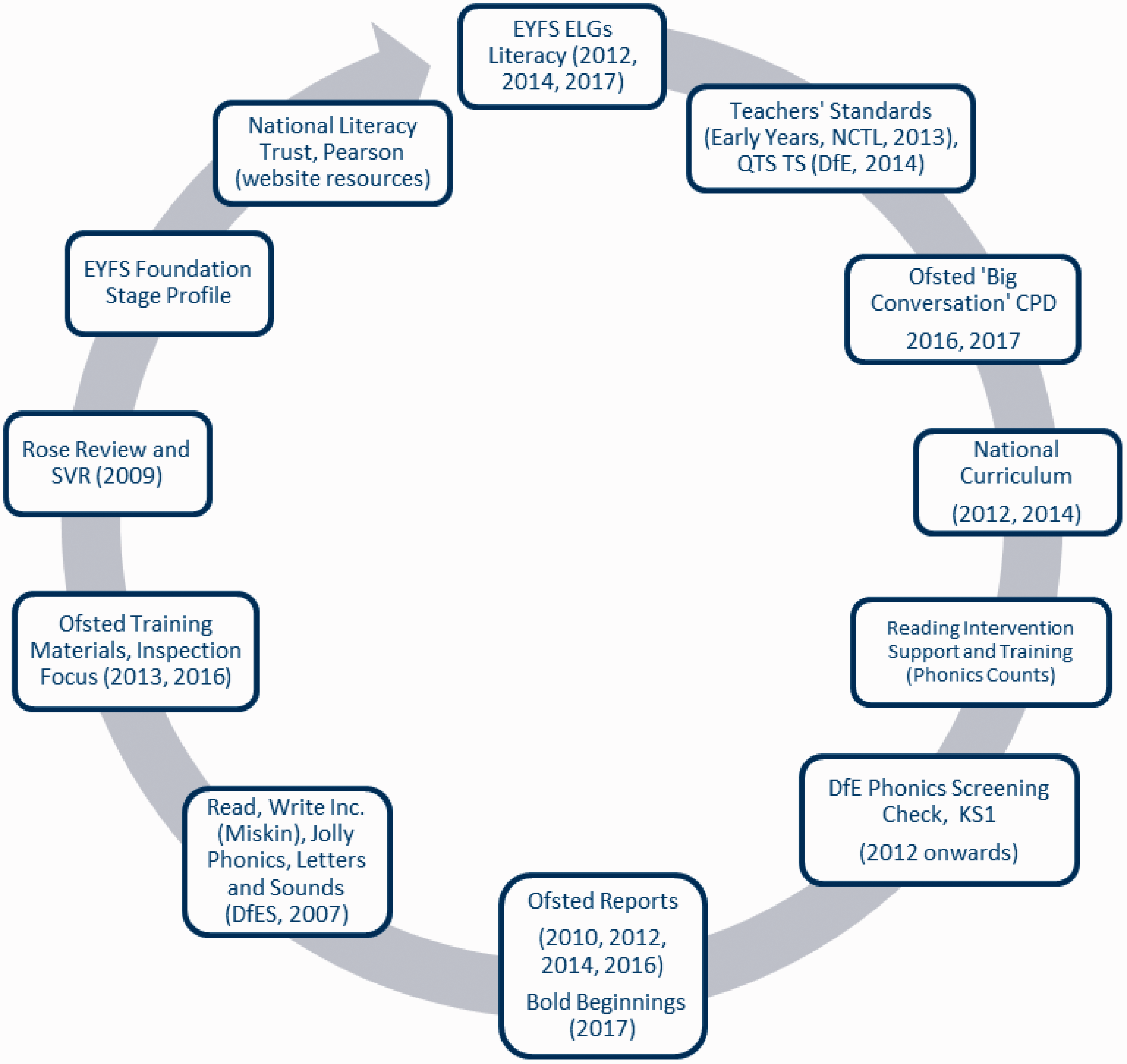
Policy documents, reports and curriculum resources emphasising phonics.
The Early Years Foundation Stage (Department for Education, 2017b)
Kilderry (2014) argues that it is vital to ensure that provision in early years settings meets all policy expectations and statutory regulatory requirements. As such, early childhood educators are accountable for the quality of the teaching and learning experiences provided. Yet, there appears to be no general concurrence or unequivocal definition of what ‘a quality learning experience’ (Department for Education, 2017b: 10) constitutes. Indeed, Elwick et al. (2018: 1) refer to the ‘pursuit of quality’ as an elusive policy mandate that is essentially disconnected from practice. In addition, the ‘Early Learning Goals’ (ELGs) for ‘Reading’ and’ Writing’ (Department for Education, 2017b) are absorbed with developing phonic knowledge, illustrating a ‘narrow, highly constrained’ approach to ‘reading’ argued by Levy (2009: 375). Flewitt also suggests that: This current narrow political focus on early reading and phonics presented in the revised EYFS is primarily out of tune with many international conceptions of literacy learning. (Flewitt, 2013: 2)
Subsequently, the characteristics of effective learning in the ‘Development Matters’ in the EYFS non-statutory guidance material (Early Education, 2012) demonstrate that ER seems to have been overlooked. Similarly, it appears to have little standing in the birth to eleven months sections of ‘communication and language’, ‘positive relationships’ and ‘enabling environment’ overviews, other than: Use finger play, rhymes and familiar songs from home to support young babies’ enjoyment and collect a range of board books, cloth books and stories to share with young babies. (Early Education, 2012: 28)
There is some apparent tension between theory and practice (Moss, 2014) given previous research noted in this paper, the EYFS (Department for Education, 2017b) and the ‘Bold Beginnings’ Report (Office for Standards in Education, Children’s Services and Skills, 2017), which appears to drive the conceptualisation of ‘reading’ in general for EYEs, which is trickling into pedagogy with under-threes.
Methods and methodology
This paper is based upon a wider doctoral thesis study (Boardman, 2017), drawing upon three key qualitative data sets: an initial survey, followed by five semi-structured interviews and two focus group (FG) meetings. This research study employed a mixed methods approach (Walliman, 2016) to explore the experiences, perceptions and challenges of EYEs working with under-threes. This interpretive, naturalistic approach is described by Cohen et al. (2011: 17) as ‘behaviour with meaning’ and ‘future orientated’, with the focus on how the EYEs perceptions of ER, influence their daily practice.
The participants were all female, graduate EYEs who volunteered to take part in this research, working in a range of ECEC settings across England. All participants’ ages ranged from 21–45 years. All participants are graduates with an honours degree in an ‘Early Childhood Education’ related subject and have from 3–24 years of experience working in ECEC settings. The majority of the early years’ educators were employed in a leadership role in their settings.
The ethical principles underpinning this research study all adhere to the British Educational Research Association (2011) ‘Ethical Guidelines for Educational Research’ and European Early Childhood Education Research Association ‘Ethical Code for Early Childhood Researchers’ (Bertram et al. 2016) , .
The survey was presented, in a hard copy format as a self-completion questionnaire with a range of multiple choice, and open response questions. The survey was distributed to 80 potential participants across a broad range of settings in the first instance, with the intention to review this and distribute wider to more early years networks. Given that the completion rate was a healthy 56/80, this was deemed to be appropriate for the scope of the study. The survey also invited participants to volunteer to take part in the next stage of interviews and FG workshops. There were some gaps in these competed responses, specifically within the babies and toddler age ranges; therefore, the intention was to follow-up on these within the semi-structured interviews and FG meetings, with all the volunteers identified from the initial survey.
Five semi-structured interviews were conducted, digitally recorded, transcribed and assigned a pseudonym to preserve anonymity and confidentiality. Transcripts were then shared with participants to ensure reliability and trustworthiness. A sample of the interview questions is presented in Figure 2.
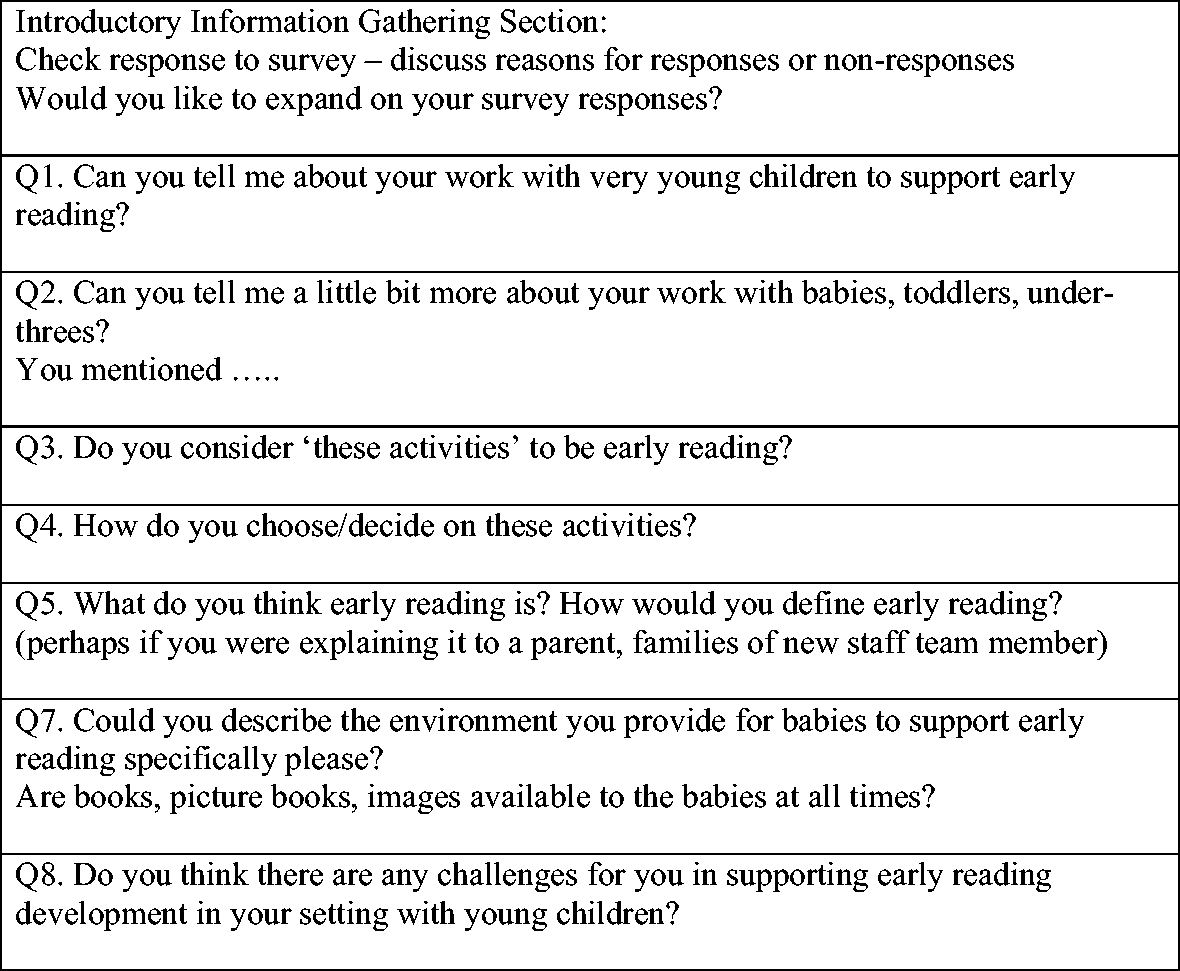
Sample interview questions.
After the interviews had been analysed, two FG workshops with 11 volunteer participants, who had previously completed the survey were conducted. The FG workshops were divided into a group of six and five participants, correspondingly. The workshop style was chosen for the FG meetings to offer enhanced opportunities for the participants to co-operate and communicate with each other and not just the researcher, so that the participants’ ‘agenda can predominate’ (Cohen et al., 2011: 288). Flip chart paper, pens, paper, card, tablets and laptops were provided during the workshop for the participants to respond to the research question: ‘How do you support under-threes with early reading?’ and subsequent questions: ‘What are your views and beliefs about reading and how does this influence your practice with under- threes? (if at all?)’ and ‘Do you think there are any challenges as an early years educator in supporting under-threes with early reading?’. The research questions were displayed on flip chart paper, on tables and on laptops. The researcher’s role was to set the scene with resources, discuss the time constraints, share the recording and transcribing protocol, and then allow the participants the opportunity to explore, plan and respond to the research question in their own way, rather than the researcher leading the discussion in a particular direction. The materials from the workshop were also used as data, with the participants permission.
Data analysis was carried out as a three-stage process: survey; interview; and FG workshop. The triangulated data from the survey, interviews and FG workshops were then further analysed utilising Schreier’s (2012) qualitative content analysis approach, combined with NVivo Pro 11 (QSR International) as a cohesive and systematic technique for reducing the data. A predominant theme emerged from the data relating to ‘understanding early reading’. An additional theme, relating specifically to this paper was the ambiguity surrounding ER and phonics, and the conflicts of policy directives and compliance.
Findings: pressures; ‘power’; and directives
Many EYEs highlighted their lack of understanding surrounding ER as a ‘complex’ challenge, which subsequently appeared to influence their pedagogy. The majority of the data from both FG workshops and all five of the interviews exposed some misunderstandings about what ER is and how this relates to their practice. For example, FG definitions described ER as: All forms of positive communication. The patterns, rhythm and sounds that lead to early reading. Making sense of sounds and marks, identifying letters and sounds. Immersing children in a literacy rich environment. Using print in the environment. Recognising and identifying marks and pictures in the environment. The foundations you need to be able to read, such as a literacy rich environment.
These definitions are somewhat focused on a print based, letters and sounds approach, which is plausible given the breadth of literature surrounding SSP, the emphasis within the EYFS, and the steer from Ofsted publications, highlighted in Figure 1. Notably, Davis (2013) proposes that teaching children to associate letters with sounds or to blend and segment sounds is not actually teaching children to read. Equally, Marsh (2003: 380) challenges an ‘undue emphasis’ placed on ‘traditional forms of print’ in ECEC literature, as ‘middle-class cultural norms’ highlighting the disparity between policy and practice. For under-threes, this print-heavy relationship is not meaningful to support ER pedagogy, given that the focus is on interactions, language, communications and engagement with multi-media resources, including music making. Without clarity of any agreed definition, it is conceivable that EYEs are drawn towards the phonics policy directives and advice given by schools: I don’t think we know enough about early reading. Children are still struggling to read, and they often don’t read at home as often as they used to. Busy working parents, different digital expectations etc. The advice is to focus on phonics, so that’s usually our starting point. (FG Workshop 2)
Accordingly, the survey data cited many examples of engaging under-threes (toddlers in particular) in rhythm and nursery rhymes activities, which Bower and Barratt (2014: 131) recommend as ‘fundamental to children’s pleasurable engagement with early reading’. Significantly, some of the definitions of ER cited in this paper do appear to link to the themes of ER development noted by Goouch and Lambirth (2011)
The terminology of ‘a literacy rich environment’ was a reoccurring phrase across the data: The very best settings do this well – you should be able to see and feel a literacy rich environment when you walk in. (FG Workshop 1)
The EYEs taking part in the FG workshops declared intricacy in explaining a literacy rich environment: You know, it does feel a bit like something we say a lot and use a lot, but it is difficult to explain – lots of words, letters, sounds, books obviously. (FG Workshop 2)
During interviews, the EYEs described their ‘literacy rich environments’ as having several variations of print – ‘environmental print’, ‘words’ and ‘initial letter sounds’. Largely, the EYEs deliberate a range of experiences provided based upon phonological awareness: ‘matching sounds, singing nursery rhymes, identifying initial sounds in their names’; and ‘teaching them that words have meaning, initial sounds in their names’. These data reveal some understanding of contemporary reading behaviours. When asked explicitly to concentrate solely on ER ‘in practice’, the definitions and discussions appeared to be predisposed with ‘pre-reading’ activities and classified as less important. The emphasis across the data is on developing an interest in reading – pre- reading, but the ‘actual’ reading happens later in school. Firstly, this may be aligned with opinions surrounding the ‘professional’ nature of working with under-threes as somehow being less important and least valued (McGillivray, 2008; Nutbrown, 2012; Osgood, 2006, 2012). McDowall Clark and Baylis (2012) argue that working in state-maintained nursery schools and reception classes is often considered to be of a higher professional status than working with under-threes, suggesting that the former negates a more qualified workforce, such as qualified teachers. The data highlighted that EYEs felt that teaching reading was ‘not really’ their role: We would only expect them to be reading when they get to school. It is the reception teachers that would teach reading. (Interview 2) We do more of the care side – supporting them to be ready to learn in school. We wouldn’t really be expected to teach reading in the toddler room. (FG Workshop 2)
The focus on ‘reception teachers’ teaching reading is revealing in this interview transcript, highlighting that this is not considered as part of their early educator role with under-threes, alongside the expectation of ‘not teaching reading’ in the toddler room from FG workshop data. It is therefore more likely that the ‘power’ of the school readiness agenda has influenced the EYEs understanding of reading, with the schools confining phonics over the broader concepts of reading, linked to performativity and measurement (Department for Education ‘Phonics Screening Check’). Ball (2015: 299) asserts that ‘measurement and monitoring’ are the archetypal techniques in the manifestation of neoliberalism, which is clearly evident here. The EYEs all consistently refer to their work with under-threes as ‘getting them ready to read’ in their conversations and definitions: This is an area of concern for me as it depends on the knowledge of the practitioner. We would be more concerned with getting them ready to read for school. (FG Workshop 2)
It appears that ‘reading books’, ‘sharing stories’ and ‘singing rhymes’ do not appear to be regarded as ‘reading’ for under-threes – activities that involve engagement with letters, sounds, print and words are understood to be reading activities and all the other activities are preparatory in nature, evident in the following definitions of ER: Getting them interested in books and picture books and words so that they will be ready to read, I think? (pause) Early reading is the bit before they read in school. Children read when they are ready. It’s phonics, letters and sounds are phonics. All early reading is phonics and getting them ready and so on because they need to be able to read later. We prepare the children with sharing stories and learning letter sounds and sound discrimination before they go to school and actually have to take home a reading book. We do Phase 1 and sometimes Phase 2 to get them ready. (Interview 1)
(ER is) getting them interested in books and picture books and words so that they will be ready to read. ER is the bit before they do the formal phonics, but I think that it merges a lot doesn’t it?
Interview transcripts note a prominent focus on phonics as ER and getting children ‘ready’ to read, to support later reading, which is at odds with the playful pedagogies and ‘infantologies’ of how young children learn, endorsed by Peters et al. (2020).
Significantly, the characteristic of ‘not teaching reading’ conflicts with the essential ominous fact that EYEs are teaching phonics to under-threes, which the following interview transcripts highlight: We do Letters and Sounds Phase 1 activities and Jolly Phonics with our children on a daily basis. (Interview 2) I do the Letters and Sounds activities with some of the older children (toddlers and two-year olds). A typical day would be daily story time with props, story sacks, singing nursery rhymes, perhaps a messy play activity, letters in sand or foam, a L&S [letters and sounds] Phonics activity, Silly Soup, small world animals alongside ‘Dear Zoo’. (Interview 5)
Findings: understanding the policy compliant approach
The interview transcripts all cited phonics programmes of study as an ER activity – ‘we do Jolly Phonics (Jolly Learning, 2012)’, ‘We have letters and sounds (L&S) (Department for Education and Skills, 2007) in the morning’ and some mentioned ‘Read, Write Inc’. (Miskin, 2016) schemes specifically. Furthermore, 46% (16 out of the 35 responses to babies and toddlers’ sections of the survey) documented formal phonic schemes such as Letters and Sounds (Department for Education and Skills, 2007), and Jolly Phonics (Jolly Learning, 2012) as survey responses to supporting ER with under-threes. This high occurrence is peculiar, yet potentially correlates with the school dominance culture of the phonics agenda (Bradbury and Roberts-Holmes, 2017). Certainly, this is an indication that EYEs require some support and clearer guidance.
The EYEs in this study revealed that they formally taught discrete adult-led phonics activities, considered to be unsuitable for many children under-five (Evangelou et al., 2009) and certainly misplaced for under-threes. Young children learn through purposeful and genuine activities, requiring context, relevance and meaning (Mandel Morrow and Dougherty, 2011). The EYEs appear to be taking a ‘policy compliant approach’ suggested by Fisher and Wood (2012: 121), of planning activities and experiences based on directives from policy or leaders and managers. This suggests a vulnerability and some resignation to the pressure of such directives, alongside the school readiness agenda. Notable examples from survey responses highlighted: Pressure from the government to get on with phonics early Children don’t always show an interest in reading, but this is the focus from the government, so we have to This is what we are advised to do – we are told that teaching phonics is the best way to get them ready for school
In the absence of any guidance to support under-threes and in such a policy performativity, neoliberal culture, it is not surprising that EYEs are confused by the discourse of ER. It is apparent that they perceive their roles in supporting ER as preparatory and as such feel pressured to teach phonics to prepare children for school. Therefore, the EYEs are engaging in and contributing to the phonics policy agenda in their work with under-threes by delivering SSP ‘phonics programmes of study’ with under-threes. Interestingly, Campbell et al. (2014: 47) also suggest that EYEs in Australia used commercially produced SSP programmes of study with pre-school children, based on the teachers’ viewpoints of this being a time saving resource to support children in ‘mistakenly’ learning to read prior to school. It could be suggested that EYEs rely on a phonics programme of study, given that they understand ER as ‘complex’ and ‘a mystery’: I think it (early reading) is a complex subject – I think I said this in the survey. Just understanding it all and getting to grips with it is really complex. (Interview 4) I think reading is difficult to get right – the confusion about how to teach reading and phonics, too early, when and what. Parents are confused and want their children to be doing something, but I don’t think anyone is actually sure about what this is. We just want to get it right really. (Interview 5) One of the challenges is phonics and the confusion about how to teach it, we have the resources and the timetable has phonics activities on daily or weekly, but it has to be delivered in a particular way and not all children learn in this particular way. Parents are confused and expect to see phonics activities too. (Interview 3)
The reliance on a phonics programme of study alongside their understanding of how best to support ER is a key factor in why EYEs engage with phonics policy directives. This apprehension surrounding ER and the government’s determined initiative of SSP (Clark, 2017; Department for Education, 2017a) in England, Australia and beyond (Clark, 2017), is impelling EYEs to engage with incongruous activities for under-threes – activities that are often not meaningful or in context for under-threes. Early years education is not ‘subservient’ to primary provision (Roberts-Holmes, 2015: 313) and therefore under-threes should not be subjected to the formal teaching of phonics to be ready for the performativity challenge (Ball, 2003) of the ‘KS1 Phonics Screening Check’. It appears that this is, in fact what this research reveals – a resignation to the ‘top-down’ pressure to deliver SSP, based upon a lack of support and guidance or alternative approaches.
Conclusion – changing pedagogy?
The perception and definition of reading as ‘teaching phonics’ is clearly detrimental to the pedagogy for under-threes. Under-threes need to be engaged in playful pedagogies and authentic meaningful experiences to support their ER development.
However, it is conceivable that a conspicuous tension exists for EYEs within the balance of play-based pedagogical approaches versus curriculum directives (Bradbury, 2011; Roberts-Holmes, 2019), leading to a discrepancy when it comes to ER. In this study, the EYEs consider that ER is an ‘educational’ activity requiring an adult-led, formal approach of teaching phonics, as this is the misleading discourse inherent within the ‘Reading’ and ‘Writing’ ELGs (Department for Education, 2017b). The annual Department for Education ‘Phonics Screening Check’ and the achievement results presented by the Department for Education perpetuate the notion that phonics, as an approach is productive for schools and young children. Consequently, EYEs working with under-threes are influenced by schools preparing for the annual ‘Phonics Screening Check’, and the wider school readiness perspective (Moss and Cameron, 2020), which complicates their willingness to resist or contest such policy directives, that are inappropriate for children under three. The complexity and contradictory nature of such policy edicts and previous research in this field engages EYEs in this inappropriate directive, with the paramount intentions of ‘getting it right’. Given that the EYEs in this study did not consider themselves to be best placed to teach ER, the power of this neoliberal mandate is leading EYEs to formally teach phonics to children under-three.
Certainly, policy-makers have positioned an emphasis on school readiness within the investment of SSP, leading to the inequitable assessment, achievement and accountability debate, proposed by Roberts-Holmes and Bradbury (2016a). This study presents a compelling proposition that this is indeed influencing practitioner perceptions of ER. Previous research, such as Levy (2009), Miller and Paige Smith (2004), and Roberts-Holmes (2015) also highlights that the primary school curriculum is notably impacting on early years pedagogy and provision. The EYFS (Department for Education, 2017b) ELGs are currently under review. Accordingly, this study suggests that the prominence of phonics discourse and school readiness within the ELGs for ‘Reading’ and ‘Writing’ are encouraging EYEs to formally teach phonics to under-threes, which is injurious to provision.
Consequently, there is now an urgent need to generate a clear definition of ER for EYEs and in collaboration with EYEs – not based on a deficit model of struggling readers or dominated by phonics, given that phonics is not reading. This hierarchy of phonics is ‘contextless’ for young children and does not engage children with reading (Davis, 2013).
Equally, it is vital to offer immediate support for ECEC settings and EYEs to resist this policy hegemony, to feel empowered to change their pedagogy aligned with the vision and ethos of the EYFS (Department for Education, 2017b). Teaching phonics, particularly SSP is not relevant, meaningful or contextual for under-threes – therefore some guidance, not based on prescriptive formal mandates is necessary. Guidance based on trust in the ECEC workforce is a starting point, so that EYEs do not feel obliged to engage with such inappropriate policy directives.
Footnotes
Declaration of Conflicting Interests
The author declared no potential conflicts of interest with respect to the research, authorship, and/or publication of this article.
Funding
The author received no financial support for the research, authorship, and/or publication of this article.
