




Abstract
This article aims to discuss the issue of environmental degradation based on understanding the material foundation of modern socialisation, which in capitalism is centred on the production of surplus value. This topic is justified by the hegemonic way in which the environmental issue is currently addressed: the inevitability of environmental degradation considering a supposed historical march towards the progress of humanity, to the detriment of natural resources. The argument put forth is that effective environmental education depends on proper contextualisation of the capitalist process. Central to this discussion is an ideological understanding of the neutrality of science and the assumption of the inevitable ongoing environmental degradation considering a presumed population explosion and pursuit of human well-being. Thus, alternative historical-cultural forms are sought to address the tensions that emerge between humanity and nature, or culture and nature, divided into the origin of the hegemonic cultural form consolidated in late modernity. Levi-Strauss’ work is taken here as an accurate historical-empirical record, namely the Nambikwara people of the Brazilian Midwest in the context of the 1930s. The referential used in this article seeks to articulate science education and environmental education with the critical theory.
Keywords
Introduction
Environmental issues are a matter of the utmost urgency when we talk about science education, especially for initial teacher training. Although controversial, it seems irrefutable that human activities exert profound changes on the natural environment, causing sudden and profound imbalances in ecosystem functioning and even local and global climate regulation (Chambers and Artaxo, 2017).
Using natural resources to meet growing human needs and desires has long exceeded the threshold of natural recovery, and much damage is already considered irreversible. The issue of water, a basic and vital resource, demonstrates the magnitude of the problem: water scarcity is a reality for millions of people around the world, and in many cases the unavailability of this resource occurs through contamination of abundant water sources by human actions.
However, what is the point of social criticism for science education, especially when considering environmental issues? We should reflect on the most stimulating procedures and didactic initiatives to awaken scientific interest, at most, concerning the cultural, bureaucratic, political and structural barriers, and the means of overcoming them towards a society of enlightened subjects. Nevertheless, the general content of the scientific debate on environmental degradation addresses the issue closely linked to the inexorable fact that human actions, in their contradictory march to progress, would have no alternative but to deplete natural resources. Such interpretations address the issue as if there were a continuum from prehistory to the present, in relation to human actions on the natural environment, whose simplistic conclusions indicate an increase in the scale of exploitation, without properly considering historical, political, cultural and economic contextualisations, etc. Obviously, there is no way to reject the benefits of progress, a direct result of the achievements of science. We generally accept this ‘scientific’ argument, especially since we do not want/can no longer return to the previous state of helplessness in the face of the forces of nature.
Zuin and Zuin (2017: 4) argue that this conception of science as an instrument of domination, strikingly expressed from Francis Bacon’s Novum Organum, transformed human beings into a kind of deus ex machina. This relationship of knowledge with nature conditions reflection and thought, which become alien to historical and social processes. They propose overcoming this limited form of rationality, starting from teaching practices, bringing to light the historical mediations of the experienceso that it stimulates ‘to go to the “counterpart” and against the techno-scientific logic also instrumentalised in teaching laboratories so that cultural goods can be understood beyond their pure application and validation in the sphere of production and the market’ (Zuin and Zuin, 2017: 12).
When discussing the consequences of a critical reflection based on the concepts of green chemistry,
1
Sjöström et al. (2016) support the need to understand the complex relationships that surround our current global risk society beyond techno-scientific procedures. Thus, they argue the need for a formation (Bildung) that includes, in addition to technical competence, the ability to understand and discuss political, economic, cultural and social issues that permeate environmental issues, for a responsible and fair science in societies with democratic aspirations: From our experience, green chemistry education must be critically considered not only in order to learn about and avoid possible damage to the environment, but also to promote ideological awareness and engagement in democratic processes concerning sustainability issues relating to chemistry, technology and society. (Sjöström, 2013b quoted in Sjöström et al., 2016: 336; Zuin, 2012)
Sauvé (2005) argues that in the foundations of the controversial concept of sustainable development, often represented by three interconnected dimensions – economy, society and environment – the economy is intended for the condition of society’s determination. Faced with this criticism, the author poses the question: ‘If this corresponds to the current alienation of societies with respect to an exogenous and dominant economy, should we still promote this worldview as the supreme goal of all humanity?’ (Sauvé, 2005: 320; our translation). Under the conditions of capitalist socialisation, it is understood that the economic dimension plays a hegemonic role in social dynamics, so that this understanding is indispensable for a critique compatible with the challenges and consequent overcoming of today’s environmental problems.
A disturbing socio-environmental scenario
Obviously we are responsible for the share of what happens to everything on the planet, so we are individually called upon to change habits, practical attitudes, grounded in transformative concepts and views of the world. Inspiring metaphors motivate us to have a small dose of ascetic attitude and individual sacrifice to transform the world: ‘many drops make an ocean’; the hummingbird’s gesture and its stubborn and heroic attitude to put out the forest fire; ‘think globally, act locally’; etc.
This is the tone of the general argument when discussing environmental degradation. The problem, dealt with in resigned fatality, is especially reinforced by Thomas Malthus’ 2 fearful elucubrations, remembered here and there to justify the argument. The population of the planet is constantly increasing and we are under constant threat from the ‘demographic explosion’.
The virtually scientific discourse conveyed by the media generally convinces us that there is no way to bring the benefits of progress to all the inhabitants of the world, even the basic conditions of existence: One billion people are permanently malnourished. According to the United Nations (UN), hunger kills one child every 5 minutes and 56,000 people a day (Previattelli, 2013). Considering this alarming reality, we need more science, put into practice by a technological avalanche and a broad economic mobilisation of the productive sectors.
This seems to be the purpose of the institutional advertising campaign ‘Agro: Brazil’s wealth industry’: ‘The “Agro is Tech, Agro is Pop, Agro is everything” campaign was created by Rede Globo
3
Marketing and Communication managers and went on until June 2018’ (G1, 2016). Moreover, according to the definitions of the media conglomerate: Concept videos … aim to address the importance of agricultural products and things in the field for the Brazilian society. The agricultural products are included in the everyday life of every urban citizen. We also always try to quote how many jobs that agricultural activity generates and how much it moves in the economy. (G1, 2016; our translation)
However, we put these findings aside to make use of contradictory aspects to the data presented, and perhaps argue about the veracity of the information.
Questions about hegemonic legitimations
Firstly, Brazil – whose population was estimated at 208 million (Brito and Alvarenga, 2018) – is heading towards stagnation in population growth (around 233 million in 2047), and from 2048 onwards the population 4 should start to decrease, according to data from the Brazilian Institute of Geography and Statistics (IBGE) (Table 1).
Projected population growth in Brazil by 2060.
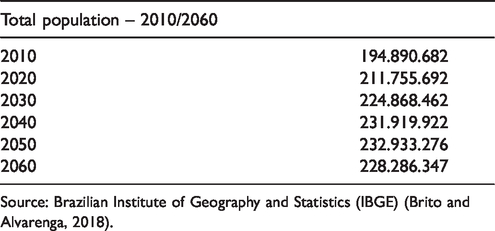
Source: Brazilian Institute of Geography and Statistics (IBGE) (Brito and Alvarenga, 2018).
However, if there is no threat of overpopulation regarding Brazil (on the contrary, it is estimated it will decline over the next decades), can we expect the same with respect to the world population?
There also seems to be a similar projection. In very populous developing countries (China, India, Indonesia, Iran, Brazil and South Africa), there has been a rapid fall in the average number of children per woman, according to the UN data presented in the report ‘World population prospects, 2012 revision’ (UN, 2013). 5 The current world population of about 7.7 billion is predicted to be 9.7 billion by 2050; it is estimated to reach its peak by 2100, with almost 11 billion inhabitants (UN, 2019). India is expected to become the most populous country in the world, surpassing China by 2028, when both countries will have a population of 1.45 billion. After that, the Indian population should continue to grow (at slower rates than today) and China’s will begin to decline. Europe’s population is expected to decline by 14% by 2028. Although UN data indicate ‘that some developing countries, especially in Africa, are still growing rapidly’, the UN report concludes that ‘the population growth will decrease … as a whole’ (2013; our translation).
But what is the challenge of food production today, when a world population 25% larger than the present one is projected?
Data from the UN Food and Agriculture Organisation (FAO) show that it would be possible today to feed 12 billion people a day with 2200 calories. We produce 55% more food than is necessary (since the world population is 7.7 billion people) (source: Nheengatu, Esalq/USP Agroecology Center) (Previattelli, 2013).
The need for a model of intensive exploitation of natural resources such as the agribusiness model would remain, since only with the strength of this sector would it be possible to feed the Brazilian population and part of the world population. Data from the Institute for Applied Economic Research, Brazil (IPEA) contradicts this argument.
Family farming in Brazil is responsible for the production of about 70% of the food that reaches Brazilians’ tables. The productive and economic efficiency of family farming is superior to that of agribusiness. Despite occupying only 24% of the Brazilian agricultural area, family farms account for 38% of the gross production value and 34% of revenues in the countryside. While family farming generates R$677/ha, non-family farming generates only R$358/ha. Moreover, regarding labour, family farming is more intensive: it occupies more than 15 people per 100 ha, while non-family agriculture occupies less than two people per 100 ha (IPEA, 2011).
Human action in nature under market conditions
What we have discussed so far seems to make it quite clear that the effects of human activities on nature have little to do with the ancestral needs of the species, but are related to choices significantly conditioned by economic interests.
Marx epitomised the modern social process with great insight: commodity fetishism. The concept of fetish (spell, magic) was the ironic way in which Marx characterised the ‘completely enlightened’ modern socialisation, which has a superior air compared to other cultures. The so-called primitive peoples, backward from the point of view of the European coloniser, attributed a spirit to things – from feitiço in Portuguese to fétiche in French. But what Marx sought to demonstrate was that modern European society, supposedly guided by rational principles, was bewitched by the self-movement of things. Commodity-centred social dynamics made things come alive, and men became things, mere abstract workforces – interchangeable mass, without specific substance or quality, whose ultimate purpose is to extract surplus value, unpaid labour surplus.
In the introduction to courses on economics (from the Greek – literally the rules of the house), it is often characterised that the aim of this science is to understand and rationally guide the satisfaction of human needs. Indeed, economics is primarily concerned with the self-movement of abstract value.
Marx’s interpretation of the dual character of commodity is that use value and exchange value are of fundamental importance. Use value corresponds to the sensible qualities of a particular human artefact, while exchange value is the social relation that this object possesses in trade, expressed by its monetary value. But it is the exchange value that mostly drives the conditioning of the modern social relationship.
Exchanges, markets and money are human relations that have existed since ancient times, long before the historical phase characterised as capitalism. But capitalism itself is historically effective when the social process as a whole becomes increasingly conditioned by trade relations. In short, when the blind self-movement of money (the ‘invisible hand’ of the market) becomes deeply conditioned to human actions – shaping our own subjectivity – whose ultimate purpose is to make money (value) continually become more money, without necessarily taking into account human needs. Ultimately, the use value is only support for the exchange value self-movement. The financial market makes this very clear, as it does not require the use of value to make value become more value whenever possible.
John Maynard Keynes, in his proposals for state regulation to mitigate the deleterious effects of the market, during the great depression of 1929, even proposed to the State in crisis, if necessary, to ‘build pyramids’ or ‘dig holes and cover them again’ in order to raise additional demand. Involuntarily, he thus proved that the modern economy has the character of an absurd end in itself. (Kurz, 1996; our translation)
The great global recession in 2008, 6 the effects of which continue to reverberate around the world, began in the American real estate expansion in the preceding decade, which occurred without actually having an effective housing need or US demographic growth: ‘Economists at Goldman Sachs point out that residential investment is at a 40-year high in America, yet the number of households is growing at its slowest pace for 40 years’ (Economist, 2005 quoted in Ortigoza and Crioni, 2008: 20), according to economic analyses prior to the onset of the crisis.
Another contradictory fact of this real estate expansion is that the objective of most of the real estate purchase and sale transactions was investment and not owner use and occupation. A study carried out by the National Association of Realtors (NAR, USA) found that ‘23% of all American houses bought in 2004 were for investment, not owner-occupation. Another 13% were bought as second homes’ (Economist, 2005 quoted in Ortigoza and Crioni, 2008: 19).
This consumer dynamics encouraged investors to buy properties that were supposed to make short-term profits through rent, sale or mortgage renegotiation. Thus, it is emphasised that the production of contemporary space should not simply refer us to the ancestral human need to inhabit, but primarily to the pertinent questions of the need to generate abstract value in the commodity journey, especially denoted by the role of commodity space in the current development of increasingly unstable and terrifying global economic forces. (Ortigoza and Crioni, 2008: 25)
The question that arises is ‘Can market capitalism be greened?’ – paraphrasing the title of the eponymous article by Hill and Tulloch (2013). The authors argue, based on Gramsci’s concept of hegemony, about the impossibility of harmony between capitalist needs and the urgencies of contemporary environmental guidelines: ‘It is this type of insight that has such profound implications for understanding the manner in which a capitalist rationality underwrites the logic of contemporary sustainability discourse’ (Hill and Tulloch, 2013: 147). They argue that several reports on global environmental problems – the 'Bruntland Report', 1987, and the reports of the Millennium Ecosystem Assessment Board, 2005, and of the United Nations Secretary-General’s High-Level Panel on Global Sustainability, 2012) – remains ‘Replete within this paradigm is the belief that acceleration in production, particularly through technological innovation, is the best possible solution to the problem of poverty – identified as a major cause of environmental degradation’ (Hill and Tulloch, 2013: 150). However, this belief in the automatisms of technological and economic rationality, ‘Rather than encouraging sustainable practices, economic inequalities [precisely caused by this hegemonic model] have exacerbated unsustainable industrialisation practices, with all the associated problems of resource depletion, land degradation, deforestation, and water and air pollution’ (Hill and Tulloch, 2013: 150).
Since the 1970s, Habermas has argued that capitalism has entered a permanent phase of legitimation crisis with social demands (including the environmental agenda) that must necessarily be discussed by the spheres of power, especially economic factors. Thus, we would be immersed in a ‘stage of permanent problematisation’ (Rouanet, 1986 quoted in Crioni et al., 2015: 934), which would further raise the emergence of consensual practices: A consensus is needed, not in the sense of conformity, but of an endeavour to constantly seek awareness of the social structures, as well as their possibilities and limits, and to remain open to new interpretations and arrangements, even if temporary, in the search for dignity and a life worth living. (Crioni et al., 2015: 935)
Non-hegemonic Brazilian cultural contributions
Below we present some aspects of non-hegemonic cultures in order to illustrate the falsity of the environmental degradation discourse as a supposed inextricable price of human historical evolution – ‘the price of progress’ – as an ahistorical process that would underlie predatory human conduct on nature, from the early hominid hordes to global society under the aegis of microelectronic and digital technologies. These are the Brazilian Indigenous cultures, threatened by the overwhelming contact with western modernity dating back to the period of the European navigations from the 15th and 16th centuries. Although the remnants of these cultures suffer from permanent and increasingly intensified economic, social and cultural aspects, the struggle and resistance of the Brazilian Indigenous people can be observed. We are extremely perplexed to find the existence of isolated Indigenous groups, living in conditions similar to those of their pre-Columbian ancestors, specifically in the so-called legal Amazon (regarding the Brazilian territory). On the other hand, there is the growing and persistent interest of young Brazilian Indigenous people in doing university courses, fostered by affirmative action policies and quota reserves. 7 The hypothesis that Indigenous students seek conditions of resistance and the struggle to maintain their cultures, territories and ways of life through university education is quite plausible (Crioni, 2016).
What follows is nothing new to contemporary anthropology/ethnology that addresses these cultures (Claude Lévi-Strauss, Manuela Carneiro da Cunha, Eduardo Viveiros-de-Castro, among others). Despite this, we often find prejudiced views, with the sentence, the verdict of considering them backward and primitive, a view that covers the spectrum that goes from common sense (illiterate, non-specialist) to enlightened (one who has a broader cultural background); regarding being enlightened, it is not uncommon to find those who belong to the academic environment and who support primary prejudices in relation to indigenous people and their cultures.
In the discussion proposed here, we present some characteristics described by Lévi-Strauss of the Nambikwara, in one of his ethnographic excursions to the Brazilian Midwest during the 1930s, narrated in the book Tristes tropiques (Lévi-Strauss, 1961). The Nambikwara were at that time a semi-nomadic people occupying an extensive territory in the northwest of the state of Mato Grosso, with very sporadic contacts with so-called ‘civilisation’, so much so that they kept their social structure, culture and way of life virtually intact. Levi-Strauss characterises the territory (cerrado vegetation, bordering the Amazon biome) as being of a very inhospitable nature to human presence, almost a desert, especially in the dry tropical winter, where scarcity reigns. Levi-Strauss’ intellectual excitement was based precisely on the possibility of contact with a sociologically elementary way of life that could lead ‘the observer back to what he might readily, though mistakenly, suppose to be the childhood of our race’ (1961: 265). He emphasises ‘mistakenly’, because the ethnologist’s attentive gaze already reminded him of the immediacy of appearance. When in previous contact with another ethnicity, he had found that ‘(m)y own experience of the Bororo had persuaded me that, on both the religious and the sociological levels, tribes sometimes dismissed as “primitive” were often, on the contrary, possessed of an exceptional degree of refinement’ (Lévi-Strauss, 1961: 238).
Regarding the demographic issue discussed in this article, Lévi-Strauss noted a refined birth control among the remaining ‘primitives’ of the Brazilian Midwest: ‘The Nambikwara have few children; childless couples are not uncommon, though one or two children constitute the norm, and it is quite exceptional for there to be more than three in one family’ (1961: 273).
This is in contrast to the supposed natural tendency of the human species to expand frantically, whose interpretation serves as a basis for the aforementioned Malthusian pessimism that pervades environmental discussions. Lévi-Strauss’ account belies an unstoppable human characteristic (a supposed natural/anthropological constant) of necessary magnification to the detriment of other species. Even in a human cultural formation with such a low relative capacity for objectification of nature, Levi-Strauss found cultural birth control devices (sexual interdicts) and contraceptive practical knowledge (ultimately the mastery of abortive techniques) that allowed this group a secure population domain (1961: 273).
It might be suggested that the Nambikwara suffered under the rigidity of a sexual repression code. The habit of walking naked immediately refutes this assumption. But far beyond that, Lévi-Strauss describes a behaviour full of affection and sexual freedom, summed up in a Nambikwara assertion that can be translated as ‘It’s good to make love’ (Lévi-Strauss, 1961: 277). Thus, this culture apparently immersed in the realm of natural necessity gave itself the refinement of cultivating sexuality under the aegis of culture; that is, conducted according to a culturally mediated ‘pleasure principle’, beyond the natural impulses and reproductive needs. Another aspect that characterised the freedom and plasticity of Nambikwara sexuality was homosexual relations (poetically called ‘the loving lie’) – although Levi-Strauss justified them from a functionalist perspective 8 – which, ‘common among the younger men, are carried on with a publicity uncommon in the case of more normal relations’ (1961: 307).
The enjoyment of such freedom is reflected in a conduct of protection and affection for the children, so that ‘(t)hey both feel and show … the liveliest affection for their children…. The children are not punished, and I have never seen one of them beaten – not even in pantomime – except by the way of a tease’ (Levi-Strauss, 1961: 273–274). Even during the drought period, the period of most scarcity, after describing the women’s routine (whose work the group mostly depends on during this period), Lévi-Strauss shows the degree of freedom, despite material ‘hardship’, in a willingness and systematic condition for fruition: In the heat of the day the camp falls silent. Its inhabitants, speechless if not actually asleep, make for the precarious shade of their huts. At other times everybody talks all the time, no matter what he is doing. Laughter and high spirits are general and there’s a constant flow of joking and teasing, obscene or scatological references being greeted with particular approval. (1961: 272) on the one hand the settled existence of the gardening period, based on the two masculine activities of hut-building and cultivation, and on the other the nomadic period, during which women are almost entirely responsible for the supply of food. One stands for security and a copious menu, the other for hazard and near-starvation. (1961: 280–281) They speak of winter (the rainy season) with that melancholy that comes from the conscious and resigned acceptance of our human condition: a dismal doing-over-and-over of an unchanging routine. Summer (the dry season) on the other hand is a matter for excited discussion, with the element of discovery always present. (1961: 281)
This brief reflection on Lévi-Strauss’ research on the Nambikwara attempts to show the symbiotic relationship of Brazilian Indigenous peoples with the environment, whose cultures have been moulded millennially, the fruit of a long process of choices and conditioning. It is a gross mistake to classify them as backward, primitive. Moreover, the above reflections show that a different relationship with nature is possible from the hegemonic form of predation that characterises the profound transformations in nature, imposed especially over the last two centuries.
Beyond the cynicism that there would be no other way, given the human condition since time immemorial, of establishing less environmentally harmful living conditions, the question remains: if relatively poorly resourced cultures have managed to make them effective, will our highly ‘enlightened’ and technified society not be able to reverse the current trend?
Adorno considered that the statement ‘Marx is obsolete’ could hide essential moments of society, which have been repressed by the collective consciousness and are to be repelled from it, are almost always present in what is dismissed as obsolete. This unfinished business, which survives in the ‘out-of-date’, may be precisely what is most important. (2000: 96) To prevent possible misunderstanding, a word. I paint the capitalist and the landlord in no sense couleur de rose. But here individuals are dealt with only in so far as they are the personifications of economic categories, embodiments of particular class-relations and class-interests. My standpoint, from which the evolution of the economic formation of society is viewed as a process of natural history, can less than any other make the individual responsible for relations whose creature he socially remains, however much he may subjectively raise himself above them. (1906: 15)
The European traveller is disconcerted by this landscape because it does not match with any of their traditional landscape categories (Lévi-Strauss, 1961: 98). The astonishment of the French anthropologist indicates the characteristic of environmental devastation inscribed in the New World landscape. The young Lévi-Strauss nurtured the illusion of finding a wild and untouched landscape (and the respective cultures) in the 1930s. However, as he went into the most developed regions of Brazil (Rio de Janeiro and Sao Paulo), his account of amazement and frustration produced a rich diagnosis in noting that the cities of America ‘pass from first youth to decrepitude with no intermediary stage’ (Levi-Strauss, 1961: 100). The brief description of the colonisation method of the Paulista territory synthesises a perverse relationship between man and nature: a relationship resembling a war whose ‘battleground’ retains ‘the memory and outline of the struggles of long ago’ (Lévi-Strauss, 1961: 99): Originally it had been dug and cultivated; but after a few years continual rain and the exhaustion of the soil made it impossible to keep the coffee-plantations in being. They were therefore moved to an area where the soil was fresher and more fertile. The relationship between Man and the soil had never been marked by that reciprocity of attentions which, in the Old World, has existed for thousands of years and been the basis of our prosperity. Here in Brazil the soil had been first violated, then destroyed. Agriculture had been a matter of looting for quick profits. (Lévi-Strauss, 1961: 97–98)
It is very revealing that this process of consumption and the discarding of nature (consequently of cultures and human beings), which characterises European colonisation of the New World, occurred precisely in the period of frank sedimentation of social relations centred on the commodity form. It is also very disturbing to see the intensification of this process, as noted by Lévi-Strauss over 80 years ago, in the so-called Brazilian ‘new agricultural frontiers’, despite attempts by the society and the state to mitigate it.
Final considerations
The aim of this article was to bring some elements that contextualise the current form of environmental degradation within the commodity producing society. Thus, we sought to refute the mistake of characterising the predatory use of nature as an anthropological constant. This mistaken view is often used as a cynical justification for maintaining the current state of affairs, but it also pervades legitimate narratives of the environmental advocacy struggle.
Nature has historically been subdued in the constitution of western thought: ‘Modern insensitivity to nature is indeed only a variation of the pragmatic attitude that is typical of Western civilisation as a whole’ (Horkheimer, 2004: 71). Man as ‘man as the master’ can be found in the book of Genesis. Subsequent biblical statements in this regard contemplate only the morals of man; for example, without any important consideration of animals (Horkheimer, 2004: 71). The ‘Dialectic of Enlightenment’ argues that in the founding mythology narrated in the epic, nature is ‘posited as wholly alien’ (Horkheimer and Adorno, 2002: 33). Horkheimer, in Eclipse of Reason, also argues that in the process of emancipation, human beings are in the same condition as the rest of the world: Domination of nature involves domination of man. Each subject not only has to take part in the subjugation of external nature, human and nonhuman, but in order to do so must subjugate nature in himself. Domination becomes 'internalised' for domination's sake. What is usually indicated as a goal – the happiness of the individual, health, and wealth – gains its significance exclusively from its functional potentiality. (2004: 64)
However, the vulgar interpretation of Darwin’s theory, which has become hegemonic reception, rather than stimulating man’s dispossession of nature, clings to the theory’s adjustment and adaptation perspective: (social) environment adaptation and survival of the fittest, of the strongest. This amounted to the ‘prime axiom of conduct and ethics’ (Horkheimer, 2004: 84). ‘In popular Darwinism, reason is purely an organ; spirit or mind, the thing of nature’ (Horkheimer, 2004: 84–85). Thus, no philosophy or ideal should stand in the way of the supposed natural order expressed in instrumentalised reason: ‘As a part of nature, reason is at the same time set against nature – the competitor and enemy of all life that is not its own’ (Horkheimer, 2004: 85).
Nevertheless, adaptation to the environment should be taken in its historical character. The abundance of material production with the advancement of the productive forces should repeal such an interpretation, when in fact it reinforces it further: Economic and social forces take on the character of blind natural powers that man, in order to preserve himself, must dominate by adjusting himself to them. As the end result of the process, we have on the one hand the self, the abstract ego emptied of all substance except its attempt to transform everything in heaven and on earth into means for its preservation, and on the other hand an empty nature degraded to mere material, mere stuff to be dominated, without any other purpose than that of this very domination. (Horkheimer, 2004: 66–67)
This split conception of nature (to the detriment of it), which is at the basis of western culture and rationality, seems to be diametrically opposed to the conceptions of nature of other non-hegemonic cultural matrices – peasants, riverine, quilombolas, Indigenous, etc. – where, in its most varied traditions, nature does not appear as a separate and unreconciled ‘thing’ from humans. This is not about idealising or romanticising, because all human cultural formations bear their barbaric trait: ‘No society is perfect. Each has within itself, by nature, an impurity incompatible with norms to which it lays claim: this impurity finds outlet in elements of injustice, cruelty, and insensitivity’ (Levi-Strauss, 1961: 385).
However, as we have attempted to argue, Brazilian Indigenous people, in this case the Nambikwara, might seem to an inattentive observer to be an archaic group of humans utterly devoid of means for survival, absolutely passive in the face of nature; when, in fact, their culture demonstrates sophisticated ways of managing the natural environment. Beyond the arrogance and cynicism of the officiality of science and economic relations, we must look for different perspectives regarding our vital relationship with nature, especially when it comes to a human life worth living, because ‘(t)he enquiries of archaeology and anthropology show that certain civilisations – some of them now vanished, others still with us – have known quite well how best to solve problems with which we are still struggling’ (Lévi-Strauss, 1961: 383).
Footnotes
Author's Note
Vânia Gomes Zuin is also affiliated with Leuphana University, Germany.
Declaration of conflicting interests
The author(s) declared no potential conflicts of interest with respect to the research, authorship, and/or publication of this article.
Funding
The author(s) disclosed receipt of the following financial supportfor the research, authorship, and/or publication of this article: Researcher with a post-doctoral scholarship granted by Coordination for the Improvement of Higher Education Personnel (CAPES-Brazil), PNPD/CAPES DQ/PPGE UFSCar nº 88887.318247/2019-00.
