




Abstract
This paper provides an overview of the homeschooling movement in Finland focusing on the methods used to monitor the progress of compulsory education of home-educated children. Although the child’s home municipality is obliged to monitor the progress of compulsory education, there are currently no national uniform instructions on how monitoring should take place. Therefore, home-educated children are treated differently depending on where they live. In this article, the authors argue that the current monitoring methods not only decrease the child’s motivation to learn but are also inexpedient, illegal and, in many cases, impossible to carry out. The study is based primarily on the qualitative approach, but it combines both qualitative and quantitative methods including surveys, interviews, observation and documents. It is the first empirical research conducted on the monitoring methods of home-educated children in Finland.
Introduction
The Finnish public education system is top-ranking and free, and the teachers are highly educated and skilled. Nevertheless, some parents choose to home-educate their children for various reasons, including a negative school environment and bullying, poor indoor air quality, a greater opportunity for individual progress, and a desire to restore stronger family connections (Myllymäki, 2017: 84–85).
Since education, not school attendance, is compulsory in Finland, home education is a legal way to educate children. It requires no permission, only a written notification from the legal guardian/guardians to the municipality’s school authorities is required.
The child’s home municipality is obliged to monitor the progress of compulsory education, but there are no laws or specific instructions on how monitoring should take place. Since there are 311 municipalities and approximately 400 home-educated children in Finland, the teachers appointed for monitoring the progress of compulsory education are often facing an unexpected situation and have little or no experience in how monitoring should take place. This has created a situation where home-educated children are being treated differently according to their place of residence and conflicts between families and educational and school authorities are common.
This research work examines why current monitoring methods are in many cases impossible to carry out and how monitoring the progress of compulsory education should take place according to the law and in a way that would maintain and enhance the child’s natural intrinsic motivation to learn. Presented are results of a mixed-method research project, that combines two surveys, participant observation and qualitative interviews of four unschooling families. The research focuses on unschooled children since the unschooling method can be considered opposite to the learning and teaching methods used in school. This research lies based on the assumption that the progress of compulsory education of unschooled children is the hardest to monitor with current monitoring methods that rely on school-like learning.
Home education in Finland
In Finland, home education is an uncommon way to achieve the requirements of compulsory education. Nevertheless, according to Statistics Finland, the number of home-educated children is steadily increasing. In 2011 there were 222 home-educated children in Finland. At the end of 2019, the number of home-educated children had increased to 437. More than 51% were boys (Statistics Finland, 2019).
Home education does not require permission – a written notification from the legal guardian/guardians is enough. All home-educated children between 7 and 16 years are obliged to acquire the required skills and knowledge stated in the National Core Curriculum for Basic Education 2014 that includes the objectives and core contents of different subjects.
The parents are responsible for the education of the child and for ensuring that the child’s skills and knowledge meet those stated in the National Core Curriculum. They receive no funding or educational material whatsoever. The municipality is obliged to monitor the progress of compulsory education in relation to the National Core Curriculum, but without evaluating and grading the child’s skills. Therefore, the child receives no report card but is entitled to a report that can be used as proof of progress and fulfilment of obligations. Since there are no specific instructions on how monitoring should take place, the methods used vary not only in different municipalities but also within municipalities according to the person appointed to the task. This has resulted in a situation where home-educated children are treated differently according to their place of residence resulting in conflicts between families and educational authorities, child welfare notifications and situations where the family has moved to another municipality.
Literature review
In the field of education research, home education is a widely ignored topic (Howell, 2013: 355). Not only does it face ideological disapproval of professional educators (Ray, 2013: 333), but the current educational paradigm does not encourage homeschooling research, and gathering accurate data can be difficult (Howell, 2013: 358–359).
In Finland, no official studies, only a few master’s theses, have been conducted on the subject. Homeschooling research conducted for example in the USA, Canada and England has focused on presenting and comparing educational policies in different countries (e.g. Barratt-Peacock, 2003; Blok and Karsten, 2011), on parents’ motivation for homeschooling (e.g. Anthony and Burroughs, 2010; Arai, 2000; Beck 2010), and child neglect, skills and academic achievements of homeschooled children (e.g. Beck, 2008; Hamlin, 2019; Ray, 2010, 2013). Debra Bell, Avi Kaplan and Kenneth Thurman (2016) have studied homeschool environments and achievement motivation by using the self-determination theory as a framework. Deani Van Pelt (Bosetti and Van Pelt, 2017; Van Pelt, 2015) has studied the policy and provisions for homeschooling in Canada. Vicky Hopwood, Louise O’Neill, Gabriela Castro and Beth Hodgson (2007) have examined the prevalence of home education in England, and the possibilities of local authorities to monitor the progress of homeschooled children. Although research presenting, comparing, and analysing monitoring regulations in different countries does exist (e.g. Kreh, 2015), studies that focus on different methods for monitoring the progress of compulsory education – not assessment of children's knowledge and skills – are nearly non-existent.
The unschooling method has also received less attention (Riley, 2018: 55). Research has mainly focused on elucidating what generates and maintains the unschooled child’s intrinsic motivation (e.g. Levin-Gutierrez, 2015; Sherman, 2017). Peter Gray has studied the connection between free play and learning, and together with Gina Riley (Gray and Riley, 2013), he studied the benefits and challenges of the unschooling method. In 2018, Riley (2018) approached the unschooling method through Richard M. Ryan and Edward L. Deci’s Self-Determination and Cognitive Evaluation Theories. According to her, these theories come in action when an inspiring unschooling environment enables learning that is inherently self-directed and sustained by intrinsic motivation.
Assessment and its impact on motivation
Assessment is often understood as evaluation and grading of knowledge and skills. A child has an inherent desire to learn, influence, and understand himself/herself and his/her surroundings, but emphasis on grades, rewards and punishments reduce the child’s intrinsic motivation to learn and study (Deci, 1975). Feedback strengthens intrinsic motivation only if it enhances the person’s experience of competence and the environment supports his/her experience of autonomy, responsibility, and the ability to influence his/her own actions (Deci, 1975: 134, 139–140, 146–148, 158). Negative feedback reduces intrinsic motivation and weakens performance. External rewards and feedback reduce the experience of autonomy by shifting the focus from action outside oneself and affecting negatively in the intrinsic motivation and performance (Deci, 1975: 139, 141–143, 158; 1980: 36–40; Deci and Ryan, 2000: 234–235). The effects of external factors on intrinsic motivation are also long-lasting: removing the reward does not restore intrinsic motivation (Deci, 1975: 138). In a similar way, external punishment reduces intrinsic motivation (Deci, 1975: 139–140).
In Finland, there are no national examinations. In basic education, assessment is carried out by the teacher in relation to the goals set in the curriculum. Assessment is based on its goals, which vary according to the method of assessment. The goals can be guiding and support learning through feedback, improving teaching, or controlling the progress of students. According to goals, assessment can be either diagnostic, formative, or summative.
The purpose of diagnostic assessment is to evaluate the student's entry-level for appropriate instruction. Diagnostic assessment occurs before instruction and can be done by means of tests and exams, previous statements, teachers’ and parents’ observations, and the student’s self-assessment. It provides teachers and homes with important information about the student's entry-level and potential need for support (Vänttinen, 2011: 316), and self-assessment deepens the student's understanding of his/her own learning.
Formative assessment – assessment for learning – refers to evaluation that is embedded within the teaching process. It aims in closing the gap between the student’s goals and abilities (Black and Wiliam, 1998: 20). The results of assessment can be used to promote learning and improve teaching to suit the student’s needs, and to level out students’ differences in performance. Formative assessment is particularly beneficial for the low performing students since self-evaluation is significant for learning and progress if the student is able to regulate his/her own learning and is aware of the criteria of assessment (Black and Wiliam, 1998: 15).
Assessment as learning focuses on increasing the student’s metacognitive skills. The aim is to provide the student with constant and descriptive feedback that guides him/her to improve study habits and to set goals. Students are not graded or compared but encouraged to learn about their own learning process.
The purpose of summative assessment is to categorize by grading and controlling learning outcomes by means of tests, exams and presentations. Assessment of learning is based on comparison of the students’ performances, and the students themselves do not benefit from the assessment. Instead, summative assessment can significantly reduce the students’ intrinsic motivation to learn and weaken the outcomes of studying.
There are currently no assessment theories that can be adapted as such to meet the needs and the monitoring of progress – not skills and performance – of compulsory education of home-educated children. The theories are designed to meet the needs of schools, schoolteachers and policymakers, and the current methods used in schools focus mainly on evaluating and grading performance. Summative assessment is still dominant in schools, although the current National Core Curriculum of Basic Education encourages a shift towards formative assessment (National Board of Education, 2014: 50). According to section 22 of the Basic Education Act (628/1998), the goals of assessment are to guide, encourage, and improve self-evaluation. Pupils must be evaluated comprehensively, but the weaknesses of assessment practices can be considered to be the major challenges of assessment (Vänttinen, 2011: 240).
Subjects and frameworks of analyses
The purpose of this study is to find out which monitoring methods are appropriate, best suited to assist the person appointed for monitoring of progress, and suitable for monitoring the progress of the compulsory education of all home-educated children in Finland, irrespective of the used learning and guidance methods.
Research questions
What kind of learning and guidance methods are used by unschooling families?
How is the progress of compulsory education monitored?
According to the law, how should the progress of compulsory schooling be monitored?
Data
In the first part of the study, three unschooling families, with four school-aged children altogether, were observed and interviewed during January and February of 2019. Two families, with one school-aged child each, were interviewed and observed for one day. The third family with two school-aged children was interviewed and observed for seven days over a period of two weeks. The fourth unschooling family participated by providing an essay based on pre-submitted open questions, that were designed to follow the same pattern used for the observations and interviews, as this provided a more coherent dataset that was easier to analyse. In addition, one former unschooled student, now an adult, was interviewed.
Theme interviews of the school-aged children were conducted in the presence of the parent, considering the age of the child in two or three sections. The children could tell freely about their learning, their projects, and why they are interested in that particular topic.
The purpose of the interviews and observation was to understand: how unschooled children study and learn; how the contents and goals of the National Core Curriculum are taken into account; how learning is documented for monitoring; and how the progress of compulsory education is monitored.
During observation, special attention was given to the metacognitive skills of the child, the materials used, the projects that promote learning, and the learning event itself. Afterwards, a summary of the field journal was submitted to the family for review and approval.
The data used in the second part of this study (How is the progress of compulsory education monitored?) was collected through two different surveys. The questionnaires in the first survey (Hartman 2017) were addressed to home-schooling families residing in Espoo and the teachers that had been appointed to monitor the progress of home-educated children in Espoo. The questionnaires were answered by eight families and nine teachers. The second survey was addressed to home-schooling parents and implemented by Homeschool Association Finland (2018) using Google Forms. The survey was answered by 27 parents residing in Finland.
Open-end questions were also sent by email to the counsellor for education of the National Board of Education. The answers representing the Board of Education were analysed together with The Basic Education Act and the Basic Education Decree and were used to answer the third research question (According to the law, how should the progress of compulsory schooling be monitored?).
Data analysis
Analysis 1: Teaching and learning methods used by unschooling families
The analysis of the qualitative data was carried out by using the close reading method. Unschooling is a method where the learner’s own interests and enthusiasm inspire learning, not external factors such as the curriculum, textbooks, parents, or teachers. Therefore, instead of traditional learning and teaching methods, broader entities that guided the learning event emerged from the data, forming unifying factors for the families participating in the study.
The factors emerging from the data were divided according to whether they were primarily influenced by the parents or the children themselves. The influence of parents was reflected in family values, the learning environment, and the way it was designed to inspire and promote learning, and the availability of materials used to support learning. The learner’s own impact was reflected on setting goals, the contents of learning, material selection, and methods for acquiring information. In addition to these factors, all data concerning social skills were analysed separately.
Analysis 2: Current monitoring methods
The quantitative data were analysed using SPSS and descriptive methods. The results are indicative and cannot be generalized. Results of the two surveys (Hartman, 2017; Homeschool Association Finland, 2018) were analysed separately since there was a possibility that a joint analysis would have resulted in incorrect results.
Analysis 3: The Basic Education Act, the Basic Education Regulation and the Board of Education
The contents of The Basic Education Act and the Basic Education Decree, and the answers to the open-end questions of the counsellor for education of the National Board of Education together with the information available on the website of the National Board of Education were analysed together. This undertaken in order to create a complete picture of how the progress of compulsory education of home-educated children should be monitored.
Results
Results 1: Teaching and learning methods used by unschooling families
Family values seem to be the most important factor in the process of learning. All four families emphasized freedom and a positive atmosphere, the importance of developing a close parent–child relationship by respecting and appreciating the child and his/her opinions, respected the child’s own individual way of learning, and abstained from all evaluation. In all families listening and discussion were a priority in promoting learning. The child’s suggestions, thoughts, and opinions were respected, questions were answered in a way that fostered the child’s enthusiasm for learning – not unambiguously or comprehensively – and meaningful discussions with the child were considered important.
The data highlighted multiple ways of learning and gaining information that reflected the diverse learning environments of unschooled children. In addition to the child’s home, the learning environment included a wide area of surrounding nature and cities, even other countries. Holiday destinations or activities were selected bearing in mind that all excursions and trips are a learning opportunity. It seems that parents are well familiar with the content of the National Core Curriculum for Basic Education. Bearing in mind the child’s own interests, sensitivities and abilities, the parents actively strive to create a stimulating learning environment that naturally guides the child’s interest towards the goals of the curriculum, enabling them to achieve the knowledge, skills and goals set in the curriculum.
An important basic idea in unschooling is self-directedness, meaning that the child himself/herself is free to choose the learning content and materials that interest him/her. The learning environment has great influence on the kind of materials unschooling learners use to promote learning and parents can consciously try steering the child’s interest in a particular direction, for example, towards the goals of the National Core Curriculum, by adjusting the learning environment and providing inspiring learning material to support these goals.
The children who participated in the study had access to all material found at home and its surroundings and at the library, such as musical instruments, craft and drawing supplies, books, magazines and computers. Home-educated children also acquire information by attending workshops, watching educational programmes, and talking with their parents or other experts. According to the interviewed former, now adult, unschooler, the unschooling method has been particularly useful in learning how to critically and comprehensively acquire information from a variety of sources. By observing his friends, he has noticed that students in schools are not encouraged to look for information outside textbooks. However, it should be emphasized that the availability of diverse material does not mean learning. In other words, if the child is not interested in the subject, learning does not occur. On the other hand, if the child is interested, he/she will make every effort to find information to learn when the information available is not restricted in what is found within textbook covers.
Although the children do not follow any pre-planned curriculum, their study is goal oriented. They learn through everyday situations and are engaged in their own areas of interest. The children set goals for themselves and evaluate their own learning and how they have achieved their goals. Occasionally, especially in the case of younger children, goals may also be suggested by parents or the person appointed for monitoring the progress of compulsory education.
In unschooling families, learning seems to be a cross-curricular project-based phenomenon connected with real-world entities during which knowledge and skills are combined with practice. Instead of acquiring disconnected theoretical knowledge, the child automatically learns to apply knowledge into different everyday situations. Learning integrated into everyday life includes activities related to mathematical skills and logical thinking, housekeeping, learning foreign languages and cultures, history, geography and science. Arts, crafts and physical activity are often closely linked to the child’s hobbies. Since enthusiasm and doing enhance learning, and theory is closely linked to practical action, it seems that unschooled children acquire a deeper understanding of the areas they engage in. They use a variety of sources and are limited only by their own enthusiasm and the possibility to access information. Thus, a young unschooled child may be profoundly familiar with topics that are usually not covered until upper secondary or post-secondary education.
The unschooled children participating in this study seemed to have excellent social skills. They told proficiently about their day, their hobbies, and what they were interested in and why. Their narration was logical, and they described their learning and learning process skilfully. According to previous studies, home-educated children have good social skills, and disturbing behaviour is significantly more infrequent among home-educated children than among schoolchildren. The goal of unschooling parents is to raise their children to be balanced, attentive and responsible adults. In comparison, schoolchildren are only temporarily socialized and only for peer groups.
The unschooled children participating in this study were not isolated at home. They spent time with friends and enjoyed several hobbies. They not only had time but also energy since early school start times did not cause them to suffer from chronic sleep deprivation. The families often travelled and made excursions to various destinations and spent time with friends and relatives. It was considered essential for the development of social skills that children were able to interact with people of different ages and backgrounds. When encouraged to participate, the child becomes active, socially competent, and a responsible member of the community.
Results 2: Current monitoring methods
The home-educated child’s home municipality is obliged to monitor the progress of the child’s compulsory education. Usually, monitoring of progress takes place once or twice a year, but according to the collected data, some home-educated children are monitored every other month, others not at all. In many municipalities, monitoring is centralized under one school with one or more teachers appointed for the task. In other municipalities, a different teacher is appointed for every home-educated child.
The progress of compulsory education of the unschooled children participating in this study was mainly monitored through a blog or a traditional portfolio. The portfolio was considered an appropriate monitoring method that enabled the teacher to be well up to date with the child’s progress.
On a national level, portfolios and development discussions are commonly used, but in some municipalities, children are also expected to take written exams or oral tests even though they are not obliged to follow the same curriculum that is used by the municipality nor are they entitled to receive a report card. Other monitoring methods included giving presentations or presenting workbooks or other evidence of progress, for example drawings or handicrafts. Numerical grades required for the voluntary graduate certificate regulate the monitoring of upper comprehensive school-aged home-educated children.
Results 3: The Basic Education Act, the Basic Education Regulation and the Board of Education
In Finland, the completion of compulsory education requires the child to acquire the knowledge and skills stated in the National Core Curriculum for Basic Education. Therefore, also the goals of home education are bound to the National Core Curriculum.
There are no national examinations. Instead, evaluation of progress and all grades are given by the teacher. If compulsory education is attained by other means than by attending school, the organizer of the education must notify the municipality in order for the child’s progress of compulsory education to be monitored by a person – usually a schoolteacher – appointed by the municipality (Basic Education Act 628/1998, § 41).
The National Core Curriculum defines the study modules that must be successfully completed as a prerequisite for progression in the subject. According to the Basic Education Act (628/1998), basic education includes mother tongue (Finnish/Swedish) and literature, another domestic language (Finnish/Swedish), foreign languages, environmental science, health education, religion or ethics, history, social studies, mathematics, physics, chemistry, biology, geography, physical education, music, art, crafts and home economics (section 11 of the Basic Education Act 628/1998). A home-educated child may proceed with his/her studies according to his/her own individual curriculum, which must be based on the National Core Curriculum, but he/she cannot be exempted from studying any mandatory subject stated in the National Core Curriculum for basic education and cannot be the subject of an SEN (special educational needs) decision.
The decision to teach the child at home can only be made by the child’s guardian/guardians (Table 1). A written notification to the child’s home municipality’s education authority is enough, and no special reason or permission is required. The home-educated child will not be registered as a student in any public school and a student who has previously studied at school must be removed from school files. After the notification, the guardian is responsible for ensuring that compulsory education is completed (National Board of Education, 2019). If the guardian fails to comply with his/her duties, he/she may be fined (Section 45 of the Basic Education Act 628/1998).
Division of tasks between different actors.
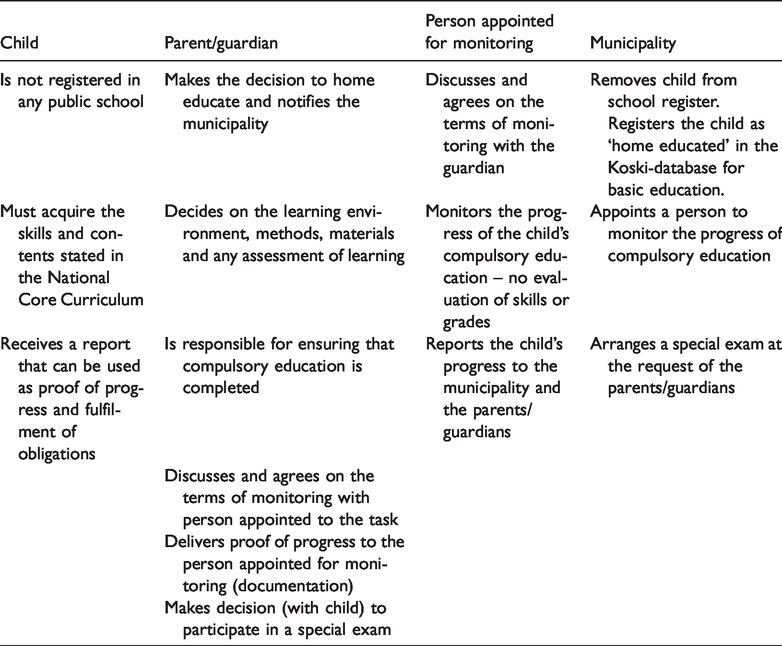
The municipality is obliged to monitor the progress of the child’s compulsory education. Although the popularity of home education is increasing, the National Board of Education has not yet considered it necessary to give more guidance to municipalities on how to make the arrangements. Therefore, there are currently no specific rules or regulations in the legislation on how monitoring of progress should take place.
The only instructions issued by the National Board of Education are available on their website. According to the website, the municipality is obliged to monitor the progress of the child’s compulsory education. Usually, the municipality appoints a person – a teacher from a local school – who, together with the guardian/guardians, agrees on the terms of monitoring. Progress of compulsory education is usually monitored once or twice a year in relation to the objectives of the subjects included in the National Core Curriculum. Monitoring can take the form of discussions, portfolios, tests and presentations that can also be displayed in actual environments such as in nature or the laboratory.
According to the Basic Education Decree (852/1998) that regulates assessment and the progress of studies, assessment of learning is a task of the child’s teacher or teachers – in the case of a home-educated child, the teachers are usually the parents. According to the counsellor for education of the National Board of Education, the sole task of the person appointed for monitoring is to monitor the progress of compulsory education of the home-educated child. Therefore, any assessment of learning is the responsibility of the parents, not the person appointed for monitoring the progress of compulsory education. The person appointed for monitoring is obliged to report on the student’s progress to the municipality and the child's parents. Constructive co-operation between the parents and the person appointed for monitoring is important for proficient monitoring, but the National Board of Education is not aware of how monitoring actually takes place in the municipalities and does not monitor whether the municipalities fulfil their obligations or not.
According to section 38 of the Basic Education Act (628/1998), basic education or part of it may also be fulfilled by taking part in a special exam. According to Article 23 of the Basic Education Decree (852/1998), the graduate certificate may be given by any school that has a permit to provide basic education. Skills are assessed in relation to the objectives of the National Core Curriculum for Basic Education, so in order to obtain a certificate, the knowledge and skills must correspond to those objectives. However, the graduate certificate is not compulsory for future studies, and the child and the guardian can together decide on the child’s participation in the special exam.
Findings and discussion
Findings
General attitudes towards home education and the monitoring of progress reflect the myth raised by Ivan Illich (1971) that only numerically assessable and measurable learning is significant and important, and children can only learn by attending school and under the guidance of a schoolteacher. Despite the persistent false assumptions, home education does not mean ‘school at home’ and attending school does not equal learning. The primary purpose of home education is to increase the child’s enthusiasm for learning, develop his/her self-assessment skills and ability to acquire and process diverse and critical information and to respect the child’s unique individuality. More important than good grades are a balance in life, secure relationships, personal growth and development, mental and physical well-being, and respecting and encouraging the child’s individual choices and educational paths.
The goals of basic education are to increase equality, good learning skills, and broad general knowledge that enable lifelong learning and personal growth. These goals can be achieved without attending school since children are capable of learning outside school and without the guidance of a teacher (Illich, 1971: 26). Compared to schoolchildren who use textbooks and teachers as their primary source of information, home-educated children have unlimited access to information and social contacts due to the wide variety of materials, channels, and networks available. Therefore, when carried out responsibly, home education is not in conflict with the goals of basic education.
Research has shown that unschooling is a successful approach to learning. It embraces freedom and autonomy and develops critical thinking, expertise and the ability to acquire information and apply knowledge, but the currently used methods are not suitable for monitoring the progress of compulsory education of unschooled children.
Home-educated, especially unschooled, children have a strong intrinsic motivation to learn. According to the Cognitive Evaluation Theory, feedback strengthens intrinsic motivation only if it enhances the learner’s experience of their own competence and autonomy, as well as their sense of responsibility and influence, as external rewards and feedback – negative or positive – have a negative and permanent influence in the learner’s internal motivation (e.g. Deci, 1975, 1980; Deci and Ryan, 2000). Therefore, careful consideration must be given to whether evaluation, assessment, and giving feedback is justified or necessary at all.
Development discussions and portfolios/blogs were considered appropriate and helpful methods for monitoring the progress of compulsory education. Also, they are suitable for monitoring the progress of all home-educated children in Finland, regardless of teaching and learning methods. However, flexibility and co-operation between the person monitoring progress and homeschooling families turned out to be the most important criteria for effective monitoring of progress.
There is an urgent need to standardize concepts that create misunderstandings and, with the increasing number of home-educated children, a need to simplify and harmonize the practices for monitoring the progress of compulsory education by providing clearer guidance that allows diverse teaching and learning methods and individual educational paths. The focus in harmonizing the methods should be on clarifying and simplifying the roles of parents and the person in charge of monitoring the progress of compulsory education. The individuality of the child and the fulfilment and securing of children’s rights, in constructive co-operation with the parents and educational authorities, must be used as the basis for monitoring.
Discussion
The discussion on home education should focus on securing children’s rights. According to Article 19 of the UN Convention on the Rights of the Child, children must be protected from neglect and abuse as well as from mental and physical violence. School bullying in all its forms, both by the teaching staff and by other students, is a serious problem that does not disappear simply by denying its existence. A child has the right to receive education in a safe and supportive environment that supports the child’s development and learning (Article 28), but the current school system is not able to protect a child from mental and physical violence at school and secure the right to study without the threat of violence.
The parents or legal guardians are responsible for the child’s upbringing (Article 18). A child has the right to express his/her views (Article 13) and his/her views on matters concerning himself/herself must be taken into account (Article 12). Therefore, the decision to home educate should always be discussed with the child, taking into consideration his/her age and maturity. The child also has the right to receive and acquire information (Article 17). In order to fulfil the rights of the child and to ensure sufficient access to information, the parents must ensure a diverse and stimulating learning environment that provides enough opportunities and does not restrict the child’s right to information and its critical evaluation. However, not all parents/guardians have the will or resources to secure the rights of the child in home education.
Positive socialization and human development can be considered as criteria for quality education. Freire understood the importance of developing autonomy that enables one to engage in society in a consciously critical manner (Freire, 1973; Petrovic and Rolstad, 2016). Rousseau (1762) emphasized the importance of a child’s healthy and strong independent self-image in the process of positive socialization for democracy. It seems that, in the same manner, the parents of home-educated children attempt to encourage and support the development of their child’s autonomy and critical thinking while protecting their child from a harmful environment. However, unlike in Rousseau’s (1762) experiment, home-educated children are not isolated – neither at home nor at school – but are offered a stimulating, varied and authentic learning environment where they can safely gain knowledge, test their skills and see the significance and impact of their own actions.
Unschooling is education for freedom, autonomy and democracy (Petrovic and Rolstad, 2016), but grading and assessment result in a biased understanding of one’s own abilities and skills and a negative self-image. A child who is not valued or judged according to his/her skills, knowledge, accomplishments, or appearance but accepted for who he/she is, grows up feeling esteemed. He/she learns to respect and self-evaluate himself/herself and his/her performance realistically.
Petrovic and Rolstad (2016) highlight five important points that, if adopted in schools, would result in a more supporting and democratic ‘unschooling in school’ environment, that enhances genuine freedom and the development of autonomy of children. These points include abandoning the pre-planned curriculum, refraining from teacher intervention, engaging with experts in the community, renunciation of grades, tests and assessment other than by constant interpersonal interactions, and acknowledging the child’s basic rights such as freedom of movement and communication (Petrovic and Rolstad, 2016: 829–830). These points must also be taken as a guideline when monitoring the progress of compulsory education of home-educated, especially unschooled, children.
The views of homeschooling families and educational authorities and the statutory methods of monitoring the progress of compulsory education are at odds. Progress of compulsory education should be monitored in relation to the goals of the national curriculum, but in many municipalities the difference between assessment of learning and monitoring the progress of compulsory education is unclear. In addition, the current assessment methods that are used in schools are inappropriate for evaluating the achievement and progress of home-educated children due to the large variety of learning and guidance methods used in home education (Hopwood et al., 2007: iv, 26–27, 31). It seems that there is a strong atmosphere of ignorance and misunderstanding whirling around the home-education debate and it is exploited on both sides. The key concepts of supervision, monitoring, assessment and evaluation are misused and misunderstood and in a state of general ignorance, and it is extremely difficult to find and interpret information concerning the monitoring of the progress of compulsory education.
Appropriate monitoring of progress should not aim at limiting home education or individual educational pathways and teaching or learning methods. The child must have the right to choose a safe and peaceful learning environment. The child must be guaranteed the right to an individual educational path and to receive appropriate education suitable for his/her need. The child must be given the opportunity to choose and use the learning materials that best support his/her learning. To ensure equal rights for each child, the methods for monitoring should be standardized by providing clearer guidance that, instead of limiting, allows individual choices and learning methods.
Concluding remarks
When responsibly and properly implemented, home education offers a great opportunity for freedom and a democratic environment that supports the child’s autonomy and individual growth for positive socialization. Appropriate practices in monitoring the progress of compulsory education would support the child to grow into an active, socially competent, and responsible member of the community.
It is necessary to take immediate action to re-organize and standardize the methods for monitoring the progress of compulsory education to meet the diverse requirements of the growing number of home-educated children in Finland. The number of home-educated children is still small, but they are spread over a vast area all over Finland. Registration of home-educated children cannot be considered a sufficient way to ensure that the rights of children are fulfilled. One way to ensure these rights and avoid confusion and conflict would be to centralize the monitoring of all home-educated children from the municipalities to a few competent and well-informed professionals trained for the task. The results of this study suggest that an electronic, portfolio-type blog, that is updated frequently and regularly, would provide the best opportunity to monitor the progress of compulsory education in real-time, regardless of the teaching and learning methods used. It would also allow the opportunity to give feedback, provide guidance, help, and encouragement, as well as ideas and suggestions.
Although Finland has a highly valued, top-ranking education system and education from pre-primary to higher education is free, the popularity of home education is steadily increasing. Research on the results and productivity of home education, the reasons why parents choose to home educate their children as well as the reasons for the increasing popularity of home education in Finland, is urgently needed.
Footnotes
Declaration of conflicting interests
The author(s) declared no potential conflicts of interest with respect to the research, authorship, and/orpublication of this article.
Funding
The author(s) received no financial support for the research, authorship, and/or publication of this article.
Author biographies
 ).
).