



Abstract
This is the second of three articles on “Sources of Authority in Education”. All use the work of Amy Gutmann as a heuristic device to describe and explain the prevalence of market-based models of Education Reform in the United States as part of what Pasi Sahlberg terms the Global Education Reform Movement (GERM). This movement is based on neoliberal tenets and encourages the enterance of private business and the adoption of business practices and challenges long standing notions of democratic education. The first article is “Negating Amy Gutmann: Deliberative Democracy, Education and Business Influence” (to be published in Democracy and Education) and the third is “The Odd Malaise of Democratic Education and the Inordinate Influence of Business” (to be published in Policy Futures in Education). My intent is to include them, along with a fourth article, “Profit, Innovation and the Cult of the Entrepreneur: Civics and Economic Citizenship,” as chapters of a proposed volume, Democratic Education and Markets: Segmentation, Privatization and Sources of Authority in Education Reform.
The “Negating Amy” article looks primarily at Deliberative Democracy. The present article considers the promise of Egalitarian Democracy and how figures such as Horace Mann, John Dewey, and Gutmann have argued it is based largely on the promise of public education. “The Odd Malaise” article begins by offering some historical background, from the origins of the common school in the 1600s to market emulation models, No Child Left Behind and how this is reflected in a “21st century schools” discourse; it ends by considering and underlying theme: what happens to the Philosophy of Education when Democracy and Capitalism are at odds. The “Profit, Innovation” article then looks at how ideological forces are popularized, considering Ayn Rand’s influence, the concept of Merit, Schumpeter’s concept of ‘creative destruction,’ and the ideal of the entrepreneur as related sources in a changing common sense, pointing out that the commonplace of identifying the innovator and the entrepreneur is misplaced.
The present article accordingly begins to question business influence and suggest show we may outline its major features using Amy Gutmann’s work as a heuristic device to interpret business-influenced movements to reform public education. Originally the title was Turning Amy Gutmann on her Head. Consequently it returns to Gutmann’s Democratic Education and its three sources of authority, suggesting that the business community is a fourth source. As such, it is in a contest to supplant the systems of deliberative democracy for which Gutmann advocates.
It continues with a consideration of what might be called a partial historical materialist analysis – the growth of inequality in the United States (and other countries) since the 1970s; this correlates with much of the basis for changes in the justifications and substance of Education reform. After casting this question in principal-agent terms, it then looks at both those who sought to create a public will for public education and recent reform movements that have sought to redirect public support from a unified education system and instead advocate a patchwork of charters, vouchers for private schools, on-line education, home schooling, virtual schools and public schools based on market emulation models. Drawing from other theories of education, especially Plato (and the Spartan model), Locke, and John Stuart Mill, it also suggests that it might be instructive to compare Gutmann’s three sources of authority to Abraham Kuyper’s concept of Sphere sovereignty.
It concludes that ultimate authority for education is —or should be—, somewhat paradoxically, vested in the adult the child will become, creating practical problems regarding the education of the sovereign that are never fully resolved and which may, in fact, be unresolvable based on rational deliberation. Finally, it looks at one instrument of business, market segmentation, and its importance as a motivating factor for education reform.
Introduction and outline
The task of creating a public will for a unified public school system is multi-faceted. At a national level, it must serve the economic interests of at least some significant parts of the population. It must craft a narrative that seems in accordance with the understandings of the society as a whole. It must suggest that it meets the needs of and appeals to the aspirations of the young and to the hopes of the old. It should consider the education community and how it works. It usually has to explain how public education helps to maintain the country’s standing in the world; it must therefore have at least an implicit explanation of its global impact. It must not be merely theoretical, but practical and help to cement a competitive political coalition. Overall, to be successful, it must somehow dovetail with political strategies, ideological understandings and utopian visions.
Understanding how this task is carried out requires an understanding of the sources of authority in American Education. We will start with the three that Amy Gutmann mentions – Parents, the State, and Professional Educators – and add a fourth that has been increasingly active, the business community.
This is not what Gutmann had in mind; if there was a fourth source in her work, it was the ongoing work of Deliberative Democracy. Accordingly, after engaging in what might be called a partial historical materialist analysis – the growth of inequality in the United States and elsewhere – and casting this question in principal-agent terms, this article looks at both those who sought to create a public will for public education and recent reform movements that have sought to redirect public support away from a unified education system and instead advocated a patchwork of charters, vouchers for private schools, on-line education, home schooling, virtual schools, and public schools based on market emulation models.
What follows is broken into nine sections. First, ‘Class and stratification' considers the promise of egalitarian democracy and argues that stratification and segmentation of the public system has been justified by a discourse of education that has been articulated in economistic terms. The essential question is whether contemporary education reform is leading our national education system off in directions seemingly far removed from our shared understandings of what is necessary for a democracy to function. Second, ‘Family effects, neighborhood effects, peer effects,' looks at some concrete elements of education programs, such as gifted and talented programs and special education, in the context of how individuals grow up in neighborhoods as part of families. To illustrate, it also looks at three men who grew up in challenging urban neighborhoods: former Secretary of State Colin Powell, rapper and businessman 50 Cent and recipient of the 2004 NAACP Lifetime Achievement Award, Bill Cosby.
The next four sections, ‘Mirroring Amy Gutmann,' ‘Spheres of authority,' ‘Principal and agent' and ‘Educating the Sovereign’ are more theoretical. The first focuses on the legacy of Democratic Education (1987) and begins an argument regarding business influence on education reform. The forms that influence takes, the positions that business takes and the authority that business wields, can plausibly be interpreted as a direct response to Gutmann’s Democratic Education – an attempt to refute its premises and principles. The question is why, and the answer is not fully given.
Instead, I move on to a discussion of Abraham Kupyer’s ‘Spheres of authority' framework and how, despite substantial differences, it has a structure that is much like that which Gutmann uses to describe authority in education. The ‘Principal-agent' section is meant to flesh out some of the difficulties of fitting business into this framework. ‘Educating the Sovereign' begins by making reference to the early modern literature on the education of the Prince – the future sovereign – and making a brief comparison with educating the sovereign people in a democracy before going on to a discussion of deliberative democracy.
The last three sections, ‘A fourth source of authority and its impact on non-exclusion, non-repression and non-discrimination,' ‘Then and now' and ‘Intimations of marketization and thought on hegemony' work to meld empirical observations and theoretical precepts. ‘A fourth source of authority' looks at how business-oriented policies and theories of democratic education have an underlying tension based on the difference between profit-based, market emulation models and community building, deliberative democratic models. ‘Then and now' traces a short history of business influence in education and its ties both ideological positions and business strategies. Finally, ‘Intimations of marketization and thought on Hegemony' looks at the ubiquitous business practice of segmentation, how it fits with the proceeding chapters and how all of this might be thought of as a process of social learning, but also an example of hegemony and how pervasive hegemonic logics shape political discourse.
Class and stratification
The promise of egalitarian democracy is largely based on the promise of public education – that it function to educate the vast majority of citizens so that they may aspire and succeed, may participate in politics, may help to shape the future.
At least that is one of the major theories in support of universal and compulsory education in the US. As Horace Mann put it, “Education then, beyond all other devices of human origin, is the great equalizer of the conditions of men, the balance-wheel of the social machinery.” He continues, it gives each man the independence and the means by which he can resist the selfishness of other men. It does better than to disarm the poor of their hostility towards the rich: it prevents being poor.” 1 The argument is that, without a public education system that works, in effect, to redistribute economic opportunity to the next generation, democracy under a free market system is much more likely to result in a stratified society with limited social mobility. Whether Democracy can still function under such conditions is left an open question.
It is therefore connected to the discourse on deliberative democracy as well as to arguments on egalitarian outcomes. Deliberative Democracy is treated at greater length in “Negating Amy Gutmann,” but one principal tenet as regards education is that participating intelligently in a process of reasoned deliberation among equals requires a fairly high level of ability, an assortment of competencies and character as manifest in deliberative virtues. This is not only to both recognize one’s interests and to advance them as aims, but to realize that individual views and interests may be transmuted by deliberative process. 2
The essential question I work to answer is whether contemporary education reform is leading our national education system off in directions seemingly far removed from our shared understandings of what is necessary for a democracy to function. The stratification and segmentation of the public system has followed a period in which the problems of education have been articulated in economistic terms. Among many consequences of the economic patterns we have been following – and which have greatly influenced the national educational system – is that public education seems not to be working as a leveling device, certainly not in outcomes and not even in terms of creating a level playing field of equal opportunity.
Let me clarify. By leveling device I do not mean that it makes all women and men equal – in fact, some educational systems do quite the opposite and select out “the more deserving.” To the extent that “deserving” is defined in such a way as to emphasize background advantages, the system will thus maintain, reinforce, and heighten social divisions. There is, after all, an inherent structural tension between leveling and a system based on merit defined as educational achievement. Michael Young, who coined the term Meritocracy near the height of both the Cold War and the Social Welfare State, articulated a principal insight: Improvement in methods of social selection was the condition of progress. But before the harvest could be reaped there was another social revolution to complete, and as profound …Everyone had to be imbued with eagerness to rise as high as his abilities justify … ambition had to be forced ever upwards, the ideology of the people brought into conformity with the needs of the new … age.
3
Some people don’t have a problem with that. As Michael Katz pointed out 35 year ago, inequality works out really well for members of the elite. He also made two observations that are still relevant.
First, the nation’s public education systems have consistently been a mix of inconsistent elements; they are: “universal, tax-supported, free, compulsory, bureaucratic, racist, and class-biased.” Much to the point, he also suggests that the question we should first ask is not what we should have in education, but why don’t we have something much better?
Katz then identifies one dynamic that has long affected policy formation in the US: the desire, particularly of the upper middle classes, to protect their children from the competition of another group – those who have as yet undiscovered and unrealized merit and would benefit from high quality public education. I expect … that any serious effort to equip poor children as effective competitors for the well-to-do will meet enormous, and probably successful resistance.
4
More generously, we can say there is an effort to create educational enclaves, whether in the form of private schools or public schools in affluent suburban districts, that are protected from many of the problems endemic in public schools that serve lower economic strata. One only has to look to a Real Estate web-site to see how important schools are in this regard. If you look up a housing listing on Zillow, it always has a school rating. At a cocktail party, parents looking to buy a home will ask, “but what about the schools?” Everyone knows this and one result is that when we look at the discourse on education reform, we see that there is an emphasis not on public schools that are doing well, but public schools that are not. Critically, these public schools that are “not doing well” are almost always in poorer areas.
Competition for future success is key in this and it goes back to at least the time that Katz was writing. Of course, comparing the 1970s to the current time, the sources of competition have changed. In the 1970s there was at the time less globalization and fewer immigrants were then arriving in the US. We can say, very generally, that workers, wages, career professions, and their accompanying salaries were all more insulated from global competition than they are today. Indeed, wages and salaries have been at best stagnant for the last 40 years; in contrast, the growth in the US economy has been concentrated in the upper strata of investors and financiers. This is clearly not a result of education reform, but it is something which has shaped mainstream education reform trends that rely on market-based solutions, market-emulation models and market models of distribution.
One salient factor is increasing stratification. New technologies have restructured the economy and inequity is bound up with power asymmetries. The well-heeled can move their “factor of production” (money or liquid capital) faster from country to country; they are less constrained then workers who, in order to more their “factor of production” (labor, which whether high in capital or not, is not so liquid) to another place, have to engage in actual, physical travel. Within virtually every country, the “bargaining relationship” between investors and laborers has tilted in favor of investors; they can communicate with multiple groups of potential workers and have the advantage.
This can be regarded as a new geometry or topography of economics and class relationships. Castells developed the concept of the “space of flows” to explain this change; global information networks are used for the real-time, long-distance co-ordination of the economy and investor classes have a marked advantage in that they control lion’s share of the material and immaterial components of which they are comprised. 5
In most developed countries, and especially English-speaking ones, inequality has risen; among the more developed OECD countries, it is highest in the United States. According to Timothy Noah, “Among the industrial democracies where income inequality is increasing, it’s much worse in the United States than it is almost anywhere else. Among 34 nations recently surveyed by the OECD, the United States got beat only by Turkey, Mexico, and Chile. That’s as measured by the Gini coefficient, and including taxes and government transfer payments.” 6
Nonetheless, the dynamic that Katz pointed to – of parents working to find better schools for their children and trying “to get a leg up” on the competition – is still very much in play. The very rich send their children to elite private schools that prepare them for elite universities; the upper middle classes retreat to enclave suburbs where expenditures on schools are often 2 to 3 times what they are in urban districts and where the vast majority of the student body comes from homes with higher incomes and higher levels of education. In addition, concerned parents who do not have the resources to move to these “better” schools and districts attempt to find the “better” schools in their own districts, whether they are magnet public schools or the supposedly better charter schools. Finally, the children of those parents with the fewest resources and who are least knowledgeable end up in schools with other children who have similar parents. Overall, we tend to group together students from from homes with similar incomes and similar levels of education.
b. Family effects, neighborhood effects, peer effects
While they are famously difficult to untangle from other causal factors, in each case there are peer effects, either positive or otherwise. Peer effects are probably not studied as much as they should be, but this is not because they don’t exist, it is more because they are hard to measure. 7 Parents who provide learning environments at home tend to look for schools populated by children with similar parents. Thus, high achievers might be clumped in some schools and classrooms, low achievers in others.Thinking of such cases, it has been hypothesized that peer effects may be minimal.
But, as a teacher, twenty years of anecdotal evidence points to peers having large effects. Sometimes these are negative – a disruptive student can ruin a class, if three to five are in the same class, the problems increase exponentially. This happens in some neighborhoods much more than others.
Just to be clear, family background, neighborhood peer effects and in-classroom peer effects are different things and may point in different directions. But they have similar dynamics. In all three contexts, some people are more privileged than others, some have security, some have trust in the world, some are challenged, others are not, some are encouraged, others are not, some may be “led astray,” others are reminded to stick to the straight and narrow and some actually fear for their physical safety and live with constant anxiety.
On the last, I recall that my students often want to travel in groups to get home so that they don’t get jumped, that some kids don’t feel safe at home and some have to worry whether they have a home. I am reminded regularly that roughly 1 of 10 NYC DOE students will spend some time in a shelter this year. And all of this affects peer-to-peer interactions in my class.
If we look in any classroom, all three factors have a role – I would assume no one would deny that. The neighborhood from which a class is drawn has huge effects in terms of level of student preparation, including a wide range of factors from language skills and the emphasis put on education overall. If you have a Chinese or Albanian speaking neighborhood, then that population needs things from the school that other populations don’t. And the neighborhood can have stronger effects than the family or the other way around.
Consider the case of Curtis James “50 cent” Jackson, the one-time Southside Queens drug dealer who became a phenomenally successful rapper and businessman.
8
He says he started dealing crack at age 12 – he told his grandparents he was at an after-school program. He first shot someone when he was 13. He rejects that anything in his home life pushed him towards dealing: “Gangsta is something that happened to me. That’s not the way my grandmother raised me. That’s the way the hood made me.”
9
One lyric: Tossed and turned in my sleep that night Woke up the next morning, niggas had stole my bike Different day, same shit, ain’t nothing good in the hood I’d run away from this bitch and never come back if I could.
10
Also it seems clear 50 had a different personality: When I first started earning on the street, it was on such a small level that it really was all about the clothes. You know, when you’re making twenty or fifty dollars a day or whatever, that’s really the height of your ambition or purchasing power.
12
The drugged, however, were 50 Cent’s customers. There was danger. 50 Cent reminds us that once he “took 9 bullets.” He even suggests that if you were still in school at 12 instead of hustling on the streets, it indicated a lack of backbone – fear and insufficient ambition to rise quickly in the world. 14
Find a twelve-year-old kid who's doing bad in school and tell him that he can possess all the things he would have to work for in high school, college and graduate school --not to mention busting his ass in the workforce after that – and then tell him he can attain those things in less than six months by hitting the street, and if that kid has any ambition he'll be out on the block selling drugs the next day guaranteed. Those were the options in front of me, and I'll be honest: The choice was obvious. 15
This was definitely a different attitude than Colin Powell's, one that is reflected in his song “the Hustler’s Ambition, close your eyes, listen see my vision.” 16 For 50 Cent, drugs were a way out, an economic choice. It wasn't a matter of right or wrong, but a way to expand options. His family used drugs, his mother had sold drugs and her friends let him into the game. Let me quote at length:
You grow up in a household as big as mine where everyone is scraping to get by, you know by the time you're twelve that your options in life are very limited. I lived in the 'hood and I knew my school wasn't all that great. But let's say I worked really hard and got into college. I'd come out with $100,000 worth of debt and a job that would pay me no less than $30,000 a year, but no more than, what, forty-five grand? . . . it didn't add up in my head. When I was presented with the option of selling drugs, it really wasn't much of a decision for me. You have to understand, too, that on the south side of Queens, drugs are everywhere. Weed and cocaine were things I had seen people in my family do at parties for as long as I could remember. . . . There was no taboo. Getting into selling wasn't a moral decision for me,it was just an economic one. By giving me those drugs –telling me to sell them, come cop more, and stack the profit-- [the dealers] were empowering me. 17
For Powell, his family thought otherwise — it was an immense taboo. I remember Powell speaking in an interview, trying to account for why his life was different from many people who also went to Morris High School and met much sadder fates. He said he did not want to embarrass his family. It was striking to me because I remember Bill Cosby saying almost the exact same thing, “only the fear of embarrassing my mother and grandparents kept me on the straight and narrow” and so Cosby did not become an “aimless and undisciplined youth who might never had made it off the streets of North Philadelphia.” 18
Before his recent legal problems for sexual assault,
19
Cosby was controversial for his scolding moral views on African American culture, especially for his “Pound Cake” and “Dirty Laundry” speeches.
20
Cosbygave the “Pound Cake” speech in 2004 while receiving a Lifetime Achievement Award from the NAACP, Afterwards questions were raised as to whether he was “a race traitor.” He could have had 50 Cent in mind as he brought up how people didn't have taboos any more:: If you knock that girl up, you’re going to have to run away because it’s going to be too embarrassing for your family. In the old days, a girl getting pregnant had to go down South, and then her mother would go down to get her. Let me tell you something, your dirty laundry gets out of school at 2:30 every day, it’s crusing and calling each other ‘nigga’ as they’re walking up and down the street. They think they’re hip. They can’t read; they can’t write. They’re laughing and giggling and they’re going nowhere.
21
A lot of schools and programs, such as Success Academies and KIPP, have a no excuses, “tough love” program that aligns with Cosby’s remarks. It is a major movement based on the belief that we should focuses on “High behavioral and academic expectations for all students … A strict behavioral and disciplinary code that leaves little room for ambiguity or inconsistency … More time on academics [and a] college preparatory curriculum for all students.”
22
The author also notes: No-Excuses charters have received a lot of glowing endorsements by politicians and a lot of vitriolic attacks by advocates of progressive education – who object to their rigid pedagogical methods – and by opponents of charter schools – who often see them as the most threatening and insidious form of a phenomenon capable, they fear, of dismantling public education in America.
23
This is criticized for many reasons. Deliberative democrats believe that questioning authority is vital. Supporters of public education believe that charter schools on this model “siphon” off the less problematic students from other schools, creating a tiered system. Or you might call it culling, as one New York Times headline put it “At a Success Academy Charter School, Singling Out Pupils Who Have ‘Got to Go’” – “the high-performing charter school network in New York City,” was being accused of “weeding out weak or difficult students.” 24
In a follow-up article, a former Success Academy principal added, “I felt I couldn’t turn the school around if these students remained.” 25 To make the school succeed, he needed to get rid of the students. This pointed to the exact issue Diane Ravitch raised 5 years prior, that “charters avoid students with high needs … because they fear that such students will depress their test scores.” 26
One question that arises is what teaching methods are associated with no excuses pedagogies. One former teacher and assistant principal put it this way: “I felt sick about the teacher I had become, and I no longer wanted to be part of an organization where adults could so easily demean children under the guise of ‘achievement’”. 27 The other side of this, however, was displayed in a YouTube video of a group interview with Kate Taylor, in which parents were generally effusive, talking about the “supportive, engaging staff,” how every student grows academically and saying they were “overjoyed” with their children’s teachers and offered comments such as “it’s a tough love thing” and that “the school “demand[s] excellence and they get excellence, and that doesn’t happen in most other schools.” 28
Of course, these were parents who had decided to stay with the school, not the ones who had problems and sought out other schools. As a parent in NYC who looked at one of the schools for his daughter, I come into a trove of anecdotal evidence. Good friends removed their son because it did not seem to work for him and they felt that the school was not following his Special Education Individualized Education Program (IEP). But it is not just an anecdote. An investigation by NY state officials found Success Academy charter schools “have violated the civil rights of students with special needs.” On the other hand, Success Academies were not alone – the state investigation also pointed to the New York City Department of Education, “for not ensuring that the charter network complied with hearing orders.” 29
It is not, however, just that there is evidence that the charter school industry is not fully serving children with special education needs, there is a general incentive to cut costs by denying the need for services. The NYC DOE has other problems as regards Special Education. After a “scathing state report that found failures at virtually every level of New York City’s special education system,” the DOE has said it will address special education failures, including that “initial evaluations for special education services are often delayed or don’t happen at all.” 30 These students are marginalized, and more so if they do not have family resources. There is an “information gap between evaluations provided by the city compared to those done privately – which typically cost over $5,000” and thus present a huge obstacle for nearly all parents, but especially for poorer parents. What results is “a flawed two-tiered evaluation system,” or perhaps multi-tiered, “that leaves many students’ needs unaddressed.” 31
And it is not just that the NYC DOE is not fully serving children with special education needs, for New York's is not the only system that wants to keep Special Ed expenses down. While it is soon to expire, the Los Angeles Unified School District has been under a consent decree, the Chanda Smith Modified Consent Decree, since 1993. As they prepare for the transition, their new rubric to judge schools includes as the first of 14 performance indicators that the district will monitor: graduation rate. This makes sense on the surface, except that, they measure performance by the ‘percent of all exiting students … who graduate from high school with a regular diploma’. As a result, schools that provide services to children with special needs are penalized as the graduation rate is one of the items on which they are graded.
32
The former second city of Chicago has its own problems, “the state seized control of [the Chicago Public Schools (CPS) special education] program and appointed a monitor in hopes of correcting the illegal, systemic changes that resulted in delayed or denied services for an estimated 12,000 students.” 33 This was after WBEZ, a local radio station affiliated with NPR, reported that, in Chicaco’s 2016 special ed overhaul, officials relied on a set of guidelines – developed behind closed doors and initially kept secret – that resulted in limiting services for special education students, services like busing, one-on-one aides, and summer school. This overhaul was orchestrated by outside auditors with deep ties to CPS CEO Forrest Claypool. They had no expertise in special education. 34
After the three most populous cities comes Houston. The Houston Chronicle ran a “Chronical Investigation” series on how Texas “state officials have devised a system that has kept thousands of disabled kids out of special education.”
35
The series unfolded in seven plus parts.
How Texas keeps tens of thousands of children out of special education. Schools push students out of special education to meet state limit. Mentally ill lose out as special ed declines. Facing pressure to cut special education, Texas schools shut out English Language Learners. Unable to get special education in Texas, one family called it quits and moved to Pennsylvania. Houston schools block disabled kids from special education. Special ed cap drives families out of public schools. Explainer: How we know the reason for the drop in Texas special ed students
In the three largest US cities and the country’s second largest state we see a pattern, one in which the costs of special education are to be avoided. Non-exclusion costs money. There are plenty of stratagems to avoid spending and a lot of excuses offered by districts. After all, it costs a lot of money to address students as individuals who have varied backgrounds. If you say “No excuses” to students it is far less expensive.
These are important issues, but let’s get back on track.
36
As regards peer effects, I think it is important to remember these things – family, neighborhood and peers’ influences – interact. There are school-wide and teacher-in-the-classroom factors as well, but parents seem to be by far the most important factor. Decades of social science research have demonstrated that “differences in the quality of schools can explain about one-third of the variation in student achievement. But the other two-thirds is attributable to non-school factors.”
37
As the note to that statement explains, The 2/3-1/3 breakdown between family background and school influences was the core finding of the 1966 federal study, the ‘Coleman Report’. But this interpretation of the report overstates its finding about the influence of schools, because Coleman and his colleagues considered the influence of a child’s schoolmates (‘peer effects’) to be a school factor, not an out-of-school factor. Yet the only way to affect the composition of peers in the neighborhood schools he studied would be to change the composition of neighborhoods, with housing integration policies, for example.
38
While the title and language may be a little dated, of one older article which examineds “black youths living in the ghetto neighborhoods of large American cities” indicated that neighborhood peer groups had substantial effects. 39 I tend to remember the things my classmates said in school, so I often think I’ve learned more from my peers than my teachers. Of course, the teachers were instrumental in creating the environment in which I interacted with my peers, but the other students came from the same community. They had family support. Family background, neighborhood effects and peer effects are variables – they vary with each student and they interact, but they do so in the environment created by the school. Untangling these may be difficult to do with precision, but we do now that we live in largely segregated and class stratified communities and the combined effect of parents, the neighborhood and peers is likely to be larger than the effect of the school. 40
Also, while I am sure that parents seek out positive peers for their children, they probably are really trying to prevent their children from being exposed to negative influence from peers. There are many tales that start here and often what people mean by ‘good schools' are schools in which most kids have parents who keep them in line and encourage them academically.
Thus, while it is almost impossible to determine whether differences in classroom achievement differ because the initial student composition differs or because peers influence one another, if we move from the idea of ‘peer students' to ‘peer families' to ‘peer neighborhoods,' then almost everyone will admit there are substantial peer effects. Given residential patterns that segregate both by race and class, the norm of a local or neighborhood school in the suburbs, and the method of school financing in the US, where local taxes are an important component of school budgets, we have had an increasingly segmented system for at least the last century. Much of contemporary education reform employs instruments, such as charter schools, that would likely result in more sub-divisions, and standard based reform, that would base themselves on notions and measures of ‘merit' highly correlated with socio-economic status.
Let us take ‘gifted student programs,' the ying to the Special education yang. Not necessarily. Many states had special education programs that included gifted programs. 41 It was a way of building stronger support. 42 But with the passage of the Education for All Handicapped Children Act (1975) and, especially, its successor, the Individuals with Disabilities Education Act (IDEA) (1990), special education had a separate legal status and supporters no longer had to work together with gifted education supporters.
Plus, once school choice was introduced, ‘gifted and talented' programs often became a way to group together upper middle-class kids in urban areas. “Elementary school students from higher-income families are far more likely to land in gifted programs than their lower-income classmates, even if those students go to the same school and show similar levels of achievement in math and reading.” 43 They were referring to a study which “investigate[d] the receipt of gifted services based on the socioeconomic status (SES) of elementary school students and their families” and found their data indicated “that gaps in the receipt of gifted services between the highest and lowest SES students are profound". 44 It is part of school sorting – not absolutely and not without exception, but generally the gifted slots tend to go to children of the more affluent.
A thumbnail sketch: the United States ends up grouping students according to the success and concern of their parents. Those who have parents who have the highest levels of education and income –two figures which are highly correlated– tend to go to schools where the majority of students have a greater share of what is often called cultural capital. 45 This is the core of the system and it is plausibly the main reason why nonrepression and nondiscrimination are rarely at the center of education debates; since few are willing to change the core, they are addressed not by core changes, but by programs appendant and appurtenant to the main.
The core is the way in which classes are perpetuated and, in greater proportion, races are segregated in the United States. Determining whether segregation is a result of stratification – or whether stratification uses segregation as a tool to maintain itself – is not a set of questions I’ll consider except to say that separating the two seems to be an impossible task. But stratification is a fact. More important, as we see efforts to privatize the public system, the marketization of education will see stratification as the terrain on which its strategies unfold. Education will be segmented so as to be marketed to different groups. It already has been to great extent.
This stratification of the K-12 education system has numerous effects and is reflected in test scores. Indeed, that is one reason the US does not do as well as it might on international tests; schools in areas of concentrated poverty do not do well and we have a higher percentage of children in such schools. With a relative child poverty rate of close to 28% – about 7 times that of Finland, for instance – the US has a lot of baggage. Yet, interestingly enough, the claim that the US does not do well on international tests is largely manufactured by parties who engage in misrepresentation and muddying the waters – it is not by any means borne out by the evidence. 46
But what is clear is that the bottom quartile of schools, those in which child poverty is pervasive and parents with substandard educations comprise the majority, do pull the US down in test-based rankings. Neither is it an accident that many, if not most of the schools in the bottom quartile are segregated, serving majority minority, mainly black and Latino populations.
What is also clear is that education reform in the US has focused on tests, data, and educator “accountability” for student results, moving us away from the three traditional purposes of education – teaching people to be moral, teaching them to be good citizens and helping them towards self-realization.
47
It has also left unanswered questions about necessary connection between Democracy and Education. There are perhaps deliberately unanswered, for if one ignores the reciprocal relationship between democracy and education, that leaves room for other agenda items. And if one actually inverts the arguments in favor of Democratic Education, there is not only room for another agenda, but that agenda can be advanced.
c. Mirroring Amy Gutmann: Spheres of authority and the principle–agent problem
Since the 1980s, education policy in the US has been increasingly influenced by business interests and ideologies. Examples include the importation of business practices, the push for higher standards, high stakes testing based on standardized tests (a proxy for profits), accountability regimes, public asset privatization (such as Charter Schools), performance pay (sometimes referred to as merit pay), changes in labor relations, changing evaluation systems, an advocacy of administrative autonomy, a diminuation of teacher indepence and a more away from civics education, physical education, arts education, and music education. 48 These are intertwined and for the most part have a common political lineage in that they are based on market emulation models. They also, provide opportunities for private entities to make profits in the public education sector. Unsurprisingly, they generally oppose state participation in and regulation of economic activity.
What is striking is that, again, since the 1980s, the form that influence takes, the positions that business takes and the authority that business wields, can plausibly be interpreted as a direct response to Amy Gutmann’s Democratic Education (1987) – an attempt to refute its premises and principles. This is a political contest and the article explores this lineage by using Gutmann’s singular work as heuristic device. Find first what Gutmann forcefully rejects as not in keeping with the maintenance of Democracy; find next it is almost inevitably exactly that which is forcefully advocated by business-oriented education reform.
Find what she advocates and that is what market-based reforms with reject. Significant aspects of the pro-market education reform movement seem to closely and negatively correlate to the arguments she makes in favor of Deliberative Democracy and Egalitarian social goals. Accordingly, we will work from a conceit – that business influence manifests itself in education reform as a point by point rejection of Gutmann’s central goals. This is not to say that there was a conspiracy, but rather to suggest that the motivations of business and the interests of investor classes cohere is such a manner as to advance policies that allow for the greatest freedom of action for owners, encourage the institutional modeling of the labor market so as to align with business needs and are, as result, antithetical to liberal Democratic concerns.
This article, along with other work, 49 expands on my previous treatments of hegemony and social learning by looking at Amy Gutmann’s work on education and the how to articulate principles on which educational institutions supportive of democracy may be developed. It also expands on the notion of problem articulation, focusing on how the method used to identify problems has ideological biases that often go unrecognized. Please note, however, that I am not focusing on how problems are articulated – this is raised for discussion but it is not the point. Rather, I am using Gutmann’s work as a heuristic device in order to interpret contemporary education reform. Her Democratic Education is used to examine the assumptions (and, presumably, an underlying agenda and perhaps some unintended consequences) of business and market-emulation models in education.
Political theories of education, according to Gutmann, fall into three broad categories based on the source of authority: those that give authority over education to the state (and its citizens), those that give it to the family and those that give it to those charged with educating young people, in our day education professionals. None of these groups is without its own set of interests, but arguments are made for each group that they are the most appropriate to entrust with the future of individuals coming into adulthood.
In all three the representation of children’s interests is necessarily indirect: the family state is one in which children are educated for the good of the state and the sake of social harmony; the state of families is one where parents are entrusted to make choices for and pursue the best interests of their children; and the state of individuals is one which relies on educational professionals and expert knowledge to create institutions which maximize the future choice of children, “without prejudicing children towards any controversial conception of the good life.” 50 Saying that none of them by itself coheres with a liberal democracy, Gutmann rejects all three models as insufficient in themselves. In the end, she argues, none of the three models work in a liberal democracy precisely because they are based solely on a single source of authority.
Why do they not cohere?
The unchecked authority of parents (The State of Families in Gutmann) is based, at least in part, on grounds she identifies as Lockean. Locke thought parents were the best protectors of their children’s future interests, so it would follow that “educational authority [should be] exclusively in the hands of parents, thereby permitting parents to predispose their children through education, to choose a way of life consistent with their familial heritage.” 51 Aside from the very real problem that some people are not trustworthy parents, there are two other problems.
First, this grants liberty to parents to form their children’s values, but it fails to secure an extended liberty for children to become moral agents in their own right – they are limited to what their parents know or believe. Second, while not explicit in Gutmann, relying on the State of Families has the potential to divide society into ethical columns, with intergenerational transmission continuing uninterrupted for generations, with little or no interchange between different ethical communities and potential conflict between them. Thus there is no assurance that there will be sufficient mutual respect among persons to come to engage in collective decision making and no guarantee that children of future generations will develop the capacities for rational deliberation necessary for a Democracy to function. 52
Support for the unchecked authority of the State (the Family State in Gutmann), can be traced back to Plato’s Republic and the example provided by Sparta. The philosopher-queen (or king) supposedly could implement a mode of education that would lead to an objectively good way of life; the normative theory of the educational purposes of society would be realized through this educational system. There is a perfect fit: a rigorous education system trains intellectual rulers who are selfless and upright, those rulers maintain the system. What then is the problem? Again, there is the very real possibility that the supposed Philosopher-king may end up being a Caligula. Even if there is not that level of waste and carnage, he (or she) may be wrong or may not have the best interests of the society’s children at heart or the system may not last. These are hardly trivial problems even in The Republic, where Book VIII outlines the degeneration of the state through subsequently lower stages (Timocracy, Oligarchy, Democracy, Tyranny) of both the state and the ruler.
But even if the danger of degeneration could be avoided, the Family State, if implemented, would require either separating parents from their children or forbidding the majority of parents a significant role in their children’s growth in development. The parent becomes a spectator and this is objectionable because “an essential part of our good is the freedom to share in shaping the society that in turn influences our very evaluation of a family and the degree to which different kinds of families flourish.” 53 Here Gutmann is taking the substance of Locke’s argument, but connecting it to the identity of the parent, for the parent in order to realize his or her conception of the good life needs to be able to instruct his or her children.
In a democracy, the parent cannot do so absolutely and the Philosopher-king cannot impose his great and unmatched wisdom. The processes of argumentation and deliberation are crucial. If the philosopher-king can convince us, so be it, if the parents can persuade society that there’s is the best way, let them, but neither has exclusive authority.
Support for the unchecked authority of educators (The State of Individuals in Gutmann) is presented as being rooted in the work of John Stuart Mill. Mill forcefully rejected the idea that children are little more than a father’s property and held that it was evil for the State “to bias the conclusions of its citizens on disputed subjects.” Gutmann suggests that educators, acting in trust for future individuals, should preserve as much choice as possible, not biasing children towards one or another version of the good life and having them avoid social prejudice.
As with the other two cases, this depends on the good intent and developed capacity of the educator, neither of which can be taken for granted. But even if we knew these two factors were still in place, the State of Individuals (with educators as their proxies) would still be unacceptable. It would, like the Family State, still keep parents from instilling in their children the values they hold. And, presumably, it would not take a position on which virtues were necessary for maintaining and strengthening the state. In seeking to maximize freedom, it devalues the teaching of virtue other than the virtue of free choice. 54 Children, however, must be educated for both freedom and virtue.
Gutmann eventually calls for “A Democratic State of Education,” which draws from all three sources and achieves in their combination something that none of them can do by itself: create “maximum room for citizens collectively to shape education in their society.” 55 Democracy can then engage in a process of “conscious social reproduction” which, while neither self-evidently correct nor uncontroversial, is, at least, “minimally problematical.” 56 Moreover, there seems to be a belief in Checks and Balances rooted in the American experience. Following, Gutmann not only mentions Rawls’s “reflective equilibrium,” but also states explicitly that she is not trying to produce a theory of education that is universal, but rather a theory that can assess the value of American educational practices in terms of distinctively American democratic principles. 57
But there is a more general thought that, by drawing on the distinct sources of educational authority found in the state, parents, and educators, we avoid the error and bias that reliance on any single source is wont to fall prey to. It is not only that one wants to integrate the good insights of the Family State, the State of Families, and the State of Individuals. Beyond that, the goal is to create a generative process the results of which one cannot predict or prophesize, but that is based on “the ability to deliberate and hence to participate,” and can therefore lead on to the future and adapt itself to changing circumstances.
d. Spheres of authority
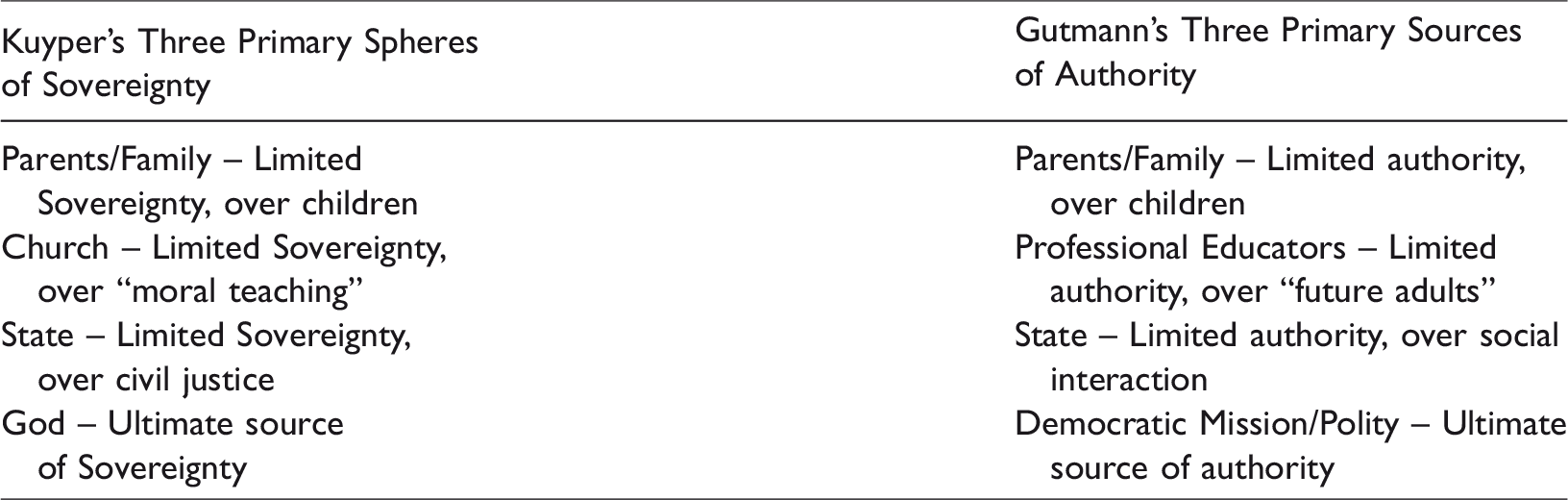
Central to Gutmann's argument is the process of conscious social reproduction with its attendant cultivation of character drawing on the three distinct sources of authority. Accordingly, it might be instructive to compare Gutmann’s three sources of authority to the concept of Sphere sovereignty, treating the former as a secular counterpart to the latter.
Sphere sovereignty is a concept within Reformed Christianity which, as articulated by Abraham Kuyper, recognizes three primary spheres in this world—the family, the church, and the state. Kuyper’s work was part of the ideological and political struggle in the Netherlands over public education and parental choice, specifically, whether to allow parents to select schools corresponding to their religious convictions. It is firmly rooted in a religious worldview in which sovereignty is not automatically associated with States, but has divine origins and three main earthly sources.
Kuyper insisted that sovereignty must be understood as ultimately belonging to God; it is then attributed to different sectors of the created order, but only in a limited fashion. 58 I am neither a theologian nor an historian of religion, but I do know that the sovereignty of God was central to Calvinist doctrine and that the consensus interpretation is that the doctrine means that “nothing is left to chance or human free will.” 59 While Kupyer could be highly critical of Calvin – his dissertation was both theological and historical, contrasting John Calvin and John Łaski as regards the rules of the church and he tended to take Laski’s side, which was more liberal – the influence of Calvin was enormous. Kuyper is often referred to as a Neo-Calvinist, having advocating a doctrine of common grace and engagement with the world. 60 Though he occupied many roles in his life besides theologian and Calvinist reformer, from newspaper editor, educational innovator, politician, and prime minister of the Netherlands (1901–1905), Calvinism was for him a comprehensive worldview. He was an anti-modernist in theological terms, but he believed you couldn’t be uniformly anti-modernist because modernity was not going away. Yes, Calvinism was a positive influence on the values of modern society, but to make that stick, Calvinism needed to engage with the world based on our shared humanity. 61
Like any good Dutchman, he was wary of larger neighbors and rejected both the popular sovereignty model of France, based on all rights being vested in the individual, and the German model in which all rights derived from the state. His model is different: God came first. Christ “is Sovereign over all, [and] God continually re-creates the universe through acts of grace. God’s acts are necessary to ensure the continued existence of creation. Without his direct activity creation would self-destruct.” 62 But under God there are spheres: parents, the state and the church.
Also, we can speculate that he was more worried about Germany than France. “Sphere sovereignty defending itself against State sovereignty,” Kuyper wrote in 1880, “that is the course of world history … in the order of creation, in the structure of human life; it was there before State sovereignty arose.” 63 Thus, part of the motivation for sphere sovereignty is to deny absolute sovereignty to the state.
The state is thought of as a latter development and a usurper of the other spheres. The understanding of sphere sovereignty often reaches anti-statist extremes: The state has thus usurped the God-given parental responsibility to educate children. Though God has given parents the right to extend their authority to a school, this should be a free choice and not something parents are coerced into. That a state would seek to fulfill the parental responsibility in such an important task says much about the goal of the modern state—and that goal is to control the future generations by indoctrinating them into subservience to the state. It should not surprise us that the rise in state-controlled education has coincided with the ever-increasing size of the welfare-warfare state.
64
The family refers to parents and their children. The state refers to the institutions of civil justice and policy making, or government. And, at least for Christians, the church refers to the visible membership of the body of Christ. In education, proponents of Sphere sovereignty tend to give authority for education to parents but justify it by reference to a deity – the state is still subject to God and should make laws respecting moral justice.”
65
The greatest violation of sphere sovereignty today is in the area of education. Throughout history, both the state and the church have claimed responsibility for the role of educating children. However, both of these spheres are mistaken. The responsibility of educating children is a task God has given to parents. Parents have direct authority over their children, as seen in the 5th commandment for children to honor their father and mother. Parents are commanded to teach their children the ways of the Lord (Deut 6:7; Eph 6:4). While schools are not forbidden by Scripture, they must be understood as an extension of parental authority … though parents are fallen and imperfect, ‘the supreme authority must be placed somewhere’. And God has indicated that ‘no place is so safe for it as in the hands of the parent, who has the supreme love for the child and the superior opportunity’.
66
Thus there are three spheres which derive their authority from and are secondary to God’s authority. Gutmann clearly does not follow quite the same path – when the question of God comes up in her work, it is usually in terms of religious parents who want to remove their children from school or who object to ‘neutral school curricula' which do not give weight to religious values. 67 Also, she does not accept that parents should have some sort of ‘the supreme authority,' and certainly not because it ‘must be placed somewhere.' Her main problematic concerns just where do you place authority for education and it is important to note that God is not a source of authority in her framework.
So God has little place in her schema. If this role is taken up at all, it is by the future Democratic Polity of deliberative citizens who have reached their potential through education. However, since that is a future state on which we can only speculate, the closest we are apt to come is by process of deliberation.
Nonetheless, the framework she presents is similar to the Spheres of Sovereignty framework – there are three sources of authority, two of them (the family and the state) the same, with the third, professional educators, supplanting the Church. (Her ‘educator' categories presumably also includes members of the Church, i.e., educators at religious schools, among its members.) But none of these are the ultimate authority. Instead of a deity’s instructions, Gutmann presents the ultimate authority as the mission of a liberal Democracy, an authority that is tested by how the three subordinate spheres of authority treat the children being educated.
As one commentator notes, the central theme of Democratic Education “is how to produce true republican citizens – citizens who possess both the ability and the motivation to participate in their deliberative political communities.”
68
The purpose is to define a set of principles and institutions which leave maximum moral room for citizens to shape their society in an image that they can identify with their moral choices.
69
There are limits, however, specifically the continuation of democracy into the future: [t]he primary aim of a democratic theory of education is not to offer solutions to all of the problems plaguing our educational institutions, but to consider ways of resolving those problems that are compatible with a commitment to democratic values.
The goal of education – the principle that authorizes public education in a heterogeneous Democratic polity – is to develop common standards that are compatible with diversity of background and opinion. Children must learn not just to behave in accordance with authority, but to think critically about authority if they are to live up to the democratic ideal of sharing political sovereignty as citizens … . Education in character and in moral reasoning are therefore both necessary and [d]emocratic societies must therefore prevent majorities (as well as minorities) from repressing critical inquiry or restricting political access.
71
e. Principal and agent
To describe this is in principal-agent terms can, as Run-DMC might say, be a bit ‘Tricky.' Guttman’s work does not explicitly present education as a principal–agent problem, but others have, as often as not presenting educators as agents and either the state or parents as the principals. 72 Implicit in Gutmann is a much different depiction of the principal-agent problem.
One goal of a principal-agent analysis is to direct attention to whether the principal’s utility is maximized, but the preliminary task is to specify who is the principal. In certain instances, this is obvious – the Owner is a principal, the Manager an agent. Similarly, according to the pervasive norms of our society, the Firm is a principal, the Workers its agents. However, these norms are not always pervasive and other societies have a different set of norms and a different common sense. For instance, in a Revolutionary society, such as revolutionary Russia in the 1920s, it is hardly as clear that the Firm is principal — after all, the firm may be a ghost by this point. In early revolutionary Russia there was, at least rhetorically, a deliberate effort to put the worker at the center of history and grant the worker historical agency as principal. This would make the political and economic institutions around him (almost always him) the agent of his historical emergence.
In Education, it is equally not as clear – a normative judgment is required to establish who is the agent and who is the principal. There is a normative judgment involved in both cases. The socially constructed norms of property ownership are what make it ‘obvious' that the firm is the principal and the workers merely agents. While they may be contested, all principal-agent problems assume such a set of norms. But Gutmann’s work is, at least in part, an effort to change norms. Accordingly – and I think it is fair to attribute this to Gutmann – among the parent, the state, and the educator, none of these three is the principal. Let us, however, step back a minute.
Theories of educational authority have been divided into three categories based on who is deemed to be the principal – the parents, their legacy and the transmission of tradition, the state and its vision of a future world, the educator and his or her mission to shape the individual so as to reach their full potential. We can even imagine a human community – a state – unified by a common belief system in which the parent, the state and the educator all had the same desire to transmit a specific culture, endorsed the same vision and shared the same ideas about human potential, but this is more imagination than reality. To the extent there is an empirical instance which approaches this unified human community, it is more likely to be religiously oriented, highly exclusionary state, perhaps with a hereditary leadership, than a pluralistic Democracy that encouraged tolerance of multiple points of view. This might be one reason Gutmann needs to divide the three types of authority – she is not talking about a Theocracy, but a Democracy.
Gutmann categorizes neither parents, the state (at any given moment of time), nor educators as principals. All three should rightly – again, in terms of normative theory – be conceptualized not as principals, but as agents. To state it succinctly, the principal is the student – or, more precisely, the student’s future self.
The problem with having a future self as an agent is that the student as a youth in the present day cannot adequately advocate for what he or she might become. Consequently, there must be, at different levels of remove, various agents: the parent, the state, and the educator. They have three different spheres of authority, but all three are acting in trust.
To the extent that she sees this as a principal–agent problem, the principal in Gutmann's view is either the child or future self. She might at the same time also hold that the principal is possibly, but both more broadly and more nebulously, the democratic state, populated by the future selves of those being educated and in need of maintenance, reproduction and change. These two are intertwined and inextricable from one another. Guttman calls upon the education system to form adults out of children and to take responsibility for equipping students with the necessary knowledge and skills to uphold or even improve democracy.
This clearly has a temporal dimension, for it unfolds over time. Brigitte Knudson describes it as such: The process-based model for teaching democratic deliberation, then, can best be conceptualized as a continuum where children are taught the concepts of democratic deliberation by adults who, in turn, participate in democratic deliberation to make decisions about education that, in turn, will subsequently affect more children. Similarly, within that model, the participatory function of adults is to maintain what Gutmann refers to as the complete democratic standard, comprised of two standards, non-discrimination and non-exclusion. In this participatory model that is governed by both respect and tolerance, adults participate in the democratic process that not only establishes the threshold for engagement – the lowest point of entry into the democratic process – but is also inclusive of engaging in, as well as authorizing, the process. We become part of the system we have been taught to nurture and uphold, keeping the process, yet recognizing and reveling in continuing debate. In order to do this, she maintains that a democratic theory of education should focus on ‘conscious social reproduction’, in other words, ‘citizens are or should be empowered to influence the education that in turn shapes the political values, attitudes, and modes of behavior of future citizens’.
73
f. Educating the Sovereign
How does one educate the Sovereign? The question of public education in Democratic systems is analogous in some regards to the question of how to educate the Prince in hereditary monarchical systems. The most famous examples of the genre are The Education of a Christian Prince by Desiderius Erasmus (1516), his contemporary Machiavelli’s The Prince (1513, but not published until the 1530s) and, if we can go a bit afield, Shakespeare’s Henry IV, Parts 1 and 2, written nearly a century later. 74 A miseducated Prince is a disaster, for he will become Sovereign and the kingdom can will then be in his hands.
So, too, a miseducated people. How then should one educate the future sovereign? As regards the Prince in Shakespeare, the Justinian tradition makes justice and fortitude the ‘king-becoming graces,' and [the lack of] these form the dual theme of Richard II. But institutions of the prince maintain that kings must be educated in all four cardinal virtues so that their subjects will become good by imitating their example. Thus in Henry IV, Hal’s education includes temperance as well as valor in Part I, and wisdom as well as justice in Part II.
75
All noncontroversial conceptions of the good life must be given an airing (the principle of nonrepression) and all adults should have access to the political system (the principle of nondiscrimination). Furthermore, it must be understood that decisions so reached, employing “the fairest ways for reconciling our disagreements,” 77 command a unique authority – that, while allowing for some freedom of conscience and protest of what are considered unwise, unjust or dishonorable acts taken by the majority, disagreement does not lead to non-adherence with or disregard of the collective decision making process. 78 In order for such a system to work, children must be educated and develop the knowledge, skills and virtues necessary for citizenship.
This, of course, opens up another ball of wax. It is one thing to say that democracy should be the basis for our ideal of education, but the question then becomes which conception of democracy are we talking about? Do we want a Representative Democracy in which people merely vote for law makers and agree to obey the laws so made? Or do we want a Participatory Democracy in which laws are generated by citizens in deliberation? Each would call for a different education ideal to ensure that children have an education sufficient to fulfill their role in society’s decision-making processes.
For Gutmann, one should also be educated so as to be able to realize one’s status as a citizen and to participate in the “conscious social reproduction” of the liberal Democratic polity. The ideal is that citizens are “empowered to influence the education that in turn shapes … future citizens.”
She distinguishes between the ongoing and habitual processes of socialization and habit which result in unconscious social reproduction and that resulting from education – conscious social reproduction. 79
That is one motivation for dividing authority in three parts, that control of education should not be ‘supreme' and not only need it not be ‘placed somewhere,' it should not be limited to a single place. It should be shared democratically among parents, the state (and, in a Democracy, its citizens) and professional educators. ‘Conscious social reproduction' then has several authorities – several spheres, if you will – not just one and each must consider the arguments and priorities of the others.
This might be considered the fourth sphere of authority, but there are other contenders.
g. An alternate fourth source of authority and its impact on Non-exclusion, Non-repression and Non-discrimination
In view of the influence of Gutmann’s work, it is particularly striking that many of the most forceful calls for education reform since Democratic Education came out in 1987 look not to the state, not to the family, not to “future” individuals (nor, by any means, to educational professionals acting on their behalf) to be the main actor. Rather, they seek to authorize a fourth group to shape the future of public education in the US: the business community and those who feel they have a calling to use business methods to improve and reform the school system. Here, in most instances, the chief priority presented is not the future choice of children grown to adults, but rather it is, variously, the plight of employers who are looking for employees, the dilemma of established businesses looking for sub-contractors, the benefit of consumers looking for greater value, and the challenge to the nation's ‘preeminence in commerce, industry, science, and technological innovation.' 80
What I suggest, half as a conceit, half as a description – and only speculatively as an explanation of how ideological justifications are produced – is that contemporary efforts at reforming education in the US seem determined to be systematic in their rejection of Gutmann’s conclusions. This is all the more striking since there seems to be much bipartisan consensus on this matter, as the actions of the Arne Duncan, Corey Booker and others attest. As Keith E. Benson recounts, once the charter and school choice sector were a bastion of primarily white conservatives clinging to their dogmas of limited government, preservation of historic school segregation, and protection of religious freedom through vouchers, today’s proponents of school choice have diversified far beyond their narrow sect of cheerleaders of a generation ago. Today, advocates of school choice come in every hue and ethnicity and span the political spectrum from liberal to conservative.
81
The principle of nondiscrimination holds that an educational good cannot be denied to anyone unless the reasons are grounded in the legitimate social purpose of that good. ‘Denial' would include not only ‘exclusion' but also ‘marginalization.' For the first years of education, at least through primary school and likely through secondary school, the principle of non-discrimination merges with that non-exclusion: “no educable child may be excluded from an education adequate to participating in the processes that structure choice among good lives.” 82
By itself, the level of segregation in this country belies any true commitment to nondiscrimination or nonexclusion, but it goes far beyond that. The emphasis on merit, somehow measured, without an accompanying emphasis to address the effects of socio-economic status almost ensures that social stratification will increase. We end up grouping students by the success of their parents – kids of economically successful parents go to one set of schools while the kids of economically unsuccessful parents go to another set of schools. Their separation speaking volumes.
As for non-repression, Gutmann sees this as eliminating all restrictions on discussions on competing conceptions of where we are headed, of what we should aim for in the future. This may be her most literally ‘liberal' value – all conceptions of the good life and the good society should be considered as legitimate subjects of deliberation. 83 However, in the last third of a century, it seems all things educational might have been going in the opposite direction. While explicit restrictions are few, such discussions have narrowed, focusing on a free market vision of economic advance. This has crowded out other visions, something that is discussed at length elsewhere. This is particularly striking in education, where economistic viewpoints and achievement goals had dominated the discourse.
We must, however, look not only at the repression of viewpoints, but also the repression of populations. Repression of and discrimination against populations results those populations having less voice. Repressed populations are much less likely to fully participate (or be able to fully participate) in discursive democratic processes. Since the 1970s we have seen the imposition of increasingly harsh school and municipal policies, including minimum sentencing laws, especially for drug offenses. 84 Between 1980 and 2015, the number of people incarcerated in America increased from roughly 500,000 to over 2.2 million – with 5% of the world’s population, the US has 21% of the world’s prisoners. 85 Overall, the US has the most incarcerated population in the world, including more than 1.3 million people held in state prisons around the country. 86
This is not only repressive, but also distinctly discriminatory. Repression and discrimination go hand-in-hand as a way of maintaining social control. African Americans are incarcerated at more than 5 times the rate of whites; about 56% of the incarcerated are African American and/or Hispanic, nearly double their 32% of the US population. 87 Segregation plays a great role and it has great effects on the schools – minors and young adults from disadvantaged backgrounds are much more likely to end up in prison, so are people in their communities.
Neither are the laws neutral. They have different effects on different populations, both because of differential implementation and because of the law itself. For instance, The Anti-Drug Abuse Act of 1986 required a minimum sentence of 5 years for drug offenses that involved 5 grams of crack or 500 grams of cocaine. Cocaine and crack are drugs that are nearly identical; a key difference, however, was in their customer base – crack or rock cocaine was used more frequently in African-American communities and flake cocaine was used more commonly in white communities. 88 This disproportionate likelihood of minorities to become incarcerated is a huge cloud that hangs over non-white students. 89
We can return to an earlier example. Not at all incidental to his early life, Curtis James Jackson turned 12 in 1987, the year following the passage of The Anti-Drug Abuse Act. One reason he was valuable to his employer-dealers was that he, as a 12 year old, was a minor and was not subject to the same legal punishments. Presumably when the punishments went up, so did his value.
Overall, let us review the five elements that Gutmann points to. For all five, we seem to be going in the opposite direction to which she pointed. Nonrepression is given secondary status and is sacrificed to maintaining social control through policing. Nondiscrimination is given up in favor of selecting out ‘merit’ according to new systems of assessment which rely heavily on computerized evaluation and networked data systems. Parental influence is channelled not into creating a public system representing democratic values, but into parental school choice, including the range of choices allowing one to opt out of the public system. State and citizen authority is limited to developing standards conducive to economic competition; ironically, ‘citizenship’ and civics are left out of it, as are other elements which one would think should be included in a self-realized human being. As Michael Mintrom pointedly asked, "Might such action further erode opportunities for citizens to deliberate about the effects of (public and private) policies on their individual and collective well-being?”
90
Finally, the authority of educators, especially of teachers, has been under attack for 40 years, while the authority of administrators, who are increasingly trained in business-oriented pedagogies, has increased.
h. Then and now
That is the phenomenon I am looking into. Nothing here is meant to be an attack on Gutmann. Rather we point to the attacks on public education and what they mean in terms of maintaining Democracy. I mention this because I was taken aback when one early reader suggested I wanted “to demolish” Gutmann's work. I thought then – and do now – I was building on her work, but pointing to a development that she did not consider at the time of her writing because it had just begun to develop, but which is now pervasive and prevalent.
One aspect of this phenomenon is that the need to “discover a curriculum appropriate for developing the right skills and values for citizens of a deliberative democracy”
91
seemingly had more widespread support a while back and now is hardly considered a priority at all. Instead we see measurement of achievement dominating the discourse: I know that at the end of the day there’s only one metric that counts. That is, did we move student achievement? And when I say move, not incrementally move, but did we substantially improve over a period of time, student achievement.
92
.
Some might claim that if the sole metric is educational achievement, this might suggest/dictate delegating authority to educators, who are supposedly specialists, in promoting educational achievement. However, that is not the case. Or let us say not all educators, for there is a particular group of data-driven educators who have gained prominence. Alongside this is another group of educators who believe they can reshape education methods (something we might call the New Pedagogy), but are judged by the same sets of tests and who can be just as narrow.
This shift of influence thus pushes asides many other functions of the schooling system: providing for socialization and public health, instilling democratic values, aiding a child’s emotional and social as well as cognitive development and somehow creating a better society. 93 Thus, by articulating the problem in a such a narrow fashion it predetermines a narrow set of solutions and a narrow set of policy options.
Moreover, it goes hand in hand with efforts to deprofessionalize and deunionize the teaching force. The use of Data and the presumed New Pedagogy can be used as a tool to hammer teachers over the head and make them conform.
This choice of goal doesn’t automatically prefigure the ‘direct solution' of delegating authority to business leaders or accepting business thinking and logic, rather it is the result, unintended or otherwise, of that fourth source of authority displacing and altering Gutmann’s three sources of authority. It is an indirect rather than a direct process – the norms of judgment for parents, state officials and educators are changed by the influence of business and the rippling effect of the norms of business practice. If the goal of education is to succeed and if business is seen as realm of success – admittedly a big if – then people tend to adopt such practices.
The way in which schools have been used to promote conformity is a very old topic, but what is relatively new is the push since the 1970s or so to re-form the schools as justified by the need of the United States to be economically competitive. In the 1950s, post-Sputnik, there was a push to improve the schools, but that was for reasons of national security – we were afraid of the Soviet threat and how they might surpass us technologically. In the 1970s and 1980s, the great competitor was the Japanese and the rationale was economic; by 1983 the Reagan Administration, pointing to a drop in average SAT scores, attacked ‘a rising tide of mediocrity' that was supposedly eroding the educational foundations of our society [and] threaten[ing] our very future as a Nation and a people, If an unfriendly foreign power had attempted to impose on America the mediocre educational performance that exists today, we might well have viewed it as an act of war. 94
This goes hand-in-hand with and an active process by investor classes of encouraging such change. It is a way of cultivating a compliant and willing workforce. Ideological production, seen most clearly in publications that are for a specific business readership, such as Forbes, Fortune, and the Wall Street Journal, trickle down in to more mainstream publications, as well as into books that are meant to help. An example of the latter is how The 7 Habits of Effective People morphed into The 7 Habits of Effective Teenagers, which “helps teenagers to become climbers rather than campers.” 95
This is augmented when schools – high schools and, to a much greater degree, college and universities – not only teach, but emphasize job search, business etiquette, resumes, cover letters and interview techniques. This is not to say that schools shouldn’t do this, but rather to point out that the pressure is on the individual to find a niche, not on the society to make sure the individual is productively employed. There is a pressure that comes with that.
In so doing there is little room for the goal of enabling democracy, promoting empathy or self-realization in other than business-oriented terms. Stratification is not to be addressed – it is to be accepted as the normal consequence of the market system. Since the demise of one room school districts, it is on the basis of this stratification that educational institutions have been shaped and are being reshaped today.
i. Intimations of marketization and thoughts on hegemony
This dynamic of stratification points to something else, however, and something in many ways new. We can see this in the institutional forms of publicly funded education. While stratification itself is not new, business strategies that aim to segment the market in education have shown robust growth. Since the 1980s, marketers have used economic and behavioral theories combined with data heavy analytical techniques to identify “market segments and product differentiation opportunities.”
96
What private business strategies do is segment the market. This involves the subdivision of a market or population into segments with defined similar characteristics – dividing a broad target market into “subsets of consumers” who have common needs and priorities, and then designing and implementing strategies to target them: Knowing your target market is the first step in selling your products and services. A marketing segmentation strategy further divides your target market into subgroups that are easier to manage. Customized customer experiences lead to higher customer loyalty and better-focused marketing campaigns. A market segmentation strategy organizes your customer or business base along demographic, geographic, behavioral, or psychographic lines—or a combination of them.
97
In Education, we’d have to add ‘parental status' but the other factors are operative and have become more operative as the school choice movement has advanced. As Ashleigh Campi argues, the school choice movement is not merely a reflection of abstract “hegemonic rationalities” that are “rooted in the elite intellectual belief in the efficiency and innovative force of the competitive market form,” it is also rooted in a disparate coalition of “strategic and tactical actors seeking paths to agency amid a field of political possibilities.” 99 While ‘hegemony' might be described in part as that which shapes norms and limits what is considered possible, thus placing constraints on politics, the so-called art of the possible, hegemony is more than that.
Whatever hegemonic rationality there is does not float down from the clouds, but must be realized in specific situations. In other words, hegemony is not just a set of ideas and norms, but must be implemented and instituted in concrete situations and continuously reinforced. In the case of school choice, Campi identifies three groups in an unstable alliance: parents of minority students (specifically black and Latino parents) in urban areas, Christian parents and advocates of education reform that argue the schools are the chief terrain of the struggle for ‘new civil rights.' One may wonder to what extent some of these are true grass roots movements and which are shell organizations funded by those who have other agendas as well; one is reminded that George W. Bush, in promoting No Child Left Behind, called education “the civil rights issue of our time.” 100
Still, undoubtably much of the support for school choice comes from parents who are dissatisfied with the offerings of public education. Campi mentions, for instance, the Christian Right, and the example is illustrative. First, it shows that politics does make unlikely bed fellows, as there is a significant element of the Christian Right that is segregationist, and yet they seem to be in alliance with those saying ‘education is the battle ground for civil rights.' But the Christian Right is hardly a grass roots movement, or if it is, it is a carefully cultivated one. Campi points out that in these circles: parental control became synonymous with market-based reform … A range of libertarian, conservative, and free-market foundations … provided the bulk of funds and organizational force to school-choice campaigns at the local level … funding private schools and [providing] massive flows of grants to support city-based voucher school campaigns.
101
Other groups, such as the Walton Family Foundation, the K&F Baxter Family Foundation, the Wasserman Foundation, the Eli and Edythe Broad Foundation and the Gates Foundation, were strong supporters of charters. Their activities are wide-ranging and they seek to influence opinion and policy; for example, three of them – the Baxter, Wasserman and Broad Foundations — also financed the LA Times coverage of public education while Broad also backed “a proposal to convert nearly half of Los Angeles’s public schools into charter schools.” 102
Thus, while school choice has some reason to be thought of as a ‘grassroots movement' instead of an assemblage of AstroTurf groups, the grass is tended much like the fairways and greens of a country club golf course. The parents who benefit are a significant force, 103 but they are only one element and their tactical moves are generally limited by others players – they do not have the reach to change the limits of the possible by themselves.
Interested parties include not just those who would benefit directly from school choice programs, such as charter school operators, but those who want to see the ‘hegemonic rationalities' of market-based norms, such as cut backs to pubic enterprise, reductions in transfer payments and the structuration of employment on an ‘at-will' employee model, to predominate. As for those who are actively in the business of education, school choice leads to segmentation.
In education, marketers do not only identify segments, but actually contribute to the creation of the segments. This is what many charter schools and other privately run entities in public education also try to do and it is accomplished by changing education law. This is a major change in marketing opportunities. Now there are chains of charter schools and virtual schools, as well as curricula for home schooling and on-line education products. If these businesses are to run well, then they will likely adopt segmentation strategies. They will also encourage the re-forming of education so that they may offer differentiated products to these different market segments.
Traditionally the big education money maker was selling textbooks. Now, however, education corporations such as Pearson and Wireless Generation have moved beyond this to providing curricula, testing services, data systems, virtual education products and teacher training. 104 Governmental offices for curriculum development at the state and district level have been eliminated since outsourcing is thought to be more efficient.
Stunning dollar amounts are involved. Pearson signed a nearly half a billion-dollar contract to provide testing services in Texas. 105 As for venture capitalists, the money has gone up 30-fold: “In the venture capital world, transactions in the K-12 education sector soared to a record $389 million [in 2013], up from $13 million in 2005.” 106 More importantly, in the name of raising standards, every state in the US is now required to give sets of standardized tests, most of them produced by private entities. Finally, there are new forms of financing and regulating schools – or not regulating schools.
This connects to the two other manuscripts with which this one is linked. In the first, the concept of directed narratives in public discourse is seen as a key in “social learning.” 107 Social learning is in quotes because what I’m really analyzing is one aspect of the production of hegemony. The education reform movement puts forth a potent common sense that run counter to the purposes of public education.
The present article, in conjunction with the others, works to make that connection by comparing two narratives. One, as noted, is Amy Gutmann’s in Democratic Education whereshe claims there are three principle sources of authority for education: parents, the state (and its citizens) and educators. The other is a counter narrative that emanates from the business community and it seems to be a mirror image of Gutmann’s work, systematically working against those facets of the system she highlights that make the reproduction of democracy possible. Each suggests a fourth source of authority, one based on the norms of a deliberative and democratic community, the other based on the norms of the business community.
Since the business community is not a source of authority Gutmann mentions in her book, a couple of people have thought my main goal was to critique (one used the word “demolish”) Gutmann’s theory, but that is not the case. There is obviously some limited critique of Gutmann, but it is building on a solid foundation, nor razing it, so as to allow us to move from her mainly normative terrain to a descriptive and critical task. What I have been working to do is to use her work to critique the business-oriented direction of contemporary education reform.
Thus, one main question is “How has the paradigm changed?” This is the substance of the manuscript on Social Learning – what I refer to as the third approach. Back in the 1980s, Gutmann presented one model of how public education could be structured; now there is another one that is quite different in which significant authority is given to the private sector and accountability is determined, largely, by standardized tests. The extent to which such tests are now used is a new factor, one made feasible in large degree by advances in the field of data collection and analysis. People speak of their educational programs as being “data-driven” (not just data-informed) and, as a little anecdote, I teach in a Datacation™ school. Really. There is a banner in the hallway.
So the fact that Amy Gutmann was writing ‘before' gives us an image of other possibilities that have not been realized. She had a different image of the future than is currently being imagined and I meant to make the point that the autocratic/testing paradigm not only can’t achieve this, but runs in the opposite direction.
That, at least, is what I want to suggest. I am uncertain as to how well the suggestion has gone over since one potential problem for the reader is the writer – it is at times difficult for me not to make this sound like a polemic. I more or less start by accepting the proposition that reliance on the market tends to subvert the purposes of public education. I then used Gutmann’s work as a good guide as to how that was being done by employing a conceit. Still, I think it is close to right — it almost seems as if someone on the side of importing business practices into public education read her book and decided to use Gutmann’s analysis to craft a political strategy.
Here there is a fourth source of authority, influencing and shaping the other three. My argument is that this fourth source of authority – the business community, by which a I mean the private sector and the non-profits it supports – has successfully altered the trajectories of the other three. We could call this indirect authorship:
Parental authority has been co-opted, directed into a limited area of school choice; the likely result is segmentation of the market for schooling. State authority loses sight of civic education and when it comes to molding ‘the modern individual' (a phrase taken from the Chicago Boys in Chile), becomes focused on how the individual can compete in global economics. This is just the sort of redefining of the national interest Peter Hall and Mark Blyth both point to when discussing social learning and paradigm change. Finally, the education community is marginalized, losing protections and their status as guardians of future generations in a process of market emulation; the authority of traditional educators is derided and the selection of ‘best practices' is drawn from the business world in general, often without any particular attention to the special problems education poses.
In some sort of analysis of causal functions, the influence of the business community would be an independent variable, the trajectories of the Gutmann’s three sources would be intervening variables and the change in policy would be the dependent variable.
That is a lot of cover and in other work I try to do so. 108 But not here. Here we will stop.
This article is the first of four on “Sources of Authority in Education,” all of which use the work of Amy Gutmann as a heuristic device to describe and explain the prevalence of market-based models of Education Reform in the United States. The first article, “Negating Amy Gutmann” looks primarily at deliberative democracy. The next (and present) article, “Neoliberalism and Four Spheres of Authority” considers, primarily, the promise of egalitarian democracy and how figures such as Horace Mann, John Dewey and Gutmann have argued it is largely based on the promise of public education. It thus begins with a consideration of what might be called a partial historical materialist analysis – the growth of inequality in the United States (and other countries) since the 1970s that correlates with much of the basis for changes in the justifications and substance of Education reform. The third article, “The Odd Malaise of Democratic Education and the Inordinate Influence of Business,” begins by offering some historical background and comparisons and ends by considering what happens to the Philosophy of Education when Democracy and Capitalism are at odds. The fourth article is on changing notions of civics, “Profit, Innovation and the Cult of the Entrepreneur: Civics and Economic Citizenship.”
All are included together in a book manuscript, hopefully soon to see the light of day, Democratic Education and Markets: Segmentation, Privatization and Sources of Authority in Education Reform. The book as presently planned begins with a theoretical chapter on paradigm change. 109 The book also includes a suggestive Conclusion, “Robert Pirsig, John Dewey and John Adams: Defining Quality, Efficiency and The Benefits of Liberal Education.”
Footnotes
Declaration of conflicting interests
The author(s) declared the following potential conflicts of interest with respect to the research, authorship, and/or publication of thisarticle: Except for having been a Bronx public high school teacher for 20 years, witness and subject to the reshaping of public education in accordance with market emulation models.
Funding
The author(s) received no financial support for the research, authorship and/or publication of this article.

Notes
When people ask what I teach, I reply “disaffected youth.” Yes, it is a joke, but it is more than a joke. The degree to which social pathologies wrack the schools is nearly beyond measure. Such social pathologies are usually not measured, only sometimes noted and more often ignored or glossed over. Measurement seems to be for accountability and labeling schools as failing.
When it would take an enormous effort to correct such problems, instead more and more pressure has fallen on the schools and, because of the lack of applied resources, adequate institutional partners in the process and political will, the schools are set up to fail. Education is labeled as failing and the schools have become scapegoats, Yet the schools are one of few institutions doing anything at all and they are handcuffed by so-called ‘reform' efforts. Reform is supposed to mean ‘the improvement or amendment of what is wrong, corrupt, unsatisfactory,' but ‘reform' in this case means following the path to privatization and market emulation.
That is the reason I write on education. I have a MPhil in Political Science, but never finished that dissertation, only a book, some articles, untold conference presentations and multiple manuscripts. Also, I have taught at the college level from UPenn to Phnom Penh, with stops in Tirana, Dhaka, and New Jersey. I have a family, one daughter, a few cats, in our Manhattan apartment, about which I could go on at length, but I am already over the suggested word count.