




Abstract
This article is the third of three on “Sources of Authority in Education.” All use the work of Amy Gutmann as a heuristic device to describe and explain the prevalence of market-based models of education reform in the US and the business-influenced Global Education Reform Movement. The other two are “Negating Amy Gutmann: Deliberative Democracy, Business Influence and Segmentation Strategies in Education” and “Neoliberalism and Four Spheres of Authority in American Education: Business, Class, Stratification and Intimations of Marketization.” All three are intended to be included together as chapters of my Democratic Education and Markets: Segmentation, Privatization and Sources of Authority in Education Reform.
The “Negating Amy Gutmann” article looks primarily at deliberative democracy. The “Neoliberalism and Four Spheres of Authority” article, considers its main theme to be the promise of egalitarian democracy and how figures ‘such as Horace Mann, John Dewey and Gutmann’ have argued it is largely based on the promise of public education. It thus begins with a consideration of what might be called a partial historical materialist analysis – the growth of inequality in the US (and other countries) since the 1970s that correlates with much of the basis for changes in the justifications and substance of education reform.
The present article, “The Odd Malaise of Democratic Education and the Inordinate Influence of Business,” continues the argument by offering some historical background and comparisons and ends by considering what happens to the philosophy of education when democracy and capitalism are at odds.
It thus starts with recent history, looking at how the content and context of educational policy have changed in the US since Gutmann wrote in the 1980s. Specifically, it concerns itself with the increasing prevalence of twin notions: that our system of education must be reformed because of global competition and that the educational system should emulate the market.
The article then goes back a little bit further, to the origins of the common school in the 1600s and Horace Mann’s articulation of the principles behind public education, which are shown to be in stark contrast to Education Reform. The narrative describes how the standards movement, variously, coalesced around George H. W. Bush’s America 2000 and Bill Clinton’s Goals 2000 programs, was reflected in a ‘21st-century schools’ discourse, found programmatic form in George W. Bush’s No Child Left Behind and it’s offspring, Arne Duncan’s Race to the Top. All of the preceding were, to a shocking degree, based on misleading and selective statistical analysis and sets goals that are unreachable even in the best of all possible worlds. The article concludes by considering paradigm change in education and its causes; I draw on both Peter Hall’s exposition of social learning 1 and Antonio Gramsci’s conceptualization of hegemony. 2
The odd malaise of democratic education: The inordinate influence of business
What happens when economic concerns become the most important goals for public education? What happens when the way in which education is assessed and run is to the largest extent imported from the business sector? More generally, what happens to the philosophy of education when democracy and capitalism are at odds?
There are a lot of ways to go at these questions, but I am going to first look at Gutmann’s Democratic Education and its three sources of authority, and then consider how Business and Democracy each argue they should be a fourth source and the ramifications for the last either’s ascendency. In order to do so, the article is broken down into the following eight sections:
Sources of Authority and the Goals of Education in Different Time Frames Democracy, Capitalism and Attacks on Education Comparing Contemporary Education Reform to Horace Mann Shifting Paradigms – Order of Change and their Causes ‘Enterprise Culture' – Assessing Standards as in Alignment with Popular Modes of Hegemony Narratives of Dedication as an Example of Hegemonic Change and an Illustration of Underlying Causes Revising the Conceit: Contemporary-education Reform finds itself at Odds with Gutmann on Autonomy, Authority and Rational Deliberation The Democratic State of Education under Capitalism
By the end, I hope we will have shed some light on the three ‘what happens when' questions above.
Sources of authority and the goals of education in different time Frames
Amy Gutmann, who became President of the University of Pennsylvania in 2004, can lay claim to being a practical educator. Nonetheless, she began her career as a theorist, a political philosopher, writing on democracy and education. Her Democratic Education (1987) has been praised as the most important book on the role of education in a democracy since Dewey (Yudof, 1989: 440). 3 Her work encouraged autonomy for educational professionals, developing critical faculties in students and promoting deliberation. It is therefore instructive to examine the values in her work and how much influence they have had and still have.
Political theories of education, according to Gutmann, fall into three broad categories based on the source of authority: those that give authority over education to the state, those that give it to the family and those that give it to education professionals. Saying that none of them by itself coheres with a liberal democracy, Gutmann (1987: 34) rejects all three models: the ‘family state’, in which children are educated for the good of the state and the sake of social harmony; the ‘state of families’, where parents are entrusted to make choices for and pursue the best interests of their children; and the ‘state of individuals’, which relies on educational professionals and expert knowledge to create institutions that maximize the future choice of children, “without prejudicing children towards any controversial conception of the good life.” In the end, Gutmann argues, none of the three models work in a liberal democracy precisely because they are based solely on a single source of authority. She argues that each of these accounts is deficient.
The first is deficient because it “is incompatible with our identity as parents and citizens” (Gutmann, 1987: 28); the second places too much power in the hands of parents “on the unfounded assumptions that they have a natural right to such authority or that they will thereby maximize the welfare of their children” (Gutmann, 1987: 42); and the last ideal, though grounded in an admirable desire to provide individual citizens and students maximum autonomy, fails to recognize that schooling can never be simply neutral, for “even if schools avoid all courses that deal explicitly with morality or civic education, they still engage in moral education by … noncurricular practices that serve to develop moral attitudes and character in students” (Gutmann, 1987: 53). Furthermore, it is not only appropriate for democratic societies to develop in its future citizens the necessary capacities for citizenship, it is not merely a preference, but it is a sine qua non for democracy to succeed and flourish. “The question thus becomes not whether this should be done, but how it should be done, with what constraints, and by whose authority” (Spragens, 1988: 511).
Of course, whenever one says there are three kinds of anything (perhaps even more so then when you say there are only two kinds), it is a simplification, and often a conscious over-simplification, engaged in for the sake of argument. In this case, for instance, one might consider human communities other than the state as being sources of authority, one might question the definition of family, and one might wonder if, as an alternative to education professionals, we might consider giving authority to those who are deemed somehow to have a “calling” for educating the young, whether they be teachers, scout leaders, priests or shamans. As a sophisticated thinker, it is unlikely that Guttmann is unaware of this. Rather, she is not willing to embrace any single viewpoint but instead offers a model that incorporates the other three.
Gutmann emphasizes that the education of the young is shaped not just by democratic governments, but by democracy more broadly conceived. She calls for a “democratic state of education [which] attempts to balance the power of the state, parents, and educational experts and officials” (1987: 42). But the picture she composes has not only this spatial aspect that calls for a particular and shifting balance between social forces or factions which check one another at a particular moment in time to inform institution building, but also a temporal element that is long lasting.
The temporal element builds the internal capacity of citizens and then builds upon those capactiies to arrive at a positively valued norm of even-handed deliberation. As democratic education unfolds over time, it is not static and fragile but also—at least this is the hope—reinforcing and robust. Significantly, she does not miss out on the fact that the young grow older over time and then have their own chance to shape democracy. Accordingly, she makes her three-fold division not as a statement of reality, but in order to begin a discussion that will encompass theories that ask who should have the authority to shape the education of citizens in a democracy.
But did she miss something? Gutmman argues for a democratic state of education that becomes, in effect, a fourth---and potentially decisive---source of authority. But what if that source of authority were not democratic, but economistic?
Gutmann’s is often the first book on the syllabus for courses on democracy and education. She is a more lucid and accessible writer than John Dewey and covers, chapter by chapter, section by section, a set of controversies for public education that make it almost an ideal book for a college course. Students may engage on issues ranging from creationism to sex education, parental authority to sexism, religious education to public finance, television and technology to book banning, illiteracy to adult education. With all this, it is interesting to note that business and markets, so much the woof and warp of debates on education reform, are words that do not appear in her three-fold division, among her chapter titles or the titles of the sub-sections.
It is particularly striking because the most forceful calls for education reform of the current day look not to the state, not to the family, not to “future” individuals, nor, by any means, to educational professionals acting on their behalf, 4 to be the main actor. Rather, they seek to authorize a fourth group to shape the future of public education: the business community and those who feel they have a calling to use business methods to improve and reform the school system.
Of course, Gutmann’s was chiefly a normative work. Her articulation of what we should have and should not have included in every possible example of groups acting in their self-interest should not be expected to be a perfect prognostication. Nonetheless, we do have to consider the political dynamics and the ability to influence opinion that lead to the public’s authorization of education, and what I will suggest in what follows (half as a conceit, half as a description) is that contemporary efforts of reforming education in the US—on which there is much bipartisan consensus—seem almost determined to be systematic in their rejection of Gutmann’s conclusions.
Let us engage our first example. There is now little call for balance between the state, the family and education professionals. Instead, schools and school systems, the argument goes, should be allowed to be run by non-professionals, at first as an experiment, later as a norm (to clarify, yes, there may be professionals, but they often come from fields other than education). Families should be able to choose among competing schools that reflect their values—they are not citizens making deliberative decisions about how public education should be shaped for the benefit of the future polity, but the customers for whom the schools must compete in the current economy. As for the state, one cannot say its role is reduced, but its role is changed. Instead of running things directly, it is to set up the rules by which different educational entities can compete, to insist that student performance be measured, to gather data and then determine who has succeeded and who has failed. With the exception of establishing standards for learning (and there it acts more as a facilitator than a producer), the state does not provide content. In sun, students are not citizens, they are clients. 5
This overstates the case a bit, but not by much. Still, there are caveats to be made. Generally, the federal and state governments have not run K-12 schools. With rare exceptions, schools are run by local districts and the US is unique in having more school districts or Local Education Authorities (LEAs) than any other country—some 14,000 compared to, at the latest count, 152 in Great Britain (No. 2 on the list), eight in Australia and one in France. 6 , 7 Nonetheless, the LEAs in the US face greater and greater constraints. State educational authorities have developed standards (and standardized tests) by which local districts and schools are to judged, and the federal government has increasingly tied federal aid to a set of conditions involving reforms, such as the implementation of monitoring systems (including standardized tests), allowing a greater number of charter schools and changing labor practices, such as the terms of tenure. This use of leverage has been effective in creating the presumption that we should have a system that emulates the market, with test scores serving as a proxy for profits.
If all of this is true—if business has managed to become the great influencer and director that I suggest it has—what then happens to the central questions in the political theory of education: How should a democratic society make decisions about education? What should children be taught? How should citizens be educated?
What happens is that the answers we find most people agree upon have shifted significantly. This goes along with a revamping of the discourse, as one sees the goals of education more often defined in economistic terms or in ways that can be tied to economic goals. The presumptive content of education has changed.
We will explore all three questions, suggesting that the newer answers do not dovetail with the aspirations of democracy. In reverse order, we find, first, that citizens should be educated so as to pursue first their own interests, so as to be economic citizens—actors who do not challenge the system or its tenets of justice, but who are ready to find and take advantage of the opportunities presented to them. They are educated so as to be entrepreneurial in spirit and to create opportunities where none exist (or no one has yet seen them), so as to not depend on others except to the extent that one needs to be part of networks that will help you realize your aspirations and advance your interests.
Second, we find that children should be taught how to become these economic citizens, how to gain skills that will be valued in the marketplace, how to rely on themselves and that the best way to pursue general welfare is, as with Smith’s Butcher, Brewer and Baker, to advance one’s individual interests; that as they add to the common good, the common good comes to be defined as the sum total of all the individual aggregated goods.
Finally, as the first becomes the last, the question of how we should make decisions is dominated by the question of whether the choices we decide upon make us—both the “us” of aggregated individuals and the “US” for the United States—more competitive economically.
Overall, instead of calling upon the education system to take responsibility for equipping students with the necessary knowledge, disposition and skills to uphold or even improve democracy, the business-influenced paradigm calls upon the education system to take responsibility for equipping students with the necessary knowledge, attitude and skills to compete in the free market and increase economic bounty. In sum, if all of this is true, then Gutmann’s original project—of sketching how a democratic state should commit itself to allocating educational authority in such a way as to provide its members with an education adequate to participating in democratic politics—might very well be a moot point.
As we proceed, there will be explorations into different areas. One might reasonably doubt whether the premise that business has had greater authority is indeed true; it is a difficult point to prove definitively, and some data clusters, such as the uptick in teacher actions in 2017 and 2018, might appear to contradict it. 8 On the other hand, those teacher actions can be considered a reaction—a form of resistance—to the increasing influence of business and the way in which figures in positions of authority reflect business norms.
The premise that there are economic agendas, both in terms of interests and ideology, underlying the education-reform movement might also be challenged. One alternative narrative is that the quality of education in the US became so poor that something had to be done, that a lot of very important people from the business world devoted large amounts of both time and resources because they felt a need. Indeed, that is a widely accepted narrative in mainstream discourse when it tilts to the right.
I would argue that the latter half of it—that there are a lot of people who became convinced that something had to be done—does not preclude the possibility that economic agendas are being followed at the same time. A good part of what follows in this, as in my 2012 book, argues that the quality of education in the US had not become poor overall, but was poor where poor people lived because the poor have little power; also, that while some things should have been done, many of the things that were done should not have been. That is a long story, and I hope what follows makes that point.
That still leads us to another question: why is there such a distance between Gutmann and contemporary education reform? One reason is time—her book was first published in 1987 and was written previous to that, in the early to mid-1980s. As will be discussed below, Gutmann was writing at a time of great political and institutional change: what Ira Shor has referred to as the hinge of 1983. In the timeline of education reform this is during the launch of the standards movement, roughly mid-way between the publication of A Nation at Risk in 1983 and the 1989 National Educational Summit at Charlottesville, Virginia, where President Bush and nearly all 50 Governors (Bill Clinton among them) convened to set education goals for the nation.
It may surprise people today who are accustomed to see heated arguments at the education summits on NBC, CNBC and MSNBC, 9 but the goals adopted at the meeting eventually transformed themselves into America 2000 in the Bush administration and were passed as Goals 2000 during the Clinton administration. There were partisan differences, of course, but there was a larger bipartisan middle ground.
Nonetheless, even if it is true that the so-called excellence movement was driven by a business-inspired coalition (see Toch, 1991), at the moment Gutmann was writing, the need to “discover a curriculum appropriate for developing the right skills and values for citizens of a deliberative democracy” seemingly had widespread support. But that support was waning and now that time certainly seems a long time ago (Pamental, 1998: 229).
Larry Cuban recounts how things changed in the quarter-century plus since. Claims were made, for example, by a US Assistant Secretary of Education, declaring that “faltering academic achievement between 1967 and 1980 sliced billions of dollars from the U.S. Gross national product”. Rhetorical questions were asked, for instance, by the chairman of IBM, who said, education “is a major economic issue … If our students can’t compete today, how will our companies compete tomorrow?” Nonprofessionals were brought in to run major school systems, and they started talking about “the bottom line. Business has profit and loss. The school system has students and [need to] get through these exams and go on to successful careers. That’s what this system is about” (Cuban, 2004: 237–239). 10
The system ceases to be about a balance between the state, the family and professional educators. The overriding goal is economic success. A sense of social commitment is hardly at center stage. Expanding the internal life is something that should be done on your free time. Civics falls by the wayside.
Cuban goes on to systematically question those statements, to counter those assumptions (and also to suggest they are often based on uncertain math), 11 showing that there is a pervasive and contestable logic that goes largely uncontested. Anyone reading about education reform today would think that business and markets would at least merit a full chapter treatment, if not half of the book—even a book primarily concerned with civic education.
But Gutmann was writing before—before Chubb and Moe (1990), before No Child Left Behind (NCLB), before Joel Klein, before Rupert Murdoch hired Joel Klein, before Teach for America, before charter schools, before the advent of the pervasive theory that, if not the family, then the state and educational professionals themselves might in fact be the source of multiple problems that could be solved by applying common sense: the common sense of what works in business.
Gutmann was writing before the common sense of what works in business became the predominant way of justifying educational reform. With that spread of business sense as common sense, there is a dual abdication of social responsibility, the first part of which is treating kids like adults, the second of which places inordinate responsibility for ‘closing the achievement gap' on individual teachers. More generally, it also places inordinate blame for the failures of public education on educators’ shoulders, when they are more accurately linked to long-standing social pathologies and an unjust distribution of educational opportunity.
Those who seemed most influenced by Gutmann’s work had different and, what might seem to some eyes, quaint priorities: I examine the role of public education in response to these social challenges. Based on Amy Gutmann’s democratic education theory, I maintain that the foremost role of public education is to foster basic democratic principles (such as equal opportunity and liberty) (Ben-Porath, 204: 245).
Foremost among these is the adoption of a top-down management style that assumes breaking apart and reconstituting the school—so-called ‘creative destruction' or disruptive innovation—is a desirable goal. As any reader of Chubb and Moe (1990) might guess, this draws on the principle of autonomy, but it is not autonomy for teachers or anything like academic freedom. And it is only sometimes for principals. Autonomy is mostly for the managers of principals.
If we look at Gutmann’s three sources of authority, we see changes of direction and great magnitude regarding all three from 1983 to the present day. The state (both the federal government and state departments of education) instituted standards-based reforms and then focused on test scores; in turn, they began to adopt, at least in part, market-emulation models that established privatization paths for some aspects of education and imported the ‘best practices' of business for others, most often using test scores as a proxy for profits. Parents were offered expanded choice in the form of school-choice programs, proposed voucher programs and, eventually, charter schools. Whether this expansion of choice also detracted from the quality of traditional public schools is a question that is debated heatedly, with judgments seemingly preordained and impervious to empirical findings. Finally, efforts were made to reshape labor relations in the profession, with attacks on tenure and job security rampant. Restructuring the profession was advocated by many whose ultimate goal seemed to be to make teachers at-will employees on the model of a sub-contractor.
All three of these areas will be examined below, albeit with less time devoted to charters, since I have spent less time examining them. But we will be looking quite a bit at discourse and how it shapes policy. This is not to say discourse arrives ex nihilo—quite the opposite—but to see what discourse reveals about the bases of these changes.
Over the last 30 years, a narrative has developed that has become the common sense of education reform. The prevailing argument is that we can succeed in global competition but only if we first succeed in fixing our failing system of education. This requires the acceptance of two competing and somewhat contradictory claims. On the one hand, global competition is conceived in terms of free trade and is assumed to be something that we should support. As Jeff Faux (2012a) argues, in order to support free-trade agreements from the North American Free Trade Agreement (NAFTA) to the Trans-Pacific Partnership (TPP), one refrain that constantly repeats is that “American workers are naturally superior to other workers and would therefore ‘win’ in any fair competition.” While this has strong roots in the Reagan administration, the use of such rhetoric is truly bipartisan. NAFTA was initiated in the Reagan–Bush White House, but it was signed into law by Bill Clinton. From President Obama (2012): “Our workers are the most productive on Earth, and if the playing field is level, I promise you: America will always win.”
On the other hand, there is another claim that we cannot compete; we are told that the US is being ‘out-educated'—that other countries have superior educational systems and that we are being left behind. Isn’t there somewhat of a contradiction here? How did we ever produce the American workers who are ‘naturally superior' and who continue to be “the most productive in the world” when we have this outdated education system? That is left a mystery.
Another mystery is that the solution to our being ‘out-educated' is not to emulate the best practices of other nations but to come up with a radically different model. Finland, Singapore and South Korea do not emulate the market; they have systems marked by a high level of state involvement. But the US is to follow a different path.
Let us then go back to the claim that American workers are the most productive on Earth and would win in any fair competition. The connection between education reform and free trade is crucial. As Faux (2012a) points out, the claim about American workers being superior is “problematic at best and at worst, a pander to our national delusion of exceptionalism.” In major part, the delusion is that free trade results in large numbers of highly paid jobs that a highly educated populace will be able to take advantage of. However, “for many governments in less developed countries and investors in developed countries, exploiting labor is the point—cheap workers represent these nations’ comparative advantage” (Faux, 2012a).
Within the teaching profession, however, exploiting labor has to be accomplished by other means. There are direct methods—in the second presidential debate of 2012, Mitt Romney suggested we “staple green cards” to the diplomas of “People from around the world with accredited degrees in science and math” and have skills we need. This would not only help information-technology companies and the like but would also make it easier for school districts to import science and math teachers, as well as English as a Second Language teachers, foreign-language teachers and, one could imagine, certain districts deciding that non-native speakers could be English teachers if they were cheap enough. It is worth noting that most states will both honor overseas degrees and provide temporary teaching credentials, if needed.
Then there are indirect methods. Here, we can look at another article by Faux (2012b); adding his voice to many others, he talks about the media ignoring facts and data while “the war on public education” continues “for the sake of the children.” He recounts the “familiar media narrative [in which] the central problem with American K-12 education is low-quality teachers protected by their unions” (2012b). Privatization is the solution, especially “the privately run but publicly financed charter school,” which because they are not regulated to the same degree, are mostly non-union and are in competition with one another, will provide a better model (Faux, 2012b). In the narrative, adopting this model is one long-needed step. The next most pressing is paying teachers based on their ‘performance,' for which one may read the ability of their students to get better scores on standardized tests. Ignoring the fact that this is exactly the opposite of what the best education systems in the world do, it is claimed that both steps are imperative if we are not to fall by the wayside in international economic competition.
The global competition theme is, by itself, not new: that our system of education must be reformed because of global competition has been a constant for nearly half a century (see, for instance, Plucker, 2012). But what does that mean for democratic education?
Democracy, capitalism and attacks on education
Both John Dewey and Amy Gutmann begin from the axiom that tax-supported public schools should primarily serve democratic ends. However, as a practical matter, creating a system of public education means dealing with the economic ends of not only individuals but also of powerful agents in society. Gutmann’s use of the family, the state and a cadre of educational professionals is therefore useful as a heuristic device to sort out the attacks on public education among the family, state and professional sources of authority. What it also points to are how those sources of authority have been pressured from without.
It follows, then, that there are different types of attacks. In non-technical language, we can think of ‘friendly' attacks such as school choice, in which the authority of parents to choose for their children is used as a pretext for dismantling and/or restructuring systems of public education. But school choice is then undermined by the standardization of education in what might be deemed ‘positive' attacks—attacks that claim, as constructive critics, that the system is lagging and needs higher standards. The common core is the latest example and I am not so much against it as I am its linkage to high stakes tests. Finally, there are ‘attack' attacks—aggressive attacks on unions, on tenure, on professional qualifications.
Taken together, I believe this to be a good, if not exactly rigorous, way of describing what has been happening since, more or less, the late 1970s. School choice, in the form of public school choice and charters, aligns with calls for parental authority. Raising standards aligns with the calls for the nation-state to shape the future members of society. Advocacy for administrative autonomy and the introduction of new evaluation systems for teachers align with calls for educators to have authority. In all three cases, the terrain has been reshaped and the effects have not necessarily been conducive to the promotion of democratic deliberation.
School choice, by definition, allows public-education funds to follow students. Parents choose the schools or services as they see fit—presumably meeting the needs of their children—sending them to a public school, private school, charter school, home school or whatever other learning environment parents select for their children (EdChoice, n.d.) As Focus on the Family (n.d.) puts it, when advocating a system that would allow government funds to pay for private school tuition, school choice “redirect[s] the flow of education funding to individual families rather than to government.” Peter Cookson (1995) argued in the 1990s both that school choice employs a market metaphor that reveals an implicit faith in consumerism and that school choice can be seen as a grassroots movement, akin to gun control, anti-abortion movements and the overlapping movement for prayer in the schools (see also Powers and Cookson, 1999: 104–122). While the latter might have originally been the case—and this is an area of deep ideological division—among the grassroots there is a lot of AstroTurf, including funding from the Walton Family Foundation, the Jacquelin Hume Foundation, the Daniels Fund, the Koch Brothers and various DeVos family foundations. Betsy DeVos, as US Secretary of Education, “has not been shy about expressing disdain for the traditional public school system by calling it a ‘dead end’ and a ‘monopoly’” (Strauss, 2017). 12
On the other side, Harry Brighouse (2000) questioned whether democratic ideals of equality would be subverted by school choice and privatization options. He expressed concerns that more-affluent families, who are better connected and have access to better information, will be better able to navigate the system. Less-affluent families will not, thus exacerbating rather than ameliorating social divisions.
Thus, we have on one side supporters of school choice who say that parents have the right to choose the school that their students attend, that many public schools are failing—especially those in urban areas serving poor students of color—that poor and middle-class parents should have the right to escape failing neighborhood schools and that public schools should be run as if they are businesses, subject to competition from other educational institutions and subject to closure if they don’t work. Critics of school choice, on the other hand, argue that you cannot run the public education system like a business, because students have different needs, that public schools are at a disadvantage in competition because they must accept all children but choice options don’t, that competition is problematic at best and counter-productive at worst, that the public school system is hurt when financial resources are diverted from districts that are chronically underfunded, that “choice schools” are not held accountable and oversight is lax in many states and, finally, that many choice options violate the fundamental constitutional principle of separation between church and state (adapted from Strauss, 2017).
The core issue can be portrayed as that of individual rights versus collective decision making. The US, while individualistic in much of its ethos, has thought of education as a community responsibility. In New England, for example, general education among the populace had been an area of strong public policy since at least the 1640s. Usually religiously- rather than politically-oriented and meant to form “good people through the reading of the Bible,” Puritan leaders in Massachusetts colony passed “the Law of 1642, requiring parents (or masters of apprentices) to provide the children under their care with a basic education, including literacy and numeracy. If children were not educated, the government could remove them and place them in a home where they could get a good education” (Boyd, n.d.). This was compounded in 1647 with the passage of The Deluder Satan Act, which required that towns hire schoolmasters and thus “the burden of education was shifted from the parents to the local community” (Boyd, n.d.).
This was not solely religious in nature, for it was also an effort to create good citizens who could understand and obey the law. The 1642 and 1647 laws were thus revolutionary. It can safely be asserted that these two Massachusetts laws of 1642 and 1647 represent not only new educational ideas in the English-speaking world, but that they also represent the very foundation stones upon which our American public school systems have been constructed (Cubberley, 1919: 18). 1. The universal education of youth is essential to the well-being of the State. 2. The obligation to furnish this education rests primarily upon the parent. 3. The State has a right to enforce this obligation. 4. The State may fix a standard which shall determine the kind of education, and the minimum amount. 5. Public money, raised by a general tax, may be used to provide such education as the State requires. This tax may be general, though the school attendance is not. 6. Education higher than the rudiments may be supplied by the State. Opportunity must be provided, at public expense, for youths who wish to be fitted for the university. … It is important to note here that the idea underlying all this legislation was neither paternalistic nor socialistic. The child is to be educated, not to advance his personal interests, but because the State will suffer if he is not educated. The State does not provide schools to relieve the parent, nor because it can educate better than the parent can, but because it can thereby better enforce the obligation which it imposes (Martin, 1894, quoted in Cubberley, 1919: 18–19).
The idea of unlimited parental choice is, however, at odds with these beliefs. So is a sectarian approach, Horace Mann being a case in point. “At the core of Mann’s thinking was the conviction that it was possible to define a set of values that were essential to citizenship in a democracy and which while not identified with any particular religious sect, were nonetheless compatible with all” (Eakin, 2000: 4). There is a question of whether such compatibility is possible and whether eventually the common school had the common elements of mainstream Protestant belief, 13 but non-sectarianism was nonetheless one of Mann’s six main principles. The others were as follows: public education should dispel public ignorance; public education should be paid for, controlled and sustained by an interested public; schools need to embrace children from a variety of backgrounds; this education must be taught by the spirit, methods and discipline of a free society; education should be provided by well-trained, professional teachers.
This, for Mann, was the role of the community and, by extension, the state. State authority was to make sure schools embraced diverse children without regard to their background, that public education be based on our common belief in the value and efficacy of freedom, that educators be well-trained and reasonably compensated, that the curriculum not be narrow, that school houses be well equipped and that all of this was in the public interest.
All these are still issues of public debate, but the state role has nonetheless significantly narrowed its focus since the 1980s by emphasizing student performance and leaving civics, creativity, empathy and other goals of education by the wayside. Scapegoating the schools as ‘failing' in comparison to the educational systems in other countries and claiming the quality of US public education posed a national security risk since we were falling behind economically (specifically, behind the Japanese in the 1980s), a ‘standards movement' developed to reform the schools. Many supporters honestly believed in more rigor and were not particularly concerned with arguments that the schools had to be more inclusive and embrace children from a variety of backgrounds, but the actual way in which this developed pointed to interested parties who saw calling for increasing rigor as a way to advance their own personal interests.
Educational companies, technology companies and organizations that underlined data-driven approaches saw this as an opportunity to find a new market in the heretofore public schools. Those who embraced privatization and dismantling of the state had their own agenda. Advocates of ‘meritocratic approaches' saw this as a way to sort the wheat from the chaff. Corporate interests, opposed to professional autonomy and unions, chimed in as well, seeing this as a way to get rid of a bad example—teachers supported by their unions, who enjoyed due process protections, had earned respect as professionals and had made teaching a viable way to make a secure living.
Comparing contemporary education reform to Horace Mann
We see three major changes that began in the 1980s. First, as indicated above, there were school-choice initiatives, which emphasized parental rights and downplayed community concerns; second, the success of schools was measured at this time mostly by standardized tests for students, from which were derived measures of ‘accountability' for districts, schools, principals and, finally, teachers. The third change was in the structure of the schools themselves, that they should be modeled on businesses, they should compete among themselves, with those that fail being closed, those that run them having the power to hire and fire whosoever they wished and with successful schools being emulated.
This, in a nutshell, was the program. While it has been only partly realized, the state and community vision of what a school was for has narrowed nonetheless. Schools were like businesses, with test scores as proxies for profits. Significantly, it often seemed to enjoy a bipartisan consensus on policy. The introduction of ‘higher standards' in academic subjects and the use of exams to measure this can be traced back to the Reagan administration’s A Nation at Risk (1983) 14 but was given a push at National Governor’s conferences, where governors of both parties endorsed them (Shor, [1985] 1992, 1986). For instance, the 1989 Governor’s Education Summit, attended by then President Bush and then Governor Bill Clinton, called for every student to demonstrate competency in all core subjects (Bierlein, 1993). 15
The Governors’ six-point plan was then first introduced in a comprehensive package by the George H. W. Bush administration as America 2000. Congress created the National Council on Education Standards and Testing in 1991; by 1992, the council report called for a national assessment system, albeit not a single national test (Rothman, 1992: 3–20). In short order, 49 out of 50 states announced standards programs. This was turned into federal public policy and passed into law as Goals 2000: Educate America Act under the Clinton administration. Next, George W. Bush’s NCLB, which called for high-stakes tests for students and the closing down of failing schools, passed with the blessing and support of Senator Ted Kennedy. Then, in a very public episode, the idea of closing ‘failing schools,' central to NCLB, came to the forefront during the Obama administration, when all 93 employees of Central Falls High School in Rhode Island were fired after the school had been persistently labeled as low achieving. The Secretary of Education praised the courage of the school board that made the decision. Saying, “there has got to be a sense of accountability,” the President approved the firing. 16
These policies were supported by diverse groups who had different goals, some of whom later disavowed the movement. 17 Despite the disparate goals, ranging from returning rigor to allowing full parental choice to increasing US economic competitiveness, the occasional defections coalesced, creating a mainstream norm centered on economics, calling for a redesign of the system and advocating private-sector involvement. Bush the elder echoed Risk in his remarks at the program’s launch: “education determines not just which students will succeed, but also which nations will thrive in a world united in pursuit of freedom in enterprise.” He then challenged the nation “To reinvent American education – to design New American Schools for the year 2000 and beyond” (1991). To that end, he enlisted Paul O’Neill (not the Yankee right fielder, but the CEO of Alcoa and future Treasury Secretary under Bush the younger), 18 to Chair “the New American Schools Development Corporation, a private sector research and development fund of at least $150 million to generate innovation in education. This fund offers an open-end challenge to the dreamers and the doers eager to reinvent, eager to reinvigorate our schools” (Bush, 1991).
Though the federal role in education was limited, the federal shift was from an emphasis on equity to one that prioritized excellence. Lamar Alexander, Bush’s Secretary of Education, called for a “nine year crusade” through “a series of truly radical incentives.” In 1992, a pamphlet—‘World Class Standards for American Education’—was sent out to every school. Federal officials and stand-ins advocated national standards to business, educational, and civic organizations.
While Bush (1991) mentions that “classrooms also must cultivate values and good character – give real meaning to right and wrong,” this is hardly his emphasis. In his very next utterance, he goes on to the primary goals. The newsletter of the Council for American Private Education (1991) summarized it this way: The only two requirements of the “architects” of the new schools, as described by Bush, is that “their students meet the new national standards for the five core subjects, and that outside of the costs of initial research and development, the schools operate on a budget comparable to conventional schools.” The President expressed his hope that development of these 21st century schools “should break the mold” and “start from scratch and reinvent the American school. [The efforts to achieve educational excellence are a] battle for our future, … our challenge amounts to nothing less than a revolution in American education.” The challenge was left to all Americans to join in “the crusade to prepare our children and ourselves for the exciting future that looms ahead [as the] miracle of learning beckons us all” [emphasis added].
There is nearly no mention of developing an American civic or political culture, no plan for addressing inequality. Moreover, it ignores a consensus that has been arrived at after decades of research: family background and community make-up are the most important factors in predicting how a child will do at school; there is a set of interrelated factors, including family income, level of parental education and the affluence of the surrounding neighborhood, which are correlated with the quality of schools (that is, so-called “good schools” are in “good neighborhoods”) and far more significant than the individual teacher. While on the surface this ‘charts a new direction,' the 21st-century-learning discourse can actually serve to strengthen a decades-long attack on public schools that are thought appropriate targets “not just because they are deemed ineffective but because they are public” (Labaree, 1997: 51).
One of the more thoughtful renderings, specifically highlighting that “schools were never designed to teach all students how to think,” is The Global Achievement Gap by Tony Wagner (2010: xix–xxi). Wagner is an experienced educator associated with the Harvard Graduate School of Education; he begins his book by calling attention to things such as the US high school graduation rate being lower than those in Europe and Japan, the fact that most college professors tell us that high school does not prepare students for college-level work and that among ‘industrial nations,' the US ranks 10th in the college-completion rate.
This is fairly typical of books on 21st-century schools—the US falling behind other countries and it being because our schools are obsolete. They are usually written by people, such as Wagner, who are Ivy educated and the like, who remember feeling bored in school and identify the problem with schools as their lack of a challenging curriculum. Wagner (2010: xxv) states that “[s]tudents in lower academic tracks–a high percentage of whom were poor and minority students—rarely had intellectual challenges of any kind… . Thus, boredom was and continues to be a leading cause of our high school dropout rate.”
That is a statement that really needs scrutiny. Lack of engagement is a cause, and it certainly comes up on studies, such as a recent Gates-funded study based on a survey of nearly 470 dropouts, in which “nearly 50 percent said they left school because their classes were boring and not relevant to their lives or career aspirations” (Bridgeland et al., 2006).
Not only does this run in the opposite direction from the Common Core arguments, but once we see the correlation between dropping out and socio-economic status, then the self-reports of boredom seem to be an epiphenomena. The National Center for Education Statistics reported that for 2014, the high school dropout rate among persons aged 16–24 years old was highest in low-income families (11.6%) and was over four times higher than in high-income families (2.8%) (American Psychological Association, n.d.). And we add ninth graders: the lowest socioeconomic status (SES) quintile had an average of 4.7% of ninth graders dropping out of school (Ingels and Dalton, 2013). Moreover, there might be a reason for that ‘boredom'—children from low-SES families enter high school with average literacy skills five years behind those of high-income students (Reardon et al., 2013) and are less likely to have experiences that encourage the development of fundamental skills of reading acquisition, such as phonological awareness, vocabulary and oral language (Buckingham et al., 2013).
One has to guess both that ‘boredom' is caused by other factors and that it is overwhelmed by other factors when it comes to dropping out. According to one article by the United Way (n.d.), the three major causes of students dropping out of high school are (a) Lack of parent engagement, (b) poor academic performance
19
and (c) work/family economic needs. They also include four additional factors: (a) lack of a supportive adult, (b) disconnect between school academics and work, (c) not enough individualized attention and (d) low student engagement (United Way, n.d.). This is not definitive, but the correlation between SES and dropout rates is strong and robust. We should also add pregnancy and parenthood as causes of dropping out; this is only for girls, but between one-quarter and one-third cite pregnancy or parenthood as a key reason they left school: “only 51 percent of teen moms earn a high school diploma compared to 89 percent of female students who did not give birth as a teen” (Marshall, 2011).
20
And on this issue, there are socioeconomic differences. In carefully measured language, the Centers for Disease Control (CDC, 2018) warns, Socioeconomic conditions in communities and families may contribute to high teen birth rates. Examples of these factors include the following: Low education and low income levels of a teen’s family. Few opportunities in a teen’s community for positive youth involvement. Neighborhood racial segregation. Neighborhood physical disorder (e.g., graffiti, abandoned vehicles, litter, alcohol containers, cigarette butts, glass on the ground). Neighborhood-level income inequality.
21
Instead, he echoes the source he cites, saying that we must restructure high schools so they are aligned to the expectations of colleges and revamp instruction so that college readiness is the goal, measure, and substance of good teaching. The research is clear: the key to preparing students for college is rigorous high school course work (The Alliance for Excellent Education, 2007).
Nearly all aspects of 21st-century learning suffers from what a lot of education-reform advocacy suffers from—a glossing over the existence of deep class divisions in American society. Thus, the conclusions they draw are already directed to the supposed urgent need for radical restructuring of the schools. This is a restructuring that creates a lot of opportunities for people urging privatization of the system. In Wagner, we have the problem presented as boredom and a lack of challenge, suggesting that in public education, “the most successful students learned how to think more often from the kinds of conversations they had with parents at the dinner table,” that “only those in the college preparatory classes were going to have to learn how to reason, problem-solve, and so on,” that “Private schools were established to educate the elite and so have always demanded more of students,” and that “the Old World of School … has remained virtually unchanged for more than a half century” (Wagner, 2010).
The last statement is true in one way—schools are still segregated and class stratified—but it is patently false in another: schools have been subject to an unending series of reforms since at least the 1980s. As Richard Slavin notes, “American education has been in an uninterrupted state of reform . . . since the publication of A Nation at Risk,” and then goes on to list a series of reforms pertaining to school governance, financing and accountability, such as school choice, vouchers, privatization, standards, tests and “systems of accountability designed to recognize schools whose students are doing well and to punish those whose students are doing poorly.” (Slavin, 1999: 325)
Wagner is better than most. He worries about the effects of testing and he does not want rigor to be defined as the ability to memorize and recite. And one must admire someone who quotes Einstein: “The formulation of the problem is often more important than the solution.” But the problem is how he formulates the problem, both focusing on boredom and emphasizing the education–wage link. This leads to his desire to “reinvent the education profession” when a lot of boredom has been produced by such previous efforts to “reinvent,” most of which were justified by economic goals. Leaving Wagner aside (and worrying that he might have been evaluated a bit harshly), we can attribute to the ‘21st-century learning' trend an emphasis on rigor and the need to prepare children for a changing world.
This has roots in those reforms that became national news in the 1980s. How it narrowed the state’s focus might be illustrated by comparing the six National Education Goals with Mann’s six principles (Table 1).
Comparison of Mann's principles and the National Education Goals.
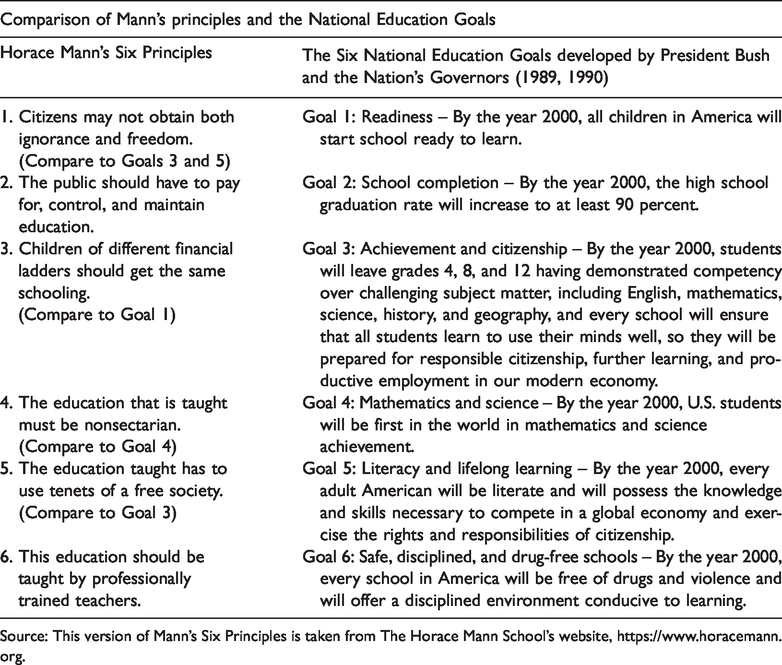
Source: This version of Mann's Six Principles is taken from The Horace Mann School's website, https://www.horacemann.org.
Putting these side by side, we see two very different paradigms in operation.
According to Mann’s first principle, getting rid of ignorance is a necessary condition for a free society. This is secondary in the six goals: citizen responsibilities are mentioned but only as part of lists that place emphasis on economics; freedom is not. Citizenship is being redefined primarily as economic capability. While goals 3 and 5 mention citizenship, it is linked with achievement, and the connection between student knowledge and “responsible citizenship” is linked with “productive employment” and the “skills necessary to compete in a global economy.”
In the greater context, civic matters are largely subsumed under economic headings. Public control is highlighted in Mann’s second principle, but it is not mentioned in the goals; one might argue that it is assumed, but the possibility of private control is left open and the program as a whole advocates less public control of the schools. The different ‘financial ladders' of Mann’s third principal are overlooked, perhaps deliberately, in the goals, which call for all children to ‘start school ready to learn,' without specifying any measures to achieve this goal or how we might proceed when students who are not ready do arrive at the school door.
Also overlooked is the question of non-sectarian education; again, the context of the program in which the goals unfolded was not non-sectarian but meant to be friendly to religious schools by encouraging a parent’s right to choose such schools. As for Mann's fifth principle, its emphasis on “tenets of a free society” seems just to be given lip service in the goals, which, instead of civics, spotlight “challenging subject matter” and set as a goal that “U.S. students will be first in the world in mathematics and science achievement.” 23 Finally, the goals make no mention of teaching or teaching quality; more significantly, they do not talk about having a teaching profession that will be sufficiently well-paid to attract good teachers. 24
What is striking about the six goals is how Pollyannish they seem, underestimating the obstacles that need to be overcome. The very ambitious second goal—that the high school graduation rate will increase to at least 90%—stands out not because of its ambition but because, unlike the other five, it does not call for all students to excel.
One notes the words “all” and “every” are used repeatedly. Goal 1: “all children” will be ready for school; goal 3: “every school will ensure that all students learn” and be prepared for productive employment; goal 4 does not use the word “all,” and instead it says the US will be “first” in math and science; goal 5: “every adult American will be literate and [be able] to compete” successfully against international competition; goal 6: “every school in America will be free of drugs and [have] a disciplined environment” so students will learn.
There would be similar language in NCLB, which stated that 100% of all students would be proficient in all tested subjects by the year 2014. There would be no exceptions, not for minority students, not for English language learners (ELL), not for students with disabilities, not for anyone.
NCLB was either a not-well-thought-out piece of legislation or one so cunningly engineered that it managed to proclaim one agenda—improving public education—while stealthily advancing another—providing evidence of public education’s failures whether they were actual or not. NCLB required that each state develop a set of assessment tests and identify a rate of adequate yearly progress (AYP) towards full proficiency by 2014. This would be applied to each school, and if a school did not meet AYP, it would face sanctions: first, it could be labeled a ‘failing school' (the label was later changed to ‘school needing improvement'); then, after a few years, substantive corrective action could be taken—new administration, restructuring or even a takeover of the school. This seems reasonable on its surface, but there was a catch: a school needed to meet AYP not only overall, not merely show a rise in total scores, “but also progress in the scores of [all] subgroups of students including minority students, English language learners (ELL) and students with disabilities. ‘The result is that the lowest-performing subgroup will ultimately determine the proficiency of a school, district or state’” (National Science Foundation, 2008). 25
In other words, the NCLB rating system was set up so that nearly no school, let alone a district or an entire state, could meet its standards. A Science magazine study, which analyzed testing state assessment data from more than 4900 California elementary schools and employed three different mathematical models to make projections of future proficiency scores, concluded that nearly 100% of California elementary schools would fail to meet AYP by 2014.
So, one problem was that the standards were not realistic—something you did not need a study to tell you, since it set the highest bar there is: 100%. In addition, it required this not of the school as a whole but of every sub-group. Not only that, but even if these schools had changing student bodies—for instance, new immigrant populations, a change due to redrawing of district boundaries or the presence of an alternative school—no allowances were made for that. Nor did NCLB note that “year-to-year changes in school-level test scores are very volatile, far too unreliable to be the sole basis for the high-stakes decisions” or that the “gap between the funding needed to ensure substantial improvement and the test score requirements can only set schools up for failure” (FairTest, 2007).
Again, it was either really badly crafted legislation in having processes that would undermine its eventual goals
26
or among the most craftily designed pieces of legislation one can think of, presenting two goals almost everyone agrees on—improving public education and reaching every group of students—and setting them up in oppostion to one another to end up with a process whereby the public system as a whole and individual schools would all be found wanting. One need not be so blunt, but if one assumes good intentions,
27
then, according to Linda Darling-Hammond, the once odds-on favorite to be Secretary of Education in the Obama Administration,
28
the nature of the assessments [leads one] to develop an Alice in Wonderland world in which the practices become sort of surreal because you’re being asked to respond to a nonsensical sort of intention … bizarre circumstances and negative consequences [point to] the deep irony of a law entitled No Child Left Behind (Hirsch, 2007).
Shifting paradigms—Order of change and their causes
All of the above points to a paradigm shift in education. Of course, I am not saying that the paradigm shift was straight from Horace Mann to Goals 2000—the common school era ended somewhere around 1900 and the ensuing years brought about profound change and enormous expansion, especially at the secondary- and higher-education levels.
This is depicted in Herbert M. Kliebard’s The Struggle for the American Curriculum, 1893–1958, in which he identifies four types of curricula that have vied for dominance in US schools: (a) social efficiency, which urges that schools be oriented to economic needs and training of the work force; (b) humanism, or the liberal arts tradition, which emphasizes general intellectual skills and familiarity with the cultural traditions of society and understanding of other cultures; (c) social meliorism, which sees the schools as an instrument for social, political and economic change; and (d) developmentalism, which starts with the psychological development of the learner and the needs of the individual learner.
Kliebard argued that changing political and economic conditions, such as urbanization, industrialization, war, depression and technological change, were reflected in the dominance of one type of curriculum over another. Similarly, Joel Spring (1998), linking it to global changes in the economy, says the curriculum is a battleground in education. Since 1983, the ‘social-economic efficiency' model seems to have been predominate. This is in sharp contrast to Guttmann’s approach and Horace Mann’s, as well.
Mann’s six principles grow out of the problems that Mann believed public schooling faced, often due to bad legislation. These problems are listed by Hinsdale (1898: 115–116):
The whole State needed to be thoroughly aroused to the importance and value of public instruction. The public schools needed to be democratized; that is, the time had more than come when they should be restored to the people of the State, high as well as low, in the good old sense of the name. The public necessities demanded an expansion of public education in respect to kinds of schools and range of instruction. The legal school organization and machinery, as existing, were not in harmony with the new social conditions. Moreover, current methods of administration were loose and unbusinesslike. The available school funds were quite insufficient for maintaining good schools, and called loudly for augmentation. The schools were, to a great extent, antiquated and outgrown in respect to the quantity and quality of the instruction that they furnished, as well as in methods of teaching, management, discipline, and supervision.
Thus, we turn finally to the third source of authority, professional educators, where we see something a bit different from the other two. School-choice programs changed the trajectory of parental authority, shifting it from a concern with the social and political system as a whole (how to create the one best educational system) to a less politically active role in which the parent serves as the proxy consumer for their children, selecting from a menu of options. This happened at the same time as the school became less important as a lynchpin of community and the role of the schools in international economic competition (and in supposedly preparing children to be able to find a place in the global economic system) became the main object of the schools.
The methodology of the schools also changed with the advent of massive and compulsory testing, the idea that schools should not only use the data from the scoring of these tests—the metric which we use as a proxy for achievement—but use the data extensively, that the schools be data-driven. Teachers, as a result, rather than relying on accumulated experience, their intuition and their knowledge of child development, are expected to adhere to a program based on improving test scores. Pushed aside are not only intuition but approaches that take into account a child’s history, such as trauma-sensitive schools and other trauma-informed paradigms. 30
In many ways, with their emphasis on reducing pressure and anxiety, the affect-oriented programs ran directly counter to the standards movement. Whatever their merits, high-stakes exams increase pressure and put demands on students. But, as has almost always been the case in US education, testing won out.
The standards movement was interesting in that it has two components: the standards that frame curriculum and the tests that measure performance and seek compliance. The problem is not with the standards in theory, but they are not perfect and there are elements, such as the focus on non-fiction as opposed to fiction in the English language arts curriculum, with which one might vehemently argue. What students read non-fiction plays a special role. It in other subject areas, such as social studies and science, but fiction is almost exclusively the domain of English.
Understanding others through fiction has traditionally been the way to build up sympathy and scrupples. Take George Eliot, for instance, who believed that sympathy lies near the heart of moral life … true acts of sympathy that involve a difficult psychic negotiation between self and other… . sympathy depends absolutely upon a division in the psyche, a split in consciousness that permits two conflicting views to exist simultaneously. This mental division is the material of conscience (Ermarth, 1985: 23).
So if one wants to cultivate sympathy, or its more emotional cousin, empathy, then it seems reading literary fiction (as opposed to popular or genre fiction, which tends to have less complex characters) increases levels of empathy and understanding (see Beam, 2018: 64–67). But that has not been enough to prevent its erosion in the curriculum, and one reason seems to be corporate pressure insisting that students be able to read non-fiction at a higher level.
Having pushed down on the balloon in one place, it pops up in another, as now there are corporate training programs meant to increase ‘empathy skills.' Corporate empathy efforts have become popular because the relationship between empathy and employee-performance outcomes have been documented, compassion-focused culture may see boosts in engagement, performance and retention and human resources professionals want to measure empathy in order to show real business value (Taylor, 2017). The result is that instead of the humanities-based approach of shared experience and sympathy through exposure to the same literature, instead of the common unifying katharsis that the audience of the Greek drama underwent, we have empathy-training workshops that teach listening skills and are “ideally suited for people who want to learn to better interact with customers, patients, or clients” (Paul, 2012). We have efforts to combat insensitive manners when communicating with co-workers or intolerance for other methods of working.
It is not that there is anything wrong with this—we could all improve our human-interaction skills—but it is all surface level stuff: it has no depth. Yet, the study of literature that does probe the depths of the human psyche is diminished and de-emphasized.
‘Enterprise Culture' – Assessing Standards as to their Alignment with Popular Modes of Hegemony
Nonetheless, despite both major and minor faults, it is not the standards themselves but their links to tests that are the central element. 31 These tests narrow curriculum and reduce the effort to shape citizens to the desire to create hyper-functional economic individuals who can survive in even the worst economic maelstrom.
In other work, I talk about this as an “assimilationist mode” of hegemony. I cannot unpack that all in a moment, but in brief, the assimilationist mode is contrasted to the integrationist mode, with the two classic models coming from the late 1800s—the free-market, immigration model in the US that propounded laissez-faire (and had more than a few tints of social Darwinism) and Bismark’s controlled-market, anti-emigration model that laid the grounds for the social-welfare state. One way of getting a grasp on the assimilationist mode is by talking of a general “enterprise form” applicable to all “forms of conduct and [which] constitutes the distinguishing mark of the style of government” (Burchell, 1996, cited in Peters, 2001). This, in turn, is the backbone of an “enterprise culture,” which then calls for the individual “to make the transition from dependent, passive welfare consumer to an entrepreneurial self” (Burchell, 1996, cited in Peters, 2001). We see the clearest example in Mitt Romney’s 2012 fundraising speech in which the GOP nominee said that 47 percent of US voters “believe they are victims” entitled to government support and that my job is not to worry about those people… . I’ll never convince them they should take personal responsibility and care for their lives (Grier, 2012). Didn’t need no welfare state, Everybody pulled his weight. Gee our old LaSalle ran great Those Were the Days
We see in both Romney’s remark and the song that the enterprise culture is paired with a distrust of the state—a negative state position that seeks to reduce if not eliminate state enterprise, except in so much as it might be outsourced to private enterprise.
As a result, in education, it leads to a direct onslaught on the autonomy of professional educators, at least if they are employed by the state. Delving into this involves a fair amount of theory, and as the theoretical framework for a heuristic case study on education reform, I draw on both Peter Hall’s (1993: 275–296) exposition of social learning and Antonio Gramsci’s conceptualization of hegemony. 2
This is in an effort to connect neo-liberal ideology to new modes of institutionalization, and it starts from Hall’s idea that social learning involves three orders of change:
(a) 1st order change—the refinement of agreed upon methods;
(b) 2nd order change—the choice of methods to achieve goals;
(c) 3rd order change—the selection of goals.
Hall’s case—the switch from Keynesianism to Monetarism under Thatcher—is interesting because it did not begin within the state bureaucracy, the focus of many previous treatments of social learning, but in public debates that were given a final imprimatur through a process of national electoral contestation. Only then did the Thatcher government move to implement and consolidate the paradigm they had previously adopted.
Whether any of this should actually be called ‘social learning' is arguable. Indeed, it can be argued otherwise that the use of the phrase “social learning” in the tradition on which Hall draws would better be termed “policy learning” or “institutional learning”. Moreover, whether societies actually ‘learn' is also questionable—they change and adopt new methods, but ‘learning' suggests a gaining of wisdom over time that might be absent.
Undeniably societies change, but whether those changes are for the greater social good or they are initiated by interested parties that seek to advance their particularistic interests, under cover of a crusade to remake society in a new and better image, is an open question. Nevertheless, I use Hall’s terminology because it suggests an historical sweep that I find helpful and because he is, at least implicitly, looking to chronicle a punctuated equilibrium that one can argue is a necessary ingredient in interpreting significant changes in policy paradigms.
On the other hand, the case of how paradigms shifted as education reform gathered steam in the US is, even if closely related, quite different from the rejection of the social welfare state in the UK under Thatcher. Thus, I make some additions:
In a diffuse institutional structure, 3rd order change can be and often is achieved outside of state bureaucracies and without any direct national electoral contest. That is not to say that education is never an issue in elections – local and statewide contests play crucial roles. But that does not take away for the point – as the examples of standards-based reform (which morphed into the Common Core) and charter schools show, 3rd order change can be constituted by incremental means spread over many different institutions.
Thus, 3rd order change can be achieved over time by incremental means, but that is much more likely to happen if something else happens:
4th order change – the justification of goals by reference to principles, values, ideologies and visions of the future, utopian to dystopian.
The discussion of 4th order change segues into discussions of hegemony. The parallel development of investor-led capitalism (based on an exchange-value paradigm) and the decay of social-welfare models (invoking a labor-value paradigm) are the context in which this all unfolds. And then there is the leading institutional factor, one that is so obvious that it often goes unnoticed: we have an integrated system of production, exchange and accumulation that, on the global level, is subject to no state authority. This is taken for granted and treated as the natural order of things, even in education.
As you notice, I hesitate to say that diffuse 3rd order change requires 4th order change, only that it usually is accompanied and supported by 4th order change and is more likely to happen during periods of 4th order change. would argue that the 1930s and the 1970s both marked the beginnings of such periods. One can attribute each case to different causes: instability in the world system in the 1930s resulted in an inward-looking nationalism; changes in technology in the 1970s, especially when it comes to financial transfers and the development of linked money-center banks, resulted in a globally informed perspective. This changed the societal balance of power between investors and those who relied on work for their sustenance.
This further allowed labor from the 1930s to 1950s to react against the vagaries and uncertainty of the market both by calling for limits on market extremes and by the establishment of social-welfare protections. In addition, the US private sector played a large role by providing health insurance and pension benefits to their employers, and large employers, such as the Big Three auto makers, were involved in a type of corporate interest-intermediation with large unions. In the 1970s, certain threads began to unravel, and eventually, investor entities, who benefited least from such ‘embedding' institutions, sought to overturn that institutional order (for an insightful account of how the changes of these “embedding” institutions were in part enabled by a shift in accepted economic ideas, see Blyth, 2002). They were able to attack them from the inside of the firm (by attacking legacy costs and many times plundering pension funds), attacking organized labor on multiple fronts and creating political coalitions that would undo previously agreed-upon limits on market mechanisms.
Narratives of Dedication as both an Example of Hegemonic Change and an Illustration of Underlying Causes
I refer to this as a hegemonic change. I also hesitate at times to call hegemony 4th order change, but at other times I don’t hesitate at all. They are related, but hegemony is a larger term—it must include 4th order change if it is going to be successful in the long run, but 4th order change is an end product of an active, strategic process. Clearly, I could be clearer, but I don’t want to find ourselves at the cul de sac of clarity at the expense of provoking thought and exploration.
Examples are often called the best explanations for just this reason and one example of the diffuse institutional interconnections is the Common Core, specifically its effect on teacher autonomy. It is a change of pedagogy through statute and state action, not through teacher training or control of the profession by practitioners. State laws (and federal leveraged aid programs) insist that students be tested, that there be a link between the Common Core and the tests. Moreover, state laws insist that teachers be evaluated, at least in part, on the test scores of their students.
This is not the only way to do this; you could do this by training teachers to effectively implement the common core and, over time, build up a professional class of teachers. That also means giving autonomy to teachers, for a profession is, by definition, self-regulated. But that would then mean more money goes to salaries and less goes to huge educational conglomerates. That is a blunt assessment, but it seems true, nonetheless. Also, authoritarian tendencies often result in administrators, who are also evaluated—at least in part—on the test scores of their students, starting to produce unit plans (or downloading them from large educational conglomerates on contract with the state or district) that teachers have to follow instead of developing their own.
Combine this with charters and alternative certification programs that allow for uncertified teachers to go to the front of the class and you have a great policy for paying teachers less and sending more money to education companies. 33
The last would be one way to answer the question, ‘What is the goal of neo-liberal reforms in education?’ In keeping with this, Pasi Sahlberg, former Director General of CIMO (of the Ministry of Education and Culture) in Helsinki, uses the acronym GERM for the Global Education Reform Movement. The emphasis on market-based competition and high-stakes-testing policies is a strategy that makes room for profit in keeping with an investor-oriented paradigm. The narratives of dedication point to individual teachers and thus, ironically, I suppose, articulate the problem in a way that targets teachers.
I am going to illustrate this with two pie charts. The pie chart in Figure 1 depicts an estimate of traditional allocation of salaries (blue) as opposed to other costs (red). The pie chart in Figure 2 depicts a speculative estimate of the allocation of salaries in the future (blue) as opposed to other costs (red), with addition of testing and monitoring (yellow).
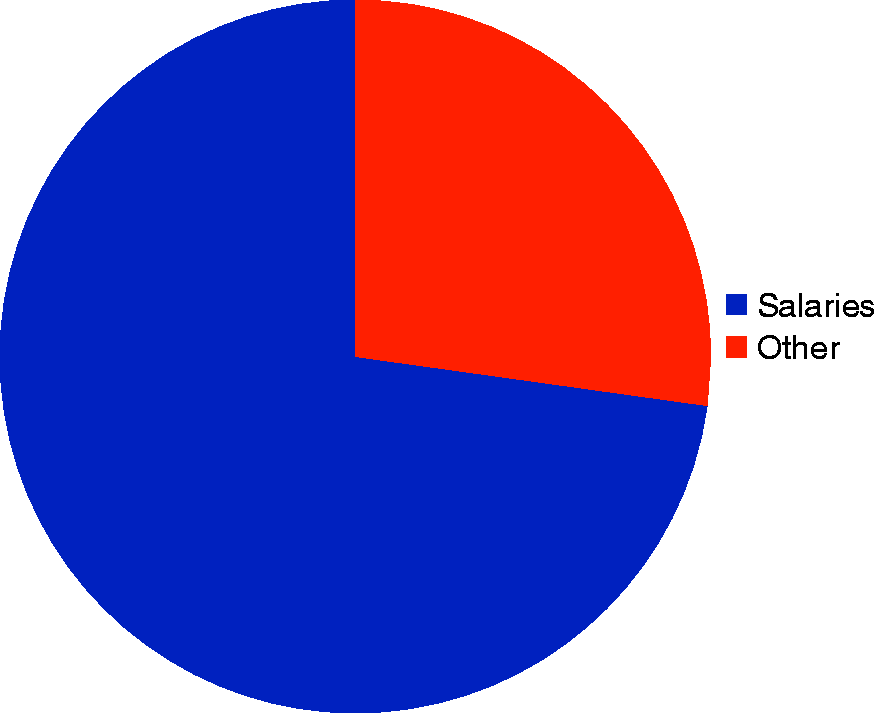
Traditional distribution of educational expenses (Pie Chart 1).
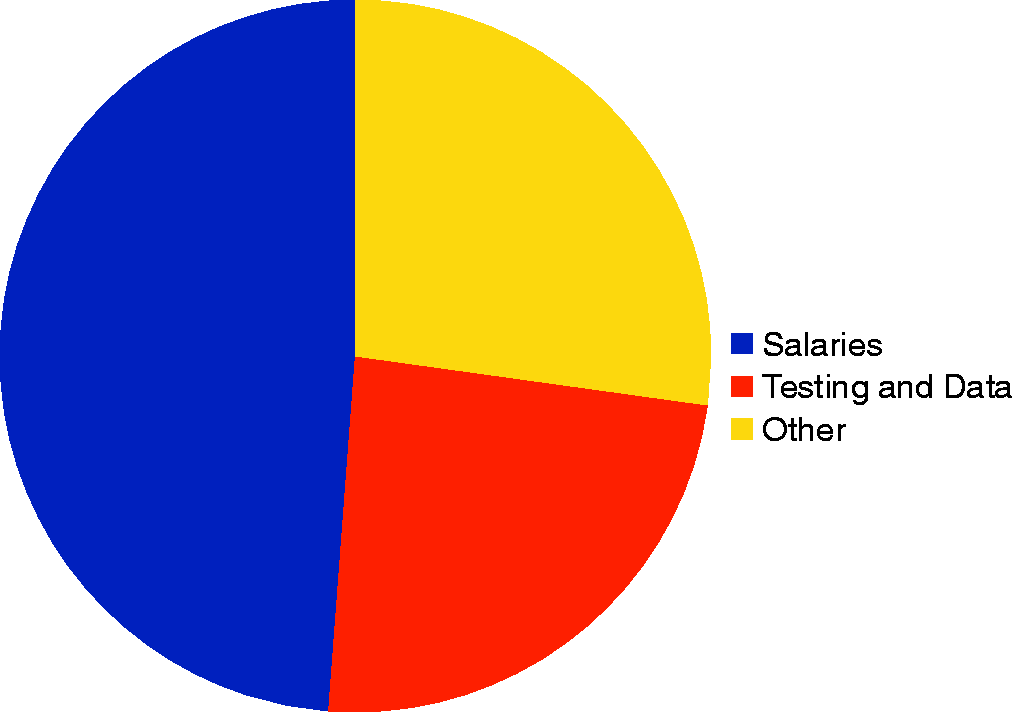
Speculative distribution of educational expenses (Pie Chart 2).
I think this is a good illustration, but I have to make a confession. While the first chart is based on long-term data indicating that roughly 70% of total education costs are devoted to salaries, the second chart is just a guess—there is no great hidden data set on which I am drawing. The guess is that one goal of neo-liberal reforms in education is to allow outsider vendors a larger share of the piee. To do this, salaries or other costs would need to be decreased.
Then, is it a gross oversimplification? Perhaps, but simplification or not, I doubt it is grossly inaccurate. As noted elsewhere, educational companies, such as Pearson and Wireless Generation, have obtained huge contracts, and venture capitalist money went up 30-fold from 2005 to 2013.
I am going to jump ahead a bit and offer a proposition: reliance on the market will subvert the purposes of public education. I won’t present all the evidence here—it is not a proposition that can be proven. But evidence there is. First, there is the use of standardized tests from the private sector with all their costs. Second, there has been a narrowing of the curriculum; the emphasis on achievement as measured by tests means that art and music, as well as physical education, are often left behind. Language and math crowd out art, civics, music and poetry. Third, the focus on international competition indicates that one purpose might be to produce a new “modern individual” who is hyper-functionalist—individualist, acquisitive, economically minded—and thus more likely to win such a competition.
Revising the Conceit: Contemporary-education Reform at Odds with Gutmann on Autonomy, Authority and Rational Deliberation
Let’s then return to the suggestion that, at least as a conceit, contemporary advocates of this brand of education reform are nearly systematic in their rejection of Gutmann’s conclusions. How they answer the question, “Where to locate autonomy?” is one example, for it is closely aligned with the question of who is invested with authority. But there are others, ranging from encouraging critical thinking to maintaining a principle of non-exclusion to disallowing repression of arguments.
In all of these aspects, contemporary-education reform finds itself at odds with Gutmann. Her assertion that “[c]hildren must learn not just to behave in accordance with authority, but to think critically about authority if they are to live up to the democratic ideal of sharing political sovereignty as citizens” (1987: 51) is often cited as an indication of a bias on her part, while her argument that “all educable children [need to] learn enough to participate effectively in the democratic process” gets even worse treatment (1987: 170). The former is discussed below, but the latter—the ability to participate in and make judgments about politics—is hardly considered anymore in current mainstream discussions seeking to establish the goals of public education. Instead, the focus is on the child as a future economic actor in competition with other economic actors, both at home and abroad.
So, politics is sidestepped. Certainly no one seems to take the stance of H. L. Mencken: The most dangerous man to any government is the man who is able to think things out for himself, without regard to the prevailing superstitions and taboos.
The bias argument, however, is neither unsophisticated nor without merit. It raises serious questions as to the viability of Gutmann’s project—or any project based on tolerance, understanding and rational deliberation. Can we come up with a set of criteria by which to judge whether we have achieved this goal? It is important enough that we might digress there for a bit in the hope that the arguments on both sides will serve an explanatory purpose.
While one can assert that we should hold such values, one is hard pressed to say why they should trump other values. Arguments worthy of note include, for instance, that Gutmann is biased in favor of a “value-neutral liberalism” that is “precisely the sort of comprehensive worldview,” which Gutmann herself has attempted “to circumvent by refusing to pass judgment on different ways of life” or, to move to another example, that she employs a “value-laden conception of autonomy” in contending that schools emphasize the transmission of “those civic values—tolerance, mutual respect, and egalitarianism—necessary for continued deliberation.” (Konganzon, 2012).
Koganzon, quoted above, is particularly interested in two court cases. The first (Wisconsin v. Yoder, 406 US 205, 1972) involved Amish parents who wanted to remove children from the school at the age of 14. The second (Mozert v. Hawkins County Public Schools, 827 F. 2d 1058, 6th Cir. 1987) involved Christian fundamentalist parents who may very well have had “a legitimate grievance in complaining that a school curriculum of neutral exposure belittled their religious values by treating them as subjective preferences, in essence espousing a worldview that eschews all comprehensive world views” (Stolzenberg, 1993, cited in Koganzon, 2012). All comprehensive world views, that is, except for that of value-neutrality, which might not be neutral at all in practice. This is hardly an insubstantial argument, and Koganzon asks a question to which there is no ready answer and thus suggests the difficulty, if not impossibility, of realizing Gutman’s project: “to what extent should intolerance be tolerated and how can a commitment to pluralism and a unified civic culture be reconciled?” (Koganzon, 2012).
Nonetheless, the lack of attention to Gutmann’s underlying goals may be more telling than the fine legalisms and attentive logic that Koganzon offers. Speaking much more generally, Larry Cuban (2004: 239) puts it much more strongly: “Even more damning are the questions that have been omitted from the current economic and political agendas shaped by business-inspired reformers,” and then lists three unanswered questions.
Cuban's three questions remain “unasked by business-inspired reform [and] go unanswered today” (2004: 239). First, do “schools geared toward preparing workers also build literate, active, and morally sensitive citizens who carry out their civic duties?” (2004: 239). Second, if it is possible at all, how “can schools develop independently thinking citizens who earn their living in corporate workplaces?” (2004: 239). Third, when “unemployment increases, and graduates have little money to secure higher education or find a job matched to their skills, will public schools, now an arm of the economy, get blamed—as they have in the past—for creating the mismatch?” (2004: 239). The first two overlap considerably with the discussion below. Returning to our main subject, however, among the issues omitted from the current economic and political agendas, we can include Gutmann’s major principles, those of non-discrimination and non-repression.
Gutmann’s principles of non-discrimination and non-exclusion are sometimes given lip service, but the ways they are used—to buoy ‘high performing charter schools' or programs to revamp teacher evaluation—are hardly consistent with providing high-quality education for everyone or improving the quality of teaching (I realize this is an argument that still needs to be made more fully, but it is not a difficult one to make). Non-discrimination states all educable children must be educated, not, as often is the case with private schools and charters, that some less affluent children will be selected out to go to better schools. The related principle of non-exclusion means that no one may be excluded from being educated so as to have the tools for participating in our democracy. But the tools that pay for performance systems, that are likely to develop would be much narrower than that. In most current debates, non-discrimination and non-exclusion are not imperatives but platitudes.
As for non-repression, this is sometimes treated as liberal nonsense. The principle of non-repression calls for open debate; it does not allow for curtailing rational deliberations on or competing conceptions of either “the good life” or “the good society.” Although the question of what to do with groups that do not show tolerance and respect is problematic, tolerance and respect for the viewpoints of others is the point—perhaps quite literally the starting point of a liberal society. No one group or alliance of groups can enforce its view of what is good in life. This principle seems to get the shabbiest treatment, for it seems to be shunted aside, the assumption being that everything will take care of itself over time. Our competitive market-based system will do this, somehow.
Thus, either through operational definitions of equal opportunity—such as that opportunity for a few of the deserving poor in special programs, 34 magnet schools or high performing charter schools will suffice—or the unwillingness to recognize that there is a problem (lack of tolerance for opposing views), we see that current debates skirt around the problems of democratic education that Gutmann raises. Current debates are goal-oriented, the main goal being economic success for the individual, the nation and, one might guess, more than a few well-connected companies and individuals. This is, of course, at most a conceit, so one can find exceptions, but the idea that Gutmann has been consistently contradicted and ignored gains in credibility when we consider her first priority: not to resolve “the problems plaguing our educational institutions” but to establish a set of methods “that are compatible with a commitment to democratic values” (Gutmann, 1987: 11).
We can finish with autonomy, which Gutmann would grant to teachers so that they may “exercise intellectual independence in their classrooms,” which is a necessary precondition if one wishes to “teach students to be intellectually independent” (Gutmann, 1987: 80). This, however, is simply not very often the case when reforms espouse business models. Ownership justifies norms of business authoritarianism, such as the ability to hire and fire at will, which are not part of the democratic canon. There are indirect effects that promote not autonomy in the classroom but a top-down model in which intellectual freedom is curtailed. The principal not only feels justified in adopting autocratic norms, but almost feels compelled to do so.
Ironically or directly, a robust anti-democratic movement has grown up in the decades since Democratic Education (1987) was published. Autocratic norms and the assumptions on which they are based have been heavily influenced by Chubb and Moe. In the early 1990s, the two made a seminal call for principal autonomy. Their Politics, Markets and America’s Schools (Chubb and Moe, 1990: 564) presents a market-based system of school choice as a pathway to excellence, because it would shift “responsibility to parents [and] their choices would have consequences” for the quality of education. They were (and presumably still are) also explicitly against democratic control of schools and advocate, above all, giving managers autonomy. 35
But there is also an interesting contradiction here, one that, considering this happened shortly after the collapse of the Soviet bloc, is even more richly ironic. While in many ways, granting autonomy is proposed as an alternative to a command economy model—which old public school systems supposedly resemble, in promoting autonomy for managers as opposed to teachers, something is lost that both the free market and democratic institutions value: the knowledge, expertise and judgment of the individual.
John Gray, in discussing Miser and Hayek, claims that the problem with planned economies is that they do not take advantage of the information possessed by individuals. In other words, a plan thinks of the individuals implementing it as mere executors of the plan. However, this underestimates them; for instance, they can adjust for specific conditions that the planner could never anticipate (Gray, 1995: 66–76). More generally, they may have knowledge that would have the planners question the wisdom of their plan. In sum, they can use their knowledge and information, which otherwise is underutilized or lost completely. In the terminology of investment, this knowledge does not provide any return.
As a teacher who has been subject to what seem to be many flavor-of-the-month edicts delivered by administrators, I hesitate to begin with examples because I don’t know when I would stop. However, I’ll note one thing: for Gray, he is looking at operations in a market and, whatever your positions on the market, the decision as to what is deemed good or bad is not made by the same people who made the plan, it is arrived at by assessing market measures. In contrast, the use of proxy measures in education results in a tendency to mold those measures in such a way as to confirm the wisdom of the planners. Arguments about what is successful are settled only through the tortured labors of assigning values that are not independently arrived at but are part of the plan from the beginning. As with any experiment, this can work, but it is hardly guaranteed to work.
All of this—business influence, the call for autonomy, the privatization of elements of the system, the call to model public education on the private sector—came to predominate the educational discourse in large measures only after Gutmann wrote. Nevertheless, if there is a deficiency in her work, it stems from underestimating both the power of the business-side argument and the difficulties of creating a system that (a) incorporates all three models on which she elaborates in her thought experiments and (b) is not overrun by private interests, especially in the form of business-oriented ideologies of change. What she underestimates is that business is in competition with the democratic state of education; while the latter attempts to balance the power of the state, parents, and educators (Gutmann, 1987: 42), the former redirects these sources of authority so as to redirect and siphon off their power.
Of course, hers was foremost a normative work telling us to what we should aspire and thus, perhaps, making its eventual appearance—or at least the appearance of some better system—more likely. Still, it might be all for naught. After all, if one takes this article's conceit seriously, Gutmann may have helped plot the strategies of contemporary education reform and made her democratic vision less likely. Moreover, whatever benefits might result in terms of civic virtue and future choice, the practical difficulties are so enormous that they threaten to rend her argument moot.
The Democratic State of Education under Capitalism: Assimilationist and Integrativist Modes
The greatest of these practical difficulties is encapsulated in the following argument: we are not merely part of a democratic state or a system of representative democracy but a democratic, and decidedly capitalist, state. The dangers capital poses for democracy are hardly a new topic—differences on this issue provide a summary explanation of the different positions Federalists and Democratic-Republicans took in preparing for the election of 1800. As for who won, not just in 1800, but during the 1800's, we probably need look no farther than our wallets. I mean that literally—most of us probably have Hamilton’s likeness in our bill fold, while Jefferson has been relegated to the lonely two-dollar bill, which, if we use at all, is mailed in birthday cards. We can add an interesting factual tidbit that I have been told is true, but might not be and which I have not been able to confirm—when NYU established its ‘American Hall of Fame' in the early 1900's, Hamilton was first on their list, in front of not only Jefferson but also Franklin, Washington and Lincoln.
While representation and democracy may provide the form of the state, capitalism is the source of the greater part of its content. While there are exceptions, the function of the school is shaped to great degree by the perceived needs of capital. That major school-reform movements correspond to struggles in capitalist relations is especially true of the demands business has for labor (Bowles and Gintis, 1976: 234–235). When this perspective dominates, schooling is seen in terms of refining the labor supply and children are conceptualized not as future citizens but as potential workers (DeYoung, 1989).
An extreme version of this argument is found in Socialist and Marxist perspectives; these view schools as having as their primary role the production of wage-labor for capitalistic exploitation. But you don’t have to be a Marxist to believe that reform is a facade hiding other motives—you just might think that people are greedy. Or you might accept a mixed view that sees the state as an arena in which pitched battles are waged (without end or with definitive resolution) between those forces seeking truly democratic reforms and pushing for greater egalitarianism and those engaging in the democratic process so that they might annex the resources of the state for reasons of private capital accumulation (see Carnoy and Levin, 1985). In the first view, the state and education authorities are little more than functionaries doing the bidding of economic actors. But even in the latter view, the presence of political forces that draw their strength from the market system create huge challenges to establishing a system in which there is a balance between the goals of educating for the sake of the community, respecting parent’s wishes and giving students, as they become adults, great latitude in choosing their own version of the good life.
It also creates a challenge for democracy itself. One of Gutmann’s reviewers claimed the book’s central theme was “how to produce true republican citizens – citizens who possess both the ability and the motivation to participate in their deliberative political communities,” the dual paradox being that the “democratic context … imposes limits on how educational decisions are made” and that, in the reciprocal relationship between education and democracy, educational decisions made in previous generations determine to a large degree how decisions are made and who makes decisions in a democratic polity (Sherry, 1988: 1229; see also Levinson, 2009: 1239).
To a great extent, I depend on Herbert Kliebard to make sense of this. He argued that there are four major social agendas in education, each linked with a coalition of interest and ideational groups. Since the 1980s, the “humanist,” the “social reconstructionist,” and the child “developmentalist” philosophies Kliebard demarcated seem to have fallen by the wayside, leaving ascendant a “social efficiency” group, the approach of which centers on preparing children for adult roles.
While this last category is something to be expanded upon at a later date, at least we can make a preliminary step to the extent of breaking down the notion of “social efficiency” into what seem to me to be two elements that point in different directions: “cost efficiency” and “social efficacy.” This is a distinction that Weber (1968: 26–66) makes and Ralf Dahrendorf (1968) expands upon—that there are two types of economic logics: one is in using inputs to their best effect (literally “to economize”) and the other is to ensure that sufficient means are used to effect an end. 36 Both are legitimate ways of thinking but it is a matter of judgment as to how to balance and combine the two.
As a consequence, there is no definitive way to resolve disagreements over these issues. After all, no one wants resources to be wasted or used inefficiently and no one wants to not have achieved a desired goal because of insufficient outlays. Similarly, no one wants to throw good money after bad and no one wants to let things fall where they lay when there is a good chance of success.
We can thus differentiate between two models: one that focuses on inputs and one on outputs. Elsewhere, I refer these to assimilationist and integrationist models. The Anglo-American model, I term assimilationist, in that it seeks resources that will be assimilated into the system and does not worry so much about potential resources that may fallow. The continental model, I term integrativist or integrationist, in that it works to integrate national resources into a coherent whole. 37 But that is not the point here; rather, it is to point to the two logics and to say that rational individuals would use both logics—the instrumental logic of paying attention to means and the goal-oriented logic of ends.
Of course, these logics do not preclude one another—it is a matter of how you balance the two. But you have to balance them. Nonetheless, that these two criteria are available to buttress arguments means that strands of argumentation develop leaning more than one to the other. The worker-oriented paradigm seeks to protect workers from the variations and extremities of the market, instituting a social-welfare contract. The investor-led paradigm tends to react against the development of ‘embedding' institutions and the integrationist model, seeking to overturn constraints on business and establish a social contract without welfare. This is a cartoonish rendering, but it gets to the point.
That is not to say that they aren’t exceptions. Highly skilled workers who are in high demand are more than willing to work in an assimilationist system—they will benefit from the dynamics of supply and demand. This, in turn, means there tends to be an elite class of workers who are willing to throw themselves in with the investor-led paradigm for an anticipated share of the proceeds. Moreover, there is a second group of those who believe they are or will be in that class of highly skilled workers and, whether it is true or not, they don’t believe that they really need worker protections. To the extent that this group sees unions and worker protections as sapping the nation’s economic vitality, they are important politically, to the extent that their beliefs are mistaken, and they can be taken as an example of successful hegemony. Then there are small-scale entrepreneurs, ranging from some participants in the gig economy to small businesses, who now have a position they want to protect and worry about levels of taxation. Of course, they also might worry about having health insurance or rising commercial rents, so they often have a mixed position.
On the other side, there are enough businesses that rely on government expenditures that they are not in favor of shrinking government expenditures. This group includes military contractors and I am reminded of my favorite quote from Schumpeter: “No bourgeoisie ever disliked war profits.” One would think they also feel that way about school profits. (Schooling is big business, after all, worth well over two trillion US dollars world-wide). But there are other business beneficiaries, such as industries protected from competition by tariffs or non-tariff trade barriers and large financial concerns, that benefit from government regulation because they have enough resources to figure them all out when smaller entities do not. In education, which at the K-12 level is largely publicly funded, there are hordes of vendors seeking contracts.
One could go on and on in this vein; still there is a basic split between those who are investors and those who rely on their labor. This makes for a further distinction between those who worry about their wealth being taxed and those who seek government protection, whether in embedded institutions or in more overt actions, such as incomes policies. In the former, cost efficiency of government is the lead argument; in the latter, it is the government’s role in leading to social efficacy.
So how does one apply this to education?
In education, the watchwords ‘efficiency' and ‘accountability' have of late been ascendant. Combined with ‘choice,' with its reference to parental authority, and an interpretation of the national interest in which economic success is first and foremost, it coopts two of Gutmann’s three sources of authority. Add to this the ongoing attacks on teachers and what is branded “the [liberal] education establishment,” and the sum total may be the most potent force in educational discourse. But it is not just a repetition of previous eras of business influencee. While Kliebard was looking at a “social efficiency educator” who wanted to apply the standard techniques of industry and make of schooling a business, the newer advocates of efficiency glean lessons from a post-industrial age in which national borders are porous and the working and middle classes have lost political potency except in the service of demagogues. Thus, the existence of a transnational system of economic governance, centered on US hegemony, has undermined what has been perhaps the US’s greatest contribution to the modern world: its system of universal public education.
How much of an overstatement would it be, however, great or slight, to say that the normative content of education is no longer democratic but almost single-mindedly economic? This can be expressed as follows: the United States is failing its youth because a poor education system is denying them the opportunity to be economically competitive. One should not underestimate the power of this argument. Its influence stems from a widespread dissatisfaction with American public schools, which, whether deserved or not, became accepted as common knowledge and resulted in wave after wave of reform movements for educational change.
Part of this is due to money—the promise of making profits, the ability to influence media outlets and the funding of campaigns. In the US system, there is a synergetic relationship between private wealth and how discourse proceeds; there is also a synergetic relationship between private wealth and those involved in what has become a perpetual cycle of seeking election and reelection, with the former financing the latter. This seems inevitable on both counts, but it exists in the second instance only because our system of indirect representation (a first-past-the-post system in which those who fail to win a plurality have little or no voice) is combined with a broad interpretation of the first amendment, that falls somewhere between Jefferson—“Our liberty depends on freedom of the press, and that cannot be limited without being lost” ([1786] Lipscomb and Burgh, 1903: ii)—and maybe H.L. Mencken (1922)—“If you want freedom of the press, then go out and buy one.” 38
With that, I’ll stop, only to note that this argument goes on, both in my own writing and in other venues.
Footnotes
Declaration of conflicting interests
The author(s) declared no potential conflicts of interest with respect to the research, authorship and/or publication of this article.
Funding
The author(s) received no financial support for the research, authorship and/or publication of this article.
