




Abstract
In numerous countries, the widening participation of underrepresented groups in higher education has become an official part of education policies. However, inequalities continue in some areas, including refugees’ participation. Norway hosts many refugees, but little is known about the social inclusion of refugees into higher education in the country. In this paper, three documents representing Norwegian higher education and integration policies are analysed using an integrated analytical framework constructed from social inclusion and its three main dimensions (access, participation and empowerment) and from a critical discourse analysis. The analysis is conducted to address how social inclusion into higher education is conceptualized, which major discourses underpin the conceptualization and what implications these have for the social inclusion of refugees into higher education in Norway. The article argues that social inclusion is conceptualized from an access dimension signifying the dominance of neoliberal principles in the policy documents. On the contrary, social justice discourses are marginalized and human potential principles are absent from the documents signalling the disempowerment of refugees in relation to higher education. Future policies should incorporate conscious and clear strategies informed by social justice and empowerment principles to ensure the social inclusion of refugees into higher education.
Introduction
In numerous countries, the widening participation of underrepresented groups in higher education has become an official part of policies (Archer, 2003; Tomlinson and Basit, 2014). However, inequalities continue in particular areas including refugees’ participation in higher education (Goastellec and Välimaa, 2019), even in countries boasting egalitarian traditions (James, 2014). 1 The governments of host countries have created integration policies to facilitate the inclusion of refugees into receiving societies (Hernes, 2018). Nevertheless, refugees are often ignored and are considered less desirable in the higher education sector (Morrice, 2013).
In Norway, refugees have been considered ‘social and cultural integration’ problems and as financial burdens on the Norwegian welfare state because of their low employability (Friberg and Midtbøen, 2018: 1466). Thus, integrating refugees into Norwegian society is high up on the political agenda in Norway (Fernandes, 2015), as is the case for many Western European countries (Hernes, 2018). Employment and education are the main focus areas of the Norwegian integration policy (Fangen, 2010; WP30, 2016). Although conversations on refugees participating in the labour market are gaining momentum in the literature (Djuve and Kavli 2019; Friberg and Midtbøen, 2018), little is known about the social inclusion of refugees into higher education in Norway. With this in mind, the present article aims at filling this gap in the literature.
This article argues that the Norwegian higher education and integration policy documents are framed within the neoliberal principle of developing human capital for economic and labour market purposes which, according to the social inclusion framework of Gidley et al. (2010), is the narrowest dimension of social inclusion. Hence, the documents sideline the social justice and human potential aspects regarding the social inclusion of refugees into higher education.
The argument in the current paper is based on a critical analysis of three policy documents (white papers) by using a dialectical critical discourse analysis (CDA) approach (Fairclough, 2013) combined with a social inclusion concept explained through social inclusion’s three dimensions: access, participation, and empowerment (Gidley et al., 2010). Two of the analysed documents deal with higher education (Long-term Plan for Research and Higher Education 2015-2024 and 2019-2028) while one document deals with integration (From Reception Center to The Labour Market: An Effective Integration Policy). The latter is incorporated in the analysis because the social inclusion of refugees into higher education is ‘conditioned’ by other social policies such as the integration policy of the host country (Détourbe and Goastellec, 2018: 3). The analysis will help address three interrelated research questions: How is social inclusion into higher education conceptualized in policy documents? Which discourses are embedded in the conceptualization of social inclusion in policy documents? What implications do the conceptualization and the related discourses have for the social inclusion of refugees into higher education in Norway?
This article is organized as follows: First, it presents a brief overview of refugees in Norway followed by a review of previous studies. Then, the paper presents an integrated analytical framework that includes social inclusion and the CDA. An analysis of the policy documents, discussions and concluding remarks conclude the paper.
Refugees in Norway
The arrival of refugees from outside of Europe such as from Chile in the early 1970s led to the institutionalization of some refugee issues in Norway. However, the political discourse on integrating refugees came into the spotlight in the late 1970s partly because of new refugees coming from Vietnam (Brochmann, 2003). In recent times, the inflow of refugees from different countries such as Afghanistan, Iraq, Iran and Somalia, coupled with the expansion of the EU in 2004, has led to more diversity in ‘a largely ethnically homogenous’ Norway (Bubikova-Moan, 2017: 56). By the end of 2018, 4.4% of the Norwegian population which totals just over 5 million had a refugee background. 2 The recent refugee crisis in 2015 has led to stricter (immigration) policies that aim at fending off many potential refugees (Søholt and Aasland, 2019). At the same time, the successful integration of refugees has become ‘even more crucial’ (Hernes, 2018: 1305).
The Norwegian Government (hereafter the Government) sets policies to foster equal opportunities for the increasingly diverse population. The introduction programme that was designed to help new refugees integrate into Norwegian society is one example of these new policies (Eriksen, 2013). Nevertheless, the programme neither guarantees participation in higher education nor is it a substitute for social inclusion policy because it ceases after the first two to three years of the refugees’ residence in Norway. When compared with other immigrants, refugees in Norway are generally characterized by a weaker link to the labour market (Friberg and Midtbøen, 2018) and lower educational attainment (Steinkellner, 2017). The successful participation of refugees in (higher) education in Norway has positive impacts on the refugees’ participation in the labour market in the country (Olsen, 2019). By the end of 2016, 22.6% of refugees in Norway had a higher education degree (obtained in Norway or other countries) compared with 34.3% of the remaining population (Olsen, 2018). There is no concrete figure indicating the number of refugees in the Norwegian higher education institutions.
Previous studies on policies of social inclusion of refugees into higher education
Even though studies focusing on higher education for refugee are not a new phenomenon (Ramsay and Baker, 2019), the literature on policies dealing with refugee higher education is scarce (Goastellec, 2018). Specific policies targeting the rights of refugees to pursue higher education appear as necessary in ‘empowering’ the refugees to make higher education choices that ‘best fit their aspirations’ (Détourbe and Goastellec, 2018: 15). Nevertheless, a number of studies indicate that nontraditional students are the target groups of policies dealing with access and participation in higher education, yet these studies never specifically mention refugees (Bhopal, 2017; O’Shea et al., 2016; Pitman, 2015). One of the reasons for this is the powerlessness of refugees when it comes to influencing higher education policies (Ramsay and Baker, 2019; Tesar, 2016).
In countries traditionally known as immigrant countries such as Australia, Canada, and the United States (UN, 2017), social inclusion policies at the national or regional levels either ignore or hinder refugees’ access to and participation in higher education (Al-Haque, 2018; Gidley et al., 2010; Perry and Mallozzi, 2011). These policies overlook the social inclusion of refugees systematically by omitting the word ‘refugee’ and instead using other terms. The most common words or phrases used in the literature are nontraditional students, students from a low socio-economic status, underrepresented groups, minority groups, and disadvantaged groups (Basit, 2014; Galindo and Rodriguez, 2015). The main challenge in using these umbrella terms is the possibility of leaving out refugees or at the very least categorizing refugees, who have unique challenges, with other non-refugee groups who might have milder challenges in accessing and participating in higher education (Baker et al., 2018; Sladek and King, 2016). These countries are different from Norway in numerous ways including their language and immigration history. However, the literature on refugee higher education is useful in Norway’s context because all the countries are signatories to the 1951 Refugee Convention and/or its 1967 Protocol; and all are Organisation for Economic Co-operation and Development nations that have some common trends in their higher education strategies (Gale and Hodge, 2014).
In European countries such as Austria and Poland, there is a lack of refugee social inclusion policy at the national and at institutional levels. Higher education institutions in these countries respond spontaneously to refugees’ needs for higher education (Kontowski and Leitsberger, 2017). Quite differently, a recent study by Goastellec (2018) indicates that there are national and/or regional higher education inclusion policies in Germany, France and Switzerland. In Germany, the inclusion of refugees into higher education is framed to ‘answer the larger needs of the national employment market’ and to tackle the challenges faced by the country’s ageing demography (Goastellec, 2018: 34). In France, the national inclusion policy is embedded in ‘social responsibility’ with social justice as a driving principle for the inclusion of refugees (Goastellec, 2018: 24). In Switzerland, where both national and cantonal policies are intertwined, the main focus is on vocational education that aims at serving the labour market. The cases of Germany and Switzerland reflect the narrow dimension of social inclusion and are in line with ‘the current educational polices across the globe’, which reflects ‘the ascendancy of neoliberalism’ (Convertino et al., 2017: 136). On the other hand, the France case reflects a broader dimension of social inclusion which some researchers claim should be the goal of higher education (Lamprianou and Sunker, 2014). In Norway, many studies on inclusion have focused on pupils in the lower level schools system (Arnesen, 2017; Hilt, 2015). However, there is a recent study which has dealt mainly with the recognition process of foreign qualifications of refugees in Norway. Moreover, the study highlights practical initiatives undertaken to integrate refugees into higher education in Norway (Pietkiewicz, 2017). Nevertheless, little is known regarding the social inclusion of refugees into higher education at the national policy level and, hence, the current article will increase our understanding of this issue.
An integrated analytical framework: Social inclusion and critical discourse analysis
To address this issue, we use an analytical framework constructed from a combination of social inclusion and a dialectical CDA. This framework allows us to recontextualize the dimensions of social inclusion (access, participation and empowerment) (Gidley et al., 2010) within the semiotic aspects of the CDA (discourses, genres and lexcio-grammar) and eventually drawing out the implications for the social inclusion of refugees into higher education. In this context, Fairclough (2013: 255) states ‘We cannot take the role of discourse in social practice for granted, it has to be established through analysis.’
Social inclusion
Social inclusion is intrinsically and antithetically related to social exclusion (Atkinson, 2000), a concept that first emerged in France in the 1970s in relation to people who were excluded from the social insurance system (Gidley et al., 2010). Researchers have defined social inclusion 3 in different ways depending on the contexts of their studies. Some have seen it as the extent to which school pupils enjoy peer acceptance and participation in activities (Bossaert et al., 2013), while others have suggested that social inclusion is an attempt to ‘break down barriers that prevent full participation’ of immigrants into their new countries (Caidi and Allard, 2005: 312). In the context of higher education, Gale and Hodge (2014) recommend to go beyond the need for human capital in theorizing social inclusion because limiting the scope of social inclusion to neoliberal economics would overlook the social concerns of higher education. In light of this, we find Gidley et al.’s (2010) social inclusion concept relevant for our analysis. According to Gidley et al. (2010), social inclusion into higher education can be understood through three main dimensions: access, participation, and empowerment.
The access dimension of social inclusion, which is grounded in neoliberal ideology, primarily focuses on increasing enrolment numbers into higher education (Gidley et al., 2010); it is more about investing in human capital and ensuring the availability of (certain) skills for the sake of economic development (Gidley et al., 2010) and less about student participation or success (Basit, 2014). Neoliberalism makes individuals responsible for their failure and, in so doing, it undermines the impact of power imbalance when it comes to pursuing higher education (Kilpatrick and Johns, 2014; Raaper and Olssen, 2016) and other opportunities.
The participation dimension of social inclusion, which is more inclusive than the access dimension and is grounded in social justice principles (Gidley et al., 2010), deals with human and democratic rights, dignity, equal opportunity, and fairness for all. The collaborations between higher education institutions and communities to increase the participation of the underrepresented groups in higher education are also part and parcel of this dimension (Kilpatrick and Johns, 2014). By social justice, we mean the deliberate and explicit efforts made by the Government to increase and/or strengthen the participation of refugees in higher education by fostering fair treatment and equal opportunities and corresponding strategies to fight social inequalities (Furlong and Cartmel, 2009).
The empowerment dimension of social inclusion, which is embedded within human potential principles, seeks to increase the personal, interpersonal or political power of people so that they can make decisions to improve their situations and to achieve self-realization (Gidley et al., 2010; Licsandru and Cui, 2018). In contrast to neoliberalism, human potential appreciates differences and diversity as an important resource (Kilpatrick and Johns, 2014). Thus, the underlying principle is not to assimilate people into what is pre-existing, in Gidley et al.’s (2010: 137) terms, ‘Westerncentric society or factory model of education’, but rather to socially include them into the society with whatever individual differences they may have (Gidley et al., 2010). However, benign terms such as social inclusion may be susceptible to manipulation because of the power imbalance and lack of clear definitions (Rose et al., 2012).This calls for a critical examination of the principles and discourses underlying social inclusion in a given document to come up with the implications emerging from the dominant discourses (Grimaldi, 2012), which we can do through a CDA.
CDA: Fairclough’s dialectical-relational approach
Studies applying the CDA are in Wodak’s (2011: 50) terms, ‘multifarious, derived from quite different theoretical background, oriented towards different data and methodology’, hence, leading to various definitions of what a CDA is. Fairclough (2013: 93) defines a CDA as a ‘discourse analysis which aims to systematically explore … opaque’ dialectical relationships between certain social practices and the wider social structure. By dialectical, Fairclough (2015) means that a social practice is determined by social structures and it also affects the social structures. Social practices are ‘a relatively stabilized form of social activity’ (Fairclough, 2013: 264). Language use, in speech or text, may be seen as a ‘form of social practice’ (Fairclough and Wodak, 1997: 258) through which power manifests itself (Liasidou, 2008). A CDA discloses how the authors of texts use language or discourse to construct the social world which in turn reflects the power relation among different groups in social structures (Hyatt, 2013; Van Dijk, 2001). This power relation, which is a result of the use of a discourse, is often the source of domination, abuse, inequalities and other social challenges (Liasidou, 2008). Hence, a CDA analyst should focus on, ‘a social problem which might be rooted either in “the activities of a social practice, in the social practice per se, or in the representation of social practice”’ (Liasidou, 2008: 487) (emphasis original).
In our case, a good illustration may be critically dealing with the (hidden or opaque) ways certain policy documents are used to marginalize the social justice and human potential aspects of refugee higher education. By doing so, we can expose the underlying major principle(s) embedded in the policy documents (Liasidou and Symeou, 2016), contributing to the way we can address what Fairclough (2013: 231) calls ‘the social wrongs’. In this context, we can help address the inequalities refugees face in accessing, participating and succeeding in higher education.
To materialize this, the three dimensions of social inclusion (i.e. access, engagement and empowerment) are used in combination with the semiotic aspects of the CDA’s framework (Fairclough, 2013). Fairclough (2013) identifies three key semiotic categories that are associated with the networks of social practices: genres, discourses, and styles. In the current article, the emphasis is on the genres and discourses because they ‘relate to policy texts, rather than on styles’ (Taylor, 2004: 438). Genres are the ways of acting, of producing social life. As an illustration, governmental genres are the ways of acting and interacting in the process of government, or the ways of regulating these processes. Discourses are the particular ways of representing certain aspects of the world. For instance, political discourses are representations and imaginations of the domains of social life, which are subjected to government (Fairclough, 2013: 232-383). Hence, we pay attention to interdiscursivity to discover which discourses and genres are drawn upon in the documents and how they are articulated together. This is helpful to linking the micro-analysis of text to the overall social practice (Fairclough, 2013). In addition to this, a lexico-grammatical construction (Hyatt, 2013; Taylor, 2004) is emphasized for the analysis of the policy documents because it can help demonstrate how ‘features of policy discourse … are constructed’. For example, the use of pronouns can include or exclude groups in cases such as ‘us’ versus ‘them’ (Hyatt, 2013: 842). We use verbs, pronouns and the vocabulary aspects of lexico-grammar. The combination of a linguistic analysis with a social analysis makes a CDA ‘a particular useful tool for policy analysis in comparison with other approaches’ (Taylor, 2004: 436).
Analysis of the policy documents
The main rationale for choosing the policy documents for the analysis is the socio-political context of refugees in Norway. Over the last decade, asylum seekers and refugees have been high up on the political agenda in Norway (Sølhot and Aasland, 2019). The politicians of one political party in the current coalition Government have stated that Norway should not take in ‘disadvantaged groups’ and that refugees should stay in ‘countries similar in culture’ (Fangen and Vaage, 2018: 468). On the other hand, the Government aims to integrate refugees in Norway, and here, education is one of the main focus areas of integration policy (e.g. WP30, 2016); thus, both education and integration policies are interlinked. These policies are not immune to influences of the powerful politicians (Djuve and Kavli, 2019) who may use discourse during the policy-making process in ways that reproduce inequalities in society. Thus, higher education and integration policy documents need to be critically analysed to unearth the social (in) justice refugees face in relation to higher education in Norway.
Policy documents considered for analysis in the current article.
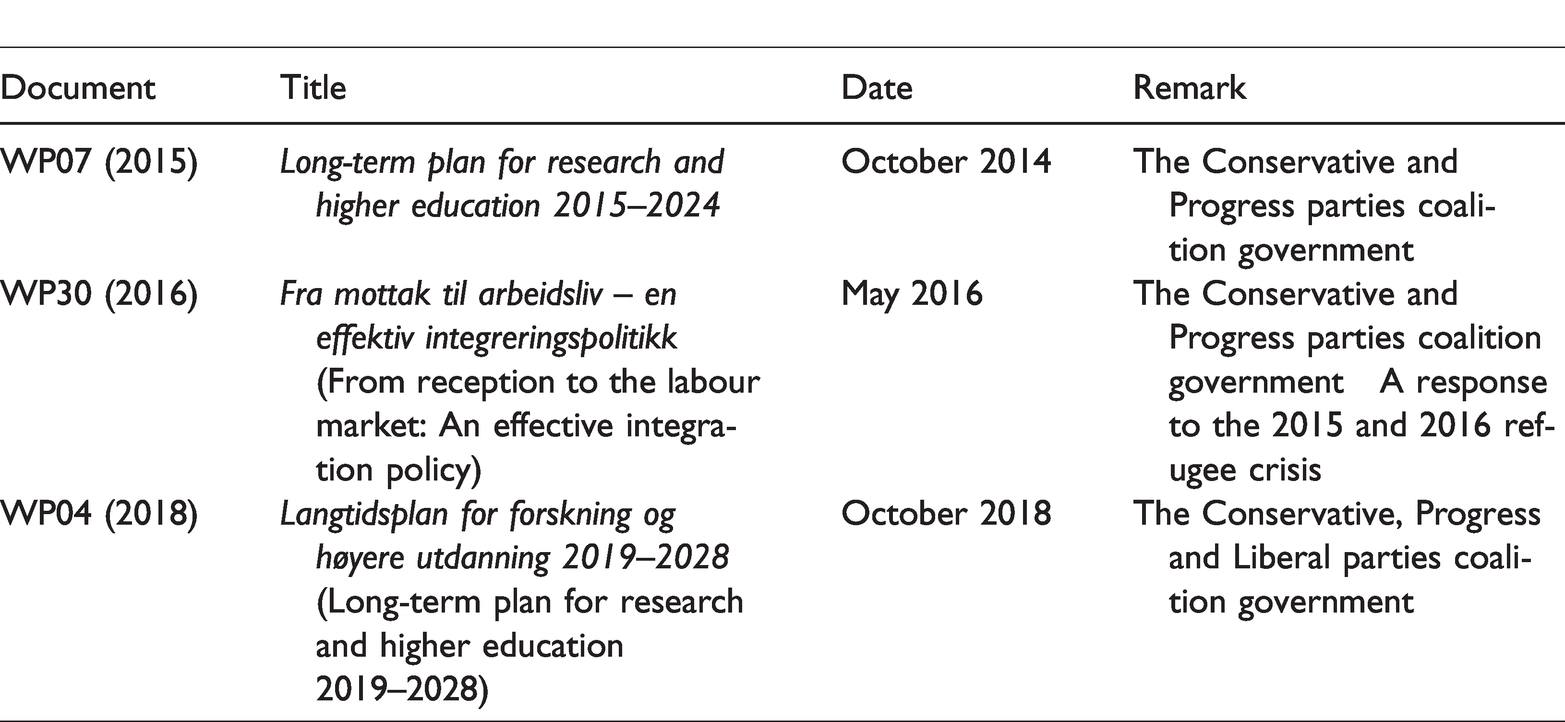
The analysed White Papers (please see Table 1) are downloaded from the Norwegian Government’s official website. 4 White papers are official policy documents that lay a foundation for legislation (Bubikova-Moan, 2017; Hilt, 2015) and reflect government and parliamentary discourses on different issues in a given country (Trowler, 2002). Even though the Government is the main actor in creating the policy documents, the contribution of different societal groups is significant in finalizing them (Hilt, 2015).
The analysis conducted below follows a three-step approach. First, the ‘relevant’ policy documents are selected from numerous documents based on the contents of these documents (Fairclough, 2013: 237). Second, an entry-level analysis is conducted (Krzyżanowski, 2013). After reading the entire documents (WP07, 2015 and WP04, 2018) and the relevant parts of WP30 (2016: 7-15, 51-72) for a general understanding, we conduct a thematic analysis, where we categorize words, phrases, sentences and even paragraphs into particular genres, discourses, and/or elements of lexico-grammar subthemes. A paragraph or the other parts of a text may include one or more of these discursive features, resulting in interdiscursivity. We further categorize the identified genres, discourses and lexico-grammar elements to find the major patterns or themes of semiotic categories in the documents (Fairclough, 2016). WP04 (2018) is the updated version of WP07 (2015) and we look at the relevant changes made in the new document concerning refugee higher education because the former document was created after the 2015 refugee crisis in Europe. Finally, an in-depth analysis is made where we relate the identified major genres, discourses and lexico-grammar elements to the social inclusion dimensions mentioned above. We trace a line of argument for the dominant, and hence, marginalized, discourses in the text trying to link them to the overall social practice (Fairclough, 2013) in the context of the social inclusion of refugees into higher education. To avoid confusion, each element of the semiotic category is highlighted in the document using different colours. We write key words on the margins of the documents, and we jot down a relatively detailed analysis on a separate notebook. The notes in the notebook contain the necessary information, such as the page number and headlines from the White Papers, for the purpose of easy reference (Taylor, 2004).
Genres
A mix of policy, promotional, managerial or planning, and academic genres is drawn upon in the documents. It is intriguing that the promotional and managerial genres are prevalent in what are otherwise political documents. However, it is far from surprising because many discursive activities in the ‘consumer culture’ of today incorporate promotional elements (Bhatia, 1997: 635; Featherstone, 2007). In these cases, the governments tend ‘to act like a corporation’ and exert influence through managerial, rather than political, means (Fairclough, 2013: 385). In higher education contexts, this may lead to the marginalization of social justice and empowerment principles, mainly by focusing on economic and labour market issues.
The hybrid genres embedded in the documents imply various ways of presenting social activities. From the outset, the ‘blurb’ on the cover pages shows a sense of genres (Fairclough, 2013: 268). The colourful pictures at the bottom of the cover pages of the documents, which are placed presumably to attract the attention of the readers, give the document a flavour of a promotional or advertising genre. For instance, the cover page of WP30 (2016) depicts many working people, where out of the 17 adults on the cover page, 13 are working while two are receiving services and the remaining 2 are anonymous. It seems that the Government promotes the notion that labour market participation is the main focus of its integration policy. Words and phrases such as ‘[r]eport to the Storting (white paper)’ and ‘policy’ indicate the presence of policy genres in the documents (Krzyżanowski, 2013), while a phrase such as ‘Long-term plan … 2015-2014/2018-2019’ implies the documents draw not only upon political genres, but on other genres as well (Cornut et al., 2012).
In addition to the cover pages, the Government uses promotional genres to convey its messages in the documents. The presence of colourful pictures (WP04, 2018: 7-8) which are common promotional features (Young and Quinn, 2017) is a good example. Moreover, there is widespread use of differently coloured boxes throughout the documents which, according to Fairclough (2000: 137), are ‘promotional’ because these boxes are persuasive and ‘widely used in advertising’. Similarly, the documents use ‘the common promotional device of bullet points’ which may be seen as ‘reader friendly’, but they also tend to be more ‘reader directive’ than dialogical (Fairclough, 2013: 387). The nature of the language used in sentences, such as ‘Digitalization and the use of new technology in higher education can promote quality … ’ ‘Today’s society demands research-based knowledge in an ever-increasing number of areas … ’ and ‘Attracting talented people … is important … ’ (WP07, 2015), is also promotional in a sense that the sentences seek to advance the Government’s stance on particular issues (see Fairclough, 2013: 386).
The documents incorporate research results and other factual information indicating the presence of academic genres: ‘A survey conducted … revealed that … ’, ‘Research on economic development … reveal that … ’, (WP07, 2015), ‘Many … comparisons … indicate our social model is success’ (WP04, 2018), and ‘Studies … indicate … ’ (WP30, 2016). There is also a mix of (strategic) managerial or planning genres in the documents (Lamond, 2004): ‘this long-term plan outlines … ’, ‘ … ten-year objectives … ’, ‘ … projections of supply and demand … ’, ‘ … declining demand for people … there may be surplus of people … ’ (WP07, 2015). ‘ … in decades to come’, ‘ … in 2060 … ’ (WP04, 2018), ‘ … must be given incentives … ’, and ‘ … long-term development … ’ (WP30, 2016). In sum, the integration of business-related genres into otherwise political documents indicates that ‘ … the state becomes managerial, incorporating business practices into government’ (Fairclough, 2013: 177).
Discourses
The various discourses drawn upon within the policy documents point to the dominance of the neoliberal version of social inclusion where higher education and research are primarily considered tools for enhancing economic competitiveness. There are also social justice discourses, albeit marginalized, that are embedded in some of the documents.
One of the discourses embedded in the documents is the political discourse that is manifested through future-oriented expressions (Van Dijk, 1997). ‘We need qualified professionals to provide good … services’, ‘The Government is working … to examine the future … ’ (WP07, 2015), ‘By focusing on knowledge, we will prepare for future … ’, ‘We will fulfill Norway’s commitment … ’ (WP04, 2018), and ‘The Government will further develop integration policy … ’ (WP30, 2016). Some of the reasons for focusing on future-oriented discourses are: serving, in the Government’s terms, ‘the knowledge society’, ‘The Government has high ambitions as regards the Norwegian knowledge society’ (WP07, 2015), and securing the economic sustainability of the welfare state ‘ … all who live in Norway … pay taxes … to sustain economic suitability of the welfare society’ (WP30, 2016).
The modernization discourse is also embedded in the education policy documents, ‘ … new care facilities … ’, ‘ … new technology … ’, ‘ … new or upgraded teaching facilities … ’ (WP07, 2015), ‘ … advanced IKT-competence … ’, ‘ … enabling industrial technologies … nanotechnology … advanced production processes’, and ‘digitalization’ (WP04, 2018). The modernization discourse in the education policy documents is primarily related to economic competitiveness, through, for example, innovation and more productivity (Featherston and O’Sullivan, 2017), in addition to meeting social challenges (that will be) facing Norwegian society as indicated in WP04 (2018): ‘Technology … to solve social challenges’. From a political perspective, the modernization discourse can be seen as a representation of a shift in the policies of the incumbent Government from the policies of the previous Government (now opposition parties) by making the current education policies more relevant to the future (Fairclough, 2013).
The other prevalent discourse in the education policy documents is the internationalization or globalization discourse. One of the main priority areas of the White Papers is to scale up ‘world-leading’ academic expertise: ‘The Government proposes … leading global expertise based in Norway’, ‘ … the Government wants Norway to be … world’s most talented students and researchers want to go’ (WP07, 2015), ‘We need updated knowledge about … global … ’, ‘We must … contribute to the global knowledge … ’, ‘Norway shall have world-leading expertise … ’, and ‘Global leadership … for economic development in Norway … ’ (WP04, 2018). These statements are not necessarily in contrast with the social inclusion of refugees into higher education per se. However, they are general indicators of the prevalence of the neoliberal principles in the education policy documents.
The clear presence of exclusionary discourses in the documents is another point worth noting. Saff (2001) states that exclusionary discourses are expressed in subtle ways, one of which is categorizing people into different groups, where some are considered superior and others, often by implication, inferior. For instance, ‘The best and the brightest-the need for doctorates … ’, ‘ … attract the best students and researchers’, ‘ … we can work together with the best … ’, ‘ … attract and develop the best talents … ’ (WP07, 2015), ‘We must be successful in recruiting the best talents … ’, and ‘ … the best and most motivated students … ’ (WP04, 2018). These types of discourses may result in the further exclusion of already disadvantaged groups, such as refugees, from higher education (Furlong and Cartmel, 2009). This is not because refugees are innately less intelligent than non-refugee students (Détourbe and Goastellec, 2018) but rather because they constitute unique target groups with ‘specific experiences that make access to and participation in higher education distinct for them’ (Ramsay and Baker, 2019: 65). For instance, some rules and regulations may hinder refugees’ access to higher education in Norway (WP30, 2016).
The social justice and inclusion discourses are embedded, albeit superficially, in the policy documents launched after the 2015 refugee crisis, as seen in the following: ‘An effective integration policy shall contribute … where all are given opportunity to be successful’, ‘The Government wishes to avoid … groups of residents are excluded from the society’ (WP30, 2016), ‘The education system … higher education and research, has an important role to play in … inclusion … ’, and ‘The Government has an ambition of creating a secured Norway where all are included’ (WP04, 2018). These discourses appear, however, in broader neoliberal discourses of labour market participation, which are more common in the documents: ‘The Norwegian welfare model is dependent on high labour market participation … ’, ‘ … to qualify immigrants with refugee backgrounds to cover the need for labour force … ’, ‘ … more effective integration policy where immigrants with refugee background enter the labour market … ’, ‘The Government will work … to facilitate transition to work among immigrants with refugee background’ (WP30, 2016), and ‘A successful integration policy … different immigrant groups participate in … work life … ’ (WP04, 2018). More specifically, refugee higher education or qualification is framed within the labour market demand. ‘Many immigrants with refugee background who already have education, may need more education to qualify for the Norwegian labour market’, ‘ … the Government will establish … a complementary education … for teachers and nurses’, and ‘Increasing economic differences [because of] … immigration of people with low education’ (WP30, 2016). The Government has introduced a flexible process of documenting previous qualifications for refugees so that they can access higher education provided they fulfil other criteria including language requirements. Hence, the goal is to enable the refugees to work in a given field (WP30, 2016; see also Pietkiewicz, 2017).
A simple comparison of the documents launched before and after the 2015 refugee crisis in Europe – as presented above – indicates the change in discourses on inclusion of immigrants and/or refugees into higher education. Not surprisingly, the policy documents drafted after 2015 have espoused social justice and inclusion discourses even though the discourses are marginalized. Put differently, there is a clear indication of change in discourses when it comes to social inclusion of refugees into higher education in Norway.
The commercialization or business discourses are also prevalent in the education policy documents, indicating the Government’s efforts in shaping higher education and research policy within a business and/or commercial framework: ‘the Government has made a commitment to commercial research … ’, ‘The Government wants to facilitate … commercialization of public research results’ (WP07, 2015), ‘ … stimulate to … commercialization and innovation from publicly funded research institutions’, ‘Commercial utilization of research results … ’, and ‘The Government has as ambition to further strengthen … commercialization of results from publicly funded research’ (WP04, 2018).
Lexico-grammatical
The lexico-grammar (verb-pronoun-vocabulary) analysis shows that the Government is a powerful actor, particularly in relation to refugees, and that a skilled workforce is necessary for the labour market and welfare state. The documents use modal, present and future verbs with different subtexts. The use of modal verbs such as must can indicate that there is a recommendation from the Government regarding a particular issue: ‘ … Norway must have the right people with the right skill … ’, ‘ … we must train and update personnel … ’ (WP07, 2015), and ‘We must have knowledge to … maintain welfare’ (WP04, 2018). These verbs may also connote obligations where the powerful, here the Government, imposes an obligation on the powerless under its jurisdiction (Taylor, 2004), ‘ … more research groups should be able to assert themselves with the world elite … ’, ‘Educational institutions and the public sector must cooperate … ’ (WP07, 2015), ‘Immigrants coming to Norway must adjust themselves to … new society’, ‘All must learn Norwegian’, and ‘ … immigrants with refugee background must fulfill requirements … for admission to higher education … ’ (WP30, 2016). The present tense and future tense verbs in the documents indicate the Government’s efforts to make the policy documents more relevant to the contemporary situations (Leech, 1966 cited in Wang, 2017) and to underscore ‘present necessity of future action’ (Fairclough, 2013:287): ‘We need qualified professionals … ’, ‘Digitalization makes the education more relevant … ’ (WP07, 2015), ‘The aim of integration policy is … ’, and ‘More municipalities have to use the flexibility of the Introduction act’ (WP30, 2016).
The most common pronoun used in the documents is what Fairclough (2015: 143) terms the ‘inclusive we’. It is often used to create an impression of communality and the Government here is making an implicit authority claim: ‘In Norway we have been successful … ’, ‘Knowledge creation is global and … we are dependent on international cooperation … ’ (WP04, 2018). ‘Norway has many good academic environments … but we have the potential … ’, and ‘Norway is among … nations … we are to continue’ (WP07, 2015).
The vocabulary that is used in the documents indicates the Government is preoccupied with ensuring the availability of highly qualified personnel and quality of education (and research). Fairclough (2015: 133) states that using many words that are near synonyms indicates a ‘preoccupation’ with something that the words refer to. This is evident from the overwording of some words and phrases that have near similar meanings: ‘qualified’, ‘competence’, ‘ability’, ‘experts’, ‘advanced … expertise’, ‘quality’, ‘quality of education’, and ‘high quality education’ (WP07, 2015). Another interesting point is the vagueness related to the words ‘education’ and ‘immigrant(s)’: ‘immigrants must often start … education’, ‘Immigrants who have completed education … ’, and ‘ … immigrants’ education … shall be used’. Similarly, it is not precisely clear what ‘education’ constitutes when it is mentioned with a job or labour market: ‘ … immigrants with refugee background enter the labour market or start an education … ’, and ‘ … get job or education’ (WP30, 2016). The use of the word ‘immigrant’ instead of ‘refugee’ overlooks the specific socio-economic challenges that refugees face in host countries (Baker et al., 2018). Similarly, the generic term ‘education’ does not indicate the relation that refugees have with higher education because there are different levels and forms of education, for example primary education.
Discussion
The education and integration policies are interlinked, a fact also separately noticed in another study by Détourbe and Goastellec (2018). In particular, the policy documents launched after the 2015 refugee crisis have some converging points regarding the importance of the integration of immigrants to sustain the Norwegian welfare system. Stressing participation in the labour market as a key factor for the integration of immigrants, the documents highlight that refugees are the least employed group of immigrants in Norway, and the low education level is blamed for this high unemployment. Therefore, it is with the aim of increasing the participation of refugees in the labour market that refugee (higher) education or qualification is framed. Similarly, the documents have various flavours of social justice. The integration policy propagates that all should be given the opportunities to be successful; and the education policy states that the education system should play a role in providing a part of these opportunities. However, the overall picture of the policies depicts the participation of refugees in the labour market to be the ultimate goal. The emphasis is on human capital development both by education and integration policies when it comes to refugee (higher) education; this is a reflection of neoliberal principles, a trend in the current global education policy (Convertino et al., 2017; Molla, 2014).
More specifically, the interdiscursive analysis of the documents indicates that the access dimension of social inclusion (Gidley et al., 2010) is a prime focus of the Norwegian higher education and integration policy documents, partly evident from the use of a hybrid of genres. The promotional and managerial genres signal that the Government is acting in managerial ways, promoting the importance of education for labour market participation and economic competitiveness. In addition to this, the Government plans specific research and higher education focus areas along with ways of having qualified personnel achieve certain goals. The Government’s ways of acting here, that is, through promotional and planning genres, are managerial, or in Fairclough’s (2013: 177) terms, ‘business practices’ which are the elements of neoliberal principles (Bagley and Beach, 2015).
The analysed documents are future-oriented and impact the future education and integration policies of Norway. The Government emphasizes sustaining the Norwegian welfare system through a robust economy, innovation, commercialization of higher education and research, and high employment. Thus, higher education and research system is expected to focus on producing qualified professionals who can serve the ‘knowledge society’ now and in the future. Furthermore, to increase the Norwegian economy’s competitiveness and increase the effectiveness of welfare services, the discourses indicate that the Government is investing in modern or advanced technologies. Hence, it is clear that Norwegian education and integration policies are rooted in neoliberal principles, where the Government is interested in ensuring the availability of sufficient and qualified personnel for economic development or quality public services and to meet the demands of the labour market. Fairclough (2013: 557) argues that nowadays there is a tendency to narrow down the purpose of education ‘towards serving the needs of the economy’ instead of, for example, envisioning education for life (Bak, 2018).
Internationalization is part and parcel of the Norwegian education and research policy documents. The Government seeks to create a world-class competitive academic community by pulling in the world’s best students and researchers, who can then contribute to strengthening the international competitiveness of Norway across the world. This highlights the access dimension of social inclusion, which focuses on human capital development, which is underlying the internationalization process in Norwegian higher education and research. This is in line with a study from Germany that indicates that the widening participation in Germany is associated with the aim of securing a ‘pool of skilled’ labour to ‘strengthen the international competitiveness of Germany as a location for science’ (Mergner et al., 2019: 64).
The focus on ‘the best and the brightest’ may constitute an exclusionary discourse. The privileged groups in society become the beneficiaries by accessing and succeeding in higher education, thereby reproducing social inequalities. Refugees may be at risk of being excluded from higher education in these neoliberal informed scenarios not so much because of a ‘lesser desire or ability but of societal and institutional obstacles and exclusions that negatively’ shaped their ‘aspirations, knowledge, and academic preparation’ (Détourbe and Goastellec, 2018: 4). In the same vein, another study (Baker et al., 2019) indicates that refugees face particular problems in accessing and participating in higher education because they ‘share neither the cultural nor the language background of the academy’ and they may not have ‘hot sources of information and support’ (Baker et al., 2019: 9).
Social justice discourses are drawn upon in the policy documents; these discourses are, however, marginalized because they are framed within the neoliberal principle of education for the labour market and economic competitiveness. For instance, on the one hand, the Government wants to avoid the exclusion of groups of residents from society, which is an integral part of social justice (Young, 2000). On the other hand, the Government focuses on refugees’ access to higher education only in selected fields of study, such as teacher education and nursing, which are generally more needed in the labour market (Dapi et al., 2016), which is typical of a neoliberal principle. When policies informed by human capital development call for inclusion, in Gale and Molla’s (2015: 819-820) terms, ‘the primary concern is loss of productive workforce, not social justice as such’. Thus, what is missing from the policy documents is explicit and extensive mainstream discourses and genres embedded in social justice and human development principles that encourage equal opportunity for and self-realization of refugees when it comes to higher education.
The policy documents’ focus on the access dimension of social inclusion may in practice impact a wider approach to social inclusion of refugees into higher education by limiting potential intervention measures to mainly one dimension. Moreover, a unidimensional focus of the policy documents may indicate that the typologies of levels of social inclusion used in this article are not able to capture the nuances in the policy documents, indicating the possibility of developing alternative frameworks in the future to better understand social inclusion of refugees into higher education in Norway.
Concluding remarks
Fairclough (2003: 14) argues that there can never be ‘a complete and definitive analysis of a text’. Acknowledging this argument, the current article has tried to address the following questions: How is social inclusion into higher education conceptualized in the documents? Which discourses are embedded in the conceptualization of social inclusion in the policy documents? What implications are there for the social inclusion of refugees into higher education in Norway?
As indicated above, the policy documents are informed by human capital development for the purpose of economic competitiveness, labour market participation, and sustainability of the welfare system. The traces of social justice found in the documents are marginalized by the dominant neoliberal principles of selecting and qualifying ‘the best and brightest’ workforce for economic and related purposes. Thus, Norwegian higher education and integration policies reflect the access dimension of social inclusion; this is underpinned by the major discourses that are drawn upon in the policy documents including the modernization, internationalization, exclusionary, and commercialization discourses.
The absence of a holistic social inclusion strategy in the policy documents hinders the ‘full’ social inclusion of refugees into higher education. To increase the participation and success of refugees in higher education, policies informed by social justice and empowerment principles are needed. These policies should incorporate conscious and clear strategies that take the particular socio-economic conditions of refugees into account so that refugees can not only access but also succeed in higher education (Eurydice, 2019). Otherwise, the unbalanced emphasis on the human capital development coupled with the powerless position of refugees in the policymaking processes leave refugees with fewer options when it comes to Norwegian higher education. In other words, refugees are disempowered, which constitutes a denial of choices (Kabeer, 2010 cited in Dryden-Peterson and Giles, 2010). Consequently, refugees may be systematically excluded from higher education and forced to fill ‘subordinate positions’ (Blackledge and Hunt, 1985 cited in Thompson, 2014: 59), shunned by the privileged groups (Friberg and Midtbøen, 2018). This is partly indicated in the integration policy document where it is stated that refugees may do jobs ‘which are not done by others’ (WP30, 2016: 52) (authors’ emphasis).
This article is just an indication of the higher education and integration policies regarding the social inclusion of refugees into higher education in Norway. Even so, the results are useful in informing policymakers in Norway and other refugee host countries and academics who are interested in refugee higher education. The analysis highlights how problematic and incomplete it can become to focus on just one dimension of social inclusion. Thus, in practice integration policies should be as comprehensive as possible by incorporating equal opportunity and self-realization perspectives in addition to labour market participation (Lamprianou and Sunker, 2014); this is because issues of social justice and empowerment are near universal principles that need emphasis in today’s increasingly neoliberalized global (higher) education policies (Convertino et al., 2017; Gale and Hodge, 2014). However, more comprehensive and preferably comparative policy analyses may be needed to further elaborate on the results of the current paper. Moreover, we call for more qualitative studies that not only comprise the macro level of national policies, but that also consider the institutional responses to refugees’ demands for higher education to capture the different meanings given to the social inclusion of refugees into higher education.
Footnotes
Acknowledgements
We would like to extend our heartfelt gratitude to our colleagues who have given us constructive feedback during the writing of this article.
Declaration of conflicting interests
The author(s) declared no potential conflicts of interest with respect to the research, authorship, and/or publication of this article.
Funding
The author(s) received no financial support for the research, authorship and/or publication of this article.