




Abstract
One debate among business owners and policymakers centres on whether higher education institutions (HEIs) have failed to transform the younger generation by developing their competencies, skills, values and behaviours to enable them to be fit for the world of work. While previous studies have considered the importance of skills development and its assessment in many contexts, there appears to have been limited scholarly research on employability issues within the higher education system (HES) in Nigeria. In seeking to address this, it is vital to understand how HEIs in Nigeria conceptualize generic skills and why HEIs have problems with teaching generic skills in their programmes. By adopting a qualitative approach, based on interviews with senior academics, industry executives and final-year undergraduates, this study found that many of the HEIs do not facilitate the teaching of high-level generic skills in their programmes. Some of the factors attributed to this include poor learning environment, lack of staff with industry experience, and over-dependence on theoretical content teaching. The findings are significant for reorienting the HE curriculum developers to align with the needs of the industry and society. Regarding implications for policy, we recommend that enterprise education be made mandatory for primary, secondary and tertiary education curriculum in Nigeria. Finally, we advocate more inclusive and interpretive research for greater understanding of the issues, and to offer useful data for policymaking and decision-making on the perspectives of preparing graduates for work.
Introduction
Higher education systems (HES) across the world have gone through many transformations over the years (see e.g. Bagwasi, 2019; Bordoloi, 2018; Hawkins, 2008; Masino and Niño-Zarazú, 2016; Pitan, 2017). These transformations have been in response to their changing social and economic status’ (i.e. the status of HES) (Auld and Morris, 2019; Bagwasi, 2019). Despite the changes, there are still criticisms that HES are failing to produce graduates who can be relied upon to integrate the functions of management (Álvarez-González et al., 2017; Leong, 2013). It is expected that students should have a broad base of pedagogical content knowledge, critical thinking, communication (e.g. Carvalho and Yeoman, 2018; Guilherme and de Freitas, 2017; Shih, 2019; Sojot, 2018), problem-solving, and team working ability (Alt, 2015; Bjørnsrud and Engh, 2012; Garnjost and Brown, 2018), which are the aims of modern higher education (HE). Arguably, many of these pedagogical contents are lacking in Nigerian HE. Since the development of university education in Nigeria, more attention has been given to theoretical content knowledge development while the practice of holistic and competency education is often ignored (Okolie, Igwe and Elom, 2019; Okolie, Nwosu and Mlanga, 2019). As a result, students attain ‘theoretical content knowledge’ ability but lack professional and generic skills which attract the interest of employers (Bagwasi, 2019; Hassan, et al., 2015; Okunuga and Ajeyalemi, 2018). This may have lead to graduates overestimating their capability, performance or chances of success (Anderson et al., 2012; Bi et al., 2016; Johnson and Fowler, 2011). It is reasonable to expect that this should play a major role in the behaviours expected based on an individual’s cognitive status (Herz et al., 2014; O’Leary, 2017; Tomlinson, 2007).
Enhancing graduate employability is a priority for many stakeholders in HE (O’Leary, 2017), and this study explores HE stakeholders’ experiences of, and attitudes towards, the inclusion of employability-related support in undergraduate degree programmes. The embedment of soft skills into HES is closely related to the curriculum philosophy brought by the respective institutions (Hassan et al., 2015). Nowadays, employers are increasingly demanding a greater range of high-level skills such as effective communication, team working and problem-solving, to mention a few (Evans et al., 2012; Jackson, 2012; Mattern, 2016). However, there is a continuing disparity between industry expectations and HE provision (Jackson, 2012). It is recommended that educationalists, policymakers and government departments need to pay greater attention to generic skills and should focus less on transferable and core skills if the impact of graduates on industry is to be more effective (McLarty, 2005). Indeed, sustainable education is what is needed to promote employment, earnings, health, and poverty reduction in society. The Organisation for Economic Co-operation and Development Learning Framework 2030 (OECD, 2018) explains that the future of education and skills and ‘education quality’ should encompass the non-cognitive dimensions highlighted in SDG (Sustainable Development Goal) 4.7: the knowledge and skills needed to promote sustainable development, including, among others through education for sustainable development and sustainable lifestyles, human rights, gender equality, promotion of a culture of peace and non-violence, global citizenship and appreciation of cultural diversity and of culture’s contribution to sustainable development. (Target 4.7, United Nations Educational, Scientific and Cultural Organization (UNESCO, 2016: 20); cited in Auld and Morris, 2019: 2–3)
RQ1. How do HEIs conceptualize generic skills in their pedagogical teaching and learning?
RQ2. Why do HEIs have problems with teaching generic skills in their graduate programmes?
By applying a qualitative approach through interviewing and exploring these questions, we hope that our study will contribute to the ‘missing paradigm’ in research towards teaching generic skills in HE, particularly in Nigeria. Finally, we hope that the findings will enable us to develop implications and recommendations for policy, practice and society. This study is timely, given that one of the major issues seeking urgent attention is complaints from industries and businesses over the poor quality of current graduates in developing countries (Bandele and Faremi, 2012). In this regard, several studies have reported that the majority of HE graduates are not employable due to poor skills (see e.g. Hansen and Haaland, 2015; Umar et al., 2009).
Generic skills
Generic skills, which are also referred to as key skills or core competencies, are significantly used in the present conversations in society, working life and education (Virtanen and Tynjälä, 2018). The OECD at the beginning of the millennium initiated the definition and selection of key competencies, which defined the key competencies that every citizen requires to achieve a well-functioning society (Katajavuori et al., 2006). In Europe, for instance, there is an inclusion of generic skills in the national and international qualification frameworks; for example, the European Qualifications Framework, which facilitates students’ knowledge (European Qualifications Framework, 2008). Australia, for instance, created a centralized generic skills assessment tool which they call the Graduate Skills Assessment (Hambur et al., 2002). There are other examples like the Cambridge Thinking Skills Assessment in the UK (Cambridge, 2017) as well as the Work Keys System assessment conducted by the American College Testing Center for Education and Work (Saterfiel and McLarty, 1995).
Virtanen and Tynjälä (2018) maintain that several business leaders and educators have developed some models and listed some skills which they refer to as ‘twenty-first century skills’ that students require in their lives and work to ensure that they are successful in the world of work. Generic skills have also been emphasized in the assessments and comparisons of education systems with a view to enhancing the quality of teaching and learning and graduates’ outcomes (Coates and Richardson, 2011). There are several forecasts that the labour market will lay more emphasis on generic skills in the future (see e.g. Casserly, 2013; DavDavies et al., 2011), and current researches from various fields have shown that in addition to job-related requirements such as the field-specific (technical/professional) skills that employers need, they also require generic skills (communication, critical thinking, problem-solving, teamwork, lifelong learning, professional ethics, entrepreneurship, leadership, etc.) (Okunuga and Ajeyalemi, 2018; Virtanen et al., 2009). This corroborates McClelland’s (1973) behavioural competencies, which are used by companies as the basis for staff selection (see Table 1).
McClelland’s 20 behavioural competencies.
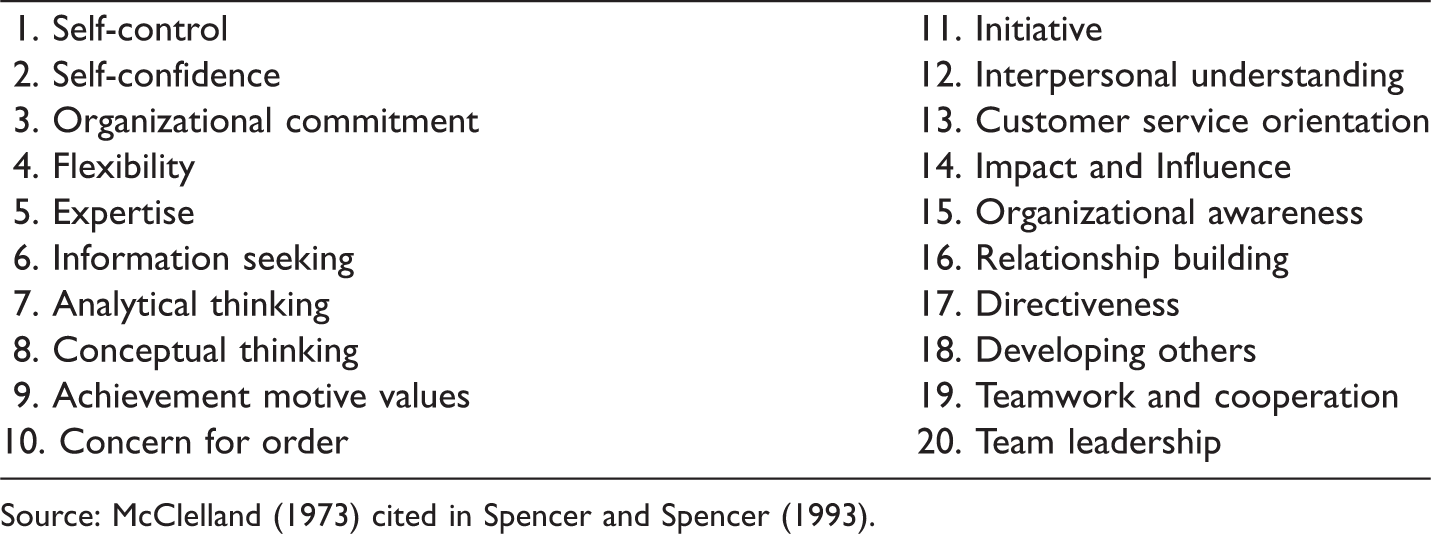
Source: McClelland (1973) cited in Spencer and Spencer (1993).
Drawing on previous studies on how a lack of generic skills negatively affects graduate employability (Virtanen and Tynjälä, 2018; Virtanen et al., 2009; Yorke and Knight, 2006), a survey from a major online employment agency found that the major reasons for graduates not being hired by employers are a lack of communication skills (56%), bad social manners (36%), requesting excessive pay packages (32%), acquiring irrelevant qualifications (30%) and being overly choosy about jobs (23%), among others (Salina et al., 2011). In the same way, the study conducted by the Stanford Research Institute and Carnegie Melon Foundation ‘involving Fortune 500 CEOs revealed that 75% of getting and maintaining a job successfully is supported by [an] individual’s generic/soft skills, while only 25% accounts for hard skills or technical knowledge’ (Malhi, 2009: 49). These generic skills are very intangible but very crucial and relevant to employers. Since a lack of generic skills contributes to a large extent to the reasons for the unemployability of graduates, this study contributes to the knowledge of the development of the concept and why HEIs in Nigeria are not able to teach high-level generic skills to students.
Theoretical context
This paper adopts the Human Capital Theory (HCT) proposed by Theodore Schultz in his 1960 article on ‘Capital Formation by Education’ (Holden and Biddle, 2016; Schultz, 1960). Schultz (1961: 1) states: ‘I propose to treat education as an investment in man and to treat its consequences as a form of capital. Since education becomes a part of the person receiving it, I shall refer to it as human capital.’ Schultz was of the view that education is key to economic growth and development in every society, based on its quality and quantity. High-quality education is highly required to achieve economic development; as noted by Okolie (2014), no nation can rise above its level of education. The HCT assumes that education is extremely instrumental and necessary to advance the productive capability of a people. The HCT argues that people who are highly educated are very productive people. The HCT lays emphasis on how quality education can increase the productivity of the labour force by improving their capabilities. As Bills and Klenow (2000) and Cohen and Soto (2007) noted, the provision of formal education is seen as an investment in human capital, which proponents of the theory have considered as equally or even more worthwhile than that of physical capital.
According to Boeteng and Ofori-Sarpong (2002:39), this expectation is rational from the perspective of human capital theory, which explains that the main determinant of the demand for higher education is the expectation of higher earnings over an individual’s lifetime, and higher income is necessary to compensate for the high costs associated with higher education.
Graduate employability in the Nigerian context
Graduate employability is a global issue that has received scholarly attention (Felicetti et al., 2013; Jackson, 2012; Mattern, 2016; McLarty, 2005; Rowe, 2019), especially since the global recession and the era of drastic increase in the emigration of tertiary-educated young people seeking further qualification and employment abroad (Tomić and Taylor, 2018). Yorke (2006: 21) sums up the tenets of employability as ‘a set of skills, knowledge and personal attributes that make an individual more likely to secure and be successful in their chosen occupation(s) to the benefit of themselves, the workforce, the community, and the economy’. This proves that there is a lot of importance attached to issues related to graduate employability and how to alleviate the situation of graduate unemployability in the developing world, especially in Nigeria, due to a skills gap (Oladokun and Olaleye, 2018). In Nigeria, evidence from previous research showed that there is a high rate of graduate unemployment, which is not related to a lack of jobs (see e.g. Emeh, Nwanguma and Abaroh, 2012; Oladokun and Gbadegesin, 2017; Oladokun and Olaleye, 2018; Pitan, 2015, 2016, 2017), but due to a lack of the employable and generic skills that the labour market (employers) needs, and also due to a skills gap and mismatch (Oladokun and Olaleye, 2018; Pitan, 2017).
To further explain the graduate employability situation in Nigeria, Emeh et al. (2012) found that of about 40 million unemployed young people in Nigeria, 23 million were unemployed due to lack of employable skills, and the majority were university graduates. To support this claim, the Central Bank of Nigeria noted that over 70% of unemployed young people in Nigeria lack the right skills required by the labour market, and the majority are HE graduates (National Universities Commission, 2004). Consequently, many employers have raised serious concerns over the skills possessed by their employees (Akanmu, 2011). As revealed by previous studies, some of the employability skills lacked by the Nigerian HE graduates include but are not limited to communication, information technology, decision-making, critical thinking, interpersonal relationships, and technical and numeracy skills. These findings demonstrate the need for urgent actions by HE policymakers and HEIs to ensure that thousands of graduates produced yearly in Nigeria possess the technical skills and generic skills required by today’s industry and the labour market. Hence the importance of this study.
Methodology
This study draws on in-depth interviews which were conducted in three phases. The first phase is the interview with the final-year undergraduate students in one of the oldest federal universities in Nigeria. The students came from the Faculties of Sciences, Education, Engineering, Medical Sciences, Management and Social Sciences, and Arts and Humanities. In line with the ethical procedures of the university, some students were approached and a request was made for volunteers to participate in the study interviews. Volunteers were requested to complete an expression of interest form, signed and emailed to the researcher as a piece of evidence that they consented to participate in the interviews. The students were also informed that they would be required to describe their university experiences with an emphasis on the issues related to learning approaches and generic skills acquisition (Chan, 2010). After 3 weeks, 57 students returned the completed expression of interest forms indicating their interest to participate in the interviews. Through purposeful sampling (Denzin and Lincoln 2005), 15 respondents were selected and interviewed. The 15 respondents (6 males and 9 females) were between the ages of 22 to 25 years.
The second phase was the interview with the industry executives linked to the HEIs. Email invitations were sent to 32 experts in the various fields. The invitation letters made clear the aim of the study and requested a short biography of interested participants. They were also asked to email the researcher their acceptance to participate in the study. The process had a response rate of 19 respondents. Again, through purposeful sampling (Denzin and Lincoln 2005), 9 individuals (n = 3 males; n = 6 females) with 10–15 years of experience in the industry were selected and interviewed. The third phase was the interview with academics. Email invitations were sent to 34 professors with the aim of the study made very clear, asking for volunteers to participate in the study. Their short biographies were requested to ensure that they were ‘information rich’ to offer their views on the subject of the study based on their years of teaching experiences in the HEIs. They were instructed to contact the researcher with the completed expression of interest form. Out of the 34 contacted, 13 expressed their willingness to participate in the study. Through purposeful sampling, 11 university professors (n = 4 males and 7 females) with experiences ranging from 10 to 20 years were selected for interviews. Overall, the study had 35 participants (13 males and 22 females).
How data was collected and analysed
The industry executives and university professors were not in the same location; the researcher, with the help of trained research assistants, used telephone calls and face-to-face methods to conduct the interviews. The process allowed us the opportunity to question and further explore deeper into the issues relating to graduate employability and generic skills. The students were in the same location, and they were interviewed face to face. Having considered the literature review and theoretical position, it was decided to use a qualitative research method (Rolfe, 2006). Ary et al. (2010) explained that qualitative research methods enable the capture of a rich and comprehensive image of a situation and allow the participants to share their views about their experiences in detail. Data was collected using a semi-structured interview approach (Wengraf, 2001). The interview was used to get an in-depth understanding of how the HEIs conceptualize generic skills in their pedagogical teaching and learning (Creswell, 2007; Igwe, Madichie and Newbery, 2019; Igwe, Newbery et al., 2018). The interviews with the group of participants lasted between 45 minutes and 120 minutes.
The number of respondents was considered to be adequate based on Simonton (1999). The interviews were recorded and transcribed verbatim and analysed using a thematic analysis approach where the key research questions served in identifying the interesting contexts of the discussion (Guest et al., 2012). To facilitate analysis, a data analysis package (NVivo) was used to identify and explore concepts and themes, trying to ascertain the best explanation for the relationship under study (Guest et al., 2012). Overall, the participants of the study proved that they have an in-depth understanding of the issue under study, except some students who had some difficulty in understanding the concept of generic skills. However, the findings of the study provide rich information to guide our understanding of the conceptualization of generic skills and why HEIs in Nigeria are not able to teach generic skills to students – the focus of this study.
Findings
The importance of teaching generic skills and the inclusion of employability-related support in undergraduate degree programmes have been publicized in many contexts (Anderson et al., 2012; O’Leary, 2017; Tomlinson, 2007). These studies, which provide the background to our study, emphasize the need for HEIs to focus their attention on graduate employability and how to change student attitudes and orientations to the labour market. In this study, we have adapted thematic analysis to facilitate the identification of the key themes which formed the basis of our findings and discussion in line with the research questions and objectives, which include: (a) How do HEIs conceptualize generic skills in their teaching (including the perceptions teachers and students)? (b) Why do HEIs have problems teaching generic skills to students? These questions were explored, and the findings are presented in this section.
Generic skills in HE
The teaching of generic skills in HEIs and in the workplace has been investigated by several studies (Evans et al., 2012; Jackson, 2012; O’Leary, 2017). For example, Crebert et al. (2004) revealed that 80% of graduates learned generic skills in equal proportions at university and in working life. Their study further revealed that the best and easier way to acquire generic skills in HEIs is to join different group activities, while in the work-life context the best way is to successfully work with other staff. Other studies revealed that to learn generic skills it is important that individuals are in the constant practice of interacting with others and also engaging in activities with others (De la Harbe et al., 2000). According to Moy (1999), collaborative rather than individual learning promotes generic skills. Also, ‘[o]ther important approaches such as social, interactive, and collaborative characteristics of students’ experiences of HE life reveal significant determinants of generic graduate outcomes’ (Smith and Bath, 2006: 271).
Evidence from many studies in developed countries suggests that HEIs, educationalists, policymakers and government departments pay greater attention to generic skills (Jackson, 2012; Mattern, 2016; McLarty, 2005; Sojot, 2018). Arguably, HEIs in Nigeria, as in some other developing countries, put more emphasis on ‘content knowledge’ (Okolie, Nwosu and Mlanga, 2019) and less emphasis on generic and softer skills (Okunuga and Ajeyalemi, 2018; Pitan, 2017), and this has been regarded as a disadvantage (Bagwasi, 2019; Darvas et al., 2017; Varghese, 2016) leading to a high rate of graduate unemployment. To explore the question ‘How do HEIs conceptualize the teaching of generic skills?’ we present the views of students, senior academics and industry experts.
During the interviews with final-year students, they had some difficulties in understanding the exact meaning of generic skills such as lifelong learning skills, interpersonal skills, leadership skills, integrity and professional ethics skills, and information management skills, among others. They showed that they had a good understanding of some generic skills such as creative and critical thinking skills, negotiation skills and teamwork skills, but they openly admitted that they were not aware if they possess any of the skills. Here is an excerpt from one of the participants: I can’t explain if I have any of those skills you mentioned but I do know that I am entrepreneurial oriented, and I have good writing and communication skills. I can work with colleagues but am not sure if I have been taught the relevant leadership, IT and professional skills required to succeed in an industry. (Participant 4: Final-year university student) I think the idea of imparting the students with the generic skills is not new in the higher education institutions, but the issue is that the system needs total rearrangement to ensure quality assurance. The lecturers need to be adequately trained to possess these skills first before imparting such skills to the students. (Participant 2: University professor) As a managing director, I have personally rejected several graduates due to that they have poor communication, leadership, and critical thinking skills. While we need these skills, I noticed that they lack in excess in the fresh graduates who often come for job search. (Participant G: Industry expert) During a recent job interview that my company conducted, we received over four thousand applicants. After the initial screening, we selected about 80 graduates who qualified for the second round of the interviews. During the week-long recruitment exercise, I found that the universities have not done much in equipping their graduates with the generic skill which we seriously look out for in the graduates. My reason for this statement is because, while the 80 second round applicants possessed the technical skills, we had challenges selecting up to 20 applicants among them who possess other important skills like the ability to critically think, ability to solve occupational problems and teamworking skills. (Participant B: Industry executive) Sorry to sound this way … I prefer to spend heavily on recruiting foreign graduates in my company to recruit our own graduates, because, our graduates lack skills like problem-solving, information management, and integrity and professional ethics. (Participant F: Industry executive)
Problems teaching generic skills in HEIs
In a previous study conducted by Kember and Leung (2005) in a university in Hong Kong on the correlation between students’ experiences of learning generic skills and the learning environment, they found that teaching for understanding, active learning, a variety of assessment methods that require the deployment of the desired capabilities and working together were the characteristics of the learning environment that particularly develop students’ generic skills. These teaching and learning features, according to Virtanen and Tynjälä (2018), are directly related to the characteristics of a constructivist learning environment (e.g. Loyens and Gijbels, 2008), which is a model of integrative pedagogy that connects the features of constructivist teaching and learning with accounts of the nature and development of expertise (Eraut, 2004; Virtanen and Tynjälä, 2018). Nigeria’s HEIs, like many other developing countries’ HEIs, are struggling with developing an appropriate HE framework that can align to international standards (Asaaju, 2015; Okolie et al., 2019; Okunuga and Ajeyalemi, 2018). These studies maintain that it is no longer enough for graduates to have a good degree, but they should also possess the skills and attributes required to compete and collaborate in a dynamic knowledge economy (Pitan, 2016). University roles include design, implementation and evaluation of various levels of knowledge content and engagement in research, scholarship and collaboration with industry and government to deliver high benefits to students (Carvalho and Yeoman, 2018; Etzkowitz, 2017). Turning to the question of why HEIs have problems teaching generic skills in Nigeria, we present the views of students, senior academics and industry experts below.
The findings from this study suggest that one of the main reasons why HEIs encounter problem teaching generic skills is the lack of pedagogical knowledge content on how to teach generic skills. This has been attributed to many factors and challenges including the lack of trained academics and professionals with adequate knowledge and industrial background. As noted by several participants, many academics working in the HES do not have industrial experience, and the majority have been recruited on the basis that they possess a PhD qualification, which is a key requirement to becoming a teacher in Nigerian HE. As a result, university teachers do not understand work or industrial needs and how to teach them: I am aware that our higher education institutions have not properly understood what the industries are looking for in the new graduates in terms of a balance between knowledge, competencies, and skills. (Participant D: Industry expert) I personally know that the students cannot acquire the generic skills through the traditional teaching method that is predominantly in use in our higher education institutions. I call it a passive method because; it does not even allow the students to effectively acquire the technical skills to talk about the generic skills. (Participant 6: Industry expert)
Another study interviewee states: Most of the universities are struggling to align their curriculum to theory-based learning. If this situation persists, graduates may never learn generic skills required by the industries. (Participant 10: University professor) I noticed that there is a disconnect between what the higher education offers and what the industries require from the graduates. HE policies and programmes need to change or reflect on how to address this challenge. (Participant 6: Final-year student) the students are losing out as the important skills are being side-tracked in favour of those skills that are more geared to teaching and assessment. It is indeed a startling revelation and one that should be taken seriously by the HE policymakers.
Of course, teaching skills in HE will involve collaboration, small group discussions, problem-solving and interaction, as well as a strong relationship between HEIs and industries and labour organizations. There have been calls from company executives, international organizations and policymakers for HEIs, industry and labour organizations to further collaborate and maximize the quality of support and teaching in HE (Cunningham et al., 2018; Etzkowitz, 2017). This position has been strengthened by the views of some of our study participants who advocate for collaborative and partnership initiatives towards solving graduate employability challenges: I am convinced that the students can learn generic skills if they are offered the chances of learning through industrial placements or effective internship programs which should be supervised by qualified teachers and the industry supervisors. (Participant 7: Industry executive) the pedagogical practices that predicted students’ learning of generic skills most strongly were those that belonged to the constructivist learning environment features (i.e. critical examination of knowledge; sharing and utilizing students’ earlier experiences and knowledge; and feedback, assessment and summarizing tasks) along with the interactive pedagogy features (i.e. acting at the interface between theory and practice).
Discussion, conclusion, and implications for future studies
This study has presented the findings on how the learning of generic skills can be enhanced to foster graduates’ employability. It has also presented findings based on the views of students, senior academics and some industry experts. The main findings of this study suggest there is still much to do to offer HE graduates in Nigeria the right support they so desperately need to help them compete, gain employment and thrive in tociety, rather than just survive. Evidence is emerging to suggest that compulsory enterprise activities in schools could impact on later engagement in further and higher Education (Anderson et al., 2014). In their study, Anderson et al. (2014) posit that the wrong type of education, such as where students talk about the enterprise as opposed to actively engaging and developing their skills, may have negative results. As we stated earlier, this might lead to graduates overestimating their capability and chances of success (Herz et al., 2014).
In developing countries like Nigeria, adequate measures are not in place in HEIs to teach generic skills and this could be one of the reasons for the persistent trend of graduate unemployment (Álvarez-González et al., 2017). Our findings reveal that HE programmes and curricula are missing the vital paradigms linked to sustainable education. As noted earlier, the embedment of soft skills into HES (Hassan et al., 2015) will enable graduates to develop specific skills required by the labour market (Evans et al., 2012; Jackson, 2012; Mattern, 2016). Therefore, if the dissonance between HEIs programmes and the demands of the labour market does not receive attention through the overhauling of the HE system, the problem of graduates’ unemployability may continue to be on the increase. In response to graduate unemployment in Nigeria, entrepreneurship education was introduced into the HES to enable students to acquire entrepreneurial skills. Arguably, this action is not enough, as such an extension of the entrepreneurship curriculum is required at the primary and secondary levels. HE policymakers and administrators need to find ways to overcome the challenges or barriers to teaching generic skills and practice-based learning. Improvements are required in relation to teaching methods, adequate continuous professional development and training of HE staff, curriculum development, and improved funding and learning environment. It is expected that such measures will enable HEIs to develop the capacity and competencies required to deliver the inclusive learning required to achieve sustainable education (OECD, 2018; UNESCO, 2016).
Regarding implications for social, practice and policy, the importance of the ‘pedagogical content’ elements of HE is evident (Carvalho and Yeoman, 2018). Linked to Human Capital Theory (HCT), there is a need to build a stronger link between content learning, competencies and development of soft skills to ensure that graduates generate the knowledge and skills required in order to pursue education for social development and cognitive processes (see e.g. Darvas et al., 2017; Varghese, 2016). This is an important dimension, given the calls for HES in developing countries to transform and develop the younger generation by reorienting education policies (Darvas et al., 2017; Felicetti et al., 2013; Tomić and Taylor, 2018). In light of the situation and linked to our findings, we make some recommendations. First, we advocate a re-validation of the HE curriculum to align to international standards that encourage class-based activities, outdoor activities, self-directed learning, teamworking, problem-solving and critical thinking.
Overcoming the present challenges will require innovative redesigning of programmes, teaching methods, assessments and other activities of HE in Nigeria (see e.g. Cunningham et al., 2018; Etzkowitz, 2017). Second, we recommend enterprise education to be mandatory in the curriculum for primary, secondary and tertiary institutions in the Nigerian education system. Such an approach will align with international standards. In their report on an education system fit for an entrepreneur by the All-Party Parliamentary Group for Micro Businesses developed by Anderson et al. (2014), they recommended enterprise education to be mandatory for 4- to 18-year-olds, with the government having an overarching strategy across departments on enterprise education. Following the recommendation by Anderson et al. (2014), we propose that enterprise education needs to be offered across all courses and levels of tertiary education to improve the number and quality of business start-ups and a high‐quality labour force. Third, we advocate the promotion of effective stakeholders' partnership involving Nigerian HEIs, industry, labour and government, each contributing according to its ‘institutional’ function in society (McAdam, 2017). Such an approach will enable HEIs to develop robust practice-based learning, placements and internship programmes as well as advanced research and scholarship. To facilitate this, current government support needs to be re-evaluated, and engagement between education and the small to medium enterprise (SME) sector needs to be increased (Anderson et al., 2014).
Finally, our study makes an important contribution to the knowledge of HES in Nigeria. One of the greatest barriers facing developing countries, especially Nigeria, is, in fact, a lack of robust research and evidence on which to base policy (British Council, 2014). Our study has relied on a qualitative method that enabled us to explore the views of students, senior academics and industry experts – this is one of the strengths of this research. By interviewing 35 participants, the method enabled the participants to share their views and contribute to guiding our understanding of conceptualization of generic skills and why HEIs in Nigeria are not able to teach generic skills to students – the aim of this study. Despite the robust method and validation process, adopted, as in many qualitative types of research, there are some limitations related to the size of the data, scope and reliability. Overall, this study provides a foundation for future studies in Nigeria and beyond. One opportunity is to examine the experiences, trends and generational attitudes to graduate employability, including appraisals of the impact of different HE policies over the years (O’Leary, 2017), through a quantitative approach. Such a quantitative study could be carried out with a larger sample.
Footnotes
Declaration of conflicting interests
The author(s) declared no potential conflicts of interest with respect to the research, authorship and/or publication of this article.
Funding
The author(s) received no financial support for the research, authorship and/or publication of this article.