




Abstract
This article focuses on neoliberal governing by the European Union of cross-sectoral youth policies directed at young people ‘at risk’. The aim is to show how the alliance of discourses of employability and precariousness in these policies has emerged and how these discourses operate in policy. In the article, we analyse European Council and European Commission policy documents from 2000 to 2016 by drawing on the idea of discourses and governing with neoliberal political rationality. Our results show that the financial crisis and policy initiatives launched to mitigate its consequences made it possible to mainstream the neoliberal rationality of individual competition and flexibility as an inseparable part of youth policy steering.
Keywords
Introduction
The global financial crisis that started in 2008 hit young people in Europe especially hard. During the recession that followed, at its peak in 2012, 23.3% of young people between 15 and 25 years of age were unemployed (Eurostat, 2012). Of those young people, around 10% were not in education, employment or training (so-called NEET young people) (Eurostat, 2018). This low rate of youth employment became a major concern in the European Union (EU) (CEU, 2008, 2013, 2014) and to tackle this ‘youth problem’, the EU governing bodies responded with multiple policy initiatives (for example, the Youth Guarantee). With the help of so-called ‘soft’ governing methods introduced in the Lisbon Strategy (CEU, 2000), these policy initiatives have been implemented in most EU member states (see COM, 2016). In the EU governing bodies, young people, especially those living in rural areas, early school leavers, young women, ethnic minorities and immigrants, are often presented as being ‘at risk’ of social exclusion, unemployment or marginalisation, or as being vulnerable and precarious (Brunila et al., 2016, 2017; COM, 2012; Ecclestone and Brunila, 2015). To reduce that risk, EU policy has set an imperative to promote the so-called employability skills of young people, mainly referring to young people of 18–25 years of age (CEU, 2013). Since these policy initiatives direct programmes and practices available to young people across Europe, their background assumptions and discourses need to be analysed.
In this paper we ask how the alliance of discourses of employability and precariousness (especially regarding young people’s chances in the labour market) has emerged and formed in European youth policy since the Lisbon Strategy and after the apex of the crisis, and how this alliance is part and parcel of neoliberal political rationality. First, we outline how youth policy related to governing young people has developed in EU policies since the Lisbon Strategy. Then, we present our theoretical framework of governing with neoliberal rationality operating through discourses of employability and preciousness in youth policies. We apply this framework to our analysis and data and identify to what extent and how these discourses emerge, develop and increasingly meld seamlessly into the neoliberal political rationality in the three time periods: pre-recession, financial crisis, and post-recession eras. We find that after the financial crisis in 2008, discourses of employability and precariousness have been legitimated as an unquestioned basis in EU youth policy development. We further suggest that these discourses work together as a mutually reinforcing alliance that promotes a neoliberal, competing, self-managing, and self-investing individual to become the centre of youth policies, especially through different short-term education projects and skills training programmes.
Youth policy developments in the European Council and European Commission
In order to understand how youth policies are formed and implemented in the EU, we find it essential to separate so-called ‘hard’ and ‘soft’ policymaking. The ‘hard policy’ or ‘hard law’ refers to transnational legislation that is implemented similarly throughout each member state through their respective state legislation. Hard policy is written by the European Parliament, which is constituted by elected citizens of each member state (PEU, 2014). On the other hand, ‘soft’ law or ‘soft governing’ is executed through different governing bodies such as the European Council and the European Commission. The European Council, consisting of the leaders of each member state, sets broader goals for the EU and the European Commission, comprised of members appointed by each member state, propose both ‘hard’ legislation to the European Parliament, and ‘soft’ governing by proposing policies through budgeting, communications, setting benchmarks, and policy recommendations (Lange and Alexiadou, 2007; PEU, 2014; Rasmussen, 2014). As Lange and Alexiadou (2007: 322–323) describe in their analysis of governing in EU’s education policies: Soft law can be distinguished from hard law, the latter being the traditional form for exercising governmental powers. While hard law, such as EC and EU Treaty articles, directives and New Forms of European Union Governance regulations, creates legally binding obligations for member states and individuals, EU soft law, such as recommendations, opinions, reports, joint communications of the Commission and the Education Council, and action plans, is only persuasive. It does not create enforceable legal rights and obligations for EU institutions or citizens.
When it comes to youth policies, the initial goals in the Lisbon Strategy (2000) were directed at achieving full employment and ensuring that EU citizens in general have appropriate competence in areas such as IT, intercultural and language skills in order to be able to compete in globalising markets (CEU, 2000, 2001, 2002, 2003; see also Bessant and Watts, 2014; Rasmussen, 2014). A few years after the Lisbon Strategy, due to declining economic growth in Europe from 2003 to 2005, young people started to gain increased attention in EU policy settings (Bessant and Watts, 2014). After 2005, the European Council named ‘early school leaving’, ‘vulnerable young people’ and ‘social exclusion’ as its main policy areas (COM, 2005, 2006, 2007; see also Ross and Leathwood, 2013). Following the Council’s guidelines, the first EU Youth Strategy (COM, 2009) was published in 2009, bringing forward issues like young people and their risk of social exclusion.
Although concerns about young people and their participation in society had already been raised, the global economic crisis of 2008 and the mass youth unemployment that followed increased that worry to previously unforeseen levels. Measures and initiatives to tackle youth unemployment followed. Most notably, the European Commission and Council launched specific youth policies such as the Youth Guarantee 1 (CEU, 2013; COM, 2012, 2013) and Youth Employment Initiative (COM, 2013). Both of these initiatives were directed at addressing the consequences of the recession and mass youth unemployment and were implemented in EU member states through OMC, the Open Method of Coordination (Lahusen et al., 2012).
Lange and Alexiadou (2007) have argued that OMC gives legitimation to neoliberal ways of arranging government – that is, arranging governing based on the ideals of free competition, freedom of choice and deregulation. This is especially the case with areas that used to be the sole responsibility of individual nation-states such as education, social policy and youth policy (Lange and Alexiadou, 2007). In our wider research project, we have found that these policies and their implementation have led to the promotion and cultivation of neoliberal rationality and individuality, mainly through a range of short-term education and training projects and programmes (Brunila et al., 2016, 2017; Mäkelä et al., in review; Mertanen and Brunila, 2014, 2018). For example, in Mertanen’s previous research about the education of young people in prison neoliberal rationality is manifested in short-term education programmes through the promotion of employability, self-management and self-control. Together these aims form an ideal way to include all young people in society (Mertanen and Brunila, 2018). Therefore, youth policies and their implementation through OMC, which we have termed youth policy steering, can be understood as expressions of an ingrained neoliberal governing, through which market-oriented individual competition and development of the competence to function as an economically productive member of society work together as defining logics (Ball, 2013b, 2016; Moos, 2009). Rasmussen (2014) noted that the Lisbon Strategy and OMC set a significant precedent in aligning education with employment and economic policies, and they thereby changed the role of the EU’s governing of education, social and employment policies in member states.
Youth policy as risk management in neoliberal political rationality
Our study of EU youth policy steering and its key discourses draws on Bacchi and Bonham (2014: 174) who, following Foucault’s thinking, define discourse as sets of practices of that construct knowledge: In Foucault the term “discourse” refers to knowledge, […] The term “discursive practice/s” describes those practices of knowledge formation by focusing on how specific knowledges (“discourses”) operate and the work they do.
We have drawn on Foucault’s (2010; 1982) notion of governing as producing discourses that are seemingly self-evident and natural, and thus desirable states of being, and producing imperatives and technologies to encourage individuals to strive and conduct themselves towards these self-evident ‘truths’ (Dean, 2010; Foucault, 1982; Rose, 1999). In addition to governing through individuals’ self-control, in youth policies, often more disciplinary and authoritarian forms of control are imposed on those who are not seen as ‘able’ to control themselves. A frequent target is marginalised and disenfranchised groups and minorities (Bacchi, 2009; Dean, 2010). In the youth policy context, our interest lies in the political rationalities that inform and guide policymaking, and following Brown (2015), we argue that policy steering is informed and conducted through neoliberal political rationality. This political rationality can be traced by identifying how certain discourses emerge in policies and become entwined with both policies and practices aimed to reduce risks, such as youth unemployment.
Under neoliberal political rationality, the role of policy and governing in general has shifted from legislation towards providing opportunities for markets and economic principles to operate (Brown, 2015). From this point of view, young people are seen as a flexible resource that can be both invested in and made self-responsible for their opportunities in the markets of life (Ball, 2013a, 2016; Brown, 2015; Brunila et al., 2017). Brown (2015: 35, 116–118) claims that neoliberalism as a rationality has changed the core of policymaking from traditional political platforms to ‘soft’ policymaking through best practices, benchmarking and cooperation. In youth policies, this turn to ‘soft’ policy and ‘soft’ governing is evident in its execution and implementation through OMC (see Lange and Alexiadou, 2014). In other words, neoliberal governing in youth policies has led to a situation in which previously political issues, such as social welfare, employment and education, are constantly de-politicising, and where decision-making relies on seemingly neutral and measurable economic reasoning, benchmarking and best practices (Brunila et al., 2017; see also Brown, 2015; Oksala, 2013).
As a market-oriented political rationality, neoliberalism and neoliberal policy focuses increasingly on identifying, measuring and defining risks that are seen as harmful to society (Brown, 2015; see also Beck, 1992). The member states are expected to be active in order to solve the problems of welfare politics (or the lack of them) with market-oriented project-based interventions that set a particular governing context for young people identified to be ‘at risk’ of multiple harms. These problems include unemployment, social exclusion, marginalisation and discrimination (e.g. Brunila, 2012). In this sense, the ‘at risk’ discourse is an example of a normative phrase that is produced and repeated, and which becomes a taken-for-granted truth as it is largely unquestioned and is embedded in particular policy aims.
We understand the EU’s youth policies to be illustrative of the wider context of neoliberal political rationality, and we traced a particular contribution to this rationality in the discursive construction of the youth problem and treatment of youth unemployment. The risk of youth unemployment and marginalisation in current EU policies is individualised rather than tied to broader systemic issues – in policy discourses unemployed status is presented as a lifestyle choice – and in policy responses, different individual-targeting programmes and guarantees are put forward (Foster and Spencer, 2010; Standing, 2011; see also COM, 2013, 2016). This has been described as a shift in education, employment and social policies from providing employment opportunities to ‘breaking the habit of worklessness’ or even ‘addiction to social benefits’ (Standing, 2011: 168). One way this opportunity-providing works in EU youth policy steering is through a twinning of the discourses of employability and precariousness.
Discourses of employability and precariousness in youth policies
In our wider research project we have identified employability as a prevailing discourse evident in the EU’s education and social policies and key to accessing the labour market and addressing social exclusion (e.g. Brunila and Siivonen, 2016; Brunila et al., 2017; Kurki et al., 2018; Mertanen and Brunila 2018; see also Fejes, 2010). Although employability has multiple definitions, in policy steering and beyond it has been defined in a narrow sense – either as different skill-sets, characteristics or qualifications enabling movement within and into labour markets, or as an individual quality or character of being employable (e.g. Belt and Richardson, 2005; Brown et al., 2013; Brunila and Siivonen, 2016; Fejes, 2010; McQuaid and Lindsay, 2005). Employability is constructed through a focus on what is assumed to be lacking in terms of skills and policies for today’s knowledge-based or post-industrial societies. These include flexibility, adaptability and willingness to develop and educate oneself constantly (Ball, 2013b; McQuaid and Lindsey, 2005; Worth, 2003).
While the discourse of ‘employability’ presents as a neutral and positive response to social issues by equipping young people with necessary skills, the assumed meeting of a perceived deficit on the part of individuals diverts attention away from the wider context in which individuals are seeking employment. Consequently, enhancing these skills is ultimately determined to be an individual responsibility and necessity in order to ‘survive’ broad competitive and uncertain labour markets (Brunila and Siivonen, 2016; Mertanen and Brunila, 2018). What Worth (2003) refers to as ‘individual-focused, supply-side orthodoxy’ (Worth, 2003: 619; see also Brunila and Siivonen, 2016) that is permeated by the ethic of adaptability and self-management is particularly well expressed in a range of policies targeted to young people. In youth and education policies, employability is often presented as a one-size-fits-all solution to multiple social issues as a flexible and mutating concept that can be used to legitimise a particular configuration of political responses at a range of governance levels (Crisp and Powell, 2016: 18–19). Although employability emphasises individualism and personal development, and despite a lack of attention to particular contexts of individuals’ lived lives, ironically there is a strong link to community in the employability discourse by asserting that social cohesion is achieved through employment and social participation (see Fejes, 2010). In its policy use, increasing individuals’ employability is introduced as a solution to a range of social problems including unemployment, social exclusion and marginalisation, and understood this way, it works as a tool for forging social cohesion (McQuaid and Lindsay, 2005; Mertanen and Brunila, 2018).
It is also interesting and important to analyse how employability is related to and intertwined with the concept of precariousness. The precariousness of work life and the use of ‘precariat’ is described in the literature to mean ‘connected insecure, volatile or vulnerable human situations that are socioeconomically linked to the labour market dynamics’ (della Porta et al., 2015: 1; see also Kurki et al., 2018). Precariousness itself is not a new concept, but its use has intensified after the global financial crisis in 2008, since when the number of people living with insecure employment is increasing on a global scale (della Porta et al., 2015; Doherty, 2016; Kurki and Brunila, 2014; Kurki et al., 2018; Standing, 2011).
Young people and their position in the workforce are often seen as somewhat precarious, as a certain amount of uncertainty is usually thought to be a ‘natural phase’ in young peoples’ lives (Foster and Spencer, 2010; Melin and Blom, 2015: 34). However, at the EU policy level, the discourse of precariousness has emerged in a particular way recently as young people are seemingly facing an even more insecure labour market after the financial crises (Brunila and Lundahl, in press; Solheim and Leiulsfrud, 2015). The discourse about the increasing precariousness of work, especially for young people, appears to be set as an accepted precondition in employment, education and social policies (see Dörre, 2015; Lorey, 2011; Siivonen and Brunila, 2014). This acceptance suggests that precariousness is no longer perceived as a phenomenon of ‘exception’, but is in fact in the midst of a process of normalisation, especially in western societies.
Drawing on research conducted on the European Labour Force Survey data, Doogan (2015) has offered an analysis of the historical development and contradictions of precariousness in the European context. He argues that precariousness is often used as concept in both political and analytical contexts in contradictory ways – as a way to describe either individual experiences and/or larger systemic mechanisms. He suggests that precariousness should be seen not necessarily as an individual experience, but as a concept that explores wider societal changes and the transformation of work in post-recession world. Therefore, it is problematic that the discourse of precariousness emerges as part of a wider set of governing discourses linking with ‘at risk’, ‘vulnerability’, and ‘employability’ that reduce youth issues to individual traits and skills. It is necessary to consider the extent to which precariousness and other categorisations related to young people illustrate an increasing economic imperative that encourages individualistic and reductive approaches to youth problems, thereby reinforcing a neoliberal political rationality of addressing youth issues and youth as an issue.
Data and analysis
This research is a part of an ongoing Interrupting Youth Support Systems in the Ethos of Vulnerablity (CoSupport) led by Kristiina Brunila, and through which Karen Pashby is a partner and Katariina Mertanen is undertaking her PhD research. It asks what national and international youth policies and practices are targeted at young people who are ‘at risk’ of social exclusion and marginalisation. In the project we investigate how youth support policies and practices shape the interests of young people who are considered ‘at risk’ or vulnerable. Our work has traced how neoliberal rationality has framed support systems for young people from various backgrounds and how the ideal subjectivity constructed by these support systems has been a rather complex one, combining contradictory ideals (e.g., Brunila and Siivonen, 2016; Brunila et al., 2016; Mertanen and Brunila, 2018).
In this study we focus on (a) identifying the discourses that are evident in the EU policy steering; (b) tracing how these discourses construct a particular truth about young people; and (c) detecting how they start to be taken for granted and ultimately hegemonic in current policy as part of an encompassing neoliberal political rationality. In seeking to identify how discourses emerge and develop salience, we can then interrogate their neutrality in order to point to the constraints they place on what is possible for young people and what norms and ideals are directed towards young people.
Following Foucault (1965;1977), our starting point in this research is to look for points at which the discourses seem to be so self-evident that they are remain largely unquestionable. We are not aiming to ‘find the real narrative’, ‘true intentions of politicians’, nor to present ‘progressive’ changes in policy discourses analysed as part of certain pre-destined development or grand story (see Bacchi, 2009; Carabine, 2001; Foucault, 2010). Rather, we look at where and when discourses of precariousness and employability emerge in European youth policies, how different economic conditions seem to open up opportunities to flexibly bring neoliberal rationality to the centre of these discourses, and what openings and consequences those discourses seem to make in present day youth policy steering.
To trace the discourses of precariousness and employability, we analysed documents from both the European Council and the European Commission. We chose not to include documents from the European Parliament in our data because youth policies in the EU are mainly executed through soft governing and not through transnational ‘hard’ legislation (Rasmussen, 2014). While the number of documents analysed in this study was vast (see Table 1), special focus was given to documents directly related to the Youth Guarantee and Youth Reports and the related staff working documents since they are mentioned as having the most influence in execution and implementation of youth policies (see for CEU, 2012; COM, 2013, 2016).
European Commission and European Council Documents used in Analysis
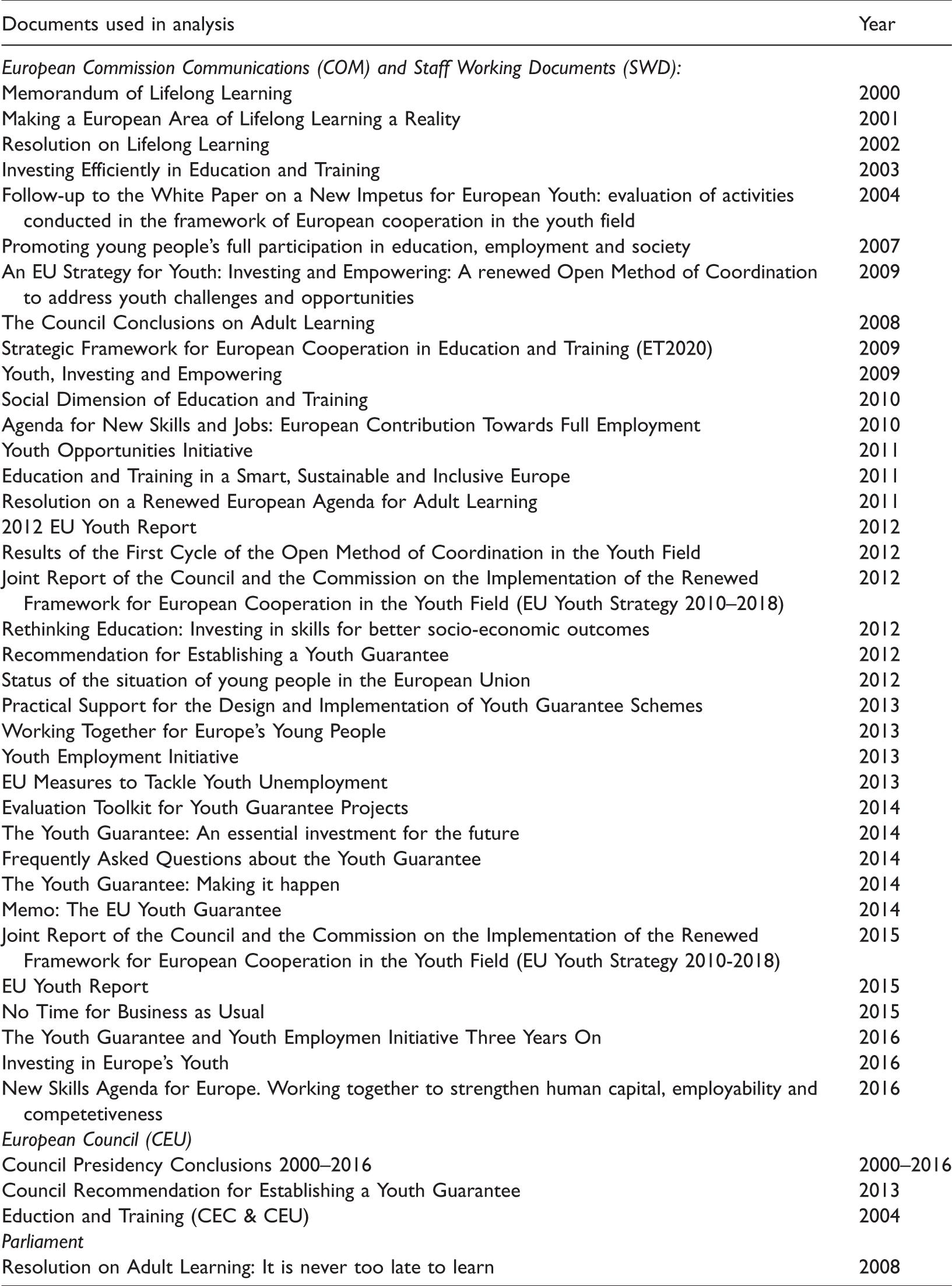
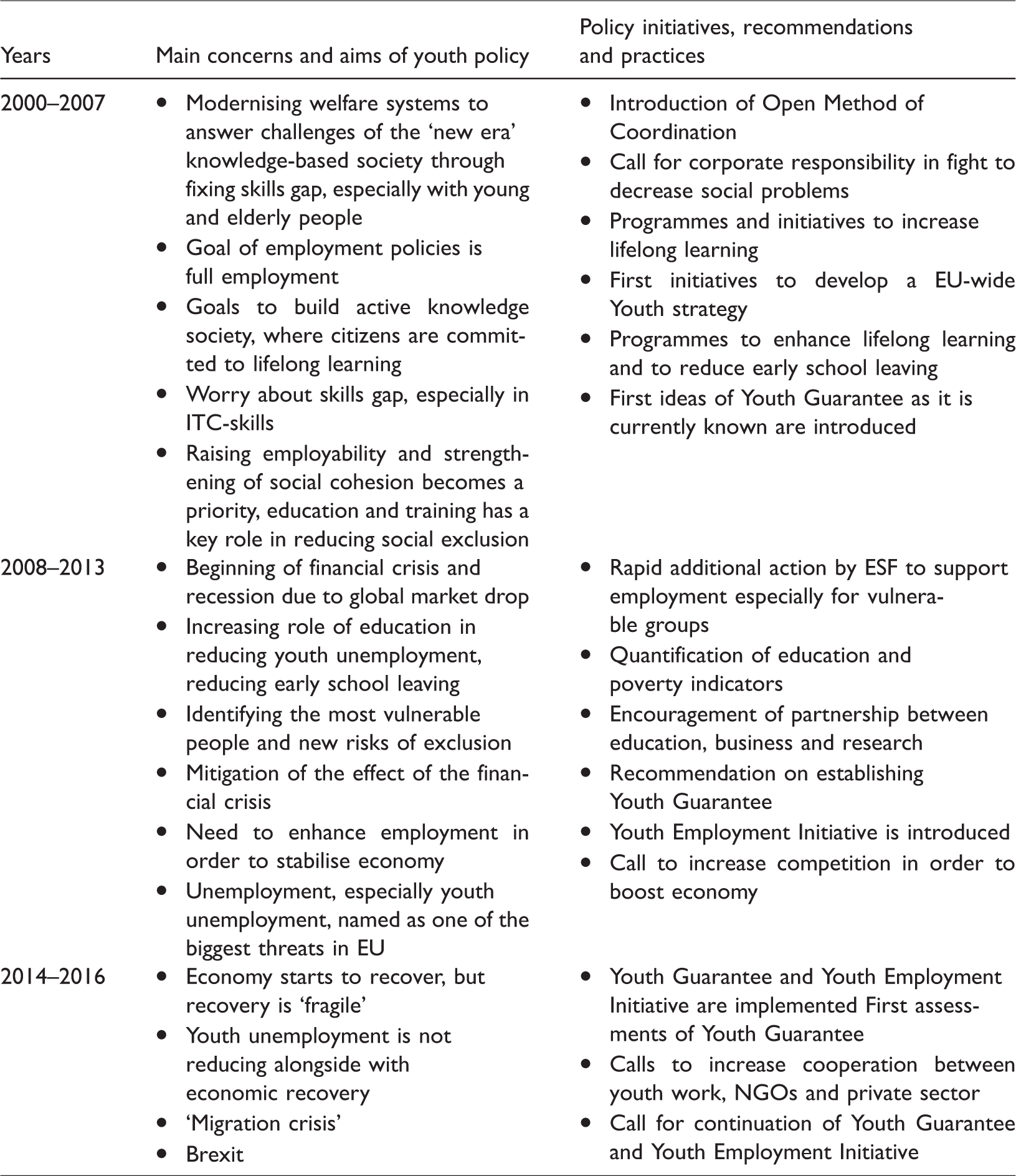
We started our analysis by scrutinising the most recent documents (in 2015 and 2016), and asked what discourses seemed to be unquestioned and seemingly self-evident. Then, after establishing discourses of employability and precariousness as such, we continued our analysis by tracing the ways in which these discourses emerged after the Lisbon Strategy and started to map how they intertwine and work together. We limited the range of documents from the most current back to those from the Lisbon Strategy because, based on the literature presented previously, the Lisbon Strategy marked a change in the process of decision-making in the EU. The Lisbon Strategy is thus a good starting point for considering which discourses have changed or been reinforced through a decade and a half of economic and social change. Finally, we considered how the emergence of these discourses changed and affected the ways in which youth policy steering was legitimised in documents. Table 1 shows the documents we used in our analysis, and Table 2 presents the main concerns and solutions in youth policies and the most notable solutions to them in the pre-recession, recession and post-recession eras.
Youth policy concerns and measures 2000–2016
The alliance between employability and precariousness in European youth policy
In our analysis, we were able to define three periods in EU youth policy discourses starting from the Lisbon treaty in 2000: the pre-recession, financial crisis and post-recession eras. In the pre-recession era (2000–2007), youth policies were discussed by the European Council and Commission through changes in the European governing system itself. The goal for the EU area in the documents was full employment for everyone, and youth-related policies focused mainly on enhancing lifelong learning skills and reducing early school leaving. During the financial crisis (2008–2013), the focus of EU policy was mainly on reducing mass youth unemployment – the consequence of financial crisis. Finally, by the post-recession era (2014–2016), the focus of youth policy was still on reducing youth unemployment, but also increasingly on finding the young people seen as ‘the most vulnerable’ and focusing on special and specific measures for them. Throughout these three stages, we found that in the documents analysed, the discourses of young peoples’ employability and precariousness surfaced and changed hand in hand with wider economic and societal developments that occurred during each defined period. It is important to note that while the presentation of these three periods follow time progression, we are not claiming that these developments represent a somewhat coherent ‘progressive narrative’ of discourses of precariousness and employability. Rather, our aim is to illustrate the relations between structural conditions and contingent changes that function hegemonically in policy discourses over this time period.
Pre-recession era: Finding success for all Europeans
The Lisbon Strategy sets as its main goals full employment throughout the EU and becoming the most competitive economy globally. This aim was elaborated through the importance of information technology and related skills as essential parts of employability, and so-called info-exclusion from the internet and network technology was seen as a perilous risk. This is evident in several declaration points in the Lisbon Strategy: 25. Europe's education and training systems need to adapt both to the demands of the knowledge society and to the need for an improved level and quality of employment. They will have to offer learning and training opportunities tailored to target groups at different stages of their lives: young people, unemployed adults and those in employment who are at risk of seeing their skills overtaken by rapid change. (COE, 2000: 7, the Lisbon Strategy, Authors’ emphasis) —improving employability and reducing skills gaps, in particular by providing employment services with a Europe-wide data base on jobs and learning opportunities; promoting special programmes to enable unemployed people to fill skill gaps; […] Progress towards these goals should be benchmarked. (COE, 2000: 8–9, the Lisbon Strategy, emphasis added)
During 2004, due to the slowing of economic growth, the European Council started to name early school leaving, vulnerable young people and social exclusion as major policy areas (CEU, 2004). Following this line of policy action, in 2007 the European Commission initiated measures targeting especially young people (COM, 2007) where young people’s social exclusion started to be connected more tightly to the social costs of that exclusion. The main focus was on specific outliers from general healthy trends: young people experiencing unemployment and poverty and special attention was given to skills of young peoples’ employability: Education is crucial for young people’s transitions into labour market and successful integration and participation in society. However the significant number of young people leaves education systems without having acquired the skills needed for a smooth transition into employment [sic]. (COM, 2007: 3, Promoting young people's full participation in education, employment and society, emphasis added) While overall conditions for young people in Europe today are positive – freedom and security, prosperity, longer life expectancy – there is increasing concern that many of them cannot prosper. High rates of child poverty, poor health, school drop-out and unemployment among a too large number of young people, indicate a need to review the investments Europe is making it its youth starting earlier, also taking into account the essential role of families. Social exclusion of young people carries high social costs and needs to be prevented. (COM, 2007: 2, Promoting young people's full participation in education, employment and society, emphasis added)
In the pre-recession era, youth policy showed increasing signs of being tied more closely to neoliberal rationality. Young people identified as being ‘at risk’ were brought closer to the centre of youth policies, and their integration and membership in society was tied to their stance in labour markets. Employability as a discourse was targeting and producing opportunities to tackle unemployment with no specific focus on young people per se, but increasingly youth policies targeted employability of disadvantaged young people to bring these outliers in to line with the perceived social and economic position of the vast majority.
Economic crisis and emergence of precariousness as a ‘quality’ of young people
After the global economic crisis in 2008, there was a shift in emphasis in youth policies. Demands for education focused increasingly on the employability of young people as a group became common. Our analysis found that along with the strengthening of employability discourse in youth policy, there was a move away from including outliers in a positive labour environment to a more global idea of the precarious situation of all young people.
In their responses to the mass youth unemployment, the European Commission emphasised enabling young peoples’ social inclusion through various measures and initiatives. For example, the Commission’s communication Results of the first cycle of the Open Method of Coordination in the youth field (2012) describes problems and actions concerning young peoples’ situation as following: The EU Youth Strategy contributed to these efforts by making youth employment the overall thematic priority during the first Trio Presidency. This resulted in recommendations and proposals for action through Council resolutions addressing the social inclusion of young people, and the role of youth work in employability and accessing jobs. (COM, 2013, Results of the first cycle of the Open Method of Coordination in the youth field; emphasis added) Young people struggle to find a foothold on the labour market. These difficulties have been amplified during the current crises, with young people often being the first fired and last hired in such economic circumstances. (COM 2013: 2 , Proposal for a Council Recommendation on Establishing a Youth Guarantee, emphasis added) Young people have been hit particularly hard during the crisis. They are vulnerable because of the transitionary life periods they are going through, their lack of professional experience, their sometimes inadequate education or training, their often limited social protection coverage, restricted access to financial resources, and precarious work conditions. […] Furthermore, some young people are at a particular disadvantage or at risk of discrimination. Appropriate supportive measures are therefore required, whilst recognising young people's individual responsibility in finding a route into economic activity. (CEU, 2013: 2, Councils Recommendation on Establishing a Youth Guarantee, emphasis added)
Although precarious conditions seem to apply to young people as a group, the discourse recognises different ‘levels’ of vulnerability and risk, as can also be seen in following exert: Yet others, often more disadvantaged young people (such as those with low skills of other barriers), will need deeper, longer and more complex interventions and the use of tangible offers in order to ensure that they too benefit from the Youth Guarantee. (COM 2012: 2, Commission proposal for establishing Youth Guarantee, emphasis added)
Our analysis found that when talking about employability and young people, the focus and goal of enhancing skills was no longer focused on gaining entry to labour markets, but the policy also sought to ‘boost the confidence’ of young people and thus increase their belief in their future prospects in otherwise risky conditions: Essential reforms must therefore be flanked by fast-acting measures to boost growth and to help young people find jobs and acquire essential skills. These measures will boost confidence and show young people that they have a bright future. (COM, 2013: 2, A call to action on youth unemployment. emphasis added)
Post-recession: Normalising precariousness of young people
The aftermath of crisis and slow but steady economic growth after 2013 reduced overall unemployment rates throughout the EU, but youth unemployment still remained higher than before the increase in 2008 (EUROSTAT, 2017). As we noted earlier, Youth Guarantee (COM, 2013) had taken notice of those seen as the ‘most vulnerable’, but the focus of the guarantee and youth policy was still on all young people. In the Commission report ‘Youth Guarantee: Three years on’ (COM, 2016) the situation of young people has been described as being better than it was after the youth unemployment peak in 2013, but the situation is not yet too hopeful. Although the worst peak of financial crisis seemed to be over, the measures still aim to decrease further the number of young people in unemployment, or ‘at risk’: Despite this significant decrease, the youth unemployment rate remains high in the EU and masks big differences between countries. This Communication – and accompanying Staff Working Documents – therefore outlines further action to be taken to continue reducing youth unemployment. (COM, 2016: 11, Youth Guarantee: Three years on, emphasis added) Despite these positive developments, more effort is needed to support those young people who are furthest away from the labour market, i.e. the NEETs who have traditionally been hardest to reach out to (even before the crisis) and have benefited the least from improvements to date. This is the case in particular for those facing poverty, social exclusion, disability and discrimination, including those belonging to an ethnic minority or with a migrant background, asylum-seekers and refugees. (COM, 2016: 11, Youth Guarantee: Three years on, emphasis added) The gap is widening between young people who study, are confident of finding a job and engage in social, civic and cultural life, on the one hand, and those with little hope of leading a fulfilling life and who are at risk of exclusion and marginalisation, on the other hand. (COM, 2015: 4; Youth Report follow-up, emphasis added) Jobs are crucial but not always enough to ensure full inclusion. Education and training can provide young people with skills needed in the labour market and help overcome inequalities and promote upward social mobility. The urgent challenge for education and training across the EU is to invest and modernise quickly enough to realise this potential. Youth policy, operating outside the classroom, can also help young people acquire the right mix of skills to prepare them for life and work. (COM 2015: 14–15, Youth Report follow-up, emphasis added)
Conclusion
In an era marked by an increasing normalisation of neoliberal political rationality, policies are built around the avoidance of risk which can be managed through sets of practices. In the administration of European youth policy, these practices include policy initiatives for gaining skills and avoiding irresponsible or risky behaviour. The life situations of young people are often ascribed by categorical thinking as being inherently and perpetually ‘at risk’ despite not having a clear sense of what those risks are, how risks are linked to wider systemic issues, nor how those risks themselves should be addressed. We see a danger that this risk is reduced in policy to a problem of individuals whereby they are considered to be perpetually deficient in certain pre-determined specific skills and knowledge sets. In turn, rather than articulating how to mitigate systemic and structural unemployment, policies are directed at solving individual youths’ unemployment, and ultimately at building their own sense of commitment to building perpetual individual skill assets.
At the same time, the ideas about young peoples’ precarious position in labour markets is currently presented as being self-evident and a ‘natural’ way to exist. In EU youth policy, discourses of employability and precariousness seem to form a ‘double helix’. In other words, they work in alliance as mutually reinforcing discourses promoting and constructing neoliberal rationality. By this we mean that discourses of employability seem to be based on the assumption that young peoples’ labour market options are precarious. This, in turn, means that individuals’ employability must be enhanced in order to mitigate the risk of unemployment and future precariousness. In EU policy settings, this produces the assumption that young people with different skills for employment are constantly competing in scarce labour markets, and thus in order for individuals to manage and cope with their employability skills, these skills must be constantly enhanced, measured and evaluated. As a result, in the state of constant competition, individuals’ situations grow more uncertain and even more precarious. Discourses of precariousness and employability construct ‘at risk’ as a constant condition for all young people; preparing oneself to survive precarious conditions is seen as a requirement for a productive life. Yet, even though these discourses seem to target all young people in youth policies, there are also calls for tightening control and surveillance over those who are seen as outliers or especially ‘at risk’ of marginalisation – namely those young people who are already marginalised in one way or another. These discourses of employability and preciousness seem to work as normative frameworks and to be normalised to all youth. However, as young people are assessed and measured, and the extent to which one is seen capable of self-control and self-conduct determines different set of measures
Through identifying the alliance of employability and precariousness, we have shown how the EU policy steering as a form of governing works by producing and legitimating the ideal, and thus, the preoccupied neoliberal rationality of the market-oriented order. It is important to interpret this finding in light of what we have shown in our earlier work in the project, namely that the form of governing related to policy steering and its implementations do not turn targeted young people into passive objects. Rather, governing cannot work unless the targets are capable of being met and unless governing offers compelling forms of agency for young people provided in the form of an employability discourse: skills, self-management, independence and freedom (see Brunila, 2013; Rose, 1999). Also, this promise of individual success by cultivating the right set of skills is also how young people end up circulating in various types of support systems – it works as a cruel promise that seldom leads to desired outcomes, especially for the historically marginalised young people (see Brunila et al., 2016; Kurki et al., 2018; Masoud et al., in press). Thus, we claim that is essential to understand that policy aimed at promoting the situation of young people in a context of economic precariousness is neither neutral nor objective but is tied to ideals of neoliberal rationality.
We would also suggest that based on the analysis we have shown in this paper, the financial crisis and its aftermath provided an opportunity to introduce neoliberal political rationality about competition, individual responsibility for one’s future and the need to develop oneself constantly through the emergence and hegemonisation of the interacting discourses of young people as ‘at risk’, employability as a problem and goal, and the accepted precariousness of labour markets. A significant implication of this trend is that systemic issues including poverty and discrimination arise as extra deficits that individual skill-development and vague ‘investment in human capital’ can solve rather than as areas for direct policy imperatives.
However, it is important to note that although discourses of employability and precariousness seem to be self-evident and unquestionable in EU youth policy steering, the policy context does not exclude the existence of other discourses concerning young people. In this study, we have not considered the implementation of these discourses on national practices at the grassroots level. We would suggest that further research should look more closely into the specific ways that these policies are realised at the national level. Our findings suggest the need for further examination of how these discourses work in local contexts.
Footnotes
Declaration of conflicting interests
The author(s) declared no potential conflicts of interest with respect to the research, authorship, and/or publication of this article.
Funding
The author(s) disclosed receipt of the following financial support for the research, authorship, and/or publication of this article: This research is part of reserch project ‘Interrupting Youth Support Systems in the Ethos of Vulnerability (CoSupport) funded by Academy of Finland.