




Abstract
What is the significance of regulations of job contracts and wages when it comes to young people’s access to labour market? This is an issue that has attracted and continues to attract a great deal of interest in both research and politics. Proposals for deregulated employment protection and reduced entry-level pay recur regularly in public debate. In our view it is incomprehensible how sectors of the labour market that are dominated by jobs with low productivity and unstable employment conditions could be expected to offer a permanent solution for the large group of young people who are currently finding it difficult to enter the labour market and reach an acceptable standard of living. Instead, the responses to the challenges facing young people in the labour market could involve training in the form of apprenticeships rather than more insecure jobs and/or lower pay. Essentially, our starting point is that apprenticeship training could provide a more accurate response to the challenges facing young people in working life. This response would not involve the costs in terms of increased social polarisation and increased social risks that may follow in the wake of an increasingly deregulated labour market.
What is the significance of regulations for job contracts and wages when it comes to young people’s access to the labour market? This is an issue that has attracted and continues to attract a great deal of interest in both research and politics. Proposals for deregulated employment protection and reduced entry-level pay recur regularly in public debate. Would less far-reaching regulation of employment protection and a wage structure that permits lower entry-level pay reduce the problems that affect young people as they make the transition from school to work? Would this transition be less protracted, and would young people with weaker educational backgrounds find it easier to find permanent jobs?
If we try to find some answers based on research, we can state that the theoretical and empirical standings available are far from clear (O’Higgins and Moscariello, 2017). According to most studies, regulating employment protection would reduce fluctuations in the number of people employed over business cycles. This may bring about a division between ‘insiders’ and ‘outsiders’, young people belonging to the latter category (Bentolila et al., 2011; Lindbeck and Snower, 1988). However, at the same time it is possible to discern several positive effects of more regulated employment protection. Longer time horizons associated with recruitments can increase interest in learning and pave the way for more innovative work organisations (Acemoglu and Pischke, 1999). All things being equal, lower entry-level pay will make it easier for young people to enter the labour market; but at the same time, this may involve jobs of short duration, with low pay and limited livelihood opportunities. The division of the labour market into various segments would increase, with more fulfilling jobs and higher pay in parallel with less qualified jobs for lower pay. Productivity might also be inhibited. Low pay may work as a subsidisation of less productive companies and long-term growth of welfare resources for private and public consumption may be reduced (Kleinknecht et al., 2014; Vergeer and Kleinknecht, 2014).
We wish to expand the perspective on regulation operations and discuss the reregulation that has taken place in working life over the last three to four decades. Changes in working life are linked to new competitive conditions, new technology and changes in work organisations. Development is moving away from what has been referred to as the industrial society to the post-industrial society. How will these long-term changes in employment regulation and demands on the workforce affect conditions for young people’s labour market establishment? With increasing flexibility comes more stringent demands in terms of responsibility and adaptability. For parts of the workforce, the changes in working life are leading in a direction that will provide richer opportunities for development and influence over work (functional flexibility), while for others flexibility requirements are reflected primarily in increased interchangeability (quantitative flexibility). How do these adaptation requirements of the working life affect opportunities for young people? And what skills and experiences do young people need to be able to cope with?
Reregulation of the working life
The changes in working life over the past few decades has to be viewed against the background of what has been referred to as Fordist production structures and Taylorist management methods. Fordism is linked with the mass production technology that was developed in the USA in the early 20th century, the crucial components of which were electricity, the internal combustion engine and the production gains that could be made in the wake of the principle of the interchangeable parts (Lundh, 2010). Far-reaching mechanisation of production and organisation of manufacture along assembly lines followed in the wake of Fordism. Taylorism refers to the principles for management, summarised in the term ‘scientific management’. The main characteristic features of Taylorism were the division of work process into smaller parts with the purpose of increasing the production volume and guaranteeing supervisors better control over the production flow. The requirements for workforce skills were relatively low and homogenous, and the criteria for mobility and full employment were good. However, the conditions began to change from the 1970s onwards.
A central element in the changes of working life from the 1970s and 1980s involved the significance of what are known as ‘internal labour markets’. It was recognised that relatively small pay differences, long-term employment contracts, clear career development based on seniority and training initiatives increased companies’ efficiency and competitiveness. In research into the working life, things appeared to be looking very bright compared to the gloomy description of an increasingly tedious world of work as set out in Harry Braverman’s influential study (Braverman, 1974). Both employers and employees had an interest in defining the terms for long-term employment contracts. Peter Doeringer and Michael Piore, a couple of American researchers, emphasised three fundamental explanatory factors for this development: the significance of company-specific expertise, the need for training connected to the work place, and the power of customs (Doeringer and Piore, 1971).
The value of company-specific expertise was due to the fact that technical development was in itself company-specific and therefore varied from company to company, though on the surface production trends could appear similar. Significance of training of the workforce, primarily by means of informal learning, was also linked to the fact that tasks were company-specific in nature and required skills and expertise that were offered to only a minor extent via regular training institutes or schools. Much of the valuable knowledge connected to work and expertise were of a tacit nature. Customs and norms developed at all places of work, and breaching these were costly in terms of efficiency and production losses. Risks and major costs associated with recruitment and training of new staff increased interest in offering long employment contracts.
However, some researchers pointed out that the favourable job-conditions for parts of the workforce were by no means shared by all, not even among the well-educated workers, and that conditions were largely dependent on which segment people worked (Gordon et al., 1982). A core of employees, that is, insiders, was able to get good terms with secure employment conditions and stimulating tasks to perform. People who failed to establish themselves in the internal labour market, and ended up in the periphery, were instead referred to jobs that offered neither training opportunities nor social security in the form of employment connected benefits. After the crisis in the early 1990s and the later 2008–2009 financial crises, this development has been reinforced with an increasingly large group of people in what are known as precarious atypical jobs (short-term contracts, part-time work, etc.) (Standing, 2014). According to an assessment, the number of people employed in atypical jobs within the EU increased from 7.5% 1980 to 14% in 2011 (Bentolila et al., 2011).
Thus the labour market has become more segmented and divided between sectors, with secure jobs with better pay conditions and sectors characterised by poorer job conditions (Frazer and Marlier, 2010). It is in this latter sector that we can find a group of social vulnerable citizens defined as the precariat by Guy Standing. The precariat includes many young people with limited social networks and weak educational backgrounds. In a European context we can conclude that this group of young people often lack completed upper secondary education (Standing, 2014). It is a large group that in 2016 encompassed around 17% of all young adults aged between 20 and 24 years old in EU member states (Eurostat, nd).
In our view it is incomprehensible how sectors of the labour market that are dominated by jobs with low productivity and unstable employment conditions could be expected to offer a permanent solution for the large group of young people who are currently finding it difficult to enter the labour market and reach an acceptable standard of living. Instead, the responses to the challenges facing young people in the labour market could involve training in the form of apprenticeships rather than more insecure jobs and/or lower pay. The significance and strength of apprenticeship training can be visualised in light of three distinguishing features. First, it relates to a training model that provides a point of contact with working life and that is related to direct recruitment needs within companies and other organisations. Second, it relates to training that has to be updated continuously in relation to the skills needed in working life. Third, it relates to training that not only provides defined occupational skills but also focuses on the capacity for new learning – in both a professional and a social context – and that is a key factor to modern working life.
Essentially, our starting point is that apprenticeship training could provide a more accurate response to the challenges facing young people in working life. This response would not involve the costs in terms of increased social polarisation and increased social risks that may follow in the wake of an increasingly deregulated labour market. We will return to this issue later in the article, but first we would like to say something more about the significance of labour market regulations from a social perspective.
Labour market regulations in Sweden and other countries
Compared with Anglo-Saxon countries, Sweden has a more regulated labour market. In a regulated labour market, wages and employment conditions are not determined directly by market forces of supply and demand or solely by individual agreements. Collective agreements between labour market organisations and/or government legislation are of major importance. At the same time, a common perception during latter years has been that the rigid regulations of the labour market in Nordic countries (with the exception of Denmark) – as in several countries on the continent, primarily in southern Europe – have brought about reduced flexibility, more unfavourable employment conditions for youth and generally lower economic growth. This perception has been motivated by the fact that – among other things – globalisation is thought to increase the requirements for rapid adaptation to altered market conditions. According to this approach, that is heavily connected to the neoclassic school of economics, institutions that make it more difficult for companies to adapt the costs of the workforce quickly lead to a less effective distribution of workforce and capital, and hence reduced competitiveness.
In connection with this perception, it is often claimed that an excessively generous unemployment insurance and other income security systems are further helping to reduce the capacity for adaptation on the labour market. High remuneration from unemployment insurances may act as a wage-driving factor and hence contribute to reduced employment. The job-search intensity of unemployed people may decline as well as their willingness to accept job offers, which may lead to higher unemployment. Economists usually refer to an increase in the reservation wage, that is, the lowest wage an unemployed individual is prepared to accept facing a job offer. According to a popular view, the level of the reservation wage is highly affected by the income replacement rate, in combination with the length of the compensation period, offered by the unemployment insurance (Layard et al., 1991).
These interpretations of the labour market have been launched internationally by organisations such as the OECD and the IMF. They are sometimes described as the ‘orthodox’ interpretation, as they attach so closely to the neoliberal or neoclassic perception of the functioning of the social economy (Björklund et al., 2014). Essentially, unemployment is primarily viewed as a result of regulations of employment protection and collective agreements that results in a wage setting above the point of market clearing and full employment. Various obstacles to mobility, such as high taxes and generous benefit systems, also contribute to a higher level of equilibrium unemployment. Unlike in Keynesian-inspired analyses, emphasis is not attached to the significance of the demand in terms of opportunities for the unemployed to find jobs. Socio-psychological factors connected to the intrinsic importance of work for human development and social quality are not taken into account (Van der Maesen and Walker, 2012). The emphasis is on economic incentives that may affect the labour supply of individuals. At the same time, it is important to emphasise that work is of key significance to mental and physical wellbeing of humans. Opportunities to get a job do not simply influence livelihood opportunities, but are of significance for the self-perception, identity as well as for learning opportunities and a sense of belonging for individuals.
However, the conclusions in the reports from the OECD and IMF have not remained unchallenged. As highlighted initially, there are studies who indicate that employment regulations and collective agreements on the labour market increase efficiency (see also Agell, 1999 and Ahlberg et al., 2006). Major comprehensive trade union organisations are taking broader socioeconomic responsibility and facilitating the introduction of new technology. Some authors talk about the importance of social productivity coalitions (McLaughlin, 2013). The culture connected to the collective agreement system promotes cooperation and counteracts conflicts, and a relatively limited wage distribution in combination with long-term employment relationships facilitates investments in occupational and company-specific competence. High unemployment figures in general and high unemployment among young people in particular have been linked with general demand situations and changes in qualification requirements, rather than with regulation operations on the labour market. These perspectives will be examined in greater detail below.
Do regulations reduce efficiency and social welfare?
The high level of unemployment in a number of western European countries from the 1970s subsequently led to more and more researchers starting to focus their searchlights on various labour market regulations. The policy implications presented by these researchers received support in the influential report The OECD Jobs Study (OECD, 1994a) in the 1990s. The analysis assumed that the weak development and employment and high levels of unemployment in several western European countries, compared with conditions in the USA, could be ascribed to excessively regulated employment protection, generous unemployment benefit with high replacement rates and long remuneration periods, and high tax wedges due to large payroll cost supplements.
A range of studies initiated by the OECD have compared countries’ degree of employment protection in the form of an index – the Employment Protection Legislation Index (EPI) – that assumes a value between 0 and 4. The EPI weighs together various factors such as procedures on termination of employment, seniority rules, rules on temporary employment contracts, provisions relating to severance pay, etc. The OECD’s follow-ups to the Jobs Study report stress that most countries had eased the rules on employment protection, compared with conditions in the late 1980s, which resulted in a general tendency towards a falling EPI (OECD, 2006).
There had been significant easing of employment protection in Sweden as well since the 1980s, primarily by giving employers greater opportunities to offer temporary employment contracts. Despite this, Sweden remained at a relatively high regulation level as late as 2013, with an index of 2.6 compared with 1.1 the United Kingdom and 0.3 for the USA – two nations with liberal regulations of the labour market and weak trade unions. 1 It must be emphasised, however, that this assessment relates to regulations of permanent employment contracts. Countries such as Germany and France, as well as a number of southern European countries, ended up with indexes higher than Sweden. Finland and Norway had indexes that were slightly below the index for Sweden. Even Denmark, with its flexicurity model, ended up lower (2.2). The average for all OECD countries was just over 2. The trend in most of countries, including Sweden, was for employment protection to be reformed, but the changes did not affect people with permanent employment contracts to the same extent as people holding various temporary job-positions.
If we look at the index produced by the OECD for regulation of temporary employment, a completely different picture emerges. Sweden has very weak regulations of employment protection for temporary employees, with an index of 0.8. All Nordic countries, except Iceland, come out with a higher index, and the average among OECD countries is also significantly higher (1.7). In practice, employers’ options for offering short-term job-positions have been extended very significantly in Sweden. Sweden had an index of approx. 4 at the start of the crisis in the 1990s. Thus, there has been a very significant decline since then. Developments since the early 1990s have been characterised by the fact that not only the percentage of young people in gainful employment has fallen but also the proportion of people in gainful employment working in temporary positions is considerable higher than in the late 1980s. 2 One explanation might be that a higher share of young people combine work with education compared to the situation before the 1990s, but the liberalisation of employment contracts is reasonably of major importance. Unfortunately, we do not have access to any statistics on the share of youngsters on temporary contracts combining work and education. In Figure 1, we include a graph showing the total share of students as a proportion of the population between 20 and 24 years old. The expansion in the numbers of students among young adults might be one of the explanations behind the higher share of temporary employees, but it is obviously not the only explanation.
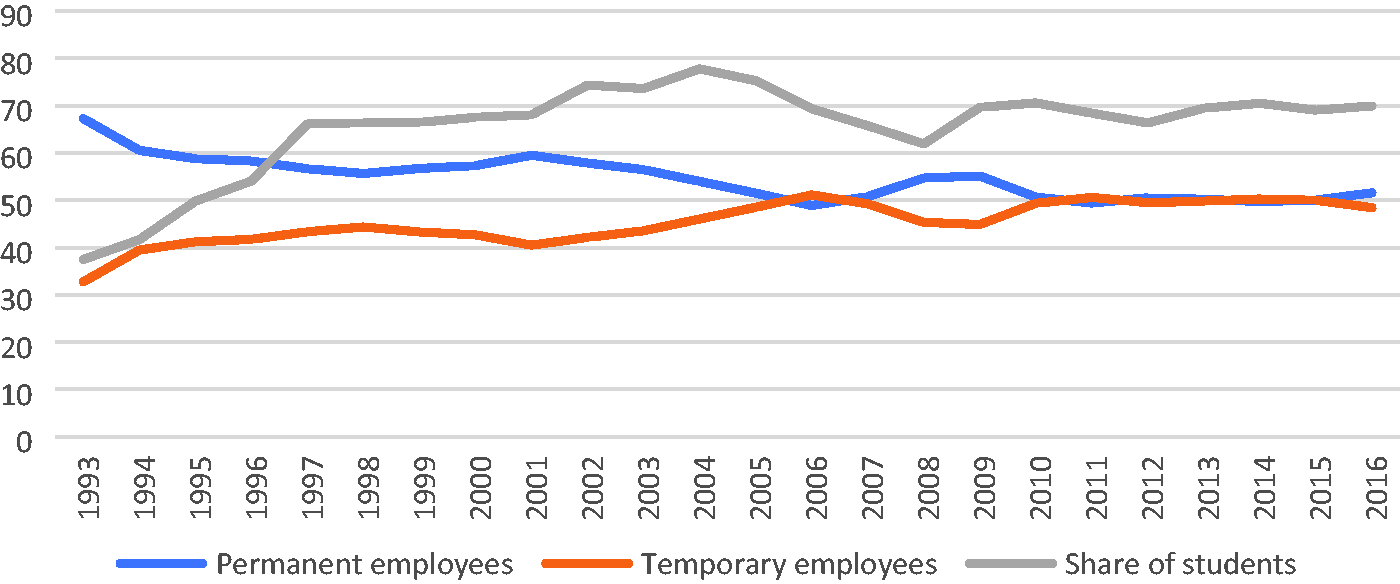
Percentage of permanent employees, temporary employees and students aged 20–24, 1993 to 2016.
A number of the countries that followed the recommendations made in the OECD Jobs Study also changed their regulations of unemployment benefits. Sweden is one example of the countries where income replacement levels have been reduced and remuneration periods have been shortened. The requirements for eligibility for remuneration have been made more stringent. The rise of temporary employment has led to many young people in Sweden finding it very difficult to meet the qualification requirements for benefits (what is known as the ‘employment condition’). At least six months of paid continuous work is required in order to be eligible for basic benefits. However, a year of paid work is required for entitlement to income-based benefits. Only a minority of unemployed young people aged under 25 are members of an unemployment insurance fund. In practice, many are referred to municipal social welfare. In a comparison between OECD countries, it emerges that the level of remuneration is relatively high in Sweden from an international perspective, but low compared with the other Nordic countries. Finland, Denmark and Iceland all have higher remuneration rates. The percentage of unemployed young people with low incomes who are lifted above the poverty line after social benefits and contributions is also low compared with the corresponding figure for people aged 30 and over: approx. 40% compared with just over 60% (OECD, 2016). In other words, the poverty risks are significantly higher for younger people than for older people, a fact that reflects that the security systems are less generous for young than middle-aged and older people.
It is important to view the institutional conditions on the labour market in a broader context and in a dynamic perspective. Rules on employment protection and provisions on entry-level wages, as well as insurance protection in the event of unemployment, influence one another. Research shows, for example, that any negative effects of higher entry-level pay on youth unemployment can be neutralised by more far-reaching employment protection (the tendency that fewer people have their employment terminated is stronger than the tendency that fewer people will be employed) and a salary structure based on coordination (which not only facilitates macroeconomic stability, but also favours high-performance, expansionary companies that do not need to adapt wages to the productivity of single employees) (O’Higgins and Moscariello, 2017).
Regulations and labour market risks for youth
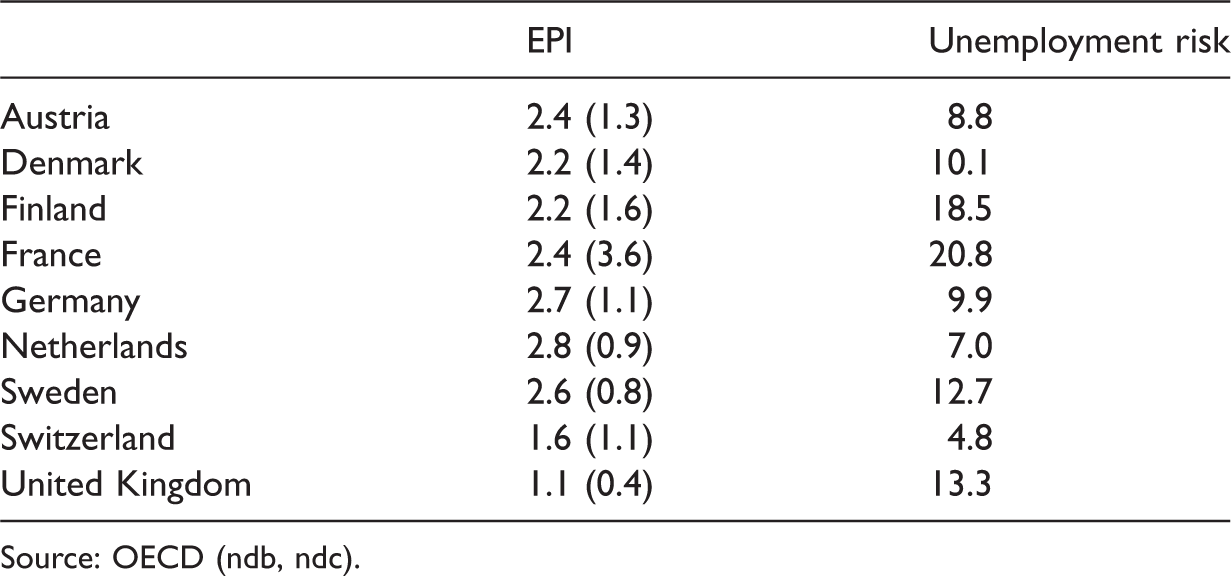
The OECD has weighed together various measures of young people’s unemployment risks and income protection in order to gain a comprehensive indication of employment quality and risks on the labour market. The risk of becoming unemployed, the likely length of periods of unemployment and the percentage of income losses covered by social insurance schemes and contributions are just some of the factors measured here. 3 We can start by looking more closely at the risk of unemployment for young people aged under 30 in a selection of countries. This measurement reflects the total inflow in unemployment in a certain month (compared to the numbers in unemployment the month before) in combination with the average length of the period of unemployment, and is expressed in percentage. In Table 1, the risk of unemployment is also related to the index for the degree of employment protection relating to permanent employment contracts (EPI). The EPI for temporary employment is specified in brackets.
EPI and unemployment risk for young people aged 15 to 29, expressed as a percentage.
Source: OECD (ndb, ndc).
The data in the table does not indicate a given link between EPI and unemployment risk. France is a country with far-reaching government regulation of the labour market, regulations that are being reassessed after the latest presidential election in 2017. Above all, this is reflected in restrictive provisions as regards temporary employment. The unemployment risk is also very high. However, the same is true in United Kingdom, where regulation of both permanent and temporary employment is very moderate. The unemployment risk among young people under 30 years old is relatively high in Sweden as well, even though the rules relating to temporary employment are liberal and generous from an employer perspective.
Of course, all this illustrates that other factors are of major importance. We will return to the fact that the education system, and not least apprenticeship training, is of significance. Several of the countries with low unemployment risks in Table 1, with the exception of Finland, have well-developed apprenticeship systems, and this in turn could explain why the transition from school to work is more effective and is characterised by fewer interruptions and lower social risks. The apprenticeship model is characterised by the fact that significant elements of the training take place at workplaces. Among other things, this means that recruitment is facilitated. The risk perceived by individual employers in connection with recruitment is reduced; a risk that is likely to be more perceptible in countries with stricter employment protection and higher entry-level wage.
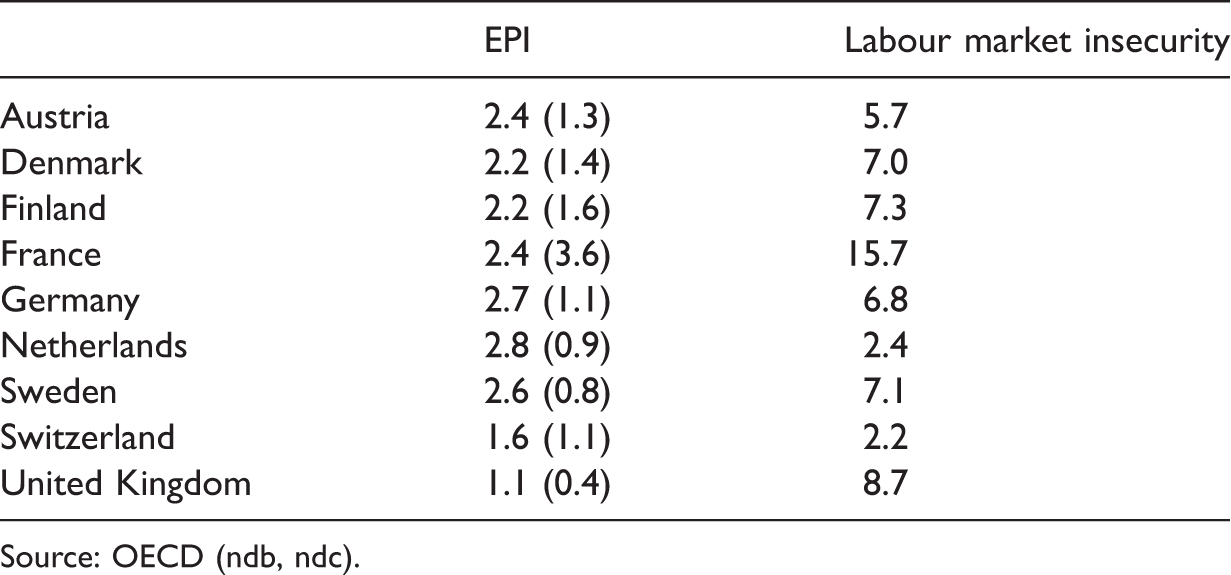
As stated above, the OECD also reports a broader measure of labour market insecurity for young people under 30 years old in different countries. This measure weighs together the unemployment risk and the expected loss of earnings associated with the income replacement levels of unemployment insurance schemes and social welfare system in different countries. Table 2 shows the EPI data (for permanent employment contracts and temporary employment) and the labour market risk, expressed as a percentage, for young people in the same countries as in Table 1. 4
EPI and labour market insecurity for young people aged 15 to 29, expressed as a percentage.
Source: OECD (ndb, ndc).
The labour market insecurity can be interpreted as a broader measure of young people’s conditions on the labour market, the degree of vulnerability linked with the risk of becoming unemployed and losing income. This broad measure provides the same differences between the countries that could be distinguished earlier. Regulations of employment protection do not appear to provide a decisive explanation to the variations in labour market risks. France, with its stringent regulation operations, demonstrates high labour market insecurity. But even the UK, with its liberal scheme on the labour market, have relatively high unemployment insecurity. Denmark, Finland and Sweden report lower labour market insecurity than the UK. The other countries such as Netherlands, Germany, Switzerland and Austria also shows low or comparatively low labour market insecurity for young people. In these countries, this is not explained to any major extent by the fact that young people are offered generous unemployment benefits. Instead, the primary explanation is low unemployment. These are also countries with firmly supported apprenticeship systems. Again, there is a lot to indicate that multiple factors are of significance when interpreting young people’s opportunities and vulnerability in working life. The structure of the transition from school to work, primarily the vocational training system, appears to be of major significance.
More aspects on regulations – the significance of social safety networks
As stated at the outset, the assessments of negative effects of statutory employment protection and relatively high entry-level wages on employment and unemployment levels, associated with the OECD’s analyses, among other things, have not been confirmed. Critical researchers who have reviewed the data from the surveys have pointed out that the alleged links are largely due to the choice of period, the fact that the causal links between the level of unemployment benefit and unemployment figures – for example – have not been clarified and the fact that employment protection, as stated previously, also helps to stabilise employment; even as fewer new employees are recruited, fewer existing employees have their employment terminated. For instance, it has also been highlighted that generous unemployment benefits help to include a higher percentage of the population in the workforce, while lower benefits leads to higher exit rates from the workforce during weak business cycles. Higher exit rates from the workforce means that recorded open unemployment falls as fewer people consider it meaningful to search for a job (Howell and Rehm, 2009). Hidden unemployment, or the number of latent jobseekers – which is the designation of the group in official labour force surveys – increases.
The established view of negative impacts of regulations on labour market efficiency in a number of western European countries, particularly compared to conditions in the USA, have also been questioned from other perspectives. Strong interest organisations and a coordinated wage structure may have positive effects on employment and the capacity for structural changes of economies. More even distribution of income and a generous system that guarantees social safety lead to fewer labour market conflicts and facilitate continuous innovations among companies. As stated previously, relatively high entry-level pay helps to increase interest in investing in skills and competence among the workforce, which increases productivity (Riley and Bondibene, 2017). Studies also show that stronger trade union representation at the workplace, more developed employment protection and more generous unemployment benefits have resulted not only in faster real wage growth, but also in less hierarchical and more democratic work organisations. The supervisory functions in more democratic work organisations become less onerous and bureaucratic (Buchele and Christiansen, 1998; Eichengreen, 2018). A good climate of cooperation in the workplace with longer timescales as regards employment makes it easier to pass on and benefit from the tacit knowledge of single workers that is so crucial to changes and renewal at a workplace (Vergeer and Kleinknecht, 2014).
The development of employment conditions and employment times follows a two-part pattern. The labour market in many countries, including Sweden, is characterised by a growth in temporary employment and various part-time jobs, not least among young people and more among women than men. The statistics indicate a high turnover of jobs every year. Approximately one-fifth of the existing jobs in Sweden are phased out every year, while about the same number are created. This illustrates major flows on the labour market and indicates an extensive dynamic. However, other relationships are concealed behind this data: the major mobility and flexibility in the economy does not appear to emerge as strongly as regards job tenures.
Again, in this regard we have to look at the data from the OECD (OECD nda). There is major variation between countries, but according to the OECD average job tenures have remained relatively stable over the past few years. Sweden was very close to the European average in 2016, with an average employment period of nine years. There is a link between the degree of employment protection and the average job tenures. Countries with a high employment protection index (EPI) also have longer average employment periods, while the opposite is true for countries with lower EPI. France has an average employment period of more than 11 years, while the corresponding figure for Denmark, Ireland and the UK – which have weaker employment protection – was less than nine years.
So in other words, the statistics do not indicate a general tendency towards shorter employment periods between 2000 and 2016. One interpretation could be that the data illustrates increasing division and segmentation of the labour markets, with large groups of people being either excluded or locked in involuntarily. Studies that indicate a link between efficiency and the length of employment periods on the internal labour markets contradict this perception. As stated, companies are more inclined to invest in skills development if it is expected that employees will remain with the business for a longer period. Employees who have worked at a company for a longer period build up company-specific competence that makes them particularly attractive and justifies greater investments in skills and seniority-based wage development. For the individual, as well as for the employee collective as a whole, guarantees of stable employment can act as a kind of insurance that motivates greater commitment and a more long-term perspective as regards pay development. Studies of differences between innovative and less innovative companies show that the former are more dependent on stable, long-term relationships with the workforce. Every day innovation work is largely based on initiatives from employees, and not just from employees at higher levels with backgrounds in academic education (Lundvall et al., 2008).
Summary: no straightforward effects
As stated in the introduction, studies into the impact of employment protection and unemployment benefits on employment and unemployment levels indicate that the effects are not unequivocal. That said, it could be stated that the institutions and regulations on the labour market influence the distribution of jobs and unemployment, as do the social consequences of not having a job. Subsequently, people who are critical of more far-reaching employment protection and trade union influence sometimes use the terms ‘insiders’ and ‘outsiders’, referring to the fact that people who are established on the labour market with permanent contracts – often adult men – have secure conditions, while new arrivals to the labour market, such as young people and immigrants, are penalised by means of protracted and recurrent periods of unemployment. In general, transition from school to work has often been described as less effective during later decades, and this is due to unmotivated regulations, strong unions and too narrow wage differentials.
However, this view has also been questioned. For example, there is no evidence to suggest that strong trade union organisations necessarily give rise to higher youth unemployment. An acclaimed study by Andrea Bassini and Romain Duval (2006) indicate a very weak negative link between the trade union organisation level and youth unemployment in OECD countries. Both this study and a later follow-up study also showed that a coordinated wage structure and a high coverage of collective agreements reduce unemployment among both younger and older people (Bassini and Duval, 2009).
It should also be noted that rules on employment protection, as well as higher unemployment benefits, have other values from both an efficiency standpoint and a social perspective. Weakening employment protection for people in permanent employment brings with it costs from a welfare and efficiency standpoint, without necessarily influencing overall employment or employment opportunities for groups that currently find it more difficult to establish themselves on the labour market. Therefore, a more reasonable strategy would be to concentrate and increase initiatives for groups that need more support. Experiences from a number of European countries indicate that apprenticeship training may be a recipe for success (Olofsson, 2014; Olofsson and Panican, 2018).
The significance of apprenticeship training
There are many advantages of apprenticeship training compared with vocational training provided primarily in schools (see, for example, OECD, 1994b, 2010). First, apprenticeship training assumes that employers will make training places available. The latter constitutes a guarantee for the fact that the training will focus on labour market areas where there is a perceptible demand for manpower. There are no corresponding guarantees in a training model based in schools, where students’ own choices control the composition of training places to a greater extent, as in the case in the Swedish upper secondary school-system.
Second, the workplace is a strong learning environment (Ellström, 2010; Olofsson, 2017). Students are able to use the latest equipment and gain an insight about the organisation of work. This means that they acquire both ‘hard’ and ‘soft’ qualifications in a manner impossible in an artificial learning environment. Schools rarely have the opportunity to offer students opportunities to use the latest technology or gain an insight into the latest work processes, a situation that underlines the significance of more extensive workplace-based elements in education. There is also a sociological and cultural aspect of relevance here. Apprentices become part of the community of practice in the work place and within an occupational group (Wenger, 2000). Learning is perceived as social practice. Knowledge is perceived in different ways, but social skills are always related to practical experience. By becoming part of the community of practice, apprentices develop gradually broadening skills within their occupational field and also assimilate the culture and identity associated with the occupation.
Third, apprenticeship training facilitates the recruitment of manpower. For employers, recruitment of new staff involves significant uncertainty and major costs. It is necessary to gain a view of the individuals’ reliability and capacity for work, given the various demands and pressures that may occur in a workplace and within a particular occupation. Apprenticeship training gives employers more favourable opportunities to test individuals’ capacity for work, but of course it also makes it possible to equip individuals with the qualifications that are particularly desirable within the company in question.
Fourth, apprentices contribute to production. This facilitates for the companies involved and for the economy in general, as well as for individual students in that apprentices receive pay while they participate in training. The value of the contributions of apprentices increases over time as their qualifications develop and they can be entrusted with more advanced tasks.
From a learning standpoint, these jobs are essential in order to bring to life the theories set forth in teaching at schools, to develop problem resolution capability linked with real-world surroundings, and to expand students’ technical and social skills.
So in theory, there are strong arguments in favour of the fact that vocational training with significant elements of workplace-based learning, according to the apprenticeship model, has a series of advantages compared with primarily school-based vocational training. There has also been a lot of interest in the apprenticeship model due to the fact that comparisons of employment and unemployment among young people in different countries illustrate that establishment of young people in the labour market seems to function more effectively in countries in which apprenticeship training is widespread. Sweden is no exception. There has been a great deal of interest in apprenticeship training, and apprenticeship training was introduced as a selectable option within the scope of upper secondary education in connection with a major education reform in 2011 (for a critical discussion about this major reform of the Swedish upper secondary education, see Henning Loeb and Lumsden Wass, 2015). However, this reform does not involve classic apprenticeship training. Apprentices are primarily school students, while at least half of the training time is spent at a workplace. Although there are opportunities to employ apprentices, this is not common. Around 10% of pupils studying on vocational programmes at Swedish upper secondary level are deemed to be apprentices, which is considerably fewer than was hoped for in connection with the 2011 reform.
Nevertheless, it is important to underline that the evidence shows that the advantages of apprenticeship training are most significant for young people. A study initiated by the European Commission (2013), which covers most EU-countries, indicates that a large number of young people (aged up to 25) involved in apprenticeship training generally leads to lower youth unemployment and higher levels of employment. However, the study refers to econometric studies on a national basis showing that the positive effects of apprenticeship training are transient. Differences in employment rates between young people who have completed apprenticeship training and those with other school-based training backgrounds are reduced after the age of 25. This is, however, what could be expected. The transition from school to work takes longer for students following school-based vocational education at upper secondary level.
The difficulties with introducing apprenticeship training on a larger scale in Sweden illustrate the challenges linked with what researchers normally call institutional path dependency. There are no simple ways of transferring a learning model that works in one country to another country with different circumstances and traditions. It is emphasised that apprenticeship training is based on specific institutional regulations, linked in particular to conditions in the labour market (Ryan, 1998, 2012). These conditions vary to a great extent between countries, which also means that apprenticeship training works differently. Danish and German apprenticeship training, for example, are organised in different ways: the German model uses a dual system, while the Danish model uses an alternating learning model. That said, both models are based largely on a developed system for recognised vocational qualifications in the labour market. This system has consequences for the recruitment of manpower for various occupations and provides vocational training with an entirely strategic role in the context. The system is based on both legislation and collective agreements between labour market parties. Sweden also has rules on vocational certification, but these are by no means as widespread in the labour market. The division between vocationally trained and non-vocationally trained manpower has not had the same significance in the Swedish labour market as it has in countries with strong apprenticeship training models.
There are also tensions built into an apprenticeship model that risk making the training less fruitful for the participating individuals and less effective from a broader social perspective. Individual employers offering training places within the scope of apprenticeship training have a natural interest in designing the content of the training according to the needs of the company, while at the same time the purpose of the training should be to offer occupational skills that are as broad as possible, that is, providing vocational qualifications that can be used in different parts of the labour market. But there is also a risk that less aware and well-planned work placements within vocational training may function as a source of savings for the schools involved. Training time and responsibility for training are transferred from schools to workplaces with no corresponding transfer of resources and without taking into account how the training time at work places will enrich vocational training in general.
Both examples indicate the need for regulation of apprenticeship training so that it is not reduced to a level of too narrow, company-specific training or to a way of facilitating savings and increased profitability at individual schools, at the expense of individual pupils’ learning. If apprenticeship training is to work as qualified training and not as ‘storage’ with no learning ambitions, therefore, clear quality criteria and learning targets have to be developed. These criteria and targets in turn must be established among institutions that include both the relevant schools and workplaces and the apprentices themselves. International experience indicates that social regulation of apprenticeship training is of key importance. Labour market parties have a particularly important part to play in guaranteeing high-quality, updated content for the training and ensuring that the training is equal or the same no matter where it is provided.
It should also be mentioned that systems of recognised vocational qualifications, especially though national legislations, might have several negative side effects and strengthen an insider–outsider pattern on the labour market. Immigrants and low-educated groups might find it more difficult to get entrance to the labour market. But the negative effects have to be weighed against the potential positive social effects connected to higher qualification standards, better job quality and more transparent career patterns.
What do we know about the effects of apprenticeship training?
High youth unemployment and growth in the number of young people who are in neither employment nor education (NEET) has resulted in an increased interest in vocational training in general and apprenticeship training in particular. Reports from both the OECD and the EU emphasise the importance of vocational training initiatives in order to reduce the number of young people who have not completed upper secondary level education, to streamline matching in the labour market and to reduce the numbers of unemployed and marginalised people (see, for example, OECD, 2010). Economic and sociopolitical motives for vocational training go hand in hand.
Further, vocational and apprenticeship training provide opportunities for work experience and workplace learning. Many young people with completed upper secondary education lack the working anchorage and therefore their education risk to be assessed as irrelevant by employers; this is especially true regarding young people who have received a school-based theoretical education in upper secondary school (Olofsson, 2014). ‘Basic facts and explanations from scientific disciplines constitute the bulk of knowledge transmitted in schools, and much of this is quickly forgotten (after exams) unless the learners encounter contexts where this knowledge is needed’ (Lundvall et al., 2008: 692). In addition, the fast-changing requirements on the labour market means that knowledge conveyed only through formal education risks becoming outdated. Vocational and apprenticeship training make available opportunities for adjustment and updating of skills, which also facilitates labour market matching.
Vocational and apprenticeship training is closely linked to the requirements of working life and has the potential to optimise the youth transition from school to work (Olofsson, 2014) following all four categories of knowledge proposed by Lundvall and Johnson (presented also in Lundvall et al., 2008: 683–684): know-what (knowledge about facts), know-why (theoretical models about causality), know-how (practical knowledge and professionals skills) and know-who (combine information about who knows what as well as who knows what to do with social relationships in order to cooperate with colleagues and key persons).
The effects of vocational training are usually studied at three levels: micro, meso and macro. Microlevel relates to effects on the individual. Most impact evaluations also relate to the effects of vocational training on employment among young people (indirect unemployment risks) and income development. From a human capital perspective, it involves financial returns in terms of positive wage development. However, this also involves other effects: an extended social network, greater cooperation skills, positive identification with society, less mental ill-health and a reduced risk of abuse problems.
The regulated or classical apprenticeship training model in particular is said to have positive impacts on employment and wage development for young people (Wolbers, 2007). There are not many studies of the significance of apprenticeship training linked with young people’s employment, unemployment and the risk of ending up as young outsiders, but the ones that exist nevertheless indicate that apprenticeship training is relatively beneficial. The transitional phase between school and work is less protracted and less characterised by recurring periods of unemployment for young people in countries with widespread apprenticeship training.
In comparisons between different European countries, it is emphasised that countries with apprenticeship training systems demonstrate better employment patterns among young people, particularly in terms of numbers of young people in qualified jobs and jobs with relatively high pay (Ryan, 1998; Van der Velden and Wolbers, 2001). Positive effects on the transitional patterns of young people are also emphasised by Quintini and Martin (2006). Unemployment figures are lower in countries with widespread apprenticeship training systems, and young people are affected by recurring periods of employment to a lesser extent than in countries without widespread apprenticeship training systems. The positive economic effects for the individuals in question are also emphasised in a study initiated by the European Commission (2013). This analysis, which covers most EU countries, indicates that large numbers of young people (aged up to 25) in apprenticeship training results in lower youth unemployment and higher levels of employment. That said, it is not possible to distinguish any perceptible effects on the numbers of young people Not in Education, Employment, or Training (NEET). It must also be emphasised that the econometric studies indicate that the positive effects of apprenticeship training are transient. Differences between young people who have completed apprenticeship training and young people with other educational backgrounds are reduced after the age of 25. The positive effects relate primarily to increased employment opportunities and lower unemployment risks at relatively young ages.
Regarding the effects at individual level, it is emphasised that a lower proportion of young people fail with upper secondary level education; a level generally considered to be a basic prerequisite for secure establishment nowadays (Ryan, 1998). In addition to this, young people with qualified occupational skills possess a technical and social ability that facilitates entrepreneurship and creation of new companies.
The positive effects of apprenticeship training are particularly prominent in countries with relatively small wage differences and far-reaching employment security. Vocational and apprenticeship training that work well compensate in part for high relative pay among young people and seniority rules that place new entrants to the labour market at a disadvantage (Scarpetta et al., 2010).
The meso effects of vocational training relate to effects on companies and labour organisations. There are not as many studies into the effects of vocational training at corporate level, but the research overviews presented indicate potentially positive effects (Cedefop, 2011). Given the fact that vocational training is of a high standard, that technology and instruments are updated and that students have close contact with the working life, companies’ recruitment costs are reduced. Impulses from qualified vocational schools and exchanges with students may give positive effects such as regeneration and development of companies’ own working methods and work organisations. Old and less effective working methods can be reconsidered on a continuous basis, and learning among all employees within the organisation is facilitated. Learning can thus contribute to innovations that enhance efficiency and also reduce staff turnover, which overall has positive effects on productivity (Michie and Sheehan, 2003).
The macro effects of effective vocational training sum up the effects that can be distinguished at micro and meso level. If the transition period from school to work is shortened and matching in the labour market is facilitated, this increases employment levels and reduces unemployment figures. Lower unemployment means less exclusion and lower social costs linked with ill-health, abuse and criminality. Productivity-enhancing effects at corporate level and increased inclination towards innovation make a positive contribution to economic growth, GDP grows and there is an increase in scope for both private and public consumption.
At the same time, it is important to emphasise that research indicates that the positive effects that may follow on from vocational training are dependent on how well the training is organised and the establishment of institutional conditions that facilitate extensive, quality-assured training initiatives. Of course, the latter is the actual stumbling block. There are no obvious political recipes (Steedman, 2012).
The effects of vocational and apprenticeship training are very clear regarding both foothold on labour market and wages. Students with vocational and apprenticeship training have a much better position in the labour market after completing upper secondary education. According to the latest statistics from the Swedish National Agency for Education, 16% of students who completed a vocational programme in 2014 were unemployed one year after completing education at secondary level while the unemployment rate for students who completed academic programmes was 32%. It is also important to mention that 42% of the students who finished their vocational programmes in 2014 had a stable position on labour market (a permanent job in the field on which they have competence for with an annual income of a minimum of 187 100 SEK/18 000 EUR), which can be compared with 17% for students with a bachelor degree from academic programmes (Skolverket, 2018).
Preconditions for apprenticeship training
Thus, the preconditions for apprenticeship training are crucial. Initially, it is all a matter of how to create motivation and involvement among relevant stakeholders: companies/industries, young people, the state and municipalities and trade union organisations. There must be companies and work places that perceive the value of vocational training and of offering opportunities for qualified learning at their work places; this is crucial. This is no simple matter, particularly in a country like Sweden that has no strong apprenticeship training traditions. However, experience shows that employers at local, national and international levels largely appreciate the value of apprenticeship training. 5 This is probably mainly explained by the fact that this training provides opportunities to adapt skills development to stringent but changing qualification requirements. Employers are able to recruit and shape qualified and motivated staff.
At the same time, there is plenty to indicate that companies even in established apprenticeship countries have become more cautious when it comes to getting involved with training. From an employer perspective, there are of course uncertainties and risks associated with training initiatives. Employers must feel secure that the potential employees have a sufficiently good educational foundation from the regular education system. There must be educational support on the part of society and developed systems for assessment and recognition of qualifications, and there must also be financial support, which reduces the risk of investments in training being perceived as lost if vocational students/apprentices choose to work in competing companies. Essentially, it is a matter of building up a support structure for learning that minimises the market failures that may otherwise reduce companies’ inclination to offer training opportunities (Eichengreen, 2018). In the latter case, both public agencies and trade union organisations have an important part to play.
The various stakeholders must agree on a financial, legal and educational framework for training (Ryan, 2012). In most countries, this takes place in the form of special legislation relating to vocational training and via supplementary collective agreements between labour market organisations at industry level. There must be agreements that regulate the reciprocal obligations and rights of companies and apprentices, guidelines for training, rules on examination and documentation and rules on how training costs are to be distributed. In the case of apprenticeship training, the low entry-level pay of apprentices is part of the finance for the training: the higher the pay, the less training and more employment-like the conditions (Ryan et al., 2013). One key task for the trade union organisations is to check that qualified training is given in return for low pay. Correspondingly, the public sector should be responsible for financing the general elements of the training that are not directly linked to the workplace. One primary rule is that the longer the vocational students are away from the labour markets – the less productive they are – the greater the need for public subsidies (Steedman, 2011).
One general challenge for education, in the globalised post-industrial economy, is linked with companies’ motives for taking on the social responsibility involved in training apprentices. Apprenticeship training assumes a long-term view regarding recruitment and skills supply issues. The conditions for classic widespread apprenticeship training systems are probably not in place in countries and economies where short-term investment horizons are becoming more and more prominent, in the wake of what is known as quarterly capitalism and ever more segmented labour markets.
Further, it is important to emphasise that there are tensions built into an apprenticeship training model which risk making the training less fruitful for the individuals as well as less effective from a broader social perspective. Employers have an interest in adapting the content of the apprenticeship training according to the needs of the company, while the purpose of the training should be to offer occupational skills that are as broad as possible, providing qualifications that can be used in different parts of the labour market (Olofsson and Panican, 2018). The British sociologist Basil Bernstein made a distinction between two types of knowledge rooted in own discourses that expresses particular structures and functions: a vertical discourse (which generate theoretical, formal, abstract, critical, generalisable knowledge) and a horizontal discourse (common sense, everyday knowledge of contextual and informal nature). The apprenticeship training model has a tendency to be built on the type of knowledge imbedded in a horizontal discourse which makes it difficult to change the workplace as well as occupation (Ledman et al., 2018; Nylund and Rosvall, 2016; Nylund et al., 2017).
There is also a risk that less well-structured vocational training may function as a source of savings for schools by shifting the responsibility for the apprenticeships to the company without corresponding transfer of resources and without taking into account how the training time will enrich vocational training in general (Olofsson and Panican, 2015).
Furthermore, the apprenticeship training is a form of education dependent on cyclical conditions in the labour market. The number of traineeships and training programmes can decrease during recessions, precisely when traineeships are most needed. This problem can, to a certain degree, be counteracted with public subsidies. However, if the vocational education is to a large extent affected by cyclical conditions, then there is an overhanging risk for creating bottlenecks and skill shortages on the labour market (Olofsson and Panican, 2015).
Footnotes
Declaration of conflicting interests
The author(s) declared no potential conflicts of interest with respect to the research, authorship and/or publication of this article.
Funding
The author(s) received no financial support for the research, authorship and/or publication of this article.