




Abstract
In this article, I discuss the International Early Learning and Child Well-being Study (IELS), which is currently being rolled out by the Organisation for Economic Co-operation and Development. I summarise the development of IELS and the critique that has been voiced by early childhood scholars, professionals and advocates. I then move to an aspect of IELS that has so far been absent from the discussion: the actual conduct of the test, using the two stylised child characters Tom and Mia. I provide a provisional reading of the Tom and Mia imaginary through the lens of post-colonial and neo-colonial analysis. Applying the concept of colonisation as a frame of reference opens a space for introducing resistance and anti-colonial practices as productive forces to challenge the global hegemony. I draw on Pedro Sotolongo’s concept of the power of marginal notions to argue that experiences made on the margins of society, both geographically and socially, offer very practical alternatives to reconceptualising early childhood education, and services for young children, families and communities.
Keywords
First they said they needed data
about the children
to find out what they’re learning.
Then they said they needed data
about the children
to make sure they are learning.
Then the children only learnt
what could be turned into data.
Then the children became data.
Michael Rosen (2018)
Setting the scene
A long economic slump in Europe, war and devastation. A global benevolent dictatorship that paves the way for world peace by enforcing the English language, promoting scientific learning and outlawing religion. The result: a race of super-talents, able to maintain a permanent utopia. H.G. Wells’ future history novel The Shape of Things to Come, published in 1933, was frighteningly accurate in predicting, among other things, the devastation of aerial bombardments in World War II. Fast forward one century, Wells’ plot can be read as an eerie frame of reference for current large-scale developments in early childhood development, education and care.
The International Early Learning and Child Well-Being Study (IELS), initiated by the Organisation for Economic Development and Co-operation (OECD) without any meaningful involvement of the field, is only the latest element in a global array of standardised approaches to assessing the education of young children (e.g. the MELQO project [Measuring Early Learning and Quality Outcomes] or the various initiatives to introduce ‘baseline assessment’ in the UK). Standardised assessment in early childhood itself is part of a much wider global surge of standardised testing across all areas of education, from early childhood, to compulsory education, professional practice and higher education (Morris, 2016). Plans by the OECD to develop and conduct a large-scale standardised test of young children only came to the attention of a wider international audience in 2015, following the issue of a call for tender for the international coordination of the project (Organisation for Economic Co-operation and Development, 2015). Since then, several authors, individually and collectively, have brought forward detailed critical arguments about the general approach, the methodology (Carr et al., 2016; Knauf, 2017; Moss and Urban, 2017, 2018; Moss et al., 2016; Pence, 2017; Urban, 2017, 2018; Urban and Swadener, 2016), and the overall ‘superficiality and pointlessness’ of the IELS (Moss and Urban, 2018).
In this paper, I build on these arguments, if only as a reminder of an ongoing wider scholarly and political debate about the current global trend towards standardisation in early childhood education, and in education more generally. I take a two-staged approach: first, I summarise, briefly, the published critique of IELS. I then move from the macro-political and conceptual framing of the project to the micro-politics (Dahlberg and Moss, 2005) of the actual conduct of the test. I offer a first reading of IELS through a lens that exposes the culture and class bias, and the neo-colonialist undertone of a project that makes no sense unless it is read as a tool to draw early childhood education firmly into the hegemony of neoliberal (re)-colonisation of education on a global scale. I use the concept of hegemony here with reference to Gramsci (1971) who reminds us that an understanding of ‘education as a political practice’ does not necessarily equate to practices that are always liberating. On the contrary, every practice, including oppressive practice, Gramsci argues, is educational. IELS-style testing carries the risk of shifting education firmly into that space.
If the first part of my arguments evokes images of an angry critique rather than a thoroughly crafted analysis of IELS in the wider context of a debate on assessment and evaluation, it is because of the persistent refusal of OECD to engage with any of the detailed arguments that have been brought forward by critical scholars. The second part of my argument is meant to be an opening. An anti-colonialist critique of the imposition of standardised assessment regimes on diverse and culturally embedded local practices of education clearly deserves consideration beyond the scope of this article. Here, I stay within a theoretical framework of post-colonial analysis of early childhood provided by scholars including Gaile Cannella and Radhika Viruru (2004). However, the resonance of the imagery used by IELS (Tom and Mia) with Frantz Fanon’s seminal text Black Skin, White Masks (2008 [1967]) is hard to ignore.
In this paper, I argue that despite best intentions of some individual proponents of IELS and other standardised assessments of young children, the collective consequence very much resembles Wells’ benevolent dictatorship. It imposes a narrow, utilitarian, and largely decontextualised understanding of educational practices on children, practitioners and communities, and dismisses the diversity of ways of being, knowing and doing in this world. In other words, it is a neo-colonialist project that calls for a collective de-colonialising response.
IELS
At the time of writing (summer 2018) the IELS is well underway – and yet it is more than likely that you will not have heard about this project. Despite initiatives from authors and early childhood advocates from around the world to draw attention to the project, the OECD itself has so far made little attempt to inform, let alone engage with, the wider public or the international early childhood community about the IELS. To summarise the information available on the OECD website (http://www.oecd.org/education/school/international-early-learning-and-child-well-being-study.htm), IELS is an international standardised assessment of children at the age of 5 across four ‘early learning domains’ (early literacy and numeracy skills, self-regulation, and social and emotional skills). External assessors (who are unfamiliar to children and the settings) will carry out the assessment. The assessment itself consists of tablet-based exercises for the children, centred around two stylised child figures that will ‘take approximately 15 minutes’ to complete. In addition, data about the children’s personal background, their ‘home-learning environment’ and their experiences in the early childhood education and care setting will be collected from parents and ECEC practitioners through paper and online questionnaires.
Critical arguments have been put forward about the questionable methodology, and more generally, about the overall approach of using large-scale data sets collected from very young children for the purpose of decontextualised, league-table style comparison between countries. In a first article drawing attention to IELS and addressing an international audience of early childhood practitioners and scholars, published in Contemporary Issues in Early Childhood in 2016, Peter Moss and co-authors ask ‘did you know about this?’ (Moss et al., 2016: 345) – a question to which the persistent response from practitioners, policy-makers, and public is: no. Several other publications have raised critical questions about IELS. In 2016 I published, together with Beth Swadener, a short critique and a proposal for more carefully designed systemic evaluation of early childhood systems instead (Urban and Swadener, 2016). This article, published in International Critical Childhood Policy Studies and on the website of the Reconceptualising Early Childhood Education network (www.receinternational.org), attracted nearly 200 signatures in support from scholars and professionals in 20 countries. Alan Pence, following up with an opinion piece in the Journal of Childhood Studies in 2017, warns of the dangers of ‘Baby-PISA [Programme for International Student Assessment]’ (Pence, 2017). Articles discussing the implications of IELS for the distinctive socio-cultural approach to early childhood education and care practice in New Zealand point out that the standardised, one-size-fits-all approach taken by the OECD will ‘shift the emphasis away from pedagogies which focus on that which is meaningful and relevant in children’s lives and their learning, to an emphasis on achieving assessment results that fit a universal framework’ (Mackey et al., 2016: 448) while Margaret Carr and co-authors (Carr et al, 2016: 450), citing Gee (2007), caution against the potential damage caused by the exercise: To fairly and truly judge what a person can do, you need to know how the talent (skill, knowledge) you are assessing is situated in – placed within – the lived social practices of the person as well as his or her interpretations of those practices. … many a standardized test can be perfectly ‘scientific’ and useless at the same time; in a worst case scenario, it can be disastrous. (Gee, 2007: 364) The apparent disregard for a substantial body of evidence that consistently shows the low reliability and validity of standardised tests of young children, especially in contexts of large-scale comparison (Madaus and Clarke, 2001; Meisels, 2004, 2006; Meisels and Atkins-Burnett, 2006). Given these caveats, it has been argued that the findings from IELS will be ‘largely meaningless due to their disconnect with and disrespect for diverse, locally embedded approaches to early childhood education and care’ (Urban and Swadener, 2016: 7, 8). A disregard for diversity, children’s rights, and the rights of Indigenous peoples to self-determination and ‘education in a manner appropriate to their cultural methods of teaching and learning’ (United Nations Declaration on the Rights of Indigenous Peoples, 2007: Article 14). A highly selective use of scholarship and research evidence, and the persistent refusal to acknowledge the OECD’s own paradigmatic position in the light of diverse paradigmatic possibilities: critical (e.g. postcolonial, critical, feminist, Indigenous, transdisciplinary) scholarship ‘is rendered invisible by OECD, its existence not even acknowledged’ (Moss and Urban, 2017). A naïve underlying belief in the possibility of policy learning and implementation (Urban, 2017), based on an ‘implied model of enlightened policymakers objectively and rationally applying lessons from other countries’ (Moss et al., 2016).
Arguments for all of the points above draw on an international debate that extends beyond the IELS’s assessment of early childhood education to examine the danger of a global testing regime that spans all areas of education, from early childhood through to higher education (Morris, 2016), and to which the OECD have so far declined to respond. There have been few opportunities to discuss IELS in public, 1 and at each of them the OECD representatives chose to limit their contributions to technical information available on the website, and declined to engage in critical discussion.
Beyond IELS: A Global Education Reform Movement (GERM)
Critical discussion about IELS has so far focused on specific aspects of the project, that is, the shroud of secrecy under which it is developed and rolled out, the lack of democratic accountability of the organising body OECD and its contractors, the highly selective use of scholarship and research evidence and the disregard of any critical evidence, the questionable methodology and research ethics (as this is research involving young children as participants). Each one of these aspects deserves critical interrogation and adds to the impression that IELS in its current state is both an irresponsible waste of resources and a missed opportunity to develop and carry out a much-needed meaningful, contexualised, systemic evaluation of early childhood policies and practices (Urban and Swadener, 2016). The IELS imposes a narrow, utilitarian, and largely decontextualised understanding of educational practices on children, practitioners and communities, and dismisses the rich diversity of ways of being, knowing and doing in this world. Critical questions arise, too, about the proactive role the OECD has chosen to play in involving private-for-profit companies in the development and conduct of its international assessments (Unwin and Yandell, 2016a; Urban and Swadener, 2016). Cui bono? The question who exactly has an interest in and benefits from an exercise like IELS continues to be evaded by its proponents.
However, as Paul Morris (2016) points out, IELS does not exist in a vacuum. It is part of that ‘global web of measurement’ already referred to, spun from a much wider array of standardised assessments across all sectors of education. These testing regimes, alongside standardisation, privatisation, and de-professionalisation (Arndt et al., 2018) are a defining feature of the GERM (Klees et al., 2012; Sahlberg, 2016), based on the fundamental neoliberal assumption that privatisation, commodification, deregulation and competition will lead to ‘better’ performance in education: GERM is not a formal policy program, but rather an unofficial educational agenda that relies on a certain set of assumptions that are used as education reform principles to improve quality and overall performance in education […] GERM has become accepted as “a new educational orthodoxy” among international development agencies, consulting firms and private philanthropists. As a consequence, it has shaped many recent education reforms throughout the world, including those in the United States, Australia, England, many parts of Latin America, some Scandinavian countries, and an increasing number of countries in the developing world. (Sahlberg and Hargreaves, 2011) Education is no longer conceived as an integrated strategy to promote freedom, self-enrichment, and human development, but rather it is a business activity driven by profit or a commodity in the market. (Tan, 2014: 429)
The local, the global, and the (neo-)colonial
Globalisation, in an early definition by Anthony Giddens, is ‘the intensification of worldwide social relations which link distant localities in such a way that local happenings are shaped by events occurring many miles away and vice versa’ (Giddens, 1990: 64). Early childhood education and care, despite being an inevitably local practice (it always takes place somewhere) is deeply influenced by globalisation. Practices and concepts that were developed as responses to a specific social (and often political) reality in a specific geographical and historical context have morphed into global brands: Montessori, Reggio, HighScope, to give just a few examples. In the process, they have become decontextualised, commodified, and stripped of their original cultural relevance and meaning. That the three most prominent examples for globalised early childhood education originate in Europe and the US is no coincidence. The global flow of concepts and practices is neither neutral nor balanced as Ailie Cleghorn and Larry Prochner, drawing on Bame Nsamenang’s work (Nsamenang, 2007), examine in their book Shades of Globalization in Three Early Childhood Settings: Views from India, South Africa, and Canada: Globalization has the potential to influence teachers and how they work with young children in many ways. For example, western-generated theories about child development often form the basis of teacher training courses, the assumption being that these theories are universally applicable. (Cleghorn and Prochner, 2010: 5)
In education, at the macro-political level, the agents of globalisation and neo-colonisation include influential international organisations, for example, the World Bank and its global education strategy (Klees et al., 2012; World Bank, 2011), for-profit corporations, most prominently Pearson PLC (Davis, 2016; Riep, 2015; Unwin and Yandell, 2016a), and increasingly philanthro-capitalist initiatives (Klees, 2016; Unwin and Yandell, 2016b). The OECD and its global project to standardise the testing of young children clearly belong into this framework (Morris, 2016).
Agents of (neo-)colonisation? Meet Tom and Mia
Surprisingly, one of the central aspects of IELS has received little attention so far: the actual conduct of the assessment, with young children in early childhood settings in the participating countries. There is some limited information on the website about the overall approach (assessment in four domains, ‘tablet-based’, etc.), but nothing specific about the instruments that have been developed and tested, and are now being used in the ‘Main Study’ by all three participating countries. However, at the few occasions where OECD/IELS representatives agreed to present the project to the public (Brussels and New York), at least some information has become available: children will be asked to engage in game-like activities centred around two characters, Tom and Mia.
The picture in Figure 1 is taken from a hand-out that was shared with the participants of a panel discussion at Hunter College, City University of New York, on 16 April 2018. The purpose of the event was to inform an interested audience of mostly New York-based early childhood practitioners and scholars about IELS in general, and more specifically about the participation of the United States in the project. As neither the OECD nor the US Department of Education had made any attempts to inform the public about the project, a group of scholars felt the need to take the initiative and invite proponents and critics of IELS and standardised testing to discuss the issues in public.
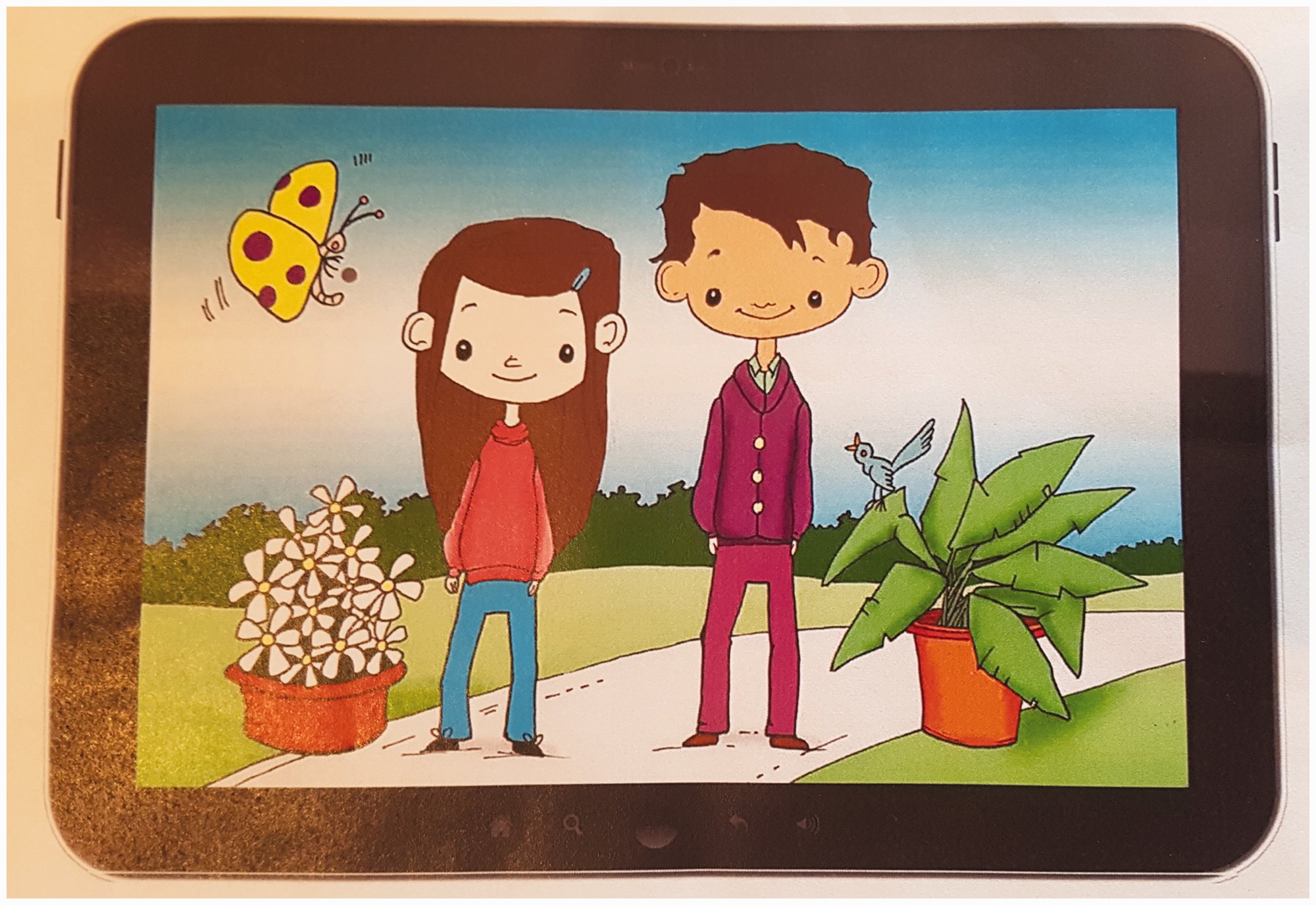
Tom and Mia, hand-out shared with participants at panel discussion, New York, 16 April 2018.
In 2017, the US Department of Education awarded a contract worth US$7 million to Westat (according to its website an ‘employee-owned professional services corporation’ that ‘offers innovative professional services to help clients improve outcomes in health, education, social policy, and transportation’) to become the ‘national centre’ for conducting IELS in the US. Like the contractor for the IELS ‘national centre’ in England (National Foundation for Educational Research), Westat has been heavily involved in the Programme for International Student Assessment and other standardised testing initiatives. Karen Tourangeau, Westat’s project director, presented the US involvement in the study to the audience at the Hunter College meeting. The picture of Tom and Mia is on page three of a four-page (two sheet A4) hand-out. Page one, the front page, contains only the letters IELS in large font and bright colours. Page two lists the names of members of several ‘expert’ and ‘advisory’ groups for IELS at international and US level. There are 22 entries on the list, nine of which are occupied by representatives of the three organisations that form the consortium for the international development and coordination of IELS 2 . The list fills roughly the top third of the page; the rest of page two is empty. Page three shows a picture of a tablet computer that displays a full-screen image of the two IELS protagonists, Tom and Mia. The picture fills the top half of the page, the bottom half is empty. Page four (the back page) is completely blank.
Considering the dearth of information on the document, the picture of Tom and Mia has to be considered the main message the hand-out conveys to the audience.
Tom and Mia stand side by side, facing, and smiling at, the assumed user of the tablet. Mia, on the left, is wearing long blue trousers, a red turtleneck sweater and black shoes. Her long brown hair reaches down below her shoulders, held in place by a small hairgrip that sits above the right-hand side of her forehead. Tom, on the right, is wearing long purple trousers, a plum-coloured, long-sleeved jacket, fastened tight with three buttons, over a buttoned-up blue shirt, and brown shoes. Tom is taller than Mia. They stand on a path that appears to lead out of the frame and towards the viewer. The path itself crosses a light green lawn that extends across the scene from darker green background vegetation, perhaps a line of shrubs or trees in the distance, under a light blue sky. Other elements in the picture are a butterfly – yellow wings with purple dots – that hovers to the left of Mia’s head, white flowers in a pot, on the path to the left of Mia, another potted plant (green leaves, no flowers) to the right of Tom, and a little blue bird sitting on that plant, its beak wide open, apparently chirping at the children. Apart from some ‘motion lines’ next to the butterfly’s wings there is neither movement nor activity in the picture. Both characters’ heads are disproportionately big in relation to their bodies. Their hands, in contrast, are so small they are barely detectable. There is no obvious indication of either child’s ethnicity but Mia’s skin is white, Tom’s is of a light brown colour.
The image exudes an untroubled lightness that appears intended to reassure the viewer that what follows will be fun, easy, and certainly not harmful in any way. How could Tom and Mia possibly be an example of children constructed as the ‘perfect objects of Empire’ (Cannella and Viruru, 2004: 97) and a global network of (neo-)colonisation?
We can start with a statement of the obvious: Tom and Mia, the two characters designed to lead children in all participating countries through the IELS assessment are not real children. They are representations, and as such, we can ask what and who they represent. Representation itself is a complex concept and a double-edged sword. In colonial and neo-colonial contexts, representation has been, and continues to be, employed as a powerful ‘methodology of contemporary colonization’ (Cannella and Viruru, 2004): Although political representation may be seen from the dominant perspective as an act of speaking, from other points it may actually be seen and experienced as silencing. (Cannella and Viruru, 2004: 69)
The target group of IELS and its ‘tablet-based’ tests are five-year old children. Tom and Mia, as their physiognomy, appearance and composed demeanour show, are no five year-olds. They appear older, seven or eight at least, and perhaps in their early teens; this seems strange in the context of an activity that is supposed to be carried out by five-year olds. There are other layers of representation-as-silencing in this image. Standing motionless in a park-like landscape or garden, their outfits clearly not suitable for anything to do with rough-and-tumble or messy play, painting, experimenting, cooking, gardening, digging, or indeed anything involving physical or hands-on activity, Tom and Mia give a strong indication of what counts as ‘early learning’ in the context of IELS. They seem to represent the ‘domains’ to be tested in the assessment more than the actual children that will be exposed to the tests. One can imagine them engaging with ‘early numeracy’ and ‘early literacy’ exercises, competently exerting ‘self-regulation’ and displaying ‘empathy’ to others and ‘trust’ to the unfamiliar ‘trained study administrator’ who appears in their classroom, tablet in hand. The iconography – huge heads, negligible hands, motionless bodies – suggests a radical turn away from Johann Heinrich Pestalozzi’s union of ‘head, heart and hands’ as the necessary foundation of learning and pedagogy. What is taking place here is nothing short of a radical re-definition, by the proponents of IELS, of what it means to be a child and, in consequence, a human being.
The ubiquity of such acts of re-defining and thus controlling and ‘othering’ younger human beings as children inspired Gaile Cannella and Radhika Viruru to investigate them through the lens of colonisation, and its ‘post-colonisation’ and ‘neo-colonisation’ incarnations. They write: What kinds of limitations and lost possibilities take place when this labelling occurs? […] the status of the child is used to signify and legitimate the behaviour of particular human beings. Further, the label and all that is associated with it limits one’s expectations of what those who have been labelled can do. […] What is controlled, lost, disqualified, and even erased through our expectations? How do our beliefs about children serve as violence against children, a kind of epistemic violence that limits human possibilities, freedom and actions? (Cannella and Viruru, 2004: 2)
This lack of diversity is of particular concern. The IELS and its methodology have been designed to be universally applicable, in any participating country, regardless of context, but the approach taken by the IELS suggests that its proponents either underestimate or (worse) knowingly disregard the complexity of local practices in early childhood, and the diverse historical and cultural contexts they are rooted in. This, as we have discussed in an earlier publication (Urban and Swadener, 2016), amounts to a deliberate denial of the rights of children, families and communities to self-determination and meaningful participation in all matters concerning the upbringing of young children. As exemplified by Tom and Mia, a uniform western, normalised, domesticised and sanitised image of the child dominates the approach. This image, through the vehicle of the assessment, is imposed on the complex, diverse and unequal realities of the children. Rights of minorities and indigenous groups are of no consideration for IELS, in direct contradiction, for example, to the United Nations Declaration of the Rights of Indigenous Peoples (United Nations, 2007), which explicitly recognises the right of Indigenous Peoples to diversity and to education ‘in a manner appropriate to their cultural methods of teaching and learning’ (Article 14), and to ‘dignity and diversity of their cultures, traditions, histories and aspirations which shall be appropriately reflected in education and public information’ (Article 15). Despite these rights, the present OECD initiative intersects and overshadows countries’ own approaches to conceptualising, framing and evaluating early childhood education and care practices
Read through a neo-colonial lens, the IELS (as do other standardised testing regimes) becomes a powerful tool for constructing and maintaining what Cannella and Viruru, referencing Antonio Gramsci, call the ‘neo-colonial situation’: ‘a condition in which control is maintained by a particular cultural, ideological, and economic elite who are complicit with the international capitalist system’ (Cannella and Viruru, 2004: 17). The global (macro-political context) and the local, the upbringing of young children in diverse and specific environments, are inextricably bound up in a hegemonic and, in effect, colonialising exercise. As Antonio Gramsci (1971) reminds us, Every relationship of “hegemony” is necessarily an educational relationship and occurs not only within a nation, between the various forces of which the nation is composed, but in the international and world-wide field, between complexes of national and international civilisations. (Gramsci, 1971: 666)
Resistance: the power of marginal notions
Historically, colonialism, and its technologies of hegemony and for exerting power have been the means for building and maintaining Empire in its various forms. Whether geographically or conceptually, Empire is about the assumed (and enforced) supremacy of the centre over the periphery, the province. This continues to be the case under neo-colonial conditions (Apple, 2003), where physical colonisation has been replaced by political, economic and cultural dominance. However, as Rosi Braidotti observes in Nomadic Theory, in contemporary contexts the boundaries between centre and periphery have become blurred, resulting in the clash between the urgency of finding new and alternative modes of political and ethical agency, on the one hand, and the inertia or self-interest of neoconservative thought on the other. (Braidotti, 2011: 301) to explore and experiment with more adequate forms of nonunitary, nomadic, and yet accountable modes of envisaging both subjectivity and democratic, ethical interaction. (Braidotti, 2011: 301). As history demonstrates, these idea-forces are commonly not fostered intentionally by the prevailing social strata of a particular epoch but, on the contrary, emerge due to that epoch’s shortcomings. They are a product of the lack of understanding of social realities, the fact that social problems are either ignored or not solved, and the inherent contradictions of the prevailing social strata, which more often than not, benefits from the status quo. It is from a fresh understanding of such social realities and from the efforts of solving those social problems that the new idea-forces arise. And for the same reasons, more often than not, these “idea-forces” make their original impact in the least expected territories and/or social strata of the prevailing society. (Sotolongo, 2013: 99–100) The trans character of the idea-force stems precisely from the peripheral situation of a region or from the marginalized situation of a people; from their previous history, often a formally colonized region and its marginalized people and/or an informally subdued or neo-colonized one, with its very specific sociality, culture, and traditions, all of which constitute that region’s or people’s social, cultural, and historical legacy. The trans character emerges from these circumstances and serves as the driving force of idea-forces. In other words, the “trans” character and the “force” of such “idea-forces” both come from the claim of such regions or peoples to re-insert themselves in history—past, current and future history—with their own cultural and social specificity; from their claim not to be considered as totally “subsumed” or “integrated,” under the impact of the reigning culture and social order. (Sotolongo, 2013: 101)
What are the implications, if any, for the current context of early childhood education faced by the Empire-building undertakings of international agents such as the OECD, the World Bank and others? If we can learn anything from the experiences in the past and present, and from the struggle against the imperialist dominance of one supposedly universal way of understanding, practicing, and evaluating early childhood education and care, it is this: that conversations and activities that are taking place outside the western-dominated mainstream ‘best practices’, ‘domains of early learning’, and decontextualised assessment of individual performance can offer pathways towards transformation. As Eve Tuck and K. Wayne Yang write in the introduction to Indigenous and Decolonizing Studies in Education, we can draw on ‘collective process[es] that utilize a Freireian dialogical learning approach that is critical of the underlying structures of oppression, systematic in its inquiry […], participatory in involving communities members and organizations in change-making, and creative in employing […] people’s cultural productions’ (Tuhiwai Smith et al., 2018: xv, original emphasis).
Here lies the possibility – and responsibility – for new conversations between the global and the local, and between the Global South and the Global North. Together we can change the Shape of Things to Come.
Footnotes
Declaration of conflicting interests
The author(s) declared no potential conflicts of interest with respect to the research, authorship and/or publication of this article.
Funding
The author(s) received no financial support for the research, authorship, and/or publication of this article.