




Abstract
Edible verge gardens, which are cultivated sections of public footpaths created by residents for household and community use, have gradually become more common in some Australian cities. As an emergent form of urban agriculture, verge gardens uniquely provide opportunities for encountering and learning about food cultivation and consumption practices at the mundane level of the footpath. The “public pedagogy” potentially generated by the spaces can be conceptualized as not only a range of garden-oriented learning experiences but also an incremental journey of embedding into the daily life of the neighborhood. Considering this 'pedagogical life' enables understanding of the extent to which specific urban agricuture spaces mediate care, or the interdependence between all human and non-human life, in the function-oriented spaces of the city. To this end, I explore the interplay of semiotic and performative aspects of verge gardens through multimodal discourse analysis and ethnographic methods, respectively, to understand both the material affordances present in and through the spaces as well as the subsequent “post-launch” life of the gardens. This 'multimodal-performative' approach allows for a micro-scale understanding of how urban agriculture spaces potentially re-educate public sensibilities around food and reimagine the city in terms of care—a visible integration of food, community, and urban space. The analysis elucidates the mundane yet consequential process of urban agriculture spaces folding into the everyday rhythms of neighborhood life. This research suggests that the ethics of everyday food practices (i.e. cultivation, procurement, preparation, eating, etc.) and the ethics of space are intimately related.
Introduction
As urban agriculture spaces become increasingly a regular feature of cityscapes, urban dwellers are afforded more opportunities to encounter and learn about food-oriented activity often absent in the public life of modern cities. The notion that food practices associated with the full cycle of food, from production to disposal, should be fully visible and accessible to city residents is no trivial matter considering that for most of the past century, the global food complex and its industrialization of food have systematically veiled the growing, processing, and transportation processes of food (Vileisis, 2008). However, with the resurgence of interest in localizing urban food systems within the past decade or so, pockets of agriculture and regional food culture have returned to cityscapes via spaces that are interstitial, such as rooftops, abandoned lots, and nature strips, and more prominent, such as schools, restaurants, and parks—rendering visible again the everyday activities related to growing food.
While the introduction of urban agriculture presents an opportunity to address a variety of concerns in cities such as food security (Zezza and Tasciotti, 2010), urban ecology (Lin et al., 2015), and resilience (Barthel et al., 2015), what is often overlooked is the role of urban agriculture sites and their spatial design to enable certain social and ecological relationships and activities. An approach that both considers these dynamics and the “kaleidoscope” of issues that converge with urban agriculture, is the paradigm of care (Morgan, 2015: 1380). The ethics of care not only accentuates the moral responsibility for meeting the needs of the disadvantaged (i.e., food security and food justice) and repairing fractured relationships between human and non-human entities (i.e., urban ecology and resilience); it also emphasizes the significance of the built environment in enabling (or limiting) certain relations and activities that address these concerns. With modern cities characterized in part by ecological degradation, social isolation, and individual existentialism (McClintock, 2010), urban agriculture is a vehicle for contributing to the reversal of these processes of disintegration and towards an interdependence of people, community, and land.
This article examines the case of a single edible verge garden in the suburb of Cammeray in Sydney, Australia, with respect to how its representation through spatial design acts as pedagogy. Specifically, focus is placed on the representational level of verge gardens, which views the gardens as a semiotic text that conveys multiple layers of meaning. Literature on urban agriculture spaces normally depends only on ethnographic methods to investigate their discourse and values (Classens, 2015; Baker, 2004) and visitor experiences. What is lacking is a more thorough account from the perspective of the space itself that considers how organization of design features generate a pedagogical effect. This article scrutinizes the learning processes within urban agriculture spaces from a social semiotics lens, by considering how spatial elements in the spaces act as a public pedagogy to challenge dominant notions regarding food. In other words, how do the spaces as a whole—the sum of its spatial elements, discourse, activities, and values—act as a “re-education” of public sensibilities and senses about food (Petrini et al., 2007)? Furthermore, how do urban agriculture spaces and their public pedagogies mediate values and activities of care?
Verge gardens, which are the cultivation of plants in areas on and around public footpaths—have become more common in Australian cities in recent years due to their potential to transform dull urban streetscape, stimulate social interaction, increase ecosystem services, and provide economic savings for councils tasked with nature strip maintenance (Nyers, 2013). The gardens allow for the possibility of residents and/or passersby encountering basic food practices and can therefore be conceived of as pedagogic texts that “teach” the identification, cultivation, and harvest of edible plants. While other urban agriculture spaces can function in this way, verge gardens uniquely bring the teaching of agricultural practices to arguably the most public of urban spaces—the street. Located at the nexus of public, private, and community life, the gardens are consequently a constant agricultural presence in the everyday life of residential areas, shopping districts, and alleyways. In short, verge gardens are rich spaces to understand how urban agriculture spaces act as pedagogy because of their reconception of the footpath as community food space, visibly confronting prevailing narratives and values about food in public fashion.
The garden chosen for this article was located through a council staff referral and selected because of its prominent design features and frequent community use. Located in a residential street in the suburb of Cammeray in Sydney, the garden was installed around six years prior to the time of writing. The immediate neighborhood comes from a predominantly white upper-class demographic, with significant numbers of residents having been born overseas, particularly England, New Zealand, Europe, and Asia. There is a diversity of age groups, from single young professionals and families to the elderly. Most notably, the footpath surrounding the garden receives a steady flow of morning and late afternoon foot traffic as work and school commuters or children and their care givers travel to the nearby shops only two blocks away. On an average weekday morning, around four or five people will pass by the garden at least every five minutes or so when the footpath is busiest. Various perspectives of the garden can be seen in Figures 1 to 3.
I will first explore how verge gardens function as spatial texts by applying multimodal discourse analysis (MDA) to the space, assisted by photos and observations taken in summer and winter seasons. The resulting description provides a detailed account of the space’s multiple levels of semiotic meaning. To understand the unfolding life of the space, or its performativity, I rely on a semi-structured interview with the owners as well as direct observations of the gardens gleaned through muliple visits to the space over a period of two years. Interview data was audio-recorded and later transcribed and coded using data analysis software. Both the description from MDA and the interview data have been coded through the performativity categories of staging and narrative, which allow for an understanding of the broader picture of the life of the garden and how its representation acts as public pedagogy. It should be noted that this specific case is not meant to be representative of other similar gardens, but rather serves to provide a tangible example of how verge gardens’ spatial design interfaces with everyday neighborhood rhythms, and how that translates into pedagogy.
Public pedagogy, multimodality, performativity
Public pedagogy
The construct of public pedagogy explores the learning that happens in informal settings, drawing attention to the everyday spaces of life and their agency to transmit knowledge, discourse, and values. This article adopts the strand of public pedagogy that emphasizes the dynamic of “transfer,” which points to everyday practices and public spaces having pedagogical force (Burdick and Sandlin, 2015: 147). From this perspective, the primacy of culture as pedagogical force is considered within sites “where people actually live their lives and where meaning is produced, assumed, and contested” (Giroux, 2000: 355). Drawing on the notion (Hall, 1997) of culture being a continuous, dynamic struggle of power between competing ethical discourses and representations, spaces and practices in the city, such as film, events, and art installations, can be viewed as having agency to form narratives and values.
The “public” aspect of public pedagogy has been described as either a “political public” critiquing governmental structures and ideologies, a “popular public” emphasizing everyday spaces and practices as being educative, or a “concrete public” referring to physical spaces as libraries, museums, and events as having educational salience(Savage, 2014: 79). All three articulations of “public” are simultaneously present in the space of a verge garden, particularly with the immediate context of the footpath.
The political nature of footpaths is not immediately self-evident, though footpaths have served, at multiple instances in the past two centuries, as a space for firstly, protesting and exercising free speech for any number of social issues such as civil rights, worker rights, and globalization; and secondly, establishing and challenging culturally accepted public behavior such as street vending, panhandling, loitering, public drunkenness, sleeping, and child labor (Loukaitou-Sideris et al., 2004). The everyday character of the footpath is so mundane as to also be easily overlooked. The footpath, being the most expansive and spatially penetrating of all the public spaces in a city, is where routine activities of daily urban life become visible; its influence on shaping everyday urban culture cannot be understated. As a physical structure, the whole of the streetscape—not only the footpath but also at least the nature strip, street, utility infrastructural elements, buildings, people, animals, vehicles, and foliage—has pedagogical salience, contributing to our understanding of “contemporary landscapes and lifestyles” (Hickey, 2010: 161). The verge garden, as a recent addition to some streetscapes, offers both new understandings of the ontology of the street as well as opportunities for food education.
Beyond these articulations of “public,” I suggest that the vernacular reading of public—the quality of being accessible and/or visited by a wide range of people—is also relevant when considering bounded spaces. Edible verge gardens on footpaths that have higher degrees of foot traffic may potentially wield more influence than those on footpaths that are not frequently used. It can be surmised then that the more openly noticeable forms of urban agriculture such as urban farms, front yard gardens, “unfenced” community gardens, and kitchen gardens attached to restaurants, have potentially greater degrees of pedagogical influence due to their sheer visibility and degree of exposure via regular traffic in and near them.
This dynamic has been alluded to in a number studies around learning occurring in urban agriculture sites. For instance, literature focused on community gardens as sites of a potential form of public learning have suggested that the gardens act as sites for not only understanding agriculture and sociality but also being aware of food movement values (Walter, 2013) and “the politics of space,” such as the precarious land tenure of the gardens due to urban redevelopment (Bendt et al., 2013: 26). It has also been observed that community gardens with specific garden characteristics (i.e., degree of nearby public foot traffic, the range of programs and activities offered, etc.) attract more participation numerically and also from a wider representation of demographic groups (Bendt et al., 2013). Urban agriculture spaces have also been regarded as confronting cultural sensibilities of dominant urban forms; the public pedagogy of edible front yards, for instance, attempts to influence pervasive preferences of what is socially appropriate for house landscaping (Hsu, 2018). This thread of literature suggests that the educative potential of urban agriculture spaces is related, in part, to the degree of its visibility and accessibility.
From this perspective, urban agriculture spaces have a form of agency in themselves, potentially acting as “urban coordination tools”) or physical structures that direct and circulate knowledge throughout the city, and also “stimulate [or limit] the imagination” of how cities should be ( McFarlane 2011:13). The spaces can therefore exert public pedagogy—a range of knowledge, discourse, and activities through an array of learning processes, much of which are unconsciously embedded in the flow of urban life. In other words, urban agriculture spaces have pedagogical potential through their production of new meanings and practices (Hall, 1997).
As a way of operationalizing the public pedagogy construct in order to explore how urban agriculture spaces, enable educational processes, I suggest a theorization of the learning within these spaces that considers two distinct, yet overlapping layers. The “multimodal” layer refers to the agency of material affordances present through the overall spatial design of an urban agriculture space, while the “performative” layer alludes to the unfolding social life of the garden. This conceptualization is drawn from Hall (1997: 2) and his conception of culture as being the interplay between “shared meanings” generated and circulated (i.e., multimodal representation) and “sets of practices” (i.e., social embedding); as well as from urban learning assemblage theory (McFarlane, 2011), which stresses the circulation of knowledge and learning through specific urban spaces and other structures, while simultaneously situated in the continually unfolding activity between people and the urban landscape. From this standpoint, urban agriculture spaces can have public pedagogical salience through their agency in making meaning through their spatial design (multimodality) and unfolding social life (performativity).
This articulation of public pedagogy aligns with the notion of learning articulated by “cultural pedagogies” (Watkins et al., 2015: 13), which assume the process of learning to be a “cumulative, a continuous but uneven set of routines and recalibrations” while occurring “potentially everywhere, and at any time” and not caught up with distinctions of formal and informal learning. The outcome of this expansive view of pedagogy includes not only intellectual, practical, or tacit forms of knowledge (Brown and Duguid, 2001) but also “cultural capacities” (i.e., literacies needed to navigate the gardening subculture), “effects” (i.e., intuition and sensory-based formative experiences tied up with gardening) (Ellsworth, 2005), and “practices” (i.e., gardening and gardening-associated practices such as cooking, pickling, socialization, etc.) (Watkins et al., 2015: 14).
Multimodality and performativity
Multimodality refers to the theoretical perspective in which “texts” such as media, objects, and spaces, have overlapping semiotic systems, or “modes” (i.e., written language, music, space, etc.) that communicate a range of meanings. Multimodal discourse analysis (MDA) is a method of enquiry for exploring such texts through understanding the synergy of modes as they employ semiotic resources (elements that have communicative potential such as color, layout, size, etc.), affordances, and social functions (Kress and Van Leeuwen, 2006). Central to MDA is the notion that texts convey meaning through the synergy of representational, interactional, and organizational layers, or “metafunctions” (Kress and Van Leeuwen, 1996). Representational meaning is primarily concerned with the denotation and connotation (Ravelli and McMurtrie, 2015) of a text’s salient elements as they relate to action and context. Narrative patterns are also observed through the presence of “vectors” (directional movement) in the text. Interactional meaning focuses on how the texts mediate relationships between users, and users and the text, itself; and the accompanying relational dynamics of power and social distance. Organizational meaning refers to the overall layout of a space in terms of its information values, salience, framing, and navigational path (Kress and Van Leeuwen, 2006 ; Ravelli and McMurtrie, 2015). Information values refer to the overall placement of design elements in relationships as Given-New (left and right areas signify “old” and “new” information, respectively) and Center-Margin (elements in the center, compared to those in the margins, are perceived as more important). Salience is the hierarchy of elements in terms of prominence. Framing concerns how strongly a text is bounded, suggesting thematic separation or interrelationship. Navigational path pertains to the participant’s route taken through a space (Ravelli and McMurtrie, 2015). These three layers of analysis are the foundation of MDA and have served as an analytical frame for exploring the semiotic organization of a range of urban spaces, including museum spaces (Ravelli, 2007) and iconic buildings (O'Toole, 1994).
The theoretical approach of performativity puts forward the notion that all activity is ritualized performance that generates social reality. Essentially, repeated actions over time define major markers of reality, such as identity, social structures, and place, rather than the other way round. Two aspects of performativity are most relevant to this article. Firstly, performativity acknowledges that all individual and collective behavior is enabled through staging, which means that each specific stage has specific affordances for activity that contribute to the “deliberate organization of an interaction.” Stages enable certain meanings and actions through their overall design and purpose (Noy, 2008). In terms of the purpose of specific stages, I am using Bezemer and Kress’s notion of interest (2008), which refers to the creator’s objectives for the text and rationales for its design. Secondly, performativity conveys the notion of narrative, which involves an unfolding process of actors and practices experienced in real time, iteratively producing images and meaning (Bamberg, 2010). Though the emphasis on symbols collectively producing meaning is similar to MDA, performativity gives primacy to actions realized through a text’s affordances, rather than the text itself, to construct reality. In other words, without the confluence of public activity, including discursive acts, social practices, and non-human actions, texts are simply an empty stage.
The multimodal layer
For the case of the single verge garden, I will consider how each key concept within the three metafunctions is realized in the space, as well as how the three layers work together to communicate meaning. The resulting description generated through MDA integrates interpretive analysis and discussion, which is consistent in approach with prior work on social semiotic analysis of built environment spaces (Ravelli and Stenglin, 2008; O’Toole, 1994). A summary of all the social meanings uncovered through MDA is shown in Figure 4.
Representational metafunction
Through representational metafunction, I will first explore this verge garden’s overall denotation and connotation. With denotation, what is first observed are seven circular half wine barrel containers dug into the ground of a large nature strip (and positioned slightly closer to the footpath than the street), which at about five meters in width acts as a generous framing for the whole garden. The barrels are divided into groups of three and four, which surround an auxiliary footpath leading to a house directly behind the garden (presumably associated with the garden), while connecting perpendicularly to the main footpath. Inside the planters are herbs and plants at various stages of growth (see Figure 1).
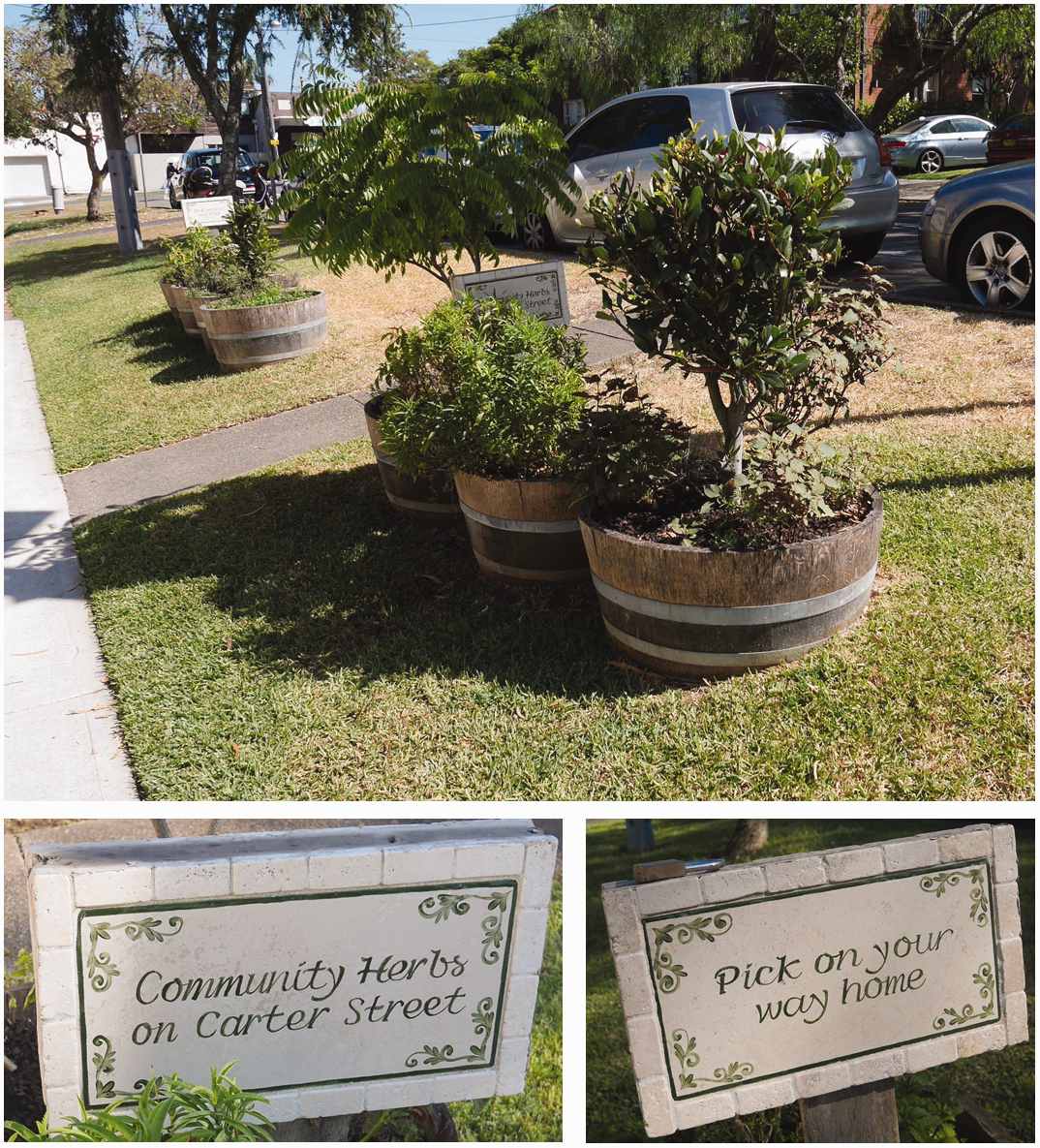
Verge garden on Carter Street and its signage.
Set within each group of barrels are two identical porcelain tiled signs, mounted on wooden posts, embellished with decorative green bordering and a handwritten message that reads, “Community Herbs on Carter Street” and “Pick on your way home.” The signs always communicate that message in that order regardless of how one approaches the garden, because the same phrases are written on both sides, but in reverse order (Figure 1).
Across the main footpath and on the property of the house are a number of objects which complement the garden: two pastel blue watering cans hanging from the white picket fence fronting the house; a simple rustic fountain, just inside the fence, comprised of a faded green metallic water pump continuously dripping water into an additional wine barrel filled with water and a single goldfish; and a small wooden wheelbarrow with terracotta containers of herbs on the front porch of the house (Figure 2).
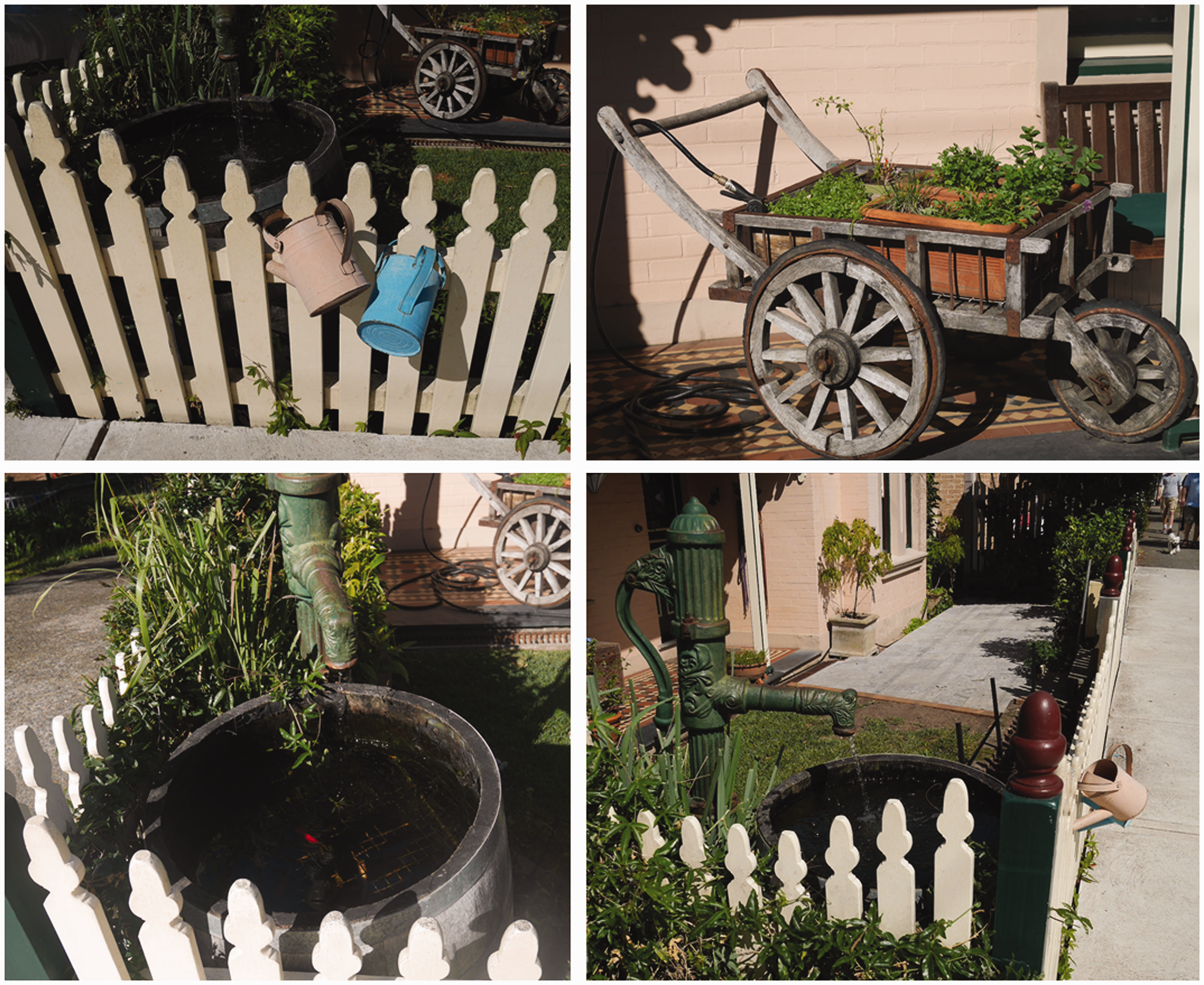
Prominent design features include: a French-style water pump fountain with a goldfish, protective screening, and watering cans (top left and bottom photos); and a wooden wheelbarrow of herbs in the background (top right photo).
Because the garden is an unorthodox sight, those encountering the space have to decipher the space’s identity, function, and “owner.” Given the high-quality materials and uniform arrangement suggests the garden belonging to the adjacent house or being a small community garden set up by the council. In either case, the signs clearly identify the garden as provided for neighborhood use.
In terms of connotation, the garden space has an air of refinement, tradition, and sentimentality, which is expressed through the natural materials—aged timber, ceramic tiling, and metals—and various handcrafted objects that allude to the past, including the water pump, fountain, wooden cart, wine barrel, and the signage. These container and signage material choices reveal at least a commitment to higher quality space, as cheaper materials such as timber or corrugated metal are typically used for verge gardens.
Permanence and strength are conveyed through the wine barrels appearing as two continuous structures (barrels are flush against each other) and the barrels’ thick walls which are set heavily into the ground. This is also communicated through the materiality of the aged wood of the barrels, which shows no visible imperfections, though appearing to have withstood many seasons of rain and sun. Warmth is connoted by the circular shape of the barrels, in contrast to industrial overtones associated with more angular shapes of, for example, rectangular garden shapes (Kress and Van Leeuwen, 1996; Ravelli and McMurtrie, 2015), and its placement on the expansive space of the large nature strip lawn.
The space also subtly communicates its association with the nearby house through its closer proximity to it, as well as the nearby garden-related objects—watering cans, fountain, and wooden cart, which are curiously located on the house’s property. The space’s features, therefore, suggest that it is simultaneously connected with the house and community through its overall design, materials’ selection, and explicit signage. The semiotic markers effectively blur the home and community boundaries, while making the space feel idyllic, elegant, and inviting.
The space is also represented through a series of transactional processes, which in MDA are actions/movement received by objects. Beyond observing and interacting with the garden (and fountain with fish), passersby can also read signage, pick up, fill, and return watering cans, and water plants (see Figure 3). A synergy thus exists between the passerby, signage, plants, watering cans, fountain, and water; excluding any element would impede the activity of watering. Without signage, passersby might not interact with the garden; without watering cans, the fountain is simply decorative; and without water, there is no direct engagement with the watering cans and fountain. Even the goldfish are a critical element as they prevent mosquitoes from deterring garden users.
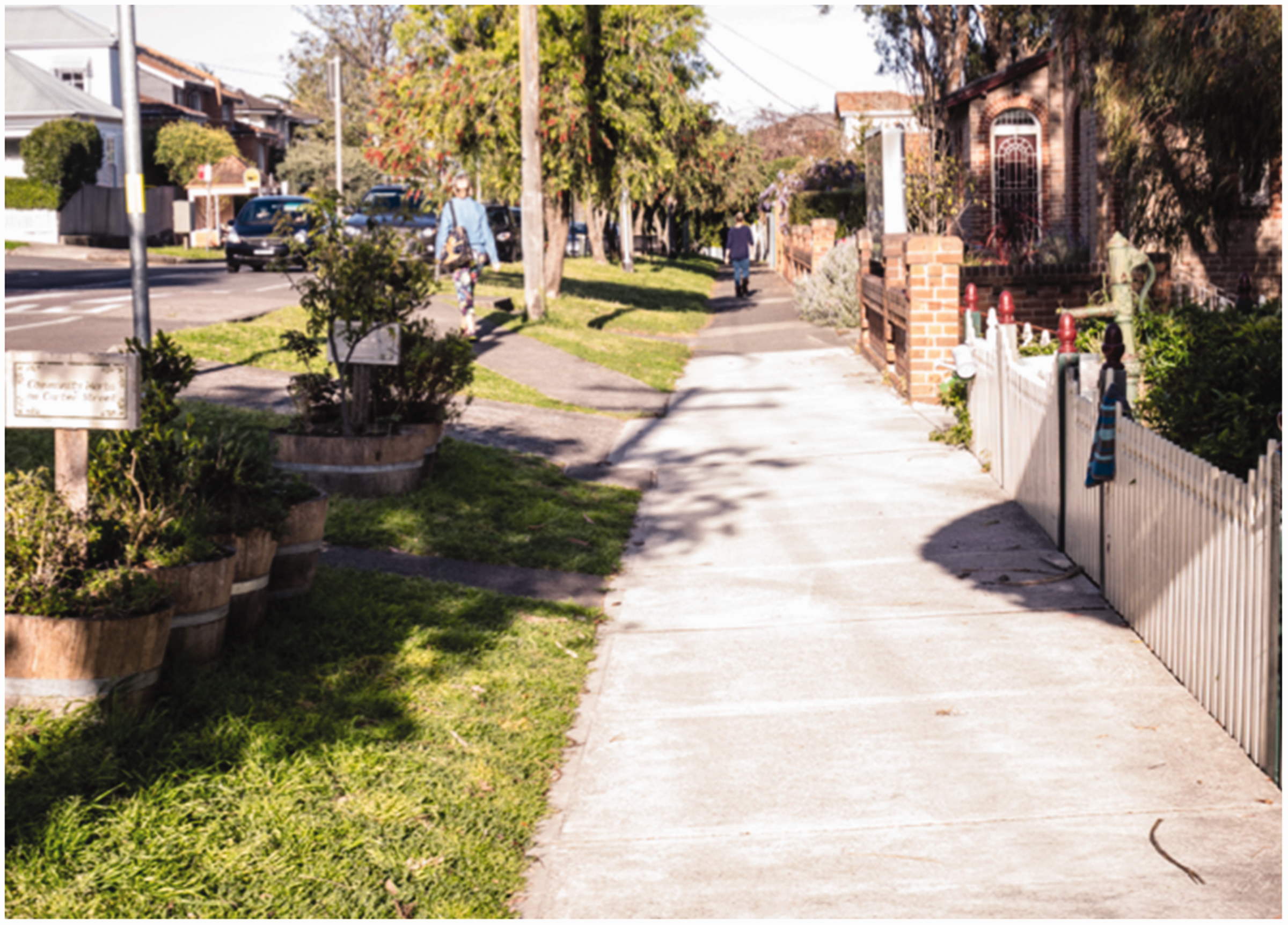
View of footpath when a pedestrian passes the garden. Fountain and water cans can be seen along the white fence on the right.
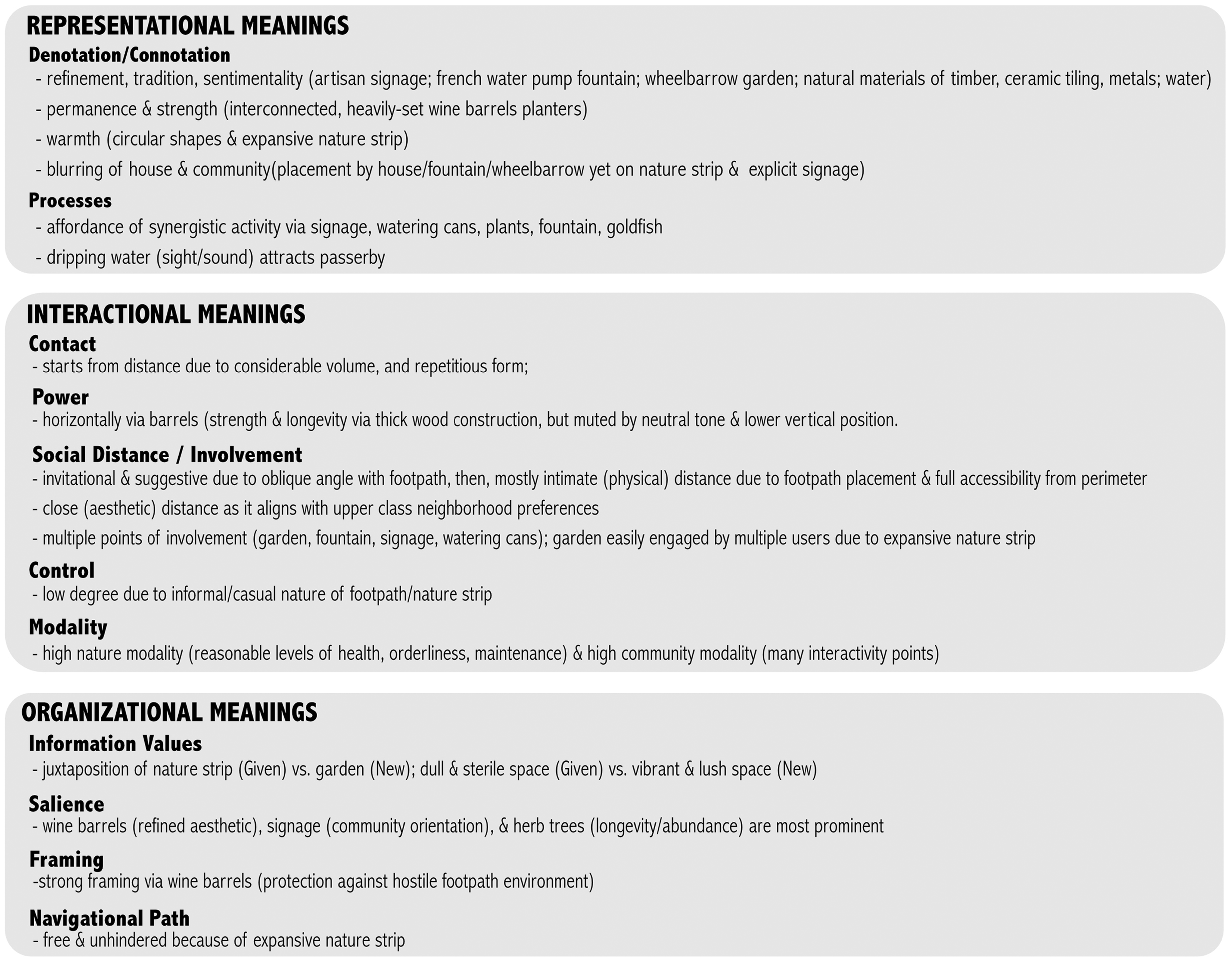
Summary of meanings via multimodal discourse analysis.
The positioning of objects is also crucial to enabling activity. The watering cans’ location on the outside of the fence suggests that pedestrians can water the garden. The water fountain’s placement directly behind the watering cans implies that passersby can use the fountain to fill the watering cans. Also significant is that movement (vector in MDA terms) and sound are created through the water dripping into the barrel also serving to attract the passerby. Through these subtle details, affordances for a spatial engagement are created, while communicating the owners’ hospitality and invitation to participate in the life of the garden. The simplicity and good-naturedness of these actions is supported by the pervasive aesthetic of tradition, countryside quaintness, and perhaps nostalgia, most certainly reinforced by the lulling sound of the dripping water.
The interactional metafunction
For the interactional metafunction, this garden has a range of meanings related to its large size and stylized features. Contact with the garden would be initiated from a reasonable distance away because of its considerable volume and footprint (more than seven wine barrels of width and girth), reinforced by the containers’ repeated identical form; and continues as pedestrians near the space, likely reading the signage which is invitational in tone, content, and materiality (subdued white and green hues and cursive handwriting). However, the space does not impose, despite its substantial size, but instead suggests itself to the viewer because it is below eye level (Kress and Van Leeuwen, 1996; Ravelli and McMurtrie, 2015). Power is expressed horizontally by the two sets of barrels conveying strength and longevity through their thick wood construction, but it is muted through their neutral tone and lower vertical position.
The social distance at which passersby can engage with this garden is intimately close, especially as the plants are propped up to almost waist height by the containers, as well as being fully accessible from any direction due to the surrounding large nature strip (unlike most verge gardens, which are hardly accessible from the street-facing façade). A close social distance is also realized through the earthy materials, an upper-class aesthetic that is likely suitable to the surrounding upscale neighborhood. As for involvement, pedestrians initially relate to this space from an oblique angle which is inviting and suggestive, rather than demanding and imposing (Ravelli and McMurtrie, 2015). A longer involvement (and a closer social distance) between users is encouraged through the sizeable nature strip which allows easy engagement with the garden and other users, as well as the water pump fountain area which provides an additional point of social contact and interaction.
The garden has a low degree of control or degree of physical/regulatory limitations imposed on a person from a space, due to its large area: pedestrians have ample room for movement. The pathway to the fountain does cross the footpath but is hardly limiting because of the light foot traffic. However, the water pump fountain area is highly controlled through its placement behind the fence. Pedestrians can fill the watering cans only by reaching over the fence.
Lastly, modality refers to the degree of truth perceived based on cultural notions of a specific space and is dependent on a given sociocultural standard, or coding orientation, and corresponding evaluative criteria (Ravelli and McMurtrie, 2015). Two coding orientations are relevant to verge gardens: nature and community Hsu. The nature coding orientation refers to people’s idealization of nature, which for Western sensibilities is equated with beautiful and pristine scenery that is a source of refuge and escape (Cronon, 1995). This can be expressed in verge gardens in that its appearance may clash with visual expectations of nature. Verge gardens having a high nature modality are therefore spaces that are vital, well-maintained, and orderly; spaces with a low nature modality are either plain, of poor condition, and/or unkempt. The second coding orientation of community is based upon the degree to which a space reflects community life and activity and is assessed by the presence of interactivity points (i.e., elements encouraging community such as seating, signage, garden tools, etc.).
Overall, the verge garden on Carter Street has a moderately high nature modality due to its plants being generally healthy, its arrangement of containers expressing a high degree of orderliness, and its reasonably maintained plants. However, seasonality affects its nature modality. In the winter, the garden was found to have a lower modality through an increase in brown/lifeless plants and empty beds communicating neglect, though this may be mitigated by lower expectations of health for plants during winter months. The garden also has a high community modality via its many interactivity points—two signs, watering cans, and water pump fountain—all enhanced by the spacious perimeter area and signage explicitly encouraging community usage.
Organizational metafunction
The organizational metafunction allows for analysis focused on how the garden is arranged spatially. In terms of its informational values, there is a number of Given-New relationships. For the pedestrian walking along the footpath, the “Given” of the nature strip is juxtaposed by the “New” of the verge garden. Though the garden matches the aesthetics of the neighborhood, it is still conspicuous as it is the only verge garden on the street. From this vantage point, the nature strip might be perceived of as the conventional approach to managing the verge which is dull and sterile (Given); and the garden as an innovative reconfiguration of the verge resulting in a space that is vibrant and lush (New). The Given-New relationship is also expressed through the signage as a pedestrian encounters the signs sequentially. The first sign, “Community Herbs on Carter Street” (Given), communicates the space as belonging to the neighborhood, while the second sign, “Pick on your way home” (New), offers an invitation to use the garden.
With regards to salience, the most prominent design element is the wine barrels, whose repeated circular pattern reinforce the aforementioned meanings of permanence, refinement, and durability. Also salient are the signage due to their raised position and white color, which convey the space’s community orientation, and the largest plants of the space—two small trees (curry leaf and bay leaf)—which communicate longevity, rootedness, and abundance. The water pump fountain and wooden cart, though not centrally positioned, are reasonably salient because they are unusual objects for the neighborhood streetscape. This space’s strong framing is accomplished, again, via the wine barrels and their tall and thick walls which confer a sense of protection against the hostile environment of the footpath (i.e., dogs, cats, littering, etc.). Lastly, a pedestrian’s navigational path—made by the border of the nature strip which uniformly surrounds both sets of containers—is unobstructed around the perimeter of the garden, greatly facilitating gardening activities while supporting the space’s invitational tone.
Considering all three metafunctional layers together, this verge garden as a spatial text is fundamentally anchored by the series of seven wine barrel planters set in the grass expanse of the large nature strip. The barrels’ rugged, thick, and circular wooden walls form a stout, yet elegant base and barrier for the garden, imbuing it with a sense of warmth, refinement, and order; and the ample swath of grass surrounding the wine barrels makes the space feel free and approachable. The synergy of these two design elements supports the overall warm atmosphere of the space, which expresses an uncomplicated neighborly friendliness through the ensemble of salient objects—cheerful signage, plentiful herbs, quaint water cans, a continually dripping water pump fountain, and an antique wooden cart of plants. Those objects also crucially encourage pedestrians to move from observing to interacting with the garden. Viewers develop a more than casual connection with the garden through the elemental actions of filling, watering, and harvesting. The overall earthiness and countryside-inspired simplicity, communicated through the selection and arrangement of the objects and their potential for spatial engagement, ultimately transforms one small section of a mundane footpath into a vital community space.
The performative layer
The verge garden’s description from MDA forms the basis for understanding the space’s design and potential layers of meaning for the passerby. In order to glean details beyond the spatial text, an in-depth interview detailing “interest” (Bezemer and Kress, 2008) in creating the space and its actual usage post-installation is analyzed, serving as an ethnographic counterpoint to the text-specific MDA description .
The owners’ overall purpose in creating the verge garden is found to be threefold. Firstly, they wanted to beautify a “very ugly” nature strip because of a “huge liquid amber tree” that prevented the growth of grass or other plants. “Ugly” and its derivatives are mentioned four times to describe their displeasure with the past verge space and as a rationale for its transformation. Secondly, they wanted the garden to benefit the community. Being “very community minded,” a herb rather than an ornamental garden is purposely chosen because it would be “nice for the neighborhood, it’s a service for the neighborhood, it’s the right sort of community thing to do. And on top of it, the children can water.” Their community outlook is also revealed through the fact that the owners don’t pick from the verge garden themselves; it is exclusively for community use. Thirdly, they intended the garden to educate the community, especially children, about food: We always liked the idea that in France, children learn to cook. From a very young age to be part of the cooking … often in Australia, that’s not what happens. And we thought this is one way the people will actually get to know the herbs. And the very fact that you’re nurturing something and you’re watering something, that’s a nice activity for a parent and a child, and the child gets to learn this is this, and what that [is]. So there’s definitely sense there’s teaching that’s part of it … there’s also the feel-good factor, isn’t it nice that something grows and you can share it and you can be generous and that picking is good, watering is good. And a cycle gets created.
Garden elements were also thoughtfully considered. Herbs were chosen because of their ease of care and also with “vegetables … you couldn’t produce enough” for sharing. Also, the larger bundling of herbs at supermarkets often go to waste, so their “idea [is that] you pick it on your way home.” The French-style water pump was selected to complement the appearance of their historic Federation-style house. The watering cans were included after realizing that “children can water,” effectively linking the fountain and garden together. Signage was handcrafted by a local artist and “drilled into the side of the barrel” to prevent theft. Beyond the design elements, the owners launched the garden in theatrical fashion: We had a certain amount of time, we had a golden opportunity, we knew it had to go up very fast … we bought the little plants … started growing them … [the artist] said she could make a sign. I said, “Okay, it’s Sunday today. I need it by Tuesday, cuz this is being planted on Wednesday. Can you do it? Can you do it?” … It was a great launch because it was great that afternoon … [people thought] “That wasn’t there that morning!” [Pedestrians] walk back and they’ll stop at the herbs and they talk about the herbs and how it works, and then, even if there’s no children in sight, the person has explained to them how the watering cans work and how this works and how that works. [i]t’s a very nice focal point … because people … bump into each other there because it’s there. If people are walking in both directions and they stop to say hello, they always stop there while watering is going on.
The garden space has also facilitated food education, as children and adults have learned to identify and pick herbs. Children, in particular, engage and learn from the garden: “They love the smell and they know. And they proudly walk past, [saying] ‘that’s rosemary!’” Passersby have also learned about picking herbs incrementally. At first, popular herbs such as basil were overpicked. Over a year, through trial and error, “people were educated that you can just pick little bits and then let things grow.” The owners thoughtfully allowed room for users to make mistakes, even if it meant that plants had to be pruned or replaced.
Lastly, the interviews reveal a narrative of unfolding events. Since the launch, the community reaction has been overwhelmingly positive: Oh surprise, but delight! [When the garden launched] it was just wow, wow, this is great! … What most amazes me is that all the years gone, people still stop me, and say how fantastic it is to see it. I mean there are new people walking past all the time, “Oh, we just moved to the suburb a few months ago. This is so fantastic … we’d never do it in our suburb!” People [say] “I'm out visiting from England, oh this is amazing, you’d never do it at home!” I’ve just completely stopped watering [because the community waters]. The thing is that’s not necessarily ideal for the plants cuz they don’t get a proper … soaking. You know, a kid walks past … the child’s probably carrying 200 ml and they’re dropping 100 ml. So you’re only getting 60 ml of water that’s actually going on the plant every time. This process goes on … it’s all very haphazard, we don’t stress too much about it.
Though there is fluidity in the garden’s appearance due to irregular community usage practices and seasonal changes, the garden has served to nurture community. As one owner affirms: A lot of people will stop and say specifically … your herb garden makes me feel really good. It makes me feel good about living in Cammeray that the people are so nice that they do this kind of thing. It makes me feel good about life … about people … Some of those people never pick herbs, but it’s just really a strong feel-good factor. I think what people like most about it is the community spirit. The herb garden gives rise to friendly, informal conversation, appreciation of generosity, and thus a desire to give back. So, when the trees on the verge were being trimmed … I asked if the tree loppers would trim off a lightning damaged branch from the church property next door. This was done. In response as to why from a fellow worker, the tree lopper said, “She gave me rosemary—how could I not help out?”
Discussion
A fuller picture of the pedagogical potential of the space is now possible through viewing both multimodal and performative layers through the performative categories of “Staging” and “Narrative” (Table 1). In terms of the stage’s purposes, I have described through MDA that explicit design choices lead to affordances for various activities (reading signage, watering plants, etc.) and reinforce the notion that the space is for community use. Furthermore, the owners’ selection of the materials, construction, and placement of the garden elements generate certain social relations as seen through the interactional meanings. The garden, through its house-complementing aesthetics, is likely seen as an extension of the adjacent house and thus perceived as an act of generosity by the owner, which contributes to an amiable relationship between the owners and passersby. The garden’s invitational atmosphere, ample access space, and opportunities for various types of activity enable passersby to easily socialize around the space. The affordances for interacting with the garden and water fountain create certain potentially differentiated social roles for passersby which allow for the possibility of least two different tasks occurring simultaneously (i.e., interacting with herbs, observing the fountain, filling up watering cans, watering the plants, etc.).
Performativity of the garden through both MDA and performative account.tage
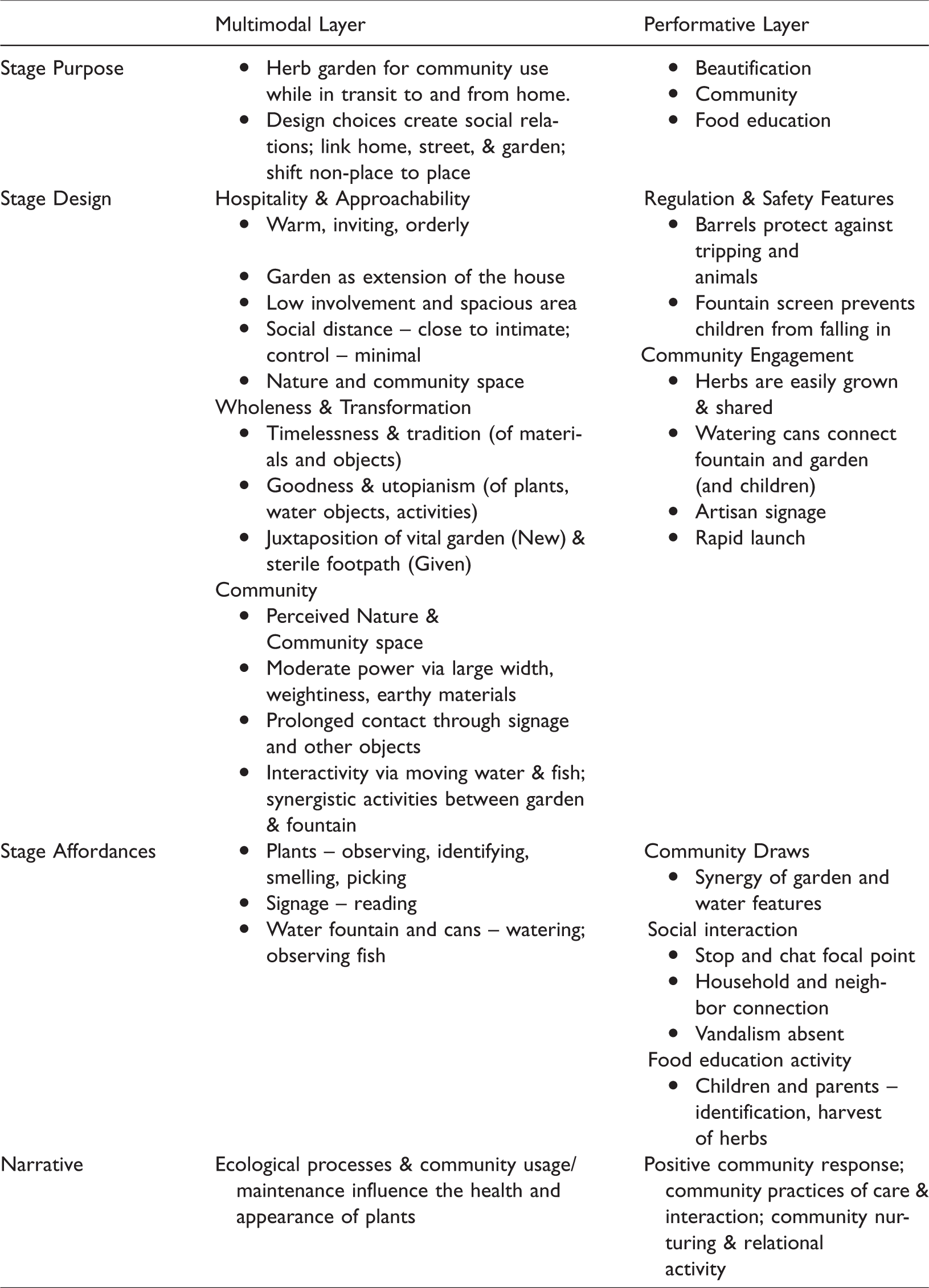
The organizational meanings from MDA reveal the “stage purpose,” or the garden’s function of creating a community food space. The garden effectively bridges the home, street, and garden to transform the “non-place” of the footpath (Arefi, 1999)—a space characterized by its function (i.e., pedestrian flow, visual/physical buffering, and infrastructure placement) and associated regulations—to essentially a community nature space; it has become a microspace that fosters appreciation for urban nature through giving residents opportunities to interact with “natural elements of the city in new ways” (Davidson and Ridder, 2003: 306). The space also works organizationally to both enhance the gardening experience and meet safety requirements through the choices of a large-sized garden, aesthetically pleasing and robust garden containers (at waist level so as not to be a trip hazard), ornate yet friendly signage, and a watering pump fountain area (with protective screening). If any of these elements were missing, the space’s affordance for community-oriented gardening would be diminished. The qualitative data revealed the overlapping purposes of the garden: beautification of space, community benefit, and food education.
The garden’s overall spatial design (“stage design”) can be encapsulated through three thematic categories uncovered through MDA. Firstly, the space reflects hospitality and approachability through design element choices conveying an invitation to participate (content and materiality of signage, position of garden nearer to house, and watering cans), while allowing accessibility for passersby (round containers, spacious nature strip, and friendly toned signage). Secondly, the space expresses the themes of wholeness through the space’s portrayal of community-oriented gardening as a timeless, sophisticated, and nostalgic activity; and transformation through its aforementioned shift of the footpath from non-place to urban nature space. Thirdly, the space communicates the theme of community through its numerous features and cues mentioned previously. The interview data also emphasizes the owner’s attentiveness to community, as well as to regulation and safety.
In terms of “stage affordances,” while MDA accentuates the range of potential activity in the garden, the interview data served to provide an account of how activity occurred, in actuality. The synergy of the garden, water elements, and related activities gleaned theoretically through MDA is corroborated through the interview which confirms the owners’ intentionality in linking the water fountain and gardening spaces, and the resulting social interaction and food educational encounters that occured post-launch.
As for the “narrative” of the garden space, the description through MDA observed the garden’s health and appearance as continually evolving as a result of seasonality and community care. Performatively, the garden’s narrative begins with a positive community response after the space launches, continues with the emergence of activities around food education and social interactivity, and concludes with the cultivation of a sense of community and positive relational activity. MDA highlights the continually changing garden composition whereas the performative lens draws attention to the community sentiments and activity through the garden.
Examining the various themes of the multimodal-performative analysis, two prominent discourses from the garden emerge which, together, form the ethical orientation of the garden’s public pedagogy, challenging dominant cultural norms about urban space and food (Hickey-Moody et al., 2010: 229). Specifically, the garden spatially reflects and elicits values and practices around care, the notion that all living things are interdependent (Tronto, 1993), confronting conventional uses of neighborhood streets centered solely on function. As a form of public space, the garden mediates encounters which deepen social and environmental relationships, illustrating the notion of care as situated in “particular, embodied, and emotional” practices that foster well-being (Williams, 2017: 821; J7, ImrieImrie and Kullman, 2016).
The “public” aspect of public pedagogy, in the context of this garden, does not refer to the scale of the city, but rather to the microscale of the street and surrounding residential neighborhood, especially those who utilize the footpaths as part of their daily commute to work, school, and/or nearby shops. As mentioned previously, this street as a major pedestrian thoroughfare receives a constant flow of walkers, particularly in the mornings and late afternoons, as parents and school children, city workers, and the elderly living in the neighborhood transit to local schools, shops, and/or bus stops—translating to a significant number of people noticing and potentially engaging with the garden. For this “catchment” of residents, the garden challenges dominant values around food and the use of urban space.
Firstly, the garden recasts the footpath as a civic space fostering conviviality (Jacobs, 1961), rather than a regulated space for transit (Blomley, 2012) through its inviting spatial design, affordances for garden activity, and resulting social interaction and food education. No longer just a pedestrian corridor, the small section of footpath has become a legitimate community space. Passersby are compelled to reimagine their footpaths as more than only transitory space but as public space having different rhythms and social possibilities (Amin, 2008). The garden, as with other nature spaces in the city, most obviously encourages the human-nature connection (Beatley, 2011) and has become a microsite of community-based stewardship through the rhythm of observing, watering, harvesting, and social learning and interaction.
Less obvious is its vital role in creating a child-friendly spot in the neighborhood, which is not trivial as the design of modern cities has been critiqued for its lack of infrastructure to support children and child-raising (Hayden, 2002). The owners repeatedly mentioned their expectation that mothers/caregivers and children would use the garden, which led them to make several design decisions, including the inclusion of the protective screen on the water fountain and the watering cans on the fence. This expectation has been realized in the life of the garden as parents and children are now among the most frequent users of the garden.
Secondly, the verge garden informally communicates a community food ethic, which is the notion that the food system should be more deeply embedded in local spaces and activities. While other urban agricultural forms might also convey a community food ethic, verge gardens through their placement on the footpath are a more striking embodiment of this ethic. Its thoroughly public and everyday context contributes to the garden being a more visceral assertion that food system activities be reestablished in the public arena, while suggesting that common residents have a right to determine the identity of both their streetscape and food system (Figueroa, 2015). Furthermore, though small in size, the gardens also challenge the marketized food system. Mintz (1996) asserts having control of food production is accompanied by control over the cultural meanings of the food. By producing herbs for neighborhood use, verge gardens introduce the alternative narrative of community food production, conferring that meaning onto those herbs. Those harvesting from the verge garden may potentially purchase fewer herbs, and, moreover, the herbs at the store will likely be perceived in a different light (i.e., not fresh, impersonal, expensive, etc.).
Though all edible verge gardens potentially act as spatial interventions, those that fail to attract (or allow) public usage have limited influence on the everyday culture of the footpath. In contrast, the Carter Street Herb Garden has been able to fold into the daily activities of the street and therefore functions not only as a spatial but also a “practice” intervention. The garden highlights the dual role that design has in both communicating a community food ethic and enabling social activity around food. While the community food ethic—especially in relation to the sentiment of generosity—is plainly reflected in the owners’ investment of their own resources to convert their verge into a high-quality garden entirely for community use, it is specific design choices which have led to its regular use. The synergy of friendly handcrafted signage, round wine barrel containers, spacious access area, water fountain area, and watering cans, all translate to affordances for interaction, which has stimulated daily usage to the degree that the garden is entirely reliant on the community for its care.
The case of the Carter Street Herb Garden illustrates how even a single urban agriculture space can potentially shape community notions of streetscape aesthetics and activities. Namely, though agriculture is an unorthodox use for the footpath, the garden, through its design choices and affordances for specific user activity and relationships, enables it to seamlessly fold into the everyday neighborhood fabric. In other words, the process of the garden becoming a space that people care about and for is supported in part through a specific arrangement of design features that structure the manner that social life unfolds around it (Probyn, 2014). The spatial transformation of the footpath as an intervention in the discourse and ethics of how the public street should be used is intimately linked to re-imagining everyday practices around food. That is, the space profoundly mediates how we view and ascribe meaning to our food and practices around food at not only an individual but also a neighborhood level.
The garden also pushes the conceptual understanding of how urban environments can be better designed so as to enable regular experiences around care. Beyond supporting social relationships, especially around the needs of childraising, the garden fosters and teaches interdependency between human and nature. Namely, both agriculture and greenspace/nature strip stewardship, as forms of “care work,” are undervalued and overlooked practices in cities, yet are entirely essential to the vitality of city life. Also, the garden highlights the potential of ordinary residents being able to more directly reconfigure the urban landscape to enable care practices. In addition to the conventional planning approach of gathering community input to inform the streetscape design, this research suggests the possibility of enabling residents—who are, themselves, embedded in the community and are literate with its needs—to physically reshape urban space. While relinquishing some control over the direction and uniformity of the built environment may seem radical or even reckless, this garden demonstrates the value of such an approach, especially when paired with planning tools that inspire resident creativity while ensuring adherence to urban streetscape standards.
Conclusion
Edible verge gardens clearly have pedagogic salience with regards to the ethics of food and urban space—their stylized appearance, coupled with a highly visible locale, provoke a response and potentially attract engagement. This article provided a multi-layered framework for uncovering the implicit pedagogical processes present in verge garden spaces, while following their subsequent translation to discourses and ethics around food and space. Considering both the multimodal discourse and performative dimensions of a space is key to bridging the visual analysis of spaces with the lived experience of the space which offers a fuller picture of the life of the space. In the case of verge gardens, understanding the interplay between the spatial text and the everyday dynamics afforded through the space is a crucial first step in establishing a baseline awareness of tracking, in detail, a verge garden’s overall influence on a neighborhood. While this article is focused specifically on verge gardens and their public pedagogy, the multimodal-performative approach employed can be applicable to other urban agriculture spaces that have an underlying pedagogical intention in order to draw out the various informal learning processes that generate a potential for shifting ethics, values, and practices related to food. Understanding how each urban agriculture space—whether community garden, farmers market, local food restaurant, or emergent structure—acts as pedagogy is crucial to understanding the extent that a space is able to embed into the everyday fabric of a given locale.
The public pedagogy of urban agriculture spaces, in this sense, enables a more detailed accounting of the extent to which a specific space interfaces with a given community, including the cultural discourses that it might generate and the social relations that it might encourage. This also implies that urban agriculture spaces have a certain degree of reach and penetration within a given community. This quality of a space’s “publicness” is naturally dependent on the character of a space and its context, as well as the specific synergies between them. It follows that each urban agriculture space has distinct strengths and limitations in terms of its ability to fold into the community fabric and encourage care-oriented practices around food (i.e., social interaction, food sharing, urban ecological stewardship activities, etc.). More precise planning, policy, and programmatic mechanisms can support urban agriculture spaces, such as verge gardens, through targeting the pedagogical implications of their spatial design in order that the life of urban agriculture spaces can more deeply saturate into the surrounding locale and culture.
This article also suggests that the ethics of practices around food are invariably linked to the ethics of space. The nature of what and how food is produced, prepared, and eaten is very much dependent on the normative dynamics at play in a given space. It follows that reconfiguring urban spaces towards encouraging interdependencies between community, food, and the landscape, and away from the ethics of marketization and commodification, can be a productive approach to shaping the character and ethics of everyday food practices. Re-imagining how cities can more holistically integrate agricultural practices that involve the wider public, and not only urban farmers, food practitioners, and “local food”-conscious individuals (i.e., “foodies”), in the everyday spaces and activities of urban life is an urgent task with wide social, cultural, and ecological implications. Through the public pedagogy frame, the intricacies of embedding the new urban agriculture and local food spaces of the city can be better understood and addressed.
Footnotes
Declaration of conflicting interests
The author(s) declared no potential conflicts of interest with respect to the research, authorship and/or publication of this article.
Funding
The author(s) received no financial support for the research, authorship, and/or publication of this article.