




Abstract
Starting in the late 1960s, alternative schools were established in many public school districts across North America. These programs tended to embrace humanizing ideals and sought to center self-expression, creativity, and non-hierarchical values in school governance models. While alternative schools persist today, many now embrace a range of historically situated values—often layering market-based ideals onto the language and structures of their humanizing commitments. This article explores the historical entanglements of public alternative schools, humanizing pedagogies, and market-based ideals in the Philadelphia and Toronto contexts in order to consider what structures of the past might be of use in reimagining public education for the future. In so doing, we argue that such programs, when augmented by a commitment to critical hope, offer generative possibilities for reimagining and redefining schools for the post-neoliberal future.
Keywords
We need a counter-vision to the neoliberal, corporate, colonial education… Such counter-vision will be oppositional to the conventional ways of knowledge production, interrogation, validation, and dissemination... Such counter-visioning of alternative and multiple educational sites would become a place to decolonize and reclaim or recapture the myriad identit(ies), knowledge(s), and experiences of our learners, as well as the varied teaching and pedagogical styles of educators. (Dei, 2013: 120)
Public schools hold great potential. They offer a space of possibility where all students, regardless of their sociocultural identity, might access a fair, equitable, and critical intellectual education. Public schools can support students in thinking more deeply about their own and others’ identities, reflecting on their relationships and means of interaction with others, and engaging in critical thinking about how the world does—and could—work. Like Dei, we believe that public schools present powerful opportunities for realizing broader social-justice-oriented commitments through transforming how we “do” school. In this article, we define social justice as a set of commitments that seek to dismantle dominant systems of power and oppression while providing people, families, and communities with access to basic resources that support their health, wellness, and ability to thrive, regardless of their race, class, gender, sexuality, or other intersecting identities. Such a perspective centralizes schools—alongside other public institutions—in such change-making efforts. Living up to this promise, however, demands more than forward-looking, speculative education reform. It requires a looking-backward, a reclaiming and recapturing of those personal and pedagogical histories that may be of use in imagining and constructing public education for post-neoliberal futures.
While public school systems, and their tendencies toward bureaucratic order, may appear to be an unusual archive for such an historical inquiry, there are timely instances from the past where these otherwise rigid institutions have been host to generative, yet precarious, spaces of possibility. In particular, we attend to public alternative school models—which have been developed and supported by districts across Canada and the USA for over 50 years—as one exemplar of reforms that embed rich experimentation within bureaucratic systems (Bascia and Maton, 2015, 2017; Beattie, 2004; Glatthorn, 1975; Maton and Nichols, 2017; Roberts, 1975). Although the term alternative public schools has been used to signal a variety of school models, we use the category here to denote those programs “designed in answer to the search for an education that will simultaneously prove more humane, more responsive, more challenging, and more compelling for all involved” (Raywid, 1990: 26). Raywid (1990: 26) argues that this strand of alternative school reform grew out of countercultural movements in the 1960s, and was animated by an inclination “to be critical of the mass processing conducted by conventional schools and of their bureaucratic organization.” Such schools engaged alternative structures, social-justice-oriented curriculum, and humanizing instruction to work within and beyond the system as a means to bring about material change and reshape social imaginaries (e.g. Finkelstein and Pollack-Schloss, 1975; Glatthorn, 1975; Miller, 2002).
As a mode of reform that emerged contemporaneously with, yet largely distinct from, the congealing of free-market impulses into an era of unabashed neoliberal policy, the history of alternative public schools presents resources for imagining educational configurations outside the present neoliberal focus on standardization, efficiency, accountability, and the privatization of schools, staff, and services (Harvey, 2005; Hursh, 2004). In revisiting this history, both in US and Canadian contexts, this article explores how public alternative schools have created space for experimentation with structures that address institutional and social problems, and cultivate opportunities for redefining what the world is and could be. In other words, we assert that the history of alternative education shows that alternative models can present “radical possibilities” (Anyon, 2014) for rupturing dominant systems of power and oppression through changing how we design and structure public schools.
Crucially, we point out that alternative schools have not been silver bullets for systemic injustice. Instead, we argue, alternative public schools elucidate how educational stakeholders may embrace a kind of critical hope that holds promise for imagining schools in post-neoliberal futures. This critical hope serves as an antidote to despair by actively reimagining localized and systemic power relations—even as it acknowledges the persistence of inequities that might limit its influence. In this way, public alternative education, when augmented by a commitment to critical hope, offers generative possibilities for creating responsive, social-justice-oriented public schools. Looking to past configurations of such spaces—and to the challenges and successes they have manifested—can be instructive in the project of designing and constructing post-neoliberal schooling.
The power of critical hope
A substantial body of scholarship names neoliberalism and systemic racism as pervasive destructive forces that negatively shape the work of public education and society broadly (e.g. Apple, 2004; Crenshaw, 2011; Delgado and Stefancic, 2012; Dixson and Rousseau, 2005; Harvey, 2005; Hursh, 2004; Ladson-Billings and Tate, 1995; Leonardo, 2009; Maton, 2018; Ross, 2010). Frequently, conversations concerning the embedded nature of systemic inequity elicit a sense of despair and fatalistic notions of the pervasive and impenetrable nature of such systems of power. In an effort to support the ongoing development of a counter-narrative to such notions, we find “critical hope” to be a provocative concept that offers considerable purchase for both critiquing systems of power and for moving society—thoughtfully and with critical care—toward just and equitable transformation.
In many ways, public education is, itself, a decidedly “hopeful” project. Practitioners, intellectuals, and policymakers have long regarded public schools as a space through which democratic dispositions and outcomes might be achieved. Portelli (2001) argues that there is a reciprocal relationship between education and democracy, such that education should produce knowledgeable, engaged citizens who are well prepared to participate in public discourse; and meanwhile, that democracy should infuse education and remove authoritarian restrictions and produce critically engaged—rather than compliant—citizens. However, while many have asserted that public schools hold democratic potential in line with Portelli’s notions (Dewey, [1916] 1997; Holt, [1976] 2004; Hursh, 2008), this mode of “hopeful” reform has not always been tied to a system-wide critique of the power asymmetries that have historically marginalized non-dominant communities and privileged market-driven policies. The “critical hope” framework, then, presents one opportunity for countering these asymmetries by interrogating assumptions about how public schools can and should operate, and imagining how they might be configured otherwise.
Critical hope has been used by scholars as a counterpoint to narratives of despair. Bozalek et al. (2014: 1) present critical hope as a “conceptual and theoretical direction” and, simultaneously, an “action-oriented response to contemporary despair.” They argue that critical hope is a “unitary and unified concept which cannot be disaggregated into either hopefulness or criticality [sic].” Bozalek et. al (2014) assert that critical hope simultaneously encompasses affective, political, intellectual, and spiritual dimensions. Critical hope requires active engagement in reimagining power relations and living in accordance with hopes and dreams for the world, in ways that are fundamentally rooted in knowledge of broader systems of domination (Duncan-Andrade, 2009). Critical hope is thus not naïve, but, rather, is a conscious and intentional practice involving a “radical subversion of the existing regime of truth” (Zembylas, 2014: 16).
As such, critical hope is intimately tied to the radical imagination. Radical perspectives critique dominant oppressive structures and systems, and present alternative visions for human relationships, social systems, and institutional structures. The radical imagination thus involves a new envisioning of possibility for the future and a re-dreaming of what the world could be (Haiven and Khasnabish, 2014; Kelley, 2002). Together, the radical imagination and critical hope present a conscious and reflective practice of hopefulness, one that is not only rooted in the collective development of a new social imaginary, but also willingly engaged in the steady work of bringing these possibilities into existence.
With this in mind, we find that alternative public schools are uniquely positioned to leverage the resources of systemic education while concurrently providing provocative contexts for experimentation with authority structures and social-justice-oriented curricula that have potential to nurture engaged future citizenries (Bascia and Maton, 2015; Glatthorn, 1975; Maton and Nichols, 2017; Raywid, 1990). Historically, such schools present models of how critical hope has been animated through visions of a radical imaginary, and show how stakeholders have engaged in a patient and incremental process of critical reflection toward this outcome. In what follows, we turn to such examples, not because they provide accounts of frictionless revolution or permanent change, but, rather, because they situate critical hope as a contingent practice. Attending to these contingencies in the past opens possibilities for recapturing and reclaiming similar practices of critical hope in the present so that we can, together, work toward more just and equitable post-neoliberal futures.
Alternative school contexts
Over the past 50 years, many school districts across Canada and the USA have experimented with developing and adopting alternative school models and options. Such alternative schools initially arose from the broader “progressive” education movement—a pedagogical philosophy focused on humanizing, democratic, and experiential education (Cremin, 1961; Zilversmit, 1993). Starting in the late 1960s, experimental models multiplied both within private and public schools, many of which embraced alternative pedagogical approaches that included free schools, open classrooms, “unschooling,” and “deschooling” (Illich, 1970; Meier, 2002; Mercogliano, 1998; Ravitch, 1983). In response, public school districts, and particularly those within urban districts, strove to more thoroughly integrate such progressive alternative models into local education systems. As we will track in this article with respect to Toronto and Philadelphia, many of these schools have since closed their doors. However, as is often true of projects animated by critical hope, the core threads of this movement have lived on, although often in revised configurations. For instance, intermittent movement toward progressivist ideals has continued to surface in the proliferation of small schools in urban centers of the USA (see Darling-Hammond et al., 2002; Meier, 2002).
In this article, we examine two cases of alternative public school movements from vastly different contexts: Philadelphia’s attempt to organize and sustain a network of alternative schools from 1967 to 1972, and Toronto’s evolving alternative initiatives over a span from 1970 to 2016. We do not present these cases side by side to invite specific comparisons or to argue for the superiority of one approach over another—the significant disparities in periodization and the attendant sociopolitical climates would render any such appraisals anachronistic at best. Instead, we offer these cases as provocative instances of public systems leveraging alternative models that enact a kind of critical hope, radically reimagining the structure and design of schools, even as they remain tied to the larger structural organization of the public education system. Reading across these movements, we argue, not only helps to illuminate the critical hope that animates these attempts at radical reform, but also attunes us to the points of friction that can complicate or undermine such efforts. Such a view of the past and present, we suggest, can be instructive as we look to imagine teaching and learning for post-neoliberal futures.
Philadelphia, 1967–1972
The history of Philadelphia’s alternative public schools and their rapid development and expansion into a thriving district office in the 1960s and 1970s is often told as a hero and villain tale. As the story goes, in the mid-1960s, the Philadelphia public school system was among the worst in the country. Top-heavy bureaucracy, institutional neglect, racism, and systemic unresponsiveness had left the neighborhood schools in a state that seemed to actively undermine student flourishing. Henry Resnik (1970: 4), a journalist who documented education reforms in the city, said of the district at the time, [Its] dropout rate was the highest of the nation’s ten largest cities; nearly a quarter of the buildings were antiquated firetraps; two thousand teachers were permanent substitutes without full accreditation; segregation and inequality were widespread; pupil achievement was far below national norms.
Particularly worrying were the challenges of desegregation. In the decade since Brown vs. Board of Education, little substantive effort had been made to integrate Philadelphia schools—and white flight to the suburbs and busing protests in the city had heightened the challenge of doing so. C Taylor Whittier, named school superintendent in 1964, had implemented a few small initiatives—for instance, a voluntary integration and teacher relocation program—but with little grassroots support, participation was limited. In fact, by 1966, the problem had become so grave that the Philadelphia National Association for the Advancement of Colored People (NAACP) and Citizens for Progress, a community activist organization, publicly called on the Johnson administration to suspend federal funding to Philadelphia schools because of the board’s unwillingness to implement a plan that would allow students of color to “get an equitable share of the city’s resources in terms of schools, materials, and teachers” (Magee, 1966).
Concurrent with these concerns, a larger change in the district structure was beginning to manifest. A year earlier, in the spring of 1965, a citizen’s coalition had rallied voters to approve a revision to the city’s Education Home Rule Charter. This reform loosened the state legislature’s control over the Board of Education and allowed the mayor to appoint new board members without approval from the Common Pleas Court. Under this provision, Mayor James Tate appointed his predecessor, Richardson Dilworth—a reform-minded crusader—to be the head of the board, which was then tasked with finding a progressive superintendent who could replace Whittier and lead the charge in not only integrating schools but in imagining and working toward just and equitable school–community relations more broadly (Resnik, 1970). For Dilworth, the candidate for the job was Mark Shedd—the person often depicted as the “hero-figure” in Philadelphia’s public alternative education saga.
Shedd had earned his reputation as a reformer bent on racial justice and community engagement while overseeing the desegregation of public schools in Englewood, New Jersey. Even before he took office, he began working with community groups and the Philadelphia Urban League to propose integrated education parks—a school design that placed state-of-the-art elementary and secondary buildings in a complex complete with open grassy spaces for play and extracurricular activities. Importantly, these parks were to be located strategically so as to bring together students from different neighborhoods and, as was often the case, races—all supported by some of the best teachers in the district in order to model how successful integration might be done in other schools around the city (Erickson, 2016; The Philadelphia Tribune, 1966).
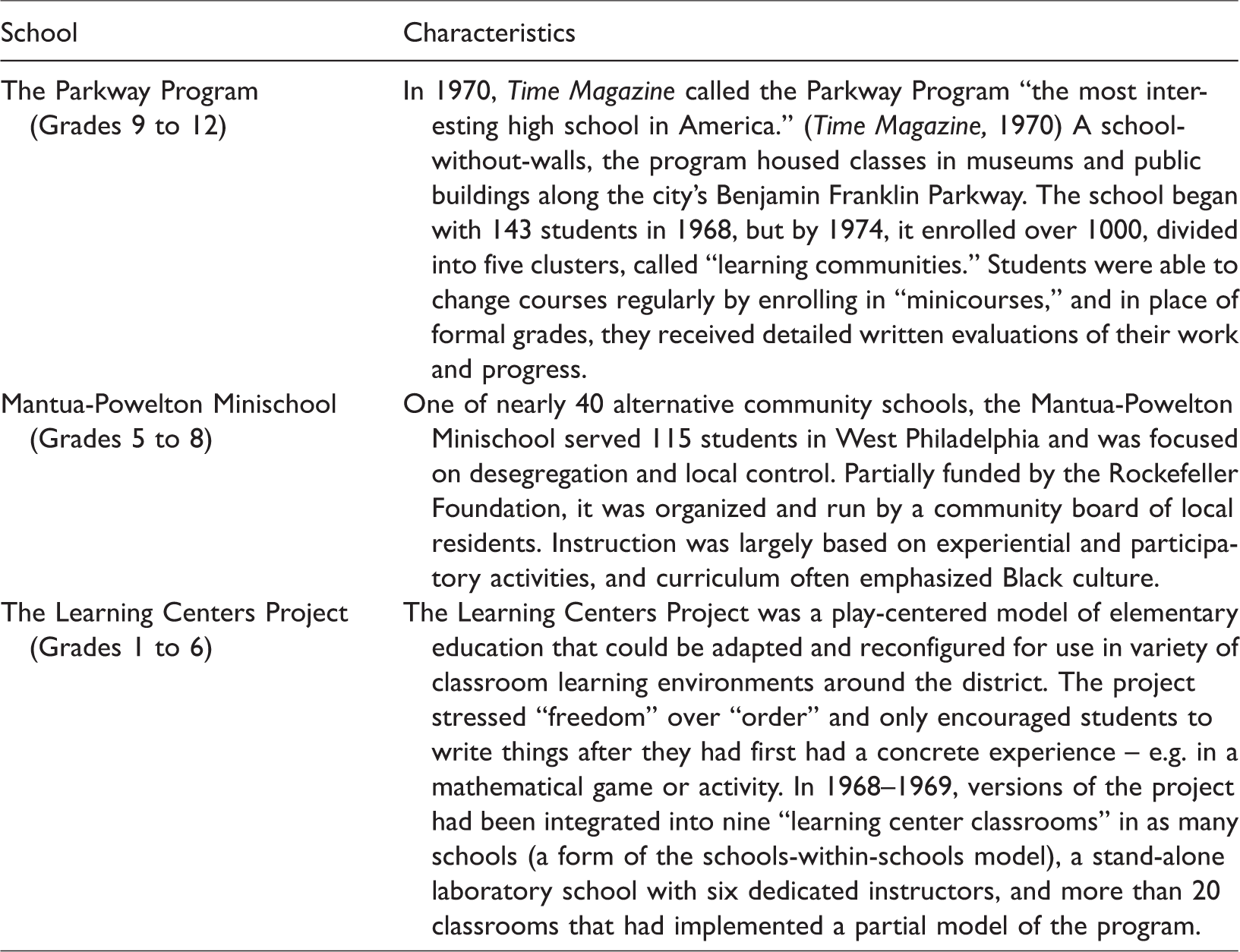
For Shedd, the education park proposal was only the beginning. These parks were referred to by the Urban League as “Model School Districts”—in part, because each was to be run autonomously, based on the needs of the communities being served, all while maintaining a loose tie to the larger district office (Wilder, 1967). Shedd saw in this decentralized configuration a means to shift the focus from simply integrating schools to truly improving the overall quality of learning for all students (see Table 1 for a description of several Philadelphia alternative schools). In a speech given to administrators shortly after taking office, Shedd built on this model, recommending “clusters” of schools that were “small enough to be manageable” yet “with a relevance and sensitivity to the local needs not otherwise possible” (Shedd, 1967).
Early in his tenure, Shedd was made aware of what these needs might include. In November 1967, 3000 African American students demonstrated at the Board of Education building with a list of demands—most related to school curricula and the need for Black History courses in schools. In response to these protests, Frank Rizzo—the city’s police commissioner, who had a history of stirring up public anxieties about Black activism in the city—ordered for student activists to be subdued by force and taken into custody, as needed. This ignited the ire of community groups and Black nationalist organizers. Working to deescalate the situation, Shedd came to the students’ defense and condemned Rizzo’s actions—starting a rift that would come back to haunt him a few years later. But in the immediate aftermath, Shedd set to work, providing opportunity for those same student protestors, along with existing community groups, to develop—from the ground up—new learning environments and curricula that could better serve the decentralized needs of individual alternative schools and the students who attended them (Corr, 1968). In contrast with Rizzo, Shedd saw those students’ activism as a way of participating in the hopeful critique that reimagined what schools might be—a vision that coincided with his own project of reconfiguring school structures around the district for more respectful and humanizing education (Shedd, 1968).
The vision of decentralized, alternative public schools, first advocated by the Philadelphia Urban League and various community partners, and later shaped into a formal Office of Innovation and Alternative Programs, was grounded in this ideal of “humanization.” Shedd often spoke of the district as less of an institution and more of a foundation—a resource for teachers and communities to experiment with methods that would serve the students and promote democratic ideals. While this approach was historically popular with community organizations (Countryman, 2006), it garnered widespread support and public legitimacy as Shedd formalized these ideals and began to receive outside investments for them. During his first year as superintendent, the budget for alternative programs was augmented by nearly US$30m in federal funds—more than any other district in the country (Resnik, 1970). These included pedagogical innovations, like the nation’s largest program for computer-assisted and individually prescribed instruction, as well as structural innovations, like open classrooms, schools within schools, storefront schools, and community schools. Many of these varied school structures also experimented with alternate governance structures. The Mantua-Powelton Minischool, for example, was largely run by community residents; whereas the Parkway Program, a “school without walls” that had no formal building, distributed its classes and instruction throughout the museums, galleries, and government buildings that lined the city’s Benjamin Franklin Parkway (Resnik, 1970).
However, just as many of these efforts were beginning to thrive, Shedd’s tenure as superintendent was coming to an end. In 1971, Frank Rizzo announced that he would be running for mayor of Philadelphia—and among his campaign promises, many of which hinged on escalating his attacks on Black nationalist organizing in the city, he specifically targeted Shedd (Shapiro, 1971). Rizzo not only vowed that he would personally oust Shedd from his role, but his campaign also worked to stir up unrest and uncertainty among teacher unions and, thus, destabilized support for Shedd. Rizzo intimated that white teachers’ jobs would be at stake under a prolonged Shedd superintendency. And while voices from the community came to Shedd’s defense, including the progressive caucus of the union and The Philadelphia Tribune, the city’s African American newspaper, he ultimately stepped down from his position after Rizzo won the election (Daughen and Binzen, 1977; The Philadelphia Tribune, 1971).
While Resnik (1970) and other journalists have largely narrated the rise and fall of Philadelphia’s alternative public schools in the 1960s and 1970s as a battle between Shedd’s heroic ingenuity and Rizzo’s quest for retribution, such an account elides some crucial details. While it is true that Shedd helped to popularize and legitimize certain decentralized, community-based school reforms in ways that garnered media attention and federal funds, much of the organizing, planning, and development of these ideas was done in neighborhoods by local activists and community organizations—some well before Shedd arrived in Philadelphia. Recall, for example, that Shedd’s plan for decentralized alternative programs first emerged from the Philadelphia Urban League’s groundwork in developing plans for city-wide education parks. Likewise, recall that Shedd’s model for school–community partnerships was not only dependent on the initial activist work of 3000 African American students demanding reform, but also on the networks of activist organizations that formed coalitions to develop and run new community-driven schools. One could even argue that Shedd would not have been hired were it not, first, for the NAACP and local activist groups pressuring the district to take integration seriously, and, second, for the organizers whose local ballot initiative returned control of the schools to the city itself.
From this perspective, the story of Philadelphia’s alternative public schools in the 1960s and 1970s is not—as it has often been narrated (e.g. Resnik, 1970)—one of a dramatic rise and fall tied up with Shedd and Rizzo alone, but, rather, one of local community members, student activists, Black nationalist organizers, as well as intermittent allies, like Shedd and Dilworth, who sought financial and institutional support to develop and sustain existing programs and local innovations. These efforts, together, were animated by a sense of critical hope that not only imagined possibilities of humanizing education, but simultaneously worked incrementally toward policies that would gradually make it a material reality. While this reality was not permanent, we can see evidence of its durability beyond Shedd’s tenure. Even in his absence, these decentralized reforms and experiments would be consolidated into their own Office of Alternative Programs—which would continue to house over 60 different configurations of schooling into the mid-1970s (Finkelstein and Pollack-Schloss, 1975).
Toronto (1970–2016)
Like Philadelphia, Toronto was a forerunner in the late-1960s and early-1970s movement to design and integrate alternative and critical approaches to K-12 education. There are three striking dissimilarities between Toronto and Philadelphia, however, which highlight the significance of context and modes of leadership in institutional change—and, by extension, the ways that critical hope was mobilized differently in each location. First, Toronto has been able to sustain momentum within the alternative school movement over time up through the present moment. Second, Toronto’s movement has been largely designed and driven by bottom-up grassroots action from students, parents, community members, and educators—a configuration that proved to be less dependent on the sustaining efforts of district-level administrators and initiatives than was the case in Philadelphia. And third, where many of Philadelphia’s alternative reforms strove for equity by reconfiguring school structures to aid in the desegregation and promotion of experiential learning (e.g. schools without walls, schools within schools, community schools), Toronto’s movement placed greater emphasis on reforming the curriculum itself—often with an eye toward affirming and supporting student identity and social-justice-oriented inquiry (see Bascia and Maton, 2015).
The late 1960s was a time of significant radicalization within Toronto—and, indeed, across the continent. Thousands of Vietnam War resisters fled the USA between 1965 and 1973, and many settled in Toronto. There was movement to challenge traditional values and to experiment with alternative lifestyles and organizational models, and some of this energy was directed toward rethinking the form and intended function of schooling (Shuttleworth, 2010). This Magazine is About Schools was established in Toronto in 1966, with a mission to record “the best of urban political change in education and good teaching in regular institutions” (Davis, 1990: 27). The magazine’s establishment marks the formal beginning of the alternative school movement in the city.
Toronto’s first public alternative school, SEED, opened in 1970 following several years of committed grassroots organizing. For the two years prior to its official opening, SEED had operated as a summer and after-school program for adolescents and experienced resounding success, indicated by high enrollment and positive reviews by students. By early 1970, the program had formed a committee to propose to the Toronto Board of Education that it be established as “an experimental alternative to the regular secondary school program” (Shuttleworth, 2010: 152). Upon approval by the school district, SEED officially opened its doors in September 1970 with an enrolment of 100 students. The school boasts notable longevity and continues to operate today (Shuttleworth, 2010).
Alternative schools continued to open within the district throughout the early 1970s. Such schools were frequently developed by parents and community members, and at times were even proposed by groups of teachers. 1 The first public elementary alternative school, named A Lot of People Hoping for an Alternative (ALPHA), was established in the district in 1972 (ALPHA, 2018; Shuttleworth, 2010). ALPHA resulted from the work of a citizens group called People for an Alternative Elementary School, which sought to create a community school that would support diverse learning styles and teaching methods, and allow students to develop at their own speed. It took several rounds of back-and-forth between the citizens group and the school district to obtain institutional approval and funding. ALPHA continues to operate today and has a long waiting list of students hoping to attend due to its innovative freedom-oriented approach (Shuttleworth, 2010).
While some of the early alternative schools did not survive, the district has continued to maintain institutional support for alternative programs over the years. This support has frequently emerged in response to the activism of local parents, community members, and educators (see Levin, 1979; O’Rourke, 2012; Shuttleworth, 2010; Winsa, 2012). Shuttleworth (2010) points out that this high level of community and parent involvement in district-level policy development is unique in the field of public educational alternatives.
Toronto alternative schools today
Currently, the Toronto District School Board hosts 42 alternative schools and programs, making Toronto home to the largest number of publicly funded alternative schools in Canada, and arguably within North America (Bascia and Maton, 2015). A small handful of these alternative schools are top-down initiatives developed and sponsored by the district; however, most schools resulted from the grassroots thinking, organizing, and activism of local community members, parents, students, and educators (see Beattie, 2004; Levin, 1979; O’Rourke, 2012), who have sought to create school structures that are more responsive to students’ creative, intellectual, and identity-based needs than traditional schools that have tended to prioritize economic efficiency in school design and outcomes.
Toronto public alternative schools have consistently been subject to the same regulations as other public schools within the district (Beattie, 2004; Meyer and Rowan, 1977). They are managed by district administrators in order to maintain efficiency in overseeing alternative programs and schools (Bascia and Fine, 2012). Each school is also assigned a principal, although principals are usually split across multiple schools (TDSB, 2018). Principals tend to take a backseat role and leave governance decisions up to the student, staff, and parent body instead (Beattie, 2004). For instance, ALPHA Alternative principal Ghabriel names himself “the least important person” in the school, stating that, rather, “It’s parents, kids and staff that run this place” (Ansari, 2015).
Many Toronto alternative schools take up democratic decision-making models that push back against top-down authoritarian governance structures that emphasize neoliberalist goals of standardization and efficiency in governance. Decision-making processes at the elementary level typically involve students, parents and educators. For example, ALPHA alternative school asks students to Chair monthly meetings for parents, students, and educators as they make curricular, pedagogical, and structural decisions. At the secondary level, decision-making tends to primarily involve students and educators. SEED, Toronto’s oldest public alternative school, has consistently employed democratic decision-making processes, where the community meets on a regular basis to discuss problems in the school and to provide input on school policy and procedure (TDSB, 2018).
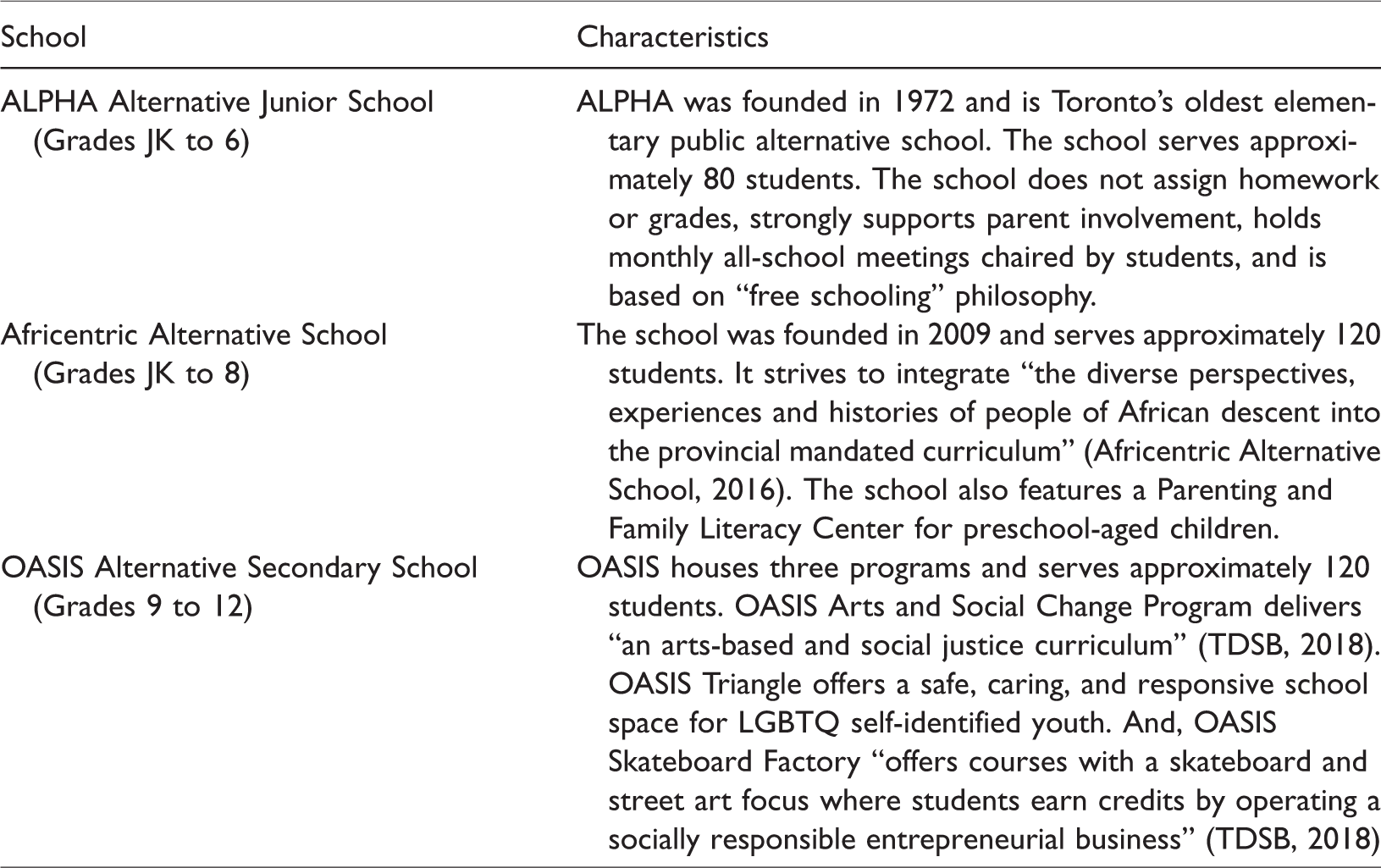
Most Toronto public alternative schools are driven by identified thematic foci. The emphasis on creative, intellectual, and identity-based themes is meant to contrast with mainstream structures of schooling which have prioritized standardization and efficiency in teaching and learning. Alternative school themes range from social justice to environmental concerns, the arts, and experiential education. Many schools embrace a targeted student population, such as students with specific sociocultural identities (such as LGBTQ youth, youth from socioeconomically marginalized backgrounds, students with African heritage, and First Nations youth), while others target students who have previously dropped out or are otherwise disengaged from traditional schooling. Toronto’s Africentric Alternative School (see Table 2), for example, centers an Africentric approach to ethos, relationships, curriculum, and pedagogy. The school emphasizes parent engagement in the daily life of the school and strives to nurture connections between students and the local community (Brown, 2015a; Dei, 2013; The York University Magazine, 2015). Of course, the presence of such a program does not mean the model has not faced opposition or challenges. The Africentric school faced significant resistance from the school district and local community members, many of whom were white, as it sought to gain public alternative school status (Brown, 2015a). As such, it is important to note that while the Toronto public alternative schools might strive to embrace and respond to identity-based and other thematic needs, that they do not exist without struggle and strife in the public milieu and local education system.
Examples of Philadelphia alternative schools (1967–1972). Descriptions adapted from Alternative Programs: Existing and Newly Funded (School District of Philadelphia, 1973).
Descriptions of select Toronto alternative schools. Descriptions adapted from Toronto District School Board website (TDSB, 2018).
Alternative school programs tend to be small and highly personal, in contrast with neoliberal impulses toward maximizing efficiency through the ranking and sorting of students. The majority of schools enroll between 50 and 100 students, with enrollments ranging from under 30 to over 210 students per school (TDSB, 2018). The small size is thought to allow for a tight-knit community with strong relational ties. Teachers are thought to be more responsive to students when they have smaller school-wide enrollment and greater opportunity to flex curriculum and pedagogy in response to student need and interest (Bascia and Maton, 2015, 2017).
The schools tend to be highly focused on relational elements—both within and across groups of students and faculty. In her study of one secondary alternative school in the district, Beattie (2004: 27) argues that relationships are “at the heart of the teaching and learning that takes place in the classroom and throughout the events and activities of the learning community.” Relationships are shown by Beattie (2004: 27) to be nurtured through the “informal, community-like environment of the school” where “teachers and students [can] form the kinds of relationships in which adolescents can develop their voices and perspectives, identities, sense of self-esteem, and feelings of self-worth.” Similarly, ALPHA links relational skills with child development. Their website states that the school “emphasizes the development of communication and conflict resolution skills. An understanding of social justice is acquired through social interaction and the development of critical thinking skills” (ALPHA, 2018). District alternative schools tend to explicitly link relationships with students’ development of self-esteem, critical thinking, and social justice values.
Teachers tend to experience enhanced autonomy in designing curriculum and pedagogy, which pushes back against neoliberal trends toward systemic standardization of curriculum and assessment. Bascia and Maton (2015) show that this results, in part, from the structure of alternative schools, where there is frequently only one teacher per subject area and, thus, a lack of department heads overseeing subject areas or requirements for teachers’ curricular and pedagogical coordination with colleagues. Teachers often voluntarily collaborate across subject areas with colleagues to create new projects, curriculum, units, and even courses. They find that they can more effectively respond to the needs of their students through getting to know their students and designing responsive curriculum (Bascia and Maton, 2015).
The longevity of critically minded alternative schooling in Toronto might be most potently linked to the ways in which its support and development are deeply intertwined with local communities. Throughout the history of Toronto pubic alternative schooling, there has persisted a movement of critical-social-justice- and human-rights-minded parents, community members, and educators, albeit not without some moments of tension and conflict in relation to the local community and public education system context, as we have shown. The alternative schools tend to take up a grassroots orientation, have minimal administrative oversight, exert a tendency toward democratic decision-making, and be small in size with a committed focus on relationships. They are organized around central themes and foci that are responsive to specific student populations and their needs.
Discussion
Looking across the Philadelphia and Toronto contexts, we can see how different groups have engaged in a form of critical hope that reimagines possible futures for students, communities, and cities, and works to cultivate educational models that can sustain such visions. The concept of social justice is central to this critical hope in each context. In both Philadelphia and Toronto, public alternative schools were created and developed, in part, as a strategy for addressing larger systemic impulses toward racist and classist ideologies—impulses that have continued to animate the neoliberal project that underpins much of contemporary education reform (Harvey, 2005; Hursh, 2004). In Philadelphia, communities and district officials worked in coalition to create decentralized alternative models that not only pushed back on the technocratic school configurations so common in the post-war era (e.g. Hartman, 2008), but also foregrounded the importance of racial integration and educational equity in shaping the curricula of these emergent models. Likewise, in Toronto, grassroots mobilization led to the adoption of new school models by the district, including schools that embraced curricular and pedagogical methods centered on critiquing and destabilizing systemic social inequities.
Of course, these contexts also make legible the limitations and constraints that such visions face when enacted within larger bureaucratic systems of schooling. In the Philadelphia context, for example, justice was framed in terms of integration and educational equity—and while these ideals were carried forward by resilient networks of community-based supporters, they struggled to find legitimacy in the larger district structure until they were endorsed by a white, male superintendent sympathetic with their cause. Even then, other institutions with their own legacies of racism continued to work against these visions: it is not coincidental that the mayoral campaign that undermined much of the coalitional work in Philadelphia alternative public schools was grounded in the “law-and-order” policies of a former police commissioner—or that the tactic for eroding support for these programs involved sowing seeds of dissent among white teachers by suggesting their privileged positions would be threatened or eliminated under an expanded alternative program. In Toronto, marginalized communities have at times faced significant pushback as they sought to realize their vision for a responsive school environment that allows for a critical lens on power relations and coloniality. For example, Black parents, teachers, and community activists faced significant pushback when advocating for and implementing a public Africentric alternative school. Yet, even amid these tensions, two themes emerge from each context’s respective constructions of social justice that speak to the ways alternative public schools, when guided by critical hope, might configure equitable learning for student flourishing in post-neoliberal futures: mobilization in response to identity-based needs; and leadership in institutional structures.
In Philadelphia and Toronto, communities often mobilized for alternative schools in an effort create better educational opportunities for students from economically and racially marginalized backgrounds. Thus, student identity played an integral role in shaping the imagined futures toward which alternative public schools worked. In Philadelphia, for example, the coalition of community members and administrators that were hallmarks of Mark Shedd’s tenure were only possible because of existing networks of neighborhood activists committed to issues of structural inequity and extending their concerns to school reform initiatives. The famous student protest that launched Shedd’s turn toward grassroots school design, for example, grew out of larger activist concerns that African American students were not being given opportunities to learn about their history and culture (Resnik, 1970). The resulting coalitions of students, community members, and city officials would become the baseline on which the district’s Alternative Programs Office would be built.
Where Philadelphia mobilized around student identity from a standpoint of integration and representation in curricula and school design, Toronto has largely addressed the matter by creating alternative schools that have explicitly focused on supporting and celebrating the identity-based needs of students. The OASIS Triangle Program, for example, which opened in 1995, is funded by the public school district and supported by the local LGBTQ+ community. The program emerged out of a need to create a learning space for LGBTQ+ youth that was free of harassment and bullying, and celebrated diverse student identities (Knight, 2000; Triangle Program, 2018). Similarly, Toronto’s Africentric Alternative School opened in 2009 as a result of five years of activism by local African Canadian parents and community members. And, while the school has faced significant pushback over its Africentric ethos over time, it also successfully received alternative school status and funding from the local public education system and has provided a space in which African heritage is honored and celebrated (Brown, 2015a; Dei, 2013; The York University Magazine, 2015). Thus, specific identity-based communities have engaged critical hope as they mobilized to counter identity-based sociopolitical power differentials through the formation of public alternative schools in Toronto. Such schools have sought to provide more equitable and responsive structural possibilities for schooling that counter institutionalized tendencies to overlook and/or harm historically marginalized groups.
Conceptions of identity differed across contexts yet remained central to the imagined visions of an alternative public program that could resist the systemic impulses toward racism and homogenization. These impulses have only strengthened with the growth of neoliberalism—where many of the same talking points about humanization have now been appropriated to serve the purposes of individualistic learning that are often positioned as an outgrowth of business, industry, and job preparation (Maton and Nichols, 2017). As such, a pedagogy that embraces critical hope beyond neoliberalism will interrogate the means by which school and district structures can build on these impulses toward personalizing learning in a way that celebrates and sustains students’ intersectional identities, even as they actively work against neoliberal efforts to commodify this personalization by linking it to a larger telos of business and enterprise.
A second theme that runs through these contexts relates to the role of diverse forms of leadership and institutional structure in school design and organization. We argue that the critical hope framework holds implications for understanding the permeability of institutions. Bureaucratic institutions like schools and districts are capable of transforming to better accommodate the needs of local communities and the public broadly. They can support human rights values as well as equity and diversity initiatives and outcomes.
Contrary to popular accounts of the period (e.g. Resnik, 1970), in the Philadelphia context, much of the groundwork in establishing alternative schools was conducted at the level of local activism. This included the community and neighborhood groups who organized the ballot initiative that led to greater community control of public schools, as well as the local chapters of national organizations, like the NAACP, who put pressure on the district to hire a new superintendent who would take seriously concerns related to racial integration and the unequal distribution of resources within the district. Even after Mark Shedd’s hiring, neighborhood activists, as well as Black nationalist organizers, continued to put pressure on the administration so that the adoption of new alternative schools would remain committed to educational equity. In this sense, while the story of Philadelphia reform often positions Shedd as a heroic reformer who faced an untimely dismissal in a volatile political climate, it is important to recognize the coalitional forces that worked together to critique power asymmetries in the broader system and to work toward a hopeful vision of a more equitable future. While neighborhood and community activists engaged in the work of imagining and bringing about systemic change, their work was augmented by the institutional support of a sympathetic administrator who shared this hopeful vision of “humanization” within the bureaucracy of schooling (Maton and Nichols, 2017). Far from a lone hero, Shedd’s most valuable contribution was that he offered institutional legitimacy to a longstanding network of grassroots community activism that had been largely blocked out and silenced by previous administrations.
In the Toronto context, grassroots agents, including community groups, parents and teachers, have collectively developed visions and designs for alternative education that resist the neoliberal focus on standardization and efficiency, and through grassroots organizing have ensured that such social-justice-oriented visions are legitimized and adopted by the school district. The school district engages bureaucratic agents to monitor these schools through a district-level administrator overseeing alternative schools and school-level principals (Bascia and Fine, 2012). However, significant decisions, such as those regarding school structures, rules, and pedagogy and curriculum, tend to be primarily led at the local school level. The district maintains a loosely coupled connection with alternative schools (Bascia and Maton, 2015), allowing alternative school constituents to take on primary leadership roles in decision-making. Thus, even though alternative schools are subject to the broad rules and regulation of the public school district, they are afforded some autonomy to meet local community needs in responsive and meaningful ways. In this sense, the Toronto public school district retains some degree of permeability to local communities and constituents.
Importantly, attending to leadership and institutional structures also reveals the vulnerabilities that can come with alternative school structures. In Philadelphia, while there were many distributed efforts that were legitimized under Shedd’s tenure, the Office of Alternative Programs was dramatically consolidated in the years after he was ousted from his position. Like many “free schools” of the era on which some of these alternative programs were modeled, few lasted longer than three years (Miller, 2002; Resnik, 1970). Because much of the longstanding community-based reforms had, at the district level, become associated with Shedd’s name, what might have evolved into a thriving, sustainable network of alternative programs, instead became tied to the reputation and standing of the administrator who endorsed them. As a result, years of distributed, grassroots work was made vulnerable to shifts in city-wide politics, and faced some demoralizing setbacks when Shedd left office. By contrast, in Toronto, where leadership has consistently been dispersed across multiple agents including parents, teachers and students, it is notable that alternative schools have tended to exhibit less vulnerability to shifting local politics and district-level leadership. Schools seem to be more vulnerable to institutional and political shifts when leadership is concentrated among a small population—a challenge that, while exacerbated under the logic of neoliberal reform, would continue to demand shared attention and deliberation in post-neoliberal futures of schooling.
The cases of Philadelphia and Toronto beginning in the 1970s provide generative examples of grassroots work at the margins of public systems that helped to carve out alternatives to the rigidity and inequities of conventional school models. Much of what they worked against were impulses toward standardization and efficiency—the same logics that would, over subsequent years, become integral to the project of neoliberalism and market-driven school reform. Of course, just because these cases originated before the advent of formal neoliberalism does not mean they are immune to its reach. Indeed, the historical longevity of the Toronto alternative system means that its development has been concurrent with the proliferation of neoliberal policies, and it is possible to see its present-day landscape as entangled with the pervasive discourse of neoliberalism. While Toronto alternative schools continue to espouse values of identity, humanization, and experiential learning, in practice, these schools also at times contribute to the market logic for schooling itself—one that views schools as commodities that must compete for enrolment within the broader system. In other words, alternative schools are at times framed in neoliberalist terms as educational commodities, and this tendency can detract from investment in and support of the broader commons of the public system. Had Philadelphia’s alternative office survived continuously to the present, we conjecture that it would likely face the same challenges.
We would like to emphasize that while we believe that the cases of Philadelphia and Toronto speak to the enduring power of critical hope, that such cases do not provide a magical, silver-bullet solution. The logic of neoliberalism has proven to be eminently flexible—not only in expanding its reach into all aspects of political, economic and social life, but also in absorbing the modes of critique, protest, and resistance that rise against it (Brown, 2015b; Harvey, 2014). As such, we assert that critical hope demands not only attention to imaginative possibilities for social-justice-oriented education and the material work of bringing it into existence, but also the vigilance of interrogating how these means and ends might be vulnerable to neoliberalist appropriation. The historical record can be an asset in this respect: by turning to instances from Philadelphia and Toronto that predate the pervasive hold of neoliberal ideology, we can find, in this defamiliarized past, ways of thinking, knowing, and doing that can jar us from the familiarity of our present lens and focus. In doing so, cases like these can help us to better understand how critical hope and material labor might work at the frayed edges of public education in order to achieve more humane learning conditions for students. And in these histories, we might find possible pathways and creatives modes of resistance that may be of current use as we work to imagine and bring about more just and equitable post-neoliberal futures.
Conclusion
This paper has argued that the histories of public alternative schooling present hopeful structural possibilities for supporting the creation of responsive and social-justice-oriented public schools. This is not to suggest they are panaceas, nor that they lack their own unique challenges, but, at their best, we argue that public alternative schools can provide space for inventive models that frame the world in new and critical ways. They present opportunity for nourishing new social imaginaries—and work to support and sustain the flourishing of all students, from across their varied experiences, backgrounds, and identities.
Establishing a system of strong and vibrant public alternative schools requires significant effort and long-term commitment. The cases of Philadelphia and Toronto show that the potential for social-justice-oriented teaching and learning is maximized when there is a critical mass of public involvement in the design and sustenance of such practices. This critical mass, frequently exerted through advocacy and activism, not only supports the organization and construction of public alternative school spaces, but also the longevity of their impact in the wider community. The case study of Philadelphia has shown that leaders can be a vital intellectual force in dreaming up new possibilities for alternative structures. However, there is a danger in relying too strongly upon a single leader, rather than dispersing the iterative work of designing, building, and critically reflecting across a range of community constituents. If there is too much reliance on a single leader then the fruits of critical hope may live and die with a single person. The case of Toronto elucidates how alternative school structures may be collectively mobilized by community groups, students, and teachers. The dispersion of power across multiple agents can provide a more stable infrastructure for public alternative education—not only to make such models more resilient to change, but also to provide a foundation for future stakeholders to engage in their own processes of critical hope that address the shifting needs of the community.
The case studies of Philadelphia and Toronto show that the same bureaucratic impulses within public education that allow for constraining, for commodification, surveillance, and control (e.g. Scott, 1998) can also be leveraged to create new opportunities for those who have been historically marginalized and to challenge historical inequities. Public school systems can offer institutional support, funding, and resources, and established structures through which to develop and implement new inventive alternative programs that are attentive to, and that directly involve, the grassroots activism and the lived perspectives of their communities. Public alternative schools provide opportunity for parents, students, educators, and communities to collaboratively mobilize and leverage their local intellectual resources into constructing community-responsive curriculum and pedagogy. In so doing, they may become vibrant spaces where alternate imaginaries are developed, and where post-neoliberal futures can be realized.
Footnotes
Declaration of conflicting interests
The author(s) declared no potential conflicts of interest with respect to the research, authorship, and/or publication of this article.
Funding
The author(s) received no financial support for the research, authorship, and/or publication of this article.