



Abstract
The National Socialist regime was, generally speaking, not interested in an outright levelling of social differentiation patterns, as they were present within the German society around 1933. On the contrary: old hierarchies were to be fought and new ones were to be established—both according to the Nazi administration’s social ideology and, deriving from it, its racial ideology. The Hitler-Jugend, the Nazi’s youth organization, can be subsumed under this conclusion. The following contribution takes a closer look at the particular fate of Jewish “Mischlinge,” classified as such by the Nazi regime, in order to explore the question as to what extent the phenomena of social inequality occurred in the Nazi youth organization and how it can be ordered in a systemized manner. Two difficult fields of research are being united here: on the one hand, there is the research field regarding the Hitler-Jugend that is hardly manageable, but shows desiderata; and on the other hand, the thus-far rarely consequently and systematically conducted analysis ofthe National Socialists’ repressive policies targeting the newly created population group of Jewish “Mischlinge” in Germany.
The Jewish population in Germany during the Nazi regime and the construction of the “Mischlinge”
At the time of the Nazi’s assumption of power in 1933, there were about 500,000 people who lived in Germany that were committed to Judaism (Benz, 1996a: 9; all quotes are translated into English by the author unless stated otherwise). This was equivalent to 0.76% of the total population. About 99,000 were not considered German citizens according to the law back then (Benz, 1996a: 10). For a theoretical approach to socialization it is especially interesting that among them, there were about 117,000 Jewish adolescents between the ages of six and 25 (Kaplan, 2003: 140); approximately 58,000 Jewish adolescents between the ages of 16 and 24 lived and grew up amongst this group (Kaplan, 2003: 160). Roughly 10% of the German Jews stayed orthodox until 1933 (Kaplan, 2003: 25).
The second national census under Nazi reign 17 May 1939 (the first had already been conducted in 1933), which then already included a particular way of counting for Jews and Jewish “Mischlinge,” and also distinguished “Jews” from other religious confessions, showed that the number of the Jewish population had shrunk to approximately 250,000 Jews who were residents in the “old Reich” (Germany excluding annexed or occupied areas) (Boberach, 2003: 57). The Jewish population in Germany at that time, however, was—considering sociological, political, and religious aspects—one that showed great heterogeneous structures (Plum, 1996; Weiss, 2000). The increasing repressive pressure of National Socialist (NS) politics led to liberal Jews within the Jewish population in Germany returning to religious and cultural content of Judaism. This entailed a strengthening of the feeling of community among the Jewish population in Germany, which was being threatened and persecuted as an allegedly united group, and further strengthened the Zionist’s authority (Benz, 1993: 275). One should, nonetheless, not draw the conclusion that there were the Jews in Germany who formed “an ideological and politically cohesive population group” (Benz, 1993: 275). Among them, the majority was made up of “those indifferent, who—similar to many Christians—held on to numerous practices, respected the high holidays, but in general did not let their religion influence their every-day lives much anymore” (Benz, 1993: 275).
In contrast, however, the NS regime and its propaganda aimed at establishing an artificially homogenized population group consisting of the “Jews” endowed with stereotyping of an anti-Semitic ideology. As an alleged external enemy and deliberate cause for Germany’s stated downfall, this group was to increase the power for inclusion for the propaganda-slogan of a German “national community,” and at the same time was to provide legitimacy for the Nazi’s anti-Semitic politics. In order to be able to initiate, organize, and propagandistically reason the systematic defamation, exclusion, deprivation of rights, violent persecution, and finally the attempt of extermination, 1 a definition of the alleged distinctively identified group was needed. 2 The difficulties presented by the process of finding such a justifiable categorization that had to be vague enough to include as many of the flourishing anti-Semitic stereotypes as possible, but was sufficiently specific to identify the respectively declared group of people with a seeming legal validity and to finally persecute them, cannot be outlined here in detail. 3 As a result, the first decree of the Reich Citizen law, issued on 15 September 1935 (Reichsgesetzblatt, 1935: 1146), a part of the “Nuremberg laws” that followed on 14 November 1935, 4 presented the following highly abstracted provision: a Jew was a person who 1. descended from at least three Jewish grandparents (full or three-quarter Jews) or a person who 2. descended from two Jewish grandparents (half Jews) and at the same time a) belonged to the Jewish religion on 15 September 1935 or joined it after said date; or b) was married to a Jew on 15 September 1935 or who entered matrimony with a Jew after said date; or c) a descendant from a marriage entered into by a three-quarter or full Jew, after the law to protect the German blood and the German honor came into effect (15 September 1935); or d) a descendant from an extramarital relationship of a three-quarter or full Jew and was born illegitimately after 31 July 1936. For the status determination of the grandparents, it was also stated that a grandparent was Jewish if he (or she) was a member of the Jewish religious community. A person of “mixed Jewish blood” was whoever 1. descended from two Jewish grandparents (half Jews), but a) was not a member of the Jewish religion after 15 September 1935 and did not join any time after and b) was not (or no longer) married to a Jew after 15 September 1935 and did not enter matrimony after said date (such half-Jews were called “Mischlinge of the first degree”) 5 ; and 2. descended from one Jewish grandparent (“Mischling of the second degree” [so-called “quarter Jews”; the author] (Hilberg, 1999: 76). This decree also classified “non-Aryans” into two categories: Jews and “Mischlinge.” Paradoxically, it was not a genetic criterion that was crucial for an ostensibly on-scientific-principles-based assignment, but the grandparents’ religious confession. It is, finally, also noteworthy that “half Jews” were to remain “Mischlinge” as long as the racial situation did not exacerbate due to a belonging to the Jewish religious community. The final assessment whether a certain “half Jew” as descendent from a “mixed marriage” was to be considered a Geltungsjude (people that were considered Jews by the first decree to the Nuremberg laws) and thus belonging to the group of “Jews” was henceforth dependent on their actions—in the case of children and adolescents on parental upbringing—or, to be more precise, on whether a Jewish religious lifestyle (or the respective upbringing of children in “mixed marriages”) was chosen; it was, however, not dependent upon an allegedly inherited biological feature. For the latter group, the same anti-Jewish provisions were applicable as for “full Jews.”
With regard to the “definition of Jews” in the laws that represented the legal foundation for the further marginalization of Jewish citizens from German society, it can be stated that it did not primarily rest on “racial” criteria for judgment. Eventually, it was the exchange of the feature of biological descent, which “in itself was not legally tangible” (Adam, 2003: 102), with the legal concept of religious affiliation that made it possible for a grandchild descending from four “Aryan” grandparents of which three converted to Judaism to go from “purebred Aryan” to “Rassejude” (full Jew) in the NS view (Adam, 2003: 102).
Those who were part of the category of “Mischlinge” were exempted from a further process of extermination. They were non-Aryans in the sense of earlier decrees and “continued to be affected by them, but the following measurements were essentially limited to ‘Jews’” (Hilberg, 1999: 77). Immediately affected by this classification were groups of people of the following numbers: “full Jews (in a racial sense): approximately 502,000 …]; half Jews: 70,000 to 75,000; quarter Jews: 125,000 to 130,000” (Friedländer, 2000: 168). The regime’s national census conducted on 17 May 1939, recorded a maximum of 72,738 and at least 71,126 (Statistical Reich Office, 1944: 4, 56) 6 “Mischlinge of the first degree”; however, the numbers diverge slightly because the statistics published between 1941 and 1944 are not consistent. Within this cohort only 6660 persons, 9.9% of all children descending from “mixed marriages” (Statistical Reich Office, 1944: 4, 6) were counted as so-called Geltungsjuden. The “Mischlinge of the first degree” (“half Jews” and Geltungsjuden) only made up 0.09% of the total population (Statistical Reich Office, 1940: 84). “Mischlinge of the second degree” made up 0.05% (Meyer, 1999: 162). Seventy-eight percent of children descending from “mixed marriages” belonged to one of the two Christian confessions (60.8% were baptized Protestant, 17.2% Catholic) (Meyer, 1999: 418). In general, it can be found that more than 90% of “Mischlinge” belonged to some form of Christian confession, which clarifies the great extent of assimilation of Jewish partners within “mixed marriages” (Meyer, 1999: 162). The group of adolescents that were old enough to be allowed into the Hitler-Jugend (HJ; ages 10–18), which is especially interesting for this contribution, consisted of 12,927 people among the “Mischlinge of the first degree” in the national census (6079 10–14-year-olds (of which 970 were Geltungsjuden), 3396 14–16-year-olds (of which 486 were Geltungsjuden), and 3452 16–18-year-olds (of which 388 were Geltungsjuden)). 7 Generally speaking, taking a closer look at the demographic structure of Germans classified as “Mischlinge,” it becomes obvious which specific relevance for socialization had resulted from the differentiation of the population according to racist criteria. Thus, at the time of the national census in 1939, it was two age groups that dominated the “Mischlinge”: apart from young and middle-aged adults (25–40 years old), it was the group of children and young adolescents between the ages of 10 and 14 (Meyer, 1999: 163). Especially the latter group showed a specific relevance for socialization. The differentiation of age groups back then suggests “that in May 1939 ‘Mischlinge’ were—for the most part—of school age, in education or in adulthood” (Meyer, 1999: 163); whereas, within the Jewish population in general, decreasing numbers of children and adolescents contrasted with a large group of over-50-year-olds. Many of the young “Mischlinge” were publicly stigmatized and faced tangible repressions at a time of their lives when they not only had to handle important steps in their physical, psychological, and social personal development, but were further explicitly reliant on the support of societal authorities (teachers, instructors, superiors, etc.), as well as on performance assessments. Wherever they were not directly hindered from this side, the respective establishment of a professional identity, as well as the development of skills appertaining to said profession, children and adolescent “Mischlinge” were—in most cases—accompanied by terrible anxieties. 8 Adolescent “Mischlinge” in particular were affected by psychosocial effects of the policy of exclusion. They gradually lost areas of life that had become familiar to them and had further become part of their self-perception (school), contacts (friends, school mates, children from the neighborhood), and confidants (teachers, etc.). Alongside the increasing exclusion from the education and training sector, their social isolation progressed. Concerned parents further demanded not to attract anybody’s attention in public (Meyer, 1999: 192–195) in order not to confirm the Nazi’s attestation of Jews being “defiant” and thereby possibly endangering oneself and one’s own family. For many, a “you may not talk about it” became an internalized behavioral maxim, which they could barely retreat from—even after 1945 (Meyer, 1999: 266–281).
The here-outlined classification of an allegedly homogeneous population group of German “Jews” 9 differs significantly from the earlier outlined actual heterogeneity of the Jews in their differing contexts of affiliation and self-interpretation who lived in Germany at the time. The levelling of these differences was, similar to the anti-Semitic stereotypes it referred back to, merely the Nazi regime’s execution of dominion. The attributions of the definition and the patterns of differentiation of the provisions did not correspond to the self-perception of the Jewish population or those who had been made Jews by law. Then again, this also resulted in tangible and threatening consequences for all “Mischlinge.” The above-quoted provisions categorized many people, who according to their experiences “had suddenly become Jews” (Gay 1999: 62–66) 10 as a consequence of the Nazi’s assumption of power, and legally became “full, half, and quarter Jews.” Among the “Mischlinge,” too, many who were affected by the above-outlined process, and labeled “Jewish,” and who had further been accused of having the respective attributed characteristic traits, would come around to an actual consciousness and an active preservation of Jewish religious traditions only “as defense” (Klüger, 2005: 41) against the imposition of the Nazi state. In reality, the unrealistic definition of “Jewish” and the insufficient administrative preparation, as well as the provisions based on these, led to two consequences: on the one hand, the manifesting material contradictions and ambiguities, with the regime’s gradually radicalizing anti-Semitic population policy, both required constant readjustments; and on the other hand, public officials on different decision-making levels had to make decisions with respect to in- or exclusion themselves (Meyer, 1999: 146–147, 150–151, 162) in the light of a lack of legal ascertainment. Those affected had to endure the fact that numerous representatives of the “national community,” of some larger and (at least in the beginning) relatively independent institutions, and especially of the Nazi apparatus of power, from private person to top officials, implemented—often hastily and aggravatingly—the racist provisions in an ambitious willingness to adapt (Stolzfus, 2003: 126–130).
The affected “Mischlinge” were sufferers in a double sense throughout all of this: They were not granted any codetermination with respect to the definition of their status and the provisions affecting them (Meyer, 1999: 12–14, 21); additionally, a clear perspective on their possible further fate, based on the above-mentioned unfinished anti-Semitic laws and the resulting arbitrariness of the practical implementations, was lost. Accordingly, many of them wanted and could bet on “taking their spot within the ‘national community’ as individuals with good education, competences, appropriate manners, and commitment” (Meyer, 1999: 373), especially if they avoided potential conflict situations. In accordance to this attitude, many of the “Mischlinge” continuously adjusted to the new orders and limitations within the different areas of their everyday lives, always making an effort to avoid conflicts. Finally, it was the beginning induction of forced labor in 1944, which largely took away any individual room for maneuvering and thus, the opportunity to perceive themselves as major players within the narrow but allegedly constitutionally founded borders (Meyer, 1999: 374). This mentality was further supported by milieu-specific increased strict loyalty to legality, and a willingness to adapt to the authority’s orders, which not a few of them had internalized. At the beginning of the war this civic identity had many male “Mischlinge” hoping that the draft for the armed forces would reintegrate them into the “‘national community’ or at least into the males’ community” (Meyer, 1999: 375). The special status of “Jewish Mischlinge” in contrast to that of their “fully Jewish” fellow sufferers should not lead to the deceiving idea that their burdens should not be regarded as severe. Personal security in the sense of reliable legal structures or social security beyond one’s family was only slightly more experienced by “Mischlinge” in comparison to “full Jews” (Meyer, 1999: 144). The fundamental cause for the marginalization was the same for all who had been categorized as “Jewish”: “Our crime was our physical, our biological existence; it was the fact that we were on this earth, it was the fact that we lived” (Giordano, 2007: 145). Jewish “Mischlinge” were also affected by the advancing process of social isolation (Meyer, 2009)—by the threat, arbitrary arrests, and the abuse through state police of the Nazi’s repressive apparatus, first and foremost the Gestapo (secret state police). 11 They were, furthermore, finally also affected by the recruitment for physically and psychologically highly stressful forced labor (Meyer, 1999: 192–196; Tent, 2007: 192–195). In the light of the radicalization of the NS policies, the beginning of the war marked a time in which the assaults on these people became more frequent and more violent; the deprivation of their rights increased strongly starting in 1942 (Meyer, 1999: 52–54). As a consequence, the “Mischlinge,” too, “feared the always possible violent death” during the war; a thought that more and more became the “central attitude to life” (Giordano, 2007: 145). Throughout the course of war, the living conditions for all “Mischlinge,” as well as for all people who lived in a “mixed marriage,” got noticeably worse (Stolzfus, 2003: 223–226). Toward the end of 1941, the management of the National Socialist German Workers’ Party insistently discussed the deportation of these groups of persons (Stolzfus, 2003: 233–236) whose transportation to the East was officially “preliminarily” postponed (Stolzfus, 2003: 229). For these people, the smallest offenses against the anti-Semitic provisions, such as shopping, which had become necessary in order to obtain enough food for one’s own small children, outside the predetermined times for Jews, could lead to deportation and thus to a probable death. Although Geltungsjuden had not been deported to extermination camps as a group, and a majority survived the war (Stolzfus, 2003: 114, 434) until the end of the Nazi regime in May 1945, it can be considered a fact that a Nazi “Endsieg” (“final victory”) or even a much longer time of war would have meant certain death for “Mischlinge,” too (Hilberg, 1999: 437–449).
As indicated above, it was adolescents especially, who struggled with the above-mentioned burdens in several ways. They were significantly restricted with regard to their social and material (education, profession) opportunities of development. At the same time, they also suffered from the increasing social stigma and isolation that often already started in their private environment and thus among former circles of acquaintances or even friends. This was further intensified by the constant uncertainty with respect to their status. In the years until 1939, they were exposed to a constant, often in itself contradictory and partly simultaneously occurring change between demanding inclusion and rejecting exclusion within the various areas of the Nazi reign (Hilberg, 1999: 126–129). In the years after the tightening of the Nazi politics, this uncertainty more often meant a perceived and actual omnipresent threat to one’s own life (Benz, 1996b: 685). This was especially true for those who the NS state considered to be Geltungsjuden. Between the two groups of “half Jews” one could spot significant differences with regard to how the regime treated them. Accordingly, the provision of September 1941 that stated that Jews had to wear the Star of David applied to Geltungsjuden, but not to the other “Mischlinge of the first degree” (Stolzfus, 2003: 114). The opportunity of explorative behavior, typical for adolescents and necessary for a forming of identity, was—for the most part—suppressed through stigmatizing limitations of their freedom of movement. When focusing on the obstruction regarding an identity development under constant threat at that time, it becomes obvious that the allegedly relieving legal status caused great burdens especially for the adolescents among them. After 1935, they were neither unequivocally “Jewish” (a classification that would have meant an increased burden of persecution) nor “Aryan,” which suddenly had them caught between the stools of newly created societal categories (Benz, 1996b: 684–686; Stolzfus, 2003: 169). With respect to race, they were declared “border crossers” in every aspect (Meyer, 2009: 146, 151). The inconclusive position within the NS system resulted in difficulties regarding the development of the affected adolescents’ identity. National Socialism and its race definitions affected their most intimate concepts of personality and their most private social spaces, and forbade their just-developed patterns of self-perception without offering an identity with which they could have any familiarity or reliability. Despite the educational-historic importance of the Jewish “Mischlinge” tales of woes in NS times that has been stated here, the research status with regard to the topic is relatively limited. In the context of historical presentations of the Holocaust their fate is often mentioned, but individual progress reports and analysis of the meaning of the anti-Semitic provisions that affected this population group have barely been taken into account (Meyer, 1999: 9, 12). In the following, the above-depicted structures of the particular suffering from the Nazi regime experienced by those adolescents classified as “Mischlinge” at the time will be shown in depth with an example: their inclusion through the NS youth organization, the HJ. With it the potential relevance of socialization for those who were exposed to the Nazi arbitrariness immediately becomes clear. Two difficult fields of research are thus included in the analysis: the fate of the “Mischlinge” that has been analyzed only to a relatively minor extent on the one hand, and the barely manageable research regarding the HJ (Wiegmann, 2004: 12), which still shows desiderata, on the other.
The Nazi racism as an important determinant 12 of the creation of inequality of the NS youth organization towards Jewish “Mischlinge”
The following is about the systemizing depiction of the NS racism as a central condition, which preceded the HJ’s own inclusion policies, for the creation of social inequality within and through the Hitler-Jugend.
When it comes to races, contemporary research and biological findings show that they are “social constructs” (Hund, 2007: 120). This form of racism, which in consequence is older than the races it puts down, is about the “social construct of natural inequality” (Hund, 1999).
The NS regime considered power to be the condition and basis for an enablement to establish ideologically and politically motivated social inequality, and saw its reign in its institutionalized form as the socio-cultural precondition for the implementation of population policy; racism represented the ideologically and propagandistically spread legitimation. In this context, its argumentative use had a stabilizing effect on the regime’s power: Racial demarcation […] provides all members of society with ideologically sanctioned, often equipped with religious or scientific legitimacy, ways of discrimination applicable regardless of social differences […]. It, therefore, allows demarcation, revaluation, and protest all in one and—at the same time—stabilizes the relations that are themselves the motivator for the application. [.] In any case, it denies the humanity of those affected and, therefore, legitimizes the exploitation and persecution equally (Hund, 1999: 126). ‘racial purity’ and ‘hereditary health’ are dynamic concepts which—in the sense of self-regulation of the evolutionary process—can continuously be narrowed so that an increasing number of social classes fell under the verdict. Discrimination would thus begin at the margins of society and would eat into the center—with increasing aggression at the same time (Schmuhl, 1993: 189).
The characteristic of racism as the main paradigm of the NS ideology also had great effects on the regime’s youth policy. The attempts of practically implementing the intention to “burn” (Hitler, 1933: 475–476) the “sense for race” in general and especially the particular form of radical anti-Semitism into the upcoming “Aryan” generation can be found in different severities and in concretely applied methods within all areas of the NS education. 14 In accordance to said objective, the “issue of the so-called race-political education belonged to the fixed inventory of the ideological training work of the HJ” (Buddrus, 2003: 70) 15 since the beginning of 1934. In June 1939, the Reichsjugend’s press service announced that the “racial thought” especially in its anti-Jewish characteristic, had become the “focus of all ideological educational work within the Hitler-Jugend,” and praised this development as an outstanding achievement within the figuration of education (Buddrus, 2003: 70). Thus, on the level of a Hitler-jugend–specific conveyance of ideology, the racial ideology and the encouragement to behave in a respective racial-aware manner represented one of the key elements in the HJ training for both sexes, although the intensity of conveyance was lower within the Bund Deutscher Madel (BDM, League of German Girls; Schulungsplan der HJ, 1934: 3–6).
The HJ as a youth organization had its own definition for a target group, which would—on the other hand—refer back to the basic value of “race” or “blood” (Dietze, 1939: 74–75). Since the mid-1930s, the so-called “Aryan certificate” was required for admission or in order to assume leadership in the HJ. Ever since the summer of 1936, and thus before the implementation of the HJ law, members had to prove “that in their families there had not been any colored or Jewish ancestors before January 1st, 1800” with the help of a great “certificate of descent” (Kollmeier, 2007: 96). 16 On the level of the organizational structure it was those population categories that—according to the legal definition of the anti-Semitic law of 1935—were “fully Jewish,” as well as those whose membership would have presented an all-too-obvious contradiction to the propagated racist doctrine due to phenotypic characteristics, both of which were supposed to be excluded from the HJ service on principle. This was experienced especially by adolescents across both sexes who were distinct from the “Aryan” ideal because of their dark skin tone (Kollmeier, 2007: 201–202; Tent, 2007: 93–98). Affected by this in particular were, among others, those adolescents who according to the inclusion-related extensions of the implementing provision of 1939 and the here-determined inclusion of colored German citizens would have been liable for compulsory service (Kollmeier, 2007: 201). The terminological vagueness (“looks,” “characteristics,” etc.) that opened the flood gates to a socially differentiating arbitrariness, with which exceptions from the rule were planned, allowed those affected to experience highly burdensome inequality. 17
To what extent racism and the exercise of dominion could—in mutual dependence—become the cause of social inequality in the NS context, becomes especially clear when considering the loopholes which the regime kept for its pragmatically handled exceptions from the racist rule, particularly with regard to our topic. Such a loophole, as mentioned earlier, was the functionalized handling of racial differentiations of the NS regime. To be more precise, it was the few known race-related revaluations of individual Jewish citizens, which was given only on the basis of arbitrarily handled attributions of usefulness determined by the regime leadership (Cornberg and Steiner, 1998). In total, Hitler approved only 260 of 9636 requests for a racial revaluation to “Aryan” (Cornberg and Steiner, 1998: 149). Baldur von Schirach’s later claim he had declared children of hundreds of families to be “honorary Aryans” merely represents an insubstantial apology (Buddrus, 1998: 52–53). Hitler had exclusively reserved this right—the social difference of the “Führer” principle—to himself after the enactment of the Nuremberg laws. Similarly, former leader of the department for “race rights” Bernd Lösener’s statement that Baldur von Schirach himself had been raised from “Mischling of the first degree” to “Aryan” belongs in the realm of myth (Koop, 2014: 63). Members of the HJ were not among those who had been revaluated in this manner. It was already due to their age that they had little to offer that was of enough interest to the regime, which differentiated accordingly to the expected usefulness, for them to disregard their own definitions of race. Only as a family member of an “honorary Aryan” could the individual case of an adolescent becoming a member of the HJ after the respective parent had been assigned accordingly, in all likelihood occur (Koop, 2014: 103–113, 199–200).
The quantitatively low number of requests approved, as well as the qualitative suitability of the awarding structure as a functional instrument for dominion of the NS regime, however, does not allow the inversion of the argument that parents of Jewish adolescents would generally waste this opportunity. In times of increasing social exclusion, defamation, and increasing experiences of physical violence, parents were motivated by the longing to make their children’s lives easier. Thus, in some cases this led to such a “plea for mercy” in an attempt to achieve a racial revaluation and an inclusion or a chance to remain in the HJ. 18
The gray areas of the race-related differentiating inclusion structure of the HJ
The interplay of the introduced dimensions of power and racism in the HJ-related origin of social inequality is now to be clarified, with the help of the obvious contradiction resulting from the selectivity in the organization’s own group definition.
With respect to the public, which was controlled by the Nazi’s propaganda and behavioral regulations, this could further lead to a balancing act on a narrow and rarely straight path. This eventually meant a maximum of social inequality, with the exercise of rule on the one hand, and powerlessness to a great extent on the other.
The representatives of the regime, here the Reichsjugendführung and the HJ leadership on the lower levels, led the affected adolescents onto a by-the-regime determined path of functionality of reign using profound arbitrary power with respect to the interpretation of racial ideological maxims. At the same time, those affected by assumed deviations would be threatened with unmitigated exclusion, which in the “culling” dynamic of National Socialism would almost always entail cumulative, additional repression. The fact that some affected adolescents would willingly accept the submitted offers with respect to inclusion, and maybe even internalize the accompanying, sometimes emotionally relieving attributions, is understandable firstly because they would otherwise be faced with a constantly threatening living environment, and, secondly, because it did not change anything regarding the above-mentioned realization of complete powerlessness. They basically depended on the NS functionaries’ certificates. At the most, they could experience their own degrees of freedom if they avoided inclusion in advance, and thereby unofficially chose and initiated exclusion—at the expense of a further accelerated social isolation and oftentimes the endangerment of oneself (Tent, 2007: 62–63). The contradiction would become especially obvious whenever the attributions of a racist category and the phenotypical appearance of the adolescents did not match, thereby triggering a heterogeneous impulse of in- and exclusion especially in relation to the HJ. As has been indicated above, in these cases it was usually the phenotypical appearance that decided on whether an adolescent was considered useful and thus invited to a functional inclusion or whether they were defamed as “of foreign ethnicity” or simply “foreign” and therefore excluded. Such experiences could equally be made by adolescents of dark skin (Tent, 2007: 93–94) or Jewish “Mischlinge” (Tent, 2007: 59–65; Benecke, 2015: 144–147) depending on the attributions to the respective propagated racial stereotypes of the NS ideology and propaganda.
Eventually, the two framing influences (power, racism) created a heterogeneous, but at the same time highly effective mental and policy-making complex web of causality of social inequality. In the following, this will be clarified exemplarily by taking a closer look at the procedural structures in the context of the HJ’s racially selective practice of inclusion, and by systemizing group specificality, which has not been done with respect to the research perspective concerning the creation of social inequality. These show the caused gray areas between the claim for ideological selection and the totalitarian claim, which in this context did not occur on accident, but rather evolved as a direct result of the dependency of the HJ’s inclusion policy and the requirements of the previously outlined determinants. In a stage specific and systemized manner, adolescents were—at least temporarily—targeted to serve in the HJ or were at least tolerated, who were supposed to have been excluded according to the general Nazi ideology and its collectively attributing propagandistic proclamations. Such gray areas of inclusion relevant to inequality within the HJ can be found, to different extents according to the stage they appeared in, in three areas (Benecke, 2013: 60–68, 2015: 151–171). Due to the constraints of this paper, only two can be named. The fate of the Jewish “Mischlinge” is then to be used in order to exemplary portray the importance of gray areas with respect to their relation to inequality, by taking a closer look at their development.
The first gray area of inclusion in the HJ can be found within the NS occupational policy in the East of Europe, especially in Poland. Here, the BDM and the HJ both were, although equipped with gender-specific tasks, 19 actively and systematically involved in creating social inequality, which was euphemistically obfuscated as “racial and educational politics” (Harten, 1996: 99–110, 265–270; Buddrus, 2003: 814–825; Steinert, 2013: 97–100). This participation especially took place in terms of organizational or care responsibilities in the context of a “repatriation of Reichsdeutsche or ethnic Germans abroad” (cited from Buddrus, 2003: 804), as well as in the urged development of HJ organization structures in the incorporated territories, 20 which Heinrich Himmler’s leadership aimed at starting in 1939. Those adolescents affected by the racially selective implemented “Germanization,” which was, furthermore, a legitimization of the political regime, found themselves in a gray area of desired inclusion and violent exclusion only on the basis of characteristics attributed to them with no fault of their own. Their fate represents a continuous desiderate within research—especially in the German speaking countries (Hopfer, 2010: 12).
The second gray area of the HJ inclusion affected those who, according to “biological” criteria, were part of the socially differentiated part of the “national community” that were negatively connoted. Its emergence and development shows the inequality causing interplay of dynamically evolving racism on the one hand, and the intention of comprehensive control of power on the other hand. The here subsumed, racially legitimized social differentiations that were bound to the reign, especially affected those members of the “national community” who were attested a disability and were thus not in accordance with the HJ membership’s propagated ideals of the “hereditary healthy” (Benecke, 2013: 62–63, 2015: 168–171). This, accordingly, led to the founding of some Sonderbanne, consisting of those who were socially differentiated due to “biological” patterns of attribution in the first stage of the NS reign and the connected organization development (Vorschriftenhandbuch der HJ, 1942: 55, 60–61). In March 1934, the Reichsjugendführung approved Bann B (for the blind), in December of 1934 Bann G (for the deaf), and in July of 1935 Bann K (for the physically handicapped) (Büttner, 2005: 79–84). After only a few months of its emergence, Bann K was dispersed in 1936/37 because its existence and especially a possible public perception of the physically handicapped presented an obvious, possibly phenotypically recognizable contradiction to the racial ideology (Vorschriftenhandbuch der HJ, 1942: 60; Brill, 2011: 175). 21
Finally, as mentioned above, there was a third gray area in the context of HJ inclusion with respect to the members of the alleged main category of the excluded racist NS population policy. Here, the Reichsjugendführung transformed the NS population policy’s patterns of inequality based on racism directly into the organizational structures of the HJ. The here allegedly appearing, continuous contradiction can only be understood when taking the stage structure of the Nazi reign into consideration. Although the inclusion of entire groups of associations of youth organizations could lead to the admission of adolescents of “foreign ethnicity” in the first stage, there had not been any binding admission criteria that would have principally excluded these adolescents at that point. Many decisions had to be made by the responsible HJ functionaries on the spot, who often wanted to prove the efficiency with respect to the radical “cleansing” of their divisions. At the same time, however, the Reichsjugendführung established its totalitarian claim little by little. Thus, it was possible that the paradoxical situation of adolescents first being excluded from the HJ and later being liable for compulsory service could arise. Additionally, the combination of a consideration for pragmatic reasons with regard to the Nazi-reign and the totalitarian claim of the Reichsjugendführung within the first, second, and the early part of the third stage led to the inclusion of those of “foreign ethnicity” persisting, while at the same time other representatives of the same population group were rejected crudely or even defamed and physically attacked. A central criterion concerning this matter was the protection of the ideological appearance of an existing racial purity among HJ members. It was in the second half of the last stage at the latest that almost all of the adolescents of “foreign ethnicities” were excluded from the Nazi organization and “treated” accordingly to NS racial policies. However, there were undiscovered or randomly tolerated exceptions until the last, especially within the Wehrmacht (armed forces).
The here affected main groups of “foreign ethnicity” included: the population group of Sinti and Roma derogatorily graded as “Gypsy” on the one, and the Jewish “Mischlinge” on the other hand. In accordance with the common parlance of the National Socialists, Sinti and Roma were socially degraded by calling them “Gypsies.” They were, furthermore, recorded and “treated” as such. Within the Nazi regime catchment area their group had to endure a similar prosecution of that of the Jewish population (Zimmermann, 1996; Fings and Sparing, 2005). This notably characterized the life experience of their younger and youngest adolescents (Fings and Sparing 1993).
22
At the same time, however, they too would find themselves in contradictory admission regulations of the HJ when they reached a certain age. In the thirties, some HJ memberships of “Gypsies” and “Gypsy Mischlinge” were recorded (Benecke, 2013: 149–151). Most exclusion in this population group, too, appeared starting in the early thirties if the affected had not already reached the age of eighteen beforehand anyways. According to this selective subdivision with regard to allegedly existing differentiability in Mischling levels, the Reichsjugendführung determined in May 1942, that gypsies and gypsy Mischlinge are not to be liable for compulsory service. Exceptions are those gypsy Mischlinge with mainly German bloodlines whose parents were considered to be socially adapted by the Berlin Reichskriminalamt [comparable to a criminal department] […] (Bundesarchiv (Federal Archive) Berlin-Lichterfelde (BArch) R 43-II/522b, Bl. 95; printed in Benecke, 2013: 297).
The Jewish adolescents’ fate is now to portray the HJ differentiations’ structure, which they were affected by and which are structurally comparable to those mentioned above. The race-related provisions of the NS-system were especially directed against Jews “Non-Aryans” within the HJ against Jewish children and adolescents between the ages of 10 and 18. However, some adolescents among them could experience a temporary admission to the HJ if they were classified to be part of the legal gray area of the Jewish “Mischlinge” or a subdivision of that “race” category (Stolzfus 2003: 93–94, 171–172; Tent 2007: 78). A transfer of the youth association in which they were previously organized into the HJ would also result a HJ membership (Meyer, 1999: 282–287; Tent, 2007: 93–98).
23
In some individual cases they had already joined the HJ before 1933 (Tent, 2007: 171) (Figure 1).
The Hitler-Jugend’s admission requirements for “Jewish Mischlinge” and adolescents of non-German ethnicity.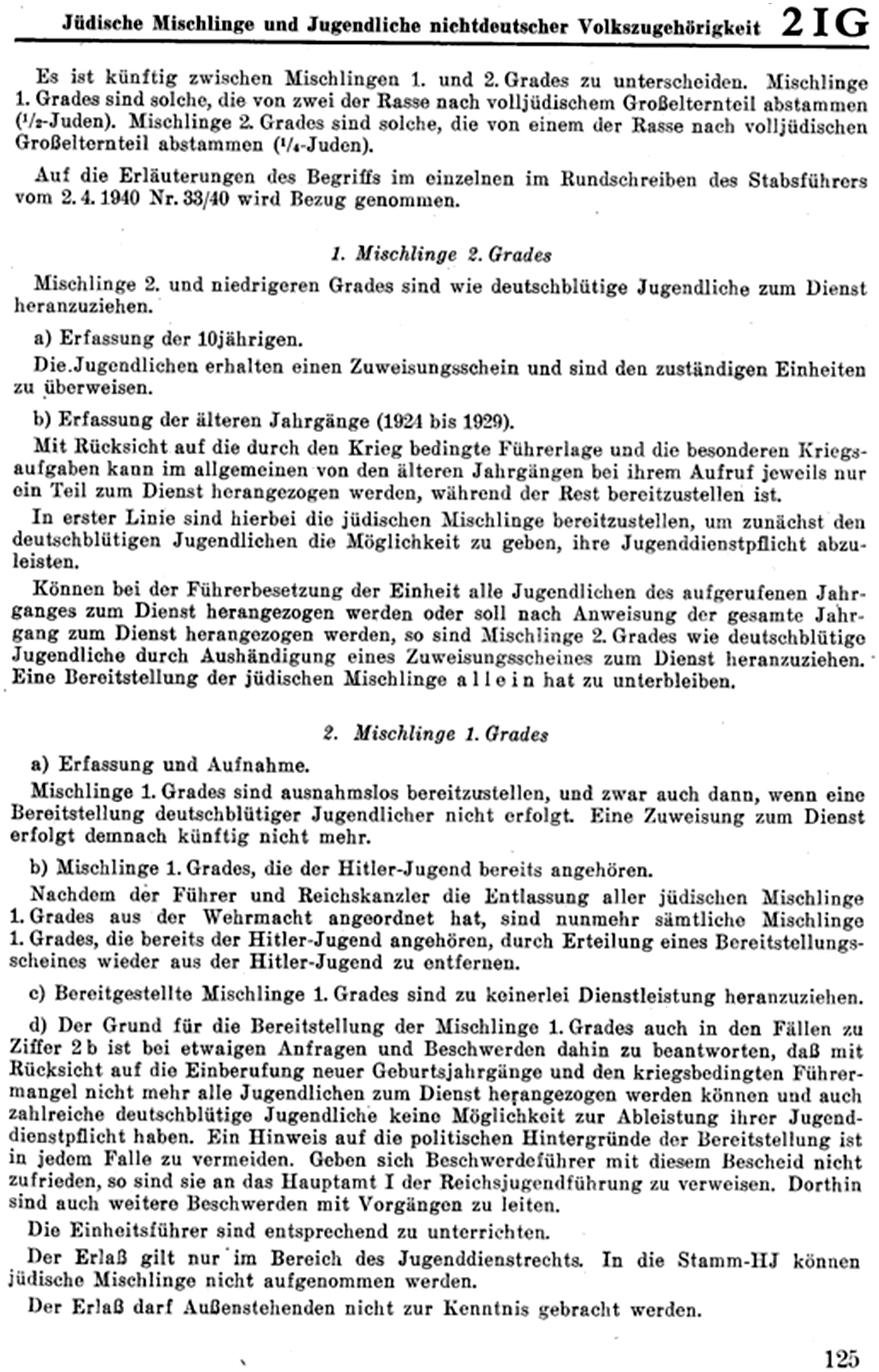
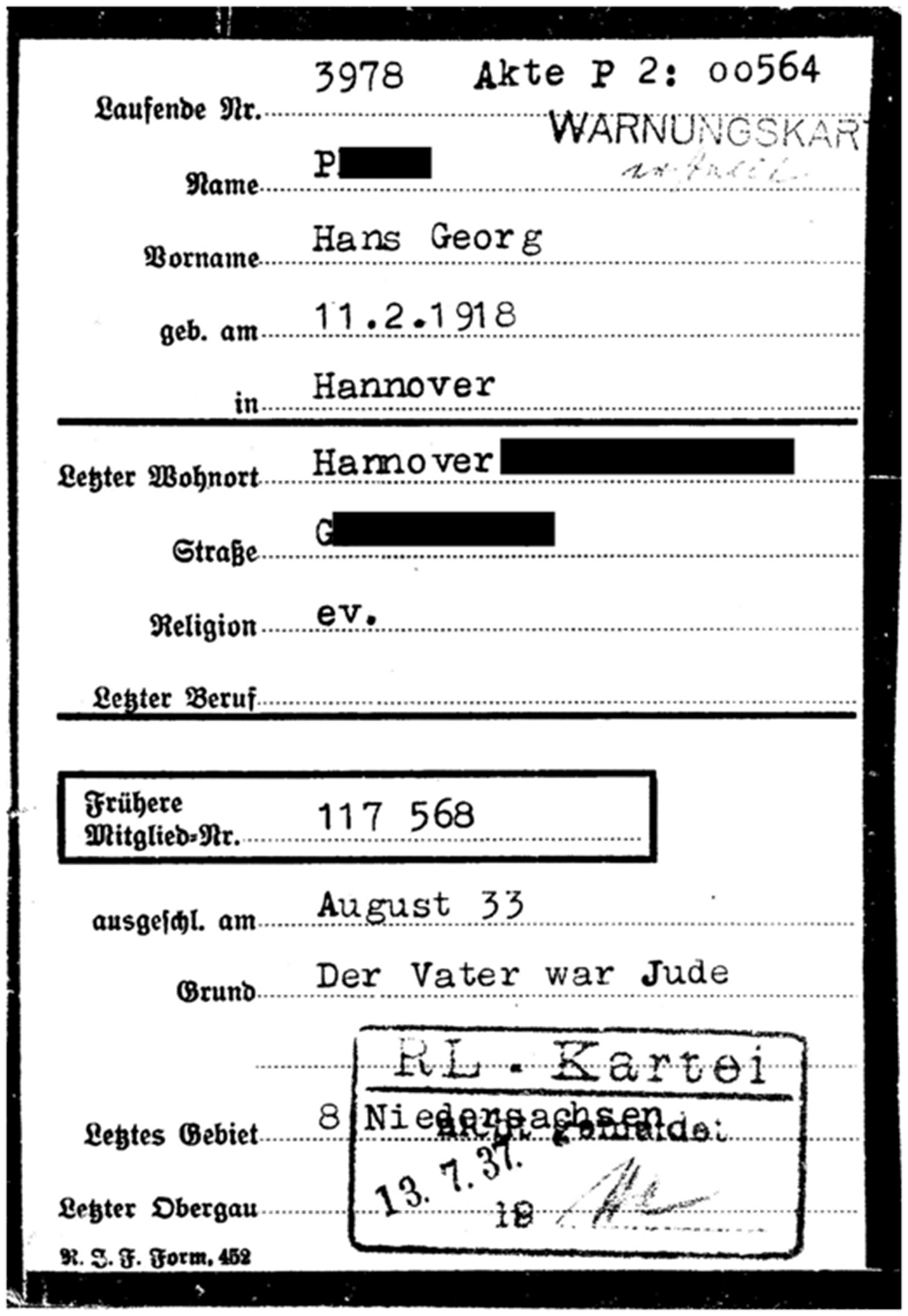
The “Mischlinge” faced a great arbitrariness from their surroundings and especially the National Socialist organizations because of their racially constructed and justified social status (Benz, 1996b: 684–690). Thus, it was quite likely that appearance alone or more precise the existence of allegedly “Jewish” physical features decided upon whether an adolescent was considered a “Jew” and, therefore, excluded from the HJ. 24 Now and then sons of the same family made different experiences when it came to their classification (Tent, 2007: 49–54, 61–62). “Mischlinge” of both degrees were admitted into the general HJ until 1940 (Meyer, 1999: 195). 25 In contrast, the HJ had excluded 574 members of “partially Jewish descent” between 1933 and 1939 (Kollmeier, 2007: 98) according to the records of the organization’s Warnkartei (Bundesarchiv (Federal Archive) Berlin-Lichterfelde (BArch): NS W B0006); Bundesarchiv (Federal Archive) Berlin-Lichterfelde (BArch): NS W B0007) (Figures 2 and 3). 26
In “their total claim for inclusion” the Reichsjugendführung finally applied the “adolescents’ official duty with a bureaucratic craze of comprehensiveness” (Buddrus, 2003: 284) to the members of the here-mentioned groups of “foreigners.” This was especially true for the time after the enactment of both, the implementing provisions of 1939 and the corresponding radicalization of the adolescents’ disciplining, which included the totalitarian claim for inclusion, and the inclusion-related contradictions produced by them (Kollmeier, 2007: 201–205, 303). According to this expansion,
27
the Reichsjugendführung ordered a new admission practice for the HJ in October 1941 (BArch R 43-II/512, Bl. 246; printed in Benecke, 2013: 283–284; Vorschriftenhandbuch der HJ (1942: 125).
From category 3. From category 3.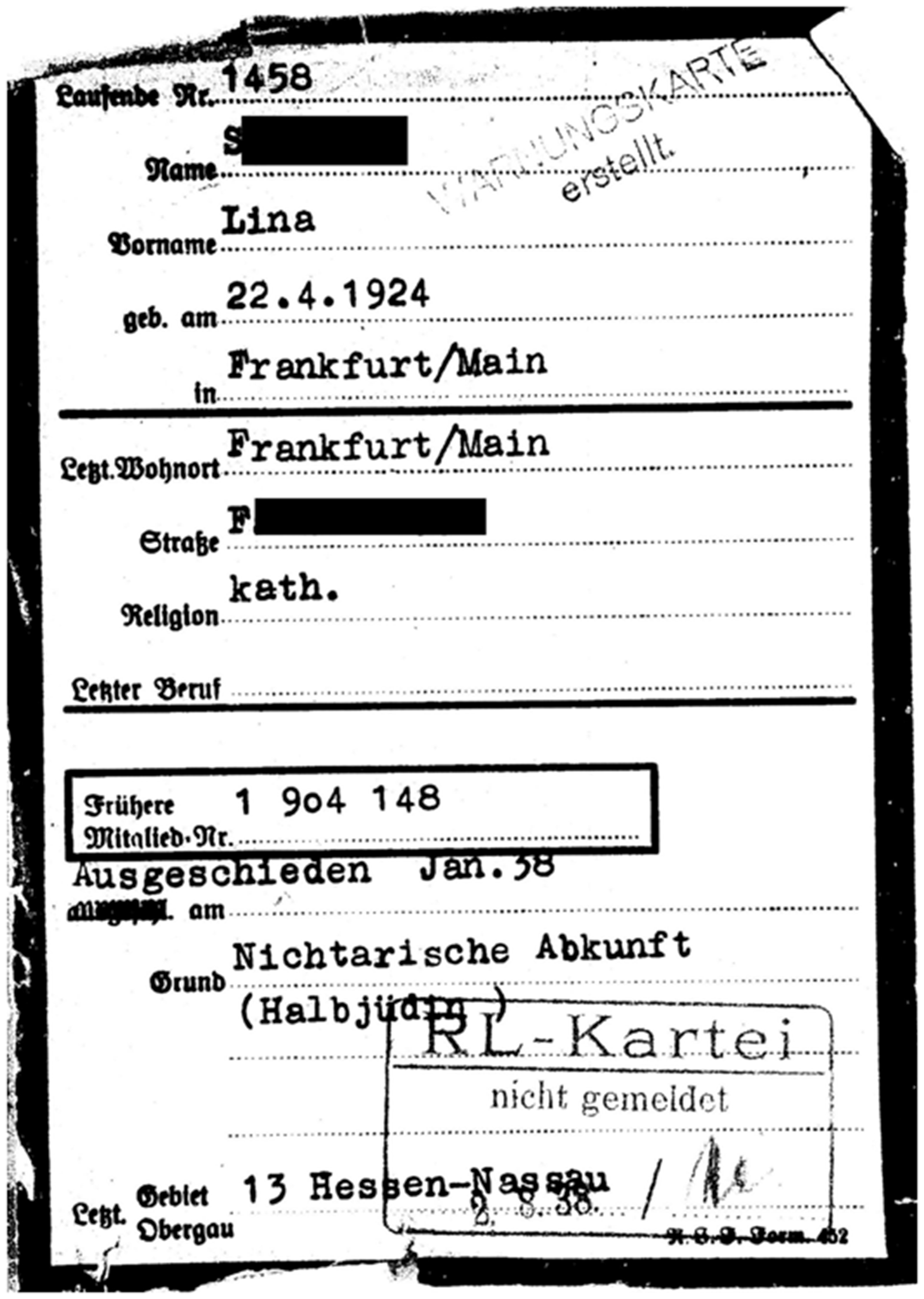
Within these race-related regulations for admission—and thus the organization’s own regulation of the socially differentiating criterion of “admission”—the inequality generating characteristics, which had already been presented for “Gypsies” above, come into effect. The same was true for the preference of “deutschblütige” adolescents (of German blood), which has to be highlighted and interpreted as a social differentiation in the sense of the earlier defined differences in admission, when it came to enabling them to “attend to their adolescent duty.” In this context, the known mistrust, also based on assumed attributions of racist complexion, toward an alleged attempt of conspiracy of the “Jewish race” also broke free. For example, when it was said: “Provision [and thus not a complete admission into the HJ service; J.B.] of Jewish ‘Mischlinge’ alone [hence in groups without an organization related and thus power-related control; J.B.] has to stop” Eventually, however, it was the greatly, socially differentiating care that Jewish “Mischlinge of the first degree” became liable for compulsory service in the HJ between March 1939 and October 1941 contrary to the earlier, at least propagated “general exclusion” (Kollmeier, 2007: 202). Afterwards, they were only to be made available; an assignment for service, however, was not to be given anymore. Mischlinge of the first degree, who were already members of the HJ, were to be “eliminated” from their ranks by “issuing a ticket for provision.” (BArch R 43-II/512, printed in Benecke, 2013: 283–284). On 18 October 1941 the Reichsjugendführer Axmann, on the other hand, affirmed that theoretically there was a duty for service for Jewish “Mischlinge of the second degree” as well. They were to be continued to be drafted for HJ service pro forma (Kollmeier, 2007: 202), but in fact would in most cases only be in “provision.” This was due to the inequality intensifying order that in the face of a lack of HJ leaders in the war “German blooded adolescents were to be given the opportunity to fulfill their duty for youth service first” (BArch R 43-II/512, printed in Benecke, 2013: 283–284). This, as shown, did not apply to “Mischlinge of the first degree” anymore. In fact, the latter were to be removed from the HJ silently at the latest with the beginnings of the systematic deportations in 1941. Therefore, Jewish “Mischlinge of second or lower degree” were still liable for compulsory youth service in 1943, but were not allowed to become members of the Stamm-HJ which, according to the first implementation order of the HJ law from March 1939, admitted every adolescent who—among others—had voluntarily joined the youth organization before a compulsory service for adolescents was implemented (Reichsgesetzblatt, 6.4.1939: 709–710). The latter was also a secondarily social inequality generating measure aiming at “protecting the access’ function to the associations of parties” (Kollmeier, 2007: 202). For this purpose, one referred back “to the strict definition of Jews made by the party” (Vorschriftenhandbuch der HJ, 1942: 195; also printed in Benecke, 2013: 179). Since 1942, however, those Jewish “Mischlinge” that were not actually exempted from duty according to the law, were ultimately excluded from HJ service without ever publicly communicating it (BArch, NSD 43/111). The latter procedure presented a third social differentiation which was founded on racist reasons and implemented in dependence on power: (a) after the separation of the Jewish population and (b) the differentiation according to “Mischling degreed”, there was then (c) a refusal of access for partial groups of those originally liable for compulsory service without them being able to make an impact. As a consequence of the here outlined attributions which could in no way be influenced by those affected, the affected “Mischlinge” faced a tangible “inner conflict” between a partial inclusion, which they were threatened to lose rather than experience any revaluation from it, and a partial, stigmatizing exclusion in accordance with the anti-Semitic NS policy (Grabowsky, 2012). 28 As a result, some members of said race category experienced burdensome inequality with relation to the HJ even after 1945. From then on, they were apparently required to justify their HJ membership retrospectively, while they were sometimes classified as “followers” due to the same denazification committees (Meyer, 1999: 256).
Conclusion
Membership in the different organizations of the NS state led many of the affected “Mischlinge” to have contradictory emotions and partially great identity problems. One the one hand, they were allowed to satisfy the urgent need for social belonging and personal security; on the other hand, their personal commitment to a regime that was basically hostile to them, their relatives, and especially their “fully Jewish” fellow sufferers was considered to be schizophrenic and burdensome (Giordano, 2007: 159–165). The security the service, and especially exemplary dedication in the Wehrmacht (Wette, 2005: 84–88) in a national socialist sense, offered to “Mischlinge” could range from protection from anti-Semitic discrimination through the NS state to the sheer securing of survival (Giordano, 2007: 172). In addition, such commitment for the “national community” could have relieving or lifesaving effects on close relatives of “Mischlinge” (Kaplan, 2003: 128–129; Giordano, 2007: 171–175). However, all of this would only amount to minor regulatory options regarding one’s own or one’s family’s fate. Yet, those affected almost always powerlessly faced their original classification as Jewish “Mischlinge” and the respective experiences of repression. They could not influence their special status—neither the respective categorization nor the demographic or organizational consequences in the form of regulations regarding obligation or exclusion which affected them. Due to the fact that they were—at least temporarily—liable for compulsory service and belonged to a population group, which because of its status as “non-Aryan” was not granted any deviating behavior in contrast to “purebred” members of the “national community,” an actual voluntariness in HJ-membership that occurred as such among Jewish “Mischlinge” is out of the question. This was especially true considering the fact that they would endanger not only themselves but also their families in the case of a deviation. After 1945 the denazification committees burdensomely categorized them on the basis of their HJ affiliation, then as “followers” of the NS reign. This occurred in the case of a young woman, who as “Mischling of the second degree” belonged to the BDM between 1936 and 1940, in order to be able to graduate from high school (Meyer, 1999: 256). After the NS regime’s downfall, a pact to remain unspoken took place in families of numerous “Mischlinge” between Jewish parents, if they had survived the Holocaust, and their children. In an attempt to spare one another and to suppress the experienced sufferings, most of the families affected did not address the psychological strains of relatives and did not process them together. It was especially among the younger ones that anxieties and feelings of shame would arise, which led to an additional defense against addressing their experiences. Due to the fact that clinical psychology after 1945 showed little interest in these seemingly less serious fates, young “Mischlinge” were often left without any help facing the psychological and psychosomatic consequences of their experiences (Saloch and Thiele, 1994: 195–196). The given example of the fate of young Jews at the time, the so-called “Mischlinge,” also allows general conclusions regarding the structure of the HJ to be drawn. As mentioned earlier, the general perception of the HJ is oftentimes based on contemporary colported combination of two, complementing perspectives, which are often remembered to the present day: on the one hand there is the propagandistic enactment of the HJ as a restrictive organization that included all of the German or “ethnic German” adolescents who were classified as “racially pure” (Schirach, 1934: 66–72); on the other hand, there is the gradually tightening, and monitored and sanctioned obligation, for all adolescents to become members of the HJ, which finally led to the logical consequence of hitherto unimagined rates with regard to the nominal collection data. Together they created a sustainably effective image, which conventionalized an adapted belonging of the addressees as the alleged socially and legally inevitable norm starting in 1936 and at the latest by 1939. In contrast, the preceding executions clarified exemplary that—similar to developments of other areas of the “national community” (Bajohr and Wildt, 2009; Reeken and Thießen, 2013)—the existence of a heterogeneously caused and structured variety of occurring inequality specific for the organization was more characteristic for the HJ, than a homogenization of its target group occurring because of their own impact. A conflict situation of at least four aspects became causally effective: Firstly, an NS-specific frame built on the dimensions of power and race or rather the interplay between the two. Secondly, the immediately resulting determinants of reign and racism, the latter as a racist practice of action and justified race ideology; all of which were applied to the level of social practice. Thirdly, the relation patterns between these two influencing variables and other, oftentimes traditional and the Nazi reign outlasting, social differentiation criteria (sex, area/region, environment, etc.). Fourthly, some other patterns of social differentiations, crossing the ones already mentioned, such as age of the affected or the point of time of their membership that could—in the interaction with requirements for admission and task—generate HJ specific experiences of inequality. And finally, it becomes clear that a simple, dichotomous differentiation cannot comprehend the HJ specific occurrences of social inequality on all levels of the NS reign’s execution in its complexity of causes and features sufficiently. This requires consistently differentiated and analyzing object perspectives. As a result, it, therefore, appears appropriate not to assume a successful enforced conformity of the German youth through the HJ. Rather, an order of organization-specific social inequality that was provoked and strengthened by their activities, one that racially defined and trenched the considered target group with social claims of control, can be interpreted as their central feature.
Footnotes
Declaration of conflicting interests
The author(s) declared no potential conflicts of interest with respect to the research, authorship, and/or publication of this article.
Funding
The author(s) received no financial support for the research, authorship, and/or publication of this article.