



Abstract
This article reviews the rival trends and competing discourses within the cosmopolitan tradition to formulate a comprehensive educational approach, called ‘rooted cosmopolitanism’, that is timely, conceptually operational, culturally sensitive, and applicable in local educational settings. After reviewing the existing conceptions of cosmopolitanism, I define cosmopolitanism and cosmopolitan education. Then I present various critiques of the cosmopolitan discourse, focusing on the need for rootedness. To bridge the tension between lofty cosmopolitan values and the concrete demands and aims of local educational systems, I conclude by claiming that cosmopolitan education can be sustained through a prism of local culture, religion, heritage and language.
Introduction
We live in unprecedented times. As Appadurai framed it in his five ‘scapes’ (1990), our local realities are constantly shaped and reshaped by the rapid and interwoven movement of people, technology, capital, information, and ideology around the globe – all of which transcend barriers of distance, time, culture, nationality and language. A system of complex, global forces is being formulated before our eyes, often fundamentally changing the local human experience in areas such as economics, society, environment, communication, immigration and education.
The complexities of life in a globally interconnected world, which is at the same time fragmented and polarized, confronts us with political, economic and ethical challenges with which neither we nor our children have been adequately prepared to cope (Gur-Ze’ev, 2010). This intricate reality, which affects people regardless of their national, religious, cultural and racial affiliation, has triggered a renewed interest in education toward cosmopolitanism, a worldview that emphasizes ‘the necessity for new civic ideals, international in reach, that would be better adapted to the realities of politics in an increasingly interdependent world’ (Callan, 2004: 74).
Cosmopolitanism, derived from the Greek word kosmopolitês (‘citizen of the world’), is an ethical and socio-political theory that originated in the fourth century BCE. It posits that all people belong to a community of human beings that transcends the particularities of local and national affiliation, calling for ‘the concern for the world as if it were one’s polis’ (Benhabib, 2004: 174). Subsequently, cosmopolitan education (Nussbaum, 1996a) seeks to extend the students’ circles of moral and political commitment beyond their close kin and parochial surroundings.
Since the early 1990s, cosmopolitanism has been featured in a growing number of scholarly accounts across the humanities and social sciences (e.g. Brown and Held, 2010; Delanty, 2012; Fine, 2009; Rovisco and Nowicka, 2011). Cosmopolitanism has also recently become a trend in education. Numerous books, articles and special issues in journals such as Curriculum Inquiry (2014), Teachers College Record (2011), and Educational Philosophy and Theory (2009), have devoted considerable attention to educational accounts that draw on the ideal of cosmopolitanism (e.g. Hansen, 2011; Papastephanou, 2011a; Nussbaum, 2010; Roth and Burbules, 2011; Todd, 2009; Waks, 2009, 2010).
The renewed interest in cosmopolitanism in recent years has also taken its toll on the ancient concept. Cosmopolitanism has become a conceptual amalgamation of almost anything, ranging from universalism (Singer, 2004) to jazz (Feld, 2012) to various forms of ‘globally sensitive patriotism’ (Nussbaum, 2008, 2011). A comprehensive review of the cosmopolitan discourse in academic writings reveals substantial fragmentation and ambiguity (e.g. Papastephanou, 2013). Particularly in educational literature related to cosmopolitanism, scholars have criticized its conceptual inconsistency (Burbules, 1999; Todd, 2009), impracticality (Waks, 2009, 2010), and superficial approach to contemporary challenges (Hansen, 2011).
The cosmopolitan worldview has also been labeled: colonial, elitist, Eurocentric and insensitive to difference. According to critics, enlightenment ideals such as homogenisation of cultures, global governance, and shared rational morality were often promoted as being cosmopolitan (Werbner, 2008; Kymlicka and Walker, 2012).
The goal of this article, in light of the aforementioned critique, is to propose an integrated account of ‘cosmopolitan education’ that is timely, conceptually operational, culturally sensitive and applicable in local educational settings. By successfully bridging the tension between lofty cosmopolitan values and the concrete demands of local educational systems, I hope to assist policy makers and educators in the introduction of cosmopolitan-oriented education (which is perceived as an initiation into a global community of rootless citizens) into a specific local setting.
The article is divided into the following parts. I provide an overview of existing conceptions of cosmopolitanism and suggest an integrative account of what cosmopolitanism actually means in contemporary scholarly literature. After defining cosmopolitanism and cosmopolitan education, I present various critiques of the cosmopolitan discourse – with a focus on the need for a form of rootedness. I then suggest a new concept, namely ‘education toward rooted cosmopolitanism’, to mediate between open perspectives such as cosmopolitanism and closed perspectives such as national, cultural and religious identity. By combining aspects of various rooted approaches (e.g. Alexander, 2015; Appiah, 1997; Hansen, 2011; McLaughlin, 1996; Kymlicka and Walker, 2012) that promote openness to different human traditions through a profound initiation to a major civic, cultural, spiritual or religious tradition, I will claim that cosmopolitan education can be sustained through a prism of local culture and heritage.
Cosmopolitanism – what’s in a word?
According to Wittgenstein (1961), in order to operationalise a concept, it is enough to examine the way people use it and then retrieve the rules according to which they do so. Alas, contemporary research presents many different faces of cosmopolitanism that are at times contradictory (Hansen, 2011: 73–77, 87). It is therefore not surprising that in light of the growing interest in cosmopolitanism, several typologies have been suggested to operationalise both cosmopolitanism (Kleingeld, 1999; Beck and Sznaider, 2006a; Delanty, 2009; Kleingeld and Brown, 2011; among others) and educational cosmopolitanism (Waks, 2010; Hansen, 2011).
In the following review, I will rely on a conventional division into four primary disciplines – ethics, politics, cultural studies, and economics (Kleingeld and Brown, 2011; Delanty, 2009). Following the work of Kleingeld and Brown (2011) and Delanty (2009), in addition to a discussion about cosmopolitanism from a sociological and anthropological prism, I will present the implications of each prism to education.
Moral cosmopolitanism
Proponents of moral cosmopolitanism rely on the tenet of the equal worth of all human beings to discuss the character of our moral obligation toward others and toward the world. In their writings, the scope of our moral commitment varies from the whole of humanity (Singer, 2010; Nussbaum, 1996a) to one’s group of affiliation (Nussbaum, 2008) to different combinations of both (Appiah, 2008; Hanson, 2011). The educational approach that is most often identified with moral cosmopolitanism rejects patriotism and concern for our close kin as the primary motives for our actions. Instead, it asks us to develop ‘narrative imagination’ – the ability to imagine the circumstances in which another was educated, and to discern the humane within the other (Nussbaum, 1996a, 1996b). The goals of cosmopolitan education, as rendered by its renowned representative, Martha Nussbaum, are to invoke openness, compassion, and tolerance. According to Nussbaum, cosmopolitan education also enables us to learn more about ourselves and induces recognition of our moral commitment toward the world (Nussbaum, 1996a).
Conversely, Merry and de Ruyter (2011) claim that in order to educate in the light of moral cosmopolitanism in the classroom there is a need to teach children to identify injustice and tackle it, firstly on the local scale, due to practical considerations, and only later on the global scale, as suggested by Nussbaum.
Combining these two approaches, Hansen’s ‘cosmopolitanism on the ground’ encompasses linguistic, cultural, ethical, aesthetic, and somatic dimensions of the cosmopolitan encounter with similarity and difference. It is a bottom-up rather than top-down moral perspective, beginning with peoples’ concrete experience and paying heed to their individual and community self-understandings, as well as their internal debates about how to regard both the local and larger world (Hansen, 2010, 2011).
Political cosmopolitanism
Political cosmopolitanism discusses institutions, organisations, policies, and laws that go beyond national sovereignty. Several scholars perpetuate the promotion of cosmopolitan democracy and cosmopolitan rights (Held, 2005; Archibugi, 2008), in consideration of increasing globalization, to enable citizens to have direct impact on decisions with global relevance. Others emphasize the need to modify traditional definitions of citizenship (Cheah and Robbins, 1998; Eder and Giesen, 2001) and emphasize the rights of asylum seekers (Benhabib, 2008). Global citizenship and various forms of transnational (Ong, 1998) and post-national societies (Smith, 2007) are discussed within this framework.
From an educational perspective, political cosmopolitanism is usually expressed in civics education that seeks to encourage participation on the local level, while developing awareness of the ramifications on those others who exist beyond that given group (Holowchak, 2009). Scholars have also suggested evoking a broader understanding in students of their ‘national citizenship’, and a sense of responsibility regarding our joint future by integrating in the course of their studies the knowledge, skills and techniques needed to allow them to play key positions in the local and global arenas (Osler and Starkey, 2003). According to this approach, students should learn how to apply the values and rules of democracy across communities, and study human rights by looking at the problems experienced by other societies from an ‘inward’ perspective. Methods can include learning in heterogeneous groups instead of separately, taking part in international exchange programs and sabbaticals to get to know the political reality in different countries, and participating in institutional and global governance programs in collaboration with the United Nations (Archibugi, 2012).
Cultural cosmopolitanism
Proponents of cultural cosmopolitanism seek to offer an open and reflexive response to the encounter with ‘otherness’ and alien cultures. It also initiates the development of some sort of competence in making one’s way into another’s culture (Hannerz, 1996: 103). The radical end of this orientation, identified with post-colonialism (Cheah and Robbins, 1998), supports anti-nationalism, promotes cultural hybridity, and turns against the tendency to ‘transcend’ the distinction between various forms of cosmopolitanism (Delanty, 2009: 60). More than once, this branch of the cosmopolitan literature identifies the victims of financial and cultural globalization as the ‘true cosmopolitans’ (Bhabha, 1996; Clifford, 1997).
More moderate approaches discuss the possibility of one’s being ‘rooted meaningfully’ in several cultures, an option necessitating that a person can see the world through the eyes of an individual from another culture (according to Hansen, 2011: 11; Hollinger, 2002; Waldron, 2000, 2003). Even more moderate approaches respond to the intensified intermingling among people, habits and practices, both physically and virtually. As stated by Hansen (2011: 11), such encounters produce, in their softest versions, eclectic cultural ‘borrowing and lending’ of various identity features that do not require a transformation in values, faiths and commitments.
From an educational perspective, cultural cosmopolitanism can be identified not only with the demand to develop a national multi-cultural curriculum (Parekh, 2000) but also with an education that promotes cultural and national hybridity (Huddart, 2006: 79–80). More moderate versions seek to nurture openness to intercultural exchange, communication, and mutual acceptance (Koczanowicz, 2010), as well as with fluid forms of identity and belonging (Smeyers and Waghid, 2009). Such perspectives resonate in post-modern outlooks on education, emphasizing the difficulty in aspiring to see the world from the perspective of another person (Mehta, 2000; Englund, 2004).
Several approaches to cultural cosmopolitan education identify it with ‘international education’ (Gunesch, 2004) or present it as a way to emphasize universal human rights that apply to people of all cultures (Kleingeld, 1999; Gregoriou, 2004; Kiwan, 2005) without forcing them upon others (Waks, 2009). Other approaches believe that in order to nurture cultural cosmopolitanism, it suffices to engage students with a civic education that seeks to deepen their understanding of cultural similarities and intercultural exchange (Costa, 2005). Some scholars maintain that cosmopolitanism can serve as a culture in and of itself (Gregoriou, 2004). Yet, unlike multiculturalism and communitarianism, cultural cosmopolitanism recognizes not only individuals’ ability to expand their cultural norms but also their right to change those norms, to develop a unique cultural identity, and even to assimilate in the majority (McDonough, 1997).
Economic cosmopolitanism
Economic cosmopolitanism is sometimes identified with the Western economic paradigm (Hayek 1990; Friedman, 1962) of a global open market based on free trade, free movement of capital, and minimal government intervention (Kleingeld, 1999; Kleingeld and Brown 2011). Yet, many scholars are critical of this sort of cosmopolitanism (Habermas, 1998; McCarthy, 1999; Papastephanou, 2005), and, given continued economic and political inequalities the world over, propose economic cosmopolitanism based on social justice and care for the downtrodden (Barnett et al., 2005; DeMartino, 2000; Sen, 1985; Tan, 2004). Although defined here as economic cosmopolitanism, this branch of thought sometimes overlaps with political approaches that seek to magnify the influence of citizens on their local governments and change the architecture of international institutions and their efficiency as a pathway toward global justice (Beitz, 1999; Pogge, 2008).
From an educational perspective, the capabilities approach developed by Amartya Sen (1985) shifts the attention from judging the well-being of the citizens of a country by their country’s gross domestic product to their ability to participate in designing their lives in a more meaningful way. This change, claims Sen, can be achieved via education. ‘In this sense, the capabilities approach can be understood as a mode of economic cosmopolitanism reconstructed through values derived from political and moral cosmopolitanism’ (Hansen, 2011: 10).
Sociological cosmopolitanism
Scholars who consider cosmopolitanism as a sociological condition (Fine, 2003; Beck and Grande, 2007) view it as a transitional phase in which the world is connected beyond a national framework, but cannot avoid the impact of the national conditions. This ambivalent cultural existence necessitates a substantially different thought paradigm than was used in the industrial society, titled by Beck as the ‘first modernity’ (Beck, 2002; Beck and Sznaider, 2006b; see also: Martins, 1974; Chernilo, 2006). First and foremost, it should manifest in the national monological imagination, which negates the ‘otherness’ of the other (Beck, 2002). Cosmopolitanism, as defined by Beck, is the possibility to imagine alternative ways of life and ways to understand the world, which include the otherness of the other. A somewhat complementary approach to Beck’s account of cosmopolitanism is Delanty’s ‘critical cosmopolitanism’ (2006, 2009, 2012), which attempts to reconcile the universalistic rights of the individual (a fundamental right from the beginning of the modern age) with the need to protect minorities (a result of life in a cosmopolitan reality that should not be ignored). Exposure to a ‘cosmopolitan moment’ in the encounter between two seemingly unbridgeable realities creates a common sphere of discourse that can evoke self-critique and mutual transformation in awareness and policymaking.
These approaches resonate educationally in suggestions to nurture new ways of seeing the world as composed of various tensions, ranging from individuation to cooperation to protectionism, and thus developing a deeper sense of belonging to our complex world (Vasudevan, 2014). Expanding on that in relation to the growing need to cross borders in various physical and virtual arenas, Wahlström (2014) seeks to develop an ethical outlook inside the space of the classroom, which will later give birth to a moral commitment toward all human beings without feeling that it contradicts one’s commitment to his/her environment, family and friends (Vasudevan, 2014: 116).
Delanty’s notion of the cosmopolitan moment was recently developed into a school curriculum. The European Commission-funded Philosophical Enquiry Advancing Cosmopolitan Engagement (or ‘PEACE’) project sought to promote an educational model that allows for space for discourse between ‘others’ and mutual transformation. Other scholars relied on Delanty’s model to claim that when forming initiatives that allow youth to leverage their creativity and nurture critical cosmopolitan education, there is a need to pay attention to the unique mediatory nature of the places where such initiatives take place, because Uganda for example, is very different from the USA (Hawkins, 2014).
Anthropological cosmopolitanism
Scholars who engage in anthropological studies examine cosmopolitanism as a grassroots phenomenon. These studies focus mainly on immigrants from the working classes (Werbner, 1999; Lamont and Aksartova, 2002; Sassen, 2006) and on local, emotional, everyday expressions of cosmopolitanism (Nava, 2002, 2007). Additionally, anthropologists consider the influences of mobility, roots and interconnectivity on the identity of particular groups (Urry, 2002, 2003; Szerszynski and Urry, 2006; Thompson and Tambyah, 1999; Molz, 2006).
In this context, cosmopolitan education is seen as an answer to the dynamic identities that youth adopt today (Osler and Starkey, 2003), as well as a lens through which we can understand the diverse, flexible and relative perspectives that develop among youth today (Mitchell and Parker, 2008).
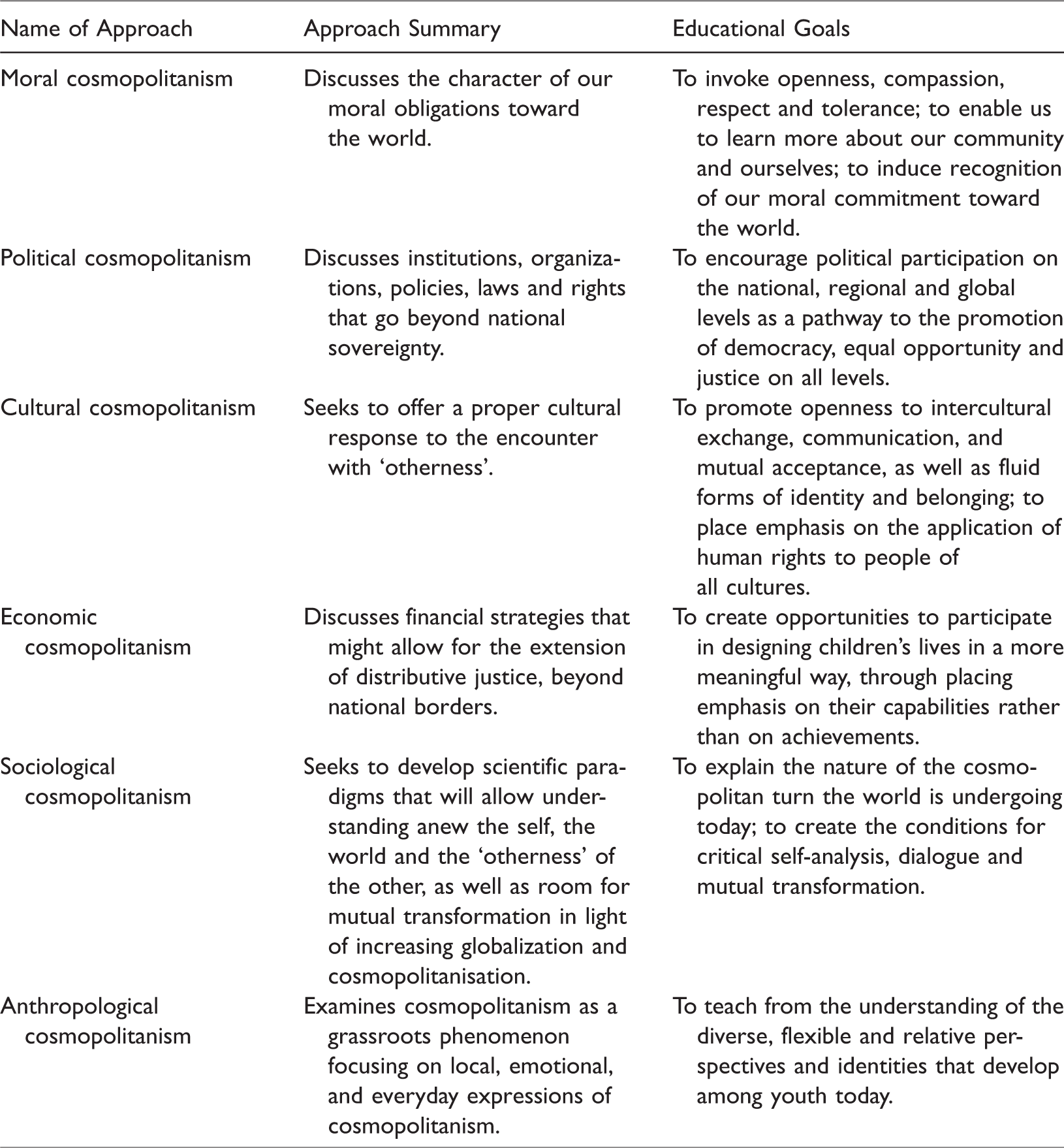
These various approaches are summarized in Table 1.
Cosmopolitan approaches and their educational goals.
Cosmopolitanism integrated
The aforementioned review of the scholarly literature on cosmopolitanism and cosmopolitan education enables identification of the main elements that are common to all approaches, namely moral, cultural, political, economic, sociological and anthropological.
In a nutshell, cosmopolitanism is an orientation; an attitude emanated from one dweller of the world to another, which builds upon a sensation of shared fate or identity. It may manifest ‘on the ground’ as a moral, financial, cultural, or political commitment or as a sociological and anthropological lens that allows one to understand today’s rapidly changing reality. Consequently, cosmopolitan education can be viewed as an umbrella concept that includes various educational perspectives that aim to nurture care, respect, concern and commitment for the other, both locally and globally. A cosmopolitan-oriented education may call us to:
Change our attitude to otherness – to include the other in our system of calculations, to ‘place ourselves in the shoes of the other’ (Nussbaum, 1996b), to take interest in the other’s culture (Hannerz, 1990), to enter a dialogue with the other, and to care for the other’s rights and needs, even if we do not share the same values (Appiah, 2008, 2010a). The essence of cosmopolitanism, as noted by Ulrich Beck (2002: 18), is ‘overcoming the otherness of the other’. Be reflectively loyal and cognitively and morally open for self-transformation – a meaningful encounter with otherness necessitates reflective loyalty to the known and reflective openness to the new and unknown (Hansen, 2011), as well as moral and cognitive readiness for the mutual self-transformation that such an encounter might bring about (Delanty, 2009). Take action – care, respect and responsibility for the other should result in practical actions that promote justice on the personal, communal, organizational and/or institutional levels, both locally and globally (e.g. Archibugi, 2000; Cheah, 2006; Held, 1995; Sen, 1999; Singer, 2004).
Cosmopolitanism contested
The growth in the popularity of cosmopolitanism among scholars has generated a vast amount of critique from various spheres of the academic discourse. The common ideological thread running through most of these critiques is that cosmopolitanism is insensitive to concrete realities, publics and spheres of life. Namely, concepts such as ‘cosmopolitanism’ evoke a disembodied and out of context birds-eye ‘view from nowhere’ (Nagel, 1986), whereas any lived ideal, no matter how big, is lived from the embodied and contextual first-person perspective. Moreover, cosmopolitanism underestimates the inherent difficulty human beings face in caring for those beyond their domestic/religious/cultural/national circle. In other words, when attempting to trigger practical actions on behalf of students, our directions cannot be amorphous, general and practically unclear, as it happens more than once in the morally oriented cosmopolitan discourse (Peterson, 2012). A top-down approach that asks children to accept a priori the notion of moral equality of all people and thus the need to nurture equal concern for all people, is theoretically feasible, but practically unrealistic in local educational settings. As noted by Barber (1996: 24), ...we live in this particular neighbourhood of the world, that block, this valley, that seashore, this family. Our attachments start parochially and only then grow outwards. To bypass them in favour of an immediate cosmopolitanism is to risk ending up nowhere…
The political critique
One of the main claims placed before the proponents of political cosmopolitanism is that they depict a desired political condition as if it has already become a reality. Thus, although Held claims that ‘cosmopolitanism is the new realism’ (Hamel-Green and Held, 2012: 431), national citizenship is still dominant and this situation only seems to escalate, especially in light of contemporary cultural and financial challenges and the renewed spike in nationalism and xenophobia.
A critique from a different angle, brought up by Miller (1999), involves the conceptual ambiguity of the concept ‘global citizenship’, due to the inherent contradiction between the terms that comprise it. How can two concepts that promote loyalty and deliberation in two completely opposite arenas (locally and globally) coexist one alongside the other?
The marrow of the life of citizenship is the deliberation between people who live on the same soil, share the same concerns, argue about concrete and mutual rights and duties, and feel reciprocally obligated. To this end, normative approaches to global citizenship are fundamentally apolitical, because they are unable to provide mutual ground that might unite people who speak different languages, seek to promote different interests, face different challenges, and use different political platforms into one vivid political community (Kymlicka, 2001; Miller, 1999, 2002, 2011).
Moreover, the failure of the European Union’s European identity project – despite the extensive financial investment in it – is raising additional doubts regarding the possibility of establishing an effective and active supra-national political identity, of which the members will share concrete cosmopolitan duties and rights.
The communitarian critique
Communitarians claim that ethics, as well as meaningful life and happiness, flourish within an enclosed space, within defined ‘thick’ relationships – namely between people that share the same history, culture, bounded community and mutual obligations (Walzer, 1994). This claim illuminates the innate difficulty that is involved in the realisation of an approach that asks us to feel responsibility and even sacrifice something of our own for the sake of an amorphous global community, whose members are alien and foreign to us.
Thus, claim Walzer, Barber (1996), and the like, concepts such as a ‘cosmopolitan community’ are contradictory by nature and will collapse the moment the social contract of such a ‘community’ faces its first minor test. Although people tend to agree with the moral stances promoted by proponents of cosmopolitanism, the picture will drastically change when their deeds and not creeds will be tested. What will motivate complete strangers to ‘get out of their skins’ and sacrifice something for the benefit of a cosmopolitan ‘community’? Communitarians assert that the cosmopolitan theory is incapable of providing a worthy response to this question.
The religious critique
One of the harshest critiques directed toward western cosmopolitan approaches – to some extent as a result of the critique of Kant’s rationalistic stance – is that the attempt to suggest a list of ‘universal values and characteristics’ (as well as the attempt to establish a vision of the good based on Socratic arguments and empiric and objective facts) ignores and disrespects most religious perspectives (Burbules, 1999). Although cosmopolitan approaches call for the need to ‘dwell in the shoes of the other’, for example Nussbaum’s concept of ‘narrative imagination’ (1997: 85–112), de facto they promote a lack of sensitivity and ignore the fact that many people derive their vision of the good from their religion, and not from a rationalistic western intellectual ideal (Alexander, 2015). As a result, the cosmopolitan approach cannot be accepted in many parts of the world, despite the fact that these areas are where it is most needed.
The cultural critique
Many of the voices that criticized the vibrant engagement in cosmopolitanism in recent decades raised claims regarding the lack of cultural and local sensitivity in classic accounts of cosmopolitanism. These critics have blamed cosmopolitanism for being colonial, elitist, Eurocentric and insensitive to cultural and linguistic diversity. Critics state that proponents of cosmopolitanism have more than once played a key role in the development of Enlightenment ideals such as homogenization of cultures, global governance, and shared rational morality (Bhabha, 1996; Delanty, 2009; Gonzalez-Ruibal, 2009; Kymlicka and Walker, 2012; Werbner, 2008). To this end, the universal aspect within the cosmopolitan tradition is ‘paradoxically both utopian and dystopian’. It is utopian in its ‘expectations of a democratic world state’, but dystopian in its ‘suppression of cultural and linguistic diversity and in the way they open the door to imperialism’ (Kymlicka and Walker, 2012: 3).
The educational critique
In the educational arena, the critique can be divided into national, philosophical and practical aspects. From the national aspect, social scientists claim that public schools have always served national goals (Gellner, 1983; Green, 1990; Mitchell, 2001; Schiffauer et al., 2004). Throughout the development of the modern democratic state, national education systems aimed at the socialization of a bounded community of citizens, who were expected to pledge loyalty to a concrete authority, land, people, myths and narratives. Parker asserts (2011: 498) that the scenario is usually the following: In a nation’s early years, the school system devotes its powers to nation building and cultural integration – to developing a national community unified by common beliefs, ideals and customs. Later, the system turns to reproducing these in subsequent generations and to making adjustments that may have wide political and cultural resonance.
From the philosophical aspect, as proclaimed by Todd, cosmopolitan approaches to education attempt to ‘cultivate humanity’, often neglecting ‘the very human aspects of our inhuman actions’ (Todd, 2009: 3, 2011). In other words, by asking educators to nurture a ‘common’ picture of an ideal humanity, humanistic cosmopolitan educational approaches ignore the violent urges that play out in children and their surroundings. Thus, children are presented with a distorted and overly simplistic picture of reality. To promote a cosmopolitan education worthy of its name, there is a need to relate to the imperfection of man and society as well as to the complexity and troubling aspects of human interactions.
The practical critique relates to the lack of practical suggestions for the realization of cosmopolitan education in the local and global arenas. The term, ‘educational cosmopolitanism’, as well as the attempt to cope with contemporary reality from an educational cosmopolitan perspective, is still underdeveloped (Hansen, 2008: 293). Despite the vivid writing about cosmopolitanism and cosmopolitan education, there are very few attempts to face the difficulty of integrating cosmopolitanism as education theory and practice in the framework of the nation state. There are no more than a handful of suggestions for a cosmopolitan curriculum or educational policy that bear a cosmopolitan character (for rare examples see: Hansen, 2011; Osler and Starkey, 2005; Merry and de Ruyter, 2011).
Another critique that sits on the seam between the philosophical and the practical critiques concerns the ‘fuel’ of the students, namely: what will make a child desire to realize the sublime ideals that are promoted by cosmopolitanism’s proponents? What will be the catalyst, the motive that will make children want to treat the other with openness, responsibility and love? What will make them autonomously choose to prefer the care for the other to selfishness? This is one of the most difficult challenges a cosmopolitan-oriented education should address if it is to make a profound impact.
Rooted cosmopolitanism
On the face of it, the tension between open and closed worldviews seems unbridgeable. The core idea that is common to various cosmopolitan perspectives is that all human beings, regardless of their particular political, religious and cultural affiliation, belong to one open global community. Conversely, citizenship, both as a legal status and as a social practice, presupposes the existence of a bound political community that revolves around a core common identity. Similarly, religion and culture are centered on loyalty to a specific community, whether territorially or virtually.
How could a closed education, which is perpetuated in the framework of the nation–state and thus promotes loyalty to a bounded political community (civic education), coexist alongside an open education that promotes loyalty to a global community that crosses borders of ethnicity, culture, gender, history and nationality (cosmopolitan education)? Put differently, how can we educate to cosmopolitanism given the fact that educational systems are still anchored in the particular framework of the nation state?
According to Robert Nozick (1981), when facing a dialectical question such as ‘how could a certain phenomenon exist given contradictory conditions?’, we shouldn’t search for a theory that proves or discards one of the sides in the ‘debate’, but rather for a philosophical explanation that shows how that phenomenon might actually be plausible given contradictory conditions. Nozick claimed that by locating different ideas in different theoretical contexts and clarifying the connections between them, we can shed new light on a researched phenomenon and expand the scope of opportunities for its understanding. During such a process, the emphasis is given not only to a plausible explanation but also to interesting explanations that suggest new meanings and understandings.
In the spirit of Nozick’s approach, the central question running through this article is: ‘how can cosmopolitanism and rootedness dwell under the same conceptual-educational roof?’ A plausible way to bridge the tension between education toward cosmopolitanism and the human need to preserve one's political, religious, cultural or national identity could be to look at the cosmopolitan discourse through a local prism. If we are to allow for the manifestation of cosmopolitan-oriented educational approaches in a reality where the nation state is still the predominant unit that socializes and acculturates ‘the citizens of the world’ (many of which define themselves by their culture and/or religion), there is a need to develop more detailed educational models that encapsulate cosmopolitan values within a given local context. Neither aspect can be ignored.
The buds of such a mediating approach can be identified in a growing corpus of writing that connects cosmopolitan ideals with cultural and national ‘roots’. Prominent examples in social sciences include the ‘cosmopolitan patriotism’ of Appiah (1996, 2006) and the ‘rooted cosmopolitanism’ of Kymlicka and Walker (2012).
The concepts of ‘cosmopolitan patriots’ (1994/1997) and ‘rooted cosmopolitanism’ (2005/2010b) were first suggested by Appiah. Appiah claimed that people’s commitment to cosmopolitanism doesn’t have to cancel their loyalty to their culture. Contrary to nomadic understandings of cosmopolitanism (Nussbaum, 1996a), Appiah envisions world citizens who are connected to their homes, cultures and traditions, but who also enjoy the presence of others from different cultures (Nussbaum, 2008).
For Appiah, the concept of cosmopolitanism consists of two interwoven threads: first, the commitment towards the distant other; and second, the interest in people as individuals with unique traditions and the belief systems that give them their meaning. To this end, cosmopolitanism acknowledges cultural diversity, not because culture matters, but because culture matters to people. Thus, according to Appiah, cosmopolitanism is ‘universalism plus difference’ (Appiah, 2005: 151). Moreover, Appiah states that local cultural attachments can actually invoke deep commitment and respect toward difference, and thus are essential to our ability to nurture a cosmopolitan perspective.
Kymlicka and Walker (2012) imbued the concept of ‘rooted cosmopolitanism’ with additional meaning, maintaining that as long as the nation state is the predominant political actor, the best way to promote political and economic cosmopolitan approaches is to integrate them as part of the practice of local citizenship. Moreover, as professed by Kymlicka and Walker, ‘the outward-bound cosmopolitan perspective requires and involves the very roots it claims to transcend’ (Kymlicka and Walker, 2012: 1). Thus, it is also important to illuminate the presence of cosmopolitan values in peoples’ national identity. The citizens of many countries already feel committed to aspects of political and economic cosmopolitanism in the form of global justice and global peace initiatives. One example given is the feeling of global responsibility that is considered by Canadians to be an essential part of being ‘Canadian’ and which generated the support for Canadian ‘peacekeepers’. Another is the sense of volunteering that is essential to Swedish identity and which made Swedish citizens feel morally obligated to donate funds to assist African refugees. Thus Kymlicka and Walker believe that shedding light on such aspects within the national identity as well as promoting national intervention to improve the lives of the downtrodden of the world could be the most realizable step toward a somewhat cosmopolitan vision that doesn’t relinquish national identity, but rather complements it.
Although there are very few scholarly references to cosmopolitanism per se in the spiritual and religious discourse, important contributions can be seen in McLaughlin’s ‘openness with roots’ (1996: 147) and Alexander’s ‘Pedagogy of Difference’ (2015). Although McLaughlin and Alexander didn’t relate directly to cosmopolitanism, their educational approach is cosmopolitan in nature: promoting openness to different human traditions by exposing a child to alternative perspectives, together with a profound initiation to a major spiritual or religious tradition.
In their joint article, McLaughlin (Alexander and McLaughlin, 2003: 361–362) wrote: On the side of ‘openness’, liberal democratic societies should be committed, within familiar limits, to a robust pluralism that accommodates a diversity of religious and spiritual belief, commitment, and activity and ensures the development for individuals of the tools of self-definition… On the side of ‘rootedness’, however, liberal democratic societies also have an interest in the flourishing, again within familiar limits, of forms of religious and spiritual belief, commitment, and activity that constitute not only important contexts for the formation of persons and of democratic character, but also resources for the shaping of lives.
Rooted cosmopolitanism and education
The above-mentioned examples suggest that education toward cosmopolitan values, as depicted in the integrating cosmopolitanism section, can be introduced in various forms into different local settings, be they civic, national, cultural or religious. How can this come about?
A cosmopolitan-oriented approach could expand the scope of civic education in a given country to encompass the care for others, within and beyond national borders, by educators encouraging their students to look anew at the vision of the founding fathers of their nations. I believe that if examined thoroughly, it is possible to find a cosmopolitan bearing in the vision of the founding fathers of many nations. Such an inquiry into the roots of a nation’s building process might allow educators to stress, for example, that the citizens of a country are united first and foremost in the most basic way – by the simple fact of their common humanity. Noteworthy examples of such an approach include the presence of a common cosmopolitan strand in the works and writings of some of America’s founding fathers, like Madison, Emerson, Whitman, and Lincoln (Keck, 2008). By tracing the ways these Americans dealt with the issue of solidarity in the fundamental period of US history, educators can open student’s minds to the presence of cosmopolitan values in their culture and contribute greatly to their development of cosmopolitan tendencies. Having said that, there is a need to pay tribute to the fact that the same founding fathers that talked about cosmopolitan values were responsible for some of the worst wrongdoings in modern civilization with respect to the indigenous people who lived in America. Thus, a profound inquiry into the cosmopolitan roots of a nation should also bring to the classroom a critical evaluation of the extent to which this vision was actually cosmopolitan, or only served as lip service. In other words, by looking deeper into the foundations of a given nation – and American history can serve only as one example – students can learn not only about their country’s or culture’s cosmopolitanism, but also about what isn't cosmopolitanism in their culture/history and thus allow for a moment of transformation, both in the self and in the culture (Delanty, 2009). It takes a lot of maturity and courage to admit to one’s culture’s wrongdoings, but if done in a dialogic setting, such a scrutiny might bring about the conclusion that to be truly loyal to a certain tradition or culture there is a need to pay back old debts to indigenous people and minorities (Papastephanou, 2011b), and drastically change the social conduct toward greater cultural and political justice.
Similar examples of a critical outlook at cosmopolitan theory and practice can be applied to canonical texts written by the founders and renowned intellectuals of modern France (the declaration on human rights and the French revolution), Germany (the writings of such influential authors such as Kant and Wieland) and even Israel (the scroll of independence, which pledges loyalty to the cosmopolitan vision of global peace of the prophets, which is also engraved on the walls of the United Nations headquarters in New York). Such an inquiry could easily connect with the demands of citizenship in the 21st century, because, in addition to the need to educate toward cosmopolitanism in an era of global cooperation, interconnectedness and interdependency, and in addition to the need to know more about the culture, religion and the realities of life of others, such an approach also enables students to derive cosmopolitan ideals from a deeper scrutiny of their own culture and heritage. This way, students will get to know that unlike what they are used to hearing from various demagogues, that cosmopolitan values are strongly present in their own national roots, that more that often there is a huge gap between creeds written on paper and actual deeds. Such a critical discussion could engage students in intriguing conversations about social justice, the character of their country and society, and their relation to the world. Knowing that cosmopolitan values are wrapped up in the history of their country can help people identify with and solidify values they might have seen in the past as threatening or contrary to the ones they pledged loyalty to. Acknowledging the distance from these values and their practical realisation in the past and present life of their country and society might trigger a very ‘rooted’ and contextually attached debate about the future we see for our country and society in the future and about the challenges that a cosmopolitan-oriented person might tackle when enculturating real moral, cultural and political dilemmas. Such discussions might invite the students to forge their own vision of the good in light of the believed and the actual gap between the desire to ‘cultivate humanity’ and human attachments, behaviour and nature, which are not always as broad and ‘humane’ as they are often uncritically presented to students (Todd, 2008).
Just as it can be done with civics and history education, cosmopolitan-oriented education can easily find its way into religious and cultural studies, as demonstrated above in the approaches of Alexander and McLaughlin, among others.
As these writers exemplify in their work, education toward cosmopolitan values can be given both in separate educational settings and in the public schools. In public schools, students can get acquainted with the fact that no one culture or religion ‘owns’ the truth, but rather that the values to which persons are accustomed in their surroundings originated from a plethora of cultures and can be easily traced in every religion. Thus there is no room for prejudice and the more we know about the culture and religion of the other, the more we understand the responsibility that lies on our shoulders to promote a positive social vision. Such lessons can be taught by representatives of these cultures and religions, or even parents and grandparents, in the presence of the class teacher.
In the case of separate religious education, for example, religion could be thought of as a catalyst of cosmopolitan values. In other words, because religion can be taught in various ways, just as it can bring about hate, it could cultivate love to another on the basis of our common humanity and the fact that all people were created in the image of God. In such a way students could take pride in practicing values such as openness to others, from within their religion.
In addition to the examples stated above, another noteworthy example is Rabbi Jonathan Sack’s notion of dignity of difference (2003), which reinterprets Judaism to claim that ‘no one has God in his pocket’ and that there might be many ways to worship God, which ought not to be imposed by force or violence on those who either do not recognize this universal divinity or do not follow the correct canons of worship. He also provides an elaborate account of Jewish history and religion to claim that especially because Jews were persecuted throughout history due to their difference, the 21st century is their time to fight for the protection of difference.
From a cultural aspect, this approach could empower communities and manifest in the study and realisation of practices that promote cosmopolitan values from a local cultural prism. For example, many successful restorative practices such as discussions in circles and deep listening, as well as various democratic capabilities, originated from the local indigenous cultures. By stressing what is unique in every culture, by practicing it or even bringing in elderly community members to tell their stories about the way their culture celebrates our common humanity, students could ‘claim ownership' of various aspects of cosmopolitanism. By translating cosmopolitan values into local terms and meanings, educators and students could much more easily affiliate themselves with values they might otherwise consider as imposed from above.
Conclusion
By bringing together various cosmopolitan perspectives, this article suggests a new take on cosmopolitanism and education. Instead of viewing cosmopolitanism merely as an ideal one-size-fits-all, top-down, political, cultural, financial or moral project based on universal reason, the ‘rooted’ notion of cosmopolitanism allows envisioning cosmopolitanism as an educational response that is deeply rooted in various cultures.
The underlying assumption of this article is that many cultures have developed a unique moral grounding for life in a constant tension between ‘self’ and ‘other’. Such culture-specific moral grounding could open new pathways to face the difficulties that stand before the contemporary cosmopolitan discourse. Moreover, it can imbue the cosmopolitan worldview with local meanings, and thus help educators to creatively tackle the tension that naturally arises when introducing cosmopolitan-oriented education. If instead of referring to a global community of rootless citizens, cosmopolitanism can be viewed as a broadening of perspective that begins in a specific local educational setting. Rooted cosmopolitanism can contribute to the promotion of cosmopolitan values within a particular cultural, religious and/or cultural context.
Although some of the ideas that were placed forth in this article aren't new, I believe that their power rests in their integration. Instead of promoting a separate educational vision in religion, culture, civics, and so on, I have suggested three main characteristics of cosmopolitan education (changing attitude to otherness; being reflectively open while cognitively ready for self-transformation; taking action) and later suggested, in light of the critique against rootless cosmopolitanism, to cultivate these characteristics from within cultures instead of trying to impose them from outside. In this way, I hope to possibly open a new approach to the process of educational policymaking, namely defining the basic values we want to be present in our societies and then allowing local actors to creatively integrate them into their local educational settings.
I believe that such an integrative approach could gradually create the conditions for a more cosmopolitan-oriented curriculum that doesn’t cancel uniqueness, cultural plurality, and difference, but rather leverages it to unite society above its innate differences. The few minor examples I have offered here were given only to incite educators’ imagination to develop them further and create a cosmopolitan-oriented setting in their classrooms and communities. There are still many questions to be answered, but I believe it to be a step on our way toward a more caring, culturally sensitive, and cosmopolitan society.
Footnotes
Authors note
Various aspects of the research draw upon my PhD thesis titled “Education toward rooted cosmopolitanism” that was written at the University of Haifa, under the supervision and guidance of Prof. Hanan Alexander.
Declaration of conflicting interests
The author(s) declared no potential conflicts of interest with respect to the research, authorship, and/or publication of this article.
Funding
The author(s) disclosed receipt of the following financial support for the research, authorship, and/or publication of this article: The article was written with the generous support of the ISEF Foundation, which provided the author with the ISEF International Postdoctoral Fellowship for the 2016–2017 academic year.