




Abstract
This article seeks to address often overlooked cultural assumptions embedded within neoliberalism; specifically, the researchers explore what ecofeminist Val Plumwood describes as centric thinking, leading to a logic of domination. The authors argue that social justice educators and activists who are committed to critiquing neoliberalism must take into consideration the ways in which a logic of domination undergirds the unjust and destructive social and economic ideologies and policies that constitute neoliberalism. The authors examine and share pedagogical moments from experiences in teacher education seeking to: (a) challenge and disrupt dualistic thinking; (b) interrupt perceptions of hegemonic normalcy—referring to a socio-cultural process by which actions, behaviors, and diverse ways of interpreting the world are perceived by dominant society as “fitting in” and being socially acceptable; and, (c) contest false notions of independence—the degree to which an individual is perceived as able to meet their social and economic responsibilities on their own—as measures of success in schools and society. The authors detail how they work with(in) teacher education programs to introduce how an ecocritical approach, drawing from ecofeminist frameworks, identifies and examines the impacts of neoliberal policies and practices dominated by “free” market ideology. The authors assert that educators, especially teacher educators, can challenge harmful discourses that support the problematic neoliberal understandings about independence that inform Western cultural norms and assumptions. Concluding, the authors share a conceptualization for (un)learning the exploitation inextricable from the policies and practices of neoliberalism.
Recognizing the pervasiveness of neoliberal capitalism and its restrictive conceptions of personhood, this article argues that teacher education supportive of inclusion requires rethinking understandings of hierarchy, dependency, and difference. Furthermore, in this article we focus on how dominant assumptions about independence, and success in school, impact our understanding and support of the day-to-day kinds of interpretations and actions that make neoliberalism possible (Lupinacci, 2014; Ward, 2014a, 2014b). It is our position in this article that the cruel conditions of schooling that accompany neoliberal capitalism ought to compel scholar-activist educators to think of potential futures—futures that support diverse, inclusive, and sustainable communities (Martusewicz et al., 2015;Lupinacci and Happel, 2015; Lupinacci and Happel-Parkins, 2016).
The current frequency and increased intensity of social exploitation and environmental degradation demand a commitment to examining the limits of many of the dominant disciplining assumptions of pre-kindergarten through grade twelve (PreK-12) education as inextricably linked to teacher education. This work is situated in what Cochran-Smith et al. (2014) refer to as teacher education research with an emphasis on “teacher candidates’ beliefs and practice” (117). This article shares how two teacher educators are partnering with a feminist qualitative methodologist to critically think through how we prepare and support teachers in challenging assumptions about their beliefs. We share three examples of how we work with our students to understand neoliberalism in order to highlight how interruptions to dominant beliefs in schools and society offer the potential to change how teachers act in relationship to the diverse ecologies of their classroom.
The larger economic and exclusionary paradigms that surround teachers and students all too often impose limitations on a future educator’s imagination and consequently prevents them from moving beyond the confines of dominant discursive boundaries. Situated within the educational contexts of ecofeminism and an ecocritical framework for teaching, this article seeks to share the possibilities possessed by an ecocritical education to (un)learn normalcy and teach toward inclusive communities that value ecological diversity—a goal we view as interrelated and interdependent with teaching toward socially just communities. While recognizing that there are a vast number of important projects that examine social and ecological suffering in a capitalist culture, this paper brings what we call an ecocritical lens to work through some of the difficult contestations we have observed. We take the position that teachers must learn to think and view students beyond the dominant definitions of teaching and learning—cultural assumptions that often are working to value-hierarchize, commodify, and set children up for failure. Additionally, we share pedagogical moments from our experiences in teacher education informed by diverse scholarship that draws from ecofeminism and ecocritical projects in education seeking to: (a) challenge and disrupt dualistic thinking; (b) interrupt perceptions of hegemonic normalcy—referring to a socio-cultural process by which actions, behaviors, and diverse ways of interpreting the world are perceived by dominant society as “fitting in” and being socially acceptable (Warner, 2001); and, (c) contest false notions of independence—the degree to which an individual is perceived as able to meet their social and economic responsibilities on their own—as measures of success in schools and society.
Understandings of independence are culturally mediated and thus directly linked to centuries-old patterns of beliefs and behaviors that rely on the legacy of privileging certain types of individuals over equity (Bowers, 2013; Martusewicz et al., 2015). These understandings often deny the recognition of our existence in, and dependency upon, a complex web of biologically and culturally diverse relationships that make up the living systems to which we all belong. A large part of this work focuses on how and why we engage future teachers in challenging dominant assumptions in Western industrial culture that frame what it means to be included into neoliberal spaces—and who is included or excluded in efforts toward achieving “inclusion.” Inclusion is often a process dominated by cultural assumptions rooted in the exclusivity of ableist discourses and discursive practices of sorting, ranking, and controlling bodies in society (Ward, 2014a, 2014b). More specifically, this article attempts to reclaim or unsettle notions of normalcy in connection to inclusion by exploring the ways in which many people situated within Western industrial culture often identify themselves as separate from and superior to one another—and everything else. This perception is constructed within modernist discourses that prioritize the individual over community, culture over nature, and human over animal.
We assert that if teachers are interested in abolishing neoliberalism—and we advocate they ought to be—then they must learn to identify how it is that dominant discourses are reproduced in our day-to-day relationships. We teach that this kind of work seeks to support self-advocacy through educational efforts to eliminate the pervasiveness of the hegemonic structures that threaten inclusiveness for both human communities and the more-than-human world. We argue that one of the most critical places that this work can occur is in teacher education courses and in teacher professional development. These groups of educators and future educators can examine taken-for-granted cultural assumptions in Western industrial communities and learn how to teach towards radical educational change efforts, specifically how to (un)learn assumptions of normalcy, to support truly inclusive and sustainable communities.
An ecocritical framework
An ecocritical framework draws on and builds from key ecofeminist claims. Sparing the details of the development of an ecopedagogy (Kahn, 2010), an EcoJustice educational framework (Martusewicz et al., 2015), and the influence of such perspectives in teacher education, we can summarize what we call an ecocritical framework in teacher education as working on three interrelated fronts. In an ecocritical framework, activist-scholar educators—more specifically teacher educators—strive to identify the role that education both plays, and ought to play, in transitioning toward creating diverse, socially just, and sustainable communities. Drawing from an EcoJustice educational framework (Martusewicz et al., 2015) and contributing to the growing field of ecocritical work in social and cultural foundations of education, we define an ecocritical framework in teacher education as an approach to teaching and learning as critically and ethically
examining the root assumptions in Western industrial culture and how such assumptions lead to habits that have detrimental impacts on social and environmental systems; examining the links and interrelations between prevalent value-hierarchized dualisms and how superior/inferior dualisms intertwine with either/or thinking prevalent in Western industrial culture, which then contributes to inequities such as racism, classism, sexism, ableism, anthropocentrism, and so on; and examining and identifying how to teach or share skills and habits of mind that support socially just and environmentally sustainable communities. (Adapted from Lupinacci and Happel-Parkins, 2016: 41)
In order to work within an ecocritical framework, we must first turn our attention toward the discourses and associated discursive practices that manifest as the logic structures of centric thinking that constitute Western industrial culture.
Neoliberalism: recognizing centric thinking and value-hierarchized dualisms
Social justice efforts in teacher education must respond directly to inequity and inequality in schools. Schools reflect, and are a microcosm of, political and economic systems of exploitation at work as global systems of neoliberalism and hyper-capitalism expand to the far reaches of the planet. Neoliberalism is a set of ideas, beliefs, policies, and practices that “proposes that human well-being can best be advanced by liberating individual entrepreneurial freedoms and skills within an institutional framework characterized by strong private property rights, free markets and free trade” (Harvey, 2005: 2). Within neoliberalism, the primary responsibility of the state is to create the necessary conditions under which hyper-capitalism can flourish. This leads to deregulation, privatization, and a focus on so-called “free” markets (Bourdieu, 1998; Duggan, 2003; Giroux, 2008; Harvey, 2005). In short, neoliberalism is a system of enclosure through deregulation and privatization. Enclosure is “the practice of privatizing that which was once freely shared as part of the commons” (Martusewicz et al., 2011: 248). Enclosure—specifically the normalcy of commodification—ensures that individualism, competition, and illusions of independence (from human others, non-humans others, and the environment) are valued and internalized as natural and/or innate.
Teaching to confront neoliberalism, Hursh (2016) suggests educators, and teacher educators, consider “new ways of thinking about the relationship between one another and to the environment” (25) when confronted with such giants as neoliberalism and the free market agendas of multi-national corporations. Following Hursh’s suggestion, we set out to share the “new ways” we are working with teachers—which are actually not new but are now marginalized to the point of near extinction in many Western industrial communities. In doing so, we ask: How could such destructive ways of thinking and acting be rationalized, justified, or ignored?
One of the primary assertions we make as ecocritical educators is that “critiques of neoliberalism must include an understanding of centric thinking and how centric thinking and the accompanying logic of domination is foundational to the maintenance and perpetuation of neoliberalism” (Lupinacci and Happel, 2015: 270). Centric thinking is a way of thinking in which one thing is viewed as primary, or as center, and everything else in relation is secondary, or periphery (Plumwood, 1993). Centric thinking can be understood as a pattern of thinking that prioritizes and values certain things by subjugating anything that is not associated with a culturally constructed norm or center. This metaphor for deconstructing how unjust value-hierarchies can be understood in Western industrial culture refers to a center/margin dualistic. Within this metaphor all aspects—or norms—in dominant culture are grouped and categorized as center. These norms serve to subjugate and push any difference or abnormality to the margins. For example, social justice educators often refer to individuals and communities regularly devalued and systemically denied rights as marginalized.
Centric thinking informs and perpetuates seemingly commonsensical ideas and beliefs about the kind of systemic thinking that contributes to conditions of neoliberalism. It is our position that by recognizing how such assumptions work to enclose and govern relationships among humans and with the more-than-human world, teachers can work with students in their communities to emphasize that there are alternatives. However, in order for critiques and challenges to neoliberalism to be effective, the underlying foundations of neoliberalism must be examined and understood. This means understanding that the underlying logic that justifies the domination, exploitation, and eventual devastation of environmental ‘resources’ is the same logic that informs, for example, patriarchy and racism. Concerned that this underlying logic has become normalized through hegemonic neoliberal discourse (Harvey, 2005: Goldstein et al., 2011), we focus on exposing dangerous either/or dualisms in relation to centric thinking in efforts to illuminate value-hierarchized assumptions that have become familiar—or normal—in schools, classrooms, and communities.
Ecofeminist philosopher Val Plumwood (2002) illustrates how in Western industrial cultures humans overwhelmingly understand relationality through sets of hierarchized dualisms. This thinking not only justifies and perpetuates the hierarchized dualism of anthropocentrism (human/not human), it also upholds forms of oppression like racism (white/not white), classism (wealthy/not wealthy), sexism (male/not male), ableism (able bodied/not able bodied), and so on. All of these forms of oppression rely on value-hierarchized dualisms that reflect a center/margin structure and often inform how we understand and interact with one another. In efforts to help explain how recognizing and understanding the logic structure of value-hierarchized dualisms in Western industrial culture—a logic structure we posit as foundational to neoliberalism—we work with teachers and future teachers to recognize sets of superior/inferior dualisms and how they can then provide guidance and opportunities for PreK-12 students to consider alternatives to dualistic and centric thinking. We do so by introducing a list of these dualisms in order to illustrate how this logic structure works. The list includes but is not limited to: Superior/inferior Center/margin Human/nature Man/woman Reason/emotion Mind/body Wealthy/poor White/Person of Color Civilized/savage Master/slave Independent/dependent Teacher/student Adult/child
Looking at this list with students, we group a few of these dualisms and stack some of them together with superior/inferior and centralized/marginalized to visually illustrate how they work to set up what is often referred to as the norm—or the standard. We introduce this list to illustrate how such assumptions organize how we view one another—especially our students—and how these assumptions then encourage us to interact in specific ways. We emphasize that while these dualisms inform how we think and act, “the map is not the territory” (Korzybski in Bateson, 1972: 455). Specific to unsettling notions of normalcy, we then examine how a few of the hierarchized dualisms work together. Superior/inferior Center/margin Human/nature Mind/body Teacher/student Adult/child Independent/dependent
We use these lists and the associated conversations in methods courses as well as in courses dedicated to classroom management and special education. We have found that these lists clearly illustrate how configurations of privilege and power work; they also work to show how these dualisms combine for those ascribed the subject position within the left-hand column. Such a tool for analysis introduced early on in a methods course sets a foundation for a semester of considering how traditional curriculum and pedagogy work to reinforce power over and control of those identified as subject positions in the column on the right. This analysis can also work to help our students try to reconceptualize and ultimately reconfigure these superior/inferior hierarchized relationships and provide example alternatives that move beyond the limitations of dualistic thinking. Drawing from Plumwood (2002), Martusewicz et al. (2015), and Lupinacci and Happel (2015)—and specifically considering contesting neoliberal normalcy in schools—this work examines independence/dependence with the other dualisms to show how perceptions or illusions of independence are inextricable from other assumptions of superiority listed in the left side of the dualisms. Furthermore, we ask students to consider how personhood is often defined in current political and economic systems by one’s ability to conform to normalcy. This is often predicated upon one’s economic purpose as both a commodity and a consumer while simultaneously presenting as independent—which is at best temporary because we are dependents as children and will become increasingly dependent as we age.
Applying such logics, we ask students to consider: If a condition of personhood is independence (which we will later dispel as an illusion in this article) then are children and any being who visibly requires assistance from so-called independents considered less-than? Although such hierarchies are examined through critical pedagogies in teacher education programs, the direct relationships between independence/dependence and the other dualisms depicted in the list are often overlooked. It is our pedagogical intent that these provocative configurations, or arrangements, encourage teachers and future teachers to critically question the fundamental assumptions in Western industrial culture about relationships. We hope that the list and the described process of how we draw attention to the value-hierarchized dualisms and the connections between them facilitate an understanding of how these value hierarchies are intersectional and work—while noting they are not universally experienced—to expose what is often valued and rewarded as “normal” in Western industrial culture. We have found that the ability to recognize how these systems work must be practiced in order for developing teachers to be able to apply such an understanding to their own curriculum and pedagogy.
Ideally, students in teacher education programs would have educational psychology and foundations courses within which they would have the time for an in-depth exploration of the relationship between language, culture, and education. Such an approach, even if embedded into methods courses, offers students the opportunity to examine how Western industrial culture—or in the current historical conjecture, the neoliberalized subject—has emerged from and thrives within a specific set of cultural practices and historical events. It also highlights the need for activist-educators to take action toward addressing these deeply rooted cultural assumptions in all grade levels and across content areas.
Martusewicz et al. (2011) draw from postmodernism and ecofeminism to define “discourses of modernity” as “the specific set of discourses that together create our modern, taken-for-granted value hierarchized worldview” (86). The critical examination of these discourses, or shared cultural meanings, is complex and allows for the multidimensional analysis of language and culture in connection with taken-for-granted assumptions regarding what is valuable, what is worthless, and how these concepts are applied. Martusewicz et al. (2015) explain that these discourses of modernity consist of individualism, mechanism, progress, rationalism/scientism, commodification, consumerism, anthropocentrism (human-centered or speciesist), androcentrism (male-centered or patriarchal), and ethnocentrism (racism). As ecocritical scholar-activist educators, we emphasize and advocate that teachers, and future teachers, learn to identify and disrupt the role these discourses—and their associated discursive practices—play in contributing to socio-cultural conditions, paying particular attention to the role of the hierarchized dualisms that are integral to the functioning of the above discourses. It is through these conditions that systems of exploitation gain and maintain power to the extent that they become “the way it is”—or “normal.”
Recognizing the “normalcy” of commodification and centric-thinking
As detailed earlier, ecocritical educators emphasize how enclosure via dominant discourses of modernity and the associated discursive practices become the “norm” and such normalization then becomes the foundation for rationalizing the devastating treatment and exploitation of the more-than-human world. Disability scholar Lennard Davis (1995), in Enforcing Normalcy: Disability, Deafness, and the Body, argues that normalcy is a category that has historically been—and still is—enforced by culture. Davis (2013), in The End of Normal, situates the category of normal as having “done such heavy lifting in the area of eugenics, scientific racism, ableism, gender bias, homophobia and so on” (1). Davis proposes that activists and scholars consider how normal can be “decommissioned as a discursive organizer” (2013: 1) and that diversity—a condition of difference—might become the organizing principle of a new-normality. We draw from this important call to challenge notions of normality and find important alternatives to neoliberal enclosures in learning to recognize diversity as difference and to value it as a condition.
As discussed earlier, enclosure is the privatization of that which was once shared freely (Martusewicz et al., 2011), and it is an essential feature of neoliberal policies and practices. Neoliberalism can be understood as an economic and political theory that emphasizes the private rights over public interests through deregulation, privatization, and a redistribution of power and resources from democratic governments and communities to the private corporate interests of individuals. Focusing on this definition of neoliberalism, we are concerned with how neoliberal ideas and concurrent practices have become commonsensical within Western industrial culture. Specifically, we are interested in exposing how neoliberal discourses, and their undergirding hierarchized dualisms, work to enclose all aspects of life, leading to the commodification of humans and the more-than-human world. Plumwood (2002) explains: Some leading features of the ethics of commodification are that it assumes a moral dualism between the group taken to be morally considerable (“persons”) and the rest—which are “things” (and, potentially at least, property), and are assumed not to matter or count ethically at all, hence to be open to rational instrumental use. (144)
We suggest that it is imperative for teacher educators to understand and uncover with their students the discursive and metaphorical ways in which commodification of the more-than-human world (in connection with the discourses of modernity shared in the previous section) is constituted and perpetuated by centric thinking. As the above Plumwood quote states, a necessary condition for commodification is the Othering and/or objectification of the being/thing that is to be commodified for neoliberal market purposes. We have found that when analyzing how the aforementioned discourses of modernity work in our daily lives with teachers that we needed some concrete ways for teachers and future teachers to recognize how things like commodification and individualism work through a logic structure for centric thinking to devalue and rationalize the exploitation of Othered beings. We again turn to Plumwood and share with students what we have found to be extremely helpful in teaching how marginalization is rationalized—or normalized—in Western industrial culture. Plumwood presents a logic structure for centric thinking emphasizing that concepts of radical exclusion, homogenization, backgrounding, instrumentalism, and incorporation as integral to the enclosure and commodification of living and non-living things.
In the following chart (Figure 1), we explain how Plumwood’s ideas of radical exclusion, homogenization, backgrounding, instrumentalism, and incorporation work within neoliberalism to contribute to enclosure and commodification. This chart is something we use in our teaching to help students work through learning to recognize how centric thinking works. This particular chart illustrates how neoliberalism depends upon the various processes of commodification—which is rationalized with assumptions about superiority introduced in the aforementioned lists of superior/inferior dualisms. Working with students to fill in this chart (adapted from Martusewicz et al., 2015 and Lupinacci and Happel, 2015), we also discuss how these processes/ways of thinking show up in regular, standardized classroom assumptions and lessons and later refer back to this logic structure to ask: How might we teach toward practicing alternatives to such problematic thinking?
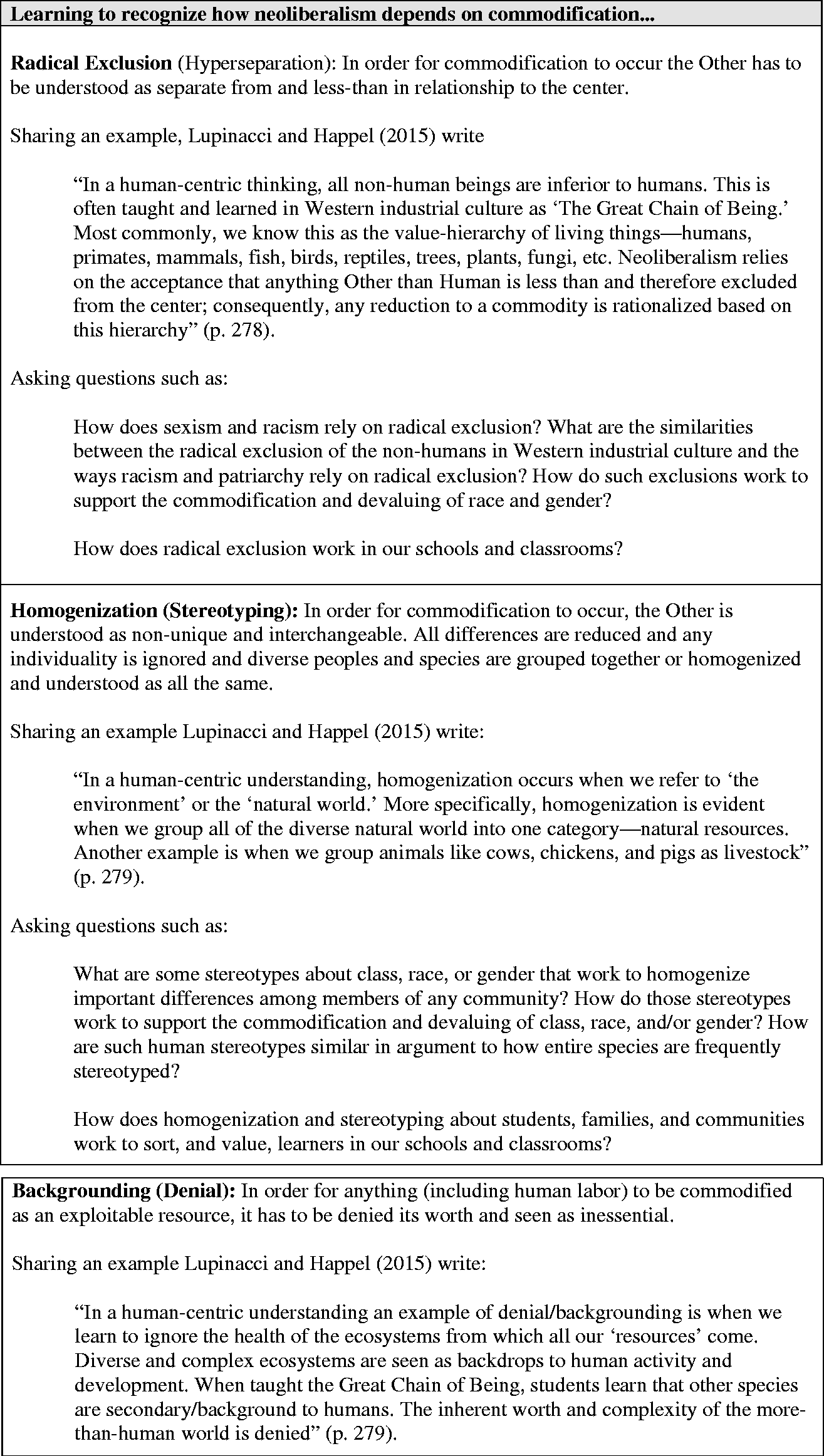
Learning to recognize how neoliberalism depends on commodification.
An illusion of disembeddedness: Manufacturing false notions of “independence”
Following these steps taken in teacher education to recognize how centric thinking and superior/inferior dualisms work toward establishing and maintaining social inequality and environmental degradation, we then engage with teachers to identify and examine how to recognize the illusion of one of the most foundational assumptions in schools—independence. This requires the use of a heuristic that we have developed to help students visually recognize the relational, meaning-making assumptions that influence our day-to-day actions in Western industrial culture. We teach using variations of the following figure in order to better understand the logic structure of centric thinking in Western industrial culture and critique the notion of an independent individual. Furthermore, we are able to use the figure to emphasize the problematic assumption of an independent individual as a person separate from and superior to all other beings. We focus this attention on neoliberalism, specifically highlighting how the aforementioned logic structures of centric thinking contribute to neoliberal understandings of independence, and how these ideas have influenced how educational achievement and mental health is measured in schools and communities. We offer this figure as a teaching and learning heuristic, which we believe can aid students as they learn to recognize value-hierarchized relationships and discourses that maintain and perpetuate oppressive and destructive relational patterns. Essential to addressing the value hierarchies of a human-centered neoliberal logic of domination is learning to recognize and teach how important it is to resist individualism, or what Plumwood (2002) calls the “illusion of disembeddedness”—a lack of recognition or a denial of our existence as linked to all other species embedded in a larger community of life. This “illusion of disembeddedness” is an integral component to understanding how neoliberalism functions in our everyday lives to perpetuate social suffering and environmental degradation. Furthermore, it is our hope that understanding individualism and the associated false notion of an independent individual can help teachers to reconfigure curriculum and pedagogy to emphasize the importance of all our dependencies over this illusion of independence. Through this process, students work through and with the following questions: What does is means to be human and successful? What sort of relationships are necessary for humans to exist in healthy and sustainable ways? How do we make decisions together that are ethically responsible? Whose voice is valued and/or centered in what is determined as ethically responsible?
At the root of a culture that interprets difference in ways that reproduce the logic of centric thinking, there exists a fundamental error in relational understandings. Instead of understanding humans as being connected to and interdependent with other humans, the more-than-human world, and the environment, human subjects in neoliberal systems too often learn to understand themselves and to act as though they are not connected to the vast networks of relationships that support and sustain their existence—the relationships upon which they depend. We suggest that such denial (recall denial is part of the logic structure for centric thinking) stems from the fact we have been socialized within a cultural logic that prioritizes and rationalizes such erasures and enclosures of life. These denials and illusions of our existence as independent individuals are learned and thus can be unlearned. This concept is illustrated in Figure 2, “Illusion of disembeddedness,” as a visual heuristic for teaching how a logic structure for centric thinking can be understood by exposing individualism, and how individualism connects with patriarchy, racism, commodification, ableism, heteronormativity, and other dominant habits of mind informed by hierarchized dualisms which are present in Western industrial culture. Further, this heuristic illustrates how the notion of self as separate from and superior (or inferior) to others sets up a limited and dangerous perspective from which meanings are constituted. The constituted meanings then contribute to the existence and strength of an exploitative political and economic system like neoliberalism. Specifically, when considering learning to care for the well-being and right to an empowering education for all children, this heuristic can help teachers confront assumptions that ultimately lead to seeing children as less than human—or certain children as more dependent and therefore considered less than or inferior to other children.
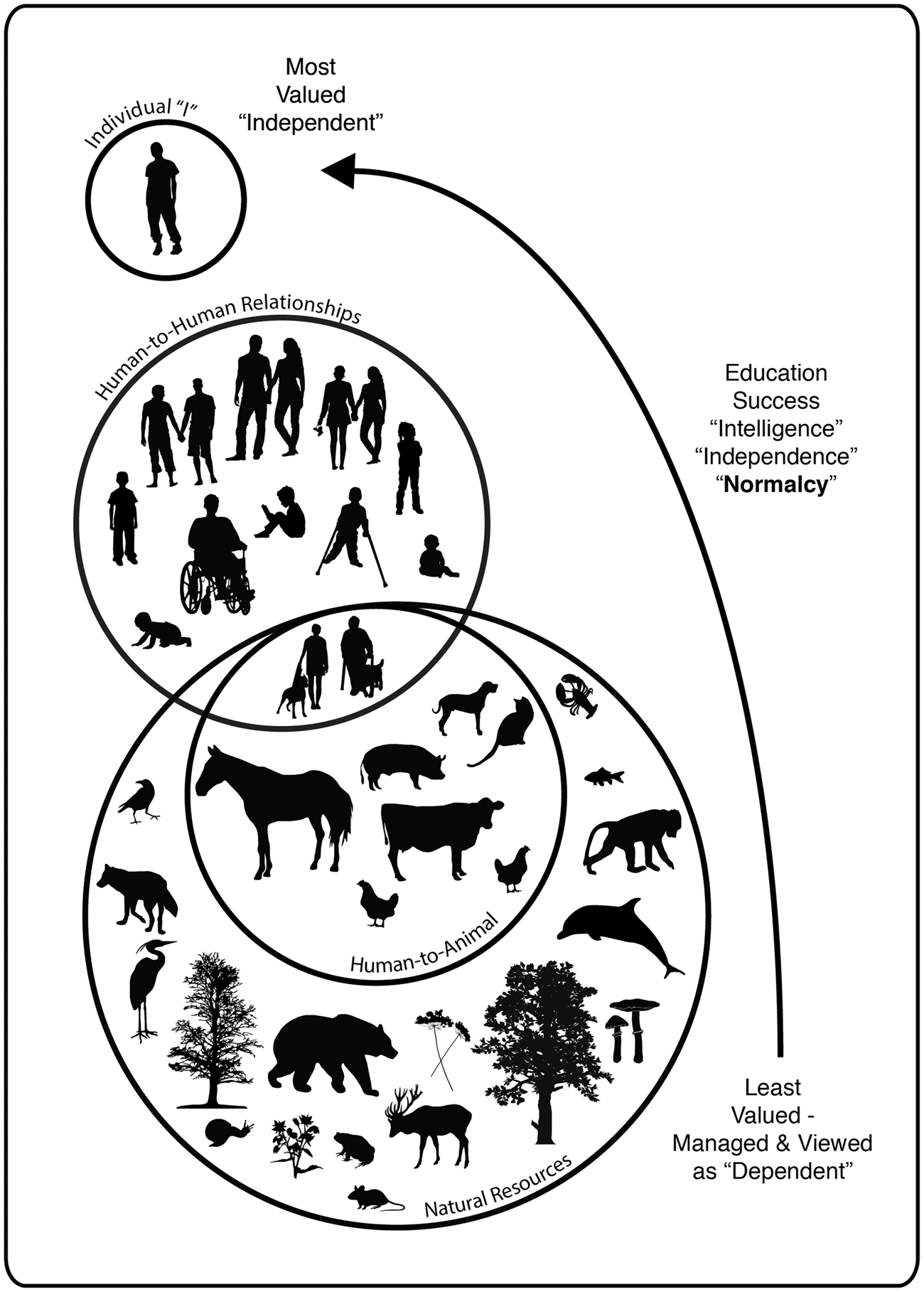
Illusion of disembeddedness.
This figure illustrates the concept of knowledge and value construction according to Western value-hierarchies of relationships. This figure is based on Plumwood’s (2002) articulation of an “illusion of disembeddedness” and is adapted from Lupinacci and Happel (2015) and Lupinacci (2013).
Referring to Figure 2, “Illusion of disembeddedness,” the location of the Individual “I”—pictured in the figure by the silhouette of a young male to illustrate how patriarchy and ageism are intertwined in this particular worldview—is biologically impossible. It is here that Plumwood’s use of the word “illusion” becomes extremely important to the figure’s potential as a teaching heuristic; she is making explicit how this particular way of perceiving and understanding the world is not in accordance with our biological existence as human beings embedded within—and dependent on—a living ecology. Essential to understanding how this model illustrates a fundamental break from living systems and our shared dependencies is recognizing the location what we've labeled “Individual ‘I’” and making explicit that schooling is too often focused on achievement and success measured by independence. In this model, the Individual ‘I’ exists in isolation from all of the other sets. Furthermore, it is through this isolated understanding of self as disconnected from other relationships—despite the impossibility—that we emphasize how in Western industrial culture this standard of independence has become a socially constructed goal often measured, and referred to, as “progress.” Moreover, considering neoliberalism, we use this heuristic for emphasizing how the separation rationalizes the commodification of all the other beings. In Figure 2, we point out how not only is the Individual “I” perceived as a separate and superior being, but also how it is situated in a clear value-hierarchy. The Individual “I” is the center, against which all Others are judged and measured. In this worldview, human relationships are perceived and understood as primarily occurring among only other human beings, thus reducing all Other(ed) living and non-living beings and things to “Natural Resources” or commodities. Additionally, the set of “Human to Human” relationships is located in the model above the depicted smaller set of “Human to Animals” relationships. This shows how humans’ relationships with the more-than-human world are often devalued, ignored, or silenced. In the current dominant Western industrial worldview, “Human to Human” relationships are often the only relationships that are both recognized and valued.
It is from this illusive and biologically impossible perception of self, as an independent individual, that we can see how all Other(ed) beings are then viewed as less-than—or as colonized resources or commodities in neoliberal iterations of capitalism. This kind of thinking can be more clearly understood through the manifestation and rationalization of behaviors like clear cutting forests for lumber. Further breaking this down, this kind of thinking is situated at the foundation of when any other living, or non-living, being is valued only in relation to its human use or serving the interests of the Individual “I” (which in Western industrial culture is a temporarily able-bodied, white, wealthy—or presenting as wealthy—male). Further examples include people (often children and women) working in sweatshops to make electronics and sneakers, children-prisoners serving time in for-profit prisons for minor and/or non-violent offences, or orcas spending decades sentenced to a life of swimming in confined pools for human entertainment.
As ecocritical scholar-activist teacher educators we believe that through a critical teacher education we can facilitate unlearning these oppressive value-hierarchized conceptual frameworks by illustrating that at the core of our ecological existence we are dependent on each other and all other living species. Examining the relationship between value-hierarchized dualisms and a logic structure for centric thinking helps to illustrate how the “illusion of disembeddedness” is a fatal and dangerous model for understanding our relationships with one another and the rest of the world. It is an illusion that advances false notions of independence while hiding and devaluing our dependencies.
More explicitly, when we teach using an ecocritical framework to recognize and resist reproducing a logic structure for centric thinking, we draw from Plumwood (2002) to request that students consider how an “illusion of disembeddedness” supports an economic and political system based on radically excluding, homogenizing, backgrounding, incorporating, and instrumentalizing of socially constructed Others—including humans, animals, and any member of the more-than-human world. In other words, an “illusion of disembeddedness” works to normalize structures and relationships of sexism, racism, classism, ableism, etc. Utilizing this approach in teacher education, we ask students to reconceptualize dependency and how they would teach in PreK-12 schools to support their students in learning to recognize and value difference, equity, and dependency. Further, we ask students to consider how such work to contest these assumptions would, and does, contribute to understanding how we might explore alternatives to the cultural assumption contributing to human-centric thinking that allows us to exploit, devalue, and destroy one another and our more-than-human members of the community.
Teaching to (un)learn normalcy: Recognizing and valuing difference and dependency
The concepts discussed in this chapter illuminate differences between fundamentally different ways of interpreting and understanding the world: A world that is based on exclusion, ideations of normalcy, and socially constituted notions of independence versus the multitude of possibilities that recognize relationships and (re)imagine curriculum and pedagogy based on diversity, mutualism, equity, and interdependency. This work engages educators, scholars, and activists in a dialogical process focused on (re)imagining classrooms in order to explore how learning communities can be constituted in ways that move away from being exclusionary, unjust, and unsustainable towards learning communities which are inclusive, socially-just, and sustainable. More explicitly, when engaging in (re)conceptualizing—or (re)imagining—learning communities or classroom ecologies, we must ask participants to consider how value-hierarchized dualisms undergird dominant discourses like human supremacy, sexism, racism, and ableism. Further, one must examine how such assumptions support an economic and political system based on the normalization of these discourses contributes to conceptions of community. Then we must consider how interrupting such notions and refocusing on diversity and dependency would and does contribute to understanding how we might explore alternatives to value hierarchized thinking that allows for so much unjust social suffering and environmental degradation.
As scholar-activist teacher educators, we hope that this work contributes to a necessary conversation for (re)conceptualizing how teachers prepare for teaching in schools. This conversation must be grounded in supporting educational efforts that eliminate the pervasiveness of hegemonic structures of personhood as the Individual “I” generated by rationality of anthropocentric, androcentric, ethnocentric and ableist discourses and discursive practices.
Recognizing that there is no one set way to engage in this work or to predict the directions of these critical dialogues, we conclude by outlining some possible suggestions. Since this discussion must include diverse perspectives that consider the interests of each other and the more-than-human communities, the principal action is to build networks of solidarity that recognize, respect, and represent diversity among a multitude of movements. We must educate, organize, and take action together in diverse ways to break from Western industrial understandings of ourselves and how we learn to live together on the planet.
Our first step is to encourage other teacher educators to engage in radical teaching and learning that collaboratively explores with teachers and future teachers rethinking the assumptions influencing how we, as humans, construct meaning and thus how we learn to relate to each other and the more-than-human world. Further, we encourage ecocritical teacher educators to make the commitment to critically and ethically examine how we understand educating, organizing, and taking action towards collectively educating with the goal of healthy democratic communities. Further, such projects should include all beings and seek to push beyond the limitations of a neoliberal normalcy. It is essential that teachers emphasize learning that highlights the intrinsic value of recognizing, respecting, and representing the right of all beings to exist and live well in a shared ecological system. For our second recommendation, we encourage teachers and future teachers to engage in critical and ethical (re)conceptualizations of personhood that center on difference and dependency. As notions of personhood are all too often defined in terms of human-centered exclusion and based on perceptions of normalcy, it is important to disrupt the value system of Western industrial culture with a commitment to always asking who and what is included or excluded in our definitions of our communities—and how those definitions contribute to either supporting or undermining the right of all beings to coexist in peace. Lastly, in these concluding encouragements for other teacher educators, we call for an ecocritical examination of inclusion that reconsiders what is presented in Western industrial culture as a neoliberal normalcy in favor of the diverse ways in which difference and dependencies can be recognized, respected, and represented throughout all of our efforts in teaching and learning to include in a healthy education all members of our shared communities.
Footnotes
Declaration of conflicting interests
The author(s) declared no potential conflicts of interest with respect to the research, authorship, and/or publication of this article.
Funding
The author(s) received no financial support for the research, authorship, and/or publication of this article.