




Abstract
US curricular policies frequently bolster neoliberal power structures within both pre-K to 12 schools and universities by privileging settler–colonial narratives and excluding Indigenous knowledge. However, curricular policies can also serve to enhance social reconstructionist and social justice education. In this article, we describe two case studies focused on a state-level policy—Montana’s Indian Education for All—aimed at advancing understandings about Indigenous experiences and worldviews. The first study’s findings demonstrate Indian Education for All’s potential to support practicing teachers, including teachers with limited experience working with Indigenous communities, in their efforts to confront settler-colonialism and neoliberalism within curricula. The results from our second study suggest the potential for Indian Education for All to create space for Indigenous student leadership. However, our research also provides cautionary notes about the potential for “tools,” such as Indian Education for All, to unintentionally reinforce settler-colonialism, neoliberalism, and racism, as they can create opportunities for racial microaggressions and inequitable expectations. We conclude with recommendations for teacher education programs, institutional leaders, and policymakers.
Keywords
Introduction
Through her analogy that “The master’s tools will never dismantle the master’s house,” Audrey Lorde (1984: 112) suggests that civil rights movements will struggle to transform society given their tendency to rely upon the very White patriarchal structures and tactics they seek to critique. We acknowledge the continued role of these structures and tactics in shaping, reinforcing, and transforming power in today’s societies, particularly through modern neoliberalism’s efforts to target “institutions and activities which lie outside of the market, such as universities” (Davies, 2014: 310). For example, curricular tools (e.g., curriculum frameworks, standards, textbooks) used in educational institutions in the USA generally sustain socioeconomic hierarchies, perpetuate Eurocentric views of economic progress, and exclude Indigenous 1 knowledge, even in content areas that claim to focus on cultural experiences, such as social studies.
In recent years, however, several US states have initiated policymaking aimed at disrupting or complicating these settler–colonial, neoliberal, and capitalistic narratives. The purpose of this article is to explore the potential for one such policy—Montana’s Indian Education for All (IEFA)—to challenge the legacy of settler-colonialism through mandated inclusion of Indigenous experiences within both the pre-K to 12 and university curriculum. Broadly, we endeavor to answer the question, is it possible to honor, sustain, and/or revitalize cultural knowledge of marginalized peoples using the tools of neoliberal education?
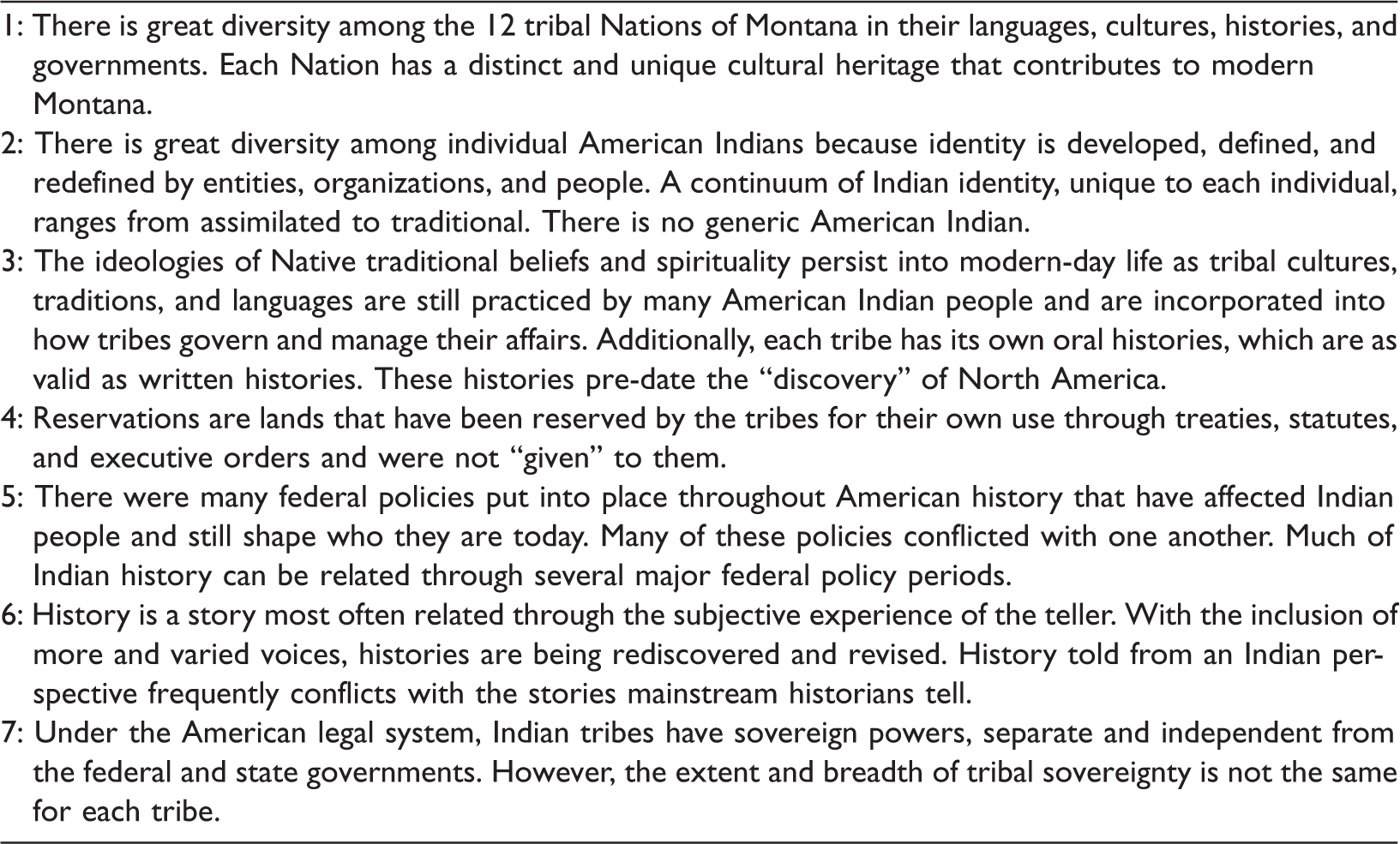
To challenge settler–colonial, neoliberal educational structures, social reconstructionists and multicultural educators call for transformative curricula that draw attention to the knowledge of peoples of color (Banks, 1993; Gay, 2000; McNeil, 2009). Unfortunately, many school systems resist approaches that appear counter to the mainstream, particularly given the influence of standardized testing and large-scale curricular frameworks (e.g., the Common Core State Standards for English Language Arts and Math, Next Generation Science Standards, C3 Framework for Social Studies State Standards, etc.). Therefore, we wonder if change might be more rapidly realized if familiar tools, such as curricular frameworks, are used in new ways to advance decolonizing agendas. For example, although IEFA’s framework of essential understandings (see Table 1) is, in many ways, a tool that looks like other (i.e., mainstream) curricular frameworks, it offers support for Montana’s predominantly White educators as they endeavor to interrupt the mainstream settler–colonial curricular narrative.
IEFA essential understandings.
To consider the intersections between curricula, policy, and teacher education, we describe two case studies focused on IEFA. One case explores the potential for IEFA to draw attention to Indigenous counter-narratives within the predominantly White classrooms of practicing teachers. Our second case considers the influence of IEFA on teacher education and Indigenous teacher candidates. Although our findings suggest that curricular policies such as IEFA can advance the goals of multicultural, social reconstructionist education, their effectiveness remains dependent upon educators’ motivation and preparation to implement critical pedagogy.
Theoretical foundations
The legacy of settler-colonialism
Neoliberalism and settler-colonialism are inextricably linked, as they both privilege private economic gain over social welfare and Indigenous rights. We define neoliberalism as a free-market ideology, propelled to mainstream dominance in the US during Reagan’s presidency. In general, proponents of neoliberalism resist government oversight and regulation of private business, favor competition between and privatization of social institutions, and seek to limit collective action (Davies, 2014). Furthermore, neoliberalism emphasizes the individual over the community, particularly when questions regarding social welfare arise (Peters, 2012).
For this article, we situate our discussion of neoliberalism within the specific context of US settler-colonialism. Hixon (2013: 4) explains, “What primarily distinguishes settler colonialism from colonialism proper is that the settlers came not to exploit the Indigenous populations for economic gain, but rather to remove them from colonial space.” European and Euro-American settlers, therefore, expanded on the colonizing goals of economic expansion through theft of land and the forcible removal of the land’s inhabitants.
US settler-colonialism is unique in its use of policy (i.e., treaties) to expand access to land for the US government and White settlers while removing, limiting, or redefining access for the First Peoples of the nation. That is, although the Indigenous Peoples of other nations also experienced forced removal, US treaty-making offered an unprecedented means of justifying war, land seizure, and cultural genocide at institutional (i.e., governmental and religious) levels (Hixon, 2013). Inherently, treaty-making favored the settler through dismissal of Indigenous epistemologies. Whereas the hundreds of diverse Indigenous communities in the US each have unique histories and beliefs, Indigenous scholars agree they often value dialogical decision-making (as opposed to written policymaking), collectivity (as opposed to individuality), cultural wellbeing (as opposed to material wealth), and protection of natural resources (as opposed to extraction and consumption of those resources).
Indigenous Peoples have long been subjected to educational policies and practices aimed at their assimilation into settler–colonial culture. For example, from the late 1800s through the 1970s, thousands of Native children were forcibly removed from their families and communities and sent to boarding schools, where they were required to cut their hair, stop learning about and practicing traditional knowledge, wear European-style clothing, speak only English, and submit to learning through mainstream US curricula and instruction (Lomawaima, 2004). Although the boarding school policies officially ended in 1975 with the Indian Self-Determination and Education Assistance Act, both local and nationwide educational reform efforts continue to promote assimilation and the settler–colonial curricula. For example, “back to basics” and “No Child Left Behind” requirements expanded accountability efforts as measured by standardized test scores and guided by state and national standards and frameworks. As standardized tests rarely include Indigenous knowledge, the curricula written to prepare students to excel in the tests tend to misrepresent, marginalize, and/or minimize Indigenous experiences.
The 2016 US presidential election bolstered neoliberal discourse and revived the application of settler–colonial ideology. Within the first weeks of his presidency, Donald Trump approved an easement to allow completion of the Dakota Access Pipeline—an action that directly conflicts with Indigenous treaty rights (to this day, the US government has failed to uphold a single treaty with Indigenous Nations). Individual and corporate economic progress remains paramount within the US neoliberal narrative, and government interference is typically tolerated for the purpose of expanding, not limiting, access to profit, land, and resources.
US curricular policymaking and neoliberalism
Generally, we define curriculum to include the collection of concepts and skills that inform teaching and learning, whereas instruction refers to the various pedagogical methods used to implement curricula. Within contemporary schools, the academic curriculum focuses on academic concepts and “big questions” to support preparation for post-secondary education, whereas the systematic curriculum focuses on alignment to academic and vocational/social standards (McNeil, 2009). As McNeil (2009) notes, the humanistic curriculum builds upon individual learner interests and potential, and the social reconstruction curriculum engages students and teachers in the process of evaluation of power structures within their communities and society. Most public schools in the US promote a mix of academic and systematic curricula. Whereas public schools must adhere to state standards, private schools have no such requirement. Unfortunately, research demonstrates that the bulk of the US curriculum opts to privilege and incentivize settler–colonial narratives over a curriculum that advances understanding of multiculturalism and social justice (Apple and Christian-Smith, 1991; Loewen, 2010; Scott, 2008; Stanton, 2014).
Although public schools and universities technically lie outside of the private market, they are increasingly expected to be both recipients and perpetuators of neoliberal ideology, as they encourage competition, standardization, and assimilation. Within the US education system, neoliberalism is most clearly manifest through an emphasis on “local control” of schools, academic capital as measured through standardized test scores, and competition for resources. To enhance competitiveness, many publishing companies point to research that highlights the effectiveness of their programs, and such effectiveness often hinges upon standardization and fidelity of implementation. As a result, curricular programs promote standardization and assimilation (i.e., students in very different communities and from different backgrounds are taught using the exact same materials and the exact same pedagogical methods). Grande (2003: 330) refers to this education as “Whitestream” in its tendency to privilege and perpetuate the mainstream White (i.e., Eurocentric, settler–colonial) narrative. For example, most textbooks used in US public schools value Eurocentric, neoliberal ideas of land ownership and cultivation over collective access, nomadicity, and relationality (MacGillivray et al., 2004; Sanchez, 2007; Stanton, 2014).
Given the 2016 elections, US schools will see expanded neoliberal policymaking within education, which will likely lead to expanded privatization, reduced regulations, diminished oversight, and increased segregation and inequities. In theory, school choice initiatives could result in new opportunities for locally driven, indigene-centric curricula, but these efforts could also lead to a rapid proliferation of cookie-cutter, for-profit schools and practices that disadvantage minority students, unless states and local districts establish clear curricular and pedagogical guidelines. Therefore, state and local policymakers will likely play a significant role in curricula design and implementation.
Culturally sustaining and revitalizing education
Transforming education requires more than mere tolerance for or inclusion of Indigenous knowledge within the curriculum. Generally, Indigenous scholars encourage critical, student-centered pedagogies, partnership with Indigenous communities and leaders, and meaningful integration of Indigenous counter-narratives throughout the curriculum (Brayboy, 2005; Grande, 2008; McCarty and Lee, 2014; Smith, 1999; Tuck and Fine, 2007). In addition to working to confront the legacy of settler-colonialism, such efforts expand historical accuracy (Banks and Nguyen, 2008; Bennett, 2001), increase academic success of underrepresented students (Choi, 2013; Nieto, 2004), support retention of teachers of color (Achinstein et al., 2010), and encourage use of culturally responsive pedagogy by White teachers (Goldenburg, 2014).
Although curriculum and pedagogy are inherently linked, curricular decision-making in the US has typically been viewed under the scope of policymakers (e.g., school district boards, state departments of education, etc.), whereas pedagogical decision-making often falls within the domain of individual teachers and teacher educators. To actively sustain the languages and identities of marginalized and underrepresented peoples, Paris (2012) advocates for culturally sustaining pedagogy, which integrates both cultural knowledge and ways of knowing into the curriculum. Therefore, classroom-level pedagogy may be informed and transformed through the enactment of culturally sustaining and revitalizing curricula.
In 2014, McCarty and Lee argued for culturally sustaining and revitalizing pedagogy (CSRP), especially in schools serving Indigenous communities, where reinvigoration of endangered Indigenous knowledge and ways of knowing is critically important. To demonstrate CSRP in action, McCarty and Lee (2014) provide a case study of the Native American Community Academy (NACA), a public charter school in New Mexico focused on providing “holistic attention to students’ intellectual, physical, emotional, and social development within a community and cultural context” (McCarty and Lee, 2014: 108). As an example of CSRP, NACA students, teachers, and community members engage in a “morning circle” as a means of sharing information, supporting collective decision-making, and encouraging spiritual wellbeing (McCarty and Lee, 2014: 108). In this case, both the curriculum (knowledge) and the pedagogy (ways of knowing) align with “traditional protocols” viewed as relevant to students from many Indigenous communities.
IEFA
Whereas McCarty and Lee’s work considered the potential for “grassroots” community-based efforts, such as NACA, to drive CSRP, this article describes the potential for “top-down” curricular policy to generate culturally sustaining and revitalizing education at the classroom level. Currently, few states require extensive teaching about Indigenous histories and perspectives and, in most cases, such teaching focuses on pre-1900 events (Shear et al., 2015), thereby recognizing superficial contributions or additions that privilege settler–colonial perspectives (Stanton, 2014). In Montana, however, official efforts to challenge the pervasiveness of settler–colonial curricula have been underway for over 40 years.
Montana’s state constitution includes a provision recognizing “the distinct and unique cultural heritage of American Indians” and emphasizing the state’s “educational goals to the preservation of [American Indians’] cultural integrity” (Montana Constitution, 1972: Art. X, §1.2). In 1999, this constitutional mandate led to legislation known as IEFA, which requires educators across grade levels and content areas to teach Indigenous and non-Indigenous students about the histories, experiences, and perspectives of Montana’s Indigenous Peoples (Montana Code Annotated,1999: 20-1-501). IEFA was inspired in large part by the leading multicultural education scholarship of the time, including Banks’ model for curricular integration (Banks, 1993). Advocates of IEFA noted the importance of transforming the curriculum across grade levels and content areas for all students, not just Indigenous students.
To initiate IEFA, leaders from Montana’s 12 Indigenous Nations collaborated to develop “essential understandings” as a means of framing curriculum development and implementation (Montana Office of Public Instruction, 2001). Despite the introduction of the essential understanding framework (see Table 1), implementation of IEFA was fragmented and inconsistent in its early years. In 2005, the state committed to funding implementation efforts, which led to curriculum development, professional training for teachers and administrators, and the hiring of IEFA coaches to support teachers in day-to-day implementation (Carjuzaa et al., 2015). In the 10 plus years since the state began funding IEFA, the few studies that have evaluated implementation efforts note that although the state still has much work to do, Montana is serving as a nationwide leader in drawing attention to Indigenous experiences within the curriculum (Carjuzaa et al., 2015).
In many ways, the IEFA essential understanding framework reflects the goals of neoliberal education. It is a tool to, in essence, promote quality control through standardization and accountability. As a set of written essential understandings, it even looks like the type of guidelines or standards that dominate curricular decision-making and drive the textbook publishing industry. Although IEFA is structurally familiar, it is very different from other curricular frameworks in its focus on sustaining and revitalizing local Indigenous knowledge.
Methodology
In this article, we discuss two distinct, yet related case studies evaluating the potential for IEFA to inform curriculum transformation and classroom-level pedagogy. Our first study focused on the ways IEFA supports practicing teachers as they transform their curricula to challenge the “master narrative” (Scott, 2008: 104) of settler-colonialism. The second study considered the influence of IEFA on teacher education pedagogy, particularly in terms of the preparation of Indigenous teacher candidates.
Study #1: Practicing teachers
Our first study compares teacher curricular decision-making in two high schools—one in Montana and one in Wyoming. To evaluate the ways IEFA shapes teacher thinking and practice for CSRP, particularly in rural, predominantly White communities, we applied methodological elements of critical ethnography (Castagno, 2012; Foley and Valenzuela, 2005) using modified stimulated recall interviewing techniques (Dempsey, 2010; Smagorinsky and Coppock, 1994). Critical ethnography aligns well with efforts to decolonize research and education as it supports “goals related to illuminating power differences, injustice, agency, resistance, and larger analyses of structures” (Castagno, 2012: 375). In this case, we were particularly interested in investigating how educators engage with and/or resist settler–colonial curricular narratives, and how state-level curricular structures, such as IEFA, affect that decision-making.
The US Census Bureau classifies both Montana and Wyoming as “frontier” states because of their geographic expansiveness and low population density. The two states are similar demographically (approximately 90% of residents identify as White), although Montana’s Indigenous population comprises a larger percentage (6+%) than Wyoming’s (2.3%). However, the states differ substantially in terms of their recognition of Indigenous communities and such communities’ experiences in education. Wyoming includes vague, historical references to Indigenous Peoples in the state social studies standards, but there is no explicit expectation that the histories and contemporary experiences of Indigenous Peoples should be taught across content areas. At the time we conducted the case studies described in this article, the state of Wyoming did not offer curricular materials to support teachers who wanted to integrate Indigenous histories, experiences, or perspectives into their teaching. If teachers want to integrate the aforementioned into their curricula, they are left largely to their own devices in terms of finding and developing curricular resources.
In contrast, Montana’s statewide IEFA mandate demonstrates a comprehensive commitment to recognizing the histories, experiences, and perspectives of Indigenous Peoples. IEFA applies across grade levels and content areas and, as the name suggests, it is meant to frame curricula for both Indigenous and non-Indigenous students. Furthermore, IEFA includes an expectation with regard to the state’s predominantly non-Indigenous teachers: all educators are expected to “have an understanding and awareness of Indian tribes to help them relate effectively with Indian students and parents” (Montana Code Annotated, 1999: 20-1-501). To meet this goal, teachers make use of the state’s extensive resources, including the IEFA essential understandings, the state’s Montana History textbook, and lesson plans available through the state’s Office of Public Instruction. In addition, some teachers participate in IEFA-focused professional development and teacher education coursework. That said, teachers and administrators note that the integrity of implementation varies greatly from school to school and teacher to teacher.
The two communities used for the study were identified because of their comparability in size, their shared industries (agriculture and tourism), and their similar demographics (over 90% of each town’s 7500 residents identify as White). In both communities, there is an “achievement gap” noted between White students and Indigenous students. Although the two contexts have many similarities, they also reflect important differences.
The town in Wyoming is geographically isolated and located on the border of an American Indian reservation. Many of the Indigenous students, who comprise 15–20% of the student population in the district’s schools, ride buses long distances to get from their homes on the reservation to school. As a reservation border town, the Wyoming community is faced with higher levels of racism than many others (Ambler, 2009; Perry, 2009). The racial tensions present in the border town led us to anticipate teachers might challenge settler–colonial curricular narratives in their classrooms, even if they are not required to do so by the state.
Although 12 Indigenous Nations call reservations in Montana home, the Montana case site is located over 200 miles from the nearest reservation, and only 1% of the students who attend the high school identify as Indigenous. Although the town is considered a rural community, it is located less than 10 miles from a city of approximately 40,000 residents, which is the site of a university that draws attention to Indigenous experiences. Despite the distance from Indigenous communities and a limited number of Indigenous students, we expected to observe teachers challenging settler–colonial curricular narratives due to the requirements of IEFA and the proximity to the university.
Our study compared the curriculum preparation and implementation of two social studies teachers—Liz, 2 who teaches in the Wyoming school, and Diana, who teaches in the Montana school. The teachers were purposefully selected because of their similarities in age and because they are both long-term residents of their communities. Despite their similarities, there are important differences between the two teachers. Liz, who has been teaching for over 30 years, has been recognized as a leader for her work with regional Indigenous communities. Her mother was an enrolled member of the Lakota Nation, and although Liz does not herself identity as Indigenous, she has extensive knowledge of traditional perspectives. She has developed and taught Native American history courses, served as the sponsor for the school’s Indigenous student club, and guided professional development to advance culturally responsive teaching throughout the school. Diana is a less experienced teacher, with just over 10 years of experience, because she completed her teaching degree later in life. She identifies as White and acknowledges her personal lack of knowledge with regard to Indigenous perspectives, experiences, and histories.
Multiple sources of data, including descriptive information about the communities, curricular materials (e.g., textbooks, state standards, IEFA essential understandings, etc.), in-depth interviews, and classroom observations, contributed information for the study. We used a modified approach to stimulated recall interviews, which provide a running record of “mental processes occurring” during teaching and learning experiences (Rose, 1984: 23) to investigate teacher thought processes related to teaching about Indigenous experiences, histories, and perspectives. Data were coded using a combination of open and focused coding (Rubin and Rubin, 2005), and the two teachers provided member checks of the coding following their stimulated recall interviews.
Study #2: Pre-service teachers
Our second study considers the influence of IEFA on the preparation of teachers. In particular, we evaluated the role of IEFA in drawing attention to settler-colonialism within teacher education coursework and field experiences. The study applied elements of participatory research (Northway, 2010), because the lead researcher (Author #2) is an Indigenous person who was—at the time—a teacher candidate and co-participant in the study. Additionally, we combined Indigenous research methodologies (Smith, 1999; Wilson, 2008) with narrative inquiry to allow for an in-depth focus on participants’ stories. Specifically, the study was initiated in response to a sense of obligation to Author #2’s cultural and academic communities. As Wilson (2008: 97) notes, “relational accountability” is a key element of Indigenous research. In particular, Author #2 embarked upon the study after learning about some of the experiences of other Indigenous teacher candidates and she felt compelled, given these relationships, to investigate further and report the findings to her communities. Through such actions, Author #2 hoped to effect change at her institution and in other teacher education programs across the region.
The study was carried out at a public university in Montana, which graduates over 100 elementary and secondary teachers across content areas per year. The university is located several hours from the nearest reservation. That said, the institution has received recognition as a “home away from home” for Indigenous students, and numerous programs are in place to support students and engage with Indigenous communities and families. Despite these accolades, the university continues to struggle to recruit and retain Indigenous students at a rate that mirrors the state’s overall population. The teacher education program primarily prepares elementary and secondary teachers for licensure in Montana. The state’s commitment to IEFA has, therefore, influenced the design of the teacher education program. In addition, several faculty members have teaching and research backgrounds in social justice and Indigenous education. However, although several courses make reference to IEFA, very few include sustained attention to the policy.
Three Indigenous teacher candidates, all social studies education majors, participated in the case study. Sam is a Blackfeet tribal member from the Blackfeet Reservation. At the time of the study, he had completed all of his coursework and part of his student teaching internship. Perri is a Northern Cheyenne tribal member who was born and raised on her reservation, which she refers to as the “center of the world.” At the time of her interviews, she had just returned to the university as a sophomore after taking time off to be with her family. Author #2 is from the Oglala Lakota tribe and the most recent Indigenous graduate of the social studies education program.
Data sources included personal narratives accessed through research journals and interviews. The interviews focused on teacher candidate experiences with regard to coursework and fieldwork, examples of racial microaggressions, and ideas for institutional and programmatic change. Author #2 also contributed insights from her research journal. We applied collaborative open coding in order to analyze the data (Rubin and Rubin, 2005).
Findings and discussion
Findings from our two studies demonstrated two main ways that policymaking can drive educational change: (a) by providing structural tools (e.g., curriculum frameworks) to support teachers as they confront the dominant narrative of settler-colonialism; and (b) by engaging teachers and students in the active deconstruction of settler-colonialism. Although these two groups of findings are related, they are, in fact, quite different, as one suggests navigation within the system and the other demands movement beyond it. As a result, the first finding, which is primarily curricular and policy directed, offers a low-stakes approach to the confrontation of settler-colonialism and related ideologies. The second finding, which requires a pedagogical shift, demands a challenging level of commitment and leadership on the part of individual teachers.
Using the tools to renovate the house
Both studies demonstrated the potential for state-level policy, such as IEFA, to support educators as they make classroom-level changes within the larger existing education system. In this way, IEFA serves to help teachers use the tools they already have in order to renovate or expand the curriculum. Without a broader structure, such as a supportive state-level policy, such changes are possible but difficult, because they typically depend upon an individual teacher’s experience and interest. As a result, many inexperienced or disinterested educators rely on deficient textbooks. Furthermore, some educators resent policy charges, which, as noted by participants in our second study, can lead to complacency in implementation. Liz and Diana both expressed the importance of professional development, and Sam, Perri, and Author #2 emphasized the need for teacher educators to model IEFA implementation, self-reflection, and culturally responsive pedagogy.
Practicing teachers
Although both Diana and Liz work to include Indigenous counter-narratives in their curricula, our study suggests that state-level policy, such as IEFA, eases the difficulty of curriculum transformation. Liz noted that the textbook used in her Wyoming school, which is published by the largest educational publisher in the world, is not a “bad textbook,” but that it is lacking in terms of Indigenous counter-narratives. This challenge played out in an observed lesson, when Liz asked students to list “some of the famous people coming out of that era [Westward Expansion]?” In her stimulated recall interview, Liz explained: I had to prompt [the students] with, “OK. So who were some of the famous Native American figures?” And then they say, “Oh yeah! Well, Crazy Horse. And Sitting Bull.” But they run out pretty soon, even in their own tribes. They mention Chief Washakie. But they don’t mention Sharp Nose or Black Kettle or White Antelope.
IEFA has made it easier for Montana teachers, such as Diana, to access and integrate Indigenous counter-narratives into their curricula, than it is for Wyoming teachers. In particular, Diana is grateful for IEFA-related resources and professional development provided by Montana’s Office of Public Instruction, because she notes that few resources developed outside of the state include adequate information about Indigenous knowledge, particularly that specific to Montana Nations. Diana explains that although she views herself very much as a “learner in terms of IEFA,” she feels confident teaching substantial units that incorporate Indigenous knowledge because members of Indigenous Nations across Montana contributed to the development and review of the resources she uses.
Like Liz, Diana recognizes the importance of humanizing the curriculum to help her students connect to Indigenous experiences. Unfortunately, the school’s distance from reservation communities makes it difficult to invite Indigenous guests into her classroom. As an alternative, Diana finds that sharing stories through primary sources can offer students a glimpse into Indigenous experiences, knowledge, and ways of knowing. For example, in one observed lesson, Diana introduced her predominantly White students to thinking about how their own beliefs about Indigenous Peoples have been shaped. Students then engage in a counter-narrative activity, which uses primary accounts from modern Indigenous Montanans printed on posters and distributed by the state’s Office of Public Instruction. Diana acknowledges that without the state’s policy and support, she probably would not even know about the stories herself, as she notes she does not personally have Indigenous friends or mentors.
Pre-service teachers
All three of the Indigenous teacher candidates who participated in our second study noted they initially felt optimistic about the potential for IEFA to transform curricula, both at the pre-K to 12 level and within teacher education. Specifically, we learned that IEFA provides a framework that can communicate complexities to non-Indigenous peers and instructors, which the participants find helpful. For example, IEFA allowed Sam, who is Blackfeet, to seek opportunities for exploring the multiplicities of personal and tribal identities in his lesson planning. This helped Sam make history relevant for himself, while recognizing the diversity that exists between and within tribes. Similarly, Perri focused on building connections between the university and her Indigenous community through her coursework. Although Author #2 did not grow up on the reservation, she was raised next to her grandparents, has been able to travel to South Dakota several times a year to visit family, and is familiar with the traditional ways of knowing unique to her tribe. As a teacher candidate, one of her goals was to learn how to make more culturally relevant resources available to other Indigenous students, including those who are located at a distance from a reservation. Therefore, state-level policy, such as IEFA, can provide opportunities for Indigenous teachers and students to legitimize, honor, and revitalize their individual and community counter-narratives.
However, the teacher candidates explained that although IEFA’s framework is introduced early in teacher education coursework, they experienced limited modeling in terms of IEFA implementation from education and content area (e.g., history or political science) professors. In some cases, IEFA seemed simply to be an added structural burden to both instructors and students that increased resentment toward Indigenous Peoples. For example, Sam noted, While there were bits and pieces of IEFA integrated into a few of the education courses themselves, they are so few and far between. When this happens, non-Native students become stressed about creating meaningful lessons and the anger and stress is placed on the Native students in the class—as if it were our fault [the White students] had to do IEFA, and the professor was nowhere to intervene or give clear or concise examples to help students succeed in their IEFA lesson planning. It became contradictory and I started to feel like I was taking the blame for other students’ lack of success.
Using the tools to dismantle the master’s house
In addition to offering information about the ways in which policy can support curriculum transformation, the case studies also provided important insights with regard to how policy can affect pedagogy. Historically, social studies pedagogy has prioritized teacher-centered and textbook-driven instruction. CSRP demands a shift in teacher thinking about both curriculum and instruction, as it calls into question the authority of the teacher (who, in over 80% of US classrooms, is White) and the legitimacy of the textbook narrative. In both of our studies, IEFA provided opportunities for critical thinking, student ownership, and inquiry, all of which align with CSRP values. However, participants in both studies demonstrated an awareness of the potential for “resistance” to both the counter-narratives themselves and how those counter-narratives are used in the classroom.
Practicing teachers
Our study with practicing teachers demonstrates the potential for curricular policy, such as IEFA, to prepare teachers and students to think critically about culture and identity, even in predominantly White communities geographically distant from reservations. The interviews with Liz and Diana and observations of their teaching suggest that both teachers are intentional about how they use their curricula. In other words, although their pedagogy is influenced by the state and district curricula, these teachers both demonstrated a commitment to pedagogy that encourages students to critically evaluate settler–colonial narratives and to actively seek out and engage with Indigenous counter-narratives.
For example, Liz and Diana challenge students by asking questions such as, “Whose perspective is missing?” and “How can we learn about that perspective?” Diana asks questions throughout her lessons to encourage students to think like historians and scientists by asking, “Why do you think the Cheyenne have this little tiny reservation, compared to the Crow? How did that happen?” These types of questions pique students’ interest and, as Diana suggests, “we start thinking and we start looking.” The teachers normalize the questioning of assumed objectivity within textbooks (and society) while encouraging students to invest in their own learning.
Liz and Diana believe that student ownership of learning is the only way to truly transform education. Liz uses student-led inquiry in her classes, which expands opportunities for students to transform their own curricula. For example, one of her Arapaho students decided to do some extended research on the Sand Creek Massacre, an event that was pivotal in her tribe’s history but which is described in two brief paragraphs in the class textbook. Diana encourages her mostly non-Indigenous students to take ownership of not only what they are learning, but also of how they will apply what they have learned. During one lesson, she emphasized: I hope this helps you think about how [non-Indigenous peoples] view Native Americans. But, you have to own it. It can’t be what I tell you. You have to decide for yourself. I hope to help you think about that image as we learn about the history and some of the issues on the reservations. I hope you start to see that some of those issues are the result of policies and things that we have done.
Both teachers emphasize the importance of preparing students for critical thinking about settler-colonialism, because they believe students will be “resistant” or “defensive” to CSRP without a critical foundation. Our observations supported this claim in that students in Montana demonstrated more prior knowledge about Indigenous histories, worldviews, and experiences than students in Wyoming. Diana was able to engage her predominantly White students in conversations about higher level concepts, such as identity, assimilation, stereotypes, and privilege, whereas Liz expressed frustrations about needing to frequently remind her students to question the author and look for bias. In addition to providing a base of conceptual knowledge, our study suggests that ongoing, comprehensive integration of the IEFA essential understandings can encourage habits of mind, such as questioning of inaccuracies. For instance, students in Diana’s class had the content awareness and confidence needed to question her when she incorrectly identified the Fort Peck Reservation as home to the Gros Ventre Nation. This example demonstrated the interaction between curriculum and pedagogy in that IEFA created the foundation needed for students to share their expertise and challenge inaccuracies while supporting Diana’s efforts to embrace and model learning about culture and identity. For a White teacher, this is an important step in terms of practicing CSRP.
Pre-service teachers
The teacher candidates in our second study noted that although curriculum and pedagogy are linked, simply incorporating IEFA does not result in pedagogy that is culturally sustaining or revitalizing. Even when their professors incorporated Indigenous counter-narratives into their teaching, which happened rarely, they appeared unprepared or unwilling to actively engage with their students in critical thinking about those counter-narratives. In some cases, the participants noted trivial or additive integration of IEFA, which indicated to both Indigenous and non-Indigenous students that IEFA is something “extra” that deters attention from the “real” curriculum. For example, Perri described an experience in a class where her peers complained about “having to do IEFA” just to finish an assignment. She viewed her peers’ resistance as equivalent to “IEFA isn’t actually important—we just have to check off the box.”
Within social studies teacher education, including discussions about settler-colonialism and Indigenous counter-narratives can draw attention to racially charged issues and, potentially, generate new opportunities for racism. For example, Author #2 explained, “Going into the field of social studies education, I expected more cultural awareness, so I was alarmed to learn that racism was alive and well in my coursework and field experiences.” Although IEFA can create opportunities for Indigenous Peoples to share counter-narratives, it also shines a spotlight on the dark history of the US. Without adequate preparation, non-Indigenous students can become more entrenched in their resistance, particularly in the light of increasing tensions surrounding “identity politics.” Such resistance not only discredits counter-narratives and cultural identity, it also reinforces neoliberal, meritocratic beliefs that progress depends upon assimilation into the Whitestream culture.
Finally, all three teacher candidates expressed a tendency for IEFA to force them to be the “cultural experts” in their classes. In some cases, this expectation resulted in unwanted attention and pressure. For example, Sam said, “Sometimes I just want to sit there, and not always feel like I’m in the hot seat.” Perri echoed this concern, noting how often she feels like the “token Indian” who is expected to simultaneously represent herself, her tribe, and all Indigenous Peoples. IEFA also created new opportunities for misconceptions, stereotypes, and even racial microaggressions (i.e., subtle verbal and/or visual insults directed toward people of color, often automatically or unconsciously). If instructors were not vigilant and prepared to address these issues or, worse still, if they did not see a problem with such issues, the participants felt extra pressure to “speak up” and point out injustices and discrimination. Author #2 explained that the “radar is always up” for Indigenous students when the course focus shifts to IEFA, which can lead to emotional exhaustion, and bullying by other students. All three participants noted the tendency to be negatively labeled, either directly or subtly, as an “angry Indian” or an “activist.” For example, Author #2 explained, In some cases, the racism was overt. For example, if I questioned settler–colonial perspectives or narratives, I was labeled the “token” or “angry” Indian. In other cases, I encountered racial microaggressions. For example, my professors expected me to present on IEFA to the class [simply because I’m Indigenous].
Implications and recommendations: Building a new house
As Paris (2012) notes, truly transforming education requires a new approach—one that moves beyond mere tolerance to advocacy and action. Our studies offer several implications for policymakers, teachers, and teacher education programs. First, our research highlights the importance of building a critical mass of CSRP advocates. Second, we note the need to address inequities between the personal/cultural imperatives and the professional expectations driving curriculum transformation and CSRP practice. Third, our findings draw attention to the need for community-centered professional development in both pre-K to 12 and university contexts.
Building a critical mass of advocates
Our participants noted that some professors and practicing teachers are resistant to perspectives that challenge settler–colonial narratives, and that such resistance leads to extra expectations for Indigenous students. These expectations add undue pressure, suggest Indigenous individuals can represent entire Nations (including those that are not their own), shift the responsibility for teaching away from the teacher, and potentially drive Indigenous teacher candidates away from the profession.
Research demonstrates the importance of building a critical mass of teachers of color, both for students and for the teachers themselves (Achinstein et al., 2010). In addition to expanding efforts to recruit and retain Indigenous teachers, our participants recommended cultivation of a critical mass of educators with expertise in CSRP, including Indigenous leaders/mentors, Indigenous teacher candidates, Indigenous teacher educators, and informed non-Indigenous teacher educators who are able and willing to model CSRP. Our participants believe building such a community would reduce pressure on individuals to serve as cultural experts or to challenge racial microaggressions independently.
To promote a sense of community and initiate efforts to cultivate this critical mass, the teacher education program involved in our second study launched an Indigenous student cohort, which allows Indigenous teacher candidates to meet, form networks and friendships, and work closely with faculty and advocates. In addition to this sort of direct action to build critical mass, teacher education programs need to confront the ongoing assimilative demands common to educator preparation and academia as a whole. For example, Perri withdrew from the university for two years in order to be closer to her family and tribal community. She recently returned to finish her program, but such fragmentation in her study is a disadvantage not typically experienced by her non-Indigenous peers. Programmatic revisions, such as adding distance/online offerings, allowing flexible course substitutions, and/or expanding partnerships with community and tribal colleges, could provide institutional support for Indigenous teacher candidate recruitment and retention.
Building a professional imperative for change
Although IEFA claims to advance learning and equity for all students, our work demonstrates the reality, which is that individual teachers view the mandate with differing levels of commitment. For Indigenous educators and teacher candidates, there is often a personal and/or cultural imperative that drives their investment, action, and response. Although there is also a “democratic imperative” to advance CSRP and to recruit and retain teachers of color (Achinstein et al, 2010; McCarty and Lee, 2014; Paris, 2012), our research suggests such an ethic, even when coupled with a policy, may not be enough to inspire change. Therefore, we note a need for a professional imperative that ensures policies like IEFA become part of the culture of teaching at both pre-K to 12 and post-secondary levels.
The results of our studies highlight key insights with regard to teacher identity and expectations for investment in the process of enacting CSRP. Teachers who are unfamiliar with Indigenous knowledge and ways of knowing, especially non-Indigenous teachers, rely heavily upon the “tools” available to them. In these cases, state-level policy, such as IEFA, serves to transform the curriculum, and it can support basic elements of CSRP as long as teachers are willing to encourage critical thinking about difficult content. However, to advance deconstruction of settler–colonial curricula, teachers also need to take ownership of their own learning within and beyond the classroom.
The Indigenous teacher candidates noted the importance of a sense of cultural duty or what Wilson (2008) terms “relational accountability.” Although IEFA increases opportunities for misconceptions, stereotypes, and microaggressions, both the practicing teachers and teacher candidates recognized it creates opportunities for them to become advocates for Indigenous Peoples and their specific Nations. For example, although Sam was exhausted by the likelihood that he would face continued “racial battle fatigue” throughout his entire academic and professional career, he felt a sense of duty to his Nation to confront the misconceptions and stereotypes.
Without a supportive, culturally sustaining policy such as IEFA in place, teachers have to be knowledgeable and motivated in order to confront the settler-colonialism that pervades mainstream curricula. In Liz’s case, her own experience and her partnerships with community members made such work possible. Although Diana acknowledges that she is “still a learner” in terms of Indigenous knowledge and ways of knowing, she credits periodic professional development for helping her develop confidence as a multicultural educator. Unfortunately, IEFA implementation and professional development is not yet evaluated or prioritized at the post-secondary level. Therefore, as noted by the pre-service teachers in our second study, college and university educators have little incentive to implement IEFA with integrity and to practice CSRP.
Building community-centered professional development
McCarty and Lee (2014: 110–111) note that advancing CSRP is particularly challenging given the “need to address monolingual, monocultural norms embedded in standardized testing while prioritizing community-based values.” We recognize that this challenge becomes even more pronounced in contexts such as predominantly White schools and universities that serve a minority of Indigenous young people. McCarty and Lee (2014: 118) also highlight complexities stemming from the “overlapping sovereignties and expectations” of different entities that influence policymaking, including the many Indigenous Nations and state and federal governments.
Our research illustrates this complexity of CSRP, even when teachers are required to integrate cultural knowledge into their curriculum, and even when teachers are carefully and purposefully thinking about their praxis. Although IEFA has a presence within teacher education curricula and professional development across the state of Montana, its implementation remains sporadic and the integrity of that implementation is even more uncertain. The practicing teachers and teacher candidates who participated in our two case studies recognized the need for more explicit, community-led guidance with regard to Indigenous histories, experiences, and perspectives, especially given the prevalence of settler–colonial curricular resources.
Specifically, participants in our studies expressed a desire for more preparation and discussion time, cultural mentorship from multiple Indigenous Nations, access to resources, and exposure to high quality examples of classroom practice. Similarly, the teacher candidates noted a need for more professional development for teacher educators and content area professors, as well as more time for their peers to engage with counter-narratives and the complex questions that arise from discussions about counter-narratives.
US policymakers often prioritize individualistic, economic, and meritocratic indicators of progress over the needs of the wider community, particularly if the community includes members from groups that have struggled academically. Despite this reality, our research suggests that communities remain the greatest potential tool for change. Local school districts have extensive control over curricula and teacher professional development, and will probably continue to retain that control. Therefore, we advocate for community-centered, place-conscious education (Gruenewald, 2003; Stanton, 2014), which engages Indigenous Peoples as mentors and educators throughout ongoing professional development, and guidance for practicing teachers, administrators, and policymakers.
Conclusion
IEFA differs from other standardized curricular frameworks and policies in its emphasis on communities instead of individuals and its recognition of Indigenous knowledge and ways of knowing. As such, policies like IEFA in and of themselves have the potential to resist neoliberal and settler–colonial ideology. However, our work suggests state-level policy, such as IEFA, can only be the starting point if educational change is to be generated in a way that revitalizes Indigenous knowledge and ways of knowing.
In Montana, IEFA continues to face resistance and challenge. In Wyoming, progress has been made since we conducted our research as the state recently adopted its own IEFA policy. Indigenous leaders and their allies in Wyoming have been pushing for this recognition for over 40 years. It is clear that adopting curricular policy to confront settler-colonialism can take an extraordinary amount of time, and effective implementation can take even longer.
As evidenced by the two case studies shared above, curricular policies, such as IEFA, also create new opportunities for racial microaggressions. Specifically, our findings point to the need for, but difficulty of, deconstructing misconceptions about Indigenous experiences, given the length (i.e., pre-K to post-secondary) and breadth (i.e., across content areas and both within and beyond school contexts) of teachers’ and students’ prior exposure to Whitestream narratives. Furthermore, without extensive preparation, high quality resources, and relational accountability, educators may not acknowledge a democratic or professional imperative to change the way they teach in order to more effectively sustain and revitalize Indigenous knowledge and ways of knowing.
Throughout this article, we have considered the moves to change the curriculum that have been made possible by using mainstream tools in new ways, tools such as curricular policies and frameworks, Our results demonstrate that although curricular policy can challenge neoliberal, settler–colonial knowledge and ways of knowing, its effective implementation depends on teacher access to resources, sustained and meaningful community-centered professional development, and critical CSRP. We note that difficult work lies ahead, given the current demographics of the US teacher workforce, the pervasiveness of neoliberal educational structures, and the current socioeconomic hierarchy. However, we agree with those who led the way with IEFA: multicultural education is important for all (Carjuzaa, 2012), and it is worth the struggle.
Footnotes
Authors' Note
Danielle Morrison is a recent graduate of Montana State University's Social Studies Broadfield teacher education program.
Declaration of conflicting interests
The author(s) declared no potential conflicts of interest with respect to the research, authorship, and/or publication of this article.
Funding
The author(s) disclosed receipt of the following financial support for the research, authorship, and/or publication of this article: The research reported in this article was funded in part through a Montana State University Presidential Emerging Scholars grant.