




Abstract
In this article, we share a social action process useful in teacher education and derived from a decade of practical experience with social action projects. Influences, theoretical underpinnings, and individual leadership in an early childhood teacher education program are considered alongside practical enactments of social action projects by preservice teachers in their licensure program. One particular type of field-based assignment, the social action project, is described and analyzed. An examination of program transformations expanding the social justice framework to include more global perspectives, such as the International Baccalaureate Primary Years Program, shaped and challenged our earlier notions of working to address isms to frame justice and advocate for children in larger social and educational networks. We suggest what social action should and can entail in teacher education for an interdependent world and offer a gradient of social action for justice in early childhood education practices and environments.
As the most senior professors in a large North American teacher education program geared mostly for preservice teacher preparation, we acknowledge the tremendous intellectual work of preservice teachers as we attempt to shift their worldviews to more just, global, and cognizant positions (Hyland, 2010; Kroeger, 2015; Lash and McMullen, 2008). In this article we share a field-based social action project (SAP) from our own teaching to implementation and describe the evolution of the types of problems targeted in the SAP. We show how projects are introduced to preservice teachers, as well as how everyday problems in early childhood are addressed. We illuminate how the project has shifted with an evolution of policies adopted in our own program—to confront increasing standardization—led by our desire to increase academic achievement, perspective taking, and global awareness. Our educational efforts support preservice teachers’ positioning themselves in local social networks and thinking of themselves as agents of change in a world awash with inequalities for young children and their families. Moreover, we want preservice teachers: (a) to recognize the power in schools, governments, countries, and the world as addressable; and (b) to leave our institution with an understanding of the necessity of moral action and ethical fidelity (Castner, 2015) in their teaching, both of which surpass testing, assessment, and any given standardized curriculum.
In this article, we: (a) contextualize our early childhood teacher education program; (b) examine theoretical and philosophical underpinnings; (c) share the SAP assignment and strategies that our faculty uses to support preservice teachers in locating an issue; (d) analytically explore networks of power, implement strategies and the resources to work within and against local problems; and (e) come to understand how one person or a small group of people can bring about changes in the classroom, school, and local or larger community. After reflecting on our teacher education practices, we present Figure 1, which not only reflects but can also support preservice teachers as they live out new awareness about family (Lash, 2014), school, and community, as well as larger institutional or systemic injustices through personal action. Instead of perpetuating the assumption that inequitable relationships are inevitable in the world, critical pedagogy compels the experienced teacher educator and her or his students to explore the relationships among larger historical, economic, global, and social constructs as they relate to local and, more recently, global conditions (Banks, 2005; Hollins, 1996b; Kroeger, 2015; McDermott, 2017; Polokow, 2010). Like others, we have been buoyed by an awareness of the countless ways in which “we can rupture the status quo in order to create learning experiences that value all, give voice to all intentionally” (McDermott, 2017: 9). Thus, preservice teachers are supported in seeing themselves as change agents in the broader world, as well as in their increasing neoliberal school and classroom contexts as they add to their sense of efficacy in teaching young children.
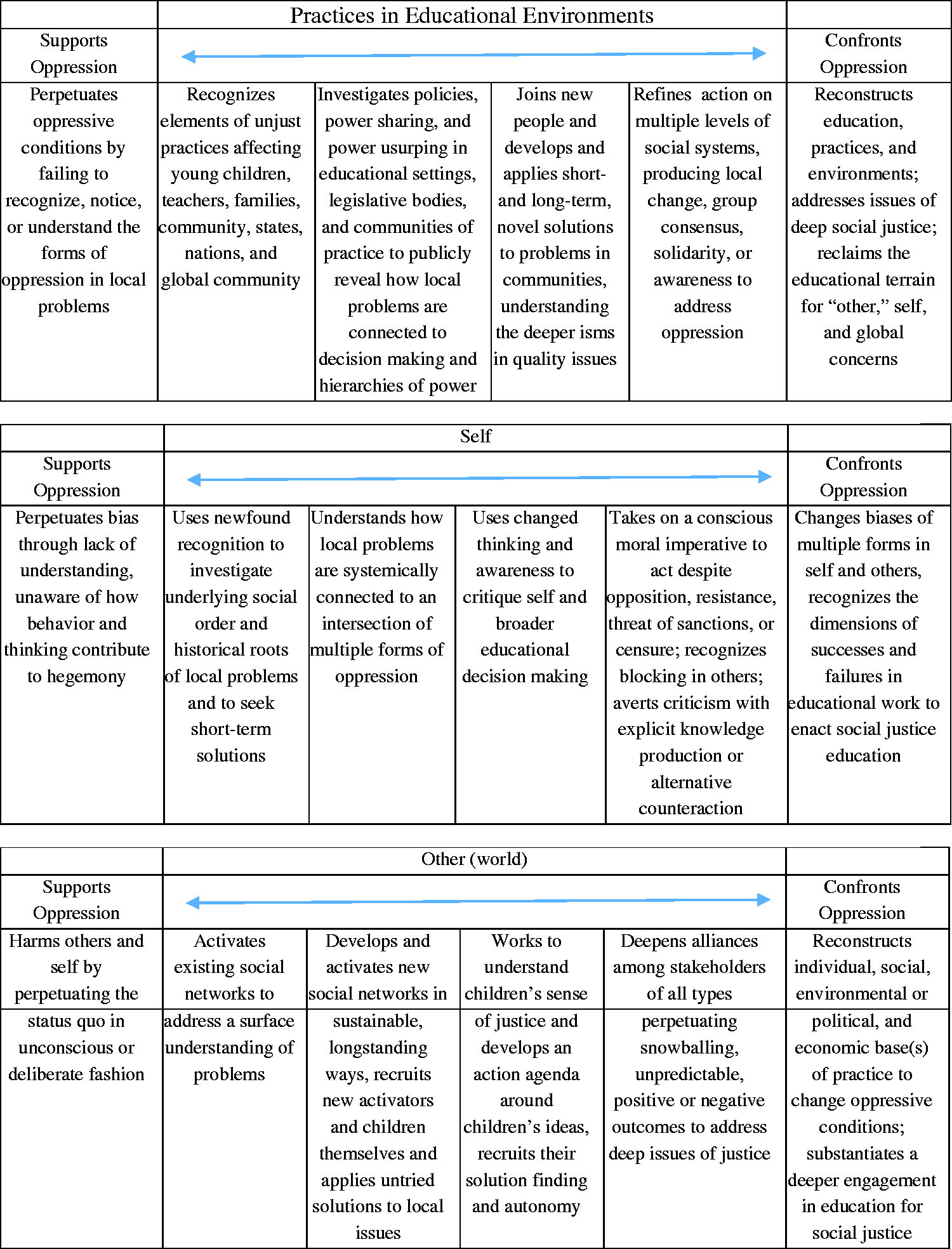
Gradients of social action for justice in ECE practices and environments.
Contextualizing our early childhood teacher education program
Our early childhood education (ECE) program is situated in a teaching and research public university with 34,000 university students at the main campus; the geographical setting is suburban, located near two urban areas and surrounded by small towns and rural communities in the Midwest, USA. The ECE teacher education program is nationally recognized, most recently in 2015 by the National Association for the Education of Young Children (NAEYC) and the Council for the Accreditation of Educator Preparation (CAEP). Faculty beliefs derive from and are enacted in an inquiry-based constructivist approach to teaching and learning that merges theory and practice to help preservice teachers become effective critical educators and teacher leaders.
Theory to practice: Coursework and fieldwork interplay
Coursework includes a foundation in children, families, communities, curriculum, content, and methods; furthermore, field and student teaching experiences for the ECE students occur both in preschool and primary grades for five different placements and approximately 1400 hours. The coursework and classroom fieldwork are intertwined over five semesters to support the transition from theory to practice; that is, all classes each semester entail field assignments to seal the university classroom learning. This includes weekly reflection and processing of field experiences. Given the geographical location, a wide variety of schools allow for diverse pedagogical, sociocultural, and socioeconomic experiences that are discussed in the university classroom (Vartuili et al., 2016). With an emphasis on social justice and international mindedness, the ECE program’s conceptual model (see http://www.kent.edu/ehhs/tlcs/eced/philosophy-early-childhood-education) positions novice teachers as critical educators/teacher leaders, who are committed professionals, curriculum experts, democratically accountable leaders, culturally relevant pedagogical experts, reflective thinkers, and co-decision makers. The critical educators/teacher leaders emerge during and as an end result of the program with the expectation that they will possess well-grounded views of these six roles to facilitate engagement in the construction, deconstruction, and reconstruction of developmentally meaningful and culturally relevant educational practices for all children and their own teaching identities. The conceptual framework encompasses the specialized domains for national and state accreditations as indicated by the NAEYC and CAEP and the teacher performance domains of the Ohio Department of Education, USA, respectively. As of 2014, early childhood preservice teachers earn the International Baccalaureate Certificate for Teaching and Learning; the university has been recognized by the International Baccalaureate Organization (IBO), and the conceptual framework of the ECE program reflects IBO values.
Intentional practice supports preservice teachers taking action
Given the conceptual framework of the program and the intensity of the fieldwork in our program, we must point out that deliberative classroom experiences and assignments, not simply the number of hours, prepare our preservice teachers for a wide array of schools, beliefs, and approaches (Dewey, 1938; Vartuili et al., 2016). Experiential teaching experiences take various forms; thus, delineating how we position our students is important. Preservice teachers in our program engage in field-based teaching experiences over five semesters in preschools and primary schools. The service of supporting schools allows preservice teachers to find personal motivation in local contexts and to see situated problems that impact young children. In addition, field experiences allow preservice teachers to see themselves as parts of communities, perfecting their longer-term affiliations with the profession of teaching. We ask them to connect their motivations to their long-term professional identities as advocates in the teaching profession. According to a critical reading of advocacy, however, students must look at power and multiple sources of oppression in the field. Preservice teachers sometimes discover that local challenges faced by children or schools are met with complacency. Thus, in the social action process, we ask them to become part of local social networks and attempt to activate those networks in new and different ways to address a problem toward which local communities have reacted with complacency or found no good solution. Preservice teachers are assigned to five field placements, where they can compare and contrast and borrow and share ideas, as well as gain a new awareness of neoliberal influences.
In differentiating our social action work from service learning, looking to the literature is fruitful in determining what service learning entails. Boyle-Baise (2003) compared a typical definition of service learning with her modified version—one that includes multicultural facets. The goals of the latter type of service learning, actually closer to our view of social action than the traditional view of service learning, are still markedly different from those we have for our students. Boyle-Baise stated that the following description of service learning by Bringle and Hatcher (1996) is typical. Service learning is a credit-bearing educational experience in which students participate in an organized service activity that meets identified community needs and reflect on the service activity in such a way as to gain further understanding of course content, a broader appreciation of the discipline, and an enhanced sense of civic responsibility (p. 222). Service learning is a credit bearing educational experience. Teacher educators and community representatives collaborate to organize service and learning activities that respond to local needs and help future teachers learn about culturally diverse or low-income communities. An “assets” model ensures a focus on community capacities and resources. Reflection on the experience includes community representative, highlights local concerns, and considers issues of equality and equity. Pre-service teachers should gain further understanding of course content, a broader grasp of the social and economic contexts for community concerns, and an enhanced sense of teaching as service to a culturally diverse public and as advocacy for educational quality, equality, and excellence (p.10).
Second, proponents of service learning have claimed that it is a form of advocacy, and we support this claim. Yet we find that unless preservice teachers see themselves as working with versus doing for, they will not recognize their own vital place as critical educators/teacher leaders. When problems and solutions are oversimplified and a conscious challenge to engrained and biased practices in the everyday worlds of early childhood is absent, preservice teachers may accept the status quo that may be on display in their placements. We strive to enhance their sense of moral obligation to recognize and interrupt forms of hegemony that are subtle, stealthy, and shifting as they encounter issues of quality and access and other typical problems in ECE.
Kroeger’s (2006a, 2006b) ongoing work with agency and activism suggests that turning to ideas about how social networks operate is helpful. For example, social theorists have argued that identity is embedded in the roles one holds as a member of groups, in affiliations, and in social aggregates; therefore, any attempt at action on the part of members of classrooms would hinge on individuals’ motivations because they are connected to the goals of others also within similar or different cultural understandings (Holland et al., 1998; Lash and McMullen, 2008). Commonly, preservice teachers learn that entire hosts of individuals can help them address a problem for which they have not yet arrived at a good solution if they are able and willing to do the footwork of inquiry, discussion and investigation, planning, and responsive action (Kroeger, 2009; Kroeger and Lash, 2011).
Critical theory
As one might predict from the program description, many of our assignments align with a focus on critical theory with examination into power as it manifests itself in particular knowledge domains and cultural practices. Critical theorists furthermore hold that power does not operate on conscious or deliberate levels, but tends to be tacitly reinscribed in different systems of interpretation—especially those represented in modern curricula (Freire, 1970; Leistyna, 2005; Shor, 1987). Critical theorists posit that education is never neutral. Instead of thinking of our students as passive recipients of the presented curriculum, state mandates, and standards, we guide our students with critical thinking, active questioning, and local participation. Critical work helps us to teach our students to develop a broader framework for problems encountered in schools by asking preservice teachers to attempt to situate a problem historically. Moreover, we ask them to: (a) consider a problem within the larger political or economic system that reveals racism, classism, heterosexism, discrimination, violence, and disempowerment in social systems; (b) question actions that support oppression; and (c) move toward actions that confront oppression (Adams et al., 1997; McDermott, 2017). Instead of perpetuating the assumption that inequitable relationships are inevitable in education, critical pedagogy compels us as faculty members to engage with preservice teachers as well as novice teachers and their classrooms of students to: (a) explore the relationship between larger historical, economic, and social constructs and local conditions (Banks, 2005; Hollins, 1996a); and (b) interrogate the neoliberalism contexts of the various early childhood field placements.
By using a critical theoretical framework to support knowledge and preservice teacher understanding, we also simultaneously help preservice teachers to challenge and supplement state teaching standards and mainstream early childhood practices with other just actions. Articulated in our critical framework, this philosophical orientation is also in play throughout the curriculum in our program. It is particularly realized through SAP work, which, when conducted in a field placement, compels preservice teachers to act on a continuum of confronting oppression by: (a) recognizing oppression; (b) educating others; (c) supporting those who speak out against oppression; and (d) working to include targeted groups finally to initiate and prevent oppression (Adams et al., 1997; Griffin and Harro, 1982; McDermott, 2017).
Preservice teachers are required to grapple with queries common to critical theory and power in schools. As teachers, we ask them the following: whose knowledge and interest is best served (e.g., by this condition, social challenge)? How is moral obligation reconceptualized by examining it with power (if we choose to act upon social problems in schools and society)? As professors, we ask ourselves: how do we teach in a way that alerts learners to the neoliberal structures that limit and enable their participation in society? How do we teach in a way that informs learners that justice should be understood as fairness (Rawls, 1971)? Will awareness of these structures empower learners to participate in transformation of oppressive conditions (Hyland, 2010; Lash and McMullen, 2008)? Does awareness move students to reject the status quo and become action oriented (Castner, 2015; McDermott, 2017)?
Philosophical perspective: international mindedness
Early in 2012, the faculty initiated a shift in the program to incorporate the International Baccalaureate Primary Years Program (IBPYP) into our conceptual framework. The IBPYP is an internationally recognized curriculum framework, developed with global society in mind. This philosophy allowed the faculty to move beyond state standards into more globally recognized objectives and concepts in teaching and learning and the young child. The mission statement follows: The International Baccalaureate aims to develop inquiring, knowledgeable and caring young people who help to create a better and more peaceful world through intercultural understanding and respect. To this end the organization works with schools, governments and international organizations to develop challenging programmes of international education and rigorous assessment. These programmes encourage students across the world to become active, compassionate and lifelong learners who understand that other people, with their differences can also be right. (IB, n.d.)
The IB concept of international mindedness—an openness to and curiosity about the world and people of other cultures and a striving toward a profound level of understanding of the complexity and diversity of human interaction—manifests itself through the IB Learner Profile attributes: inquirers, knowledgeable, thinkers, communicators, principled, open-minded, caring, risk-takers (courageous), balanced (spiritual), and reflective. These concepts and attributes mirrored and enhanced faculty approaches to teaching and learning for our preservice teachers and for the children in early childhood programs; the holistic nature of learning in our program and the six transdisciplinary themes in the IBPYP were clearly aligned: who we are, how we express ourselves, how we organize ourselves, where we are in place and time, how the world works, and sharing the planet.
Although the various dimensions of the SAP were fortified by making connections to international mindedness, further connections were realized through action as service and the action cycle of choose, act, and reflect, beliefs underlying the IBPYP (IB, 2007). In action as service, the action (for children and teachers) can involve service in the widest sense of the word: service to fellow students and to the larger community, both in and outside the school with the expectation that through service students grow both personally and socially, developing skills such as cooperation, problem solving, conflict resolution, and creative and critical thinking. Through learning as evidenced by action, the most significance efficacy of the program occurs. Beliefs shared by those in IBPYPs extend to the responsibility of the student to choose actions carefully, facilitate action responsibly, and reflect on their action as part of active, participatory learning. In an IBPYP, effective action does not need to be grandiose; on the contrary, it should emanate from a genuine concern and usually begins at the immediate basic level—self, family, classroom, hallways, and playgrounds—and can grow from there. Teachers, who are encouraged to tap into and recognize that even very young children can have strong feelings about fairness and justice (Hyland, 2010; Wardle, 2013), can assist them with effective action to demonstrate responsibility and respect for self, others, and the environment (IB, 2007).
Social action: process, projects, and reflections of practice
SAPs, as we teach them, allow preservice students to live out new awareness, community partnerships, and action through personal action. We work with preservice teachers, encouraging them to think of themselves as agents of change in a field awash with injustices for young children and their families (Hyland, 2010; Wardle, 2013). Frequently, students act as small players in large systems, but by locating an issue, analytically exploring the social networks of power, and implementing goal-oriented strategies of working in and against local problems, preservice teachers learn to understand how one person or a small group of people can bring about local change and why: using their power and voice and taking a stand are integral to healthy school lives for young children and as important to their growing sense of efficacy as early childhood educators.
Our preservice teachers are asked: (a) to identify a challenge in a school (or elsewhere), which will interest children; and (b) to create a history of the problem (as they or their community know it), building upon known information (e.g., discussions, interviews with school people, observations of how the problem affects children or families directly). The preservice teacher may also notice the needs of larger organizations that serve young children and follow a similar set of actions. To build authenticity, the preservice teacher then develops a proposal of social action focusing on these needs. Because preservice teachers are in field sites in local communities (rural, urban, suburban), their encounters with the challenges of poverty are numerous; so the connections between classism and poverty, for example, are easy to identify. After vetting their proposal work with professors and local teachers or principals, the preservice teachers define broad and specific goals for their projects (whether simple or grand). They are asked to consider the spheres of influence and risks they might undertake to act upon the local problem, all the while considering social, academic, economic, or political improvements that could be made for young children, teachers, and families.
Preservice teachers are encouraged to work in small groups, and the foci of SAPs are often co-initiated, sometimes by the key stakeholders in preschools or elementary schools (center directors, teachers, parents, community members). As preservice teachers work, they are encouraged to build a realistic timeframe for achieving their goals. Because of the length of time preservice teachers are in schools during this experience, they sometimes scale back their initial goals to assume that the anticipated realistic impact they might have upon settings, people, and problems is realistic. We emphasize process over outcome with students in order to keep them engaged in action over anticipated results.
One crucial element we encourage them to consider is the social networks in which they will need to embed themselves, and this act alone tends to enhance their purview of power. While building social networks to address local or global issues, preservice teachers also encounter institutional settings with concomitant forces that affect their choices of action. Commonly, when preservice teachers embed themselves in local situations, they notice not only how many people in social networks have vested interest in a problem, but also how much effort goes into marshalling like-minded people to create resources and responsive action in existing networks.
Finally, upon completion, preservice teachers report the resulting local changes in class seminars or expand upon any further plans that might evolve for their project. At times, preservice teachers in one semester build upon the work that previous preservice colleagues initiated. Preservice teachers reflect upon the process in class, sharing artifacts and describing the unexpected snowballing effects and any direct or indirect benefits to their classrooms or schools; and consider new issues that have arisen, positive effects as well as unintended negative effects. Often their dreams of the work do not match the outcomes, but they learn about action.
When preservice teachers share their work, they are asked to consider what they learned about working in larger institutions (like schools) to promote social justice, what they learned about their own power, and finally what lasting local changes resulted from their work. Over time, we have seen the practice of social action frameworks supporting preservice teacher education. In the next section, we feature some projects as well as some of the findings we have gleaned by studying preservice teachers’ work. First, we share some overarching results of reflection on preservice teacher’s work over time, calling attention to some of the persistent elements of SAPs that trouble us and explaining how projects have evolved with programmatic and then international changes.
Preservice teachers’ SAPs in practice
The initial goals of the faculty were to help preservice teachers understand the underlying racial, class-based, and oppressive elements in community concerns (Adams et al., 1997). We hoped to see preservice teachers enact advocacy and action for justice as an aggressive way of discerning the political and social ends to educational practices. We have found that preservice teachers gain an enhanced sense of moral obligation to recognize and interrupt forms of hegemony that are subtle and often buried in the teaching and learning context.
Although SAPs are designed to help preservice teachers realize social power, we also find that they come to understand and grasp how status variables are recapitulated within practice, or how classism, racism, and other forms of oppression can be at the root of (or subtly hidden within) social problems. As they work, preservice teachers begin to create and reinstate forms of power that are more relevant, authentic, and socially complex than those that previously existed and shape new action. At times, preservice teachers recruiting new kinds of social actors into the social sphere (e.g., music influences—elders from the Afro-centric school) while changing their own minds about what is important. They sometimes realized that they had been looking at difference through lenses of privilege or judgment. Sometimes students better discerned how their roles as teachers might reproduce society in oppressive ways; whereas, before doing the SAP, they paid no attention to this issue. They also become conscious of biased practices and framed responsibility more fully. Preservice teachers saw themselves as working with communities versus “doing for.” SAPs lend themselves well to current issues, to unaddressed feelings (especially frustration at something that seems unfair), and ultimately to connectedness among students, programs, schools, and communities. Awareness of students in determining the project is vital, but they do not speak for the communities in delineating ensuing action.
In 2006, our course and field organization underwent a strategic shift and faculty members solicited field sites that helped us to emphasize more heavily the changing demographic diversity of our region (refugee, linguistic experience, religious practice). As our program has evolved with changing needs for coursework in primary grades and as the philosophy of international mindedness (2011) has taken hold in our program, the SAPs have also evolved in particular ways in ever-increasing diverse field placements. Frames of social justice remain central in students’ work, but locations and topics have shifted.
Reflections of practice
The SAPs showed a wide range of understandings, approaches, and actions. Upon reflection, we saw this was partially indicative of the variable quality in early childhood programs and public school settings in the USA, as well as the range of preservice teachers, each of whom brought unique understandings and beliefs to the field of education, and resonance or dissonance with the critical stance inherent in the SAPs.
Originally, we intended that students focus on race, class, and gender (isms) in SAPs, but variability in the level of placement sites and understanding of what social action entailed among preservice teachers encouraged, or sometimes necessitated, addressing the gross inequities in early childhood programs that have affected opportunities for learning (Fuller et al., 2013; Lash and McMullen, 2008). Thus, in our analysis of the project we noted that basic quality and care issues (see Table 1) were usually addressed instead of our desired focus on -isms. For example, one program located in a middle-class church involved paint materials, which were available only for use when under the direct supervision of a teacher. Other programs simply did not supply manipulatives, paint, and other hands-on learning experience (for various reasons).
Although our desire as professors was to interrogate the pervasive power influences in their assigned placements, we quickly realized that at some sites, availability of materials, accessible play areas, and responsive daily practices were problematic—because this is what preservice teachers brought to the project. In these cases, basic improved approaches to caring and educating children needed immediate attention. Different from our original intention, this focal work empowered preservice teachers to voice their concerns and take action toward reaching at least minimum standards in childcare services. Optimum learning for young children often intersects with social class variables, and quality of settings and depth of understandings were changed by students’ SAP work; thus, we were heartened. In class discussions, preservice teachers learned to understand oppression differently; issues of access to materials never occurred in our lab school, or local higher income elementary schools for example, but always at Head Start and in other types of care settings or elementary schools with mostly poor and lower-income children. Even if preservice teachers were able to make change on basic quality issues, those issues were still linked to oppression in a larger way, largely framed by the thinking of others in the setting. This range of projects (often involving quality) was informative to all in our cohorts and provided insights into the wide employment settings they may expect to experience as in-service teachers; in addition, persistence with projects and self-examination were worthwhile endeavors.
Social action projects in preschool educational settings (Lash's Projects).
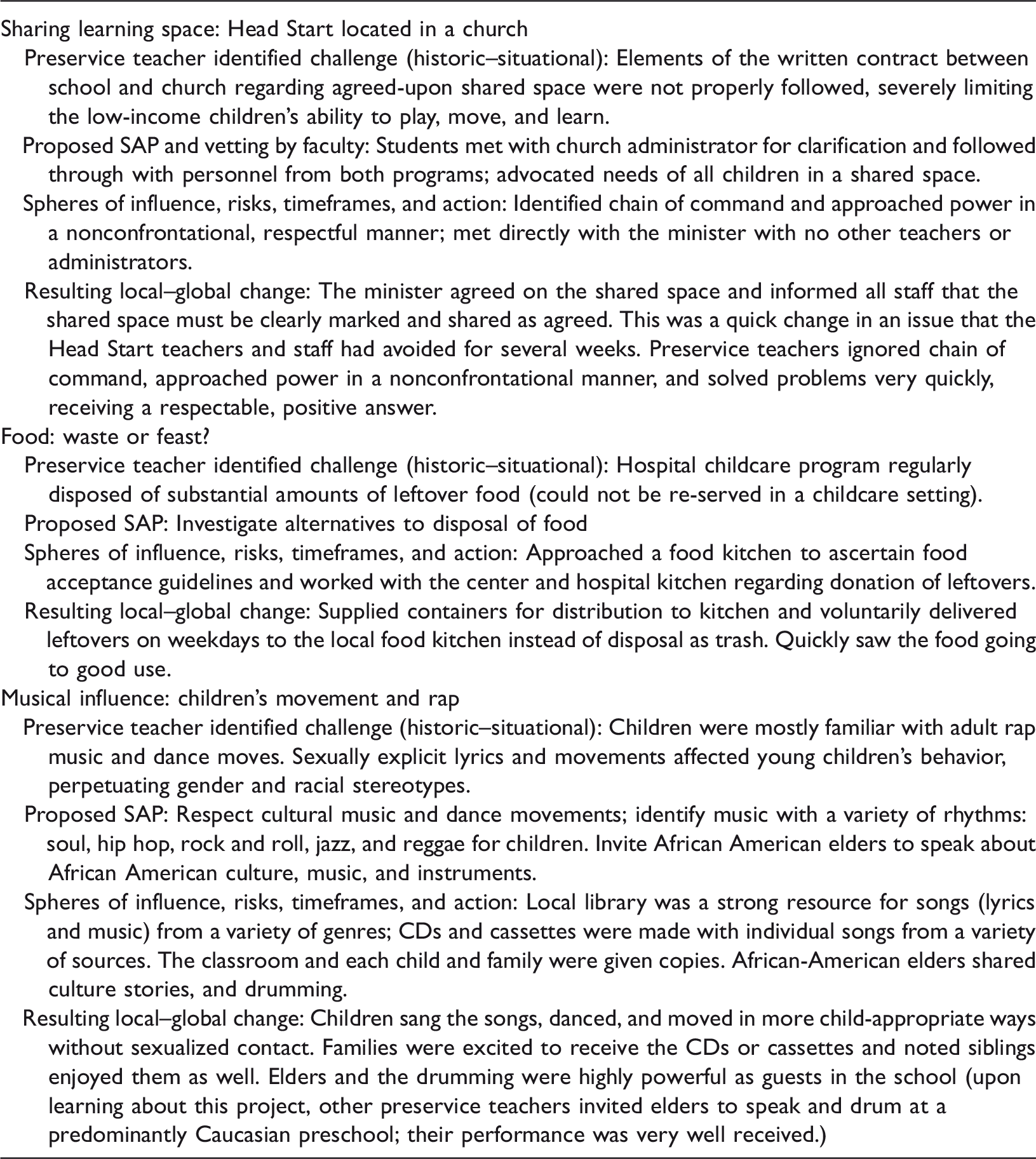
SAP: social action project.
Social action projects in primary grades (Kroeger's Projects).
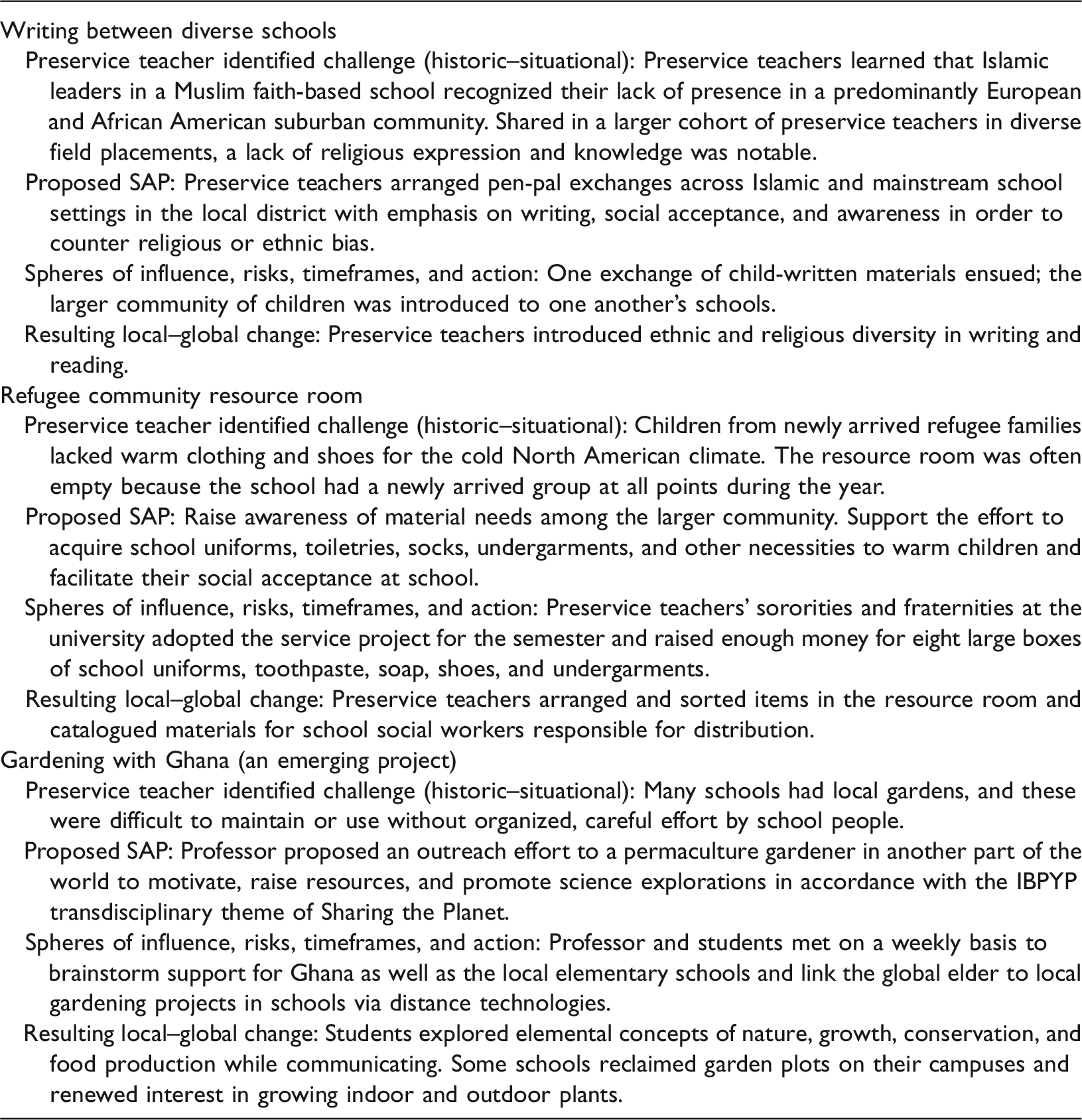
SAP: social action project; IBPYP: International Baccalaureate Primary Years Program.
Other SAPs from our courses over many years concerned us because of deeper ethical implications. For example, one SAP involved working with the family of a child who is deaf and investigating the potential of cochlear implants. Because the preservice teacher did not have extensive knowledge of the debates in the field of disability studies, we informed the preservice teacher that deafness has its own culture that needs to be respected. Altering the child’s body to become more hearing may be hegemonic instead of liberatory (depending upon perspective). One group of preservice teachers decided to participate in a “Walk for Prematurity,” and although held by a reputable children’s hospital, the students neglected to identify how much of the money raised went to premature babies versus simply to the hospital overall (or conversely, why sufficient funding to support infants in relation to other populations was not readily available). In another instance, despite our instruction and readings, preservice teachers misunderstood social action as shown in comments such as “I need a fundraising project for my Head Start site,” or envisioned their role as simply to marshal economic resources for the poor, which meant more one-to-one discussion and processing. Again, these are examples that appear to be grounded in social action, but, in reality, are ideas that lack the rigor of the moral and ethical partnerships we were striving for in regard to justice. Our self-assessment was confirmed by the document “Making the PYP happen” (IB, 2007), in which the action of fundraising, either modeled by adults or initiated by students, is recognized as common in schools but frequently lacks the personal commitment and reflection of participatory action. We became sensitive to levels of understanding among our preservice teachers, when a lack of sophistication could result in missteps that could do more harm than good.
In many instances, students reached a level at which their actions were productive and conducive to social change, outweighing our dissatisfaction. Of particular interest was how the naivety of students provided inroads and change when, as faculty members, we would have tried to control the situation. For example, with regard to the contract between the Head Start program and the church, we would have counseled the preservice teachers to choose something else because of a concern that the SAP could bring unwanted consequences for Head Start; however, the preservice students’ request to talk with the pastor resulted in an immediate invitation into her office, and a conversation about shared space ensued before the preservice teachers could communicate with the professor. Fortunately, a very prompt, positive outcome resulted with the pastor immediately acknowledging that the contract needed to be revisited and followed; the desired changes were in place prior to the next university class session, resulting in opportunities for young children. Similar results occurred with empowered preservice teachers in efforts regarding, for example, leftover food, kindergarten transportation, shared playground space, a newly organized tutoring room, an indoor climber, the beginnings of a long-term butterfly garden in one school, a new school marquee, and the renewal of community gardens. In fact, no situations have occurred in which preservice teachers or faculty members were called to untangle some of the SAP endeavors.
Once we acknowledged that the preservice teachers and children’s agendas take precedence over the idealism of this project, we have been impressed with outcomes—predictable and insightful in nature. First, equity in early childhood programs sometimes entails addressing quality in any program—regardless of race, income, or gender. Combined with youthful energy, naivety, which provided a sincere approach inadvertently used by our preservice teachers, is an effective strategy for real change.
We found that snowballing effects between classmates and between cohort semesters sometimes means that SAPs that begin small can grow into sustainable changes or larger projects in which the early childhood program was instrumental. We were pleased when preservice teachers questioned childcare licensing rules that they previously saw as rigid, and even more pleased when their projects showed these rules were sometimes open to interpretation. SAPs are very responsive to current issues and feelings, and provide connectedness to students, schools, and community.
Faced with an SAP assignment and due date, preservice teachers view their responsibilities through lenses different from those of in-service teachers. Preservice teachers may experience feelings of discouragement (and lack of companionship while confronting a social problem). They may be more willing to face resistance (and deconstruct it within power dynamics) because they need to do the assignment or make some attempt at change, and because they are not permanent members of communities and hence less worried about disrupting the status quo. Overall, we were energized and refreshed by the creative, persistent, kind, and constructive forays our preservice teachers made into social action on local and global fronts. These reflections have shown us—as faculty members—growth in our preservice teachers and in ourselves (Brookfield, 1995, 2011; Caligiuri, 2012; Chen et al., 2009; Cochran-Smith and Villegas, 2015; Holly, 1998; Rueda and Stillman, 2012; Vartuili et al., 2016).
Ongoing efforts to define and support social action for justice in early childhood teacher education
Before presenting the conclusion of this paper, we submit “Gradients of social action for justice in ECE practices and environments” (see Figure 1, loosely based on Adams et al., 1997), developed as a reflection of our work on the topic of social action in ECE (Kroeger and Lash, 2005). In the gradients we considered the environment, the self, and the social worldly aspects of the realization of social action in preservice teachers’ practice. We acknowledged the gains and progress that can occur by working with preservice teachers on equity issues, but the gradient reflects positions of lesser attempts as well as full-out “activist” strategies for social change.
Preservice teachers may be at any stage of each of the gradients simultaneously, depending upon their own understandings of how to recognize an unanswered challenge, as well as how that challenge is matched with possible action, internal understanding, and finally solutions to address social problems. For example, preservice teachers could recognize that free lunches are available for poor children through national and state policies. They might also inform others (in power) how providing these lunches in their public schools’ first or second grade would replace poor children’s hunger with ample nutrition to learn. Then, upon learning that the principal of the school or district was not interested in applying for those benefits (perhaps because the school then declares a higher percentage of free and reduced lunch recipients, affecting its public reputation), preservice teachers become aware of the larger power of marginalizing society—and the realization that systemic class oppression is operating.
This identification of the problem, as well as the power hierarchy in which it exists, puts the student in mid-range awareness of power sharing and recognition of how hierarchies of power operate. Simultaneously, preservice teachers (without a particular strategy to impact this problem in the school) continue to observe young students without lunch and with ongoing lunch fees owed to the school. The preservice teachers solicit food donations so as to have something for poor children to eat, but this is only a very partial and temporary solution. The students then realize how unfriendly the school might be to this group of children who are affected and why their relationship to school and school people is troubled within the larger community. The students connect their own larger role in the profession to dismantle class-based inequities (like access to lunch) while also thinking about the social dynamics of poverty in schooling. Preservice teachers may become aware of unjust practices in educational environments and the power of those in charge, but acting upon these problems may be impossible until they are hired to work in a school, where they find companionship in like-minded professionals willing to act with them against the oppression and those who continue to reinforce it.
Our assignments continue to be based on real classroom settings and experiences; that is, classrooms serve as “learning labs.” If we expect preservice teachers to become in-service teachers who take action on behalf of young children, families, teachers, communities, and global issues and who teach the children in their classrooms to take meaningful social action, we must give preservice teachers learning experiences that support these approaches. Action brings cognitive structures into being and creates cellular memories (Zull, 2002). Teachers grow in their fieldwork (Holly, 1998; Vartuili et al., 2016), particularly as enacted in assignments that are evocative and followed up with critical reflection through writing and discussion (Kroeger and Lash, 2011). What cellular memories do we want our preservice teachers to retrieve? In some cases, we are confident the preservice teachers are growing as action-oriented individuals; in other cases, we know only the seeds of the ideas for action have been planted and may germinate in future courses, fieldwork, or personal motivation. We must be satisfied that they have a reference point.
Conclusion
In this paper we examined the theory and practice underlying undergraduate course and fieldwork, as well as assignments and intellectual struggles inherent in developing the critical mind of the novice teacher. We candidly shared our successes, challenges, and ongoing efforts: (a) to reflect in practices while formulating a critical conceptual framework to talk back to and against state standards and mainstream practices of early childhood; and (b) to address the inequities in early childhood classrooms in diverse realms of materials, environments, gender, race, and class. Our efforts forced change in our own undergraduate teaching and our conceptualization of an early childhood teacher education program in totality. We surmised that the SAP met the goodness of fit with our evolved conceptual framework as an institution with a political instead of assimilation framework (based only upon state and national standards). We appreciated how the SAPs provide inroads for our preservice teachers to understand current issues; express varied emotions on behalf of others; and increase their connectedness to their students, programs, schools, communities, and, in some instances, the larger world while understanding political and social inequities.
Footnotes
Declaration of conflicting interests
The author(s) declared no potential conflicts of interest with respect to the research, authorship, and/or publication of this article.
Funding
The author(s) received no financial support for the research, authorship, and/or publication of this article.