




Abstract
In this paper, we investigate mentor perspectives of their roles as de facto “teacher educators.” Drawing upon three years of qualitative data, we argue that community voices and knowledge should be reflected in decisions regarding what and how children are taught. We assert that, by broadening the definition of “teacher educator” beyond university faculty to include community members, we create spaces through which the development of culturally responsive teaching can more authentically emerge. The larger study from which this paper is derived examines the innovative practices of a teacher preparation program at a Midwestern university in the United States of America, wherein majority White, female, middle-class candidates are paired with mentor families in a low-income African-American neighborhood. This program of cultural immersion builds relational ties between community members, and mentors facilitate candidates’ movement beyond deficit perspectives of communities of color and simplistic notions of celebration to see cultural affirmation and contextual knowledge of children’s lived experiences as critical to student success. In the present study, we challenge neoliberal “commonsense” in the preparation of teachers by privileging community voices and highlighting how mentors perceive their respective roles as teacher educators.
Despite a robust body of research to demonstrate the ways in which larger social contexts shape educational opportunities and outcomes, neoliberal reform efforts in recent years have been “deliberately context-blind” (Sleeter, 2012: 565), ignoring the complex interplay of cultural, racial, and socioeconomic factors related to student achievement (Howard, 2014; Milner, 2013; Orfield and Lee, 2005). Neoliberal educational policies attempt instead to apply “business logics” to education, prioritizing standardizations, individual choice, efficiency, and market principles (Apple, 2001; Cochran-Smith and Villegas, 2015; Dimitriadis, 2012; Hurst, 2015; Lipman, 2011), and belie deep suspicion of democracy and public goods (Saltman, 2007). Neoliberal reforms are now seen as “commonsense” (Cochran-Smith et al., 2015), influencing current conversations regarding the purpose of education and education reform, and disregarding what Apple (2012: xi) calls “one of the most significant questions that should be asked in our schools: What and whose knowledge should we teach?” Further troubling, neoliberal “commonsense” also influences education research, as studies more closely aligned to the agenda receive more funding, greater prioritization, and wider distribution (Cochran-Smith et al., 2015; Zeichner and Sandoval, 2015).
Neoliberal influence in education focuses attention on meeting the needs of the economy, instead of the needs of communities and the larger social good (Lipman, 2011). With deliberate inattention to the ecological systems in which students’ lives are situated (Bronfenbrenner, 2006), structures informed by this ideology continue to perpetuate an achievement divide among Black, Brown, and poor children, and their more privileged peers (Hemphill and Vanneman, 2010; NAEP, 2015; Reardon, 2011; Vanneman et al., 2009). Indeed, in the current terrain, it is “residents in the poorest communities of color who depend on public education to build the academic capacity and market competitiveness of their children,” children who have been “rendered even more marginal than in the recent past” by neoliberal disinvestment in public systems (Fabricant and Fine, 2013: 23–24). It is unsurprising then, as Sleeter (2012: 563) notes, that “research on the impact of culturally responsive pedagogy is thin,” despite its promise. To challenge both this dearth of research and the larger reform agenda, Sleeter calls for more research that confronts neoliberal constructions of culturally responsive teaching as insignificant to academic achievement and as threatening to the traditional canon.
In this piece, we take up this call and present findings from the field which demonstrate the powerful impact of culturally responsive teacher development—research that is often marginalized by the neoliberal commonsense informing teacher preparation and reform. Informed by uncritical deficit perspectives of low-income students and students of color, neoliberalism in education advances a vision of what is best for “other people’s children” (Delpit, 2006). Our “context-specific” work seeks to challenge this perspective by privileging the traditionally marginalized voices of families and communities in the education of their children, thereby elevating “community cultural wealth” (Yosso, 2005) and “funds of knowledge” (Moll et al., 1992) which inform children’s experience. We argue that this orientation toward educator preparation has the potential to develop community-engaged, culturally responsive teachers who are prepared to both reach and teach children, and to move the needle in the direction of equity in education (Zygmunt and Clark, 2016).
Our research focuses on a unique approach to teacher education that embodies Murrell’s (2001) community teacher framework and Noddings’ (1999) ethic of care in the development of community-engaged, culturally responsive teachers. The larger study, from which this paper is derived (Zygmunt and Clark, 2016; Zygmunt et al., 2018), examines the innovative practices of a program of teacher preparation at a mid-sized Midwestern university, wherein the pairing of majority White, female, middle-class candidates with mentor families in a low-income African-American neighborhood situates teacher learning in all-important historical and cultural contexts, which we argue are critical for teacher and learner success. This program of cultural immersion builds relational ties between community members and candidates through which authentic culturally responsive teaching can begin to emerge. This intentional program design pushes back against the neoliberal project of teacher preparation, reified by high profile alternative pathways such as Teach for America and legislation like the Every Student Succeeds Act (2015). Instead, harkening back to Apple’s (2012) question of “what and whose knowledge should be taught?” and Zeichner et al.’s (2016) challenge to define “whose voice counts?” this particular program of teacher preparation centers and elevates the voice of community members in the education of their children.
In this paper, we investigate mentor perspectives of their roles as de facto “teacher educators,” and argue that community voices and knowledge should be reflected in decisions regarding what and how children are taught. We further assert that by broadening the definition of “teacher educator” beyond university faculty to include community elders, members of the local community council, pastors, and families within the community, as well as school administrators and service providers who work in concert with faculty, we create spaces through which the development of culturally responsive teaching can more authentically emerge.
Literature review
The preparation of White teachers has been notably “colorblind” (Atwater, 2008; Bonilla-Silva, 2003; Delpit, 2006; Derman-Sparks, 1989; Paley, 2000; Schofield, 1986; Zygmunt and Clark, 2016). This stance, while potentially well-intended, belies research on the imperative of understanding children’s cultural backgrounds in order to connect content in meaningful ways to their lived experience (Hammond, 2014). To address the colorblind stance prevalent in teacher education, scholars have demonstrated the importance of congruency between children’s lived experience and the content and pedagogy in place in schools (Au and Jordan, 1981; Cazden and Leggett, 1981; Erickson and Mohatt, 1982; Vogt, Jordan and Tharp, 1987). Multiple variations of teaching that bridge children’s home and school lives have since been articulated: culturally appropriate (Au and Jordan, 1981), culturally congruent (Mohatt and Erickson, 1981), culturally compatible (Jordan, 1985; Paris et al., 1987), culturally relevant (Ladson-Billings, 1995), culturally responsive (Cazden and Leggett, 1981; Erickson and Mohatt, 1982; Gay, 2000; Villegas and Lucas, 2002), culturally sustaining (Paris, 2011), and, most recently, reality pedagogy (Emdin, 2016). While not identical, these approaches share in common a utilization of children’s backgrounds, knowledge, culture, and lived experiences to inform instruction. In this article, we define (and use) “culturally responsive” as practices which not only affirm, support, and respond to children’s lived experience in both content and pedagogy, but also require a great deal of “self” work on the part of teachers. Culturally responsive practice, as we define it, requires that educators “understand that when they engage the real-life experiences of their students, while simultaneously understanding and critically examining how their own experiences shape their understandings of students, the real work of social change and ending inequity happens” (Fasching-Varner and Seriki, 2012: 4).
Although the research on the impact of such practice is somewhat thin (Demmert and Towner, 2003; Goldernberg, 1987; Reese and Gallimore, 2000; Reese, Goldenberg, Loucky and Gallimore, 1995), research in cognitive sciences (Hammond, 2014; Sousa, 2011) has pointed to the effectiveness of the practices embedded in culturally responsive teaching, reinforcing it as a positive direction in the preparation of future teachers. There is also, to some extent, philosophical alignment in the field of teacher preparation regarding the imperative of developing culturally responsive teachers (CAEP, 2015; Council of Chief State School Officers, 2013; NAEYC, 1995; Richards, Brown and Ford, 2006), yet there has been less attention paid to the specifics of how to accomplish this task. Krasnoff (2016) effectively outlines distinct components of the culturally responsive classroom, aligning practice to the theoretical frames of Delpit (2006), Ladson-Billings (1995), and Sleeter (2008); however, this report falls short of explicating how teachers can come to learn what students’ real-life experiences are, if they are to “connect school learning to students’ lives” (6).
Villegas and Lucas (2002) suggest that meaningful and authentic engagement in communities is critical to understanding the cultures from which children come, enabling teachers to better connect children’s existing schema to new content (Hammond, 2014). This encourages the discovery of community “funds of knowledge” (Moll et al., 1992) and “cultural wealth” (Yosso, 2005), which can then decrease deficit orientations typical of individuals who have not had the privilege of uncovering the resolve and resilience of traditionally marginalized communities. Further, such an approach challenges individual assumptions that all communities that share particular racial, class, or cultural elements are all alike—in other words, emphasis on authentic community engagement recognizes what is unique about each and every context and that only through deep, sustained engagement in and with a particular community can one come to understand it.
While imperative to developing the skills and knowledge base necessary for culturally responsive teaching, community connection and relationship building can be difficult, particularly for cultural outsiders (Sleeter, 2001). A small but promising body of research that documents the benefit of resident mentors serving in the role of cultural ambassadors to pre-service teachers seeking authentic engagement is encouraging (Catapano and Huisman, 2010; Kretchmar and Zeichner, 2016; Lee et al., 2013; Lees, 2016; Zeichner et al., 2016; Zymunt and Clark, 2016; Zygmunt et al., 2018). Cultural ambassadors can engage candidates in a process of “facilitated acculturation” (Lee et al., 2014: 68) through which they induct them into the values of the community and enable opportunities for relationship building with other community members. The configuration of these mentorship models is varied, yet each model privileges community voices as neighborhood residents serve in the role of “cultural brokers” (Szasz, 1993), imparting cultural wisdom and expertise of the community authentically. Absent the cultural guidance of the ambassador, candidates are likely to misinterpret experience, applying their own “cultural map,” which, without facilitation, is likely to be inadequate to navigate low-income communities of color (Lee et al., 2014; Murrell, 2001).
Methods
This article originates from a much larger, ongoing, longitudinal study of a community-engaged teacher preparation program at a mid-sized university in the Midwestern United States.1 In this article we focus our attention on one component of the larger program—the relationship between community mentors and pre-service teacher candidates. We have found the mentor–candidate relationship to be a critical element in the preparation of teachers oriented toward cultural responsiveness and social justice. In this article, we focus on mentor perspectives and experiences as we theorize the impact of positioning community members as teacher educators. Specifically, we address the following research question: How do mentors perceive their role in the preparation of community-engaged, culturally responsive pre-service teachers?
Data collection
For this paper, we draw upon data collected over three 16-week semesters between 2013 and 2015, and include data from a focus group interview with community mentors (1), video interviews with mentors (9), informal conversations with mentors,2 participant observation, and transcriptions of mentor presentations to audiences of teacher educators seeking to emulate this community-engaged approach in their programs of preparation (2). The focus group interview lasted about 90 minutes in duration and was conducted by two members of the research team, following a semi-structured interview format (Bogdan and Biklen, 2007). Questions centered on the mentor experience—for example: Why did you volunteer to mentor? How do you see your role in the preparation of future teachers? How is this partnership with the university different from your prior experiences? Questions from panel presentations, which were formulated based upon findings from focus group interviews, ask mentors to expound upon their role as educators—for example: What are some things that pre-service teachers need to know that you feel that the university can’t teach? Talk about being a “teacher educator” and what you feel you have to offer.
At times, we include candidate voices from journal entries, personal conversations, and transcription of video interviews (5) to reinforce points raised by the mentors. Candidates journal weekly, for a total of 912 journal entries over the three-semester period (18–20 candidates per cohort [57 total], 16 journal entries per candidate, per semester). Throughout the three semesters of data collection, candidates also participated in video interviews relative to specific projects in which they engaged alongside community mentors. These additional data reinforce the perspectives shared by mentors, and provide additional support for the paradigm of authentic community engagement privileged in this study.
Participants
We include data from 12 mentor families (16 mentors total; 12 women and four men), many of whom have been serving in this role since the program’s inception in 2009. Mentors—the brainchild of a neighborhood matriarch committed to educational improvement in the community—have been recruited from the neighborhood and represent clergy, school board members, community activists, neighborhood elders, and families. All mentors are African-American, ranging in age from 40s–80s, and live in Whitely, the neighborhood in which the program takes place. Every semester, each mentor/family is assigned two candidates whom they commit to engaging in the life of their family and the neighborhood by inviting them to family gatherings, neighborhood meetings and events, and church. We intentionally ask that experiences reflect the day-to-day experience of life in the neighborhood. We additionally encourage candidates to invite mentors into their lives, past examples of which have included attending campus presentations, sporting events, and meeting candidates’ families. Furthermore, candidates and their mentors participate in community mobilization efforts alongside the neighborhood council, which strategically prioritizes initiatives to improve the quality of life in Whitely.
We also draw from three cohorts of pre-service teacher preparation candidates who participate in the preparation program (see description below). Each cohort comprised 18–20 teacher education students in the third year of their baccalaureate and licensure program, the overwhelming majority of whom are White, middle class, traditional aged students. The three cohorts contained in this paper include 55 females (49 White, 3 African-American, 2 biracial, and 1 Chinese-American) and two males, both of whom are White.
Our team of six researchers is comprised of five females and one male who serve as instructors in the program.3 Of the six researchers, five are European American and one is Kenyan. Awareness of our identities as primarily White, university faculty in a principally low-income, African-American neighborhood is of critical importance as we strive to equalize the power structures that typically exist among university/community collaborations. Although our work over the last eight years in this neighborhood has resulted in lasting friendship and trust, we are keenly aware of the power and privilege inherent to our collective identities, and use this lens as a constant filter through which to guide our participation, processes, and partnership.
Data analysis
All data were analyzed using a grounded theory approach (Charmaz, 2008; Glaser, 1978; Glaser and Strauss, 1967; Strauss and Corbin, 1998), with multiple sources used to triangulate findings (Merriam, 1998). According to Mills et al. (2006: 7), the grounded theory approach “keeps the researcher close to the participants through keeping their words intact in the process of analysis [in order to] maintain [their] presence throughout.” As such, grounded theory affords researchers more liberty in communicating “how participants construct their worlds” (7).
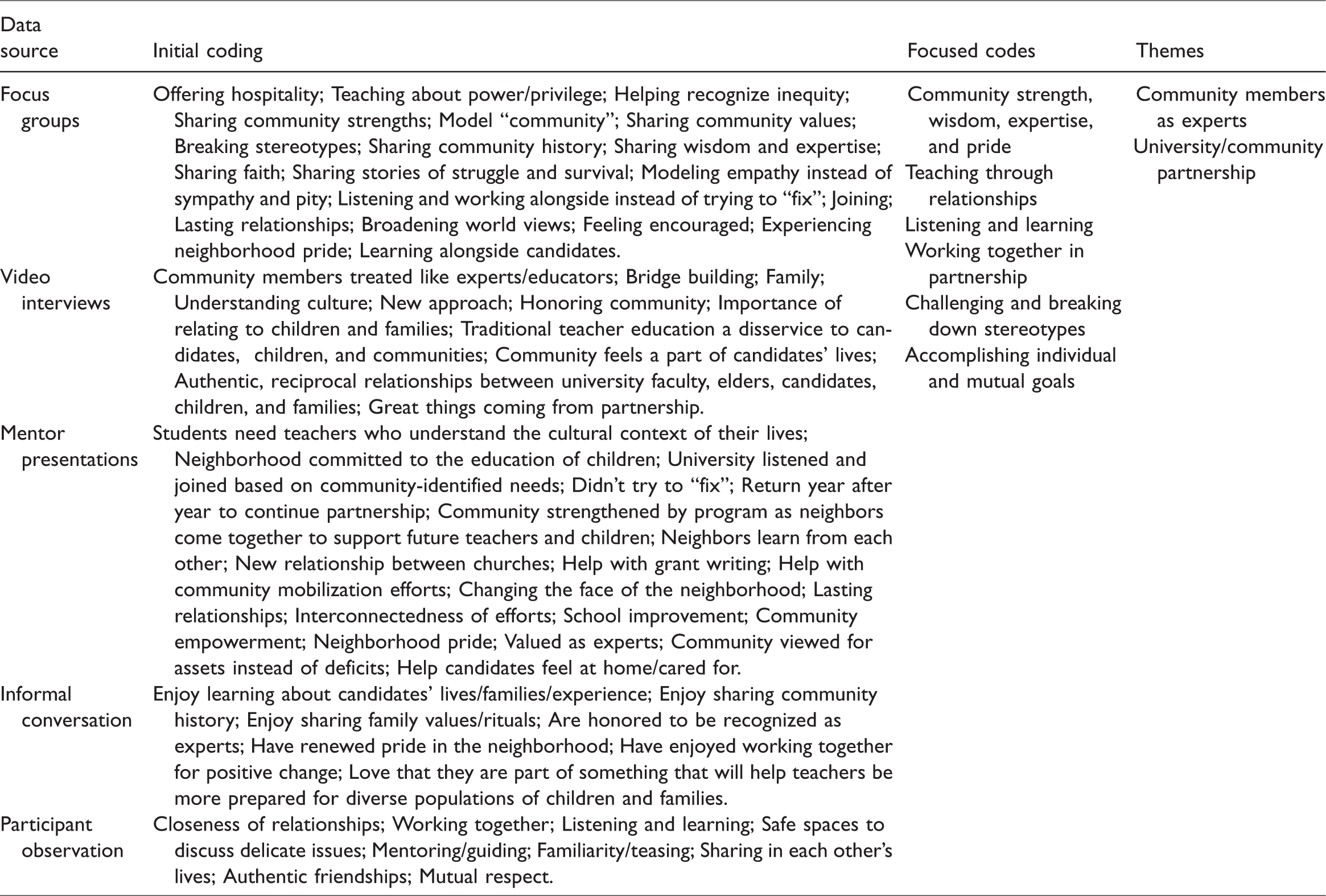
As data were generated and reviewed, researchers used a process of open coding to classify elements of mentor and candidate perspective, experience, and interaction.4 After this initial open coding, researchers re-reviewed the data, creating focused codes to categorically identify repeated and related phenomena. In an ongoing fashion (over the following two semesters of data collection), data were generated and openly coded, re-reviewed, and categorically clustered, with new categories emerging based on phenomena of emerging significance. When data collection was complete, a process of axial coding refined categories into themes, from which we developed a theory relative to how mentor–candidate interactions and experiences inform the development of culturally responsive teachers (see Table 1).
Data analysis.
With not for: program description5
Grounded in the research on culturally responsive teaching, the preparation program providing the context for this study was designed to develop teachers who are equipped with the will and skill to ensure educational equity for all of the children with whom they will work. The [Schools within the Context of Community] began in 2009 as part of a university initiative to increase undergraduate students’ connection to the local community, with priority placed on experiences that develop solutions to real-life, community issues in partnership with local expertise. Community expertise is privileged as a decisive element of candidate learning. Our largely White, female, middle-class candidates are removed from campus and immersed in a low-income, historically African-American community6 for an entire semester’s coursework, where they are paired with community mentors. Candidates take 18 credit hours of integrated teacher preparation courses with university faculty members, practice-teach 10 hours per week in the neighborhood schools, and participate in a range of community events. In addition, candidates participate in critical service learning (Mitchell, 2008; Rosenberger, 2000) alongside their mentors and members of the neighborhood community council. This model provides a vehicle through which the typical “outside-in” view of a community can be transformed, and provides a mechanism through which “legitimate peripheral participation” (Lave and Wenger, 1991) can be achieved.
This model provides a new approach to preparing early childhood and elementary school teachers—a community-engaged approach that introduces and engages future teachers in the complex interplay of factors that influence children’s learning. The term “community-engaged” underscores the joint nature of our collaborative effort with the [Whitely] neighborhood and is distinctly different from “community-based” models where candidates simply occupy a space away from campus. Differentiated from more traditional models of university service learning (Neururer and Rhoads, 1998) characterized by “doing for,” and which tend to favor those who serve over those being served (Sandy and Holland, 2006; Tryon and Stoecker, 2008; Vernon and Ward, 1999), candidates here participated with and alongside residents in programs and projects identified by members of the neighborhood as integral to community improvement. Critical service learning in this neighborhood highlights community strengths—mobilization and activism in particular—and provides an opportunity to position candidates as co-agents of social change. Reflection on this participation within the frames of race and privilege provides additional opportunities for significant and meaningful candidate learning, a point we will address at the conclusion of this manuscript.
Community members are teacher educators: privileging community wisdom and expertise
Critical to one’s development as a culturally responsive educator, Ladson-Billings (2008) argues that teachers must see students through a lens of possibility. This perspective results in a shift in their position from one of “sympathy (‘you poor dear’) to one of informed empathy. This informed empathy requires the teacher to feel with the students rather than feel for them. Feeling with the students builds a sense of solidarity between the teachers and the students” (Ladson-Billings, 2008: 165, emphasis added). As we describe above, community expertise is a decisive and crucial component of our program. We suggest that by broadening the definition of “teacher educator” beyond university faculty to include community members, our candidates are better able to make this shift and begin to feel with the community, and, in turn, with their students. Given the central role that mentors play in this transition, we shine light on their voices and experience to privilege their expertise in preparing community teachers (Murrell, 2001).
In what follows, we highlight the power of critical service learning and then distill two germane and related themes of importance; namely, that through the university’s positioning of mentors as expert sources of essential knowledge, a true partnership in the training of future teachers has been forged based on mutual respect and synergy of aspiration.
The power of critical service learning: Shaffer Chapel
Our experiences with critical service learning derive from the ambitious agenda of the local community council, whose strategic plan outlines neighborhood mobilization priorities. One such example involved a local African Methodist Episcopal (AME) chapel, on the Indiana registry of historic places due to its affiliation with one of the last documented lynchings in the northern states. The community council, identifying the chapel as in need of significant restoration, began a campaign to “save” [Shaffer Chapel], and invited our participation. Alongside congregation members, community mentors, and other neighborhood residents, candidates and faculty participated in a significant fundraising initiative, collectively researching the history of the chapel, preparing and delivering public presentations to local and regional philanthropic organizations, and creating and hosting a website through which donations could be made. Together, the efforts resulted in significant fundraising, and subsequent restoration of the chapel.
The chapel project became a multi-phased project, presenting an opportunity to engage over the course of multiple semesters. Following a community-wide “renovation celebration” to showcase the impact of fundraising, members of the neighborhood began an important dialogue regarding the chapel as a symbol of civil rights. Neighbors decided to create a permanent collection to enshrine the story of the lynching and the countless other stories that have informed the path toward civil rights and social justice in the neighborhood and broader community. An emphasis on keeping these stories alive led to the next phase of the project, which involved co-creating a museum to showcase this history.
Working in tandem with the chapel congregation, their mentors, and members of the community council, candidates and faculty hosted community history days where residents shared family photos and artifacts for display in the museum. These interactions breathed life into neighborhood history, and gave candidates a direct and authentic connection to stories of neighborhood persistence, perseverance, and resilience. As one candidate remarked: A neighborhood elder sat with us for nearly two hours and shared stories of his experiences growing up in [Whitely]. He talked about how he was a boy when the lynching happened, but how racism has been a thread throughout the history of the city. Before today, I didn’t fully realize the impact of racism in contemporary America. I mean, I have always known it existed in the past, but I don’t think I really realized how much it is alive and well. What impresses me is how people have continued to persist, despite what must have been, and what must continue to be, incredible discouragement. So much has been accomplished, but there is much work ahead. I am so grateful I had the opportunity to learn from this great man. (Informal Conversation, Fieldnotes) It’s so powerful to hear these stories from people who were there and experienced the events. Although these things happened decades ago, they are part of the timeline that has led us to where we are today. During our conversation, I kept thinking that perhaps we are not as far with such things as I previously thought. This reinforces for me how change is a constant, but that it is a stubborn process. (Weekly Reflective Journal)
The story of [Shaffer Chapel] is one example of many opportunities for critical service learning that have emerged during our years working collaboratively in the neighborhood. As we position ourselves as listeners and learners, and community members as experts and educators, we find countless ways through which we can authentically engage with members of the neighborhood in furthering community-identified goals for mobilization. It is this co-participation in local mobilization efforts that affords the opportunity for truly relational learning. Reflecting upon the impact of this project, one mentor stated I enjoyed what the students did for Shaffer Chapel; my thought is what it does for them—you’ve asked them to see differently; you’ve opened up their eyes to something they’ve never seen before; we’ve seen both sides; sometimes with Caucasians they only see one side—you’ve broadened their view. (Focus Group Interview)
In the following section, we feature mentor voices discussing perceptions of being positioned as experts. Additionally, we explore and privilege mentors’ views on the nature of university/community collaboration relative to the program of educator preparation under investigation.
Community members as experts
Faculty intentionally position mentors as educators, and mentors’ presence is felt throughout the curriculum—in planning, teaching, and class discussions—with two of the foundational texts that candidates read prior to the semester written by former community members (Goodall and Campbell, 2004; Williams, 1996). Mentors are highly visible, particularly in the first week of classes, where they lead sessions on family engagement and community history.
It is clear that mentors embrace this role as educator and see it as fundamental to the development of effective teachers. As one mentor shared I feel like the community members are being treated like educators. This teacher education program asks the questions, “What does this community value? What does it need? What kinds of things do people want for their children?” and it enlists the expertise of community members in answering these questions. We feel validated that our voice is heard. (Video Interview) Our neighborhood is a place of great history, family togetherness, and love … what I have so loved about this partnership is that it allows community members to teach the university students. We are valued as experts. (Focus Group Interview)
It is important to consider from where this altogether too common mindset descends. As proponents of culturally responsive pedagogy argue, all children come to school “experts” in their own culture. Our pre-service candidates, many of whom are members of the dominant culture, have had numerous experiences to develop their personal cultural competence.7 Seeing their culture reflected back in their curriculum and the larger society has normalized their ways of knowing and being in the world to the extent that they have, in many ways, been oblivious to an alternative narrative. The normalization of their lived experience has resulted in little opportunity to develop a critical consciousness regarding issues of inequity. Many of them begin the program subscribing to deficit views of poor communities and communities of color and uncritically and unwittingly promoting the belief that their middle-class values are the “right” ones. Many more think their prior interaction with one community of color or perhaps a few “friends” in high school make them simultaneously immune to racist thinking and also more knowledgeable on what “those” communities need. Taken together, they are largely ill-equipped to work with linguistically, economically, and racially diverse groups of students like those in Whitely. Additionally, and unfortunately, many subscribe to a savior mentality regarding their work in traditionally marginalized communities. This is where the expertise of the mentors is critical.
Mentors believe that their positioning as educators produces a shift in candidates, as the mentor below explains One of the other things that happens is that they [the mentors] have conversations with the candidates; The candidates end up thinking, “I don’t see this person as just a Black woman—she has a life—I see you and vice versa.” They can see that there is more to this than meets the eye; this will help them throughout their lives. (Focus Group Interview) The candidates don’t have any idea about White privilege…things they need to re-think. The experience in [Whitely] is very useful in broadening their thinking and recognizing inequities, [it’s] important to see how we’re alike. “Can you be humane enough to recognize my humanity?” It’s the importance of recognizing that I too am an American [A reference to Langston Hughes]. (Presentation) People have a misconception of who we are and what our goals are. People think this neighborhood is the “ghetto.” Our belief in education is just as strong as anyone else’s—maybe stronger—we gave that to the girls [teacher candidates]. (Presentation) Each group of my mentees have become like family members. They come to our church to learn what is important to us. This is something that I have never seen teachers do—it means so much. They stay in touch after the program is over. (Focus Group Interview) We develop relationships with the candidates, and then the candidates can more authentically develop relationships with the children. It is the closeness of these relationships that keep the candidates coming back, even after the semester has ended. (Presentation) I think candidates have learned a lot by listening to a variety of people in the community. It’s been important for them to hear what elders want for the children, as well as younger parents and families. What I hope candidates take away is that in whatever school and community they end up in, they will need to connect with experts, and they will commit to doing what it takes to get to know the community in order to make this happen. It will make all the difference for them to get to know not just the parents, but others in the community who want the best for children. It will be through these interactions that they will believe in, and help realize, children’s promise and potential. (Focus Group Interview)
University/community partnership
The authentic engagement that continues to evidence positive outcomes for candidates, the community, and ultimately children’s learning is fully dependent upon the intentional university/community partnership, which has evolved over the last eight years. Without a partnership, it would be impossible for community members to be seen as equal members of the educational team. The imperative of this partnership is emphasized by one community mentor, who contrasts it with the more traditional and tenuous university/community connections common to the literature This program is fundamentally different. It has remained. It was birthed out of hearing the self-identified needs of a community, not a university coming in to “fix” you and then leaving after a semester. The attitude was, “How can we join you in what you’re already doing?” The program has not left after a semester; it’s a true relationship; it doesn’t go away. (Focus Group Interview) This program has joined together with the neighborhood—has joined forces. When you come together it’s not just a presentation. There’s a difference between someone who comes and mentors you for a short time, or someone who teaches a class, and those who are committed to the long haul. We have joined together, and since there is this togetherness, you don’t let go. (Focus Group Interview)
In fact, while the particular program of teacher preparation under study serves only 18–20 students each year from a much larger cohort of teacher preparation students, community expertise has filtered into the Elementary Education department where it can have wider influence in affecting how teachers at [Ball State University] are trained. Community members often serve as guest lecturers, serve on departmental committees (e.g., the Community Engagement Teacher Preparation Committee), and one mentor has recently been appointed as part-time faculty. Community expertise has also been recognized at the school-level, with mentors visiting classrooms and sharing their knowledge of and experience with the local civil rights movement, strengthening children’s access to stories of resilience and resolve. In many instances, it is candidates’ experience with the community mentors that bridges their entrance into the school, and through which school day and after school teachers are now learning more about community strengths and assets. In processing this, one candidate reflected It was wonderful to have my mentors as special guests in the afterschool. The children were excited to see people from the community at their school, and their engagement was heightened as they heard stories about people and places in the community that they know about. My teacher commented on how she noticed this, how much she learned about the neighborhood that she didn’t know, and how she hoped to continue to build on this experience. (Informal Conversation)
Indeed, we have found that shared humility is an essential element of the equation leading to the success of our partnership and our co-commitment to innovation in teacher education. The emphasis of this humility is underscored by the late Peter Murrell (2001: 5), who reminds us that a “major share of the knowledge needed to improve our schools lies outside the parameters of the typical university”. Additionally, emphasizing the imperative of a collective humility, Murrell eloquently articulates, “the measure of our success as agents of change is not the expertise we bring as university people, but rather our capacity to learn in the company of others” (Murrell, 2001: 33). This sentiment directly aligns with our introductory remarks contrasting the neoliberal agenda with the directive from Apple (2012) and Zeichner et al. (2016) to reexamine whose knowledge should be considered and whose voice matters in the preparation of future teachers. At this moment in time, the response to these queries has never been more germane.
Discussion
In this article, we challenge neoliberal “commonsense” in the preparation of teachers through privileging mentors’ perspectives relative to their engagement in a program of teacher preparation which aims to develop culturally responsive teachers through the process of authentic community immersion. In particular, we highlight how mentors perceive their respective roles as teacher educators, as well as their views on the mutuality and reciprocity of the university/community collaboration. We argue that through the university’s positioning of mentors as expert sources of essential knowledge and through engaging in critical service learning, a true partnership in the training of future teachers has been forged—one that creates the conditions of transformation for culturally responsive practice. As we suggest elsewhere (Zygmunt et al., 2018), relationships forged between mentors and candidates through which candidates feel cared about allow them to care for the children and families with whom they work, and to care about larger social issues of equity and social justice. Candidates come to value community expertise and begin to open their eyes to the ways in which structures of oppression have worked to benefit some at the expense of others—structures they were reluctant to acknowledge prior to this experience.
Mentors facilitate students’ movement beyond deficit perspectives of communities of color and simplistic notions of celebration to see cultural affirmation and contextual knowledge (of the specific community as well as the larger forms of oppression—race and class, for example—that shape children and families’ lives) as critical to student success. Access to mentors’ collective expertise and wisdom, as well as the connections they provide as cultural ambassadors, disrupt candidates’ perception of teaching as set of technical skills that can be transplanted, unchanged, from one community to another. Instead, candidates come to understand the richness and complexity of community and how their teaching must be responsive to each unique setting. Transformation such as this cannot flourish in the current education reform climate wherein teacher preparation is fast-tracked, community engagement is curtailed, and community ways of knowing are downplayed or dismissed.
Conclusion
The neoliberal project grinds on despite its poor track record (Apple, 2012; Dimitriadis, 2012). Attempts to reform education systems in crisis have focused on greater standardization and accountability, and embody a “we know what’s best for you” mentality, yet the data clearly demonstrate that the neoliberal “we” does not know what’s best. Inequality and achievement gaps have been exacerbated, not lessened, under its reign. Rather than repeat these mistakes, the field must challenge the neoliberal commonsense by amplifying promising work that is grounded in and developed with communities.
We can no longer remain blind to the contexts that shape children’s lives, nor can we continue to think of “educators” in narrow terms that exclude the very adults who surround and support children. Parents in affluent communities have long been expected to intervene on behalf of their children and their voices have been included, and indeed welcome, in decision-making processes (Brantlinger, 2003; Lareau, 2003). For low-income students and students of color, this is not the case. Their ways of knowing have been denigrated and marginalized to the detriment of their children’s learning. Our empirical study, while small in scale, challenges this paradigm. As Sleeter (2012) argues, we need more longitudinal, comparative, and larger scale studies that challenge neoliberal dogma regarding what works in education. While we have a solid start on this research agenda (Zygmunt and Clark, 2016; Catapano and Huisman, 2010; Kretchmar and Zeichner, 2016; Lee et al., 2014; Lees, 2016; Zeichner et al., 2016), we call on the field of educator preparation to further this line of investigation through more authentically engaging the work of teacher preparation in communities, and systemically assessing candidate development, community transformation, and most importantly, student learning.
Teachers, teacher education, and educational researchers need to push back against neoliberal logics that marginalize community and educator voices. In the spirit of the community in which we work, from whom we have learned so much about resiliency and resolve, we must be ever vigilant in our quest to ensure a better tomorrow for all children. Invoking the words of our deeply respected colleague and friend Tyrone Howard (2014: 150), we must persist, persevere, and press on to consider “what actions we are engaged in to end exclusion and oppression no matter what shape or form it takes.” We fundamentally agree with Howard that, now more than ever, “our work must operate from a paradigm of possibility.”
Footnotes
Declaration of conflicting interests
The author(s) declared no potential conflicts of interest with respect to the research, authorship, and/or publication of this article.
Funding
The author(s) received no financial support for the research, authorship, and/or publication of this article.