




Abstract
Since the economic recession and European Union accession, Croatia has seen a drastic increase in the emigration of tertiary-educated young people seeking further qualification and employment abroad. The brain drain has caused grave concern among political parties across the political spectrum and society as a whole. Recently, however, the tone of discourse has turned from accusations of national ‘disloyalty’ to engagement with how to mitigate the push factors for emigration on the one hand, and how to attract educated and successful migrants back to the country on the other. Changes to the education system are seen by experts and the public alike as one of the key factors in reducing the mismatch of prevailing education and training programmes with the specialist knowledge requirements of the domestic labour market and in improving youth employability. However, efforts to introduce urgently needed education reforms have recently been stalled by a lack of political consensus on aspects of a proposed reform package and its implementation rooted in the deep ideological rifts of post-socialist transformation. This contribution investigates how the impact of the brain drain, as well a shift towards recognition of the possible benefits of circular migration, have affected recent discourse on education policy and the growing involvement of non-governmental organizations and initiatives in introducing a more practice-based orientation to education on all levels.
Introduction
As a result of the economic crisis that dragged Croatia into recession in 2008, and the opening of borders with the European Union (EU) after accession in 2013, Croatia saw a drastic increase in the emigration of tertiary-educated young people seeking further qualification and employment abroad. The brain drain has caused grave concern among political parties across the spectrum and society as a whole as it faces not only the exit of its ‘brightest and best’ but also sliding natality. In this, Croatia faces very similar challenges to its neighbours of the Danube Region – in particular, those with a socialist past. The situation is reflected in the catalogue of key issues listed in the EU’s Strategy for the Danube Region (European Commission, 2010). The most pressing problems across the region are listed as: negative demographic developments (declining birth rates and an ageing population) and high youth unemployment. In addition, the employability of young people is seen as a crucial issue reflected in the mismatch of prevailing education and training programmes with the actual specialist needs and knowledge requirements of domestic labour markets (in regard to content, methods and opportunities for further education, this applies both to emerging sectors of the economy, e.g. ecotourism, as well as to firmly established ones such as the banking and insurance sector) and a general lack of practical orientation in all stages of education: primary, secondary and tertiary education, as well as in vocational training. Lastly, the issue of equality in the education system remains acute, especially in view of the widespread discrimination of marginalized population groups such as the Roma community (EUSDR, 2015).
The authors see the so-called ‘brain drain’ as not only narrowly intertwined with demographic trends, youth unemployment and the lack of practice and labour market orientation in the education system, but also as a component of their increasingly acute interaction. The emigration of junior trainees and employees in general, especially of young – but also of senior – professionals and specialists, is perceived in Croatia and the region by some as a fundamental threat to development, competitiveness and sustainability, in both the EU member states as well as in (potential) candidate countries (Taleski and Hoppe, 2015). 1 Closer scrutiny of the brain drain phenomenon, however, shows that the mobility of qualified employees and young graduates – so-called ‘skilled mobility’ – is not only a consequence of development deficits but also of development progress. 2 This can have a positive impact in the home country; for example, in the form of financial remittances (economic capital), through the formation of transnational contacts and networks/social remittances (social capital) and, last but not least, through the cross-border transfer of knowledge and experiences (cultural capital), which can all contribute to development. 3 We believe, therefore, that skilled mobility should not be seen as solely a cause for concern. Instead, it can also be read as a positive signal depending on how benefits – not only drawn from financial but, in particular, from social remittances 4 – are derived to support the development of the societies of origin.
Indeed, in Croatia the tone of discourse has in recent years become more diversified: while traditional accusations of national ‘disloyalty’ on the part of migrants still persist, ideas on how to mitigate the push factors for emigration – such as the dissatisfactory employment situation, or further education needs – on the one hand, and how to attract educated and successful migrants back to the country on the other hand, have become more vocal. Changes to the education system are today seen by experts and the public alike as one of the key factors in reducing the mismatch of prevailing education and training programmes with the specialist knowledge requirements of the changing domestic labour market and in improving youth employability. Alongside the following observations of social and political developments relating to youth unemployment and migration in the past decade, we want to discuss whether the impact of the brain drain as well as a slow shift towards recognition of the possible benefits of migration for development – and, more specifically, brain circulation – indeed have created public awareness of the importance of education and at the same time of migration policy reform. We see the growing involvement of non-governmental organizations and initiatives in creating a more practice-based education system on all levels as indicative, and also pay attention to the aspect of mobility. The contribution, therefore, draws on a range of sources: non-governmental organization programmes and conferences, print and social media coverage, informal dialogue as well as academic research, in order to trace tendencies and developments in political, media and public discourses which need to translate into a credible agenda for education and, likewise, for migration policy reform.
Emigration and youth unemployment
With a long history of emigration (see the website: Croatia.eu. The diaspora), Croatia experienced a new exodus since joining the EU in the summer of 2013, similarly to other accession countries in the enlargement phases of 2004 and 2007, such as Poland and Romania. Emigration, which, on average, has seen a steady increase since the mid-1990s, has been boosted further by pull factors linked to the EU’s free movement of workers. In addition, migration data provided by the Croatian Bureau of Statistics clearly indicate that emigration has once again seen relative growth while immigration decreased since the start of the financial crisis as a result of recession. Since 2009, net migration could no longer be balanced through immigration and instead dipped into a chronically negative trend. Between 2013 and 2015, as is evident in Table 1, annual net migration almost quadrupled from –4884 to –17,945. 5
International migration of the population of the Republic of Croatia.
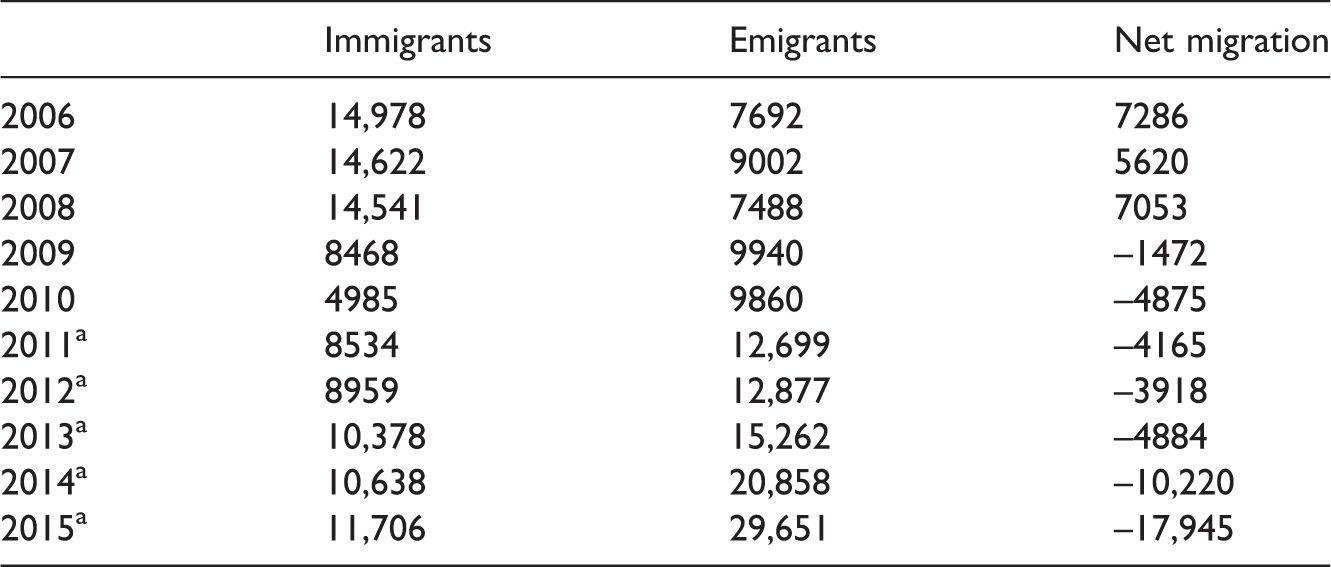
aIn order to harmonize the international migration statistics with international standards and the acquis communautaire, data since 2011 have been processed according to a new methodology.
Source: Croatian Bureau of Statistics (www.dzs.hr).
International migration of the population, by age and sex, 2015.
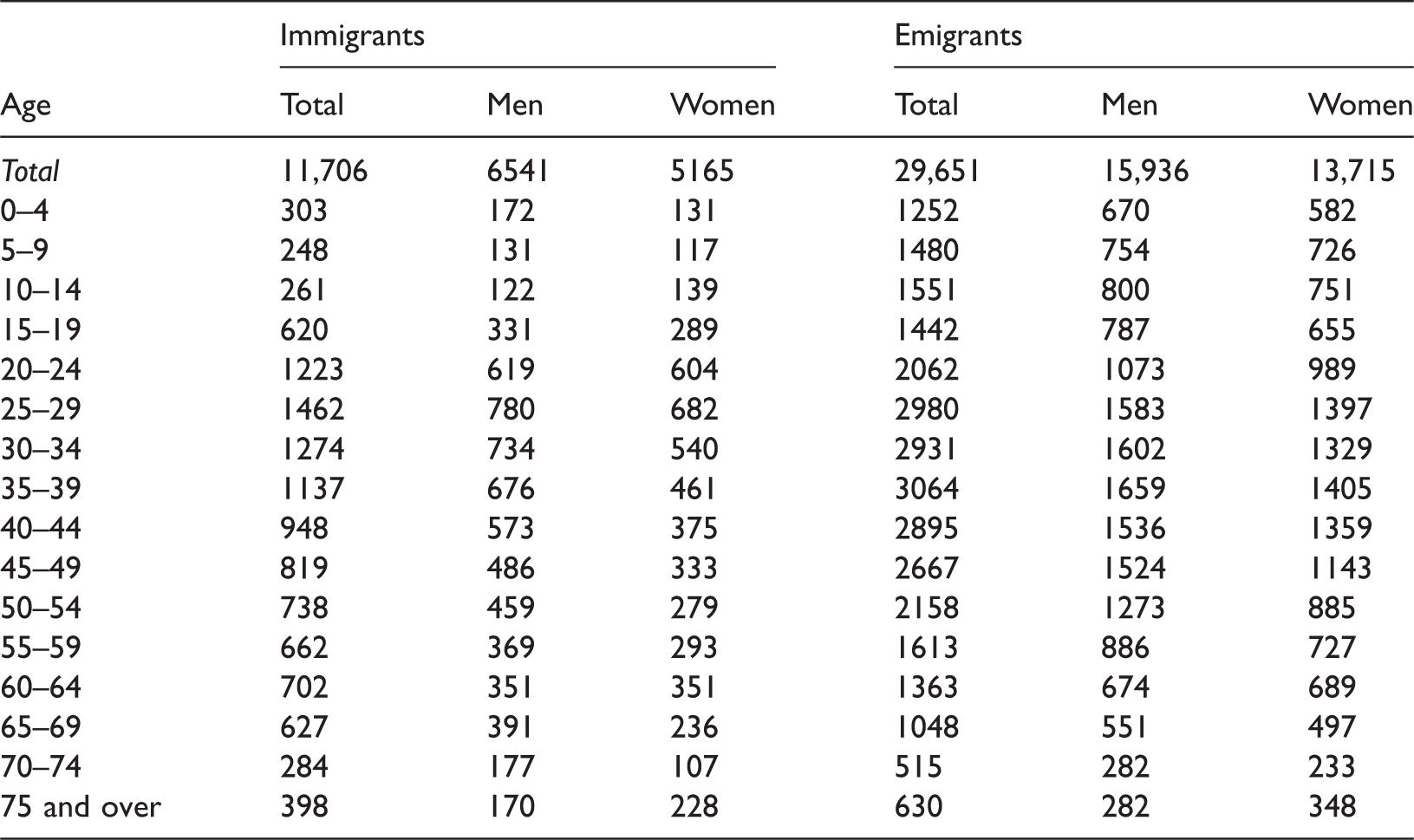
Source: Croatian Bureau of Statistics (www.dzs.hr).
Given a total population of around 4.2 million and a negative birth rate paired with an ageing society, such figures have caused concern despite Croatia’s tradition of emigration. Indeed, Croatian society has been shown to be the most prone to emigration in the region. Authorities put the figure for Croatians living in the diaspora at almost three million, while other domestic sources give somewhat lower estimates of around 2.5 million. 6
However, Croatian official statistics on current migration dynamics appear almost reassuring compared to other sources. In January 2016, the daily Jutarnji List described data delivered by a spokesman for the German Federal Statistical Office as ‘explosive’ and ‘alarming’, indicating an influx of approximately 120,000 Croats since EU accession (Turčin, 2016). While closer scrutiny of the methods of data collection, which can sometimes lead to extremely divergent figures, are beyond the scope of this article – it would be crucial to first discuss who is registered as an immigrant in Germany or as an emigrant from Croatia by the respective authorities and from what point in time – this reference at least conveys an image of media reporting and echoes the overall mood of concern. The article notes the dramatic increase in emigration since EU accession; it names Germany as the main destination country for migrants from Croatia; 7 it identifies the young unemployed and tertiary-educated experts as an especially mobile population group (indeed their share among emigrants is higher than their rate among Croatia’s total population); it determines the social and economic crises as push factors; and it warns about growing negative demographic trends as a consequence of emigration and its impact on social systems.
In the prolonged recession since the financial crisis, Croatia (45.1%), together with Greece (49.5%) and Spain (47.5%), retained its position among the EU countries with the highest rates of youth unemployment (Bundesagentur für Arbeit, 2016). 8 In 2016, youth unemployment dropped for the first time since the start of the crisis in Croatia (28.8%), and to a lower extent also in Greece (46.7%) and Spain (42.6%). Without being able to provide deeper analysis of such data here, 9 we suggest that the decrease might be a reflection of emigration rates rather than of rising employment. 10
As already mentioned, for some time a public discussion has been ongoing on whether not only the economic situation but also the education system, which is in urgent need of reform, the lack of practical relevance that marks training in general and insufficient communication between the education and economic sectors, have played a causal role here.
According to figures for 2015, while Croatia has the lowest level of early leavers from education in the EU (2.8% compared to the EU average of 11%), tertiary education attainment is lower, with more university students dropping out of their studies (European Commission, 2016: 1; 30.9% of 30- to 34-year-olds have attained tertiary education compared to the EU average of 38.7%). What gives reason for concern is that only 62.6% of recent tertiary graduates found employment within one to three years of graduation, compared to the EU average of 76.9%. A higher education degree has, therefore, not provided a ticket to a job, and while this situation is mainly attributed to the impact of low economic growth, there have been indications for some time from the private sector that graduates lack key employability skills required by potential employers such as technical, foreign language, management and problem-solving skills (Lowther, 2004: 16–18). Economists have also reflected on how the mismatch between higher education and the needs of a rapidly changing and increasingly internationalized labour market continue to impede the country’s competitiveness (Bejaković, 2014: 93–115).
Against this background, the discussion on mobility has become more differentiated: negative, sometimes alarmist, media reporting on the brain drain and youth unemployment, which still remains high despite some signs of economic recovery, is being counterbalanced by more fact-based reports and positive commentary on migration and mobility. Public discourse on the difficult labour market situation and emigration has thus shifted slightly from being problem-oriented to becoming more solution-oriented. Finally, given the comparatively high share of emigrants between 20 and at least 40 years of age – almost as many women as men, see Table 2 – and the outflow of much-needed professionals such as doctors and medical personnel, it has become expedient to think about how to encourage return. It is clear that this alone cannot compensate the negative demographic and economic consequences of emigration. While the need for a pro-active immigration policy has barely entered discussion in this young southeast European and new EU member state – compared to the discourses and practices of western and northern EU members – and has only been touched upon in the light of Europe’s refugee crisis, increasing openness towards Croatians abroad and the de-ideologization of domestic discourse on the diaspora, as well as an intensification of relations with representatives of the second generation who have settled in Croatia since the transition from socialism, 11 point towards a gradual shift in thinking and an opening up to people coming from abroad or returning. 12
Structural and quality deficits in the education system
Broad consensus exists among experts and politicians that reform is much needed in order to better prepare young people for the labour market and challenges of the future. Discourse on the modernization of the education system has been triggered not only by the brain drain and high rate of jobless youth outlined above, but also by attainment surveys such as the 2012 OECD Programme for International Student Assessment of 15-year-olds that found that 29.9% of pupils in Croatia had weaker mathematics skills than the EU-25 average of 22.1%, though science and reading skills produced results around the average (European Commission, 2015: 4). Pupils going into higher education were found to overwhelmingly prefer the social sciences to science, technology, engineering, and mathematics (STEM) subjects, though interest in technical studies rose slightly between the academic years 2008–2009 and 2013–14 (https://www.azvo.hr/hr/vrednovanja/44-statistike). STEM studies are widely perceived as ‘difficult’ and – revealingly – ‘too difficult for girls’. On the other end of the education system, despite a steady increase since the mid-2000s, the participation rate in early childhood education is one of the lowest in Europe (72.4% in 2014 compared to the EU average of 94.3%; European Commission, 2016: 3).
As elsewhere in the region, the flagging economy has impacted on government investment in education on all levels. In 2015, public expenditure as a percentage of gross domestic product fell back to slightly below the EU average (4.7%, compared to 4.9% for the EU) after briefly surging to 5.1% in 2013, and absolute expenditure contracted from 2013 to 2014 (European Commission, 2016: 2). Apart from chronic under-funding, structural weaknesses remain unresolved despite being addressed by various surveys as well as by the national education strategies, and plans for curricular reform are outlined in the next section. Decentralization has yet to be systematically rolled out to combat what a study published in 2004 described as the ‘rigid, hierarchical and opaque governance and management of the education system’ characterized by conflicting authorities, poor transparency in budget allocation and a lack of synergy (legislative, professional and institutional) for system change (Lowther, 2004: 19–20). On the other hand, EU accession has brought financial assistance to support educational reform during the 2014–2020 period, accompanied by measures to encourage spending efficiency and monitoring. Poor facilities in many schools and the training of teachers in new technologies and methods are areas in which more action is required. In this connection, the draft curriculum published in 2016 highlights the need for a unified system for evaluating learning outcomes (see www.kurikulum.hr/wp-content/uploads/2016/02/ONK-18.2-POPODNE-2.pdf).
Meanwhile, increased attention to the role of competitiveness and performance in the market economy has not only entered discourse on education as will be shown below, but also brought to light further deficits lurking in the transition from the education system to the workforce, where Croatia is seen trailing behind in the percentage of employees with tertiary education: 18.5% compared to the EU average of 26% (Bejaković, 2014: 96; European Commission, 2016: 3).
State initiatives for education reform
In the first years following the turn of the millennium, the ‘knowledge society’ came to the fore as the leading model for strategic development policy and, along with this, the national education system came under inspection as the crucible for such a society. The 2010 National Curriculum Framework (NCF) for pre-school, general compulsory and secondary education set out ‘Knowledge, competences, success and competitiveness’ as strategic goals in the transition to a system based on student achievement and learning outcomes rather than content (Ministry of Science, Education and Sports of the Republic of Croatia, 2010: 5). 13 Importantly, the NCF called for the greater transparency of educational institutions and closer cooperation between educational institutions and parents/legal guardians, the local community and ‘a wider community’. A widely debated state matura exam was introduced in the 2009–2010 academic year as a result of this document.
The Social Democrat-led coalition that came into government in late 2011 went a step further and created a comprehensive Strategy for Education, Science and Technology, which was to be the main motor of extensive reform. Parliament adopted the Strategy in the autumn of 2014. Presented to the media in 2015 under the banner ‘Nove boje znanje’ (The new colours of knowledge), the document gave an in-depth analysis of the Croatian education system from pre-school to tertiary level, also covering adult education and the concept of life-long learning, and staked out an ambitious agenda for improving educational outcomes in all these sectors linked to the parallel development of the science system. Applied to schools, a comprehensive structural reform of the primary and lower secondary curriculum would see a gradual transition from the current eight-year system to a nine-year system. It promoted an individual approach to education that would foster the needs and capabilities of each child, with the goal of bringing ‘long-term social stability, economic progress and ensuring cultural identity’ – the latter concern also being a key element of the NCF (http://www.novebojeznanja.hr/strategija/o-strategiji/16).
The government in 2015 appointed a working group to draft a curricular reform through which the Strategy for Education, Science and Technology would be realized. The group was assisted by a wide range of stakeholders including teachers, university professors, education experts and parents. It visited schools and civil society initiatives across the country in the course of gathering information ‘on the ground’ for preparing the document with the title ‘Cjelovita kurikularna reforma’ (Comprehensive curricular reform) (2016a, 2016b), to be implemented on an experimental basis for one year before its full introduction. The draft, comprising six lead ‘proposals’, was completed in February 2016 and subsequently published online by the Ministry of Science, Education and Sport (http://www.kurikulum.hr). Apart from setting out clearly defined learning goals, the proposed changes underlined the need to strengthen critical thinking and problem-solving skills in pre-school and school education and responsibility for preparing pupils and students for ‘contemporary life’, further education and working life. In addition, the proposals called for the more objective assessment and evaluation of learning outcomes in educational institutions. Parents should become more closely involved in all stages and aspects of schooling, and receive more meaningful feedback on their children’s achievements. As well as raising professional standards among teaching staff, the reform should allow educators more autonomy and creativity in their work. 14
Diaspora outreach to tackle the brain drain
Growing awareness of the inevitability of joining the process of globalization, and all it entails with respect to international competitiveness, contributed to political and media discourse taking interest – on and off – in Croatian returnees and the descendants of former emigrants who have returned from abroad to live in Croatia since the transition, both temporarily and permanently. The often quite ambivalent experiences and partial marginalization of returnees/remigrants of both the first and second generation have been described in detail in the framework of qualitative research 15 on the case of Croatia, which has emerged in recent years (Čapo, Hornstein Tomić and Jurčević, 2014; Hornstein Tomić, 2014a; Hornstein Tomić and Scholl-Schneider, 2015; Hornstein Tomić, 2016; Hornstein Tomić and Scholl-Schneider, 2016). In the early phase of transition, calls to return were few and far between. Only later was more attention given both in politics and the media to the need to encourage return, the reintegration and acceptance of (educated) immigrants and remigrants alike and their potential contribution to the country (see Hornstein Tomić, 2015: 74–84). In the course of discussion on the proposed shift to a ‘knowledge society’ in the mid-2000s, the so-called ‘scientific diaspora’ came to the attention of authorities. 16 In order to contact its representatives and foreign research institutions and to initiate international cooperation, the Ministry of Education, Science and Sport of the Republic of Croatia set up a database and organized two conferences in 2004 and 2007. The Ministry campaigned for remigration and offered the prospect of research and teaching positions to those willing to return. Today, the success of these promotional measures is seen variously. Data on how many of those who followed the call actually received permanent positions (and, indeed, have remained in Croatia and are still active in the country), how many now move between Croatia and their country of origin and how many have again turned their backs on Croatia, has not yet been systematically gathered. In 2007, the ‘Unity through Knowledge Fund’ (UKF; http://www.ukf.hr/) was launched with the support of the World Bank in order to boost contacts and get longer-term cooperation off the ground between national and foreign research institutions that employ Croatian scientists (http://www.ukf.hr/). There were also plans to strategically include the domestic private sector in order to provide incentives for the application of scientific findings in industry. In retrospect, however, this element of the programme was seen to have only limited success. In the framework of the UKF’s first programme cycle, further resources were made available to support the return of scientists from abroad. However, they were not extended to the second cycle due to the low response. The UKF received international recognition as a successful programme for strategically raising the international competitiveness of the national science sector (a clear increase in the obtainment of EU research funds was a key indicator). Moreover, a second grant programme in the framework of Marie-Curie-FP7-People-2011 and co-financed by the Ministry of Science, Education and Sport – the ‘New International Fellowship Mobility Programme for Experienced Researchers in Croatia’ (NEWFELPRO; http://www.newfelpro.hr/) – renewed efforts to support the reintegration of both junior researchers and established scientists. Over a period of four years, from 2013 to 2017, the programme supports domestic scientists who aim to conduct projects at research institutes abroad, as well as foreign scientists undertaking research work in Croatia, and promotes the return of Croatians already employed on a long-term basis at scientific institutions abroad. A central element of the programme aims to embed scholars in local science and research structures by funding individual positions. The programme provides impetus aimed at intensifying brain circulation and internationalization and at reinforcing the international competitiveness of Croatian scientific research. It should be emphasized that the individual efforts of scientists and science managers, demonstrated, for example, at the internationally renowned Ruđer Bošković Institute in Zagreb or at the University of Rijeka, in acquiring research funding and scientists from abroad, in supporting the return of scientists and their life partners working outside Croatia and in establishing international joint projects, have also set decisive signals against the brain drain alongside the state-initiated programme.
Since assuming office in 2015, President Kolinda Grabar Kitarović, who spent a high school year in the USA and later studied for some time abroad, has on numerous occasions stressed the strategic importance of intensified relations to the diaspora communities. An increasing number of media reports likewise have focussed on emigrant Croats who made careers abroad, as well as on young second-generation entrepreneurs who have moved to Croatia to establish successful businesses in the ‘home country’ (see, e.g. Malbaša and Borić, 2015). Also, a growing number of conferences have reached out to representatives of the diaspora, addressing them not only as investors but also as potential ‘development agents’.
Conflicting political legacies and stalled reform
In May of 2016, the issue of curricular reform dominated the Croatian public and media discourse. However, this was not the result of a constructive discussion, but of a fiery disagreement between the working group and representatives of the new centre-right government. The head of the working group, Boris Jokić, firmly dismissed the conclusion of a Parliamentary Committee on Science and Education that the expert group should be expanded to include 10 new members from different scientific areas, describing this as an attempt to exert political pressure and refusing interference in the reform on the part of any political party or interest group. In this vein, a prominent civil society organization, the initiative for Civic Education (GOOD), called on the Education Minister to prevent a ‘hostile takeover’ of the working group. While the Minister underlined the importance of continuing the reform process, the plan to appoint 10 new members was not withdrawn and the entire working group resigned. Subsequently, on 1 June 2016, Croatia saw one of the biggest protests in the country’s young history, as thousands of citizens concerned about the discontinuation of the reform process and civil society organizations across the country joined under the slogan ‘Hrvatska može bolje’ (Croatia can do better) in loud support of the reform. For some nine months, reform was stalled after the working group turned down an offer of reinstatement under the government’s conditions. Recently, however, the group has been reinstalled, signalling government support for the continuation of the reform process. Nevertheless, the government’s direct appointment of a new head of the working group was slammed by opposition parties and the media as undemocratic and triggered a second, though smaller, protest rally.
This example highlights the deep ideological and political rifts of post-socialist transformation, which, even in the area of education where social and political consensus on reform is so close to being achieved, constantly wear down or fracture initiatives for change. The unresolved polarization of society into ‘left’ (associated by the ‘right’ with socialism and Yugoslavism) and ‘right’ (associated by the ‘left’ with nationalism and clericalism) overshadowed earlier efforts to modernize parts of the teaching plan and also politicized reform efforts in the period leading up to the appointment of the working group, as debates unfolded over values claimed and attributed along ideological lines. 17
Nevertheless, the ramifications of the repeated postponement of reform for youth, society and the welfare of the nation are acknowledged by actors previously not profoundly engaged in education. Representatives of the corporate world, for example, have joined ranks to emphasize the necessity of reform in preparing young people for the demands of the contemporary – and specifically domestic – labour market, and to remedy the evident shortage of institutional capacities. On round tables and in media interviews, prominent representatives of the business community and of the Croatian Employers’ Association (HUP) have frequently pointed out that companies can sometimes not fill vacancies as young school-leavers and graduates lack the set of skills required for specialist or sophisticated jobs. They have appealed to politicians for unity in solving these pressing problems, advocating practice-oriented education and knowledge exchange. Recent corporate initiatives have begun to set up student internship agreements with both private and state universities, for example the ‘Private Sector for Youth Initiative' jointly organized by HUP and the European Bank for Reconstruction and Development (EBRD) (compare also: Biondić, 2016: 1). A young organization, the foundation Wissen am Werk / Znanje na djelu, which is also concerned about the flight of educated youth abroad, has set up job-shadowing programmes that bring schools together with companies and institutions. 18 This confrontation with the ‘world of work’ aims to help young people make better and more responsible decisions about their education and training, and has the approval of the Ministry of Education, Science and Sport. Thus, as the introduction of wide-ranging curricular reform appears to remain on hold, it is clear that non-governmental initiatives are pushing forward contemporary approaches to education while at the same time seeking cooperation with government agencies. However, backing on the part of state institutions that hitherto, as indicated above, have tended to take a directive approach, remains cautious and channelled by individuals rather than cross-party consensus.
Outlook: A call for joining forces – and for new visions
It is obvious that youth unemployment and the brain drain represent key challenges for governments and political stakeholders and demand of them the ability to identify problems and take future-oriented action. In addition, there is an evident shortage of institutional capacities. At the same time, however, we see tasks ahead and scope for action on the part of civil society actors. We consider public pressure groups as crucial to the process of fostering the policy changes desperately needed both in education and in migration policy areas, and in impelling Croatian political parties to join efforts to combat the widening development gap between Croatia and other EU member states. The evident development of society-wide awareness, as we have tried to show, has not yet resulted in profound and sustainable policy changes. While moves in such a direction are being undertaken, their translation into education and/or migration policy reform has yet to follow. In education, experience-based learning ought to be the rule and not the exception. And the recent signs of a turn in the tone of public discourse and media reports on the brain drain still need further support through the active promotion of mobility for learning, both cross-sector and international. As pointed out in a recent contribution outlining paths towards a Croatian migration strategy (Puljiz, Tica andVidović 2014), the issue of national identity politics and alternative routes to national consensus also need to be tackled in order to retain the better-educated population and generate remigration (Božić, 2014: 291–292).
It remains to be seen in the medium-term whether the programmes and incentives for brain circulation will ultimately succeed in slowing the flight of young citizens seeking better prospects for professional and personal development abroad, and indeed in reviving the country’s underdeveloped regions presently facing an internal brain drain and the depopulation of rural areas. National or local attempts to control – or revert – skilled migration flows will hardly be able to compete effectively with the promises and attraction of moving to urban centres, or further abroad. 19 Indeed, the development gap we have addressed in this contribution and its disintegrating consequences should be a cause of concern to all engaged in negotiating and shaping Croatia’s education, economic, demographic and migration policies. Last but not least, the interplay of factors essential for the successful reintegration into local social structures and professional fields (such as the scientific community – as an example of a comparatively small professional sector; see Hornstein Tomić and Scholl-Schneider, 2015: 205–238) will only come to light through practice, long-term observation, monitoring and surveys of the actors involved. Only then will the role of networks, the significance of social capital and remittances, and the effectiveness of adaptation strategies, which encourage or impede integration, the transfer of knowledge and eventual development gains, become comprehensible.
Footnotes
Declaration of conflicting interests
The author(s) declared no potential conflicts of interest with respect to the research, authorship, and/or publication of this article.
Funding
The author(s) disclosed receipt of the following financial support for the research, authorship, and/or publication of this article: Funding for research on emigration and remigration dynamics in Croatia referred to in this article was provided by ERSTE Stiftung.