




Abstract
This study explored the metaphors of schooling generated by prospective teachers (N = 157) in Turkey who were attending a teacher training program to be certificated for the teaching profession. The schooling (teacher, learner, school) metaphors of certificated teachers were collected by using concept prompts such as ‘A teacher is like … because …’, ‘A learner is like … because …’ and ‘A school is like … because …’. In total 278 valid metaphors and 20 conceptual themes derived from the metaphors were generated across the three concepts. All of the metaphors produced were also categorized as either teacher-centered or learner-centered. The results show that the certificated teachers hold pervasively teacher-centered teaching beliefs which will shape their future classroom practices. In addition, it was also concluded that the certification program implemented in the university context did not meet the required high standards of teacher training and should be thoroughly reviewed and revised to provide a broader perspective. The metaphors appeared to act as a powerful thinking tool by providing an insight into the pedagogical thinking of and further actions by certificated teachers, and led to a discussion of recommendations regarding teacher training via certification programs.
Keywords
Introduction
Visions of the future of the Turkish teacher training system
‘If you cannot be anything you can at the least be a teacher!’ (Altan, 1998: 411) is a quotation that perhaps reflects perfectly the past and current status of teachers and their occupation in Turkey. Becoming a teacher in Turkey has, for many reasons, lost its charisma and evidence-based pedagogy (Ayas, 2005; Saban, 2003, 2004); relatively low salaries compared to other professions, including law and medicine, is but one such reason.
To illuminate this clearly-identified decline, one has to turn back and take a closer look at the basis of the Turkish teacher training system and policies. There is a clear need for a detailed consideration of the past trajectories of the Turkish teacher training system and policies. The future orientations and targets of the policies for Turkish teacher training system would be made more predictable and knowable by virtue of historicizing the initiatives of educational policy-makers for the higher education system in a defined historical context (Tesar, 2016; Peters and Tesar, 2016).
In the context of this study, the infrastructure (i.e. the basis) of the policy futures of teacher training in Turkey has been perceived by the present authors as being the actions and decisions of Turkish policy-makers. Furthermore, the superstructure of the policy futures of teacher training in Turkey has been regarded by the authors as being the pedagogical and instructional actions and decisions of prospective teachers that are largely anticipated and determined through the would-be teachers’ beliefs and perceptions about teaching and learning that have been created or imposed over time; for instance, within a certification program in education, as a recent policy produced by the Turkish policy-makers. It was considered worthwhile to ascertain how the current Turkish teacher training policies (the base) have shaped the cognition (the superstructure; the belief system about learning and teaching) of the prospective teachers to prepare them to deal with the actual instructional responsibilities of real classrooms.
Turkish teacher training policies: a brief introduction
After the first attempts of Darulmuallimin (Binbasioglu,1995), the first teacher training institution, several models have been developed and implemented in order to advance teacher training in Turkey. Acknowledging the 1973 National Education Basic Act No. 1739, it was decided that teachers were to be trained in higher education institutions (Cakiroglu and Cakiroglu, 2003). Then, in the early 1980s, the responsibility for teacher training was transferred from the Ministry of National Education (MoNE) to the universities (Altan, 1998; HEC, 1998, 2007a, 2007b). These regulations and rearrangements were intended to contribute to the training of highly qualified teachers for Turkish schools.
There was another scenario that developed in teacher training in Turkey in the 1990s, at a time of a shortage of teachers for Turkish schools, particularly for classroom teaching. To solve this problem, some 12,000 graduates were appointed as teachers, particularly in elementary schools, in the academic years between 1995 and 996. Interestingly, these teachers had no pedagogical training (Bilir, 2011): they became teachers regardless of where and what they had studied (Altan, 1998). In the 1996–1997 academic year some 30,000 graduates from diverse faculties (e.g. agricultural engineering, business, veterinary medicine) were employed as elementary teachers without being subjected to testing in relation to their teaching knowledge and skills or having attended a teacher training certification program (Bilir, 2011).
Justification of the study
The simplest way of becoming a teacher in Turkey is to attend a certification program in education. This process of certification has been maintained over the last two decades (HEC, 2007a). In Turkey an undergraduate or graduate can be certificated as a teacher if they pass a two-phase, 26-week and 21-credits program (HEC, 2007a). However, it is argued here that it is highly questionable whether such a program is sufficient for graduates or undergraduates who, in fact, are novices to join a profession that is regarded as complex and more than simply a process of teaching facts to learners.
Furthermore, it is somewhat worrying to consider the pedagogical decisions and actions of these Certificated Teachers (CTs) when they face the reality of the currently overcrowded classrooms in the school system. It is possible to make an educated guess about such decisions and actions by examining the initial beliefs of CTs about ‘schooling’ because this provides information about what the CTs know and their reasoning about teachers, students and schools. Since beliefs are regarded by some as the most salient indicator in understanding human behavior (Levitt, 2001; Pajares, 1992), we argue that a wise and thoughtful educator of teachers should inquire into the preconceptions of schooling held by CTs (Clark, 1988). In addition, there have been proposed changes in the Turkish educational system, one such change being for learners’ voices to be heard in classrooms, to comply with the internationally scaled reform-based standards of teaching and learning (Ministry of National Education, 2004a, 2004b, 2004c, 2004d). In order to achieve this goal in the Turkish context, there has been an increase in designing, implementing and evaluating learner-centered curricula, and teachers have been introduced to several aspects of the reform-based initiatives (Odabasi-Cimer and Cimer, 2012). It is therefore reasonable to ponder whether CTs will be candidate agents of change in undertaking the needs of the current reform-based initiatives in Turkey. Accordingly, the research questions of this study are:
What were the metaphorical images regarding schooling (i.e. teacher, learner, school) of the CTs as an indicator of their initial beliefs about teaching and learning? What types of instructional and pedagogical orientations were derived from the metaphorical images regarding schooling of the CTs in determining their anticipated in-class practices?
Theoretical underpinnings
Metaphorical images as a way of capturing schooling concepts
An approved approach for predicting teachers’ pedagogical decisions and actions is to take into account their beliefs about teaching and learning. It has been well understood that teachers strictly organize and adjust in-class activities, pedagogical tasks, instructional methods and evaluation approaches, for instance, in line with their deep-seated beliefs about teaching and learning (Pop and Turner, 2009; Watt and Richardson, 2008, 2011). As an alternative to merely capturing recorded or written beliefs regarding schooling, considering metaphorical imaginings may also provide reasonable explanations in predicting teachers’ future pedagogical decisions and actions.
A metaphor can be defined as a lens or filter through which something is viewed in the light of something else (Lakoff and Johnson, 1980). Stated otherwise, a metaphor is employed when the customary realm is transported to a new realm, in order to make sense of the source domain by means of the target domain (MacCormac, 1990; Yob, 2003). Metaphors may therefore be conceived as powerful cognitive tools with which to reason about things; for instance, becoming a teacher or practicing teaching (Hardcastle et al., 1985; Onysko and Michel, 2010). Thus if a person is of the view that ‘teachers’ work is like that of a nurturer’, they not only explain what teachers are similar to, but also describe ‘what it is like to be a teacher’.
In this way, metaphors can be more powerful than literal language. Metaphors may facilitate a genuine externalization of inner and tacit beliefs, and reasoning and mental models pertaining to practices, which literal language cannot articulate (Gurney, 1995; Moser, 2000). In this context, metaphors may function as the translation of such experiences into mental images, as in the form of imaginings (Saban, 2003). To elaborate, Shuell commented that ‘If a picture is worth 1000 words, a metaphor is worth 1000 pictures! For a picture provides only a static image while a metaphor provides a conceptual framework for thinking about something’ (Shuell, 1990: 102).
Metaphors about the schooling concepts: teacher, learner and school
There are several descriptive studies presenting teachers’ metaphors about schooling and their instructional or pedagogical orientations. Effectively this group of studies first extracted the metaphors about schooling in a qualitative sense; and then produced a quantification of the metaphors generated to determine the pedagogical orientations or tendencies (teacher-centered vs. student-centered) embedded in the extracted metaphors. For instance, Guerrero and Villamil (2002) proposed nine broad categories for the teacher concept as obtained from teacher-led metaphors. These were: cooperative leader; provider of knowledge; challenger/agent of change; nurturer; innovator; provider of tools; artist; repairer; and gym instructor.
With particular reference to the Turkish context, Saban and his colleagues conducted an array of studies that were designed specifically to identify teacher-led metaphors (metaphor extraction by coding) and their pedagogical orientations (metaphor quantification by counting). For instance, Saban (2003) researched entry-level elementary teachers’ (n = 381) metaphors about school. He deduced that metaphors regarding school as a factory (a place where socially useful products are produced; teacher-centered, 56.7%), a hospital (diagnosing and eradicating student errors; teacher-centered, 53.8%) and a family (meeting individual needs and interests; learner-centered, 33.1%) were the most representative. However, school as a family (84.0%), a garden (a loving and nurturing learning environment; learner-centered, 82.4%) and a restaurant (receiving a quality education service; learner-centered, 76.4%) were the most preferred metaphors of school.
Similarly, Saban et al., (2007) derived 10 conceptual categories by taking into account prospective teachers’ (n = 1142) metaphors about ‘teacher’. The following six groups were considered as teacher-centered metaphors: knowledge provider; molder/craftsperson; curer/repairer; superior authority figure; change agent; and entertainer. The conceptual themes which reflected learner-centered perspectives were the teacher as counselor, nurturer/cultivator, facilitator/scaffolder and cooperative/democratic leader. Saban (2008) also explored how primary school students (n = 1204), their teachers (n = 85) and teacher candidates (n = 420) described school through metaphorical imagining. Saban (2008) revealed 74 valid metaphors that were classified under 10 conceptual categories. The concept of school was likened to places of love and solidarity (40%); knowledge and enlightenment (26.7%); enculturation and shaping (9.5%); growth and maturation (5.9%); and discipline and control (1.8%). In addition, the image of school was also perceived as a nice and beautiful place (5.6%); a means or tool for development (3.4%); a workplace (2.6%); a guide (1.8%); and as the hope and guarantor of the future (2.8%).
For a broader depiction, Saban (2010) revealed 98 valid metaphorical images of learners of prospective teachers (n = 2847) that were allocated to 12 conceptual themes. The metaphorical conceptual categories were: learner as raw material (22.6%); a developing organism (21.3%); empty vessels (18.4%); a significant being (12.6%); an absolute being (8.9%); a knowledge recipient (3.9%); a knowledge reflector (3.5%); a knowledge constructor (3.0%); a defective being (1.8%); a social participant (1.5%); a knowledge carrier (1.3%); and social capital (1.3%). Saban (2010) concluded that most of the extracted metaphors about learner had a subject-centered or teacher-centered pedagogical orientation.
There are two salient aspects regarding the studies of Saban and his colleagues:
There was a breadth of awareness in the metaphors generated about schooling. Stated differently, Saban and his contemporaries were able to demonstrate that Turkish prospective teachers had different ways of experiencing the same phenomena of schooling as teacher, learner and school. Although there was a substantial variation in experiencing the schooling concepts, the teacher-led metaphors were clearly revealed as teacher- or subject-centered, confirming the belief that the current teacher education system in Turkey has continued to impose knowledge-transmission modes of teaching and learning.
There are also studies that researched the contextual influences of the instructional settings on the metaphor constructions of the teachers. For example, Ben-Peretz et al. (2003) confirmed that teacher-led metaphors could be contextually-influenced. To illustrate this, in the study by Ben-Peretz et al. (2003) the teachers working with high-achieving students referred to their profession as that of ‘conductor’, while those teachers working with low-achieving students depicted themselves as ‘animal keepers’. In a way this study verified that the context in which teaching was undertaken can have a substantial influence on the metaphors teachers use to refer to their professional selves. Bozlk (2002) examined the metaphorical images of 49 first-year prospective teachers in relation to how they regarded themselves as learners. The teachers produced 35 valid metaphors that were sorted into four distinctive categories of metaphors: animal (37%), object (29%), human (26%), and actions (8%). This study confirmed the fact that the previous schooling experiences of the participants, as a contextual factor, had a greater impact on their metaphorical images of being a learner. Most of the participants felt themselves to be similar to sponges, ready to soak up the teachers’ knowledge. The participants also made reference to rote learning and described, ironically, how they might display the symptoms of Alzheimer’s disease because they felt they had difficulties in retaining the knowledge they had acquired.
There have been a few studies exploring the metaphors of prospective teachers about schooling concepts during an intervention or implementation process such as a standard-based teacher education program. In an example of this, Buaraphan (2011) examined initial teacher metaphors of prospective teachers and revealed three relatively dominant categories: teacher as nurturer/cultivator; as knowledge provider; and as superior authority figure. The principal direction of the change of metaphor was from the teacher as nurturer/cultivator to the teacher as knowledge provider, confirming the less than sufficient impact of the standard-based teacher education program on the beliefs and accompanying in-class practices of the prospective teachers.There have also been comparative studies informing the theoretical perspective of metaphors. The comparisons in these studies were across the nations or different respondent groups (e.g. primary school students, their teachers and parents). In an in-depth naturalistic study, Demir (2007) compared the metaphors of Turkish (n = 24) and US (n = 18) middle school students regarding the concept of school. Turkish students perceived the school as a family-like center of caring, support and love, a means of advancement and upward social mobility, transmitter of knowledge, a place for vocational preparation, and an enjoyable place in which to grow. In contrast, the US students conceived the school as a wild environment, an organization, a comforting place to go, a chaotic place, a place of limited autonomy and freedom, an enjoyable place and a family-like center of caring, support and love. In the Turkish context, Balcı (1999) explored the metaphors of primary school students, their teachers and parents regarding school.[CL: please note the use of Turkish alphabet, the final character, in the name Balcı] School was mainly likened to ‘family’, ‘home’, and ‘home for education’, ‘bird’s nest’, ‘warm home’ and ‘parents’. Balcı (1999) concluded that the metaphors of the respondents reflected an intensive caring-role of the school. Moreover, from the viewpoint of the participants, schools were places where knowledge was safely transmitted to learners by their teachers. The metaphors that were generated also showed that schools were places in which young persons were enculturated, cultivated and enlightened for the sake of rigorous societal norms. Balcı (1999) revealed that imaginings for school in the Turkish context reflected a pervasive subject-centered teaching perspective that had been exacerbated by highly disciplined, authoritarian and chaotic school environments.
General summary
Overall, there are several arguments concerning the metaphors of schooling (i.e. teacher, learner, school). First, the metaphors of different groups of people reflect both teacher-centered and learner-centered teaching perspectives. In detail, metaphors have favored teaching-by-telling insights of schooling, to a considerable extent. The behaviorist teaching paradigm is still dominant in the embedded metaphorical imaginings of the respondents. In contrast, there are particular signs of the cognitive constructivist teaching paradigm in the metaphorical reasoning of the respondents. However, signs of social constructivism are still absent in the metaphorical images of schooling concepts.
In research methodology, large-scale studies have become prominent. Quantification (i.e. frequencies, percentiles) of qualitative data has allowed researchers to make contextual generalizations about schooling and issues related to schooling. In this sense, there are also cross-cultural differences in the metaphors of schooling. Teachers, students, teacher candidates, principals and parents have been selected as the respondents of related studies in reporting metaphorical images of schooling. Finally, most of the featured studies acknowledge the idea that metaphors are functional tools for capturing a person’s deep-seated reasoning, theories and practical experiences about schooling. We were therefore encouraged to use most of the outcomes of the related studies in terms of both structuring a theoretical framework and a methodology to extract the CTs’ metaphorical theories, and predicting their potential and probable pedagogical decisions and actions in their future teaching practice.
Methodology
Research design
As mentioned above, this study had two main aims, addressed by two research questions. The first aim was to define the metaphorical images of the CTs with regard to the schooling concepts. The second the aim was to deduce the pedagogical orientations (i.e., teacher-centered vs. learner-centered) embedded in the metaphor constructions of the CTs. These two research aims required a naturalistic inquiry, as in the form of basic qualitative research. For the first aim, the interest was in how the CTs interpreted their experiences with the schooling concepts and how they constructed their meanings of schooling concepts, as well as what meaning they attributed to their experiences of such concepts (Merriam, 2007). This was possible by virtue of adopting a basic qualitative approach in which ‘the overall purpose is to understand how people make sense of their lives and their experiences’ (Merriam, 2007: 23). Once the CTs generated their metaphors regarding the concepts of schooling, it was reasonable to re-classify them as teacher-centered and learner-centered, in order to infer the CTs’ implicit or explicit pedagogical orientations. This was therefore more illustrative in predicating each analytical component (a produced metaphor) of the re-classification pool by means of a numerical process to interpret the future pedagogical tendencies of the CTs. The qualitatively interpreted and pooled data were quantified to generate and reveal percentages of the pedagogical orientations of the CTs.
Participants and setting
There were 157 participants in the study, of which 126 (80.3%) were females and 31 (19.7%) were males; they had all enrolled in a 14-week Certification Program in Education (CPiE) in order to be employed as elementary or secondary teachers. They undertook the CPiE in a large foundation-supported university located in the Marmara Region in northwest Turkey. The university has a population of some 38,000 students, with 11 faculties offering various study programs. The Faculty of Education has 10 major teaching study programs, with more than 50 lecturers or faculty members. The participants in this study were enrolled in or graduated from the following different programs or departments of Faculties of Science and Letters: Turkish Literature and Language students constituted the largest group (n = 89; 56.6%), followed by English Literature and Language (n = 33; 21%), Mathematics (n = 20; 12.7%) and Psychology (n = 15; 9.7%). The participants considered that they would be employed as school teachers in their teaching fields after gaining their CPiE. Of the participants, 42 (26.7%) were employed in a private or official organization and the remaining 115 (73.3%) students were undergraduate seniors. The participants’ ages ranged from 22 to 29 years (M = 25.3 years, SD = 1.80).
Within the CPiE, there were no courses regarding subject matter knowledge (e.g., English, Mathematics); rather, the courses aimed to enhance the participants’ general pedagogical knowledge and knowledge of the schooling context (e.g., teacher, student, school, Turkish education system, and culture). The CPiE consists of two phases, each carried out over an intensified seven-week period. During the first phase, the participants attended five pedagogically oriented theoretical introductory courses consisting of in-class hours only. These courses were Classroom Management, Introduction to Educational Science, Educational Psychology, Measurement and Evaluation in Education, and Teaching Principles and Methods, each offering two credits.
The remaining four CPiE courses were Special Teaching Methods, Instructional Technologies and Material Design, Guidance, and Teaching Practice. The Special Teaching Methods and Teaching Practices courses were arranged as four in-class hours. In Special Teaching Methods, the participants undertook micro-teaching experiences within two practical hours per week, whereas for the Teaching Practice course they were allocated to schools for their intern periods comprising a total of 14 hours. The remaining two courses had the same two-credit system. The 22-credit CPiE was completed by the participants in 14 weeks, over 154 course hours, and they were then certificated as future teachers.
Data collection and analysis
The metaphors presented by the CTs were captured using structured prompts – ‘A teacher is like … because …’; ‘A student is like … because …’; and ‘A school is like … because …’ – which were given to the CTs to complete in an open-ended manner. The participants were allowed 30 minutes only to present their metaphorical imaginings because we wished to explore their momentary and episodic metaphors rather than expecting them to compose long essays about their general ideas of schooling.
The connecting word, ‘… because …’, was added because it was highly important for capturing the justifications of the CTs’ metaphors (e.g. Buaraphan, 2011; Saban et al., 2007). We also recommended and prompted the CTs to generate more than just one metaphor, in order to ensure a high variance and frequency across the schooling concepts for the in-depth qualitative analysis. In order to avoid an elimination of ample numbers of pseudo-metaphors (Saban et al., 2007), a small group of CTs engaged in a pilot study; metaphorical imagining was introduced to the CTs by presenting them with some sample metaphors. To avoid influencing their generation of metaphors of schooling, the sample metaphors referred to other areas (e.g. an electrical circuit being a metaphor for water installations). A pilot study on 10 CTs was conducted and the prompts for schooling metaphors were found to be workable.
The metaphor analysis consisted of the following stages. First, all valid metaphors were simply labelled with regard to the teacher (e.g. ironmaster, chemist, craftsman), the learner (e.g. wood, sheep, poem) and school (e.g. slave labor camp, information transfer center, rewarding maze). We also conducted a clarification and elimination procedure by separating each metaphor produced into its characterizing subcomponents (Saban, 2010) of ‘the topic’ (teacher, learner and school), ‘the vehicle’ (comparative entities for the concepts of topics) and ‘the ground’ (further explanations regarding why there should be a resemblance between the topic and the vehicle). Then, using these three interrelated lenses, we looked at the structures of the metaphors that were produced. We also followed the suggestion made by Saban et al. (2007) to detect and eliminate invalid metaphors. Those to be eliminated were metaphors containing a plain description, the absence of provision of a rationale, fuzzy/hybrid metaphors, and tautological or idiosyncratic metaphors.
Most of the metaphors constructed were valid. In the categorization process conducted to create conceptual themes, metaphor justifications and explanations were matched with the general metaphor structures of the CTs. To clarify: in order to determine the orientation (teacher-centered vs. student-centered) and validity of a metaphor produced by a participant, accompanying justifications and explanations of the CTs were re-analyzed in a detailed manner. This was crucially important because some of the participants used their metaphorical reasoning to criticize and satirize the Turkish educational system; thus, we had to decide whether to include these critical metaphors in the pool and allocate them to conceptual themes. We decided that if a participant provided reasonable mechanical justification for their metaphorical reasoning we would include their metaphor in the pool of metaphors. Otherwise, in the case of mere criticism of the educational system via metaphors, these metaphors would be excluded because they were deluding rather than illuminating (Cook-Sather, 2003). Consequently, some (n = 17) of the CTs’ metaphors (n = 33, 10%) were eliminated from the metaphor pool. During the process of locating conceptual themes and sub-categories, we used a theory-laden and data-based analysis to determine both aspects, to produce a substantive labelling of major themes.
Trustworthiness of the study
To estimate the inter-coder reliability between the coders (the authors of the present study), a formula was used consisting of the total of the agreed codes divided by the addition of agreed codes to the disagreed codes (Miles and Huberman, 1994). For the preliminary analysis, the level of agreement was quite low, at 0.83. We therefore engaged in rigorous negotiations of the shared meaning from the lens of the CTs’ metaphors. We then achieved a 91% consensus level for the coding procedure through recoding the incompatible codes. The final inter-coder reliability exceeded 90% and was sufficient for the analysis conducted in this study (Miles and Huberman, 1994). During the course of these negotiations we also were externally audited by our colleagues; for instance, while we were modifying the predetermined codes, or allocating the codes to themes, or labelling the themes. We also engaged in peer review and debriefing sessions conducted by colleagues who had no connections to the study, but were specialists in the field of teacher education (Lincoln and Guba, 1985). On the whole we consider that the study meets sufficient standards of the validity for a naturalistic inquiry.
Findings
Frequencies of subcategories and conceptual themes of the metaphors produced.
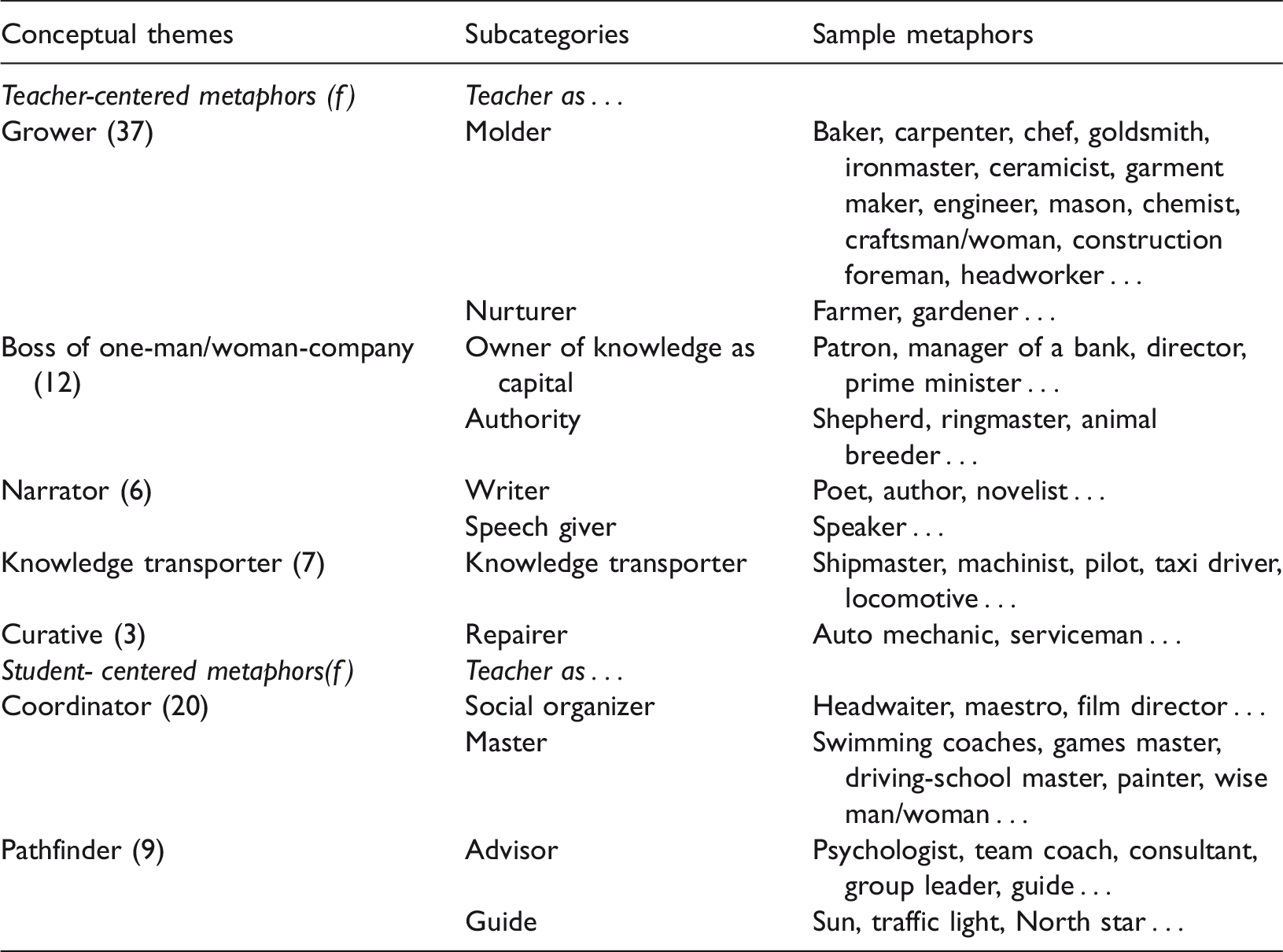
Conceptual classifications of the metaphorical images of ‘teacher’.
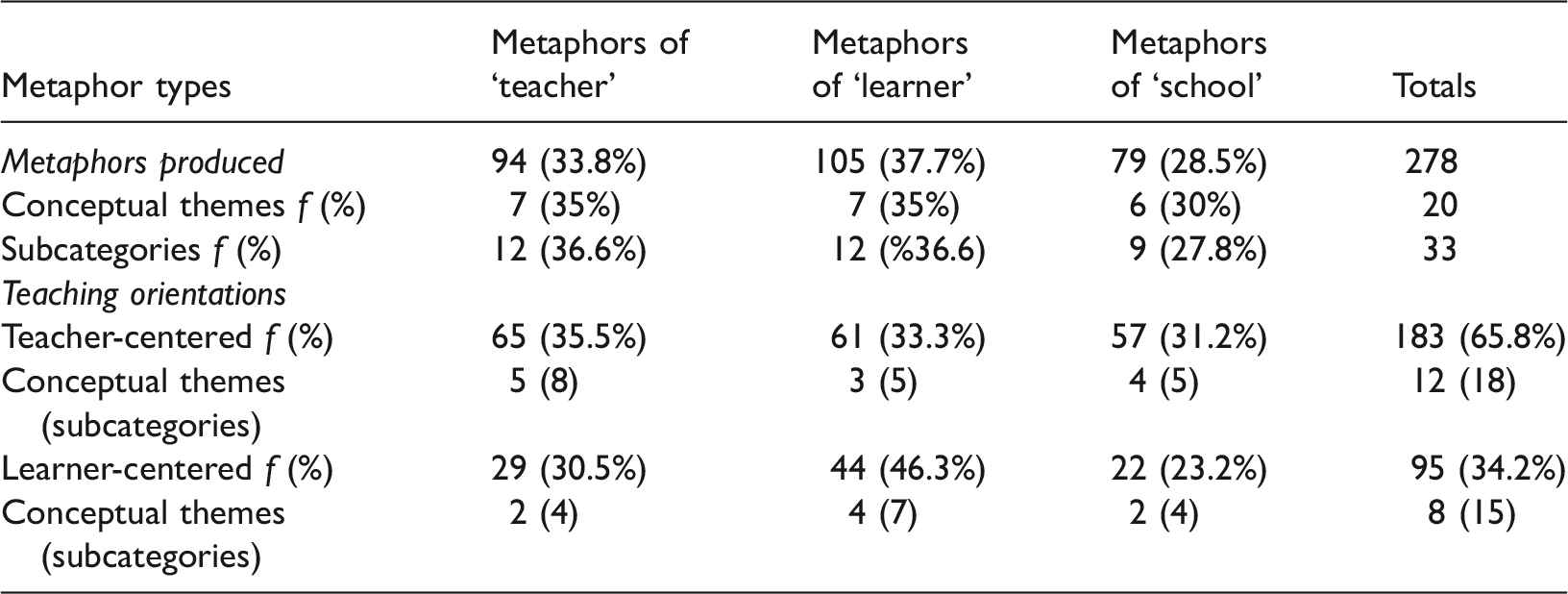
There was a total of 33 subcategories and a total of 20 conceptual themes for the metaphors across the given concepts. Twelve of the 33 subcategories (36.6%) were for metaphors of teachers which were similar to metaphors of the learner. Fewer subcategories (f = 9; 27.8%) were produced for the school compared to the other two concepts. Seven of 20 conceptual themes (35%) were allocated to the metaphors referring to teacher and learner and six themes (30%) were found for metaphors of the school. In general the CTs tended to generate more metaphors for the teacher and learner than for the school.
We also sectionalized the metaphors across the themes of teacher-centered and student-centered perspectives of teaching. Of the 278 metaphors, 183 (65.8%) referring to teacher (f = 65, 35.5%), learner (f = 61, 33.3%) and school (f = 57, 31.2%) were located in the teacher-centered teaching perspective. In contrast, 95 (34.2%) of the 278 metaphors of teacher (f = 29, 30.5%), learner (f = 44, 46.3%) and school (f = 22, 23.2%) were located in the learner-centered teaching perspective. In addition, 18 of the 33 subcategories (54.54%) were redefined as teacher-centered metaphors and the remaining 15 subcategories were redefined as learner-centered metaphors. Twelve of the 20 derived conceptual themes (60%) were allocated as having a teacher-centered perspective and the remainder (f = 8) were considered as having a learner-centered teaching orientation.
To conclude, the participants were able to generate a substantial amount and variety of metaphorical images regarding the three schooling concepts; however, there were some restrictions to the metaphorical imagining of the CTs.
Figure 1 shows the relative proportions of the teacher-centered and student-centered categories of teaching, based on the quantified data, and reveals a pervasive teacher-centered perspective in the metaphors generated. Of the metaphors produced for the teacher, 70% (65/94) reflected a teacher-centered teaching perspective. Only one third of the metaphors for the teacher were associated with learner-centered orientations of teaching. These proportions are also valid for the metaphors referring to learner (teacher-centered, 58%, and student-centered, 42%) and school (teacher-centered, 72%, and student-centered, 28%). Overall, the CTs still held intensive teacher-centered teaching perspectives referring to knowledge-transmission modes of teaching, and there were fewer learner-centered images, implying true co-constructions of learned phenomena. The conceptual themes of the CTs for teacher-centered and learner-centered teaching orientations are discussed in the following section.
Categorizations of teacher- and learner-centered metaphors of the PTs.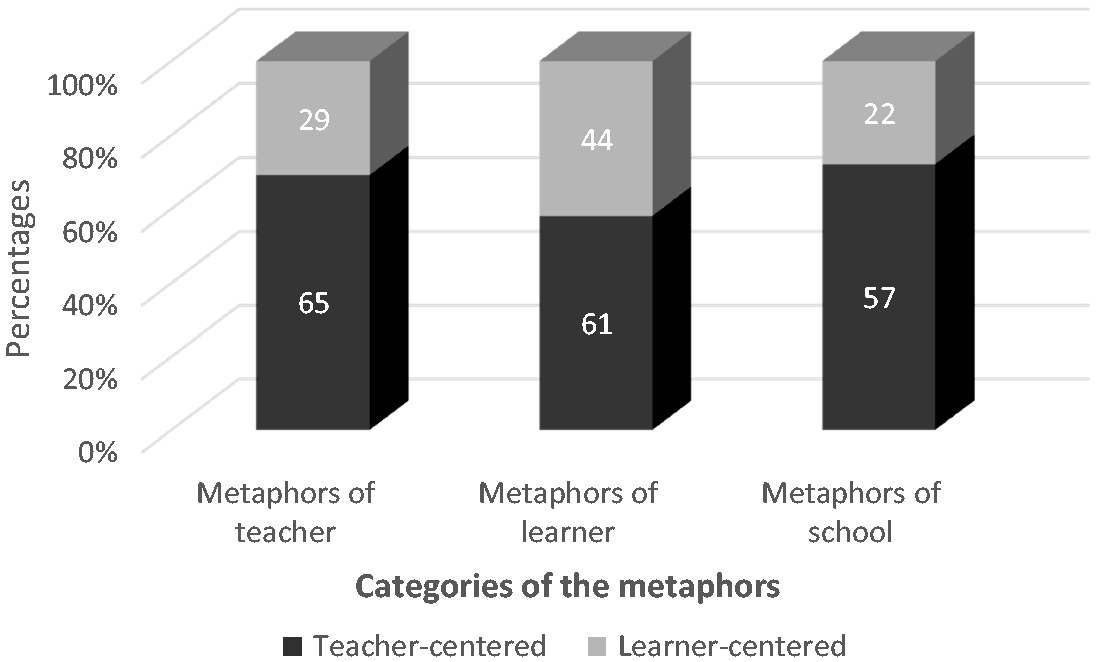
Conceptual themes for the concept of teacher
Teacher-centered metaphors
The CTs generated pervasive teacher-centered metaphors for the teacher (see also Table 2). They attributed some roles to teachers, of passivating and objectifying their students. In the context of this study, the terms ‘passivating’ and ‘objectifying’ suggest that teachers downgrade the status of students to that of mere objects in classrooms. According to the CTs, teachers are molders and growers, because students are raw materials that should be irrigated, cultivated, shaped, and mixed, in a similar manner, for instance, to agricultural crops or chemical substances. Therefore, both the control and regulation of classroom actions belong only to teachers because they are the formers of the students as material entities. Ontologically, students are in the classrooms; however, the teaching and learning actions of the classroom should be undertaken only by teachers. In this sense, teachers are living organisms whereas students are dull and cold, inanimate, object-like entities. If a teacher takes action, students can be awakened from their dormancy status similar to, for example, seed potatoes. To illustrate, students are not able to trigger their own learning or manage their intellectual gains; they need a teacher in order to be activated or initiated for learning to occur. A building can only be constructed in a stable way by cement. Students are similar to the cement of a building. Here, the teacher is the civil engineer. She shapes the cement. The better the civil engineer, the more durable building produced by the solid cement. (M08, Turkish Literature and Language) All students come together in the same setting [saucepan] like chickpeas. Then, the teacher comes and she cooks the chickpeas like a chef. If needed, she may add something. If there is excessive food to be cooked, she reduces it. She intervenes if the meal begins to burn. She directs them [students]; she helps them to mature [cooked]. She sometimes cooks students over low heat. (M11, Psychology) Students are like apprentices. When they acquire knowledge, they will be masters. A school is similar to a company that is crowded, organized and incorporates definite hierarchies, statuses … Teachers are the principled executives of the companies. (M18, English Literature and Language) There should be organizers who provide corrective guidelines to students who were at the bottom of the ladder. (M43, Turkish Literature and Language) A student has resemblance to a ship that does not know where it should go. The captain manages the students to help them reach their ultimate purpose. A captain is a teacher who leads the student [ship]. The captain loads the information on the ship at the harbor, and the students transport the load to the desired place. (M09, Mathematics Department)
Finally, the CTs produced metaphors for teachers as curers, with the students as patients who are less knowledgeable users of the classroom. In other words, being a less knowledgeable member in the classroom implies a type of sickness, or an epistemic pathology, coined as ignorance. In a linear sense, the troubles belong to the students and the cures belong to the teachers. In a clear sense, teachers are more knowledgeable compared to their students and students’ problems result from their ignorance or illiteracy; thus, according to the CTs, it should be remedied by the compensatory efforts of teachers.
Student-centered metaphors
The teacher concept was embraced as leadership and guidance with regard to student-centered metaphors. The CTs considered teachers as social organizers who may allow students to take responsibility for their own learning by co-arranging, co-planning and co-managing the instructional events and activities. In this sense, teachers should have the discursive abilities to orchestrate classroom events with the help of the authentic efforts and genuine intellectual contributions of learners. A student is born with growing, developing and flying desires. Of course, she will be flying but the student must stay safely in the nest until she learns to fly. The teacher, like a mother-bird, has to teach a young-bird how to fly. The mother-bird has to support and give the young bird confidence. When a student flies, she will be actualizing herself. The purpose is to ensure the student is able to fly by herself. (M48, English Literature and Language)
Conceptual themes for the concept of learner
Teacher-centered metaphors
If a student is likened to dough, the cook shapes and kneads that dough; the cook is the teacher. A student who needs instruction and education is similar to dough that has not been kneaded. The teacher is the one who molds that dough. (M46, Psychology)
Conceptual classifications of the metaphorical images of ‘learner’.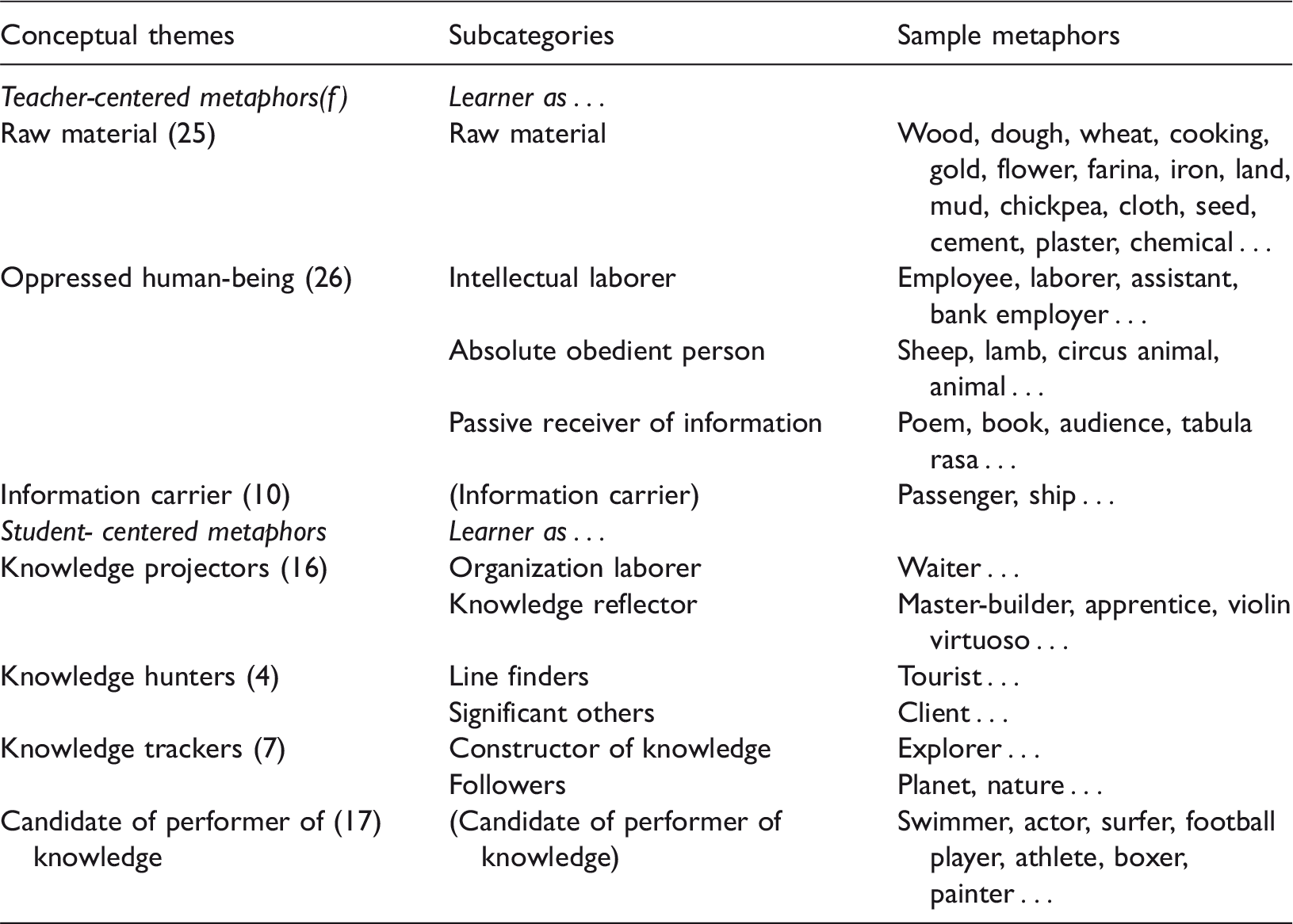
The CTs also perceived the learners as oppressed human beings; for example, as intellectual laborers employed in school-like companies. Within the metaphorical images of the CTs, it was pertinent that it was the teacher who had the knowledge. Thus, the teacher determines the classroom actions. Learners were regarded as intellectual laborers by the CTs, because both the social (e.g. the organization of classroom discursive interactions and exchanges) and epistemic (who legitimates student-led or teacher-led utterances) authority in the classroom should be the more knowledgeable member of the class: the teacher. Learners have an unobtrusive role that is invisible and the dominant role of teachers guarantees the asymmetry and power allocations in classrooms. The learners have lost control of their learning because the teacher holds the control mechanism. Teachers are seen as the authority holding the knowledge; thus, they determine the classroom actions such as assigning turns, selecting the students who can intervene, determining when they can intervene, choosing the topics, posing the questions, evaluating the responses of learners according to the teachers’ non-negotiable correctness criteria. As a whole, there are no co-legitimators or co-evaluators in the classrooms where the students were perceived by the CTs as having unobtrusive roles under the control of the more knowledgeable teacher. A handler modifies an animal’s behavior, directs the animal to do what he requires and the animal must behave as its handler desires. A handler, with his trainer power, trains the animal to follow his commands. (M29, Mathematics)
Accordingly, the CTs depicted the learners as empty vessels because they, the learners, are novices in organizing the thematic and organizational flows in their own classrooms. Thus, learners are not knowledge producers; they are knowledge consumers and carriers. In other words, knowledge is loaded onto the learners; then, they carry isolated pieces of knowledge from one space to another without interrogating its validity or rationality, in a manner similar to ships carrying a cargo.
Student-centered metaphors
The CTs also composed learner-centered mental images for the learners. The first three conceptual categories (e.g., knowledge projectors, hunters, trackers) incorporate fewer learner-centered metaphors, whereas the last (i.e. candidate of performer of knowledge, see also Table 3) is a more learner-centered metaphorical conceptual theme. Within this conceptual theme the CTs paralleled learners as the reflectors of the school knowledge. Students could be a waiter, an apprentice, a tourist or a follower. If there is no island, there is no need for guide. If there is no guide, there is no need for tourists. An island is the place containing knowledge. The guide is the facilitator of the knowledge. Finding your way is only possible under the conditions in which guide leads the tourists, and the tourists should listen to their guide actively since the student resembles a tourist who is an experienced stranger in a new world. The guide shares his experiences with the tourist so they can find their way in the complex ancient ruins. (M51, Mathematics)
Conceptual themes for the concept of school
Teacher-centered metaphors
In the presence of excessive subject-centered metaphors for the concepts of teacher and learner, we anticipated that the CTs would offer overly teacher-centered mental images for the concept of school (see also Table 4). The CTs conjured up the school as a place in which raw materials (the students) are manufactured. In a linear manner, the students are invited to the schools, they are then enrolled in schools and, finally, the students leave the schools by gaining some outputs, the whole process functioning as a mechanical pathway. Through the lens of the CTs, as with a prefabricated system of production learners come to school as untouched materialistic entities (e.g. empty vessels, less knowledgeable others) that will be processed by factory staff (teachers, as more knowledgeable others) as the masters of manufacturing. These factories are controlled and regulated through private companies and their fixed regulations, such as curricula, which have their own history of development and are subject to social and political pressures, as in the other representation of the school by the CTs. If a student is a citizen of a country, then the school is the place in a country in which individuals are developed and trained. The government must discipline every student, and when it [the government] offers services and liberty to its students, the living conditions of the students should be made better.(M39, Psychology) Conceptual classifications of the metaphorical images of ‘school’.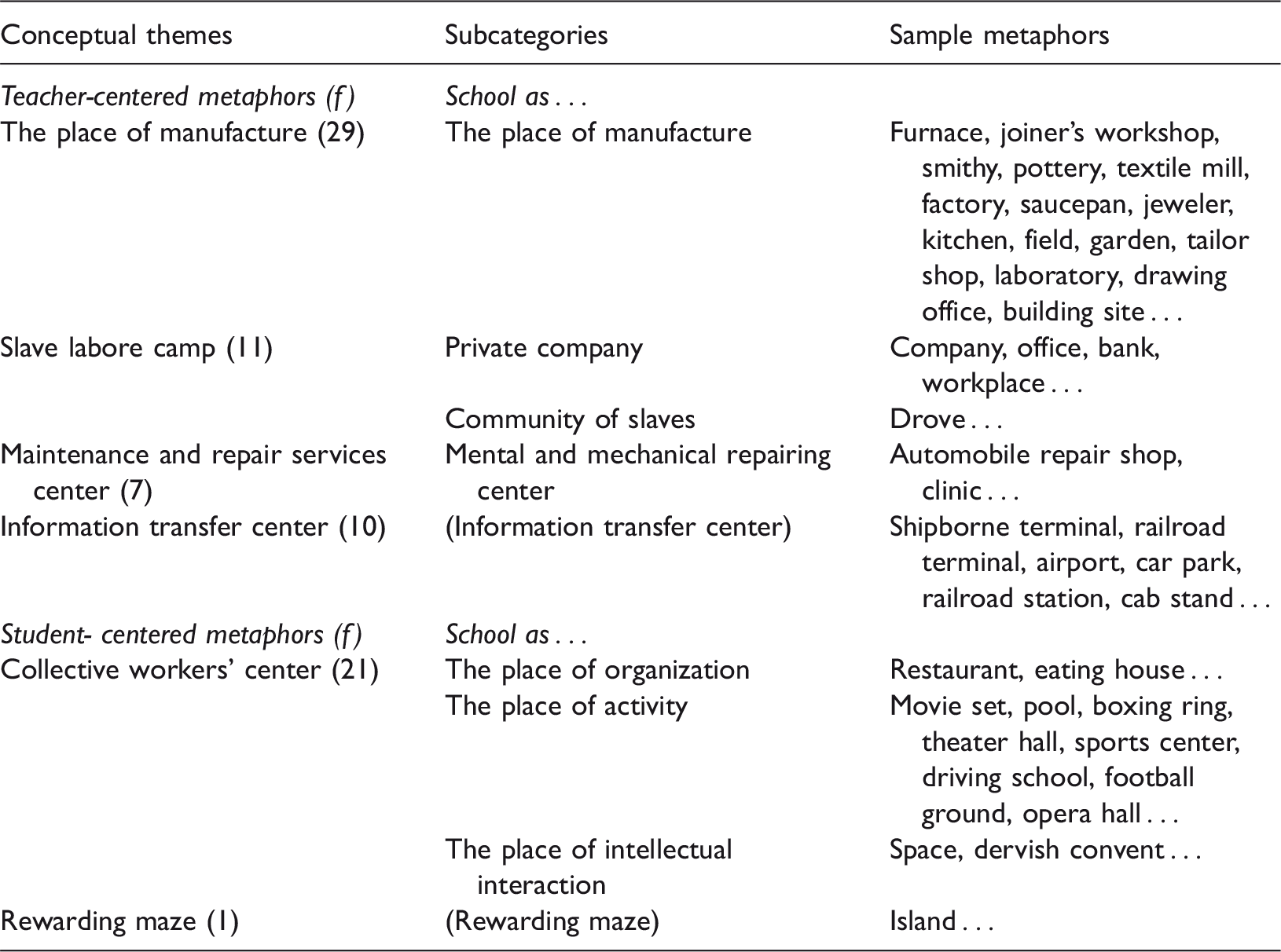
Student-centered metaphors
Schools can also be organic places where there could be authentic interactions between the members of the learning communities, such as from teachers to students and students to teachers. Some of the CTs considered the school as a place of organization and activity (e.g. a movie set, an opera hall, a theater). In these places teachers and students can work collaboratively and synergistically. The sportsman must follow the coach’s advice to achieve the best performance. The arena is the place in which some sporting interactions occur between the coach and students and the students concentrate on demonstrating their skills in the arena with the help of their coaches. (M39, Turkish Literature and Language)
Discussion and concluding remarks
Overall, it is clear from this study that the CTs have not been prepared to undertake the teaching profession in an authentic manner; rather, they have only been awarded a certificate. This suggests that they will not be better change agents in terms of fulfilling the attempted reform-based initiations in Turkey. Teaching is not an issue of transmitting knowledge, using a diffusion method, simply by dictating facts to learners; rather, it is a genuine co-construction of meaning among the practitioners by taking both intra-mental and inter-mental processes into account. However, the certificated teachers were found to be predominantly instructivist or teacher-centered, possessing few emerging cognitive constructivist perspectives. Similar to the findings of Leon-Carillo (2007), the CTs likened teachers to a knowledge-source, direction-setter and character-formatter. Moreover, the metaphors of the CTs were very compatible with Fox’s (1983) fully teacher-centered metaphorical categories of transferring, travelling, shaping and growing; and the metaphorical items given by Oxford et al. (1998) of social order (e.g. manufacturer, competitor, hanging judge, doctor, mind-and-behavior controller, as social engineers who mold students for the needs of society); and Gurney’s (1995) metaphor classification of delivery, a one-way simple transmission of knowledge, change referring to growing or transforming students; and Hadar’s (2009) school learning metaphors that are related to acquiring what teachers say to gain higher grades in exams.
Similar findings to those in the extant literature (e.g. Buaraphan, 2011; Demir, 2007; Fenwick, 2000; Inbar, 1996; Lahelma, 2002; Saban, 2006, 2007, 2008, 2010) were also revealed in this study; and particularly the study by Martinez et al. (2001) which compared the metaphorical images regarding the concepts of teaching and learning of 50 experienced elementary school teachers and 38 fourth year teacher education students. The metaphors produced were categorized in terms of three relevant learning perspectives: behaviorist, cognitive and socio-cultural. More than half (57%) of the experienced and 56% of prospective teachers presented conventional metaphorical descriptions for teaching and learning. They depicted teaching and learning as the transmission of knowledge from source to target. There were relatively fewer teachers who presented cognitive constructivist metaphors, with 38% of the experienced teachers and 22% of the prospective teachers using cognitive constructivist metaphors. The social constructivist metaphors of teaching, in which the teachers considered teaching and learning processes to resemble the social negotiations of meaning with a community of practice, were present in only 5% of the metaphors of the experienced teachers and 22% of the prospective teachers’ metaphors. As a whole, the experienced and prospective teachers’ metaphors did not incorporate a particular meaning of teaching and learning as the context of a Vygotskian perspective. In other words, there were no signs of the Vygotskian perspective implying meaning-making of the concepts under research by virtue of social negotiations of meanings from the inter-psychological plane (e.g. language and other semiotic mechanisms are used to develop and rehearse meanings between individuals) to the intra-psychological plane (e.g. internalization through the mediational means that enable individual cognition) embedded in the metaphors of the both groups of teachers (Scott, 1998; Vygotsky, 1978).
Similarly, the results found by Martinez et al. (2001) were valid for the outcomes of the current study. There were few cognitive constructivist views of teaching in the CTs’ metaphors across the schooling concepts. However, social constructivist perspectives, as the ultimate target of recent curricula (MoNE, 2004a, 2004b, 2004c, 2004d), were not detected in the CTs’ schooling images.
There may be counterarguments that attempt to reject the current dark status of teacher education in Turkey confirmed in this study, particularly for certificated teachers. For example, it could be argued that future professional support, official in-service teacher training programs and related organizations’ attempts will compensate for acute deficits. A close interrogation of these ill-structured probabilities is crucial to shed light on the failing aspects of training so-called certificated teachers. For instance, in 2010 HEC imposed some rigid conditions to regulate the pace of the certification in education. First, HEC (2007a, 2007b) determined that only universities which incorporate a well-established faculty of education or educational sciences departments and highly qualified teacher educators have the right to provide teaching certification for graduates or undergraduates who are enrolled in faculties of science and letters (Özoglu, 2010). In addition, graduates or undergraduates who wish to gain a certificate in education must have a certain grade point average of 2.5 out of 4, the highest diploma grade in Turkish universities.
It was well reported by Sisman (2009) that the deficits of teacher educators in faculties of education in Turkish universities are alleviated by other university workers specialized in different fields. Particularly for secondary education, the departments of faculties of education in Turkey have been filled with university graduates who gained their PhDs from diverse departments of science and letters faculties (Ayas, 2005). Gencdogan (2004) also reported that only 155 (36%) of 400 theses of teacher educators who had been employed in different departments of faculties of education were associated with educational sciences. The remaining255 theses, (74%), were dedicated to fields that were completely removed from educational sciences. In addition, many of the teacher educators employed in various departments of faculties of education in Turkish universities and who appear to be educational theorists have little knowledge of the national educational system, and have little connection with schools and classroom teaching (Sisman, 2009). If this is the case, the certificated teacher candidates cannot possibly achieve pedagogical competences under these conditions within the Turkish educational system.
In addition, it can also be argued that if certificated teachers do not acquire some of the necessary core elements of the teaching profession during certification programs they have a second chance to compensate for this by attaining better pedagogical orientations and enhanced teaching capabilities in future in-service training; however, given Turkey’s history of in-service training, this is not possible. As a constant tenet, the further teacher training of the employed graduates is undertaken during weekends and summer courses in a superficial and artificial manner (Özoglu, 2010).
A comprehensive study by the Turkish Education Association (TED) has shown that MoNE has no additional financial budget to spend over 17 TL for each of the 700,000 teachers employed in elementary and secondary schools (TED, 2009). Furthermore, Turkish teachers do not consider themselves and their profession as an entity that is open to ongoing development and change (OECD, 2009a, 2009b). Large-scale studies have revealed that about six out of every 10 Turkish teachers had not engaged in a higher-quality professional development (PD) program within the two years prior to the study (TED, 2009). Internationally, comparative studies also verify the lower levels of Turkish teachers’ demand for ongoing, onsite and continuing PD. In an international survey study (TALIS, the Teaching and Learning International Survey), the teachers’ needs for PD were measured within 11 different pedagogical capabilities and competences. Both in terms of being engaged in a higher-quality PD program and demanding quality professional support, Turkey (Turkish teachers) was given the lowest ranking (OECD, 2009a). Lastly, Turkish teachers appear to seek remedies for the lack of PD in one-shot, one-day superficial teacher training programs (OECD, 2009b).
As a final comment, the certificated teachers appear to have been trained in order to alleviate the problem of the deficit of quantity in the teaching profession: quality is another issue. In the presence of other related obstacles in teacher education and PD of teachers in Turkey, certificating individuals who are not prepared or inclined towards the teaching profession therefore does not improve the situation in schools. This unplanned and disorganized process, which aims to increase substantially the number of CTs, some of whom may become the core executive part of a school system, has made things more difficult and created seemingly insurmountable barriers. Thus it is possible and reasonable to suggest that there has been a ‘one step forward’ but two steps back’ mechanism regarding arbitrarily certificating a person for a sophisticated and demanding profession.
Footnotes
Declaration of conflicting interests
The author(s) declared no potential conflicts of interest with respect to the research, authorship, and/or publication of this article.
Funding
The author(s) received no financial support for the research, authorship, and/or publication of this article.