




Abstract
This study examines women’s access to education (‘gender justice’) during the rule of the People’s Democratic Party of Afghanistan from 1978 to 1992, using a qualitative research methodology and discourse analysis at the operational level from the perspective of Laclau and Mouffe’s discourse theory. The data collected in this research were extracted from textual sources concerning the role of women in education in Afghanistan in the Marxist era: the importance of the data concerns an understanding of the intellectual and political atmosphere, particularly with regard to women’s education, in the government of the time. It is concluded that several factors contributed to the failure of the hegemonic discourse, despite intensive efforts made by Marxist government to realize hegemony and gender justice. Political agents, availability, credibility and exclusion, as elements of the hegemonic discourse, were evaluated and it is further concluded that these elements were unable to play an effective role in the discourse, as had been expected, and were gradually marginalized.
Introduction
Women’s access to education (‘gender justice’) in Afghanistan has always been a matter of controversy and the subject of heated debates in the social and political history of the country. This polarizing discussion has, in three phases of the history, experienced many high and low points, challenges and opportunities. This includes in particular the period of Amanullah Khan (1919–1928) who made every possible effort to defend women’s right to education. He stood firmly and resolutely against the traditionalists, but his struggles eventually led to his downfall and removal from power. The second phase of the history began with the Marxists coming to power in Afghanistan. To earn acceptance and earn legitimacy, the Marxist government endeavored to spread political awareness among women, to increase their participation in public affairs as well as to help bring about gender justice in the country. The third phase began in the wake of the terrorist attacks in the USA on 11 September 2001 and the collapse of the Taliban regime (1996–2001), followed by the establishment of a new government and the creation of socio-political space for women.
The present research focuses on gender justice during the rule of the People’s Democratic Party of Afghanistan (PDPA) from 1978 to 1992. This discussion is important because the Marxist regime launched a massive campaign to promote and achieve gender justice. One of the most important reform programs was to eradicate illiteracy and to promote education among segments of Afghan society, including both men and women. For instance, in 1978 the then president of Afghanistan (Noor Muhammad Taraki) announced the government’s new policies, which sought to provide free education to all learners as well as to create a environment conducive to eliminating illiteracy (Ministry of Justice, 1978). In line with this program, special courses were held for adolescents and out of school age citizens in every city, town, and village across the country. Efforts were ongoing to introduce fundamental changes to education. The goals and structure and the curriculum changed (Samady, 2001a). A nationwide education campaign was launched and a multi-cultural education plan was implemented in the country’s education system (Sen Gupta, 1986). As noted, these programs were aimed at creating gender justice (Burki, 2011). The questions to be asked are: Given the enormous efforts to attain gender justice, why did the government fail to make its intended discourse hegemonic? Why did it fail to turn ‘gender justice’ into a dominant discourse?
Theoretical and methodological foundations of the research
The research methodology and the theoretical foundations of this study are based on Laclau and Mouffe’s discourse theory, supplemented by Thomassen. Laclau and Mouffe’s general theory is that every practice and event must be discursive in order to make sense, and that the activities and phenomena are understandable in the context of a particular discursive framework. Thus, the social phenomenon can be perfected only when it manifests in the form of a discourse (Howarth et al., 2000).
Laclau and Mouffe’s discourse theory was developed and first presented in Hegemony and Socialist Strategy (Laclau and Mouffe, 1985): however, it was not confined to this work; rather, efforts were made in subsequent works to supplement the theory. Laclau (2000) embarked on designing a model in this regard which studied in particular the antagonism which made articulation possible; and Thomassen also reformulated the model (Thomassen, 2005). Figure 1 shows Laclau’s model together with the reforms enacted by Thomassen.
Laclau’s model, including reforms enacted by Thomassen.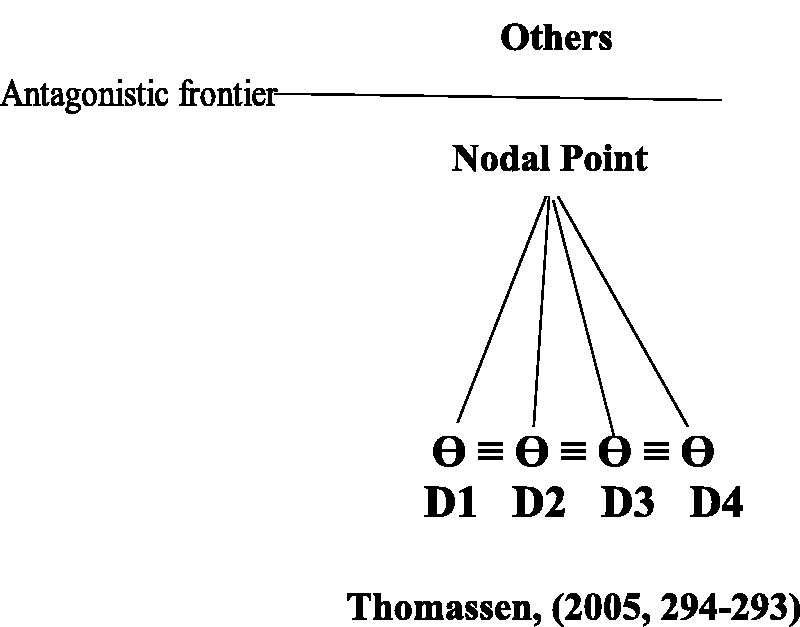
According to the model presented in Figure 1, Laclau shows how an articulation turns into a dominant and hegemonic discourse. In this model, the sign θ has been used to show the moments and the sign = has been used to show the relationship of the moments. In the reformulated model, Thomassen has made use of ≡ by which the moments are placed beside one another on the basis of ‘the logic of difference’. Hence, the sign ≡, which signifies the existence of an equivalence relation (not that of equality) among the moments and signifiers which are ordered in chains of equivalence, is called the nodal point. In other words, the structuration of moments in a discourse takes place around nodal points – privileged signifiers around which moments are ordered in chains of equivalence (Laclau and Mouffe, 1985).The line which is placed between others and nodal point is called the antagonistic frontier, which is used to create hegemony. This frontier line shows the discursive domain or the floating elements and special moments which have been articulated in the discourse (Thomassen, 2005).
The purpose of discourse analysis in connection with the discussion in question is to analyze and consider gender justice as a discourse as well as its formation in an organized and structured totality. In what follows we will deal with the question of whether or not the gender justice discourse became hegemonic during the Marxist period in Afghanistan. If it did not become hegemonic, what contributed to its failure?
Data analysis: articulation of a discourse on gender justice
The formation method is such that the first step deals with the signs and signifiers which help articulation and create a semantic system of the discourse. Then, a nodal point is extracted from within the floating signifiers which, in Laclau and Mouffe’s discourse theory, can lead the reader to the facts. Nodal points organize the discourse around a central privileged signifier or reference point, and a floating or empty signifier is one that is over-endowed with meaning because it is articulated differently within different discourses; thus, they may mean whatever their interpreters want them to mean (Laclau and Mouffe, 1985).
Nodal point: education centered on Marxism–Leninism
The Marxist government in Afghanistan began, from the outset, to change the foundation and method of education. Because education was considered to be highly instrumental in social and economic developments in Afghanistan, the government sought to introduce dramatic changes to educational institutions (Samady, 2001b). The reports presented by the Ministry of Higher Education and the Ministry of Education of the Democratic Republic of Afghanistan in the years 1978 and 1979 indicate that the Afghan government decided to introduce fundamental changes as well as to restructure Afghanistan’s curricula on the basis of the ruling party’s goals and objectives (Andishmand, 2011).
Babrak Karmal, leader of the People’s Democratic Party, speaking at the first congress of teachers, held in Kabul on 24 May 1980, elaborated on the duty of teachers by stating: It is the highly constructive duty of a teacher to inform his students about the goals and duties of the national and democratic revolution of the people of Afghanistan (April 1978) to cultivate patriotic feelings, love of people, love of the country, love of humanity and internationalist feelings; that is, philanthropic feelings together with uncompromising spirit towards the retrogressive ideologies or the ideologies of the enemies of the hardworking people or those of the exploiting and tyrant classes. (Andishmand, 2011)
With regard to women’s education, the same approach was followed. Shortly after the change of government, the Marxists embarked on propagating their ideology. As stated by Mubariz, who accepts this claim, the students were invited to political meetings and activities rather than allowing them to engage in learning and acquiring education in their educational centers. They were fully engaged in politics and there was no room to follow their curricula (Mubariz, 1996).
The textbooks considered and approved by the Marxist government bear witness to the above assertion: the educational programs changed in the wake of the Marxist government coming to power. The education and educational standards in those schools which followed a French model were changed to Russian; and the Russian language replaced English (Samady, 2001a). The new textbooks were prepared on the basis of Leninist–Marxist ideology about which, the central committee of the People’s Democratic Party considered, it was a formal duty of the teachers to propagate and teach. The teachers were, therefore, obliged to use the new books in education centers (Vickers, 2008).
The question now is why the government embarked on providing education based on Marxist theory, bearing in mind the fact that Marx himself considered ideology to be false consciousness – a reference to the systematic misrepresentation of dominant social relations in the consciousness of the subordinate classes (Bill, 1972). One reason could be this that ideology, in turn, is one of the most important controlling levers, and even a key factor, in shaping an educational system. The government had reached the conclusion that education was highly instrumental in institutionalizing doctrines and beliefs; and, if it wanted the Marxist doctrines to be institutionalized in Afghan society, one of the important ways to make it happen was to use education.
The signifier of support for women
Women enjoyed a very high status in the manifesto of the People’s Democratic Party of Afghanistan. They were spoken of in all its programs and platforms as a segment of the Afghan society whose rights had been violated in the past and that they required their lost privileges to be restored so that they could attain their original status (Marx and Engels, [1848] 2002). It can be said that women’s situation at this time was markedly different from their situation in the past because they experienced a new and fresh period in terms of education and employment.
There are various explanations about what led the People’s Democratic Party of Afghanistan to give priority to supporting women. For example, Peter Marsden argued that the reason the government supported women was because it was seeking to modernize everything, which eventually led to an increase in the participation of the women in the government – especially in the educational sector (Marsden, 2002). Burki is of the view that different problems encountered by the government made it face the risk of illegitimacy (Burki, 2011). That was why defending the rights of women, which could enable the government to win the consent of half of the people of the society, was considered to be a redeeming proposition.
Assuming both explanations to be equally likely, it can be said that the ruling party’s concern for women’s rights in its programs largely originates in the ideological programs of the party which were based squarely on Marx’s principles about women’s rights. Given that this government had set and arranged its fundamental structures, including the educational structure, on the basis of Marxist theory, it made significant efforts to empower women to have access to education. Gender equality was considered to be an obvious and indisputable principle of Marxist theory, which stressed complete equality of men and women in all social, political and economic arenas. With regard to the extent to which the statesmen struggled to draw women nearer to Communist teachings, the answer is provided in the ‘Nodal Point’ section of this study.
The signifier of educational justice
Access to justice, according to the Marxist theory of justice, was considered to be among the main goals of the People’s Democratic Government of Afghanistan, especially in the field of education. In a directive issued in April 1980 by the government, it was emphasized that all citizens of the Democratic Republic of Afghanistan, regardless of their ethnicity, religion, race, gender or socio-economic status, had equal rights to education (Samady, 2001a). Article 7 of the first chapter of the basic principles of the People’s Democratic Republic of Afghanistan states that, ‘The goal of the Democratic Republic of Afghanistan is to eliminate economic, social and cultural inequality in all parts of the country’. In addition, in the second chapter, articles 8 and 20 speak of the equality of all Afghan citizens before the law. Thus, it was emphasized that ‘all Afghan citizens regardless of racial and tribal affiliation, language, gender, place of residence, religion, education, descent, property and social status have the same rights and obligations’ (Ministry of Justice, 1980).
It can be said that justice, with its special interpretation, enjoyed high status and respectability in the Marxist system. The Marxist theory and conception of justice was to enable the proletariat (the poor) to achieve their independence and attain a higher social class, as well as to help this class achieve victory in the war against the bourgeois class (the elite), this latter being considered to be the main factor responsible for injustice in human society. For this reason, Engel’s teachings, always directed towards criticizing the political economy of capitalism in a bid to achieve the communist utopia, constituted the central idea of social justice.
However, the questions then are: Why did the Afghan government fail to achieve gender justice? Why did Afghan society fail to attain what the government had seemingly assured in the code of conduct and constitution? The answers to these questions are presented in the section on ‘gender justice becoming hegemonic in the Marxist period’.
A signifier of a changing educational system
Here we will consider three major educational plans developed and introduced in the time of the Marxists:
The National Literacy Plan; Changing the Educational Curricula 4; and The Multicultural Education Plan.
Implementation of two of the above programs was a step forward in attaining gender justice because it contributed significantly to achieving and realizing gender justice. Further details of the three programs are as follows.
The National Literacy Plan
During the rule of the People’s Democratic Party of Afghanistan, Noor Muhammad Taraki presented the country’s first general programs in May 1978. He spoke of ‘providing primary education, free and compulsory, for all children of school age and ensured that all the basic conditions for an effective campaign against illiteracy would be created’ (Kishtmand, 2002): this was partially implemented later, in the literacy program. Following this program, the government’s second farman (order) was issued emphasizing a nation-wide literacy campaign in urban and rural areas, cities and villages. The aim was to pave the way for the country’s population between the ages of 10 and 50 to become literate. According to this order, literacy was regarded vital and an appeal was made to all active members of the society to mobilize themselves and ‘join hands’ to turn this plan into a nationwide program (Vickers, 2008).
However, this program was not as successful as expected, due mainly to the fact that it was later politicized and became ideological. Kishtmand maintained that the emotional and rebellious actions of the political agents of the People’s Democratic Party of Afghanistan led to this breakdown and failure (Kishtmand, 2002). The problems and obstacles created by the opponents to this and other programs must be regarded as other factors responsible for the failure of the programs launched by the government (Baiza, 2013). All of these factors led the government to abandon focusing on rural areas and to concentrate its efforts and resources instead on the major cities, such as Kabul, Herat and Mazar Sharif, which were deemed to be under government control. Although these programs did not have any impact on women in the rural communities, according to the statistics women comprised up to 70% of teachers, 40% of doctors and 50% of students in the universities in the major cities (Burki, 2011). They even had a strong presence in those supposedly ‘men-only’ fields such as law and engineering. There was also another reason associated with women’s strong presence in these fields; it was due mainly to the fact that most of the men had joined the Mujahedeen or Islamists or were engaged in the war while doing military service (Burki, 2011).
Refining goals, structure and curriculum
The new government made significant changes to the goals, method and contents of the textbooks which it was intended would, in some way, affect women’s education, role and qualifications (Samady, 2001b). It was announced by the government that learning Pashto was no longer compulsory. The entrance exam was removed and students could enter the ninth class after finishing the eighth class without having to take an entrance test. These reforms were intended to result in more and more women entering the educational cycle and help achieve gender justice because, hitherto, thousands of girls failed annually to progress because they were frustrated and obstructed by the entrance exam (Samady, 2001b).
It can be concluded that the reforms made in the curriculum led to positive developments enabling women to benefit from the educational opportunities that were made available. However, it should be noted that two important decisions were perceived as more eye-catching and more important achievements.
First, it was announced that Pashto was no longer a mandatory subject and a medium of teaching and communication (as will be explained below). Second, the abolition of the entrance exam after the eighth class. Success in this exam was required to enter the next and higher levels of education and because passing the entrance exam was a major task, many students gave up on continuing their education. The People’s Democratic Party removed this obstacle.
This second decision on the part of the government was considered to be highly significant and it clearly had an impact on the area of gender justice because the entrance exam was regarded as a major barrier for girls at a time when they were desperate to attain higher levels of education. Thus, this decision on the part of the government was not only a positive step but it was also considered to be a unique achievement.
Multicultural instruction in the educational system
In one of the orders issued in April 1980, attention had been drawn to the mother tongue and cultures of religious minorities. The order read as follows: All Afghan nationals have the right to choose their mother tongue as the language of instruction and learning. The government is taking action to promote education, eliminate illiteracy, facilitate instruction in the mother tongue and to develop free intermediate and advanced professional and technical education. (Ministry of Justice, 1978)
Indeed, the political background of this program should not be overlooked, because certain factors seem to have played a very important role. Fear of the influence of Persian language was the driving force that motivated the government to make this decision, as Sen Gupta (1986) claimed, because the government was afraid of the influence of the idea of Khomeinism by way of the Persian speakers, and especially the Hazara Shiites. That was why the government allowed the local languages to replace Persian (which is a common language of Iranians and part of the people of Afghanistan).
In addition, the government’s decision to follow the Union of Soviet Socialist Republics (the USSR) as a model should not be overlooked. It was on the basis of this model that the national identity was formulated, within the framework of Marxist ideology – one of the requirements of which was to give credit to the languages of the ethnic minorities in Afghanistan. In addition, Islam as a religion opposed to the communist state was depicted and portrayed as the main factor responsible for the backwardness of the countries in the region; but this argument was not sufficient per se and other actions needed to be taken. Thus, efforts were made to marginalize Islam and support national identities such as Afghanistanism, Turkmanism, Tajikistanism, etc., as a pan-Islamic identity. At a lower level exactly the same occurred with the existing smaller ethnic groups in Afghanistan. There, the aim was to break up and end the power monopoly of the Pashtoons over other Afghan tribes, which would eventually lead to establishment of a democratic social Afghanistan (Lall and Vickers, 2009).
The multicultural education of women and instruction in the mother tongue were aimed at helping girls from the minority groups to learn better and more easily. Therefore, apart from other factors, the benefit of learning in one’s own language should not be overlooked, and the effort made to make this happen must be considered to be a positive point in the field of education during this period.
Discussion
Gender justice becoming hegemonic during the Marxist period
A question that may arise in this regard is whether or not gender justice could gain hegemony during the period of the People’s Democratic Party of Afghanistan. In other words, despite all the efforts by the Marxist government to make education public and available for all, how far could it achieve its objective in creating gender justice? To give an answer to this question, it will be necessary to determine whether gender justice was a hegemonic discourse during the Marxist era in Afghanistan. Hegemony as the purpose of every discourse is the best way of exercising authority, by influencing the minds and persuading people and groups (Marsh and Stoker, 1998). A system can be hegemonic only when its favored semantic system is appealing to the general public in a way such that popular groups abide by it without coercion and force, in a manner that is moral and thoughtful. To arrive at our answer, four major indicators of a hegemonic discourse during the period of the Marxist government in Afghanistan will be studied, and then gender justice will be evaluated in that period taking these four factors into consideration.
The Marxist government of Afghanistan came into being out of a society which carried strong traditions mixed with tribal and religious values. With no regard for the ideologies and traditions of Afghan society, the project of educating women went ahead rapidly, and views and ideas which were opposed to the common Afghan beliefs were imposed. With regard to educating girls and public opposition during the Soviet rule, Marsden believed that most of the refugees left their country for Iran and Pakistan because they were afraid lest their daughters should become influenced by the Marxist materialist ideology (Marsden, 2002). Equally, the people reacted to this type of performance by the government, and the reaction very quickly manifested itself in the form of killing women wearing Western fashions, the murder of the reformists affiliated to the People’s Democratic Party in the villages, and harassment of female social activists (Moghadam, 1997).
The capitalism system, which, according to the Marxists, resulted in gender inequality and class-based society and which, they believed, would never lead to gender justice in society; and Islamism, whose ideological and intellectual principles were, according to the Marxists, the main cause of injustice against women and in the view of which women did not have a status better than that of a slave.
Indeed, the ruling party was confronted with otherness in its fragile insider discourse, which had a major impact on the disintegration and deconstruction of the Marxist discourse. In this discourse competition, education was an appropriate, deceptive tool which the Marxist state could use to bring to the general public’s notice its positive aspects and destroy the rival group. To promote and achieve their political ends, both the Marxist factions (Khalq and Parcham) had embarked, before coming to power in 1978, on publicizing themselves by making use of educational institutions. According to the People’s Democratic Party of Afghanistan, making use of education to further political ends was not only good but it was also recommended (Baiza, 2013); thus, the government used textbooks on social sciences as one of the main channels for transmitting its political message. In its curricula, urban patterns and models were defended and, in contrast, there was disapproval of traditional etiquettes, customs and models as symbols of retrogression and backwardness (Amiri et al., 2004). The government therefore aimed to maintain its own interpretation of ‘self’ and ‘others’ in the subjects’ minds in order to attain and consolidate semantic hegemony. It claimed that only the communist state could save women from the difficulties and stalemates which they faced.
Therefore, despite all the efforts to make gender justice a hegemonic Marxist discourse, not only did it not become hegemonic but also, due mainly to the insufficiency and inefficiency of the aforementioned factors, this period remained in the public mind as a haunting, unforgettable tragedy and a dangerous nightmare. The political factors, rather than any others, had a more important role in bringing this discourse to a halt. They can thus be regarded as the most important factors responsible for the hegemonic failure.
Conclusions
The formation of gender justice in the Marxist system of Afghanistan revolved around a Leninism–Marxism signifier which linked together and gave sense to the other signifiers in a single semantic system. The correlated signifiers included education of women, gender justice, multicultural education and reform in the educational system. The aim was to attain power through domination by means of the Marxist discourse. The Marxists regarded gender justice from an ideological perspective. They maintained that women had suffered injustice throughout history and the suppression of women was linked to the class struggle and labor and economic issues. The injustice was seen as being entirely rooted in the capitalist system, and the only solution to this dilemma rested in the disintegration of capitalism and, by extension, a change in the performance of the family and patriarchal role and helping women to attain their full status. The discussion concerning gender justice and women’s accession to education can be better explained from this perspective in the Marxist discourse.
In line with this objective, the Marxists took certain effective steps during their period of rule, including a nationwide literacy plan, modification of textbooks, omission of entrance exam requirements for class 9 and paying attention to the multicultural features of education. Although all these actions resulted in providing easy access to education for all women in that period, they did not achieve their goals as planned.
In this arena, the Marxists had two important and powerful opponents to their discourse. The women’s issue was at the forefront of the ideological confrontation between them and the opponents of the Marxists’ discourse in Afghanistan. The capitalist and feudalist system on the one side, and Islamists on the other, were considered to be the biggest rivals of the Marxists’ discourse.
The semantic system of the gender justice discourse in Afghanistan in the Marxist period can be outlined on the basis of Laclau and Mouffe’s (1985) discourse theory supplemented by Thomassen (2005), as shown in Figure 2.
The semantic system of the gender justice discourse in Afghanistan in the Marxist period.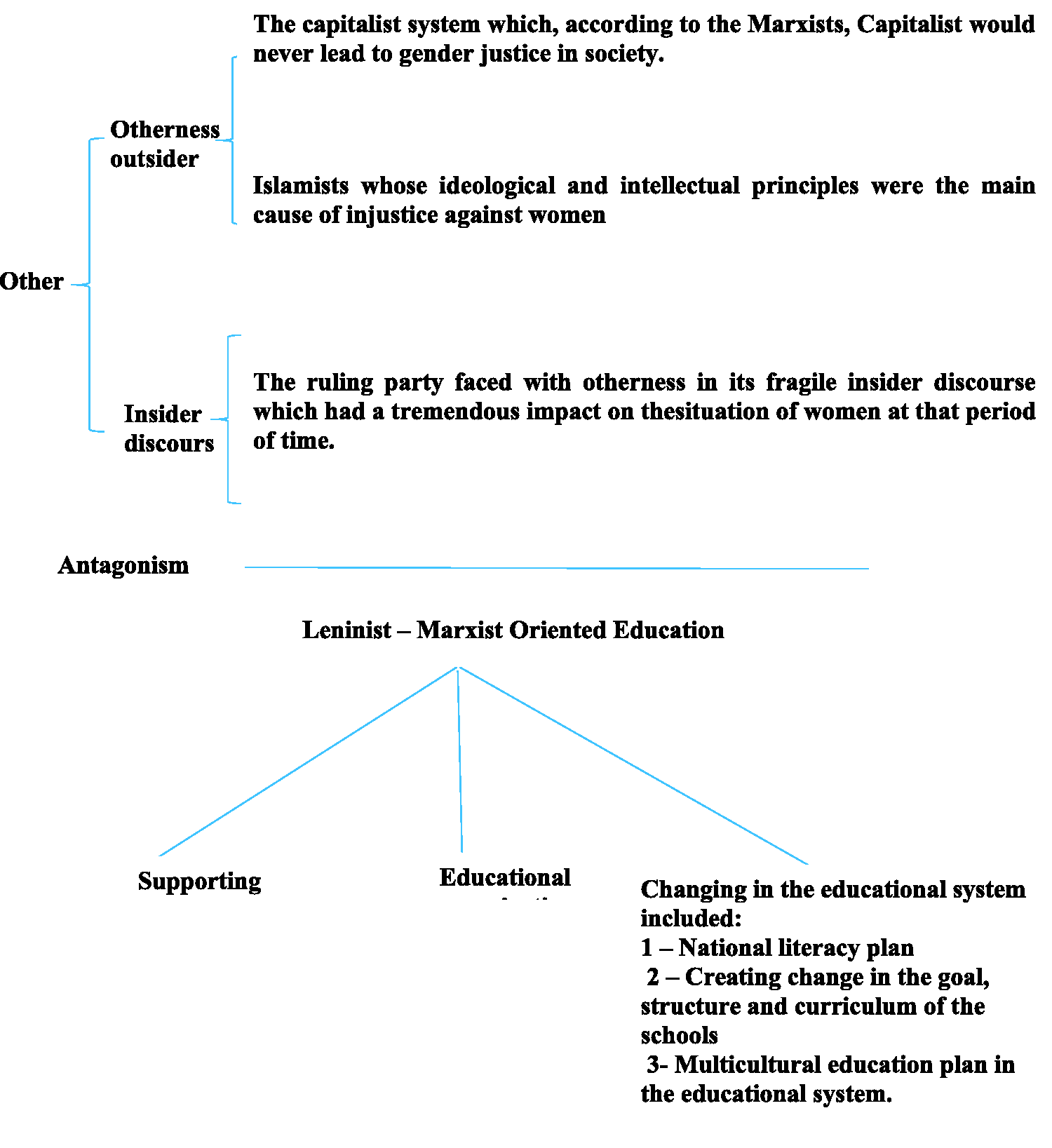
Figure 2 shows the semantic meaning of the gender justice discourse during the Marxist period in Afghanistan, based on which the government sought, by nominating the Marxist education as a nodal point, to give sense to other floating signifiers. As was noted above, gender justice in the Marxist system of Afghanistan was confronted with setbacks and problems which can be considered to be some of the factors responsible for the failure of the Marxist discourse to become hegemonic. Hence, the four elements which can make a discourse hegemonic – political agents, credibility, availability, and expulsion and foregrounding of the political agents – were unable to play their role as expected. Equally, factors such as opposition to the ideology, politicization of education and especially the education of women, instant but inconsiderate actions, and the strength of the rival discourse led this discourse to be finally moved to the periphery and no longer be able to attain complete formation of its semantic system.
Footnotes
Declaration of conflicting interests
The author(s) declared no potential conflicts of interest with respect to the research, authorship, and/or publication of this article.
Funding
The author(s) received no financial support for the research, authorship, and/or publication of this article.