




Abstract
In the field of English Language Teaching (ELT), attention has been shifted toward the alternative role of teachers as transformative intellectuals whereby transformation in teaching occurs from control and technical operations to criticism and intellectual reflection. This role enables teachers to focus on marginalized students’ lived experiences and worlds to transform them into active and critical citizens who are emancipated to develop their voices and question the status quo. Through critically examining the learning milieu that maintains injustice and inequality, students struggle to connect it to sociopolitical conditions in wider society, and eventually transform it to meet the desired ideologies and thinking. This paper attempts to scrutinize teachers’ role as transformative intellectuals and their challenges through the transformation process. Thus, the researcher used purposive sampling to select 26 teachers in four private language institutes of Tehran, Shiraz, and Yazd, Iran to adopt the role of transformative intellectuals based on theoretical principles and concepts of critical pedagogy. Semi-structured interview and an online focus group were used to collect data. Data analysis disclosed transformations and benefits as well as the challenges resulting from teachers becoming transformative intellectuals. The fruitful findings of this study are insightful, since this study is an example to show how language teachers can create transformation in the EFL context, change their fossilized role, and empower oppressed students within the institutionalized and oppressive system of schooling.
Keywords
Introduction
The role of teacher in teaching practices is a perennial issue that has attracted the attention of researchers and educators over the years. Language teaching is also overwhelmed with a multitude of metaphors which have been conceptualized for teachers, reflecting the dominant ideologies and values embedded in the prevalent methodologies of the time. Kumaravadivelu (2003) believed the concept of the language teacher role was traditionally conceptualized as that of passive technicians, tracing to the behaviorist paradigm, assuming that content knowledge in the form of clearly articulated facts and rules was broken into manageable pieces in order to be absorbed by passive students and then, as Giroux (1988) puts it, was assessed based on predefined forms of measurement.
Based on this transmission or technicist view, in Kumaravadivelu’s (2003) sense, teachers rely on professional experts as the producers and contributors of knowledge base or curriculum packages in the educational circle. In this regard, according to Giroux (1988), teachers carry out the objectives and dictates of experts, detached from the realities of the language classroom life. Through this process, the teachers’ role is restricted to that of a conduit which channels the flow of information content from experts to learners without any alteration (Kumaravadivelu, 2012). This process in teaching is also called the proletarianization of teachers’ work, by which teachers manage and implement curriculum programs rather than critically appropriate and develop curricula to suit pedagogical concerns (Giroux, 1988). In other words, the process of proletarianization that teachers experience results in the loss of their autonomy, changing them into technicians (Apple, 1986) who are passive (Kumaravadivelu, 2012).
During the postmodern era, the field of English Language Teaching (ELT) education has developed by means of a myriad of novel ideas, philosophies and thoughts from different scholars such as Auerbach (1995), Giroux (1988, 1989), McLaren (1995, 1998, 2000), Kumaravadivelu (1999), and Pennycook (1990), who themselves were inspired by the insightful ideas of Freire (1972). In fact, critical pedagogy as an alternative approach to language learning and teaching (Safari and Pourhashemi, 2012, 2015) has emerged to respond to the lack of consideration of the traditional approaches to the socio-historical, political, and economic resonances in the ELT context. Critical pedagogy embraced the idea that in education, social, political, historical and ideological forces should be challenged by both students and teachers, as this empowers students to obtain essential social skills and knowledge in order to become critical agents in wider society (Giroux, 1988). In this process teachers are required to transform into transformative intellectuals who help students to become liberated, critical thinkers, and social agents who will operate as active citizens in the future.
Due to the significant role of teachers in the liberatory pedagogy as transformative intellectuals, it is wise to consider the challenges they face in addition to the transformations and benefits obtained through this transformative route. An exploration of teachers’ mission during this process gives insights to policy makers, educators, and teachers who are eager to bring about transformation in education. This understanding is crucial, in that any obstacles facing language teachers through the journey of moving from technicists toward transformative intellectuals can be predicted and resolved by the officials prior to allotting resources and funding. This paper is in fact a step toward illumination of insights and understanding in the case of a group of English language teachers who were commissioned to adopt transformative intellectuals through the implementation of critical pedagogy.
Language teachers as transformative intellectuals
Based on ethics of Foucault, transformative intellectuals are considered to be telos in critical pedagogy (Yoon, 2005). The telos in Aristotle’s philosophy is the eventual aim of any particular entity. In his view, the telos is the excellence of entities, since it consists of the essence and is characterized as the unique quality of the entity for which it has primarily been designed. In the case of humans, human excellence means reasoning, since it is the main distinguishing feature of human beings. Thus, the telos of human acts is the ability to do reasoning and do it well, since it is by means of this reasoning that in the political and moral realms happiness is achieved (Dale and Hyslop-Margison, 2010). In sum, the telos refers to a state of being or a mode which is ideal, and an individual aspires or strives in his or her ethical work toward it. It is the act of self-mastery which is aimed at achieving a state of moderation characterized as liberation in the fullest form (Robinson, 2011).
In his book Schooling and the Struggle for Public Life, Giroux (1988) defines the features, goals, and responsibilities of transformative intellectuals. In this book, the transformative intellectual is described as a type of political activist and intellectual who exercises pedagogy and intellect to inject learning and teaching into the political domain. The transformative intellectual has reached the point of understanding that the process of schooling is necessarily a struggle of power and meaning. In Giroux’s sense, a transformative intellectual’s mind allows him or her to carefully examine social constructions and express possibilities for emancipation. This is the individual who seeks the type of consciousness that is higher in nature, and this vantage point enables him or her to realize different contradictions and social interests. Giroux argues that the person who acts as a transformative intellectual is required to question knowledge and how it is constructed, shared, and distributed. According to him, a transformative intellectual makes an effort to work toward liberation, makes use of dialogue, makes knowledge critical, meaningful, and eventually liberatory, and treats learners as critical agents. Giroux believes that a transformative intellectual’s duties are to challenge learners through dialoguing and to push them to be transformed into active citizens, and to insert meaning into a meaningless and oppressive system of schooling which they are not able to resist or discern on their own.
In fact, the transformative intellectual’s mission is to emancipate not only students but also themselves from the hegemony of dominant agendas, ideologies, and interested knowledge transmitted from top-down hierarchies and structures in the oppressive system of education and schooling. Thus, according to Giroux (1989), one of the threats faced by teachers working in public schools is the ideology that highlights a technocratic approach to language teaching and pedagogy. These ideologies in the process of schooling operate as a hidden curriculum which emphasizes practical and instrumental factors. Hence, teachers who lack agency and autonomy are devalued, deskilled and considered as executors of dominant knowledge, principles, policies, and agendas imposed on education.
The instrumental rationalities and technocratic ideologies, as Giroux (1989) argued, reduce teachers’ autonomy concerning the development of curriculum and judgment of its implementation. This underestimation of teachers’ role can be seen in what Apple (1986) calls teacher proof in the form of curriculum packages. The rationale behind the use of these packages is the implementation of pre-selected and pre-determined knowledge and content which can be broken down into separate pieces and delivered to students for consumption (Kumaravadivelu, 2012). Taking the role of transformative intellectuals provides language teachers with the opportunity of transforming the curriculum and moving beyond the transmission and technocratic approach to teaching and learning. The educational space constructed through the process of transformation nudges teachers and learners into critical thinking and praxis to question any deep-rooted assumptions, facts, and myths within language education. This emancipatory process allows them to see education as a political sphere in which the ideologies of those who are in power are infused. As Giroux (2004) puts it, “Education, in the broadest sense, is a principal feature of politics because it provides the capacities, knowledge, skills, and social relations through which individuals recognize themselves as social and political agents” (p.81).
In sum, the role of language teachers as transformative intellectuals or social and political agents in Giroux’s (2004) sense is an emancipatory role whose outcomes involve meaningful education, social justice, equality, liberation, and salvation. Transformative intellectuals are critical pedagogues who establish a relationship with their students based on mutual understanding, compassion, and common goals (Darder, 2003; Zembylas, 2013). They try to prepare students as critical agents to transform the larger community and the society they belong to, to resist inequalities and injustices which conflict with their emancipation, and to critically question the status quo and oppressive education that has marginalized them over the years.
ELT Education in Iran
ELT practices in Iran as an EFL context is restricted to two systems of language education which are both controlled and supervised by the Ministry of Education. The first system involves the language program, administered in all public schools in Iran. The English textbooks and materials are all designed, developed and provided by the Ministry of Education, and all schools are obliged to use them for teaching practices. For years, teaching and learning English in public schools has been based on traditional systems and the Grammar Translation Method (GTM). Although a reform has recently occurred in the language program of the ministry and communicatively based textbooks have been introduced into schools, teaching is still based on the banking model of education in which students are silent and passive and are accustomed to listening meekly to their teachers through the process of schooling (Izadinia and Abednia, 2010). It is also highlighted by Safari (2016) that teacher-fronted pedagogy is in conflict with liberation, equality, social justice, and democracy.
On the other hand, private language institutes communicatively present language programs to compensate for the deficiencies of the public schools in training proficient English students to appropriately use English in their real lived experiences outside the classrooms. Language institutes in Iran are hierarchically controlled and supervised by the Ministry of Education. The permission for establishment of an institute must be issued and authorized by education organizations such as the branches of the Ministry of Education located in different cities of Iran. Thus, the language system in institutes is strictly controlled and monitored by officials of the ministry in order to be in keeping with Islamic-Iranian culture, ethics, and the principles of the Islamic government. For instance, there is no co-education in either public or private schools, regardless of students’ age, as happens among children of five or six years of age.
Each institute should also serve language tuition exclusively for just one gender, male or female; or the buildings of each institute should be at least 200 m away from each other, to ensure they are not in constant contact with each other. And institutes will be locked and sealed by the authorities in case of violation of the laws. It should be highlighted that most of the institutes use PPP (Presentation, Practice, Production), ALM (Audio Lingual Method), CLT (Communicative Language Teaching), TBLT (Task Based Language Teaching), or a mixture of them as their language teaching methodologies. The concept of method overshadows the language programs of institutes, although the managers of institutes are somehow free to use teaching principles, materials, and textbooks which are appropriate. The term “somehow” is used here as far as the institutes’ system not conflict with the revolutionary, Islamic, and cultural principles and values.
The employment of English teachers in private language institutes is also controlled by the Ministry of Education. First, skillful and knowledgeable English teachers are selected by the institutes; they are then interviewed by the officials of the education organization to see whether they ideologically and politically match the ethics of the Islamic Revolution of Iran. Those English teachers selected teach based on the abovementioned methods, and try to utilize interactively based activities in classes to promote students’ language learning. On the whole, both the language system of institutes and the English teachers greatly impact Iranian students’ competence and prepare them to respond to the challenges and demands of the globalization trend.
Purpose and significance of the study
Qian (2007) believed that teachers as the knowledge transmitters: have been given absolute authority and students are not expected to challenge this kind of authority. As a result, students are not encouraged to form their own opinions and thoughts. They are used to looking for keys to questions from their teachers and textbooks. We teachers, as both victims and practitioners of this kind of long-term educational practice, often find that it is very difficult to hear original and fresh ideas from our students and ourselves as well (p.45).
The dialogic approach to language learning and teaching challenges the lecture and transmission form of instruction in favor of interaction, dialogue, and communication among teachers and students. According to Bakhtin (1981), all language is dialogue and a social practice. In fact, dialoguing is in contrast with monologic approaches (Lyle, 2008) such as banking education, which is prevalent among pedagogical practices in various parts of the world and is characterized as a hierarchical approach which aims at oppression, domination, maintenance of status quo, and formation of culture of silencing and obedience among students.
The role of teachers as transformative intellectuals, which is a characteristic of critical pedagogy, is a step toward students’ emancipation, challenging the tyrannical system, promoting dialogue in language classrooms, giving voice to oppressed students, and bringing about equality, fairness, and social justice. As Izadinia and Abednia (2010) argue, the significance of the development of students’ voices through critical pedagogy is due to the fact that they dare to resist and oppose rigid structures, rules, beliefs, and ideas. Without this opportunity, they remain silent, submissive, and obedient. Thus, the role of language teachers as transformative intellectuals becomes absolutely different from their role as transmitters of knowledge. The significance of this research is that it explores the benefits, opportunities, transformation, and challenges that a group of Iranian English teachers will experience due to embracing the role of transformative intellectuals through a democratic journey within the institutionalized system of education. The results of this study may be like a flashlight, illuminating the route along which many teachers dare not take any steps.
Method
This qualitative study was conducted in the EFL context of private language institutes of Iran. The EFL context of Iran includes both Iranian public schools and private language institutes. The EFL program in public schools is totally under the jurisdiction of the Ministry of Education and based on predetermined instructional materials, textbooks, and instructional activities (Safari and Rashidi, 2015a, 2015b). Due to the lack of teachers’ agency, teachers’ and students’ passivity, and the domination of the banking model of education in public schools (Safari and Sahragard, 2015), the researcher selected the participants from private language institutes. In language institutes, students register for English classes in order to promote their communicative skills and capabilities based on their needs. The teaching methodology which is prevalent in language institutes is CLT and task-based language teaching and learning. However, teachers have agency and autonomy to select activities which enhance interaction among students and give dynamics to classroom practices and activities. Thus, the participants in this study did not have any problem with regard to taking the alternative role of transformative intellectuals.
The participants of this study were 26 English teachers (14 females, 12 males) who were MA graduates of ELT or English literature from Tehran (n = 8), Shiraz (n = 7), and Yazd (n = 11), Iran. All the participants were English teachers working in different private language institutes in these cities. The selection of these participants was based on purposive sampling, also known as the judgmental sampling, which is a sort of non-probability sampling. On the basis of the email addresses of the researchers, teachers, and paper presenters who took part in national and international ELT conferences held in Iran, the researcher initially selected 57 email addresses. Then, an email was sent to each of these participants asking for participation in this study. Twenty-six participants finally agreed to participate in the study.
In this study, the researcher followed the ethical guidelines proposed by Christians (2005) for the implementation of the study, including gaining informed consent from the participants, staying away from any deception, keeping participants’ confidentiality and privacy, and ensuring them data accuracy. For instance, to protect participants’ privacy and confidentiality, the researcher assured them all at the beginning of the research that no information would be divulged regarding their personal identities and names in the research. Alternatively, oral consent was gained from them all, and they were provided with information about the study including its purposes, time, practicality of findings, their contributions in extending this area of knowledge, ethical issues, and their rights as research participants.
The researcher used interviews as a data-gathering method for educational studies to collect enriched qualitative data. According to Englander (2012), interview is the main procedure for data collection linked with qualitative human research. Accordingly, in Kvale’s (1996, 2003) sense, the interview allows the researcher to explore people’s perspectives in greater detail and depth. Cohen et al. (2007) also add that the interview is “a valuable method for exploring the construction and negotiation of meanings in a natural setting” (p.29). Thus, the value of the interview is to enable the interviewees to “speak in their own voice and express their own thoughts and feelings” (Berg, 2004: 96). So, semi-structured interviewing was used in the present research to allow flexibility and provide an emphasis on individuals’ understandings of issues and events. It is also based on what individuals view as significant in understanding and explaining patterns, events, and behaviors.
To triangulate the qualitative data, the researcher also utilized an online focus group as a new method of data collection in qualitative research. Innovative communication and informative technologies such as the internet provide creative and unique opportunities for qualitative investigators. Social researchers have started to identify the opportunities that the internet offers to recruit research participants (Turney and Pocknee, 2005). Over the last few years, online survey research has increased (Pocknee and Robbie, 2002), allowing many more individuals to have their voice. This type of data collection method has the potential to precisely record discursive data as texts, and to supply anonymous and safe milieus for people, and is considered as an advanced research instrument (Turney and Pocknee, 2005).
According to Im and Chee (2006), the online focus group offers a method for investigators to communicate with people in different geographical places. In this regard, Stancanelli (2010) also stressed that this method can be implemented in the case of populations which are hard to reach in qualitative study. The construction of online groups and interaction among the members lead to the provision of data which are helpful in illuminating different issues. Watson et al. (2006) also examined the communication of group members through virtual focus groups, and stressed that online group members are able to establish a cohesive union.
Participants sent their phone numbers through email as the first step of conducting the online focus group. Then, the researcher created a virtual group through Whatsapp and added each participant as a group member. The purpose of constructing this virtual group was not only to gain familiarity with the participants, but also to provide a space for social interaction and communication. Thus, a mediation space allowed the researcher to feasibly communicate the aims and purpose of this study. As they became familiarized with the underpinnings and theoretical considerations regarding critical pedagogy and the role of teachers as transformative intellectuals, each teacher was required to perform his or her role as a transformative intellectual in language classrooms. In case of any problem regarding conceptual understanding and pedagogic practices relating to this issue, the researcher referred the participant to relevant books and articles on the internet. It is also needs to be emphasized that all of the study participants had already taken some courses in their graduate studies on Critical Pedagogy (CP) and Critical Literacy, wherein the main focus is on the nature of students’ learning not only as the members of their classrooms, but also as the future members of larger societies where intervening and competing ideologies, thinking and people of divergent social, ethnic, religious, and educational backgrounds are living together. Meanwhile, we provided some introductory videos authored by CP figures such as Peter McLaren, Noam Chomsky, Howard Gardner, and Bruno della Chiesa for participants to learn about the operational pedagogies for critical-natured classrooms. Iranian EFL practitioners’ empowerment with these highlighted underpinnings of CP is also evident in Tohidian’s (2016) teaching practice, which confirms the recent Iranian EFL graduates to be well prepared for teaching based on new and innovative teaching methodologies which are contrary to the clichéd teaching methodologies they were accustomed to during their continuum of learning from primary years of education to higher studies. It is also highlighted by Safari and Pourhashemi (2016) that there should and would be a change in professional development of student teachers which “challenge[s] the transmission nature of teacher education which assumes student teachers as the conduits, requiring to be filled with skills, input, and knowledge lectured by educators as authority figures” (p.1). The online focus group was a space through which the researcher could obtain fruitful data before, during, and after the implementation of the study. The discursively obtained texts provided the qualitative data for the researcher to thematically analyze during the data analysis phase of the study.
As teachers began to operationalize the theoretical understandings in their classes, three to four sessions of the semester had passed. So, 18 sessions were left. However, one or two of these sessions were devoted to mid-term and final exams. Thus, on the whole, 15–16 sessions were devoted to pedagogic activities and instructional practices based on the role of the teacher as the transformative intellectual. At the end, the researcher interviewed participants about their experiences of having this alternative role in their classes, as well as the pros and cons of this experience, or benefits, concerns, or constraints in this context. The researcher attempted to interview each participant face to face. However, in those cases where a participant could not be accessed, the researcher attempted to obtain the participant’s views and perspectives concerning this experience via telephone.
With respect to the nature of qualitative methods which is interpretivist and open-ended, thematic analysis of data is a more suitable choice (Mertens, 2005). According to Bogdan and Biklen (2006), data analysis in qualitative research is a systematic process of arranging and sifting the data to enhance our understanding and to enable researchers to present what has been identified. Following Strauss and Corbin’s (1998) constant comparative method, the researcher analyzed the qualitative data obtained through semi-structured interview and the online focus group. In this study, the researcher pursued a grounded theory approach which in Strauss and Corbin’s (2008) sense allows for the emergence of concepts and themes out of the data.
Grounded theory consists of three processes including data reduction, coding, and theoretical sampling. The process of reducing data into manageable pieces and coding the data are the primary parts of the analysis. Data reduction involves the process of assortment, abstraction, simplification, and transformation of the information (Miles and Huberman, 1994). Through this process, the researcher developed two main categories: teachers’ transformations and benefits, and teachers’ challenges.
To develop a grounded theory related to the main themes of this study, different pieces of data were constantly compared, coded, and analyzed. Thus, in the coding process, the researcher applied three levels of analysis: open coding, axial coding, and selective coding. According to Strauss and Corbin (2008), these three stages are used to provide a complete portrait of the information obtained during the data collection phase of the study. During the open coding, the researcher compared the pieces of data continuously and developed a number of core or major dimensions, properties, concepts, and categories.
At the next stage, or axial coding, the data were connected and pieced together, leading to the identification of relationships and connections between categories. Strauss and Corbin (2008) state that the main focus of this stage is continuously posing questions and comparing the data, and the deductive and inductive thinking process of linking subcategories to a category. The last stage is selective coding through which the grounded theory emerges as the result of integrating, refining, and weaving all the major categories into a core category. Thus, the core category, which connects to other categories, validates the relationships and connections, and completes the categories requiring further development, is systematically chosen and identified.
It is worth mentioning that in the development of grounded theory, the theoretical sampling process is used with the constant comparative method (Glaser and Strauss, 1967). According to Taylor and Bogdan (1998), theoretical sampling is considered as a procedure which selects additional participants to be studied to collect new information or refine and expand the previously gained concepts. The process of data collection, in this study, continued until the researcher reached the saturation point. As Bogdan and Biklen (2006) state, data saturation is defined as the point at which the gathered information becomes redundant. It is essential for data saturation to take place to help ensure the researcher that sufficient information has been collected to precisely reflect the participants’ perspectives of the study (Kolb, 2012).
Since validity is a major concern in research methodologies, there is a need for researchers to justify the information supplied through the investigation (Kolb and Hanley-Maxwell, 2003). Thus, to ensure credibility and trustworthiness of the data, the researcher utilized debriefing and member checking. Peer debriefing consists of the provision of information about the evolution and application of the study to an impartial or disinterested colleague who makes a critical review of the information and gives feedback concerning the adequacy of the collection and analysis of the data, the completeness and trustworthiness of the research findings, and the overall evolution of the study (Frels and Onwuegbuzie, 2012). Member checking was the next procedure to assure the trustworthiness of findings. Mertens (2005) also highlights that member checking is the most significant procedure to maintain credibility. Thus, this method was used at the end of the data collection phase and the transcription process to ask participants for accuracy. The participants of this study were asked to check whether the transcripts of the data precisely reflected their views and positions.
Findings
Teachers’ transformations and benefits as well as their challenges resulting from adopting the role of transformative intellectuals in the EFL context of private English language institutes of Iran were the two main categories of emergent themes of data analysis.
Teachers’ transformations and benefits
The following emerged themes were teachers’ attained transformations and benefits through the journey of becoming transformative intellectuals (Figure 1).
Themes relating to teachers’ transformations and benefits.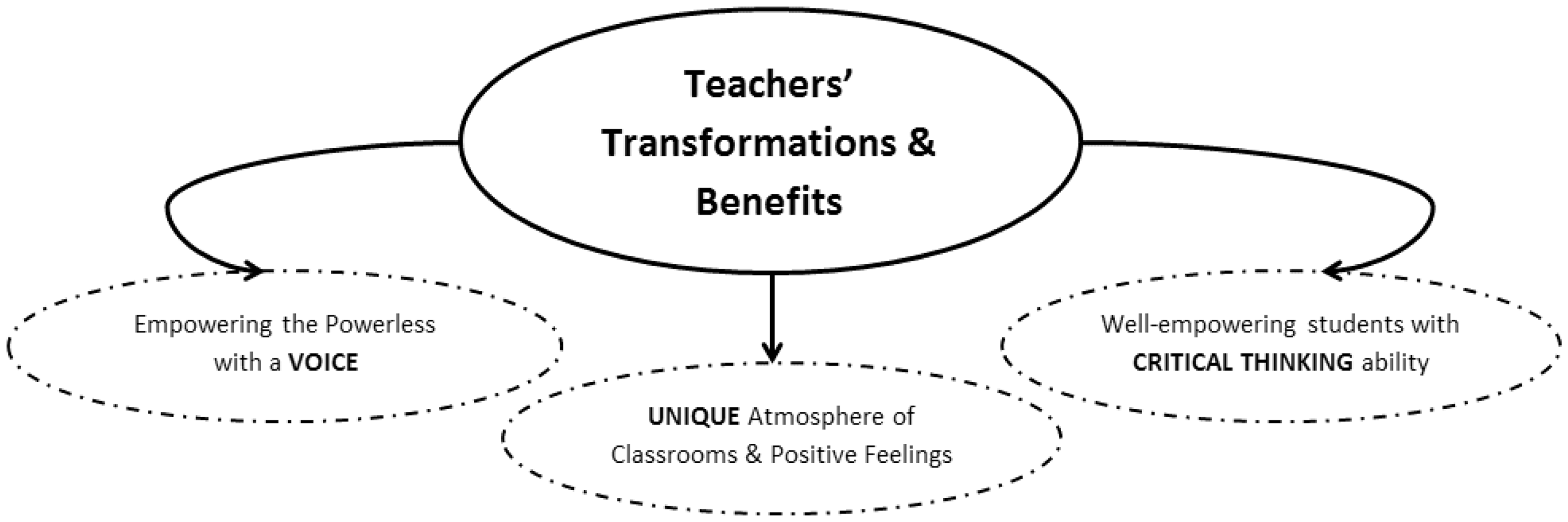
Empowering the Powerless with a VOICE
Based on the banking model of language learning and teaching, students are assumed to be “receptacles” and “filled” with “content of the teachers’ narration” (Freire, 1993: 1). Freire (1988) criticized the banking model of education, since students as the passive objects are acted upon and dominated by the teacher (Freire, 1988). In his sense, “banking education” aims at demobilizing the individuals within the existing power relationships by getting them unknowingly to accept the social, cultural, and political status quo of the prevailing culture. In this type of education, knowledge is regarded as a gift assigned to students as ignorant, marginal, and resource-less (Rugut and Osman, 2013). According to Freire (1973), this condition is seen as the dominant individuals’ (oppressors’) false generosity and a means of controlling and governing the oppressed people to improve and sustain their interests.
Teachers as transformative intellectuals can provide students with a democratic space to simultaneously express and share their ideas, and show them how to respect other individuals’ feelings and thoughts. This can be used as a means of promoting the culture of voice among learners, as opposed to the culture of silencing (Freire, 1972), which would prevent students from getting their voice heard in the context of classroom or society (Izadinia and Abednia, 2010). In fact, empowering silent students can occur through the creation of the dialogic and democratic space in language classrooms so that students have the right to freely speak, express their voices, question the status quo, and act upon any sociopolitical and economic inequalities. As Freire (1972) puts it, dialogue exists at the foundation of transformative pedagogy, and thus the lecture form of language instruction is far away from the dialogical approach in which teachers act as transformative intellectuals. According to Guilar (2006), transformative pedagogy, while advocating open space for dialoguing among teacher and students, asks them to shift their attention toward the social issues to and analyze them, as it involves all the participants’ voices and ideas.
Thus, this role of teachers gives students the real generosity and gift; that is, the ability to emancipate themselves from oppressive chains, to develop the feelings that their views and ideas are constructive, effective, and beneficial, and to empower them as the social agents who can resist any injustice and inequity. Students’ empowerment is contrasted with the teacher-fronted education and banking model, as students have the same rights as their teachers. When the emphasis is on dialogue, communication, and participation, power is no longer in the hands of authoritative figures such as teachers, but as Delpit (1995) puts it, students become skillful at negotiating the structures of institutionalized power.
In fact, “dialogue that starts with the students’ experiences empowers them to conceptualize these experiences. The teacher, in turn, can frame the curriculum within these experiences and resulting language” (Dorsey, 2009: 89). The promotion of dialogue also presumes equality among class participants (Rugut and Osman, 2013). According to Freire (1972), dialogue is a format of collective praxis which is directly related to unveiling unequal situations masked by the dominant classes. In this critical project, a recurring theme that frequently occurred was that one of the fruitful outcomes of this role was empowering the oppressed and powerless students whose voices were rarely allowed to be heard through the oppressive system of education. As a teacher said: I tried to involve students in different activities to express their ideas and beliefs. In this class, my students talked more while I talked less to give them this chance to think that I’m not the main authority in class. In other words, I’m one of the members of the class who contributes communication and discussion among all the members. (Participant 13#) Sometimes, students compare this class with the ones they used to have with other teachers. And they give comments on the freedom they’ve got in my class; I mean, the freedom of speech, the freedom to be themselves, and the freedom to express themselves. Each student has a unique experience and world who can share with others. (Participant 22#)
UNIQUE atmosphere of language classroom and positive feelings
The democratic language classroom presents a unique atmosphere for students that contrasts with the traditional top-down curriculum. In the hierarchical system of education, the atmosphere of the language classroom is authoritarian so that teaching and learning are considered as linear processes, and hence information is primarily transmitted from teachers to students (Rendon, 2005). In other words, language instruction is teacher-fronted (Jensen, 2000), since it is the teacher, as an authoritative figure, who decides about the nuts and bolts of everything. Teachers in this dominating structure of the language classroom act as professional authorities, while students are considered as ignorant creatures (Wang, 2010).
The educational system of Iran is based on the banking model of education (Safari, 2016) in which the format of language classrooms and school systems is primarily lecture-based or based on the “sage on the stage” model of language teaching and learning. This type of instruction involves information delivery from an authoritative figure to passive and silent students who, according to Izadinia and Abednia (2010), rarely show any tendency to participate in classroom activities. In this system, teacher talk is favored over student talk (Wang, 2010). In traditional Iranian language classes, the passive students copy down the information and knowledge on which the teacher lectures. Further, most of the teachers pursue a familiar routine in language classrooms, including checking students’ assignments, presenting and teaching new lesson, and giving seatwork to students.
During the current critical project, all the teachers agreed that the type of classroom atmosphere was totally different from the traditional one. The movement toward the creation of a democratic and liberatory space for students to talk dialogically was the most important change in the environment. Dialogic talk gives the opportunity to oppressed students to bring their own experiences into language classrooms and relate the concrete circumstances of the world to their learning. Doing so indeed affects students’ living and thinking (Freire, 2005). Giroux (1983) also refers to this reality that “Students bring different histories to school; these histories are embedded in class, gender, and race interests that share their needs and behavior” (p. 149).
The significance of this type of learning is due to the fact that it “occurs as the co-construction (or reconstruction) of social meanings from within the parameters of emergent, socially negotiated, and discursive activity” (Hicks, 1996: 136). Through dialogic learning, as Wertsch and Smolka (1993) describe, “Two or more voices come into contact with and confront the utterances of a speaker” (p.74). Thus, understanding and learning are achieved through allowing a multiplicity of voices in language classrooms. Accordingly, a teacher said: This experience was very useful for me as adopting the role of transformative intellectual and applying critical pedagogy helped me create an ideal atmosphere for learning and teaching. I could witness active participation on the part of students in classroom activities. I could hear their voices which reflected not only their power and understanding but also their sociopolitical lives, experiences, and society. (Participant 6#)
The change of students into conscious and critical beings was the result of this atmosphere, through which students were emancipated from oppression, inequity, and injustice associated with the oppressive system of educational system based on the banking model. This type of transformation in students allowed them to think critically and not to accept anything in the name of knowledge, information, and schooling. In this regard, a teacher stated: The type of transformation that I as a transformative teacher created in students was to persuade them to think critically. I tried to cultivate critical understanding and awareness in my students and enable them to examine things with open eyes. They say: this class gave us the power of examining and expressing things in a critical way. I’d always be happy that I also gave them a valuable gift. That is critical thinking… (Participant 13#) In my classroom, during the time that I acted as transformative intellectual, I witnessed a sense of responsibility and belonging in my students. When I ask them about their feelings regarding my class, they say they don’t feel they are as isolated and passive individuals. They think that they belong to the community of language classroom and the larger society. In this atmosphere which is associated with trust and a sense of ownership, I can see more motivation and self-confidence in students. Actually, when the social setting of language classroom is integrated with security and trust, my students feel they learn more and consequently their competence increases. (Participant 19#) It is highly recommended for teachers to be more like a partner and friend than a mere authority who stands in front of the class and keeps his or her distance from the students, and they have no right to deviate into the teachers’ territory, as teachers feel relaxed and secure in such a fabricated and immune zone (p.747).
Empowering students with CRITICAL THINKING ability
Enhancing critical thinking is a desired objective in education (Balsaen, 2011) and especially in language learning, where language and power are related. The dispositions and skills for the promotion of critical thinking should be infused into learning and teaching at all educational levels (Burbules and Berk, 1999). To create transformation in the educational system and society, to challenge the powerful structures of schooling, to fight against oppression, subjugation, and dominance, to liberate students from oppressive education, to uproot the sociopolitical inequity and injustice, and to question status quo and institutional, ideological, and political hegemony (Safari and Razmjoo, 2016), it is essential for transformative teachers to act as critical pedagogues and sharpen students’ minds by means of promoting critical thinking as a valuable asset.
According to Jones (2012), a consequence of emancipatory pedagogy is critical thinking. That is, critical pedagogy occurs in advance of critical thinking. Thus, students, as critical thinkers, “become more skeptical toward commonly accepted truisms” (Burbules and Berk, 1999: 45), become open-minded, and show willingness to reconstruct their identities by means of their acts in the real world (Cervetti et al., 2001). As Carroll (2004) puts it, the most crucial features of a critical thinker include being problem solver and decision maker, skepticism, and open-mindedness. The critical thinker should be a good decision maker and a good problem solver, since when people think critically they make use of their intelligence and knowledge to reach the most justifiable and reasonable position.
According to Ennis (1987), skepticism associated with critical thinking refers to polite doubt. It does not mean that people go through their lives never believing anything they see or hear. It means that what people know at any moment is part of the whole picture (cited in Cottrell, 2005). With respect to open-mindedness, Carroll (2004) states that it is the willingness to consider issues from different angles, to search for bad and good points of the different examined sides, and to consider views which oppose to our own. Hence, a teacher who wants to enhance students’ critical thinking first needs to be equipped with these characteristics.
In the educational system of Iran, critical thinking has not received much attention, and sometimes teachers avoid it since criticism is wrongly misinterpreted as the rude behavior (Safari and Rashidi, 2015c). Through this critical journey, most teachers called the skill of critical thinking a missing cameo in the educational system of Iran that was given to students as a valuable gift. It is appropriate to mention here some of the participants’ quotes: In my class, I could show the students that each of them can be a critical thinker. An important element that has been ignored in our education. Now, they can think deeply about the different things discussed in class. They can question the different sides of the things, especially those aspects which are hidden and not clear. (Participant 7#) My students have changed a lot. One aspect is the way of their thinking, reasoning, and judgments. They pose questions about the taken-for granted things and challenge the sociopolitical issues about their lives. They do not naively accept anything… (Participant 11#) One of the fruitful outcomes of applying critical pedagogy for teachers as transformative intellectuals is students’ critical thinking development. I can see how my students have improved this capacity. They examine and understand things critically and through acute eyes. Every session they gain new insights about beliefs, practices, actions, experiences, and different issues. (Participant 14#)
Teachers’ challenges through becoming transformative intellectuals
Now, it is time to unearth the challenges that our participating teachers experienced and building blocks they observed to become transformative intellectuals (Figure 2).
Requirement for possessing CERTAIN knowledge and skills
According to Sadeghi and Ketabi (2009), transformative intellectuals as reflective practitioners have the following characteristics: (a) they possess the competence, knowledge, skills, and willingness to reflect, question, and act upon power structures that have kept them oppressed, and maintain the status-quo; (b) they connect their theoretical and pedagogical knowledge to authentic teaching practices and acts, and continuously involve praxis; (c) they relate their teaching to the larger sociopolitical community; (d) and finally they utilize the respective dispositions to operate as active agents of social transformation. With respect to the above-mentioned features, in Sadeghi and Ketabi’s (2009) sense, transformative teachers need to critically be engaged in a deep and structural change of their feeling and consciousness towards learning and teaching, leading to permanent progress in their practices and acts.
Teachers’ challenges to be a transformative intellectual.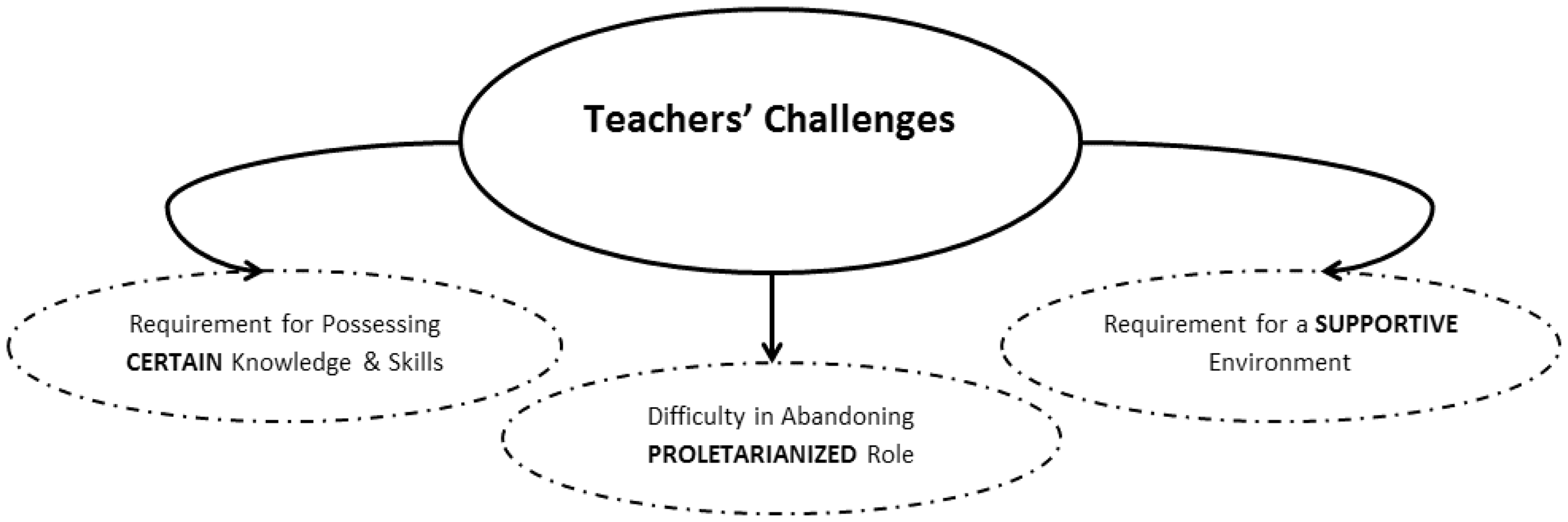
Thus, Iranian English teachers who intend to become transformative intellectuals are required to be equipped with the above skills and knowledge in addition to possessing the theoretical as well as pedagogical competency relating to the field of language teaching. One of the teachers mentioned this point as follows: First of all, we need to be completely familiar with the theories of language teaching and learning, and then decide to become a transformative intellectual. I think this background knowledge provides the basis upon which we can place the more recent knowledge and skills. (Participant 18#) I think moving towards transformation is not a simple job since it requires English teachers who have not only language proficiency knowledge like the ability to speak fluently and accurately but also information about the daily challenging topics and sociopolitical, historical, and economic conditions in which our country exists and reflect our daily lives. (Participant 12#) For a teacher who wishes to act as a transformative intellectual, critical thinking as an important skill is necessary. We need this skill to train generations of students who can transform the society. (Participant 24#) Critical thinking is an important skill that each teacher needs to have. If our aim is to become transformative intellectuals, then we ourselves need to be critical thinkers to transform students as critical thinkers, too. When a teacher has not developed critical thinking skills, how can he or she promote students’ critical thinking? (Participant 3#) I tried to introduce new concepts about teaching methodologies and teachers’ practices from the early days at my classes as it helped students learn that there are too many theories which are contrary to their clichéd way of thinking and what they are accustomed to from primary years of education (p.744). The ability of individuals to take perspective on their immediate cultural, social, and political environment, to engage in critical dialogue with it, bringing to bear fundamental moral commitments including concerns for justice and equity, and to define their own place with respect to surrounding reality constitutes an important human faculty (p.13).
According to Dillon (2008), if people are not sufficiently empowered with critical consciousness, they will not be able to transform the oppressive and limiting conditions of their lives, since they are still restricted by the ways in which they see and perceive their circumstances and their lives. Hence, teachers’ efforts through critical consciousness are aimed at transforming education and society and creating a society based on social justice and equity. This force helps them empower the disempowered students and give them voice to seek emancipation from an oppressive society and education. The necessity of developing critical consciousness awareness was mentioned by teachers in this project. One of them said: A transformative teacher should be an informative and a consciously wise person whose mission is to liberate students from the limitations imposed by the current system of education. (Participant 17#) An important issue that needs to be considered is teachers’ critical awareness. A teacher who is consciously and critically aware can liberate students from injustices and inequities in the society. This capacity gives power not only to teachers but also to students to resist against social power. The result of this process is transformation of students, education, and society. (Participant 21#)
Difficulty in abandoning PROLETARIANIZED role
As Giroux (1988) puts it, “The tendency to reduce teachers to the status of specialized technicians within the school bureaucracy” shows “the proletarianization of teacher work” (p.122). There should be a transformation in teaching from control and technical operations to criticism and intellectual reflection. In other words, teachers should be transformed into intellectuals or social critics who have independent spirits. Thus, teachers are required to change their apathetic and detached attitudes that have separated them from their social lives and political conditions, and become critical agents. Along with students, they pose questions regarding ready-made information, criticize the social politics and its unequal sides, culture, economy, and strive for a qualitatively perfect world for all groups of people (Giroux, 1988, cited in Hua and Pinar, 2015).
In Sadeghi and Ketabi’s (2009) sense, the core foundation of Iranian ELT curriculum is to pursue a principled conformity, implicating teachers as transmitters of a preselected set of isolated information and pedagogical procedures through teacher-proof methods and standardized tests. The hidden assumptions underlying this agenda are to legitimize pedagogies which discount teachers’ role in getting students ready to be critical and active citizens, and cause teachers to close their eyes to oppression, support it or avoid questioning the current educational system. Sadeghi and Ketabi (2009) add: Most teachers enter the profession with a dream of making a difference, by assuming an activist role and seeking a bypass to numerous impediments in controlled conditions. But, there is no room for developing a critically appropriate syllabus which fits specific pedagogical concerns. We have to bear in mind that the educational system which silences and marginalizes critical intellects instead of nurturing them is an oppressive system (p.53). I wish to act as an emancipator, a teacher who wants to reach her students to the point of prosperity and freedom of speech, to become active citizens in the future but I feel I’m not the sole force to do so. I think the educational system does not let me do it. Because my previous role imposed by this system has overshadowed my wishes and tendency. Sometimes, I unconsciously like to act as a powerful teacher in class who knows everything. This feeling is unavoidable because the system urges me to be like that. (Participant 2 #) Our system is based on rigidity, severe management, and authority. The educational system and our culture have been shaped based on such things. There is no room for dialoging, giving voice to students, behaving like a partner, like a student in classrooms. Our syllabus and teaching are pre-selected by the official bodies. How can I find an opportunity to be myself, a teacher who can create transformation? (Participant 20#) Something like chains has closed my hands and feet. I want to liberate myself. It is not me but it is the role that my body and soul are living with it for years. To teach to students who are always listeners, to talk to them but with no reactions, I just know everything, and I should give my knowledge to them. These are the basis of my work for years, how can I get rid of this routinized life? (Participant 5#)
Requirement for a SUPPORTIVE Environment
I think great transformation occurs when the outside community including parents, government, ministry of education, and educational organization support teachers; otherwise, any effort is like beating a dead horse… (Participant 9#)
Teachers as transformative intellectuals are committed to creating a democratic space in which they can help students become knowledgeable, brave, and critical, to understand new ways for their societies, to engage in social transformation, and to change into active citizens (Giroux, 1988). Through this process, oppressed students are given the opportunity to voice their experiences, to interrogate the sociopolitical, economic, and historical injustices in society, and to challenge the oppressive system. In fact, the main goal of transformative teachers is to prepare students as critical and active citizens for a just world. This can be possible if teachers are supported through this transformative journey. In this critical project, teachers felt they needed support from the wider context, and they found this issue challenging. If teachers receive sufficient attention from the community, they eagerly tend more toward this mission to create transformation in education and society. A teacher said: This mission cannot be done by just engaging teachers. To do the job well, we expect support from the government and the ministry of education. There should be foundational changes in the educational system. There should be a movement toward democratic learning and teaching, critical thinking, and preparing students for a society based on democratic principles. When the educational system in Iran is based on authority and the responsible people do not support teaching and learning based on democracy, how can I alone change my role into a transformative teacher? (Participant 25#) When what we do and say in class are not appreciated by the authorities, it makes no difference whether you are a transmitter of knowledge or a transformative teacher? (Participant 8#)
There should be a sense of freedom and power to enthusiastically deal with teaching practice. Being exhausted by those clichéd teaching practices, and fearing being accused of violation of rules, most teachers are demotivated about their profession as a teacher in general, and their teaching practices and behavior toward students specifically. They believe that students’ rights and voice should be respected and heard, but while there are no such feelings about themselves from higher levels of power such as school administrators, policy-makers, and government, they prefer to stick to those well-embraced and well-respected policies and teaching practices of powerful political groups. So, a change in state policies and well-supported political environment for teachers motivates them to work based on the principles of critical pedagogy in their teaching practices.
Conclusion
In the critical pedagogy literature, the role and the work of teachers are reconceptualized and rethought as transformative intellectuals. Teachers who adopt this role should possess the skills and knowledge to criticize and change injustices and inequities in education and society. According to Sadeghi (2008), the role of transformative intellectuals is to engage students in dialogic practices, to appreciate their views, and to learn from their experiences. In Freire’s (2005) sense, through reflection on students’ experiences, teachers can help them act as social agents who can evaluate fairness, validity, and power within educational structures and living conditions.
In this study, we obtained understanding and insight about a group of English teachers who took a journey that transformed them into transformative intellectuals. Based on the qualitative data, the benefits as well as the challenges through this formidable path were explored and examined. In fact, this study is an example to show how language teachers can create transformation in the EFL context, change their fossilized role, and empower oppressed students within the institutionalized system of schooling. The findings of this research are insightful for educators who strive for teachers’ agency, creativity, and autonomy in order to educate in-service teachers through these philosophical, theoretical, and pedagogical rationales. Curriculum developers and textbook writers can also benefit from this research in that materials and curricula can include provocative topics which stimulate students to express their voices and question the status quo and taken-for-granted knowledge. Last but not least are the fruitful outcomes of this study for governmental bodies and authorities in the Ministry of Education, since significant transformation at the level of education and society needs support on the part of the government. Without any support, teachers as transformative intellectuals will not be able to achieve their goals in the best way through this process.
Footnotes
Declaration of conflicting interests
The author(s) declared no potential conflicts of interest with respect to the research, authorship, and/or publication of this article.
Funding
The author(s) received no financial support for the research, authorship, and/or publication of this article.