




Abstract
State education policy changes have contributed to a reduced interest in teaching and a decreased enrollment in education degree programs in North Carolina, USA. Pressure to cut budgets and generate revenue has added to a climate of academic capitalism influencing the ways in which deans lead schools of education. The purpose of this mixed-methods study was to understand school of education deans’ perceptions of and strategic responses to political and economic challenges. Findings demonstrate that the burdens of being a school of education dean in North Carolina are substantial and require a specific skill set to manage external pressures. Deans reported devoting more time and energy to recruitment, fundraising, program creation, and active participation in policy discussions as strategic responses to these pressures. Findings throw into stark relief the need for professional development and the importance of supportive relationships across campus to help deans hone skills and manage new pressures.
Introduction
Reflecting on her time as dean of a professional college, Gallos (2002: 174) concluded, “even on the best days, being an academic dean resembles living in a vise”. Gallos utilized the vise metaphor to capture the reality that deans “juggle multiple roles and a myriad of expectations from diverse constituents. Squeezed from above and below as well as from inside and outside the university, deans are caught in the jaws of conflicting cultures, pressures, and priorities” (2002: 174). Several other scholars have noted that the academic deanship is plagued by substantial stress and role ambiguity (Gmelch et al., 1999; Montez et al., 2003; Wolverton et al., 1999). Pressures emanating from beyond the confines of campus have increased, requiring deans to spend more time and energy pursuing new student markets, cultivating donations, advocating policy changes, and marketing their programs. Such external pressures have been particularly acute for deans leading schools of education that prepare teachers and other education professionals.
School of education deans face unprecedented political and economic challenges in the United States. This is particularly the case in the state of North Carolina. In 2011, the North Carolina General Assembly (NCGA)—the state-level legislature—ended the 20-year-old Teaching Fellows Program, which provided a full scholarship to talented students who planned to pursue a bachelor’s degree in education. Two years later, NCGA eliminated a provision in the state budget that automatically increased by 10% the salary of teachers who received master’s degrees. This and other education policy changes and proposals reduced interest in teaching and thus enrollment in education degree programs. Many of the undergraduate and master’s degree programs in education throughout North Carolina (and across the United States) have experienced drops in enrollment since the policy changes went into effect (Cooper, 2013; Smith and Imig, 2014; Westervelt, 2015). The latest figures indicate a decline of about 27% in (undergraduate and graduate) education degree program enrollments across the public university system in North Carolina—known as the University of North Carolina (UNC) system—during the last several years (A. Chapman, 2015, personal communication).
Because state appropriations to higher education are based, in part, upon enrollment figures, schools of education confront declining revenues, compounding a $400 million system-wide permanent budget reduction (Ross, 2013). Various national news outlets have covered changes to state education policies and proposals in North Carolina, describing them as a “step-by-step war on public education” (Strauss, 2015). There is, therefore, interest across the United States in North Carolina’s austerity-driven education policies. School of education deans in North Carolina are tasked with adapting to this new policy environment while continuing to meet state accountability demands, supply schools with highly qualified teachers and administrators, and address the myriad other challenges facing them on campus.
Despite the fact that deans are burdened with extensive responsibilities within complex organizations, there is limited research with respect to how they navigate contemporary issues in the academy. Over a decade ago, Gmelch and Wolverton (2002: 15) observed, “the academic deanship is the least studied and most misunderstood position in the academy”. With the notable exception of several recent studies within and beyond the United States (e.g. Bray, 2008; De Boer and Goedegebuure, 2009; Del Favero, 2005; Strathe and Wilson, 2006), research has been slow to advance our knowledge of the academic deanship in the intervening decade. There is increasing evidence that deans are experiencing burnout more quickly, resulting in reduced leadership effectiveness and frequent turnover (Wolverton et al., 2001). Exemplifying this trend is the fact that 10 of 15 school of education deans in the UNC system announced their decision to step down in the 2014–2015 academic year, and another two resigned in the 2015–2016 academic year.
This study aims to contribute to our understanding of the academic deanship, with the related goals of: (1) describing and problematizing the neoliberalist policy context in which school of education deans work; (2) revealing the effects of state policy changes and proposals that have directly influenced interest in education degree programs and education professions; and (3) informing the improvement of training, professional development, and retention of academic deans who must lead their schools through continuing financial, political, and accountability challenges.
Background
During the last several decades, the United States and other developed countries have witnessed the rise of neoliberalism, which can be succinctly characterized as “a vision that sees every sector of society as subject to the logics of commodification, marketization, competition, and cost-benefit analysis” (Apple, 2013: 6; see also Smyth, 2014). At the same time, strong claims have been made about a significant decline of academic excellence and the worsening of a so-called achievement gap among particular demographic groups, as well as a deterioration of American culture and values in general. Despite the counter-claims of some critics that these arguments amount to a “manufactured crisis” (Berliner and Biddle, 1995), essentially resembling “the shock doctrine” that is the hallmark of “disaster capitalism” (Klein, 2007; Saltman, 2014), governmental and corporate leaders during the last two decades, with the support of selected educational scholars and practitioners, initiated intensive efforts to reform (or, according to critics, deform) “traditional” public education. This has been the case not just for those attending preK–12 schools but in higher education as well. While there have been varied educational challenges during the last 100 years, these may be uniquely “volatile times,” especially for those working in university-based teacher education programs (Reese, 2005; Teitelbaum, 2014).
The effects of neoliberal educational reform efforts can be seen across the United States. Indeed, this is very much a national movement, led by such prominent figures as US Secretary of Education Arne Duncan, Microsoft founder Bill Gates and his wife Melinda, Wal-Mart inheritor John Walton of the Walton Family Foundation, and former Florida governor and current presidential aspirant Jeb Bush (Schneider, 2014), but with critical support from state and local political and business leaders as well. In North Carolina, which in 2013 found both its executive and legislative branches controlled by the political right for the first time since 1870, several important educational policy changes have been made, essentially departing from what can be considered the more progressive approaches undertaken by James Hunt during his two periods in the governor’s office (1977–1985 and 1993–2001). During those years, and for the decade afterward, the state became well known nationally for its support of public education, which included an increase in overall state funding for schools, an increase in the number of teachers as well as support personnel (e.g. librarians and social workers), a reduction of class size, monetary rewards for teachers and administrators, and a significant increase in funding for early childhood education (Stallings, 2015).
By 2016, the educational landscape in North Carolina has changed markedly due to austerity-driven policies. It now stands near the bottom among states for per-pupil funding and teacher salaries. In addition, following on national neoliberalist reform initiatives, the state has witnessed a number of changes in policy. For example, as noted earlier, the Teaching Fellows Program, created in 1986, was discontinued. It had provided competitive four-year scholarships to top high school students who committed to seek a teaching licensure and to teach in the state’s public schools for at least four years. In addition, the ability of teachers and administrators to garner further compensation for earning graduate degrees was severely curtailed, and salary increases in general for teachers (and university faculty) have been minimal. Funding for teacher assistants in the classrooms has been significantly decreased, and proposals to eliminate teacher tenure are being considered. Headway is being made on the adoption of value-added measures (VAM) to evaluate individual teachers, based almost entirely on the standardized achievement test scores of their students, with proposals to do likewise for the evaluation of teacher education programs. The state has also recently witnessed the proliferation of charter schools, including a decrease in the percentage of teachers in these school settings who are required to hold professional licensure, and the increase in public monies (in the form of “opportunity scholarships” or vouchers) to fund the attendance of students who choose to go to private schools. As is the case nationally, there are strident claims being made about “failing schools” (including threats of closure), which are used to support many of these so-called reforms, even though the evidence to support such claims is arguable (Ravitch, 2013; Rizga, 2012).
School of education deans’ work with their faculty and staff colleagues, as well as with their students, is directly impacted by these policy changes in public schooling as well as in higher education. Morale issues in the public schools, for example, directly affect the work of teacher educators, as they contend with the growing doubts of students considering the teaching profession. In the current economic times, and given the relatively low salaries for teachers, the need for scholarships becomes more acute and university colleagues find themselves enlisted in new ways to help secure such funding from foundations and private donors. These changes in workplace needs and expectations particularly impact the work of school of education deans in ways that intensify the challenges that have long been present in the position.
Literature review
There are three prominent bodies of literature with respect to the academic deanship that are relevant to this study. The first examines deans’ professional relationships with faculty members (Wolverton et al., 2001), as exemplified by Bray’s (2008) analysis of faculty members’ expectations of deans. Although most deans started their careers as faculty members, Bray (2008) asserted that deans and faculty members often view issues from different perspectives and draw upon different values when making assessments (Birnbaum, 1988). Echoing previous research (e.g. Campbell and Slaughter, 1999), these differences can result in distance or conflict. Bray’s survey results showed that, irrespective of discipline, tenure-track faculty members expected deans to seek their input, be visionary, listen to multiple voices, and “interact across all levels inside the organization and between the organization and the external environment” (2008: 714). Importantly, faculty members were critical of deans who were unwilling or unable to communicate within and beyond the institution. In addition to liaising between the administration and faculty members, deans must represent their schools to external constituents. As Gallos (2002: 175) wrote, “a dean lives with feet firmly planted in two worlds.”
A more robust body of literature looks at how deans are prepared for their positions, as well as their career path to the deanship (Del Favero, 2005, 2006; Gmelch, 2000; Strathe and Wilson, 2006; Wolverton and Gonzales, 2000). Research acknowledges that deans often assume the position with little formal preparation (Bray, 2008; Gmelch, 2000; Wolverton et al., 2001), and our understanding of how deans learn job responsibilities remains under-developed (Del Favero, 2006). According to a survey of 210 deans, Del Favero (2006) found that holding a past administrative position was respondents’ primary method of learning the dean role, followed by relationships with faculty leaders. In a three-year ethnographic study of a new dean, Gmelch (2000) found that the process of “taking charge” in the deanship can be lengthy and institutions frequently leave socialization up to chance. In light of the fact that “most administrative expertise is gained on the job,” Strathe and Wilson (2006: 8) advocated for the development of mentoring programs to help prepare new deans. Such programs may be especially important for increasing the number of women and racial minorities who become deans, as the job has in the recent past tended to be dominated by white men (Wolverton and Gonzales, 2000). One reason why research has focused upon preparation for the deanship is that there is widespread agreement that the job has become more difficult over time.
A good deal has been written about the challenges deans face, as well as how the role of dean inside and outside the United States is evolving in response to austerity, accountability, and demands of the global knowledge economy (De Boer and Goedegebuure, 2009; Gallos, 2002; Gmelch et al., 1999; Montez et al., 2003; Slaughter and Rhoades, 2004; Wolverton, et al., 1999). While the changing nature of the deanship is addressed in the next section, it is worth noting here that research often situates deans as mid-level managers within professional organizations. Like department chairs, deans “are, in essence, classic middle managers: They have enormous responsibilities, little positional power, insufficient resources, and limited authority” (Gallos, 2002: 174). As mid-level managers, deans are tasked with operating in “loosely coupled” systems (Weick, 1976), where they “provide support for relatively autonomous specialists performing complex tasks” (Birnbaum, 2000: 150). Management becomes difficult in this setting because coordination relies largely upon the culture of the institution and the socialization of faculty and staff. Nevertheless, many deans must attempt to assert managerial control due to encroaching external forces. As De Boer and Goedegebuure (2009: 350) succinctly put it, “Universities today are being challenged to be entrepreneurial, financially self-sufficient and innovative, while at the same time having their performance assessed”. Consequently, they argue, institutions have embraced “accountability,” “productivity,” “client services,” “competition,” and “marketing and growth strategies” as organizing concepts.
Deans frequently must take responsibility for operationalizing these concepts in their work. Thus, academic leaders have not been immune to performance assessment efforts that aim to measure the effectiveness and efficiency of institutions. In fact, research (e.g. Rosser et al., 2003) has documented efforts to assess the leadership effectiveness of deans within the context of heightened interest in institutional performance. This study builds upon important research on the deanship by foregrounding deans’ strategic responses to an increasingly neoliberalist state policy context through use of a mixed-methods design.
Conceptual framework
One recurring theme in the literature is that the role of dean has evolved over the preceding three decades. This evolution has been conceptualized as a transition from “chief academic officer to chief executive officer” (Wolverton et al., 2001) and a shift from “scholar-dean to manager-dean” (De Boer and Goedegebuure, 2009). According to Montez et al. (2003: 243), as early as 1980 deans were “academics disguised as managers dealing with extraordinary circumstances.” Over time, the responsibilities of deans expanded to include representing the university in the community, recruiting diverse faculty and students, and becoming political advocates and solicitors (Montez et al., 2003). The manager-dean is “expected to take on administrative identities commonly associated with corporate business managers” (Wolverton et al., 2001: 6) and “adhere to the culture of the academy and the corporate-informed culture of administrative performance” (Gallos, 2002: 175). This means, in part, that deans are increasingly expected to lead their school’s efforts to secure donations and other external funds. Rosser et al. (2003: 2) argued that this “pressure to get more involved in development has shifted the traditional role of the dean as chiefly an academic policy-setter and the liaison between professors and the administration…to entrepreneur and politician.”
External political and economic pressures related to neoliberalism have certainly played a role in this shift towards the manager-dean. Slaughter and Rhoades (2004) captured these external pressures in their theorization of academic capitalism, which is explicitly premised on policies of the neoliberal state. The theory of academic capitalism was developed as a result of data showing a steady reduction in government support for higher education in the United States, Canada, Australia, and the United Kingdom since the late 1970s (Slaughter and Leslie, 1997). As a result of austerity policies, institutions have increasingly engaged in “market and market-like behaviors,” such as treating knowledge as a raw material by licensing and selling intellectual property. The goal of these efforts is for institutions to become more active participants in the global knowledge economy and, ultimately, identify and capitalize upon new revenue streams. One important construct of the theory of academic capitalism is that colleges and universities extend managers’ capacity to leverage institutional resources that might result in new sources of income. As a consequence of cultivating academic leaders’ entrepreneurial subjectivity, a new “academic capitalist regime” has emerged, which supplants a previous public good regime “characterized by valuing knowledge as a public good to which the citizenry has claims” (Slaughter and Rhoades, 2004: 28). Executive and managerial administrators, such as deans, play an important role in bringing the academic capitalist regime to fruition through their extended managerial capacity. Roles associated with administrative academic capitalism include: (1) directing attention and resources to branding and marketing; (2) establishing a strategic plan around entrepreneurship; (3) cultivating private donations; and (4) establishing revenue-generating academic programs (McClure, forthcoming).
Our conceptual framework draws upon scholarship on the emergence of the manager-dean and the academic capitalist regime through three interrelated arguments. First, the deanship has become more managerial in nature in that deans must fuse intellectual leadership of their school with new responsibilities as “fiscal experts, fundraisers, politicians and diplomats” (Wolverton et al., 2001: 15). Second, new responsibilities of the deanship are a direct product of academic capitalism and the need for institutions to become more self-sufficient, productive, and efficient by engaging in market and market-like behaviors. As discussed in the background section, North Carolina represents a microcosm of the declining government support and promotion of neoliberal education policies globally on which academic capitalism is premised. As a consequence of state education policies and proposals, deans in North Carolina increasingly lead their colleges of education in the context of academic capitalism. Third, these economic and political conditions compel manager-deans to focus on external concerns and encourage strategic responses consistent with administrative academic capitalism. In the face of declining enrollments and budget reductions, we expect school of education deans in North Carolina to invest greater time and energy in marketing and branding, cultivating donations and other extramural funds, and creating new programs that portend to bring in additional revenue.
Methods
This study employed a sequential explanatory mixed methods design (Ivankova et al., 2006). Recognizing that neither quantitative nor qualitative data could, by themselves, provide insight into the state education policy environment and the strategies of deans (Creswell, 2007), we constructed a rich dataset derived from a survey of UNC school of education deans and follow-up, in-depth interviews.
The quantitative phase of data collection consisted of a survey of school of education deans at public, four-year universities in the University of North Carolina (UNC) system. We limited data collection to public, four-year universities in the UNC system because these institutions are subject to the same state governing entity (the UNC General Administration) and are similarly influenced by state policies, particularly regarding allocation of funds. The North Carolina School of Education Deans Survey focused on deans’ perceptions of the state education policy environment and their strategic responses to challenges linked to policy changes and proposals. We piloted the survey with four current or former education deans in other states to check the comprehensibility of questions. The survey utilized a seven-point scale (0–6), which we simplified into three “bins” (0–1, 2–4, 5–6) in the tables below for the purposes of clearly conveying the findings. The survey was distributed via email to 14 deans in the 17-institution UNC system. Two institutions in the UNC system were excluded from the study because they are specialized art and science secondary schools and do not have a school of education. One of the study co-authors was a school of education dean at the time of data collection and did not participate in the survey. Thus, three institutions were removed from the sample. A total of 10 responses were received for a response rate of 71%. Survey results were analyzed using frequencies and descriptive statistics.
The qualitative phase of data collection consisted of follow-up interviews with survey respondents to more deeply query important trends identified in analysis of survey data and capture deans’ narratives. Each researcher independently studied survey results and identified findings that warranted further investigation, guiding development of the interview protocol (Ivankova et al., 2006). Survey respondents were invited to participate in follow-up interviews, and four deans agreed to do so. Interview participants worked at different types of institutions within the UNC system, including one liberal arts institution, two regional comprehensive universities, and one research-extensive university. The interview protocol was semi-structured, and guided by principles of elite interviewing (Kezar, 2003). Interview questions asked deans to comment upon survey results, provide real-world examples of issues and strategies, and share their perceptions of the job in light of the state education policy environment. Interviews were digitally recorded and transcribed.
Analysis of the interview transcriptions proceeded in two rounds of coding. The first round of coding involved reading the text line-by-line and pulling out phrases and sentences that recurred in interviews, exemplified survey data, and either confirmed or disproved ideas contained in the literature review and conceptual framework. These phrases and sentences were entered into a spreadsheet and assigned codes. The second round of coding sought themes and relationships within the spreadsheet and simplified the codes into four main categories: state policy environment (SPE), internal college effects (ICE), challenges to the dean role (CDR), and strategic responses and perceptions (SRP). This process of categorizing and seeking connections among discrete units of data allowed us to identify those perceptions and strategies that deans deemed to be most important or regularly affected their lived experience on the job.
Several limitations to the study should be noted before making use of the findings. We recognize the limitations inherent to a small pool of interview participants but nevertheless believe the data reveals important findings that should be subject to scholarly discussion and additional research. Moreover, the data is limited to public, four-year institutions. Collecting data from school of education deans at private institutions may yield different issues and strategic responses. Lastly, we acknowledge that investigating the effects of education policies in a single state is a limitation. However, we also see this localized bounding as an asset in developing nuanced analysis.
Findings
Findings demonstrate that the burdens of being a school of education dean in North Carolina are substantial and require a specific skill set in order to manage external pressures. Deans reported devoting more time and energy to recruitment, fundraising, program creation, communication of policy changes and proposals, and active participation in policy discussions as strategic responses to these pressures. Dealing with the state education policy environment proved to be taxing for many deans, raising questions about the long-term effects of policy changes and proposals to school of education leadership and, by extension, education professions in the state.
Perceptions of the state education policy environment
The data show that UNC school of education deans have been forced to adapt to policies that, in their view, have made education professions and education degree programs less attractive. Nine out of ten survey respondents said that they were concerned about the future of the teaching profession in North Carolina. During interviews, deans called the state education policy environment “anti-teacher,” “demoralizing,” “volatile,” and “confusing.” One dean reflected, “I think some of the policies around the K–12 world are just a giant step backwards from where North Carolina has been in the past.” Another dean believed that those currently working in education “feel attacked and under the gun with regard to these legislative changes and proposals.” In particular, nine of ten respondents reported that ending pay for teachers who earn a master’s degree was very impactful for their school of education, and seven of ten reported that eliminating the Teaching Fellows Program was very impactful.
Several interview participants expressed alarm over policies designed to provide families with greater choice in education by increasing the number of charter schools and assigning schools a letter grade. For example, one dean stated: Their [state education officials’] point is to say, “Let’s provide choice for parents, provide information to parents,” and so on, but assigning letter grades does nothing to improve a school. Nothing to help the teachers or kids or families of those kids in any way. It only harms, and I think it’s just creating a real negative environment in so many districts. I mean nobody wants to go to a school that is labeled a D or F.
Effects of state policies and proposals
As a result of the state education policy environment, deans reported difficulties recruiting high-ability students, declining undergraduate and graduate enrollments, and varying levels of budget reductions. With respect to recruitment, one dean lamented, “Teachers out there in the field are saying to these pre-service folks, ‘You’re so smart, why would you go into…education? If I were you I wouldn’t do this.’ From a person who is teaching.” Survey results showed that, for nine of ten respondents, declining graduate enrollments were “very challenging” for their school. Eight of ten respondents similarly rated decreases in undergraduate enrollments as “very challenging.” One dean noted in an interview that “the policy on master’s pay changed our graduate enrollment overnight and…also impacted how our undergraduates were feeling about their profession.” This dean further reported: You can just go down the legislative agenda for the past two years and the bottom line impact has been the declining enrollments. We’re down about 36% in teacher education at the master’s and undergraduate levels, and those very much are related to those policies and climate issues.
Challenges Posed by the State Policy Environment.
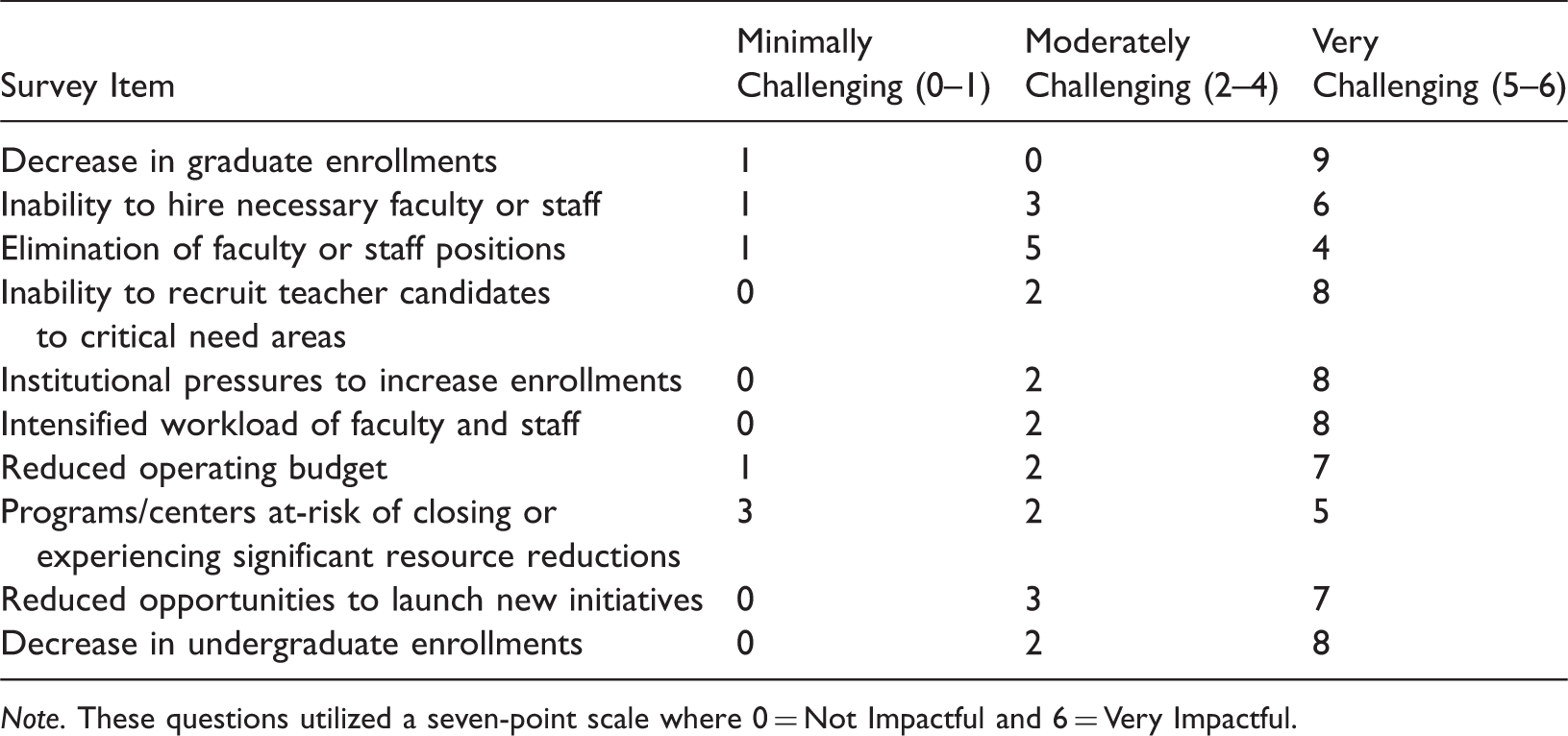
Note. These questions utilized a seven-point scale where 0 = Not Impactful and 6 = Very Impactful.
Other effects of recent state policy changes center upon deans’ inability to fill vacant faculty lines, increased faculty workloads, and decreased faculty retention. Increasing faculty workloads was rated as “very impactful” by eight of ten survey respondents. In the words of one dean, “my faculty and staff are being asked to work harder, especially the faculty. Many of them are going to be seeing an increase in their workload this next year.” This increase in workload meant teaching more courses and sections, and supervising more interns and advisees. As a result of increasing workloads and the lack of pay increases, some deans have not been able to retain faculty members. One dean recounted, “over the last five years we’ve lost some quality faculty and we have a hard time hiring new positions because we’re not able to be competitive.” After losing a faculty member to another university, one dean reflected, “The hits to higher education have been so demoralizing…Everybody is looking [for other jobs] and I can’t blame them. We’re just trying to create positive working conditions so people want to stay. But it’s been really hard.” The data thus demonstrate that the state education policy environment produced a great deal of instability and uncertainty within schools of education.
Strategic responses to challenges
Deans’ Strategies to Address State Policies and Proposals.
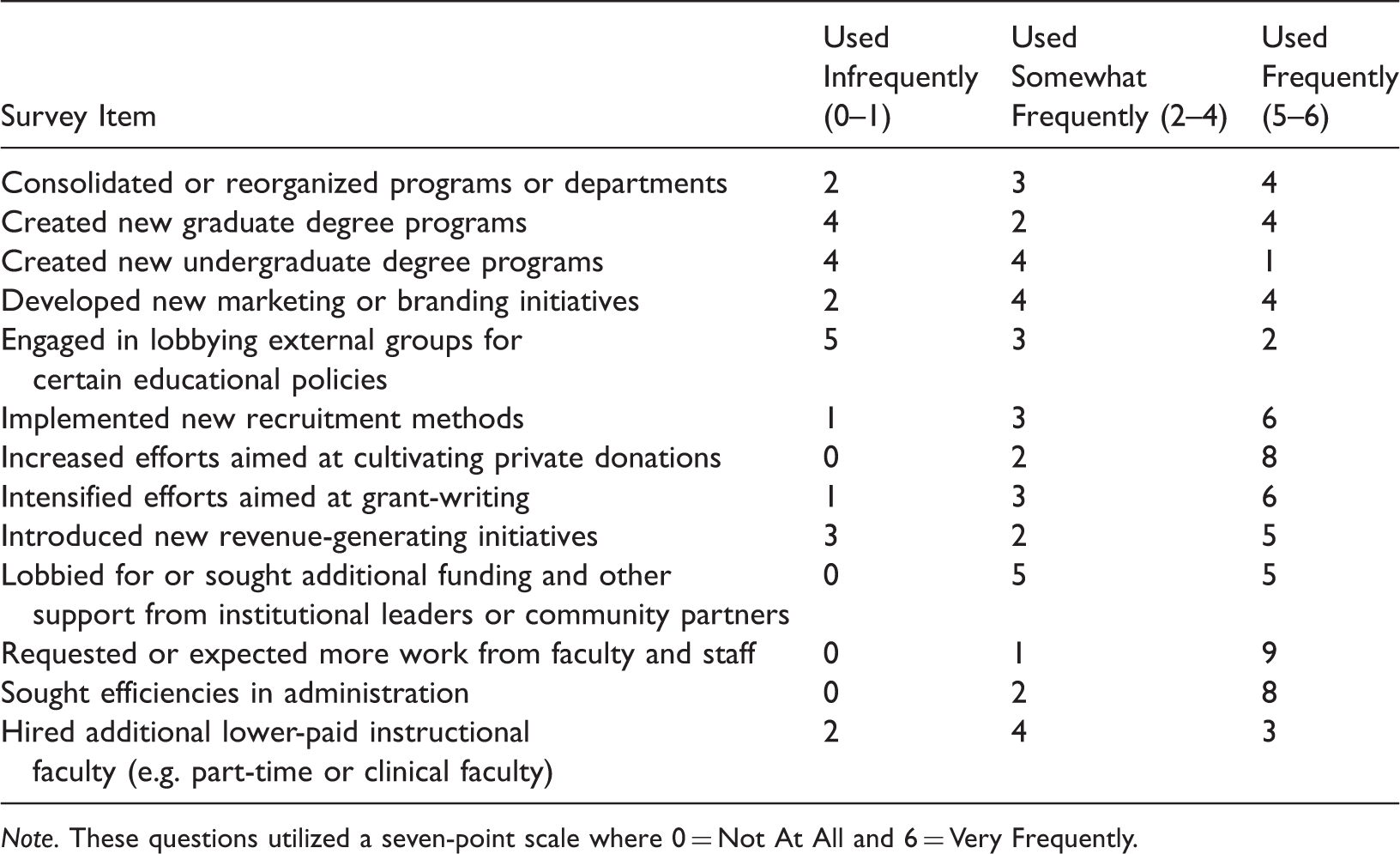
Note. These questions utilized a seven-point scale where 0 = Not At All and 6 = Very Frequently.
Six of ten survey respondents relied heavily upon new methods to recruit students, especially through social media and scholarships. For example, after the Teaching Fellows Program ended, several deans stated that they sought to establish a privately funded scholarship program to attract “high profile” students. In essence, these deans sought to create their own Teaching Fellows Program at the institution level, rather than the state level. Four of ten deans cut or consolidated low-enrollment programs and developed new programs outside of teacher education. At least two interview participants developed degree programs in “education entrepreneurship” to attract undergraduate students “who are very interested in education and don’t want to teach.” Moreover, deans created new online programs and new graduate certificates as a way of increasing enrollment. Lastly, eight of ten deans reported that they sought efficiencies as a strategic response to challenges. This entailed reducing spending on conference travel, professional development, and supplies.
Perceptions of the dean role
Perceptions of the Job and State Policy Environment.
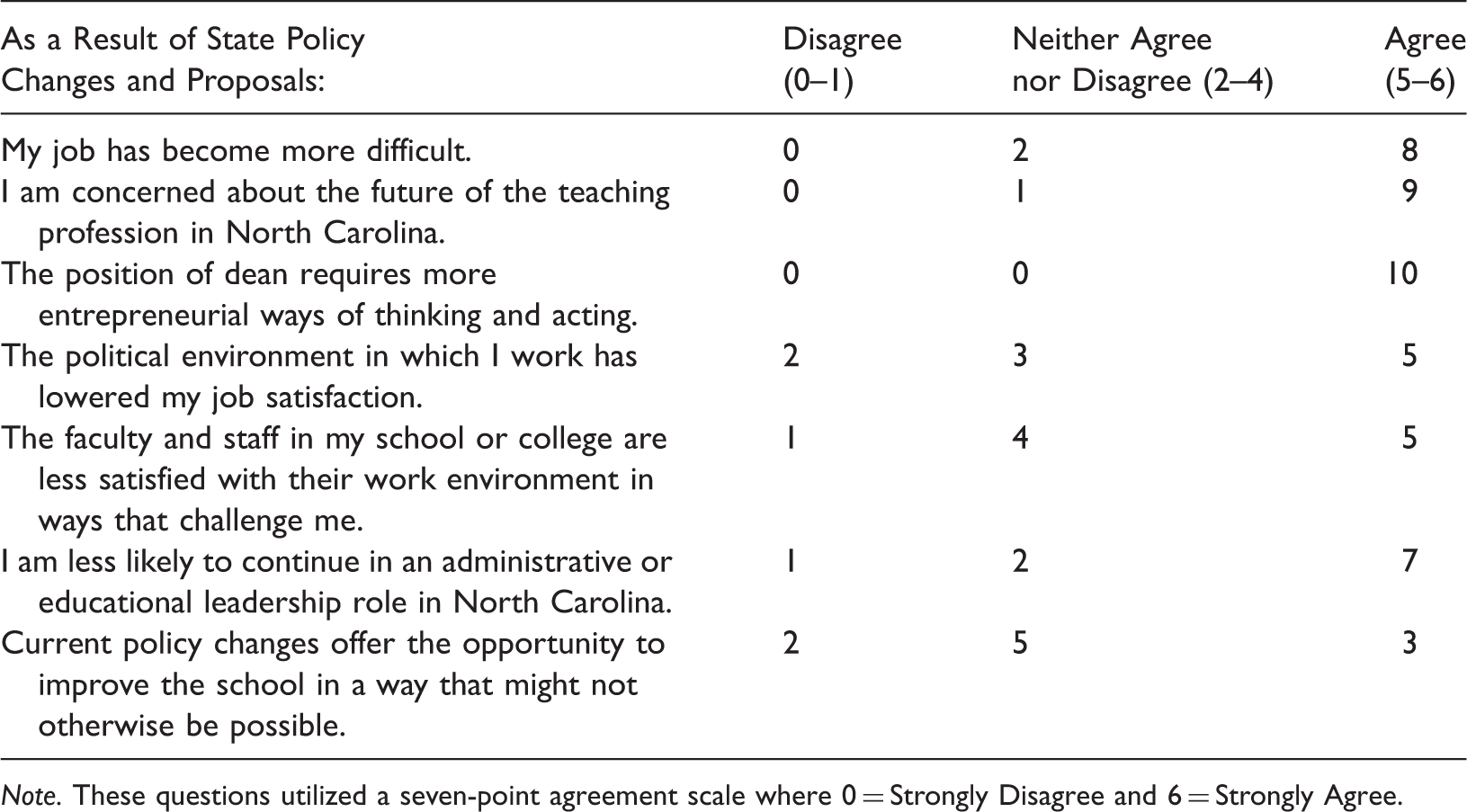
Note. These questions utilized a seven-point agreement scale where 0 = Strongly Disagree and 6 = Strongly Agree.
The increasingly external orientation of the job pulled some deans away from traditional tasks associated with the deanship: “What I wanted to do was to come in here and take care of the faculty and help them and support them. Work with them to get grants and work with them to do interesting work. I do a little of that, but I do less of that than I thought I would be doing and more external work.” Eight of ten deans said their job has become more difficult as a result of state education policy changes and proposals. Significantly, seven of ten deans reported they are now less likely to continue in an administrative or educational leadership role in North Carolina. For example, one dean revealed, “I knew the job was hard coming in, but it’s physically, mentally, and emotionally exhausting.” Another dean stated, “I have been a dean or associate dean in three different colleges of education for the last fifteen years, and it’s the worst it’s ever been.” All four of the deans interviewed in the study were aware that many of their colleagues were resigning, and they all believed that the state education policy environment played some role in this mass exodus. Nevertheless, only half of survey respondents said that they were dissatisfied with their job because of state politics, and several interview participants found leading their colleagues through difficult times to be exhilarating. This seemingly contradictory set of findings suggests that deans’ satisfaction with the job hinges upon multiple variables, including external political and economic challenges.
Discussion
The conceptual framework mapped out a set of interrelated arguments about the emergence of the managerial-dean as a consequence of the evolving state education policy environment. In many ways, the findings provide a vivid portrait of the managerial-dean, as school of education deans’ focus gravitated to financial solvency and external concerns in light of the neoliberalist trajectory of state education policy (De Boer & Goedegebuure, 2009; Montez et al., 2003; Wolverton et al., 2001).
Analysis of data revealed that UNC school of education deans are tasked with leading efforts to cultivate private funds for their school. In some cases, these funds were designed to help launch new scholarship programs to attract students to education professions or to offset significant budget cuts. In addition to fundraising responsibilities, deans often had to embody fiscal expertise (Wolverton et al., 2001), analyzing the operation of their schools in search of efficiencies and scanning the educational marketplace for opportunities to recruit new students. This latter activity is evinced by several deans’ strategic creation of non-teacher preparation degree programs (e.g. educational entrepreneurship) for students who were interested in education, but did not want to be classroom teachers. Responsibilities of the manager-dean also emerged in deans’ careful attention to diplomacy as they responded within the UNC system to new state policies and proposals, communicated with colleagues in their schools and across campus (Bray, 2008), and addressed the administrative and leadership challenges that emerge on a regular basis.
The new responsibilities of school of education deans in North Carolina can be understood and explained, in part, through reference to the theory of academic capitalism (Slaughter and Rhoades, 2004). School of education deans engaged in several market and market-like behaviors in response to state education policies that clearly affected traditional founts of money. These behaviors centered upon securing private donations for new programs and scholarships and establishing online degree programs and graduate certificates that would boost enrollments. During interviews, deans rather explicitly exemplified what it means to lead a school of education in the context of academic capitalism. One dean established a stark binary whereby the realities of becoming less dependent on state money necessitated either making difficult cuts to programs and personnel or meeting budgetary demands with private money. Other deans intimated that there were substantial pressures to generate revenues for their school—as one dean aptly put it, “beating the pavement to get more private funds.” By necessity, deans’ managerial capacity was extended in the interest of making their schools enough money to operate and remain competitive. For these reasons, the findings show that school of education deans in North Carolina increasingly must demonstrate leadership skills that match realities imposed by academic capitalism.
This does not mean, however, that deans assumed all roles connected to administrative academic capitalism (McClure, forthcoming) or surrendered their commitment to serving the public good. Only half of the deans reported that they developed new marketing or branding initiatives, though marketing and branding was never explicitly mentioned in any interviews. Moreover, the data did not indicate that deans pursued entrepreneurship as part of an over-arching strategy or vision for their schools. Although deans said that the job required that they think and act more like entrepreneurs, their responses were seemingly more motivated by near-term financial survival than enriching their schools. Thus, we should recognize that deans often expressed discomfort with the increasing amounts of time dedicated to cultivating private financial and other support—they were, for this reason, reluctant academic capitalists. This reluctance became clear as deans discussed what they would rather be doing than constantly seeking money. Several deans articulated a strong desire to help their faculty members, elevate the status of education professions, and, ultimately, improve the quality of public education statewide. Private funds were often viewed as an instrument to continue doing work in the public interest.
Uneasiness with the emphasis placed on seeking private funds may be a contributing factor in deans’ perception that the job was more difficult. Corroborating previous research (Wolverton et al., 2001), the findings suggest that school of education deans in North Carolina confront workplace conditions that could produce substantial stress and lead to early burnout. Some of this stress revolved around working with faculty members, but not because of conflict over decisions or deviations from expectations (Bray, 2008; Campbell and Slaughter, 1999). Instead, stress derived from deans’ inability to keep and reward talented faculty, their inability to avoid increasing faculty members’ workload, and their inability to devote time to assisting faculty members with their teaching and research efforts. This does not necessarily mean that faculty members agreed with deans as they created new programs and cultivated donations. It is entirely possible that faculty members resisted the strategies deployed by their managerial deans. Nevertheless, the findings showed that deans’ stress on the job seemed to emanate more from external versus internal power dynamics.
One of the more striking findings arising from this study is the sense that the education landscape in North Carolina is in the midst of seismic shifts and significant upheaval, characterized by student, faculty, and administrator movement. At some institutions, students are moving away from education degree programs in North Carolina and/or electing to not enter teaching professions (Strauss, 2015), perhaps as a result of the “anti-teacher” culture that interview participants described. Because faculty members are asked to work more amidst continuous attacks on teachers and public education, yet receive scant additional compensation, deans noted that some faculty members are looking for employment where their contributions are better recognized. Also, as previously noted, 12 of 15 school of education deans in the UNC system turned over between 2014 and 2016. Thus, changes to state education policy like those in North Carolina can have a destabilizing effect on schools of education with significant long-term consequences. Among these consequences are shortages in teachers, especially in critical need subject and geographic areas, as well as difficulty recruiting excellent teacher educators.
Simply put, this study suggests that there is an intricate relationship between state education policies, schools of education, and educational quality. More supportive, generous state education policies beget strong schools of education, which in turn prepare robust numbers of students interested in becoming teachers and enhance the quality of those who enter the teaching profession. In the context of state policies and proposals that cut funding for education and, specifically, for successful teacher preparation programs, deans’ ability to supply schools with outstanding teachers and school leaders is decidedly more difficult.
Implications
There are several implications of this study for practice, research, and policy. With respect to educational practice, in the short term, this study foregrounds the need for more training and professional development for school of education deans. In order to promote retention and curb burnout, this training should encompass effective strategies for communication and fundraising (within schools of education, with colleagues across campus, and with external constituencies). This study reinforces Strathe and Wilson’s (2006) call for colleges and universities to more intentionally prepare senior faculty for leadership roles through workshops, mentoring, and opportunities to shadow or work closely with acting deans. Moreover, this study sheds light on the type of knowledge and skills that new school of education deans may need to be successful. Although an ideal scenario would involve the restoration of funding and other supports for public education in North Carolina, there is a pragmatic need for academic leaders that are prepared for the present challenges.
In addition to preparation and professional development, this study shows that in times of financial duress, deans require extra support from central campus administrators, particularly the provost. It is worth noting here that several interview participants expressed sincere gratitude that external pressures were not compounded by demands from central campus administrators that they cut costs or boost enrollments. In more than one interview, deans noted how much they appreciated and valued the support of their provost. Just as most deans would seek to support department chairs and faculty members in difficult times, provosts and other central campus administers should seek to assist deans, especially school of education deans. If it is the case, as Gallos (2002) wrote, that being a dean is like living in a vise, it behooves provosts to relieve some of the pressure.
Further research on how deans respond to external pressures and even crisis moments as a result of policy changes is needed. In particular, this study highlights the need for research that explores how deans talk about state education policies with various constituents and take part in advocacy work while balancing the many traditional demands of the job. Additional research should also showcase and highlight successful programs that prepare and professionally develop deans for management challenges of the contemporary academy. One question that emerges from this study is how turnover in the dean position affects schools of education and their ability to meet state performance objectives. Research along these lines could underscore the need for a more nuanced understanding of how deans strategically respond to challenges and how colleges and universities can implement or improve dean retention efforts.
In terms of policy, this study shows how state education policies geared towards K–12 education can have far-reaching effects at the post-secondary level. State education policies and proposals that reduce the attractiveness of education professions not only influence primary and secondary schools’ ability to staff classrooms, but also alter the operations, management, and personnel of schools of education. Although this study narrowly concentrated on one organizational unit (schools of education) in public higher education within a single state, it is worth noting that few of the state education policies discussed here are unique to North Carolina. For example, several other states have adopted or are considering policies that shift the basis of salary increases from acquisition of an advanced degrees to performance measures (Banchero, 2013). Accordingly, the perceptions and strategies of school of education deans in North Carolina may represent a microcosm of similar trends affecting institutions and academic leaders across the United States. Indeed, this study may forecast policy futures for academic leaders at several levels, both locally and globally.
Footnotes
Acknowledgements
The authors wish to thank Andrew Lounder and Michael Apple for their thoughtful feedback on earlier versions of this paper.
Declaration of conflicting interests
The author(s) declared no potential conflicts of interest with respect to the research, authorship, and/or publication of this article.
Funding
The author(s) received no financial support for the research, authorship, and/or publication of this article.