




Abstract
After decades of decline, African higher education is now arguably in a new era of revival. With the prevalence of knowledge economy discourse, national governments in Africa and their development partners have increasingly aligned higher education with poverty reduction plans and strategies. Research capacity has become a critical development issue; and widening participation to doctoral education is seen as an instrument for enhancing this capacity. Against this backdrop, this paper presents a review of emerging initiatives and policies that have some bearing on the PhD in select sub-Saharan African nations, namely Ethiopia, Ghana and South Africa. The findings show a shared optimism about the economic value of higher education, and explicate divergences and convergences in the framing of problems and policy responses related to doctoral education across the three nations. In the conclusion we reflect on challenges and policy omissions in the pursuit of the African PhD.
Keywords
Introduction
In the knowledge economy imaginary, advanced research and research training are seen as instrumental in enabling participation in innovation and knowledge-driven prosperity. In the case of Africa, the exponential expansion of higher education (HE) systems coupled with the growing demand for skilled researchers outside academia has made doctoral education a crucial part of development plans. Recently, following a forum on Higher Education for Science, Technology and Innovation co-convened by the World Bank and the Government of Rwanda, the representatives of the governments of the five countries participating (Rwanda, Ethiopia, Mozambique, Senegal and Uganda) unanimously affirmed that: It is fundamental for Africa to increase the PhD programs in the continent and continue to engage in partnerships that increase the number of PhD holders in Africa. (The Kigali Communique, 2014: 2)
Following an outline of the scope and method of the study and a brief overview of the HE systems and research capacities in the three selected countries, the discussion reports on findings from this comparative policy analysis in three sections dealing with (1) shared optimism on the prospects of participating in the knowledge economy and the role of enhanced doctoral provision; (2) the diverse challenges identified in policy documents which speak to the different levels of development of each of the three HE systems; and (3) an overview of what we identify as policy convergence in the discursive construction of the PhD and the potential it holds. We conclude with some critical reflections on the challenges facing these three countries in their pursuit of the African PhD, challenges arising in part from specific conditions in each country and in some cases from omissions in policy.
Scope and method of study
Through a search of online government sources from the three selected countries, we identified key policy texts across the three categories mentioned above: national development plans, education strategies, and science and technology policies. At the national economic plan level, we identified the Growth and Transformation Plan, 2010−2015 (Ethiopia), the Shared Growth and Development Agenda, 2010−2013 (Ghana), and the National Development Plan: Vision 2030 (South Africa). Education sector policy documents include the Education Sector Development Program IV, 2010/2011–2014/2015 and Higher Education Proclamation, 2009 (Ethiopia), the Education Strategic Plan 2010–2020 (Ghana), and the National Plan for Higher Education, 2001 (South Africa). In the category of science, technology and innovation policies, this survey includes the National Science, Technology and Innovation Policy, 2012 (Ethiopia), the National Science, Technology and Innovation Policy, 2010 (Ghana), and Innovation towards a Knowledge-based Economy, 2007 (South Africa). Thus, the study investigates documents published in the period between 2001 and 2015.
Our initial reading and analysis of these texts identified key themes and ideas. We were particularly interested in areas of strong policy convergence, the influence of global policy agents such as the World Bank, and constructions of the economic prospects of each of the three countries as knowledge economies. The analysis emerging from these texts highlights the prevalence of the knowledge economy narrative as a policy framing device (shared optimism), ‘problems’ identified by policy actors (diverse challenges) and proposed ‘solutions’ (convergences in strategies). In what follows, we compare the three countries using these specific themes. In examining the forms and scopes of national initiatives aimed at associating knowledge economy with research training and knowledge production, we focus on three key indicators: rate of doctoral enrolment, rates of doctoral graduation, and the proportion of academic staff with doctoral degrees.
Before we proceed to the next section, a word of clarification is in order. Given the sheer diversity of HE systems in the region, we recognize that it is not possible to imagine a single model of doctoral qualification that can be labelled as an ‘African PhD’. Nonetheless, certain convergences in policy aspirations across the region, particularly with respect to the recognized need to produce PhDs in Africa for Africa argue for the usefulness of this concept. As such, in this paper, we use the term ‘African PhD’ primarily as an analytical concept to capture the shared optimism toward the value of the doctorate and the subsequent ‘policy moment’ prevailing in the region, as reflected in such regional initiatives as the Dakar Declaration on the revitalization of African HE (2015), the Kigali Communiqué on research capacity building (2014), the African Centre of Excellence Project (2014–2018) and the Pan African University (established in 2012).
Africa and the knowledge economy: an overview of the three countries
Africa is being re-imagined as a knowledge economy. Under the influence of global and regional policy agents (e.g. AfDB, 2008; AU, 2010; GoSA, GoF and World Bank, 2007; Juma and Yee-Cheong, 2005; World Bank, 2007, 2014), and in line with countries in other regions of the world, nations in Africa have embraced the knowledge economy narrative as they seek to revitalize higher education systems through national and regional initiatives. Enabled by shifts in global aid policy, which has now embraced support for higher education after decades of neglect, and in the face of exponential growth in undergraduate enrolments, the focus is now on increasing the capacity for research within Africa (Cloete, 2005). This in turn has led to the pursuit of the PhD in Africa as a significant policy concern. The PhD is seen to hold the key to the generation of the highly skilled workforce required for participation in the knowledge economy; and to providing African universities with the requisite level of research-qualified staff to enhance educational standards and research capacity, and to driving innovation in the wider economy.
The countries selected for this analysis are representative of the diversity of SSA. With over 94 million people, 1 Ethiopia is the second most populous country in the Africa. Despite the recent expansion of its HE system that increased the number of public universities and an emerging private HE sector, Ethiopia still has the lowest HE enrolment rates in the world (UNESCO, 2010). In the 2012/13 academic year, the undergraduate gross enrolment rate was only 5.7% (MoE, 2013). This means that only less than six out of 100 young adults between 19 and 23 years old currently have access to HE. In the same year, the world and African average of HE enrolment rates were, respectively, 32% and 8% (TrustAfrica, 2015).
An overview of research capacities of Ethiopia, Ghana and South Africa (2010)
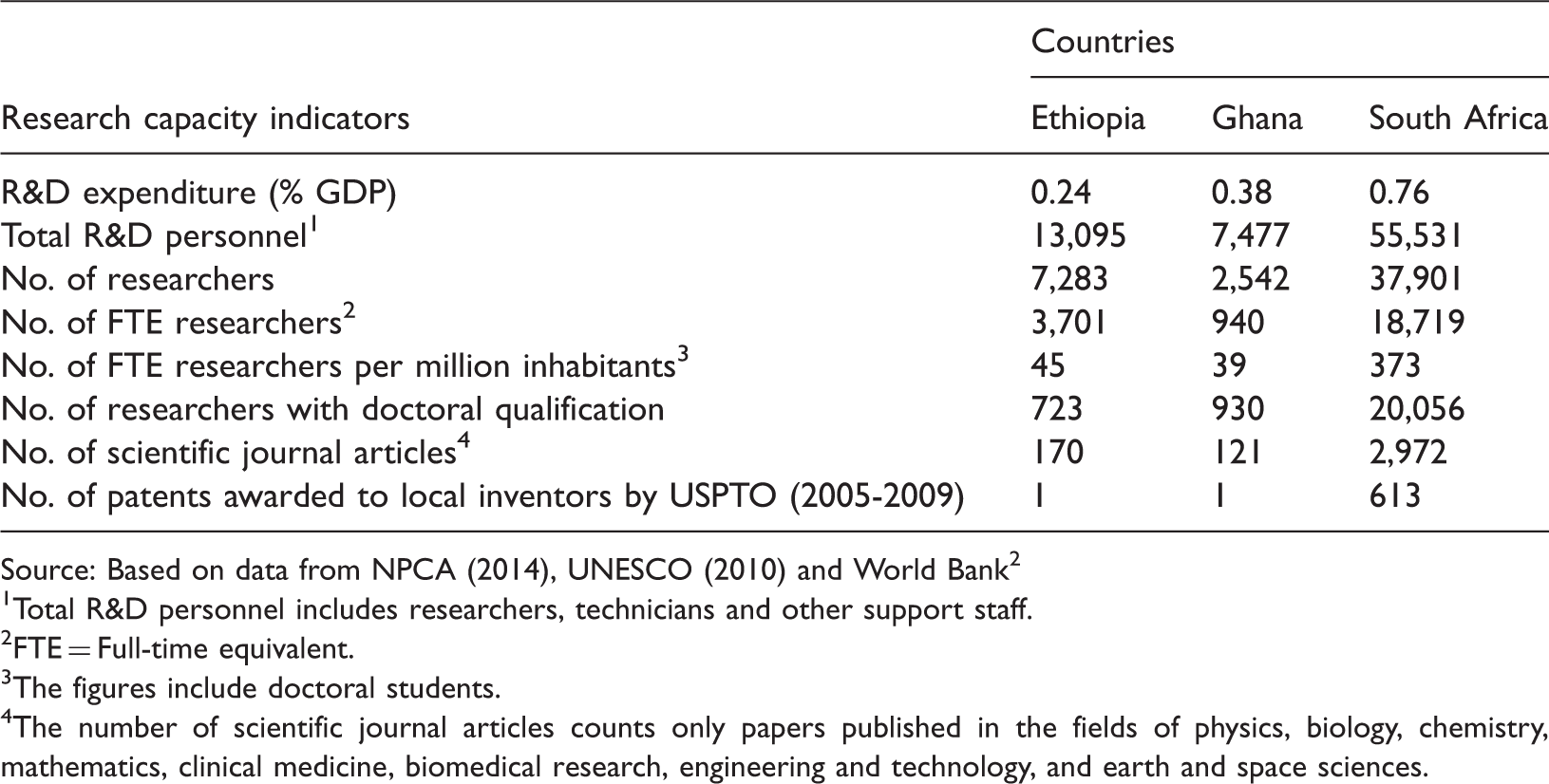
Source: Based on data from NPCA (2014), UNESCO (2010) and World Bank 2
Total R&D personnel includes researchers, technicians and other support staff.
FTE = Full-time equivalent.
The figures include doctoral students.
The number of scientific journal articles counts only papers published in the fields of physics, biology, chemistry, mathematics, clinical medicine, biomedical research, engineering and technology, and earth and space sciences.
However, low R&D investment is not the only reason for Africa's disadvantage in the knowledge economy workforce. Skilled migration is another contributing factor. Although developing countries produce a sizeable number of scientists and professionals (Weinberg, 2010), they often end up losing them to economically advanced countries at an alarming rate (Baruch et al., 2007; Geber, 2013; Okeke, 2013; Teferra, 2005). A study shows that some 70,000 highly qualified professionals (e.g. academics, managers, physicians, engineers) leave Africa every year (World Markets Research Centre, 2002
Shared optimism in participating in the knowledge economy
One of the impacts of the prevalence of the knowledge economy as a discursive construct in policy arenas of many African countries is the increased interest in doctoral studies. Regardless of significant differences in levels of HE development and knowledge production capacity across the three countries, the analysis of the policy texts reveal a shared sense of optimism about the value of knowledge in economic productivity and of the potential for each of these three countries to participate in the global economic system.
In its education sector development plan (FDRE, 2010a), Higher Education Proclamation (FDRE, 2009), and national Science, Technology and Innovation policy (FDRE, 2012), the government of Ethiopia emphasizes the importance of knowledge production and technology transfer capacity as key inputs for the poverty reduction goals of the nation. As a reflection of the broad national policy discourse on knowledge economy and human capital formation, the fourth education sector development programme highlighted the central role of the HE system in ‘turning Ethiopia into a middle-income country by the year 2025’ (FDRE, 2010a: 7, emphasis added). Similarly, the Higher Education Proclamation (No.650/2009) outlines the core missions of the system to be promoting and enhancing research ‘focusing on knowledge and technology transfer consistent with the country's priority needs’ and supporting the nation's goal of becoming ‘internationally competitive’ (FDRE, 2009: 4979). Accordingly, one of the key development strategies of the government is ‘expanding human capital and improving human development outcomes’ of the nation (FDRE, 2010b: 10).
One of the objective manifestations of this knowledge economy optimism is the exponential expansion of the Ethiopian HE system since the turn of the century. The government spends more than 1.5% of the national gross domestic product (GDP) on HE, the highest expenditure in SSA (UIS, 2010), making Ethiopia one of the top spenders on the HE sector in the world. As a result of large-scale expansion at all levels, Ethiopia has the third highest average annual growth rate of HE enrolment in the world, after Lao People's Democratic Republic and Cuba (UIS, 2009
Similarly, in Ghana, economic and education policies and strategies reflect knowledge economy narratives. In the Education Strategic Plan (2010–2020), the government frames the goal of education (specifically ICT education) in terms of transforming the nation ‘into an information rich, knowledge based and technology driven high income economy and society’ (GoG, 2010a: 17, emphasis added). Affirming the centrality of HE to the nation's development and transformation aspirations, the government asserts that without quality HE and advanced knowledge, the country's development ambition remains unattainable: Without a well-educated, skilled and informed population, the transformation of the key sectors of the economy, and the effort to raise living standards and productivity as the bases of wealth creation and the optimization of the potential of the economy will continue to stall. (GoG, 2010b: 92) It [research] makes possible the growth of an innovation culture in which new ideas, approaches and applications increase the adaptive and responsive capacity of our society, thereby enhancing both our industrial competitiveness and our ability to solve our most pressing social challenges. (MoE-SA, 2001: 62)
This shared optimism can be seen as evidence of the pervasive impact of post-2000 knowledge economy discourse in the national development plans of each of the three countries. National policy processes regarding research and research training are informed by such discursive constructs as ‘high calibre human capital’, ‘global competitiveness’, ‘critical mass of research workforce’, ‘repositioning Africa in the global knowledge economy’, and ‘responsiveness and relevance of African HE’.
What emerges from our analysis is that while all three countries have endorsed the global knowledge economy imaginary, they differ in the extent to which they align research training (e.g. doctoral education) with the broader economic discourse. In Ethiopia, institutional and systemic changes towards research training aim at facilitating the “research and technology transfer capacity” of the nation whereas in Ghana and South Africa, the importance of research and “knowledge production” (as measured mainly by the number of doctoral graduates and scientific publications) is framed in terms of innovation, economic productivity and social transformation. This difference in priority has significant implications for which research is funded, and what sort of knowledge is valued.
Diverse challenges
World rankings of the three countries in different indicators of knowledge economy productivity
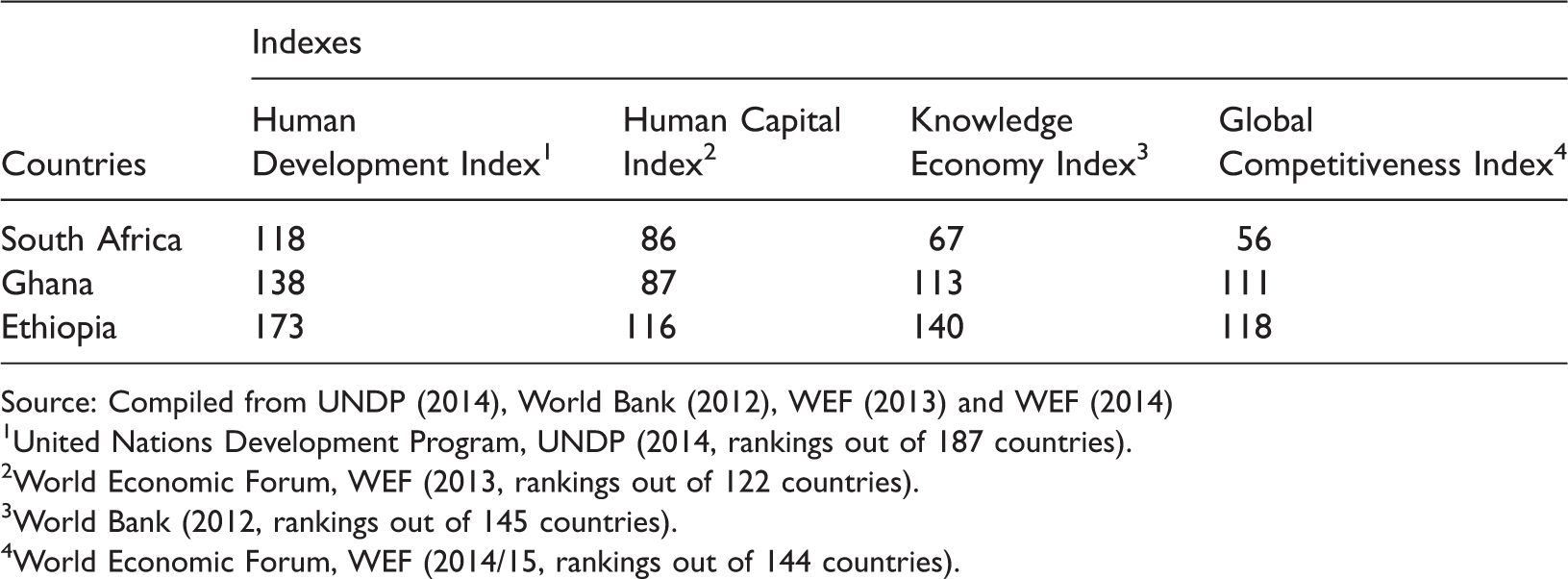
Source: Compiled from UNDP (2014), World Bank (2012), WEF (2013) and WEF (2014)
United Nations Development Program, UNDP (2014, rankings out of 187 countries).
World Economic Forum, WEF (2013, rankings out of 122 countries).
World Bank (2012, rankings out of 145 countries).
World Economic Forum, WEF (2014/15, rankings out of 144 countries).
The challenges facing doctoral education in Africa flow from these low development indicators; as outlined by Szanton and Manyika (2002), doctoral training takes place in intellectual environments that offer little to facilitate the critical, scholarly engagement of candidates relative to the conditions in more advanced HE systems. Modes of delivery of doctoral education – still predominantly the apprenticeship model with a lone supervisor – also fail to address the needs of candidates who, in many cases, are new to the research process. In this section, we look in more detail at critical issues facing doctoral education in the three countries: low research training capacity, institutional inequality in research productivity, inefficiency and lack of responsiveness of research training to local needs.
Low research training capacity
Low research training capacity is a particularly critical issue in Ethiopia, where it is related to low levels of funding for scientific research, and a lack of institutional capacity to train researchers (e.g. through doctoral education). The challenge is particularly significant in terms of continuing low levels of doctoral-qualified academics to meet the demands of the expanding HE system. Following the exponential growth in undergraduate enrolments, many of the academic positions in Ethiopian universities are filled by underqualified staff. In 2012, in the Addis Ababa Institute of Technology, one of the newly established universities of Ethiopia, only 19% of the academic staff had doctoral level qualifications, while 42% and 39% had only respectively Masters and Bachelor degrees respectively. The Institute aims, perhaps unrealistically, to improve its ratios of qualified staff by 2015: no more than 20% holding only Bachelor degrees, 50% Masters graduates holders, and 30% PhD graduates (IAU, 2012).
Further, Ethiopia counts on ‘imported expertise’ for its research and research training needs. For example, in the public universities, the number of expatriate staff increased from 429 in 2000/01 to 955 in 2009/10 and to 1,848 in 2012/13, while the number of Ethiopian national academic staff members increased from 2,528 to 13,121 and to 20,051 in the same years (MoE, 2001, 2010, 2013
Similar challenges on a different scale face Ghanaian public universities. Although compared to Ethiopia, Ghana has a higher proportion of doctoral qualified personnel in the research workforce, overall it has a very low quotient of researchers per capita, with only 17 researchers per million people (World Bank 2014). In contrast, South Africa has a relatively well-established and diverse HE system. In 2011, South Africa had 20 PhD holders per one million people – and PhD enrolment grew from 706 in 2001 to 1,002 in 2007 (Cloete et al., 2011).
Institutional inequality in research productivity
Institutional inequality in research productivity and research training capacity can be inferred from the wide gap between well-established (national) universities and other universities in terms of the proportion of academic staff with doctoral qualifications. Whereas on average PhD holders in public universities account for 8.6% in Ethiopia, 38% in Ghana and 34% in South Africa, the proportion is much higher in each country's national (leading) universities: that is, 28% in Addis Ababa University (Ethiopia), 46.8% in the University of Ghana and 58% in the University of Cape Town, South Africa (GoG, 2013; Molla, 2014; NPC, 2011).
The South African case is particularly instructive. South African universities are highly differentiated in knowledge production capacity (as measured by such indicators as masters and doctoral enrolments and graduates, proportion of staff with doctorates, proportion of PhD graduates to permanent staff and accredited publication output). Although all universities receive a research subsidy, much of the research expenditure (65%), half of university-based researchers, over 60% of research output (as measured by the number of articles published in scientific journals) and 56% of doctoral students are concentrated in five universities (namely Cape Town, Witwatersrand, KwaZulu-Natal, Pretoria and Stellenbosch) (Boughey and McKenna, 2013; SAccess, 2010). According to the National Plan, this inequality is attributable to the fact that South African universities are differently positioned in terms of material resources, historical legacies and critical mass of qualified staff to supervise doctoral students and undertake quality research.
Inefficiency and lack of responsiveness
The knowledge economy aspirations of African countries have been considerably constrained by an array of factors, including low research productivity, inefficient research training and lack of responsiveness of research outcomes to the socio-economic needs of society (Cloete et al., 2015; World Bank, 2014). Whereas the imperative of efficiency of doctoral programmes is commonly measured by progression, retention, completion and productivity rates (Cloete et al., 2015: 61) and is mainly linked to systemic planning and institutional practices, relevance is assessed in terms of the extent to which the programmes (a) align their contents and goals with local needs and priorities, (b) facilitate technological transfer and innovation, (c) train quality young generation of scholars, (d) reflect the level of differentiation and specialization that the labour market requires, and (e) enhance the employability of graduates.
Postgraduate enrolment and graduates in Ethiopian public higher education (2008/09–2012/13)
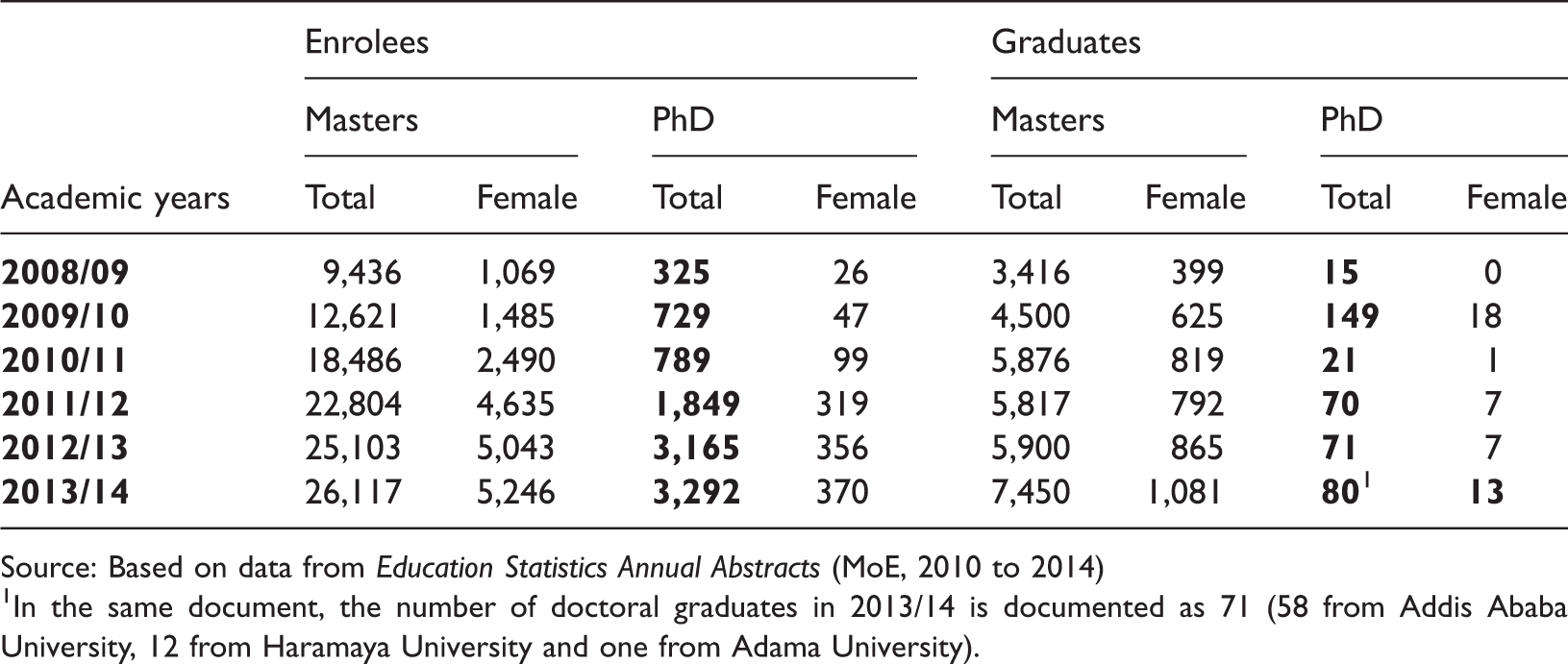
Source: Based on data from Education Statistics Annual Abstracts (MoE, 2010 to 2014)
In the same document, the number of doctoral graduates in 2013/14 is documented as 71 (58 from Addis Ababa University, 12 from Haramaya University and one from Adama University).
One of the key problems of doctoral education in Ghana is lack of internal efficiency as measured by low completion rates and lengthy completion times (World Bank, 2010; UNCTAD, 2011). According to the World Bank' s 2010 report on HE in Ghana, only 16 of the 38 PhD candidates who commenced their full-time study in Arts and Sciences in 2000 had graduated by 2007. In the face of this level of inefficiency, coupled with an increased brain drain, Ghanaian universities remain poorly equipped to run effective PhD programmes – they lack qualified academic staff to supervise doctoral candidates. In the National University of Ghana, the problem of the inefficiency of doctoral education is a critical concern: throughout the 2000s, on average only a dozen students graduated with the PhD annually (Aryeetey, 2013:19). In Ghana, lack of responsiveness of research is largely recognized in terms of the limited value of research outcomes in achieving the national poverty reduction targets (GoG, 2003), and the problem of the low level of commercialization of scientific research outcomes (GoG, 2010b: 167).
Low enrolment rates, high attrition rates, and lengthy completion time are also critical challenges in South African doctoral programmes (ASSAf, 2010; Boughey and McKenna, 2013; NPC, 2011). For instance, of the doctoral students commencing in 2006, only 46% graduated within seven years (Cloete et al., 2015). This is well below the average length of completion-time in other developed HE systems such as Australia (see Cuthbert and Molla, 2015a). In response to these issues, the National Plan has set a benchmark for each university to achieve a graduation rate of 20% of total doctoral enrolments annually (DST-SA, 2007). The relevance of HE to the socio-economic needs of the society is another policy issue. Among the key criticisms regarding the appropriateness of the doctorate in South Africa are that it is ‘too specialised and not multidisciplinary enough’, and that ‘it does not allow for the development of knowledge and broad skills necessary in industry’ (ASSAf, 2010: 38). Against the backdrop of such challenges, in the National Development Plan, the South African government recognizes: ‘While knowledge production is the rationale of higher education, high quality knowledge production cannot be fully realised with [among other things] a curriculum or environment that is alienating and does not articulate the vision of the nation’ (NPC, 2011: 271).
Seen from the context of the knowledge economy discourse that underpins ‘the PhD policy moment’ in the region, the alignment of the doctorate with the needs of industry is of great development importance.
Convergences in strategies
As the foregoing discussion illustrates, the three HE systems have faced pressing challenges that necessitate policy actions. Similarities in the nature of the problems they have faced, strong influence of global and regional policy agents such as the World Bank and African Union, and the ubiquity of knowledge economy constructs at all levels of the HE policy process have resulted in convergences to policies and strategies in the area of doctoral education. The key strategies adapted across the three national policy contexts are: expanding postgraduate enrolment, strengthening the institutional research capacities of public universities, and ensuring the efficiency and relevance of research training. These points are briefly discussed in turn here.
Expanding research training
In 1999, there were only 22 PhD students in Ethiopia. In 2011, the number grew to 789 – that is, in 12 years, PhD enrolment grew by a factor of 35. Even so, PhD enrolment in Ethiopia remains among the lowest in Africa. 3 For example, the same source shows that in 2011, there were only nine PhD students per one million Ethiopians while there were 450, 244, 29 and 17 PhD students per one million of population respectively in Egypt, Mozambique, Ghana and Niger.
The government of Ethiopia sees technology transfer as key to the nation's transition to middle income category (FDRE, 2010a, 2010b) through knowledge-based economic growth. The government holds that in the face of a serious shortage of trained researchers and research trainers, the knowledge-driven economic growth agenda remains a mere statement. Accordingly, the government has set qualitative and quantitative targets that need to be achieved in order to build a national research and technology transfer capacity. In its ongoing education sector development programme (FDRE, 2010a) the government has set clear goals to increase the number of doctoral candidates and graduates as well as to improve the proportion of academic staff with doctoral qualifications. In the new plan, the Ethiopian government aims to produce 3000 doctorates in five years (from 2009/10 to 2014/15). In 2008/09, the proportion of academic staff with doctoral qualifications was only 8.6% (that is, 997 doctorates out of 11,238 academic staff in public universities). The new plan aims to increase the quota of PhD holders in public universities to 5750 in 2014/15 – that is, 25% of a projected 23,000 total academic staff (FDRE, 2010a: 65). As is shown in Table 3, the number of doctoral candidates in Ethiopian universities has increased by nearly ten-fold since the implementation of the new plan in 2009/10, from 325 in 2008/09 to 3292 in 2013/14. Although the end-goal appears to be ambitious, even unrealistic, the projected figure is less than those set by other African counties such as Kenya. In 2014, the government of Kenya set out to produce 1,000 PhDs a year with the PhD becoming a compulsory qualification for a lecturer position in Kenyan universities (Nganga, 2014).
The most ambitious plans for doctoral education training comes from South Africa, which may not be surprising given the level of development in this HE system and its increased capacity to deliver PhD education. In order to achieve its stated goal of 100 doctoral graduates per million per year by 2030, compared with 20 doctoral graduates per million per year in 2010, the South African government has set targets of 5000 PhD graduates per year, as compared with 1420 graduates produced in 2010 (NPC, 2011: 278). Illustrating the virtuous circle whereby higher numbers of PhD graduates within universities led to an enhanced doctoral-delivery capacity, the South African government has specified an increase in the proportion of PhD holders in the academic staff of universities from 34% in 2010 to 75% in 2030 (NPC, 2011: 267). To compare the South African case with other advanced economies, Portugal has 569 PhD graduates per million per year; UK, 288; USA, 201; Australia 264; Korea, 187; Brazil, 48; and South Africa 28 (NPC, 2011: 278). The National Plan also seeks to increase South Africa's global share of research outputs from 0.5% in 2002 to 1% in 2018 (DST-SA, 2007: 8).
For HE institutions, improved research-training capacity and research productivity starts with increasing doctoral graduates. However, it should not be assumed that all PhD graduates readily qualify for quality teaching, research and supervision roles. They may need additional mentoring and capacity building (e.g. through postdoctoral research fellowship) before they become productive and independent scholars.
Beyond highlighting the importance of expanding postgraduate training, the government of Ghana has not set specific targets for admissions or graduation rates at doctorate level. The plan to expand research training in Ethiopia and South Africa is partly necessitated by the need to improve the institutional research capacities of public universities. All three countries, like many other SSA countries, also send their students overseas for postgraduate studies. In 2012, in Australian, British and American universities alone there were 1,593 Ethiopian, 4,725 Ghanaian and 3,685 South African students. 4
International collaboration
As part of their research capacity expansion objectives, many African countries, including Ethiopia, Ghana and South Africa, have been engaged in regional and international collaborations and partnerships for research training. For instance, since 2002, the African Economic Research Consortium's Collaborative PhD Programme has sponsored approximately 20 doctoral candidates per year in eight degree-awarding universities across SSA (Cross and Backhouse, 2014). The programme has been supported by African governments as well as development aid providers such as the UK's Department for International Development (DfID). 5 In a period of ten years, the programme has produced 160 doctoral graduates (Cross and Backhouse, 2014). Likewise, the International Association of Universities’ portal on Innovative Approaches for Doctoral Education in Africa (IDEA-PhD) provides an online networking and information sharing platform on doctoral education in Africa. The portal serves as a showcase of emerging innovative approaches and models of doctoral education that suit the socio-economic needs and contexts of the region, and seeks to address shortfalls in local research capacity through skills-sharing and collaboration. 6 As King (2014) notes, the emerging trend of Africa–China collaborations in ‘human resources development’ also means that African HE systems are well-positioned to benefit from new sources of funding and new models of partnership in research training.
International partnership is a key component of South African doctoral education development. In 1998, five schools of education in South African universities, in collaboration with Stanford University and the University of Queensland, formed the South African Doctoral Consortium. Among other things, the consortium aimed to restructure curricula and structures of doctoral training programmes in education, building research capacity of students and staff, and promoting collaboration and networks (Cross and Backhouse, 2014). In three cycles, between 1999 and 2005/06, the consortium enrolled 75 candidates. It received funding from national and international sources. Further, many universities from the Southern African Development Community (SADC) countries, including 12 South African universities, participated in the Cooperation on Doctoral Education between Africa, Asia, Latin America and Europe (Jørgensen, 2012). Since 2012, a consortium of South African universities (Rhodes, Stellenbosch, Cape Town and Fort Hare), in collaboration with Dutch partners, have put in place a course for the professional development of PhD supervisors in an effort to boost this key capacity. About 18 of the 23 South African public universities have been part of this partnership, and many supervisors have benefitted from it (Boughey and McKenna, 2013).
Following the agreement of the BRICS countries (Brazil, Russia, India, China and South Africa) to establish BRICS Network University as a key infrastructure to promote research collaboration and student mobility in November 2015, a dozen South African universities will be part of the cooperative programme (UWN, 2015, 21 November). The initiative aims, inter alia, to ‘support joint research projects, encourage more collaborative programmes at post-graduate, doctorate and post-doctorate levels and promote join-publishing of scientific results by BRICS universities’. 7 Such initiatives imply a readiness on the part of South African doctoral education programmes to take advantage of international and regional collaborations directed at enhancing their capacity to deliver high quality PhD graduates.
In Ethiopia, the importance of partnership and collaboration for improved research training is duly acknowledged in official discourses. In his opening address to an international conference on innovative approaches to doctoral education in Africa (12–13 July 2012, Addis Ababa, Ethiopia), for example, Dr. Kaba Urgessa, State Minister for Higher Education of Ethiopia, reported that his government planned to produce 2,000 doctorates by 2015 through local training and ‘sandwich programmes’ offered by local and overseas institutions (IAU, 2012). The government has also been encouraging international higher education institutions to offer postgraduate programmes in Ethiopia. In 2008, the government signed a bilateral agreement with the University of South Africa (UNISA) for capacity building at the postgraduate level. The agreement has enabled UNISA to launch a doctoral training component through its distance graduate programme.
8
In 2012, there were a total of 370 doctoral candidates enrolled in UNISA's Ethiopia Centre for Graduate Studies.
9
UNISA also runs periodical face-to-face research workshops for masters and doctoral students in Ethiopia. Moreover, research grants from international development agencies play critical roles in supporting university-based research and research training in Ethiopia. The leading R&D donors include: the World Bank, United Nations Educational, Scientific and Cultural Organization (UNESCO), United Nations Development Program (UNDP), Food and Agriculture Organization of the United Nations (FAO), European Union (EU), International Foundation for Science (IFS), German Academic Exchange Service (DAAD), and International Development Research Centre (IDRC) of Canada (Mekuriaw, 2003
There is a range of other institutional initiatives for collaborative doctoral training. Many public universities in the three countries have established bilateral collaborations and partnerships with overseas institutions and agencies but collaboration with African counterparts appears to be highly limited. For example, Addis Ababa University (AAU), in partnership with the German Academic Exchange Service (DAAD), has opened a new PhD programme in Environmental Planning (IAU, 2012). Ethiopia's Jimma University has been part of the Institutional University Collaboration programme of Flemish universities in Belgium since 2007. 10 The programme aims to support efforts at institutional building in the global South. In November 2014, the first four (out of a total of 50 planned) Ethiopian doctorates graduated through the programme. 11 Further, international visiting scholars support doctoral programmes in AAU and other Ethiopian universities through committing time to teach, supervise and examine research students (Mohamedbhai, 2011).
In Ghana international collaboration in research training is part of the nation's development policy. The government holds that in order to improve the national research workforce, ‘Ghana will seek opportunities to collaborate with partners in the African Union and foreign partners for education, training and research’ (GoG, 2010c: 29). According to the vice chancellor of the University of Ghana, international partnership is a key aspect of the proposed new model of doctoral training (Aryeetey, 2013). Partnerships with European and American universities are crucial for two reasons: doctoral students spend part of their training period in world-class partner universities (for exposure and experience), and they provide assurances that research supervision and evaluation are undertaken by leading international scholars in the field. The national Science, Technology and Innovation (STI) policy stresses the importance of building the capacity of universities to produce qualified doctoral graduates in the areas of science and technology; and encourages ‘Ghana's scientists and technologists to link up with international research centres where world class basic research is being conducted’ (GoG, 2010c: 12).
Importantly, to counter the brain drain, initiatives are focused on keeping doctoral scholars in Africa (with perhaps short periods overseas), and on collaborations within Africa and internationally to address the lack of critical mass of world-class researchers and research trainers in Africa itself by pooling resources which may be directed to enhancing the quality of doctoral provision in key fields, such as the science, technology, engineering and mathematics (STEM) disciplines (World Bank and Elsevier, 2014). Collaborative doctoral programmes have a potential to avert brain drain especially if the collaboration is intra-Africa or if doctoral students spend much of their time, including the final year, in their home country.
Ensuring relevance of research and research training
There is a strong movement across Africa to ensure that doctoral education is relevant to the socio-economic needs and contexts of the society (Cross and Backhouse, 2014). Perceiving the relevance of research undertaken to be an issue, the government of Ghana has taken policy action to address the problem. In Ghana, the agenda of ensuring the relevance of research training is justified in terms of the role of knowledge and innovation in the economic processes of the country. Ernest Aryeetey, vice chancellor of University of Ghana, called for the national government to commit to the establishment of a world-class university as ‘a thought leader and knowledge provider in the required structural transformation process for the economy’ (2013: 19). In line with such expectations, the University of Ghana has introduced a new doctoral programme that has replaced the traditional 3-year research-only PhD programme model that was found to be inefficient. The new PhD that came into effect in August 2013 and takes a minimum of four years training, including one year of course-work, two years of practical training in research (through collaborative research and seminar presentations that would be assessed towards the doctorate), and a final year dissertation writing-up period (Aryeetey, 2013).
Similarly the Ethiopian government has put in place two policy directives to improve the relevance of research and research training. First, it set out to reorient research activities ‘to focus on the national technological demands for searching for, learning about, adapting and utilizing effective foreign technologies’ (FDRE, 2012: 9). To this end, the government has introduced what has come to be known as the ‘70/30 per cent professional mix’ policy that favors enrolment in Science and Technology fields at undergraduate and postgraduate levels. The policy mandates that university in-takes are on the basis of placement of 70% into the Science, Engineering and Technology streams, and 30% into the Social Sciences and Humanities streams (MoE, 2008). This has implications for research and research training, and is intended to supply a pipeline of ‘a mass’ of STEM students suitable for doctoral study. Second, as part of the effort to improve the ‘research and technology transfer capacity’ of the country, the Ethiopian government has outlined initiatives for the establishment of a national framework for research priorities, institutional research policy statements of public universities, and university-based innovation funds and consultancy centers (FDRE, 2010a: 65), and for the consolidation of Government Research Institutes (GRIs).
It is noteworthy that whereas South Africa and Ghana strongly encourage basic or pure research, the focus in Ethiopia seems to be limited to applied research, specifically to support the nation's technology transfer capacity (FDRE, 2010b, 2012). Moreover, unlike Ethiopia and Ghana, South Africa has diversified its doctoral education programmes by introducing doctorates by publication, taught doctoral programmes and the ‘professional’ doctorate alongside the traditional supervised original research (Boughey and McKenna, 2013).
Conclusion
The policy texts analysed in this paper share similarities in their expression of knowledge economy optimism, and the framing of the policy problems related to increasing research capacity in each of the three selected countries. However, we also note divergences in the level of policy engagement towards doctoral education across the three national contexts.
Compared to Ethiopia and Ghana, South Africa has a better-articulated policy environment in relation to the doctorate, research training, and research productivity in general. Focused on improving research training, the government of South Africa has introduced changes in the areas of funding, recruitment, and quality assurance. The rate of doctoral graduation and the output of original articles published in scientific journals are central to the measuring of the nation's knowledge production capacity. A relatively high R&D expenditure as a percentage of GDP (see Table 1) coupled with the expansion of doctoral enrolments mean that South Africa is well-positioned to produce, disseminate and use knowledge. As part of the effort to address the problem of inefficiency in research training, the National Plan for Higher Education set a benchmark of an annual 20% doctoral graduation rate for each university (MoE-SA, 2001), with the government encouraging the diversification of doctoral programmes as described above.
The considerable policy attention given to research training in South Africa is a reflection of the overall strength of the national HE system. The ambitious plan to expand doctoral enrolment can also be linked with the government's aim to attract fee-paying international students. In SSA, South Africa has emerged as ‘PhD hub’ (Cloete et al., 2015). In 2009, 22% of the total 10,529 doctoral students enrolled in South African universities came from other African countries, 12% from SADC members (Sehoole, 2011). The country also benefits from skilled migration: a third of non-South African doctoral students intend to stay in South Africa after graduation (ASSAf, 2010). While this might represent a better outcome for Africa than brain drain to Europe and America, the consequences of this concentration of doctoral capacity in South Africa comes at a cost for those nations whose students are studying and staying there post-graduation.
In Ethiopia, the policy narrative is narrowly framed in terms of increasing doctoral enrolments. The policy provision in the areas of quality assurance and funding is lacking. The policy goals appear to be unrealistic. For instance, the government plans that by 2014/15 all academic staff in Ethiopian public universities will have graduate level qualifications – 25% at doctoral and 75% masters level. However, given that in 2009/10 over half of the academic staff in Ethiopia had only a bachelor degree (Molla, 2013) and that in the last five years (2008/09–2012/13) Ethiopian universities produced only 326 doctorates, it is not clear how the government can achieve the goal of upgrading over 4,500 of the projected 23,000 academic staff to doctoral level qualification by 2014/15. We also noted an omission in the policy discourses. Overall access to doctoral education is extremely limited, even worse, completion rates are significantly low. In 2013/14, there were around 3,300 doctoral students in the Ethiopian public HE system, but only 80 graduated with a doctorate in same year (see Table 3). This raises the question of the efficiency of doctoral training programmes, and the importance of support for candidates to assist them to complete. And yet, the policy documents do not highlight this as an area of concern. Further, there is a wide gap between well-established universities and the rest in terms of their research training capacity. The majority of the public universities are very new and do not have the institutional capacity to offer doctoral programmes. In 2012/2013, only eight of Ethiopia's 31 public universities had PhD programmes; over half (1,575 out of 3,165) of the doctoral enrolments were in Addis Ababa University (MoE, 2013). This is partly attributable to the high degree of inequality in research training capacity across the public universities (mainly measured by the proportion of PhD holders on the academic staff). None the less, this institutional inequality has not been duly recognized in the policy documents, and there are no mechanisms in place for narrowing this gap.
Ghana does not yet have a comprehensive HE policy. In May 2013, the government, in collaboration with TrustAfrica, organized a national dialogue on HE policy in Ghana with the theme ‘Repositioning Tertiary Education for National Development’. The dialogue passed resolutions on a range of issues including the need for developing a National Vision and Plan for Tertiary Education in Ghana, addressing concerns about graduate employability, increasing the contribution of non-government actors in the funding of the higher education sector, and promoting research and innovation (National Council of Tertiary Education and TrustAfrica, 2013). Clearly, a great deal hangs on the emergence of this plan.
The pursuit of the African PhD must be a cornerstone of national development, HE policies, and science and technology strategies in Africa. To deliver on the great promise of high quality doctoral provision, elements contained in the policy documents of the three countries investigated in this study are necessary but – especially in the cases of Ghana and Ethiopia – not yet sufficient to deliver on this promise. Alignment between high-level national development planning and strategies for HE, of which South Africa provides the best example, is needed in both Ghana and Ethiopia. Further, while graduation targets are necessary to drive behaviours in universities directed at successful completions, they carry the risk that the pursuit of the PhD will become a numbers game, and the even greater risk that focus on the volume of graduates will overtake concern with the quality of their education and its responsiveness to African needs. Africa needs highly trained doctoral graduates who, while based in Africa, are exposed to best practices in research training and to the best researchers in their fields. Strategies to achieve this include increased collaborations across Africa and internationally, and the mobilization of the African diaspora, which has members in virtually every higher education system in the world, including the most highly developed.
Footnotes
Acknowledgements
The authors are grateful to participants in the Doctoral Imaginaries Symposium (December 2014, RMIT University) for their critical discussion of an earlier version of this paper. Thanks are also due to Dr Kay Dreyfus for her assistance in preparing this article for publication.
Declaration of conflicting interests
The author(s) declared no potential conflicts of interest with respect to the research, authorship, and/or publication of this article.
Funding
The author(s) received no financial support for the research, authorship, and/or publication of this article.