




Abstract
The Government of India made a series of policy changes regarding elementary school education in the country in the period 2002–2012. In 2009 the Government made free (and compulsory) education a fundamental right of every child in India between the ages of six and fourteen. The Government also set out the infrastructure provisions that schools were mandated to implement. In doing so, it adopted a rights-based approach to elementary school education. This paper reports on a study of the effectiveness of this approach. It is argued that merely declaring a public service as a citizens’ right does not entail either optimal access or optimal implementation. Rather, the paper argues that claiming of rights and implementation requires an enabling environment and it is concluded that societal power bias and social accountability are important factors in creating such an environment. The examples of Kerala and Bihar, respectively the best and worst performing states in India with regard to implementation of the right to education, were used to examine these states’ different levels of performance regarding the mandates defined by the Right to Education legislation enacted in 2009.
Introduction
India’s achievements in elementary school education since the beginning of the current millennium have been the subject of contradicting views. UNICEF claimed that India was one of the ‘few developing countries in the world’ to have implemented ‘a national provision to ensure child-centered, child-friendly education to help all children develop to their fullest potential’ (UNICEF, 2010). In contrast, however, evaluations of education attainment among elementary school students have shown the levels to be dismally low. The challenge for Indian authorities therefore is to translate its milestone education policies into real changes (ASER, 2012; UNESCO, 2010).
Between 2001 and 2011 two significant amendments to the constitution were made in India such that elementary education became a civil–political right for every child in the country between the ages of 6 and 14. In 2002 the central government of India amended Article 21-A of the constitution to make free and compulsory elementary school education a fundamental right of every child aged in this age group and mandated the States to operationalize this right. Further, in 2009 the central Government endorsed this with a rights-based approach (RBA) to education and provided socio-economic guarantees for its implementation (see RTE Act, 2009). The Right to Education (RTE) Act makes it mandatory for the States to provide free education, including the supply of books and uniforms, to every child between the ages of 6 and 14 (RTE Act, 2009). In addition it provides for various infrastructure facilities in schools, the lack of which were long considered as major obstacles to school participation.
These policy changes were initiated following the Dakar Framework for Action in 2000 which reaffirmed the Right to Education through the Education for All (EFA) objective. These reforms were based on the fundamental principles underpinning the 1948 Universal Declaration of Human Rights, the 1966 International Covenant on Economic, Social and Cultural Rights (the Covenant), and the 1989 (UDHR) Convention on the Rights of the Child (CRC), in setting down the agenda for elementary education (Aradhya and Kashyap, 2006).
A rights-based approach to education submits that every individual, including children, is entitled to a good education and that it is the state’s responsibility to ensure legislation is enacted which supports this. A rights-based approach to education is thus based on the belief that education is a universal human right: it falls within the child-rights framework and adheres to the four non-negotiable ‘general principles’ laid down by the 1989 Convention on the Rights of the Child (CRC). These include the principles of non-discrimination and equality, best interests of the child, survival and development of the child, and participation by the child (CRC, 1989).
The provisions contained within the RTE Act embody the underpinnings of a rights-based approach to education and place a constitutional guarantee on it. Transforming as it does the mandate to universalize elementary schooling from a directive principle for the government to a constitutional citizens’ right, it marks significant progress with regard to children and human rights.
This paper argues that the mere act of making free and compulsory elementary education a constitutional right for children aged between 6 and 14, and setting legal safeguards to protect this right, does not guarantee the provision of universal education in India for those in this age group. A more nuanced and multi-tiered approach in assessing the RTE Act must be adopted. The idealism of the rights-based approach lies in its belief that when constitutional status is granted to a right, citizens become naturally empowered to exact their rights and states become either altruistic or accountable. The rights approach discourse is often at the risk of being rhetorical because it seeks to achieve a reversal of inherent social and power structures on the basis of a rights–development nexus.
This paper reports on the variations in state level performance between the best and worst performing states in India with regard to elementary education parameters – Kerala and Bihar respectively – to provide an understanding of the context and dynamics within which RTE has operated in achieving its goals. Reference is made to ASER (Annual Status of Education Report) documents from 2006 and 2011 to compare the performances of Kerala and Bihar on parameters including participation and learning outcomes; RTE mandated infrastructure indicators; and budgets and expenditures. A comparison is also made of the performance of Kerala and Bihar on other government programs, social ‘safety net’ programs and social indicators, in order to support the argument that operationalizing rights is contingent upon the socio-political and economic climate of a state or community and that a rights-based approach to education alone cannot ensure universal access to acceptable quality elementary school education.
While a historic perspective has been provided of the two states in order to provide an understanding of the context of operationalizing rights, this paper does not claim that a region’s history alone can validate its ability to realize rights effectively. Examples of states making use of good governance and rising socio-political consciousness to achieve remarkable progress over the last 20 years abound in India – for example, Chhattisgarh, Himachal Pradesh, Madhya Pradesh and Andhra Pradesh.
RTE: evolution and background
As noted above, Article 21-A amended the constitution of India to make ‘free and compulsory’ elementary school education a fundamental right of every child in the 6–14 age group. While Article 21-A granted elementary education the status of ‘fundamental right’, it left state responsibility regarding the terms and conditions of RTE implementation ‘to be regulated by law’, leaving it to the state’s discretion to implement the right ‘in such a manner that the State may by law determine’, thus making it an ‘…allied right through non-coercive means, if not through legislative provisions’ (Sarva Siksha Abhiyan, 2002).
In 2009 the Government of India announced the RTE Act and laid down very strict guidelines and guarantees for the state regarding universal elementary school education. RTE is based on the principles of equity and non-discrimination: as a constitutional amendment, it was claimed that this 93rd Constitutional Bill would be ‘path breaking in the Indian context’ because it promised to bring all children in the 6–14 age group into a formal education system (Banerjee, 2005). Together with state responsibility to ensure the implementation of this right, the Act also exhorts the fundamental duty of parents/guardians to provide this opportunity for their children/wards.
The Act places elementary education on the concurrent list, which makes implementation and the associated financial burden a shared responsibility between the central and respective state governments. Government is liable for all direct and indirect costs of education, including those related to uniforms, textbooks, school admission and tuition fees. It is also bound by law to ensure access to students at a place in a neighborhood school or, alternatively, free transportation to the nearest school. It is the government’s responsibility to ensure that students attend and complete elementary school (RTE Act, 2009).
The RTE Act sets out several provisions for addressing infrastructural deficiencies in school facilities and the quality of schooling. School buildings are required to be all-weather, have separate toilets for boys and girls, and provide access to safe drinking water, a playground and a library. Pupil–Teacher Ratios are capped at 30:1 for grades one to five and 35:1 for grades six to eight. Every teacher is required to hold a minimum qualification, as determined by the state government. Teachers are to be remunerated according to state specified norms and are mandated to work at least 45 hours a week. They are further required to hold regular parent–teacher meetings to discuss the academic progress of the children.
In addition, to incentivize school enrolment and participation, midday meals are provided to students, these meals to be prepared under hygienic conditions (RTE Act, 2009). The midday meal scheme was announced by the central government for the whole of India in May 2003 and was conscripted by law in 2009. Under the scheme, state governments are thus required to serve freshly prepared nutritious lunches to students every day of school.
Performance is required to be monitored by central and state government child protection commissions. To encourage social accountability, community empowerment and participation – especially of women – in decision-making and school monitoring, every school is required to establish a School Management Committee (SMC) comprising parents and teachers, with a minimum of 50% of SMC members to be women. SMCs are empowered to monitor school performance and government grant utilization; and work with local authorities to prepare school development plans (RTE Act, 2009).
Research project
It is argued here that the mere act of making free and compulsory elementary education a constitutional right, and setting legal safeguards to this right, does not guarantee success. It is believed that a more nuanced and multi-tiered approach in assessing the RTE Act needs to be taken. The idealism of the rights-based approach lies in its belief that when a constitutional status is granted to a right, citizens become naturally empowered to exact their rights and states either become altruistic or accountable. The rights-based approach discourse is often at the risk of being rhetorical because it demands a reversal of inherent social and power structures on the basis of a rights-development nexus. Using a comparative study of the best and worst performing states of India, Kerala and Bihar respectively, this paper tracks the variance of state level performance with regard to elementary education parameters. It also elaborates on the context and dynamics within which RTE has worked in achieving its goals.
Research design
The study involved collecting and tracking secondary data on parameters including RTE mandated infrastructure indicators, participation and learning outcomes, and budgets and expenditures. Secondary data were sourced from ASER reports for the period 2006–2011; Socio-Economic Statistics, India, 2011; National Health Profile, 2007; and IHDS, 2010. In addition, a comparison was made between the performances of Kerala and Bihar on other government programs, social safety-net programs and social indicators, to support the present authors’ argument that a rights-based approach to education cannot alone ensure universal access to quality elementary school education, and that operationalizing rights is also contingent upon the socio-political and economic climate of a state/community. 1
Study findings
RTE mandated infrastructure indicators
A minimum basic quality of school facilities is of significant importance in determining education achievement outcomes worldwide (Harbidson and Hanushek, 1992). As discussed above, the RTE Act mandates the state provision of most school facilities which, traditionally, have shown positive correlation with school enrolment, participation and attainment in India.
With regard to school facilities mandated by the RTE Act, the scores for Kerala and Bihar as of 2011 indicate Kerala surpassing Bihar on every account by a margin ranging from 10 percentage points to 89 percentage points. Figure 1 shows the comparison of the performance of the two states on implementing RTE mandates.
RTE indicator status as of 2011 for Kerala and Bihar (Source: ASER, 2011).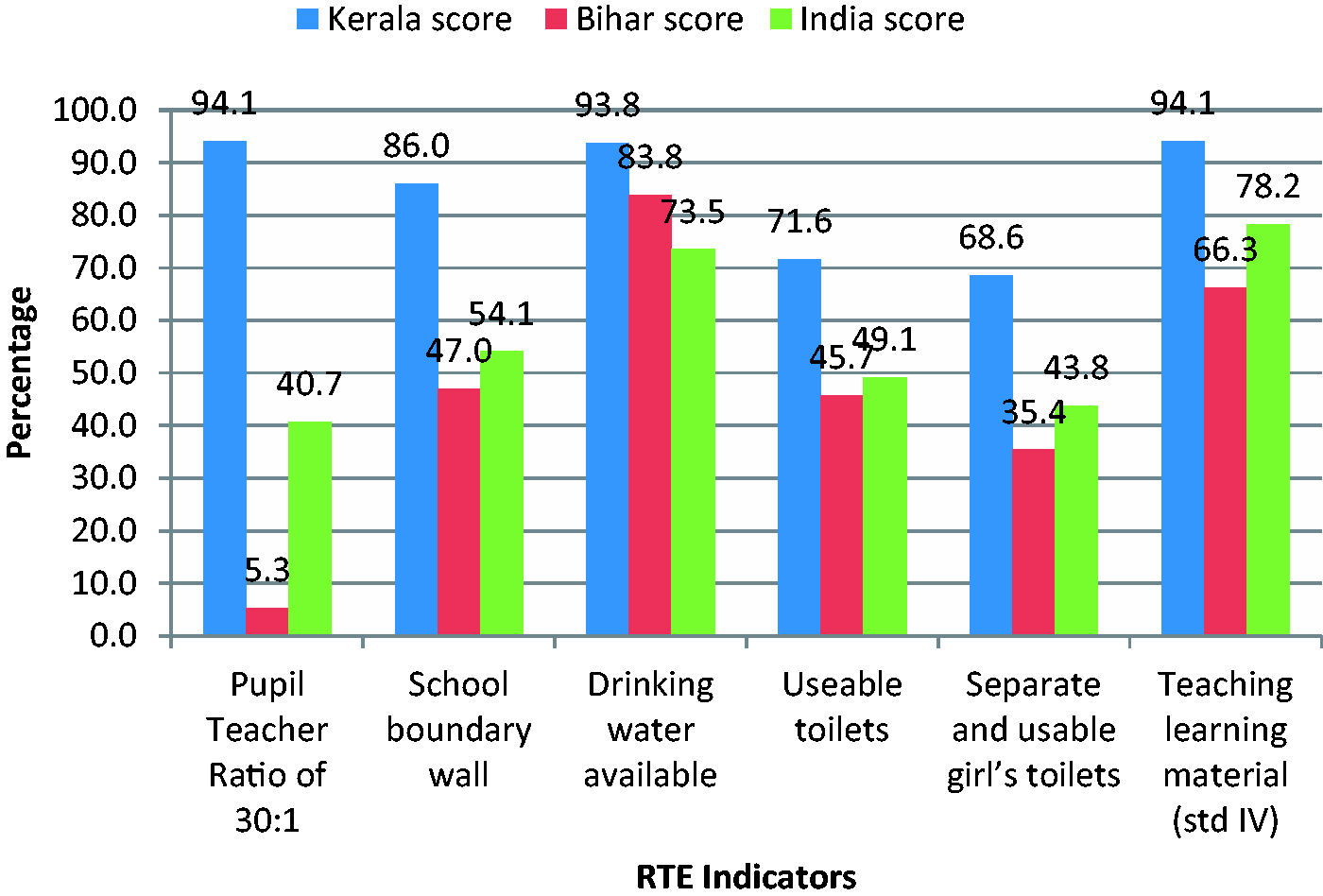
The RTE Act set the PTR (pupil–teacher ratio) at 30:1 across elementary schools in 2009. While in Kerala 94.3% schools achieved this, in Bihar the corresponding value was 5.1%. In 2009, before the PTR was set at 30:1, Kerala’s elementary schools had, on average, a PTR ratio of 29:1, with the corresponding value for Bihar being 65:1 (DISE, 2001: 5). While it was undeniably easier for Kerala to meet the RTE PTR norm than it was for Bihar, in terms of additional investment required, it should be noted that in 2011 most of Bihar’s school grant budget had been spent on school repairs instead of investment in teacher appointment and training (PAISA, 2011).
In addition to the infrastructure requirements set down by the RTE Act in 2011, Kerala also performed better with regard to providing midday meal in schools. Both Kerala and Bihar have therefore been obliged to serve the midday meal according to a directive issued by the Government of India in 2003. In the eight years between 2003 and 2011, 54.5% of the schools in Bihar served the meal; in the same time period, 100% of the schools in Kerala served the meal. In the same time period, the national average for provision of the midday meal was 87.5% (ASER, 2012).
Even among the schools in Bihar serving the midday meal, several irregularities were noted. A Planning Commission Review report noted that while some schools were functioning on satisfactory levels others reported sub-standard food, and infrequent mid-day meal service. (Planning Commission of India 2010 http://planningcommission.gov.in/reports/peoreport/peoevalu/peo_cmdm0106.pdf).
Similar issues were reported in an elementary school in the town of Chhapra in Bihar where the midday meal had not been served for 15 consecutive days. School authorities interviewed about this problem stated that matters were beyond their control, citing administrative delays in the supply of food-grain as the cause (Nanda, 2013); the authorities also mentioned that they did not know how to solve this particular problem.
In another incident, in Saran district (Bihar), 22 students died and 50 were taken ill after consuming the midday meal in June 2013. A joint investigation by the Forensic Science Laboratory team and the Saran Divisional Commissioner reported that the food had been cooked with illicit oil containing traces of pesticide (Devichand and Hume, 2013).
School participation and learning outcomes
The improvement in India’s effective literacy rate for the decade 2001–2011 was 9.2 percentage points (Census of India, 2011). In 2011 the national effective literacy rate stood at 74.04%. In this context a person is considered literate if they can both read and write simple sentences. The equation used to calculate effective literacy rate by the Census of India is:

According to 2011 census data, Kerala had the highest effective literacy rate in the country, scoring 93.91%, while Bihar scored the lowest, with an effective literacy rate of at 63.82% (Census of India, 2011).
Participation and learning outcomes for Bihar and Kerala in 2011
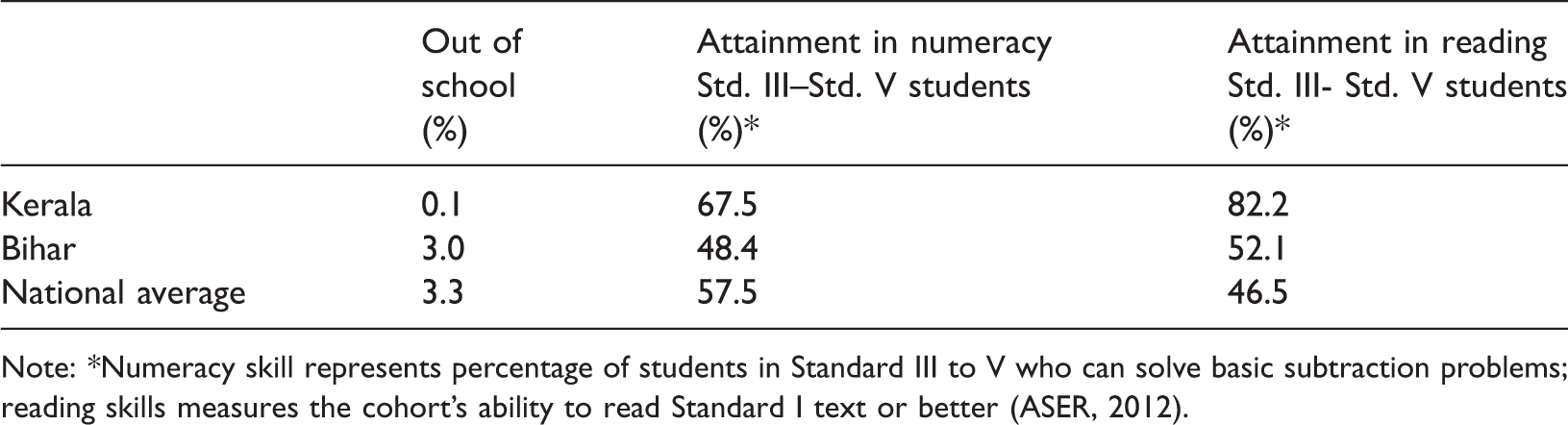
Note: *Numeracy skill represents percentage of students in Standard III to V who can solve basic subtraction problems; reading skills measures the cohort’s ability to read Standard I text or better (ASER, 2012).
Kerala also scored among the highest with regard to elementary school education parameters of enrolment, attendance, school facilities and quality of education, while the scores for Bihar were consistently low (ASER, 2012). Kerala, with almost 100% participation, was thus very close to achieving universal enrolment and participation.
Budgets and expenditures
In Kerala, per child allocation under RTE increased from US$29 in 2009–2010 to US$64 in 2011–2012: the increase in per child expenditure in Bihar rose from US$34 in 2009–2010 to US$90 in 2011–2012. However, while in Kerala, for 2010–2011, 93% of the schools reported receiving the grants, in Bihar for the same period the proportion was only 82%. Among the schools receiving grants in Bihar only 30% reported having received their grants on time, while in Kerala 81% reported receiving the grants on time (ASER, 2012).
There was leakage (funds being used for purposes other than that for which it was obtained) and over-claiming with regard to the implementation of the midday meal provision and to the politicization of teacher appointments within RTE budget expenditures. There was also inefficient use of budgets, made worse when there were delays in releasing funds (National Institute of Administrative Research, 2009). Last quarter acceleration with regard to the release of funds typically results in inefficiencies arising from the associated acceleration of spending (National Institute of Administrative Research, 2009). Seen in this perspective, the late receipt of funds in Bihar might be a plausible explanation as to why, in spite of its high PTR, Bihar continued to invest in infrastructure repairs rather than teacher appointments.
Analysis and discussion
Kerala’s wide margin over Bihar in literacy, enrolment and attainment rates cannot be seen merely as a result of the RTE Act or Article 21-A. Rather, it is argued that it is due to the imposition over many years of educational and other social reforms initiated by the state and pre-dating India’s independence. Kerala’s social and economic development has been substantially better than most other states in India (Drèze and Sen, 1997). Its accomplishments show that the wellbeing of the population can be improved, and social, cultural and political conditions transformed, even at low income levels, when implemented by public action and good governance (Drèze and Sen, 1997).
Kerala’s educational reforms began in the nineteenth century and, by 1961, its literacy rate reached 46.8% – comparable to current levels in Bihar. In 1961, the national average was nearly half the current Bihar rate, at 24%, and Bihar’s was lower still at 21.95% (Planning Commission, 2002). This is perhaps one of the reasons why Kerala performed better on almost every indicator.
The performance of both states in providing midday meals, and their performances in providing grants on time, emerge as important indicators in implementing a rights-based approach. Both indicators arose as a result of state-wide directives issued by the central government. On both accounts – midday meals and timely delivery of funding – Kerala surpassed Bihar by a wide margin.
For rights to be claimed, the potential for participation, whether under the rule of law or in social practice, does not automatically mean that it will be used equally by various actors (Gaventa, 2002). The space for citizen participation is not socially inherent. It needs to be opened and the varying ‘dynamics of participation across differing levels and arenas of citizen engagement’ (Gaventa, 2002) acknowledged. Rights claiming is characterized as much by competition as consensus (Shankland, 2000) between a plurality of local actors. It occurs in highly politicized contexts in which outcomes depend to a large extent more on power relations between the state and citizens, and the hierarchies among citizens (Grugel and Piper, 2009), than the rule of law.
One of the most instructive features of Kerala’s development is its political activism in bringing about social reforms. Partly as a result of the socio-political consciousness of its people and citizen-led mass protests demanding inclusive development, the state’s reforms included lower castes and the lower-class population in its development agenda. Being a matrilineal society, Kerala has also traditionally experienced healthy levels of gender parity. The importance of political leadership and initiative, together with high levels of citizen involvement and interest, have been instrumental in making a real difference in improving the capabilities and literacy levels of Kerala’s population at large (Drèze and Sen,1997), putting the state in a virtuous cycle.
Kerala’s social and economic development has been substantially better than most other states in India (Drèze and Sen, 1997). Kerala has seen radical land reforms and significant achievements in abolishing untouchability, and its women have very levels of participation in the labor market. The gap between its ‘backward’ and ‘advanced’ regions has been substantially reduced through consistent reform efforts. The traditional hegemonic order is therefore less evident in Kerala.
Bihar, in contrast, began experiencing a decline in its social and economic conditions from the nineteenth century onwards, with the collapse of the industries sustaining its economy – sugar, cotton, opium and indigo. During this time Bihar’s ‘petty feudalism’ and strong power hierarchies were born. These have persisted post-independence and the caste, class and gender-based bias has widened (Das, 1992).
Das suggested that Bihar’s development deficit was caused by the lack of political will, the presence of strong power hierarchies, and severe caste, gender and class-based discrimination (Das, 1992). He stated that this malaise was due to Bihar being ‘subjected to societal stagnation, economic exploitation and cultural degeneration under conditions of feudalism, external and internal colonialism’ (Das, 1992: 4). The lack of political will, strong social apartheid, low socio-economic development, low literacy rates and accountability has led to Bihar’s entrapment in a vicious cycle, with the result that the environment for claiming and implementing rights is enfeebled.
If power relations are heavily biased in favor of and indemnify those in power, then implementing the RBA could become no more than a cosmetic legally-obliged change rather than meaningful reform. A review undertaken by DFID of the effect of citizen engagement in governance, which studied 100 examples of citizen engagement across 20 countries, concluded that a democracy is built not simply through political institutions and development interventions. Organized citizens also play a critical role, by articulating demands, mobilizing pressure for policy change and monitoring state governance, thus demanding accountability. Specifically, the DFID found positive outcomes related to strengthening citizenship through building awareness regarding rights; strengthening processes of participation by building alliances and relationships through grassroots communities, civil rights groups and various advocacy groups; and building responsive states and institutions through better access to development, and strengthened accountability (DFID, 2010; Gaventa and Barrett, 2010).
With regard to operationalizing and claiming rights, Kerala provides fertile ground with its tradition of socio-political consciousness, greater societal equality in terms of class, caste and gender, and political commitment to deliver social programs. Bihar, in contrast, experiences widespread social apartheid, which is detrimental to empowering the marginalized sections of the population, and low political commitment to deliver on its responsibilities. This is evident in the way in which the Public Distribution System – a government-aided, rights-based pro-poor food rationing program functions in the two states. Kerala’s Public Distribution System is acknowledged as being very effective, while that of Bihar has been termed as being in ‘a languishing state’ with historically low rates of performance showing no signs of improvement (Singh, 1990).
Performance of Kerala, Bihar and India on select socio-economic indicators
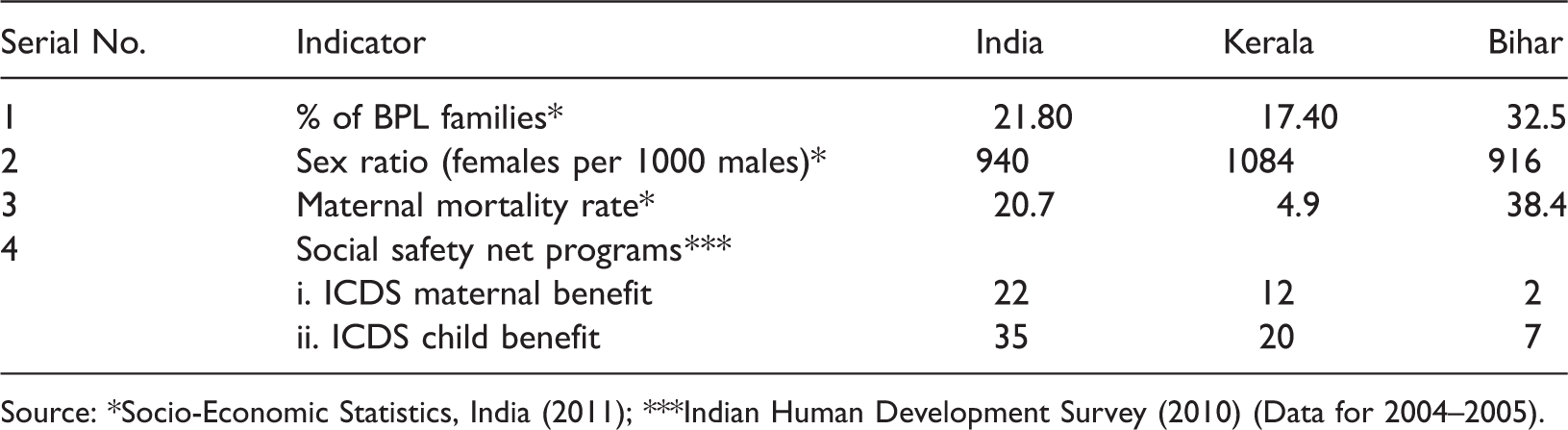
Source: *Socio-Economic Statistics, India (2011); ***Indian Human Development Survey (2010) (Data for 2004–2005).
As might be anticipated, the mediating force of social accountability between those in public office and the citizenry was higher in Kerala than in Bihar. We would argue that this is due to Kerala’s development history of ‘greater participation of the Panchayat and communities’ (National Institute of Administrative Research, 2009). While the political and social commitment and access to education is clear, on the basis of Kerala’s history of social and literacy growth, in terms of exacting accountability in RTE performance Kerala also leads by a large margin. While 94.5% of the households in Kerala were aware of the program and its entitlements, only 73.33% were aware in Bihar with 35% aware of when it was being implemented in Bihar their jurisdictions (National Institute of Administrative Research, 2009). Kerala presents a fertile environment for the propagation of the rights to education approach considered here: Bihar, in contrast, presents one which is apathetic to it.
Conclusions
In making elementary education a civil–political right for every child, the stated purpose of the RTE Act is to ensure inclusive growth by addressing and overcoming the malaise of social apartheid and ineffective policy implementation in some states of India. By means of the comparative case studies of Kerala and Bihar, we argue that placing legal provisions and sanctions alone, through a rights-based approach, does not ensure the success of service or policy, especially in education. Success in both the claiming of rights by citizens, and operationalization by the government and relevant service providers, requires an optimal environment.
The disparity in results between Kerala and Bihar serves as a reminder that India’s historic fault lines of gender, caste and religion continue to militate against a rights-based approach to universal elementary education, despite such education being granted a civil–political status (Indian Human Development Survey, 2006). The existence of these disparities continues in the face of a constitutional right to free and compulsory education, legal safeguards on school norms, state responsibility for implementing these norms, and strict guidelines on budgets. Inadequate focus on strengthening social accountability and political commitment, and continuing hegemonic behavior, are culpable in weakening the implementation of RTE as a true inclusive educational reform policy.
Footnotes
Funding
This research received no specific grant from any funding agency in the public, commercial or not-for-profit sectors.
Acknowledgement
This article is based on research work carried out for the partial fulfilment by Sharmila Ray of a Master’s degree in Public Sector Policy Management at King’s College, London in 2012–2013