




Abstract
The purpose of this article is to carry out a critical inquiry of comparative education by using an example of a comparative programme within kindergarten teacher education in Norway. The article discusses the inclination, in cross-cultural comparative studies, to emphasise cultural essentialism, to evaluate educational practice from a mono-cultural perspective and to overlook the interrelation between globalisation and local practices. The article further argues for promoting dialogism in order to understand local practices in cross-cultural comparative studies. Furthermore, the article underlines the importance of extending the understanding of context and problematising the position of the students in order to construct knowledge which challenges their preconceptions, and to contribute to transformation of knowledge.
Keywords
Introduction
A group of kindergarten teacher students from Norway were observing in one of the most famous kindergartens in Beijing. It was time for morning exercise and cheerful music came from the loudspeakers in the courtyard. Soon the children came marching out from the classrooms and, with the teacher in front, they were doing all kinds of exercises resembling tai chi, Gong Fu, aerobics and military march. In the evening we were discussing the phenomenon. The opinions were many and quite disharmonious. ‘How impressive it is to see all the children following the instructions of the teacher! We could never manage to do this at home’; ‘It is really frightening to see that everybody has to do the same thing at the same time and at the same speed. There is no room for individuality and children’s participation!’
This example illustrates some of the immediate reactions from Norwegian kindergarten teacher students after doing an observation in a Chinese kindergarten. Simultaneously, the example indicates possible pitfalls when ‘outsiders’ do short term observations in kindergartens. Observations without a specific analytical focus and without explanations or reflections can easily strengthen fortified preconceptions, rather than being a contribution to transformation of knowledge. The intention of this article is to carry out a critical inquiry of a programme in cultural understanding and comparative education in kindergarten teacher education, and point out some educational implications of this inquiry.
There is a long tradition of carrying out comparative and international studies to look for influences across national borders, in the kindergarten field (Wollons, 2000). ‘The kindergarten is a diasporic institution, global in its identification, and, … local in its execution’ (Wollons, 2000: 2). Practitioners, teacher educators and students have been involved in international collaboration and comparative studies since the initial phases of kindergarten (Wollons, 2000). Norway is no exception in that respect (Korsvold, 2013).
Concurrent with global collaboration and diffusion of ideas across national borders, there is a contemporary pressure on Norwegian kindergarten teachers to develop multicultural knowledge and understanding. Norwegian kindergartens have traditionally emphasised imparting local cultural knowledge. However, the question of what can be identified as local knowledge is complex and ambiguous. This is partly due to an increasing number of working immigrants as well as refugees. Norway has developed from being mainly a homogeneous culture towards a society with a greater multitude of ethnic groups, national origins, different religions and cultural backgrounds. Political expectations about the kindergarten teachers’ cultural understanding and cultural knowledge are specifically addressed in the Act of Kindergarten, the Framework Plan for the Content and Tasks of the Kindergarten (Kunnskapsdepartementet, 2006) and the Framework Plan for the Kindergarten Teacher Education.
Increased globalisation of Early Childhood Education policies is also putting pressure on teacher education to include international and global perspectives on the development of kindergartens (Bennett, 2006; OECD, 2006). The Framework Plan for the Kindergarten Teacher Education emphasises that the students are supposed to have global, national, regional, local and multicultural perspectives into the work in the kindergarten. The Framework Plan for the Content and Tasks of the Kindergarten underline the same: ‘Kindergartens must be open to influences from their local, regional, national and global surroundings’ (Kunnskapsdepartementet, 2006: 31).
To meet some of these political expectations, the Faculty of Education, Bergen University College, has collaborated with Chinese universities and kindergartens since 2002. Since 2004 the kindergarten teacher education has offered a programme named Cultural Understanding and Comparative Education 1 . The main focus of the programme is Chinese kindergarten, culture and society in a comparative perspective. The aims of the programme are related to knowledge and understanding of cultural variations and the interrelatedness between education and culture. Implicit, there is an assumption about learning, but what it is to be learned and how to learn is somewhat ambiguous and open ended.
However, a programme in comparative education with the intention to compare kindergartens in two different countries has a diversity of pitfalls. An overall concern is whether such a programme contributes to reinforcing the preconceptions of the students or whether it contributes to transformation of knowledge. Are established notions more or less taken-for-granted ideas about childhood and are educational values in Norway and China challenged in a programme like this? This question is addressed by focusing on some of the pitfalls in the programme. In the following section the content and aim of the programme will be described. Then the article will discuss pitfalls identified as cultural essentialism, evaluation from a mono-cultural perspective and the overlooking of the effects of globalisation on local practice. The last part of the article will suggest some educational implications of the discussion by using the perspectives from Paula Saukko about validity in cultural studies (Saukko, 2011).
Comparative education
Historically, the field of comparative education and internationalisation has been a complex and multifaceted field, different in purpose, method and theory (Crossley and Watson, 2003; Kazamias, 2009a, 2009b). The knowledge interest in comparative education and research has differed between carrying out cultural loans, describing best practices, understanding the interrelatedness between education and culture, and developing global solidarity as a world citizen (Kazamias, 2009a; Kemp, 2005; Nussbaum, 1997). The design of this concrete comparative educational programme is based on two main assumptions. First of all, an assumption about the problem of cultural loans and transfer (Beech, 2009), and secondly, the importance of studying local educational practice and pedagogy in comparative education (Kazamias, 2009c).
The idea of transfer and cultural loans is based on too simplistic assumptions and ignores different cultural contexts (Alexander, 2001). As early as 1900, Sadler, in his classical text, warned against transfer of educational policies or practices from one context to another. ‘We cannot wander at pleasure among the educational systems of the world, like a child strolling through a garden, and pick off a flower from one bush and some leaves from another, and then expect that if we stick what we have gathered into the soil at home, we shall have a living plant’ (Higginson, 1979: 49). Even though Sadler’s perspectives have been given much attention within comparative education, the question of transfer is still a prevalent issue. At least, all ‘comparativists’ have to deal with the problems of transfer, translation and transformation (Cowen, 2009: 339).
Secondly, comparative education – as it developed in the second half of the 20th century – has been concerned mainly with the study of educational systems, institutions, policies, and school and society relationships. Little attention has been given to educational knowledge, the content of the curriculum and to pedagogy – to the internal or intrinsic aspects of schooling (Kazamias, 2009c). The knowledge interest of small scale, idiographic and cultural studies is, first and foremost, to be better fitted to study and to understand our own educational system, as well as to respect other ways of imparting education. Such studies are important opponents to simplistic global transfer of educational politics and pedagogy.
The design of a comparative programme
Cultural Understanding and Comparative Education is a 30ECT optional programme in the third year of the kindergarten teacher education at Bergen University College. The programme includes one month of study in China for the students. The content of the study in Beijing is developed in collaboration with Beijing Institute of Education (BJIE) and Beijing Normal University (BNU). East China Normal University has recently become involved in parts of the programme.
The choice of China as a focus in the programme has been motivated by the established cooperation between Bergen University College and Beijing Institute of Education. However, other more scientific oriented perspectives have supported the choice of China as well. First, the fact that the Chinese kindergartens have a different history and traditions from the Norwegian kindergartens can challenge the taken-for-granted assumptions of the Norwegian students. In fact, the programme is, in many ways, based on a most different system and contrasting design (Winther-Jensen, 2004). Secondly, comparing kindergartens in two different countries, such as Norway and China, may also illustrate global diffusion of ideas within the kindergarten field and how these ideas are executed locally. Finally, there is a more pragmatic perspective pointing to the fact that there are no similar programmes focusing on comparing Norwegian kindergartens with kindergartens in China.
The Cultural Understanding and Comparative Education programme organisation.
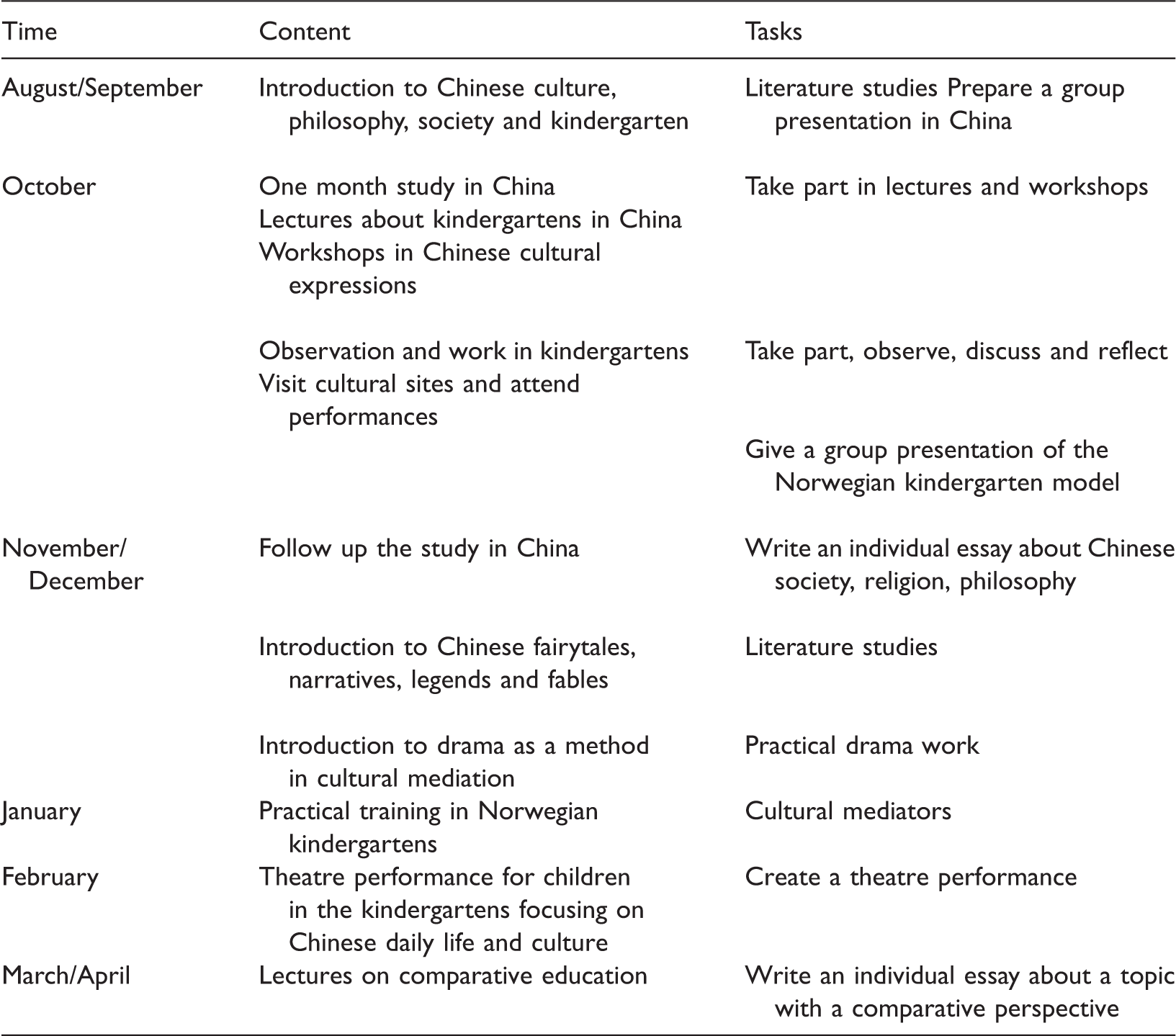
The purpose of organising the programme in this way is that the students will gain knowledge about as well as experience cultural variations. The knowledge interest of the programme is described in the aims of the curriculum plan:
‐ To gain knowledge about different views of children and childhood; ‐ To develop understanding for the interrelatedness of society, culture, children’s care and education; ‐ To gain knowledge about variations in life conditions and cultural manifestations; ‐ To develop conscience about personal and cultural values and attitudes by studying cultural variations; ‐ To experience and gain insight into the affordances and challenges of multicultural meetings; ‐ To gain knowledge about the multiple cultural influences children meet outside kindergarten today; ‐ To develop competence in creating a good and varied cultural environment in the kindergarten.
The expectations of the students, however, have a broader scope than the goals in the curriculum plan. They express expectations from the programme – such as transfer of working methods and artefacts from China to Norway, evaluation of best practices, awareness of cultural differences, preparation for cultural diversity in the kindergarten, development of solidarity, and self-reflection as a teacher. Goals in a curriculum plan do not delimit the learning of the students. To follow Biesta, the risk in education is that the students may not learn what is intended to be learned (Biesta, 2005). On the other hand, there is also a risk that they may learn something that was not thought of and intended. In the further discussion, however, the article will focus on one of the goals in the programme: to develop understanding for the interrelatedness of society, culture, children’s care and education. In spite of this explicit and valuable goal there are obvious pitfalls in this approach. Some of these will be discussed in the following sections.
The discussion is based on an analysis of the content of the curriculum plan of the programme Cultural Understanding and Comparative Education. Furthermore, two compulsory student assignments within the programme have been analysed. The first assignment is a group assignment. It is a 10-minute oral presentation for Chinese kindergarten teachers and students. The topics of the five presentations were: ‘Outdoor education in Norwegian kindergartens’, ‘Drama education in Norwegian kindergartens’, ‘The toddlers – collaboration between families and kindergartens’, ‘Dramatic play in Norwegian kindergartens’ and ‘Children’s literature in Norwegian kindergartens’. The second assignment is an individual written essay at the end of the programme. The students chose a topic with a comparative approach to Chinese and Norwegian kindergartens. Examples of topics were ‘Play in the Norwegian and Chinese kindergarten’, ‘The daily schedule in the kindergartens in a comparative perspective’, ‘Artefacts in Norwegian and Chinese kindergartens’, ‘The teacher’s relationship with the children in a comparative perspective’ and ‘The indoor environment and activities’. The contents of 25 student essays were analysed and the first results were published in Birkeland and Ødemotland (2013). Norwegian students’ encounters with Chinese culture and kindergarten were discussed from the perspectives of different cultural regimes such as mono-cultural, multicultural, intercultural and transcultural (Beck and Paulsen, 2011a; Pannikar, 2000). The article concluded that the comparative programme had the potential to develop the intercultural and transcultural perspectives. This article is a further elaboration of these perspectives, pointing to the pitfalls in the design of the programme.
Pitfalls in comparative education
The first pitfall to be discussed in the following paragraphs is the tendency to look at culture from an essentialist point of view. Another pitfall is to evaluate from a mono-cultural approach. The final point to be discussed is the inclination to overlook the effects of globalisation on local practices, and thereby enlarge the differences and overlook the similarities between educational practices in the two countries. These pitfalls are difficult to avoid. However, it is crucial to pay attention to some of the mechanisms within comparative education.
National comparison – the pitfall of cultural essentialism
According to the curriculum plan, the programme is a comparison between kindergartens in two countries, Norway and China, in a cultural perspective. The curriculum plan itself invites national comparison of the kindergartens. This indicates that the understanding of kindergarten practices and policies in the two countries is explained in association with cultural traits in the two countries, and can easily fortify dichotomies and strengthen stereotypes of the two countries. As Tobin et al. argue in their extensive research project Preschool in Three Cultures, introducing a third country will contribute to nuancing the comparison (Tobin et al., 1989, 2009).
When the students have oral presentations in China, they choose topics from the Norwegian kindergarten they think may be interesting to the Chinese teachers and students. One example they chose is the outdoor education in Norway. The students presented the outdoor activities as a typical cultural phenomenon in Norway. In their presentations, the students gave little or no attention to a large group of people in Norway who do not share this value and who also question this tradition. On the contrary, the students presented sleeping outdoors in all kinds of weather and playing in the snow and rain as something natural to everybody. The nuances in the changing cultural landscape in Norway are, in this way, given little space. The reception by the Chinese students reflects this lack of nuances in the presentations. The task (10 minutes of presentation), in itself, does not really invite elaboration of nuances in the educational landscape.
In the essays at the end of the programme the students express, in different ways, culture as something rigid, with a hard core. The following are some expressions collected from these essays: ‘Since Norway and China are two different cultures’, ‘Both cultures’, ‘When I understand the Chinese culture, I can easier understand the authoritative role of the teacher in kindergarten’, ‘In Norway children are allowed to plan the everyday in kindergarten and all children are viewed as equal individuals’, ‘ Both the Norwegian and the Chinese kindergartens work structured to adjust the children to the culture and the society to which they belong. The children are integrated in their culture by learning the social attitudes and norms of their culture’, ‘Even if Norway and China are two definitely different cultures …’. These expressions underline ‘the culture’ as something clearly defined with specific traits and following national borders. This approach to comparative education encourages the students to look for what they expect to find, more than for the unexpected.
These examples illustrate that the curriculum plan itself and the assignments given to the students encourage, to some degree, the students to look at culture as something delimited with few tensions and differences within each nation, but with significant differences between the cultures in the two nations. Culture, from this perspective, is seen as something ‘clean’. With such an essentialist approach to culture the changing character of culture is given little attention, and the stereotypes and dichotomies are very close.
The pitfall of evaluation from a mono-cultural perspective
The programme is named Cultural Understanding and Comparative Education, which, in some way, is ambiguous in purpose. Cultural understanding implicates relativism inspired by anthropology, whereas comparative education implies normative aspects from the field of education. The students are encouraged to be open to another culture and to see the variation of childhood and cultural values. At the same time, the students are supposed to compare educational practices which most certainly are normative practices with specific purposes and goals in mind.
The students involved in the programme have not yet finished their undergraduate study. For two years, they have been socialised into the Norwegian kindergarten system – with its values, perspectives and traditions. Suddenly, they are exposed to kindergartens with seemingly different purposes, working methods and structure. Becoming a teacher involves participation in a collective practice with certain goals, artefacts, methods and content. Embedded in all educational practices are considerations about what is valuable knowledge, suitable relationship between teacher and children, and evaluation of desirable childhoods. Education is, in other words, normative. To compare educational practices, therefore, easily involves evaluation of ‘best practice’, regardless of contexts. Crucial questions within comparative studies are: from what perspective does the comparison occur? What is the purpose of the comparison? What is the knowledge interest of such a comparison?
When the students present a topic from Norwegian kindergartens in China, the students are prepared to meet an audience which is quite unfamiliar with kindergartens in Norway. Still, the presentations are quite mono-cultural in the way that the norms and values in Norwegian kindergartens are, to some degree, discussed or questioned. A mono-cultural approach is an expression of one horizon of possibilities and where there is one set of legitimate norms (Beck and Paulsen, 2011b; Pannikar, 2000). These norms are taken for granted in the meeting of ‘the other’ and norms are often unarticulated. The mono-cultural approach implies that everything is based on the same values, norms and criteria for good practice. Early childhood education is taken for granted and is not discussed as a cultural and normative practice. At least, the Norwegian kindergarten is presented as something natural, rather than cultural, whereas the Chinese kindergarten is discussed as cultural practice. This is visible when the students refer to the Framework Plan of the Content and Tasks of the Kindergarten. Different paragraphs in this plan are presented almost as fact when they present the Norwegian kindergarten: ‘The Framework Plan says …’. The Framework Plan is referred to as if the values are unquestionable, unambiguous, universal and natural.
When the students discuss the Chinese kindergarten after observing for some days, the perspectives are still dominated by the values and traditions in the Norwegian kindergartens. The students express that they understand there are other priorities in the Chinese kindergarten, but they explain this mainly as due to different resources, framing and conditions – like the number of children. In other words, if the Chinese kindergartens had the same conditions as the Norwegian kindergartens, they would have prioritised like the Norwegians.
This mono-cultural perspective is also visible in the choice of topics for their essays. One of the students had the following suggestion for a topic: ‘Where do we find the children’s participation in the Chinese kindergarten?’ The question reveals this as a topic highly focused on in Norway and the student expects to find the same in the Chinese kindergarten. When the student does not find what she defines as children’s participation, she interprets this as a ‘mistake’ of the Chinese kindergarten. In other words, she is looking for her own values in ‘the other’. The Norwegian Framework Plan is not problematised. Rather, it is considered as universal. The cultural belonging of the student almost represents a window shade delimiting her ability to see values in the local practices in the Chinese kindergartens.
In this way the Norwegian kindergarten practices are presented in a way that, to some degree, invites other perspectives. We can agree with Mikhail Bachtin that the presentations are an expression of monologism or an authoritative voice blocking dialogue: Monologism, at its extreme, denies the existence outside itself of another consciousness with equal rights and equal responsibilities, another I with equal rights (thou). With a monologic approach (in its extreme or pure form) another person remains wholly and merely an object of consciousness, and not another consciousness. […] Monologue is finalised and deaf to the other’s response; […] Monologue pretends to be the ultimate word. It closes down the represented world and represented persons. (Bachtin, 1984: 293)
The pitfall of overlooking the effects of globalisation in local practices
The question of context is always relevant in comparative studies. Crossley and Watson argue that the concern with context is perhaps the most enduring characteristic of disciplined comparative and international studies in education (Crossley and Watson, 2003). To develop an understanding of the interrelatedness between education, culture and society is an attempt to overcome the limited perspective that the individual teacher is free to create and develop the practices in their classroom. However, the question of context in comparative studies is complex and cannot be limited to the national context. This needs to be addressed in a comparative programme.
A comparative study of kindergartens in two countries is inclined to explain local educational practices from a cultural perspective and, furthermore, to delimit context to national borders. This may overlook how the early childhood education field is continuously influenced and changed by global diffusion of ideas. Globally, early childhood education has, so far, not been exposed to the same degree of national politics and international competitiveness as schools. Still, kindergarten policies in Norway, as well as in China, are influenced by powerful discourses from international organisations like the UN, the World Bank (Penn, 2002) and the Organisation for Economic Co-operation and Development (OECD) (Bennett, 2006). The tendencies are obvious in reports like Starting strong from the OECD (Bennett, 2006; OECD, 2006).
Dale (1999) points to different mechanisms through which globalisation affects national policies of education. In the early childhood education field there are few examples of direct imposition of policy. Rather, the mechanisms of policy transfer take the form of educational isomorphism 2 (Dale, 1999). Traces of normative and mimetic isomorphism can be found in curriculum guidelines globally. The Nordic early childhood education model is increasingly put forward as a model worth imitating, especially by the OECD (Bennett, 2006). Early childhood education is increasingly looked upon as human investment and something that fortifies the competitiveness of the nation (Bennett, 2006). This is also evident in an increasing number of curriculum guidelines with expressions like lifelong learning and mapping of knowledge. Another mechanism of policy transfer, according to Dale, is the installing of interdependence by being concerned about issues that extend far beyond the nation state. An example of such issues within early childhood education is, first of all, the rights of the children to participate and to have influence (Unicef, 1993). Secondly, we can identify the topic of education for sustainable development initiated by the World Organisation for Early Childhood Education (OMEP) as another example of such issues (Siraj-Blatchford et al., 2010).
The effects of globalisation within education have an indirect rather than a direct effect on educational practice. It is also too simplistic to look at the effects of the globalisation of ideas and policies as deductive from global to local. The interrelatedness of globalisation of ideas and local execution is rather dialectic. Global ideas are not automatically implemented in the local practices. However, there is a need to see and understand the educational practice in kindergarten beyond the limits of the nation state (Appadurai, 1996: 11).
These perspectives are challenging in a comparative programme. How can the students identify these complex forces in their meeting with Chinese kindergartens? Are they aware of these global influences on the Norwegian kindergarten? The content and aims of the comparative programme do not clearly encourage the students to investigate these perspectives. On the contrary, the students are invited to carry out comparisons that are culturally and nationally delimited. This implies that explanation of kindergarten practices in both countries, in relation to global diffusion of ideas, is excluded. How does globalisation influence the everyday practice? This question must be attended to. Increased focus on local effects of globalisation will give legitimacy to small-scale empirical studies with an ethnographic approach. Such an approach will bring forth the complexity of educational practices to a larger extent than will large scale quantitative comparative studies (Cheng, 1998; Crossley and Watson, 2003; Moss, 2007).
Some implications for further development of comparative education
As illuminated in the previous parts of the article, there is a diversity of pitfalls in a programme of cross-cultural comparative studies. They are not easy to overcome; still, it is important to bring them forth – in order to prevent a fortifying of the students’ preconceptions, rather than contributing to transformation of their knowledge. This is not primarily a shortcoming of the students but, generally, a fundamental problem in comparative studies. According to Paula Saukko (2011: 344), cultural studies need ‘an integrative and multidimensional framework’ on how to construct valid knowledge. Saukko is concerned with how to make valid arguments and conclusions in cultural studies. The concept of validity is, in this perspective, not used as a clear border between truth and untruth. Validity is a question of credibility and persuasion in the arguments and conclusions (Kvale et al., 2009). Her discussion is related to research but her perspectives are also relevant when kindergarten teacher students construct knowledge in cross-cultural comparative education.
Following the arguments of Saukko, cultural studies need to be sensitive to the everyday life in kindergartens and to have a hermeneutic approach to this everyday practice. Furthermore, cultural studies need to promote an understanding of social structures. Finally, cultural studies need a critical analysis of the discourses of social reality in order to construct trustworthy and reliable knowledge (Saukko, 2011). These approaches do not stand hierarchic to each other, meaning, for example, that everyday life in kindergarten is to be understood as a result of structural conditions. Saukko’s point is that the different approaches are horizontally connected and can, thereby, enlighten each other and bring forth new knowledge. These perspectives can contribute to overcoming the pitfalls discussed earlier.
Dialogic approach
Saukko describes hermeneutic validity as how a study gives voice to ‘the other’ and is sensitive to the others’ views and opinions. The hermeneutic approach is concerned with understanding as a phenomenon. This will demand a dialogic approach. However, a dialogic approach is much more complex than it may seem. In a comparative study of kindergartens it is not only a question of how thoroughly students will try to understand what is unknown and unfamiliar, but also of how they are willing to question the familiar and what they think they know (Biesta, 2002: 349). In other words this is a movement between closeness and distance (Tobin et al., 1989, 2009). To challenge the familiar and self-evident in this way is decisive in order to imagine that the world can look different.
So what does it mean to have a dialogic approach? First of all, living in China for a while, although for a short time, opens up for dialogue in a way other than just reading about China. This allows for bodily experiences like smells, tastes, sounds, tempo and crowd. The students experience that China is not only exotic and exciting, but also frustrating and confusing. The silence and lack of people in Norway becomes overwhelming when experiencing the crowds in the everyday life of China. These reflections of the students underline the importance of exposing the students to everyday life in China, in addition to their experiences in kindergartens, university and historical sights. The everyday life in train stations, buses, metro, markets and shops is important as a dialogical dimension.
To be there is, however, not equivalent to interaction and dialogue (Kemp, 2005). It is a question of addressing and being addressed, asking and answering (Bachtin et al., 1981). This interplay between insiders and outsiders is of crucial importance in such a programme. According to Bachtin: There exists a very strong, but one-sided and, thus, untrustworthy idea that in order to better understand a foreign culture, one must enter into it, forgetting one’s own, and view the world through the eyes of this foreign culture…Of course, a certain entry as a living being into a foreign culture…is a necessary part of the process of understanding it; but if this were the only aspect, it would be merely duplication and would not entail anything new and enriching. (Bachtin et al., 1986: 6–7)
The focus of a dialogic approach is not primarily to understand the other person, but how to get a better understanding of the kindergarten practices and how these relate to culture and society. So far, the Norwegian students have been observing in a Chinese kindergarten for a week. They write down their observations and the observations are discussed in the Norwegian group of students. This is an ‘outsiders’ perspective which, to some degree, is challenged by the ‘insiders’ perspectives. One approach that can be productive in getting a better interplay between insiders and outsiders is photo- and video-elicitation (Birkeland, 2013). In this approach, both groups of students watch the same photo material from Norwegian and Chinese kindergartens and use this material as a point of departure for discussions. This approach will be beneficial in different ways. First of all, it will utilise the dialogic potential by bringing forth a more polyvocal and open interpretation and understanding of the practice which is demonstrated in the photos. This will challenge the pitfall of monologic interpretations and superficial evaluations. Secondly, it will force the students to keep their interpretations to actual practice, rather than ideals in the curriculum guidelines. The question is: What is actually going on and how can we give it meaning? Finally, practices from both countries are scrutinised. This will contribute to a more challenging dialogue with a less ethnocentric perspective. An interplay between insiders and outsiders, as in photo-elicitation, will potentially give a more polyvocal approach to the understanding of educational practices (Alexander et al., 1999; Crossley and Watson, 2003; Tobin, 1989, 1999, 2009).
Contextual sensitivity
Following the arguments of Saukko, cross-cultural comparative studies need to be sensitive to context. According to Saukko, the contextual validity is a question of how knowledge takes into account historical ‘realities’, social structures and processes. However, the contextual validity is not limited to looking at contextual traits within the national borders. It also means focusing on global context and global diffusion of ideas and policies. Studying kindergartens in China and Norway also gives an idea of how these are influenced by global traits. A comparative study does not execute any thorough historical or social analysis. However, comparative studies which are culturally oriented have to be sensitive to the historical and cultural background of the kindergarten in order to understand the contemporary kindergarten. When comparing Chinese and Norwegian kindergartens it is important to trace the historical aspects of both the Chinese and the Norwegian kindergarten. What has been the purpose of kindergarten in both countries historically?
This question is addressed within the educational programme theoretically by introducing the topic in lectures. However, the potential of being in China and observing in the kindergarten can be utilised. Cultural and historical ideals and purposes are manifested on architecture, furniture, artefacts on the walls, time schedule, tasks, play and learning artefacts. Observing, mapping and comparing these aspects of the kindergarten can contribute to a better understanding of the cultural historical development of the kindergartens.
On the local level, such as a certain kindergarten, the differences are more likely to appear in perspectives, priorities and problems. Common values and world views are more likely to appear in national and global steering documents. This leads us to the next question: how is the kindergarten influenced across national borders? And how is it possible to study this in a programme like this? As discussed earlier, the transforming of global ideas and policies is not something abstract and inevitable. This diffusion of ideas is brought about by someone – in this context, international organisations like the World Bank, UNESCO, OECD and EU. The mechanisms mentioned specifically were isomorphism and interrelatedness. This makes it important to look at the curriculum guidelines in both countries in order to identify similarities and joint international topics. Doing so in China – together with Chinese students – will contribute to a polyvocal interpretation of the guidelines. Is it possible to identify political issues like national competitiveness or social justice in the guidelines? And furthermore, can these joint topics be identified in the practices in kindergarten? As Robertson argues, this promotes glocality as a result of globalisation observed from a local spatial place (Wang, 2007).
Self-reflexivity
The last perspective on validity which Saukko mentions is the self-reflexive validity. Critical reflections on how social discourses construct and shape the way we experience ourselves and the other are, according to Saukko, the most crucial within cultural studies. These involve critical reflections about positioning and power dimensions in cross-cultural studies. This form of validation is concerned with the credibility and trustworthiness of the interpretations. When the students compare different kindergartens, they do it from specific perspectives and with specific values – conscious or tacit. It is important to bring this forth, although this ‘fact’ cannot be eliminated. We can never bring forth all of our biases and preconceptions (Gadamer, 2004).
However, this approach implies more than personal reflection on position. Just as important is the focus on the political agenda of conducting comparative studies. In whose interest is this done? Whose discourses seem to be valid? What, and whose, knowledge interest is involved in the comparison? Whose knowledge is ‘global’? What is considered as normal practice? What is considered as appropriate practice? What political interest do different childhood constructions have? Whose interest is identified in the guidelines, the conditions? These questions demand a high degree of critical self-reflection from the students.
The practical approach to such a perspective is more comprehensive than personal reflection in seminars and essays. It will demand a thorough examination of the theoretical grounding of early childhood education, as well as a critical inquiry of the power dimensions both within the kindergarten field and the comparative education field. The programme touches these questions, but the potential for critical self-reflexivity is not fully utilised. In the meetings between the Norwegian and Chinese students, these questions can be addressed.
Concluding remarks
This article has illustrated some of the pitfalls within the design of a cross-cultural comparative education programme. Methodological questions, like the combination of the universal and the idiographic functions of comparison, and the bias discussion, have been addressed. The inquiry has also illuminated how a programme in cross-cultural comparative education can improve the potential in ‘being there’ so that the students take into account the complexity of local educational practice. When students are examining the local kindergarten practice, it is crucial to raise questions about the cultural historical traits and developments, as well as questions about global diffusion of ideas and policies. The article has demonstrated that global processes are not ‘out there’, but can be studied in the dialectics between national guidelines and local practice.
The dialectics between the global and the local will continue to challenge early childhood education in China, as well as in Norway. This will necessarily have consequences for the teacher education programme so that cultural dialogue across national borders can be strengthened. Increased dialogue will also contribute to understanding the blending of cultures, rather than hybridity, as a ramification.
Footnotes
Declaration of Conflicting Interests
The author(s) declared no potential conflicts of interest with respect to the research, authorship, and/or publication of this article.
Funding
This research received no specific grant from any funding agency in the public, commercial, or not-for-profit sectors.