




Abstract
This article explores the trajectory of educational changes in China over the past three decades in the context of globalization and social and economic transformation. It addresses three research questions: what educational changes occurred in China, why some educational policies worked well but others failed, how the political dynamics of educational changes interplayed with each other. Informed by the literature on ‘glocalization’ and ‘controlled decontrol’, the authors develop a two-dimensional theoretical framework to analyze the political dynamics of educational changes in China, and examine the tensions between globalization and localization, centralization and decentralization. Through a critical review of educational policies and a discussion of theories and empirical studies, this article provides insight into alternative interpretation of educational changes in China.
Introduction
The world is changing as the pace of globalization and technological development accelerates. The rise of China as one of the world’s most influential economies is regarded by many as an economic miracle of the late 20th and early 21st centuries. In recent years a growing research interest has been witnessed in Chinese education and Shanghai education system; however, relatively little is widely known about the political dynamics of China’s educational changes that have taken place over the past three decades.
Historically, there are three particularly notable phases of educational reform since China initiated its open policy in 1978. The first phase was efficiency-oriented (1978–1980s). The state rebuilt the education system from the ruins caused by the Cultural Revolution and enacted the Compulsory Education Law (National People’s Congress of China, 1986) which required every child to complete nine years of formal schooling (six years for primary and three years for junior and secondary schools). The Chinese government promoted economic transformation and gradually established the socialist market economy mechanism. Education was generally viewed as an impetus to develop the economy. The policy ‘let a few become rich first’, advocated by Deng Xiaopeng, the architect of the Chinese reform and development, positioned elite education as a priority. Some key schools and selective schools, with additional resources, were built for elite students. The concepts of ‘efficiency’, ‘effectiveness’ and ‘competition’ appeared in educational policies or official documents (Deng, 1994; Ministry of Education, 2002).
The second phase was equality-oriented (1990s to early 2000s). It focused on ensuring access to basic education and the right to education for every child. The government assumed primary responsibility for compulsory education. Key schools were abolished and became instead an integral part of the compulsory education. The priorities were to overcome the disparity in education between urban and rural areas, among the developed Eastern region and the less developed Inland and Western regions, and among groups from different socio-economic status (SES) backgrounds. The authorities formulated policies and implemented strategies in order to ensure an equitable distribution of educational resources, improve the quality education of in schools and address the needs of disadvantaged and vulnerable groups such as low SES students, female students, students with disabilities and ethnic minorities (Ministry of Education, 2008; Yuan, 2005).
The third phase is innovation-oriented (early 2000s to present date). A shift of the strategy, from ‘Made in China’ to ‘Innovation in China’ reflected China’s response to the challenge of globalization and transition to a knowledge economy. Although China’s focus on efficiency and equality had yielded remarkable achievements in the first and second phases, the prosperity of a nation in the knowledge economy era will increasingly be defined by the discovery and application of innovative ideas. A new ‘innovation-driven, transformation-oriented’ policy aims to achieve a fundamental shift in the educational system. It focuses on innovation, creativity and research, and sustainable development (Chinese Communist Party, 2012). There has been a shift from examination-oriented education to quality-oriented education in educational policy and practice, an increasing emphasis on developing students’ creativity, innovation, problem-solving and lifelong learning capabilities, and a focus on diversity, choice, flexibility and autonomy (Ministry of Education, 2008).
The landscape of China’s educational development outlined above indicates that the education system has been geared toward economic development and social stability guided by the ambitious national goal of Modernization. The strong link between education and economic and social development in China resulted in gains and losses, as manifested in the uniquely ‘Chinese-style’ changes in education.
China’s educational transformation is no easy task. China runs the world’s largest school system, serving 22% of the world’s students (200 million in elementary and secondary education), with less than 3% of the world’s GDP (Ministry of Education, 2008). Chinese education has attracted increasing attention in the world due to the outstanding performance of students in Shanghai in PISA, the Program for International Student Assessment, a worldwide assessment of 15-year-old students’ scholastic performance in reading, mathematics and science. Shanghai students ranked Number 1 in three tests in 2009 and 2012.
Researchers have variously investigated China’s educational polices and transformation. Some focused on educational reforms and policies from the cultural, social and economic perspectives (e.g. Lin, 2013; Zhang, 2011; Zhang, 2012). Others highlighted Shanghai’s educational success, examined the secrets behind it and lessons learned from the success (OECD, 2011; Stewart, 2012; Tan, 2013; Zhao, 2012). These studies have developed our understanding of world-class education systems and international benchmarking. However, the analyses tended to focus on economic, social or cultural aspects, or the outcomes of educational changes, but neglected the dynamics and complexity in the process of educational changes. The political factor is crucial in illustrating the changes and ideological underpinnings that accompany these changes in China.
This article explores the trajectory of educational changes in China over the past three decades in the context of globalization and social and economic transformation. It addresses three research topics: what educational changes occurred in China; why some educational policies worked well but others failed; and how the political dynamics of educational changes interplayed with each other. Informed by the literature on ‘glocalization’ and ‘controlled decontrol’, we develop a two-dimensional theoretical framework to examine the dynamics of educational changes in China.
A theoretical framework
In general, the political dynamics of educational changes involve political factors and complex operational mechanisms and processes that influence educational development, including influential power players and sophisticated political processes. Kingdon (2002) argued that there are two categories of political players in a political system: governmental actors and non-governmental actors. In China, the former refers to actors inside government, including the Chinese Communist Party (CCP), government at national, provincial, municipal/city and county levels, and the People’s Congress; the latter refers to actors outside government, including international organizations, transnational institutions, the media, interest groups, the general public, and other stakeholders.
China adopted the ‘open policy’ in 1978, although the interactions of the nation with the world started some 150 years earlier. These were controversies about the relationships between tradition and modernization, indigenization and internationalization, and debates on the inherent tension/contradiction between nationalism and globalism, capitalism and socialism, policy borrowing and innovation. Unlike some Asian countries – such as Japan and Singapore – which tend to have been ‘Westernized’ in the process of globalization, China has been exploring a development path with unique Chinese characteristics in order to cope with globalization and seek the convergence and coupling mechanism of a combination of both Chinese and Western styles. This is characterized by an old Chinese saying ‘Chinese learning as the base, and Western learning for application’ (zhongxue wei ti, xixue wei yong), which remains relevant in explaining how, post-Mao, globalization is unfolding in China (An, 2000; Zheng, 2004).
In order to present a critical analysis of the political dynamics of educational changes in China, Roland Robertson’s (1995) concept of ‘glocalization’ (a combination of globalization and localization) is employed as a useful conceptual tool. In traditional sociology, globalization is usually regarded as a contrast between the local and the global. Robertson contends that globalization is in fact a local phenomenon, and the worldwide exchange and fusion of culture is always achieved in local terms. Furthermore, what is conceived as the local is in fact global; for example, the concept of the nation state is a global idea. Global culture and local culture are therefore not regarded as two opposing forces. Robertson advocated replacing the concept of globalization with the concept of ‘glocalization’, defined as the simultaneity or co-presence/coexistence tendencies of both universalizing and particularizing, homogenization and heterogenization. Robertson (1995) also blurs the boundaries between the local and the global and sees the local itself as one of the aspects of globalization; or, conversely, global process as a local process. The phrase ‘Think globally, act locally’ reflects the interplay and interdependence between localization and globalization.
Moreover, the concept of decentralism–centralism has been used here as a valuable conceptual tool to analyze the political dynamics of China’s educational changes. Karlsen (2000) argued that ‘decentralized centralism’ is a framework for a better understanding of the role of government in education. It is used to examine the dynamic interaction between decentralizing and centralizing forces in an educational decentralization process. There is in fact a simultaneous practice of centralization, in which the central government sets national goals and standards for outcomes, and decentralization, in which the means and the responsibility for implementation are local duties. Paradoxically, each form of decentralization is often motivated by a centralization of strategic powers and transfer of tactical powers, and decentralization is countered by a significant amount of regulatory re-centralization.
Basil Bernstein (1996) contended that the devices of symbolic control are increasingly state regulated and monitored through new techniques of decentralized centralization. In a similar vein, Stephen Ball (2008) illustrated the paradox of the political dynamics and ‘controlled decontrol’. Such developments are deeply paradoxical. On the one hand, they are frequently presented as a move away from bureaucratic, centralized, forms of employee control. Managerial responsibilities are delegated, initiative and problem solving are highly valued. On the other hand, new forms of very immediate surveillance and self-monitoring are put in place, for example, appraisal systems, target setting, output comparisons. This is what management ‘gurus’ Peters and Waterman refer to as “simultaneously loose and tight”-another version of ‘controlled decontrol’. (Ball, 2008: 48)
Figure 1 presents a theoretical framework of two dimensions between localization–globalization, and decentralization–centralization using the spatial and temporal analogy. The political process of educational changes in China is generally concerned with two dimensions: local–global and decentralization–centralization. The former focuses on a horizontal perspective, while the latter is a vertical perspective. There is essential time–space interweaving.
A two-dimensional theoretical framework of political dynamics of educational changes.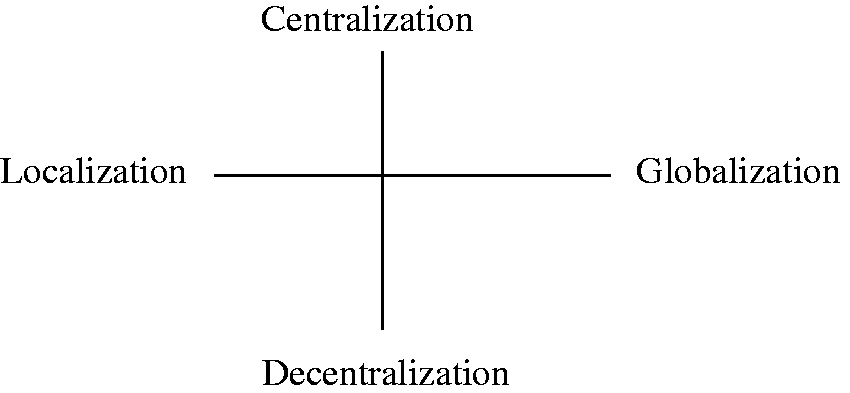
Albert Einstein once said, ‘Everything should be made as simple as possible, but not simpler’; this is very apt, in the present context, This two-dimensional theoretical framework shown in Figure 1 is designed to be a simple but not simpler illustration for analyzing the political dynamics of educational changes in China. The horizontal axis reflects the local–global spectrum. The vertical axis represents centralization– decentralization continuum. This framework shows a shift of analysis unit from traditional nation-state to entities beyond nation-state, from the nation-state perspective to the glocal perspective with a blurred boundary space. As argued by Ball (2008), as a result of particular aspects of the process of globalization and glocalization, the nation-state is no longer adequate on its own as space within which to think about policies. Policies are ‘made’ in response to globalization and those responses are variously driven or influenced by their take-up of supranational agencies, the policy work of intellectual and practical policy ‘fads’ and the resulting ‘flow’ of policies between countries. (Ball, 2008: 25)
This framework also indicates shifts of the research paradigm from static to dynamic analysis, from dual fragment to integration, and from outcome to process. It highlights the following three features. First, the core element of this framework is power. Educational change is concerned not only with what knowledge is of most worth, but also with whose knowledge is of most worth (Apple, 2004). Education is a political act and ideology is inevitably embedded in and enacted in schooling through explicit and hidden curricula. It is therefore crucially important to analyze the relationship between knowledge and power in educational changes.
Second, ‘paradox’ is a key word for interpreting this framework; a word closely connected to other concepts, such as contradiction, conflict, tension and compromise. These concepts appear to be similar, but there are slight differences in their interpretations. Paradox is a seemingly contradictory statement, which highlights the situation of tension and dilemma. Similarly, Michael Fullan (2007) advocated systemic reform and captured the dilemma in education changes. This framework also places emphasis more on co-presence/co-existence and interdependence than on mutual conflict or exclusion/repulsion.
Third, the framework focuses on the interplay and balance of various factors and events. It emphasizes the intersection, interaction and interdependence of all elements within complex political, economic and cultural contexts, which is understood as a dialectical, dynamic process. This can also be labeled as a ‘convergence’ or ‘coupling’ process. In the next sections we present an application of the framework and explore the political paradox of ‘glocalization’ and ‘decentralized centralism’ of educational changes in China.
Political paradox of glocalization
Globalization and internationalization of education
China accelerated the educational development after joining the World Trade Organization (WTO) in 2001 and new waves of educational globalization arose. China opened some educational services; for instance, pre-school education, higher education, adult education and English-language training (Wu, 2007). Policies aiming at promoting internationalization of education were introduced in order to encourage studying abroad, international exchanges and cooperation, and mutual recognition of degrees and diplomas. The central government established various programs of scholarship or funding to attract (and support) international students to China or reward those Chinese students overseas who chose to return. The China Scholarship Council (CSC) is an important force for implementation of educational globalization in China. Its objective is to provide financial assistance to Chinese citizens wishing to study abroad and to foreign citizens wishing to study in China, in order to develop educational, scientific, technological and cultural exchanges, and economic and trade cooperation between China and other countries (CSC, 2013).
In addition, China’s National Plan Outline for Medium and Long-term Education Reform and Development (2010–2020), as a blueprint for education reform in 2010-2020, emphasized the need to cultivate global citizens having a global perspective and awareness, and international competitive abilities, in order to improve the influence and competitiveness of Chinese education by further opening educational services and expanding international cooperation (CCP, 2010).
These policies promoted the internationalization of education in China. In 2008, China had cooperative and exchange relationships with 188 countries and regions and 40 international organizations. In addition, 154 agreements have been made on mutual recognition between governments of academic credentials and degrees. There were 1.39 million students studying abroad; and some 390,000 students returned to China from 1978 to 2008. More than 200,000 international students studied in China in 2008 (Ministry of Education, 2008).
Ideological tension of globalization
A review of China’s educational policies shows a shift of strategies, from being independent and self-sufficient to active participation and, potentially, becoming a leading influence in the world. However, there have been ongoing debates between those who support globalization or anti-globalization, and between those supporting internationalization or indigenization, and this reflects the ideological tensions behind this subject (Liu, 2009). The proponents of globalization argue that globalization can promote China’s educational development and make schools more competitive; and that it also creates a worldwide market and provides better quality education. Cultural interactions, it has been argued, enable each country to learn from other cultures and their educational reforms. In contrast, the opponents of globalization warn about its negative effects: it has seemingly made the rich richer while making the poor poorer, resulting in gaps and injustices in education. Globalization is regarded by its opponents as a major threat to indigenization, leading to cultural colonization or imperialism. It also implies the dissolution of national identity and traditional culture identity (Schulte, 2012).
The debate on the pros and cons of globalization reveals different ideological discourses in China. From a historical perspective, two important ideological discourses exist: that of neo-liberalism and that of the ‘new left’. Neo-liberals represent the interests of the newly-rising wealthy class – those who support market-oriented reform and privatization and identify globalism with universal freedom and democracy. The new left represents the interests of workers and farmers, endorsing a strengthening of state power to protect the poor and to resist the globalization and anti-Westernization. They advocate development of a Chinese alternative to Western forms of modernity (Schulte, 2012; Zheng, 2004). Under this discourse, ‘freedom’ is manifested in particular in terms of the social construction of identity and tradition, by the appropriation of cultural traditions.
In recent years there have been calls for indigenization from Chinese researchers. For example, Lu (2001) draws upon two important value orientations in indigenous Chinese educational thought: fostering moral character, and an emphasis on collective rather than individual interests. Lu argued that the previous Chinese experiences of Westernization and Sovietization had left only limited space for an appreciation and understanding of China’s indigenous pedagogy, or offered few possibilities for supporting modern educational development. A strong trend of westernization, policy borrowing and a simplistic transplant of pedagogy still exists: it is argued that it is therefore critically important to maintain indigenization and develop educational development and pedagogical practices in the Chinese context (Lu, 2001; Yang, 2005).
Glocalization in action
The above debates seem to hold truths on both sides. However, this dichotomy of methodology views the global and local as mutually exclusive. In reality it is a somewhat complicated dynamic process which involves interaction and interplay and reinforces the interdependence of each. On the one hand, China goes global by participating actively in the international community, exchanging students and staff, seeking collaborative programs, building international schools and international curricula. On the other hand, China pursues local by strengthening political and moral education, reviving traditional cultures. For example, modeled on Germany’s Goethe Institute, France’s Alliance Française, and the UK’s British Council, the Confucius Institutes, launched in 2004 by Hanban (The Office of Chinese Language Council International), is a glocalized pilot project with the aim of promoting glocal knowledge, cross-cultural communication and soft power (Paradise, 2009; Starr, 2009). In 2011, there were 358 Confucius Institutes and 503 Confucius Classrooms in 105 countries and regions around the world (Lien and Co, 2013).
Furthermore, China takes an active role in bilateral, multilateral, regional and global collaborations in education and cooperates closely with supranational organizations such as the World Bank, the World Trade Organization (WTO), United Nations Educational, Scientific and Cultural Organization (UNESCO), the Organization for Economic Co-operation and Development (OECD), and other regional organizations such as the European Union (EU) and Association of Southeast Asian Nations (ASEAN). Meanwhile, China actively participates in international studies and promotes the formulation of education policies, regulations and standards for regional and international organizations.
As a pioneer of educational changes in China, Shanghai is actively involved in the globalization of education. Shanghai has a population of 23 million, with 14 million permanent residents and 9 million migrant residents in 2010 (Shanghai Municipal Statistics Bureau, 2011). In 2012, Shanghai’s GDP was CNY 2010 billion (US$ 329 billion annually, US$14,305 per capita). Shanghai has 760 regular secondary schools and 761 primary schools with a total of 1.35 million enrolled school students. The enrollment rate of nine-year compulsory schools is 99.9%, while the enrollment rate in senior high schools is 96% (Shanghai Municipal Statistics Bureau, 2012; Shanghai Municipal Statistics Bureau 2013). The city has been at the forefront of efforts to cultivate global citizens, develop collaborations in education, sponsor international schools, introduce international curricula (for instance, Advanced Placement, International Baccalaureate, A-level), encourage students to study abroad and student exchanges, and attract international students (Shanghai Municipal Education Commission, 2012).
Shanghai students participated in PISA for the first time in 2009, and this was considered an important step towards educational globalization. The Shanghai Municipal Education Commission was the principal agency promoting this project, in partnership with the Shanghai Academy of Educational Science, the Shanghai Examination Institute, the Shanghai Educational Evaluation Institute and District Education Bureaus. The original intention was primarily to monitor the outcome and effectiveness of education reforms in Shanghai, assess the city’s position in the international benchmarking tests, and further promote educational reform and development (Shanghai PISA Program, 2010). A senior educational officer from Shanghai elaborated the motivation for Shanghai to participate in the PISA: First, we hope to use an international assessment system such as PISA to know where we stand in our basic education. Secondly, Shanghai has carried out basic education reforms for many years. We want to use an international benchmark to measure the effect of the reforms. Thirdly, we will learn progressive educational ideas and strategies from participation in PISA in order to improve our assessment approaches. (Tan, 2013)
Around 5115 students in 152 schools in Shanghai took part in PISA in 2009. When the results were released, Shanghai students, somewhat unexpectedly, came top, among 65 countries, of the PISA rankings in all three areas of reading, mathematics and science. Numerous international media reports, journal articles and books were published to explain this outstanding performance by the Shanghai students (Dillon, 2010; OECD, 2011; Stewart, 2012; Strauss, 2010; Tan, 2013; Tucker, 2012). The statistics from PISA also revealed that Shanghai students’ workload and study stress were much heavier than those of students in other countries. Shanghai’s education authorities and researchers reflected upon the negative impacts of test-oriented education and started to develop a new evaluation system. A Vice Director-general of Shanghai Municipal Education Commission commented, ‘The results of 2009 PISA also revealed problems of examination-oriented education, heavy student workload and study pressure, which prompted decision-makers to reflect upon how to improve this in the future’ (Shen, 2012).
A new evaluation policy, the Shanghai Green Index of Student Academic Quality in Primary and Secondary Schools, was issued by the Shanghai Municipal Education Commission in 2011. This ‘Green Index’ focuses on student’s all-around, holistic development. This system differs from traditional evaluation which focuses primarily on student’s test results: it assesses instead student achievements, happiness index, physical and mental health, student load and teaching style. This is different from PISA, which is designed to assess students’ ability to apply knowledge and solve problems. The Green Index focuses on curriculum standards and continuous improvement of teaching and learning. This localized system aims to establish an educational quality assurance mechanism, drawing upon lessons learned from PISA and taking the local contexts and educational priorities into account. The Shanghai municipal authorities designed and led the system-wide educational change in a coordinated approach.
In the next section we will deal with questions about the role and future of the state, how glocalization leads to changed role of the state and the transformation of governance, and how to deal with the relationship between decentralism and centralism.
Political paradox of decentralized centralism
The role of the state and decentralization
Globalization is not a choice: it is a reality we have to face. This reality undoubtedly affected the role of the state and the relationships of state and education. The discernible recent trend of restructuring the role of the state and the governance of education is towards decentralization. It has become, more or less, a worldwide trend and been a major governmental strategy in education and other social sectors (Karlsen, 2000).
Some powers and responsibilities of the state are increasingly being replaced or shared by those outside government – regional, international or supranational organizations such as the World Bank, the OECD, UNESCO, and other actors, including the market, private institutions, parents, communities and other stakeholders. They constitute participatory agency forces to spread the notion of decentralization in global education reform movement. From 1998 to 2008, the World Bank funded education projects in some 50 nations and regions that were attempting to decentralize their education systems. UNESCO also advocates decentralized governance in education as a way to improve access to educational services. At the World Education Forum in Dakar in 2000, the international community pledged to develop a responsive, participatory and accountable system of educational governance and management. In line with the Dakar Framework for Action, the UNESCO Program on Educational Governance at Local Levels was initiated, to build national capacities in order to formulate and implement education decentralization policies across the globe (Qi, 2011; UNESCO, 2007).
In contrast, however, there are transformations of powers and responsibilities at different levels within those inside government. According to Bray (1999), there are three major forms of decentralization: deconcentration, delegation and devolution. Deconcentration typically involves the transfer of tasks and work, but not authority, to other units in the organization: it is also sometimes called administrative decentralization. Delegation involves the transfer, or agreement to temporary ownership, of decision-making authority from higher to lower hierarchical units, governmental or non-governmental, but this authority can be withdrawn at the discretion of the delegating unit. Devolution refers to the transfer of authority to an autonomous unit that can act independently, or a unit that can act without first asking permission. In addition, these three major types of decentralization can be conceptualized into two main categories: ‘Functional decentralization’, which refers to ‘a shift in the distribution of powers and responsibilities between various authorities’; and ‘Territorial decentralization’, which refers to ‘a redistribution of control among the different geographical tiers of government, such as nation, states/provinces, districts, and schools’ (Bray, 1999; Mok, 2004).
The research evidence on educational changes in Norway, Canada, and Singapore (Karlsen, 2000; Mok, 2004; Tan, 2007) shows that many decentralization reforms were initiated from the top by the relevant central authorities and accompanied by new central legislation and regulations, and can be recentralized in order to strengthen central power in reality. Decentralization is usually countered by a good deal of regulatory re-centralization. The concept of ‘decentralized centralism’ (Karlsen, 2000) is used to examine the paradoxical and dynamic interactive process between decentralization and centralization in educational changes in China.
Three stages of the decentralization
China has a long tradition of a policy of centralization. Education was generally regarded as an instrument either to promote economic development or to disseminate the official ideology. The party-state monopolized the provision, financing and governance of education. This situation was not radically altered until the introduction of market-oriented reform in the early 1980s. Decentralization was considered a key element in educational policies and larger systematic reform movements to implement the economic reform and marketization. This process of decentralization revealed the political paradox of complicated processes and the coexistence of decentralization and centralization in the transformation of education.
The first stage in decentralizing education in China focused on the reform of the educational system in educational administration, primarily coordinating the relations between the central, provincial and local governments. The Decision on the Reform of the Educational System issued in 1985 by the central authority stipulated that educational system reform would start by adjusting the structure of secondary education, developing vocational education, and empowering schools, colleges and universities (Ministry of Education, 2002). The state made efforts to establish a mechanism of ‘local responsibility and administration at different levels’. Local governments were to be responsible for provision of primary and secondary education, and different levels of education were administered by various levels of governments. There was also a call for devolution of power to lower levels of government and a reduction in the rigid governmental controls over schools. The central government shifted the financial responsibilities to local authorities rather than delegating decision-making power. As a result, local governments had to find alternative funding, or resources, to support schools – such as tuition fees, donations, school-run enterprises or income from industry. This policy had an impact on the subsequent educational reforms.
The second stage of educational decentralization was delegation and devolution, coordinating the relations between education and society. A salient strategy of decentralization is use of marketization and privatization. Marketization involved the adoption of market principles and mechanisms in educational reforms – for example, empowerment of parents, choice, and school-based management – while privatization involved a transfer of responsibilities and resources from public to private institutions. In 1993 the central government issued the Program for Education Reform and Development in China and sought to shift the primary focus from economic development to human resource development. In 1997 the State Council released the Regulations for Running School by Social Forces, attempting to diversify education providers and services by encouraging corporations, enterprises, social organizations, groups or individuals to contribute to establishing and managing non-state schools, and promoting multiple channels in financing schools and transferring responsibilities from the state to non-state stakeholders (Ministry of Education, 2002).
As a result, a number of private/non-state schools were established in China. Education has gradually become a commodity provided by competitive suppliers, while education services are priced and access to them depends on consumer calculations and ability to pay (Mok, 1997; Whitty, 1997). As a result of the emerging changes, resulting in the government monopoly being broken, local level, non-state organizations or individuals take more responsibility for basic education in terms of finances and management. Multiple education provisions and deliveries were encouraged, while educational providers and services became more diversified. The central government shifted its schools policy, from one of direct control and intervention to that of indirect management through legislation, funding and evaluation. This educational reform was a significant part of a broader, market-driven economic reform at that time. It was guided by ideologies of market-oriented managerialism and economic rationalism which focus on efficiency and competition rather than egalitarianism and uniformity (Mok, 2004; Schulte, 2012). There was controversy about the nature of education as public good or commodity, and the purpose of education as for-profit or non-profit. The government reaffirmed that education is public good and prohibits for-profit education. Discriminatory policies were introduced to limit non-state education and place private education on an unequal status (Ministry of Education, 2002).
The third stage to decentralization involved legislation and equalization with regard to the status of the privatization of education. The Law of Privately-Run Education Promotion (or Minban, non-state education) enacted by the Standing Committee of the National People’s Congress (2002) discontinued the discriminatory policies for private education and gave private schools equal status to public schools. This legislation also defined the rights and duties for private institutions, teachers and students. In particular it allowed for reasonable economic returns for private schools, which previously had been outlawed. Non-state education institutions have therefore increased rapidly in number and have become an integral part of the educational system in China.
Motivations for decentralization
The debate on the process of educational decentralization in China has focused on some key issues:
What are the motivations of decentralization?; What is the role of the state?; and How to deal with the relationship between the state and schools?
Karlsen (2000), using Norway as an example, has identified four motivations for decentralization: strengthen democracy, promote innovation and school-based development, respond to local needs, and improve efficiency. In contrast, China’s decentralization is motivated primarily by improving efficiency, strengthening the role of the state, and utilitarian ideology.
Driven by the shortage of educational resources, the Chinese central government delegates and devolves some power and responsibilities to local governments or other sectors. Thus the main purpose of decentralization becomes solving the problem of insufficient resources and shifting the financial burden to local levels. The central government has been the initial driving force for decentralization. The motivation for decentralization in education change is concerned more by finance and efficiency considerations than by democratic or equity factors. Furthermore, divisions of responsibility and accountability are often unclear. Local governments have taken on major expenditure responsibilities in recent years, but without sufficient funding to meet them. The shortage of revenue at local levels makes it difficult to implement the national policy effectively (OECD, 2005). In contrast, the central government is endeavoring to overcome inefficient management and transform the governance functions in order to adapt to the social development and market economy. There is a strong belief that marketization can increase efficiency and improve educational quality and management. It is also in line with the utilitarianism and new liberalism ideologies which advocate that nothing other than a market system can be more effective in improving resource allocation and management efficiency. Marketization is considered a desirable alternative for improving the performance and efficiency of the governments. However, the central government is concerned about the danger of declining education standards once government controls are reduced. As such, decentralization does not necessarily mean therefore that the state weakens its position and capacity or has genuinely reduced its control over the education sector. On the contrary, it can mean a process of re-centralization or re-regulation through adopting various governance strategies or policy instruments such as national standards, assessment and inspection, and international benchmarking.
Decentralized centralism in practice
In general, decentralization, centralization and recentralization often co-exist in China. The processes of decentralized centralizations do happen in areas of education such as fiscal reform, school management and curriculum reform. With fiscal reform, the central government diversifies the education providers and allows various institutions or individuals to participate in establishing or managing schools. The diversification of financial resources and policy of decentralization exist in the blend of central and local governmental financial support together with donations, fund raising, enterprise support, social contributions and community participation (Hawkins, 2006).
Furthermore, the decentralization process of fiscal reform has been accompanying the centralization and recentralization. With regard to the first strategy, the central government reinforced the financial transfer payment system to reduce the disparity between urban and rural areas, among different regions and provinces. The government sponsored a range of programs to support school standardization/infrastructure and capacity building, such as the ‘compulsory education program’, the ‘subsidy/loan program for the disadvantaged’ and the ‘teacher professional development program’ (Ministry of Education, 2009). The second strategy involves upgrading the public financial input system and moving village-based finance and town/city government financial coordination to county and provincial government financial coordination (Yuan, 2005). The third strategy is concerned with promoting a national education inspection system which supervises the efficiency and effectiveness of expenditures and evaluates the outcomes of education.
Recent educational reforms promote decentralization and the government’s role has been transformed through marketization and privatization. Influenced by the new public management ideology and the idea of ‘governing without governance’ and ‘reinventing government’, the central government’s role has changed significantly. There has been a move away from an omnipotent to a limited government, from regulation to deregulation, from command/control administration to guided governance. The major strategies are designed to diversify education through the introduction of market forces, empower local educators and parents, promote school autonomy, and strengthen school-based management.
One example is ‘commissioned administration’ in Shanghai, in which strong public schools or NGOs take over the leadership of one or more weaker schools, and send a team of experienced teachers and administrators to improve standards of management and teaching. In 2007, the Shanghai municipal government asked 10 of its good schools to take charge of 20 rural schools, under two-year contracts, with city government bearing the costs (Tucker, 2012). In 2009 a second round of commissioned administration involved 43 rural weaker schools with 32,000 students (Qian, 2014; Shen, 2009). In 2011, the third round of commissioned administration covered 45 rural weaker schools with 33,800 students (Qian, 2014).
Research evidence shows that the government remains an active agent in the decentralization of educational changes in China. The decentralization process is a top-down reform aimed at decentralized centralization. The decentralization efforts predominantly involve the transfer of work or tasks rather than genuine distribution of authority or power. A salient feature of this process is the absence of the public and citizen participation: the change to decentralization in education appears to lack both local initiatives and broadly-based decision-making.
Another example of this paradoxical process is curriculum reforms. The Ministry of Education (MOE) initiated a reform in 1988 to change the unified national curricula and textbooks to diversified textbooks. Some publishers and provincial education authorities were allowed to compile textbooks for local use. Shanghai, Guangdong, Zhejiang and Sichuan, as pilot experiment regions, were asked to develop local curricula and improve flexibility and choice. In 2001, the policy document Outline of Basic Education Curriculum Reform issued by MOE initiated a new round of curriculum reform. This policy provided for curriculum development on three levels: national, local (provincial/city) and school-based curricula. Principals and teachers are encouraged to develop school-based curricula in order to meet students’ diverse needs and enhance their understanding of local development. All qualified publishers were permitted to compile and publish textbooks; and local education authorities could choose from the approved textbooks (Qi, 2011). School autonomy and teacher professional autonomy were encouraged, which indicated a transformation from ‘centralization’ to ‘decentralization’ in curriculum policy (Zhong, 2005).
However, this curriculum reform is not a genuine decentralization but, rather, a recentralization process, strengthening the government’s monitoring, quality control, teaching audits and accountability. In other words, the decentralization of tasks and delegation of administrative responsibility to local levels are accompanied by the introduction of a national standard and the development of a national assessment system (Tan, 2013). The national curriculum is a mechanism for the political control of knowledge (Apple, 1996): the national curriculum standard is used as a means of centralization and local curriculum development is required to be based on the national standard. Hence, the curriculum reform has shifted from a ‘one-size-fits-all’ model to ‘one-standard-fits-all’ model, although officially it is called ‘one standard with multiple textbook versions’.
In addition, examinations are used as a means of centralization. There is evidence of re-centralization of national assessment accompanying the decentralization. One strategy of control is to have a competitive national college entrance examination for all senior high school graduates, commonly known as ‘Gaokao’, organized annually by MOE. Success in this exam is a prerequisite for entrance into almost all higher learning institutions in China. There has been much criticism of the exam system with its emphasis on knowledge reproduction and rote learning rather than on creativity and problem solving. However, exam scores remain the most important indictors to measure the success of schools and students: teaching for exams remains a serious problem in school practices.
Furthermore, accountability is used as a means of centralization. One strategy involves outcome-based accountability: local leaders are responsible for education development and performance, especially for compulsory education. With regard to finance-based accountability, the central government monitors the process and outcome of funding use and aims to improve the efficiency of financial budgeting (Social Developmental Bureau in Pudong New Area Shanghai, 2009; Yuan, 2005). Another example is undergraduate teaching quality evaluation initiated by MOE in the period 2003–2008 to monitor and control higher education quality. Some researchers argued that the policy objective of this assessment was achieved at the expense of undermining the autonomy of colleges and universities (Chen, 2008; Liu and Gong, 2008; Zhong, 2009).
Conclusions
Educational changes in China have unique Chinese characteristics. The term ‘Chinese style’ is neutral, embracing the experiences of both successes and failures. There is a need to examine it dialectically and connect the educational changes to the larger socio-economic landscape. It is challenging to identify particular factors which lead to the educational transformation in China. They are in fact intertwined and present as a paradox. The term ‘organized anarchy’ perhaps encapsulates how the political dynamics work in practice. There are two prominent threads of the global–local and decentralized–centralized continuum throughout the whole process of educational changes. The two dimensions are much like two sides of the same coin and unfold the internal and external logic of the political dynamics of educational changes. The analyses of three features of educational changes will, it is believed, enrich our understanding of political dynamics in China.
Government-dominated educational change
The fact that education in China is not neutral but, rather, is fundamentally political in nature highlights the importance of dealing with the relationship between education and the state. A crucial requirement is to address the role of the state in educational changes in the context of globalization. Although the power of the modern state is being challenged by international or multinational entities, it does not necessarily mean a weakened or decentralized state. Research evidence in South American countries shows the success or failure of the decentralization and weakness of the state are both positive and negative effects of the process of decentralization (Hanson, 2006). The key issue therefore is not to enhance or reduce the role of the state, but to identify which aspects need to be enhanced or weakened in practice.
The educational reform in China has been characterized by decentralized centralism. During the process of restructuring, the role of the government has shown signs of some changes, in which some powers of the government are decentralized, while others are re-centralized. The government remains powerful in leading educational changes and takes an active role in meeting the challenges. Educational transformation is thus government-dominated within the context of re-building the state and globalization.
Incremental-coherent educational change
Naisbitt and Naisbitt conducted an in-depth study of the fundamental changes in China’s social, political and economic life. They identified eight pillars as the foundation and drivers of China’s new society: ‘emancipation of mind’; ‘balancing top-down and bottom-up’; ‘framing the forest and letting the trees grow’; ‘crossing the river by feeling the stones’; ‘artistic and intellectual ferment’; ‘joining the world’; ‘freedom and fairness’; and ‘from Olympic medals to Nobel prizes’ (Naisbitt and Naisbitt, 2010). These authors argued that the expression ‘crossing the river by feeling the stones’ mirrors the pattern of the reform in China.
This also represents the pattern of educational change in China. Incremental changes, rather than radical changes, take place. The educational changes follow this path, epitomised in the process of ‘plan–pilot–implement–reflect–revise’. The transformation concentrates not only on certain unique aspects of education, but also on the systematic and coherent promotion of mutual reinforcement and interaction within the government and between governments and communities. The ultimate purpose of the educational changes is to contribute to economic development, social cohesion and the holistic development of students. Given the complexity and dynamics of educational change processes, all contributing factors should be considered.
Balance in educational change
A critical review of the educational changes over the past 30 years indicates that Chinese policy makers have adopted a balanced and ‘moderate’ approach, aiming to keep a balance between globalization and localization, centralization and decentralization, top-down and bottom-up, equity-oriented and quality-oriented approaches. They tend to choose a balanced position along the dynamic continuum, which reveals the Chinese philosophy of the golden mean, ‘not going to extreme’, and the traditional culture of Yin–Yang. However, the term ‘balance’ has a profound meaning in the context of educational transformation. It reflects China’s ambition in addressing education quality, equality and social justice, reducing urban/rural and regional disparities. Educational change is not an event, but a process involving complex political dynamics of numerous systems, institutions, levels and activities.
In conclusion, through a discussion of educational policies and studies, we have attempted to provide an insight into alterative interpretations of educational changes in China and to shed light on educational transformation in different cultural contexts.
Footnotes
Declaration of Conflicting Interests
The author(s) declared no potential conflicts of interest with respect to the research, authorship, and/or publication of this article.
Funding
The author(s) disclosed receipt of the following financial support for the research, authorship, and/or publication of this article: This research project is supported by the National Social Science Fund of China (Project Number BHA110043).