




Abstract
No Child Left Behind is federal education legislation consisting of implementation programs intended to reconcile the goals of insuring equality while promoting competition in public education in the United States. Immigrant students whose primary languages are not English are included in the mandate of NCLB, categorized as English Language Learners (ELLs), a category of at-risk students. Drawing on case studies of immigrant students in upstate New York, as well as surveys of school district compliance with ESL/Bilingual education requirements, this analysis is an exploration of how NCLB and its implementation simultaneously obscure economic differences and polarize ethnolinguistic identities at school, state, and federal levels. Drawing from ethnographic as well as sociolinguistic data, the concept of state effects is used to examine the articulation and re-articulation of ethnoracial and linguistic diversity along axes of poverty and relative privilege. It is argued that NCLB as enacted across diverse scales constructs social subjects in relation to differences that are obscured or emphasized and produces isolated individual subjects as well as new collective identities.
Introduction
The New Literacy Studies’ conception of literacy as social practice reflects both ethnographic and theoretical commitments. There is an understanding of literacy practice as that which occurs in the immediate setting of literacy events coupled with a conceptualization of practice as a level of analysis investigating inter-event structuring principles (Barton and Hamilton, 1998; Baynham, 1995) – an example being when cultural models of school literacy privilege book reading as the normative ideal of literacy (Bialostok, 2002). From a literacy practice perspective, literacy is never just a local event; instead, it is usually underwritten, represented and regulated by wider interests, often expressed in officially-prescribed programs, planning and implementation (Brandt and Clinton, 2002).
Since the rise of modernity, the nation-state has had an interest in promulgating and regulating literacy through language standardization, schooling systems and testing regimes (Anderson, 1991; Collins and Blot, 2003; Graff, 1988). In the post
During these same decades, beginning in the era of decolonizing struggles and the emergence of new states, and accelerating with the advent of globalization underpinned by neoliberal political-economic policy (Harvey, 2005; Steger, 2003), there has been a substantial increase in transnational migration, largely from the developing economies of the ‘South’ to the developed economies of the ‘North’ (Arrighi, 2011; Bourdieu, 2000; Friedman, 2004; Suarez-Orozco, 2001). This has produced increased linguistic diversity within the national borders of many countries, and educational policy in response to migration-driven cultural and language diversity has become a controversial issue in North and South America, Europe, and Africa (Blommaert et al., 2005; Crawford, 2001; Hornberger, 2003; Martin-Jones and Jones, 2000; Martin-Roja, 2011; Prinsloo and Breier, 1996). These migratory processes, the attendant language diversification and the reactive political conflict it engenders all provide a new terrain on which to study literacy practices and education policies while challenging us to think about social practices in relation to state and state-like powers.
The study which follows takes up these themes and challenges by presenting a conceptual and empirical argument for viewing ‘policy as practice’, examining how language and literacy policy operates across multiple levels – entangling agents, resources, and constraints that operate in face-to-face settings – across the unintended actions of institutional units, and through the classifying practices of nation states. A primary argument concerns scale of analysis, treating both local actions, such as face-to-face exchanges, and global dynamics, such as migration-based language diversity and nation-state response to such diversity, as interrelated aspects of policy enacted in diverse contexts. A second argument, more substantive in focus, is that US education policy in the current century is distinctly neoliberal in its makeup, that its classification of ‘at-risk’ populations represents a new form of governance (Bialostok and Whitman, 2012), and that its strategies for managing the educational risk associated with linguistic diversity help to obscure and re-articulate dynamics of race and class that are pervasive in American education and society.
The following section includes a brief conceptual discussion of policy-as-practice and changing state power in our contemporary globalized, neoliberal, era, presented with an argument that both require contextualized, ethnographic study. The third section contains three cases that examine how local schools, state education departments and federal agencies grapple with migration and language difference. It is argued that the data reveal ‘effects’ of state power, which operate through decentralized organizations and across dispersed sites, requiring a conception of practice that appreciates the layered, vertical organization of many social and discursive phenomena (Agha, 2007; Blommaert et al., 2005; Giddens, 1984; Kontopoulos, 1993). Further, I argue for the continuing significance of social class in literacy and educational inequality by recognizing that in a post-modern, globalized era, analysis of class requires new approaches (Friedman, 2004; Ortner, 1999; Rampton, 2006; Rampton et al., 2008; Weis, 2004). To conclude, I discuss, in light of the cases presented, how both class inequalities and state processes are relevant for analyses of education policy and risk.
Social practices and state effects
The challenge of practice theories is how to articulate differing levels of social analysis, including social action (such as individual, small-group, or collective) and social structure (such as economic or political institutions) (Bourdieu, 1977; Giddens, 1984). In making efforts to escape a rigid contrast between micro and macro, both original practice theorists and more recent analysts have proposed various mediating processes, intermediate scales of analysis, and site- or event-integrating research strategies (Blommaert, 2005; Bourdieu, 2000; Giddens, 1991; Wortham, 2005, 2012). The original two-way contrast of the New Literacy Studies, between events and practices, has necessarily been elaborated – for example, by studies investigating language interaction, the institutional framing of such language, and society-wide orders of discourse (Rogers, 2003), or analyzing the interplay between indigenous education projects, state education policy, and transnational education agencies and discourses (Hays, 2007, 2011).
As McCarty (2011) has argued recently, the study of policy-as-practice must combine ethnographic grounding, a conceptualization of practice as multi-tier phenomena, and a critical perspective. The following section investigates multi-tiered aspects of language and literacy policy with a focus especially on how economic inequalities and ethno-racial hierarchies are both hidden and expressed in policy practices. First, an analysis of the federal legislation and implementation of No Child Left Behind (NCLB), and its categorization of English Language Learners, is presented; next, a survey of data on school compliance with bilingual education requirements in New York State is examined; and, last, the treatment of students’ primary languages in two English as a Second Language (ESL) classrooms in upstate New York is investigated.
Analysis of social practices always raises the issue of who are the agents or actors. The question ‘Who are the key actors in language policy?’ has an apparently obvious answer: official languages and policies presuppose state-like bodies (Blommaert, 1996; Haugen, 1966; Hornberger, 2000). However, studying how states operate in relation to the rest of society is not a clear-cut field of research, especially in an era in which stable, self-determining nation-states are increasingly compromised by transnational processes such as mass labor migrations and global investment flows (Harvey, 2005; Steger, 2003). Anthropologists have focused on how states are built and operate through schemes of classification and practices of standardization, as in the influential work of Scott (1998), who studies comparatively the standardization processes by which modernist states administratively plan and hence regulate the natural and social world. Bourdieu (1998) shares this concern with state power immanent in official categories of perception and judgment, but he integrates it into an argument about practical logics, giving attention to how such categories are internalized and naturalized. It is Foucault, however, who most advanced the study of how official categories and classifications are distributed and employed in the management of populations and the producing of social subjects. The Foucauldian legacy is valuable both for its detailed analysis of micro-techniques of power/knowledge (Foucault, 1975) and its exploration of the multi-faceted regulation of populations that he termed governmentality: We have seen, however, that practices of government are, on the one hand, multifarious and concern many kinds of people: the head of a family, the superior of a convent, the teacher or tutor of a child or pupil; so that there are several forms of government among which the prince’s relation to his state is only one. (Foucault, 1991: 91) Governmentality includes the institutions, procedures, actions, and reflections that have populations as objects. It exceeds the issue of sovereignty and complicates the question of control. It relates the power and administration of the state to the subjugation and subjectivization of individuals.
In an essay on the anthropology of the state ‘in an age of globalization’, Trouillot (2001) argues that the combined decentralization and transnationalization of state activities raise theoretical and methodological challenges for the study of the state. Theoretically, he argues for the importance of Gramsci’s (1992) insistence on inseparability of state and civil society, and for the concomitant recognition that ‘the state must be conceptualized on more than one level’. Methodologically, he argues the study of the state is more open to ethnographic inquiry since ‘there is no necessary site for the state, institutional or geographical’ (Trouillot, 2001: 127). Both points are especially valid, in an era of extensive neoliberal privatization of state functions, with nonprofits and NGOs, as well as straightforward business ventures, undertaking formerly public responsibilities whether in education, health, transport infrastructure, or police/military (Ferguson and Gupta, 2002; Harvey, 2005; Trouillot, 2001: 132).
Trouillot focuses on the problem of governmentality, for which ‘there is no necessary site’, and calls for an ethnographic study of ‘state effects’, by which he means the decentralized practices through which political and cultural subjectivities are produced in a matrix of national and transnational inequalities, especially those of race and class.
Several effects discussed by Trouillot are relevant for the data and themes of this article. First, there is an isolation effect, the ‘production of atomized individual subjects molded and modeled for governance as part of an undifferentiated but specific “public” … ’ (Trouillot, 2001: 126). I argue below that the category English Language Learner (ELL) in NCLB legislation and implementation produces just such an isolation effect. Second, there is a legibility effect, involving processes of classification, measurement and mapping, all of which render individuals and populations more susceptible to governance (Trouillot, 2001: 126, 132). Prominent among processes that produce such an effect are language standardization and monolingualism (Scott, 1998). I argue below that such a legibility effect is produced, in concert with isolation effects, by using the category ELL to justify intensified testing of this population of students, while eliminating federal programs for bilingual education, resulting in wide noncompliance with state (not federal) education policies and regulations concerning bilingual education, ESL and English immersion language education options. Third, and finally, there is an identification effect, processes that re-align individuals with collectivities, thereby producing new groups and relations among groups, whatever the complexities of individuals’ lives and histories (Trouillot, 2001: 126). I will examine below how class- and race-sensitive models of educational success and failure, operating in classroom lessons, help produce identification effects.
Policy as practice I: NCLB and the discursive erasure of class at the national level
The signature school reform of President George W Bush was No Child Left Behind (NCLB), an unprecedented federal intervention into schooling and education (No Child Left Behind Act of 2001). Central to NCLB has been a definition of literacy as a specific set of skills, with reductive curricular programs imposed when students in given schools do not meet mandated annual improvement targets (Abedi, 2003; Ravitch, 2010). The definition and associated remedial programs are controversial (Allington, 2002; Collins and Blot, 2003; Rogers, 2003), in part because they obscure evidence of the social bases of individual differences in tested skills (McNeil, 2005).
NCLB handles linguistic diversity in US education by focusing on a category of at-risk students, ‘English Language Learners’, by which is intended to categorize every public school student whose primary language is other than English and who is assessed as needing language instruction or support. ELL is in fact a very heterogeneous category, including those with high proficiency in English and those not; those literate in their primary languages and those not; the immigrant and the US-born; and those living in middle class affluence and in poverty (Abedi, 2003; Menken, 2008). This definitional erasure of heterogeneity matters because it displaces the issue of social conditions on school learning from the policy discussion.
Such displacement can be seen in a 2007 congressional hearing on NCLB re-authorization (US Congress, 2007). Entitled ‘The impact of No Child Left Behind on English language learners’, the report of this hearing presents a range of expert testimony: from the federal Government Accountability Office on how individual states define and assess ELLs; from California State University administrators on how best to prepare teachers to work with ELLs; and from Hispanic advocacy organizations on problems with test validity and reliability in assessment of ELLs under NCLB. The following demographic data are mentioned only once in the long report, and are never taken up for further questioning or commentary: that three-quarters of ELL students are Spanish-speaking and that more than ‘two-thirds’, or 66%, are from low-income families (US Congress, 2007: 29).
Such facts are noteworthy. After three decades of English Only campaigns throughout the US, often clearly targeted at Spanish language bilingual education programs, that three-quarters of ELL students are Hispanic would seem to give the category a strong social valence (Adams and Brink, 1990, Section III; Crawford, 2001; Huntington, 2004). Similarly, after decades of research showing that family economic status is the strongest variable predicting poor school performance (Jencks, 1972; Rothstein, 2004), that two-thirds of ELL students live in low-income families would seem relevant to understanding their performance on literacy and math assessments. I suggest that the reason that these facts did not elicit any comment from Congressional panelists or other expert witnesses is that they are already known: but, like the proverbial elephant in the room, they remain undiscussed. The permitted topic of discussion is how to reliably improve assessment of individual students who happen to be learning English. Everything else is, by definition, outside of the category criteria.
There is, however, considerable evidence that the reported demographic facts about ELLs are significant for school performance. Consider, for example, a recent study by the Pew Hispanic Resource Center (Fry, 2008) which focuses on an interpretive conundrum. It is widely-documented that ELL students perform worse on literacy and math assessments compared to non-ELL students. As the report documents, in all the states with major ELL populations, which together account for 70% of the four million students receiving ELL services, ELL students score significantly below ‘white students’, and ELL students are less likely to score at or above a state’s ‘proficient’ level. For example, ‘in Florida 45% of ELL third-graders scored at or above proficiency level on the math assessment, compared with 78% of white third-graders’ (Fry, 2008: iii).
However, the report also shows that ELLs are concentrated in schools where, on average, everyone performs worse on standardized assessments. The following demographic traits of schools where ELLs are concentrated suggest that social class conditions and racialized minority status are entangled with membership in the ELL category (Fry, 2008: iii–iv and 13–16):
The question is whether there is an ‘English language learner achievement gap’ or, instead, a ‘Poor and minority kids in city schools achievement gap’. The question can be explored by asking a further question: ‘How much does student poverty count in school performance?’ The short answer is ‘a lot’.
In an analysis of national data on state performance rankings based on the most recent National Assessment of Education Progress (NAEP) results, Henwood (2011) argues that the most powerful statistical predictor of the ranking of states is student poverty: [A]lmost 60% of the states’ positions in the [nation-wide education performance] rankings can be explained statistically by the share of the student population on free or subsidized lunches … [Regarding students whose primary language is other than English] … the share of students with limited English proficiency … yields only a modest correlation coefficient (r = .17) … and adding it to the [school] lunch model adds nothing to its explanatory power. (Henwood, 2011: 3, 5).
There is good evidence that class inequalities are strongly implicated in ELL performance on standardized assessments but, because socioeconomic inequalities are not part of category definition or assessment criteria for ELLs, they remain outside official discussion. I suggest that the category of ELL and its use in NCLB-mandated assessment practices performs an ‘isolation effect’. That is, they define students as atomized individuals, aggregate them in normalized achievement distributions, and obscure the connections of any cultural or historical relationship. These knowledge-power techniques turn students into atomized subjects by means of a state process, in particular, a federal intervention into what counts as literacy and math education and its assessment. Although it is federal policy, the actual implementation of NCLB is carried out in various ways by individual state education departments, school districts, and schools.
Policy as practice II: school non-compliance with state-level language and education policy
There is considerable research in the field of second language acquisition supporting the efficacy of bilingual education for language minority students (Collier, 1995; Crawford, 2001; Zentella, 2005). Nonetheless, bilingual education remains a controversial topic among educational policymakers and the general populace (Adams and Brink, 1990; Crawford, 2001; Hornberger, 2003; Menken, 2008; Woodward, 2009). No Child Left Behind ended discretionary federal funding for bilingual education, although it did not forbid individual schools, districts or states from having such programs. Instead, in a decentralizing move, NCLB eliminated 30 years of targeted federal funding for bilingual education programs, allocating lump sum grants to individual states for providing language assistance to ELL students by whatever means the states chose. The issue of language diversity and education was thus shifted from federal to state and local levels, to how individual state education departments formulate language education policy, and whether schools and school districts comply.
In New York State, the Education Commissioner’s Regulations require bilingual education programs whenever a given school district ‘has an enrollment of 20 or more pupils with limited English proficiency of the same grade level assigned to a building, all of whom have the same native language which is other than English’ (Woodward, 2009: 3). A survey of 281 schools in New York State (Woodward, 2009) reported that 25 schools, or 9%, were not complying with this regulation, and an additional 82 schools, 29% of the total surveyed, were not complying with reporting requirements regarding ELL students in schools and districts; a total of 38% of schools were non-compliant with state policy.
Native Spanish speakers in PS 86 Kingsbridge Heights School
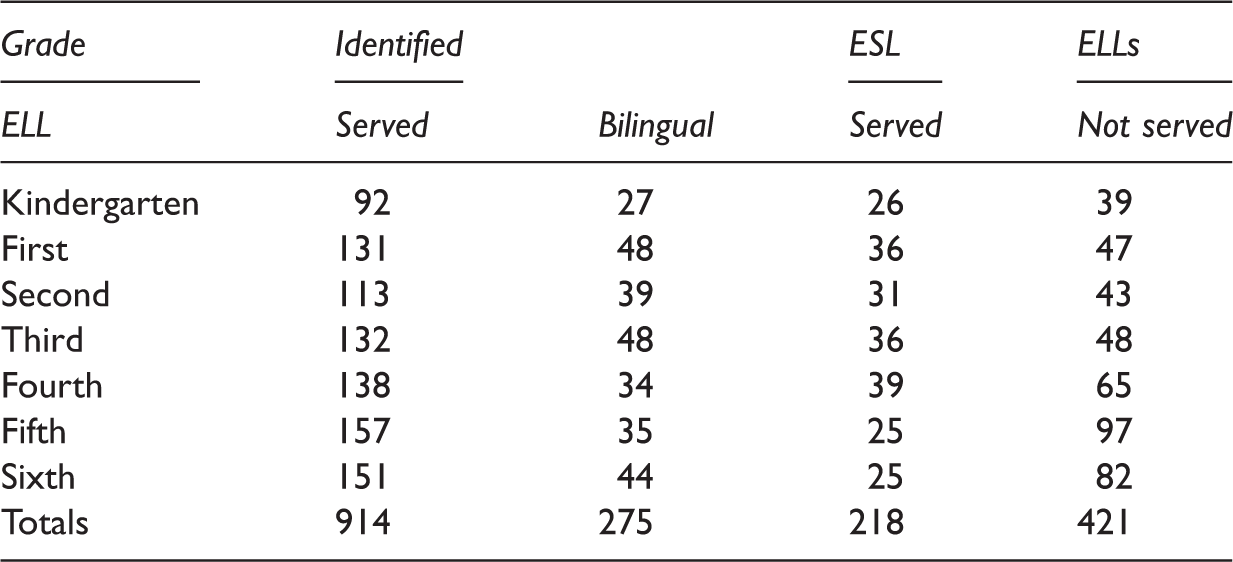
Examining Table 1 it can be seen that all grade levels at Kingsbridge Heights School have more than 20 students who are Spanish speaking (‘Identified’) and thus that each grade level is eligible for one or more bilingual education classes. However, the school provides bilingual education classes for a quarter of those eligible; another quarter receives ESL instruction; and almost half of the designated ELL students (421 Spanish speakers) receive no special language services.
As Woodward notes, there appear to be several reasons contributing to school and district decisions not to comply with State Education Department regulations on services for English Language Learners. First, there exists a pressing need for certified bilingual teachers, especially in the New York City region. Additionally, some parents choose not to enroll their children in bilingual programs (as many non-compliant schools argued, though they rarely provided documentation of this choice [Woodward, 2009: 13]). Last, it is likely that expense plays a role since dedicated federal funding of bilingual programs no longer exists. Bilingual education, with certified bilingual teachers, is more expensive than stand-alone or in-class ESL instruction. To offer no services – as in the largest Kingsbridge cohort shown above (‘Not served’) – is the lowest-cost option for a particular school or district.
It should be remembered that New York City is known for having bilingualism-friendly education policies (Menken, 2008). Carrying out policies in given situations, however, what analysts call ‘policy-in-practice’ (McCarty, 2011) or ‘policy enactment’ (Ball et al., 2012), often results in unforeseen consequences. When it was passed, the NCLB legislation intervened in a decades-long political conflict over migration, education and language diversity (Crawford, 2001; 2007). Woodward (2009: 4–5) summarizes concisely the political conflict, federal policy intervention, and new funding conditions: In the 1980s, opposition to both bilingual education and bilingual voting rights intensified and bills have been introduced every year in Congress to declare English the official language of the United States. While these bills have failed, under the No Child Left Behind (NCLB) Act of 2002, discretionary federal funding to school districts for bilingual education ended and now federal funding for K–12 is allocated to state departments of education for them to use at their discretion.
The combination of ELL categorization with decentralized bilingual education funding provides an informative illustration of what Trouillot terms a ‘legibility effect’. Under NCLB practices, speaking a primary language other than English makes one the object of special scrutiny. This is because No Child Left Behind identifies ELLs as a unified category of at-risk students whose performance is to be closely monitored. Indeed, one of the expert witnesses at the 2007 congressional hearing on NCLB praised the legislation for enabling heightened scrutiny, saying ‘The poor achievement levels of ELLs were a well-kept secret prior to NCLB, and this, thankfully is no longer the case’ (US Congress, 2007: 29). The same witness, however, subsequently decried the lack of funding for good quality bilingual education, especially in the early years of schooling (US Congress, 2007: 31–32).
This is the crux of the matter: heightened scrutiny is combined with decentralized program choice and funding. In a familiar strategy of neoliberal governance, political and institutional decentralization is combined with increased auditing (Gledhill, 2004). The traditional federal bilingual education programs, established in the aftermath of the Elementary and Secondary Education Act of 1965, had ensured funding for school districts offering bilingual education to requisite numbers of eligible students. This was eliminated under NCLB, and states were given block grant funding, with their own discretion for how to best use the monies, but with the obligation that they meet Adequate Yearly Progress targets, which are mandated by NCLB and defined in terms of its classifications of at-risk students and criteria of learning (No Child Left Behind Act of 2001, Title III: 2; Adebi, 2003; Ravitch, 2010). One result is that ELLs, the majority of whom are working-class, racialized minorities, concentrated in schools with the lowest per-pupil resources, are the most at-risk for not receiving appropriate language instruction.
Having discussed some of the ways that policy is enacted at national, state, school district and school levels, let us now turn to a study of individual classrooms. They provide ethnographic evidence for how a third state effect is produced, through the interaction of language difference, school literacy practices, and cultural models of minority students.
Policy as practice III: social class and ethnoracial hierarchy in the differential treatment of Korean and Mexican ELLs
This section presents material from case studies of Korean and Mexican immigrant children in upstate New York. It examines how macro-scale cultural models and micro-scale dynamics of language use in classrooms are both implicated in educational language policy-in-practice.
The immediate facts to be considered here are as follows. In a study of primary-school Koreans in a suburban school in upstate New York, Hong (2006) describes how the teacher of the ESL classroom she studied accommodated to the children’s primary language in various ways. The teacher in this school, which Hong calls Greenville Elementary, allowed special times when the students could speak Korean amongst themselves; she brought Korean books and pictures into the classroom; she incorporated numerous references to Korean cultural practices into her teaching; and she endeavored to learn some Korean words and phrases.
This situation of relative linguistic accommodation differed from that discovered by the present author and a research assistant when we studied how Spanish-speaking immigrant children fared in the same region (Collins, 2012; Collins and La Santa, 2006). One of our sites was a suburban school similar to that studied by Hong – both schools served predominantly middle class and professional populations and were high achieving schools. In the elementary school we studied, which we will call Sanderson Elementary, several teachers whose classrooms we observed said that they spoke Spanish. But they were also quick to point out that they felt Spanish should not be used with their immigrant Mexican students, and that they strove to keep Spanish out of school activities because they viewed the use of Spanish as a potential obstacle to the students’ learning of English (see Collins, 2012, for further data and discussion). Although the ESL class was taught by an experienced teacher, herself an immigrant, and sympathetic to the linguistic challenges her students faced, there was no accommodation to the children’s primary language in the classroom.
Both groups of students brought their language repertoires into the school setting. As Hong reports, the Korean students at Greenville Elementary frequently spoke Korean among themselves. Although the ESL teacher discouraged the practice during formal lessons, she also established special times, ‘playtime’ and ‘snacktime’, when the students were permitted to use their primary languages. In addition, Korean also entered into the regular ESL lessons in diverse ways, as we can see from example (1):
1T: (reading the book) ‘Aekying went to school for the rest of the week and tried to ignore the teasing of the other children. On Sunday, Aekyung’s Aunt Kim came to visit. She had just returned from Korea with many presents for the family, fancy dress for Aekyung. “How’s everything in Korea?” asked Father.’ 2T: What’s this called? (pointing to the picture in the book, which includes a girl wearing a Korean traditional costume.) 3Dan: Uh… 4Mina: Hanbok 5Kim: Hanbok 6T: Hanbok, remember that we had that in the play last year? 7Mina: How… how do you… know… in English? Like… that English? 8T: How do I know that? 9Mina: Yeah. 10T: Because you taught me when you brought to me that dress, you taught me it was called Hanbok. 11Mina: No… (speaking in Korean and walking to her sister, Hanna, who is sitting across the table and whispering in Korean to her) 12Hana: How do you know, like, how to say Hanbok in English? 13T: I think it’s the same word, same word. There’s no English word unless you want to say Hanbok fancy dress. 14Mina: Oh. That’s the same thing? 15T: I think that means fancy dress. (07 January 2005: from Hong, 2006: 90–91)
Several things are notable about this excerpt. First, the teacher reads a story about Korea to the ESL students. In addition, when she asks them for the name for a dress, and they reply in Korean, she then incorporates the Korean word, Hanbok, into her subsequent questions (in turn 6). When one of the students, Ming, grows frustrated with her questioning of the teacher – because Ming wants to know the English term, but the teacher thinks she is asking how the teacher knows the Korean word – then she turns to her sister, Hana, (in turn 11) and asks her in Korean to interpret her question to the teacher. Hana does this and the teacher supplies an answer (in turns 12 and 13). As Hong comments about this exchange, the students are not only reading about Korea, and discussing Korean words, they use their primary language to arrange interpreting tasks among themselves, in the service of lesson discussion.
When possible, the Mexican immigrant students at Sanderson Elementary also used their full linguistic repertoires. There were, however, no special times, such as ‘playtime’ or ‘snacktime’, when they were licensed to do so. Instead, they were repeatedly enjoined to speak only English in school settings, although they were likely to use both Spanish and English when there were enough Spanish-speakers present to constitute a sub-group within a classroom. One such occasion occurred during an ESL lesson late in our research period. During this lesson, there were four Spanish speakers in the room: three young girls plus our project research assistant. Throughout the class period the ESL teacher interacted with the students solely in English.
Thus in example (2), a student, MV, asks the teacher about a picture/word vocabulary-building activity in which they identify words and circle animal pictures. As can be seen, all business is conducted in English: MV asks ‘This is elephant?’; the teacher acknowledges the question, but corrects MV’s work and sends her back to finish the sheet.
(MV approaches teacher, T) T: Sure can, bring it over here (to MV) MV: This is elephant? T: Uh, no … FINISH and then come and see me MV: Ok.
During this same lesson the project research assistant (AL), a fluent bilingual, had been working with one student on a similar vocabulary activity. She would pose her questions in English, but allow the student to reply with answers or questions in Spanish or English. At one point, shown in example (3), MV and a new girl approach AL in order for MV to introduce the new girl:
1. MV: Ella es mi prima (She is my cousin.) 2. AL: Si? Como se llama? (Yes? What is her name?) 3. MV: Ella? (Her?) 4. AL: Uh huh 5. MV: LAURA [lawra] … Pero se dice ‘Laura’ [lorə;] en ingles. 6. (LAURA [lawra] … but you say ‘Laura’ [lorə;] in English)
In example (3), it can be seen that the Sanderson students – like the Greenville students – have metapragmatic as well as metalinguistic knowledge in their primary languages, which they use in organizing interaction during classwork. MV introduces her new classmate and comments on the differences in Spanish and English pronunciation of the name Laura [lawra]/[lorə;]. The exchange resembles example (1) which depicts Korean used at Greenville in this regard: When the use of the primary language was interactionally-enabled by speaker demographics, the children would use both languages. Normatively, however, Spanish was never a licensed part of the classroom at Sanderson. The predominant pattern at Sanderson, across the half dozen ESL lessons we observed, was as shown in example (2), with interaction restricted to English. In these linguistic circumstances, the Spanish-speaking students in our study were much quieter and limited themselves to brief exchanges in English.
For some reason the greater ethnolinguistic difference of Korean students at Greenville, where the teachers did not know Korean, was viewed as a resource to be used in learning English, but the lesser ethnolinguistic difference of Mexican students at Sanderson, where some teachers did know Spanish, was viewed as a hindrance to that same learning. The question, then, is why this different perception and treatment occurred. If we accept that social groups and their linguistic and cultural properties are perceived through the lens of cultural or discourse models about kinds of persons, life worlds, and social trajectories (Gee, 2003; Holland et al., 1998), and that such models influence the school’s classification of students (Wortham, 2005), then we can begin to examine how cultural constructs and social conditions play a role in policy enactments (Ball et al., 2012).
Urciuoli’s (1996) Exposing Prejudice contains a discussion of language, race and class in the US that can help in developing this issue. In her analysis, Urciuoli focuses upon racializing and ethnicizing discourses – ways of characterizing groups of people, tied to stereotypic projections of their families and communities, the kinds of language they use, and the likelihood of their acquiring an ‘unmarked’ or normative American cultural identity, a symbolic ideal in which language use and social class are central features. In her account, racializing and ethnicizing discourses are ways of handling difference, of symbolically marking those who are not White, Middle Class, Standard English speakers, and doing so in a gradient fashion.
Ethnicizing discourses represent difference as safe, contained to the proper social domains, and somehow providing the basis for class mobility. In such a discourse model, Koreans might speak other languages, but they can be trusted to learn English. They come from presumptively stable families and law-abiding communities. Perhaps most crucially, they are presumed to be upwardly mobile. They will become middle class (Lee, 1996; Park, 1996). Racializing discourses represent difference as dangerous, occurring outside the proper social domains, and incorrigibly working-class or poor. In such a discourse model, Mexicans not only speak another language, it is feared they will not learn or will refuse to learn English. They will insist on Spanish not just in the proper domain of home or church, but also in public arenas like law courts, workplaces and schools (Huntington, 2004). In this discourse model, Mexicans do not come from stable families and neighborhoods but, rather, from sprawling barrios. They are not presumed to be upwardly mobile, because they are predominantly working class and they have been so for many generations of labor migration (De Genova, 2005).
As Hong’s description of the school/home relation attests, the middle-class Korean migrant students in ESL at Greenville were viewed as model minorities. The Greenville staff and ESL program valued the children’s home language and culture: ‘Students’ heritage language and culture are considered as valuable resources to facilitate students’ acquisition of English as well as to connect home and school throughout the school year’ (Hong, 2006: 60). The ESL teacher encouraged the students’ parents to volunteer in the children’s classroom, and the ESL program organized several ‘multicultural celebrations’ to acknowledge the achievements of the Korean students in learning (Hong, 2006: 61). In brief, their language difference was seen as a resource for learning and thus was licensed in some school settings.
In contrast, the working-class Mexican migrant students in ESL at Sanderson were seen as non-model or racialized minorities. The principal warmly endorsed the ethos of hard work and family cohesion that she and her staff perceived as traits of the Mexican migrant families, but she and her staff also said that because of language the parents were not able to help their students with schoolwork. In the course of our classroom visits and teacher interviews, we heard the discourse of ‘language problems’ from the principal, several regular classroom teachers, and a reading specialist. It was never fully clear to what extent such problems were those of cross-language difficulty and to what extent other categories of language pathology were suspected. Two of the migrant children described as having such problems were themselves first language speakers of English, a common problem of misclassifying on the basis of name and family not actual first language (Abedi, 2003; Menken, 2008). The ESL teacher acknowledged her sympathy for the students, being an immigrant herself, feeling that their efforts to learn English while also coping with regular schoolwork did not receive much empathy or support in school. However, she did not seem empowered or able to view the students’ ‘heritage language and culture [ … ] as valuable resources to facilitate students’ acquisition of English … ’ (Hong, 2006: 60). Instead, as noted, their language difference was seen as an obstacle to school learning and was not licensed for use in any school setting.
Two apparent exceptions to this argument may provide a more nuanced view of the issues. The first comes from a long-term ethnographic study of a Mexican migrant community in the Philadelphia metropolitan region. Based on an analysis of school and community discourses about migrants, Wortham et al. (2009) reported that both townspeople and school personnel praised the migrant families for their social cohesion and work ethic; they added, however, that the children were not viewed as likely to succeed educationally. As they summarized: ‘[People] often characterize Mexican immigrants as model minorities with respect to work and civic life but not with respect to education’ (Wortham et al., 2009: 388).
The second apparent exception comes from our own data and concerns one school encounter in which the use of Spanish was not proscribed. Teaching Aides at Sanderson who happened to be Spanish-English bilinguals were inclined to draw upon the children’s knowledge of Spanish when working through math or literacy activities, a language opening in which the children eagerly engaged (Collins, 2011). However, the one time we commented on this bilingual pattern with the supervising classroom teacher, she firmly stated her disapproval of the practice.
Comparing the Korean children at Greenville with the Mexican children at Sanderson, we may say that the efforts of one group to extend the social domain of their multilingual register meet qualified success; with the other, their efforts are resolutely opposed by those in authority. What we suggest, following Urciuoli as well as literature on Asian immigrants as ‘model minorities’ (Park, 1996; Shankar, 2008), is that such a cultural model is operating. It privileges Korean students in ESL at Greenville and penalizes the immigrant Mexican students in ESL at Sanderson.
We have evidence of a link, confirmed by other ethnographic studies of racialized minorities of differing social classes (Foley, 2008 [1990]; Shankar, 2008), between class statuses and the racialization practices applied to linguistic minorities. As Fassin (2011: 215) argues, this phenomenon occurs in other developed countries in response to migration, although differing state policies and ideologies of ‘integration’ tend to obscure it: [I]mmigrants embody the articulation of borders and boundaries … They cross borders to settle in a new society and discover boundaries through the differential treatment to which they are submitted … Thus the way the British ethnicize south Asians and racialize black English illustrates the interaction between internal and external frontiers (Wallman, 1978), a problematic by contrast ignored in France until recently, because immigration was analyzed in terms of ‘melting pot’ … and ‘integration’ … whereas phenomena of racialization and ethnicization were denied.
Lest connecting stereotypes to state processes seems far-fetched, we should bear in mind that the model minority stereotype arose in response to the demands of the 1960s Civil Rights movements (Shankar, 2008). These movements articulated collective demands for redress from state and national governments, based on African American, Latino, and Native American arguments about historical oppression and unequal treatment in labor markets, schools, and other sectors of society. Against this historical background, Asian immigrants were represented as an alternative, ‘model’ minority (Lee, 1996). How such models circulate, and with what effects, requires ethnographic study, to which this case study is one contribution. Their critique requires analysis of class and how it is present in students’ presentation of self and language and in school personnel’s responses thereto (Foley, 2008 [1990]). It also requires the analysis of historical developments and ruptures, during which sudden re-articulations of race, class, and language become evident (for example, Shankar, 2008: Chapter 8 and Postscript).
Conclusion
The cases presented above suggest that in order to understand policy as a social practice, it is necessary to examine how policy operates at multiple levels, from national legislation to state-level regulation, schools’ decisions about curriculum, and face-to-face interaction in classroom lessons. Conducting such multi-leveled analysis requires conceptual focus, and I have argued for a focus on the effects of social class and state power in an era of corporate-led or neoliberal globalization. In addition, policy must not be viewed as a context-independent textual decree. In the cases presented, it has been argued that No Child Left Behind must be analyzed in relation to a political economy that spatializes economic inequalities (so that immigrant ELLs are concentrated in hard-pressed city schools), informs educational classifications of at-risk students, and underpins popular perceptions of kinds of immigrants and minorities.
Language and education policy, as represented in NCLB, attempts to manage linguistic diversity in the US in tandem with classifications of (at-) risk that exacerbate the very inequalities NCLB proposes to eliminate. The plurilingualism of the contemporary United States is significantly influenced by labor migration in recent decades, particularly the large-scale Mexican working-class migration (De Genova, 2005) but also the elite diasporas wrought by middle and upper-class migrants from the rising economies of Asia (Ong, 1999). The student classifications and auditing practices of NCLB seem particularly ill-suited for understanding those dynamics and their implications for education.
None of these criticisms mean, however, that NCLB is inconsequential. It has been argued here that the legislation and implementation program as enacted produce several state effects, which are dispersed through a variety of sites and social scales, ranging, in the cases discussed, from the federal to the state, the school to the particular classroom. Inequality is fundamental to ‘risk’ in education (Bialostok and Whitman, 2012): the distribution of educational achievement is strongly associated with economic and racial hierarchies. Low-income status is a category of risk, as is racialized minority status. Migrants and their language differences comprise yet another category of risk. State effects operate in the processes of managing populations and articulating their differences, constructing social subjects in relation to differences that are obscured as well as rendered legible, producing isolated individual subjects as well as identifying new collectivities that are ranked in ethnoracial hierarchies.
A lesson from what has been reported here is that state power does not require a central location or unified, hierarchical control. It takes many forms: the quotidian encounter in the ESL classroom; the unintended consequences of decentralized funding for language education programs; and the ways in which policy categories shape our vision of the risks that policy is supposed to manage. A second lesson is that in thinking about the myriad forms of social and semiotic diversity that follow from contemporary transnational movements of people, capital and technology, it is necessary to remain attentive to articulations of difference that involve some very old components and principles of global systems: states, class inequalities and racializing practices.
Footnotes
Funding
The research reported in case three of this article was supported by Spencer Small Grant #200500098.
Acknowledgements
An initial draft of this article was presented at the Colloquium on ‘Literacy Education Policy as Social Practice’ at the 2011 Conference of the American Association of Applied Linguistics held in Chicago on 28 March 2011: I am indebted to audience members and fellow panelists for questions and discussion. I am also indebted to the families and school personnel who took part in the research reported in case three of this article. Preparation of the manuscript benefitted from a one-month ‘guest’ residence at the Max Planck Institute for the Study of Religious and Ethnic Diversity, Göttingen, June 2013.