




Abstract
Several movements have emerged related to the general idea of promoting ‘openness’ in science. Research councils are key institutions in bringing about changes proposed by these movements, as sponsors and facilitators of research. In this paper we identify the approaches used in Canada, the US and the UK to advance open science, as a step towards understanding how policy in this area is evolving. The findings highlight three broad patterns across the countries, showing that open science is supported not only be the activities of individual research councils, but also through government mandates and inter-council cooperation. These patterns involve efforts to create a digital infrastructure for open science, to foster open access, and to support open data initiatives.
Introduction
Advances in communications and information technology (ICT) have created opportunities and advantages for scholars in all fields to disseminate and share information (Schroeder, 2008). Enhanced structures for scholarly communication are widely believed to facilitate changes in research practices towards more open discussion and transparency. Hence, the design, implementation, and standardization of new tools, services, and infrastructures for sharing research are increasingly topping the agendas of research communities and sponsors (Data’s shameful neglect, 2009; Dealing with data, 2011). Such efforts are broadly recognized as promoting ‘openness’ in science (Science Commons, 2008).
The unrestricted communication of scientific discoveries has its historical roots in the late 16th and early 17th centuries, when it was a vital aspect of the scientific revolution (David, 2008). Since this time, the academic norms emphasize the sharing of research findings in scholarly journals (Dasgupta and David, 1994; Merton, 1973). Sharing research results through peer-reviewed publication is traditionally seen as enhancing scientific progress, avoiding duplication, and enabling the verification and reproduction of results. More recently, advocates of open science are supporting programmes to produce an Internet-based scholarly infrastructure and accompanying policies for preserving and distributing scholarly resources – principally research data and findings, as published in peer-reviewed journal articles. They seek to leverage investments in research by: enabling researchers to more easily build on previous work; permitting the creation of new large datasets when data from multiple sources are combined; and increasing the visibility, usage and impact of research (Swan, 2012).
Although universities have been called on to lead these efforts (Tananbaum, 2010; Uhlir, 2009), science funding agencies and research councils (‘research councils’ for short) have a critical role to play in fostering enhanced ‘openness’ in science (e.g., Bogden, 2010; Shearer, 2011). Research councils have considerable leverage over how research is conducted and reported, and are equipped with sizable budgets capable of funding infrastructure projects. Their importance to the scientific community makes them capable of inducing universities to incorporate principles of open science into grantee responsibilities. Moreover, they are connected to academic, and publishing industry stakeholders, as well as governments, and serve as channels through which each affects research policy.
Prior scholarship has recognized the role of research councils in promulgating open science (David et al., 2008; Fry et al., 2008; Hey and Trefethen, 2003; Schroeder, 2008; Uhlir and Schröder, 2007; Whyte and Pryor, 2011). The current study builds upon this literature by examining the policy frameworks under which research councils operate to implement such practices. In this paper the focus is on the open science policies being promoted by influential research councils in different countries: Canada, the US, and the UK. This paper thus explores the following questions: (1) What are the approaches, rationales and instruments for open science policies and practices at research funding councils?; and (2) What differences of goals, rationales, and instruments exist between research funding councils?
Different forms of ‘open’ in science
Contemporary social processes have fostered openness in knowledge and communication systems, influencing various institutions (Peters and Roberts, 2012). In science, several movements have emerged related to the general idea of promoting ‘open science’; these include e-research (or cyberinfrastructure), open access, open data, and commons based frameworks (Borgman, 2007). In this paper, these multiple forms of ‘open science’ are used to form an analytical framework from which to understand and evaluate the goals, rationales, and instruments for open science policies and practices at research councils in Canada, the US, and the UK.
E-research infrastructures underlie initiatives to promote openness in science. Advances in ICT have given rise to vast amounts of computing power and network capacity for information dissemination and collaboration, as well as for accessing and analysing large-scale data (Schroeder, 2007, 2008). Moreover, basic collaboration technologies such as network infrastructure and middleware platforms have been suggested as particularly important enablers of open science research networks (e.g., Atkins et al., 2003; Berman and Brady, 2005; OSI e-Infrastructure Working Group, 2007; ESRC, 2010; Leenaars, 2005; NSF, 2007). Borgman (2007) uses the collective term ‘e-research’ when referencing ‘technologies to facilitate distributed, collaborative, information-intensive forms of research and learning’ (20). Programmes for the development of e-research infrastructures have used the labels ‘e-science’, ‘cyberinfrastructure’, and ‘e-infrastructure’ in different national contexts. The availability of these technologies enables highly instrumented research projects, often international in scope, that produce enormous amounts of data (Maurer, 2003; Uhlir and Schröder, 2007). These large and complex datasets have become known as ‘big data’ (Big Data: Science in the Petabyte Era, 2008), ‘whose, volume, variety, velocity and complexity make it impossible for current databases and architectures to store and manage’ (Carter, 2011: 5). This ‘data deluge’ (Hey and Trefethen, 2003) is a major impetus behind efforts of research councils to develop the networks, tools, and services through which research outputs can be managed, accessed, and analysed (Mervis, 2012). Although e-research may be neither a ‘necessary nor sufficient’ condition for realizing open science (David and Spence, 2008; David et al., 2008: 2), initiatives to develop and enhance data networking and management (including the establishment of digital repositories) have nevertheless contributed to the accessibility of research outputs.
The open access movement is increasing both in breadth and depth internationally (Suber, 2010, 2011; Willinsky, 2006). Like other ‘open’ movements, open access is about the redistribution of and access to information. Open-access generally strives to make to the products of research freely available on the internet, without price or permission barriers, for re-use and distribution as long as there is proper attribution for the author (Berlin Declaration, 2003; Bethesda Statement, 2003; Budapest Open Access Initiative, 2002). Open access journals and open access repositories (sometimes called the ‘gold road’ and ‘green road’, respectively) are the two principal vehicles for achieving open access; both seek to lower the barriers for potential users to make use of articles and data by not charging user fees. 1
A number of factors have moved open access forward in some fields, including high journal prices, popular perceptions of the societal benefits of research, lowering demand for traditional journal subscriptions, and norms of information exchange (Shearer, 2011). Nevertheless, funding agencies across the disciplines now have policies regarding making the outcomes of council-funding openly accessible. These policies, although varying slightly according to disciplinary standards and best practices, usually include: (1) a description of what content to make available; (2) the permissible methods for making such content available; (3) an embargo period that gives authors and journals a certain amount of time after publication before making content open; (4) directions for which version of a publication to make available; (5) an indication of whether the policy is mandatory or voluntary; (6) exceptions for certain kinds of information and waivers; (7) details as to how the policy will be monitored; and (8) any sanctions for non-compliance. Open access policies typically request investigators to make any peer-reviewed manuscript resulting from the outcome of council-funded research available through an open access journal (or a journal providing open access), or an open repository, often after an embargo period of from 6 to 12 months.
A key issue in the open access debate is the exercise of copyright in non-restrictive, non-exclusionary ways. ‘Copyleft’ is one example of a method of copyright use that allows an author to offer the right to distribute and use versions or parts of a work as long as any derivative work is bound by the same licensing terms (also known as a share-alike, or reciprocal, requirement) (GNU, n.d.). Creative Commons’ copyright licenses give copyright owners ways to make their works available through contracts and information policies, while controlling how those works are used, shared, and built upon (Creative Commons, 2013). There are several degrees of Creative Commons’ copyright licenses, each remove degrees of permission barriers for users. Only the Creative Commons Attribution License (CC-BY) removes all permissions from authors or publishers, as long as the original authors and source are cited.
The push for ‘open data’ is similar in most ways with efforts in providing open access, except that sharing and reusing data introduces different technology and policy considerations from those related to providing access to publications. Different kinds of data may be more amenable to sharing in documented form, and best practices for documentation and standardization differ across, and even within, research communities (Borgman, 2012). Nevertheless, transformative ICTs and networking capabilities have made large bodies of data more easily accessible, and have enabled new ways of re-using, searching, organizing, and analysing research data. The data associated with research are now considered more than a by-product of the research process; they are ‘the foundation for new scientific insights and discoveries that drive innovation’ (NSF, 2010) and need to be preserved and shared. The articulation of this sentiment has been promulgated in key documents such as the OECD Principles and Guidelines for Access to Research Data from Public Funding (2007), the Fort Lauderdale Principles (2003), and the Toronto Statement (2009).
Elements of data sharing policies.
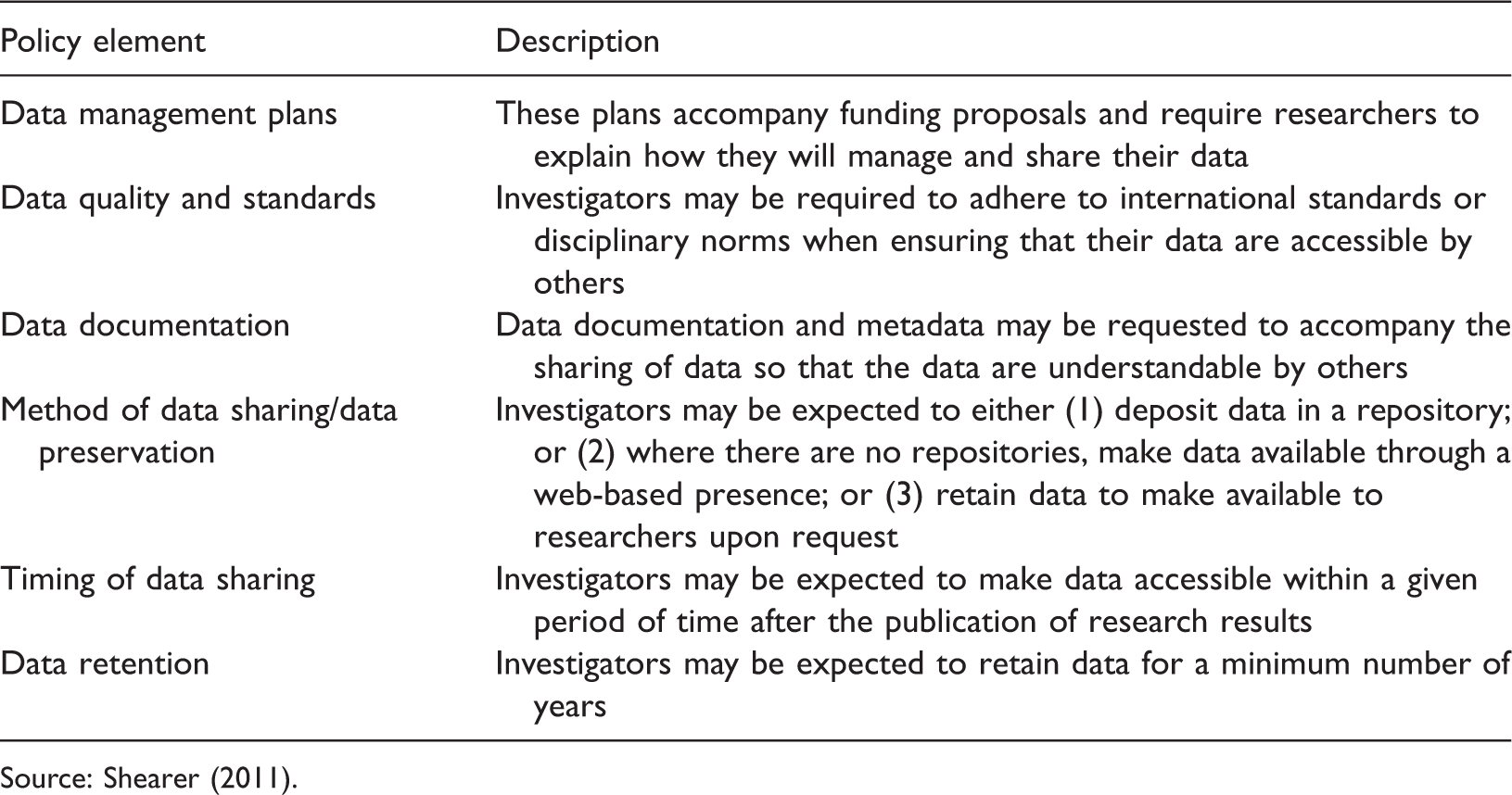
Source: Shearer (2011).
Methods and data collection
This investigation of the approaches, rationales and instruments for open science policies and practices focuses on research funding councils in Canada, the United States, and the United Kingdom. These three countries are selected for study for two reasons: first, each are global leaders in scientific research (OECD, 2012; SCImago, 2007; Scientific American, 2012); and second, each contains mature infrastructure and regulatory frameworks that at once support research, clarify priorities and research procedures, and rationalize the expectations to which researchers are held. Research councils in these three countries were thus likely to be useful sources from which to examine open science policies.
This inquiry is conducted through documentary content analysis. Content analysis uses documents to explain the status of a phenomenon that becomes emergent through searching for recurring patterns and themes in a text (Best and Kahn, 1998; Patton, 2002). This form of analysis lends itself well to policy analysis, as an organization’s goals, rationales, prescriptions, and preferred instruments and procedures are literally imprinted within official texts, policies, and reports. The themes and trends revealed through content analysis enable the examination of the nature, focus, and targets of Research Council policies and initiatives, in addition to those of stakeholders.
Data sources are collected through a comprehensive review of policy documents, grant requirements, and website content of each council selected. Government and scientific community responses to council open science policies as expressed in reports, prominent journals, and scientific council website material to identify stakeholder responses to research funding councils’ approaches towards open science and how they (stakeholders) have influenced subsequent policy moves are also investigated.
Policy landscape
Policymakers in the United Kingdom, the United States, and Canada have shown interest in making sure that the results of federally funded research be accessible to the general public. In 2004, science ministers from the three governments, along with representatives from 31 other countries, pledged support to the idea of open science in 2004 by adopting the OECD Declaration on Access to Research Data from Public Funding. Through the declaration, signatory governments declared commitment to ‘[t]ake the necessary steps to strengthen existing instruments and - where appropriate - create within the framework of international and national law, new mechanisms and practices supporting international collaboration in access to digital research data’. Since adoption of this declaration, federal governments in the United Kingdom, the United States, and Canada have launched several initiatives supporting openness in science. These moves relate partly to the on-going trend towards greater accountability pervading the three countries, and partly on a technological innovation agenda (Sá et al., 2013). Expectations for public accountability, entail regulating publicly funded agencies and programmes to ensure transparency, responsiveness, and effectiveness. Initiatives for increasing openness in science benefit from these movements, as access to research outputs is deemed necessary for both ensuring the public benefit from its investments in research, and for facilitating the scientific process.
In the US, making the results of research openly available has been the subject of legislative deliberation for the past decade. In 2004, members of the House of Representatives presented arguments for making the results of research funded by the National Institutes of Health (NIH) – the country’s largest funder of scientific research – freely available to the public, arguing that the public was entitled to the results of taxpayer funded research. This was also cast as a way to increase the impact of funded research (US Congress House, 2004). The US House Appropriations Committee adopted a set of recommendations for the 2005 federal budget that included a recommendation for the NIH to develop a policy requiring free online access to articles based on NIH-funded research, no later than six months after their publication in peer-reviewed journals. After the NIH responded with a draft policy that followed the House’s recommendation – but reduced the suggested ‘requirement’ to a ‘request’ – the House accepted the NIH’s recommendation and the appropriations bill was made into law. When the NIH released the final version of the law in 2005, the permissible delay from six months after publication was modified to ‘as soon as possible (and within twelve months) after publication. However, by 2007 it became obvious that the voluntary policy resulted in low participation from funded investigators. A mandatory provision for NIH-funded research papers was again included in a bill (the Consolidated Appropriations Act of 2008, H.R. 2764), which was later signed into law. The policy was enacted in 2008 and requires all final, peer-reviewed manuscripts resulting from research funded by the NIH be electronically submitted to PubMed Central no later than 12 months after the data of publication.
Even more encompassing is the Public Access to Science Act, which was first introduced in 2003 to propose excluding from copyright protection works that result from government-funded scientific research. The bill faced opposition and was placed in committee, and never came before a vote. The bill was subsequently reintroduced in 2006, 2009, and 2012, but each time ended up stalled in committee. In 2013, the Fair Access to Science and Technology Research Act (FASTR) was introduced with two new provisions requiring: (1) coordination among agency policies; and (2) the inclusion of a formatting and licensing provision to enable productive reuse. Like its antecedents, FASTR has been referred to committee where it awaits a vote. Although the FASTR bill is still pending, the Office of Science and Technology Policy issued a public memorandum in February 2013 that directs federal agencies to fulfil the original goals of the Public Access to Science Act. 2
As in the United States, legislators in the UK have linked open access to public accountability. In a 2004 report of the House of Commons Science and Technology Committee, the committee concluded, ‘[w]e are convinced that the amount of public money invested in scientific research and its outputs is sufficient to merit Government involvement in the publishing process’ (House of Commons, 2004). In July 2012, based on the recommendations of the National Working Group on Expanding Access to Published Research Findings, the UK government announced plans to make all research open access by 2014 (Freedman and Anyangwe, 2012).
The government of Canada has been less involved in legislating openness in science. However, recent strategies towards making government information open may lead to open science policies. In March of 2011, the government of Canada launched its Open Government strategy with two foundational actions: An Open Government Directive that provides guidance to federal departments and agencies on what they must do to maximize the availability of online information and data; and (2) the issuance of a new universal Open Government License with the goal of removing restrictions on the reuse of published Government of Canada information (Government of Canada, 2011). Following the open government strategy, the government launched its Open Data Portal in March 2011 as a 12-month pilot project to catalogue datasets from participating agencies, and make them free of charge to the public under certain licensing conditions (Government of Canada, 2012; Kavur, 2011).
Besides the trends linked to accountability, governments in the three countries have promoted open science thrusts related to technological innovation agendas. In the UK, calls for a national e-infrastructure for research are related to making science more accessible to industry (ESRC, 2010; OSI e-Infrastructure Working Group, 2007). The Department for Business, Innovation and Skills (BIS) released A Strategic Vision for UK e-Infrastructure in 2011 as a roadmap for the development and use of a nationally coordinated e-infrastructure. The BIS recommended that an E-infrastructure Leadership Council, which was subsequently established in March 2012, advise the government on all aspects of e-infrastructure including networks, data stores, computers, software and skills. Furthermore, in late 2011, the UK government adopted the Innovation and Research Strategy for Growth, expressing a commitment to the ‘free and open access to taxpayer-funded research (BIS, 2011: 76). Its outcomes include: (1) the creation of data.gov.uk as an online portal for the public and industry to access public data; (2) the Open Data Institute, which the government funds to ‘ensure that Open Data research is transformed into commercial advantage for UK companies’ (BIS, 2011: 76); (3) an Open Data White Paper (2012) that states how the UK will continue to promote data sharing; and (4) an agreement from the Research Councils to develop the Gateway to Research, to be launched at the end of 2013, to give the public better access to information on research funded by the research councils.
In the US, the America Competes Reauthorization Act of 2010, which is based on the government’s priority of connecting innovation in science, technology, and engineering to national economic competitiveness, called upon the Director of the Office of Science and Technology Policy (OSTP) to develop e-research infrastructure policies. In addition, the director of the OSTP was called to establish a working group to ‘coordinate Federal science agency research and policies related to the dissemination and long-term stewardship of the results of unclassified research, including digital data and peer-reviewed scholarly publications, supported wholly, or in part, by funding from the Federal science agencies.’ (124); such actions would necessarily involve developing a robust information infrastructure. In fulfilment of the provision in the America COMPETES Reauthorization Act, the National Science and Technology Council sent a report (NSTC, 2012) to Congress laying out common objectives for the development of individual agency policies for ensuring public access to the results of federally funded research.
Likewise, in Canada, the government launched a digital economy strategy in early 2010 to facilitate technological diffusion. That year, the Ministers of Industry, Human Resources and Skills Development, and Canadian Heritage jointly announced the release of a consultation paper which included the statement linking open access to government policy priorities: ‘Governments can help by making publicly-funded research data more readily available to Canadian researchers and businesses. Open access is consistent with many national strategies and holds great economic potential for Canadians to add value to machine-readable data’ (Canada, 2010: 14).
The digital infrastructure for open science
E-Infrastructure, middleware, and digital repositories, along with management services and policies that guide their use, underlay the open access movement. National Research Councils have been leaders in moving this forward.
The National Science Foundation (NSF) has played a leading role in supporting the development and maintenance of national computing and information infrastructure technologies in the USA for several decades. 3 The Office of Cyberinfrastructure (OCI) was created in 2005 to coordinate e-infrastructure programmes across the agency and to fund information technology infrastructure research and training (NSF, 2006; OCI, n.d.). In recent years, the OCI has funded the TeraGrid programme (2006–2011), and more recently, Extreme Science and Engineering Discovery Environment (XSEDE) project (2011-) to integrate high-performance computers, data resources and tools, and experimental facilities. In addition, NSF created a Cyberinfrastructure Council (CIC) to provide oversight of NSF-wide activities in this area (SIAM, 2005). In 2007, the CIC developed a comprehensive vision to guide the Foundation’s strategic future investments in cyberinfrastructure entitled Cyberinfrastructure Vision for 21st Century Discovery. A core focus of this vision is making research data more accessible, and it is one of several calls to build on the two decades of digital library initiatives and proposals. 4 To realize the vision set forth in the report, the OCI has funded a programme called Sustainable Digital Data Preservation and Access Network Partners (DataNet). The DataNet programme supports projects to develop new methods, management structures and technologies to develop and sustain a data curation infrastructure.
In recent years, the National Endowment for the Humanities (NEH) has also supported e-research. In 2006, the NEH launched the Digital Humanities Initiative aimed at fostering large-scale digital humanities collaborations among libraries, museums, archives, and universities. In 2008, the initiative was made into a permanent office under the new name, Office of Digital Humanities, to coordinate NEH efforts in the area of digital scholarship. The NEH’s Office of Digital Humanities will begin requiring data management plans (which are aligned with those from the NSF) in 2012 for their new grant programme Digital Humanities Implementation Grants (NEH, 2012; Scheinfeldt, 2008). The NEH has also joined the Joint Information Systems Committee from the United Kingdom, the NSF, and the Social Sciences and Humanities Research Council (SSHRC) from Canada, in supporting an international competition called the Digging into Data Challenge. The Digging into Data Challenge, launched in 2009, 2011, and 2013, encourages humanities and social science research to use large-scale data analysis by asking teams of scholars ‘to demonstrate how data mining and data analysis tools currently used in the sciences can improve humanities and social science scholarship’ (SSHRC, 2009).
Support for a digital infrastructure is more widespread among research funding councils in the UK. In addition to the core Research Councils, infrastructure projects have been supported by the Joint Information Systems Committee (JISC), which was formed in 1993.The UK e-Science programme, which began in 2001, was the first coordinated initiative involving all the research councils and the government to support the development of grid applications in science and engineering, and encourage the development of middleware. The programme was managed by the Engineering and Physical Sciences Research Council; however, most of the Research Councils have also funded their own e-Science activities. The UK e-Science programme also included the National e-Science Centre (2001–2011) which was managed by the Universities of Glasgow and Edinburgh, with facilities in both cities, to develop e-Science in the UK. In 2004, the ESRC established the National Centre for e-Social Science to encourage the use of new computer-based tools and services by social scientists. In 2010, the plan Digital Social Research: A New Strategy for e-Social Science 2010–2012 made the case for investing in new tools, methods and research resources for increasing ease of data collection, access and analysis in the social sciences.
Another prominent initiative supported by UK research councils is the National e-Infrastructure Service (formerly National Grid Service), which facilitates collaborative research by providing access to a broad range of computational and data resources. In 2009, the JISC funded the first Managing Research Data programme, which addressed the many challenges to improving research data management. The programme helps research institutions plan their data management strategies, pilot the development of data management infrastructure, and develop training materials in research data management.
In addition to e-research, several of the UK research councils have invested in developing an infrastructure of discipline-based data repositories for collecting research data. The UK Data Archive is curator of the largest collection of digital data in the social sciences and humanities in the country. In 1967 the Social Science Research Council supported the establishment of the Archive, and today it is largely funded by the ESRC, the JISC and the University of Essex (UK Data Archive, 2007). In July 2012, the ESRC announced that many of the data services hosted by the UK Data Archive will join the UK Data Service, due to be established as of 1 October 2012 as a national digital repository, and central access point for economic and social research data in the UK (ESRC, 2012). In 2004, with support from the UK e-Science programme, the JISC established the Digital Curation Centre as a centre for solving national challenges in digital curation. Moreover, JISC established the ‘depot’ repository in 2006 as a service to any UK academic author without access to an institutional repository. NERC’s research repository, known as NORA (NERC Open Research Archive), was established in 2007. Finally, the ESRC supports the Economic and Social Data Service, which is responsible for the cataloguing and archiving of data. Hosted by the UK Data Archive, this service is responsible for acquisition, processing, preservation and provision of access to research data generated as a result of ESRC funding as well as other data which feeds into the Council’s research agenda.
In Canada, numerous national consultations and working groups have documented the need for a national data archive or a national institution to support the preservation of data, manage repositories, and provide access to research (CARL, 2010; English, 1999; NCASRD, 2005; NDAC, 2002). In the continuing absence of a national research data steering body, representatives from the research community, data centres, the granting agencies, and government science departments formed the Research Data Strategy Working Group (RDSWG) in 2008 (Research Data Canada, 2012). In 2010, when the government signalled its support for open data as articulated through its digital economy strategy, RDSWG responded by hosting a National Data Summit to develop a national approach for managing Canada’s research data. Based on input from Summit participants, the RDSWG has developed a draft National Strategy for Research Data in Canada, which contains a vision, goals and framework for action (Research Data Strategy Working Group, 2011). In the autumn of 2012, the RDSWG reorganized itself into Research Data Canada, which is intended to serve a leading role as a national forum for data stewardship issues.
Programmes and tools that promote the evolution of a digital infrastructure are funded by CANARIE (previously known as Canadian Network for the Advancement of Research, Industry and Education). Established in 1993 and having played a pivotal role in the consolidation of the Internet backbone in Canada, CANARIE currently supports the development of digital platform services through its Research Middleware Program. Since 2012 it has provided research institutions with faster access to Internet-based content.
Initiatives to improve access to research data include the Data Liberation Initiative, which was launched in 1996 to provide access to numerous Statistics Canada data for subscribing colleges and universities. The initiative was started with support from the Canadian Association of Public Data Users, the university research and library communities, Statistics Canada, the Treasury Board Secretariat and the Government’s Library Depository Services Program, and later support from the Humanities and Social Sciences Federation of Canada and SSHRC (Boyko and Watkins, 2011). The Research Data Centres Program (1998) also gives researchers across the country free access to detailed micro-data through the Canadian Research Data Centre Network. This on-going programme is supported by SSHRC, Statistics Canada, and the Canadian Foundation for Innovation.
In the last few years, Canada’s National Research Council (NRC) has supported digital repositories. In March 2008, it created the NRC Publications Archive. The archive is managed by the NRC-Canada Institute for Scientific and Technical Information (CISTI), and is a searchable online repository of NRC-authored publications. CISTI is also currently collaborating with CIHR to provide ongoing funding for PubMed Central Canada, which is available for CIHR-funded researchers to deposit their papers. In 2012, CISTI launched a research data registration service called DataCite Canada to make research data easier to access, reuse and verify by enabling organizations and libraries to register their data and assign digital object identifiers to them. DataCite Canada’s services are offered in cooperation with DataCite, an international consortium of national-scale libraries and research organizations committed to increasing access to research data on the Internet (NRC Canada, 2012).
Open access
Laws and regulations requiring that government funded research be made freely accessible have emerged over the past decade. Debate around and implementation of such policies has been more marked in the US and the UK, although Canadian stakeholders have acknowledged it as well.
The NIH released its open access policy, the Policy on Enhancing Public Access to Archived Publications Resulting from NIH-Funded Research, in early 2005 after encouragement from the US House of Representatives. The government recommended that the NIH require funded investigators to submit final peer-reviewed journal manuscripts to the freely accessible digital archive PubMed Central upon acceptance for publication, with a permissible delay of up to 6 months after publication. However, the NIH’s policy merely requested compliance and modified the embargo to 12 months. In 2005, in response to NIH data showing that fewer than 5% of grantees were complying with the request for public access, it endorsed a modification of its open access policy to make the request for public access a requirement and shorten the permissible delay from 12 months to 6 months. With the government’s approval, the policy was modified. In November 2012, to strengthen compliance with the policy, the NIH informed award recipients that starting in 2013, the NIH will delay processing of non-competing continuation grant awards, and until recipients have demonstrated compliance (NIH, 2012).
Recent debate on open access in the UK has been more contentious. The UK research councils have issued a position statement on Open Access (RCUK position statement on Open Access, June 2006) and have published a set of guiding principles for making publicly funded research open and accessible to the public. In May 2011, it announced a joint commitment with the Higher Education Funding Council for England to support a managed transition to open access. In October 2011, the research councils’ association sponsored the National Working Group on Expanding Access to Published Research Findings, to make relevant recommendations for broadening access to research findings (Research Information Network, 2012). Its report, Accessibility, sustainability, excellence: how to expand access to research publications, also known as the ‘Finch Report’, concluded that open access journals provided the most effective way of making the results of publicly funded research accessible. Further, it recommended that: (1) definitions of open access include unrestricted use of manual and automated text and data mining tools; and unrestricted reuse of content with proper attribution; (2) embargo periods over six-twelve months from the date of publication become unacceptable; and (3) researchers funded by the Councils only submit papers to open access journals with a CC-BY license, or in journals that allow researchers to deposit published papers in a repository within six–twelve months of publication.
In July 2011, following the recommendations of the Finch Report, the government announced plans to make all research open access by 2014 (Freedman and Anyangwe, 2012), and the Research Councils announced a new Open Access policy in July 2012. The policy came into force in April 2013. The new policy complies with elements outlined in the Finch Report and also requires researchers to submit a statement on how to access the underlying research materials. Unlike the Finch recommendation, however, the policy will permit 12 and 24-month embargo periods (Van Noorden, 2013). The new policy requires all research that is wholly or partially funded by the research councils to be published in an open access journal. If a publisher does not offer open access or an option to make publications open access, the journal must allow deposit of the research’s peer-reviewed, final manuscript in other repositories, without restrictions on non-commercial re-use, and within a defined period. This requirement carries considerable cost implications for researchers. Typically, to make a publication open access, a journal will charge the author an ‘article processing charge’ to cover publishing expenses. The research councils announced that publication charges will be supported through block grants to research institutions (RCUK, 2012); 5 accountability would follow, as the research councils would amend their award policies to reflect these new requirements, ‘extending existing mechanisms to include compliance monitoring’.
These proposals have been contested and debated. Eleven leading academic associations have condemned the government’s plans for open access publishing as a ‘rushed policy’ which poses a real threat to the British universities. The bodies blamed lack of consultation on the policy, and indicated that open access fees will generate a substantial financial burden for universities. They also argued that the policy had been formed in response to the science, technology and engineering and mathematics disciplines, and more consultation and ‘far fuller scrutiny was needed by the government for the social sciences, arts and humanities sectors (Boffrey, 2013; Campbell, 2013).
The UK philanthropic science sector is also invested in promoting open access. The Wellcome Trust, the largest funder of biomedical research in the UK, requires both publications and data from their grants to be made publicly available. The policy requiring open access was introduced in 2006 and applies to all peer-reviewed, original research publications that have been supported, in whole or in part, by the Wellcome Trust (Wellcome Trust, n.d. a). Like other health science and medical funders, such as NIH or MRC, the Wellcome Trust requires research papers funded by the Trust be made available through PubMed Central, or Europe PubMed Central (Wellcome Trust, n.d. b). As of 1 April 2013, the Wellcome Trust will require that CC-BY licenses be used whenever Trust funds are used to pay an open access fee (Wellcome Trust, n.d. c).
In Canada, the three federal research granting agencies have taken various measures to promote open access practices, including making open access publication fees as an eligible expense for the dissemination of research results (Tri-Agency Financial Administration Guide, 2012) and including guidelines on data management, (Tri-Council Policy Statement: Ethical Conduct of Research, 2010). However, the efforts of the research councils are uneven. Although open access policy options have been explored at NSERC since at least 2008 the council remains without any policy (Morrison, 2008; NSERC, 2012). CIHR has had a policy pertaining to open access since the beginning of 2008 requiring peer-reviewed publications and data to be made freely accessible within six months of publication. On 1 January 2013 this policy became the Policy on Access to Research Outputs and extended the embargo period from 6 to 12 months (CIHR, 2013). The policy continues to monitor compliance through end of grant reporting. In October 2004, SSHRC took the position of supporting open access in principle. Following consultations with the research community and publishers, SSHRC’S governing council approved a policy on open access in 2006 that takes an ‘awareness raising, educational and promotional approach to [the policy’s] implementation, rather than imposing mandatory requirements’ (CFHSS, 2012, 4). In effect, the policy aims to reduce the barriers to accessing research results, thereby increasing the impact of research knowledge on society. This approach aligns with SSHRC’s knowledge mobilization strategy (2009–2011) and its strategic priorities, as outlined in Framing Our Direction 2010–12. As a result, SSHRC has been promoting open access through a number of projects that support the transition of Canadian humanities and social sciences journals to open access models.
Beginning in January 2009, the Senior Executive Committee at Canada’s NRC established a policy making it mandatory for NRC institutes to deposit copies of all peer-reviewed publications and technical reports in the council’s Publications Archive. Moreover, the NRC Research Press, which publishes 15 journals in the sciences, allows authors to deposit manuscripts with their institution’s web site or within an open-access repository. The NRC Research Press also offers a publishing option that establishes a fee-based mechanism for individual authors, or their research funding agencies, to sponsor the open availability of their articles on the Web at the time of online publication in NRC Research Press journals
Open data
Research councils, particularly in the US and the UK, have developed specific programmes and policies to ensure that data resulting from funded investigation are publicly shared, with a view to enhancing impact and utilization. Biomedical science councils, who have contemplated issues related to data archiving and sharing for some time, have often spearheaded these efforts, and more recently have moved to formalize policies related to open data.
The NIH has worked on data sharing policies since the early 2000s. This built on the NIH’s Public Health Services Policy Relating to Distribution of Unique Research Resources Produced with PHS Funding, which stated that ‘unique research resources’ developed with PHS funds be ‘made readily available for research purposes to qualified individuals within the scientific community’ (NIH, 1996). In 2003, the NIH released its statement on sharing research data. Investigators submitting a grant proposal seeking $500,000 or more in any single year are expected to include a plan for data sharing (NIH, 2003a, b). The policy requires research data to be made available through data archives; 6 since early 2011, the NSF has also required grant proposals to include a Data Management Plan, and has expected the open dissemination of data and materials, but not necessarily through open access (NSF, 2011).
In the UK, a number of government and private research sponsors have coalesced in recent years in advocacy groups such as the Expert Advisory Group on Data Access and the UK Open Access Implementation Group (Wellcome Trust, 2010). These groups have sought to promote principles and standards for data sharing in various fields, as different research councils monitor and enforce compliance with data sharing in disparate ways (Jones, 2009). Some councils require depositing data in a repository; 7 for example, NERC funded researchers are expected to deposit data in one of the NERC data centres.
In Canada, there are no comprehensive policies among the Research Councils to promote open data. SSHRC’s Research Data Archiving Policy has been in place since 1990. Eleven university data libraries across Canada have agreed to receive data from SSHRC-funded projects in the case that researcher’s own universities could not. Nonetheless, this policy is not enforced.
Discussion: patterns in policy developments
The policies of research funding councils are an important aspect in the institutionalization of norms and practices in the research community. This paper has identified the approaches and rationales used in the UK, US, and Canada to advance open science and highlight three broad patterns: government mandate; inter-council-cooperation; and the individual councils themselves.
First, recent government mandates in the US and the UK have largely harmonized research funding councils’ policies. Unlike the recent UK mandate, which makes specific requirements for researchers and eligibility requirements for publishers and repositories, the US directive requires federal research agencies to develop plans to make the published results of federally funded research freely available, and requires better practices for managing data.
Although the willingness to improve the efficiency of the research process is at the core of these efforts, open science policies appear to have gained momentum from accountability and innovation policy agendas. The US House of Representatives and the Office of the President have advocated for increased access to taxpayer-funded research. The House of Representatives has made several attempts, albeit with limited success, to legislate open access policies for federally funded research. The rhetoric supporting these bills has been grounded in public return on investment logic. The Public Access to Science Act rested on the statement, ‘United States Government funded research belongs to, and should be freely available to, every person in the United States’. Likewise, Representative Doyle, said of the Fair Access to Science and Technology Research Act (FASTR), ‘[t]his bill will give the American people greater access to the important scientific research results they’ve paid for’. The economic benefits of making research open, however, are not lost on policymakers. Representative Lofgren, another one of the FASTR sponsors noted, ‘[g]reater public access can accelerate breakthroughs, where robust collaborative research can lead to faster commercialization and immense benefits for the public and our economy’ (Lofgren et al., 2013). Similarly, the Director of the Office of Science and Technology Policy, which is within the Office of the President, recently argued the logic behind the Obama Administration’s commitment to ‘public access’ is to ‘accelerate scientific breakthroughs, increase innovation, and promote economic growth’ (Holdren, 2013a).
Government support for openness in science in the UK has bolstered efforts to develop e-research infrastructures, as well as promote open access policies for publications and research data. As in the US, the open science movement has benefitted from accountability and economic agendas. Although Members of Parliament have advocated for open science policies, it has been the Department for Business, Innovation and Skills that have championed and spear-headed the movement. The government’s 2011 Innovation and Research Strategy for Growth (put forth by BIS) expressed a commitment to the ‘free and open access to taxpayer-funded research”’ (BIS, 2011: 76), and the initiatives based on this strategy were to ‘ensure that Open Data research is transformed into commercial advantage for UK companies, work with academic centres to increase the number of trained personnel with extensive Open Data skills and provide expert advice for government’ (Technology Strategy Board, 2011). Furthermore, the National Working Group on Expanding Access to Published Research Findings’ recommendations to make all funded research open access (Working Group, 2012), which the government has endorsed, states that the benefits for improving access to information and knowledge from research include ‘enhanced transparency, openness and accountability, and public engagement with research’, and ‘closer linkages between research and innovation, with benefits for public policy and services, and for economic growth’ (5). When announcing the government’s decision to mandate open access, Science Minister David Willetts said, ‘[r]emoving paywalls that surround taxpayer funded research will have real economic and social benefits. It will allow academics and businesses to develop and commercialise their research more easily and herald a new era of academic discovery’ (BIS, 2012). With regard to transparency, a recent White Paper on Open Data produced by the Minister of State for the Cabinet Office and Paymaster General stated: ‘At the heart of making transparency a powerful agent of change in the UK is the right that citizens have to access and use public data’ (Minister of State, 2012: 12).
Although support for open data and access is increasingly debated in Canada, support for open science has been limited and piecemeal. The federal government has endorsed open access through international declarations and within policy documents, but has not interjected to provide a coordinating role. Recently, however, support for openness in science has come largely from Industry Canada. In the ministry’s digital economy strategy, adopted by the government, open access is recognized as ‘consistent with many national strategies and hold[ing] great economic potential for Canadians […]’ (Government of Canada, 2010: 14). Although the government has declared interest in ‘making publicly-funded research data more readily available to Canadian researchers and businesses’ (Government of Canada, 2010, 14), no actions have followed. Recently, as part of the government’s Open Government strategy (2011) seeking to make government more transparent and accountable, the government has taken some steps to facilitate the public use of government data. 8 Nevertheless, these initiatives have not been extended to the federal research councils.
Second, research councils have come together independently to advocate for open science, and coordinate their efforts. In Canada, the three councils have made such commitments to open access: as adopting shared principles, commissioning a Comprehensive Brief on Open Access to Publications and Research Data; and setting forth guidelines on data management, analysis and dissemination. In addition to dozens of jointly sponsored initiatives, sources of inter-council coordination in the UK include: the RCUK position statement on Open Access and guiding principles; the Expert Advisory Group on Data Access; a 2011 joint commitment to open access by the Higher Education Funding Council for England; and the 2010 UK Open Access Implementation Group.
Third, individual research councils themselves have supported openness in science through e-research and open policies for publications and research data. e-research is well established in the US and UK, and continued funding for these initiatives has been provided. In the US, the NSF leads efforts promoting e-research, with coordination coming from the Office of Cyberinfrastructure. Support for e-research is more diffuse in the UK, with many shared projects among councils. Unlike in the US and UK, e-infrastructure initiatives have been relatively ignored by the research councils in Canada, leaving leadership dispersed among several advocacy groups and government support agencies. Furthermore, in Canada, the council taking the most interest in supporting e-research has been SSHRC, which unlike the science councils in the US and UK that support e-research, funds social science and humanities projects. In addition to e-research, councils have been undertaking efforts towards open access and open data. Health sciences funding agencies such as CIHR, the NIH, the UK Medical Research Council and the Wellcome Trust have been pioneers in adopting open access and open data policies. Each also has supported the establishment of PubMed Central as an open access digital repository of funded research outputs, albeit in different national versions. Research councils in other fields have often taken indirect and informational approaches to promoting open access. In both Canada and the US, the councils responsible to science and engineering have not adopted open access policies, although they do encourage it. Nevertheless, the increasing fusion of open access with government agendas, together with national and international collaborations towards openness in science, may soon result with research funding councils routinely mandating open science principles in common.
Conclusion
Research councils are key agents in the open science debate. Considering contemporary and future advances of ICTs, new tools and standards are needed to produce, distribute, and manage scientific information. Despite recent mandates favouring openness in science the success of funding council initiatives, policies, and practices in facilitating the sharing of research outputs remains uncertain. Research councils must navigate the implementation of their efforts around the demands of diverse stakeholders consisting of governments, numerous academic and research communities, and publishers. Many practical considerations may also impact how, or even if, particular policies are carried out. Such barriers for adoption, and enforcement, have been extensively documented (e.g. Borgman, 2007, 2012; JISC, 2005, 2010; Savage and Vickers, 2009). Research councils are uniquely positioned to initiate and facilitate these kinds of changes. To build an effective research infrastructure for open science, greater clarity regarding the approaches and instruments of research councils is needed to better understand the direction of policies and institutional frameworks supporting open science internationally.
Footnotes
Funding
This research received no specific grant from any funding agency in the public, commercial, or not-for-profit sectors.