




Abstract
Small schools have enjoyed rich traditions in the history of education. The Vedic-age gurukula small schools, an abode for children of the privileged few, followed a structured curriculum in the teaching of religion, scriptures, philosophy, literature, warfare, medicine, astrology and history. The rigvedic small schools, which were more egalitarian, opened their doors for admission to all strata of society. In medieval India small schools located in pathshalas, madrasas and informal surroundings of a village, for example, in the teacher’s house, places of worship or under a tree imparted instruction in the three Rs: reading, writing and arithmetic. Peer-group learning, multipoint entry, needs based studies, adaptability to the immediate environment and adjusting school hours to suit local requirements were the chief merits of these schools. By the time the British arrived, India had a fairly widespread village based small primary school education on revenue free land. A major shift came with the East India Company’s policy of maximizing land revenue, where the Indian education system faced starvation in its financial resources, leaving small village schools in shabby dwellings with ill qualified teachers, an absence of primary facilities including a blackboard, furniture and proper seating arrangement, etc. By the 1830s the small village schools no longer stood as the vital centres of learning. Today the modern small schools in rural India are found struggling in the same way, with limited human and physical resources, low enrolment and high a incidence of teacher and student absenteeism. The present paper reviews the current status of small primary schools (grades 1 to 5 in most cases) in rural India by drawing a national picture substantiated with field observations in the villages of Madhya Pradesh and Rajasthan in order to examine the realities on the ground and to develop an understanding of the different contexts in which small schools function. The paper recommends the recognition of the fact that small schools exist in massive numbers and cannot be allowed to struggle further and eventually perish. Sustaining these schools and improving them further has become mandatory. The Right to Education Act 2009 has brought some hope that will look seriously into the provision of minimum facilities as per the entitlements of each school and will ensure regularity of teacher attendance through specified norms.
Keywords
Introduction
Small schools in India provide access to large segments of the child population in rural, remote, hilly and isolated areas, and disadvantaged and marginalized pockets. Established initially with a single teacher, the small school sector continues to struggle with limited physical and human resources. These schools have not been able to transform and cater for the needs and demands of its stakeholders who have largely remained excluded from the mainstream. Unfortunately, the issue is further compounded by the absence of an exclusive policy on small schools thus far. With multiple challenges, small schools facing exclusion and inequity in the hierarchical school structure are at the lowest ebb and most have been neglected in a multilayered school system in India and have lost their identity. Until recently, there seemed to be no hope of change in these schools, but with the recently introduced Right to Education Act 2009, which legitimizes the right of each child to access quality schools, one can foresee the possibility of the transformation of these small schools that comprise such a large part of the education sector today.
The framework
All forms of exclusion arise directly from small schools in India impacting more on the primary stage of schooling and rural small schools in particular. This paper is limited to primary schools (grades 1 through 5), focusing specifically on issues related to the exclusion of these schools and provisions in the light of the Right to Education Act 2009. The review paper addresses four core questions within this framework:
How did small schools traverse from ancient times to the current status in India? Is the understanding of small schools in India limited to size or is it more than this? What underlying realities do small rural schools face, which portray the diverse situations these schools survive in? What policy issues need to be addressed to sustain and ensure improvement in small rural schools?
The paper is organized into four sections. The first section gives a historical backdrop on the evolution of small schools from ancient times to the current status of small primary schools in India. The next section explains the concept through certain parameters characterizing small schools by drawing on the national picture using data sets of different years from District Information System for Education (DISE), documents from the five-year plans (Planning Commission, Government of India) and the All India Educational Surveys (National Council of Education Research and Training (NCERT), 2002), and a review of researches from India and abroad, all as listed in the References section. The third section describes the diversity in small schools by capturing grassroots realities from 20 schools each from the villages of Rajasthan and Madhya Pradesh to portray the context in which small schools survive. The final section addresses the issues necessary for the formulation of policy directives, which are especially relevant to improving small schools in India.
The shifting facets of small schools
Small schools portray diversity in size, nature and characteristics from the Vedic period to the era of proliferation in contemporary India. This section presents an overview of how economic, socio-cultural and political factors have affected the different phases that small schools have gone through.
Small schools in ancient India
Small schools in ancient India were mainly driven by the Vedic system of education, based on the Vedas (holy Hindu scriptures) propagated by three processes: the rhyming, listening and analyzing of hymns. All teachings were grounded on the philosophy of free education for all strata of society with a focus on developing the total personality, cordiality between teacher and students, low teacher-pupil ratio, valuing discipline, practicality and equal opportunities for all. The knowledge acquired was then made applicable to real life situations. Major disciplines imparted during this period were religion, scriptures, philosophy, literature, astronomy, mathematics, and physical, medical and occupational sciences. Some of the most prominent and distinctive schools that came into being during this period were: (a) the gurukulas, based on an old hermitage concept, and the tols for the learning of Sanskrit which flourished mainly in later ancient and medieval India; (b) the temple schools and the agrahãra which represented colonies of scholarly Brahmins who specialized in various branches of study; and (c) the viharas, Buddhist monasteries to educate junior monks in the art of recitation, to explain the dharma, niti, vartta, chikitsavidya, nyaya and Samkhya, etc. and to periodically test the progress and performance of students.
Small schools in medieval India
This period covers from the tenth century to the middle of the eighteenth century, or the period before British rule. This was the time when pathshalas as small, free primary schools catered for the Hindu population. These usually functioned in the veranda of a house, under a tree and also in temple premises. No regular fee was charged to the students. Though literature was included in the curriculum, moral, religious and mythology also had a secondary place in these schools. Arithmetic was a compulsory subject taught at the elementary stage. As Muslim rulers and traders from the Middle East settled in India, a radical transformation in the education system was witnessed when the Muslim rulers founded makhtabs and madrasas, invariably small in size. The makhtabs, mainly small primary schools, catered to Muslim children. It was under the guidance of ‘Maulavis’ that reading, writing, grammar and basic Islamic subjects (such as Quran recitations) and sometimes other practical and theoretical subjects, were taught. The students, after completing their ‘Makhtab’, were sent to a madrasah where special emphasis was placed in the learning of Islam; the study of Quran; Sufism; Islamic laws, history and literature; grammar; history; philosophy; mathematics; geography; politics; economics; the Greek language; medical sciences and agriculture. The students also learned about handicrafts and the architecture of the Indian traditional system. Almost every village had at least one makhtab, while a few madrasas had hostels with free boarding and lodging facilities attached.
Small schools in pre-independent India
Broadly four kinds of small schools were found to be prevalent in almost every village: tols, makhtabs, madrasas and pathshalas. Teachings in Christianity were introduced by missionaries in the pre-British period in India. These remained the only major source of education in villages and for the poor. Following the recommendations of Wood’s Despatch in July 1854, and the promotion of the English language and inception of missionary schools, although never encouraged by private enterprises, the number of village based small schools decreased dramatically except for a few gurukulas, makhtabs and madrasas. The Hartog Committee report of 1929 stressed the need to improve the quality of education, which resulted in access being made available for a special class to fee-charging educational institutions, despite the majority existence of government schools. But because of limited schooling facilities in the villages, small schools continued to be in existence.
Small schools in post-independent India
The government sector small schools continued to expand in the post-independence era. The beginning phase dates back to three consecutive five-year plans (1951–1956; 1956–61 and 1961–66) when education policies essentially focused on the expansion of schooling facilities and the introduction of incentives and compensatory measures as the main means of achieving Universalisation of Elementary Education (UEE). The 1970 era brought in the findings of the second All India Education Survey conducted by NCERT, which facilitated planners to draw basic distance and population norms for opening primary schools. This added to another phase of opening small schools in India. The early 1990s brought in another phase of small schools with the introduction of educational programmes and incentives for formal and non-formal channels of learning as an approach for UEE. Most of the non-formal schools were small-sized flexible units which adjusted schooling hours (not more than three hours a day) according to local conditions.
Parallel to these developments, the launch of the Education Guarantee Scheme (EGS) and Alternative and Innovative Education (AIE) by the Government of India added to the growth of small schools in inaccessible locations. As per the specifications of the scheme, a school is provided in locations without a formal school within the radius of 1 km and which has at least 15 to 25 children in the 6–14 age group. This added to the growth in small schools in inaccessible locations. The alternative schools established by the state in locations with populations of fewer than 300 individuals are another form of small school. The scheme in special circumstances extended facilities of EGS schools to remote locations in hilly areas, even for ten children. Similarly supported under EGS and AIE, the alternative education centres opened for older children in the 9+ age group, especially adolescent girls, and specific categories of very deprived children were again another category of small schools. Despite the majority of these schools being upgraded to formal primary schools, the fact that there are still 29,938 (as per the Ministry of Human Resource Development (MHRD), 2007–08: D.79) EGS and AIE centres functioning in the country cannot be ignored. At the same time, the concerted efforts of government through various schemes and programmes such as ‘Operation Blackboard (1987–1988)’, a centrally sponsored scheme to provide minimum essential facilities to primary schools; the District Primary Education Programme (1992); and ‘Sarva Shiksha Abhiyan’ – Education For All (2001) – resulted in a large number of schools being established to provide access to education, several of which had very limited physical and human resources.
In the past 25 years small schools have increased many fold. In 2006–2007 DISE, an EMIS Programme designed for the collection of large-scale school information and data that has been accorded official status, confirmed that one-third of the elementary schools had fewer than 50 children and 15% of primary schools had only one teacher. In the following year (2007–2008), DISE confirmed that 7.83 % schools were found to have fewer than 25 children and 16.57% had 26 – 50 children. The 2009–2010 DISE report stated that out of 7 lacs primary schools, almost 1 lac had enrolled 25 or fewer children, implying that there is still a large prevalence of small schools in India. The state-wide picture based on a (2011–2012) DISE report (annex table 1) shows small schools in the country have not declined despite progress being seen in primary schools on the whole. Today, with over 98% of children having access to primary education within one kilometre and almost 92% to an upper primary school within three kilometres of their home (MHRD, 2010), one may say that small schools have made an immense contribution to the provision of primary schooling in rural and remote rural areas.
Understanding small schools: diversity and inequity
There is no standard definition for small schools in the context of India. A specific definition of what constitutes a small-sized school is not as simple as it looks. So far, one may come to an understanding that small schools embody low enrolment, with a single or two teacher(s) and poor academic facilities. At the same time, one challenges that small schools are beyond numbers when seen from the perspective of contextual diversity in Indian school situations. Each small school holds a contextual meaning, making it unique and distinctive. This section attempts to explain why size is an important parameter, but the realities in which small schools function is about much more than just size.
Key parameters: a matter of inequity
Low enrolment
A set of studies indicated low enrolment as one of the determinants of size to describe small schools in the late 1990s and early 2000s. Reporting size as a vital predictor of the smallness of schools, studies by the Cotton (1996, 2001), Meier (1998), Howley and Howley (2006), Lee and Smith (1997), Perry (2003), Raywid (1999) and Wasley et al. (2000), quoted small as being as low as 250 and as high as 600 to 800 and beyond. Little (2008) pointed out the relative definition of the size of schools when variations in size were observed, from ‘very small’ with 50 or fewer pupils to small elementary schools in the United States with 300–400 students. One can gather from the discourse that a school with an enrolment of 150–200 is considered small, while a few put the maximum at 500 students. Most assert, however, that an upward limit of 400 is best. Others note that the size of the most successful small urban high schools is smaller still, with enrolments closer to 200 than 400. Large-scale quantitative studies on small schools of the late 1980s and early 1990s firmly sets the limit at 350 students for elementary schools and 500 for high schools (Fine and Somerville, 1998 ) and has also recommended up to 800 students for high schools. Two researchers who correlated size and test score performance came up with 600–900 as the size that works best (Lee and Smith, 1997). Size of a small school may be fixed up to an enrolment of 150–200 for other countries of the world, but in the Indian context this size seems to be too large.
Indian studies so far classify small schools with different enrolment categories. DISE (2005) suggested enrolment up to 25 children. Govinda (1995) considered enrolment of less than 100 and pointed out that, although the majority of rural schools are profoundly affected by serious problems of single teacher schools or multigrade teaching, nearly one-third of urban primary schools are small with fewer than 100 children. Aggarwal (1997) classified small schools as enrolments of less than 60 and, by definition, two-teacher schools. In her work on small schools, Angela Little points: ‘to the relative definition of the size of schools’ when one observes variations in size from ‘very small’ with 50 or fewer pupils to small elementary schools with 300–400 students. In far flung, remote desert, flood prone, earthquake prone, border area schools the enrolment does not exceed 15–20, at the most 25. Small schools in factory areas in urban cities, tea gardens of Assam where child labour is rampant, mobile schools in Rajasthan for slum children, schools in railway bogies in West Bengal are all examples of low enrolment schools.
Considering two categories of small schools: enrolment <=25 and enrolment 26–50, an analysis of 10 states ranging from large to smaller states was carried out using raw data sets from DISE from 2009–2010. The results show that the growth had been more in the states with larger numbers of smaller habitations, which included Andhra Pradesh, Haryana, Himachal Pradesh, Jammu and Kashmir, Jharkhand, Karnataka, Kerala, Maharashtra, Orissa, Rajasthan, Tamil Nadu, Uttaranchal and West Bengal. There had also been an increase in absolute numbers of schools with enrolments <=25, the maximum being in Andhra Pradesh, followed by Maharashtra and then Karnataka. At the same time, based on two enrolment categories, Andhra Pradesh has 51% of small schools, which is half of its elementary schools with enrolments of fewer than 50. Smaller states, Sikkim and Nagaland, have almost one-third of their schools being small-sized elementary schools. Andaman and Nicobar Islands, Arunachal Pradesh, Andhra Pradesh, Goa, Uttarakhand, Jammu and Kashmir, Himachal Pradesh and Karnataka were the states where almost 30%–50% of the villages had schools of both enrolment (1–25 and 26–50) categories of small schools. The rural and urban divide is seen clearly with the majority located in rural areas in all the ten states (see annex table 2 for details). Himachal Pradesh has the highest number of ultra-small (enrolment 1–25 children representing 29%) and small schools (enrolment 26–50 children representing 35.47%) in its rural areas. Andhra Pradesh also has a substantial number (21.62%) of small schools in rural areas with enrolments of fewer than 25. Out of 50% of the rural small schools in this state, slightly more than 20% are ultra-small schools. For small schools with an enrolment of 1–50 children, excluding Mizoram that has almost 10% small-sized urban schools, in all other nine states these schools are mostly located in rural areas. Himachal Pradesh has the highest low enrolment schools with almost 70% and Andhra Pradesh has 50% of small schools in its rural areas.
Single and two-teacher schools
Single teacher schools are mostly located in remote rural areas, small habitations or hamlets occupied by marginalized groups or invariably located in remote, hilly and isolated areas. Govinda (1995) pointed to the majority of rural schools as being profoundly affected by serious problems of single teacher schools or multigrade teaching wherein they handle a large number of first generation learners. Aggarwal (1997) identified small schools by definition as being two-teacher schools, where teachers handling multigrade and multilevel classes are the common scene in small school situations irrespective of where they exist.
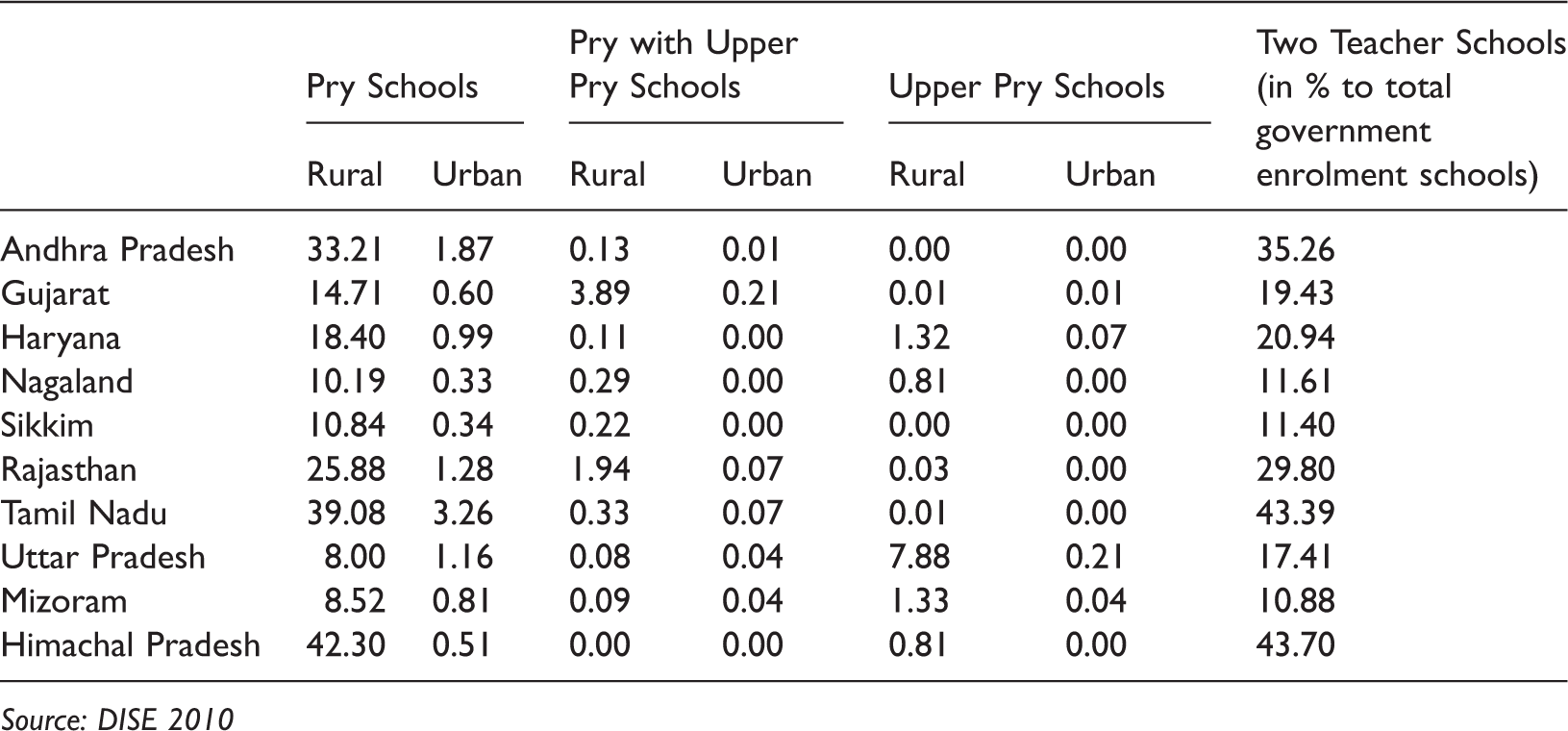
In the analysis of ten states it became obvious that single teacher schools are ubiquitous in rural set ups (see annex table 3 for details). Among 21.62 % ultra-small rural primary schools (enrolment 1–25) in Andhra Pradesh, 13.76% of primary schools are managed by single teachers. In the rural areas of Rajasthan one finds a higher number of single teacher primary schools (17.82%) than ultra-small schools (8.43%). Single teacher schools are also found in Grade 6–8 schools in the rural areas of Uttar Pradesh, Haryana, Mizoram and Himachal Pradesh. So far as two-teacher schools are concerned, the states of Tamil Nadu and Himachal Pradesh seem to have slightly less than 50% of total government primary schools. Next in line are Andhra Pradesh and Rajasthan (for details, see annex tables 3 and 4).
To sum up, size is vital but not a standalone determinant in understanding small schools in the Indian context. The present study identifies small schools with two enrolment categories: 1–25 and 26–50, mainly operating in single teacher, multigrade or monograde and multi-age classroom settings with limited resources. Each small school has a different meaning when looked at in the context of situations they survive, which are inherently diverse. One may however discern that the situation may not have changed drastically today. The fact remains that there is large sector of small schools in India, unattended and neglected.
Beyond size: understanding contexts in diversity
Size in terms of low enrolment, single or two-teacher, or an absence of minimum facilities can all be determinants in defining a small school, but they are not standalone factors. Small schools are about much more than size.
Low enrolment
A school with more than 200 pupils managed by 2 teachers (one regular and another on contract), or a multi-age group of 30 pupils managed by a single teacher in 1 classroom, or 80 pupils managed by 2 teachers in a single classroom with 2 blackboards on opposite walls and teaching taking place by seating children in rows in opposite directions, provides sufficient evidence to understand that low enrolment schools need to be understood within a context.
Facilities
The small village schools in Madhya Pradesh function in the form of EGS schools without an official building. Most of these schools are running either in the houses belonging to the teacher or in old partially constructed structures, under a tree or a hut with the roof covered by plastic sheets. Classrooms in certain cases are used for other purposes such as a storehouse for midday meal items, due to insufficient space inside the school. Interestingly, where usable blackboards were available, they were hardly used by the teacher. In a few schools the same content was found written on the blackboard for several days with just a change in dates. There were schools with blackboards painted in white to show to the school inspectors that they are ‘well maintained’. In almost all small schools, children are made to sit practically on the hard floor or on newspapers or plastic sacks which they bring from home.
Teaching in multigrade and monograde classroom arrangements
The job of teaching is far more complex in remotely located small schools due to poor connectivity, a lack of interaction with peer groups of teachers and a lack of needs based training for teachers, coupled with inadequate and poor quality school facilities. The teacher remains unaware of major developments in other parts of the state/district for the major part of the academic year. Multitasking in multigrade classroom settings, while at the same time handling multi-age children across five grades, as well as children from different family backgrounds, castes, cultures, languages, ideologies, even within the same village, are the major challenges faced by a single teacher. Increased workload for single and two teachers have been the stumbling blocks for quality education in India.
In two-teacher schools ideally roles and responsibilities should be shared, with teaching time divided. In reality, however, they are practically managed by a single teacher. The second teacher would have either taken long leave or remained occupied in the management of school administrative tasks, or running errands outside to make arrangements for the midday meal or attending meetings. The other teacher most frequently manages all of the grades. Teaching time and the quality of teaching becomes heavily constricted in such circumstances. In several such schools children confided that while they are left with one teacher all the time, no proper teaching takes place. They also shared that despite the students’ interest in subjects such as mathematics and science, these are never taught. On several occasions it is only the school monitor who is in charge for days, taking care of the school without any teaching taking place. Students felt immensely that they were deprived of good teaching and therefore the incidence of irregular attendance, withdrawal, ignorance and silent exclusion is high. These children are at risk of being excluded from the school before completion of primary school, because they do not find learning in schools meaningful. What happens within the school goes unnoticed because of the remote chance of supervision by the school inspector in such locations.
Interpersonal dynamics
A small village school, because of its proximity with the community around it, becomes a soft target in certain cases. This was seen very clearly in one of the focus group discussions in a habitation where a lot of hostility was seen among the inhabitants towards the EGS teacher. There were complaints about his late arrival at school, irregularity in taking classes and the low quality of food provided to children. Despite the grievances of the entire community, only one person, who happened to be the head of the village, defended the teacher. She was constantly supporting the teacher and finding fault with the community. In this habitation most of the children, especially boys, are sent to a private school some distance away, but this school caters for girls and children from poor families who cannot afford the fee-charging private school. The community accused the teacher of being in league with the village head in the misuse of government funds, which the school receives. Their resistance was such that they claimed that even if the school were to close down, it would hardly make much difference to them. Much later, after several visits to the same habitation, it came to light that the head of the village and the EGS teacher are close family relatives and that several school funds had been misused. This shows how social composition can impact small schools integrally.
Power position
In Rajasthan the game of local political power has also resulted in the emergence of a large sector of small schools. In a display of power, the local political leader, without realizing that a particular village does not need a school, still announced the opening of a new school at a large gathering. Such actions result in schools becoming small by compulsion, because of enrolment not going beyond 10–15 in each school.
Small schools are also a source of corrupt practices. As per government norms, a savings account is opened in a bank close to the village and the money for the provision of the midday meal in the school can be withdrawn only with the joint signatures of the head teacher and Parent Teacher Association (PTA) representative. A harsh reality that came to light during field observations was the eruption of bribes, especially at the level of a small school, due to local power politics. A head teacher who is strong in the village community dominates the less empowered representative of the PTA in all decisions concerning the school. The PTA representative is left in complete ignorance about the government funds available to the school for the benefit of children in areas such as incentives, scholarships, midday meals and other special funds for learning materials, school repairs, etc. A different power game is played in villages where the PTA representative is strong enough to dominate the entire community. Here the scene alters as the head teacher has to repeatedly plead with them to have documents endorsed for the withdrawal of money for midday meals to be provided in the school. Head teachers in such situations shared that they sign the documents when they are assured of some share out of the sanctioned amount. The destiny of small schools in such locations is shaped more by dominance of the empowered over the disempowered.
Caste politics
The story of exclusion begins with the deprivation suffered by the disempowered as a result of caste politics. They suffer in terms of their primary needs for a decent school, education and health. Caste is a significant factor in determining the choice of school in villages with mixed caste groups, which is most uncommon in villages exclusively dominated by a single caste or tribe. Caste hegemony in most villages of Madhya Pradesh has led to caste prejudices, discriminatory practices like humiliation, biases, etc., which comes explicitly with one such experience in a village where the domination of upper caste over the disadvantaged, ‘Scheduled Caste’. As one enters the village, one finds sprawling agricultural land with a streak of houses endowed with facilities like electricity connections, television, furniture, fan, a kitchen garden, etc. occupying the major area and a constellation of huts confined to one corner. Complete suppression by the upper caste reigns supreme, where they engage the scheduled caste in farming and other agricultural activities. The scheduled caste are made to work as bonded labourers, depending entirely on resources such as land, shelter, drinking water (from the village pond), which are claimed to be under the custody of the upper castes. They shared the agony they go through when they do not adhere to the wishes of the upper caste. If they dare to go against them, they are stopped on the way and threatened with the burning of their huts and harassed until they give in. While children of upper caste attend a private school at a distance, they are directed to send their children to a nearby two-teacher primary school. Their intervention in school activities goes to the extent that the head teacher has full freedom to exploit the government funds the school receives. The PTA representative elected by this group belongs to the scheduled caste, but is much disempowered and not in a position to raise their concerns about malpractices at the school. They have no say in school matters, and showed their ignorance when asked whether they know about the expenditure incurred on the midday meal, scholarships and other incentives meant for children. The benefits from different government schemes and programmes ideally meant for them, do not reach the school. It was observed that several girls were without a school uniform (funds are provided by the Government) and the Head Teacher excused himself by saying that the uniforms had gone for stitching. The school was visited towards the end of the academic session and still the uniforms were not made available to the deserving, while the school records showed timely distribution of all incentives and scholarships. Several matters concerning livelihood and education were discussed with the PTA representative and schedule caste parents, and several flaws in this school were brought to the fore such as teachers whiling away their school hours with gossiping or playing carom or reading the paper. They made it clear that children in small schools have hardly any future except that of joining labour forces or adapting to farming when they grow up, just as their parents did. The drudgery of poverty, hunger and fear was quite apparent. These are the families struggling to make ends meet who desire to see their child at school. Children are forced to writhe in poverty and access to a non-welcoming and unattractive environment indicates exclusion in a social context. The danger in this situation is that children from marginalized small schools become further marginalized. The issues of inequality and access arise because of the harsh social and economic realities of the contexts in which small schools are located (Blum and Diwan, 2007).
Policy provisions and propositions: transforming small schools
The National Policy on Education (1986) and the Programme of Action (1992) recommend removal of disparities in education. The policies of the Indian Government have been hampered so far. An absence of exclusive policies to address small schools has created unequal schooling and social exclusion. ‘One size fits all’ will not work in the coming years. This calls for exploring issues concerning viability, sustainability and predictability integral to small schools to make provisions in the policy directives. The norms for entitlements of each school in terms of facilities, teacher management, school working days, etc. are well articulated in the Right to Education Act 2009, though implementation is at different stages in the states. This section sets out workable propositions for improving small schools in the country.
Making access meaningful and equitable
While access to schooling in India is no doubt almost universal, the disparity in facilities across schools seriously questions the significance of meaningful access. In a country where 25% of all primary schools are very small with only one teacher and/or one classroom and generally located in small habitations (Govinda, 2007), and where every second school is a single-room and school with one teacher Kaura commented in Economic Times in 2003, where every second school raises issues concerning the quality of small schools. In the first instance, a major challenge before India is to gear up single and two-teacher schools with minimum physical and human resources to create enabling conditions for longer retention and participation of children. The Right of Children to Free and Compulsory Education Act (RTE) 2009 addresses this issue (RTE, 2009, Section 8: 4) by indicating the need for the establishment of schools equipped with a specified level of physical and human resources. According to the Act, no recognition will be given to a school unless it is adequately equipped as per the entitlements. The second instance relates to a cadre of teachers in this category of schools. The learning climate seems to be totally lost due to demotivation, high absences, low morale and low paid teachers, who are ill equipped in the absence of professional training to handle multi-age, multilevel and multigrade classroom settings. Renewal of their interest in their teaching profession would require policy interventions from the Indian government. The report of the Committee on the Implementation of the RTE 2009 and the resultant revamp of Sarva Shiksha Abhiyan (MHRD, 2010) recommends one uniform salary and service conditions for teachers, improving recruitment policies, exploring possibilities for improving career advancement for teachers and appropriate measures to create an environment for attracting talented people to the teaching profession (MHRD, 2010: 53). Teachers will be supported with well-designed training and professional development activities. In the context of small schools, teachers should be able to function effectively only if they are trained to handle a diversified group of children and have the skills to handle multigrade classes. There also needs to be an arrangement for training teachers in improvising and using low cost locally made teaching aids. The curriculum needs to be designed to meet the specific needs of rural small schools. The RTE 2009 specifies that teachers should not be left in isolation as is seen under the current arrangements in many single or two-teacher remote rural schools, and provides for teachers to receive support through several means, such as arranging for the redress of grievances (RTE, 2009, clauses 2 and 3 of Section 24: 8), manageable teacher-pupil ratios (RTE, 2009, Section 25: 8), liberation of teachers from non-educational activities, other than the decennial population census, disaster relief duties or duties relating to elections.
Consolidation of unviable neighbourhood schools
The Government of Madhya Pradesh has clearly defined educational policies specifically on the establishment of EGS schools. In the early years these schools were established without a systematic mapping within the required framework. The result was that EGSs mushroomed, appearing every one kilometre. A policy decision by the state government upgraded most of the EGS schools to formal primary schools. Their struggle with limited resources continued, and eventually a large sector of unviable schools appeared. It has become necessary for small schools to be consolidated wherein all resources within the schools could be pooled together to create enabling conditions for children to continue from grade 1 through to grade 8 in the same school, and ensure their completion of the entire elementary school cycle. This will be an exercise to map and strengthen schools in close proximity to one another and become attached to a lead school which is well equipped with facilities. This will enable children in feeder schools to have access to the best possible facilities which otherwise would be difficult for the government to provide to each small school. Govinda (2007) recommended the consolidation of existing provisions if necessary among unviable small schools working in a close neighbourhood. At the same time, the RTE Act proposes an education system that stands as a pyramid, merging small independent structures into one single unit, sufficiently equipped with teachers and learning materials, infrastructure and other physical facilities as per the entitlements of a fully-fledged school. The process of consolidation of schools may also be supplemented by the opening of larger schools in convenient locations with boarding facilities for grades 3 and 4 students.
Improving from within
A sense of belonging, and the accountability and commitment of the head teacher makes all the difference in shaping the image small schools carry in a village setting. The spirit of owning the school is more a matter of leading a small primary school towards improvement. One such leader reflects on each and every activity that concerns his village and school and lives with a motto: ‘How do I help my students, develop the school and village? Children in this school are weak in mathematics, how do I help? What do I do? How could the subject be made easy and interesting? How do I make my students fluent in languages, Hindi, English and Sanskrit?’ The Head Teacher wants his students to learn them all. If any child is weak, he is always available from 8 a.m. to 6 p.m. and so are the teachers in the school. Students are assured of help in all respects. In the school assembly, there is a display of students’ talent; they ask questions among themselves where not just the right answer but also the right question is rewarded. Secularism, equality and many such values are depicted on the walls, trees and each little material of the school and inculcated in their students. Taking a walk through the village and greeting every villager is his common routine. He engages in propagating lives that are free from vice and superstition, and being part of the happy as well as the sad occasions of the village is part of his nature.
Recognizing community to make difference
Changes have been happening in small schools through the active involvement of the community in various forms and there is ample evidence available of their contributions to small-sized schools. This is more pronounced in rural settings through the donation of land and personal houses, cultivating trees and plants, landscaping the school playgrounds, providing drinking water, mothers working as community teachers to pay special attention to the health and hygiene of children in schools and ensuring their regular attendance at school, providing substitutes in the absence of the teacher, developing the school into a village resource centre, participating in several activities with children, encouraging them to learn, providing help in the organization of classrooms and the school, organizing story writing workshops, helping teachers in preparing aids, etc. The success of the Mother Teacher Association of Kerala, the practice of women facilitators in the schools of Rajasthan, is well known. Their close involvement with school and community has yielded positive results in student enrolment, attendance and retention along with improved quality of life at home. Similarly, a fairly large representation of women is expected to bring a sea change in the landscape of the school. Section 21(1) of the RTE Act 2009 firmly recommends the constitution of a School Management Committee (SMC) consisting of elected representatives from the local authority, parents and guardians of children and teachers, with 50% membership for women and proportional representation for the parents and guardians of children belonging to disadvantaged groups and weaker sections. The official declaration of the constitution of an SMC will ensure the smooth functioning of a school by their active involvement in all decisions concerning the school. With clearly defined functions, Section 21(2): 7 of the RTE Act 2009 sets out that the accountability for the preparation of a school development plan and the monitoring of the working of the school will lie with the SMC. This also calls for an exercise to map and consolidate small unviable schools within a specified area.
Creating enabling conditions for teacher motivation and accountability
The appointment of teachers on contract (‘para teachers’) as an interim arrangement in small rural schools (with same qualifications as regular teachers and lower salaries in most cases) poses a threat to the planning and policies of small schools. The State of Madhya Pradesh took the lead in conceptualizing the appointment of para teachers to manage EGS schools. In the course of time, the appointment of para teachers on a large scale led to more dependency on this cadre. Their professional and personal needs were largely neglected and the policy remained silent on this serious issue. In fact the existence of para teachers on paper was denied. The system itself created demotivated teachers. The impact began to appear with frequent strikes demanding the revision of the salary structure and their absorption into the formal school system. The State of Madhya Pradesh then took a policy decision to upgrade all EGS schools into formal schools and in the process regularised para teachers in the same schools. In one such school, a regular and a para teacher were appointed. This para teacher had been providing free services to the school for almost 15 years in the hope that she would be upgraded to a regular teacher one day. On discussing this matter with the Block Resource Coordinator, the officer in charge of taking decisions regarding elementary schools, providing training and capacity building exercises, inspecting schools, disbursing salaries to schools, etc., it was shocking to learn that there was only a remote possibility of upgrade for such teachers into the regular system if their names did not appear in the inventory of contract teachers for upgrade prepared about 12 years ago in Madhya Pradesh. The records have never been updated since then and raises serious implications for teacher accountability in small schools, which are largely ignored in rural settings.
Adapting best teaching-learning practices
Despite the fact that there will always be multigrade schools in India, meaningful changes need to be initiated in the way in which teaching and learning happen in these schools. Although using a different set up, these schools are managed with a common, centrally dictated core curriculum, structured instruction, examinations, etc. Under such constraints, how a teacher ensures efficient functioning and transacts quality learning and teaching are issues to ponder. Various experiments and practices are being carried out in India as well as in other countries like Columbia, Vietnam, Thailand etc . that illustrates successful innovative teaching with the available resources. Multigrade offers such great opportunities to draw on locally available resources from the community and make them relevant to the particular needs of small schools. In India two approaches on multigrade and multilevel programmes, the Bodh Shiksha Samiti schools in Rajasthan and Rishi Valley Programme in several states including Karnataka and Tamil Nadu with ‘multigrade learning centres’, are prominent. Similarly, the Escuela Nueva programmes followed in Columbian schools have made a very positive impression. Lessons learned from Bodh Shiksha Samiti about developing strong non-governmental organizational and governmental linkages for the functioning of small schools in difficult locations can best be achieved in other states as well. The learning ladder and other innovative teaching practices followed in Rishi Valley are again a lesson to be learned and adapted in multigrade and small-sized schools in different locations. The Escuela Nueva approach to multigrade teaching is the empowerment factor. The teaching methods (using cards, learning ladders, etc.) have been adapted, but reference books should also be made available for students to consult when they have questions or are curious about something, although the level of learning displayed by the children of Rishi Valley satellite schools in particular is quite high. Finally, Rishi Valley focuses too much on individual card based learning and not enough on the kind of group learning approach that Escuela Nueva promotes, which is explicitly intended to cultivate tolerance of differences and peace and which are particularly important in the school community linkages in an Indian rural setting. In order to facilitate the process of improvement in small schools, including multigrade schools, the first step is to familiarise the state governments with innovations followed by countries abroad. In order to make practical applications of such innovations, the second step is to create at the national level, a platform for intensive national consultation on the options and ways by which the innovation can be implemented. This entire programme will call for a well-thought out plan and policy on small schools, which takes into consideration the diversity in small schools in particular.
The concluding statements
School quality is at the heart of all reform measures. Historically small schools were seen as a short-term solution for addressing issues of access in the country. They have now become symbols of unequal schooling and the exclusion of the marginalized and deprived communities. A small primary school with few students in each class will hardly be able to sustain and attract the resources it requires to meet the demands of millions who are below the poverty line in India. Another emerging dimension is the mushrooming of small, private, unrecognized primary schools in rural areas, which reproduce inequality in the name of reform by catering to the families who can afford expensive education. The government schools are left for the families from the low income groups and the poor. There are no concerted efforts from the government to bring a change in these schools and therefore they have continued to function as isolated divisions of a bureaucratically run system. If West Virginia stands on the premise that small schools provide the best education for low income group children, then why cannot India start with this move?
Western literature attributes small schools as ‘not only better but the best’ because of the non-threatening environment these schools occupy. The case with government managed rural small schools in India is just the opposite: depicting the reality that rural small schools are the worst. Improving small schools is a massive task ahead. Systemic reshuffles and policy decisions on inputs to be provided to schools may be adequate to bring about significant change in the functioning of a small school and its effectiveness in impacting student learning. The move to drive change in large sectors of small schools in rural locations calls for a multifaceted approach, systematically implemented and beginning with the clear articulation of a strong vision for improving small schools. This should be followed by the strengthening of these schools by finding ways of mobilizing resources, fostering dialogue between various groups, developing linkages and partnerships of different stakeholders from the public and private sectors coupled with collaborative decisions substantiated with a well-thought out plan to combat inequity among schools. Rural communities and schools, with their unique characteristics and needs, may require a different approach towards the investment, sharing and pooling of resources in order to meet state standards for adequacy. What also seems feasible in this context is revisiting and redefining the roles and responsibilities of stakeholders and head teachers to address the issue of autonomy, accountability and decision making. This necessitates chalking out greater details on needs based and location training programmes that essentially benefit small schools and the community at large. The states, while in the process of formulating model rules, could also begin to set standards for small schools by following an intersectoral approach to education, safety, health, environment and security on the one hand and drawing a roadmap to mobilize resources and facilities to meet those standards on the other. School mapping exercises and the consolidation of unviable small schools in close proximity to one another could also be worked out as an option to combat resource crunch. Improving teaching and learning could be informed by research findings about effective strategies to promote learning. This could be supported by a transparent and quick feedback system and regular monitoring in order to make a difference to the lives of children in small schools, correct past inequities and promote equal educational opportunities for all in the country.
Footnotes
Funding
This research received no specific grant from any funding agency in the public, commercial, or not-for-profit sectors.
ANNEXURES
Two Teacher Schools in Selected States of India
| Pry Schools |
Pry with Upper Pry Schools |
Upper Pry Schools |
Two Teacher Schools (in % to total government enrolment schools) | ||||
|---|---|---|---|---|---|---|---|
| Rural | Urban | Rural | Urban | Rural | Urban | ||
| Andhra Pradesh | 33.21 | 1.87 | 0.13 | 0.01 | 0.00 | 0.00 | 35.26 |
| Gujarat | 14.71 | 0.60 | 3.89 | 0.21 | 0.01 | 0.01 | 19.43 |
| Haryana | 18.40 | 0.99 | 0.11 | 0.00 | 1.32 | 0.07 | 20.94 |
| Nagaland | 10.19 | 0.33 | 0.29 | 0.00 | 0.81 | 0.00 | 11.61 |
| Sikkim | 10.84 | 0.34 | 0.22 | 0.00 | 0.00 | 0.00 | 11.40 |
| Rajasthan | 25.88 | 1.28 | 1.94 | 0.07 | 0.03 | 0.00 | 29.80 |
| Tamil Nadu | 39.08 | 3.26 | 0.33 | 0.07 | 0.01 | 0.00 | 43.39 |
| Uttar Pradesh | 8.00 | 1.16 | 0.08 | 0.04 | 7.88 | 0.21 | 17.41 |
| Mizoram | 8.52 | 0.81 | 0.09 | 0.04 | 1.33 | 0.04 | 10.88 |
| Himachal Pradesh | 42.30 | 0.51 | 0.00 | 0.00 | 0.81 | 0.00 | 43.70 |
Source: DISE 2010