




Abstract
This article is based on a case study conducted at a government (state-run), girls’ secondary school in a low-income neighbourhood in New Delhi that was conducted in March, 2012, two years after the Right of Children to Free and Compulsory Education Act (RTE) came into force. The study examined how RTE and its related reforms were being implemented, with the objective of gaining insights into how education objectives and the curriculum were being implemented at the school and how its teachers approached the implementation of the curriculum. Findings of this investigation are presented here in relation to the systemic issues of ‘teacher professionalism’ and ‘high teacher–pupil ratio’. The findings present some insights into the effects of a significantly high teacher–pupil ratio on educational outcomes and on the professionalism of teachers.
Introduction
The universalization of elementary education, an objective of the Indian government since Independence in 1947, has yet to be achieved. Through the introduction of recent legislation, the vision of education conceived since then and the underlying principles it has been based on have been carried forward within an updated, child-rights based framework that is built on social justice and equality and covers the whole of India. The legislation underlines the beginning of a new era in elementary education in India now that aspects of achieving educational objectives are enforceable by law.
The Right of Children to Free and Compulsory Education Act (RTE) of April 2010 provides for the following: Every child of the age of six to fourteen years shall have a right to free and compulsory education in a neighbourhood school till completion of elementary education.
1
The policy document that supports RTE states: We have had a vision for quality education for all, and now for the first time in the history of Indian education we have the RTE with a separate Chapter to ensure that this vision is implemented. (Government of India, 2011: 56)
RTE was the result of a long process of deliberation and debate, and controversy has surrounded the Act and its provisions in a number of areas (Srivastava, 2013). This includes concerns about what has been left out as much as what has been included, the lack of a plan to implement it and the distance between the rhetoric and the reality (McCowan, 2013). While the provisions of the Act are mainly through the state school system, there are some provisions for private schools. Fuelling the debates is the clause compelling all private schools to allocate 25 per cent of their places without fees to socially and disadvantaged children from the beginning to completion of elementary school (Classes 1–8) upon reimbursement by the government (Srivastava et al., 2013). Proponents claim the clause is necessary because of insufficient state sector capacity while critics maintain it represents the institutional legitimization of the private sector without sufficient effort to strengthen the decaying state sector (Srivastava, 2013). There has also been debate regarding the low-fee private sector, particularly with regard to unrecognized schools, which have to meet infrastructural and other requirements or be closed (Srivastava et al., 2013).
The case study focused on the implementation of the RTE-based reforms in the state sector. It presented a detailed review of the RTE legislation, Sarva Shiksha Abhiyan (SSA), which is the Indian government's main program for achieving education for all, and the National Curriculum Framework 2005. It also included a discussion of the numerous systemic problems inherent in Indian elementary education. These various aspects provided the context for the empirical research. The investigation was conducted in relation to the issues of ‘infrastructure’ and ‘teacher professionalism’ as well as in relation to ‘continuous and comprehensive evaluation’ as a component of child-centred curriculum. The main sources of data were interviews with teachers.
This study was started from the premise that legislation based on a child's right to education as a Fundamental Right to Freedom provides a good starting point for making efforts to universalize elementary education in India. The view was taken that through the RTE-driven reforms the Indian government is demonstrating a firm intention to tackle the numerous systemic problems inherent in Indian school education and that the reforms constitute concrete and comprehensive efforts to attempt to achieve quality education for all.
This article presents the findings of the investigation in relation to the issue of teacher professionalism and the specific infrastructure issue of high teacher–pupil ratio. The rationale for this focus is two-fold: firstly, the high teacher–pupil ratio was the greatest professional challenge the teachers interviewed experienced; secondly, teachers play a key role in implementing the education reforms. Initially, a brief review is presented of some of the relevant aspects of the education reforms and issues as background and context for the specific focus of this article. This is followed by an interpretation of the role and scope of teachers in the education reforms and of the concept of ‘teacher professionalism’. Then the relevant aspects of the research and findings are presented.
Background
The education reforms
The following provides an insight into the vision of RTE: The new law provides a justiciable legal framework that entitles all children between the ages of 6–14 years free and compulsory admission, attendance and completion of elementary education. It provides for children's right to an education of equitable quality, based on principles of equity and non-discrimination. Most importantly, it provides for children's right to an education that is free from fear, stress and anxiety. (Government of India, 2011)
The Government consequently revamped SSA as a vehicle for implementing the reforms. The programme has been operational since 2000–2001, is financed primarily by the Indian government with additional funding from donors and is implemented by both central and state governments. The Sarva Shiksha Abhyiyan Framework for Implementation (SSA Framework) whose stated intention is to ‘demonstrate the harmonization of SSA with the RTE Act’ (Government of India, 2011: 7) and to ensure that ‘the approach and strategies for universalising elementary education are in conformity with the rights perspective mandated under the RTE Act’ (Government of India, 2011: 4) supports the implementation of RTE.
SSA's stated overall objectives are universal access, universal retention, the bridging of gender and social category gaps in elementary education and enhancing the learning levels of children, with a special focus on the education of girls and children with special needs (Government of India, 2011). There have been significant successes, which indicate that SSA has been very effective in certain areas. The most marked progress has been made in access and enrolment, particularly in the last decade, and the goal of universal access has almost been achieved at the primary level (World Bank, 2014; Government of India, 2011). Ninety-eight per cent of households across the country, including rural areas, now have a primary school (class 1-V) within one kilometre of their home and ninety-two per cent an upper primary school (class VI-VIII) within three kilometres (Government of India, 2014). India accounted for 25 per cent of the world's out-of-school children in 2002. This figure is now less than 10 per cent (World Bank, 2014). The dropout rate has declined to 2.75 at primary and 3.35 at upper primary levels, and there is an increase in enrolment of children with special needs (Government of India, 2011–2012). Transition rates between school levels have improved: 83 per cent of children who completed primary school went on to upper primary in 2010, compared with 75 per cent in 2002 (World Bank, 2014). However, universal access at the upper primary stage remains problematic (Government of India, 2011–2012).
The SSA Framework identifies the core remaining problems as follows: a high proportion of children, particularly from disadvantaged and poor backgrounds, still drop out before completing Upper Primary; there is still a large out-of-school population, particularly of so far unreached children; and the quality of learning achievement needs improvement, even for children who complete elementary education. Exclusion is emphasized as being the ‘single-most important challenge to universalizing education’, which with the new legislation, must now be addressed ‘with a sense of urgency’ (Government of India, 2011: 23). The document identifies most excluded children as coming from Scheduled Castes, Scheduled Tribes and Muslim families, the majority of whom are girls as gender cuts across the categories of social and economic disadvantage. The document also identifies ‘a new category of excluded children’ which includes those living in areas affected by civil strife, children affected by migration, urban deprived children, homeless children, children in remote and sparsely populated areas and children with special needs (Government of India, 2011).
The quality of learning achievement
As stated above, the SSA Framework has identified that the quality of learning achievement is one of the core problems that needs to be addressed. Poor quality in education has been cited as one of the various factors related to why children fail to complete the primary cycle (PROBE Team, 1999; World Bank, 1997). A serious shortage of teachers, especially in the most populous states (World Bank, 1997), has impacted the quality of education delivered and has resulted in the existence of a large number of single-teacher schools (Mehrotra et al., 2005; Pailwar and Mahajan, 2005; PROBE Team, 1999; World Bank, 1977) and a high teacher–pupil ratio.
The PROBE researchers found that 12% of the villages studied had a single teacher appointed and very few schools had one teacher for each grade, with more than 70% of teachers practicing ‘multi-grade teaching’ (Team, 1999). The teacher–pupil ratio in rural schools is far worse than in urban areas and the slow growth in teacher supply as well as growing enrolment has led to a deterioration of the teacher–pupil ratio in many states (Mehrotra,. 2006). There has also been a lack of female teachers (Mehrotra et al., 2005; PROBE Team, 1999; World Bank, 1997), which acts as a demotivating factor for the education of girls, especially in states where traditional values prevail (Mehrotra et al., 2005).
Lack of teacher professionalism has also seriously impacted the quality of teaching and learning. Teacher absenteeism has been long-standing, frequent and at a high rate (Mehrotra, 2006; Pailwar and Mahajan, 2005; PROBE Team, 1999; World Bank, 1997), estimated at being at a rate of 25 per cent on average (Mehrotra, 2006; World Bank, 2010), and varying between 15 and 42 per cent, with a rate of 25 per cent when visiting schools (Kremer et al., 2005). 5 Another study found teacher absenteeism to be rampant (Grover et al., 2002). PROBE researchers had found that teachers arriving late and leaving early was common, as was schools failing to reconvene after lunch, resulting in the average teacher spending about four hours at school on an average working day as opposed to the required six hours (PROBE Team, 1999).
There is also evidence that teachers are negligent when they are present in school. At any given time, less than 50 per cent of teachers are teaching (World Bank, 2010). Kremer et al. (2005) found 45 per cent of teachers were actively engaged in teaching and Grover and Singh (2002) found little or no instruction taking place in most of the schools visited without prior notice. The PROBE Study found it rare in rural areas to find a teacher conscientiously teaching and calculated that if the effective teaching time was 2 hours a day for 150 days of the year, divided amongst 50 children, that would result in one minute of individual teaching attention per pupil over the whole year (PROBE Team, 1999).
Lack of motivation and commitment on the part of teachers has also impacted the quality of education and requires improvement (World Bank, 1997). These are also identified as factors that will play a role in determining whether children continue or drop out. Having unmotivated and indolent teachers, disproportionately high caste and supported by powerful unions, boosts dropout rates (Kabeer, 2001). It was a frequent complaint of parents interviewed by PROBE researchers that teachers did not teach properly (PROBE Team, 1999). A factor contributing to this problem may be the deep lack of accountability in the school system (Mehrotra, 2006; PROBE Team, 1999), corruption in the teacher appointment process (PROBE Team, 1999) or a widespread problem of teacher inertia because they work in a demotivating environment day after day (PROBE Team, 1999). Grover and Singh (2002) found little or no accountability in the system, at the level of teachers, schools, blocks and districts. The PROBE researchers identified the real problem as being the lack of concern on the part of teachers for the students, lack of respect for the local community, feeling trapped in a hopeless work environment and yearning for better postings (PROBE Team, 1999).
RTE mandates the enhancement of learning levels of children and raising the quality of learning achievement in various ways. It sets norms and standards for the minimum number of working days and instructional hours in an academic year, the supply of teaching aids, the establishment of library facilities in each school, and the supply of play material, games and sports equipment for each class. It also establishes the required number of teachers for various types of classes from Grades I to 8. For Grades 6–8 the required norm is ‘at least one teacher for every thirty-five children’. The Act does not specify the ratio for higher grades. 6
The legislation also establishes the minimum required qualifications for teachers and stipulates that standards for teacher training will be developed and enforced by the Central Government. State governments and local education authorities are responsible for ensuring the timely prescribing of curriculum and courses of study for elementary education and for providing training facilities for teachers. Teachers must work a 45-hour working week, including preparation; they must not be deployed for any unrequired non-educational purposes; they must not engage in any private teaching activity. Teachers must do the following: attend school regularly and punctually; implement and complete the curriculum in accordance with the provisions of the legislation; complete the entire curriculum within the specified timeframe; assess the learning ability of each child and supplement with any required additional instructions; hold regular meetings with parents and provide them with information about the child's regularity in attendance, ability to learn, progress made and any other relevant information; and perform any other required duties. 7
The role and scope of teachers in the reforms
The above legal remedies essentially situate teachers as part of the problematic of elementary education in India. They could also be interpreted as forming part of a state-set agenda for the professionalization of teachers in India, and the requirements for teachers set out in the SSA Framework could be interpreted as furthering this process. The document establishes the professional requirements for teachers from the standpoint of teachers being an ‘enabling component of quality education’ and sets a standard form of expectations of teachers by establishing the basic skill sets and attitudes they are required to have (Government of India, 2011). The National Curriculum Framework 2005 (NCF 2005) had established in more detail the knowledge areas, skills and attitudes required of teachers.
Teachers are required to move away from a teacher-dominated pedagogy and employ the ‘critical pedagogy’ embodied within the constructivist and child-centred approach to teaching, in accordance with the legislation and National Curriculum requirements. They are also required to employ Comprehensive and Continuous Evaluation (CCE) as an assessment strategy. Assessment for learning has been identified in SSA Framework as one of the various ‘core components of Quality Education’ that need to be addressed in order to deal with quality concerns in elementary education. RTE provides for Comprehensive and Continuous Evaluation (CCE). CCE essentially means that assessment should be treated as an integral part of teaching and learning, through observations of children and maintaining records of their work done in a portfolio, rather than as a judgement. (Government of India, 2011: 67)
Teachers are envisaged as being key partners in planning and implementing community participation strategies and the document states that participation for RTE implies a mutually supportive and collaborative partnership among teachers, pupils, parents, community and civil society. SSA visualizes teacher as a capable facilitator, who motivates children to construct their own knowledge. The teacher should be aware about progressive pedagogy and must know the nature and experiences of children from various social and cultural backgrounds. Moreover, RTE requires that teachers should be committed to equity and social justice, aware about child entitlements and convinced that all children can learn well if provided education of equitable quality. (Government of India, 2011: 69–70)
Recent involvement of the state with teachers in the historical and cultural context of the UK has been viewed as having far-reaching consequences for the profession. There it has been argued that as the result of recent education reforms in the UK teaching can be seen as being both de-professionalized and also re-professionalized, and that the state has taken a proactive part in the struggles over professionalism, both positively and negatively (Whitty, 2006). It has also been argued that education professions in the UK were subject to increased control from the government, mostly during the 1980s and 1990s, which has resulted in the evolution of ‘new professionalisms’ in the teaching profession (Evans, 2008). In the following decade teacher professionalism in England may be considered to have been shaped by the set of professional standards and accompanying performance system introduced by the Labour government in 2007 (Evans, 2011).
In a broader Western context it has been argued that there has been a deep ‘assault on professionalism’ in teaching and other areas in the postmodern era, which has its roots in the marketization of education and government responses to uncertainty in the form of centralized curricula and testing regimes which have diminished the range or autonomy of teachers’ classroom judgement, and market-inspired performance management systems and system of administration (Hargreaves, 2000).
Teacher professionalism
What is meant by the term ‘teacher professionalism’ is the conceptualization presented above from within the framework of the reforms for the purposes of the study. However, it is important to briefly examine this and related concepts outside this localized context because discussion of the discourses surrounding them in broadly speaking Anglophone cultures have pointed to their inherent problematic nature. This examination is important in order to have a better understanding of possible implications for the future development of the teaching profession in India and for the implementation of the reforms.
The terms ‘professionalism’ and ‘professionalization’ are not universally understood or agreed (Hargreaves and Goodson, 1996), and they are also contested (Hargreaves, 2000). The substance of what professionalism is and what it consists of remains unexamined, particularly in the context of education, which is problematic because it is therefore difficult to understand how professionalism functions and how it may be influenced (Evans, 2008). In the literature ‘professionalism’ refers to the quality of what teachers do and to the behaviour, demeanour and standards which guide it while ‘professionalization’ refers to attempts to improve the status and standing of teaching (Hargreaves, 2000).
An examination and understanding of the terminology is important because discourses and practices of professionalism and professionalization can either empower teachers or exploit them (Hargreaves and Goodson, 1996). Discourses of professionalism can also shape the professional identity of teachers. In the Australian context two discourses of democratic professionalism and managerial professionalism have shaped the professional identity of teachers under conditions of significant change in government policy and educational restructuring and have given rise to two distinct forms of teacher identity (Sachs, 2001). Reforms are not only mechanisms for improving public services but also, by extension, mechanisms for achieving government imposed professional development; this raises the question of how effective imposed reform is for achieving professional development among education professionals (Evans, 2008). Professionalism has to be accepted and adopted by the professionals at whom it is directed in order for it to be real, that is, a ‘service level agreement’ as opposed to a ‘service level requirement’ (Evans, 2008).
The research
The school
The investigation was conducted at a Hindi-medium, government girls' secondary school, which provides education to Grades 6–12 (ages 11–17). It was founded in 1996 and is located in a densely populated and highly congested low-income neighbourhood in New Delhi. Most of its students come from Uttar Pradesh and Bihar and approximately 50 per cent of them, as children of fruit and vegetable vendors, manual labourers, construction workers and domestic servants, are from the lowest socio-economic groups. The School has Science, Commerce and Arts streams, and no vocational stream. It functions as a girls' school in the morning and a boys' school in the afternoon. School starts at 7.25 a.m. and ends at 12.30 p.m. and takes place Monday to Saturday, with every second Saturday off. Each period is of 35-minute duration. There is a 20-minute recess and a 30-minute lunch period. The students wear white and blue checked uniforms, and a plain white uniform on Wednesdays and less academic days.
The school is successful in terms of academic results. It had recently received the India Award for the Best School in the Zone (District), an award for academic excellence. 8 It had achieved the following results in the Central Board of Secondary Education (CBSE) examination: 86.62 per cent of Grade 10 students passed in 2009–2010 and 100 per cent passed in 2010–2011. 84.57 per cent of Grade 12 students passed in 2009–2010 and 85.62 per cent passed in 2010–2011.
The impression given of the school is one of a pleasant environment and happy atmosphere. The grounds were clean and orderly and quite spacious. Classrooms were mainly centred on two sides of a principal walkway, along with the Library, Principal's office and the site of a new library that was going to be constructed. There were bougainvillea and other attractive plants outside the Principal's section. Additional classrooms were situated on the other side of the school, as well as an open stage for school events and drama productions.
The teachers interviewed had Bachelors or Masters degrees and their individual teaching experience ranged from 10 to 25 years. The longest-serving teachers had 29 years and 25 years' teaching experience respectively and were close to retirement. All the teachers had come here from other schools and had been at this school for different lengths of time. From the interviews with them, they could be characterized as being dedicated to their profession and committed to their students.
The education objectives and curriculum requirements of RTE and the National Curriculum for government schools for the academic year were set out in and communicated through written government directives. This included a Department of Education (DoE) Circular dated 31 January 2011, which contained a schedule of activities to be covered, as well as a DoE Circular dated 11 August 2011 that reiterated the activities and tasks which the teachers and principals had to perform during the academic year. The Circulars were distributed to teachers by the Principal and the teachers had to sign for them. The stated focus of the August Circular is on the teaching–learning process and improving the quality of education. It states: Teachers must ensure that Science practicals, subject activities are actually conducted by students and the same are being recorded by them. These activities are conducted in schools as per CCE norms in each subject as notified by Directorate of Education up to classes VIII and by CBSE for classes IX–X. Records should be kept ready for inspection by any individual officer or inspection team. (Department of Education, Delhi, 2011: 2) … coverage of syllabus of Science practical and theory for classes 11th and 12th has to be in accordance with week-wise distributed syllabus. (Department of Education, Delhi, 2011: 2)
Methodology
The objective of the study was to gain insights into how the education reforms were being implemented by conducting an investigation at a school. The focus of the investigation was on how education objectives and curriculum were being implemented at the school and on how its teachers approached the implementation of the curriculum. The curriculum was defined according to the definition in the SSA Framework, as any aspect of educational delivery, such as textbooks, syllabi, lesson planning, texts and exams.
The main research questions were as follows:
How are education objectives and curriculum being implemented? How do the school's teachers approach the implementation of the curriculum?
The chosen methodological approach was that of case study, as ‘an empirical investigation of a contemporary phenomenon within its real life context’ (Robson, 2002: 178) and as ‘the study of the particularity and complexity of a single case, coming to understand its activity within important circumstances’ (Stake, 1995: xi). The specific form of case study employed here was an ‘instrumental’ case study where the case is examined mainly to facilitate our understanding of something else (Stake, 1995, 2005).
Field research at the school was conducted over a two-week period in March 2012. The main sources of data collection were flexible, semi-structured interviews of about an hour and a half's duration with nine teachers conducted in Hindi and in English in their homes. Other sources of data for the study were two interviews with the Principal, school publications and documents, student work, teacher diaries and observation of the school environment and operations. All names, including that of the school, were kept anonymous for ethical reasons.
Issues identified in the literature review formed the conceptual structure for this study, and issue questions were the primary research questions, in order to bring attention to complexity and contextuality, and because identification of issues draws attention to problems and concerns (Stake, 1995). The specific interview questions were accordingly based on the issues of ‘infrastructure’ and ‘teacher professionalism’ drawn from the literature. The investigation was also conducted in relation to CCE as a component of child-centred curriculum. Data were analysed through a focus on gaining local meanings gathered from the data, that is, the specific school and the national context of education reform.
Findings
Number of students per class according to the teacher.
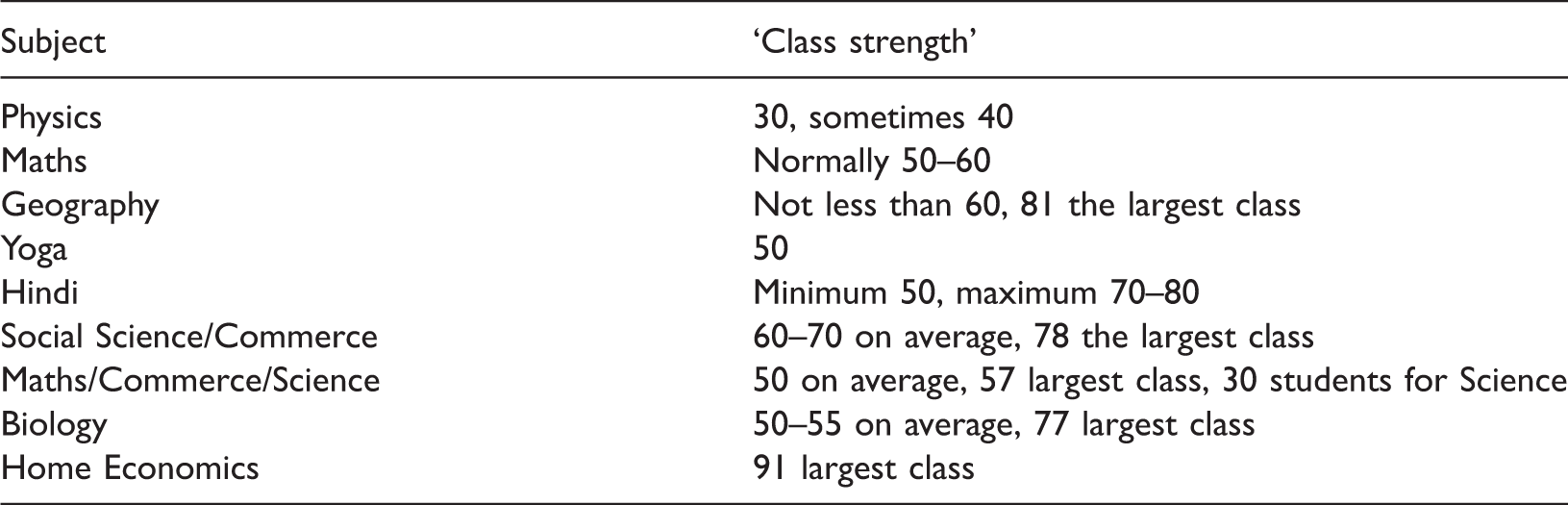
The high teacher–pupil ratio was the single largest professional difficulty that resulted from lack of infrastructure that the teachers experienced. As well as making it very difficult for them to teach, they were concerned about being able to manage the class effectively, not being able to give students individual attention, being able to check each student's work and meeting the needs of academically weak students.
When asked what they thought about the number of students in their class, the teachers' comments include the following.
The Biology teacher remarked that the length of the class period of 45 minutes practically amounted to 35 minutes after taking into account entering and leaving the class and taking the register. They always say that the student–teacher ratio must be 35:1 but in real life conditions that type of picture is not there. Always 80, 70 students are being incorporated within that particular small classroom … . so problems crop up … . as soon as we enter the class we observe so much crowd there …… the lab does not have sufficient space for all of them.
The Maths/Commerce/Science teacher's concern was that the large class size made it problematic to observe each student to make sure they were doing written work, particularly in view of the fact that the period was 30 minutes and the time passed quickly. She commented that the large class size presented many problems. The children start talking to each other, some get bored, the problems start from that … . It would be very good if the strength was less. When I first started there were 16 students, this year there are 30, the class strength was very good. The burden was much less with 16/17 students. You can check each copy [exercise book]. You can try to use the activity method [calling on students to work on the board] to benefit students who don't understand, people could put the weaker students on the front benches and look at their copies first. With a smaller class size students could get individual attention.
When asked how they managed to teach with such large numbers of students in the class, the teachers commented that they somehow managed. When asked how they adjusted their teaching to take into account the high teacher–pupil ratio, they informed me of some of the strategies they employed. The Social Science/Commerce teacher manages by dividing the class into groups of 10 or so students and having them conduct various activities. For example, she divides the class into political parties. Ten students represent the Bharata Janata Party, 10 students the Congress Party, 10 students the Communist party, and so on. Then they take a topic, such as a Parliamentary Bill, and discuss its negative and positive aspects. The Hindi teacher's strategy for having a class discussion with so many students is to ask various children questions. By questioning 11 students or so, she can cover most of the class. The Physics teacher said she used to divide the class into two groups but was currently unable to do that because of the shortage of teachers and the way that class time has been planned.
Common to all the teachers interviewed was the method of managing ‘the crowd’ through the ‘lecture method’. In the interviews with them they emphasized that giving lectures to the students was the best way of coping and it appears that they considered this to be the only, or best, pedagogic strategy in the circumstances.
The Science teachers adjusted their teaching methodology to the large number of students by giving demonstrations of the practical experiments, instead of having the students actually conduct them. The Biology teacher remarked that is what she disliked the most. When asked how she thought this affected the quality of teaching she responded: This definitely affects quality of teaching … . because if somehow we can reduce the size as per RTE, the ratio must be 1–35 ……if that type of average class size is there students will be able to do things by themselves. In that case they would be having all the knowledge, the practical knowledge will be there. If practical knowledge is there then all the theoretical concepts will be easier for them as compared to this situation where they are going through the theoretical aspects on the blackboard only. If they are conducting the practicals themselves it would be a better situation, a better picture will be there.
She thought that this situation ‘ … .. makes a mockery of the examination system’. Students could, however, earn partial marks for the practicals without having actually done them from the written portion of the test, where they have to write down the procedure involved.
When asked if any kind of adjustment was made when assessing students, she said that teachers might not deduct marks if students had not conducted the practicals. They might also make adjustments for students who were generally outstanding in their work.
Conclusion
If the high teacher–pupil ratio presented situations where teachers were prevented from conducting classroom activities, this could result in their teaching an incomplete curriculum and could also result in them not complying with the requirements of the Department of Education Circular. The integrity of the CCE and examination procedures could also be affected. These factors could have the end result of negatively impacting the performance and effectiveness of these teachers, as well as negatively impacting the quality of teaching and learning. The performance and effectiveness of the Biology, Physics and Chemistry teachers, as well as the quality of teaching and learning in their classes, were negatively impacted when their students were unable to conduct the required practical experiments because of the high teacher–pupil ratio. When their students were not able to conduct these experiments, the teachers were teaching an incomplete curriculum and were not complying with the requirement to conduct practical experiments. Because the students were examined on the practical aspects of the curriculum even though they had not done them, the integrity of the CCE and examination procedures were affected.
When teachers adopted the pedagogic coping strategy of the ‘lecture method’ and did not employ the required ‘critical pedagogy’ in accordance with the required constructivist and child-centred approach set out in the legislation and National Curriculum requirements, this could be said to negatively impact the desired quality of teaching and learning. Their adoption of the ‘lecture method’ could also mean that they do not comply with the requirement to conduct subject activities. The same could be said of the Science teachers’ demonstration of practical experiments when the students could not conduct them. These factors would have the end result of negatively impacting the teachers’ professional performance. These concerns raise questions about how far the teachers could be said to have been undermining their own performance and whether they could have considered other pedagogic choices in the circumstances. These considerations may increase in significance as the professionalism and professional expectations of teachers are further developed under the continued implementation of the reforms.
The above consequences have the result of undermining the professionalism of teachers at the school in relation to both conceptions of teacher professionalism presented above. Insofar as the high teacher–pupil ratio impacted their professional performance and effectiveness and thereby affected the quality of teaching and learning, the professionalism of the teachers was negatively affected according to Hargreaves’ definition, which defines the concept partly in terms of the quality of what teachers do. In relation to the conception of teacher professionalism as set out in the reform documents reviewed, the ability of these teachers to be an ‘enabling component of quality education’ as envisaged was undermined, as was their envisaged role as key implementers of the education reforms.
The findings in relation to the issues of ‘high teacher–pupil ratio’ and ‘teacher professionalism’ present some insights into the effects that having a significantly large number of students in a class can have on educational outcomes. The findings also present some insights into how a high teacher–pupil ratio can affect the professionalism of teachers, and they underscore the importance of the role teachers have in implementing the education reforms and thereby making the vision of quality education for all a reality.
Footnotes
Funding
This research received no specific grant from any funding agency in the public, commercial, or not-for-profit sectors.