




Abstract
As India's higher education sector is poised to grow at a tremendous pace, one of its main challenges would be provision of quality education. Teacher quality has been identified as one of the most critical factors affecting educational quality. As such, the immense importance of attracting high-quality entrants into the teaching profession cannot be overemphasized.
In India there is a rising concern shared by many, especially in academia, that nowadays relatively meritorious students are mostly unwilling to consider teaching and research as possible career options. While evidence from other countries indicates that teaching, a relatively low paying occupation, may be a poor career choice, the literature on this area is sparse in the case of India.
This paper addresses precisely this issue as it studies how students, who are prospective labour market entrants, perceive teaching as a profession relative to other available career options. Our analysis, based on a sample survey carried out among high school and college students from Delhi and Kolkata, suggests that for the majority of students surveyed, teaching is not a ‘first-best’ or ‘most preferred’ career option. Further, in their view, rather than raising salaries, it is more important to bring about changes in the nature of the teachers job, to make this a more attractive career option.
Introduction
India has been adopting policies of economic liberalization and gradually easing restrictions on trade and technology flows from the rest of the world since the mid-1980s. The pace of outward orientation picked up, especially during the 1990s, with significant easing of capital flows from the rest of the world. Foreign firms and multinational companies entered into joint ventures with Indian firms, set up operations within the country and India was a significant beneficiary of business process outsourcing and off-shoring activities carried out by a large majority of the foreign firms.
Available evidence indicates that economic growth in India has been urban-centric and concentrated largely in the services sector (see, e.g., Eichengreen and Gupta, 2010; Singh, 2006). A number of studies have reported evidence on rising wage inequality, especially in urban India under economic liberalization, with skilled workers benefitting relatively more from the pattern of growth, leading to widening of the skilled–unskilled wage gap (Azam, 2012; Dutta, 2005; Kijima, 2006; Mehta and Hasan, 2012). The nature of technological change over this period also had a bias towards skilled workers which has contributed to enhancing the relative demand for and returns to skills in the Indian economy (see Chamarbagwala, 2006; Kijima, 2006).
Alongside this, there is evidence of a rise in the returns to education in India in the post-liberalization era (Azam, 2012; Dutta, 2006). The wage gap between regular workers with primary education and higher (graduate level) education rose sharply in the 1990s (Dutta, 2006). Returns to higher education (secondary and tertiary) rose between 1993 and 2004, especially with returns to tertiary education rising dramatically by nearly 18 per cent over this period (Azam, 2012).
This sharp increase in returns is likely to enhance demand for education, especially tertiary or higher education in India, as increases in the skill premium tend to stimulate further increases in human capital investment (Topel, 1999). For instance, with rising demand for highly paid managerial professionals in the corporate sector, a significant increase in the demand for management education is evident, with large numbers of students opting for management studies in the Indian context (Agarwala, 2008). On the supply side, the education sector is poised for massive expansion, especially with the entry of private players and relaxation of Foreign Direct Investment (FDI) norms in the sector. For instance, between 1999–2000 and 2005–2006, there was a 55 per cent increase in the number of institutes imparting management education in India (Agarwala, 2008). Meanwhile, between 2000–2001 and 2010–2011, the number of colleges in India grew by 150 per cent as nearly 20,000 new colleges came into existence and the number of degree-granting universities doubled from 256 to 564 (UGC, 2012).
With India's education sector poised to grow at a tremendous pace in the near future, one of its main challenges would be the provision of quality education (e.g., Chattopadhyay and Mukhopadhyay (2013) address this issue in the context of the higher education sector in India). This is a critical issue as educational quality is an important determinant of the quality of human capital and the rate of economic growth (see e.g., Das and Guha, 2011; Hanushek and Woessmann, 2007).
Among the many factors that affect provision of quality education, teacher quality has been identified as being critical (Hanushek and Rivkin, 2006). As such, the immense importance of attracting high-quality entrants into the teaching profession cannot be overemphasized. Recent research shows that having better teachers at the school level leads to improved student performance later in life in terms of quality of college and university attended and incomes earned by them (Chetty et al., 2013a, 2013b). On the other hand, a fall in the average quality of teachers has a negative impact on students' performance (Chetty et al., 2013a). In some disciplines (including science and mathematics) less qualified teachers may have a negative effect on student academic performance beyond the short term (Bettinger and Long, 2006; Carrell and West, 2008; Ehrenberg and Zhang, 2005). In fact replacing a low-quality teacher with one of average quality can have significant positive impact on the future earning potential of students (Chetty et al., 2013b).
In this context there is a rising concern shared by many in India, especially among academia, that nowadays relatively meritorious students are mostly unwilling to consider teaching and research as possible career options (Mukherji, 2012). There is evidence to suggest teaching is a relatively low-paying occupation and may be considered a poor career choice even in other countries and contexts (e.g., Leigh and Ryan, 2008; Richardson and Watt, 2006 provide such evidence from Australia). However, this is an area on which the literature is sparse in the case of India.
Within this context our research question is: Have relatively low-paying career options like school and college teaching lost out to newer and better-paying ones in emerging fields such as, for instance, information technology (IT)? This paper makes an attempt to study how students, who are prospective labor market entrants, perceive teaching as a profession relative to other career options available to them. The analysis in the paper is based on a sample survey carried out among high school and college students from Delhi and Kolkata.
The plan of the paper is as follows. We begin with the research design and methodology used to analyse the survey data. This is followed by analysis of the main findings and thereafter the main conclusions.
Research design
Details of the sample
A field survey was conducted and questionnaire-based responses collected from high school (mainly students of Class XII) and college students (mainly students in the final year of graduation) in Delhi and Kolkata covering a total of 1821 students in all. 1
The high school sample included students from both government as well as private schools and from the science, commerce and humanities streams, while the college sample covered respondents from private and public institutions and from diverse streams ranging from students enrolled in BA (Bachelor of Arts) and BSc (Bachelor of Science) courses as well as in ‘professional’ degree courses like BBA (Bachelor of Business Administration), BBE (Bachelor of Business Economics), etc. Respondents were asked to report marks scored in standardized tests like Class X and XII board exams, which allowed a classification of the students into various groups based on merit. Details of the samples of school and college students appear below.
Sample of school students
Delhi
The sample from Delhi consisted of 481 students of Class XII from 19 schools, with an average of 24 responses from each school. Responses were also collected from students enrolled in coaching (tuition) classes, so that another 13 schools were covered, with the number of students ranging from two to seven from each school. Of the total number of students, 47.6 per cent (n = 229) were boys and 52.4 per cent were girls (n = 252). Class XII students from the science, humanities and commerce streams were covered, with 76 per cent from commerce, 37 per cent from science and 24 per cent from humanities streams, so commerce students formed the largest subject group in the Delhi sample, followed by science and humanities.
Kolkata
The sample from Kolkata consisted of 451 students from 13 schools, with an average of 31 students from each school. Responses were also collected from students enrolled in coaching (tuition) classes, so that another 21 schools were covered, with the number of students ranging from one to five from each school. Of the total number of students, 66 per cent (n = 297) were boys and 34 per cent were girls (n = 154).
In terms of streams covered, science comprised the largest subject group, with 40 per cent of students from the science stream followed by commerce with 34 per cent and humanities with 26 per cent.
Sample of college students
Delhi
The sample from Delhi consisted of 443 college students from 16 colleges, with an average of 26 responses from each college. Four per cent of the responses (n = 16) were collected from students who had applied for the MBE (Master of Business Economics) program of Delhi University and had been shortlisted for interviews; these were mostly engineering graduates. Of the total number of students, 54 per cent (n = 239) were boys and 46 per cent were girls (n = 204). Forty-eight per cent of the students were in their second year and 52 per cent in their final year.
Fifty-two per cent of the students were enrolled in BA (Bachelor of Arts), 17 per cent in BSc (Bachelor of Science) and 13 per cent in BCom (Bachelor of Commerce) courses, with the majority being honours students, while 15 per cent were engineering students. Forty-six per cent of the students reported living in hostels (or as paying guests) and were from outside Delhi, while 54 per cent were local students.
Kolkata
The sample from Kolkata consisted of 446 college students from 11 colleges with an average of 34 students from each college; 100 responses were collected from St. Xavier's College alone. Responses were also collected from students enrolled in coaching (tuition) classes, so that students from three other colleges were also covered, with the number of students ranging from three to five from each college. Of the total number of students, 43 per cent (n = 193) were boys and 57 per cent were girls (n = 253). Forty per cent of the students were in their second year and 60 per cent in their final year.
Thirty-two per cent of the students were enrolled in BA (Bachelor of Arts), 42 per cent in BSc (Bachelor of Science) and 22 per cent in BCom (Bachelor of Commerce) courses, with the majority being honours students, while less than 1 per cent were engineering students.
In contrast to the Delhi sample, only 21 per cent of the students reported living in hostels (or as paying guests) and were from outside Kolkata, while 79 per cent were local students.
Research objectives and scope
The objective of the survey was to explore the occupation choices of high school and college students with particular reference to teaching. Students were given a range of alternative career options and asked to assign ranks to indicate their preference among these. Other than teaching, the other career options listed in the questionnaire included jobs in the private corporate sector, government sector jobs, careers as independent professionals and so on. An attempt was made to see if there was a common ‘winner’ insofar as a particular occupation is concerned, across two metro cities, and in particular how ‘teaching’ fared among the options available to students. Students were also asked to assign ranks to indicate their perception regarding incomes from alternative occupations. This allowed an analysis of the extent to which career choices are affected by perceptions about earnings opportunities from a career.
So far as the teaching profession is concerned, a separate set of questions was framed with a view to probing whether students were willing to consider this as a career option and, if so, for how many this would actually be a ‘first-best’ or ‘most preferred’ career option. Respondents were also asked to indicate their preference separately for teaching in a school, college or university. They were also asked what, in their opinion, could be done to enhance the attractiveness of teaching as a profession. In particular, the survey tried to find out whether the relatively low salaries of teachers is the main reason keeping meritorious students from choosing teaching as a most-preferred option. Further, the relative preference for teaching in government vis-à-vis upcoming private institutions was also explored, especially among college students who expressed an inclination for teaching.
In light of students' occupation preferences and perceptions regarding earnings, the main hypotheses we examine are:
the students' preference for teaching is relatively low and it is not the most preferred career option for the majority; and in general, the preference for teaching is lower among the more meritorious students.
Given that the quality of research emanating from institutions of higher education has critical implications for future educational quality as well as knowledge creation in a nation, the survey also examined the inclination for research and higher education, especially among final-year college students across the science and art streams. In this context our main hypotheses are:
research is not the first preference option of majority of students; the job opportunities open to students just after completing college or after enrolling for a management course may erode the incentive for research-oriented careers.
Further, the study allows a comparison of students' perceptions about career options from two disparate urban centres both of which witnessed manifold socio-economic changes in the post-reforms era. Kolkata tends to represent an average Indian metro city, probably with relatively fewer opportunities as compared to Delhi, which tends to have a plethora of opportunities by virtue of being the capital city of a growing economy. We attempt to see whether students' choices reflect this difference between the two cities.
Currently there are very few studies in the Indian context that explore occupation preferences among students. A few studies like that by Agarwala (2008) focus on factors explaining career choices made by people who are already in a certain professional track. This study allows us to capture a priori choices made by individuals, something which has hardly been explored in the Indian context.
The present study has a few limitations. It is based on student responses that reflect subjective preferences that are liable to change, perhaps substantially, as students move on to the next stage of their careers, from school to college and so on. Nevertheless, we felt it is important to characterize perceptions, as they do influence concrete decisions, especially involving stream choice and actual career choices made later. This is an important reason as to why perceptions matter, even if they are transient.
The study is based on a limited sample from just two cities; as such conclusions drawn on the basis of our findings cannot be generalized to a broader context. Furthermore, the size of the sample could not be enhanced to include a greater diversity of responses spanning a wider range of educational institutions given the budget and time constraints which we faced. Moreover, the analysis is based on simple statistical tools and data analysis rather than more advanced techniques. In addition, the questionnaire does not probe into the reasons underlying students' choices regarding occupations; it allows characterization of students' preferences, while reasons for observed preferences are not immediately apparent.
This work is in the nature of a preliminary exploratory exercise that essentially seeks to characterize students' occupation preferences. As such it raises certain related issues, although it falls short of providing fully-fledged explanations. It is nevertheless hoped that some of the issues raised in the study will provide a basis for more advanced explorations that can be taken up for future research.
The questionnaire
Responses were collected on the basis of a questionnaire, which was finalized after conducting a pilot survey. The questionnaire contained two basic kinds of questions – the first related to background information about the respondent, and the second related to their preferences and views on various aspects of career choice in general and specifically on teaching. Details of the questionnaire appear below.
Questionnaire for school students
The questionnaire had a total of 21 questions of which Questions 1 to 4 and Questions 16 to 21 collected personal and background information about the student (like name, name of school, gender, stream enrolled in, marks scored in board exam, parents' education, and occupation and family income). Questions 5 to 9 had general questions about occupation preferences, asking students to assign preference ranks to alternative careers and incomes from these, and also giving them the option of specifying any additional career (not specified in the questionnaire) which they would prefer. Questions 10 to 14 had specific questions about teaching, whether students would opt for it, whether or not it would be their most preferred option, where they would prefer to teach (school, college or university) and what could be done to make teaching a more attractive career option. Question 15 asked students to rank in order of importance their most important sources of information about various occupations.
Questionnaire for college students
The questionnaire had a total of 26 questions 2 of which Questions 1 to 5 and Questions 21 to 26 collected personal and background information about the student (like name, name of college, gender, course enrolled in, whether residing in hostel or not, marks scored in board exam, parents' education, and occupation and family income). Questions 6 to 13 had general questions about best subject options after school, best career options after college, opinion about research degrees and what could be done to attract more students into research, preferences about occupations in general asking students to assign preference ranks to alternate careers 3 and incomes from these. Questions 14 to 19 had specific questions about teaching, whether students would opt for it, whether or not it would be their most preferred option, where they would prefer to teach (school, college or university), their preference for teaching in a government vis-à-vis private organization and what could be done to make teaching a more attractive career option. Question 20 asked students to rank in order of importance their most important sources of information about various occupations.
Methodology
In order to elicit students' views about career choices, responses were sought for two basic types of questions. The first type asked students to make a single choice among a list of given alternatives. The second type asked students to give preference rankings over a range of given alternatives.
Ultimately, based on individual student responses, collective views and preferences (i.e., preferences expressed by all school students from one city) had to be inferred. For responses based on the choice of a single alternative, the majority rule could be applied without ambiguity (i.e., the option chosen by the largest number of respondents was taken as the collective choice). The majority rule was also used when candidates were asked to rank two alternatives in order of preference.
However, for responses where candidates had to rank three or more alternatives, the simple majority rule was no longer applicable. In such cases the Borda rule was applied (see, e.g., Young, 1975) in order to draw inferences about collective preferences based on individual choices. This method is used especially in analysis of voting preferences for choosing the winner. It provides a clear cut way of ranking collective preferences based on individual preferences involving multiple alternatives. It is applicable in the context of our study as we view students’ rankings as preference ‘votes’ given to various occupations, as we analyse these orderings and identify the top and least popular choices. We chose this method for our analysis as it does not discard any of the preferences expressed. Under this method while higher preferences are awarded higher scores, lower preferences are not ignored and are also given scores in arriving at the collective preference ordering for the entire group or sample. The collective ranking that emerges as a result is akin to a broad-based consensus that takes into account the entire range of preferences, high as well as low, and choice of best, second best, etc, are based on the entire preference ordering expressed by all the respondents. Hence this method is chosen to analyse the preference orderings expressed by the respondents.
The Borda rule works as follows. Given a question which provides a total number of ‘m’ alternative options that have to be ranked in order of preference, scores are assigned for each alternative as per the following rule. The most preferred alternative is given the highest score ‘m’ and the least preferred one is assigned the lowest score of 1. Then the total score is calculated for each alternative by adding up the number of times it was given rank 1, rank 2, etc. by the respondents. Thereafter, the alternative with the highest total score is selected as representing the collective first choice, the one with the second highest score the second choice and so on, for the group under consideration.
For example, in response to Question number 5 in the school questionnaire, students had to assign ranks to a total of 10 alternative career options, in order of preference. The most preferred option was given rank 1 and a score of 10, the second most preferred option given rank 2 and a score of 9 and so on. The least preferred option was given rank 10 and a score of 1. An example demonstrates how, based on students’ preferences, the total score was calculated for each of the career options listed. For example, consider the option ‘Corporate’: if 135 students gave it rank 1, 100 students gave it rank 2, 20 students gave it rank 3 and so on, then the total score of Corporate would be calculated as ((135 × 10) + (100 × 9) + (20 × 8) + …). In this way the total score is calculated for each of the 10 career options and these are then ranked in descending order. The option with the highest total score is considered the most preferred option of the group.
We also use Pearson's chi square statistic to test whether there is a significant difference in the proportion of responses of a certain type, collected from the two cities. This test is appropriate for use with categorical variables and is therefore applicable in our case, where students’ responses either involve assigning ranks to a set of options, choosing ‘yes’ or ‘no’ or it involves selecting a single option among a list of alternatives. For instance, Pearson's chi square statistic is used to test the hypotheses that the share of students who choose teaching as their most preferred option is same in the two cities, against the alternative that they are unequal. Rejection of the null indicates there is a significant difference in responses across the cities.
Findings and analysis
Survey findings on the main aspects of occupation choice explored in this paper are presented below. First, the occupation preferences expressed by all students are reported to see how teaching fares in their preference ordering vis-à-vis other occupations. The preferences of high-scoring students are separately analysed in light of the hypothesis that meritorious students are unwilling to come into teaching nowadays with more attractive options available, especially in the corporate sphere. Thereafter students' attitudes towards research are examined and finally findings on their preference for teaching are reported. In each case, the relevant questions that were posed are discussed first, followed by major findings across the two cities and analysis of their implications.
Occupation preferences
School and college students were given a set of career options and asked to rank these in order of preference. The career options given to college students were slightly different from the school students, keeping in mind that certain options may become irrelevant once the student has enrolled in college and made a specific stream choice. School students from both cities were given 10 options while college students from Delhi were given six and the ones from Kolkata were given eight alternative career options which were to be ranked in order of preference. 4
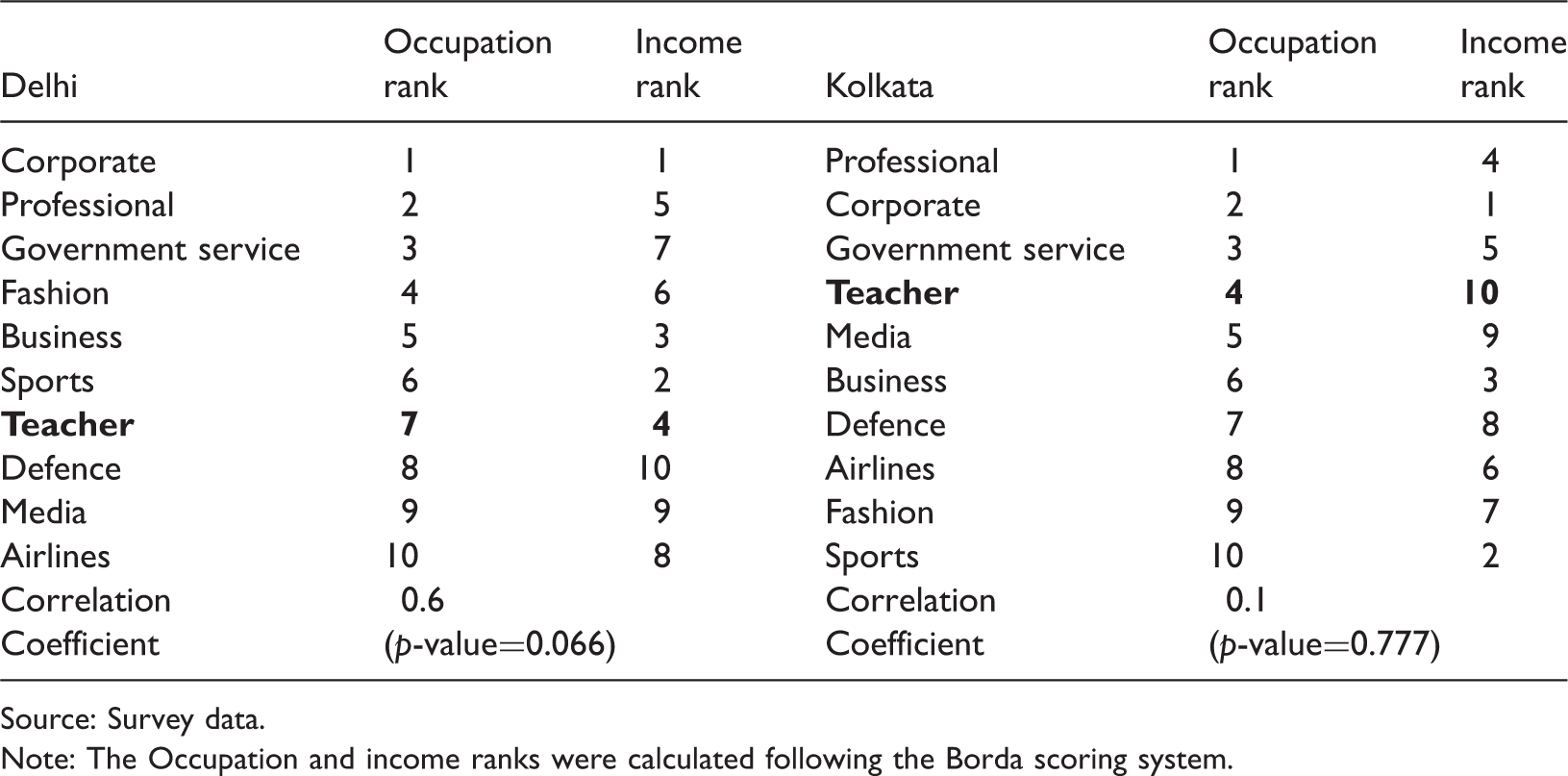
Preferences of school students from Delhi and Kolkata about occupations and incomes from occupations.
Source: Survey data.
Note: The Occupation and income ranks were calculated following the Borda scoring system.
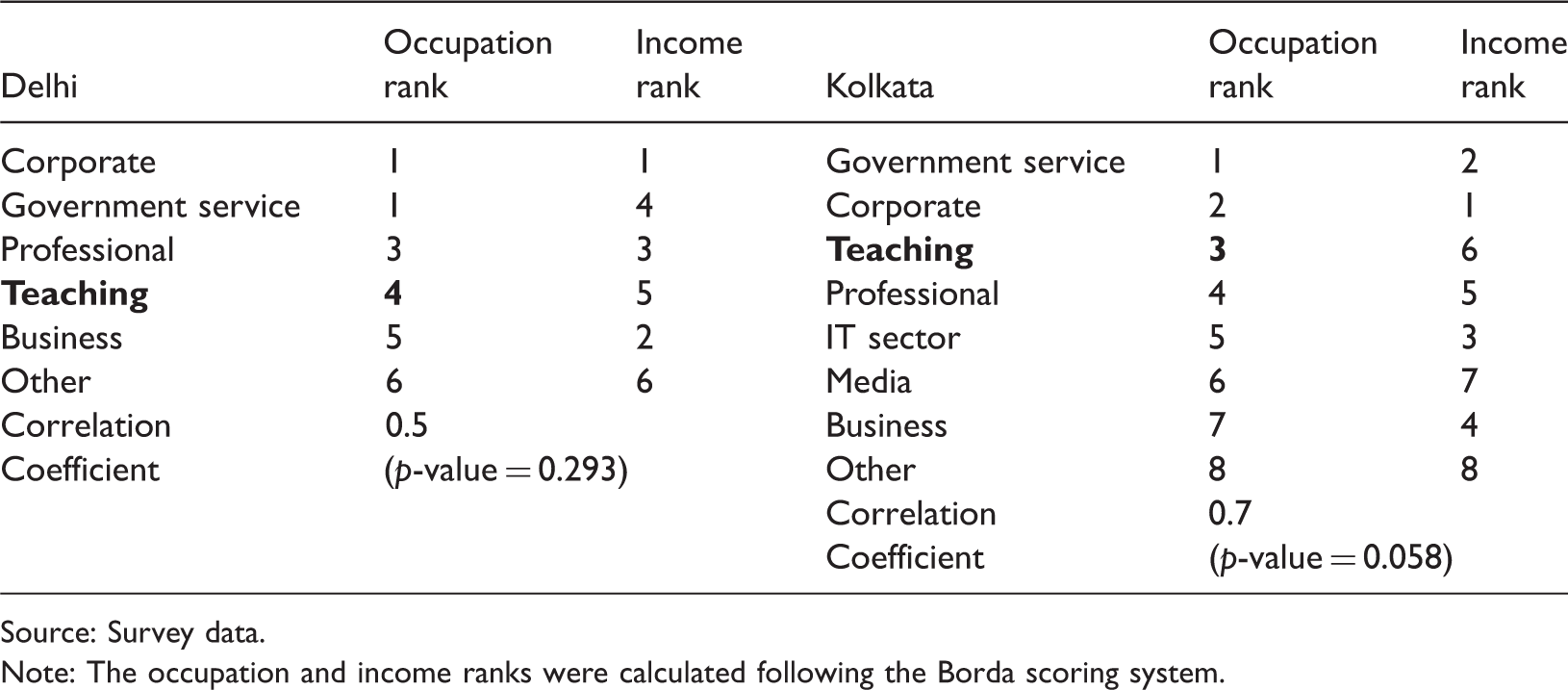
Preferences of college students from Delhi and Kolkata about occupations and incomes from occupations.
Source: Survey data.
Note: The occupation and income ranks were calculated following the Borda scoring system.
Among the school students in our sample, the top three options in both cities appear similar, these being corporate jobs and professional careers (such as doctor, lawyer, chartered accountant, etc.), with jobs in the government sector in third place.
Analysis of preference rankings assigned by college students in Delhi (Table 2) show the top three choices are similar to that of school students in Delhi, with careers in the corporate sector and in government tied as the most preferred option and with professional careers in third place. The preferences of college students from Kolkata differed; government service was their most preferred occupation, followed by corporate careers, while teaching emerges as the third choice.
One of our objectives was to identify whether there was a common ‘winner’ so far as occupation preferences are concerned. We find corporate careers and professional careers (e.g., doctor, chartered accountant, lawyer) are among the top choices of school students in both cities as well as among college students, especially from Delhi. The popularity of corporate and professional careers falls in line with the popular perception of high earnings of successful professionals and corporate executives, with the opening up of the corporate space to multinational companies and with campus placements taking off, especially in urban centres like Delhi and Kolkata. This also echoes the findings in the studies discussed above that record a widening of wage inequality and increasing returns to tertiary education in India in the post-reform era. At the same time, government jobs also remained among the top three choices of school and college students in both cities. This is a finding worth noting. Being the capital city, Delhi has a large concentration of high-ranking bureaucrats and government officials, and these findings run counter to our a priori expectation that students from Delhi might show greater preference for government jobs. The high degree of similarity in choices across two rather different metro cities might be reflecting a broader trend transcending differences arising from purely regional factors.
With respect to teaching, overall we find teaching is not one of the most preferred options among the majority of the students. It fares best among college students in Kolkata who place it in third place out of eight options listed. In contrast, college students from Delhi placed teaching in fourth place out of six choices given to them. In fact this leads to one of the interesting inter-city differences that emerge from our analysis; both school and college students from Kolkata attach greater preference to teaching as compared to their counterparts from Delhi. School students from Kolkata placed teaching in fourth place while students from Delhi placed it much lower in seventh place out of 10 career choices listed.
The preferences of high school students from Delhi shows relatively ‘new’ options such as ‘fashion’ and ‘sports’ are ranked above traditional occupations such as teaching and defence services. This differs from student preferences in Kolkata where there are relatively few takers for the new career options such as those in the airline industries, fashion and sports, and traditional occupations such as teaching and defence are ranked above these. It is likely that this finding reflects greater exposure to information about these new careers that might be available to students in Delhi compared to their counterparts in Kolkata. After all, owing to its status as the capital city, Delhi has access to greater economic opportunities thereby providing scope for greater exposure to the sheer range of livelihood options available.
There is a popular belief that girls have greater preference for teaching than boys. For each city we tested the null hypothesis that gender of the respondent does not significantly influence preference for teaching, against the alternate hypothesis that it does using Pearson's chi square test. The null was rejected at the 5 per cent level for the sample of school students from Kolkata (p-value = 0.027), while it was rejected at the 10 per cent level of significance for the sample of school students from Delhi (p-value = 0.091) and for the college students from Kolkata (p-value = 0.082). This indicates the share of those who wanted to teach and those who did not was significantly different between boys and girls. The cell chi square values showed the difference was particularly sharp at rank 1 in the sample of school students and at rank 8 in the sample of college students from Kolkata; in the case of the school sample from Delhi, there was an especially significant difference in the shares of boys and girls who had assigned rank 4. However, the null hypothesis could not be rejected for college students from Delhi, indicating the similarity in preferences for teaching among boys and girls in this sample.
Based on the analysis of the ranks assigned to teaching, we do not find the preference for teaching is higher among girls as compared to boys in the sample. Rather, we find cases where the preferences are more or less evenly matched and where boys show a higher preference for teaching than girls. For instance, in the sample of school students from Kolkata, about 13 per cent of the girls indicated a high preference for teaching (rank 1 or 2), compared to 27 per cent of the boys who had done so. Also 28 per cent of the girls put teaching at the bottom of their preference ranking (rank 9 or 10), compared to the smaller percentage of boys (18 per cent) who had done so. In contrast, in the sample of college students from Kolkata, 45 per cent of the girls as well as 45 per cent of boys rank teaching highly (rank 1 or 2). At the same time, 20 per cent of the boys gave teaching lowest ranks (rank 7 or 8), compared to a smaller percentage of girls (14 per cent) who had done so. As such, while our results indicate gender does influence the preference for teaching, there is little evidence to support the view that the preference for teaching is greater among girls as compared to boys.
Occupation preferences of meritorious students
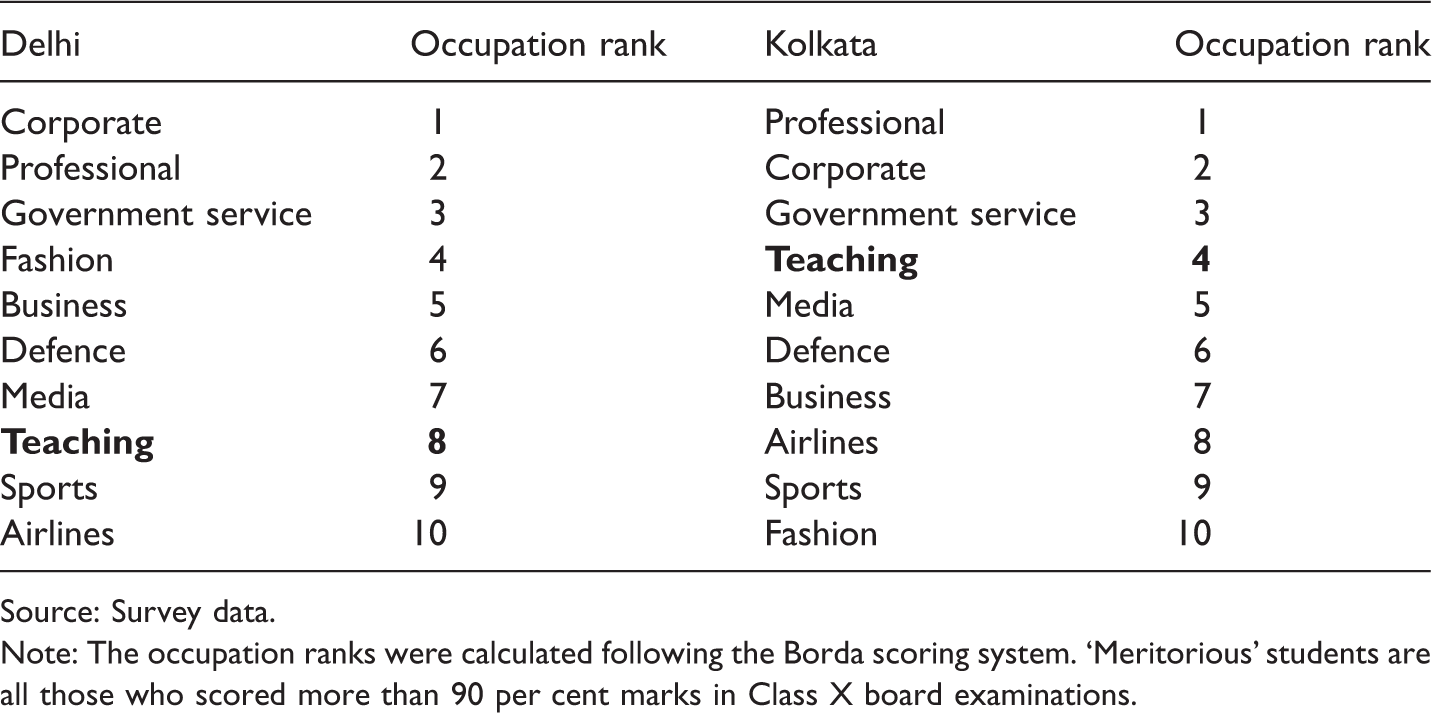
Occupation preferences of meritorious school students.
Source: Survey data.
Note: The occupation ranks were calculated following the Borda scoring system. ‘Meritorious’ students are all those who scored more than 90 per cent marks in Class X board examinations.
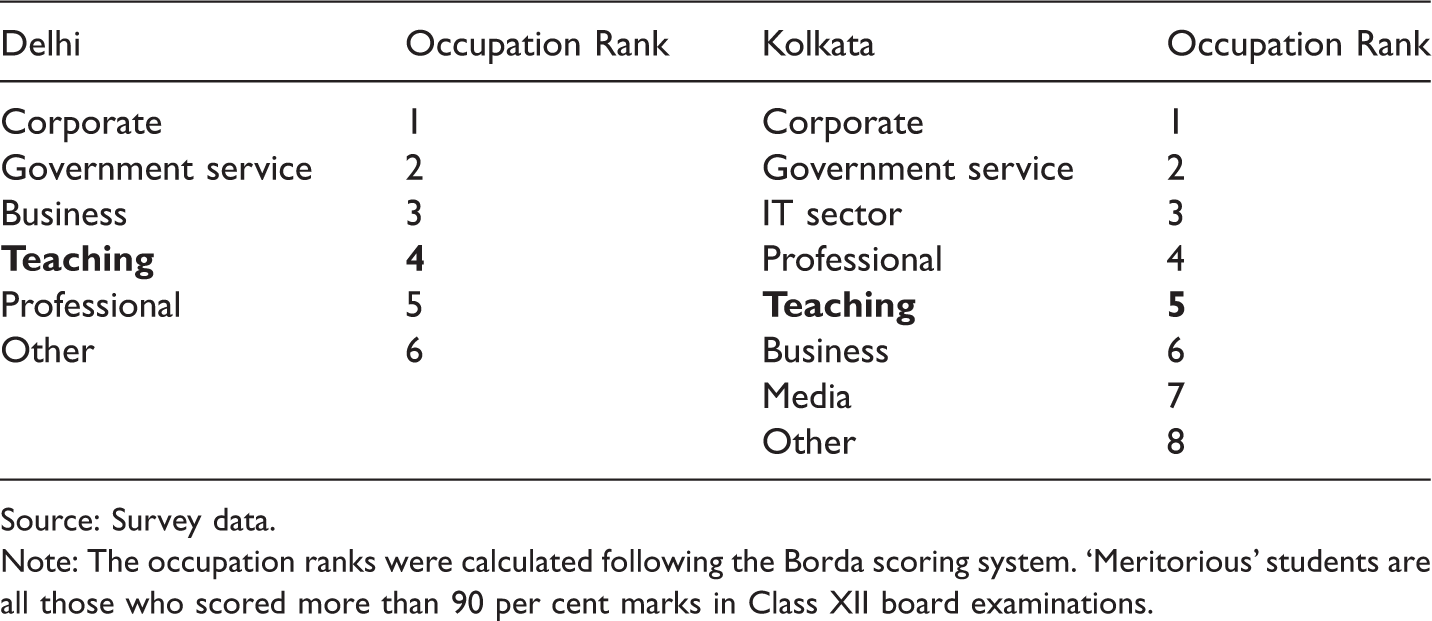
Occupation preferences of meritorious college students.
Source: Survey data.
Note: The occupation ranks were calculated following the Borda scoring system. ‘Meritorious’ students are all those who scored more than 90 per cent marks in Class XII board examinations.
Clearly, among the high-scoring students, preference for teaching is not higher than for all students in general and in some cases (such as in the case of school students from Delhi and college students from Kolkata) it is actually less than for all students in general. With the Indian education sector poised for massive expansion, the demand for teachers is going to increase massively. In this context, as a society, it becomes important to address the issue of attracting meritorious students into the teaching profession, especially in view of the importance of teacher quality for improved student performance, emphasized in the literature discussed above.
Perceptions about earnings from occupations
School and college students were also asked to rank occupations in order of perceived earning opportunities, i.e. rank the given alternatives from the highest paying option in their perception, to the one paying the least. 5
In the perception of school students from both cities, jobs in the corporate sector are the highest paying, followed by careers in sports and business (Table 1). We may surmise that the success of top Indian cricket and tennis stars like Sachin Tendulkar, M.S. Dhoni, Sania Mirza and others frequently seen in television advertisements is one of the reasons for such high earning perceptions from sports. Similarly, according to college students from Delhi and Kolkata, corporate jobs were the highest paying. For the Delhi college students this was followed by incomes from business and professional careers in second and third place, respectively. In contrast, for college students from Kolkata, government jobs were second, followed by jobs in the upcoming IT sector in third place. Students' choices of highest paid occupations are consistent with high corporate salaries and the emergence of numerous successful business leaders and professionals in the post-liberalization era in India.
Our findings indicate income perceptions for government jobs is not high among the students (not among the top three highest paying options), with the exception of college students from Kolkata. Yet there is a distinct preference for government jobs across all student categories, as it is among the top three most preferred career options for school as well as college students from both cities. It appears that careers in the bureaucracy continue to remain quite attractive to students across the two cities despite new, high-paying opportunities having emerged in the private corporate sector with liberalization.
By and large, income perceptions about various occupations are remarkably similar among school children in our sample from the two cities, captured by the high correlation (a correlation coefficient of 0.7, significant at a 5 per cent level of significance) between income ranks assigned by them. However, perception of income from teaching is very different in the two cities. While teaching is perceived as a relatively high-paying profession by school students in Delhi, who place it in fourth place just after business, students from Kolkata consider teaching to be the lowest paying among the 10 occupations listed. Considering the occupation and income ranks together, it seems clear that in both cities the choice of teaching as a career does not appear related to perceptions of earnings from it. In the case of the school students from Delhi, teaching is not a preferred option despite the perception that it is a relatively high-paying job, while just the reverse is observed with the school students from Kolkata who express a preference for teaching despite rating it as the lowest paying profession.
Teaching was perceived as one of the lowest paying options by the college students from Delhi, as they assigned this rank 5 out of the six options listed. Even in Kolkata teaching was considered a relatively low-paying option as overall the rank assigned to it was six out of the eight options listed. In both cities teaching as an occupation was assigned a higher rank than earnings from teaching. Thus, as in the case of school students, it appears that the preference for teaching is largely unrelated to earning prospects from the career.
Comparison of occupation and income ranks provides a basis for assessing whether earnings prospects significantly influence occupation choice. The correlation between income and occupation ranks is positive and statistically significant for college students from Kolkata (correlation coefficient = 0.7, significant at a 10 per cent level) and school students from Delhi (correlation coefficient = 0.6, significant at a 10 per cent level). However, no statistically significant correlation is seen with respect to the earnings and occupation rankings for school students from Kolkata and college students from Delhi. These results indicate that overall while earnings may be important, they are not the only factor affecting occupation choice. In particular, this is seen quite clearly in the case of teaching and government jobs as discussed above.
Preference for research
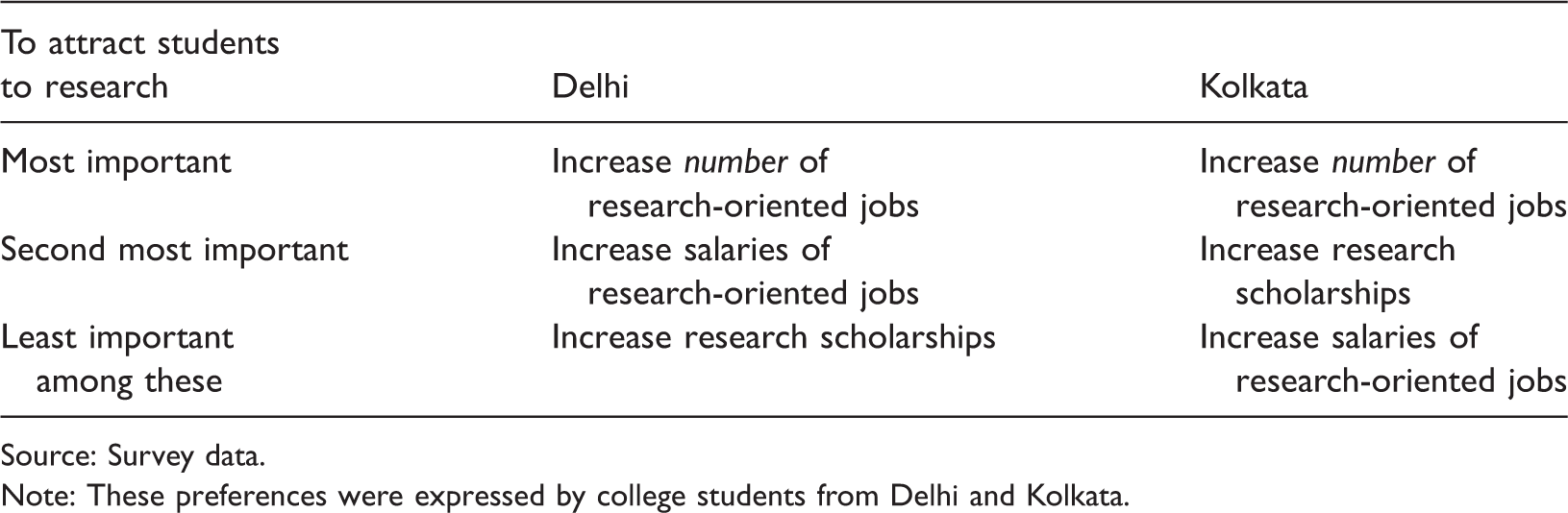
The college students were also asked whether they would consider enrolling for research degrees such as an MPhil and PhD, as these are important stepping stones for university teachers who are expected to be actively involved in research alongside teaching. 6 Thereafter, they were asked specifically whether they were planning to apply for these research degrees and whether this would be their most preferred option after college, or something they would consider only if other options did not work out. They were also asked what could be done to attract more students into research programmes in their fields and asked to rank three given options in order of preference. The options were increasing scholarships, increasing salaries of research-oriented jobs and creating more research-oriented jobs. Students were also given separate space in the questionnaire to express their views, in case these differed from the list of alternatives specified.
Based on our sample we found a significant difference in research orientation among college students across the two cities. In particular, students from Kolkata displayed a greater inclination for research as is evident from the responses to each one of the research-related queries. Pearson's chi square test rejects the null hypothesis that shares of responses to the question of whether students would like to opt for research or not is the same in the two cities. This null is rejected at the 1 per cent level of significance. Cell chi square values indicate the difference in responses is most sharp with respect to the share of students for whom research is the most preferred option in the two cities. There is also a sharp difference in the share of students who completely rule out research as an option after college. Research was the most preferred option after college for a much higher share of students from Kolkata (36 per cent) as compared to Delhi (21 per cent), while a much smaller share of students from Kolkata completely ruled out research as an option after college (37 per cent) as compared to Delhi (49 per cent). Research was a secondary or fall back option to be considered in case other options did not work out for a fairly large share of students from both cities (27 per cent from Kolkata and 30 per cent from Delhi).
College students' attitude towards research.
Source: Survey data.
Note: These preferences were expressed by college students from Delhi and Kolkata.
It is evident from Table 5 above that the need to create research-oriented jobs emerged as the most important based on responses from the two cities. For students from Delhi, raising salaries of such jobs was more important than increasing scholarships for research students, with the reverse being true for the Kolkata students. These preferences indicate the students' unwillingness to give top priority to research may stem from the perception that sufficient research-oriented jobs are simply not available.
Preference for teaching
School and college students were asked certain specific questions regarding the teaching profession. To start with students were asked if they would like to be a teacher. They were also asked whether teaching was their ‘first best’ career choice or a fall back option (i.e. one they would consider only if other options did not work out). Those who expressed a preference for teaching were further asked to indicate whether they preferred to teach in a school, college or university. All the students were also asked to indicate what they felt could be done to make teaching a more attractive career option. This question listed two options, one was raising teachers’ salaries and the other was changing the nature of teachers’ jobs, making it more interesting, e.g., by giving teachers more facilities and/or more freedom regarding teaching methods, curriculum design, etc.). Students were asked to rank these two options in order of importance. College students were additionally asked to indicate their preference for teaching in private vis-à-vis government institutions and their perceptions about facilities therein. Responses to these questions involved choosing a single option out of those listed and our analysis of responses is based on the percentage of students in the sample who chose a certain option.
The students' responses to the specific questions on teaching were as follows. The majority of school students (72 per cent from Delhi and 56 per cent from Kolkata) ruled out teaching as a career option. The remaining students wanted to be teachers, but for the majority (64 per cent in Delhi and 61 per cent in Kolkata) of those who would consider teaching as a career, this was only a fall back option. So, teaching was the first best career option for just about 10 per cent of the students from Delhi and 17 per cent of those from Kolkata.
The responses of high scoring students 7 were examined separately. In Delhi, the majority (79 per cent) did not want to consider teaching as a career. Among those who did, for over 90 per cent it was only a fall back option. In Kolkata the majority of the meritorious students (56 per cent) would consider teaching as a career, but once again for most of these students (79 per cent) teaching would be a fall back option. So teaching would be the first or most preferred option for only a small proportion of the high-scoring students (1 per cent from Delhi and 11 per cent from Kolkata).
Of all those who wanted to be teachers, among school students in both cities, teaching in a school was the most preferred option (54 per cent from Delhi and 38 per cent from Kolkata), followed by teaching in a university (31 per cent of students from Delhi and 39 per cent from Kolkata), with college teaching in third place in both cities.
Based on college students' responses on their preference for teaching it was found that the majority did not completely rule out teaching as a career option. In contrast to the high school students, a smaller share of college students (36 per cent from Delhi and 28 per cent from Kolkata) ruled out teaching as a career option. However, much like the school students, for the majority (72 per cent from Delhi and 56 per cent from Kolkata) of college students who would consider teaching as a career option, it was basically a fall back option to be taken up in case other options did not work out. Our results also show greater preference for teaching in the Kolkata sample as compared to the sample from Delhi, as Pearson's chi square test rejects the null hypothesis that the share of responses are the same in the two cities, at 1 per cent level of significance (p-value = 0.000). In particular, cell chi square values show that the difference is especially marked in the share of students for whom teaching is first preference: 18 per cent of the college students from Delhi vis-à-vis 32 per cent from Kolkata.
The responses of the high-scoring college students were examined separately and it was found that teaching would be the most preferred option of an even smaller fraction (16 per cent from Delhi and 12 per cent from Kolkata) of these students. In comparison, teaching was the most preferred option for a higher share (19 per cent in Delhi and 37 per cent in Kolkata) of the students with lower scores.
We also find that the choice of teaching does depend upon the gender of respondents. Pearson's chi square test rejects the null hypothesis of independence between gender and the decision to teach, in samples from Delhi (p-value=0.027) and Kolkata (p-value = 0.026), at the 5 per cent level of significance. However, the results do not point to a higher preference for teaching among girls as compared to boys in the sample. In the case of school students from Delhi, the share of girls (32 per cent) who expressed a preference for teaching is higher than the share of boys (23 per cent), while the reverse is observed in Kolkata, where the share of boys (48 per cent) who expressed a preference for teaching is higher than the share of girls (37 per cent). Analysis of responses to the question that probes whether teaching is a first preference or a fall back option, also rules out a greater preference for teaching among girl students. In the case of school students from Delhi, the null hypothesis that responses were independent of gender could not be rejected (p-value=0.591), as 67 per cent of boys and 62 per cent of girls said teaching would only be a fall back option, rather than a first choice career option. For the sample from Kolkata, while the null hypothesis of independence was rejected (p-value = 0.004), the share of girls (77 per cent) for whom teaching was a fall back option was much larger than the share of boys (54 per cent). In the case of college students, Pearson's chi square test could not reject the null hypothesis that the share of ‘first preference’ and ‘fall back’ responses are the same for boys and girls for the samples from Delhi (p-value = 0.342) as well as Kolkata (p-value = 0.144). Teaching was the first preference of 17 per cent of boys and 20 per cent of girls in the Delhi sample and of 32 per cent of boys and the same percentage of girls in the sample from Kolkata.
In Delhi, of those who wanted to teach, university teaching was the most popular option followed by college teaching, while not many wanted to be school teachers (46 per cent preferred teaching in a university, 42 per cent in college and 11 per cent in school). In Kolkata college teaching was the most preferred option, followed by university and school teaching (45 per cent preferred teaching in a college, 31 per cent in a university and 24 per cent in schools). In both cities, school teaching seemed to be the least popular choice. However, compared to Delhi, teaching in schools seemed relatively more popular among respondents from Kolkata, which was evident from the larger share who expressed a preference for teaching in schools.
All respondents were asked what they felt could be done to make teaching an attractive career option. Two choices were given and students were asked to rank them in order of importance. One was that teachers' salaries should be increased; the second was that teachers' jobs should be made more interesting (e.g., by giving them greater freedom over teaching methods and curriculum design).
In the opinion of the majority of the school students from Delhi (51 per cent) and Kolkata (61 per cent), making the teachers' job more interesting was more important than a hike in teachers' pay for making teaching a more attractive career option. The response to this question was analysed separately for students who opted for teaching and for those who ruled out teaching as an option. The responses were found to be similar among the two groups of students in both cities. The majority (55 per cent in Delhi and 68 per cent in Kolkata) of those who indicated they wanted to become teachers, as well as most of those who did not want to be teachers (57 per cent Delhi and 49 per cent in Kolkata) felt the same way. In fact, the majority of the college students (58 per cent from Delhi and 65 per cent from Kolkata) also felt it was more important to make teachers' jobs more interesting than to raise teachers' salaries to make this a more attractive career option. Once again the majority of those who wanted to teach (58 per cent in Delhi and 70 per cent in Kolkata) as well as the majority of those who did not want to teach (60 per cent in Delhi as well as in Kolkata) felt this way.
In addition to the above set of questions, college students were asked about their preference for teaching in private vis-à-vis government educational institutions and whether they perceived salaries and other facilities to be the same or different in these two setups. In both cities there was a distinct preference for teaching in a government institution among all those who said they would consider opting for teaching as a career, as the majority of such students (55 per cent in Delhi and 64 per cent in Kolkata) expressed a preference for teaching in a government institution. Preference for government institutions was even stronger for those who said teaching was their first preference option; in both cities over 70 per cent of these students (71 per cent in Delhi and 76 per cent in Kolkata) preferred to teach in government institutions. Not surprisingly, in the perception of the majority of the students who wanted to teach in both cities (50 per cent in Delhi and 62 per cent in Kolkata), salaries and other facilities for teachers were greater in government institutions as compared to private ones. Among all those who would consider teaching as a career option, nearly 40 per cent of such students in Delhi were of the opinion that private institutions offered better facilities and salaries to teachers, while this was the opinion of a much smaller share of students, only 28 per cent, from Kolkata.
Conclusion
In the final analysis, students' responses to specific questions on teaching do lend support to the main hypothesis in this paper that students, especially meritorious students, seem unwilling to come into teaching. We find that for the majority of school and college students across the two cities teaching is not a first choice career option, rather it is more of a fall back, to be considered in case other options did not work out.
So far as a comparison between the two cities is concerned, preference for careers in teaching and research were found to be relatively higher among students from Kolkata. However, the similarities in top occupation choices across the two cities, which are both metros but quite different in terms of per capita incomes and in many other respects, were also striking. Similar findings across these two cities might actually capture a broader pan India trend that may also be observable in other urban centres, while the differences probably reflect the influence of regional characteristics that play an important role in shaping preferences.
What clearly emerges from analyses of these preferences is that incomes in the corporate sector are perceived as highest by school and college students. Indeed corporate careers are among the top three most preferred career options for all categories of students in our sample. This is expected and is in line with the changes witnessed in the economic landscape in India in the post-liberalization reform period. However, our findings indicate that jobs in the government sector are very attractive despite students' perceptions of higher salaries in the private sector. Government jobs figure among the top three occupation choices of school as well as college students from both cities even while the income ranks indicate it is regarded as a relatively low-paying option. Government jobs also figure among the top three choices of the meritorious students who indicate a greater preference for it than for teaching. However, these findings are based on our sample and not generalizable beyond that. Indeed for policy makers it should come as good news that despite higher earnings prospects in the private sector even the best students still rate government jobs so highly. Clearly factors other than earning prospects underlie choice of careers, although the reasons for career choice were not probed in our study.
In fact we also find that salaries are not the sole or most important factor affecting individuals' choice of teaching as a career. All categories of students from both cities indicate it is more important to bring about changes in the nature of teachers' jobs to make it more interesting, rather than simply concentrating on raising teachers' salaries. In view of this at least two implications for state-based policy come to the fore. First, simply raising the salaries of teachers may not be enough to attract quality personnel into the teaching profession. Second, along with the current emphasis on monitoring teachers' performance, equal importance should also be given to addressing some of the aspects of the nature of teachers' jobs that may need reforms. This may be important for the future, especially with a view to attracting good quality entrants into the teaching profession.
However, these findings are based on our sample. We need to perform similar kinds of follow-up studies with more sophisticated methodological tools for broader generalization. Our attempt has been to characterize students' occupation preferences on the basis of a sample and in doing so we have tried to draw attention to students' attitudes towards teaching, which arise from the concern we share with many academics that academia may not be attracting some of the best minds, especially in view of emerging career choices available to students at the current conjuncture.
Footnotes
Funding
The authors gratefully acknowledge financial support from Delhi University (R&D Grant for Faculty) and the Department of Economics, Calcutta University (UGC-DRS-research grant).
Acknowledgements
The authors would like to thank Sarmila Banerjee for her comments, suggestions and support throughout this project. Cooperation from the students, teachers and heads of all the participating institutions is also gratefully acknowledged. Excellent research assistance was provided by Montu Bose, Jayita Bit, Sumita Chadha and Anmol Soni. The usual disclaimer applies.