




Abstract
Humans have always sought to grasp nature’s working principles and apply acquired intelligence to artefacts since nature has always been the source of inspiration, solution and creativity. For this reason, there is a comprehensive interrelationship between the philosophy of nature and architecture. After Charles Darwin’s revolutionary work, living beings have started to be comprehended as changing, evolving and developing dynamic entities. Evolution theory has been accepted as the interpretive power of biology after several discussions and objections among scientists. In time, the working principles of evolutionary mechanisms have begun to be explained from genetic code to organism and environmental level. Afterwards, simulating nature’s evolutionary logic in the digital interface has become achievable with computational systems’ advancements. Ultimately, architects have begun to utilise evolutionary understanding in design theories and methodologies through computational procedures since the 1990s. Although several studies about technical and pragmatic elements of evolutionary tools in design, there is still little research on the historical, theoretical and philosophical foundations of evolutionary understanding in digital architecture. This paper fills this literature gap by critically reviewing the evolutionary understanding embedded in digital architecture theories and designs since the beginning of the 1990s. The original contribution is the proposed intellectual framework seeking to understand and conceptualise how evolutionary processes were defined in biology and philosophy, then represented through computational procedures, to be finally utilised by architectural designers. The network of references and concepts is deeply connected with the communication between natural processes and their computational simulations. For this reason, another original contribution is the utilisation of theoretical limits and operative principles of computation procedures to shed light on the limitations, shortcomings and potentials of design theories regarding their speculations on the relationship between natural and computational ontologies.
Introduction
Throughout history, human beings have questioned the reality of nature to comprehend its working principles and understand humans’ place in the immense cosmos. Over the centuries, nature has proved to be a source of intelligence, inspiration for solving problems and creativity which have inspired the design of artefacts. For this reason, there is a comprehensive interrelationship between the philosophy of nature and architectural design procedures. Philosophies of nature highlight designers’ diverse understanding of scientific theories or natural phenomena. From the theories on the essence of things in Ancient Greek, mechanic understanding of the universe in the Renaissance to evolution and quantum theory-based conceptions of reality, philosophies of nature have played a vital role in shaping architectural design theories.
Arguments on the ontological construction of reality are represented by two main streams: essentialism and process philosophy. In essentialism, things operate depending on the capacities, tendencies and features of their basic components that are essentially constant and stable. 1 On the contrary, process philosophy promotes contingency, change, emergence and becoming as the main elements of the ontological description of reality. 2 The introduction of evolution theory advocated the process-based understanding of the world, where nature is understood as a changing and dynamic reality. The advancements in computer science made it possible to analyse and represent computational equivalents of natural evolution. After the beginning of the 1990s, architects have begun to utilise concepts and tools that refer to evolutionary processes of nature through computation procedures.
Although there are studies about technical information and pragmatic utilisation of computational evolutionary tools in architectural design, there is still little research on the historical, theoretical and philosophical foundations of the discourse, reflecting on the critical role of computation as an interface between nature and architecture.3–5 In these researches, the design arguments of architects regarding the connection between computation and nature while utilising evolution in design processes have been barely subjected to critical review through the very nature of computation procedures. The historical timeline of these studies does not cover the evolutionary design theories and methodologies proposed during the last 5 years. Also, these reviews only concisely and partly evaluate how the idea of evolution has been reflected in digital architecture. In other words, evolution as a paradigm plays a not central but implicit role in the investigations.
This article aims to fill this literature gap through a critical review of evolutionary understanding embedded in digital architecture theories and designs since the 1990s, after outstanding developments in computation and genetics. The original contribution is the proposed intellectual framework seeking to understand and conceptualise how evolutionary processes were defined in biology and philosophy, then represented through computational procedures, to be finally utilised by architectural designers. Special attention has been given to how random qualities of evolutionary processes were integrated into design procedures. The network of references and concepts is deeply connected with the communication between natural processes and their computational simulations. For this reason, another original contribution is the utilisation of theoretical limits and operative principles of computation procedures to shed light on the limitations, shortcomings and potentials of design theories regarding their speculations on the relationship between natural and computational ontologies.
The scope of this research is limited to the historical and theoretical interpretation of the relationship between evolution, computation and digital architecture in the last 30 years. The impact of other disciplines on the development of digital architecture is outside of the context, as this review is not an attempt at the general history of digital architecture. Only architects who utilised and instrumentalised evolutionary processes of nature as part of their design theory and methodology are included in this critical review. The detailed analysis of specific software or modelling techniques used by architects is excluded. Instead, the role of computation in design theories and methodologies regarding its modelling ideologies and universal implications for utilising the idea of evolution in digital architecture has been discussed.
Evolution theory, computation and digital architecture
Before the introduction of evolution theory, the general assumption was that all living creatures were static, unchanging and non-transformable beings that show a degree of perfection in the ladder of being.
6
Even though there were some speculations about species evolution, nobody could develop a valid scientific explanation.
7
After Charles Darwin’s revolutionary work, living beings have started to be comprehended as changing, evolving and developing dynamic entities.
8
Darwin explains this paradigm change as follows
9
: ‘Thus, from the war of nature, from famine and death, the most exalted object which we are capable of conceiving, namely, the production of the higher animals, directly follows. There is grandeur in this view of life, with its several powers, having been originally breathed into a few forms or into one; and that, whilst this planet has gone cycling on according to the fixed law of gravity, from so simple a beginning endless forms most beautiful and most wonderful have been, and are being, evolved.’
Evolution theory has been accepted as the interpretive power of biology after several discussions and objections among scientists. 10 In time, the working principles of evolutionary mechanisms have begun to be explained from genetic code to organism and environmental level thanks to the developments in genetics and ecology disciplines. 11 These developments provided a profound understanding of the evolutionary process in nature.
Simulating nature’s evolutionary logic in the digital interface has become achievable with computational systems’ advancements since the 1930s. Alan Turing 12 defined a conceptual framework for an abstract logical machine that could compute any computable function. Therefore, Turing came to the same conclusion as Kurt Gödel, 13 who had demonstrated that any logical math system was incomplete and inconsistent. This breakthrough proved that any logical computation model built upon evolutionary properties could provide only an abstract understanding of natural evolution. In 1952, Turing 14 also investigated the morphogenesis process mechanisms by focusing on the relationship between genes, zygotes and resulting organisms. The paper was among the initial attempts to decode evolutionary processes like self-organising and reaction-diffusion systems.
John Von Neumann recognised Turing’s universal computing machine and developed it into the systematic theory of automata by building an analogy between natural systems and digital computers. 15 The aim was to construct identical machines or evolutionary processes through self-reproducing automata where natural selection logic provides growing complexity from simple to complicated machines. 16 Also, Von Neumann 17 used the mutation mechanism for the random change of one element in the system. After the 1980s, Stephen Wolfram 18 advanced this idea by introducing the cellular automata as a universal computational system in which time and space are discrete. By accepting cellular automation as the new law of nature, Wolfram 19 claimed that discrete components could create complex behaviours or even the universe by following simple dynamical rules. Therefore, cellular automata provided the computational equivalence of the natural evolutionary process by utilising randomness, variation, adaptation and selection.
John H. Holland invented genetic algorithms and built an abstract and universal framework for evolutionary mechanisms and processes. Holland’s 20 complex adaptive system comprised three mechanisms: building blocks and sets of rules acting upon them, the competition that organises the system’s resources according to the environment, and recombination that generates new rules from building blocks and testing them. In contemporary understanding, the simple evolutionary model contains dynamical populations competing for finite sources, fitness criteria to apply selection and variation mechanisms to enhance diversity. 21 Computer scientists use the working logic of biological evolution because it is suitable to solve computational problems and adapt solutions to variable environments. 22 Similarly, evolutionary computation has been utilised in digital architecture theories by describing the form, function and process with quantitative parameters and applying mathematical equivalents of evolutionary mechanisms.
In the meantime, the advancements in spline modelling paved the way for an open-ended and parametric understanding of design based on differentiation, variation and non-standard production.23,24 With new sciences of complexity and emergence, the mechanical and linear paradigms have been abandoned in favour of a nonlinear understanding of architecture in which nature is conceived as a self-organising, chaotic and diversified system. 25 This shift in emphasis from individuals to collectives, from objects to fields, emphasised the bottom-up approach in which form is produced through sequences of events depending on local rules. 26 The generative and responsive comprehension of form, the ‘objectile’, foreshadowed unlimited and non-standard parametric variations in design. 27
The increasing power of computation allowed the evolutionary intelligence of try and error for the form-finding process where the full authority of the designer is undermined.3,28 Integration of data describing the dynamic material behaviours into the design procedure made it possible to speculate about the convergence of digital and material reality in architecture.5,29 The renewed interest in complexity science, the introduction of new digital tools and the increasing computation capacity have provided the theoretical and practical foundations for the penetration of the evolutionary process to be embedded in computational design procedures for architecture since the 1990s. Any change that takes place in nature from the micro to macro scale can be considered an evolutionary process. While natural ontology is about how evolution occurs in the physical world, computational ontology relates to the simulation of evolution in a virtual world through digital computation. Understanding the relationship between computational and natural ontology is essential to reveal the limitations and shortcomings of using evolutionary processes in digital architecture theories.
Evolutionary process in digital architecture theories
Since the beginning of the 1990s, architects have referred to various concepts while utilising evolutionary processes in their design procedures, including variation, autopoiesis, Neo-Darwinism, punctuated equilibrium, endosymbiosis, morphogenesis and optimisation. The connections between these concepts and architects are demonstrated in the thematic map of Figure 1. Thematic map showing the connections between architects and evolutionary concepts.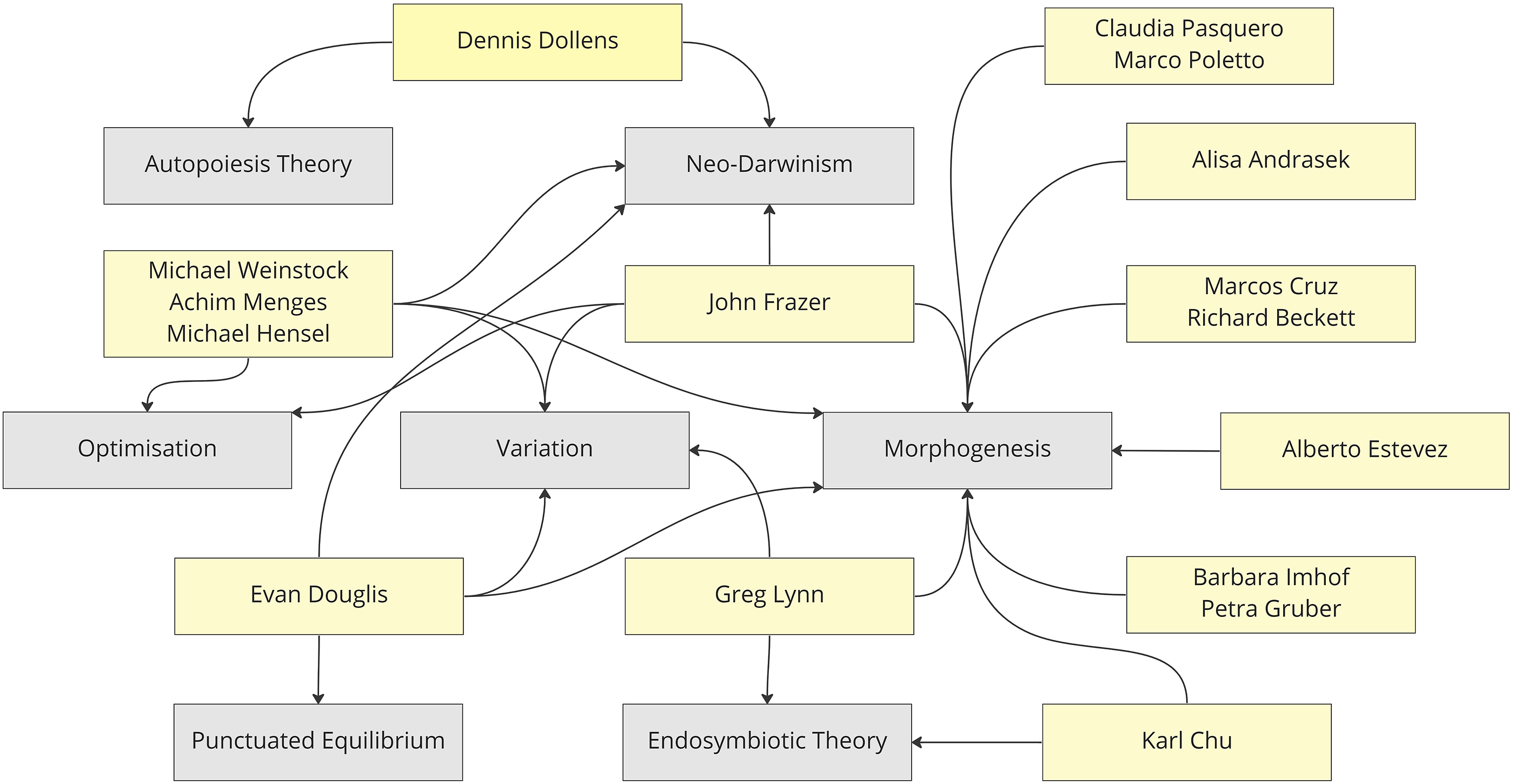
Architects fundamentally adopted two approaches regarding the relationship between computational and natural ontologies while utilising evolutionary processes in design theories and methodologies. In the first group, the computational representation of evolution has been considered an abstracted and approximated description of nature, meaning that all simulated evolutionary design procedures are defined within the frontiers of virtual reality. These architects understood computational and natural as separate ontologies with indirect and abstract feedback in between. The second group of architects strongly praised the power of digital computation regarding the depiction of the physical world. Also, attempts have been made to integrate evolutionary process of nature directly into design procedures while using their simulation through digital computation. These architects sought for a unification between computational and natural ontologies in architectural design by blurring the boundaries between organisation, structure and agency of evolutionary process in nature and its computational simulation.
Computational and natural as separate ontologies
The protagonist of evolutionary understanding in digital architecture was John Frazer. Utilising the Neo-Darwinian evolutionary model, Frazer attempted to naturalise architectural design by transferring information from genetics and evolution mechanisms. Frazer 30 utilised dynamic, self-renewing and responsive characteristics of evolutionary nature in the architectural design process via 3D evolutionary cellular automation. This system tested emergent forms through the accelerated virtual evolutionary model shaped by the internal dynamics of genetics and external environmental factors. When the complexity of the design reached a certain level in the evolutionary process, the architectural forms could organise themselves and produce more complex copies and structures, just like a natural evolution. Frazer understood computational ontology as an additional dimension that allowed designers to generate forms through the evolutionary process. Computation was not a replacement for the real world.
In Frazer’s understanding, evolutionary processes were considered the essential element even more important than the design objects’ performative, functional and aesthetical qualities. Thus, the evolutionary design process represented a significant paradigm shift regarding the architect’s authority since the design was left to its own development in the creative virtual evolutionary environment. The emerging forms were unpredictable since the characteristics of randomness were introduced into the bottom-up evolutionary process through variation mechanisms and environmental factors. Therefore, the natural model manifested itself by directing the development of the architectural form as abstracted representations of evolutionary mechanisms and contributing to the selection process by providing feedback in the form of digital data collected from environmental conditions.
Greg Lynn accepted endosymbiotic theory as the best evolutionary model for the animation-based understanding of form by criticising the Neo-Darwinian evolutionary model for its dependence on random mutation, external natural selection, gradualism and reductionism.31,32 Against the population and gene-based evolutionary model of Neo-Darwinism, the endosymbiotic theory highlighted metabolism and community-based model that explains the bottom-up evolutionary process where single organisms merge with neighbours to form complexity. 33 Such a perspective on the evolutionary process based on symbiosis let Lynn 34 recognises architectural geometry as an evolutionary space where continuous differential transformations occur. Therefore, architectural form represented dynamic, smooth and mutable singularity depending on the changing reciprocal relationship between continuous iterative differentiation and external evolutionary dynamics. 35 The reflections of this understanding were evident in the Embryological Houses project, where the constant mutated models were proposed. 36
Lynn promoted the importance of process as endless variations of the form. All final forms were considered perfect in their unique contexts since the logic of continuous change depending on external forces was proposed to justify the design solutions. As a direct impact of evolutionary process-based perspective, architectural form was recognised as momentary responsiveness rather than a static entity disconnected from its environmental forces. This realisation demonstrated that the evolvability of form was the substantial reason for the complexity of the system. Evolutionary randomness did not play a critical role. Like Frazer, the evolutionary logic contemplated within the boundaries of the computational ontology and convergence with the outside world was not investigated. Symbiosis as an evolutionary process only provided abstract principles and design logic to be used in the transformation of the architectural form.
Karl Chu proposed genetic architecture by fundamentally linking the plane of immanence, endosymbiotic theory and cellular automation. The plane of immanence was described as the foundation of philosophy that produces infinitive concepts, movements and variation. 37 Accepting the plane of immanence as metaphysical construction that embodies possible dynamic structure interactions composed by monads, Chu 38 introduced the idea of a ‘cone of immanenscendence’ as an ontological rendering that launches perpetual worlds. Following this theoretical framework, Chu 39 proposed genetic architecture to describe a novel post-human agenda that phases out anthropocentric architecture views. Chu categorised two diverse perspectives for the embodiment of computation in architectural design: morphodynamic and morphogenetic. In the morphodynamic approach, form evolves according to external dynamics, whereas in the morphogenetic one, form emerges through the internal logic of genetics, such as self-replication and reproduction.
Karl Chu criticised the morphodynamic approach as it failed to recognise objects with internal structures and works with pre-defined quantitative values, preventing randomness. The openness and random qualities of the computational system were essential since the natural events cannot be reduced into structured parameters. 40 By understanding nature as a system based on monads that carry irreducible information and act as self-replicating units, Chu conceptualised architectural design as a co-evolutionary process evolving from simple assemblages to complex self-organising systems. Nevertheless, Chu’s design theory was limited to digital design experiments, failing to show the physical manifestation of such a theoretical model. Also, this bottom-up evolution from simple parts to complex arrangements through digital computation procedures includes only abstract principles derived from the working logic of symbiosis in nature.
The Emergent Technologies and Design Group formed by Michael Weinstock, Achim Menges and Michael Hensel further developed morphogenetic design theories. They proposed a design methodology that employed evolutionary and morphogenetic processes for higher performance, functionality and environmental sensitivity.41,42 Random evolutionary variations were used to bring stochastic quality and diversity to the design process, boosting the system’s robustness and complexity. Building an analogy with evolutionary process in nature, fitness criteria were applied to evaluate candidate designs regarding their performance for finding optimum solutions. Also, material behaviour was utilised as a generative and selective design instrument by creating a complex multi-performative system informed by internal and environmental factors.
In this morphogenetic design model, architectural form resulted from the process instructed by population-based evolution, self-organisation procedures and material agency. The proposed model differed from Frazer’s regarding the role of digital computation and active participation of material behaviour. Randomness was introduced to the model through variation mechanisms to expand search space and the data obtained from the material agency. Therefore, evolutionary processes were not used to generate mere variations of the architectural objects but to create architectural models where the formal, structural and material qualities are interlaced, like the organism in nature.
Architect Evan Douglis combined Neo-Darwinian gradual evolution and William Bateson 43 ’s discontinuous change through computational design process. The design model was initiated with a generative computational unit capable of creating limitless variations through repetition depending on dynamic environmental forces. 44 Douglis constructed an evolutionary design process, both directive and progressive but not deterministic since controlled accidents or mutations were introduced to the system for unpredictable expressions of structural surfaces. 45 At every stage of the process, designs were subjected to the fitness test, measuring the performances depending on the potential to be combined with other units and create three-dimensional complexity. 46
Douglis instrumentalised the mutation mechanism in the design process as an explorative tool that expands the search space and introduces random qualities to the system. The evolutionary process was conceptualised as the creation of endless variations of surface structures through bottom-up procedures depending on the co-evolution of units, resembling the form generation in cellular automata. Still, the model differed from digital cellular automation since the material behaviour of the units also played a crucial role in the development of the form through analogue techniques. The autogenic structures were evolutionary form-finding experiments searching for indeterminacy, emergence and complexity through both digital and material computation.
The architect Alberto Estévez proposed cybernetic-digital as the logic of virtual DNA to link the binary system of the computation with the organisation of natural genetics. 47 Such a model focused on creative computational design procedures to explore the potentials of the genotype-phenotype relationship of the living world. Estévez advocated going beyond the mere imitation of static natural forms by concentrating on computational models of biological evolutionary processes, which simulated growth, self-organisation and morphogenesis. However, Estévez did not provide further critical thinking to explain the creative and intellectual role of evolutionary process, except for an analogy between the emergence in nature and computational design.
Computational and natural as united ontologies
Nature is an open system evolving under the influence of irreducible divergent parameters. On the contrary, computational methods tend to be logical, prescriptive and autonomous. While the analogue computation graphs continuity as an image of the real through semantics, the digital computation utilises discrete elements and discontinuous scales to represent the real. 48 Whether analogue or digital, the computational approaches regarding the representation of evolutionary process can only provide divergent degrees of abstracted versions of reality. 49 One must overcome this essential struggle to create evolutionary design procedures uniting the computational and natural ontologies. These two can only merge through the epistemological framework of the designers, which is subjected to several theoretical approaches.
The architect Dennis Dollens proposed one of the earliest examples of united ontology. Dollen initially accepted Louis Henry Sullivan’s drawings as seeds providing design instruction and combined it with the computational analysis of plant growth in the design process.50,51 Following this reasoning, Dollens conceptualised another framework by understanding monads as computational instruments carrying evolutionary potentials in the plane of immanence, and utilised extended phenotype theory to unify this system with the physical world.52,53 In further investigations, Dollens 54 also questioned the idea of thinking buildings as a quest for an intelligent built environment. Employing the autopoiesis theory as a platform that organises the information transfer from nature, 55 Dollens also used the extended mind hypothesis as environmental cognitive theory linking nature, computation and design objects as interconnected existence.56,57
Dollen’s main argument was the hybridised bio-digital ecology where the buildings were considered dynamic and intelligent systems continuously evolving with nature. From the computational representation of evolutionary processes to its utilisation by architects and digital design fabrication, Dollens envisaged the design process as part of the same ontology united with nature. Beyond the different utilisations of the evolutionary process in form generation, Dollens directly focused on unifying architecture and nature through computation, cognition and evolution theories. Nevertheless, extended phenotype and extended mind hypotheses, the mediator between ontologies, are still debated regarding the ontological problem, and the computation is only a powerful tool to represent nature thanks to its processing power.
The architect Alberto Estévez 58 also proposed ecological-environmental design aiming to modify living organisms’ DNA through the logic of computation to design habitable places. Future biological buildings are expected to have programmable living materials, elements and spaces. This vision has remained a utopian imagination that has shown no remarkable progress. Estévez’s projects failed to achieve the central evolutionary promise of designing an architectural space by manipulating living genetic material. How the binary logic of computation converges with the working mechanisms of genetic material and opens the possibilities of robotised control on the growth of the living building are not adequately explained.
To overcome abstracted and prescriptive evolutionary strategies, Alisa Andrasek adopted the triadic logic by C. S. Pierce and utilised the brute force of discrete computation to obtain massive data from the core fabric of material agency. 59 Unlike binary logic, triadic logic introduces a three-valued system; true, false and indeterminate. 60 For Andrasek, 61 the third value of triadic logic and computational data obtained from material agency brings randomness into the design, providing an opportunity for hybridised ecology by interlacing living and non-living intelligence. Understanding matter as information, Andrasek utilised discrete computation to propose an architectural complexity and aesthetics beyond human cognition.
Although many studies examine the evolution of material agency and microstructures, there has yet to be a consensus on a general framework explaining the connection between micro and macro evolutionary processes. 62 Andrasek attempted to unite these two scales by using pattern-recognised information obtained from the material behaviour in the design, introducing evolutionary process from the micro-scale. Nevertheless, when the design is manufactured, it fails to respond to the natural environment since the collected computational data is about the context of micro-level behaviour, not the organism and system level. Also, the pattern-recognised information provides a data-rich representation of matter beyond the centralised evolutionary process. However, it is still a degree of abstraction and simplification, not the material itself.
Architect Jenny E. Sabin and biologist Peter L. Jones spanned the boundaries between biology and architecture through computation, simulation and digital fabrication technologies. 63 They analysed the emergence of natural complexity at different scales, such as cell structures, morphological/molecular changes, self-organisation and abstracted these models into dynamic computational design models. Understanding biological events as information structures and processes, Sabin built an analogy with Conrad Waddington’s epigenetic landscape representing the embryonic development of the cells. Therefore, Sabin 64 proposed a matrix architecture, where the algorithm illustrates the design of dynamic forces through a diagram coding developmental landscapes' potential networks.
The most promising argument proposed by Sabin was understanding design as a continuous evolutionary process of forces instead of objects and their relations. Therefore, the object was only a secondary quality of the evolutionary process both in nature and computational design. Sabin believed that computation could be used as a mediator to bring the processual operation of nature into the architecture, allowing designers to embody natural ontology. Antoine Picon 65 defined such an approach as reinventing nature. However, the utilisation of digital computation is essentially a reduction of the qualities of natural process into information bits.
There is also an emergent research area where the Physarum Polycephalum’s collective foraging, extension and adaptation behaviour has been observed and applied as a problem-solving method. 66 Physarum Polycephalum is a large, single-celled, multi-headed slime mould composed of tube-like structures creating an optimised network connecting the food sources. 67 The organisms’ creativity stems from an embodied intelligence that depends on material interaction and its relationship with the environment. 68 Physarum was used for several purposes in architecture, from road network optimisation to 3D form-finding experiments.69,70 It was also considered a bio-digital aesthetic principle that defines biotechnological wholeness and ecological intelligence in which non-human actors were co-designers. 71
After successive stages of the natural selection process, Physarum has gained distinctive features to optimise dynamic morphology on the planar, topological and volumetric plane. Indeed, the organism is not trying to solve any computational problem, just struggling to survive. The evolutionary perspective highlights how organisms' will to survive can be utilised as co-designer in architecture. Physarum computation is a cutting-edge understanding in digital architecture in which evolutionary and morphological mechanisms are no longer centralised and universalised, but their complex interactions are observed in behaviour, bias and material sense of the organism. Nevertheless, once the behaviour of Physarum is described as an algorithm, it becomes part of the computational ontology and represents only pattern-recognised information.
By integrating the living material into designed parts, neoplasmatic design proposed a semi-living understanding of the ecology. 72 Such a theory aimed to create bio-composite ecology by investigating and integrating the botanical matter, animal flesh and living conditions into the current built environment.73,74 Following a similar understanding, bioreceptive design theory was proposed by Richard Beckett and Marcos Cruz. Initially, evolutionary and morphological growth processes were scanned and scripted to construct essential frontiers of the project. Then, the computational simulation tools were utilised to anticipate the growth of living material on the previously designed form. 75 Bioscaffolds were used to integrate the geometries of living organisms into the design process. 76
In bio-integrated design, the computation generated form through the evolutionary models and illustrated the growth and behaviour of living conditions on the same structure. Absolute design control was impossible since living creatures have their own autonomy, directly bringing the evolutionary process from natural ontology to architectural design without any abstraction. Still, computation only represented an abstract representation of the living world, meaning that designers cannot fully anticipate future behaviours. For this reason, the natural and artificial could only merge at the conceptual level, thanks to the computational bridge. Also, the central argument of unified ecologies composed of natural and artificial elements in continuous evolution was not achieved since bio-composites were controlled within closed habitats, isolating the system from the rest of the environmental conditions.
In the more recent united ontology attempt, Evan Douglis considered building parts as intelligent elements responding to the ever-changing conditions of planet earth. Blurring the boundaries between the living and non-living, Douglis 77 considered the responsive and dynamic material hybrids the future of the built environment in the light of the Anthropocene era. In this cyber-physical ecology, the evolutionary process was expected to occur in real-time depending on the relationship between inherent material behaviour and environmental factors, introducing divergent degrees of randomness beyond human cognition. Therefore, the design resulted from the collaborative intelligence of humans, machines, materials and the environment. Since the building is part of the evolutionary process, abstracted models were not planned to be used in the design process. However, Douglis did not explain in depth the collective working procedures and feedback mechanisms of this fusion between computation and nature for the built environment.
Conclusion: Towards united ontologies?
Computational and natural ontologies have distinctive structures, contexts and principles. However, the binary logic of computation is capable of producing complex representations of natural processes. Architects who considered natural and computational as separate ontologies used simulations of the evolutionary processes from micro to macro scale to produce endless variations of form and to find optimised design solutions through selection procedures. A computational representation of evolutionary processes provided a formal instrument to architects for applying logic and principles derived from nature in design process. The limitation of this approach was that once evolutionary processes are abstracted with their generalised computational equivalences, it becomes part of the virtual domain. For this reason, only abstract and simplified feedback between computational and natural ontology takes place.
Soon after architects realised the growing power of computation, the idea of unification between natural and computational ontologies has become more popular in the mainstream of digital architecture. These architects started to be convinced that unification between natural and computational ontologies can be proposed through increased power of computation for the simulation of nature and direct integration of dynamic materials and living organisms into architectural design. By embedding the agency of evolution in the physical world into architectural design, such a perspective paved the way for going beyond the abstract and universal portrayal of evolutionary processes. However, the limitation was that no direct and real-time feedback between computational simulation and physical evolutionary processes was proposed in this design approach. For this reason, the communication between computational and natural ontology was still abstract and reductive.
During the last 10 years, there has been a noticeable tendency and desire among digital architects to unite computation and nature in architectural design and the built environment. However, it is still early for such an argument since the proposed design models haven’t achieved the objective of unification between nature and its computational simulation. Computational and natural ontologies can become more connected in the built environment in the future if the dream of cybernetics in architecture is achieved. Until then, nature and computation will likely have separate ontologies with reciprocal information exchange. Only time will tell whether the objective of united ontologies will be another failed experiment or an outstanding success in the history of architecture.
Footnotes
Acknowledgement
This research is supported by the Republic of Türkiye Ministry of National Education. My special thanks go to Dr Roberto Bottazzi for his constant feedback and support. I also would like to thank Dr Claudia Pasquero, Prof Frédéric Migayrou, Prof Mario Carpo and Prof Philip Steadman for their feedback on several occasions throughout the research process.
Declaration of conflicting interests
The author(s) declared no potential conflicts of interest with respect to the research, authorship, and/or publication of this article.
Funding
The author(s) disclosed receipt of the following financial support for the research, authorship, and/or publication of this article: This work was supported by the Republic of Türkiye Ministry of National Education.
