




Abstract
Agent-based modelling (ABM) is a complex problem-solving approach that can be employed in early-stage parametric design, and certain design applications may benefit from such a bottom-up strategy. This research investigates the potential of ABM for structural design optimization. A case study of a form-found cantilevered truss is presented that has a doubly curved shape over a regular grid, resulting in individual members with different lengths across the structure. It is hypothesized that an agent-based approach might generate an irregular grid of similar or better structural performance, but with more uniform length of individual elements. This approach could be useful when designing a global structural form from a kit of parts or adaptively reusing a disassembled existing structure with regular member lengths. A series of ABM simulations are conducted with different hyperparameters, and the generated designs are compared to the original form-found shape in terms of structural performance.
Keywords
Introduction
There is increasing interest among architects and engineers in computational methods that can solve design problems with specific quantitative goals. Agent-based modelling (ABM) has been demonstrated to solve complex problems that cannot be addressed through other optimization methods. 1 An agent-based model represents an artificial world of agents, which are representatives of real-world entities that learn to adapt to the environment in real-time, leading to emergent results. 2 The complexity of the overall problem is handled by multiple agents interacting with one another while following simple rules. This simulation approach is characterized by the heterogeneity of agents and the emergence of self-organization. 3 The flexibility of the process taken by the agents to create global orders provides a wide range of possibilities to ABM, 4 especially in design optimization. Agent-based modelling can be beneficial when design criteria may be better enforced through simple rules compared to a heavily constrained global optimization.
Several such examples arise in the design of 3D grid structures, often called space trusses or space frames. This structural system is frequently employed for large open spans and when realizing curved other otherwise geometrically complex forms during construction. These structures are well suited to form-finding and optimization during design since the nodal locations and distribution of elements can both serve as design variables. Especially when optimizing complex forms, the most structurally efficient solution, in theory, might result in a large variety of lengths and sizes for individual structural elements. However, depending on how the structure will be built, it may be more useful to find a design solution containing more uniform elements, especially if the joints themselves are geometrically flexible and similar structural performance can be achieved compared to other methods. While element homogenization and patterned structural unit cells have been considered in multi-objective optimization of grid structures, 5 and sizing optimization in one-layer shell grids, 6 ABM enables a broader set of possibilities for simplifying complicated forms toward an additional design goal.
Building on previous applications of programmed agents in architectural design, 7 this paper presents a series of freeform 3D grid structures computed by an ABM optimization process. The nodes of the spatial structures are taken as autonomous entities, with their final locations based on simple rules. 8 One of these rules considered a predefined target reference length for structural members as an input. These ABM-designed grid structures are compared to a more traditionally form-found structure in terms of stiffness (measured by displacement), weight, and uniformity of element length. It was hypothesized that an ABM method could achieve similarly stiff and lightweight structures to the traditional form-finding method, but with more uniform element lengths that could be better suited to building with a kit of prefabricated parts or reused, uniform elements. Although there may be other ways to solve these design constraints beyond ABM, it is difficult to manage all design goals simultaneously.
The following section describes current research and design interfaces available for ABM, discusses overlooked opportunities in ABM for architectural and structural design, and then proposes potential solutions. The methods section then presents the overall procedure for implementing ABM for the design of grid spatial structures, including a detailed explanation of the ABM process. It also describes the parent form-finding process, which is used as a basis for comparison. In the result section, the form-found hyperbolic geometry is compared to the ABM generations based on structural performance and elements uniformity. Finally, a discussion of the successes and limitations of the ABM approach is provided.
State of art
In the broadest possible terms, design optimization is the process of improving on a current solution. While traditional optimization was a manual process where designers refined solutions to perform better than a starting point,9,10 computational optimization offers powerful tools for a variety of engineering applications. 11 The Architecture-Engineering-Construction (AEC) field can benefit from parametric design in various ways including performance-driven geometries, 12 embodied carbon reduction, 13 thermal comfort and energy optimization, 14 and multi-objective optimization in the early-stage design phase. 15 Within the wide class of automated algorithms for design, ABM has shown potential for developing optimal design configurations. For example, recent research showed how agent-based simulation of child physical activity impacts their health. 16 Concerning the emergence of a global pandemic, Minoza et al. 17 integrated ABM with COVID-19 vaccination distribution optimization, while also applying an agent-based simulation to address the intervention scenarios regarding pandemics. While ABM has significant applications in the social and health-contextual fields,18,19 this paper concentrates on applications in architectural engineering, where there have been several efforts to implement ABM to address building performance within a multidisciplinary optimization framework. 20
For example, robotic fabrication of a plate structure morphology 21 and solution exploration through modeling architectural design components as the programmed agents 7 have both been addressed through this problem-solving approach. Research considering multi-factor energy optimization, 22 building performance simulation,23,24 and evacuation simulation for risk mitigation25,26 have also benefited from embedded multi-agent systems. In structural design specifically, Samareh 27 mentioned optimization by ABM in grid computing as an option to consider for assisting architects in early-stage structural design, but there is a relative lack of ABM applications for this task. So, despite some related research in architectural design, there are more opportunities for architects and engineers to reap additional benefits of ABM in design, especially the relatively uncovered area of structural performance optimization.
As a barrier for some, simulating an agent-based system can require significant programming, which can make users who are less familiar with programming distrust its potential benefits. Recent progress in developing computational interfaces with multi-agent systems could make ABM more accessible to designers. Existing ABM platforms include AgentSheets, 28 Altreva, and Netlogo, 29 but they are toolkits mostly based on Textual Programming Languages (TPL), and none have focused on building science or the complex visual outputs required in architecture. Thus, they may not be suitable for direct implementation in AEC.
In AEC, experts widely implement computer-aided design (CAD) and engineering (CAE) to design high-performance buildings and other structures. 30 Designers rely on the latest software for modeling, modifying, and presenting their designs, especially as the concept of coding the design process in architecture has become more prominent.31,32 Parametric design approaches are now widely taught at schools and used in design practices. 33 In the field of Generative Design (GD), Visual Programming Languages (VPLs) such as in Grasshopper are increasingly popular compared to TPLs. 34 Visual Programming Language–based programs consist of iconic elements that can be interactively used by those with limited knowledge of programming or scripting, 35 while still allowing designers to produce form by thinking mathematically and applying data-tree organization.
Some ABM-related plugins exist for Grasshopper including Nursery, 36 Quelea, 37 and Physarealm. 38 While the implicitly applied rules in these tools provide wide design exploration, the system acts as a black box, with only initial conditions and final designs perceptible. 39 So, despite the popularity of digital and parametric design among architect-technologists, architects as designers—and not just as programmers—have largely overlooked the benefits of ABM for building performance optimization. Therefore, this research demonstrates the application of ABM in a specified problem-solving procedure first to introduce the potential of ABM in optimization and second to assess its performance compared to other methodologies. This paper demonstrates freeform optimal gridding based on space tessellation and agent-location optimization for decreasing link variations among agents, which is critical for certain structural design applications. It then compares the results generated by ABM to other methods for structural optimization, before laying out a roadmap for more rigorous testing and successful implementation of ABM in the future.
Methods
This section summarizes the overall research sequence, which begins with defining the design case study: a double-cantilever, hyperbolic paraboloid-shaped grid structure. While ABM procedures could be applied to a variety of structures, this case study offers the opportunity for a clear contrast in results between a traditional form-finding method and the ABM method. Figure 1 shows the individual steps, from form generation to final structural comparison of different models. First, a hyperbolic “initial” geometry is generated using a 2.5D flat truss with the same length for all elements as a starting point, which is then modified into a hyperbolic form. Then, a form-finding process is implemented on the initial spatial structure to improve its structural performance and increase stiffness. As will be discussed in upcoming sections, the initial spatial structure (step 3 in Figure 1) varied considerably in the length of all elements, and the form-finding process further increased this variability of element lengths. The new workflow of ABM is then introduced with the aim of redesigning the structure while generating equal-length spatial elements. The output geometries extracted from the ABM process represent an irregular grid of elements and nonuniform holes in spatial structure. So, using the emergent outputs from ABM, new sets of spatial case studies are created, and a comprehensive comparison of structural performance and distribution of element lengths can determine the utility of an ABM approach. The results indicate which structural characteristics are the same in all models and how decreasing the elements length variation affects the overall structural performance. Overview of the case study process.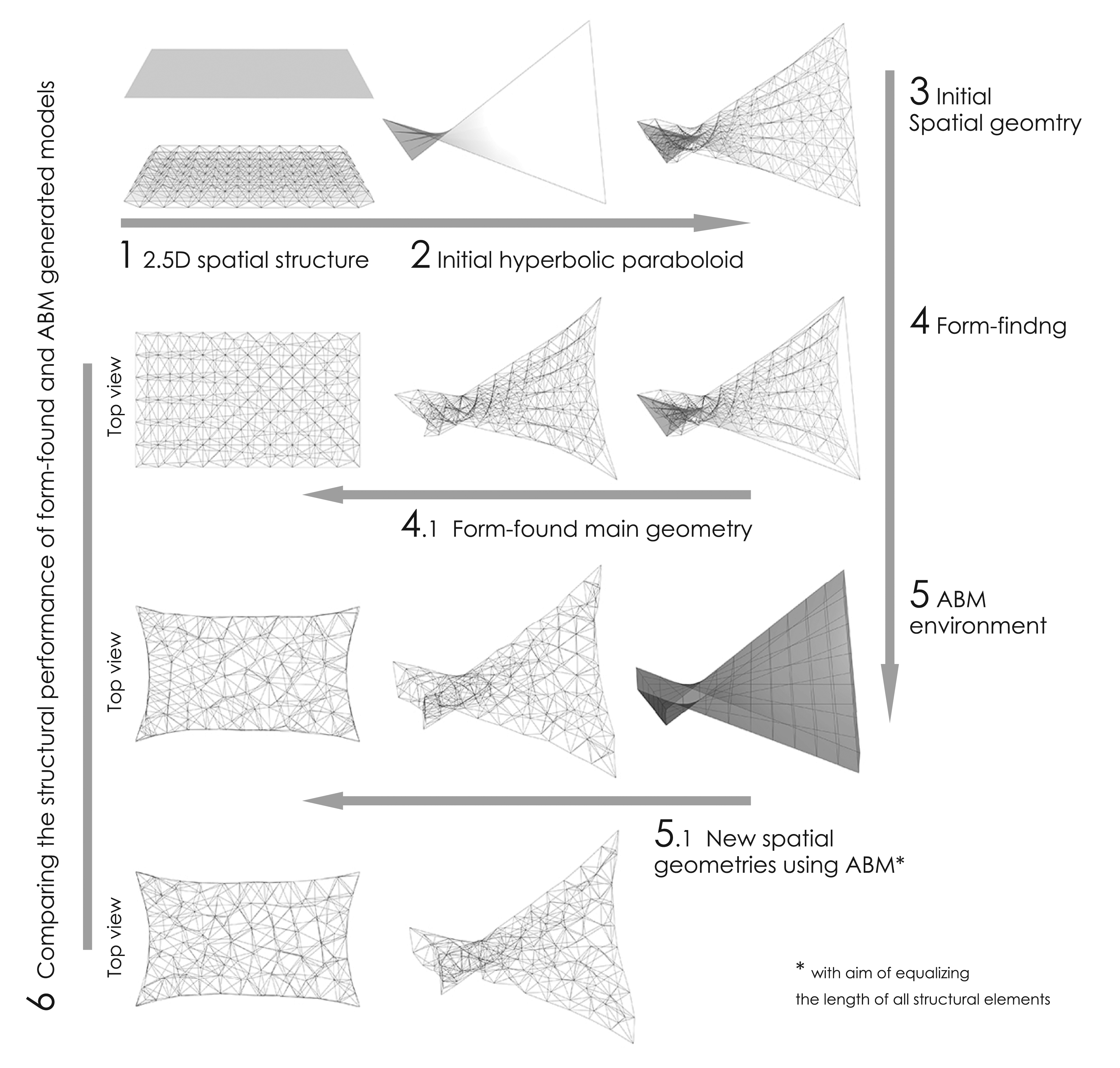
Initial spatial geometry and form-finding process
The process for determining the geometry of the hyperbolic structure is described next. Figure 2 shows the dimensions first of the initial flat spaceframe, and then as a hyperbolic form. Next, a form-finding process based on the Force Density Method (FD) is applied to the hyperbolic form using the HALO add-on in Grasshopper.
40
The form-finding is based on an initial weight of structural elements, with the goal of increasing the stiffness in response to self-weight. As shown by the calculated eigenvalue of the stiffness matrix for the initial and form-found geometry, the stiffness of the structure is improved considerably. However, this process also increases the deviation of element lengths compared to the stage before form-finding. Form generation and form-finding of the case study.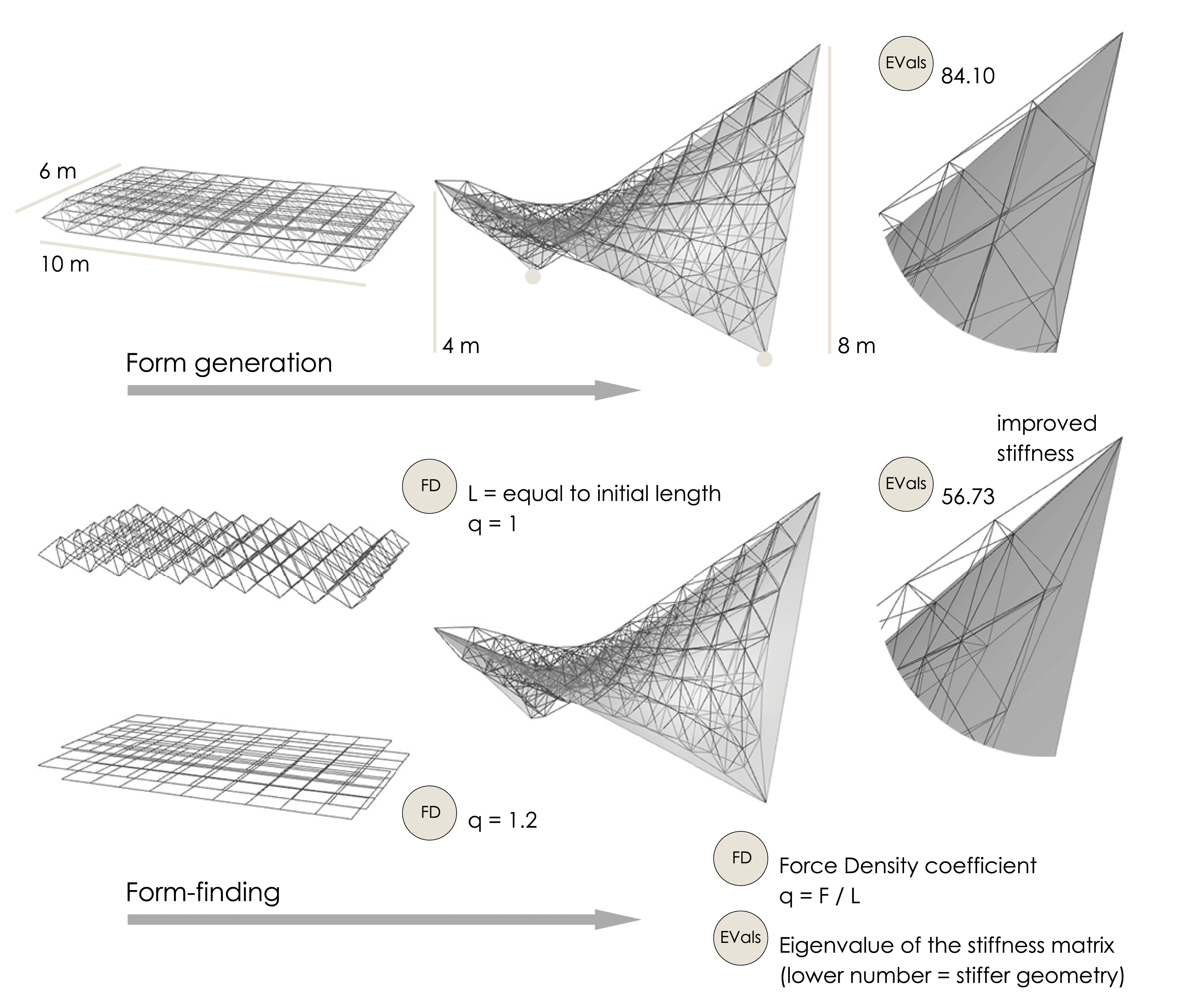
The change in element length variability frequently occurs in many spatial form-finding projects. In some cases, new external rules can be added to a form-finding process to reach preferred answers. For instance, the authors initially investigated adding vector-based criteria to a dynamic relaxation form-finding procedure as an alternative to the ABM approach in this paper. As they alter the pure form-finding process, these methods were unable to correctly satisfy all desired outcomes for this spatial case study. On the other hand, some layout optimization methods 41 can be used and the effect of these algorithms on reaching same length of elements can be investigated as well. Considering all the possibilities, in this current research, the potential of ABM to address these problems is investigated. After the form-found shape is determined, its 3D boundary representation was used as a parent environment for ABM. As a result, the ABM-generated designs have equal height of structures and similar total length of elements, even as the structural performance and other characteristics may vary.
Agent-based modelling
For a system to be agent-based and result in emergent outputs, it is necessary to pre-define agent knowledge, which is used to make decisions. 42 Such systems contain an environment, objects, agents, relations between all entities, and variables to change the universe in real-time. 43 In general, an “agent” is a computational mechanism with a high degree of autonomy, and its actions will be defined based on environmental information such as sensors and feedback. In the agent-based visualization process, and according to the features of such a dynamic system, each determination leads to a series of vectors that move all agents forward until they reach their goal. The simple rule for a group of agents in this study, who are acting in an integrated system, is to locate at a particular distance to each close neighbor.
In the proposed framework, shown in Figure 3, agents occupy the environment while reacting to the external objects to avoid or engage with fluctuating strengths and parametric inputs defined by the user. The number of agents (nodes), reference distance, and emitter points locations are the system’s main inputs. The velocity parameter controls agent reactions to adjacency, and the number of links defines the agents’ vision. Moreover, the defined boundary limits the agents’ behaviors regarding the environmental force velocity explored by the user. The final output of an agent-based model is emergent, relying on the initially defined inputs. The outputs of each running loop are lists of points (agents) and links (lines connecting neighboring agents). The links are monitored on whether they satisfy the project objectives, or if the parameters should be further explored. As shown in Figure 3, the system modifies the agent’s location such that the links length distribution and data standard deviation stay minimized. The parameters such as fixed nodes, obstacles, and attractors assist the system performance if needed. For this paper, the framework was implemented in custom C# components embedded within Grasshopper. ABM flowchart for modifying the structure.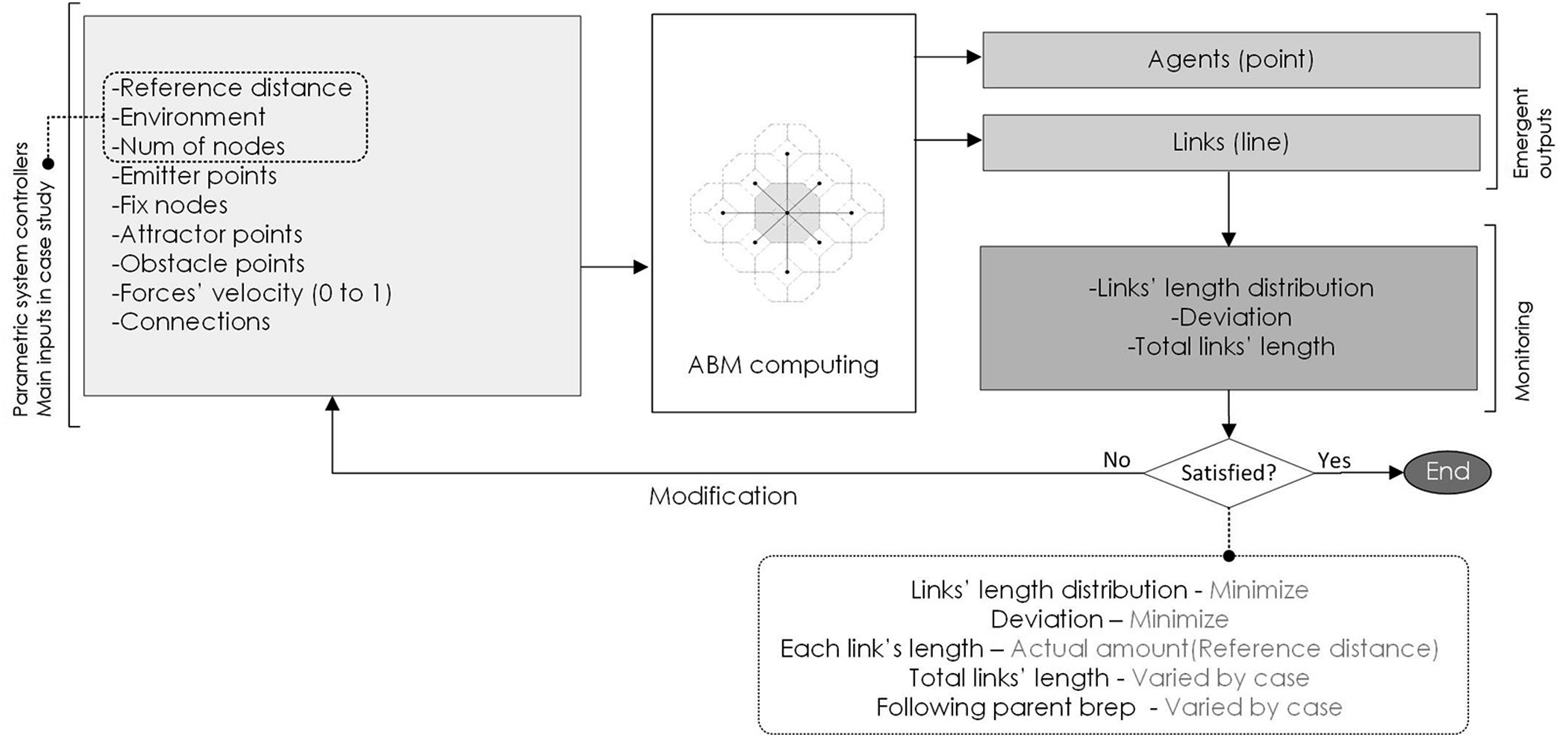
Due to its implementation within a parametric geometry environment, ABM here enables the multi-agent optimization process and a graphical workflow for investigating outputs (see Figure 4). In this study, a series of add-on components were developed as GhPython scripts that implement each step of the ABM optimization in a hierarchy. The agents are controlled by parameters enabling management of the environment, neighboring, and the effect of external objects on their behaviors. Any behavior responding to the neighborhood (agents, environment borders, and the external points) ends in the creation of a vector; the whole process follows the determination and effect of the vectors through a mass vector calculating each agent’s movement. A loops counter shows how many times these vectors are created and subsequently move agents’ positions in the real-time optimization process. ABM rules and properties.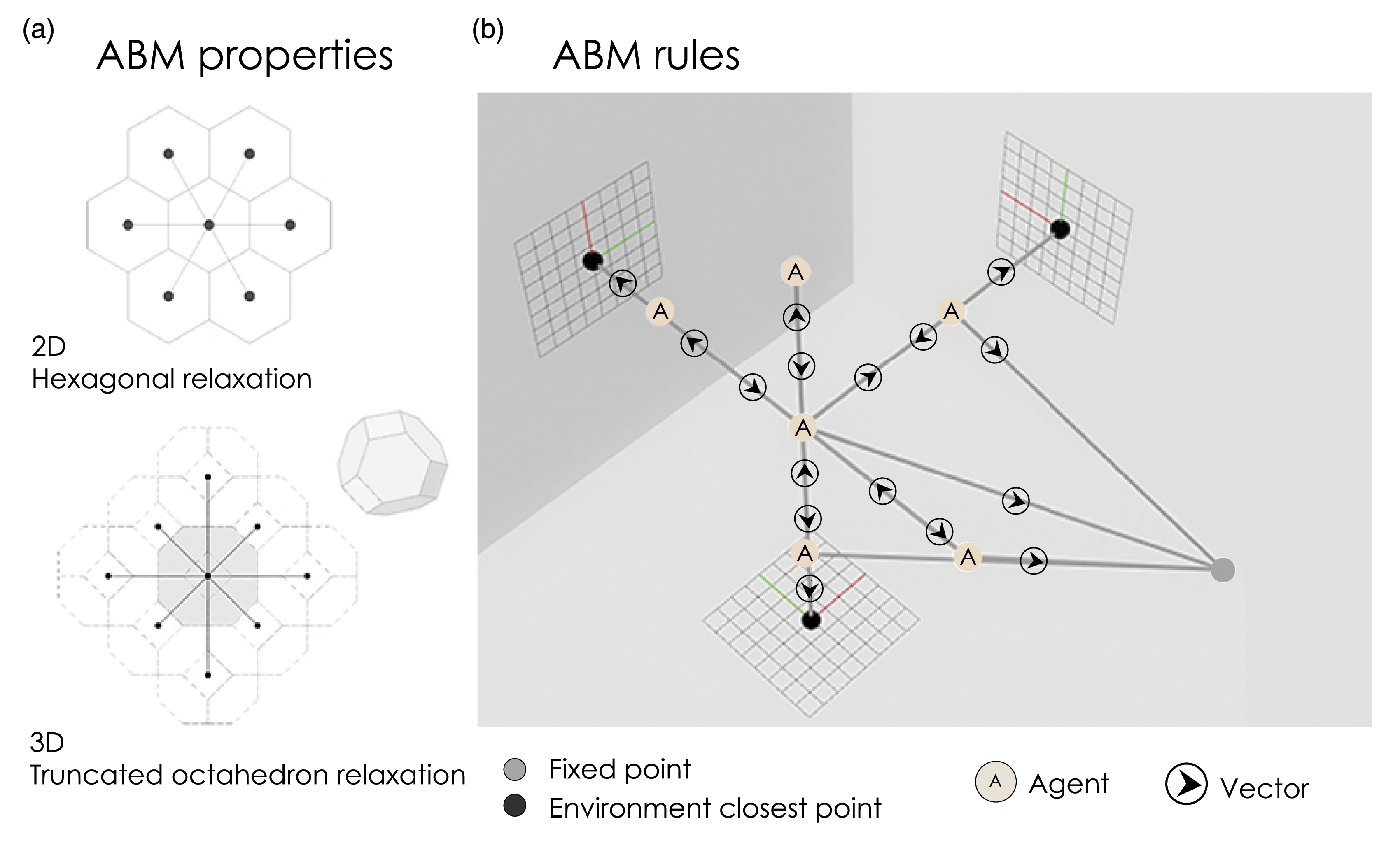
The ABM approach makes use of a space-filling polyhedron, called a truncated octahedron, which enables space tessellation of the parent form. As shown in Figure 4, the truncated octahedron has 14 faces, including square and hexagonal geometries, and it shapes eight and six equal distances to the 14 homogeneous neighboring while occupying the space. Therefore, the eight closest neighbors are taken as the maximum amount for equalizing the linkage. A version of this spatial optimization is shown in Figure 5, in which the reference shape for tessellation is hexagonal, with six maximum neighboring connections. The proportion of the environment shape as the parent form to the volume and radius of the relatively scaled octahedron or hexagonal hints at the number of parameters to explore while running or modifying the ABM procedure. As a result, there is a simple relationship between the number of nodes and reference link length. Therefore, defining either nodes number or reference distance will define both, and only one needs to be entered into the system as input. The ABM process shown in Figure 5 used eight random locations to emit 34 nodes in a 3D space. Defining the reference distance, the algorithm placed the emitted nodes at equal distances from the neighbors. The elements (links) will be generated in a final step of the process emphasizing the margin of error from the references distance. ABM computation example with different steps of reaching the reference distance based on defined rules.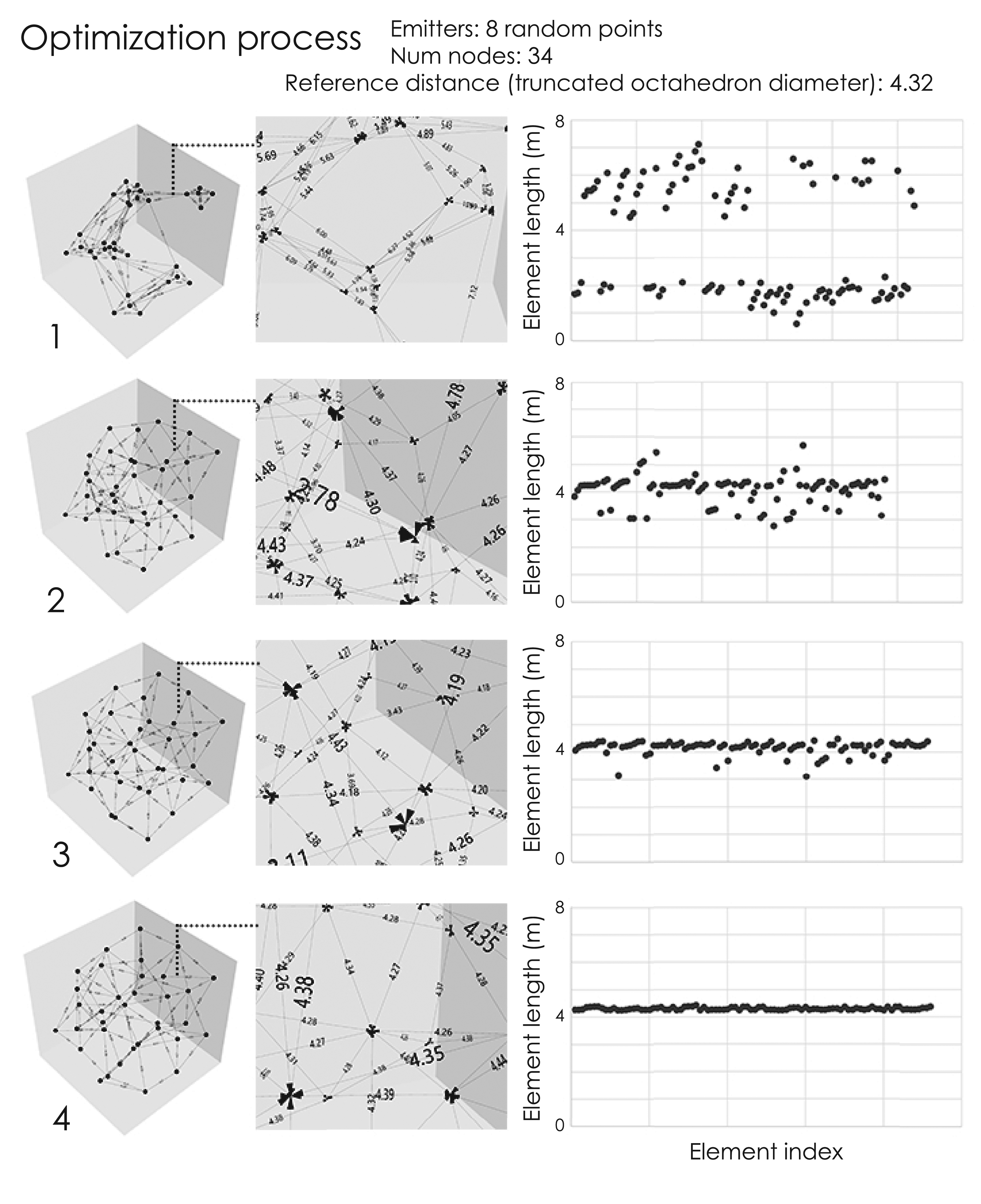
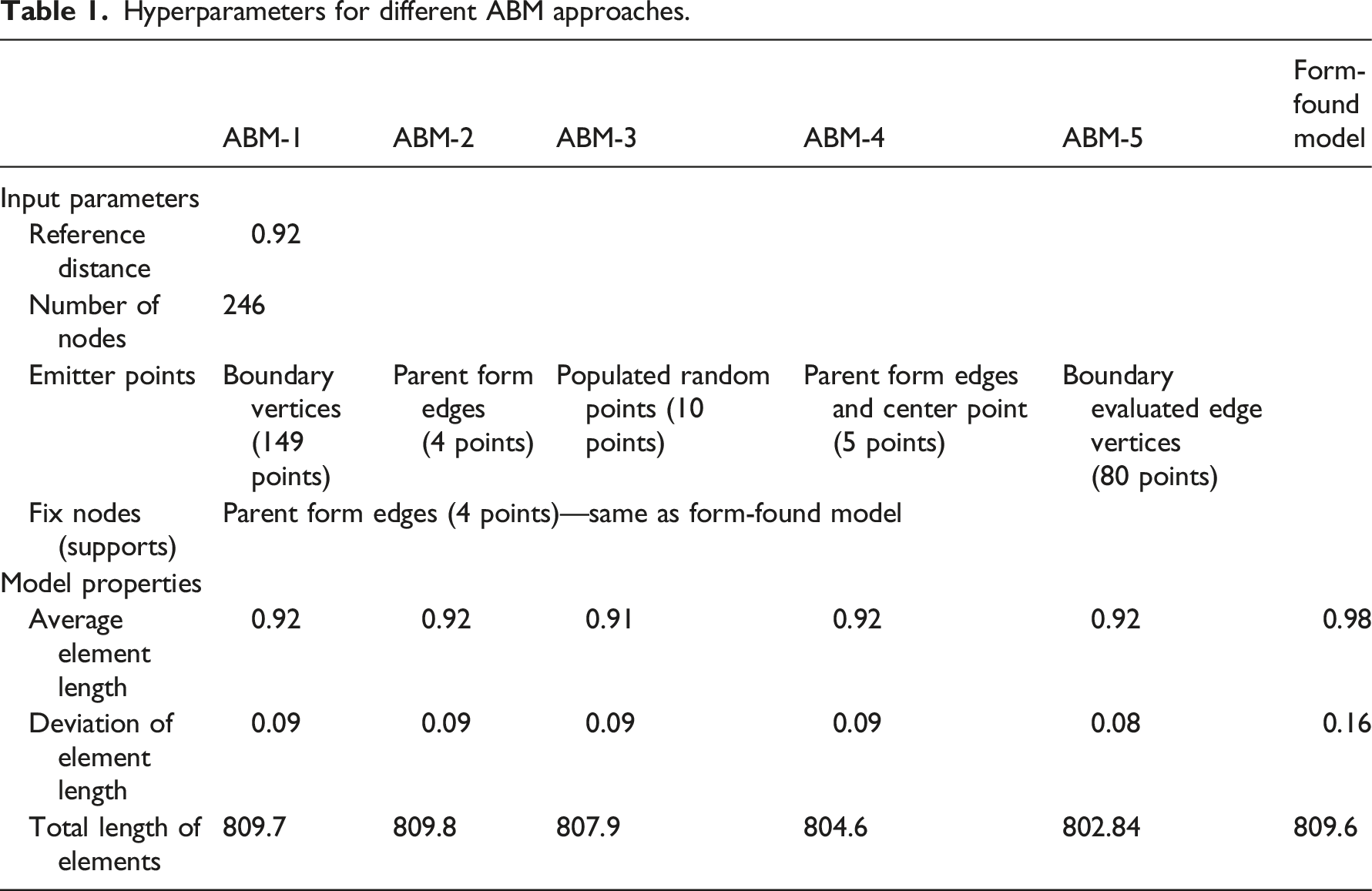
Hyperparameters for different ABM approaches.
Structural performance comparison
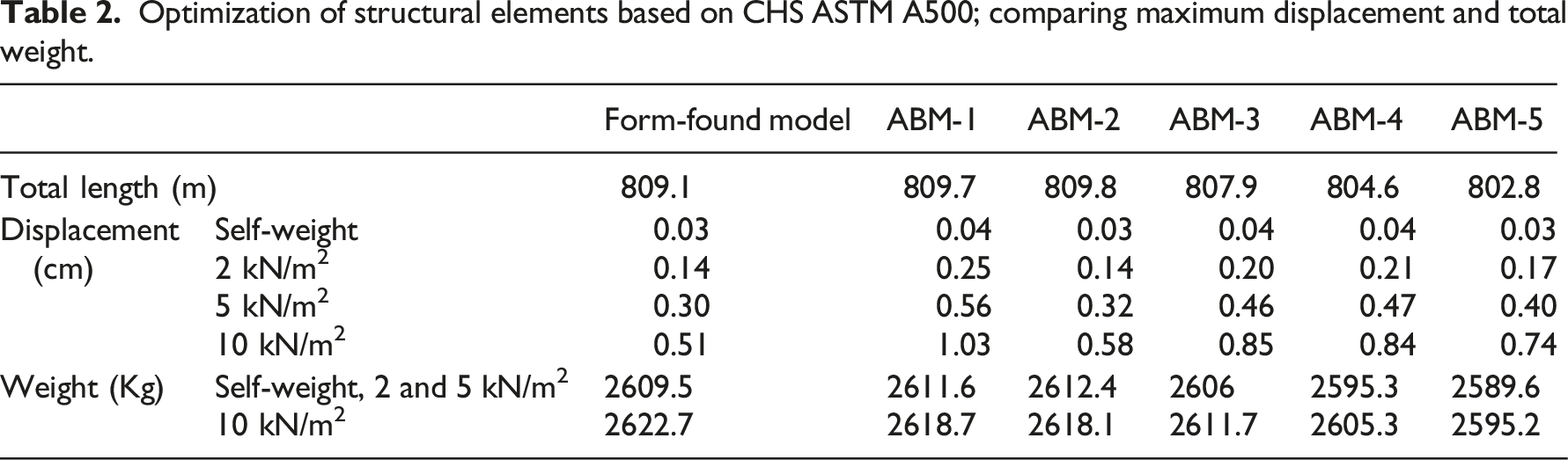
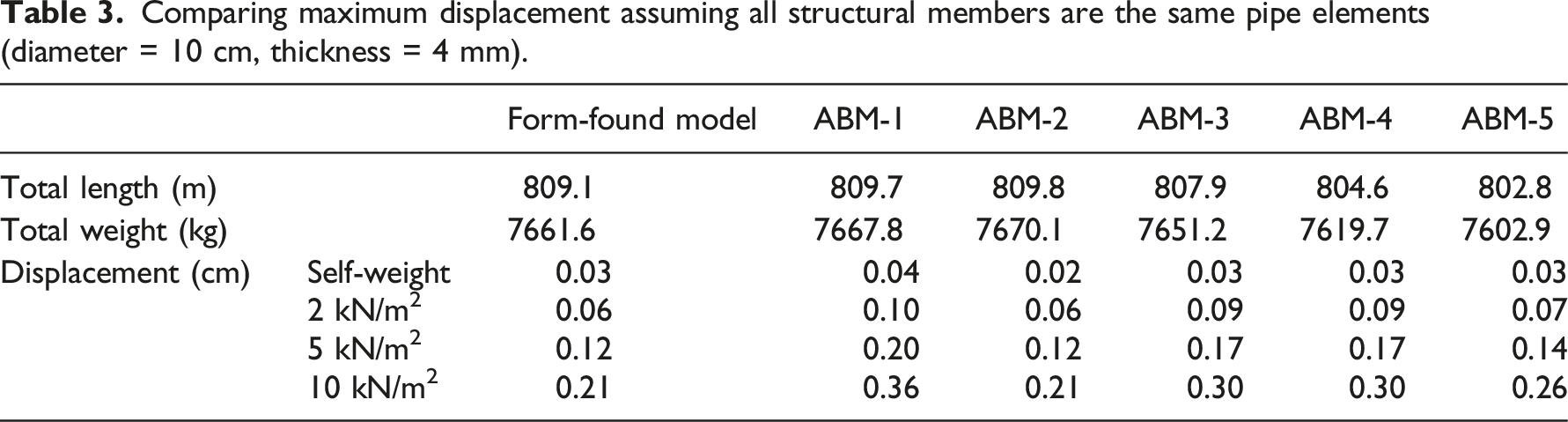
Once all geometries were generated, their structural performance was simulated using the finite element modeler Karamba3D. 44 Each model was subjected to self-weight and an external loading of 2, 5, and 10 kN/m2 distributed on just the upper nodes of each model. A projected tributary area was used to convert the external area load to point loads. Cross-sections were assumed to be designed in two different scenarios, which are both detailed in the results. First, the structural design was done using similar pipe-shaped struts for all spatial elements. In this scenario, all cross-sections are similar with the assumption of a single section size being available, either from a kit of parts or a previously disassembled structure with homogeneous elements. In the other scenario, the finite element modeler performed optimization of cross-sections using a standard pipe table. The maximum displacement of each model was calculated, along with the distribution of stresses and displacements among the entire structure. All structural information is provided in the results, alongside the resulting elements length distributions of each model.
Results and discussion
Figure 6 shows all resulting geometries from form-finding and ABM, along with a box and whisker plot of the distribution of element lengths for each model. Figure 7 presents a closer look at patterns in the element length distribution between the models, indicating the percentage of elements that fall within 10% of the target length. This result would be consistent with a structural system in which the nodes are flexible and can accept members of slightly different lengths based on the connection type, but beyond a given threshold, the variation cannot be tolerated by the system. From these two graphs, although the ABM-generated models have a more irregular global pattern, they can reduce the element length variation from both the original hyperbolic form and the form-found geometry. The resulting element lengths are not identical—further optimization of the ABM hyperparameters could result in even more evenly distributed elements. The proposed ABM framework is highly focused on obeying the defined boundaries of the parent form to distribute the agents within an actual initial environment. Consequently, the system performance depends on the complexity of the environment. Different emergent outputs of ABM compared to initial and form-found models. The overall element length variation of different ABM models compared to the initial form-found case study. 81–84% of elements are in the 10% error range of reference length.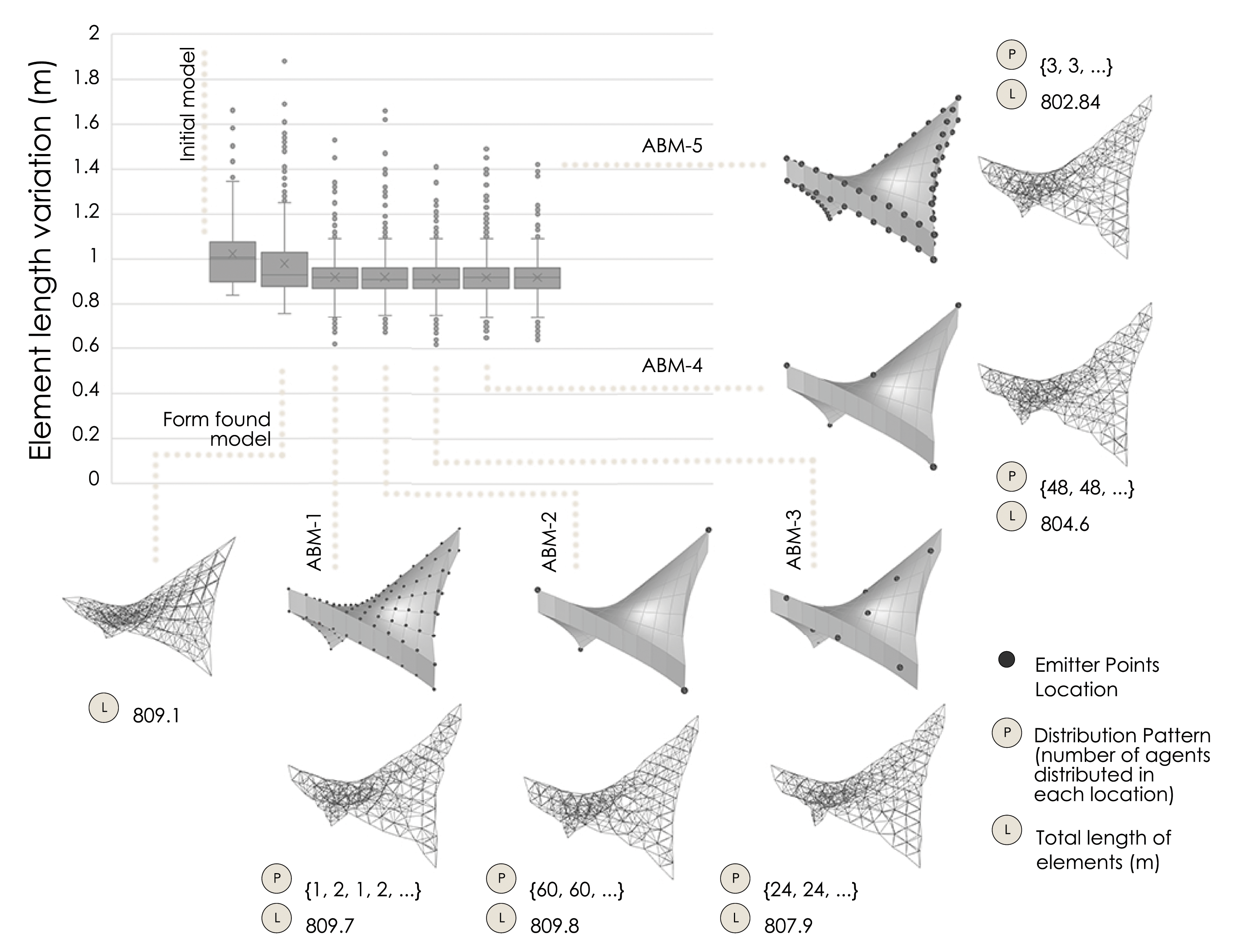
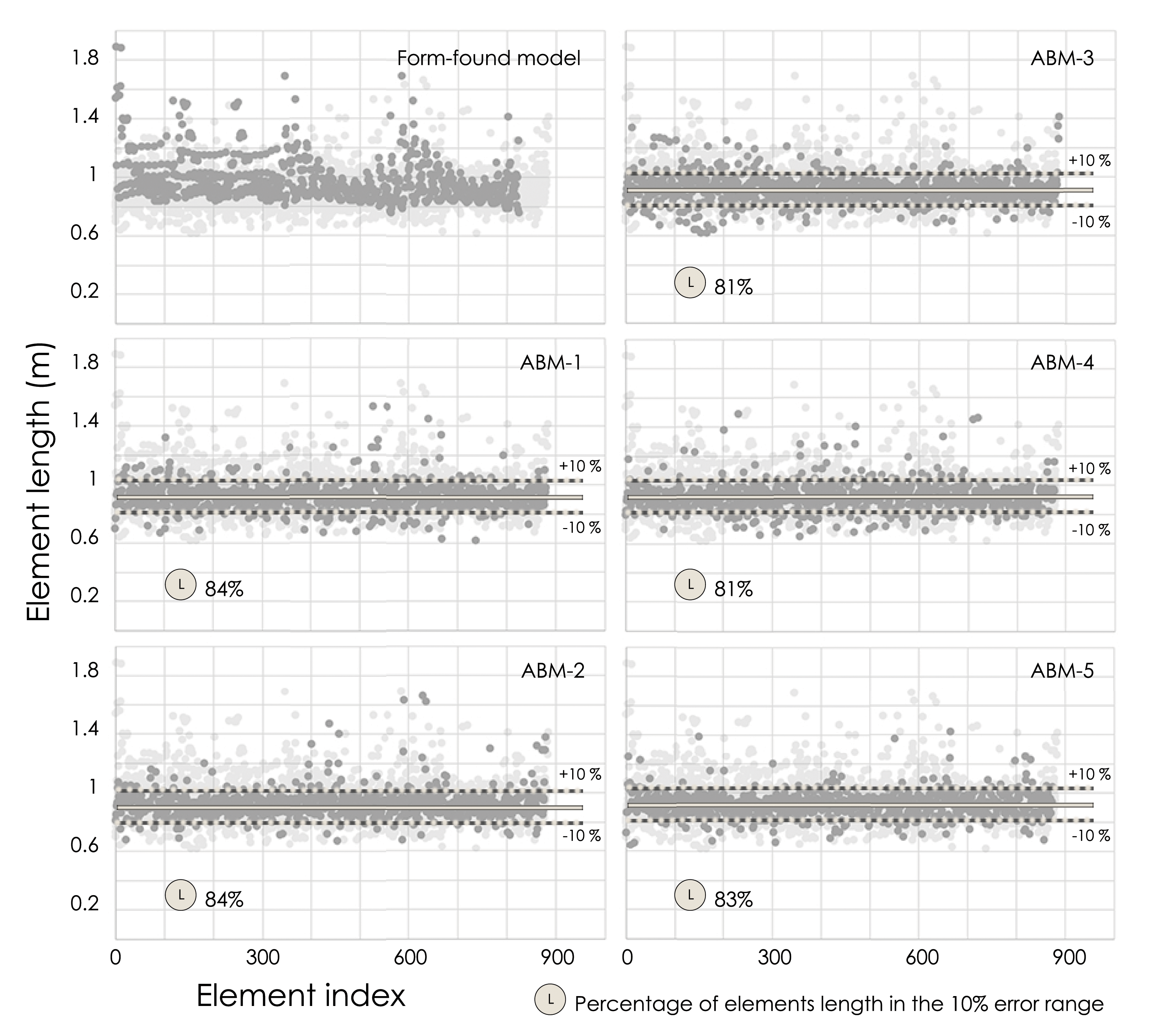
For instance, as tested in a developing step (see Figure 5), considering a regular cube (characterized by 90-degree edges and flat faces) as the parent form resulted in 99% accuracy for equalizing links’ length and satisfying the reference distance. However, in our current hyperbolic paraboloid case studies (ABM-1–5), the complexity of the shape reduced the accuracy to 80–85% of elements within a 10% margin of error. Moreover, the limitation of setting up at least two shared characteristics among all models (form-found and ABMs) to verify the structural comparison step, led the ABM to face some challenges for obtaining the 0.92 m for each connection. It is hypothesized that moving forward from a current back and forth “discrete design exploration” process to “optimization” of the ABM’s hyperparameters will significantly increase the accuracy of the model. Despite future possible improvements in the hyperparameters, the case study results clearly show that increased complexity in the problem definition can influence the performance and practicality of an ABM approach.
Optimization of structural elements based on CHS ASTM A500; comparing maximum displacement and total weight.
Comparing maximum displacement assuming all structural members are the same pipe elements(diameter = 10 cm, thickness = 4 mm).
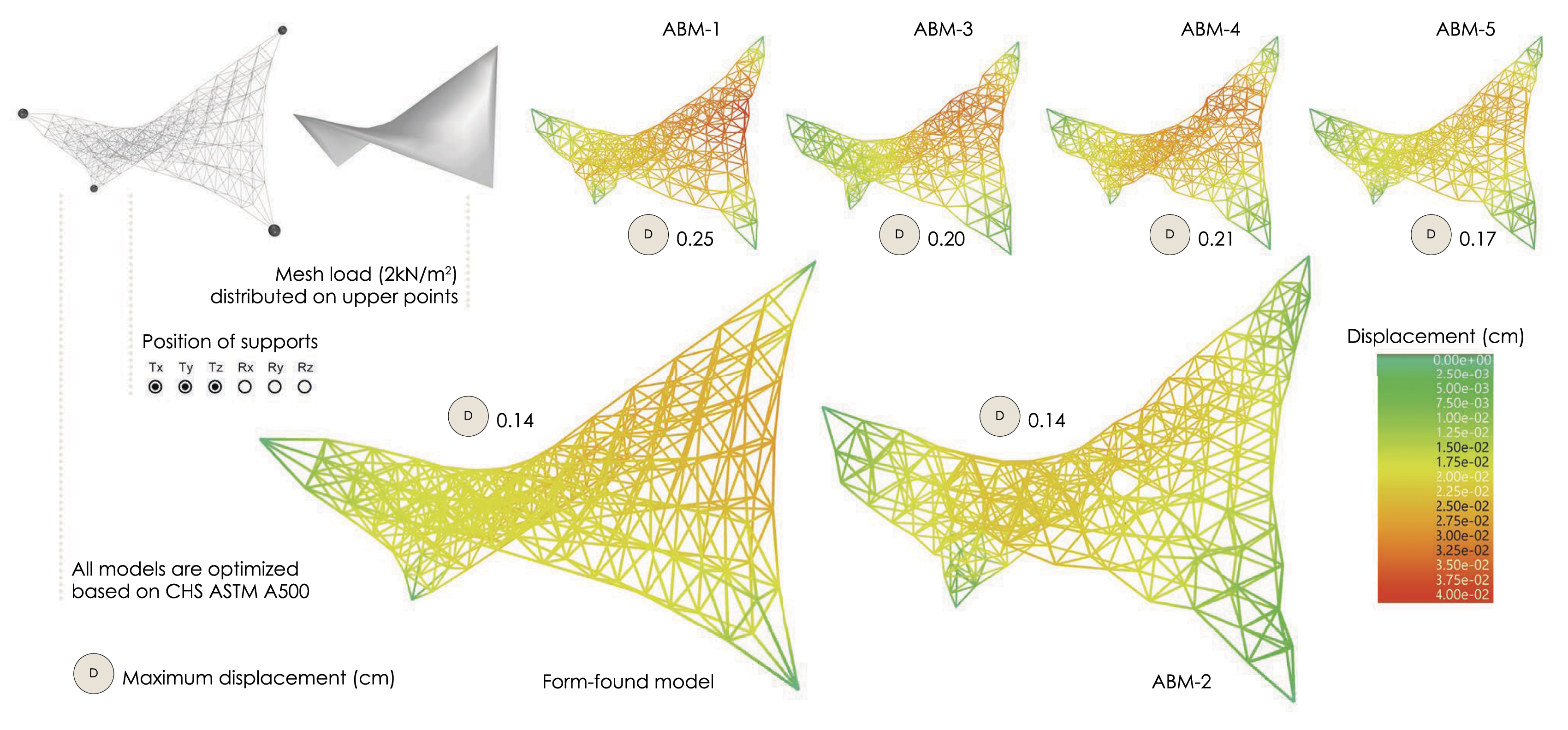
Comparing structural performance and elements displacement (loading scenario = 2 kN/m2).
Conclusion
This research investigated the potential application of ABM in the optimization of spatial structures. Contributions include the implementation of ABM in a design environment where it could be combined with form-finding and the demonstration of ABM on a structural design case study. The results show that ABM can provide a workflow for adjusting designs toward equalizing lengths of different elements, although a process for tuning hyperparameters of the system is likely required to improve goal affinity. This approach will be useful for more straightforward construction of spatial structures in which elements are of similar lengths, but the nodes themselves may be flexible, such as when using disassembled elements from an old structure. However, the downsides of adding more complexity to the structural system should also be investigated. Overall, ABMs are complex, yet they can operate on simple rules, offering potential for solving design and optimization questions such as the structural optimization approach in this paper.
Upon completion of these experiments, there are several future research directions involving the ABM conceptual framework and structural design. First, better definition and tuning of the hyperparameters is necessary, as they play a significant role in achieving a desirable answer using ABM. Hyperparameter tuning can be addressed in future research by performing optimization on the parameters themselves. However, having such a step in a typical design process adds complication, which may limit its utility. From a fabrication perspective, other constraints can also be integrated into the optimization process, such as the minimum and maximum valency (degree) of the nodes to simplify the connections or constraining the angles of the neighbor links (edges) to a set of angles to rationalize the construction process. Finally, in the current stage, structural performance improvement is tested at the end of the generation of the geometries using specific case studies. An investigation of a broader range of geometries (different shapes or roofs, and spatial structures) is needed to prove that the current defined ABM algorithm would have the same impact on other geometries. Nevertheless, this paper provides an initial implementation of ABM suitable for structural design problems and reveals key advantages of this design method.
Footnotes
Declaration of conflicting interests
The author(s) declared no potential conflicts of interest with respect to the research, authorship, and/or publication of this article.
Funding
The author(s) received no financial support for the research, authorship, and/or publication of this article.
