




Abstract
The article examines the impact of the virtual public sphere on how urban spaces are experienced and conceived in our data-driven society. It places particular emphasis on urban scale digital twins, which are virtual replicas of cities that are used to simulate environments and develop scenarios in response to policy problems. The article also investigates the shift from the technical to the socio-technical perspective within the field of smart cities. Despite the aspirations of urban scale digital twins to enhance the participation of citizens in the decision-making processes relayed to urban planning strategies, the fact that they are based on a limited set of variables and processes makes them problematic. The article aims to shed light on the tension between the real and the ideal at stake during this process of abstracting sets of variables and processes in the case of urban scale digital twins.
Keywords
Introduction: The myths of digital universalism and data universalism
The article examines the critiques of ‘digital universalism’, reflecting upon the role of urban scale digital twins in data-driven decision-making concerning urban policies and urban planning. It also explores how Manuel Castells’s theory could help us better understand the relationship between big data and urban planning in our data-driven society and the new kind of temporality that emerges in the so-called ‘network society’.
The point of departure of this article is the necessity to shape methodological tools offering the possibility to develop new forms of social advocacy around big data. Its main objective is to explore how the intensification of the use of urban scale digital twins for decision-making in urban planning makes indispensable to investigate the risks that digital universalism and the use of big data entail. At the centre of this article is the idea that when working with big data thinking locally means thinking critically. This goes hand in hand with the recognition of the significance of shaping approaches that aim to enable us to reveal the specificities and implications of the local contexts in which data are created. When we study how data are collected and instrumentalized, it would be useful to bear in mind Christine L. Borgman’s remark that ‘entities become data only when someone uses them as evidence of a phenomenon, and the same entities can be evidence of multiple phenomena’. 1
How big data are collected: Topological perspectives on urban data and critical data studies
Dietmar Offenhuber and Carlo Ratti mention, in their introduction to Decoding the City: Urbanism in the Age of Big Data, that the ‘term big data refers to the availability of massive amount of machine-readable information’. 2 They refer to a quantitative approach in the field of social science that is focused on the analysis of big data, which is known as computational social science. Additionally, they place particular emphasis on the emergence of the field of network science, which focuses of the investigation of complex networks. The questions raised within the field of network science, and, especially, in Manuel Castells’s work are related to the transition from spatial perspectives on urban data to topological perspectives. Michael Batty and Manuel Castells have been playing a protagonist role in the debates concerning the topological perspectives on urban data. A key question in the field of the critical data studies is that concerning the ways in which big data are collected, as well as the impact of the local conditions of their creation on our research. Some other issues that are at the centre of the critical data studies are the following: firstly, the analysis of the extent to which sense data are an operational part of an economic system; secondly, the questioning around which social groups take advantage of the creation of big data. 3
A notion that is of great significance for this endeavour to take into account the aforementioned principles is that of ‘local reading’, that Yanni Alexander Loukissas has explored in his work, including his article entitled ‘Taking Big Data apart: Local readings of composite media collections’ published in 2017 in Information, Communication & Society 4 , and his recently published book entitled All Data Are Local: Thinking Critically in a Data-Driven Society. 5 The following principles from which Loukissas departs, in the aforementioned book, are useful for better grasping the weaknesses of ‘digital universalism’: all data are local; data have complex attachments to place; data are collected from heterogeneous sources; data and algorithms are inextricably entangled; interfaces recontextualize data; and data are indexes to local knowledge. 5
The critiques of ‘digital universalism’
During the last years, there has been increasing criticisms of ‘digital universalism’. The critiques mainly argue that ‘digital universalism’ is a ‘myth’, placing particular emphasis on the dangers and risks that its intention to achieve a comprehensive representation and knowledge of phenomena entails. The weaknesses of ‘digital universalism’ are related to the fact that it is based on theoretical assumptions, on the one hand, and on the use of a limited set of variables and processes, on the other. In parallel, another disadvantage of ‘digital universalism’ is the fact that data and information on which it is based are necessarily curated.
The myth of ‘digital universalism’ is based on the false conviction that ‘once online, all users could be granted the same agencies on a single network, all differences could dissolve, and everyone could be treated alike’. 6 As Loukissas highlights, ‘[i]f left unchallenged, digital universalism could become a new kind of colonialism in which practitioners at the “periphery” are made to conform to the expectations of a dominant technological culture’. 7 To challenge ‘digital universalism’, certain scholars such as Stefania Milan and Emiliano Treré call for a ‘de-Westernization of critical data studies’. 8 Feng Xia, Laurence T. Yang, Lizhe Wang and Alexey Vinel have defined the Internet of Things as ‘the networked interconnection of everyday objects, which are often equipped with ubiquitous intelligence’. 9 Benjamin Bratton, in the chapter of his book entitled The Stack: On Software and Sovereignty devoted to ‘City Layer’, remarks that ‘for Stack urbanism, mobilization precedes and supersedes settlement’. 10 Useful for understanding that the evangelism that accompanies the discourse around smart cities is not something new but has a long history is the remark of Bratton that ‘[w]ell before smart cities evangelism, the modernist call for a more intense technologization of design’ s disciplinary doxa, blending urban and cybernetic programs, was a predominant discourse’. 11 According to Loukissas, ‘[a]spiring to the ideology of big data means seeking to collect everything on a subject, downplaying the importance of data’s origins, and assuming that data alone can entirely supplant other ways of knowing’. 12
The transition from technical to socio-technical perspectives of understanding urban data
An important shift within the field of smart cities that should be taken into account is the transition from the technical to the socio-technical perspective. 13 For instance, several scholars, such as Simon Joss, Frans Sengers, Daan Schraven, Federico Caprotti and Youri Dayot have shed light on the fact that the concept of smart city should be related to an effort to reveal ‘multiple dimensions beyond an infrastructure-technology focus’. 14 A term that is relevant for the questions addressed in this article and is dominant in the current debates about big data is that of ‘data universalism’. As Stefania Milan and Emiliano Treré maintain, in ‘Big Data from the South(s): Beyond Data Universalism’, the myth of ‘data universalism’ refers to ‘the tendency to assimilate the cultural diversity of technological developments in the Global South to Silicon Valley’s principles’. 15 Milan and Treré criticize the ‘hyperbolic narratives of the “big data revolution”’, 16 arguing that ‘the main problem with data universalism is that it is asocial and ahistorical, presenting technology […] as something operating outside of history and of specific sociopolitical, cultural, and economic contexts’. 17 A key question they intended to address is the following: ‘how does datafication unfold in countries with fragile democracies, flimsy economies, impending poverty?’. 16 The uneven access to the technologies and data that make possible smart cities and urban scale digital twins should be seriously taken into account if we wish to go beyond the myth of ‘data universalism’. Regarding the issue of this uneven to the technologies and data, Simon Joss, Frans Sengers, Daan Schraven, Federico Caprotti, and Youri Dayot have shed light on the ‘competitive dynamics created between world cities posited as “model” smart cities and various second- and third-tier “follower” cities’. 18
Urban scale digital twins and the establishment of real connections between the virtual and the real
‘Digital twin’ is a term used to refer to the digital representation enabling comprehensive data exchange and can contain models, simulations and algorithms describing their counterpart and its features and behaviour in the real world. A ‘digital twin’ is a digital representation of a physical process, person, place, system or device. The term ‘digital twin’ firstly emerged in the field of manufacturing sector. It was first coined in the early 2000s by Michael Grieves and refers to digital simulation models that run alongside real-time processes. 19 ‘Digital twins’ are conceptualized as digital replicas of physical entities. Digital twins become possible thanks to the use of technological advances as sensing, processing, and data transmission. Digital twins apart from the field of urban analytics, they are also used in the domain of the so-called computational social sciences. ABI Research forecasts that urban digital twin deployments will exceed 500 by 2025. According to Michael Batty, ‘[t]he idea of the digital twin […] has emerged from the representation of the city in terms of its physical assets’. 20 What is worth mentioning is that the digital twins are able to get updated following the changes of the physical equivalents. This becomes possible thanks to the pairing between the virtual and the physical world. To understand what is the main idea behind the creation of digital twins, we should bear in mind that ‘[a]n ideal digital twin would be identical to its physical counter-part and have a complete, real-time dataset of all information on the object/system’. 21
Recently, within the domain of urban planning and more particularly within the field concerning smart cities design, the notion of urban scale digital twin has acquired a central place. Li Deren, Yu Wenbo and Shao Zhenfeng, in their article entitled ‘Smart city based on digital twins’, analyse the relationship between digital twins and smart cities. 22 Introducing their article, they define the ‘digital twin’ as a ‘simulation process that makes full use of physical models, sensors, historical data of operation, etc. to integrate information of multi-discipline, multi-physical quantities, multi-scale, and multi-probability’. 22 They also highlight the fact that the current debates concerning the notion of digital twin are characterized by plurality of how this concept is understood. Characteristically, they remark that ‘a consensus definition has not yet been formed’. 22 The common denominator of the different definitions of the term is the shared interest in the ‘bi-directional mapping relationship that exists between physical space and virtual space’. 22 Of great importance for this article is the fact that the creation of digital twins is based on the intention to establish ‘real-time connection[s] between the virtual and the real’. 22 In the case of digital twins, the digital models, apart from for ‘observing, recognizing and understanding’ 23 the physical world, they also aim to control and transform it.
The potentials of urban scale digital twins lie mainly in their capacity to monitor activities in the city and to use the data of monitoring for shaping more efficient and more sustainable design solutions. The data that can be monitored through the use of urban scale digital twins can include numerous parameters concerning the urban conditions, such as data concerning traffic and transportation, power generation, utilities provisioning, water supply and waste management among other. For instance, Li Deren, Yu Wenbo and Shao Zhenfeng, in ‘Smart city based on digital twins’, refer to the application ‘Smart City Traffic Brain’, which is based on the use of digital twins and collects the big data concerning travel trajectories and ‘real-time dynamic traffic information’. 24
Many scholars, including Martin Mayfield, have highlighted the role of urban scale digital twins in providing a holistic approach to urban and infrastructure design. 25 The debates around the urban scale digital twins are closely related to the research on smart cities and to the debates around big data. A key article for the debates around big data is Anah Boyd and Kate Crawford’s article entitled ‘Critical Questions for Big Data: Provocations for a cultural, technological, and scholarly phenomenon’ published in Information, Communication & Society. 26
As Li Deren, Yu Wenbo, Shao Zhenfeng highlight, in ‘Smart city based on digital twins’, urban scale digital twins are based on the intention to construct ‘a complex giant system between the physical world and the virtual space that can map each other and interact with each other in both directions’. 27 The creation of urban scale digital twins requires continuous generation of ‘massive urban big data’, which becomes possible thanks to the use of ‘various sensors and cameras everywhere in the city, as well as the digital subsystems successively built by the municipal management departments’. 27 Among the technologies that are used to create urban scale digital twins are the Internet of Things (IoT), cloud computing, big data, and Artificial Intelligence (AI). A note-worthy research project is DIGITbrain, which is funded by the European Commission in the framework of Horizon 2020 Research and Innovation Programme (grant agreement number 952,071) and is composed by a consortium of 36 partners, intends to help small and medium-sized European manufacturing companies to develop AI-based digital twins. 28
Before the emergence of the use of big real-time data and AI, the applications that aimed to test parameters related to urban planning decisions were performing more poorly. In the case of traffic light control, AI has not achieved impressive improvements yet, and a flexible local adaptation to short-term-anticipated vehicle arrivals performs surprisingly well in a very resource-efficient way. 29 An interesting case related to the issues that this article addresses is the project of Future Cities Laboratory entitled ‘Engaging Mobility’ led by Dr. Pieter J. Fourie, which focuses on the analysis of current and future urban mobility challenges through travel behaviour research, big data informed simulation, designing and evaluating alternative solutions. 30
Criticizing the term ‘digital twin’: From urban scale digital twins to cyber–physical–social ecosystems
Among the challenges of data-driven approaches are the measurement errors, the biases, the existence of false positives and false negatives, the undesired discrimination effects, the complexity, the network effects, the non-linear dynamics, the wicked problems, and an ensemble of convergence issues. Apart from the aforementioned issues, a problem that should be highlighted is the fact that, in general, the digital twin approaches have been largely ignorant of people and what relates to them. This means that the ways in which the digital twins function often neglect the importance of social interactions, competition and cooperation, social norms, laws and regulations, culture, history, politics, democracy, human rights, ethics and essential non-material qualities. It is, therefore, indispensable to develop approaches that aim to incorporate questions related to the aforementioned aspects in the ways in which urban scale digital twins are created and used. The fact that the role of urban scale digital twins in the decision-making processes concerning urban planning will become even more important during the next years makes the incorporation of aspects related to democracy, human dignity and solidarity in how the urban scale digital twins function even more necessary.
Clare Wildfire, in her article entitled ‘How can we spearhead city-scale digital twins?’, published in Infrastructure Intelligence, distinguishes two categories of benefits of the city-scale digital twins: the reactive benefits, on the one hand, and the predictive benefits, on the other. Wildfire relates the first category of benefits to the capacity of enhancing ‘real-time or near real-time interventions and improve the smooth day-to-day running of the city or asset’, and the second category to the use of data for the improvement of ‘longer-term scenario planning to steer appropriate (and equitable) investment decisions’. 31
Michael Batty, in his editorial entitled ‘Digital Twins’, remarks that ‘one of the quests in city modelling is to merge social and economic processes with the built environment and to link functional and physical processes to socio-economic representations’. 32 The shift from technical to socio-technical perspectives goes hand in hand with the effort to construct urban scale digital twins that aim to ‘reflect the specifics of the urban and socio-political context’. 33 Martin Tomko and Stephan Winter highlight, in ‘Beyond digital twins – A commentary’, that ‘[t]he term “digital twin” has been applied to representations of buildings and aggregations thereof such as precincts or entire cities – as long as these representations preserved aspects of temporal dynamics and self-updating (“4D”)’. 34 In the aforementioned article, Tomko and Winter have criticized the term ‘digital twin’. Their critique departs from Batty’s remark that ‘a computer model of a physical system can never be the basis of a digital twin [i.e. ‘mirror’] for many elements of the real system are ignored in any such abstraction’. 35 Tomko and Winter, in contrast with Batty, have argued that the notion of ‘digital twin’ should be replaced. They suggest that the notion that should replace the term ‘digital twin’ should be ‘cyber–physical–social system with coupled properties’. 34 They claim that this shift in the description of this phenomenon goes hand in hand with a recognition of the fact that digital models do not function exclusively as a ‘passive reflection of a mirror’, 34 but most importantly as systems serving to establish methods of action. They also mention that ‘[t]he coupling also implies that the system to describe is not a purely digital one’. 34 Martin Tomko and Stephan Winter, to render explicit why the term ‘digital twin’ is problematic, remark that ‘the “digital twin” is embodied and immersed in what it is supposed to mirror, and thus is no longer an independent representation’. 36
To understand how ‘digital twins’ can affect urban planning methods, we could bring to mind that ‘[t]he digital side of [the] […] coupled system, however, can react, predict, and act’. 36 An example of how they can serve for predicting and acting is their use for ‘controlling the traffic lights according to traffic, guide by digital signage’. As Tomko and Winter highlight, ‘the digital side of the coupled systems (the “digital twin”) morphs into the physical environment by communication and control, a phenomenon studied by cybernetics’. 36 What makes ‘digital twins’ operative is the ‘bi-directional coupling between the physical artifact and their digital counterpart’, 36 as well as the ‘bi-directional coupling across the digital, physical, and social spheres’. 37 Tomko and Winter, to render explicit the importance of this ‘bi-directional coupling’, use the term ‘coupled ecosystem’ and ‘cyber–physical–social ecosystem’ 38 to refer to the coupling the physical and the digital system. The bi-directional coupling between the real and the digital artefacts becomes possible thanks to the use of ‘snapshot[s] of the current or past representations’, which serve ‘to predict by extrapolation’. 38
Among the technologies that are indispensable for the creation of urban scale digital twins are the following: 5th generation mobile network (5G), Internet of Things (IoT), Edge Computing, Artificial Intelligence (AI) and Big Data (BD). The access to the data that are necessary for the creation of urban scale digital twins is often challenging given the fact that, in certain cases, they come from maps that are not publicly accessible. Nowadays, BD and AI are often treated as universal tools. In parallel, these technologies are usually applied by people with no specialist background. This means that their application goes hand in hand with the consumption of a plethora of resources that are not transparently documented and communicated to the public. It is, therefore, not so clear what is the quality and level of improvement of the applications from the point of view of the citizens who use them. The fact that acquiring the data that are indispensable for the creation of urban scale digital twins are costly and time consuming makes their construction quite challenging. The counter-argument against these difficulties is their capacity to enhance effective decision-making processes at city scale. Despite the fact that the stakeholders that have access to the urban scale digital twins can refine their strategies, the access to the data is far from equal to the large public in most cases.
The cases of Nomoko AG and Smart City Lab Basel
Among the companies that focus on the creation of urban scale digital twins is Nomoko AG. Nomoko AG argues that ‘[t]o make future oriented decisions at city scale, it is important for stakeholders to have a digital representation of their respective city and the ability to interact with it’. 39 The Smart City Lab Basel, which is a joint initiative by SBB and the Canton of Basel-Stadt, is also conducting research on impact of urban scale digital twins on urban planning strategies, placing particular emphasis on the role of logistics and mobility in urban planning decision-making. 40 Nomoko AG is among the contributors to the research conducted in the framework of the Smart City Lab Basel.
As we can read in the introductory section of the website of the company, Nomoko AG’s main objective is to build ecosystems ‘that turns spatial data into real world solutions’. 41 Among the types of data on which Nomoko has focused are the data concerning traffic, pedestrian circulation and consumption patterns. Special attention was paid to juxtaposing the different types of data, integrating ‘different data sources within a consistent context’. 42 The main objective of Nomoko AG is to render possible to integrate any kind of geo-referenced data in the 3D platform. For this purpose, a workflow is used to generate the data that are used to construct the urban scale digital twins, integrating spatial information from different data sources, such as BIM and data concerning traffic ‘to show the transformation that happens over time’. 42
The cases of the urban scale digital twins of Hervanta in Tampere and Kalasatama district in Helsinki
Urban scale digital twins can also contribute to the establishment of policies aiming to render more efficient several urban intelligence tasks, including, for instance, the management of traffic and power systems. Urban scale digital twins can be used to address climate adaptation and optimization of mobility models. Their role in optimization of mobility models within the framework of urban development is apparent in applications such as this concerning the automatic traffic test area in Hervanta, Tampere
43
(Figure 1). The urban scale digital twin of Hervanta departed from the intention to test parameters related to a public transportation project.
44
The main objective of Hervanta Digital Twin is to provide a platform for testing efficiently methods concerning autonomous driving studies. The creation of this urban scale digital twin was the outcome of a collaboration between the city of Tampere, Sitowise, VTT, and Business Tampere. The main intention of this project is to ‘use […] the Digital Twins in autonomous driving testing and studies, with the focus on innovation, efficiency and quick iterations in conducting studies’. It departs from the hypothesis that the use of digital twins can significantly contribute to the reduction ‘of costs of traditional testing methods in autonomous driving studies’.
45
Digital twin of Hervanta, Tampere. Source: https://www.sitowise.com/customer-story/digital-twins-open-new-world-urban-development.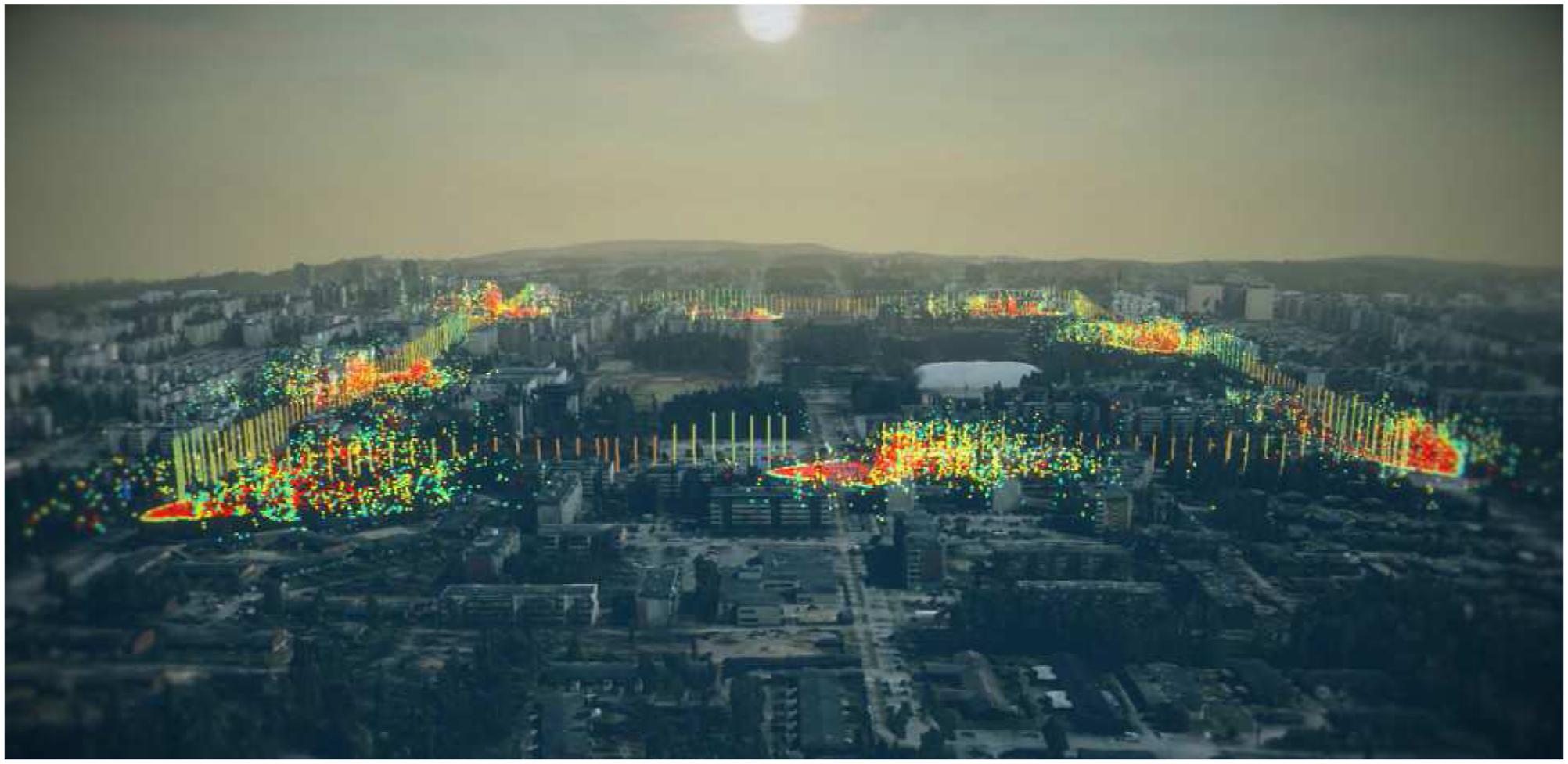
In ‘Urban development with dynamic digital twins in Helsinki city’, Mervi Hämäläinen examines the case of the digital twin of the Kalasatama district. She analyses Open Cities Planner, an application that was developed in the framework of this project ‘to complement and reinforce the usage of the Kalasatama digital twin platform’. This application aimed to familiarize citizens with the use of the data of the digital twin and to enhance ‘participation and interaction among Kalasatama residents’. 46
A case in which the aforementioned application was used to promote the participation of citizens is the ‘public participation GIS (PPGIS) poll’ that intended to explore, through the use of the application, what locations the residents of Kalasatama would recommend to the visitors of the district. Mervi Hämäläinen’s remark that ‘Digital twin platforms were also exploited to integrate citizens into urban development initiatives and activities in Helsinki’ 46 makes us wonder to what extent the use of urban scale digital twins can contribute to establishing participatory design methods. Despite the fact that Hämäläinen argues that the digital twin of Helsinki made ‘design processes more transparent and open’ 46 , in many cases the access of the general public to the digital twins is not possible. This does help to make the design processes more transparent and open. Efforts should be made during the years to come in order to achieve the transparency and openness that Hämäläinen describes.
The digital twin of Kalasatama district also aimed to provide a platform to simulate cases related to wind and solar parameters, including data concerning airflows, shadows, solar rays, and air pressure. The purpose of these simulations is to provide sustainable urban planning solutions, testing the impact of the aforementioned data on the built artefacts.
The case of ‘Digital Urban European Twins’
Another interesting case that is based on the use of urban scale digital twins is the project entitled ‘Digital Urban European Twins’ (DUET) (Figure 2), which is ‘a cooperative endeavour, involving 15 different partners from across Europe’.
47
Another ongoing project that also focuses on the use of digital twins is Low-Emission Adaptive last mile logistics (LEAD).
48
Among the cities that are involved in this project are Madrid, The Hague, Budapest, Lyon, Oslo, Porto, Athens, Antwerp and Pilsen. DUET is based on the intention to experiment with new decision-making processes, using on-demand logistics operations. Through the uses of urban scale digital twins, it explores the potentials of new strategies as far as low-emission logistics operations are concerned. Urban scale digital twins render possible the integration of data and the modelling of possible strategies, a wide variety of solutions for shared, connected, and low-emission logistics operations. DUET alpha version for Athens, Pilsen and Flanders. Source: Lieven Raes, Philippe Michiels, Thomas Adolphi, Chris Tampere, Thanasis Dalianis, Susie McAleer, Pavel Kogut, ‘DUET: A Framework for Building Secure and Trusted Digital Twins of Smart Cities’, IEEE Internet Computing (2021). DOI: 10.1109/MIC.2021.3060962.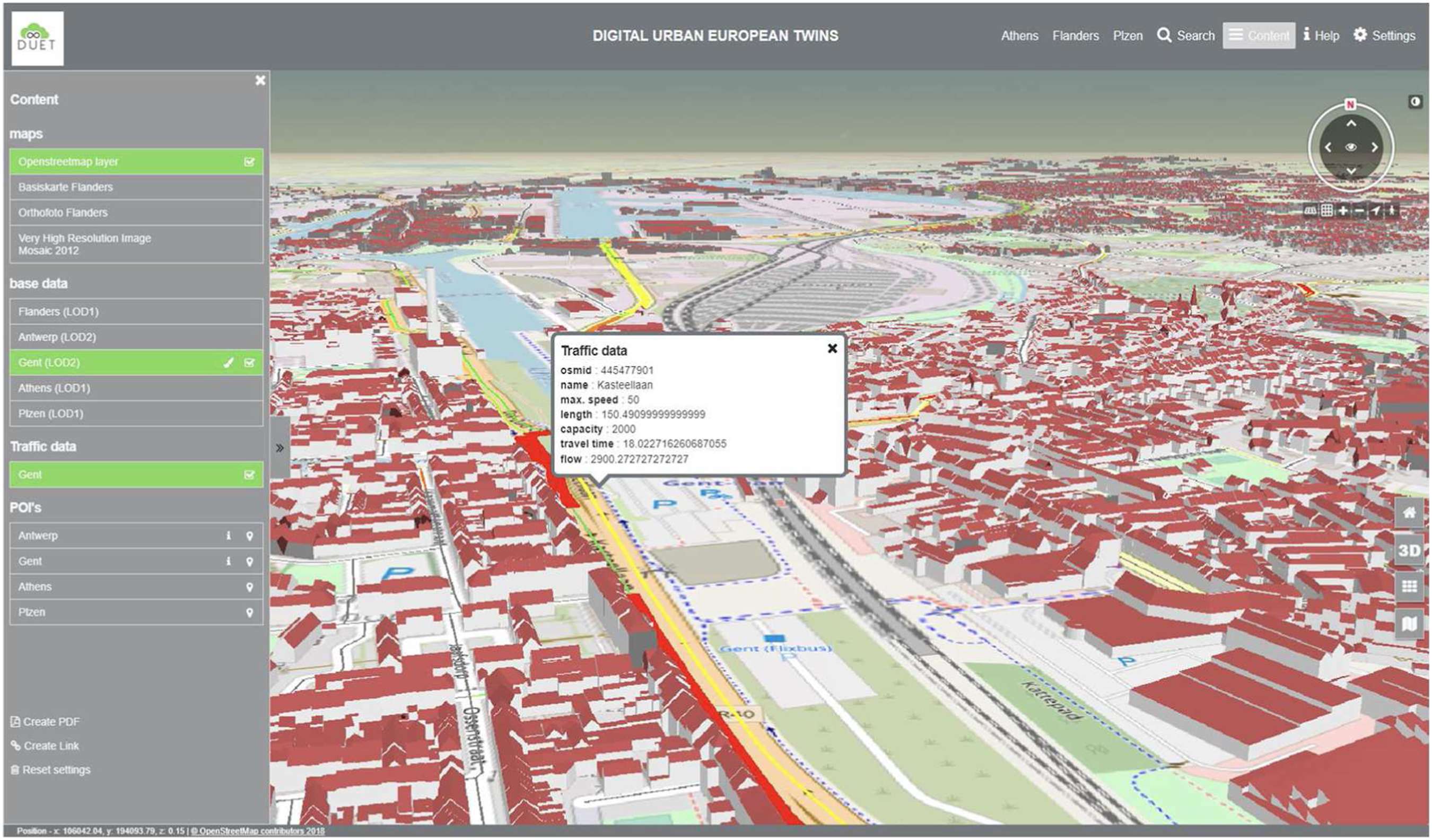
Among the parameters that the urban scale digital twins of the DUET project simulate ate those concerning different traffic, air and noise. Particular attention is paid to the exploration of traffic models, including static, dynamic and a local mobility (Cityflows) models. In order to simulate air quality data concerning traffic volume, road network, wind speed and wind direction are used.
Despite the interest of the project to take into account how citizens perceive urban landscape, trying to render the urban scale digital twins ‘citizen-centric’, the efforts to ‘model citizens by looking at their emotional state’ entail risks given that they are based on significant abstraction and simplifications. While urban scale digital twins seem very efficient in simulating parameters related to sustainable environmental design, they are rather problematic when they intend to simulate ‘how people experience their built environment [in order] […] to develop smart cities in line with evolving patterns and preferences’. 49
The case of ‘Virtual Singapore’
A note-worthy case of urban scale digital twin is ‘Virtual Singapore’. Despite its potential benefits for establishing urban planning agendas and methods, it has not yet been made publicly available. This means that the citizens do not still have the possibility to provide feedback data to it. Another disadvantage of ‘Virtual Singapore’ is the fact that it does not include urban mobility data. The creation of the ‘Virtual Singapore’ platform is supported by the National Research Foundation (NRF), Prime Minister’s Office, Singapore, the Singapore Land Authority (SLA) and the Government Technology Agency of Singapore (GovTech). In the official website that presents the creation of this platform, one can read that it is based on the intention to enhance the following four categories of activities: firstly, virtual experimentation; secondly, virtual test-bedding; thirdly, planning and decision-making, and, finally, research and development. 50
In the case of ‘Virtual Singapore’, special attention was paid to the visualization of the benefits and potentials of solar energy production (Figure 3),
51
and to data concerning demographics, climate and traffic. The ‘Virtual Singapore’ was developed by the French software corporation Dassault Systèmes, which advertised the project as follows: ‘Singapore wanted to develop a smart city environment to plan everything – from emergency evacuation to comfortable urban living’.
52
The name of the urban scale digital twin for Singapore that Dassault Systèmes created is 3DEXPERIENCity. For its creation, real-time data and data collected from various public agencies were used. One of the main goals of ‘Virtual Singapore’ is to achieve more sustainable solutions in terms of urban planning and more efficient energy consumption. In 2012, Dassault Systèmes developed 3DEXPERIENCity solution, which, in April 2013 was enhanced by Archividéo S.A., a company that specializes in three-dimensional (3D) mapping technology. The specific potentials of 3DEXPERIENCity solution lie in the fact that it renders possible a ‘detailed simulation of extremely large-scale environments’.
53
However, one of the issues that are at the centre of this project is the difficulty of acquiring the resources this urban scale digital twin would require in order to be kept up to date.
54
Virtual Singapore. Solar Panel Production. Source: National Research Foundation, Prime Minister’s Office Singapore.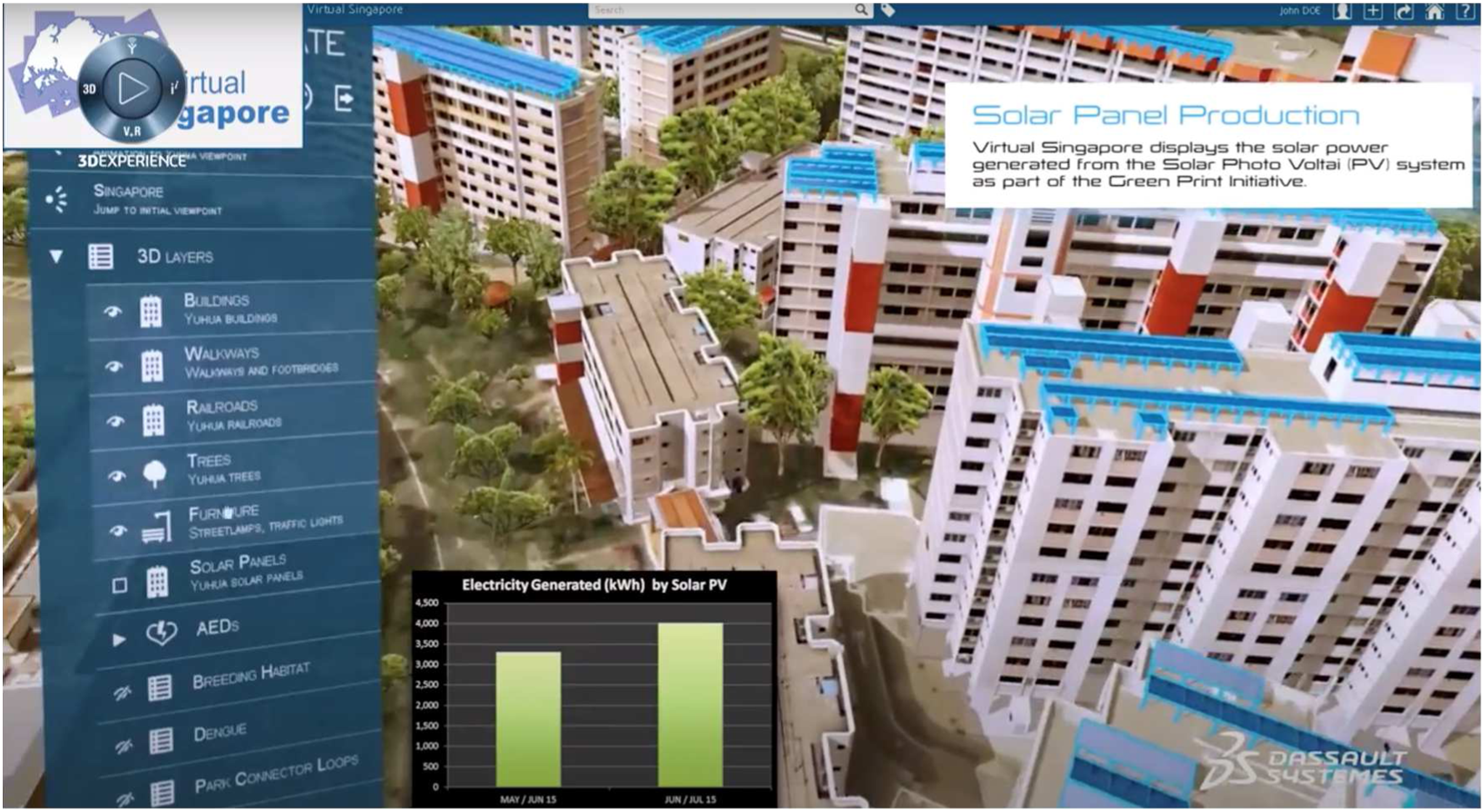
The case of the urban scale digital twin of the city of Zurich
Another case of urban scale digital twin that is worth mentioning is that of the city of Zurich. This project is known under the label ‘Virtual Zurich’. Among the data that have been visualized for this project are data concerning noise, air pollution, mobile phone radiation, solar potential and visualization of construction projects (Figure 4). As mentioned by Gerhard Schrotter and Christian Hürzeler in their recently published article entitled “The Digital Twin of the City of Zurich for Urban Planning”, the creation and use of this digital twin became possible thanks to ‘the release of 3D spatial data under Open Government Data’.
55
Schrotter and Hürzeler, in their aforementioned article, refer to the distinction between Low Frequency and High Frequency City, drawing upon the work of Batty and Wildfire.31,32 They highlight that ‘[t]o make the digital twin known, it is necessary that the data sets are made available as Open Government Data’.
55
They also underscore the significance of rendering easily accessible the data through their visualization. In order to render possible this, ‘[s]ince 2012, the City of Zurich has been providing data from public administration free of charge, machine-readable and under a free licence’.
55
Established applications: noise (upper left), air pollution (upper centre), mobile phone radiation (upper right), solar potential (lower left) and visualization of construction projects (lower right). Source: City of Zurich.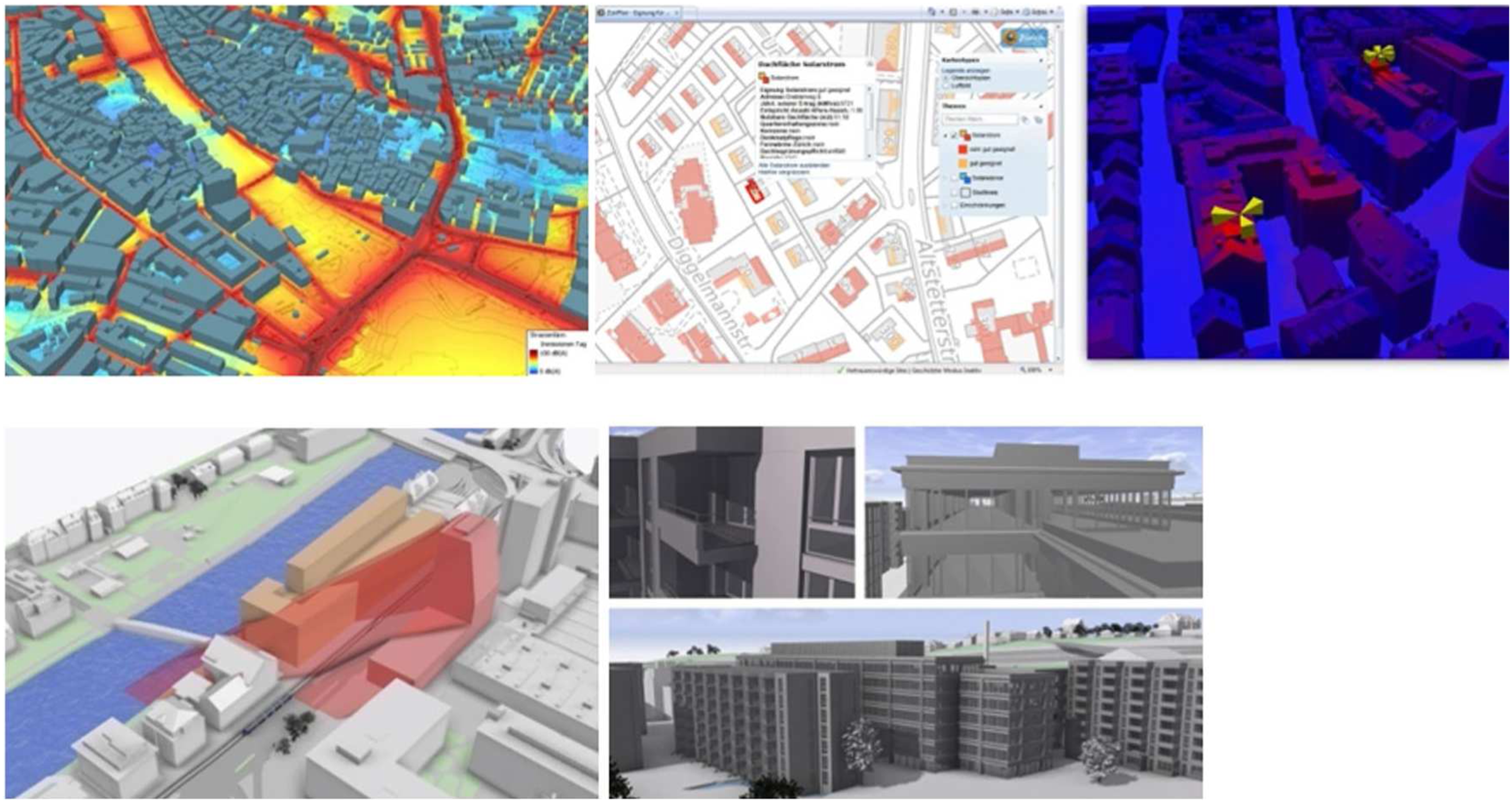
A turning point for this effort to render accessible a big amount of data was the media conference on 12 November 2018, which was accompanied by the publication of the terrain model, block model and roof model on the Open Government Data (OGD) platform. The company Blindflug Studios used the data of the digital twin of the city of Zurich to create ‘(re)format Z:’, a game about the Reformation in Zurich, which was launched in November 2017. This game was based on the creation of a model that ‘contained the external shape of the houses including the roofs and the elevation data of the ground’. 56
The case of the urban scale digital twin of the Docklands area in Dublin
Urban scale digital twins are digital representations, or ‘virtual replicas’ of cities that can be used as simulation and management environments to develop scenarios in response to policy problems (Figure 5). At a first place, data are ‘generated by smart cities[, and, at a second place], digital twins [are] […] used to model urban planning and policy decisions’.
21
In the digital twin interaction diagram that concerns the case of the digital twin of the Docklands area in Dublin (Figure 6), this process becomes evident: at a first stage, citizens give feedback to ‘the model being deployed online […] [, and, at a second stage, their feedback is sent] to the relevant group, such as the researchers who developed the urban mobility model or the city council, who provide the urban IoT data’.
21
Diagram showing how digital twin collects and visualizes data. Source: Bentley. Online digital twin interaction diagram. Source: White et al. 2021.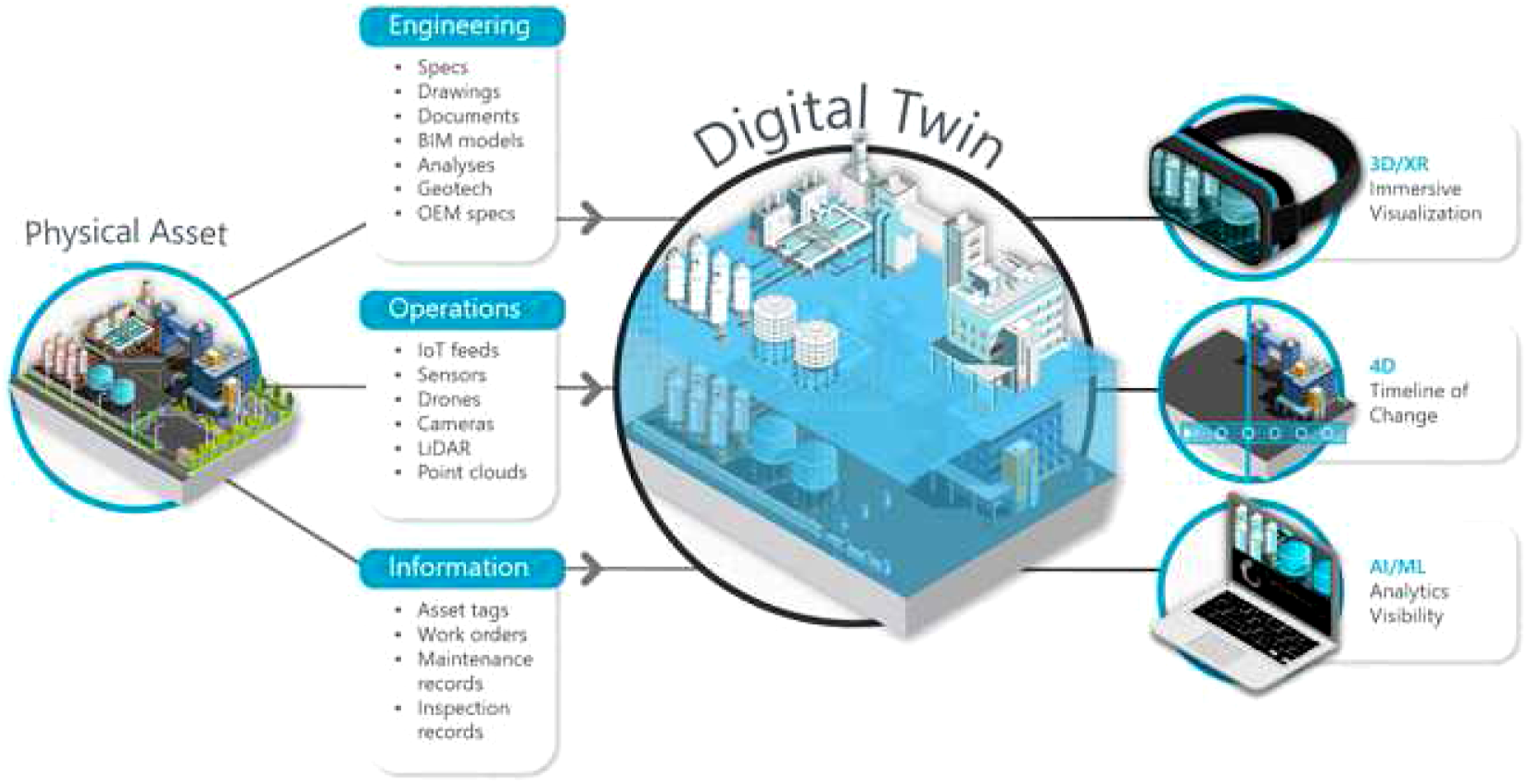
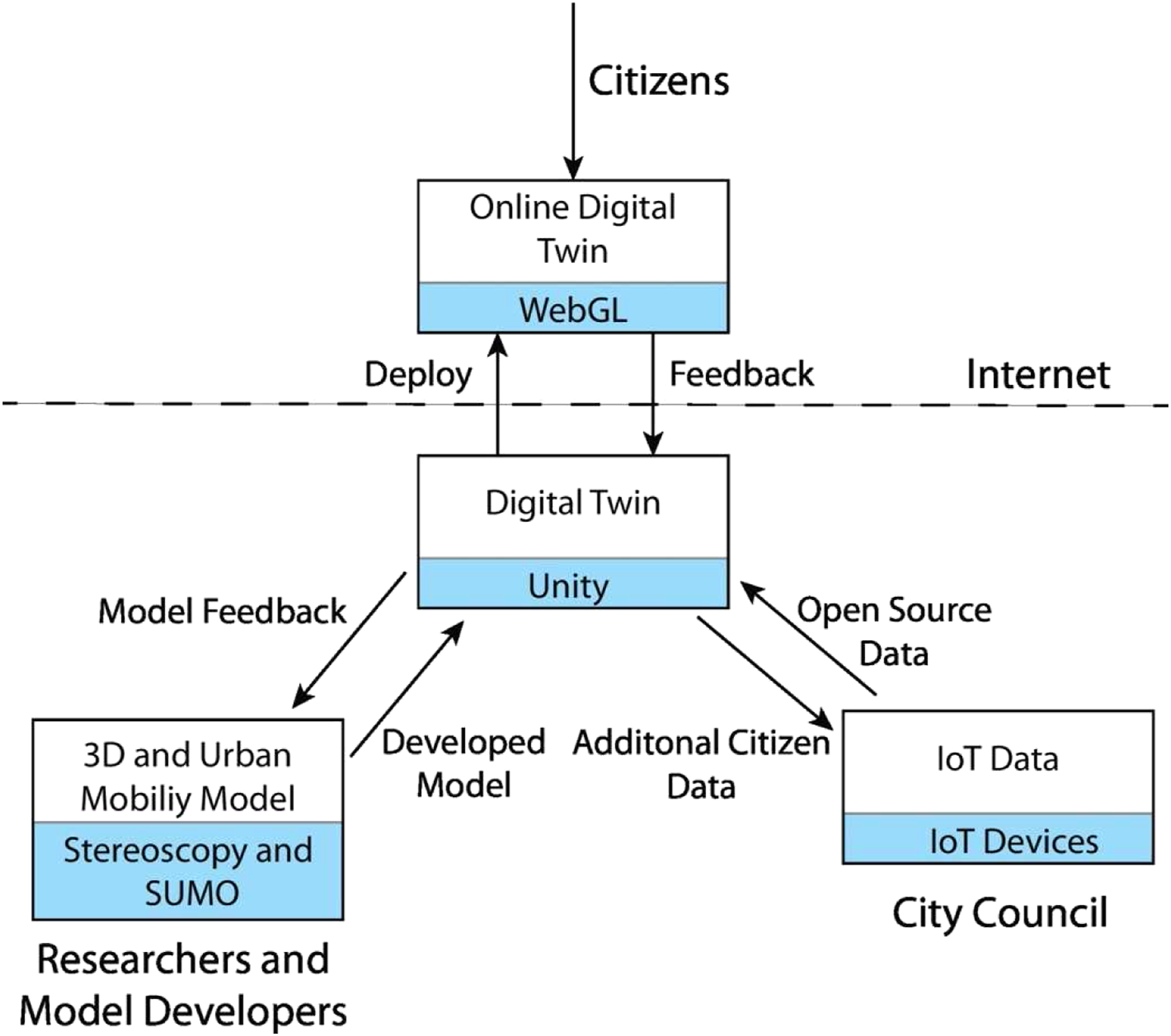
To understand how the debates around digital twins and their relationship with smart cities are closely related to questions concerning democracy and sovereignty, we can bear in mind that until today the majority of the companies or institutions that are responsible for the creation of urban scale digital twins are private. This goes hand in hand with the fact that their models are not made publicly available. An exception to this is the digital twin of the Docklands area in Dublin, which is publicly available online, giving the opportunity to citizens to update its data and inform it. The creation of this urban scale digital twin departed from the intention to use the data generated to perform additional simulations concerning mobility optimization, building placement and the design of renewable energy such as offshore wind turbines.
Towards a conclusion: Space of flows, timeless time and the challenge of bridging short-term scale and long-term scale urban dynamics
Despite the fact that often the dissemination of urban scale digital twins focuses on their aspiration to enhance the participation of citizens in the decision-making processes through the integration of their input to the urban planning strategies, this is not valid in most of the cases. Some of the reasons for which this is not valid are the following: on the one hand, the creation of urban scale digital twins is based on a limited set of variables and processes, and, on the other hand, the ways in which they abstract sets of variables and processes neglect the social aspects of urban contexts. Manuel Castells’s approach is useful for deciphering the tension between the real and the ideal at stake during this process of abstracting sets of variables and processes in the case of urban scale digital twins. Castells argues that the societal system corresponding to the digital era is based on two key features: informationalism and globalism. He also claims that societal processes cannot be understood or represented without the underlying technology. Castells, in Communication Power, addresses the following question: ‘where does power lie in the global network society?’. 57 More specifically, he distinguishes four categories of power in the network society: networking power, network power, networked power and network-making power. 58 He argues that the fourth category of power, that is to say the network-making power, is the ‘paramount form of power in the network society’. 59
At the centre of Castells’s approach are the following three concepts: ‘space of flows’, ‘space of places’, and ‘timeless time’. 60 According to Castells, the network society is organized around these three concepts. Castells, through these concepts, intends to render explicit how the ‘incorporation of the impact of advanced forms of networked communication’ 61 calls for a new understanding of societies. He places particular emphasis on the fact that in network society, there are no boundaries and suggested that contemporary urbanization and networking dynamics should be studied conjointly. Additionally, he argued that transport and digital communication infrastructures should also be examined in relation to each other. A remark of Castells that can help us better understand why ‘digital universalism’ is not useful for challenging inequalities is the following: ‘the network of decision-making and generation of initiatives, ideas and innovation is a micro network operated by face-to-face communication concentrated in certain places’.62,63
To explain how the notions of time and space were transformed due to the transition to the so-called information age, Castells drew upon the work of several scholars in the field of social sciences such as Anthony Giddens,64,65 Scott Lash, John Urry66–68 and David Harvey 69 among others. Through the notions of informational city, metropolitan region and dual city, Castells redefined the field of urban sociology. The main objective of Castells’s approach is to render explicit how urban dynamics work. In contrast with Saskia Sassen’s global city, 70 Manuel Castells’s informational city emphasizes the significance of the ‘incessant flows of information, goods, and people’. 71 A turning point for his work is the theory he develops in The Informational City: Information Technology, Economic Restructuring and the Urban-Regional Process. 72 As Felix Stalder has highlighted, in Manuel Castells. The Theory of the Network Society, according to Castells’s theory, cities should be understood as processes and not as places. 73
Castells’s approach can help us better understand how the creation of ubran scale digital twins influences our comprehension of the public sphere. 74 In the sixth chapter of The Rise of the Network Society, which is devoted to the spaces of flows, Castells analyses ‘[t]he relationships between the space of flows and the space of places, between simultaneous globalization and localization’. 75 He argues that ‘function and power in our societies are organized in the space of flows’. 75 A concept that is useful for addressing the issue of unequal access to urban scale digital twins’ data is that of ‘mobility justice’, which is employed by sociologist Mimmi Sheller, in her recently published book entitled Mobility Justice: The Politics of Movement in an Age of Extremes, 76 to suggest a new way of understanding inequality and uneven accessibility to the mobility commons. This concept is useful for analysing the urban scale digital twins concerning traffic simulation. The main idea behind the use of the term ‘mobility justice’ is the intention to render explicit that while mobility is a fundamental right for everyone, it is experienced unequally along the lines of gender, class, ethnicity, race, religion and age. 77 Castells defines ‘timeless time’ as follows: ‘the kind of time that occurs when in a given context, such as the network society, there is systemic perturbation in the sequential order of the social practices performed in this context’. 78 In the chapter of The Rise of the Network Society devoted to this new concept of temporality that he calls ‘timeless time’, Castells highlights the notion of ‘timeless time’ refers to ‘the emerging, dominant form of social time in the network society, as the space of flows does not negate the existence of places’. 79
To conclude, it is important to highlight that the difficulties of using urban scale digital twins in a way that challenges the disadvantages of ‘digital universalism’ are related to the fact that as Jens Kandt and Michael Batty remark, ‘big data for cities bridge fundamentally different temporal scales of urban dynamics: the short-term scale of fast dynamics or real time and the long-term, much slower dynamics of urban structure and policy’. 80 The potentials of the urban scale digital twins for data-driven decision-making in urban planning lie, therefore, in our capacities to tackle these two different temporal scales conjointly and to elaborate conceptual and methodological tools that manage to do so. This tension between the two different temporal scales could be better understood through the notion of ‘timeless time’ in Castells’s work. In order to shape approaches that promote the use of big data for urban analytics without neglecting the social aspects involved in the strategies of formation of urban policies, it is important to bear in mind the weaknesses of ‘digital universalism’ and the assumptions on which the creation of urban scale digital twins. In order to do so, pivotal is the epistemological shift from technical to socio-technical perspectives.
Footnotes
Declaration of conflicting interests
The author(s) declared no potential conflicts of interest with respect to the research, authorship, and/or publication of this article.
Funding
The author(s) received no financial support for the research, authorship, and/or publication of this article.
