




Abstract
Architects and designers communicate their ideas within a range of representational methods. No single instance of these methods, either in the form of orthographic projections or perspectival representation, can address all questions regarding the design, but as a whole, they demonstrate a comprehensive range of information about the building or object they intend to represent. This explicates an inevitable degree of deficiency in representation, regardless of its type. In addition, perspective-based optical illusions manipulate our spatial perception by deliberately misrepresenting the reality. In this regard, they are not new concepts to architectural representation. As a consequence, Optically Illusive Architecture (OIA) is proposed, not as a solution to fill the gap between the representing and represented spaces, but as a design paradigm whose concept derives from and accounts for this gap. By OIA we aim to cast light to an undeniable role of viewpoints in designing architectural spaces. The idea is to establish a methodology in a way that the deficiency of current representational techniques—manifested as specific thread of optical illusions—flourishes into thoughtful results embodied as actual architectural spaces. Within our design paradigm, we define a framework to be able to effectively analyze its precedents, generate new space, and evaluate their efficiencies. Moreover, the framework raises a hierarchical set of questions to differentiate OIA from a visual gimmick. Furthermore, we study two OIA-driven environments, by conducting empirical studies using Virtual Reality (VR). These studies bear essential information, in terms of design performance, and the public’s ability to engage and interact with an OIA space, prior to the actual fabrication of the structures.
Introduction
THERE IS A GAP. . .
Architects and artists, as a part of their practices, have historically studied and improved representational techniques. However, unlike artforms that do not necessarily entail precision to communicate with their audiences, architectural representation has always focused on the problems of accuracy and human perception. 1 In fact, precision in architectural representation minimizes the risk of miscommunication during construction. Alan Dempsey portrays effectiveness of representational technique as a must to narrow the gap between the architect’s intention and the builder’s interpretation. 2
Broadly speaking, representation always fails to fully capture everything about reality. Whatever the medium or method, every form of perspectival representation has some inherent limitations. 3 There is always a gap between representing a space and its actual spatial dimensions. In a historically-oriented narration of perspective evolution, Alberto Perez Gomez interprets this gap as an everlasting distance between architectural drawing and building. He specifically highlighted drawing as “a tool of reduction,” suggesting drawing can never represent actual qualities of the physical space. 4 A few decades earlier, Paul Rudolph explained how the actual appearance of the buildings are different from their representations, and emphasized the necessity of visual aesthetics to harmonize drawing and building. 5 His frequent representational technique has particularly been inspiring to this research, where he would use section-perspective to enhance two-dimensional information along with three-dimensional qualities of the built environment6,7 (Figure 1).
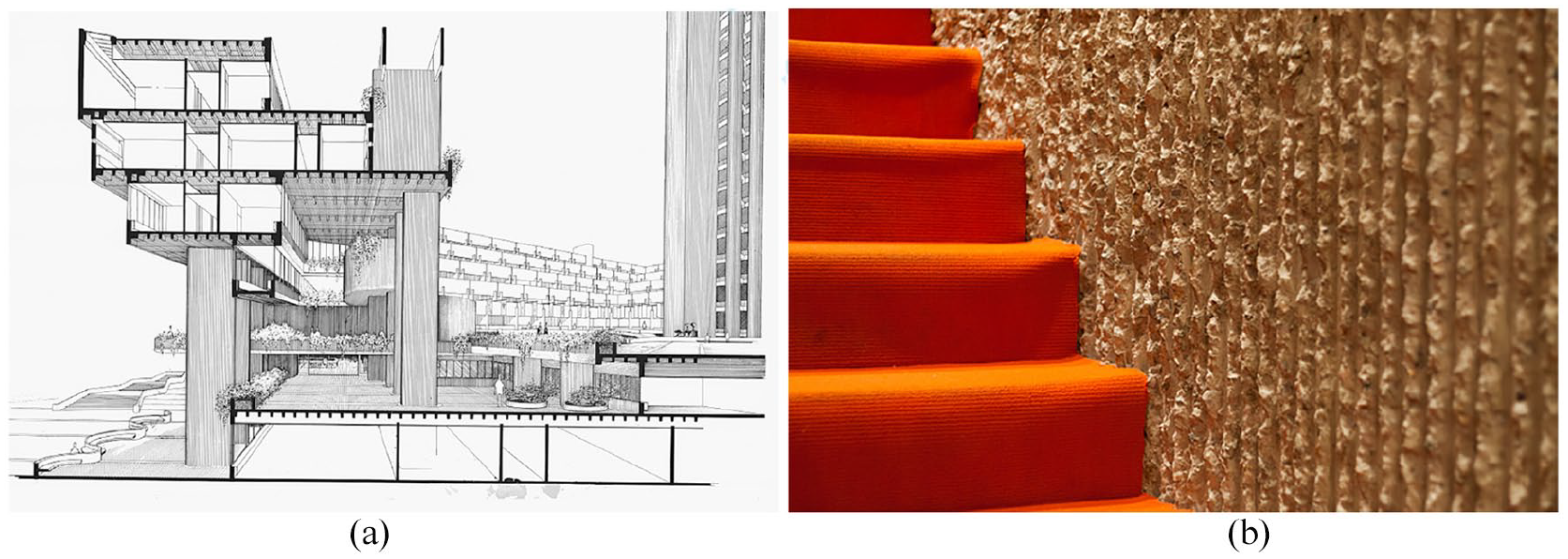
Rudolph’s unique method draws attention toward another method of architectural representation: “Descriptive Geometry”—a systematic representation of three-dimensional shapes through projections on three planes.4,9 The definition explicitly echoes the relevance of descriptive geometry to our research, since its orthographic projection censors objects depth as opposed to viewpoint-driven perspectival representation that mocks spatial depth within a flat medium.
MIND THE GAP. . .
There is significance in studying this gap in architecture as the complex reality of the built environment is far richer than its represented image. Architects can only design what they are capable of representing. 10 Despite the accelerating application of Building Information Modeling (BIM), the call for descriptive geometry, as a certain and accurate technique of representing three-dimensional shapes on a two-dimensional medium, never ceased to exist.
Moreover, in a research focusing on architectural representation, it is stated that the notion of a building is formed by a combination of typical architectural drawings. 11 Along the same concept, Fuente Suárez argues that orthographic projections—in the forms of descriptive geometry—present the spatial dimensions, as opposed to their actual appearance. 12 In other words, the represented documents are linked to our interpretation, and we never experience the built environment in reality like the way they are represented. This magnified discrepancy founds an investigation to verify whether or not we can establish a design paradigm whose concept explicitly derives from the gap between representational limitations and physical reality.
EXPLOIT THE GAP. . .
Having established the anchor statement—the existence of a gap between limitations of representational techniques and physical reality—and the “Why” question, that explains the significance of studying this issue in architecture, this research begs a pertinent question: “Can we leverage the gap between representation and physicality to create a new architectural paradigm?”
To address this core question, we shall remember architecture’s historical subscription to representational techniques. These representational techniques are the contribution of artforms to the architecture domain. Nonetheless, as explained earlier, representation always fails to fully capture everything about the reality. Such failure leaves a gap between representational data and the physical reality.
Meanwhile, optical illusions are designed to convert this failed representation into a deliberate misrepresentation in order to overshadow our perception of spatial dimensions. In fact, the concept of optical illusions is to mislead our visual perception. Thus, they can potentially play an important role in addressing this perceptional/reality differentiation. Specifically, perspective-based optical illusions override our perception of spatial depth compared to the actual spatial geometry, culminating in the dominance of the former over the latter. This is the principle of the proposed Optically Illusive Architecture (OIA). Once an OIA environment is seen through a specific viewpoint(s), specific visual effects appear before the subject’s eyes that may contradict the physicality of the space.
The major contribution of this research is introducing OIA and its multi-layer framework. A clear definition of OIA is as follows: “OIA is a viewpoint-sensitive design paradigm whose concept derives from the gap between representational limitations and physical reality. Also, results of this design paradigm deliver specific messages to certain privileged point(s) in the space.” This design paradigm does not introduce one architecture, but rather defines a set of rules and criteria that, once satisfied, account for a variety of optically illusive architectures. In other words, it does not provide a single solution to a broad question, instead offers strategies to describe, generate, and evaluate a wide range of outcomes.
OIA has a multi-layer framework that distinguishes its results from similar work. According to the definition of OIA, this framework has a layer whose job is to verify if a design bears a viewpoint-driven, or perspective-based, perception. Besides establishing the layer of viewpoint-sensitiveness, an OIA space should undergo an optimization process to ensure its results are compatible with human’s stereoscopic vision. We call it “Anti-Cycloptic Perception Mechanism.” Another layer is categorizing the results. Broadly speaking, they fork in two branches. These branches are diverged according to their impact, either to suppress or augment three-dimensionality. One branch is referred to as “Depthlessness,” where three-dimensional objects appear two-dimensional, when viewed through a privileged point(s). “Super-dimensionality” is the second branch of OIA. These objects manifest as a three-dimensional object other than the actual object when viewed from a certain viewpoint(s).
In this section, we posed the “What,” and the “Why” questions. We also raised the big question that is explored by this research. Toward this end, we briefly introduced Optically Illusive Architecture (OIA) to address the “How” question. The rest of the paper is organized as follows. In the following section, we dissect layers of OIA framework, as well as historical backgrounds and relevant work. Next, to assess design efficiency, and see how people would interact with an OIA, we analyze the results of user-studies of two OIA environments. We will also discuss major concerns regarding design development, interaction, the impact of OIA on people, and vice versa, in the “
The territory of OIA
To formulate OIA framework, we compile a hierarchical list of questions that steers the process of categorizing every illusory effect related to the concept of OIA (Figure 2). Ideally, anyone should be able to differentiate every single result of OIA from another, using this framework. The order of questions should be such that the same question not be asked in multiple levels.
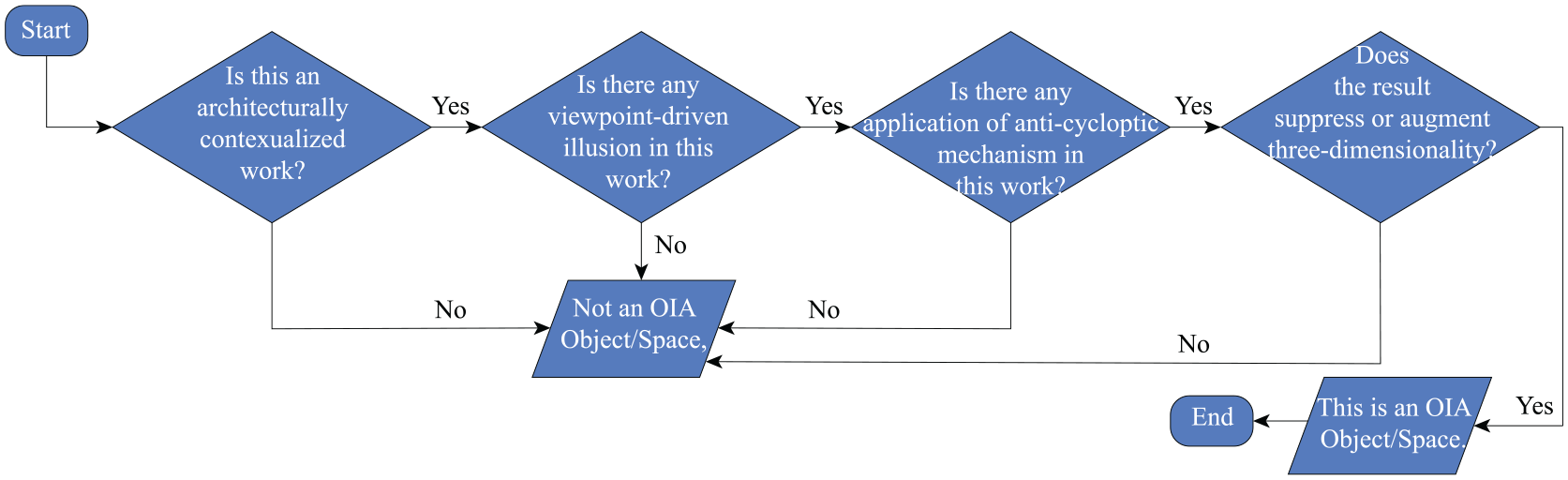
The OIA framework.
In case of being an OIA design, we can further refine the result with questions regarding the scale, the number of viewpoints, and the role of signifiers (if any) to ease locating the privileged point(s) and/or perceiving a specific effect.
To dissect this framework, we shall first take a thematic approach to techniques, applicable in generating viewpoint-driven works. More specifically, we outline perspectival representation and perspective-based optical illusions as well as their examples and related work, carried out in various disciplines, particularly in arts, architecture, and computer graphics. It is ideal to encounter one subject that triggers a series of diverged questions from experts in different fields. Next, we unpack the concept of anti-cycloptic perception mechanism; a lineage of optimization process to adjust OIA results to human’s stereoscopic vision. We also highlight those works in the literature that employ any of the techniques associated with our proposed mechanism. Finally, we conclude this section by clarifying the notions of “Depthlessness” and “Super-dimensionality,” as well as their examples in related work. Every single OIA result should be labeled with either of these two categories.
The illusory domain of perspectival representation
“To clearly see” is the meaning of perspective’s Latin root—perspicere. 13 This is closer in meaning to natural perspective, or the way we see things, 14 as opposed to linear perspective that refers to the way we reconstruct this view in pictures. 13 Nonetheless, there is an extensive range of definitions for perspective. Originated in the 15th century, 15 it has been referred to as: a hinge for architectural representation, addressing the visual appearance of an object, 16 a qualitative representation to perceive qualities of an environment/object, 12 a parametric result of spatial relationship between the object and the viewer, 17 or an algorithm that solves the problem of flattening space as perceived from a specific point of view. 1
In a historical research and narration of perspective evolution, perspective is broadly labeled as a “tool of illusionism,” and linear perspective as “a perception of the building’s totality in depth.” 4 Since depth does not exist in two-dimensional media, then linear perspective serves as an illusion to fake spatial depth in the absence of three-dimensionality. 18
Moreover, investigating the components of perspectival representation is the subject of a number of research projects. Their goal is to improve efficiencies of current representational systems. For instance, Correia et al. introduce a new system of graphical representation with two distinct projection surface and representation surface, 19 and Salgado’s work offers a comprehensive technique for measuring distances in a perspectival drawing. 20
Perspective-based optical illusions
Identical to perspectival representation, perspective-based optical illusions are viewpoint-driven perceptions (Figure 2), and broadly speaking, they fall into three main categories: trompe l’oeil, anamorphic projection, and forced perspective. Depending on their application, the effects could suppress (as in Greek columns 21 ) or augment (as in the Ames room13,22,23) the discrepancy between the representing and the represented.
Trompe l’oeil mostly refers to a drawing technique that represents three-dimensionality within a two-dimensional medium. The objective is to simulate depth of space precisely enough to deceive the eye and challenge our visual perception. 13 Bertol describes this visual perception as equivalent to perception of the real scene from a certain viewpoint. 15 In fact, the viewpoint orchestrates the scene in delivering a visual effect of trompe l’oeil as deviations from the viewpoint can reveal the two-dimensionality of the medium. 24 “Escaping Criticism” and “A Handful of Keys” are amongst the most prominent examples of this technique (Figure 3).
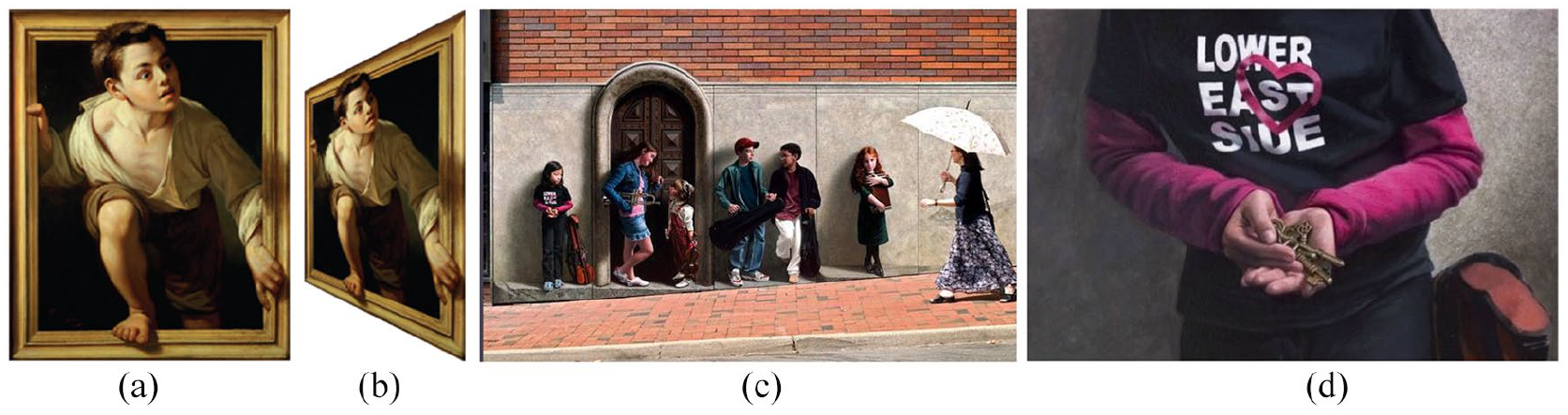
(a) Escaping criticism, Pere Borrell del Caso, 1874, (b) an acute-angle viewpoint spells the depthless reality of the artform, (c) a handful of keys, William Cochran, 2005, and (d) extreme details in drawing and shades enhance the illusion.
The critical question associated with trompe l’oeil is whether we can reversibly employ it in an architectural design process. In this regard, we also need to inspect the implications and technical constraints in bringing the concept of flatness into the three-dimensionality.
Another technique—anamorphic projection—refers to a two or three-dimensional distortion that becomes readable when viewed from a particular viewpoint, or through a special mirror.21,25,26 Alberto P Gomez provides the closest analogy of anamorphic projection to the concept of representation where he states it reveals the potential gap between an object and its appearance. 27
As it is seen in Figure 4(a) and (b), the main orientation of the artform supersedes the anamorphic viewpoint location, meaning that, the observer initially notices an anomaly within a broader legible context. In order to perceive the hidden/anamorphic message they have to occupy an oblique position. Thus, it comes into a critical question whether reversing this hierarchy profits spatial orientation. This implies designing the space orientation in a way that we perceive the hidden message first.
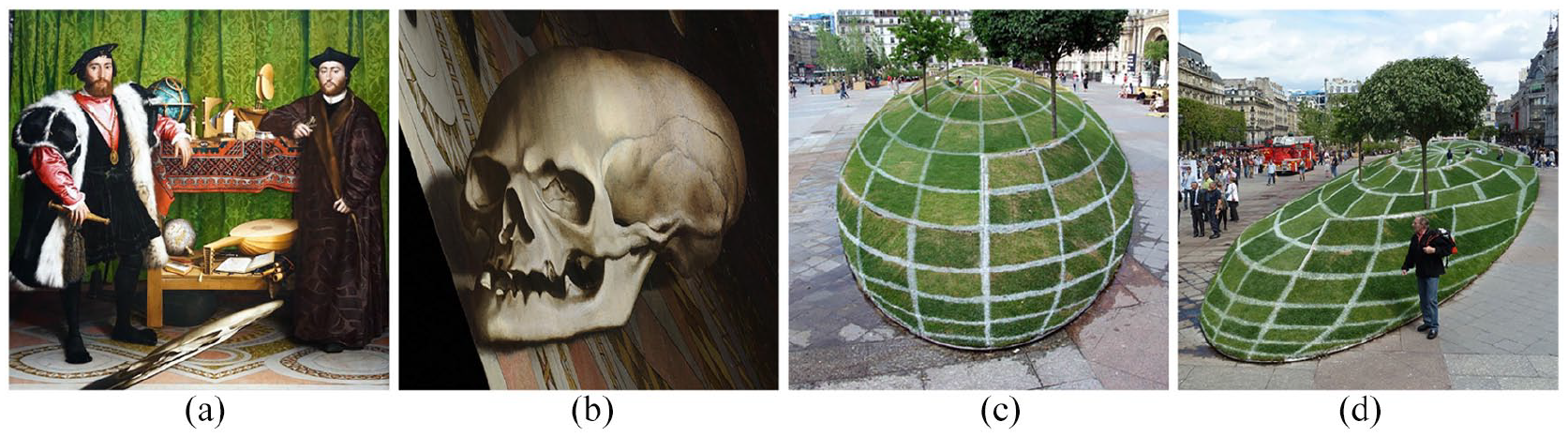
(a) The ambassadors, by Hans Holbein, 1533, (b) its anamorphic effect at the bottom of the painting, (c) and (d) “who to believe?” by François Abélanet, 2011.
Similar to trompe l’oeil, anamorphic artforms are not bound to scale and medium. Besides historical anamorphic instances, such as Saint Ignatius’s Church in Rome by Andrea Pozzo, (1691–1694) and Saint Francesco fresco by Emmanuel Maignan (1642), we can refer to “Who to Believe?,” a contemporary anamorphic urban-scale installation in front of the city hall in Paris. Despite the uneven actual shape, it looks like a giant three-dimensional globe covered with grass when viewed from the certain point (Figure 4(c) and (d)).
Anamorphosis-related literature is relatively rich. In a lineage of work, anamorphic projection has been studied to generate effects on architectural tectonics. Accordingly, Jovanovic et al. explain a methodology to apply a robotic arm for the purpose of generating an anamorphic projection on a curved wall by means of modular brick-like elements. 28 Other research represents a pavilion, based on anamorphic and trompe l’oeil effects, that is deemed depthless from a specific viewpoint in the space. 24 Another contribution is a study that discusses a methodology to design and fabricate anamorphic effects on architectural surfaces. 29
There is also a wide range of mathematically-oriented approaches to this concept. For example, a walk-through to achieve single-viewpoint anamorphic effects of 2D shapes, 25 and 3D meshes, 23 a framework based on ray-casting technique to generate anamorphic effects, 30 also intersecting two visual cones, each with a different silhouette, in order to generate a novel three-dimensional shape, 31 as well as generating objects with multiple meaningful visual attributes through multiple viewpoints. 32
The third perspective-based optical illusion is forced perspective. It is a technique that manipulates our perception of objects’ scales by thoughtfully arranging them in different distances to a single viewpoint.13,33 In fact, both forced perspective and trompe l’oeil play with our perception of spatial depth. However, while trompe l’oeil augments three-dimensionality in the absence of actual spatial depth, forced perspective forces a shallower looking space than the actual spatial depth.23,34
Similar to prior techniques, defining a viewpoint in space is an underlying step when practicing forced perspective. The logic behind forced-perspective leads us to mull over a process through which an object can be dissected into fragments. Next, these fragments get distributed within a three-dimensional space in a way that the whole object remains readable from one particular viewpoint. Figure 5 illustrates examples of forced perspective.
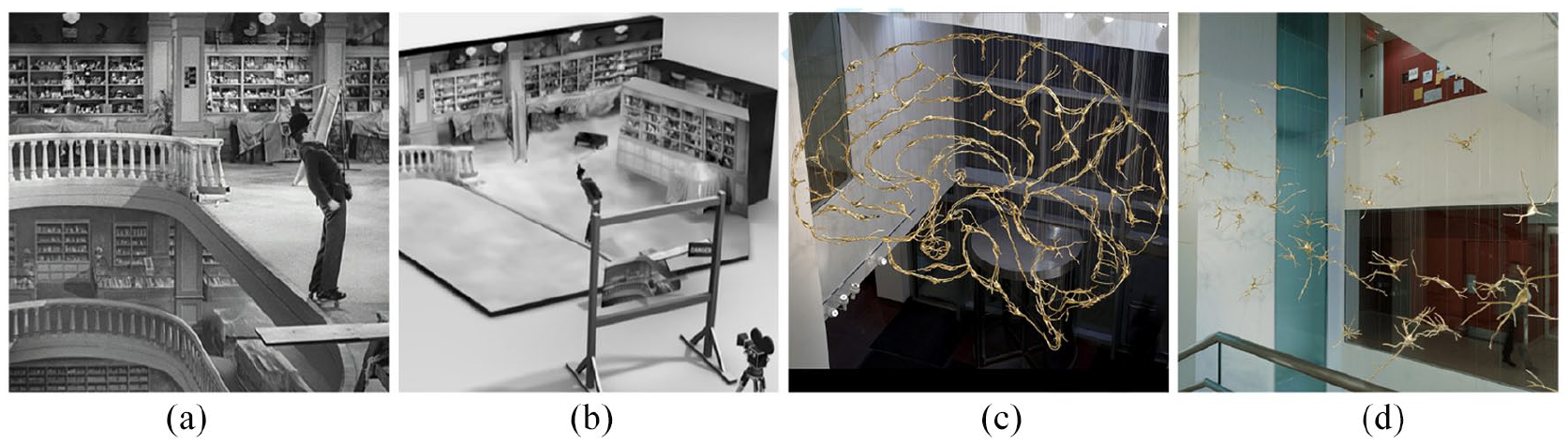
(a) Charlie Chaplin’s “Modern Times,” 1936, (b) prior to the advent of computational visual effects, application of forced perspective in cinematography would help avoid imposing life-threatening actions on the actors, (c) Schwerpunkt by Helmick Sculpture, Cambridge, MA, 2016, and (d) away from the viewpoint, the installation is seen as individual neuron sculptures in various sizes suspended from the ceiling. 35
Anti-cycloptic perception mechanism
Within the study of perspective-based optical illusions, we learned about a range of research work in different domains. In some cases the proposed visual effects hinge on individual viewpoint(s) in the space, and we acquire our secondhand perception via images captured by cameras as single-eyed devices. The problem is, we are not Cyclops! Thus, there has to be a mechanism that would leverage our stereoscopic vision. We call it Anti-cycloptic perception mechanism (see Figure 2 for reference). Having reviewed all precedents, we categorize this mechanism under “Viewpoint Optimization” or “Application of specific illusory techniques” (Figure 6).
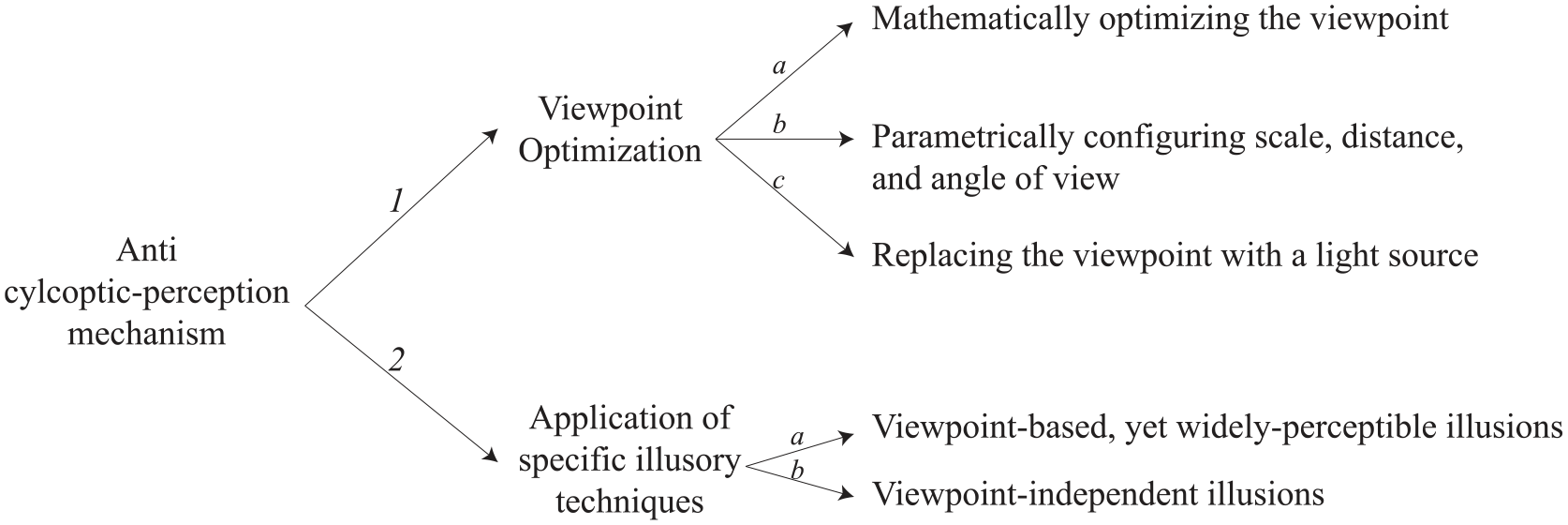
Methods of anti-cycloptic perception mechanism.
Viewpoint optimization is plausible through three methods. First, mathematically optimizing the viewpoint enables perception to occur within a sphere around the viewpoint (fork 1a in Figure 6). For example, the optimized viewpoint in a research, where a grid of mirrors are uniquely oriented to compose an image by means of reflection.
36
The second method under viewpoint optimization is parametrically changing some components of the space, such as distance of the viewpoint to the illusory effect, as well as the scale of the object (fork 1b in Figure 6). In this regard, we can approximate our stereoscopic vision to single-eyed perception. More details are provided in the “
The third viewpoint-optimizing method assigns a light source at the privileged point rather than a viewpoint (fork 1c in Figure 6). While the viewpoint card obliges people to perceive the effect one at a time, placing a light source at the privileged point casts shadows, granting simultaneous interaction by its audience.
There are many examples of leveraging privileged points to create meaningful images by using shadow. In shadow puppetry, for example, a performer’s hand arrangements against a source of light creates a recognizable shadow on a background. In addition, several artists have produced sculptures that cast meaningful shadows that are uniquely different from the sculpture or installation itself. For example, “Wire Sculpture” by Matthieu Robert-Ortis, “Dirty White Trash” by Tim Noble and Sue Webster offer instances of these effects.
In CG, “Shadow Art” is a relevant project that deals with multiple visual cones and their intersection. 37 More specifically, they find the intersection of a number of given images, projected from various privileged points. After an optimization process, the result is an object with multiple shadows, respecting the given images, when light is cast from the privileged points. In this line of work, we also acknowledge SHADOWPIX, 38 where one single fabricated object produces several images under different light directions, as well as a research in which the amount of light to pass through perforated lampshades are precisely calculated so that their shadow produces a given image. 39
As stated before, application of specific illusory techniques can also be a solution to avoid unconditional single-eyed perception. Relevant works of this type fall into two classes. First, those techniques that are designed based on a single viewpoint but perceived within an area, around the viewpoint (fork 2a in Figure 6). In this regard the illusory message can be received by crowds simultaneously. Nonetheless, the effect always remains within a spectrum of readability and distortion. The closer to the privileged point, the less distortion. An example would be an application of mirror-assisted anamorphic projection to reconstruct a set of 2D data distributed within an architectural space.
40
We conducted a user study that confirms, the application of this technique in architectural scale, is efficiently capable of communicating with each and every individual of its audience at the same time. More details in the “
The second class of illusory techniques, to overcome cycloptic perception, refers to objects, designed in a viewpoint-independent process (fork 2b in Figure 6). Nonetheless, the viewpoint-sensitivity of the results of such a design process do not fall apart as long as subject’s position in the space would not reveal the actual concavity or convexity of the object. Based on different experiments, they are refereed to as “Inside-out objects” 41 or “Reverspective,” 42 and their goal is to manipulate our perception of objects’ orientation by swapping the background and foreground, or concavity and convexity, of the object (Figure 7). The core idea originates from the Necker Cube, 43 however, it has been elaborated further in designs of Jerry Andrus 44 and Patrick Hughes. 42
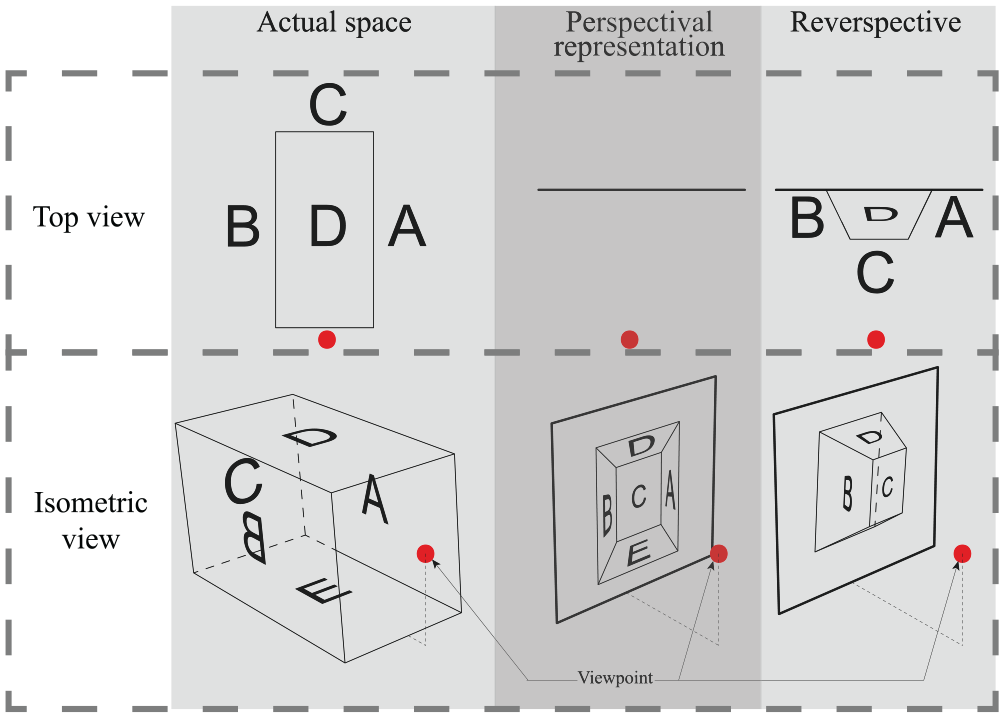
Wall “C” in the actual space is the farthest wall to the viewpoint, while in the Reverspective model it becomes the nearest surface to the viewer. This causes a dynamic illusion, regardless of the subject’s position in the space.
Depthlessness and super-dimensionality
Earlier, we established a framework, equipped with a list of hierarchical questions. A key component of this list questions the visual characteristic of illusive objects, whether their three-dimensionality is perceived suppressed, or augmented. Toward this end, they are categorized as “Depthless” objects and “Super-dimensional” objects, respectively (Figure 2).
Examples of both categories are abundant. In addition to an extensive walk-through to suppress three-dimensionality, 24 the immediate result of Data-spatialized Pavilion 40 is also an example of depthlessness: A three-dimensional anomaly, in the form of architectural tectonics, looks like a set of readable, meaningful, two-dimensional datasets, when viewed within a privileged area. Shadowart, 37 in a sense, generates depthless objects, whereas a three-dimensional object casts meaningful shadows on flat surfaces. Along the same metrics, shadow installations of Tim Noble and Sue Webster are also deemed depthless.
The Ames room is a clear example of super-dimensionality, in which from a viewpoint, visual perception of a seemingly regular room differs the actual physicality of the room.13,22,23 “Ambiguous Cylinder” is another example of super-dimensionality, however in much smaller scale, implemented by Kokichi Sugihara. 45 The illusory design of this super-dimensional object overrides our perception of the usual reflection, and amazingly contradicts interpretations between its first-hand image and the reflected image in the mirror. A cylindrical shape has a reflection of a cube, and once spun along its main axis, resembles a cube with a cylindrical reflection.
In summary, the OIA’s territory is defined by a set of questions/rules. Once an architecture is perceived through a viewpoint(s), and it benefits from an anti-cycloptic perception mechanism, and depicts degrees of depthlessness, and/or super-dimensionality, it is considered a result of the proposed Optically Illusive Architecture (OIA).
Empirical studies
User study, why, and what?
The idea behind OIA is not to boundlessly conceptualize forms and shapes in the name of architecture. Instead, it is supposed to provide a publicly-accessible privileged space. This implies considering real-life factors and curbing the design with reasonable and achievable rules. Perhaps the most important factor is how the public would communicate with a design, once physically made at its actual scale. Therefore, it becomes an invaluable advantage for a design team to anticipate user reactions and feedback, prior to construction.
Toward this end, we conducted a user-study to evaluate design efficiency of two OIA environments, in order to see whether people could effectively communicate with the designed spaces. To briefly introduce these environments through the lens of OIA framework (Figure 2): The first space—categorically representing depthlessness—is an anamorphic pavilion, expected to be seen as a two-dimensional pattern from a single privileged point
24
(Figure 8(a) and (b)). Also the applied anti-cycloptic mechanism is a specific configuration of scale, distance, and the angle of view (fork 1b in Figure 6). More details are provided in the “
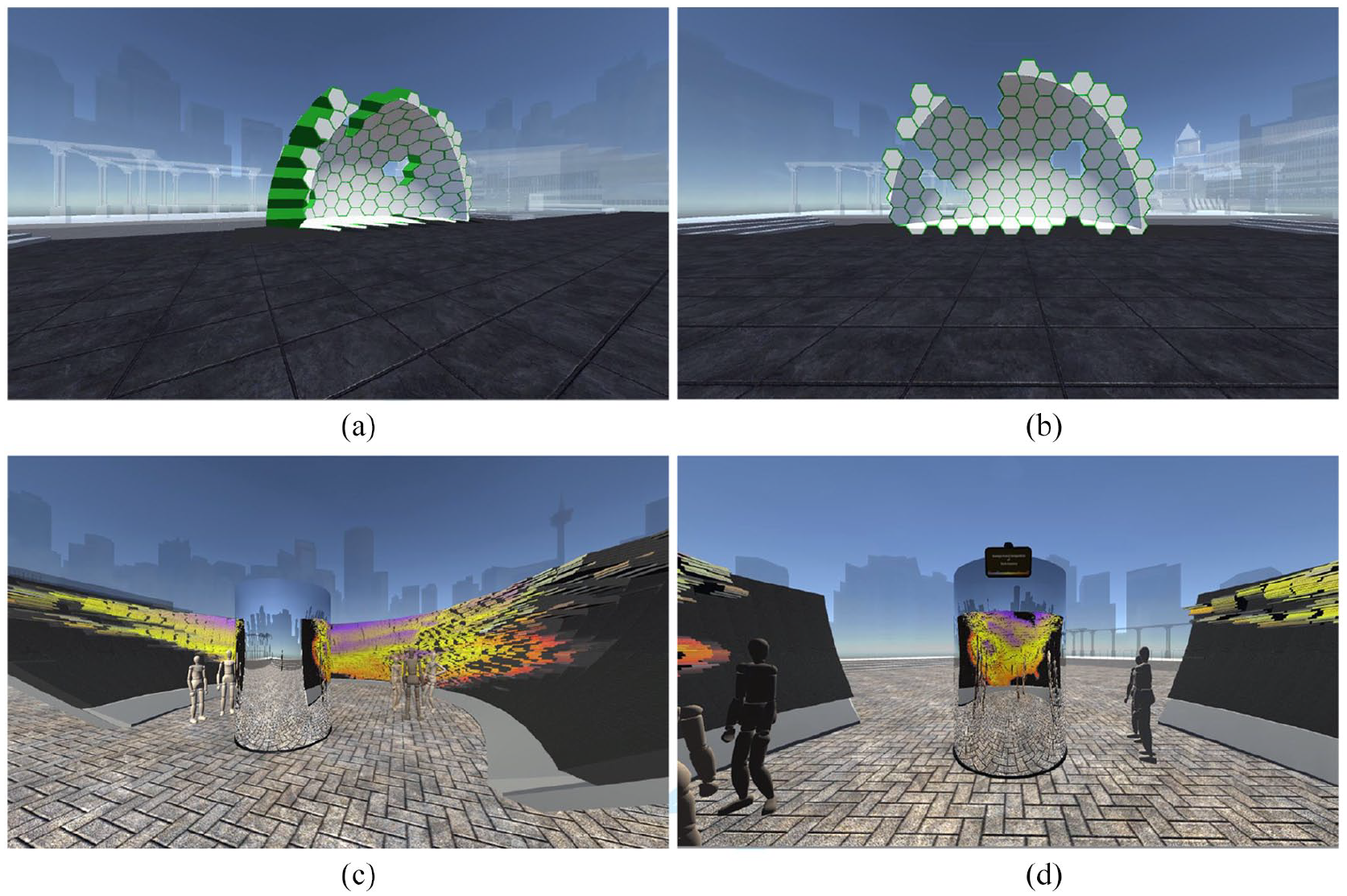
The VR scenes: (a) Pavilion #1, (b) the depthless pattern, seen from the privileged point, (c) Pavilion #2, and (d) the catoptric anamorphic effect, seen from the privileged point.
The methodology
Evaluation of an architecture is typically achieved through a range of documents, presented in various media. This includes, but not limited to, a series of 2D and 3D technical drawings, physical models at different scales, computer generated images and videos. These methods are intended to deliver a relatively accurate description of the design. Having used a number of these methods, as the collateral documents, we founded our user-study mainly on immersing participants in the virtual environment, using the Virtual Reality (VR) technology. It is acknowledged as a powerful tool for modeling and data visualization, and there is a growing demand for such a cutting-edge technology in architecture for various goals; as a tool for representation, design development, evaluation and analysis,46–48 education,49,50 and data visualization at urban scale.51–53 Upon receiving a human ethics certification, and with no recruiting criteria in terms of gender, demographic breakdown, prerequisite skills, etc., we invited the first 20 volunteers for the study.
The data type
The concept of OIA mandated the user-study to collect both qualitative and quantitative data. For the qualitative side of the study, participants filled out a questionnaire regarding their experience, at the end of their VR session. To fulfill the quantitative evaluation, for each pavilion there was a specific task to tackle. Regarding Pavilion #1, each individual was asked to locate the privileged point, through which the pavilion was deemed depthless. About Pavilion #2, however, participants had to spot three coordinates to accomplish their job.
To explain the logic behind locating three coordinates, we first need to reiterate the function of Pavilion #2, where data readability and data distortion represent opposite ends of one spectrum. More specifically, the cylindrical shape of the mirror helps reading the represented data within an arc, embracing the privileged point. To establish this arc, we need three points. The first point is the perfect spot, where readability is robust. The farther we step away from this privileged point, the less readable the data becomes, until we reach an edge, where the distortion overshadows the readability of the data. Thus, volunteers had to first pinpoint their privileged points. Next, they were asked to step toward both edges of the pavilion and spot the endpoints of an arc where they could still read the data. An interpolated arc through these three points represented each participant’s privileged area to read the data.
Quantitative data analysis
Analyzing the quantitative data in these two OIAs can deliver a distinct message about the design functionality, and efficiency in communicating with the public. Owing to an anti-cycloptic perception mechanism, applied to Pavilion #1, (fork 1b in Figure 6) the perception of depthlessness was plausible with slight deviation from the actual viewpoint. Our pilot-study suggested marking privileged points at any distance shorter than 10 inches away from the actual privileged point are considered successful (Figure 9). Results indicated only four participants, out of twenty, found their privileged points within this distance, with the best attempt less than 3 inches away from the actual point (Figure 10).
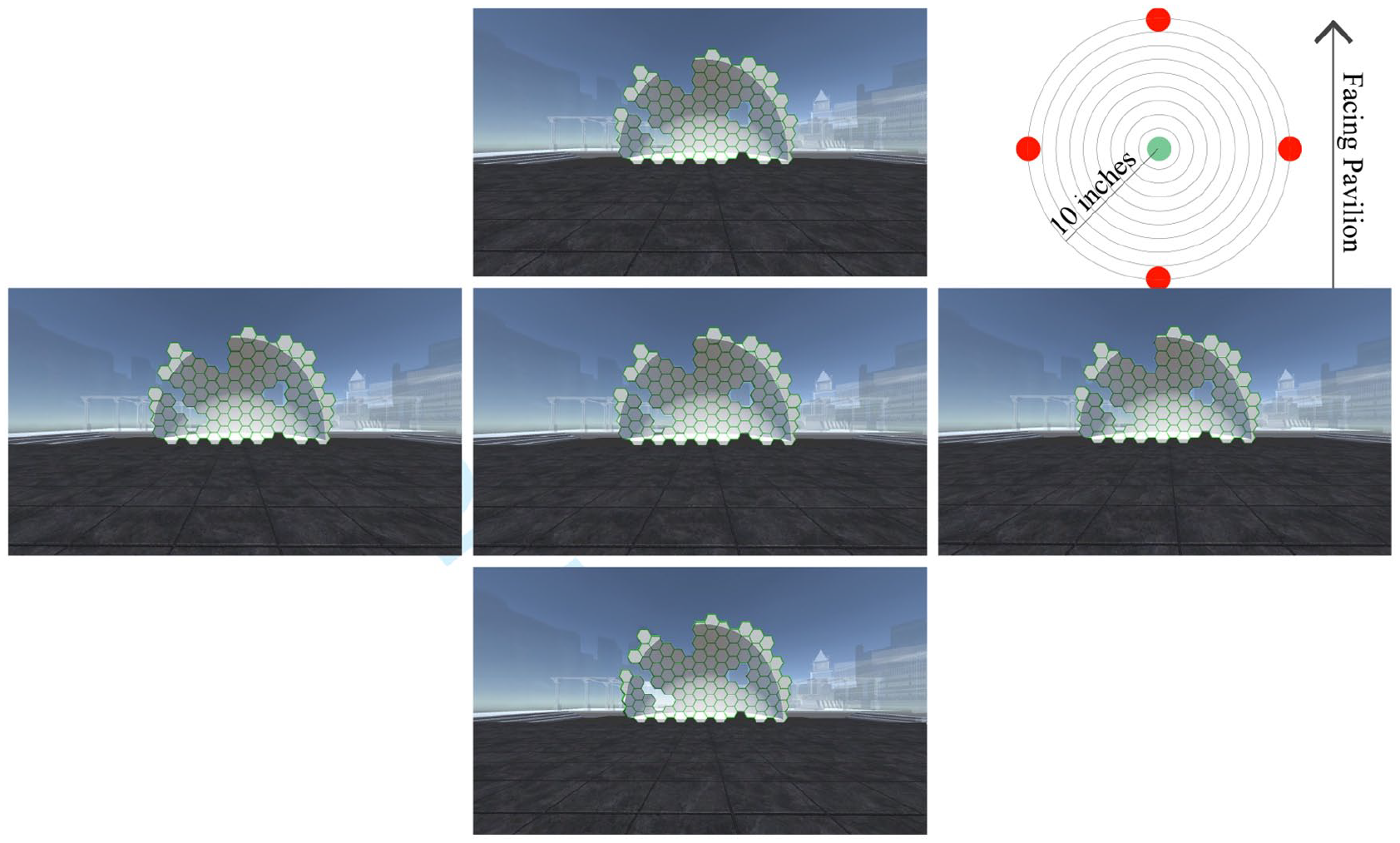
According to the pilot study, perception of depthlessness is considered successful within a radius of 10 inches around the actual privileged point. The center image is seen from the green dot, and the rest images are seen from their corresponding red dots.
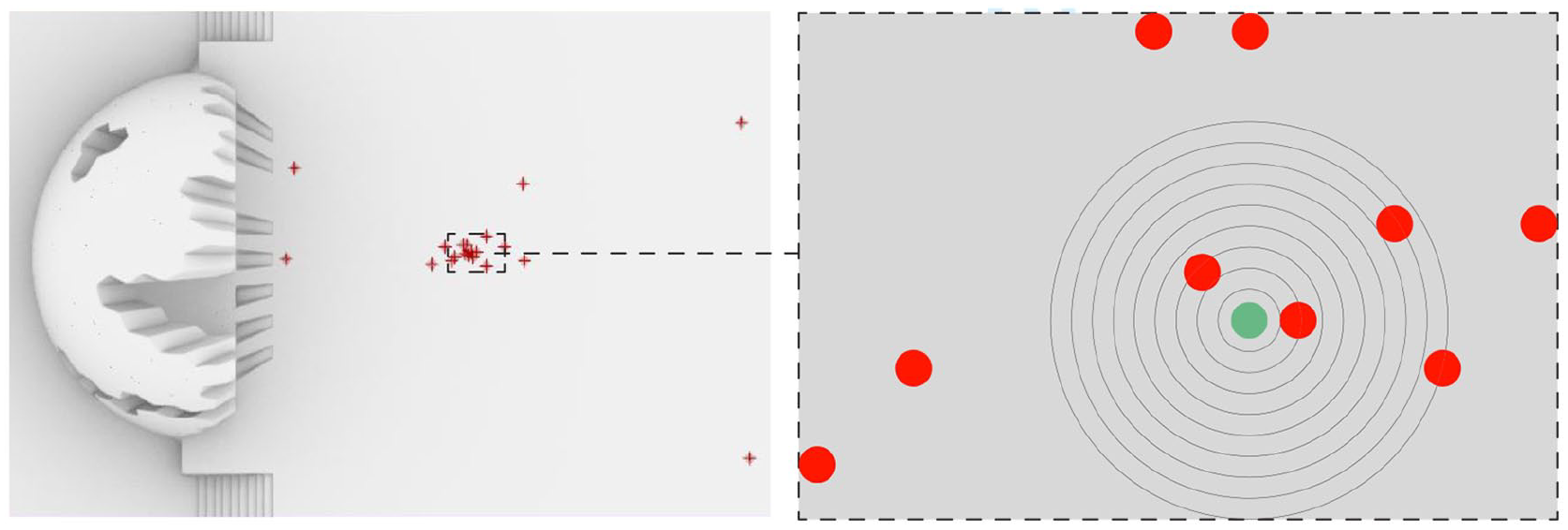
Privileged points defined by users (red dots), and the actual privileged point (green dot). The radii differentiation of the concentric circles around the privileged point, is 1 inch.
Apart from the result of the task, there are two valuable data about the audience’s behavior during interaction with the space. First, according to the speedometer, participants would first find the approximate privileged area, and then would walk compulsively to locate their actual privileged point, upon which the pavilion is perceived flat (Figure 11).
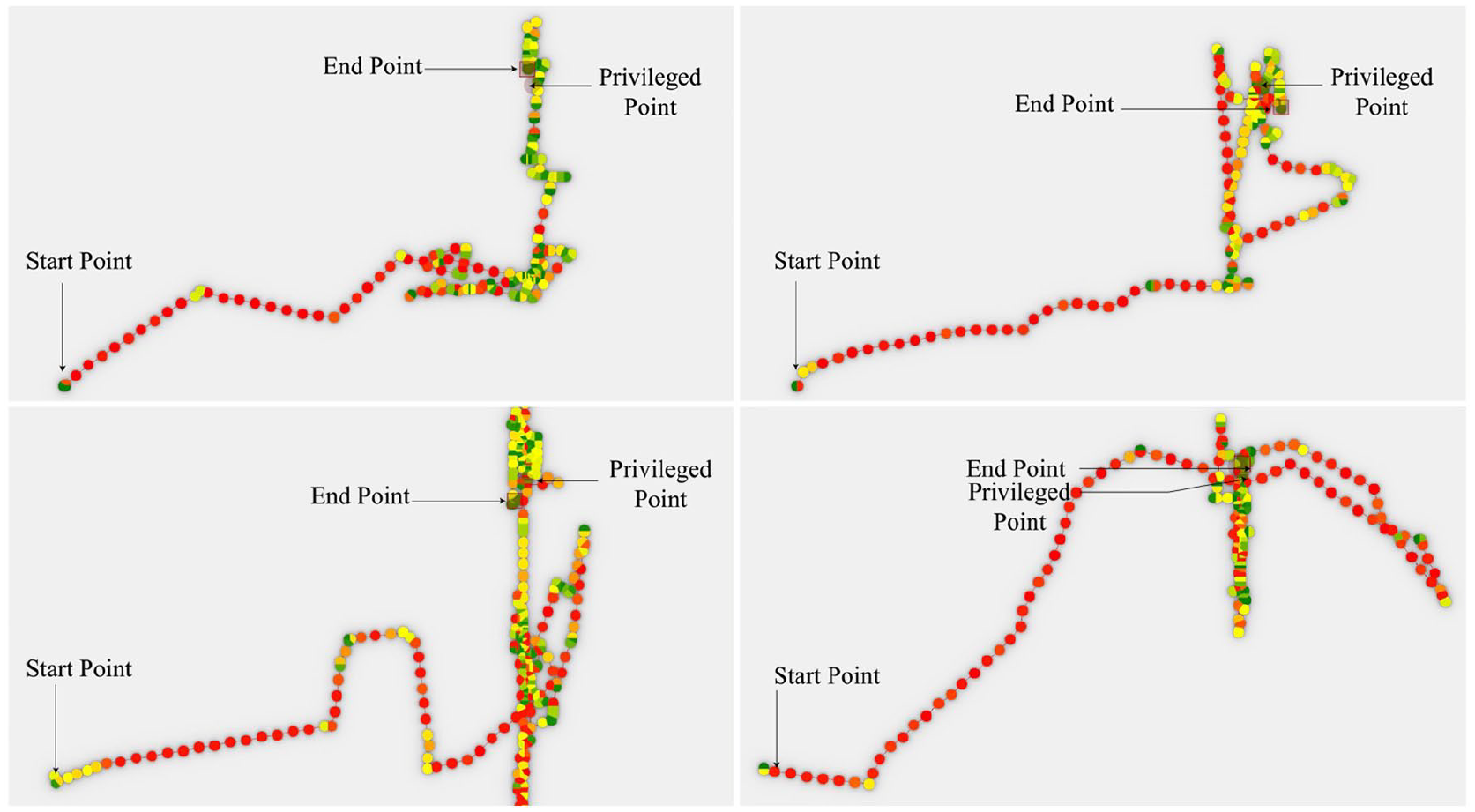
Four random participants’ data. The speedometer used in the study visualizes participants’ manner to approach the pavilion. Red and green colors are at either end of this spectrum, representing maximum and minimum speeds, respectively.
Second, having overlaid all speedometer data, the quest to locate the privileged point seemingly befell more in an axially oriented space, in front of the pavilion (Figure 12). In other words, such an anamorphic structure can arguably communicate more effectively with a broader group of people, when placed in spaces that are linearly oriented alongside this axis. 24
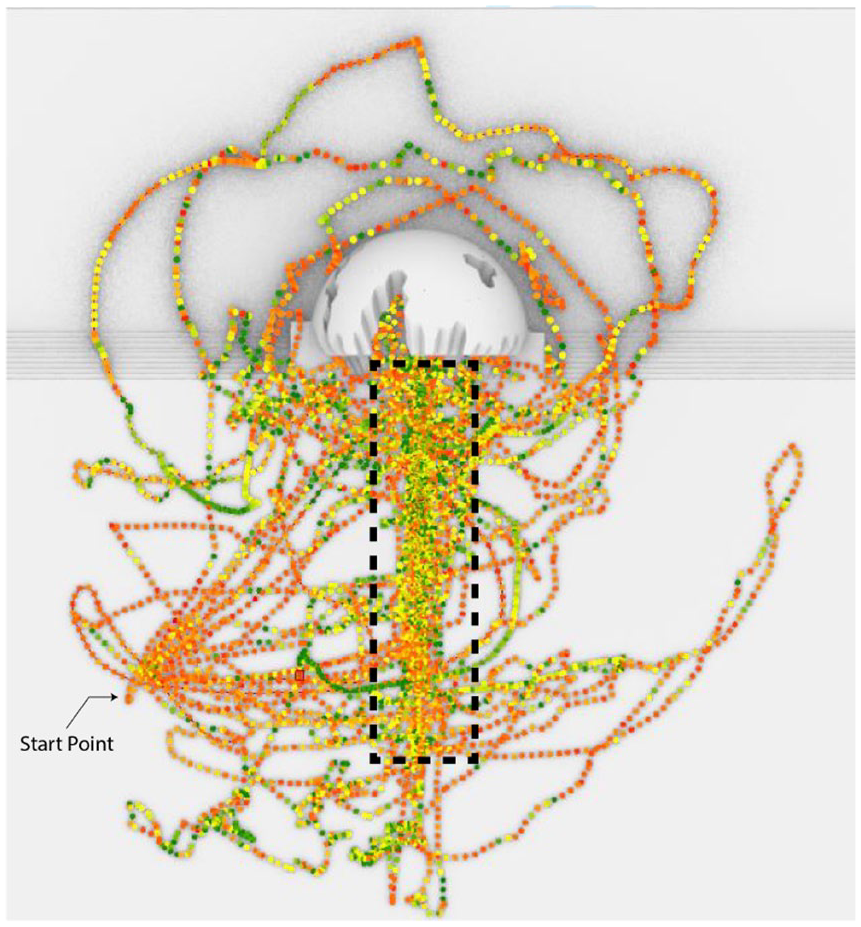
All participants’ data. The dense area within the dashed frame renders the axial interdependency of the pavilion, where most attempts to interact with the pavilion took place.
Likewise, data analysis of Pavilion #2 bore worthwhile information, collected by participants. They initially explored the space and pinpointed their privileged points (Figure 13(a) and (b)). Next, they defined the both ends of an arc, in which data was still readable (Figure 13(c) and (d)). Having extracted all arcs, and the three average points out of all participants’ data, we could establish an average arc as the privileged zone where a group of audience could simultaneously read and understand data within the mirror (Figure 13(e) and (f)). The underlying reason to search for a privileged zone is that, in practice, such urban structures are meant to be open to the public exploration. Thus, the coinciding presence of people is an inevitable consequent. This resonates a legitimate concern regarding the likelihood of people occluding the represented data.
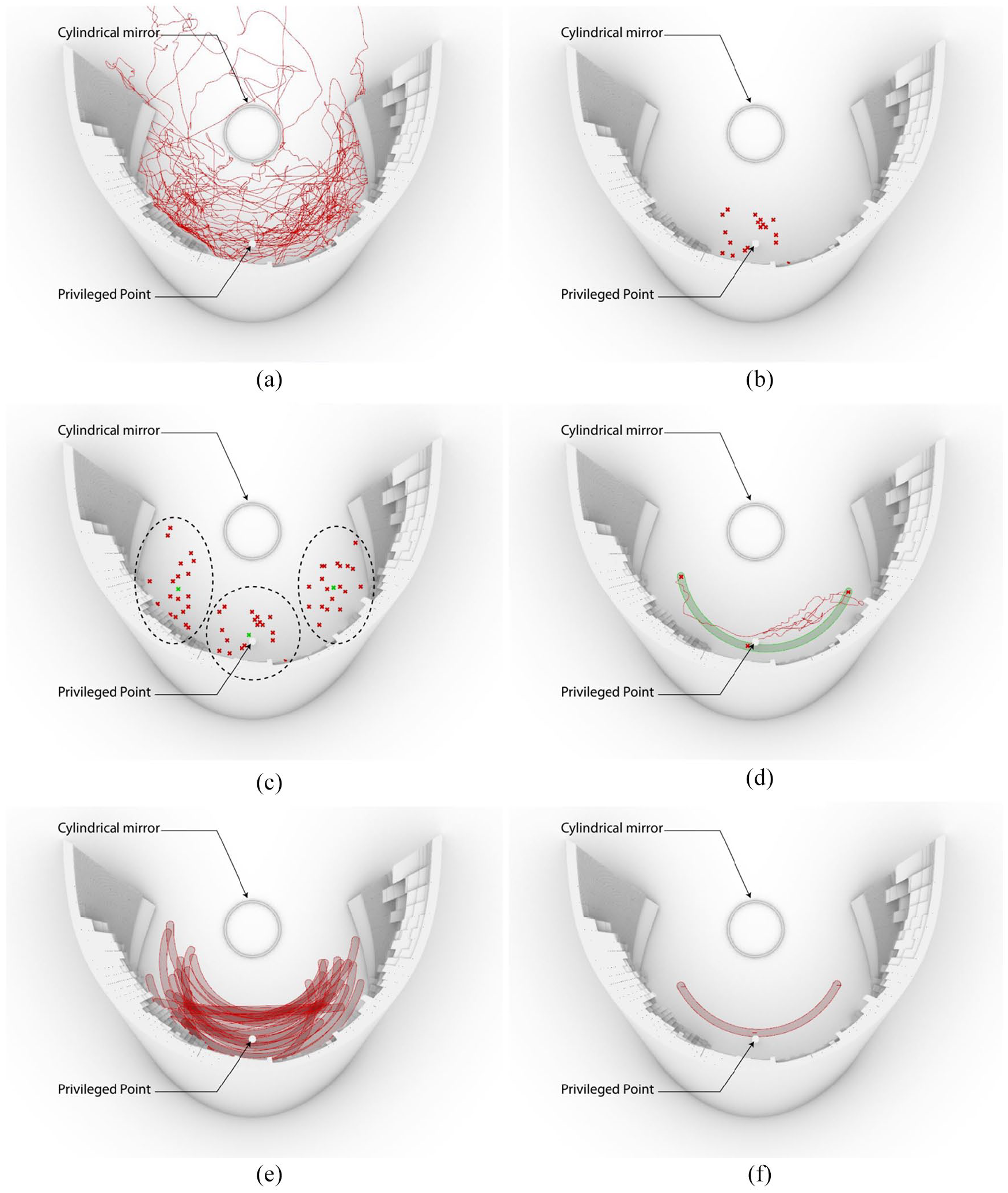
(a) Areas explored by participants, (b) a cluster of privileged points marked by participants, (c) three clusters of points to construct participants’ privileged area, (d) an individual’s data and the corresponding arc established with three points, (e) all arcs extracted from every individual’s data, and (f) the average arc, established by averaging three points out of three clusters of points.
However, we do leverage occlusion in favor of the design of the pavilion. In other words, occlusion could have been avoided by a conic mirror, and/or distributing the anamorphic components overhead. The proposed design, however, pursued specific goals, such as: Raising public awareness toward anamorphic projection, and facilitating interaction with the space. 40 It is worth noting that in our study, in order to simulate the actual space, we populated our VR scene with a number of animated mannequins.
Qualitative data analysis
Likert-scale questions
The first question referred to the verbal briefing. To restate the procedure, participants would receive a verbal briefing, at the beginning of their time, about the objective of the study, as well as the attributes of two optically illusive environments, they were about to explore, using a VR headset. As anticipated, none of the participants had heard about anamorphic projection. Nonetheless, the verbal briefing, together with a number of illustrative examples established a basic knowledge of this concept, assisting them with interacting with the two pavilions faster. Although we acknowledge one individual who disagreed with this statement, five stated “Agree,” and 14 out of 20 strongly agreed; No neutral or “Strongly disagree” reported accordingly (Figure 14).
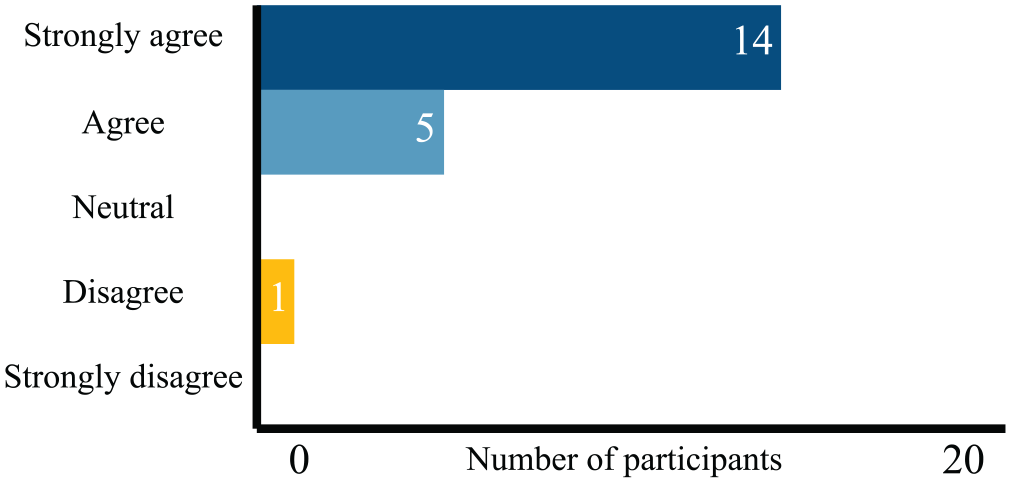
Participants’ responses to “Having explored the two pavilions, together with the verbal briefing, I now understand what anamorphic projection is.”
The optically illusive aspect of anamorphic projection was the subject of another question. The majority of participants—18 out of 20—agreed this type of projection, once applied to an architecture-size space, would stimulate curiosity on exploring them. Besides, one disagreed, and one remained neutral (Figure 15).
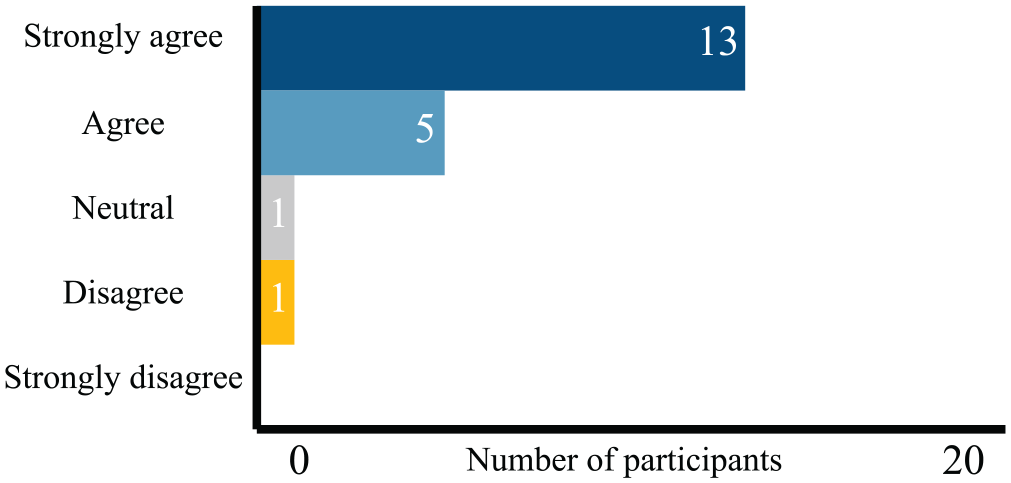
Participants’ responses to “Do optical illusions trigger curiosity to explore these environments?”
Our data analysis also revealed the relevant complexity of one space compared to the other one. Regarding the mirror-assisted pavilion, all participants were unanimously able to read and recognize data, reflected by the mirror. On the contrary, only 15 out of 20 believed that they managed to locate an approximate privileged point of the depthless pavilion. Three could not finish their job (marked “Disagree” for the statement) and two, who remained neutral, sought extra assistance for this task (Figure 16). This clearly explains why 90%—18 participants—expressed enthusiasm for exploring an actual mirror-assisted pavilion as opposed to rate of 75%—15 participants—for the depthless pavilion. Figure 17 illustrates the results accordingly.
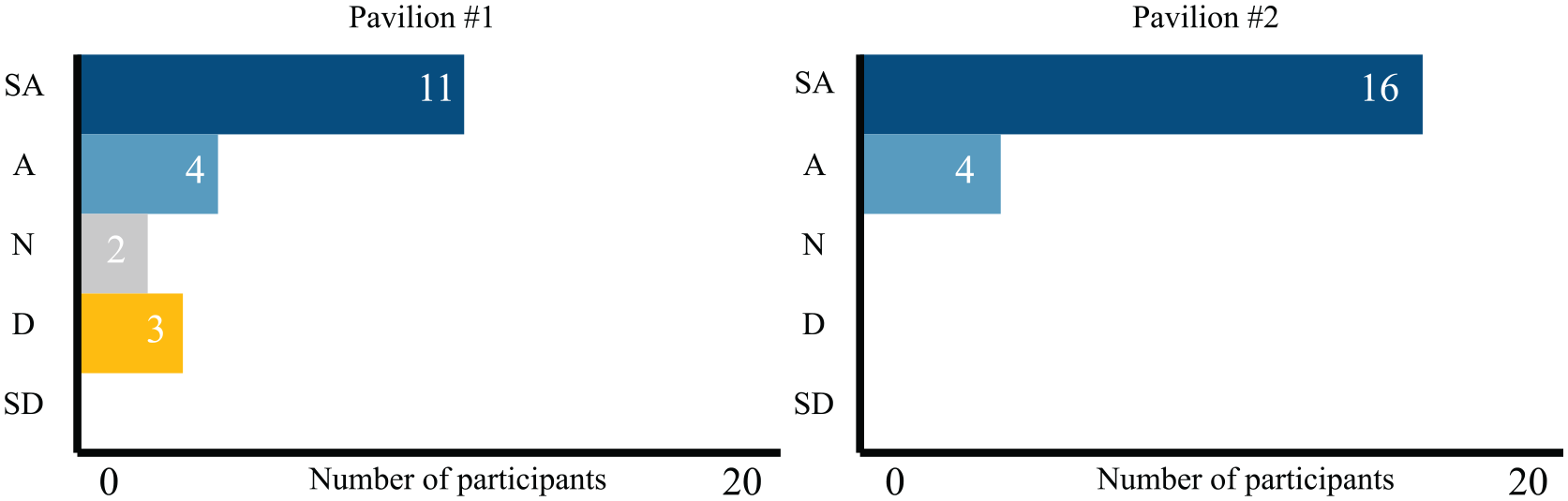
The rate of successful communication with pavilions. Left: participants’ responses to “I managed to locate an approximate viewpoint, from where the pattern on the pavilion looks flat.” Right: participants’ responses to “I was able to recognize the reflection of the pavilion in the mirror, as the image of North America.”
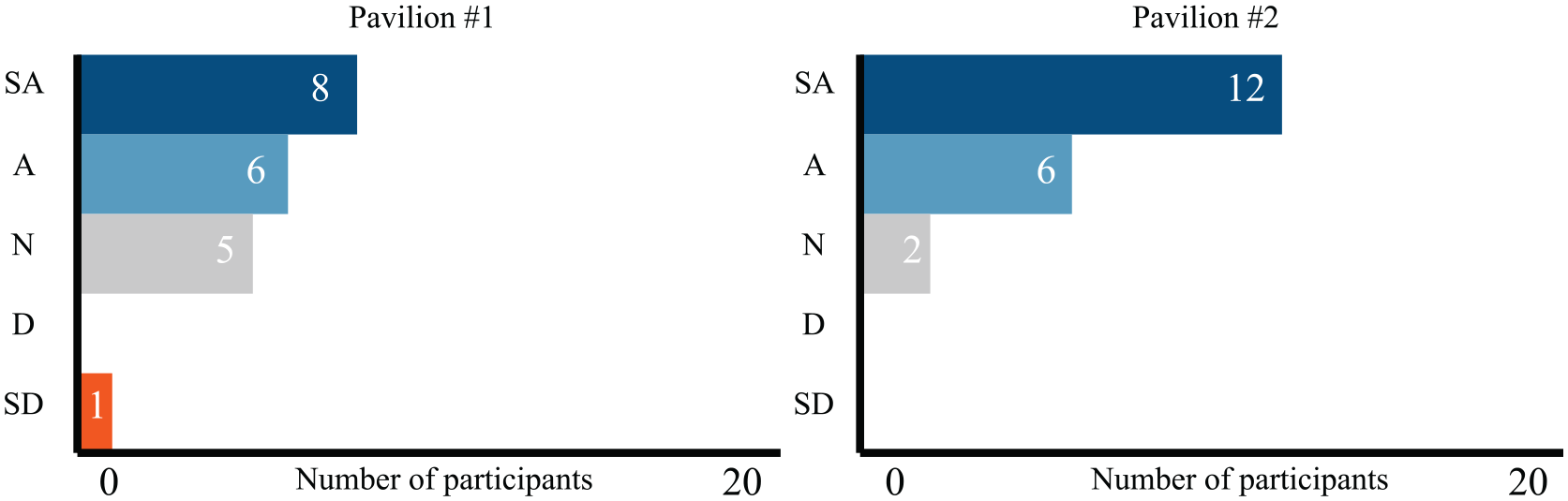
Participants’ responses to “I would like to explore pavilions, if physically built at an actual scale.”
The correlation of answers, within the likert questions can also bear some remarkable information. For example, about “finding the approximate privileged point in Pavilion #1,” five participants marked the statement either “Neutral” or “Disagree,” and just one individual out of these five, stated they fully understood the initial verbal briefing (Figure 18).
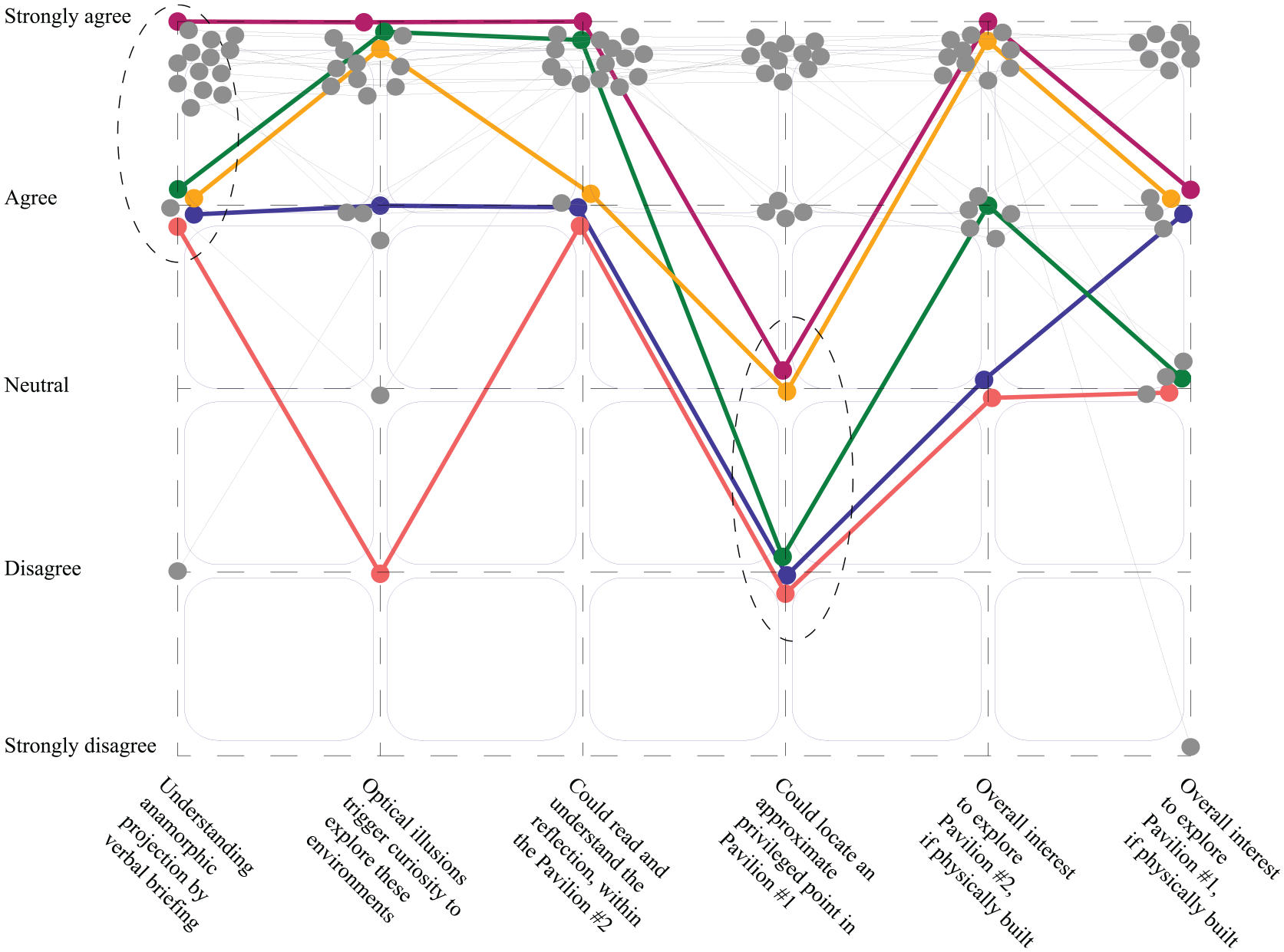
Based on our data, there might be a correlation between understanding the initial verbal briefing, and ability to perform a specific task in this study.
Another noteworthy fact here links the overall interest to explore Pavilion #1, and the personal enthusiasm toward optical illusions. According to the records, only two individuals stated any answer other than “Agree” or “Strongly agree” regarding the encouraging aspect of optical illusions to explore pavilions. At the end of the study, both expressed levels of unwillingness about exploring Pavilion #1 (Figure 19).
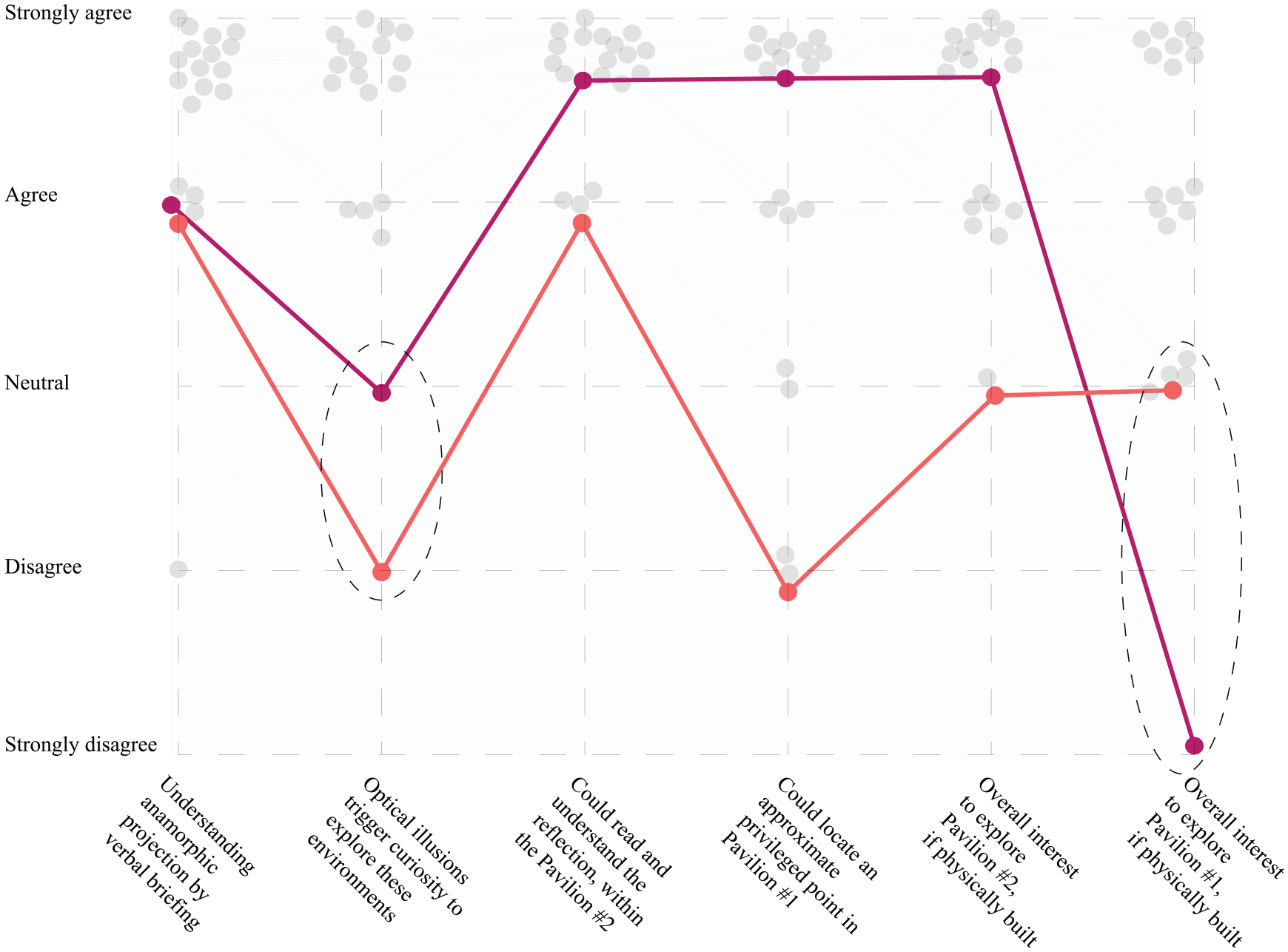
Lack of interest to physically explore the depthless pavilion might have roots in lack of interest in optical illusions, applied to architecture structures.
Open-ended questions
In addition to the likert scale, we also raised three open-ended questions about challenges during the study, and Enjoyable/unenjoyable aspects of the study. One strategy to analyze these open-ended questions was to separately annotate answers of each question. Toward this end, these answers generally fell into a number of themes, such as media-related concerns, the role of signifiers, scale, and interaction with the space. This gives us the opportunity to alternatively analyze the questionnaire through the lens of these themes.
According to our data, media-related answers appeared in response to all open-ended questions. The VR experience, for example, was a media-related issue, highlighted by 11 participants as the dominant enjoyable part of the study (Figure 20). This is closely aligned with the fact that 13 participants just experienced their first VR exploration in our study. In addition, complaints about dizziness, blurriness of the scene, frame rate, were also listed as media-related concerns. Apart from those who found dizziness a challenging feature (three participants), four preferred to disclose it as an unpleasant portion of their participation.
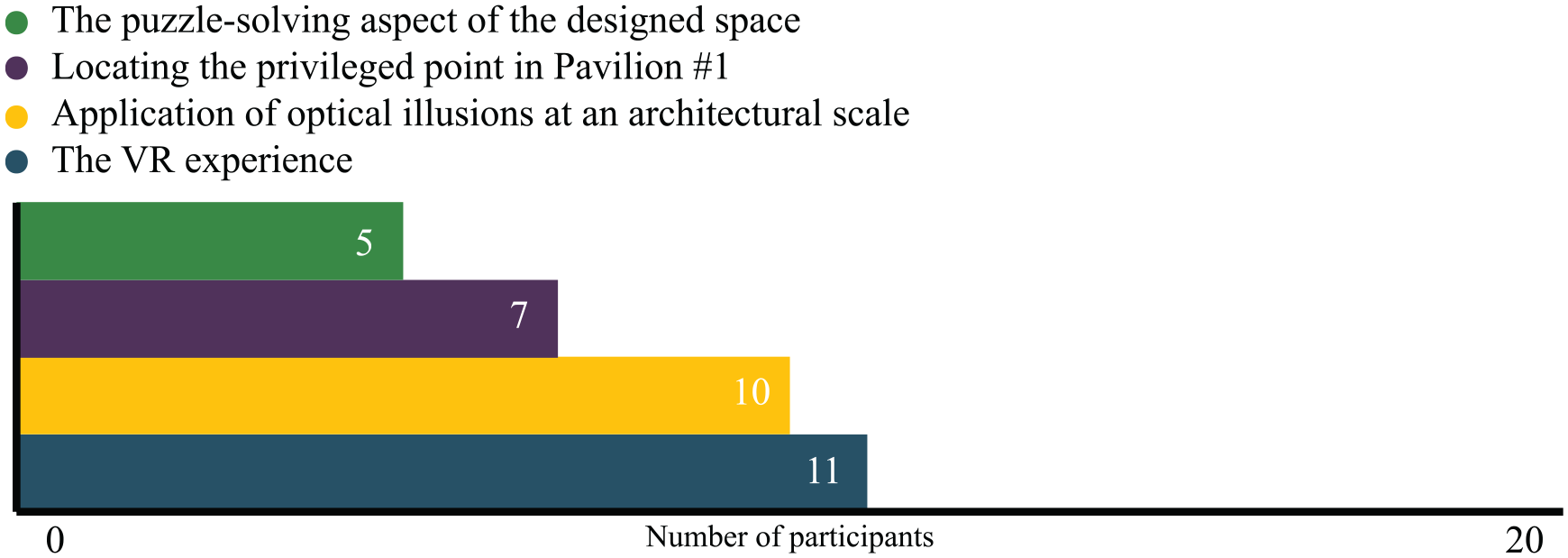
Enjoyable aspects of the study, reported by participants. Some participants reported more than one item.
Moreover, in several cases, we categorically referred to the role of signifiers to address the problematic attribute of finding the privileged point. The noteworthy lesson here is respecting the subjective condition of the study. While finding the correct spot to stand was a satisfying task to do for some people (seven participants), it was certainly causing anxiety for some others (two participants). Figures 20 and 21 represent the data accordingly.

Unpleasant experiences, listed by participants.
Furthermore, we received feedback, arguing optical illusions are fascinating phenomena when implemented at architectural scales. Optical illusions are, indeed, fascinating phenomena. But when their power is harnessed in favor of an architectural design, they facilitate interaction, and raise public awareness toward the illusory message within the design. We believe this is how an effective built environment can communicate with its audience.
Discussion
The significance of scale and material in design
OIA is primarily supposed to address questions in architectural scale. This scale extends from an entire building, to a tiny component of an interior. Consequently, there are challenges associated with practicing OIA in different scales. For example, we shall acknowledge the fact that material is a limit on scale and vice versa, meaning that, not all materials are applicable to any scale, nor all scales are doable by any chosen material. However, despite potential uncertainties over the final geometry, scale, and materiality can parametrize components of the design. Toward this end, we can parametrically link the scale of an object (h), the distance of the privileged point to the object (d), and the field of view (
Methods of facilitating the interaction with an OIA space
Interaction with environments within the OIA realm, is channeled through privileged points and/or privileged spaces. If the privileged point/space fails to establish a proper connection between the architecture and its audience, then the OIA will be downgraded as a mute and abstract structure. It is, therefore, important to shed light on every aspect of privileged points/spaces, and make sure any optically illusive architecture speaks for itself. An alternative to boost the relation between OIA and its audience is to employ what was first introduced by Don Norman; Signifiers. 55 Their role is to suggest a particular behavior, using recognizable hints such as words and/or symbols. Figure 22 illustrates a number of common signifiers.
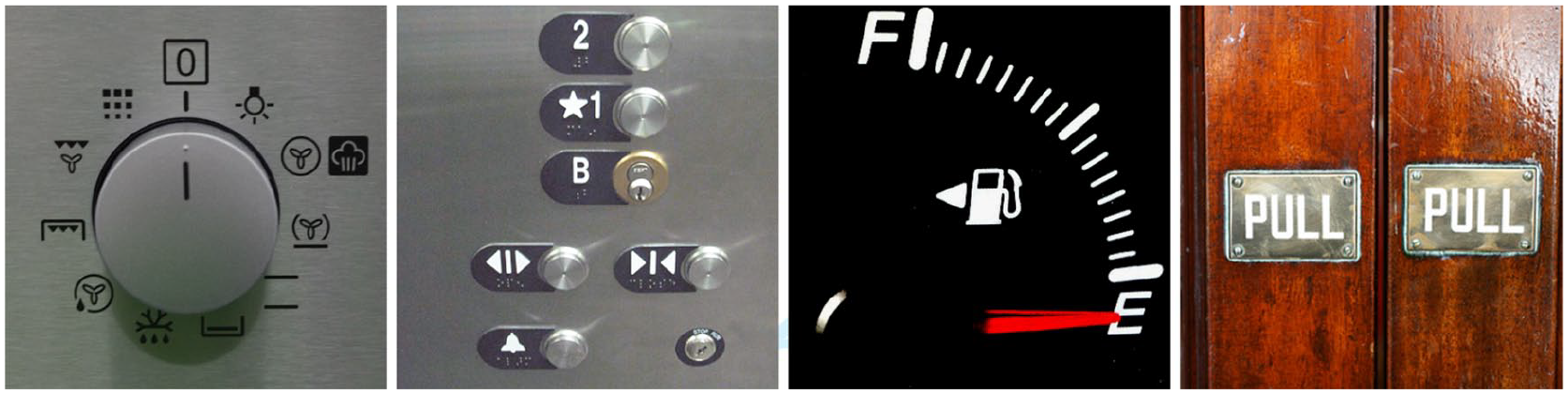
We frequently use signifiers in our daily life and it poses a question about their potential application in OIA.
Hypothetically there could be a reciprocal instrumentality between an OIA and signifier(s), meaning that either one can be used to draw attention to the other one. In other words, OIA can arguably work as signifiers that help audience to be in certain areas, or to do certain tasks. Accordingly, once an effect is seen or perceived, the viewer understands they are in the right place. Likewise, a signifier(s) could be used to funnel the audience to their anticipated place, where an OIA effect is perceivable. A conceptual example in case of the “Pavilion #1” in our user study, would be marking the privileged point with concentric circles, and/or placing a specific aperture to make sure the effect is seen from a precise height (Figure 23).
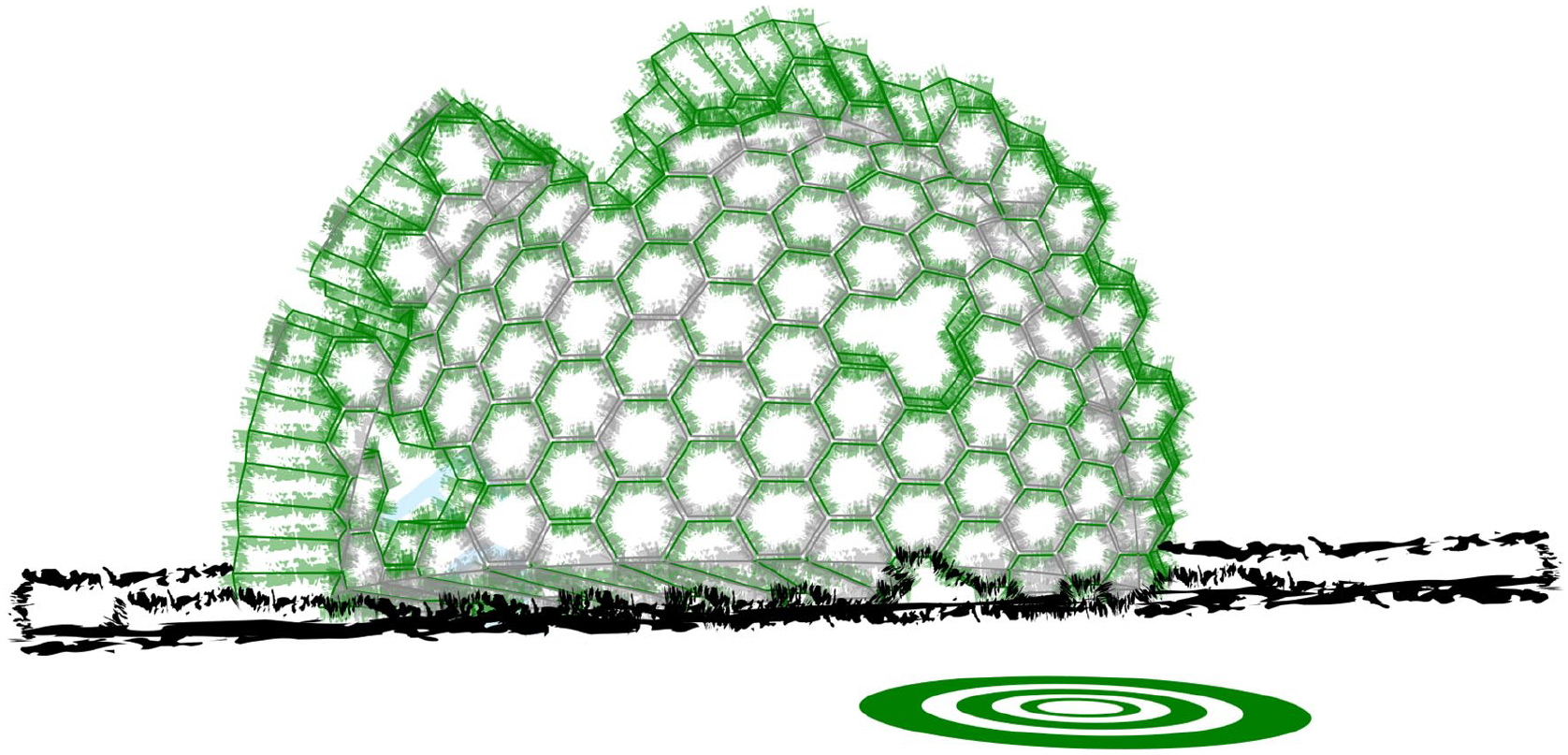
Marking the floor in the form of concentric circles is one way of applying signifiers to assist people with finding the privilege point(s).
Now that we know how signifiers can impact an OIA environment, we shall need to question the intended mentality that the designer would bestow upon audience by eliminating, or keeping the signifiers. In case of the latter, further questions will form to find out if an OIA effect serves as a signifier, or a signifier helps finding an OIA effect.
The impact of an OIA space on its audience
There are interdependencies between the designed space and the audience who is experiencing it. In this regard, a viewer can be embedded into the space, in a way that OIA predicts/governs their presence. Paintings with trompe l’oeil or anamorphic effects do govern their observers, however, on a much smaller scale and resolution. To bring it into the light, we analyze “The Ambassador,” one of the most promising paintings with anamorphic projection effect, by Hans Holbein in 1533.
As it is seen in Figure 24, there is actually more than one orientation associated with the painting. The first orientation refers to the privileged space, in front of the painting. This is the space, most people take to communicate with a 2D artform. The second orientation of the painting is toward the privileged point, through which the anamorphic effect is perceived. To see the painting as a whole and to experience its anamorphic effect, one has to make spatial transition between these privileged spaces. It is therefore, governing people’s position in the space.
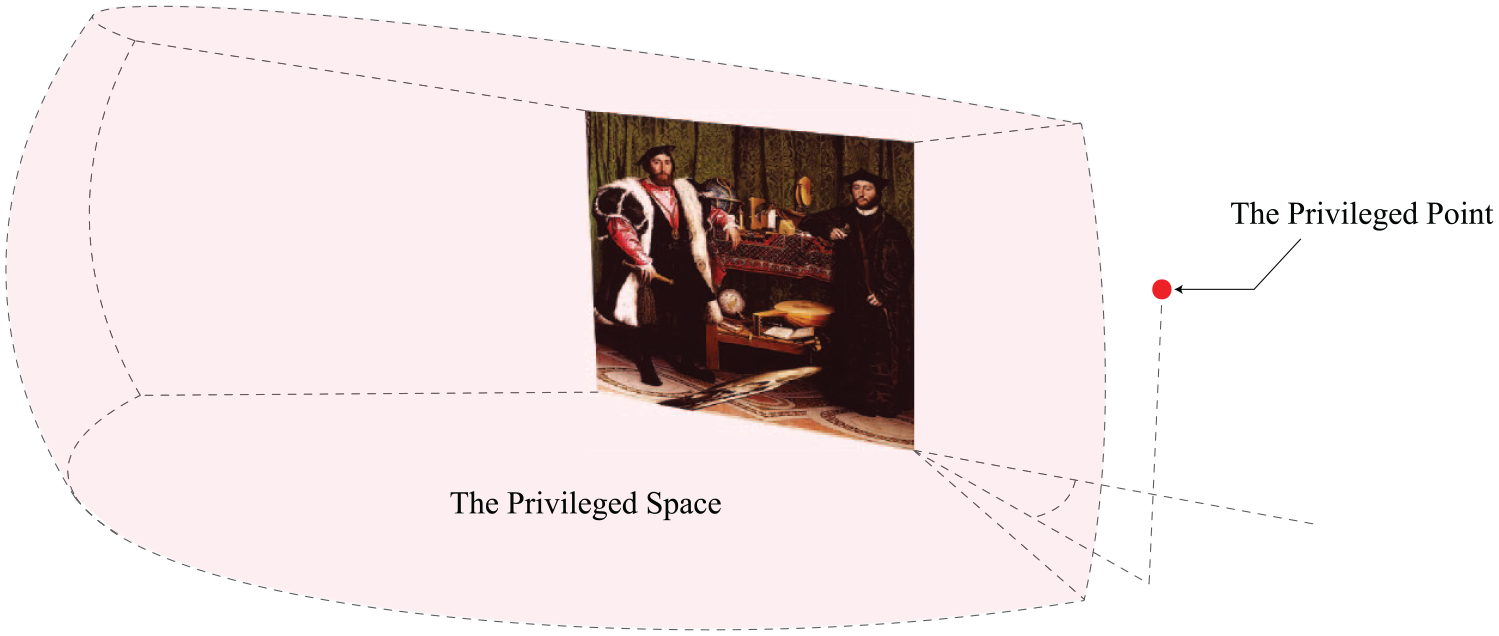
The painting “The Ambassador” dictates its audience’s position in the space by defining two different privileged zones.
Along the same concept, and through the lens of architecture, OIA is capable of exerting agency over people’s position in the space. In fact, transition between privileged points/spaces, together with differentiation between the messages they transmit, will provide a physical inhabitation 56 that eventually orients the space and its audience (Figure 25).
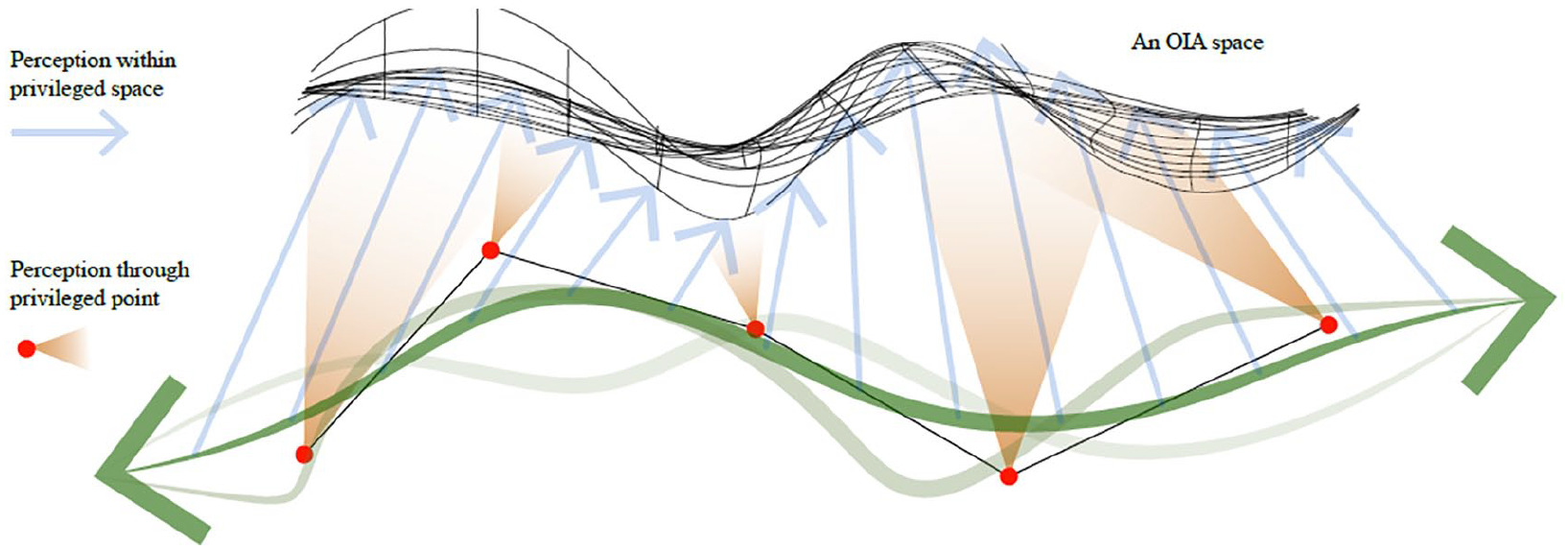
Smooth spatial transition, within an OIA space, is feasible by higher number of privileged points/spaces, as well as expanding the perimeter of privileged spaces.
In the following section, our user study reveals how the quest to locate the privileged point of an anamorphic pavilion, results in an axial transition of the audience. Within this OIA environment, the pavilion’s orientation can be read from any point in the space, except the privileged point where the orientation disappears, and the pavilion appears as a depthless space.
Conclusion and future work
The journey of Optically Illusive Architecture (OIA) begins with a question; how do artforms, specifically paintings and drawings, contribute to a traceable evolution of architecture? Studying architectural representations together with paintings and drawings of various eras leads to the realization that there are two elements of representation that most of them have in common; Viewpoint, and representational deficiencies. While the former fundamentally influences our perception of the world, the latter is an inexorable effect, lurking in a gap between representational limitations and the reality.
Besides, perspective-based optical illusions are designed to convert this representational imperfection into a deliberate misrepresentation to mislead our visual perception. Since sight is our primary sense that governs our interaction with the geometry of our surrounding space, OIA borrows this optically illusive quality with the aim of governing our behavior within an architectural space. In this regard, OIA directly deals with both elements. It establishes a design paradigm, whose concept explicitly derives from this gap between representing and represented, around the role of viewpoints in the space.
Perspective-based representations and optical illusions are best perceived through viewpoint(s). Thus, to architecturally contextualize the illusory effects, we shall apply a mechanism, called “anti-cycloptic perception,” in favor of our stereoscopic vision. Accordingly, our empirical studies of two OIA environments, via VR, revealed promising results, in terms of stereoscopic perception, interaction, and OIA’s ability to orient its audience and the space. Yet, as expected, the future scope of OIA is enriched with new questions. For instance, questions around the behavioral implications of exposing public to an optical illusion, embedded in a built environment. Besides raising public awareness toward architectural aesthetics, to what extend is an OIA environment is efficient in shaping the public behavior, compared to easy-to-grasp signifiers?
In addition, our work unleashes a series of fabrication-oriented question. what design challenges do we confront in materializing an illusory effect as a non-flat topological surface? How is it different if we approach this question through the lens of digital fabrication? In a broader scope, how do constraints of machinery and material systems correlate to representational limitations, harnessed by OIA paradigm?
Footnotes
Declaration of Conflicting Interests
The author(s) declared no potential conflicts of interest with respect to the research, authorship, and/or publication of this article.
Funding
The author(s) received no financial support for the research, authorship, and/or publication of this article.
