



Abstract
Interventions to redress the apartheid education’s negative impact on the education and training systems of the previously disadvantaged groups in South Africa include the implementation of recognition of prior learning (RPL). The paper attempts to qualitatively assess emerging farmers’ individual perspectives by analysing their cognitive and non-cognitive characteristics during RPL credit assessment sessions. A total of 200 Free State province emerging farmers participated in an RPL credit assessment session of the unit standards to be recognised for two agricultural qualifications. The RPL unit standards credit assessment sessions for two agricultural courses were conducted in a classroom for 3 months. The data generated from text, video, and voice recordings was processed and analysed using critical discourse analysis. What emerged from the discussions was that emerging farmers were appreciative of the opportunity to embrace spontaneity during training. The study found that embracing adult learning principles had a positive effect on the cognitive and non-cognitive characteristics of emerging farmers during training. The findings of this paper will help strengthen the understanding of how RPL is implemented in the context of emerging farmers and further development of what needs to be done to further improve RPL procedure.
Background
The teaching and learning of emerging farmers are crucial for the processes of diffusion and transmission of knowledge needed to understand and process new information (Solomon et al., 2019). To increase agricultural produce productivity at the farm level, the proper education of emerging farmers aimed at understanding and adapting to complex scientific changes is necessary (AgriSA, 2016). Ashfield et al. (2020) note that research evidence has proved that there is a positive relationship between education and farmer efficiency. Capacitating emerging farmers with agricultural knowledge allows for farm-level decision-making through increased emerging farmers’ awareness of new practices and assisting farmers (Anurugwo & Mbara, 2019). The emerging farmers’ individual perspective as a well-understood concept in psychology, driven by the psychological paradigm, is the predominant way we think about learning in adulthood. Individual perspective assumptions are that learning is something that happens internally, primarily inside of our heads. We can construct a set of principles and competencies that can assist all adults to be more effective learners, no matter their background or current life situation (Fenwick & Tennant, 2020). To assess the learning of the emerging farmers as it relates to the individual perspective in this paper, I qualitatively examine the emerging farmers’ cognitive skills and non-cognitive characteristics. The cognitive skill of education comprises basic literacy and numeracy that emerging farmers achieve from education (Owusu-Boadu et al., 2021). The emerging farmers demonstrate cognitive skills by articulating their understanding of the content of each topic during recognition of prior learning (RPL) credit assessment session engagements. The non-cognitive characteristics refer to the change in the attitude of emerging farmers because of the discipline of the classroom in terms of punctuality, teamwork, correctness, adherence to schedules, and so on (Peng et al., 2021). The perseverance, willingness, and receptiveness amongst others of the emerging farmers’ attitude towards the RPL credit assessment sessions underscore the non-cognitive characteristics observed during these RPL sessions.
The emerging farmers in the South African context are the livestock and crop producers from the previously disadvantaged groups (Nkosi & Agholor, 2021; Teele et al., 2020; Teele, 2018). These farmers are found as individuals or groups regulated under a trust and are beneficiaries of the Department of Agriculture and land reform programs (Morris, 2023). Emerging farmers are found in various categories, such as subsistence, smallholders, medium-scale, large-scale, and commercial farmers (Olofsson, 2020; Vetter et al., 2020). They can be farmers who farm on their private land, leased land, commonage land, and communal land (Nkosi & Agholor, 2021). Adhitya et al. (2019) noted that the influence of individuals’ non-cognitive characteristics on labour outcomes is as strong as the influence of cognitive skills. Research has revealed that for the main type of learning environment, the educator plays an important role in both cognitive and non-cognitive outcomes (Boman, 2023; Kamphorst et al., 2021; Kortteinen et al., 2021). There is a need for more research on emerging farmers’ cognitive functions and educator-relevant factors, which are crucial in human cognitive and non-cognitive outcomes, to be able to predict the willingness to adopt the acquired knowledge and skills. With acquired learning from engaged RPL, emerging farmers can increase their productivity potential by developing and refining their capabilities through appropriate education (Anwarudin & Dayat, 2019).
RPL is a process of evaluating knowledge and skills acquired through life experience allowing recognition in formal systems (Letseka & Pitsoe, 2014). It includes providing access to education and training and facilitating redress of former unfair discrimination (Mothokoa & Maritz, 2018). RPL emphasises and supports the principle of lifelong learning by encouraging individuals to continuously improve their skills (Letseka & Pitsoe, 2014). The knowledge of emerging farmers is evaluated through a series of unit standards credit assessments demonstrated by Snyman (2013), for a particular qualification that the emerging farmer is evaluated. However, this process leads to academic knowledge that is often organised around the dominant and prescriptive view of knowledge (Cooper et al., 2017). The mismatch between the emerging farmers’ lifelong skills and knowledge and academic knowledge, the candidates’ practice skills, and expected professional skills is demonstrated when emerging farmers articulate and reflect on their experience. Recognition of the prior learning process in the context of this study refers to the combination of unit standards credit assessment sessions facilitated by the assessor in a classroom and demonstrations performed by emerging farmers on the farms. The policy and procedure for RPL provide that the RPL assessment process must provide valid evidence using various methods and instruments. The RPL assessment must be planned and designed based on the requirements of previously accepted SAQA unit standards of the whole qualification (AgriSETA, 2019). The type of facilitation is the one in which the assessor explains each question during the unit standards credit assessment sessions for the emerging farmers to understand each question. It is important to note that the emerging farmers who participated are individuals whose majority never had the opportunity to study beyond primary education or further. To demonstrate this reality, a previous study by Maphalla and Salman (2002) has revealed that only 5.2% of the emerging farmers in Free State hold a tertiary qualification, 16.1% did not attend school, 8.9% completed primary school, and only 18.6% completed secondary school.
During these unit standards credit assessment sessions, the emerging farmers engage on every topic that they either need clarity on or when they wish to put their points across. Emerging farmers freely express themselves on any issue related to the unit standards questions or any matter they wish to communicate. The importance of cognitive capacities in determining economic status is documented in the psychology and sociology literature (Gustina et al., 2020). The ‘g’ theory of human behaviour emphasises the importance of cognitive capacities measured by the intelligence quotient (IQ) (Peña et al., 2002). The IQ of emerging farmers is demonstrated during the sessions where they discuss and demonstrate their understanding of the content in the topics. Demonstrating the level of cognitive capacity and non-cognitive characteristics when it relates to the content in classes and context during practical demonstrations is paramount RPL progress. Cognitive ability is indicated to be the best predictor of farm workers’ productivity because they are the main element of socioeconomic outcomes (Zhao et al., 2022). This translates to the proficiency of trained farmers and farm workers to understand their work and make decisions that bring about successful outcomes. The non-cognitive characteristics have an important role in enhancing schooling performance for both children and adults (Semeraro et al., 2020; Yao et al., 2023). Non-cognitive characteristics – such as obedience, loyalty, and persistence – were perceived as more important than cognitive ability, particularly for the low-skill labour market (Li et al., 2021). Both cognitive skills and non-cognitive characteristics could predict the outcome of emerging farmers’ engagement because they can explain learning outcomes and social behaviour (D’arcy et al., 2019; Jacobs et al., 2021; Vanbecelaere et al., 2021).
Farm practices are a very crucial aspect that ensures farm production towards productive, economical, and sustainable farming. It deals with the emerging farmers’ efficacy and efficiency in making decisions and solving problems on the farm (Wulandari et al., 2023). How emerging farmers understand and practice intended farming skills will determine the efficiency and success of producing farm products of the expected quality in the market. Whether intended or not, RPL for emerging farmers achieves two important functions. It provides a means of assessing the candidate's experiences against the requirements for completion of the qualification, the completion of required assessments and the teaching and learning of the content of the course (Osman, 2003). The sessions for emerging farmers’ RPL when facilitated using adult education methods rather than traditional methods become a teaching and learning environment where they circulate their knowledge with each other (Ashfield et al., 2020). RPL is meant to provide opportunities for emerging farmers who do not have an agricultural education certificate or equivalent to obtain recognition for learning acquired in informal and non-formal contexts of learning (Snyman, 2013). This paper critically assessed the understanding of emerging farmers who have gone through RPL credit assessment sessions and qualitatively assessed their individual perspectives on the learning experience.
Theoretical framework
This study is framed within the framework of two overlapping and interrelated theories: constructivism and bricolage.
Constructivism theory claims that knowledge is not transmitted but rather embodied in cognitive structures constructed by every person’s interaction with the world around them (Kim, 2006). It allows me as a researcher to uncover new understanding of the world of the emerging farmer. I am of the view that the realities of emerging farmers are articulated when they circulate and share their lifelong experiences. Constructivists theorise by reflecting on the assumptions of philosophy (epistemology – the nature of knowledge), psychology (cognition – the ways of knowing), and education (pedagogy – the methods of teaching knowledge) (Charmaz, 2020; Mogashoa, 2014; Zajda & Zajda, 2021). I, therefore, reflect on the epistemology of the knowledge circulated, on how emerging farmers know what they say they know, and the teaching and learning methods used during the RPL credit assessment sessions. The process of bricolage appears to emphasise the cognitive frame of bricoleur-learning regarding the learning process of opportunity recognition and exploitation (Bhardwaj et al., 2023). Bricolage is used to denote a concrete as opposed to an abstract learning style (Lotteri et al., 2023). As a bricoleur, I then make use of every tool available to me to conclude the task of investigating the individual perspective of the emerging farmers. The French word bricoleur describes a handyperson who makes use of the tools available to complete a task (Beltagui et al., 2021). The theory of bricolage exists as a way of making the subject accessible to a broader range of students. Emerging farmers as students are assured by bricolage complexity that they are viewed as equals and no one is above anyone, making it possible for them to express themselves freely and openly without fear of being wrong. Because knowledge is circulated by the emerging farmers amongst themselves, this assures accessibility.
Given the highly structured nature of the agricultural science domain, a tendency to bricolage in educational research discourse would manifest itself as inefficient, trial-and-error actions based on a superficial model, the WYSIWYG (what you see is what you get) model (Anwar & Clauß, 2021). Bricolage views teaching and learning methods actively rather than passively, meaning that we actively construct our teaching and learning methods from the tools at hand rather than passively receiving the ‘correct’, universally applicable methodologies (Lotteri et al., 2023). Bricoleurs also steer clear of pre-existing guidelines and checklists developed outside the specific demands of the teaching and learning at hand (Kleine-Stegemann et al., 2022). Embracing complexity, the bricolage constructs a far more active role for emerging farmers both in shaping reality and in creating the teaching and learning processes. Understanding of the bricolage approach assumption is that every study is subjective because it is influenced by the researcher’s personal history, biography, gender, social class, race, and ethnicity, as well as by the people in the society (Ben-Asher, 2022). In the context of active bricolage when facilitating sessions with emerging farmers, I bring my understanding of the teaching and learning context together with my previous experience guided by the adult education principles. Bricolage is the use of available resources to solve new problems, thereby generating various new knowledge, know-how, expertise, and learning capabilities (Zahra, 2021).
Methodology
The population of two hundred (n = 200) emerging farmers from 10 training sites (towns) in the Free State province were selected for assessments towards RPL credits for agricultural courses in two qualifications. The study explored the multi-perspective approach to accommodate the opposing views of the emerging farmers as co-researchers. The qualitative data was generated during discussions of contact sessions from the emerging farmers using video and tape recordings, written text, and notes. The engagement of discussions during contact sessions was conducted by the assessor. The languages used throughout the sessions were English and Sesotho, because of low literacy amongst emerging farmers and the preferred language that farmers in the region use. The content of the assessment used to credit the emerging farmers was translated into Sesotho for them to understand. The sessions for evaluating farmers for two unit standards of each qualification were held for 4 hours every second week with 2 hours of engagement, for a duration of 3 months.
Emerging farmers as co-researchers were assured that they are experts in their farming practices and the importance of their participation and contribution to the improvement of the sessions during engagements (Chang et al., 2022). Because emerging farmers are the ones who know the work that they do and have been doing every day and that no input from them is treated as being wrong (Ben-Asher, 2022), there was no specific individual or a particular group of emerging farmers that was given preference or special attention or treatment, everybody was afforded equal participation (Busch & Barkema, 2021). Each individual was afforded enough time to express themselves on any topic of their choice during engagements (Chang et al., 2022). During the facilitation of the unit standards credit assessment sessions, the lead researcher among the co-researchers expressed himself without imposing his knowledge or perspectives on the emerging farmers and viewed himself as an equal to the co-researchers (Teele et al., 2020). The spoken words in the voice and video recordings were transcribed into text and analysed using critical discourse analysis to expose the discursive practice and hidden meanings (Teele, 2018). I analysed text from a social and textual position using van Dijck’s (2005) theoretical perspective. The impact of agricultural training under traditional teaching methods is reported to be minimal. There is a lack of interest and reluctant participation by the emerging farmers. More research is needed to study the root causes of this lack of participation.
Interpretation of findings
Research Findings From the Discussions of the Study.
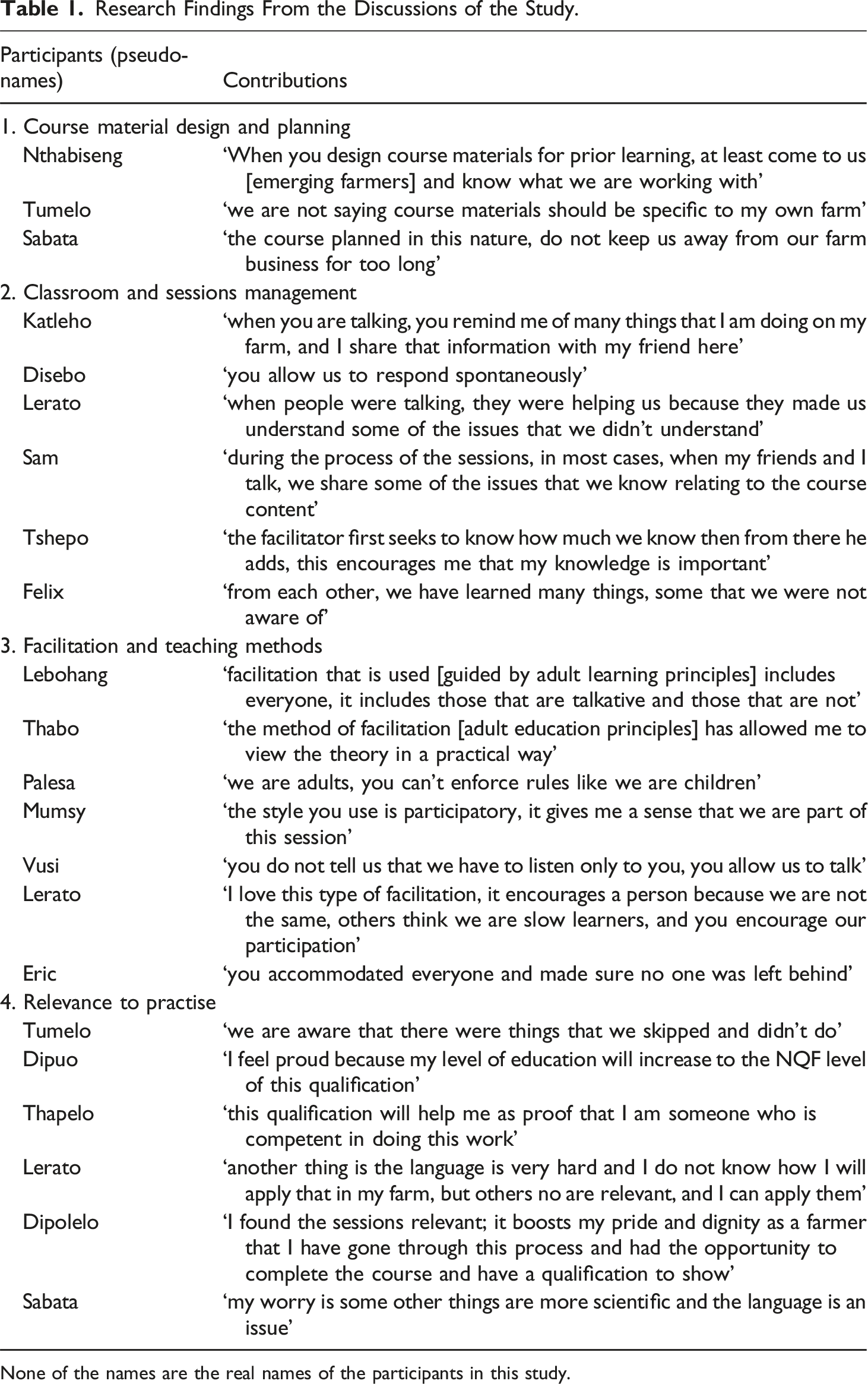
None of the names are the real names of the participants in this study.
Course material design and planning
RPL policy is not specific about the type of assessment instruments that have to be used during RPL process in South Africa. The policy provides that the assessment instruments have to be simple and designed based on approved SAQA unit standards requirements (AgriSETA, 2019). The unit standards assessment instruments used by the training provider are non-simplified copies of the summative assessments used in facilitation of the courses. In attempt to simplify the content of the assessments, the assessor then explains each question to ensure that everyone understands.
Nthabiseng said, ‘…, at least come to us …’, and it exposes that the emerging farmer is of a view that they are not part of the planning and design of the course materials. This contradicts the expectations of andragogy theories: (a) the learning materials sound to have not inspired the objectives based on the learner’s needs, interests, and skill levels and (b) to work collaboratively with the learner to select methods, materials, and resources for instruction (Desta & Gugssa, 2022; Machynska & Boiko, 2020; Tymchuk et al., 2021). The negative side of learning materials that are not responsive to the needs and aspirations of emerging farmers has the potential to stigmatise the training (Assefa, 2021). This suggests that the used course material quality reflects the objective attitude of emerging farmers towards course material to a certain extent and could assist us in understanding the reality of course content positively and objectively.
When she continues and says ‘… and know what we are working with’, it reveals that she is aware that the course materials are not realistic and responsive to their day-to-day activities and the solution is for them to be consulted and become part of the design of the course materials. What the speaker implies is in line with the requirements of the educator that observe the andragogic principles that are required to assess the learner’s specific needs and interests and evaluate the quality of the learning experience to make necessary adjustments for further learning. Adults ought to be confronted with activities related to real-life problems in the learning process as they are far more interested in developing knowledge and skills that they can apply to their current day-to-day activities (Assefa, 2021). To support these findings, Kögce and Aslandag (2018) found that 10 % of the participants expressed that learners’ needs, interests, or wishes were taken into consideration while identifying the assessment tools. However, when Tumelo said, ‘we are not saying … be specific to my own …’, he indicates that he is aware that the course is vast and covers more areas that might not apply to others. This suggests that emerging farmers want to embrace self-directed learning where they are involved in the planning, carrying out, and evaluating their own learning experiences. In line with the adult learning principles, they rightfully want to make decisions about their course content, training methods, resources used, and evaluation of the learning. In line with this finding, Benavot et al. (2022) concluded that training should encourage learners to encounter different knowledge and historical traditions and to engage in interactions based on dialogue, reciprocity, courtesy, and mutual respect.
Sabata said, ‘… do not keep us away from farm business for too long’, and it indicates that he appreciates the duration in terms of time spent for each lesson (4 hours per session). This indicates that time spent in a classroom is very important to farmers because it is time that could be used on other business-related activities. The short duration of time seems to bring a positive attitude and the emerging farmers seem to appreciate the short time spent in a classroom. Desjardins (2017) clarified consistent with this finding that adult education is closely related to economic, social, and human functioning which are fundamentally linked and cannot be neatly distinguished.
Classroom and sessions management
Emerging farmers are a group of individuals that farm on different scales, from subsistence farmers to medium-large-scale farmers. Their responsibilities vary from part-time to full-time farming activities. Classroom and sessions prepared for emerging farmers follow the traditional classroom sessions where learners are passive receivers of knowledge from the educators. To most of them like any businessperson, time is of the essence. They would prefer to be in their workplace rather than made to sit in a classroom. The time spent on lessons has to be managed in such a way that they do not feel like their time was wasted. RPL sessions have to be planned with these issues in mind.
Katleho said, ‘when you are talking, you remind me …’, and Sam said, ‘…, we share some of the issues that we know …’; this confirms that the content discussed in the lessons reminds them of their past experiences, reflecting on their subjective views, confirming that things that are discussed are things that they are familiar with. This is a display of critical reflection that speaks to the process by which adults question and then replace or reframe an assumption that represents common sense, take alternative perspectives on previously neglected ideas, actions, forms of reasoning, and ideologies, and recognise the hegemonic aspects of dominant cultural values. It is indicative that adults examine the underlying assumptions and self-reflection is often triggered by a major dilemma or problem and may be undertaken collectively with others who share similar problems or dilemmas.
When he continued to say ‘… and I share that information …’ and Lerato said, ‘…, they help us …’, and Felix said, ‘from each other, we learned many things …’, they indicated their willingness to share their experience and the importance of shared information with others. This form of information sharing represents a symbolic relationship formed in human consciousness and presented in the form of language, translating to transformative learning that results in a shift of understanding of learning. Here, through the mental process of expressing their series of psychological experiences, ‘share’ and ‘help’ reflect the perception of learning through circulating information. The credibility of the information that is shared by the emerging farmers lies within the fact that they are reflecting on their past experiences.
Disebo saying ‘you allow us …’ shows that she appreciates the kind of facilitation, that she has the freedom to express herself freely. She expressed confidence and determination in the process of learning with the freedom to express her views, supporting the view that this method makes space to develop positive attitudes relative to transformative learning and independence as it relates to self-directed learning, which is in line with the self-directed learning expectation of making space for a negotiated learning contract that sets learning goals, strategies, and evaluation criteria.
When Tshepo said, ‘the facilitator first seeks to know how much we know …’, it indicated that his lifelong skills and experiences are given a fair chance in the teaching and learning during the sessions. This is consistent with Brown’s (2018) andragogic principle that adults’ prior experiences provide a rich resource for learning. Transformative learning is displayed when emerging farmers reflect on what they know, immediate and helpful feedback is provided, and activities are employed that promote student autonomy, participation, and collaboration and help them to explore alternative perspectives and engage in problem-solving and critical reflection (Thangrattana et al., 2014; Trukhachev et al., 2019). The speaker implies that they have the responsibility to expose the existing problems that they experience in the farms during the sessions.
Facilitation and teaching methods
The assumption that underpins the RPL process is that emerging farmers who participate in it are individuals who over the years have acquired lifelong skills. The emerging farmers are armed with the knowledge that is transferred from parent to child over the years. They continue to produce their products using the same skills acquired over the years. Some of these skills are indigenous and not practised in modern farm production and not captured in agricultural pedagogy literary sense. The difficulty that the RPL process faces in the context of the assessment methods and teaching and learning language used is where the emerging farmers cannot express themselves because of the language used during the sessions. The facilitation and teaching techniques used in these sessions have to be of a nature that is guided by adult education principles and accommodates the different situations of the targeted learner group.
When Lebohang said, ‘… includes everyone …’, and Eric said, ‘you accommodated everyone …’, they confirmed that the facilitation method used gave everyone a fair chance to participate in the teaching and learning process of their assessment. It validates the fact that adult learners do not appreciate being seen as passive receivers of knowledge. It is evident that they want to be included in their teaching and learning process with Boeren (2018) emphasising the importance of adult education methods in adult learning and (Gouthro, 2019) of inclusiveness. Lebohang continued to say, ‘… those that are talkative and …’, and Lerato said, ‘… because we are not the same …’, which indicated that they are aware that there are different types of people and how they respond to the learning environment, suggesting in line with transformative learning that emerging farmers recognise that those who are ‘thinking types’ and enjoy logic will appreciate case studies, debates, critical questioning, and analyses of theoretical perspectives (Yang & Wu, 2012). However, it is worth noting that emerging farmers who are uncomfortable with confrontation and having their statements challenged may be more successful when learning occurs in ‘harmonious groups’ in which participants discuss but do not debate.
When Thabo said, ‘… has allowed me to view theory in a practical way’, he demonstrated the effectiveness of the adult education principles to allow adult students to imagine a theory practically because it is likely to repeat what the emerging farmers have practiced on the farms. Practically viewing theory in this context explains how emerging farmers attempt to grapple with the dilemmas, tensions, and contradictions of their work (Duţă & Rafailă, 2014). Embedded in assumptions, readings, and interpretations, emerging farmers have evolved to make sense of their practice. When Palesa said, ‘we are adults, … like children’, it showed that she is aware that emerging farmers are adults, and when she said, ‘…, you can’t force rules …’, and Vusi supported this by saying ‘you do not tell us that we have to listen only to you, …’, it indicated that they are aware that they cannot be treated like small children who have to follow rules without having a say in it. This agrees with the sentiments that adults as learners or the nature of adult learning suggests that people identified as adults are homogenous entities simply by virtue of their chronological age. Desjardins (2017) makes an argument that the attempts to cast aside social and power relations, norms, and aspirations, or to approach adult learning as something distinct from social and political activity, are too circumscribed and can lead to highly perverse or misguided analytical and policy perspectives. Consequently, their differences in class, culture, ethnicity, personality, cognitive style, learning patterns, life experiences, and gender are far more significant than the fact that they are not children or adolescents. When Mumsy said, ‘the style you use is participatory …’, and Lerato said, ‘… and you encourage participation’, they indicated to be aware of the participatory nature that is fostered by adult education. Consistent with the research findings of Aljohani and Alajlan (2020), emerging farmers seem to come to a more informed understanding of their informal patterns of reasoning by subjecting their understandings to critical review because they compare their emerging information to those of others. It is important to understand that emerging farmers subject their understanding to individual conversations and in a more structured way through participation in reflection groups. Therefore, in agreement with Aljohani and Alajlan’s (2020) sentiments, participatory learning helps emerging farmers explore alternative perspectives and engage in problem-solving and critical reflection.
Relevance to practice
The relevance of the topics discussed during the RPL sessions and how emerging farmers link that content with their day-to-day farm practices are key to motivating emerging farmers to participate meaningfully in the RPL process. The content relevance to the emerging farmers’ respective farm practice is fundamental to their interest and commitment to the RPL process.
Tumelo said, ‘… there are things that we skipped …’, Lerato said, ‘…, but others no are relevant, …’, and Dipolelo said, ‘I found the sessions relevant; …’; they confirmed the relevance of the content of the assessments during the sessions. This suggests that emerging farmers, even when they find the content of the courses relevant to their day-to-day activities, also have doubts and do not see relevance in some of the content. However, when Lerato said, ‘… the language is very hard and I do not know how I will apply …’, and Sabata said, ‘… other things are more scientific, and the language is an issue …’, they indicated that there were other aspects of the content of the assessment questions that they did not understand and were unrealistic to their situations. Agricultural course content includes biological and scientific terms that are not easily translated by the facilitators. This has the potential to cause confusion and misconceptions during lessons and indicates that there is a need to do more work to research and translate agricultural science subjects to local languages.
Discussions
Liu et al.’s (2022) research findings, similar to the results of this study, found that the course materials were important but more needed to be done for them to be relevant to what they practice on their farms. Consistent with the findings of Chen et al. (2022), the suggestion was that the learning materials need to reflect their daily activities on the farms. Erath et al. (2020) make a similar point that emerging farmers need to be part of the planning of the course materials. Drawing from the provisions of the RPL policy, there is a sense that there is a need to rethink and simplify the RPL instruments, and this finding proves that the content has to mirror what emerging farmers practise on the farms. Kögce and Aslandag (2018) makes a point that all the elements of an instructional process are supposed to be determined together by learners in adult learners’ classrooms such as objectives, content, methods, materials, and assessment tools. Emerging farmers are adults and as students, they need to be treated as adults (Akintolu & Letseka, 2021). This was in recognition of the fact that adults cannot simply act as passive receptacles of others’ expertise as children often do. This finding reveals that the classroom and session preparations have to factor in the voice of the emerging farmers. They have shown that it is not whenever they talk during the lessons in classrooms that they mean to disrupt the class but to deliberate on some of the important observations and experiences that they might have had earlier on the farm. This coincides with Akintolu and Letseka’s (2021) account that adult learners are self-directed, independent, and autonomous in their learning. This form of talking in class even helps others who do not understand other concepts and need clarity on the same issues that are deliberated on.
The emerging farmers make a very important addition to adult learning, which is that they are observed to be allowed to be spontaneous. It is worth noting that Maslow’s pyramid of needs identifies spontaneity as the highest form of self-actualisation (Trivedi & Mehta, 2019). They appreciate the fact that they are accommodated in the lessons and their experiences are given a fair chance in the discussions about teaching and learning in the classroom. Anurugwo and Mbara (2019) stress a similar point, that adults enter learning programmes with various diverse experiences and knowledge. The emerging farmers feel that being given the chance to express themselves in class during lessons gives them pride that the work they do is important. This leads to the realisation that in the minds of emerging farmers, similar to the sentiments of Lionetti et al. (2023), knowledge has to be contextualised in the place where one lives. Part of the type of arrangement that the classroom environment and session preparation has to take into account is the circulation of knowledge of the emerging farmers amongst themselves. This forms a sustainable learning environment where emerging farmers are able to learn from each other.
The emerging farmers expressed their comfort with the facilitation style and teaching approach that is guided by the adult learning principles during the sessions (Odigiri et al., 2019). They indicated how the adult education approach is important in allowing them to visualise the learning more practically. Akintolu and Letseka (2021) support this point stating that the orientation to learning for any adult is to materialise for immediate use. Adult learning orientation is problem-centred, life-focused, and learner-centred. This form of learning allows emerging farmers to learn from each other. These findings are consistent with the results of Teele et al. (2020) that the emerging farmers circulate their knowledge amongst one another during training sessions. The facilitation style of the assessor during RPL credit sessions influences how emerging farmers feel and think about the sessions. Emerging farmers appreciate the participatory nature of the lessons, and when their voice is included in the teaching and learning it brings relevance and encouragement to continue learning (Aljohani & Alajlan, 2020). The influence in these sessions can either be negative or positive based on the approach on the facilitator. It is important that the facilitation and teaching methods during these sessions be guided by the trialled and tested adult education approach. These sessions from the emerging farmers’ point of view are relevant to their practice, and they make them aware of other things that are necessary that they have not been doing on the farm. The emerging farmers expressed their concerns about the scientific nature of the content in the assessments or course materials and their practicality at the farm level. They expressed their appreciation for an opportunity to be capacitated with knowledge and certification of a higher level of qualification. It is important that the RPL instruments used during RPL unit standards credit assessments capture the activities that the emerging farmers practise on daily basis.
Conclusion
Emerging farmers are concerned that some of the content in the learning materials is not responsive to their daily activities, and this has the potential to affect their non-cognitive characteristics. If they lose interest in the learning materials, this will affect their motivation towards learning. Lessons that are conducted in a way that is guided by adult education principles have allowed them to share knowledge, encouraging participation and circulation of knowledge. This approach has enabled positive cognitive skills of the emerging farmers. Non-cognitive characteristics were also positively enabled by the fact that the sessions were conducted in a way that they were free to engage amongst themselves and with the assessor in any how they wished. At the same time, the cognitive skills were enhanced, and this was demonstrated by the knowledge shared during these ‘spontaneous’ engagements during the RPL unit standards credit. The inclusive and accommodative nature of the adult learning approach has motivated emerging farmers, encouraging them to participate more in the classroom. The RPL assessments are ideally meant to be used as instruments that provide unit standards credit for a specific qualification. There is need to simplify the version of the SAQA approved assessments to reflect what the emerging farmers know about the content of each topic in the unit standard. This suggests that their attitude towards learning was boosted, so non-cognitive skills were enabled. The individual perspective of the emerging farmers during RPL assessment sessions proved to have demonstrated positive enablement of both cognitive skills and non-cognitive characteristics, respectively. There need to be ongoing engagements in the agricultural education research discourse, relating to research on how to capture the farming practices. The interest could be on the emerging farmers’ specific farming practices that can be linked to commercial farming. The study recommends that the RPL policy within quality assurance bodies to be observed and implemented fully during RPL unit standards assessment sessions.
Footnotes
Declaration of conflicting interests
The author(s) declared no potential conflicts of interest with respect to the research, authorship, and/or publication of this article.
Funding
The author(s) received no financial support for the research, authorship, and/or publication of this article.
