



Abstract
In a time when the construction industry shares the challenge of labour shortage, more attention should be paid to how attractive careers in the construction field are in the first place. The constantly evolving working environment is causing significant changes in careers and career management in the field, leading to the need to explore company practices that can contribute to the development of fulfilling careers. In this research, we investigated how supervisors in construction companies perceive career support for their employees. This was a phenomenographic study in which 23 supervisors of five construction companies in Finland were interviewed. The analysis showed that the supervisors’ perceptions could be categorized into six support types varying between company, professionally, and individually oriented perspectives. Based on the analysis, needs for continuous learning in the construction field can be identified more broadly, highlighting also the various opportunities to advance careers in the field.
Keywords
Introduction
Research on career development and success has shown that employees’ psychological dimensions as well as their social networks and relationships play an important role in construction careers (e.g. Moore & Gloeckner, 2007; Rautio, 2022; Syben, 2008) and work success (Rautio, 2022; Rosa et al., 2017). How to support these careers is an essential question that deserves more research attention (Rosa et al., 2017). In this article, we present a study on how career support for employees is understood in construction companies. We aim to provide new viewpoints for understanding and developing career support practices in the field.
Internationally, the construction industry shares a common challenge of labour shortage (Gajjar et al., 2019; Ministry of Economic Affairs and Employment, 2022). It is also internationally noted that a lack of education of young adults to generate interest in construction as a career path (Bigelow et al., 2018) concretizes in working life (Gajjar et al., 2019). Careers in the field take place in traditionally male-dominated environments, commonly recognized as complex, people-intensive, and fast-changing (Dainty et al., 2007; Rosa et al., 2017) multicultural projects (Tabassi et al., 2019). These features lead to employment patterns necessitating that employees actively adapt to emerging challenges and difficulties in their career development (Hall et al., 2018; Savickas et al., 2009). Due to the transformation of work contexts, careers are significantly changing, which implies the need to study personal and organizational resources that can promote the development of satisfactory careers (Bargsted et al., 2021; Rosa et al., 2017).
Previous studies identify a number of field-specific features affecting careers: two of the key objectives are to maintain and improve productivity and safety measures, which contribute to the development of a wide range of practices (Akram et al., 2019; Pekuri et al., 2011). Gendered, masculine working practices affect careers in the sector (e.g. Naoum et al., 2019; Raiden, 2016), and employees’ work and well-being stressors have long been associated with high workload, long working days, and insufficient time spent with family (Dainty et al., 2007). Structural fragmentation, diversity of work practices, and rapidly changing projects require people with specific competences and from various companies to work in such frameworks, where they quickly need to create co-operative working conditions (Bigelow et al., 2018). Additionally, the construction industry is going through a time of great upheaval as new technologies, digitalization, internationalization, new types of business models, and climate change are changing operations and causing new learning requirements (Akinosho et al., 2020; see also Adeel et al., 2023). Yet, both in Finland and internationally, the vast majority of construction companies are still small and local (ILO, 2024), and in Finland, the construction sector accounted for about 9.8% of all enterprises and 10.8% of person-years worked (Statistics Finland, 2022). Thus, as the sizes and operational fields of the companies vary, the resources and practices available to companies to support careers also vary. All this poses remarkable challenges but also major chances for career development and makes work in the construction industry an appealing field of research. Through a qualitative research approach, we aim to produce insights that can be used to structure and further develop career support in the construction sector and in research.
In order to reveal supervisors’ different ways of understanding the support of employees’ careers, we applied a phenomenographic approach, which focuses on describing a phenomenon through a ‘second-order perspective’ (Harris, 2011). The results bring an important addition to the wider social discussion about career success. The conclusions drawn from the findings shed light on why collective understanding of career support should be broadened and on how the success of individuals, and thus of work communities and companies, could be enhanced.
Theoretical approaches to construction career development
Modern careers
Both in science and empirically, one can recognize internationally shared megatrends (Wang et al., 2022) and features that mark the beginning of this millennium at work, affecting careers and leadership practices and causing a need for continuous learning (Zaitouni et al., 2020). As some of these features, Burns (2020) mentions globalization, technological development, dynamic economic and structural changes, rapid obsolescence of knowledge, employment prospects and career redefinition, human needs and the purpose of work, and implications of education in the world of work. When speaking about modern careers, we specifically refer to careers that are carried out in the eddies of these trends, characteristic of current working life.
The dramatic pace of technological change is transforming the way companies and the construction industry operate. Even if the field of construction will always need practical human skills and labour, technological forecasting and social change will affect modern careers and the future of work in this field, too (Frey & Osborne, 2017, 2023). Modern construction industry and construction management development cannot much longer execute inefficient, old construction methods as a response to the ongoing enhancement of efficiency, quality, and safety standards (Adeel et al., 2023). Instead, intelligent construction (e.g. smart city industry) will have an increasing impact on the construction practices and learning needs in the field (Adeel et al., 2023). The digital economy is gradually affecting the world of work, strongly also construction processes, and as such building information modelling, artificial intelligence, and machine learning (Frey & Osborne, 2023) can be seen as driving forces behind the development (Adeel et al., 2023). In this research, we particularly focus on developmental and learning aspects of modern careers.
The career-related learning that takes place in working life and throughout their career has become a requirement for employees, and employers have a key role in utilizing both formal and informal continuous learning (Rowold & Kauffeld, 2009). Previous studies have shown that in working life, there has been a growing interest in strengthening thriving or the psychological state in which individuals experience both learning and a sense of vitality (Porath et al., 2012). When individuals increase their participation in career-related continuous learning, their managerial success also increases (Kuznia et al., 2010). For about two decades, studies around successful work-life and leadership have shared a growing interest in the optimal use of human capital, which requires ‘going beyond it’ by strengthening a deeper knowledge about its psychological aspects (Luthans et al., 2010; see also Arnold et al., 1993). Career success is suggested to be related to various aspects of an individual’s life, and it can be experienced and defined in multiple ways; it may refer to happiness and satisfaction but also to mastery and visible achievements (Seligman, 2011). Career-related research in the field of positive psychology (e.g. Achor, 2010; Hyvärinen et al., 2022; Linley et al., 2013; Niles et al., 2011; Seligman, 2011; Uusiautti & Määttä, 2015) has emphasized the importance and understanding of the individual perspective and the mutual benefit that can be achieved in working life when the understanding is shared.
Modern careers are also explained by the idea of career adaptability, which refers to the psychosocial resources that enable individuals to overcome challenges in their career development (Savickas & Porfeli, 2012). Career adaptability has been recognized as a significant predictor for positive career outcomes, such as salary, promotability, and career satisfaction (Johnston, 2018; Rudolph et al., 2017). It can be defined through four dimensions: becoming concerned about one’s vocational future; taking control over one’s vocational activities; expressing curiosity to explore possible selves and future work scenarios; and acquiring confidence in pursuing vocational aspirations and implementing career choices (Savickas & Porfeli, 2012; see also Zhu et al., 2019). Research has consistently shown that developing and flourishing at work in areas that interest an employee also strengthen their commitment to work, provide joy and well-being, and in many ways contribute to their success and thus that of the whole company (Achor, 2010; Seligman, 2011; Uusiautti, 2015).
Based on the aforementioned research, we consider careers as individual experiences that are intertwined with contexts and environments (Baruch & Bozionelos, 2011; Cohen et al., 2004) and, at their best, as a positive source of identity, creativity, and life challenge as well as status and access to social networking (Baruch, 2004). The opportunities for flourishing and favourable career development can form the basis of a successful career path that can include personal development hierarchically and horizontally with expanding expertise and skills in the field (Redecopp & Huston, 2019; Uusiautti & Määttä, 2015; Wu et al., 2019). However, in order to find the right type of career and be able to flourish, the construction site worker needs support for building the career (Wu et al., 2019).
Career support in the construction field
Construction companies have at their disposal a wide variety of ways to identify employee competence and to support career development (see Borg & Scott-Young, 2022). In bigger companies, human resource managers may design career programs matching employees’ capabilities and interests with organizational requirements and opportunities (Ismail et al., 2014). In this context, career programs refer to employees’ complete work experience in organizations (Ismail et al., 2014; Roongrerngsuke & Liefooghe, 2013). When these programs are properly designed and implemented, this can steadily promote the career advancement of employees (Ismail et al., 2013; see also Baruch, 2004) and affect previously confirmed concerns that construction companies now face challenges regarding voluntary employee turnover (Chagadama et al., 2022). Through good career management practices, companies can also positively affect employee retention (Hlanganipai & Mazanai, 2014). Supervisors and leaders therefore play a significant role in the successful implementation of career support practices. It is already known that smaller companies may not have official or strategic career programs (e.g. Chagadama et al., 2022; Perrenoud, 2020), but career support may still be included in companies’ values, leadership practices, and efforts to strengthen employees’ competence or practical needs, which then provide the structure for the support.
As described in the Introduction section, the construction field appears manifold with multiple stressors such as role ambiguity, changing work environments, and economic pressure in the field (Wu et al., 2019). However, the reason why people commit to construction work can be explained by high levels of career calling (Wu et al., 2019), and the career choice seems to have similar influencing factors among women and men (Oo et al., 2020; Rautio, 2022). Still, people with different cultural or gender backgrounds may have quite different career aspirations (McIntyre et al., 2024; Oo et al., 2020; Raiden & Räisänen, 2019) and the masculine and white norms in the field can shape career aspirations and experiences already from the time of educating oneself (McIntyre et al., 2024).
The need for research on supporting career development can also be found in the construction industry in terms of cultural or gender differences (e.g. Rosa et al., 2017). For example, the effectiveness of current career support strategies in supporting women’s career development may be limited, and in order to develop a more gender-balanced construction industry, new support strategies are urgently needed (Rosa et al., 2017). With this study, we aim to shed light on how individualized career support strategies can be viewed and thus developed.
Method
The following research question was set for this research: How do supervisors perceive employee career support in construction companies?
We applied a phenomenographic approach to reveal supervisors’ diverse – even contradictory – understandings and perceptions of employees’ career support in construction companies. Phenomenography is a method ‘adopted for mapping the qualitatively different ways in which people experience, conceptualize, perceive, and understand various aspects of, and phenomena in, the world around them’ (Marton, 1986, p. 31). Being established and used in education for decades (Marton & Booth, 1997), phenomenography is also extensively applied in other disciplines concerning workplace studies (Sandberg, 2000; Teeter & Sandberg, 2016). The content of perceptions and the relationships between them (e.g. Marton & Pong, 2007; Paloniemi, 2004) were of our particular interest. The concepts arise through the how-and-what aspect: How do the interviewees understand the theme and what are the elements included in it? (e.g. Harris, 2011). The purpose of the phenomenographic research isto reveal the variety of perceptions about the phenomenon under investigation and thus understand better the meanings that, in this case, the supervisors give to employee career support through their various perceptions. Though each interviewee presented their own interpretations of the phenomenon, conceptions were not studied at the level of individuals but as a whole set of meanings in qualitatively different perceptions (e.g. Marton, 1986). This research approach does not aim at generalizable findings per se but can provide understanding about the phenomenon that is usable and scalable in the construction field and from the needs of continuous education.
Research data
To find suitable research participants to be interviewed, we started the data collection procedure by compiling a list of over 40 companies operating in Finland through online searches and searches of Rakennuslehti [construction magazine], issues spring and summer 2022. Those companies (N = 15) that presented employees’ career development programs or practices on their websites were selected for initial contacting. The companies were contacted by email and by phone. Finally, five of fifteen companies decided to participate in this research.
The participating companies were either Finnish (N = 2) or Finland was one of their areas of operation (N = 3), and the number of employees in Finland in 2022 varied as follows: 650+ (N = 2), 300–650 (N = 1), 50–299 (N = 1), and fewer than 50 employees (N = 1). For confidentiality, the number of employees of the largest companies is deliberately reported to be anything above 650. The companies were informed to prompt three to four supervisors to volunteer to be interviewed. Interestingly, two of the companies directed more people to the interview; thus, three to eight supervisors from each company participated. The companies decided themselves which business areas of construction the interviewees represented.
The data consists of twenty-three oral, semi-structured interviews (twenty-one men, two women, aged 31–61 years, average 42), conducted via video call with Teams or by phone. The participants’ job titles were production manager (N = 1), human resource director (N = 1), region manager (N = 1), financial manager (N = 1), head of unit (N = 2), project development manager (N = 1), construction manager (N = 4), project director (N = 2), responsible site manager (N = 3), site engineer (N = 1), operational manager (N = 1), CEO (N = 1), foreman (N = 1), and site manager (N = 3). The participants’ educational backgrounds were construction engineer (N = 7), master of science in technology (N = 6), master builder (N = 4), automation engineer (N = 1), master of business administration (N = 1), construction engineer/civil engineer (N = 1), construction engineer/surveying engineer (N = 1), construction and civil technician (N = 1), and a bachelor of business administration (N = 1). Work experience in the field varied between 6 and 39 years (6–9 years N = 3; 10–19 years N = 8; 20–29 years N = 6; 30–39 years N = 6). The durations of the interviews were 15–45 min. We refer to the interviewees as supervisors, as these interviewees were either supervising subordinates, colleagues, or interns in their careers. According to the Cambridge Dictionary, supervisor means ‘a person who is in charge of a group of people or an area of work and who makes sure that the work is done correctly and according to the rules’.
Interviews
We followed three practices of the relationality phenomenographic approach (Bowden, 2005): (1) a similar opening scenario for every interviewee, (2) the interviewer’s minimal participation in speech, and (3) the only evidence used in developing categories of description was that contained within the transcripts. Though we were particularly interested in the phenomenon of supporting white-collar workers in their careers, this was not defined in the interviews for the following reasons: the companies do not necessarily separate the means of supporting employee career by the employee group; the interviewees represented a wide range of supervisor positions in the companies; and career paths may concern employees of various statuses depending on the phase of their career. Thus, the interviewees were allowed to approach the phenomenon from their own perspective. The interview questions were as follows: Does the company have a program or policy for identifying, designating, or managing employee competencies? What kinds of career opportunities are available to employees in the company? Are there any other opportunities offered by the company you would like to talk about? Do you feel it is your role to support employees in their career? Could you give an example of a situation where you have supported an employee in their career? What requirements (e.g. competence) do you have to meet to support the careers of the employees? How do you think career support could be developed in the construction field? How can you tell if an employee in the construction field has succeeded in their career?
Analysis
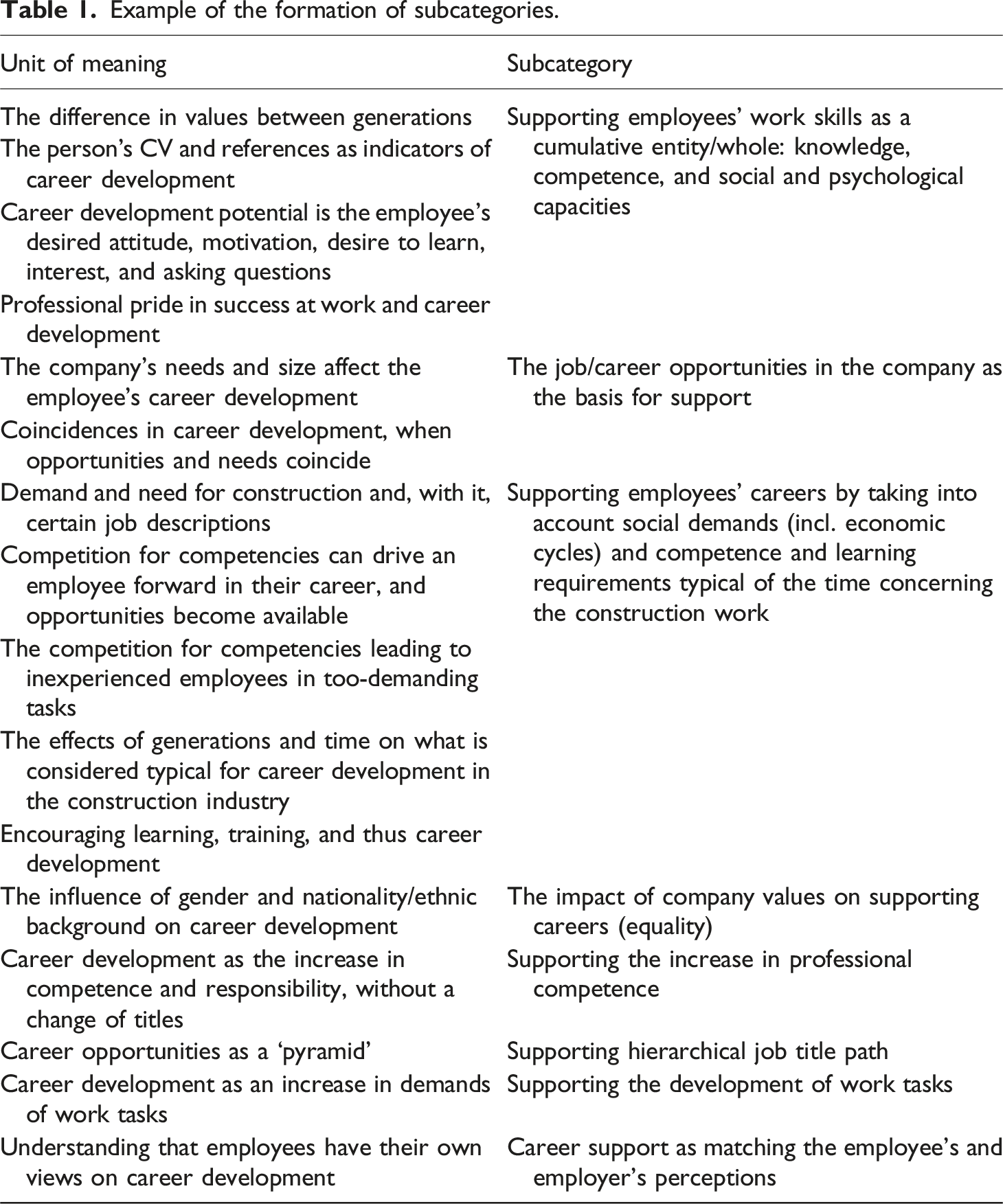
Example of the formation of subcategories.
Example of the formation of descriptive categories.
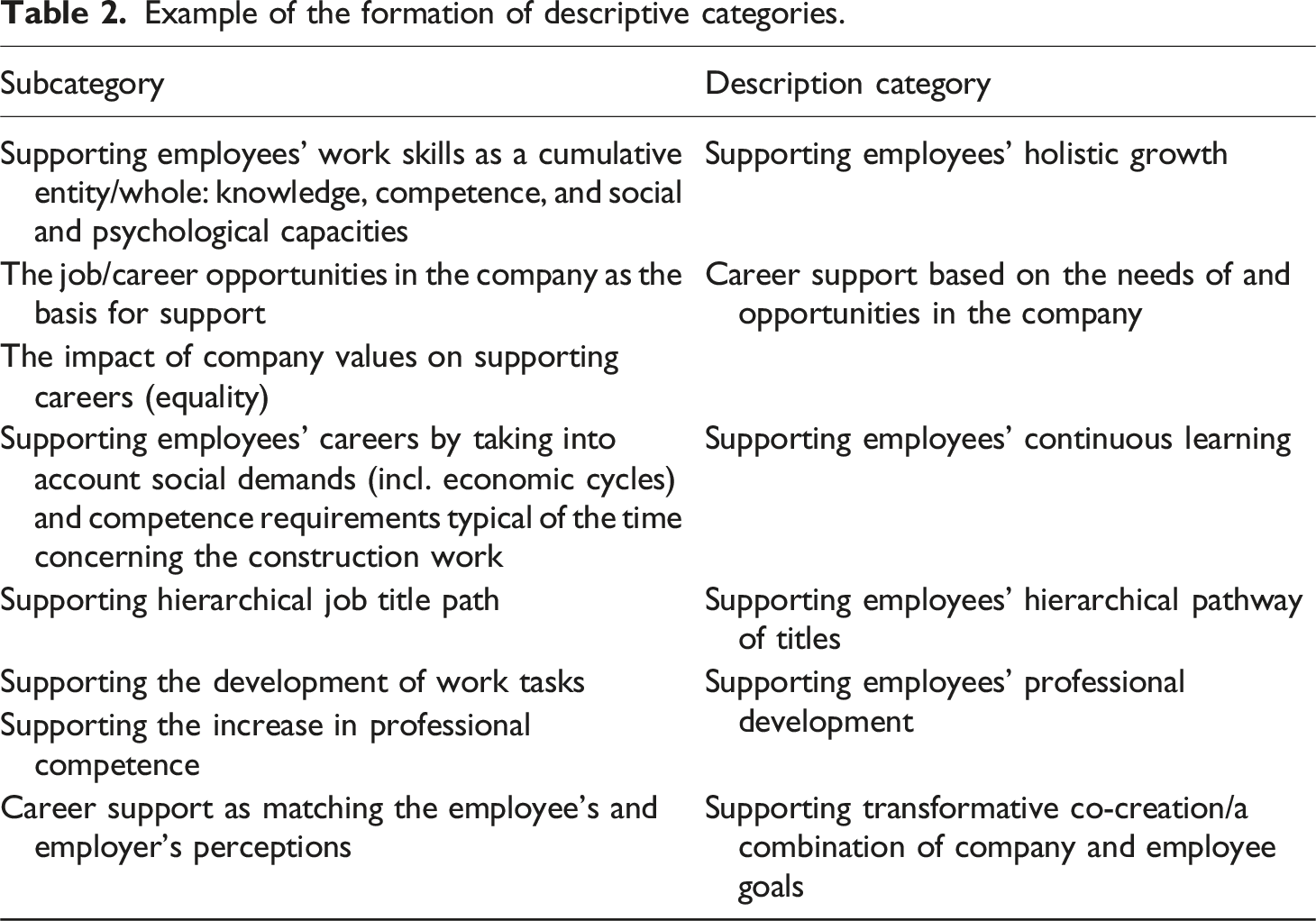
(IV) Arranging/grouping and rearranging subcategories. We combined subcategories with the same content into descriptive categories, naming the description categories with descriptive terms. (V) Forming descriptive categories.
(VI) Creating a system of descriptive categories and presenting the outcome space. In the final stage of analysis, we identified the relationships between the categories and their positioning in relation to each other. While horizontal description categories embody equal perceptions of the phenomenon, vertical description categories embody the order of perceptions, for example, from the point of view of time, maturity level, change, or degree of generality (Marton & Pong, 2007; Uljens, 1996). We identified the outcome categories as horizontally positioned so that, although clearly distinct from each other, their subcategories connect them by positioning them at the intersection of the main categories.
Results
Next, we introduce the findings based on how the supervisors perceived the career support in the construction companies in relation to the nature of careers.
Supporting employees’ hierarchical pathway of titles
A majority of supervisors regarded their support as the means to help employees advance their careers as hierarchical progress all the way from internship to managerial positions. This was how the structured career paths were also often described. Support meant analyzing the employee efficiency, supporting advancement on a hierarchical career path with various training, and rewarding employees by promoting them into more demanding supervision/leadership/managerial roles. … It’s very typical [---] that you advance from one expert position to another and then you’re traditionally rewarded with a supervisor’s role … (Supervisor 19)
Hierarchical advancement was often described as supported with various coaching, testing, and training solutions. [For support to be a] unit manager [---], we hired an external coach [---] and then we had tripartite meetings [---] and those certain tests, in this case the WorkPlaceBigFive test, 360 and First Beat related to endurance. [---] Then came the emotional intelligence test and the coping test. (Supervisor 16)
Interesting indications of a hierarchical understanding of career development were that those who were satisfied with work under the same title were not considered to have ‘the desire’ for more demanding tasks. In this case, the means of support might not be identified. …employees who’d have the potential to handle more demanding tasks, but they don’t necessarily have the interest and desire for it. [---] They’re satisfied [---] with the foreman’s career where they’ve started… (Supervisor 8)
The desire to advance quickly along the hierarchical path was also perceived as problematic and not sustainable if it was seen to be the goal of too many employees. There are more tasks close to the operational levels and not enough senior management positions.
Supporting employees’ career development in the direction of the needs and opportunities of the employer company
When supporting employees’ careers by guiding them according to the opportunities the company had to offer, the size of the company and social and economic factors played major roles. ... Areas of expertise we have a shortage of. For example, young site engineers with economic skills, or concrete work supervisors [---]. I should [---] guide people to these areas. (Supervisor 4)
Support was adjusted to the availability of employees and to demand in the company’s operations. When there was a need for employees but not enough experienced ones, inexperienced ones had to be guided into responsible positions or trained in operations where there was lack of expertise. Skill or labour shortage in the construction sector [---] has driven to constant competition. [---] We have to put young, inexperienced guys on the next step a little too early and too quickly. (Supervisor 16)
The support of motivation and professional pride were considered essential in cases where other options of career development were considered limited. Many interviewees pointed out that social skills of the supervisor, such as the ability to listen, to recognize strengths, and to be present for employees, played an important role. ... based on the strengths [---]. It would be good to develop the weaknesses as well, but based on the weaknesses, you can’t be thrown into the most difficult task if you’ve never done it, so in a way we play in areas of strengths. (Supervisor 15)
Supporting employees’ professional development
When supporting careers as professional development, the support included guiding towards opportunities where professionalism and competence grow, such as variation in projects or choosing suitable work pairs. I always try to place [employees] on projects where something different happens [---] so that they learn [specific] tasks and get [specific] qualifications. (Supervisor 4) Other employees promote career development if you choose work pairs so that the more experienced can teach the less experienced. (Supervisor 23)
Generational values and differences were considered meaningful when supporting professional development; for example, younger generations were said to enjoy the positions of site manager for a shorter time. Besides shortening careers in one position, downsides mentioned were turnover and commitment challenges, to which the means of support had to respond. As one guiding tool, an interviewee mentioned mentorship that the company had enabled. I’ve supported people [---] as a mentor when they take on new tasks. We’ve taken this type of tool to the site, so that we can take another construction manager to work there, who’s not actually a work manager yet, but learning the duties of one. (Supervisor 8)
Also, professional development was supported and complemented with educational possibilities. I try to recommend to them all possible training that the company offers and also external training according to their wishes [---] if it comes up [in development discussions and results discussions] that they would like to study or transfer or take on more demanding tasks … (Supervisor 8)
Support as transformative co-creation/a combination of the company’s and employees’ needs
Where career development was seen as a joint construct between the company and the employee, the emphasis of support was on open interaction, discussion, and listening to employees and taking into account individual perceptions. Supervisors used personalized means in career support, utilizing organizational structures, demands, and opportunities. … We’ve created quite precisely, systematically, a path for him [to be a construction manager]. First, [---] we know our customers have certain requirements regarding the education of employees in responsible positions. We complemented his university of applied sciences degree in the right field. [---] And then supported it with training provided by us and others. And now he’s become a construction manager. (Supervisor 10)
Support is described as requiring mutual identification of skills and strengths and as including new ways of thinking about career development and competition between companies for skilled workers. If we’re on the axis of ‘construction manager, responsible site managers, site clerks’ then we’re probably close to the basics, whether it’s technical competence, know-how, negotiation skills, supervisory work or whatever, then in a certain way it is continuous communication, which I think is essential. (Supervisor 16)
The emphasis here was on both presenting opportunities and what the company has to offer, communicating about opening possibilities, and recommending employees to senior managers (to enable progression) and on listening to the employees themselves, where it might be noted that the employee had something surprising in mind: the employee might aim for something other than the company’s representatives had assumed. ... I wanted to keep him in the house, so I told my supervisor that I’d like to make this guy a construction manager. (---) I supported him in his growth in that changing environment … (Supervisor 18)
Supporting employees’ holistic growth
According to these perceptions in the data, career/work development is a growth story that is understood through career stages and cumulative, holistic human development. The younger ones [---], because it’s a growth story, [---] they still have a hunger for growth to advance. (Supervisor 1)
The interviewees reflected that the age of the employee determined values and, for example, whether the employee still had a hunger for growth or had reached a point where other aspects of life and personal interests and values also determined career goals and development. When supporting holistic growth, career support was seen first and foremost as taking into account the whole person and supporting psychological aspects, such as professional pride. … Those who succeed in the construction industry exude a kind of professional pride. (Supervisor 17)
Supporting employees’ holistic growth may also lead to a situation where the supervisor genuinely supports the employee in thinking about the right steps for him or her and, in this way, can also support a change of job. ... But I try to use common sense in how to help people, because common sense goes a long way in guidance and encouragement, also in rewarding and negative aspects. (Supervisor 17)
Supporting employees’ continuous learning
The interviewees also approached career support by reflecting the need for continuous learning (based on a holistic view of the skills, livelihoods, training provision, and labour needs of people of working age) characteristic to the construction field, gender and ethnicity as promoters or preventers, demands for and trends of construction, competition between companies, economic cycles, career development trends, and employment situations. Career/professional development requires learning, which can be supported by, for example, learning-friendly management and a good working atmosphere. The working atmosphere, if it gets bad then no one wants to learn there. When everyone is having fun, then it’s nice and you can absorb new things and develop your know-how. (Supervisor 23)
Employee learning could also be enhanced by encouraging employees to actively seek out learning opportunities they might need. … We encourage people to be proactive in their own training. (Supervisor 18)
To support and develop an atmosphere of continuous learning, an interviewee presented a proposal to develop career support as a common mission of continuous learning in the whole sector: instead of competence competition between companies, everyone benefits if employees gain experience in different organizations and bring along new insights and ways of working. … should [the support] get to the point where a certain kind of rotation [of workers] was more normal. This industry, it’s not rocket science so that anyone would manage to take someone else’s major trade secrets, so shouldn’t we just be brave enough to let people develop without thinking that if we invest [a certain amount] in a person’s training, then we’re afraid that the person will change the workplace. But, if everyone would [invest], then it was just an investment in the development of the whole sector. (Supervisor 19)
Discussion
As presented in the Results section, the supervisors’ ideas about how to support careers were based on their perceptions about the shape of careers in the construction industry. These can be roughly divided into three categories based on what kind of an approach they represent on the development of the employee: (1) professionally oriented (development of competences), (2) company-oriented (the company’s objectives, needs, and opportunities), and (3) individually oriented (holistic growth) perspectives on career support. This division and the six forms of career support are positioned in Figure 1. In these three sections and at their intersections, there are different perceptions of what kind of development can be supported. Supporting the employee’s continuous learning is recognized as a uniting point of view; it is therefore in the middle of the figure. Outcome space: supervisor conceptions about the support of employee career development.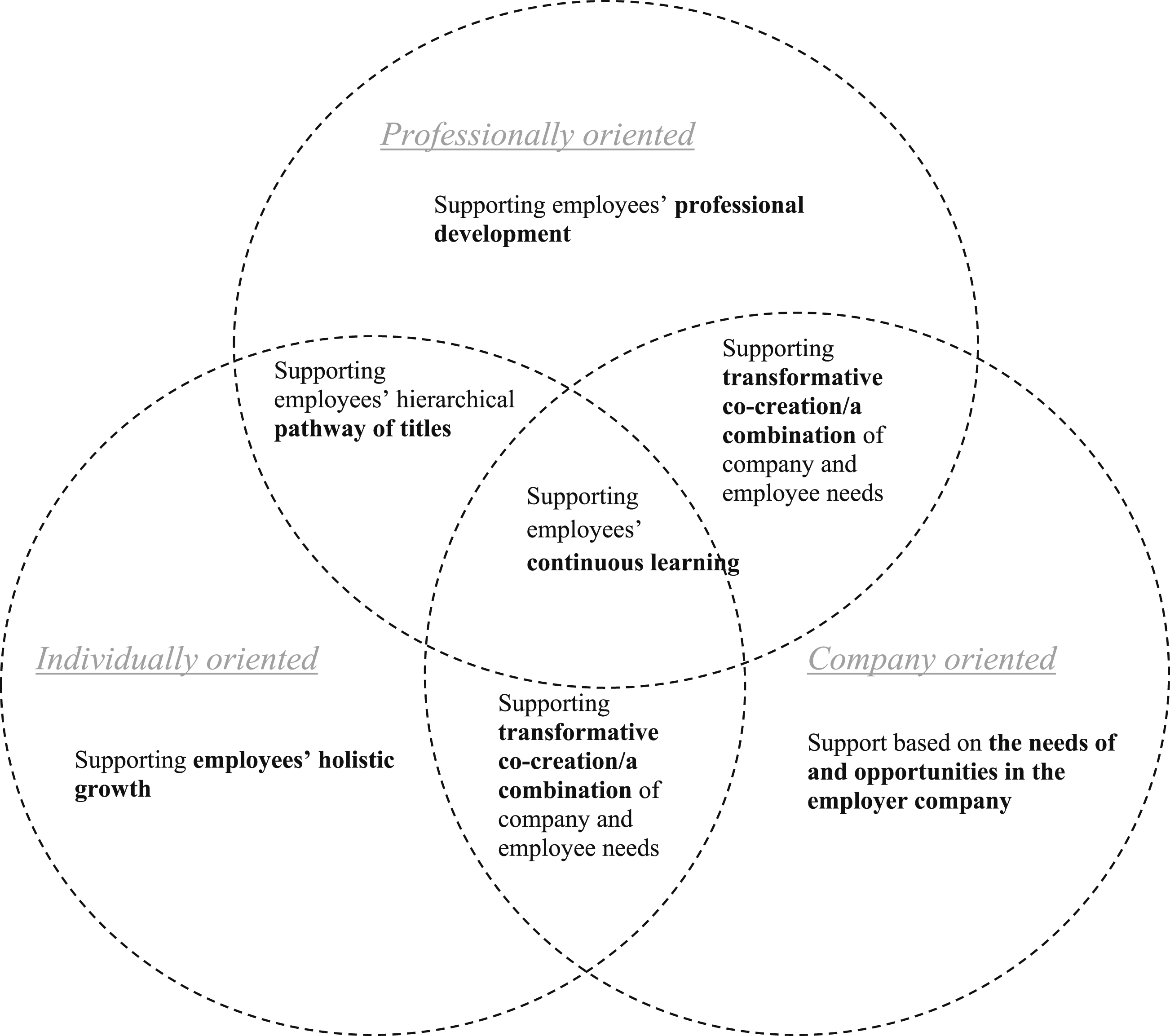
In the light of the results, career support in these three dimensions can be viewed from the perspective of continuous learning. 1. Professionally oriented career support focuses on professional development and advancement, measurable work achievements, education, evaluation, and supporting employees on predetermined, structured career paths with established (yet transformative) competence requirements. If the company is unable to offer opportunities for professional development, the supervisor may refer the employee to another company or to another type of position to apply for professional development. The priority is that support is targeted to professional development. Continuous learning objectives are thus not only occupational know-how but also career adaptability dimensions: considering occupational future and activities, supporting curiosity about possible future work scenarios, and confidence in pursuing vocational aspirations and implementing career choices (see also Savickas & Porfeli, 2012). 2. Company-oriented support considers the needs and opportunities of the company as overriding, as, for example, the size of a company or a specific construction industry determines the career opportunities available. In case the company is small, careers may be supported in the sense of ‘everyone does everything’ or ‘it’s like running your own business’, which may lead to a wide variety in career development. This orientation may be a dominant form of career support operations in bigger companies as well, for example, when the economy is tight, demand for construction is scarce, there is a lack of employees, or the career paths of the company are otherwise very structured/predetermined. From the point of view of continuous learning, the employee’s learning is guided to the greatest extent by the demands of the environment. 3. Individually oriented career support primarily values open discussion, shows humanity, and considers the individual as a whole, considering career stages and employee values, reconciliation of work and family, and flexible education and work solutions that inspire the worker. From the point of view of continuous learning, psychological dimensions such as emotional intelligence are emphasized. Different career options are recognized in terms of supporting individual success (Rautio, 2022).
In this sense, our findings have similarities with the idea of transformative learning as suggested by Sterling (2010). Sterling focused on the challenges that we have also highlighted in the context of construction field – namely ‘contemporary socio-ecological conditions of unsustainability, complexity and uncertainty present to educational purposes and practice’ (Sterling, 2010, p. 17) – and call for wider understanding of continuous learning and its transformative nature in the field. When contrasted with the transformative learning theory, our division into three perspectives of professionally, company-, and individually oriented career support illustrates the need for considering continuous learning opportunities as epistemic learning. Sterling (2010) states that providing such epistemic learning experiences that are transformative in nature is a challenge. Our research provides new viewpoints to better understanding the needs for continuous and transformative learning experiences in the construction field from the perspective of career support and in which the construction company can have, in all three levels, a meaningful role.
Supporting a hierarchical career path can be both an individual goal and a journey understood as professional development and can thus be placed at the intersection of individual and professional areas. Transformative co-creation can also be placed either at the interface between individual holistic views and company needs or at the intersection of professional and company needs. Thus, continuous learning is seen in these categories in a more multidimensional way: as a combination of holistic or professional and company-driven themes.
Further, we argue that continuous learning in this context should first be understood as an activity, namely learning, where the learners are construction workers and companies are education providers. Second, continuous learning should be understood as a phenomenon influenced by the social factors presented in the introduction; thus, we also understand that, in addition to active learning, the actors themselves produce the environment and themes of continuous learning that are considered important now and in the future. Therefore, alongside reactive learning, the learners can also proactively produce and develop the themes of and needs for continuous learning. Supporting employees’ continuous learning covers occupational, work/environmental, and holistic growth aspects.
Views cutting across categories were recognized in the interviews as something that challenged leadership and characterized the working environment in the field, or, in other words, formed the field-specific needs for continuous learning. Regardless of how a supervisor understood career support, the employee’s own skills and competencies, goals, and social skills were highlighted as things that can promote or prevent career development.
Reliability
The phenomenographic approach was integral to the overall research, thus being more than a method for gathering and analyzing data and reporting findings (Sin, 2010). To ensure the reliability of our phenomenographic findings, we committed to interpretive awareness and maximum loyalty to the data when interpreting meanings by carefully following the processes of phenomenographic research and by describing the analytical process (Marton & Booth, 1997; Sin, 2010). We also sought to set aside possible preconceptions by identifying them and making interpretations of the meanings of the data as explicit as possible throughout the research process (Sin, 2010).
A phenomenographic research cannot be replicated as such, and it does not aim at generalizable data because in phenomenography, the emphasis is placed on the reflexive relationship between the phenomenon and the participant, backgrounding the influence of social discourses on the participant, the relationship between participant and researcher, and the researcher’s own relationship to the phenomenon (Bowden, 2005). This means that the analysis of perceptions provided a deeper understanding about the phenomenon under investigation and that the results are never the conceptions as themselves. However, the phenomenographic approach allowed us access to view analytically the conceptions of career support identified in the selected group of respondents – supervisors in construction companies.
The participants represented a variety of educational backgrounds, ages, and work experiences and can thus be considered providing quite a rich data for the purpose of this research. It is however noteworthy that they operated in supervisor positions where they were involved in supporting careers and that the participants actually represented companies that had established career support programs or practices. By intentionally focussing on this group, we wanted to reveal the full range of perceptions about career support (both in the formal sense and in everyday interactions with employees) and provide information for the further development of those support practices and better meet the needs of future employees in the construction field. This can be seen as a limitation for the representativeness of the participants compared to a situation if we had invited supervisors also from companies that did not have any established career support programs.
The conceptions are essential to be revealed because (phenomenography is originally a learning theory stating that) people can be guided to experience a phenomenon in more powerful ways if they become simultaneously and focally aware of more critical aspects of a phenomenon than was previously the case (Marton & Booth, 1997). People are more likely to discern such features when they experience variation between and within these features (Marton & Booth, 1997). We also followed the quality criteria for analysis as stated by Marton and Booth (1997) to make sure that the results categories are (1) in a separate relationship with the phenomenon revealing new perceptions about it; (2) in a logical relation with each other; and (3) providing a concise illustration about the variety of perceptions.
Conclusion
Previous studies have recognized parallel, sometimes even competing, perspectives on careers (Arthur et al., 2019; Driver, 1982; Plant, 1997). These perspectives may consider visible and measurable steps and career stages, or they may also include an individual perspective, such as the values, goals, and meaning of work set by the individual. Thus, a construction career cannot be spoken of as a single entity, nor is it defined in the same way for everyone. Instead, career studies have identified different types of careers that are seen to be shaped by the influence of a number of individual and external elements (e.g. Inkson & Amundson, 2002; Rautio, 2022).
While our results provide valuable information on the many dimensions and opportunities for career development, they also reveal some critical aspects between the perceptions of supervisors on career support and support practices applied in the companies. Therefore, it may not be enough to share best practices in career support in companies, as these strategies may not be able to adequately address the specific situations or contexts faced by individual employees and their perceptions of career development and success. We argue that construction careers should be understood and thus supported more broadly in education and companies, not only as a vertical or horizontal move from one job to another but also as the deepening of skills in jobs with the same title – following the idea of transformative, continuous learning. Thus, for example, a long-term responsible site manager would also be recognized as having had a developing career. As Savickas et al. (2009) stated, the new relationship between the worker and the work world creates the need to develop and apply new systems of personal promotion. A satisfying and meaningful career can also be built without changing jobs or titles (Zhu et al., 2019) through a more epistemic learning of the profession and its meaning at the personal, organizational, and societal levels (Sterling, 2010).
A topical issue in working life is that organizations are becoming increasingly aware that career success depends on the ability to continuously learn and adapt to the environment, but scant attention has been paid to how learning activities contribute to managerial success (Zaitouni et al., 2020). Our study showed that the interviewees aimed to support employee enthusiasm and to provide encouragement for continuous learning and that supervisors value and call for a culture that integrates continuous learning aspects with career support practices, where career development is understood in companies and career programs in a broader sense. Themes of learning may consist, for example, of professional, psychological, or social aspects that consider the needs among employees with various ethnical backgrounds and genders (McIntyre et al., 2024). For example, Becker et al. (2014) highlighted the importance of communication skills for engineers and construction professionals, emphasizing that these skills are equally as important as technical abilities. They also stressed the significance of providing timely feedback and evaluations to young engineers in a positive and effective manner to support their personal and professional development, inspire motivation, and foster engagement in their work. Oo et al.’s (2020) study showed that especially among early career women, their job satisfaction and commitment with the construction field increased if their career expectations could be met at the workplace.
Career development in the sense of continuous learning can only be effectively supported when it is conscious. As Ekwuno (2022) argues, no matter how skilled a construction manager is, if the employer is not communicative and proactive in responding to notifications, the construction manager will not deliver, and all stakeholders are needed as a team to achieve greater success in the industry. It is therefore important to recognize in career management that career advancement is greatly influenced by the perceptions and assessments of others (Floris et al., 2020). This research complements this notion by revealing that the means to support career advancement are affected by conceptions about career development.
Chagadama et al. (2022) state that high voluntary employee turnover is undesirable for organizations and is a significant business concern of managers. Reasons for voluntary turnover include alternative employment opportunities, job satisfaction levels, interpersonal conflict, a sterile work environment, work–life balance challenges, or other personal reasons. In the light of our results, we may look at previously presented findings from two directions: First, this reinforces the need to broaden understanding of, and reward for, all kinds of career development in construction companies, not just the most recognized ones that often emerge from the company-oriented goals. Second, we may approach this through the lenses of continuous learning that brings in the societal and individual perspectives for career support in a new manner. Määttä and Uusiautti (2023) suggest that employees should be motivated to recognize their own learning and development needs and autonomously seek opportunities to learn new skills (see also Zaitouni et al., 2020). This study adds that the competition for human resources and concern about education provided by the company being wasted if employees change employer could also be seen differently from the perspective of transformative learning: the movement of employees between companies and gaining experience elsewhere increases the competence of each company. If every company invested in enabling learning in the spirit of continuous learning, it would collectively pay back.
Finally, by understanding the complexity of careers and the effect of various perceptions concerning it, we also understand that there is a need to diversify the ways and methods that educational institutes, construction companies, and society employ to support career development. For example, the new governmental reform for continuous learning in Finland and its connections with the research and development investments in companies require new understanding about the needs for support and learning opportunities (Finnish Government, 2022) that our research provides for the construction field.
We conclude with two main contributions of this research. The first one is a learning-theoretical perspective for careers and the latter focuses on the concrete support mechanisms of the future in the constructions field: 1. In construction education and work, career development could be supported through the idea of continuous learning, covering occupational, work/environmental, and holistic growth aspects. Continuous learning can be seen as an activity, namely transformative learning, where the learners are construction workers, companies, and education providers, and as a phenomenon influenced by social factors, trends, and the aforementioned actors. Alongside reactive learning, learners can also proactively produce, develop, and support flourishing careers and pursue epistemic learning for seeing the construction field in new ways. 2. Construction companies already have multiple supporting and encouraging practices to support successful career development and to enhance professional pride. To support construction professionals’ careers sustainably, we should commonly consider varieties of career development, taking into account their multiple aspects and the diversity of career paths. This research focused on companies that already had established career support programs or practices. However, the findings showed that the support system does not fully pay attention to the diverse career aspirations the employees may have, nor were all supervisors aware of the possibilities that their companies had for supporting their employees’ careers. Thus, the research provides new ideas for supporting careers and building new and more varied career support programs not only in those companies that already have one but for those whose programs are still emerging.
Footnotes
Declaration of conflicting interests
The author(s) declared no potential conflicts of interest with respect to the research, authorship, and/or publication of this article.
Funding
The author(s) received no financial support for the research, authorship, and/or publication of this article.
