




Abstract
This study examines how six principals in Norwegian adult education centres (AECs) navigate and make sense of and navigate the multifaceted and uncertain environment in which they act. Specifically, the study aims to explore the significance of improvisation and positioning in the principals’ day-to-day decision-making and leadership as they address the challenges posed by complex migration patterns, shifting policies, and diverse student populations. The principles were interviewed in spring 2018, and selected to represent the diversity of such centres. Through initial analyses, the study identified that the environment of AECs was characterised by complexity, unpredictability, and uncertainty. Moreover, results indicate that improvisation and planning interplay. In addition, improvisation is strengthened by a collective focus on improvement, unpredictability as a rule and diversity as a strategy. Regarding leadership understood as positioning, we see how the principals assert their roles through power dynamics, acting on potential for change, and collaboration. Recognising the unique challenges faced by AEC principals, there is a need for targeted support and professional development that addresses the importance and understanding of improvisation and positioning in AEC-leadership. Moving forward, our findings should have implications for research, policy, and practice in municipal adult education. Key words: Principals, adult education centres, unpredictability, positioning, improvisation.
Introduction
Principals in Norwegian municipal adult education centres (AEC) face a demanding and complex set of tasks. These centres largely reflect contemporary migration patterns, as their students are primarily speakers of minority languages. Migration is unpredictable and can occur in waves, and immigration and integration policies are influenced by international agreements and a volatile political climate. At the same time, the leadership in these centres is contingent upon the local context and the local framework for the development of educational offerings.
The primary aim of this article is to provide an in depth understanding of how principals in Norwegian AECs make sense of and navigate the multifaceted and uncertain environment in which they act. Specifically, we aim to explore the significance of improvisation and positioning in their day-to-day decision-making and leadership as they address the challenges posed by complex migration patterns, shifting policies, and diverse student populations. Through a qualitative analysis of interviews with six AEC principals, we seek to shed light on how the principals’ sense-making can create possibilities in a challenging educational Norwegian context.
There are no overarching guidelines for how municipalities should organise mandated adult education. This leads to a variety of local solutions and structures (Djuve & Kavli, 2015). Many municipalities adopt a model with a dedicated department, often led by a principal. Others organise themselves through inter-municipal collaborations or they utilise private entities. AEC principals often form part of the principal body within the municipality, but their responsibilities only partially overlap with those of principals in education for children and youth. Key collaborators typically include the municipality as the local education authority, the refugee service, the labour and welfare administration (NAV in Norway), local employers, and the Directorate for Higher Education and Competence (HK-SIR). Additionally, the voluntary sector and various other public entities at local, regional, and national levels serve as relevant partners. These entities represent a complex diversity within administration, the labour market, and volunteerism. Both external collaboration and internal complexity necessitate skills in comprehending and adapting to a multitude of stakeholders.
Municipal adult education has primarily three target groups. The first pertains to adults participating in the introduction program, and/or tuition in Norwegian language and social studies. The second group is adults who have not completed primary education, while the third group consists of adults with special educational needs. In 2022, approximately 43,000 individuals participated in offerings associated with municipal adult education, when you combine different types of statistics from Statistics Norway (2024), although this number has changed between 67000 in 2016, 57000 in 2018, and 33000 in 2021.
In light of this intricate landscape, our study seeks to answer the following research question: How do principals in Norwegian AECs make sense of and navigate their complex environment through improvisation and positioning?
Overall, the research contributes to the existing knowledge by shedding light on the practical aspects of leadership in the context of adult education in Norway, particularly in response to the complexities introduced by migration, policy changes, and diverse educational needs.
Previous research on leadership in municipal adult education
The phenomenon of leadership in municipal adult education has received limited attention in previous research. In Nordic contexts, research on municipal adult education has primarily focused on the impact of education on participants (e.g. Fejes, 2019; Fejes et al., 2018; Keskitalo-Foley & Naskali, 2018; Piekut, 2017). Fejes and Nylander (2019) point out that sociocultural perspectives, critical pedagogy, and post-structuralism are the dominant theoretical approaches. A study by Bjursell (2016) finds that leadership models in adult education appear to be driven by economic theories. Grover and Miller (2016) emphasise that international research on leadership in adult education is fragmented and unclear, due to the various and diverse ways in which this type of education can be organised. The literature addresses leadership of specific offerings in adult education, but only to a lesser extent, it explores the challenges in leadership responsible for a variety of educational offerings and the associated complexity, as is the case in Norwegian municipal adult education. The diversity in organisation of AE will make international comparisons difficult.
With the exception of some master’s theses (Andersen, 2019; Eek, 2018; Ødesneltvedt, 2016), and leadership in the context of experimental activities at an adult education centre (Nødland & Vedøy, 2017; Vedøy & Nødland, 2019), we find little prior research on the phenomenon of leadership in municipal adult education in Norway. Many contributions addressing municipal adult education are, however, found in a range of commissioned reports on the effectiveness of measures related to the introduction program and tuition in Norwegian language and social studies for immigrants (e.g. Rambøll Management, 2007, 2009, 2011a, 2011b; Djuve et al., 2017; Djuve & Kavli, 2015; Hernes & Tronstad, 2014; Kavli et al., 2007), as well as a knowledge synthesis on Norwegian language education for adult immigrants (Randen et al., 2018).
Principals are frequently used as informants. However, there is limited research on adult education’s responsibilities in the areas of adult primary education and special education measures. This leads to a bias in the research overview towards the tasks that principals have within the introduction programme, while the way tasks are interpreted and expressed through (leadership) action remains untouched. It is precisely here that our study contributes with new knowledge about how principals create meaning and exercise leadership in three different educational offerings within a societal context increasingly characterised by uncertainty, unpredictability, and complexity.
Theoretical framework
Educational institutions are typically shaped around principles of learning and teaching to meet externally defined standards and expectations regarding students’ learning outcomes (Male & Palaiologou, 2015). Given the uncertainty and unpredictability that characterise municipal adult education as an educational organisation, this challenges some of the assumptions of managing operations through defined standards and principles. In particular, the diversity in educational backgrounds, linguistic competence, and age of participants, as well as varying local conditions in municipalities, introduce a complexity that questions the relevance and precision of externally defined standards. Male and Palaiologou (2015) suggest that in such circumstances, leadership should be understood as the exercise of reasonable and prudent judgement. At the AECs, there will be possibilities both for an approach rooted in standards as well as in prudent judgement.
To conceptualise our understanding of leadership practices in this article, we focus on four areas that are also interlinked: 1). Complexity, uncertainty, and unpredictability, 2). Sense-making, 3). Improvisation, and 4). Positioning.
Complexity, uncertainty, and unpredictability
Complexity can be understood as problems without straightforward solutions, and it characterises all challenges where meaning is scarce (Dehlin, 2013). Complex situations are marked by uncertainty and ambiguity, and what defines a good action under complex conditions will need to emerge after the action itself, as a retrospective rationalisation (Weick, 1995). Acting in complex situations involves contributing to the very complexity the action is meant to unravel (Weick, 1998), and since the action is irreversible, it entails significant risk. The uncertainty and unpredictability stipulate that actions are akin to practical experiments, the significance and consequences of which are unknown until it is too late to reverse them. Together, this means that organising and leading in complex situations represent a form of sense-making and sensegiving (Gioia & Chittipeddi, 1991), where control is primarily achieved not through systematic planning, but through improvisation (Ciborra, 1999; Dehlin, 2008, 2013; Hatch, 1997; Weick, 1998). In improvisation, the focus in organisation primarily shifts towards the context and the moment, while principles, standards, and plans become more guiding than governing.
Building on this background, we have drawn from the ‘ambiguity models’ within educational leadership research (Bush, 2003). These are theories based on the idea that unpredictability is a key feature of all organisations and organising (Weick, 1995). School organisations are no exception, especially not AECs with their distinct features of more or less acute complexity. Relying solely on experiences and established structures for leadership may often be insufficient in complex situations (March, 2010), and storytelling and model-building may be more suitable for organising. Male and Palaiologou (2015), for example, advocate for emphasising the process over the outcome, negotiations over control, context over standards, thereby promoting equal participation as an organising principle (Klev & Levin, 2021).
Sense-making
Organising from a process perspective involves creating structure from complexity (Dehlin, 2008; Scott, 2013; Stacey, 2001). Leadership can be understood as organising work, and since work constitutes the sense-making activities we recognise as organisations, leadership becomes organising sense-making in the workplace (Pye, 2005). In rule-dominated and routine-based educational activities, sense-making often takes a back seat to structures and systematic planning, potentially giving the impression of the organisation as a machine (Morgan, 2011). However, the fact that a school exhibits mechanistic traits or operates like a machine does not mean the school is a machine, and crises or other forms of disruption make us aware of this. For example, Jones et al. (2021) describe how the COVID-19 pandemic acts as a magnifying glass on the complexity and sense-making that always take place in school organisations, but may fade into the background in ‘normal situations’. As a consequence, it makes little sense to sharply distinguish between operations and development in schools, as operations will always encompass uncertainty and unpredictability. AECs appear as a type of educational organisation where the magnifying glass is always ‘on’, and where the unexpected and sudden override the customary and repetitive. In AEC organisations, unpredictability becomes predictable.
From a sense-making perspective, AECs appear particularly suitable as a subject of study for understanding leadership challenges and practices that may otherwise be overshadowed by administrative structures, rules, and routines. Researching the organisation of work in AECs can provide valuable insights into leadership activities that are relevant beyond the AEC sector, especially in relation to building understandings of school leadership in exceptional circumstances (e.g. crises and developmental processes). Inspiration for such research can be found in Weick and Sutcliffe’s (2015) studies of so-called High Reliability Organizations (HROs) – organisations where the risks of accidents and deviations are significant. They use the term ‘mindful organising’ to highlight the attentiveness and context-sensitivity they find to be characteristic of organising in risky work processes. In this view, leadership involves dynamically and sensitively engaging with situations and adapting actions to the interpretations made by the organisation’s members at any given time. This presents leadership as an organisation of collective consciousness, consistently critically examining the way reality is interpreted and meaning is created. As ‘mindful organising’ brings uncertainty and unpredictability to the forefront, disruptions and interruptions come into focus, and a crucial task becomes ensuring a continuous search for the tools available at any given time. Thus, attentiveness is not a capacity reserved for leaders, but a virtue and a principle of critical exploration pursued by all members of the organisation, increasing in significance as the context becomes marked by uncertainty, unpredictability, and complexity.
Improvisation
Contextual sensitivity is closely related to improvisation, a phenomenon defined by Ciborra (1999) as a situated and spontaneous merging of action and thought, in short, creative and deliberate action. Improvisation is purposeful, intentional action characterised by elements of chance, intuition, competence, and design. Weick (1998) describes improvisation through ‘enactment’, meaning that the environment is framed and given meaning through more or less purposeful action, and all external and internal contextual factors and resources that can be used in such action serve as tools influencing and guiding the improvisation. In many ways, improvisation means to be breathing life into tools, elements from memory, skills, and external surroundings in a way that leads to effective action. However, what constitutes something as ‘good’ is contingent on context and perspective, where that which is good for some may be detrimental to others (Dehlin, 2008). Following the words of pre-Socratic philosopher Heraclitu, water is good for the fish that live in it, but not necessarily a good place to live for humans. ‘Good’ can of course also be dissected into moral, pragmatic, or aesthetic dimensions, but this is beyond the scope of this article. Instead, to further pursue the metaphor, our research starts from the premise that the fish is often the last to notice the water in which it swims: the constant stream of spontaneous and creative actions performed by AEC principals to address uncertain, unpredictable, and complex situations can be understood as improvisation, and this is something that has not received much attention – neither in educational leadership as practice nor in the field of research.
Improvisation can be understood as creating solutions in unpredictable environments where familiar methods fall short (Oddane, 2020). While improvisation is spontaneous, sense-making action (Dehlin, 2008), it is accompanied by uncertainty and risk regarding the next step (Barrett, 1998). The quality of improvisation depends on perspective and understanding of context, and both emotional and aesthetic dimensions play a role in how unpredictable situations are met and structured (Dehlin, 2008). Good improvisation requires knowledge and experience, allowing for purposeful and knowledge-based improvisation in unexpected situations (Alterhaug, 2004). Improvisation can thus be understood as an exploratory and irreversible process where solutions are created in interaction between participants’ knowledge and impulses from the situation (Weick, 1998).
Positioning
Contextual sensitivity can also be associated to positioning, a concept primarily linked to conflict resolution in traditional research. However, Harré et al. (2009) suggest that the theory of positioning can also be used to understand how collaborations are reinforced or undermined. Positioning is predicated on the belief that conversations and discursive practice are foundational processes in our social world, as our understanding of it emerges from the exchange of meanings, dialogues, and negotiations (Harré & Van Langenhove, 1999).
Positioning, which can be conscious or unconscious, is inevitably adopted the moment we express ourselves. This suggests that in our interactions with others, we adopt a stance on an issue, and perceive it from a specific viewpoint (Davies & Harré, 1990). McVee et al. (2011) connect self-positioning with role-based positioning, where individuals like principals, assume a role and thereby position themselves and others. Simultaneously, our utterances position others, implying an expectation or invitation of how they behave or interact with us. This study examines the role of improvisation and positioning in sense-making during daily work, as explored through interviews with principals in municipal adult education.
Positioning requires interpreting a situation and making an improvisational judgement, much like a balancing act. Brunstad (2009) underscores the necessity for leaders to continuously acknowledge the uniqueness of their situations and approach them with sensitivity and respect. He distinguishes between doing things right (strict adherence to rules, procedures, and regulations) and doing the right things. Leadership is always marked by situational awareness and mindful presence, enabling the capacity to balance and exercise sound judgement in both simple and more complex situations. Since rules, procedures, and regulations may not always be adequate, it is essential for leaders to demonstrate sound judgement and the ability to improvise (Brunstad, 2009).
Positioning theory, as proposed by Harré et al. (2009), provides a lens to understand individuals’ roles, actions, and interactions within their social and interpersonal contexts. It is based on the premise that our identities, roles, and social relations are not fixed, but are continuously negotiated and constructed through our discursive practices, including conversations and interactions. It is through the process of positioning that individuals and groups construct their social realities, navigate their social world, and make sense of their experiences, Harré et al.’s (2009) posits. Positioning theory may thus offer a powerful tool for understanding how individuals and groups shape and are shaped by their social and discursive contexts, and how they can negotiate and challenge their positions to effect change.
In positioning theory, ‘positions’ are the roles individuals occupy in a particular context or discourse. These positions are not just about who we are (our identities), but also about what we can do (our roles and responsibilities) and how we should act (our rights and duties). They shape and are shaped by the narratives, stories, and conversations in which we participate. Positioning can involve both self-positioning (how we position ourselves) and interactive positioning (how we position others and are reciprocally positioned by them). In all instances, positioning can be intentional or unintentional, conscious or unconscious. The moment we express ourselves, we assume a position towards something or someone, and simultaneously we position others, creating expectations about how we and they should act. It follows that positioning is dynamic and fluid, changing across contexts and over time, and notably it reflects and shapes power relations, as some positions may have more authority, privilege, or influence than others.
Method
The study is based on 6 qualitative interviews conducted with principals in municipal adult education in the spring of 2018. Three interviews were conducted in the Eastern region, and three in the Western region of Norway. The interviews focused on leadership tasks and practices in adult education, with a special emphasis on the opportunities and limitations the interviewees encounter when performing their leadership roles. A semi-structured interview guide was used. All interviews were conducted face-to-face at the principal’s workplace, except for one conducted over the phone.
The most important criteria for selection was diversity in terms of the size of the learning centres, availability, and the number of years of work experience in the current position. Since leadership in municipal adult education is a relatively unexplored field, the primary intention was to gain insights into patterns and variations in what the practice of leadership entails. Thus, in-depth and thick descriptions (Geertz, 2008) in each interview were prioritised over a large quantity of informants (and interviews).
The interviews were audio recorded. Regarding the ethical aspects, the data collection for the project has been approved by the Research Committee for Social Sciences in Norway (NESH), which provides guidance on privacy matters for research. This means that the interviews have been conducted with the informed and written consent of the informants, that audio recordings are stored in a pre-approved and restricted access area, and that the schools are anonymised when publishing the data. The audio files were transcribed verbatim, and anonymization was carried out in the transcription.
After the interviews were transcribed, we conducted analyses to identify connections and structures in the data. The material underwent several phases of processing. The first phase was characterised by an abductive process where we moved back and forth between empirical data and relevant theory (Alvesson & Skjöldberg, 2018). The most prominent patterns were related to the understandings and ways in which leaders in adult education organise their work in the face of complex, uncertain, and unpredictable situations. The second phase involved a theory-driven analysis of the patterns identified in the first phase, and the material was organised based on Weick and Sutcliffe’s principles of ‘mindful organising’. A strength of this two-step analysis is that it allows us to gather rich and detailed (‘thick’) descriptions of the complexity, uncertainty, and unpredictability in the everyday work of adult education leaders, as well as the strategies and patterns of action employed by these leaders. A limitation of this methodological design is that our analyses are based on statements from principals and not on observations of practice. Following the two-step analysis, a third step involved focussing our interest and analysis primarily on sense-making and the way in which principals understand and explain connections, challenges, and imperatives in their practical everyday lives. Using a stepwise inductive analysis, the interview data enabled us to identify clear patterns and findings, which we will now proceed to present and discuss.
A clear thematic thread emerged from the material related to leaders’ strategies and patterns of action. At a higher analytical level, this pertained to two aspects: improvisation and positioning. Despite the apparent internal coherence between these aspects (i.e. positioning as an art of improvisation), we have chosen to discuss them separately based on the data. Improvisation was found to be associated with curriculum work, reactivity related to (spontaneous) problem-solving and interruptions, daily organisation, and systematic development of the school organisation and professional community. It was also linked to intersubjectivation in relational complexity and diversity. Positioning was crucial for being able to interact with various interest groups that the leaders had close contact within their daily work. Specifically, the informants highlighted the following interest groups: actors in adult education, a diverse group of teachers, various collaborators within the municipality’s own organisation, NAV, voluntary organisations, and representatives and arenas in the labour market that serve as important learning environments for the participants.
Improvisation
Improvisation manifests itself in various ways in the leaders’ everyday organising practice. We uncover how they utilise the combination of improvisation and planning, and how unpredictability demands reactive problem-solving and ‘putting out fires’. Furthermore, we observe how the leaders emphasise the significance of a collective focus as a contribution to continuous adaptation, adjustment, and improvement, and how they utilise the diversity within the staff as a resource.
Improvisation and Planning
Improvisation is often projected as a counterpart to planning, but our analysis indicates a close and intimate connection between the two. For instance, the principal at Kvase says the following about the implementation of new modular-based curricula: They haven’t had many enhancement resources. We’ve approached that a bit differently and differentiated in another way, and then it became like, oh, yes, we hadn’t thought of that. It’s logical that they should have the same amount. So, we took action and got it changed. It’s not more complicated than that, but it's a good illustration that change takes time and no matter how aware you are of things, we tend to laugh, we tend to think the way we thought yesterday. So, it takes an extra loop, in a way, to get in sync with what you want.
In this case from Kvase, we see an improvisational approach through action based on impulses as the situation unfolds. Notably, this does not seem to be perceived as a devaluation of the original plan, but rather as a pragmatic act of social sense-making where good solutions emerged collectively. The original plan appears to have acted as a tool of improvisation; a pragmatic starting point built on previous knowledge. Next, in the face of new practical challenges, the principal chose to loop in new knowledge and adapt the plan to the situation at hand. Perceptibly, as much as the plan is part of the process, it does not dictate it. The pragmatic desire to find good solutions seems to have opened up for spontaneity, exploration, and experimentation, with previous knowledge and understandings serving as tools of guidance rather than as obstacles or means of coercion.
The principals have plans and guidelines at their disposal that can be valuable resources in problem-solving. In their own words, however, these rarely or never provide clear, concrete answers to immediate challenges. Rather the principals report that each problem is framed by its unique context, history, and social dynamics, over and over again. Somewhat paradoxically, creativity and spontaneity become part of the mundane. We see a clear pattern that the principals engage in organising activities hallmarked by a particular art or skill to judge and act in the spur of the moment. To the best of their ability they engage in and promote pragmatic and collective efforts fleshing out functional solutions based on a contextual assessment of what appears as ‘right’ there and then. They do not pursue perfection as much as they strive to ‘make things work’. Like bricoleurs, the principals make do with whatever knowledge and overview is achievable (at hand), turning their organising practice into a perpetual exercise in improvisation. Overall, their practice displays situational courage and an ability to experiment, individually and collectively.
Remarkably high levels of unpredictability and turbulence means that (any) pragmatic assessment of whatever action performed, is to be made in retrospect when consequences are surfacing. Accordingly, we find that the principals typically make (and encourage) tweaks and adjustments based on continuous responses from physical and social surroundings. Through acts of reflexive context-sensitivity, the principals assess the quality of action in situ, as a form of ‘call and response’, using emerging knowledge to guide and improve further improvisation.
Reactive problem-solving and firefighting
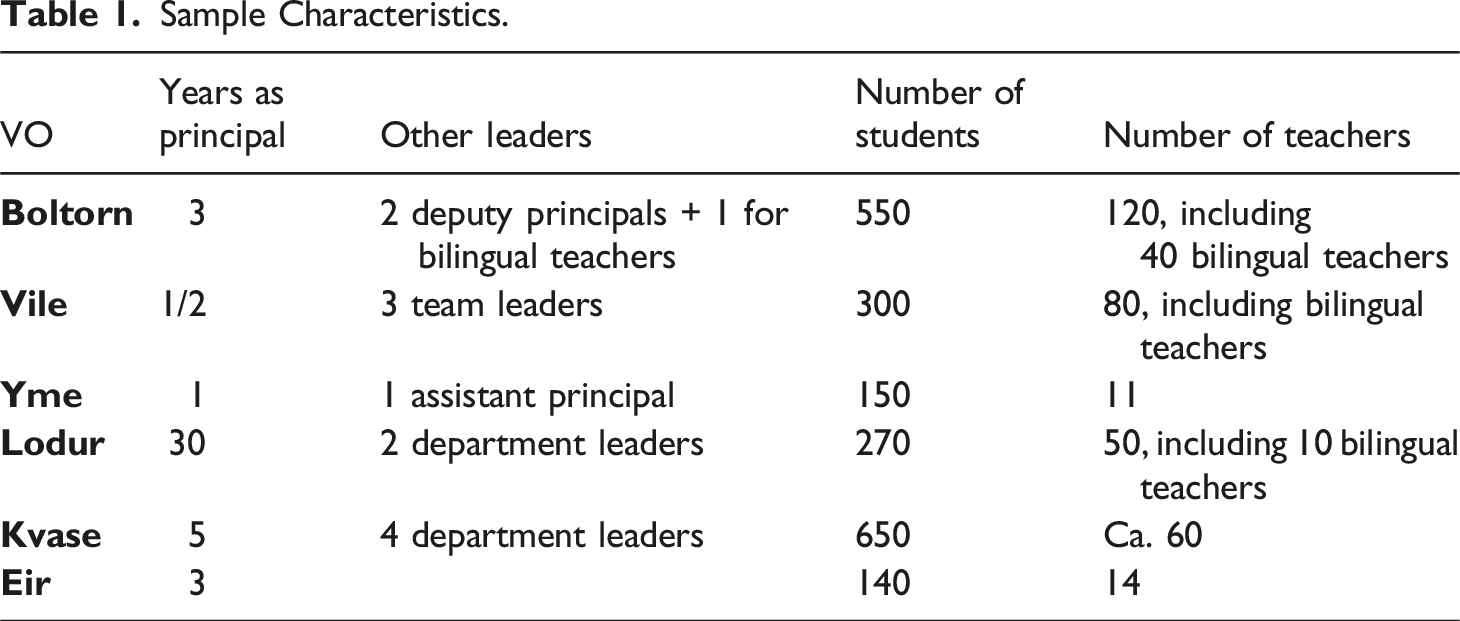
Sample Characteristics.
Recurring examples of ‘sudden events’ (Dehlin et al., 2022) include sick leave, larger and smaller conflicts, accidents, and misunderstandings, or as we have seen in our material, changes in the number of participants and country of origin. It is worth noting that some interruptions and sudden events are easy to grasp and acted upon, especially those that resemble previous events and are easily manageable. However, other unexpected problems are more complex and demanding, requiring greater attention from the principals in terms of interpretation and contextualisation. For example, sick leave on one hand may be an expected part of daily operations, even if it rarely comes at a convenient time. The task often becomes finding a replacement or reorganising planned tasks (postpone, cancel, etc.). On the other hand, there is always a history and a context associated with sick leave. Even though practical solutions for replacement (e.g. substitute) may be ready at hand, the principals talk about underlying, complex, and relational dimensions that underlie the situation, requiring much from them and their cognitive and empathetic capacities.
Unpredictability and unexpected events are described by several of the principals as a significant component of their everyday work. The principal at Eir provides the following example: The school needs flexibility, pointing out that it constantly needs to work on expanding the educational offerings to adapt to the variations in the participants’ prerequisites and backgrounds. Thus, assessments are constantly adjusted as they learn more about the different participants. In 2015, the school had reason to expect that the Syrian group was highly educated. But, as she says: ‘So, in a way, the demographics changed, right? Those who have come in the last two years have been quota refugees, and have been picked up in camps, and often come without any school background’. The adjustment to meet a completely different target group was as spontaneous as it was necessary. While it may not have required firefighting, reactive problem-solving was necessary.
Uncertainty regarding which groups of immigrants arrive, how many they are, and their characteristics is a particularly recurring feature that the principals express significant concern about. The principal at Vile describes: Our school offerings must be tailored to the local community, and it varies a lot, from when we built up a large offering, when the wave of unaccompanied minor refugees came in 2015, to us putting the world class program at [neighboring school] on hold, because there isn't a single student coming in that age group. […] in the groups, there are people who start and stop when they want, there’s in and out. Some progress quickly, others need a different approach and so on. The fact that the teachers work closely together and are flexible in terms of moving participants is a must.
Given a political climate for this type of education that is particularly changeable, they cannot take for granted which tasks will disappear or be added to adult education. In the following, we will move from improvisation as a characterisation of reactive problem-solving and firefighting to a more future- and development-oriented form.
Organisational improvisation through collective focus for adaptation, adjustment, and improvement
Improvisation seems to be woven into school organisation at an everyday level, and can also be linked to the development of the school organisation at a systemic level that requires a collective focus for adaptation, adjustment, and improvement. At Eir, they have applied for project funding from the Directorate of Integration and Diversity (IMDi). However, the principal points out that it may take some effort to get the staff engaged: ‘It’s perfectly fine that there is resistance in the beginning, and it’s natural that you have to take your time, and I’ve sort of learned that it’s not so much about me, but about natural processes’.
This illustrates two aspects. First, as several of the principals see it, their own and the staff’s work is considered a contribution to a system, an organisation, and are not isolated individual actions. It is the needs of the organisation on a holistic level that become crucial for the work, not the individual’s personal agenda. Second, the principal expresses an interest in developing engagement and nurturing ‘natural processes’. By seeking project funding, space is given to develop improvisational capacity and collective focus, among other things, to avoid falling back into automated reaction patterns and routine operations. The principal’s emphasis on so-called ‘natural processes’ illustrates a vision to counteract the notion that organisational routines are taken for granted without crucial elements of collective learning. The project application signals a desire to think innovatively, reorganise, and adapt to real challenges. The subsequent work reflects an adaptive and improvisational leadership where the rules and procedures of the systems are not followed blindly, but where ‘natural processes’ and an holistic focus are thought to contribute to ongoing adaptation, adjustment, and improvement in short to organisational improvisation.
Improvisation as a collective capacity to handle unexpected problems locally is prevalent in the data. In general, the principals express a preference for developing a competence to address issues along the way rather than managing work through information and control. In other words, our finding does not only pertain to the principals’ individual improvisation, but to visions and actions of leadership that contribute to learning and developing improvisational competence locally: Improvisational leadership that fosters organisational improvisation. The principal at Kvase explains: I have a kind of philosophy that there's very little that needs to be kept secret. But it's always a challenge to inform well enough, because if you send out a lot of information, there are many who still won't catch it. But then you have to be clear about how you do things and when there are ongoing processes and who is influencing them. Then it's also easier to move forward. [...] then you get things done and change things, and sometimes it ends up that part of what you thought doesn't quite work and you have to adjust the course a bit along the way. But being open to the fact that you're not perfect.
The quote highlights the importance of discussion and collaboration for reactive problem-solving and proactive school development. Thus, improvisation does not remain solely in the domain of leadership but is attempted to be cultivated as a collective value and organisational practice. For instance, the principal at Lodur mentions interdisciplinary collaboration in special education and Norwegian as a second language: ‘So that we look across, and establish a good collaboration there’. Equally, at Eir, the principal has ‘...tried to break down the barriers between different departments, and shift from individual practices to collective practices’. Further, the principal at Boltorn believes there are great opportunities in utilising the capacity of having bilingual teachers on the staff. ‘We try to utilize that capacity’, she says. The same applies to including the collaborators at the various learning arenas. The capacity for improvisation in daily problem-solving thus seems to be closely linked to the development of professional communities. The significance of challenging, providing different perspectives, and creating intersubjective understanding of the issues emerges, which in turn can contribute to organisational, collective preparedness.
Diversity as a Relational Leadership Strategy
A recurring finding is that the leaders practice a form of proactive improvisational leadership with the goal of building organisational, systematic collective improvisational capacity for sustained development within the staff. A distinct pattern in such strategic leadership is that the principals leverage the differences and diversity within the staff to bring forth and activate various perspectives and unique, local knowledge. For instance, at Yme, the principal consciously tries to hire people with different expertise to contribute to flexibility and multi-perspectivism in the organisation, based on a belief that diversity is beneficial when dealing with complexity.
However, diversity does not stand alone as a value and vision for the development of collective improvisational competence. The principals give many examples of how relational skills are highly valued, such as when the staff supports each other, the participants, and the principal in their everyday tasks. Furthermore, the principals express a high degree of consistent practices that involve asking questions, thinking aloud, and bringing forth different viewpoints from the staff. This demonstrates an understanding of the importance of emphasising a collective and learning community, where the diversity in the staff discusses and provides input for solutions. For example, the principal at Kvase is concerned with having common processes when implementing changes. Similarly, the principal at Eir emphasises that respect between colleagues and participants is their most important value. Disagreement is encouraged as a development strategy: ‘There are a lot of teachers with strong opinions here, and strong personalities. And I find that very exciting’, she adds.
The principals express a clear strategy that solutions should be created along the way and collectively. A broad understanding among the principals is that the opportunities to exploit flexible decision-making structures increase by ensuring the hiring of teachers with high competence who can complement and learn from each other. Expertise is thus not exclusively tied to the individual, but comes as a consequence of interdisciplinary dialogue. Concrete examples suggest that there is significant room for action by using adult education to find new and creative solutions, such as experimenting with various forms of mother tongue-supported teaching, or working towards vocational qualifications in the introduction program. Such collective development can take place either with others in the local context or within the AEC.
Diversity and relational competence as tools in improvisational leadership seem to be as demanding, as they are expressed strategies. They point out that a great deal of time and resources are spent on creating a common understanding of the challenges and opportunities inherent in education; to create an intersubjective space that in turn positively contributes to improvisational organisational preparedness. Particularly challenging for intersubjective understanding and effective action is what is stated to be a demanding and contradictory framework for adult education, as well as unclear boundaries for municipal responsibility and cooperation. Labour market expectations also change in line with developments in the job market. In addition, there are local challenges related to digital solutions, municipal mergers, and conditions at local reception centres for asylum seekers. This, in turn, paints a picture of leadership as positioning, which we will address in the next section.
Positioning
Positioning is expressed in various ways in the principals’ leadership. We uncover how they position themselves through the exercise of power, and ‘positioning as potential’. Furthermore, we see how the principals position themselves through collaboration and balancing.
Positioning as a power exercise
The principal at Vile positions himself as a leader with clear expectations regarding the qualities teachers should have: ‘A key expression for us is that teachers without a dynamic approach cannot work with us. It’s a perpetual change. The only thing we know for sure is that nothing is certain’. Positioning through the exercise of power is at play here as the principal alone decides about which qualities teachers should possess to be employed.
Another example of positioning as a power exercise may be drawn from the tension between Nav and an AEC, comes from the principal at Yme, who emphasises that Nav takes a bureaucratic and rigid position not taking sufficient consideration regarding how much time it takes to learn Norwegian language: ‘When Nav communicates to participants that once they have finished the 600 hours, they can get a job, motivation to learn Norwegian becomes very low because the goal is just to finish the 600 hours’. Simultaneously the principal further argues that Nav firmly believes that as long as you are in practice, you learn to speak Norwegian. Power is exercised here as the principal makes a claim about what is believed to be wise and what may benefit each participant in the long run.
Another example concerns the principal at Yme and what Van Langenhove and Harré (1999) describe as second-order positioning, which involves not accepting the position given: ‘You have to run adult education in all directions all the time’. She explicitly mentions a lack of competence and knowledge about her operation from both Nav and the local education authority. At the same time, she warns against violations of the law, without it seeming to help. ‘The answer is often the budget, the budget’, she expresses. With this, she can be said to position herself as a guardian of the law, one who raises ‘the red flag’ and warns that collaborators, including superior authorities, are lawbreakers. This can be said to indicate tension related to the dichotomy of bureaucrat-activist, simplified and caricatured as a question of whether the principals primarily describe their role as following central and educational policy guidelines for adult education. Or, they may primarily see themselves as contributors to improving opportunities for individual participants at the centres and as advocates for social justice locally (Vedøy & Nødland, 2019), that is, positioning as potential.
Positioning as Potential
An expression of positioning as potential is found in what McVee et al. (2011) refer to as role-based positioning. In our material, for example, it is expressed through the principal positioning themselves and the teachers by virtue of their role, which in turn implies an expectation of how they should act. The positioning can be illustrated through the principal’s emphasis on ‘being close’, and then taking position. Making oneself available and encouraging alternative ways of working are central for the principal at Lodur: In order to get the teachers to do a good job, to focus on what they should focus on, an important part of my job is to be close to the teachers, have a good dialogue with them, have a low threshold for them to contact me.
The quote shows that this can be done through informal practices or more formal practices, as at Vile, where the principal practices learning walks. She thereby demonstrates presence and expresses a desire for involvement from the teachers. The importance of creating a pleasant atmosphere, engagement, and a positive approach to the job is also emphasised, while she also refers to her own responsibility: ‘And then it’s a responsibility I have as a leader, to get the arrow pointing upwards, and to pull and drag’. It is a question of whether there is a willingness and ability to engage in what Brunstad (2009) refers to as boundary crossing. In this context, it would mean that the principal takes the lead for their school and emphasises context and the students’ future opportunities (Male & Palaiologou, 2015). By taking the lead, it means creating a rift, tear, or opening, and in this, the principal must show courage to act to create interaction, new insights, and change (Brunstad, 2009). However, there are few or no indications in our material of real activities that challenge bureaucratic forces sufficiently to create lasting changes, for example. Some centres are responsible for the full-day offer in the introduction program and have thus been given a wide mandate, while others are only responsible for the educational part with tuition in Norwegian and social studies and have a narrower mandate. It is reasonable to assume, as we pointed out initially, that AECs may have a broad or narrow mandate, depending on local needs, available resources, and political priorities. Boltorn, however, has a relatively broad mandate. The principal sees a great potential by the fact that: This is an AEC that receives approximately 30 new students every week. We have a dedicated admissions department with three staff members solely responsible for registering, interviewing, and placing people in classes. We can apply for substantial funding, such as basic workplace competence, etc. After all, we sold services for many millions of kroner a year, right.
She further emphasises that this requires quick handling of changes, and staff must be comfortable with improvisation.
Here, we find that principals with a broad mandate also see more opportunities to be activists on behalf of their participants. It can be argued that with a limited mandate, the principals understand their own role more clearly as part of a centralised and standardised education bureaucracy, while with a broad mandate, they more strongly express an understanding of their role as advocates for marginalised groups in the municipality, and this also expresses positioning as potential. Likewise, the principals express the potential inherent in collaboration, which is the topic for the next and last section.
Positioning as Collaboration
The principals at Kvase and Lodur both emphasise the importance of having an open dialogue within the staff and with the participants. There is also a flexibility associated with tasks and tools, as the principals see the potential for a wide range of actions, as described by the principal at Boltorn: ‘Many find it difficult to work in adult education because there are so few frames to relate to, but I think completely the opposite. There is a range of action out of this world’. If one does not see this opportunity but expects predictability and clear frameworks, the job can probably be challenging both for the principal and the teacher. In other words, there seems to be a large space for both the development and application of expertise among those closest to the daily challenges and opportunities. Examples include everyday conversations, exchanges of opinions, and discussions. Regarding the training opportunities for participants in the introduction programme, for example, we find that regular triangular conversations between Nav, the AEC, and the participant are an established practice. The conversations result in an individual plan for each participant. It is thought that participants can become experts in their own lives, in collaboration with professionals who are closely involved in their daily lives. This can be understood as one of the flexible decision structures described in the interviews. Otherwise, the principals are in unison that when they initiate processes, it is important to involve the entire staff and to anchor the academic work broadly, as described by the principal at Boltorn: For our school, it's about getting others involved in a change. We can't blame others. For better or worse! You know, people understand that they have the power themselves and can sit down and say, “We want it this way.” We have never said, “Now the Director of Education has decided that...” So, when we decide on something, the staff is part of that process.
Similar to the example above, the principal at Boltorn also clearly expresses their stance on having the development work collectively anchored in the staff, and that decision-making processes are expected to be carried out through empowerment, participation, and discussions.
The question of when, as a leader, one should assume a position related to the exercise of power, and identify and harness the potential inherent in collaboration, can be illuminated by considering positioning as a delicate balance.
Summarising Reflections
This study investigates the leadership strategies of principals in Norwegian Adult Education Centres (AECs), focussing on improvisation and positioning. Given the complexity and unpredictability of AEC environments, principals resort to improvisation, a form of sense-making characterised by spontaneity and creativity. This involves a close connection between planning and improvisation, where plans are adapted based on unfolding situations. Leaders use improvisation to address unexpected events, unpredictability, and discontinuity, often resulting in the need to start anew. The study also identifies a form of organisational improvisation that fosters collective focus on adaptation, adjustment, and improvement. This approach values diversity among staff and encourages broad discussions to find solutions.
Positioning emerges as another pivotal strategy. Principals exercise power by setting expectations, advocating for marginalised participants, and fostering collaboration. They also navigate legal responsibilities using professional discretion. The study underscores the importance of open dialogue and staff involvement in decision-making processes. The findings suggest the need for targeted support and professional development for AEC principals. The study highlights the significant role of improvisation and positioning in successfully navigating the complexities of Norwegian municipal adult education.
Moving forward, our findings should have implications for research, policy, and practice in municipal adult education. Recognising the unique challenges faced by AEC principals, there is a need for targeted support and professional development that addresses the importance and understanding of improvisation and positioning in AEC-leadership.
Considering practical implications for school leaders in AEC about improvisation and positioning drawn from the discussion, we concentrate on two aspects, respectively. Leaders may work towards creating an organisational culture that values and encourages improvisation, for example, promoting a growth mindset, providing opportunities for experimentation and innovation, and rewarding flexibility and adaptability. Moreover, the discussion highlights the role of improvisation in promoting organisational learning, which imply leaders to view improvisation not just as a reaction to unexpected events, but also as a proactive strategy for learning and development.
Likewise, the discussion underscores the importance of empowerment of the entire educational team through positioning. This could involve setting clear expectations for staff members and encouraging them to develop their own leadership skills and take ownership of their roles. Moreover, principals can use their positioning to advocate for marginalised groups within their institutions, for example, by actively promoting diversity and inclusion, standing up for the rights of disadvantaged students, and working to remove barriers to their development and participation on the labour market. By applying these practical implications, leaders can leverage the power of improvisation and position to foster a positive organisational culture and enhance their organization’s ability to navigate change and uncertainty.
Footnotes
Declaration of conflicting interests
The author(s) declared no potential conflicts of interest with respect to the research, authorship, and/or publication of this article.
Funding
The author(s) received no financial support for the research, authorship, and/or publication of this article.
