



Abstract
Recent research reveals that many students are “swirling,” or transferring more than one time, and not always vertically. This rise in swirlers suggests that some students choose transfer institutions that do not fit their needs. Yet, very little research examines the choices students make as they seek to transfer from one school to another, and there is even less information about the experience of adult learners who transfer multiple times. The purpose of this descriptive case study is to explore the experiences and transfer college decision process of students who have transferred multiple times. Through examining the narratives of five swirling students, most of whom are adult learners, we aim to provide recommendations on how institutions can better support the choice process of non-traditional students and adult learners.
Transfer students represent a large proportion of students in higher education. According to data from the National Student Clearinghouse Research Center (2022), nearly a third of students who begin as first-time college students will transfer at least once within 6 years. Though, transfer pathways have changed in recent years. Recent data suggests that the number of students who transfer vertically from a 2-year to a 4-year institution has fallen while reverse and lateral transfer is on the rise (NSC Research Center, 2023). Research has also found that transfer rates have increased among students returning from a stop-out (NSC Research Center, 2023). This has implications not only for educational trajectories but also for student demographics. Although transfer is more common among traditionally aged students, the number of adult learners (i.e., students who are 25 years or older) who transfer is still significant: 26% of students who transferred from a 2-year institution were older than 24, while 13% of students who transferred from a 4-year institution were adult learners (Shapiro et al., 2015).
Historically, “transfer” has been commonly associated with vertical transfer pathways (i.e., transfer from a 2-year to a 4-year institution). However, recent research reveals that many students are “swirling,” or transferring more than one time, and not always vertically (Shapiro et al., 2015; Taylor & Jain, 2017). This rise in swirlers suggests that some students choose transfer institutions that do not fit their needs. Yet, very little research examines the choices students make as they seek to transfer from one school to another (Buenaflor et al., 2021; Tobolowsky & Bers, 2018), and there is even less information about the experience of students who swirl across multiple institutions. To date, there is very little research on experiences of adult learners who transfer multiple times. Given the many challenges brought on by the COVID-19 pandemic, it is possible that even more students will swirl across higher education institutions, leaving 4-year institutions in search of more affordable and/or flexible options, such as transferring from an out-of-state institution to an in-state institution or transferring from a 4-year institution to a 2-year institution. The purpose of this descriptive case study is to explore the experiences and transfer college decision process of students who have transferred multiple times. Recognizing that this is a nuanced topic and that there is no single solution to address challenges faced by swirling students, this paper will examine narratives of five swirling students, most of whom are adult learners, in order to provide some recommendations on how institutions can better support the choice process of non-traditional students and adult learners.
Literature review
Taylor and Jain (2017) suggest that vertical transfer is no longer the most prominent form of transfer; rather, there are several different transfer patterns. Some examples of these transfer patterns include vertical transfer (transferring from a 2-year institution to a 4-year institution), lateral transfer (transferring from a 2-year to 2-year institution or from a 4-year to 4-year institution), reverse transfer (transferring from a 4-year to a 2-year institution), and swirling or alternating transfer. They define swirling students as “students who attend more than two institutions and transfer or who transfer from and to community colleges” (Taylor & Jain, 2017, p. 276).
A significant portion of undergraduate students are transfer students. One study from the National Student Clearinghouse tracked all entering college students in a given year, finding that over a third of students transferred within a 6-year period, and nearly half (45%) of them did so multiple times (Shapiro et al., 2015). In other words, 16% of all students entering higher education became “swirlers.” Initial transfer reports for 2020 and 2021 indicate that transfer and mobility are down by 10% or more (Causey et al., 2021; Sedmark, 2021); however, it is possible that more students will transfer in a post-COVID world (Fink et al., 2020).
Adult learners most often pursue higher education because they want to build, switch, or boost their career; earn more money; pursue a personal interest; or to set a good example for their families (Francois, 2014; Lurie, 2019). When selecting whether to pursue higher education or where, prospective students must balance their choice between the desire for engagement, community, and networking with the need for convenience, autonomy, and control (Lurie, 2019). Students who are new to higher education may be unsure of which institutions might meet their needs, which could lead them to transfer multiple times as they learn more about what meets their needs.
One study was conducted on the enrollment patterns and experiences of adult swirling students. McGregor (2018) found the reasons why adult learners transferred multiple times could be divided among three groups: career swirlers (students who started college but transitioned back and forth between college and career), path changers (students who transferred multiple times because of changing career or major goals), and strategic swirlers (students who stopped out and returned multiple times because of deliberate choices to save money or other strategic reasons such as serving as a caregiver). While students often choose to transfer for personal and practical reasons, there can often be financial and academic repercussions (e.g., loss of financial aid and loss of academic credit).
The ability for students to pay for college tuition is an ongoing problem in higher education. Transfer students, especially community college students and adult learners, are often the neediest due to the added responsibility of personal expenses (e.g., rent, childcare) (Taylor & Bicak, 2019). When transferring, finances are a critical factor dictating students’ decisions. Buenaflor et al. (2021) found that many transfer students were uninformed about the true cost of higher education and made decisions based on “sticker shock.” Their study also found that students limited their college search process based on the availability of majors at in-state institutions and scholarship support. Finances and financial literacy are critical obstacles to students during their educational journey.
Another obstacle is the loss of credits during the transfer process (Doyle, 2006). On average, students lose 13 credits (i.e., one semester’s worth), though 40% of students lose nearly all their credits (Simone, 2014). Credit loss is a significant problem for students. It is a waste of time and money, but it can also impact students’ completion. Indeed, Monaghan and Attewell (2015) found that students who transferred 90 to 100% of their credits were more than two and a half times more likely to complete a bachelor’s degree than students who transferred less than 50% of their credits. While there is no data on credit loss for swirlers specifically, it is reasonable to assume that credit loss may pose even greater challenges for swirlers, as they must navigate how their credit transfers from not just one but multiple institutions. Similarly, students who swirl across multiple institutions must also navigate different costs and financing structures, which can be a complex and stressful process. As students use and lose credits, they may also be losing financial aid eligibility (Campbell et al., 2015).
This literature begs an important question: what does the college choice process and college experience look like for students who transfer multiple times, specifically for adult learners? There is significant literature on the college choice process (Hossler et al., 2003; Iloh, 2018; Perna, 2006) and some literature on transfer students’ college choice process (Buenaflor et al., 2021; Jabbar et al., 2021; Tobolowsky & Bers, 2018); together, these bodies of literature have provided insight into how transfer students make their decisions to move from one institution to another. However, there is almost no literature on the transfer college decision-making process or the transfer experiences of adult students who swirl across multiple colleges. This paper aims to explore this research gap by reflecting on the experiences and choice processes of swirling transfer students, particularly adult learners.
Conceptual framework
The conceptual framework used for this study is Maliszewski Lukszo and Hayes’s (2019) framework for transfer student decision making, which was developed based on Iloh’s (2018) ecological model of college-going decisions and Bean and Metzner’s (1985) model of non-traditional student attrition. Maliszewski Lukszo and Hayes (2019) developed this framework based on a descriptive case study, which examined the experiences of 24 students who had transferred to a large, public university on the East Coast. Participants transferred from both 2-year and 4-year institutions. Findings indicate that students from each institutional type experienced the transfer process differently because the 2-year transfer students had always planned to transfer while the 4-year transfer students transferred more abruptly due to factors such as finances, institutional fit, or social factors. The difference in students’ intentions to transfer then led to varied experiences with transfer credits. Those students who transferred from 4-year institutions experienced higher credit loss than their peers coming from 2-year institutions. Students in the study also reported varied levels of support throughout the transfer process, as students transferring from 2-year institutions generally felt well supported, compared to students transferring from 4-year institutions.
Maliszewski Lukszo and Hayes’s (2019) framework intentionally uses both theories of college choice and retention given that transferring is a “dichotomous process wherein students are departing their sending institution while also making the choice to persist by selecting to enroll at the transfer institution” (p. 6). According to Iloh (2018), students make decisions to attend a specific transfer institution based on information, time, and opportunity. These three bidirectional forces were identified in order to reinforce the fact that students will come from a variety of backgrounds. This is particularly noteworthy for adult learners who will experience varied levels of opportunity based on when they choose to enroll in or return to school. For example, veteran students may have specific opportunities that are tied to educational assistance programs (e.g., the GI Bill), whereas parents may time their education based on the age of their children. Iloh’s model accounts for external factors that may impact how students choose to pursue an education. Similarly, Bean and Metzner’s (1985) model of non-traditional student attrition suggested that student experiences are shaped by a number of external factors.
External factors, such as finances, hours of employment, outside encouragement, family responsibility, and opportunities to transfer, will all impact whether or not a student is able to remain enrolled and persist in higher education (Bean & Metzner, 1985). These factors, coupled with academic and psychological factors, all shape the way in which students make decisions about transfer.
Methods
This study was guided by the following research questions: 1. What are the experiences of “swirlers” prior to transferring to their final destination institution? 2. How does the lived experiences of adult learners inform their subsequent college choice(s) and college completion?
Participants.
For this paper, we employ a descriptive case study methodology because we seek to understand a real-world phenomenon—the experiences of students who transfer multiple times (Merriam, 1998; Yin, 2014). In case study, one must examine a bounded system and be able to generalize findings to the population (Yin, 2014). For this study, students who transferred more than once (i.e., swirlers) and who transferred to a baccalaureate-granting institution in the United States within the last 10 years were our selected population. All of our participants had either graduated or were nearing graduation at the time of our interview. This enabled them to reflect on their overall college journey and describe the decisions that led to their current enrollment.
Interviews are a rich data source for case studies because they allow researchers to delve more deeply into peoples’ experiences (Creswell, 2013; Merriam, 1998). In this study, we include five student participants who met our eligibility criteria. All five of those students have been assigned pseudonyms. Our interview protocol was informed by our research questions, conceptual framework, and literature review. We piloted the protocol with three students before adjusting it for clarity and brevity. The final interview protocol included 12 questions, such as “What factors were most important to you when adding colleges to your application list?” and “What factors were most important in your final decision-making process?” Participants were also asked about the types of support they sought and received while selecting a college. The interviews, which ranged from 25 to 55 min, were audio recorded with consent from the participants and later transcribed verbatim. As part of our member checking process, we emailed each participant their transcript and a narrative vignette summarizing their story so they could amend it as needed to more authentically represent their transfer journey (Glesne, 2011).
We used both inductive and deductive coding techniques to analyze our interview data in Dedoose (Saldaña, 2016). Pre-established codes were generated from the conceptual framework and research questions, and additional codes were added as new themes arose during data analysis. Each transcript was coded by two members of the research team; any coding discrepancies were reviewed and resolved by the team. Each student was treated as an individual case, so cross-case analysis was used to derive the conclusions for this study. We used several different methods to ensure the trustworthiness and credibility of our data, including member checks and reflective memos (Glesne, 2011; Saldaña, 2016; Yin, 2014).
Given the unique nature of each student experience, we chose to summarize each student’s story in a narrative vignette. According to Langer (2016), research vignettes are used to present “significant single cases to illustrate complex research findings” (p. 736). Langer describes the use of vignettes as a reflexive method of interpretation designed to present qualitative research findings. Given the unique experiences of transfer student “swirlers,” our research team felt vignettes would be a useful tool for illustrating the individual complexity of each student narrative. We have opted to present our findings in the form of narrative vignettes to more fully represent our participants’ experiences.
Positionality of researchers
As qualitative researchers, it is important to note professional and personal experiences that may have influenced our research. Our research team included three white, female practitioners; one who works at a university with transfer students, one who works at a community college in academic affairs, and one who (at the time of the study) worked for a non-profit organization focusing on underserved student populations. Throughout the research process, we engaged in a reflective practice through the use of analytical memos and group discussion (Glesne, 2011). This reflective practice helped us interrogate some of these questions more thoroughly through data collection. Practicing reflexivity was a core component during data analysis.
Limitations
The data that informed this manuscript was a subset of a larger study that did not specifically recruit swirling students. As such, the subset of participants included in this paper was limited to female students. We realize this may not be representative of swirling students as a whole, so findings may not necessarily be generalized to all swirling students.
Findings
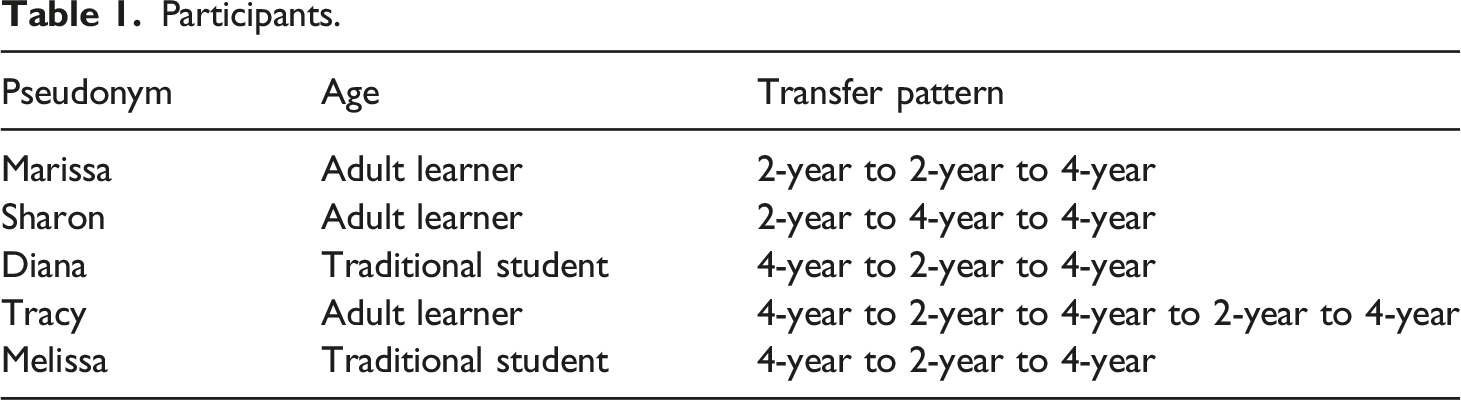
The findings in this paper follow the journeys of five students who swirled between institutions. In order to first frame the experiences of our participants, we provide a table below mapping out their transfer pathway (Table 1). Following this table, we include narrative vignettes that summarize each student’s transfer story. These vignettes are followed by a cross-analysis, which provides insights into the overarching themes presented from our quantitative survey data and narrative vignettes.
Vignette #1: Marissa
From the beginning of her college journey, Marissa has aspired to become a Certified Registered Nurse Anesthetist. Initially, she enrolled in a for-profit college, which required her to commute an hour each way. Marissa had only done a quick college search, and the institution’s easy application and enrollment process made it an attractive option, at least initially. Ultimately, she earned a Licensed Practical Nursing (LPN) certification, which helped her both professionally and personally (while caring for an ill mother); still Marissa has struggled with the debt from her first college choice.
After 3–4 years as an LPN, Marissa enrolled at a local community college in the mid-west, where she earned her associate degree in Nursing in 2018. She chose the community college because she wanted to advance her career. During her time there, she focused exclusively on core nursing classes.
Recently, Marissa continued pursuing her BSN at a large, public, 4-year institution in the same state. At the time of our interview, she was in her second semester and doing most of her coursework online. Initially, Marissa had considered a few other institutions; however, she soon dismissed them for being too expensive (i.e., private and/or out-of-state) and only applied to her current institution (“Let me spend the least amount of money, put one application into the one that I want.”)
For Marissa, transfer fairs at her community college, scholarships for transfer students, and compliance with the Americans with Disabilities Act (ADA) were key priorities. She also prioritized honor societies, organizations specific to nursing, volunteer opportunities, and proximity to home. Throughout her search, she found her community college advisor, boyfriend, and community college honor society to be helpful sources of support and information.
Marissa has been largely satisfied with her final destination institution, saying it has been on par with what she expected. She rated her satisfaction level a “7 or 8” out of 10 and said she would choose the same college again. Although she has struggled a bit with virtual courses and inadequate ADA accommodations, she appreciates the accelerated time to degree, Transfer Student Center, and volunteer opportunities. Notably, Marissa was working several jobs and attending school full-time until she became pregnant and opted to stay home due to health concerns. She advises future transfer students to use a similar transfer college choice process—attending college fairs and asking questions about the things that matter to them (e.g., course format, transfer scholarships, ADA accommodations).
Vignette #2: Sharon
Sharon is a non-traditional student from a rural southeast state who began school at the age of 40 to pursue a career in occupational therapy. She enrolled at her local community college because of its convenience, reasonable costs, and program availability. After completing her program, she began a full-time job.
Initially, transferring and completing a bachelor’s degree was not on Sharon’s mind, but she started thinking that she wanted to continue her education and began looking at 4-year institutions. She selected a local institution because it offered the program she was looking for and had a combination of in-person and hybrid classes, which she believed would work well with her work schedule but still allow her to have an in-person class experience. She also received tuition discounts as a result of being an honor society member. Sharon shared that financial cost was also a large part of her initial transfer college decision.
Once admitted, Sharon began working with an advisor in June with a planned start date of August. She indicates that the advisor did not seem to know much about her program, which made a poor first impression. Within a few weeks, she began getting emails from a professor asking her why she was not in class. The advisor had registered her for a summer term class, even though she had indicated in her meeting that she wanted to start classes in the fall. Sharon says, “I just lost complete faith in their school because of that situation.” The experience was so frustrating that Sharon immediately withdrew and started looking at other transfer options.
Sharon had heard from a friend about an online institution that seemed more supportive of students and had flexible scheduling. When she applied, she discovered that she would also receive a tuition discount and that they would accept more credits than her previous institution. She enrolled and was very satisfied with her transfer decision, stressing that the level of care that staff took in supporting their students really impressed her. During the application process, Sharon had worked closely with an admissions counselor, and when she selected the school, she was assigned an academic advisor who was very supportive and knowledgeable. When a family member passed away during the semester, she called her advisor to ask for help. The advisor encouraged her to contact the office at any time throughout the weekend if she needed anything. Later, the advisor followed up with her to ask how she was doing and what they could do to help. When a hurricane came to her local area, Sharon received an email from the college acknowledging the hurricane and offering a variety of resources for help, despite the fact that the university was located in a different part of the country. Overall, she feels that the level of support and the flexibility made her experience a positive one. Sharon’s advice to other students is to take the time to do research and select an institution that will truly be the best fit for their needs.
Vignette #3: Diana
Diana’s initial college choice process was a very stressful experience. Her earliest memory of discussing college was at age 14 with her mother. At the time, she felt as though selecting a college was an incredibly overwhelming decision to make. During high school, Diana enrolled in the International Baccalaureate (IB) Program and was stressed by the academic pressures. This stress informed her decision to attend a public, in-state, 4-year institution near her hometown. She made this decision quickly, explaining that she suddenly felt “freaked out at the thought of moving away” after having made plans to attend an out-of-state school.
Unfortunately, because Diana felt mentally unprepared for the college experience, she ended up failing her first semester courses. She explained, “It’s kind of a lot of things went wrong all at once.” She struggled to make friends during her first semester and, by Thanksgiving, had given up on going to class due to mental health troubles. Diana continued taking just a few classes at the 4-year school in the spring semester but eventually left altogether.
Because Diana did not pass her courses, she lost her financial aid package and accrued a great deal of debt. Over the course of the next year, Diana worked so that she could focus on paying back the debt. At first, her plan was to return to the 4-year school once she had resolved her bill and could re-enroll in courses. However, for both financial and personal reasons, Diana decided that it would be best for her to attend a local 2-year college.
Diana’s experience at the 2-year college was completely different from what she initially experienced at the 4-year institution due to smaller class sizes and better access to campus resources. She shared that she “busted her butt” and managed to maintain a 4.0 GPA during the 3 years she was enrolled. She became highly involved on campus and joined Phi Theta Kappa (PTK), an honors society for 2-year college students. Her experience in PTK inspired her to complete her associate degree. She became more active in the organization and began to carefully consider where she would transfer to earn her 4-year degree. She briefly considered returning to her initial institution. However, because she had left that institution with a 1.0 GPA, she opted for a fresh start. Eventually, Diana determined that a private school would be the best fit. Diana shared, “I decided that the private was the better route for me because I had been in a 2-year school [and] that’s where I thrive, not in this huge state school with 50,000 students.” Eventually, Diana settled on a local private institution because of their generous scholarship offer.
Throughout Diana’s decision-making process, she had a great deal of support. At the community college, she connected with an advisor who was able to provide her with advice and critical information that helped her identify scholarship opportunities. She also enjoyed constant support from her mother and boyfriend (now fiancé), both of whom were extremely supportive of her education.
By the time Diana transferred from her community college to the private 4-year institution, she was eager to continue her studies and felt far more confident as a student then she had as a first-time freshman. Diana explains that she still wanted a “traditional” college experience and felt that a private college would give her the best chance at that: “I was also chasing a sense of normalcy that I felt like had evaded me in my first two institutions. I was searching for a school that could give me the experiences I’d felt that I missed out on, and private schools seemed better for that given their small campuses and enrollments.”
However, reflecting on her initial impression of the private school, Diana admitted, “I was very miserable when I first got there.” While the school itself was a great institution and provided Diana with the educational experiences she was seeking, the environment was not transfer-friendly. The 3-day orientation program was geared specifically towards freshmen students. Diana remembers feeling “way ahead of my orientation leaders.” Unfortunately, the orientation process “felt very isolating as a welcome to campus.” Additionally, she had been so successful at her community college, it was difficult to start over at a new school as an upperclassman.
Diana was deeply affected by her experience as a transfer student and began to advocate for other new transfer students. She developed a student organization and met with upper-level administrators to revise the orientation program and make it more welcoming to transfer students. Unfortunately, Diana encountered many roadblocks while attempting to improve the transfer student experience. Eventually, she gave up her pursuit and chose to focus exclusively on her studies. Reflecting on this, Diana shared, “I don’t know, it’s hard because I think I’m really satisfied with my choices, and I can’t see myself being at a different school and I really like the resources. But, as a transfer student, I’ve never been supported.”
At the time of our interview, Diana was in her senior year and excited to graduate. She concluded our conversation by emphasizing the importance of satisfaction while in college: “If you’re happy at a school, you’re going to find something you want to do with your life. But, if you’re not happy there, you’re never going to find what you want.”
Vignette #4: Tracy
Tracy enrolled at a small, public, in-state university straight out of high school. After struggling academically, she decided to take a break from higher education and join the workforce. When she was ready to go back to school in her mid-20s, she followed several friends’ recommendations to enroll in the local community college. After completing an Associate of Arts degree, she transferred to a local private university. However, after realizing they had provided incorrect information about her financial aid package, she decided to leave soon after she had transferred, enrolling at an in-state community college to pursue an Associate of Science in business—this time with the goal of transferring to complete a bachelor’s degree in business.
While at this community college, Tracy joined a student success program geared at helping first-generation students prepare for the transfer process. As part of the program, students were assigned a mentor who helped them think through their transfer choices. The program organized visits to various colleges. It also required students to tour at least four colleges and apply to at least two. Tracy’s mentor asked a lot of helpful questions, such as, “What is your comfort level with each of these schools? Where will you feel the most comfortable? Where will you learn the best?” These questions helped Tracy narrow her choice set from four colleges to two: a small private Christian college and a public, in-state University.
Ultimately, Tracy decided to attend the smaller, private, Christian institution because she felt like it was the environment in which she would be more comfortable and learn the best. She liked that the college had smaller class sizes and that the campus felt more intimate. Another important component to Tracy’s decision was outreach from the admissions counselor. This individual had reached out to Tracy multiple times throughout the process to ask how she was doing and whether she had any questions about the transfer process. The counselor also invited Tracy to come back to visit campus or attend prospective student dates. Tracy shared that this made her feel welcome and wanted as a transfer student. Notably, she had never heard from anyone at the other university.
Tracy felt that welcoming and inviting spirit throughout her entire experience at the institution. She was quickly struck by the accessibility of faculty and staff. Faculty offered their phone numbers in case students needed anything. Advisors were always available if students needed support. Tracy had been worried about fitting in as a non-traditional student, but students and faculty/staff alike made her feel welcome and a part of the campus. In the business office where she was a work-study student, fellow employees constantly asked her how classes were going. Since classes were small, she felt that faculty were invested in her success. She attended chapel several times a week and noted that chaplains were also very supportive of all students.
Importantly, Tracy did not feel stigmatized as a transfer student: “They didn’t treat us any different than if we came in as freshman. We were just part of the family from the beginning. It didn’t matter that we went somewhere else first, then came to [the University].” Tracy says she would absolutely choose the college again, and now that she has graduated and moved onto completing a Masters of Business Administration, she encourages other students to attend her alma mater.
Tracy recommends that transfer students take the time to ask critical questions about their prospective colleges and ask current and former students what their experiences were like. Tracy also seconds her mentor’s advice to think about where one will feel the most comfortable and at home, and to ask questions that will help determine this (e.g., How accessible are professors? What support services are offered to students, like tutoring, health services, etc.?).
Vignette #5: Melissa
Melissa started college at a public, in-state university on the West Coast immediately after high school. Eventually, she decided that the college was not a good fit for her because it was not as academically rigorous as she had hoped; she was looking to be more challenged in her classes and wanted to be surrounded by classmates who were invested in learning. Melissa left the university and moved home to enroll in community college. Ultimately, she enrolled simultaneously in two community colleges, because the community college closest to her was very popular, making it difficult to get into classes. Melissa’s dual enrollment enabled her to complete all of her classes in a timely manner.
When considering where to transfer, Melissa immediately focused on out-of-state institutions and institutions that would be a better learning environment for her. Upon encouragement from her father, she looked at schools with better academic reputations and was soon drawn to private, liberal arts colleges. Resources from her community colleges, including transfer advisors, and a book about various colleges helped Melissa narrow her search to small, liberal arts colleges on the East Coast. Melissa shares that she was very fortunate to have financial support from her parents, so the cost of college was not necessarily a factor in her choice process. This allowed her to focus on other factors that were important to her. Although Melissa visited some in-state schools, she did not get the chance to visit East Coast schools. Still, she ultimately transferred to a small, liberal arts women’s college in the Northeast.
Melissa lived in a dorm that housed a lot of transfer students, which immediately made her feel like she fit in on campus. She also often interacted with students from a program for non-traditional transfer students, which enabled her to develop friendships with traditional, non-traditional, and transfer students. Melissa recalls a bit of a stigma that transfer students were not as academically prepared, but that did not compromise her personal experience. She became a Resident Advisor on campus and took on leadership roles in different clubs and organizations. She also declared herself a philosophy major, noting that she really loved her classes because she felt that her classmates were engaged academically and wanted to learn, and that the faculty facilitated the kind of learning that she was looking for. Melissa thinks very highly of her transfer college and feels it prepared her well for graduate school, a Master’s in Business Administration program, which she completed after her baccalaureate degree.
Her advice for other transfer students is to not be influenced by their high school experience: “[don’t worry] about your past [...] really focus on who you are, where you want to end up.” Although Melissa did not have the opportunity herself, she recommends that students visit prospective colleges to determine whether they offer the desired environment to fit their needs.
Cross-case findings and discussion
Through these narrative vignettes, we find that each student’s transfer journey was unique. Their reasons for starting at one college and transferring several times varied tremendously, according to their particular life situations and circumstances. Still, some key themes exist that may be common among “swirling” students.
For all five students, “fit” at their final destination was incredibly important. Notably, several students had begun their college journeys at institutions that were a poor fit. Both Diana and Tracy indicated that they were not ready (academically or emotionally) for the environment of a large, 4-year college. As a result, both students struggled and eventually withdrew from their first institution. Diana shared, “I don’t know, somewhere around like Thanksgiving break I just decided like I didn’t want to do this anymore. And I stopped going to class. I didn’t drop. I stopped going to class.” Diana and Tracy’s shared experience has implications for high school counselors, as not all students may be academically or emotionally prepared for a 4-year school. Educators should consider flexible pathways into higher education such as gap years and/or community college enrollment. For many students, the idea of selecting a college at 17 or 18 years old is overwhelming. However, by working and/or exploring career opportunities within a community college sector, students can develop a maturity that will allow them to more intentionally select a college. Higher education institutions should also consider ways to engage the workforce in postsecondary education opportunities, as some students may have preemptively self-selected out of a college education.
Further, some students may be unprepared to accurately identify their ideal institutional fit. As the students in our sample progressed throughout their educational journey, they narrowed in on what they really wanted from their final transfer college, learning to ask probing questions and gather key information to help them better understand college fit. Although transferring multiple times, they learned valuable information that helped them make better decisions along the way. Sharon shares her advice for other students that she learned through her transfer experience: “I think I kind of zeroed in on [my first university] because I thought it was exactly what I needed, and I was wrong...maybe a slower course is better, even if you don’t get as much money from there, if you find a better fit.”
A common theme among almost all of the students was the lack of clarity around cost and financial aid. In some cases, this caused students to leave their institution, and with substantial debt. For instance, Tracy transferred to a private university after her community college, but when she realized that a scholarship she had counted on did not come through, she dropped out and then selected another transfer college. Although the lack of understanding financial aid and cost is well documented in other research (Chen & Volpe, 1998), this adds a layer of understanding as to why students may transfer multiple times. For adult learners, it is important for students to understand the implications of enrolling part-time versus full-time. For many students, it is necessary to complete courses on a part-time basis due to external obligations (e.g., work and family); however, part-time students do not always qualify for the same level of financial support. These findings indicate that colleges must do more to educate students early in the transfer process about cost and financial aid so that students can make informed decisions. In the choice process, each of the students mentioned specific individuals who guided them through the transfer process, whether it was a community college advisor, friend, family member, or significant other. For example, Marissa’s advisor was instrumental in helping her choose a transfer college, while Tracy relied heavily on an admissions counselor at her transfer university. These institutional agents appear to have been critical to students’ transfer journeys. This finding is consistent with past research that indicates that advisors, faculty, and staff can be tremendously beneficial during a student’s transfer process and transition to a university (Hayes et al., 2020; Lester et al., 2013; Wang et al., 2021). However, we find that this may be uniquely applicable to swirling students, as institutional agents were a key influence in selecting their final institution and finding a college that was truly the best fit for their needs.
Reflecting on these students’ stories, satisfaction with a final destination institution was influenced by both institutional fit and how transfer-friendly an institution was. When a college was the right fit for the students’ needs as well as transfer-friendly, students felt supported, welcomed, and happy with their choice. When a college might have been the right fit for their needs but was not necessarily transfer-friendly, students had a hard time adjusting and questioned their decision. This finding indicates that prospective transfer students should ask questions about both fit and transfer friendliness. This finding is consistent with Buenaflor et al. (2021), who found that, although transfer friendliness was rarely a search criterion, it had a critical impact on student satisfaction. The students themselves gave very similar advice, encouraging future students to deeply consider whether their prospective transfer college will be a good fit.
Implications
Our findings indicate that students often transfer multiple times because at least one institution they chose was not a good fit. In the examples from this study, we see students who started at a 4-year university and then, after realizing it was not a good fit, followed a vertical transfer pathway (i.e., transferring to a community college and ultimately another 4-year institution). We also see students who started as vertical transfers only to realize their initial 4-year institution was not a good fit, causing them to transfer horizontally to a different 4-year institution. In light of this, it is imperative that all institutions of higher education do a better job of helping students understand what their needs are and whether an institution is the right fit for them. This requires that both high schools and community colleges help students think through critical questions about their career goals and their ideal college environment. For example, students need help thinking through their ideal college cost, quality, and experience so they can ask relevant questions of their prospective universities. Additionally, 4-year colleges and universities must be more transparent and accessible during the recruiting and admissions process to help students ascertain whether an institution is a good fit. Many adult learners do not have the opportunity to visit college campuses when making their decision to enroll. As a result, they may develop inaccurate expectations about what it means to enroll in a particular school. Colleges and universities should be intentional in sharing information about the campus climate and academic environment. This may involve opportunities to meet with faculty or information about transfer-specific support resources either in person or virtually. With the COVID-19 pandemic, institutions have pivoted to provide numerous opportunities for online engagement. Institutions should consider creative ways to leverage these virtual spaces as a way to engage prospective adult learners. These platforms can then provide spaces where community colleges and 4-year universities can help students better understand cost, financial aid, and student loan debt so that students can make informed decisions and avoid transferring again due to financial concerns.
Consistent with previous research, nearly all of our participants indicated that institutional agents impacted their satisfaction or dissatisfaction with their transfer institution (Dowd et al., 2013; Lester et al., 2013). When students do not feel supported in their transfer experience, they lose confidence in their institution. On the contrary, when students feel like their institution actively welcomes and supports transfer students, they tend to be more satisfied with their transfer experience. This has important implications for institutions, since students may be more likely to recommend the institution to other prospective students and/or become more engaged as alumnae if they are satisfied with their selected university. As a result, institutions must actively create a transfer-receptive culture and create the infrastructure for institutional agents to become transfer champions. For example, the University of Arizona has prioritized transfer students by creating a Transfer Student Center, that is, prominently located in their student union. Other institutions, such as the University of Maryland, have dedicated pre-transfer advisors who work to provide students with advising prior to transfer.
Recommendations for future research
Although this study begins to address a large research gap on the experiences of students who transfer multiple times, additional research is warranted to better understand swirling student experiences and better serve their needs. Our sample was limited to female students. Thus, additional qualitative studies should include a more representative sample of students, including by gender. Additionally, this paper paid particular attention to adult learners, but future research may want to more intentionally compare the experiences of traditionally aged learners to those of adult learners to better distinguish the unique differences of each population.
Limited descriptive data hinders our understanding of swirling students as a whole. Organizations that have the capability to report out on national metrics on a regular basis, such as the National Student Clearinghouse Research Center, could help a great deal in this regard. Such data would help practitioners and policymakers understand an important component of the transfer puzzle—the extent to which students are transferring multiple times. Additional descriptive data, that is, reported out over time should be disaggregated to better understand the metrics for sub-groups of students, such as by race/ethnicity, gender, and age.
Conclusion
The purpose of this paper was to showcase the experience of students who swirl across multiple institutions, particularly adult learners. Highlighting the narratives of five individual students, the paper illustrates the dynamic and ever-evolving pathway that many transfer students navigate in their pursuit of a baccalaureate degree. Students in our study made decisions about their education while balancing many other aspects of life (e.g., family obligations, work responsibilities, learning needs). In order to support students along their journey, it is critical that institutions acknowledge the various constraints (e.g., information, time, opportunity, external factors) framing student decisions. Further, as the higher education landscape continues to evolve, and we move into a post-pandemic society, institutions should be nimble in meeting students where they are to provide flexible options and opportunities to achieve their educational goals.
Footnotes
Declaration of conflicting interests
The author(s) declared no potential conflicts of interest with respect to the research, authorship, and/or publication of this article.
Funding
The author(s) received no financial support for the research, authorship, and/or publication of this article.
